Our God Reigns

1 Let every person be subject to the governing authorities. For there is no authority except from God, and those that exist have been instituted by God. Therefore whoever resists the authorities resists what God has appointed, and those who resist will incur judgment. For rulers are not a terror to good conduct, but to bad. Would you have no fear of the one who is in authority? Then do what is good, and you will receive his approval, for he is God’s servant for your good. But if you do wrong, be afraid, for he does not bear the sword in vain. For he is the servant of God, an avenger who carries out God’s wrath on the wrongdoer. Therefore one must be in subjection, not only to avoid God’s wrath but also for the sake of conscience. For because of this you also pay taxes, for the authorities are ministers of God, attending to this very thing. Pay to all what is owed to them: taxes to whom taxes are owed, revenue to whom revenue is owed, respect to whom respect is owed, honor to whom honor is owed. – Romans 13:1-7 ESV

At the heart of this passage is the sovereignty of God. That should not be overlooked or under-emphasized. All throughout his letter, Paul has been dealing with the subject of man’s justification before God. He has made it clear that this is the work of a sovereign God. He is the one who calls, justifies, sanctifies and ultimately glorifies all believers. And even in this section of his letter, where Paul is talking about the practical outflow of one’s faith in relationship to others, he keeps emphasizing God’s sovereignty. In chapter 12, Paul talked about spiritual gifts and their role in the body of Christ. Because they are given by God, there is no room for pride or boasting. Like salvation, they are a gift from God and have nothing to do with human merit. Paul wanted his readers to remember that they had “gifts that differ according to the grace given to us” (Romans 12:6 ESV).

Now, as Paul addresses the believer’s relationship with civil authority, he continues to emphasize God’s sovereignty, but it is important that we keep Paul’s words within their context. He is writing to believers in Rome, the capital of the Roman Empire, the world’s most powerful nation at the time. Both the Jews and the Gentiles who made up the church in Rome knew what it was like to live under the authority of an oppressive regime. And as far as the Romans were concerned, the Christians were little more than a break-off sect of the Hebrew religion. Their only real knowledge of Christianity was tied to the individual for whom it was named, Jesus Christ, who was crucified by Pontius Pilate for claiming to be King of the Jews.

The Christians, like the Jews, were tolerated by the Romans and given certain freedoms to practice their religion in peace. But the Jewish Christians would have had no affinity for the Romans, knowing full well that their people had lived under the weight of Roman rule for years.

Yet Paul tells his readers, “Let every person be subject to the governing authorities” (Romans 13:1 ESV). The word Paul uses is hypotassō, and it means “to subject oneself, obey” (Greek Lexicon :: G5293 (KJV). Blue Letter Bible. Web. 23 Dec, 2015). In this passage, Paul does not address what Christians should do when rulers overstep their God-given authority and begin persecuting their subjects; he simply encourages believers to submit to those in authority over them. And he was not alone in promoting this kind of behavior. The apostle Peter said something very similar.

For the Lord’s sake, submit to all human authority—whether the king as head of state, or the officials he has appointed. For the king has sent them to punish those who do wrong and to honor those who do right. – 1 Peter 2:13-14 NLT

And Paul provides the “why” behind his call for submission to earthly authorities.

For there is no authority except from God, and those that exist have been instituted by God. – Romans 13:1 ESV

It is a case of God’s sovereignty. Jesus lived out this very idea, having submitted Himself to the Roman authorities, even allowing them to carry out their decision to put Him to death. But He knew that His submission was ultimately to God. During His trial, Pilate asked Him, “Don’t you realize that I have the power to release you or crucify you?” (John 19:10 NLT), and Jesus responded, “You would have no power over me at all unless it were given to you from above” (John 19:11 NLT).

The very existence of the Romans as a nation-state had been divinely decreed by God. Their presence in the land of Palestine and their rule over the people of Israel were not something that caught God off guard. Paul wrote in his letter to the Galatians, “But when the fullness of time had come, God sent forth his Son, born of woman, born under the law, to redeem those who were under the law, so that we might receive adoption as sons” (Galatians 4:4-7 ESV). At just the right time, God sent His Son. When Roman rule was at its zenith and the Jewish people were living under their control, the Messiah appeared on the scene. The very existence of the Roman government in the land of Israel played a vital role in fulfilling God’s promises and plan. The death of Jesus, predicted in Isaiah 53, was fulfilled in detail because of the Romans and their practice of crucifixion.

But he was pierced for our rebellion,
    crushed for our sins.
He was beaten so we could be whole.
    He was whipped so we could be healed.
All of us, like sheep, have strayed away.
    We have left God’s paths to follow our own.
Yet the Lord laid on him
    the sins of us all. – Isaiah 53:5-6 NLT

Unjustly condemned,
    he was led away.
No one cared that he died without descendants,
    that his life was cut short in midstream.
But he was struck down
    for the rebellion of my people.
He had done no wrong
    and had never deceived anyone.
But he was buried like a criminal;
    he was put in a rich man’s grave. – Isaiah 53:8=9 NLT

Jesus’ submission to the Roman authorities was based on His understanding of God’s sovereign will for His life. So, when Paul encourages our subjection to governing authorities, he does so based on his understanding that all authority exists by God’s decree. For a believer to resist God-given authority is to resist God.

Again, Paul does not address what a Christian is to do when the government encourages disobedience to God. But if we follow the example of Paul, he submitted to the governmental authorities on many occasions and was willing to go to jail when their demands contradicted the will of God for his life. Ultimately, Paul found himself a prisoner in Rome because of his faith. His preaching of the gospel led to his arrest and imprisonment. So, there may come a time when the believer must resist and disobey civil authority, but we must always be willing to suffer the consequences of our disobedience, even if it means persecution.

Paul makes it clear that all governing authorities are appointed by God. They are “God’s servant for your good” (Romans 13:4 ESV) and “ministers of God” (Romans 13:6 ESV). Ultimately, our submission to civil authority is to be seen as submission to God because He is in control. We are to live our lives with the understanding that our God is sovereign and rules over all, including nations, governments, leaders, parliaments, presidents, dictators, senates, and all man-made institutions. He is in control at all times, and His plan for this world will be fulfilled regardless of who sits on a throne or rules the nations. He used the Assyrians, Babylonians, and Romans to accomplish His will for the nation of Israel, and He remains in authority over all the nations of the earth at this very moment. So, we are to live our lives in submission to and trust in His sovereign, providential power because our God reigns over all.

Our God is great and glorious
We put our trust in Your name, Jesus
Able to save and deliver us
We put our hope in Your name, Jesus

Blessing and honor
Glory and power
Unto our God forever and ever
All of the honor
All of the praise is Yours
Yours forever

Hallelujah
Hallelujah, our God reigns
Hallelujah
Hallelujah, our God reigns

– Israel Houghton, Copyright © 2025 Integrity Music. All Rights Reserved

Father, You rule and reign over all the nations of the earth. Your authority is absolute and Your will is always accomplished, regardless of who sits in the seats of power and claims to be in charge. No political party or government entity can resist Your will or operate outside Your control. This does not mean that You sanction evil or are complicit in the sinful activities of godless nations. But it does mean that their presence on this earth is not outside Your will. Dictators and despots have always existed. Pride, arrogance, and the allure of power have always driven sinful men to do wicked things. But You have the power and authority to use godless people to carry our Your righteous will. You used Pharaoh, Nebuchadnezzar, Ahab, Darius, and others to accomplish Your providential plan for the people of Israel. And You are still operating in undimished authority over the nations of the earth. Help us to see that You remain in control at all times. Despite what happens around us, never let us lose hope in Your redemptive plan for our lives and this world. Amen

English Standard Version (ESV) The Holy Bible, English Standard Version. ESV® Permanent Text Edition® (2016). Copyright © 2001 by Crossway Bibles, a publishing ministry of Good News Publishers.

New Living Translation (NLT) Holy Bible, New Living Translation, copyright © 1996, 2004, 2015 by Tyndale House Foundation. Used by permission of Tyndale House Publishers Inc., Carol Stream, Illinois 60188. All rights reserved.22

It Is Never Wrong To Do What Is Right

Examine yourselves, to see whether you are in the faith. Test yourselves. Or do you not realize this about yourselves, that Jesus Christ is in you?—unless indeed you fail to meet the test! I hope you will find out that we have not failed the test. But we pray to God that you may not do wrong—not that we may appear to have met the test, but that you may do what is right, though we may seem to have failed. For we cannot do anything against the truth, but only for the truth. For we are glad when we are weak and you are strong. Your restoration is what we pray for. 10 For this reason I write these things while I am away from you, that when I come I may not have to be severe in my use of the authority that the Lord has given me for building up and not for tearing down. – 2 Corinthians 13:5-10 ESV

At first glance, it may appear that Paul is calling on the Corinthians to examine themselves to see if they are truly saved. But in reality, Paul is calling on them to do the right thing because they are saved. They have Christ within them and, therefore, they have all they need to do what God would have them do. The real issue here is sanctification, not salvation. Paul wants them to live out the reality of their position as children of God. He wants their behavior to match their confessed belief in Christ. He has no doubt that they have the capacity to do the right thing. It is more a matter of commitment. Are they willing to do what is right?

Paul is praying that they will be and assures them that he “cannot do anything against the truth, but on for the truth” (2 Corinthians 13:8 ESV). He is unwilling to act in a way that would be contrary or detrimental to the gospel.

It is essential to understand that much of what Paul has said throughout this letter has been in defense of his apostleship. There were those who cast doubts about his qualifications. So when he asked them to examine themselves, he was really challenging them to take a long, hard look at their lives to see whether they themselves are not the very proof they are looking for. In other words, their changed lives were the greatest testimony to Paul’s calling they would ever find. The gospel message he had brought to them had been effective, resulting in their conversions and proving his calling as a messenger of Jesus Christ.

But they had struggled in their sanctification and had hit some tough spots along the way. Since Paul’s initial visit, divisions and disunity had erupted in the church. There were some moral indiscretions that had gone unpunished and remained unconfessed. Paul had already told them that he feared he would find them still struggling with the same old issues of “quarreling, jealousy, anger, hostility, slander, gossip, conceit, and disorder” (2 Corinthians 12:20 NLT). So he let them know that he was praying for their restoration. Not only that, he was writing in a very blunt, in-your-face style because, when he arrived, he didn’t want to have to spend all his time playing bad cop. His goal was to build them up, not tear them down. He wanted to see them continue to grow in their salvation, increasing in their knowledge of Jesus Christ and developing an ever-deeper dependence upon God, resulting in a desire to do His will, to do the right thing.

In his letter to the Thessalonians, Paul reminded them that God’s will for them was their holiness or sanctification.

For this is the will of God, your sanctification…1 Thessalonians 4:3 ESV

In his first letter, the apostle Peter told his readers that it was God’s will that they do good.

For this is the will of God, that by doing good you should put to silence the ignorance of foolish people. – 1 Peter 2:15 ESV

Doing good (what is right) and holiness go hand in hand. Our sanctification or growth in Christlikeness should have an outward expression. It should manifest itself in godly living (doing what God would have us do). That is Paul’s prayer for the Corinthians. He wants them to live out their faith by stepping out in obedience to God’s will.

We do good, not to win God’s favor, but because we have been the recipients of His favor. We do what is right, not to make God love us, but because He loved us enough to send His Son to die for us. Doing what is right brings God’s blessing. Doing what is wrong brings His discipline. Both are motivated by His love for us. But Paul would prefer that we learn to live obediently, doing what God deems best, even when it makes no sense. Paul would have us enjoy the benefits of a life lived within the will of God, faithfully doing what He deems to be right and good.

Father, Your will is for my holiness, not my happiness. Your desire is that I live righteously, according to Your standards, not those of a fallen world. You’ve given me Your Spirit to guide, convict, and instruct me. His power makes obeying Your commands possible, and Your Word is “a lamp to guide my feet and a light for my path” (Psalm 119:105 NLT). You’ve placed me within the body of Christ so that I might have enjoy the community of like-minded believers who comfort and challenge me in my walk and provide me with opportunities to use the gifts You have given me. Yet, I live in a world where the pursuit of personal satisfaction takes precedence over sanctification, happiness trumps holiness, and selfishness is more important than selflessness. Don’t let me give in to the temptation to make this life all about me. Continue to show me how to do what is good and right, because that is Your will for me, and You alone know what is best.  Amen

English Standard Version (ESV) The Holy Bible, English Standard Version. ESV® Permanent Text Edition® (2016). Copyright © 2001 by Crossway Bibles, a publishing ministry of Good News Publishers.

New Living Translation (NLT) Holy Bible, New Living Translation, copyright © 1996, 2004, 2015 by Tyndale House Foundation. Used by permission of Tyndale House Publishers Inc., Carol Stream, Illinois 60188. All rights reserved.
The LORD Reigns Over All

20 Then Isaiah the son of Amoz sent to Hezekiah, saying, “Thus says the LORD, the God of Israel: Your prayer to me about Sennacherib king of Assyria I have heard. 21 This is the word that the LORD has spoken concerning him:

“She despises you, she scorns you—
    the virgin daughter of Zion;
she wags her head behind you—
    the daughter of Jerusalem.

22 “Whom have you mocked and reviled?
    Against whom have you raised your voice
and lifted your eyes to the heights?
    Against the Holy One of Israel!
23 By your messengers you have mocked the LORD,
    and you have said, ‘With my many chariots
I have gone up the heights of the mountains,
    to the far recesses of Lebanon;
I felled its tallest cedars,
    its choicest cypresses;
I entered its farthest lodging place,
    its most fruitful forest.
24 I dug wells
    and drank foreign waters,
and I dried up with the sole of my foot
    all the streams of Egypt.’

25 “Have you not heard
    that I determined it long ago?
I planned from days of old
    what now I bring to pass,
that you should turn fortified cities
    into heaps of ruins,
26 while their inhabitants, shorn of strength,
    are dismayed and confounded,
and have become like plants of the field
    and like tender grass,
like grass on the housetops,
    blighted before it is grown.

27 “But I know your sitting down
    and your going out and coming in,
    and your raging against me.
28 Because you have raged against me
    and your complacency has come into my ears,
I will put my hook in your nose
    and my bit in your mouth,
and I will turn you back on the way
    by which you came.

29 “And this shall be the sign for you: this year eat what grows of itself, and in the second year what springs of the same. Then in the third year sow and reap and plant vineyards, and eat their fruit. 30 And the surviving remnant of the house of Judah shall again take root downward and bear fruit upward. 31 For out of Jerusalem shall go a remnant, and out of Mount Zion a band of survivors. The zeal of the LORD will do this.

32 “Therefore thus says the LORD concerning the king of Assyria: He shall not come into this city or shoot an arrow there, or come before it with a shield or cast up a siege mound against it. 33 By the way that he came, by the same he shall return, and he shall not come into this city, declares the LORD. 34 For I will defend this city to save it, for my own sake and for the sake of my servant David.”

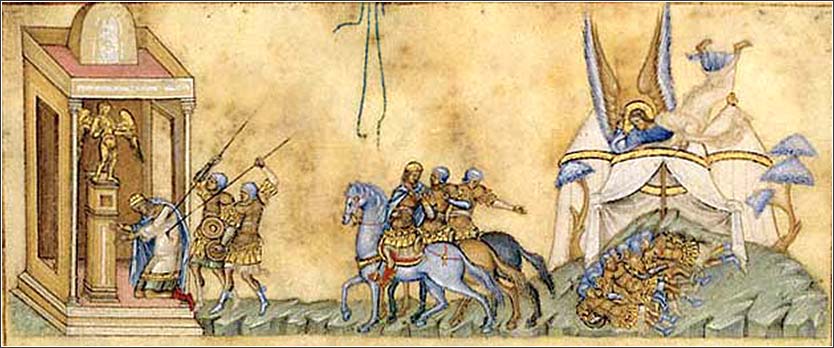
35 And that night the angel of the LORD went out and struck down 185,000 in the camp of the Assyrians. And when people arose early in the morning, behold, these were all dead bodies. 36 Then Sennacherib king of Assyria departed and went home and lived at Nineveh. 37 And as he was worshiping in the house of Nisroch his god, Adrammelech and Sharezer, his sons, struck him down with the sword and escaped into the land of Ararat. And Esarhaddon his son reigned in his place. 2 Kings 19:20-37 ESV

This is essentially the story of three kings. First, there is King Sennacherib, the sovereign ruler over the rapidly expanding Assyrian empire. He is the commander-in-chief of one of the most powerful armies on earth, and his ambitious plans for global conquest have met with little to no resistance. Kingdom after kingdom has fallen before his army, and now he has his sights set on the nation of Judah, where Hezekiah, the second king in our story, rules from his throne in Jerusalem. But King Hezekiah finds himself in the unenviable position of ruling over a city under siege. His capital city is surrounded by the Assyrian army, and he has been given an ultimatum to surrender or face annihilation.

Two kings. One is dressed in his royal robes and reveling in the indisputable reality of his own success. The other has discarded his regal attire for sackcloth and ashes, the garments of mourning. Sennacherib is a confident and self-assured king who sees no end to his plans for global conquest and domination. He is unstoppable, and it would appear that Hezekiah agrees with that assessment because he has turned to Yahweh for help. With his city completely surrounded and his allies nowhere to be seen, Hezekiah has called on the God of Judah to come to their aid.

“O LORD, God of Israel, you are enthroned between the mighty cherubim! You alone are God of all the kingdoms of the earth. You alone created the heavens and the earth. Bend down, O LORD, and listen! Open your eyes, O LORD, and see! Listen to Sennacherib’s words of defiance against the living God.” – 2 Kings 19:15-16 NLT

This penitent petition engages the attention of the third king in our story.  From His royal throne room in heaven, Yahweh heard the humble and contrite prayer of the king of Judah and immediately responded with an answer. The sovereign King of kings, who rules over all the kingdoms of the earth, sent a message to Hezekiah through His prophet Isaiah.

But this message, while delivered to King Hezekiah, was really directed at Sennacherib. Yahweh, the indisputable King of the universe, had a few choice words for the pompous and prideful potentate of Assyria. He warns the over-confident, land-grabbing king that his plans for Judah’s conquest will fail.

“The virgin daughter of Zion
    despises you and laughs at you.
The daughter of Jerusalem
    shakes her head in derision as you flee. – 2 Kings 19:21 NLT

Despite Sennacherib’s boastful claims, Jerusalem will remain pure and undefiled, her walls unbreached, and her population spared the indignities of conquest or capture. Yahweh wanted Sennacherib to know that the day was coming when the citizens of Jerusalem would rejoice and celebrate as the Assyrians abandoned their siege and disappeared over the horizon.

Sennacherib had made the fateful mistake of mocking the wrong deity, and Yahweh let him know that his derisive and disrespectful words were going to cost him. He had offended the Holy One of Israel and would soon suffer the consequences for his error. But first, God points out Sennacherib’s primary problem: His pride.

“By your messengers you have defied the LORD.
    You have said, ‘With my many chariots
I have conquered the highest mountains—
    yes, the remotest peaks of Lebanon.
I have cut down its tallest cedars
    and its finest cypress trees.
I have reached its farthest corners
    and explored its deepest forests.
I have dug wells in many foreign lands
    and refreshed myself with their water.
With the sole of my foot
    I stopped up all the rivers of Egypt!’” – 2 Kings 19:23-24 NLT

Sennacherib suffered from a terminal “I” condition. His unbridled success had gone to his head, and he had begun to believe that he was invincible and, in a sense, divine. By his own boastful admission, Sennacherib claimed that the kings of Assyria had defeated the gods of all their enemies.

“Have the gods of other nations rescued them—such nations as Gozan, Haran, Rezeph, and the people of Eden who were in Tel-assar? My predecessors destroyed them all! What happened to the king of Hamath and the king of Arpad? What happened to the kings of Sepharvaim, Hena, and Ivvah?” – 2 Kings 19:12-13 NLT

And he was convinced that Yahweh, the God of Judah, would fare no better than any of the other gods. But Sennacherib failed to understand that Yahweh was the sovereign ruler over all the nations of the world. The Assyrians’ rise to global dominance had been a part of God’s preordained plan. They were nothing more than instruments in His hands and actors in His divine drama that will one day culminate with the redemption and restoration of all creation.

Yahweh let Sennacherib know that he had no right to boast or brag; he could take no credit for any of his success. It had all been according to the sovereign will of the King of the universe. Although Sennacherib was a pagan and not a citizen of the chosen nation of Israel, God was sovereignly directing this unbeliever’s life to accomplish His divine will.

“I decided this long ago.
Long ago I planned it,
    and now I am making it happen.
I planned for you to crush fortified cities
    into heaps of rubble.
That is why their people have so little power
    and are so frightened and confused.
They are as weak as grass,
    as easily trampled as tender green shoots.
They are like grass sprouting on a housetop,
    scorched before it can grow lush and tall.” – 2 Kings 19:25-26 NLT

This message, while directed at Sennacherib, was meant to encourage Hezekiah. It was intended as a well-timed reminder to the king of Judah that his God was sovereign over all things. Regardless of the circumstances of life, the people of God could and should rest in the fact that their God reigns. Centuries later, when the nation of Judah fell to the Babylonians and a remnant of the people found themselves living in exile, the prophet Daniel expressed his firm belief in Yahweh’s sovereignty over all the affairs of human life.

“…the Most High rules over the kingdoms of the world. He gives them to anyone he chooses— even to the lowliest of people.” – Daniel 4:17 NLT

The psalmists shared Daniel’s optimistic and faith-filled perspective.

The LORD has established his throne in the heavens, and his kingdom rules over all.
 – Psalm 103:19 ESV

For the LORD Most High is awesome. He is the great King of all the earth. – Psalm 47:2 NLT

God reigns above the nations, sitting on his holy throne. – Psalm 47:8 NLT

For all the kings of the earth belong to God. – Psalm 47:9 NLT

The LORD reigns, let the earth rejoice; let the many coastlands be glad! – Psalm 97:1 ESV

The LORD reigns; let the peoples tremble! He sits enthroned upon the cherubim; let the earth quake! – Psalm 99:1 ESV

Yahweh wanted Hezekiah and Sennacherib to understand that they had nothing to do with their positions or power. Their very existence was God-ordained and orchestrated down to the last detail. Their kingdoms and crowns were fully attributable to God, and He had the divine right to remove them from power should He so choose, which is exactly what He warned Sennacherib was going to happen.

“I will put my hook in your nose
    and my bit in your mouth.
I will make you return
    by the same road on which you came.” – 2 Kings 19:28 NLT

Man’s plans must always give way to God’s sovereign will.

Many are the plans in the mind of a man, but it is the purpose of the LORD that will stand. – Proverbs 19:21 ESV

Sennacherib had ambitious plans for global dominance, but he would soon find that God’s plan superseded his own. And the King of the universe assured Hezekiah that He would protect Jerusalem and continue to provide for all their needs. Sennacherib and his forces would remain a threat for three more years, but God made it clear that “his armies will not enter Jerusalem. They will not even shoot an arrow at it” (2 Kings 19:32 NLT).

As a sign that He was in full control of the situation, God sent an angel who slaughtered 185,000 Assyrian soldiers in a single night. The next morning, the citizens of Jerusalem woke up to find the land outside the walls covered in corpses, but the rest of the Assyrian army was nowhere to be seen. The King of kings had displayed His sovereign power by sending a single angel to wreak havoc among the Assyrians.

When Sennacherib returned home, his days of glory and conquest came to an abrupt and ignominious end; he was assassinated by two of his own sons. As a further sign of Yahweh’s sovereignty and singularity as the King of kings, Sennacherib’s less-than-glorious death took place in the temple of his god.

The circumstances surrounding Sennacherib’s demise should not go unnoticed. As the vainglorious king of Assyria was safely ensconced in his capital and worshiping in the temple of his false god, the one true King chose to demonstrate His sovereign power over all the kingdoms of the earth. The Holy One of Israel proved yet again that He is “the great King of all the earth” (Psalm 47:2 NLT).

English Standard Version (ESV) The Holy Bible, English Standard Version. ESV® Permanent Text Edition® (2016). Copyright © 2001 by Crossway Bibles, a publishing ministry of Good News Publishers.

New Living Translation (NLT) Holy Bible, New Living Translation, copyright © 1996, 2004, 2015 by Tyndale House Foundation. Used by permission of Tyndale House Publishers Inc., Carol Stream, Illinois 60188. All rights reserved.

When Zealousness Becomes Dangerous

1 Now Ahab had seventy sons in Samaria. So Jehu wrote letters and sent them to Samaria, to the rulers of the city, to the elders, and to the guardians of the sons of Ahab, saying, “Now then, as soon as this letter comes to you, seeing your master’s sons are with you, and there are with you chariots and horses, fortified cities also, and weapons, select the best and fittest of your master’s sons and set him on his father’s throne and fight for your master’s house.” But they were exceedingly afraid and said, “Behold, the two kings could not stand before him. How then can we stand?” So he who was over the palace, and he who was over the city, together with the elders and the guardians, sent to Jehu, saying, “We are your servants, and we will do all that you tell us. We will not make anyone king. Do whatever is good in your eyes.” Then he wrote to them a second letter, saying, “If you are on my side, and if you are ready to obey me, take the heads of your master’s sons and come to me at Jezreel tomorrow at this time.” Now the king’s sons, seventy persons, were with the great men of the city, who were bringing them up. And as soon as the letter came to them, they took the king’s sons and slaughtered them, seventy persons, and put their heads in baskets and sent them to him at Jezreel. When the messenger came and told him, “They have brought the heads of the king’s sons,” he said, “Lay them in two heaps at the entrance of the gate until the morning.” Then in the morning, when he went out, he stood and said to all the people, “You are innocent. It was I who conspired against my master and killed him, but who struck down all these? 10 Know then that there shall fall to the earth nothing of the word of the LORD, which the LORD spoke concerning the house of Ahab, for the LORD has done what he said by his servant Elijah.” 11 So Jehu struck down all who remained of the house of Ahab in Jezreel, all his great men and his close friends and his priests, until he left him none remaining.

12 Then he set out and went to Samaria. On the way, when he was at Beth-eked of the Shepherds, 13 Jehu met the relatives of Ahaziah king of Judah, and he said, “Who are you?” And they answered, “We are the relatives of Ahaziah, and we came down to visit the royal princes and the sons of the queen mother.” 14 He said, “Take them alive.” And they took them alive and slaughtered them at the pit of Beth-eked, forty-two persons, and he spared none of them.

15 And when he departed from there, he met Jehonadab the son of Rechab coming to meet him. And he greeted him and said to him, “Is your heart true to my heart as mine is to yours?” And Jehonadab answered, “It is.” Jehu said, “If it is, give me your hand.” So he gave him his hand. And Jehu took him up with him into the chariot. 16 And he said, “Come with me, and see my zeal for the LORD.” So he had him ride in his chariot. 17 And when he came to Samaria, he struck down all who remained to Ahab in Samaria, till he had wiped them out, according to the word of the LORD that he spoke to Elijah. 2 Kings 10:1-17 ESV

Jehu was methodical and ruthless in carrying out God’s judgment against the house of Ahab. After killing King Jehoram and ordering the execution of the queen-mother, Jezebel, he turned his attention to Ahab’s 70 male descendants. Jehu knew that as long as any of them remained alive, his hopes of consolidating the kingdom under his rule would be in jeopardy. These boys and young men were under the care and protection of royal guardians who served in Ahab’s administration. More than likely, these protectors of the royal protégés answered to Jezebel. But now that she was out of the picture, Jehu issued a challenge to these custodians of Ahab’s dynasty.

“…select the best qualified of your master’s sons to be your king, and prepare to fight for Ahab’s dynasty.” – 2 Kings 10:3 NLT

Jehu proposed that they do battle for control of the kingdom. He and his allies would go up against Ahab’s chosen heir and the forces of Israel, and whoever was left standing would become the next king of the northern kingdom. But his offer was quickly rejected. The elders and officials of Samaria recognized that Jehu had the upper hand and any attempt to defeat him in battle would be ill-advised and ill-fated.

So, these men informed Jehu that they had no intentions of protecting or promoting the heirs of Ahab. So, he demanded that they prove their loyalty by beheading all 70 of Ahab’s sons. The next day, the elders and officials of Samaria showed up in Jezreel and presented to Jehu their rather macabre coronation gift. He ordered that the 70 heads be placed in two piles beside the city gate, as a gruesome reminder of God’s divine judgment against the house of Ahab. No one who entered or exited the city of Jezreel could miss the message this hideous sight was meant to convey.

But the next morning, Jehu called the nervous citizens of Jezreel together. These people were caught in the middle of a violent, deadly transition of power. For more than 30 years, they had lived under the rule of Ahab and Jezebel, but almost overnight, their way of life had come to an abrupt end. They had witnessed the assassination of their king, the violent death of his mother, and the annihilation of every living male heir to the throne. They had no way of knowing what kind of king Jehu would be. So, in an effort to assuage their fear and apprehension, Jehu took full responsibility for the death of King Jehoram but then vowed that he would avenge the deaths of Ahab’s sons. This somewhat disingenuous display of righteous indignation was intended to win over the hearts of the people. But he failed to admit that he had been the one who ordered their executions. In his zeal to carry out God’s command, Jehu overstepped his authority. Rather than simply punishing the house of Ahab as God had ordered, Jehu used his newfound power to enact a bloody purging that spread far beyond his original assignment.

Jehu killed all who were left of Ahab’s relatives living in Jezreel and all his important officials, his personal friends, and his priests. So Ahab was left without a single survivor. – 2 Kings 10:11 NLT

We are not told the motivation behind Jehu’s actions, but we are given God’s response. In the book of Hosea, God provides a glimpse into His displeasure with Jehu’s overzealous and bloody purge. In the book’s opening verses, the prophet Hosea has just discovered that he is a new father. His wife, Gomer, a former prostitute, has given birth to a son. And God tells Hosea to name the boy Jezreel.

And the LORD said, “Name the child Jezreel, for I am about to punish King Jehu’s dynasty to avenge the murders he committed at Jezreel. In fact, I will bring an end to Israel’s independence. I will break its military power in the Jezreel Valley.” – Hosea 1:4-5 NLT

The entire book of Hosea is meant to display Israel’s unfaithfulness through the relationship between the prophet and his unfaithful wife. The name given to their son was meant to be a permanent reminder of Jehu’s ungodly actions that day in Jezreel. He had decided to do God’s will his way. By taking the lives of the elders and officials of Samaria, Jehu had overstepped his God-given authority. He had exceeded his role as an instrument of God’s judgment against the house of Ahab. As a result, innocent people died unnecessarily, and he would pay for his costly mistake.

In a sense, Jehu was obedient to God’s command. He had been anointed by the prophet of God and given the task of eliminating the house of Ahab, and he did as he had been told. He killed King Jehoram. He ordered the death of Jezebel. He orchestrated the executions of all of Ahab’s heirs. He had even taken it upon himself to kill King Ahaziah of Judah because he was the grandson of Jezebel. The tentacles of Jezebel’s influence had reached all the way into the southern kingdom, infecting Judah and its people.

At one point, Jehu had an unexpected encounter with some of Jezebel’s royal relatives from Judah. Unaware of all that had transpired in Israel, they were on their way to visit the queen-mother. But when Jehu discovered their identity, he ordered their immediate executions.

“We are relatives of King Ahaziah. We are going to visit the sons of King Ahab and the sons of the queen mother.”

“Take them alive!” Jehu shouted to his men. And they captured all forty-two of them and killed them at the well of Beth-eked. None of them escaped. – 2 Kings 10:14 NLT

His determination to eliminate every last vestige of Ahab’s influence was comprehensive and commendable; he left no stone unturned. This dedicated servant of God did what he had been anointed to do.

…he struck down all who remained to Ahab in Samaria, till he had wiped them out, according to the word of the LORD that he spoke to Elijah. – 2 Kings 10:17 ESV

But in carrying out God’s will, he had gone above and beyond his official commission, ordering the deaths of the innocent. While Jehu could justify his actions by claiming that the elders and officials had murdered the sons of Ahab, they had only done so because he had given them no other choice. Jehu had delegated to these men a responsibility that had been given to him alone. It was he who should have taken the lives of the 70 sons of Ahab. It had been his job to execute Jezebel. But he had ordered her death by commanding her servants to throw her down from the window of the palace. Jehu had used his newfound power and authority in ways God had not ordered or ordained, choosing to accomplish God’s will in his own way. And no amount of zeal, enthusiasm, or good intentions can justify disobedience.

Hundreds of years later, the apostle Paul would commend the nation of Israel for its enthusiasm toward the things of God. But he would also point out that their zeal was misplaced and misdirected. In their energetic effort to please God, they were actually living in disobedience to His will and in violation of His ways.

I know what enthusiasm they have for God, but it is misdirected zeal. For they don’t understand God’s way of making people right with himself. Refusing to accept God’s way, they cling to their own way of getting right with God by trying to keep the law. – Romans 10:2-3 NLT

Zeal is never an excuse for disobedience, and zealousness can become dangerous when carried out in opposition to God’s will. Doing the right thing in the wrong way or with the wrong motivation will never produce godly results. In his overzealous desire to establish and protect his fledgling reign, Jehu had gone too far. The newly crowned king’s misdirected zeal damaged Yahweh’s reputation, painting Him as a capricious and callous deity who approved of the slaughter of innocents. Jehu’s self-promoting additions to God’s original assignment were unwarranted and unnecessary. But his newfound power had gone to his head, causing him to overstep his God-ordained commission; to the detriment of Yahweh’s reputation and the well-being of the people of Israel.

English Standard Version (ESV) The Holy Bible, English Standard Version. ESV® Permanent Text Edition® (2016). Copyright © 2001 by Crossway Bibles, a publishing ministry of Good News Publishers.

New Living Translation (NLT) Holy Bible, New Living Translation, copyright © 1996, 2004, 2015 by Tyndale House Foundation. Used by permission of Tyndale House Publishers Inc., Carol Stream, Illinois 60188. All rights reserved.

Long Live King Solomon!

28 Then King David answered, “Call Bathsheba to me.” So she came into the king’s presence and stood before the king. 29 And the king swore, saying, “As the Lord lives, who has redeemed my soul out of every adversity, 30 as I swore to you by the Lord, the God of Israel, saying, ‘Solomon your son shall reign after me, and he shall sit on my throne in my place,’ even so will I do this day.” 31 Then Bathsheba bowed with her face to the ground and paid homage to the king and said, “May my lord King David live forever!”

32 King David said, “Call to me Zadok the priest, Nathan the prophet, and Benaiah the son of Jehoiada.” So they came before the king. 33 And the king said to them, “Take with you the servants of your lord and have Solomon my son ride on my own mule, and bring him down to Gihon. 34 And let Zadok the priest and Nathan the prophet there anoint him king over Israel. Then blow the trumpet and say, ‘Long live King Solomon!’ 35 You shall then come up after him, and he shall come and sit on my throne, for he shall be king in my place. And I have appointed him to be ruler over Israel and over Judah.” 36 And Benaiah the son of Jehoiada answered the king, “Amen! May the Lord, the God of my lord the king, say so. 37 As the Lord has been with my lord the king, even so may he be with Solomon, and make his throne greater than the throne of my lord King David.”

38 So Zadok the priest, Nathan the prophet, and Benaiah the son of Jehoiada, and the Cherethites and the Pelethites went down and had Solomon ride on King David’s mule and brought him to Gihon. 39 There Zadok the priest took the horn of oil from the tent and anointed Solomon. Then they blew the trumpet, and all the people said, “Long live King Solomon!” 40 And all the people went up after him, playing on pipes, and rejoicing with great joy, so that the earth was split by their noise. 1 Kings 1:28-40 ESV

The news of Adonijah’s treachery had an immediate impact on David. The threat of the nation engaging in a deadly civil war stirred the elderly king into action. David knew from past experience that Adonijah would do everything in his power to rally support for his cause and divide the nation further. His ambitious son had already swayed a large portion of the royal court to join him in his attempted coup. He had also convinced the rest of David’s sons to ally themselves to his cause. Joab, a powerful and influential general in David’s army, put his support behind Adonijah as well. This was a strategic move on Joab’s part because he had lost favor with the king.

Earlier in David’s reign, when his son Absalom attempted to usurp his throne, Joab had violated David’s orders by taking Absalom’s life (2 Samuel 18:14). While his action had helped save David’s kingdom, it resulted in his removal as the general of Israel’s army (2 Samuel 19:13). Rather than thank Joab, David demoted him and gave his job to Amasa. By aligning himself with Adonijah, Joab saw his chance to seek revenge against David and to reclaim his former role as the supreme commander of Israel’s forces.

Adonijah had covered all his bases, ensuring that he had the backing of the royal administration, the military, and the religious leadership. He had convinced Abiathar the priest to join his cause, because he understood the powerful influence the priesthood held over the people. With Abiathar on his side, Adonijah could lead the people to believe he had God’s seal of approval.

Understanding the immediacy of the threat, David acted quickly, providing Bathsheba with his assurance that their son, Solomon, would be the next king of Israel. He called in representatives of the priesthood, the prophets, and the military, informing these three men of his intention to make Solomon his co-regent. He gave them instructions to begin the proceedings and set in motion the official commissioning of Solomon as the next king of Israel.

“Take with you the servants of your lord and have Solomon my son ride on my own mule, and bring him down to Gihon. And let Zadok the priest and Nathan the prophet there anoint him king over Israel. Then blow the trumpet and say, ‘Long live King Solomon!’” – 1 Kings 1:33-34 ESV

This would have to be an expedited coronation because Adonijah was already declaring himself to be the true king of Israel. David knew he had no time to waste. Under normal conditions, Solomon would not have taken the throne until after David’s death, but these were drastic times that called for drastic measures. So, David instructed Zadok, Nathan, and Benaiah to expedite the coronation. After anointing Solomon with holy oil from the Tabernacle, they were to personally escort Solomon to the capital and crown him as king. 

“…he will sit on my throne. He will succeed me as king, for I have appointed him to be ruler over Israel and Judah.” – 1 Kings 1:35 NLT

Understanding the seriousness of the circumstances, these men did not question David’s commands, but expressed their full support.

“May the Lord, the God of my lord the king, decree that it happen. And may the Lord be with Solomon as he has been with you, my lord the king, and may he make Solomon’s reign even greater than yours!” – 1 Kings 1:36-37 NLT

They followed David’s instructions to the letter, and, in what must have been record time, they crowned their new king. Just imagine the thoughts going through the mind of Solomon, the young son of David, who suddenly found himself seated on his father’s throne, wearing his father’s crown, and trying to take in all that was taking place around him.

There is no indication that Solomon saw any of this coming. He likely knew he was next in line for his father’s throne, but all of this had happened so suddenly. He must have wondered if his father had died, but he was given no time to grieve or question what has happening. Caught up in a whirlwind of unanticipated events, Solomon suddenly found himself thrust into a role for which he was neither prepared nor properly forewarned. As the people shouted, “Long live King Solomon!” the seriousness and soberness of the situation must have begun to sink in. His young life would never be the same. He had some big sandals to fill. His father David was going to be a hard act to follow. With the hasty coronation of Solomon, the nation of Israel was poised to enter a new phase in its relationship with God.

This hastily enacted coronation established an unexpected scenario where Israel had two kings at the same time. Since David was still alive, he was still considered the king of Israel, but his son Solomon now held the same title.

“The exact relationship between David and Solomon during the period of coregency is not made clear. Normally in such coregencies, the father remained in supreme command as long as he lived, with the son more or less carrying out his directives. This probably was true with David and Solomon also, though the fact that David was bedridden during this time suggests such an arrangement may have been more theoretical than actual.” – Leon J. Wood, Israel’s United Monarchy

Scholars have long debated Solomon’s age at the time he was crowned because the biblical text is silent on the matter. Some have speculated that he was as young as 12 to 14 years old, while others place his age at anywhere from 20 to 30 years old. But regardless of his age, Solomon was a young man who found himself suddenly thrust into a difficult situation. He stood opposed by his own brothers and faced an uphill battle trying to win the favor of the people. However, in God’s sovereign will, He had arranged for Solomon to have the assistance of his father as he began his reign. David’s willingness to pass the crown to his young son provided ample evidence that he rejected Adonijah’s bid to be the next king of Israel. As Yahweh’s hand-picked regent, David had a strong say in who would carry on his dynasty, and he had chosen Solomon. But the days ahead would be difficult as the new king tried to assert his authority and end his brother’s attempt to steal the crown.

English Standard Version (ESV) The Holy Bible, English Standard Version. ESV® Permanent Text Edition® (2016). Copyright © 2001 by Crossway Bibles, a publishing ministry of Good News Publishers.

New Living Translation (NLT) Holy Bible, New Living Translation, copyright © 1996, 2004, 2015 by Tyndale House Foundation. Used by permission of Tyndale House Publishers Inc., Carol Stream, Illinois 60188. All rights reserved.

Obedience from the Heart and Not the Head

To the choirmaster: according to The Gittith. Of Asaph.

1 Sing aloud to God our strength;
    shout for joy to the God of Jacob!
Raise a song; sound the tambourine,
    the sweet lyre with the harp.
Blow the trumpet at the new moon,
    at the full moon, on our feast day.

For it is a statute for Israel,
    a rule of the God of Jacob.
He made it a decree in Joseph
    when he went out over the land of Egypt.
I hear a language I had not known:
“I relieved your shoulder of the burden;
    your hands were freed from the basket.
In distress you called, and I delivered you;
    I answered you in the secret place of thunder;
    I tested you at the waters of Meribah. Selah
Hear, O my people, while I admonish you!
    O Israel, if you would but listen to me!
There shall be no strange god among you;
    you shall not bow down to a foreign god.
10 I am the LORD your God,
    who brought you up out of the land of Egypt.
    Open your mouth wide, and I will fill it.

11 “But my people did not listen to my voice;
    Israel would not submit to me.
12 So I gave them over to their stubborn hearts,
    to follow their own counsels.
13 Oh, that my people would listen to me,
    that Israel would walk in my ways!
14 I would soon subdue their enemies
    and turn my hand against their foes.
15 Those who hate the LORD would cringe toward him,
    and their fate would last forever.
16 But he would feed you with the finest of the wheat,
    and with honey from the rock I would satisfy you.” Psalm 81:1-16 ESV

This psalm is divided into two contrasting halves. Verses 1-10 contain a call for the people of Israel to celebrate the appointed feasts and festivals ordained by God. Before entering the land of Canaan, the Israelites received a directive from God, ordering them to commemorate their divinely-ordained victories over their enemies by keeping the various annual feasts He prescribed.

“When you arrive in your own land and go to war against your enemies who attack you, sound the alarm with the trumpets. Then the LORD your God will remember you and rescue you from your enemies. Blow the trumpets in times of gladness, too, sounding them at your annual festivals and at the beginning of each month. And blow the trumpets over your burnt offerings and peace offerings. The trumpets will remind your God of his covenant with you. I am the LORD your God.” – Numbers 10:9-10 NLT

The first of these annual feasts was the celebration of Passover, instituted by God just before their deliverance from captivity in Egypt. God gave them specific instructions for conducting the first Passover, leaving nothing to their imaginations or up to chance. Once God delivered them from bondage, they were to put this date on their calendars and celebrate it annually.

“Remember, these instructions are a permanent law that you and your descendants must observe forever. When you enter the land the Lord has promised to give you, you will continue to observe this ceremony. Then your children will ask, ‘What does this ceremony mean?’ And you will reply, ‘It is the Passover sacrifice to the Lord, for he passed over the houses of the Israelites in Egypt. And though he struck the Egyptians, he spared our families.’” – Exodus 12:24-27 NLT

These annual feasts were intended to serve as reminders, prompting the people to recall God’s gracious acts of deliverance. By celebrating what Yahweh had done in the past, they would be encouraged to trust Him for the future. These annual holidays were designed to highlight God’s former demonstrations of faithfulness and instill a sense of hope for His ongoing provision. Asaph quotes where Yahweh reminded the people of Israel that He had heard their cries for deliverance and provided an answer.

“Now I will take the load from your shoulders;
    I will free your hands from their heavy tasks.
You cried to me in trouble, and I saved you;
    I answered out of the thundercloud
    and tested your faith when there was no water at Meribah. – Psalm 81:6-7 NLT

All along their journey from Egypt to Canaan, God met their needs. He tested their faith by allowing them to run out of food and water, but when they grumbled and complained, He graciously and miraculously stepped in. He turned bitter water sweet, provided water from a rock, fed them manna and quail, and kept their sandals from wearing out. But God’s acts of mercy and grace came with a condition. He expected His people to show their appreciation by willingly keeping His commands and treating Him with the dignity and honor He deserved.

“There shall be no strange god among you;
    you shall not bow down to a foreign god.
I am the LORD your God,
    who brought you up out of the land of Egypt.
    Open your mouth wide, and I will fill it. – Psalm 81:9-10 NLT

God would not tolerate spiritual infidelity among His people. If they would remain faithful, He would continue to pour out His blessings. But this is where the psalm takes a dramatic turn. Despite all of God’s gracious acts of kindness, mercy, and grace, the people of Israel proved to be unfaithful and disobedient.

“But my people did not listen to my voice;
    Israel would not submit to me.
So I gave them over to their stubborn hearts,
    to follow their own counsels.” – Psalm 81:9-10 NLT

It is interesting to note that they kept the annual feasts and festivals. They adhered to God’s laws concerning the sacrifices. On paper, they were rule-keeping, festival-celebrating, sacrifice-giving adherents to God’s commands. But it was all for show. God saw through their pretense and declared their efforts to be unacceptable.

“Because this people draw near with their mouth and honor me with their lips, while their hearts are far from me, and their fear of me is a commandment taught by men.” – Isaiah 29:13 ESV

In the opening chapter of that same book, God declares His dissatisfaction with their hypocritical displays of religious rule-keeping.

When you come to worship me,
    who asked you to parade through my courts with all your ceremony?
Stop bringing me your meaningless gifts;
    the incense of your offerings disgusts me!
As for your celebrations of the new moon and the Sabbath
    and your special days for fasting—
they are all sinful and false.
    I want no more of your pious meetings.
I hate your new moon celebrations and your annual festivals.
    They are a burden to me. I cannot stand them!
When you lift up your hands in prayer, I will not look.
    Though you offer many prayers, I will not listen,
    for your hands are covered with the blood of innocent victims.” – Isaiah 1:12-15 NLT

For God, it has always been about obedience. But He requires more than lip service and heartless adherence to a set of rules. Going through the motions is not enough. If our heart is not in it, our displays of outward obedience become nothing more than legalism masquerading as devotion.

Asaph provides another stinging quote from Yahweh that displays His desire for true, heartfelt obedience.

“Oh, that my people would listen to me!
    Oh, that Israel would follow me, walking in my paths!
How quickly I would then subdue their enemies!
    How soon my hands would be upon their foes! – Psalm 81:13-14 NLT

The Book of 1 Samuel records the story of Saul attempting to cover up an act of disobedience by offering sacrifices to Yahweh. He had just defeated the Amalekites in battle, but failed to heed God’s command to take no plunder or leave any survivors. God had made His will clear, stating, “completely destroy the entire Amalekite nation—men, women, children, babies, cattle, sheep, goats, camels, and donkeys” (1 Samuel 15:3 NLT). But Saul spared the life of the Amalekite king and “kept the best of the sheep and goats, the cattle, the fat calves, and the lambs—everything, in fact, that appealed to them. They destroyed only what was worthless or of poor quality” (1 Samuel 15:9 NLT). 

When Saul was confronted by the prophet Samuel for his disobedience, he tried to justify his actions.

“I carried out the mission he gave me. I brought back King Agag, but I destroyed everyone else. Then my troops brought in the best of the sheep, goats, cattle, and plunder to sacrifice to the Lord your God in Gilgal.” – 1 Samuel 15:20-21 NLT

But Samuel wasn’t buying what Saul was selling. Even when Saul claimed that he intended to offer the animals as sacrifices to Yahweh, Samuel delivered the unexpected news that Saul’s actions would have unexpected and unpleasant consequences.

“What is more pleasing to the Lord:
    your burnt offerings and sacrifices
    or your obedience to his voice?
Listen! Obedience is better than sacrifice,
    and submission is better than offering the fat of rams.
Rebellion is as sinful as witchcraft,
    and stubbornness as bad as worshiping idols.
So because you have rejected the command of the Lord,
    he has rejected you as king.” – 1 Samuel 15:22-23 NLT

Psalm 81 is a powerful reminder that God desires far more than outward obedience. He is looking for adherence that begins on the inside and works its way out. David understood this inside-out perspective on obedience. After being confronted by the prophet Nathan for his affair with Bathsheba, David declared his conviction to God.

You do not desire a sacrifice, or I would offer one.
    You do not want a burnt offering.
The sacrifice you desire is a broken spirit.
    You will not reject a broken and repentant heart, O God.” – Psalm 51:16-17 NLT

Adrean Rogers relates a familiar story that puts Saul’s unacceptable attitude in terms we can all relate to.

“There is a classic story about a father who told his little four year old son to sit down, but the son didn’t sit down. So the father said a second time, “Son, I said sit down.” The boy still didn’t sit down. Finally, the father took him by the shoulders and forcefully placed him in the chair. He said, “Now, Son, sit there!” The little boy answered, “I may be sitting down on the outside, but—” he added defiantly, “I’m standing up on the inside!” – Adrean Rogers, oneplace.com

Saul was standing up on the inside. So were the Israelites. Yes, they were doing all the right things by keeping the prescribed feasts and festivals, offering the appropriate sacrifices, and adhering to the rules as they knew them. But God was not satisfied because their hearts were not in it.

But the solution to their problem was simple. All they had to do was obey from the heart. Their rule-keeping needed to come from the right place — a broken and repentant heart. If they would acknowledge their sin and love God with all their heart, soul, mind, and strength, He promised to feed them “with the finest wheat” and satisfy them “with wild honey from the rock” (Psalm 81:16 NLT).

Father, obedience without love is meaningless. How often have I displayed the attitude of that small boy in Adrean Roger’s story. On the outside I may be sitting down, but on the inside I am standing in bold defiance to Your will and in rejection to Your ways. I may appear compliant, but my heart reveals a different reality. I want to be obey from the inside-out. I want my acts of submission to Your will to be heartfelt and not a legalistic form of religious rule keeping. Give me the attitude of David and not Saul. Help me to obey from the heart and not the head. So that my life might be a testimony to Your faithfulness and proof of my love for You. Amen

English Standard Version (ESV) The Holy Bible, English Standard Version. ESV® Permanent Text Edition® (2016). Copyright © 2001 by Crossway Bibles, a publishing ministry of Good News Publishers.

New Living Translation (NLT) Holy Bible, New Living Translation, copyright © 1996, 2004, 2015 by Tyndale House Foundation. Used by permission of Tyndale House Publishers Inc., Carol Stream, Illinois 60188. All rights reserved.

Trusting God When It Doesn’t Make Sense

To the choirmaster. A Psalm of the Sons of Korah.

1 Hear this, all peoples!
    Give ear, all inhabitants of the world,
both low and high,
    rich and poor together!
My mouth shall speak wisdom;
    the meditation of my heart shall be understanding.
I will incline my ear to a proverb;
    I will solve my riddle to the music of the lyre.

Why should I fear in times of trouble,
    when the iniquity of those who cheat me surrounds me,
those who trust in their wealth
    and boast of the abundance of their riches?
Truly no man can ransom another,
    or give to God the price of his life,
for the ransom of their life is costly
    and can never suffice,
that he should live on forever
    and never see the pit.

10 For he sees that even the wise die;
    the fool and the stupid alike must perish
    and leave their wealth to others.
11 Their graves are their homes forever,
    their dwelling places to all generations,
    though they called lands by their own names.
12 Man in his pomp will not remain;
    he is like the beasts that perish.

13 This is the path of those who have foolish confidence;
    yet after them people approve of their boasts. Selah
14 Like sheep they are appointed for Sheol;
    death shall be their shepherd,
and the upright shall rule over them in the morning.
    Their form shall be consumed in Sheol, with no place to dwell.
15 But God will ransom my soul from the power of Sheol,
    for he will receive me. Selah

16 Be not afraid when a man becomes rich,
    when the glory of his house increases.
17 For when he dies he will carry nothing away;
    his glory will not go down after him.
18 For though, while he lives, he counts himself blessed
    —and though you get praise when you do well for yourself—
19 his soul will go to the generation of his fathers,
    who will never again see light.
20 Man in his pomp yet without understanding is like the beasts that perish. Psalm 49:1-20 ESV

This psalm is an honest response to one of the most common concerns expressed by the godly in every generation. Why do the wicked prosper while the righteous seem to suffer? This seeming incongruity on God’s part has always puzzled His people, often causing them to question His justice. The author of Psalm 73 voiced the frustration of the faithful as he conveyed inequitable success of the godless.

I envied the proud
    when I saw them prosper despite their wickedness.
They seem to live such painless lives;
    their bodies are so healthy and strong.
They don’t have troubles like other people;
    they’re not plagued with problems like everyone else. – Psalm 73:3-5 NLT

He goes on to express the impact this inequity has on God’s people.

And so the people are dismayed and confused,
    drinking in all their words.
“What does God know?” they ask.
    “Does the Most High even know what’s happening?”
Look at these wicked people—
    enjoying a life of ease while their riches multiply. – Psalm 73:10-12 NLT

This is exactly the problem the author of Psalm 49 is addressing, but he comes at it from an eternal perspective. Rather than focusing on the temporal success of the wicked, he points out the promise of future reward for the righteous. He approaches the whole matter from God’s all-knowing, all-seeing vantage point. Yahweh is not blind to the actions of the unrighteous, and He is not guilty of injustice or inequity. Things are not always as they seem. So, inspired by the wisdom of the proverbs, the psalmist calls on all people to listen to his counsel.

Listen to this, all you people!
    Pay attention, everyone in the world!
High and low,
    rich and poor—listen!
For my words are wise,
    and my thoughts are filled with insight. – Psalm 49:1-3 NLT

Rather than rail against God for His apparent mishandling of earthly affairs, the psalmist sought to take a more long-term perspective. While it may appear that the wicked grow wealthy as they purposefully disregard God’s law and abuse His people, their affluence will have no influence on their eternal state. They will never make enough money to pay for their sins or ransom their way out of judgment.

Why should I fear when trouble comes,
    when enemies surround me?
They trust in their wealth
    and boast of great riches.
Yet they cannot redeem themselves from death
    by paying a ransom to God.
Redemption does not come so easily,
    for no one can ever pay enough
to live forever
    and never see the grave. – Psalm 49:5-9 NLT

The psalmist repeatedly brings up the topic of Sheol, or the grave, because he is attempting to shift the focus to the fate of the wicked. Death is inevitable and unavoidable. This life can be fleeting and fickle, with some enjoying experiencing joy and material success while others suffer great sorrow and the pains of poverty. But in the end, they all suffer the same fate: Death.

King Solomon was the wisest man who ever lived and he enjoyed all the perks that came with his role as king. He was wealthy, powerful, well-educated, and surrounded by all the pleasures money could buy, but he had learned that money was an unreliable source of satisfaction and provided no protection from the grave.

Those who love money will never have enough. How meaningless to think that wealth brings true happiness! The more you have, the more people come to help you spend it. So what good is wealth—except perhaps to watch it slip through your fingers! – Ecclesiastes 5:10-11 NLT

There is another serious problem I have seen under the sun. Hoarding riches harms the saver. Money is put into risky investments that turn sour, and everything is lost. In the end, there is nothing left to pass on to one’s children. We all come to the end of our lives as naked and empty-handed as on the day we were born. We can’t take our riches with us. – Ecclesiastes 5:13-15 NLT

A rich man may use his money to build a beautiful mausoleum to contain his remains, but his wealth can’t stave off death. That is precisely the point the psalmist is trying to make.

Those who are wise must finally die,
    just like the foolish and senseless,
    leaving all their wealth behind.
The grave is their eternal home,
    where they will stay forever.
They may name their estates after themselves,
   but their fame will not last.
    They will die, just like animals.
This is the fate of fools,
    though they are remembered as being wise. – Psalm 49:10-13 NLT

It doesn’t matter if you’re wise, foolish, wealthy, impoverished, famous, or faceless — everyone faces the same fate. With this rather somber and depressing thought in mind, the psalmist drives home his primary point. He will rest in God’s sovereign protection and provision.

Like sheep, they are led to the grave,
    where death will be their shepherd.
In the morning the godly will rule over them.
    Their bodies will rot in the grave,
    far from their grand estates.
But as for me, God will redeem my life.
    He will snatch me from the power of the grave. – Psalm 49:14-15 NLT

The wicked, like all mankind, will eventually face death. Their bodies will rot in the grave while others spend their hard-earned wealth and enjoy the fruits of their earthly labor. And when they are gone, there will still be righteous, God-fearing people who remain behind. Verses 14 and 15 are sometimes construed as the psalmist’s belief in some form of afterlife. But at this point in their history, the Israelites did not have a fully formed theology of heaven, hell, and the eternal state. Their concept of life beyond the grave was a work in process that had yet fully developed.

“It is possible that the psalmist is looking at ultimate eschatological realities, anticipating his own resurrection and a time when the righteous, not the rich, will rule on earth. However, it is more likely that the ascendancy of the righteous refers to their vindication in this life, a well-attested theme in the Psalter, especially in the wisdom psalms (see, e.g., Pss. 1, 34, 37, and 112, as well as the discussion above). In this case verse 15 refers to God’s preserving the psalmist through ‘evil days’ (cf. v. 5) by keeping him from premature, violent death at the hands of the oppressive rich and from the calamity that overtakes them. ‘Morning’ (v. 14), which brings to mind the dawning of a new day after a night of darkness, aptly symbolizes the cessation of these ‘evil days.’“ – Robert B. Chisholm, Jr. – “A Theology of the Psalms.” In A Biblical Theology of the Old Testament

It’s unlikely that the psalmist is expressing his belief in a place called heaven or declaring his hope in an eternal abode beyond the grave. He is simply stating His trust in God’s sovereign will over the affairs of life. He knows that he, too, will one day face death, but he trusts that his days are numbered by God and that nothing will happen to him until his God-ordained hour comes.

The emphasis of his song is not on the hope of heaven but on the inevitability of death. Everyone dies — from the wealthiest and wisest to the impoverished and ignorant. Death is the great leveler. But the righteous have God on their side. He watches over them and protects them. He preserves their lives even when they are confronted by the unfair and unjust actions of the wicked. So, he concludes:

So don’t be dismayed when the wicked grow rich
    and their homes become ever more splendid.
For when they die, they take nothing with them.
    Their wealth will not follow them into the grave.
In this life they consider themselves fortunate
    and are applauded for their success. – Psalm 49:16-18 NLT

Don’t waste your time envying them or longing to be like them. Don’t get fooled by their apparent success and seeming avoidance of God’s judgment. Death will come for them just as it does for everyone else. The Jews did believe that death was not the end, but it was not a well-formed or fully developed doctrine at this time. The psalmist is not trying to encourage hope in the afterlife; he is trying to remind his fellow Hebrews to trust God in this life. In a sense, he is saying, “Don’t judge a book by its cover.” The wealthy wicked may seem blessed and free from pain and suffering, but death is the inevitable judgment for all mankind. Death, as the apostle Paul put it, is “the wages of sin” (Romans 6:23 NLT). Death entered the world because of sin, and only God can preserve and protect His people from the penalty of death. In the psalmist’s day, they believed God could delay death for His righteous ones.

But it wasn’t until the coming of Christ that the concept of a permanent escape from sin’s penalty became a reality. With His death and resurrection, Jesus paid the penalty for mankind’s sin debt. Death still occurs. The righteous must still face the inescapable reality of the finality of life. But the apostle Paul reminds us that there is hope beyond the grave because of the atoning work of Jesus.

But let me reveal to you a wonderful secret. We will not all die, but we will all be transformed! It will happen in a moment, in the blink of an eye, when the last trumpet is blown. For when the trumpet sounds, those who have died will be raised to live forever. And we who are living will also be transformed. For our dying bodies must be transformed into bodies that will never die; our mortal bodies must be transformed into immortal bodies.

Then, when our dying bodies have been transformed into bodies that will never die, this Scripture will be fulfilled:

“Death is swallowed up in victory.
O death, where is your victory?
    O death, where is your sting?”

For sin is the sting that results in death, and the law gives sin its power. But thank God! He gives us victory over sin and death through our Lord Jesus Christ. – 1 Corinthians 15:51-57 NLT

The psalmist had no concept of this great truth, but he encouraged his audience to sing God’s praises nonetheless. He believed in the goodness and greatness of God in this life, even though he had no fully developed doctrine of the next life. He was willing to trust God in the here and now, even when it didn’t make sense. Death is the great equalizer, but God determines each man’s fate. As David confessed in Psalm 139, God knew his birth date and death date before he was even born.

You saw me before I was born.
    Every day of my life was recorded in your book.
Every moment was laid out
    before a single day had passed. – Psalm 139:16 NLT

So, don’t worry. Don’t be jealous. Don’t allow the apparent success of the unrighteous weigh you down or cause you to doubt God’s goodness. He is in control, and your life is in His all-powerful hands.

Father, I needed to hear this today. We live in a world where nothing seems to make sense. It seems like the wicked get rewarded while the righteous are forced to suffer in obscurity and face ridicule for our faith in You. It’s so easy to allow jealousy, envy, fear, and doubt to creep in and destroy my confidence. But this psalm reminds me that You are in control — at all times. I know things the psalmist didn’t know. I have been exposed to the truth of the gospel and the hope of eternal life through Jesus Christ. I know where I’m going when I die, yet I still struggle with fears, doubts, and questions about the seeming lack of justice in this life. Help me stay focused on Your faithfulness and sovereignty. You are not done yet. Your plan has not yet been completed, but it will be. Thank you for this timely reminder.. Amen

English Standard Version (ESV) The Holy Bible, English Standard Version. ESV® Permanent Text Edition® (2016). Copyright © 2001 by Crossway Bibles, a publishing ministry of Good News Publishers.

New Living Translation (NLT) Holy Bible, New Living Translation, copyright © 1996, 2004, 2015 by Tyndale House Foundation. Used by permission of Tyndale House Publishers Inc., Carol Stream, Illinois 60188. All rights reserved.

Doom, Gloom, and Hope

The vision of Obadiah.

Thus says the Lord God concerning Edom:
We have heard a report from the Lord,
    and a messenger has been sent among the nations:
“Rise up! Let us rise against her for battle!”
Behold, I will make you small among the nations;
    you shall be utterly despised.
The pride of your heart has deceived you,
    you who live in the clefts of the rock,
    in your lofty dwelling,
who say in your heart,
    “Who will bring me down to the ground?”
Though you soar aloft like the eagle,
    though your nest is set among the stars,
    from there I will bring you down,
declares the Lord.” Obadiah 1:1-4 ESV

This book is part of a larger collection of prophetic writings called the Minor Prophets. This designation was meant to highlight the shorter length of the books when compared with the “Major Prophets.” While shorter in length, these books carry no less weight and their authors are no less significant than their more wordy counterparts.

Much scholarship has been conducted over the years to ascertain the identity of the book’s author. The name Obadiah was common among the Hebrews and the Old Testament refers to 13 different characters by this name. Despite the efforts of biblical scholars and historians, no consensus has been reached regarding the identity of the author, making it virtually impossible to determine when the book was written.

“This shortest book in the Old Testament, consisting of only twenty-one verses, bears the distinction of being the most difficult of all the prophecies to date.” – Gleason L. Archer Jr., A Survey of Old Testament Introduction

All we know about the unidentified author of this rather diminutive book is that his name meant “Worshiper of Yahweh” or “Servant of Yahweh.” He was a faithful follower of the God of Abraham, Isaac, and Jacob who received a divine commission to deliver a message to God’s people. But the message he was given did not address the people of Israel or Judah. Instead, it dealt with the nation of Edom, which was comprised of distant relatives of the Israelites. The Edomites were descendants of Esau, the firstborn son of Isaac and the twin brother of Jacob. Esau was the grandson of Abraham, the patriarch of the Hebrew people.

The story of Jacob and Esau as recorded in the Book of Genesis, is a tale filled with deceit, envy, hatred, and division. These twin brothers were born to Isaac and Rebekah. Esau, who came out of the womb first, was the rightful heir to all that Isaac owned. But through a series of events, Esau forfeited his birthright for a bowl of stew, then helplessly watched as his brother deceived their father and stole the blessing of the firstborn. Having been robbed of all that was rightfully his, Esau set out to kill his brother. But Rebekah intervened and sent Jacob away. Years later, the brothers were reunited and the feud between them was settled. But Esau ended up relocating to a region just south of the Dead Sea on the border of what would become the land of Israel.

Centuries later, the descendants of Jacob, now known as the Israelites, were making their way from Egypt to the land that God had promised as their inheritance (the inheritance that had rightfully belonged to Esau). But it has always been God’s plan for Jacob to receive the inheritance. In fact, when the boys were still in the womb, God informed Rebekah, “Two nations are in your womb, and two peoples from within you shall be divided; the one shall be stronger than the other, the older shall serve the younger” (Genesis 25:23 ESV).

In God’s sovereign plan, it had always been Jacob, the second-born, who would receive the blessing and the inheritance. It was Jacob whose name would later be changed to Israel. It was Jacob who would move his small family to Egypt to escape the famine in the land of Canaan. It was Jacob’s son, Joseph, who would rise to power and prominence in Egypt and provide food and shelter to his family. It was the descendants of Jacob (Israel) who would be delivered from their captivity in Egypt and led by Moses to their new home in Canaan.

But on their way to their promised inheritance, they encountered difficulty from their distant relatives, the Edomites. This unfortunate event is recorded in the Book of Numbers.

Moses sent messengers from Kadesh to the king of Edom: “Thus says your brother Israel: You know all the hardship that we have met: how our fathers went down to Egypt, and we lived in Egypt a long time. And the Egyptians dealt harshly with us and our fathers. And when we cried to the Lord, he heard our voice and sent an angel and brought us out of Egypt. And here we are in Kadesh, a city on the edge of your territory. Please let us pass through your land. We will not pass through field or vineyard, or drink water from a well. We will go along the King’s Highway. We will not turn aside to the right hand or to the left until we have passed through your territory.” But Edom said to him, “You shall not pass through, lest I come out with the sword against you.”  – Numbers 20:14-18 ESV

Long before this confrontation took place, God had given the Israelites strict instructions regarding any future encounter with their distant relatives.

“You will pass through the country belonging to your relatives the Edomites, the descendants of Esau, who live in Seir. The Edomites will feel threatened, so be careful. Do not bother them, for I have given them all the hill country around Mount Seir as their property, and I will not give you even one square foot of their land. If you need food to eat or water to drink, pay them for it. For the Lord your God has blessed you in everything you have done.” – Deuteronomy 2:4-7 NLT

The Israelites had been forbidden to take land from their relatives. Yet, when they asked for permission to pass through the land of Edom, the descendants of Esau treated them with disrespect and disdain. Their shared bloodline made no difference. And, as time passed, the Edomites and Israelites would remain sworn enemies.

When Israel finally conquered and occupied the land of Canaan, their first king, Saul, would face ongoing opposition from the Edomites. So would his successor, David( 1 Samuel 14:47, 2 Samuel 8:14, 1 Kings 9:26). Years later, when Jehoshaphat was king of Judah, the Edomites joined forces with the Moabites and Ammonites to attack Judah (2 Chronicles 20:1-27). The Edomites would also rebel against King Jehoram of Judah (2 Kings 8:16-22). Eventually, they would be defeated by King Amaziah of Judah (2 Kings 14:9-11) but their subjugation to the people of Israel would end with their attack on Judah during the reign of King Ahaz (2 Chronicles 28:17).

This love-hate relationship between the Israelites and Edomites went on for centuries. By the time of Obadiah, the Edomites had proven to be a perpetual thorn in the side of God’s chosen people. The message given to Obadiah was addressed to the kingdom of Edom but intended for the ears of the people of Judah. God wanted them to know He would deal with the Edomites justly and effectively. He was well aware of their past actions and would punish them appropriately.

God had bad news for the people of Edom. A prideful people who lived in virtually impregnable conditions in the cliffs south of the Dead Sea, they were about to experience the humbling discipline of God. He was going to breach their defenses (Vs 2-4), plunder their treasure (Vs 5-7), and destroy their leadership (Vs 8-9). But while most of the book of Obadiah seems to be words of warning against the people of Edom, it was written to the people of Judah. This book was meant to be a word of encouragement to the people of God about His sovereign rule and reign over their lives, circumstances, and future.

God was not unaware of or indifferent to the condition of the people of Judah. He knew what was going on and was fully aware of the events taking place around them. This included the behavior of such nations as Edom. It may have appeared to the people of God that He was unsympathetic or preoccupied elsewhere during their times of difficulty, but nothing could have been further from the truth. He was not only aware, He was in control, and He had a plan. The message to Obadiah was one of hope for the people of God because He was about to act on their behalf. He would right all the wrongs, defend the helpless, and keep His covenant promises.

It may get worse before it gets better, but IT WILL get better – much better. Nations like Edom will not be able to stand against the wrath of God. When Christ returns to Earth the second time, He will wage war against the nations that have aligned themselves against God and His people.

It is interesting to note that when Jesus came to earth as a baby, Herod the Great, an Edomite, tried to have Him destroyed when he put to death all the Jewish boys under the age of two. The animosity of the Edomites for the people of God had not abated, even in Jesus’ day. But Herod failed and the plan of God would succeeded.

Even today, there are nations trying to destroy the people of God – the nation of Israel. Jerusalem itself is a battleground of contention and strife between Muslims and Jews. The Palestinians and Iranians would love to see Israel completely eliminated from the face of the earth. But God is their protector. He will not allow that to happen. He is in control and will finish what He began with the people of Israel. He is going to fulfill every promise He has ever made to them. Obadiah is a reminder to us all that God is in control. He knows what is going on around us. He knows our hurts, cares, and concerns, and He has a plan. He will ultimately right every wrong, destroy every one of His enemies, and restore righteousness to the earth. Even amid all the doom and gloom, we can have hope – because our God lives!

English Standard Version (ESV)
The Holy Bible, English Standard Version. ESV® Permanent Text Edition® (2016). Copyright © 2001 by Crossway Bibles, a publishing ministry of Good News Publishers.

New Living Translation (NLT)
Holy Bible, New Living Translation, copyright © 1996, 2004, 2015 by Tyndale House Foundation. Used by permission of Tyndale House Publishers Inc., Carol Stream, Illinois 60188. All rights reserved.

The Message (MSG)Copyright © 1993, 1994, 1995, 1996, 2000, 2001, 2002 by Eugene H. Peterson

David: A King of Contrasts

1 David built houses for himself in the city of David. And he prepared a place for the ark of God and pitched a tent for it. Then David said that no one but the Levites may carry the ark of God, for the Lord had chosen them to carry the ark of the Lord and to minister to him forever. And David assembled all Israel at Jerusalem to bring up the ark of the Lord to its place, which he had prepared for it. And David gathered together the sons of Aaron and the Levites: of the sons of Kohath, Uriel the chief, with 120 of his brothers; of the sons of Merari, Asaiah the chief, with 220 of his brothers; of the sons of Gershom, Joel the chief, with 130 of his brothers; of the sons of Elizaphan, Shemaiah the chief, with 200 of his brothers; of the sons of Hebron, Eliel the chief, with 80 of his brothers; 10 of the sons of Uzziel, Amminadab the chief, with 112 of his brothers. 11 Then David summoned the priests Zadok and Abiathar, and the Levites Uriel, Asaiah, Joel, Shemaiah, Eliel, and Amminadab, 12 and said to them, “You are the heads of the fathers’ houses of the Levites. Consecrate yourselves, you and your brothers, so that you may bring up the ark of the Lord, the God of Israel, to the place that I have prepared for it. 13 Because you did not carry it the first time, the Lord our God broke out against us, because we did not seek him according to the rule.” 14 So the priests and the Levites consecrated themselves to bring up the ark of the Lord, the God of Israel. 15 And the Levites carried the ark of God on their shoulders with the poles, as Moses had commanded according to the word of the Lord.

16 David also commanded the chiefs of the Levites to appoint their brothers as the singers who should play loudly on musical instruments, on harps and lyres and cymbals, to raise sounds of joy. 17 So the Levites appointed Heman the son of Joel; and of his brothers Asaph the son of Berechiah; and of the sons of Merari, their brothers, Ethan the son of Kushaiah; 18 and with them their brothers of the second order, Zechariah, Jaaziel, Shemiramoth, Jehiel, Unni, Eliab, Benaiah, Maaseiah, Mattithiah, Eliphelehu, and Mikneiah, and the gatekeepers Obed-edom and Jeiel. 19 The singers, Heman, Asaph, and Ethan, were to sound bronze cymbals; 20 Zechariah, Aziel, Shemiramoth, Jehiel, Unni, Eliab, Maaseiah, and Benaiah were to play harps according to Alamoth; 21 but Mattithiah, Eliphelehu, Mikneiah, Obed-edom, Jeiel, and Azaziah were to lead with lyres according to the Sheminith. 22 Chenaniah, leader of the Levites in music, should direct the music, for he understood it. 23 Berechiah and Elkanah were to be gatekeepers for the ark. 24 Shebaniah, Joshaphat, Nethanel, Amasai, Zechariah, Benaiah, and Eliezer, the priests, should blow the trumpets before the ark of God. Obed-edom and Jehiah were to be gatekeepers for the ark.

25 So David and the elders of Israel and the commanders of thousands went to bring up the ark of the covenant of the Lord from the house of Obed-edom with rejoicing. 26 And because God helped the Levites who were carrying the ark of the covenant of the Lord, they sacrificed seven bulls and seven rams. 27 David was clothed with a robe of fine linen, as also were all the Levites who were carrying the ark, and the singers and Chenaniah the leader of the music of the singers. And David wore a linen ephod. 28 So all Israel brought up the ark of the covenant of the Lord with shouting, to the sound of the horn, trumpets, and cymbals, and made loud music on harps and lyres.

29 And as the ark of the covenant of the Lord came to the city of David, Michal the daughter of Saul looked out of the window and saw King David dancing and celebrating, and she despised him in her heart. – 1 Chronicles 15:1-29 ESV

Having settled in his new capital city of Jerusalem, David began the process of constructing a house in which to live. Few details are provided about this new palace, but due to the generosity of a neighboring ruler, David’s home was likely fit for a king.

Hiram king of Tyre sent messengers to David, and cedar trees, also masons and carpenters to build a house for him. – 1 Chronicles 14:1 ESV

But David wasn’t satisfied with one home; according to the chronicler, he “built houses for himself in the city of David” (1 Chronicles 15:1 ESV). David’s ambitious home-building effort mostly likely reflects his understanding of his status as God’s chosen leader.

David realized that the Lord had confirmed him as king over Israel and had greatly blessed his kingdom for the sake of his people Israel. – 1 Chronicles 14:2 NLT

The number of homes he constructed probably had more to do with the size of his household than anything else. At this point in his reign, he had at least seven wives and a growing household of children. The various homes were intended to house his large and ever-expanding family.

But having completed his personal projects, David endeavored to bring the Ark of the Covenant into Jerusalem a second time. His earlier attempt to bring the ark into the city had ended with the untimely death of Uzzah. This tragedy had taken place because David had disobeyed God’s commands concerning the transportation of the ark. Rather than having the ark carried by the Levites, David had ordered it to be placed on an ox-drawn cart. When the oxen stumbled and the ark began to fall, Uzzah reached out to steady it and was instantaneously killed. While Uzzah’s effort had been well-intended, it violated God’s command and resulted in his death. Angered by the death of Uzzah, David ordered the ark to be left in the care of Obed-edom. But three months later, he had second thoughts when he received word that the house of Obed-edom had been blessed because of the presence of the ark. He immediately ordered a second attempt to move the ark into his new capital, and this time he did it God’s way.

The prophet Samuel records, “…when those who bore the ark of the Lord had gone six steps” (2 Samuel 6:12 ESV). This time, there was no cart, no oxen, and no alternative method of transport used. David ensured that the ark was moved using God’s prescribed method.

Then David said that no one but the Levites may carry the ark of God, for the Lord had chosen them to carry the ark of the Lord and to minister to him forever. – 1 Chronicles 15:2 ESV

David had learned a painful but valuable lesson from his first attempt to move the Ark and, on this occasion, he made sure to enlist the aid of the Levites.

“You are the leaders of the Levite families. You must purify yourselves and all your fellow Levites, so you can bring the Ark of the Lord, the God of Israel, to the place I have prepared for it. Because you Levites did not carry the Ark the first time, the anger of the Lord our God burst out against us. We failed to ask God how to move it properly.” – 1 Chronicles 15:12-13 NLT

The death of Uzzah had been tragic and unnecessary but it forced David to reflect on the error of his ways and the need for total obedience to the will of God. On this occasion, David not only ensured that the ark was carried properly but that the Levites observed all the prescribed ritual purification rites that God had commanded. He was taking no chances. He even “ordered the Levite leaders to appoint a choir of Levites who were singers and musicians to sing joyful songs to the accompaniment of harps, lyres, and cymbals” (1 Chronicles 15:16).

As the procession of priests and musicians made its way from the house of Obed-edom to Jerusalem, a great crowd of celebrants joined it, with David leading the way. Along the way, they sacrificed seven bulls and seven rams. It was a joyful and worshipful event, accompanied by celebratory music, sacrifices of thanksgiving, and the sight of the king dancing at the head of the procession. But not everyone shared in David’s joyful exuberance. The chronicler states that David’s wife, Michal, was less than enthused by what she saw.

When she saw King David skipping about and laughing with joy, she was filled with contempt for him. – 1 Chronicles 15:29 NLT

David had many wives, but Michal had the distinction of being his first. During his years of exile, David was forced to leave Michal behind and she ended up marrying another man. When David became king over the 11 tribes of Israel, he demanded that she be returned to him. Nothing is said of Michal’s feelings about being reunited with David, but her response to his very public display of unkingly behavior speaks volumes. The text states that “she was filled with contempt for him” (1 Chronicles 15:29 NLT). No reason is given for her deep disdain for David. Was it his choice of attire? Did his dancing embarrass her? Perhaps she was angry that he was bringing the Ark of the Covenant into Jerusalem. It’s clear from 1 Samuel 19:11-16 that Michal kept an idol of a false god in their home. So, it could be that she viewed the ark as an idol of David’s God and she resented him bringing it into the city.

While the motivation behind her anger is unstated, the Book of 2 Samuel makes her dissatisfaction crystal clear.

“How distinguished the king of Israel looked today, shamelessly exposing himself to the servant girls like any vulgar person might do!” – 2 Samuel 6:20 NLT

She was disgusted with David’s embarrassing lack of decorum, but there was far more behind her anger and resentment toward David than just his choice of attire and dancing skills. Michal was a conflicted woman who was dealing with a great deal of emotional and psychological baggage. She had fallen in love with David when he was a young man serving in her father’s court. But when her father turned on David and he was forced to run for his life, she became an abandoned woman. During David’s years of exile, she was given to another man and started a new life. But when David ascended to the throne, she was forcibly taken from her husband and returned to David – only to find out that he had acquired many other wives.

Michal found herself living with her former husband and his growing harem of wives and their many children. This too may have added to Michal’s anger because it appears she was childless. which was not an attractive proposition for any woman in those days, especially the wife of the king. And Michal would remain childless. Because of her hostile reaction to David, it appears he lost any affection he still held for her. Their marriage was essentially over at that point. She would remain one of his queens but she would no longer enjoy his favor or ever bear him a son.

It is impossible to read this story and not see the stark contrast between celebration and disintegration. David was building his kingdom while at the same time watching his relationship with Michal fall apart. He was constructing a house in which he would rule and reign, but he was also multiplying a household in direct violation of God’s commands. His many wives and their multitude of children would eventually bring disorder and destruction to his kingdom.

His worship of God is contrasted with his propensity to flaunt the will of God. This man after God’s own heart exhibits a strange mix of humility and pride. He was obsessed with establishing his image as a king, but also willing to humble himself before the God who had placed him on the throne. In David’s response to Michal, you get a subtle sense of his pride mixed with humility.

“I was dancing before the Lord, who chose me above your father and all his family! He appointed me as the leader of Israel, the people of the Lord, so I celebrate before the Lord. Yes, and I am willing to look even more foolish than this, even to be humiliated in my own eyes! But those servant girls you mentioned will indeed think I am distinguished!” – 2 Samuel 6:21-22 NLT

David knew that it was God who had made him king but he also enjoyed the fact that he was the king. He displays a subtle sense of superiority and pride in his statement. He had been chosen by God. He was the king. And while he was willing to humble himself before God, he was also counting on the fact that God was going to distinguish him as a king. Dancing and disdain. Pride and humility. Celebration and disintegration. Palaces and tents. Worship and wives. Blessings and barrenness. Burnt offerings and burned relationships.

But the other interesting insight gleaned from this chapter is that while David built a brick-and-mortar house for himself, he simply “pitched a tent” for the Ark of the Covenant. He would later regret this oversight and voice his desire to build a great house for God (2 Samuel 7). But at this point in his reign, it appears that David was busy establishing and solidifying his rule with all the trappings of kingly success; at least, according to the worldly standards of his day.

This is a passage of contrasts, and David’s reign would be one of contradictions and conflicts. There would be times of great blessing and significance, but there would also be times of pain, sorrow, and disobedience. David was going to continue to learn the truth found in the words of Samuel, spoken to David’s predecessor.

“What is more pleasing to the LORD: your burnt offerings and sacrifices or your obedience to his voice? Listen! Obedience is better than sacrifice, and submission is better than offering the fat of rams.” – 1 Samuel 15:22 NLT

English Standard Version (ESV)
The Holy Bible, English Standard Version. ESV® Permanent Text Edition® (2016). Copyright © 2001 by Crossway Bibles, a publishing ministry of Good News Publishers.

New Living Translation (NLT)
Holy Bible, New Living Translation, copyright © 1996, 2004, 2015 by Tyndale House Foundation. Used by permission of Tyndale House Publishers Inc., Carol Stream, Illinois 60188. All rights reserved.

When We Lose Our Identity

28 The sons of Abraham: Isaac and Ishmael. 29 These are their genealogies: the firstborn of Ishmael, Nebaioth, and Kedar, Adbeel, Mibsam, 30 Mishma, Dumah, Massa, Hadad, Tema, 31 Jetur, Naphish, and Kedemah. These are the sons of Ishmael. 32 The sons of Keturah, Abraham’s concubine: she bore Zimran, Jokshan, Medan, Midian, Ishbak, and Shuah. The sons of Jokshan: Sheba and Dedan. 33 The sons of Midian: Ephah, Epher, Hanoch, Abida, and Eldaah. All these were the descendants of Keturah.

34 Abraham fathered Isaac. The sons of Isaac: Esau and Israel. 35 The sons of Esau: Eliphaz, Reuel, Jeush, Jalam, and Korah. 36 The sons of Eliphaz: Teman, Omar, Zepho, Gatam, Kenaz, and of Timna, Amalek. 37 The sons of Reuel: Nahath, Zerah, Shammah, and Mizzah.

38 The sons of Seir: Lotan, Shobal, Zibeon, Anah, Dishon, Ezer, and Dishan. 39 The sons of Lotan: Hori and Hemam; and Lotan’s sister was Timna. 40 The sons of Shobal: Alvan, Manahath, Ebal, Shepho, and Onam. The sons of Zibeon: Aiah and Anah. 41 The son of Anah: Dishon. The sons of Dishon: Hemdan, Eshban, Ithran, and Cheran. 42 The sons of Ezer: Bilhan, Zaavan, and Akan. The sons of Dishan: Uz and Aran.

43 These are the kings who reigned in the land of Edom before any king reigned over the people of Israel: Bela the son of Beor, the name of his city being Dinhabah. 44 Bela died, and Jobab the son of Zerah of Bozrah reigned in his place. 45 Jobab died, and Husham of the land of the Temanites reigned in his place. 46 Husham died, and Hadad the son of Bedad, who defeated Midian in the country of Moab, reigned in his place, the name of his city being Avith. 47 Hadad died, and Samlah of Masrekah reigned in his place. 48 Samlah died, and Shaul of Rehoboth on the Euphrates reigned in his place. 49 Shaul died, and Baal-hanan, the son of Achbor, reigned in his place. 50 Baal-hanan died, and Hadad reigned in his place, the name of his city being Pai; and his wife’s name was Mehetabel, the daughter of Matred, the daughter of Mezahab. 51 And Hadad died.

The chiefs of Edom were: chiefs Timna, Alvah, Jetheth, 52 Oholibamah, Elah, Pinon, 53 Kenaz, Teman, Mibzar, 54 Magdiel, and Iram; these are the chiefs of Edom. – 1 Chronicles 1:28-54 ESV

Paul wrote the following words of encouragement to his young protégé, Timothy:

All Scripture is inspired by God and is useful to teach us what is true and to make us realize what is wrong in our lives. It corrects us when we are wrong and teaches us to do what is right. – 2 Timothy 3:16 NLT

Little did he know at the time that his own words would eventually be included in the canon of Scripture and considered to be the inspired words of God. But when Paul wrote to Timothy and referenced the trustworthiness and God-inspired power of the Scriptures, he had the Tanakh or Hebrew Bible in mind, what we now refer to as the Old Testament.

Paul’s wholehearted commendation of the Hebrew Bible should give us pause when encountering the lengthy genealogies in 1 Chronicles. Most modern readers find these extended lists of unfamiliar names difficult to read and far from inspiring or helpful to their faith journey. But Paul would beg to differ. He believed that all Scripture was penned under the inspiration of God’s Spirit and intended for the edification and spiritual advancement of His people. Each word and every sentence was recorded and preserved by God as part of His divine revelation to mankind.

But the nine chapters of unrecognizable and unpronounceable names found in the Book of 1 Chronicles test our belief in Paul’s assessment. These genealogies tend to make no sense to us and they seem to serve no purpose. But to the chronicler’s original audience, they provided a lifeline back to their heritage as God’s chosen people. They had returned to the land of promise after 70 years of forced exile in Babylon. Under the leadership of Ezra and Nehemiah, they rebuilt the walls of Jerusalem and the Temple itself. But they were a ragtag remnant living in a city that still showed the signs of the Babylonian destruction and the years of neglect as the people languished in captivity.

When these chapters were penned, the Israelites were worshiping in a recently rebuilt Temple that was a mere shadow of its former glory. The once-powerful nation of Israel was weak, impoverished, and virtually defenseless. They had no king or army. They were surrounded by powerful enemies and faced the insurmountable task of reestablishing themselves in the land. Most of them had not been alive when David and Solomon had reigned over Israel. They had never seen the magnificent Temple that Solomon constructed. When they walked back into the land of Judah, their eyes were met by scenes of destruction and devastation. After seven decades of living as slaves in a foreign land, these disenfranchised people were more Babylonian than Jewish. They had lost their bearings and forgotten their rich heritage as the sons and daughters of Abraham.

So the chronicler began his book by giving his readers an extended history lesson designed to reestablish their identity as God’s chosen people. He takes them all the way back to Adam, the first man, as a reminder that they too were created in the image of God. As human beings, they represented the apex of God’s creation. But the descendants of Adam sinned against God and brought down His judgment. This led to God to choose Noah and his three sons as the means by which He would repopulate the earth with a new generation of men and women made in His image.

For the sake of his Hebrew audience, the author fast-forwarded to the life of Abraham, their patriarch and the father of their people. From this one man came the nation of the Israelites and every man and woman who read these genealogical lists could find his or her lineage outlined somewhere in the opening chapters of this book. They were part of the ongoing story of God’s people.

But more than that, they shared a heritage with David, the great king of Israel, to whom God had promised to give a long-lasting dynasty. One of David’s descendants was to sit on the throne of Israel again. But at the time of the writing of 1 Chronicles, the people of God were living in Jerusalem and worshiping at the Temple, but they had no king. They were weak, defenseless, and surrounded by enemies who were less-than-ecstatic that they had returned to the land. But the chronicler wanted them to understand their unique status as God’s chosen people. Much of what he wrote in this book was designed to show them who they were, how they got to be in the state they were in, and what they needed to do to see their circumstances change. Their current situation was the direct result of their own unfaithfulness and disobedience. They were reaping the results of their failure to seek God. So the chronicler wants them to understand that, as God’s people, they must return to Him, and live as the true heirs of Israel.

God’s hand had been on Israel from the very beginning. The lists of genealogies start with Adam and clearly reveal God’s sovereign choice of Abraham and His divine selection of David. He had been active all along the way, orchestrating events in such a way that the nation of Israel would be His chosen people. And despite what would be a lengthy track record of disobedience and rebellion against His will and authority, God eventually restored His disobedient children to the land He had promised to give them as their inheritance. While they had failed to live up to His expectations and commands, He had kept His promises to them. He had miraculously provided the means by which the Temple could be rebuilt and the sacrificial system restored. He used a pagan king to make possible the return of His people to the land and the funding of the restoration of the walls of Jerusalem and the reconstruction of the Temple itself. The Temple was a symbol of God’s divine presence and a reminder of God’s willingness to provide forgiveness for sin and restoration to a right relationship to Him through the sacrificial system. But as the people of God, they would have to live in obedience to His commands, faithfully seeking His face and worshiping according to His standards, not their own.

After 70 years in exile, it would have been easy for the people of God to forget their identity. Most of those who returned to the land of Israel had probably been born in Babylon, and were seeing the land of promise for the first time. They had no recollection of how things used to be and no concept of the former glory of Jerusalem or the magnificence of the original Temple. They had long forgotten their unique status as the children of God. Theirs had been a life of slavery, servitude, and suffering, and while they were now living back in the land, they were doing so as a weakened, impoverished, and powerless people who had no king, no army, and no apparent hope for the future. But the chronicler takes time to remind them of their heritage. He wants them to understand the significance of who they are and the reality of their relationship with God.

Paul does a similar thing when writing to the believers in Ephesus. He reminds them, “You were dead in the trespasses and sins in which you once walked, following the course of this world, following the prince of the power of the air, the spirit that is now at work in the sons of disobedience—among whom we all once lived in the passions of our flesh, carrying out the desires of the body and the mind, and were by nature children of wrath, like the rest of mankind” (Ephesians 2:1-3 ESV). Then he adds those two powerful words, “But God…”

Amid our former position as sin-ravaged, spiritually lifeless, flesh-driven dead men, God showered us with His mercy and grace, providing us with salvation through Christ “even when we were dead in our trespasses” (Ephesians 2:4 ESV). He gave us new life. He provided us with new hope. As a result, Paul exhorts his readers to “walk in a manner worthy of the calling to which you have been called” (Ephesians 4:1 ESV). He challenges them to live up to their new status as God’s chosen people. Their lives were to be marked by humility, gentleness, patience, forebearance, love, unity, and a mutual commitment to spiritual growth and maturity. Their conduct and speech were to be different. Their lifestyle was to emulate that of Christ. They bore the name of Christ and shared His status as children of God. So they were to live accordingly, putting off their old nature and putting on the new self, “created after the likeness of God in true righteousness and holiness” (Ephesians 4:24 ESV).

As a child of God, I am to live differently. I must recognize my position as His son and walk in a manner worthy of my calling as His adopted child. My unique status should be apparent in my behavior. Paul told his readers to put away falsehood, speak the truth, not let their anger turn to sin, resist Satan, stop stealing, work honestly, talk righteously, extend grace, and stop grieving the Holy Spirit. He was very specific and it was likely because his readers had been used to living in such a way that their lives had been marked by behavior that was unChrist-like and unflattering to their role as God’s chosen people. As God’s sons and daughters, our behavior must reflect our beliefs. Our comportment must match our confession. We must live or walk in a manner worthy of our calling and in honor of the name of Christ.

English Standard Version (ESV)
The Holy Bible, English Standard Version. ESV® Permanent Text Edition® (2016). Copyright © 2001 by Crossway Bibles, a publishing ministry of Good News Publishers.

New Living Translation (NLT)
Holy Bible, New Living Translation, copyright © 1996, 2004, 2015 by Tyndale House Foundation. Used by permission of Tyndale House Publishers Inc., Carol Stream, Illinois 60188. All rights reserved.