The Joy of Forgiveness

1 And the Lord spoke to Moses, saying, “Speak to the people of Israel, saying, If anyone sins unintentionally in any of the Lord’s commandments about things not to be done, and does any one of them, if it is the anointed priest who sins, thus bringing guilt on the people, then he shall offer for the sin that he has committed a bull from the herd without blemish to the Lord for a sin offering. He shall bring the bull to the entrance of the tent of meeting before the Lord and lay his hand on the head of the bull and kill the bull before the Lord. And the anointed priest shall take some of the blood of the bull and bring it into the tent of meeting, and the priest shall dip his finger in the blood and sprinkle part of the blood seven times before the Lord in front of the veil of the sanctuary. And the priest shall put some of the blood on the horns of the altar of fragrant incense before the Lord that is in the tent of meeting, and all the rest of the blood of the bull he shall pour out at the base of the altar of burnt offering that is at the entrance of the tent of meeting. And all the fat of the bull of the sin offering he shall remove from it, the fat that covers the entrails and all the fat that is on the entrails and the two kidneys with the fat that is on them at the loins and the long lobe of the liver that he shall remove with the kidneys 10 (just as these are taken from the ox of the sacrifice of the peace offerings); and the priest shall burn them on the altar of burnt offering. 11 But the skin of the bull and all its flesh, with its head, its legs, its entrails, and its dung— 12 all the rest of the bull—he shall carry outside the camp to a clean place, to the ash heap, and shall burn it up on a fire of wood. On the ash heap it shall be burned up.” – Leviticus 4:1-12 ESV

Having covered the burnt, grain, and peace offerings, God now addresses two distinctively different sacrifices dealing with unintentional violations of His commands. The Hebrew phrase is בִּשְׁגָגָה (bishgagah) and it refers to a sin committed in ignorance and without premeditation. This could involve a case of someone violating one of God’s commands unknowingly or accidentally. Unlike the first three kinds of offerings, these two offerings place emphasis on the status of the sinner and not the sacrifice itself. It’s not that the type of sacrifice or the manner in which it is given is unimportant but that the specific type of sin is the higher priority.

These sacrifices involve accidental sins or sins of omission. If someone inadvertently committed a sin of which they were ignorant or unaware, there was a way for them to be restored to a right relationship with God. Their ignorance did not excuse or absolve them from guilt or condemnation. Simply claiming, “I didn’t know” would not alleviate their guilty standing before a holy God. Failing to observe one of God’s commands was a violation worthy of judgment whether the individual did so knowingly or not. And, like all other violations of God’s commands, these sins of ignorance required atonement.

So, God provided a gracious and very specific remedy for these unique situations. He knew that not all sins would be blatant displays of willful rebellion against His law. Some would innocently and unknowingly break His commands and find themselves under His righteous judgment. What were they to do? How were they supposed to remedy the situation in a way that God would find acceptable?

First of all, God addressed the priesthood. Even this select group of men would find themselves in the awkward and dangerous spot of having violated one of God’s commands unknowingly. Yet, it seems that these kinds of cases would have been rare since the priests were to be the experts when it came to God’s laws. But God knew that even Aaron and his sons were fully capable of making a mistake and unwittingly violating one of God’s many laws. And, when that unlikely occasion arose, there was a way for them to restore their broken relationship with God.

One of the important things to note in this passage is that God took all forms of sin seriously. It didn’t matter whether the individual intended to sin or not. Once the sin had been committed, it created a barrier between the individual and God. It left the violator impure and unworthy to enter God’s presence. This posed a real problem for those men who had been set apart to minister as mediators between God and His people. If Aaron or one of his sons committed an unintentional sin, their very presence in the Tabernacle and their interactions with the altars and utensils would invalidate any offerings they made. They would end up contaminating God’s house and rendering any of their actions as priests to be unacceptable.

“Purification is the main element in the purification [sin] sacrifice. Sin not only angers God and deprives him of his due, it also makes his sanctuary unclean. A holy God cannot dwell amid uncleanness. The purification offering purifies the place of worship, so that God may be present among his people.” – Gordon J. Wenham, The Book of Leviticus

These men played a vital role in the spiritual well-being of the people of Israel, and if their personal sins, whether willing or unwilling, remained unatoned for, the people will suffer the loss of God’s presence and power in their lives. Not only that, any sacrifices they offered would be deemed unacceptable to God. So, it was essential that the priests had a way to appease God for any and all sins they committed – even those that were the result of ignorance.

These inadvertent sins included such things as failing to keep one’s word or simply neglecting to do the right thing. Living in a sin-stained world could leave someone contaminated without them even knowing it. The key to these kinds of sins is awareness. Once someone became aware that they had unknowingly broken one of God’s commands, they were expected to confess their sin and make atonement for it. The former ignorance would not absolve them from responsibility or assuage their guilt. If they had unknowingly touched something that was unclean, that action would have rendered them unclean. Once they became aware of their unclean status, they were expected to do the right thing and offer the proper sacrifice. And God was quite specific as to the nature of that sacrifice.

While these sin offerings bear similarities to the burnt, grain, and peace offerings, there were slight differences. These offerings were not meant to be a soothing aroma to God. Instead, they were intended to expiate or make amends for the sin committed. As with all the other offerings, the animal that was to be sacrificed had to be without defect. There was a cost involved, even if the sin was accidental. The manner in which the sin was committed did not lessen the penalty or the cost of atonement. A perfect sacrifice was required to restore the sinner’s broken relationship with God.

When it comes to sin, ignorance is not bliss. A misguided sense of innocence did not render one right in the eyes of a holy, all-knowing God. That is why all sin should be taken seriously and it is a sober awareness of sin’s capacity for hiddenness that led David to cry out to God, “Search me, O God, and know my heart; test me and know my anxious thoughts. Point out anything in me that offends you, and lead me along the path of everlasting life” (Psalm 139:23-24 NLT).

David knew that sin was insidious in its ability to hide in plain sight. There was no way that he could know the true condition of his own heart, so he asked God to reveal any hidden sin that needed to be confessed and atoned for. And God reminded the prophet, Jeremiah, that the key to unlocking the secrets of the human heart lies with God and not man.

“The human heart is the most deceitful of all things,
    and desperately wicked.
    Who really knows how bad it is?
But I, the Lord, search all hearts
    and examine secret motives.
I give all people their due rewards,
    according to what their actions deserve.” – Jeremiah 17:9-10 NLT

Even sins committed in ignorance carry weight and require atonement. They cannot be overlooked, should not be underestimated, or treated apathetically. God wanted His people to live in perfect fellowship with Him, but He knew that sin would create an impenetrable barrier. The presence of sin in the individual’s life rendered them unacceptable and made God inaccessible. But God graciously provided a solution – in the form of a blood sacrifice because “without the shedding of blood there is no forgiveness of sins” (Hebrews 9:22 ESV).

And once the atoning sacrifice was offered and the blood was sprinkled on the altar, the remaining portion of the slain animal was carried outside the camp and burned.

“…the skin of the bull and all its flesh, with its head, its legs, its entrails, and its dung— all the rest of the bull—he shall carry outside the camp to a clean place, to the ash heap, and shall burn it up on a fire of wood. On the ash heap it shall be burned up.” – Leviticus 4:11-12 NLT

In a sense, these unacceptable portions of the animal represented the unacceptable nature of the individual’s sin. Unworthy for use as an offering to the Lord, these leftovers were to be taken outside the camp and burned. It was David who wrote of the amazing reality of God’s forgiveness.

Finally, I confessed all my sins to you
    and stopped trying to hide my guilt.
I said to myself, “I will confess my rebellion to the Lord.”
    And you forgave me! All my guilt is gone. – Psalm 32:5 NLT

And it was God who assured His stubborn and rebellious people of His willingness to faithfully forgive their repeated acts of sin against Him.

“I—yes, I alone—will blot out your sins for my own sake
    and will never think of them again. – Isaiah 43:25 NLT

Sin was inevitable. Accidental sins were unavoidable. But forgiveness was always available. And the key to restoration was confession and atonement. God would later remind His covenant people of His willingness to forgive if they would only confess.

“…if my people who are called by my name will humble themselves and pray and seek my face and turn from their wicked ways, I will hear from heaven and will forgive their sins and restore their land.” – 2 Chronicles 7:14 NLT

Men sin but God forgives. This requires that men confess so that God can restore them. And, thankfully, God provided His people with the means to be restored to a right relationship with Himself, even when they had violated His law by mistake.

The great news is, that “if we confess our sins to him, he is faithful and just to forgive us our sins and to cleanse us from all wickedness” (1 John 1:9 NLT).

English Standard Version (ESV) The Holy Bible, English Standard Version. ESV® Permanent Text Edition® (2016). Copyright © 2001

New Living Translation (NLT) Holy Bible, New Living Translation, copyright © 1996, 2004, 2015 by Tyndale House Foundation. Used by permission of Tyndale House Publishers Inc., Carol Stream, Illinois 60188. All rights reserved.
No Atonement Available

30 The next day Moses said to the people, “You have sinned a great sin. And now I will go up to the Lord; perhaps I can make atonement for your sin.” 31 So Moses returned to the Lord and said, “Alas, this people has sinned a great sin. They have made for themselves gods of gold. 32 But now, if you will forgive their sin—but if not, please blot me out of your book that you have written.” 33 But the Lord said to Moses, “Whoever has sinned against me, I will blot out of my book. 34 But now go, lead the people to the place about which I have spoken to you; behold, my angel shall go before you. Nevertheless, in the day when I visit, I will visit their sin upon them.”

35 Then the Lord sent a plague on the people, because they made the calf, the one that Aaron made. – Exodus 32:30-35 ESV

It is easy to overlook the gravity of the situation that had taken place in the valley below Mount Sinai. The people of Israel had done far more than order the creation of a false god that they might worship. Their little festal celebration was far much more than a party to commemorate their new deity. It was all blatant rejection of God Almighty and a patent refusal to keep the commitments they had made to Him. They had made a conscious decision to turn their backs on Yahweh and renege on their vows to obey His laws.

But God took their actions as a direct affront to His sovereignty and as a willful violation of the gracious covenant He had made with the people of Israel.

Now therefore, if you will indeed obey my voice and keep my covenant, you shall be my treasured possession among all peoples, for all the earth is mine; and you shall be to me a kingdom of priests and a holy nation.” – Exodus 19:5-6 ESV

And on two separate occasions, the people had responded to God’s call to covenant faithfulness by making a corporate oath to obey.

“All that the Lord has spoken we will do.” – Exodus 19:8 ESV

“All the words that the Lord has spoken we will do.” – Exodus 24:3 ESV

But their actions spoke louder than their words. While Moses had been up on Mount Sinai receiving God’s plans for the Tabernacle, the people had grown restless. His absence had left them with a leadership void and a growing sense of dissatisfaction with their nomadic lifestyle in the wilderness. Despite God’s ongoing provision for all their needs, they were wrestling with discontentment and disappointment over their circumstances. They had yet to fully accept Yahweh as their God. They viewed Him as a distant deity who resided among the thunder, lightning, smoke, and fire that covered Mount Sinai. They feared Him but did not yet revere Him. They understood Him to be powerful and potentially dreadful but did not view Him as relational.

What makes their predicament so precarious is that they stood before God as guilty of having violated two of the primary commands that had been written by the finger of God on the tablets of stone that now lay shattered on the valley floor. God had clearly prohibited their worship of any other God but Him.

“You shall have no other gods before me. – Exodus 20:3 ESV

This was not an optional clause in the covenant. It was a command that completely ruled out the worship of any other gods but Yahweh. And to make sure the people understood the nature of this restriction, God provided further clarification.

“You shall not make for yourself a carved image, or any likeness of anything that is in heaven above, or that is in the earth beneath, or that is in the water under the earth. You shall not bow down to them or serve them, for I the Lord your God am a jealous God, visiting the iniquity of the fathers on the children to the third and the fourth generation of those who hate me…” – Exodus 20:4-5 ESV

And yet, what had they done? In Moses’ absence, they had grown impatient and decided that these laws were no longer applicable or amenable to them. Incited by a group of disgruntled malcontents, the people demanded that Aaron provide them with a new god to replace the one that Moses had introduced them to.

“Up, make us gods who shall go before us. As for this Moses, the man who brought us up out of the land of Egypt, we do not know what has become of him.” – Exodus 32:1 ESV

During their long stay in Egypt, they had grown accustomed to the concept of a plurality of gods. In fact, they had adopted many of those gods as their own (Joshua 24:14-15). So, the idea of worshiping one god was new to them. And this God of Moses had proven to be a particularly difficult deity to embrace because He was invisible and seemingly unapproachable. By demanding that Aaron manufacture a new god, they were hedging their bets. They were hoping he could produce a second or third option when it came to divine assistance.

But Moses understood the gravity of their sin. He had heard the voice of God stating His divine displeasure with His people.

“I have seen this people, and behold, it is a stiff-necked people. Now therefore let me alone, that my wrath may burn hot against them and I may consume them, in order that I may make a great nation of you.” – Exodus 32:9-10 ESV

Now, as he stood before his brother and the surviving members of the Israelite nation, Moses warned them that they were not out of the woods yet. The execution of the ringleaders had not solved their problem.

“You have sinned a great sin. And now I will go up to the Lord; perhaps I can make atonement for your sin.” – Exodus 32:30 ESV

What is amazing to consider is that Aaron was still alive. Moses had demanded his death along with the rest of the men who had instigated the rebellion. Even though Aaron had given in to their demands and had fabricated the false god, he had been spared death. This is likely linked to Moses’ understanding that Aaron had been set apart by God to serve as the future high priest of Israel. But although Aaron was alive, he was far from guiltless.

As the mediator for God’s people, Moses headed back up the mountain to intercede on their behalf before Yahweh. He entered again into God’s presence as the people stood in the valley below, waiting to hear what the verdict would be. Moses had left them in a state of anxious insecurity, having indicated his own doubts concerning the outcome of his efforts.

“…perhaps I can make atonement for your sin.” – Exodus 32:30 ESV

He would do his best, but he could not assure the people that God would forgive them for their actions.

Once he arrived back at the summit, Moses addressed his concerns to God in the form of an ultimatum.

“Alas, this people has sinned a great sin. They have made for themselves gods of gold. But now, if you will forgive their sin—but if not, please blot me out of your book that you have written.” – Exodus 32:31-32 ESV

Moses seems to bargain with God. He confesses the sins of the people and knows that they deserve death for what they have done, but he pleads for God to forgive them. If God, in His righteous judgment, should refuse to forgive, Moses asks that God absolve him of all responsibility for the people. By asking that he be blotted out of God’s “book,” it appears that Moses is asking for a premature death. He would rather die than have to watch the divine annihilation of his fellow Israelites. By referencing this “book,” Moses is likely indicating his belief in a divine record of all living humans. Moses preferred death to life if God was not going to forgive the people of Israel. He knew that God had every right to mete out justice and judgment upon His rebellious people.  But Moses longed for forgiveness.

God responded to Moses’ request with a declaration of His intent.

“Whoever has sinned against me, I will blot out of my book. – Exodus 32:33 ESV

Moses would not die. God was not going to punish Moses for the sins of the people. But He would hold responsible all those who had willingly joined in the rebellion. They would pay with their lives. And God chose to punish the guilty with a plague. He brought upon them the same kind of judgment He had used against the nation of Egypt. We are not told the nature of the plague, but it is clear that God poured out His wrath on the guilty. He did not accept Moses’ offer to serve as a substitute for their sins. Moses could not offer atonement with his life because he too was a sinner. Those who were guilty would have to atone for their own sins with their own lives. But not all died because not all had participated in the rebellion.

God instructed Moses to continue his role of leading the people. He had a job to do and God had a promise to fulfill. The rest of the people of Israel would continue their journey to Canaan and one day cross over into the Jordan River into the promised land.

“…now go, lead the people to the place about which I have spoken to you; behold, my angel shall go before you.” – Exodus 32:34 ESV

God would be faithful to His covenant. But for all those who had chosen to break the covenant with God, they would pay dearly.

“Nevertheless, in the day when I visit, I will visit their sin upon them.” – Exodus 32:34 ESV

English Standard Version (ESV) The Holy Bible, English Standard Version. ESV® Permanent Text Edition® (2016). Copyright © 2001

New Living Translation (NLT) Holy Bible, New Living Translation, copyright © 1996, 2004, 2015 by Tyndale House Foundation. Used by permission of Tyndale House Publishers Inc., Carol Stream, Illinois 60188. All rights reserved.

Their Blame and God’s Name

16 The word of the Lord came to me: 17 “Son of man, when the house of Israel lived in their own land, they defiled it by their ways and their deeds. Their ways before me were like the uncleanness of a woman in her menstrual impurity. 18 So I poured out my wrath upon them for the blood that they had shed in the land, for the idols with which they had defiled it. 19 I scattered them among the nations, and they were dispersed through the countries. In accordance with their ways and their deeds I judged them. 20 But when they came to the nations, wherever they came, they profaned my holy name, in that people said of them, ‘These are the people of the Lord, and yet they had to go out of his land.’ 21 But I had concern for my holy name, which the house of Israel had profaned among the nations to which they came.

22 “Therefore say to the house of Israel, Thus says the Lord God: It is not for your sake, O house of Israel, that I am about to act, but for the sake of my holy name, which you have profaned among the nations to which you came. 23 And I will vindicate the holiness of my great name, which has been profaned among the nations, and which you have profaned among them. And the nations will know that I am the Lord, declares the Lord God, when through you I vindicate my holiness before their eyes. 24 I will take you from the nations and gather you from all the countries and bring you into your own land.” – Ezekiel 36:16-24 ESV

The good news was that God was going to purge the land and prepare it for the return of His chosen people. That bit of information would have come as a huge relief in the wake of all the latest news concerning Judah’s fall and Jerusalem’s destruction. As Ezekiel’s audience processed all the details of the reports from home making their way to Babylon, a pall of depression and despondency would have settled over them. They were already in exile, waiting to be joined by more of their fellow citizens, the latest round of victims from Nebuchadnezzar’s relentless siege of Jerusalem. Now that the invasion was over, so were their hopes of ever returning home.

But with Ezekiel’s latest message, their hopes were restored by the news that God was going to allow them to return home one day.

“…the mountains of Israel will produce heavy crops of fruit for my people—for they will be coming home again soon! See, I care about you, and I will pay attention to you. Your ground will be plowed and your crops planted. I will greatly increase the population of Israel, and the ruined cities will be rebuilt and filled with people.” – Ezekiel 36:8-10 NLT

After all that had happened, they could rest in the knowledge that God cared for them. He had not abandoned or forgotten them. The very fact that He had sent a prophet to minister to them in the middle of Babylon should have clued them into the fact that He still had a keen interest in their welfare.

This chapter is replete with good news concerning the rebellious people of God, and it will only get better. But God knew it was vital that His unfaithful children understand the reason for their suffering. As they rejoiced over the news of their eventual return and God’s plans to prosper them once again, He wanted them to grasp the seriousness of their guilt and the true cause of His harsh judgment of them. And God is unsparing and quite graphic in His description of their crime.

“…when the people of Israel were living in their own land, they defiled it by the evil way they lived. To me their conduct was as unclean as a woman’s menstrual cloth.” – Ezekiel 36:17 NLT

He leaves little to the imagination and makes no attempt to sugarcoat or downplay the extent of their iniquity. This imagery would have hit Ezekiel’s Jewish audience quite hard because they were very familiar with the Mosaic Laws concerning this matter.

“Whenever a woman has her menstrual period, she will be ceremonially unclean for seven days. Anyone who touches her during that time will be unclean until evening. Anything on which the woman lies or sits during the time of her period will be unclean. If any of you touch her bed, you must wash your clothes and bathe yourself in water, and you will remain unclean until evening. If you touch any object she has sat on, you must wash your clothes and bathe yourself in water, and you will remain unclean until evening. This includes her bed or any other object she has sat on; you will be unclean until evening if you touch it. If a man has sexual intercourse with her and her blood touches him, her menstrual impurity will be transmitted to him. He will remain unclean for seven days, and any bed on which he lies will be unclean. – Leviticus 15:19-24 NLT

Their sin had become as natural and normal to them as a woman’s monthly menstrual cycle. They didn’t have to plan it or think about it; it just happened. And when it did, it contaminated everything and everyone around them. Their actions made everything they touched impure and unholy. But rather than seven days out of the month, their impurity had become a 365-day-a-year problem.

And God makes it clear that this problem was not the result of normal bodily functions or a pre-programmed function of human anatomy. No, they were making personal choices that resulted in the violation of God’s will and the defamation of His holy name.

“They polluted the land with murder and the worship of idols…” – Ezekiel 36:18 NLT

A woman’s menstrual cycle is inevitable and unavoidable, but that is not true of murder and idolatry. In fact, God had provided clear prohibitions against these things.

“You shall have no other gods before me. You shall not make for yourself a carved image, or any likeness of anything that is in heaven above, or that is in the earth beneath, or that is in the water under the earth. You shall not bow down to them or serve them…” – Exodus 20:3-4 ESV

“You shall not murder.” – Exodus 20:13 ESV

But they had repeatedly violated these two commands, along with all the others. It seems that God pointed out these two sins because they both involved the shedding and spreading of blood. Murder requires the taking of life and the spilling of blood. And the brand of idolatry that God’s people had begun to embrace often involved human sacrifice. Their downward spiritual spiral had led them to offer up their own children to false gods like Molech. And the blood of their victims cried out to God from the soil of the polluted land of promise.

And God wants them to understand that all they have suffered has been the result of God’s anger against their blatant and unrepentant wickedness.

“I poured out my fury on them. I scattered them to many lands to punish them for the evil way they had lived. – Ezekiel 36:18-19 NLT

They had no one to blame but themselves. While their deportation to Babylon had been God’s doing, it had been their own fault. He had simply given them what they rightly deserved. He had punished them in keeping with His own righteousness and according to His covenant commitment.

“…if you refuse to listen to the Lord your God and do not obey all the commands and decrees I am giving you today…The Lord will exile you and your king to a nation unknown to you and your ancestors. There in exile you will worship gods of wood and stone! You will become an object of horror, ridicule, and mockery among all the nations to which the Lord sends you. – Deuteronomy 28:15, 36-37 NLT

It had all happened just as God promised, including His prediction of their continued unfaithfulness through further idolatry. His punishment of them had virtually no impact on their behavior. They were so addicted to idolatry that they couldn’t resist the temptation, even while undergoing divine judgment for that very sin.

But little did they know that their actions had been adding to their long list of crimes against the Almighty. And, worst of all, all the while they had been violating the will of God, they had been defaming the name of God.

“…they brought shame on my holy name. – Ezekiel 36:20 NLT

It wasn’t just the fact that the people of God were living godless lives. There is no doubt that their behavior was a stain on God’s name because they were violating everything that He stood for. But God points out that their punishment had raised questions about Him among the pagan nations of the world.

For the nations said, ‘These are the people of the Lord, but he couldn’t keep them safe in his own land!’ – Ezekiel 36:20 NLT

God doesn’t worry about public opinion. What people think about Him plays no part in His decision-making. But He does care about His name because it is a reflection of His character. Yet, He had been willing to risk the repudiation of His reputation in order to deal with the sins of His people. The very ones who bore His name and should have been declaring His greatness and goodness to the nations had become a drain on His personal reputation. And the prophet Jeremiah provides a glimpse into God’s rationale for allowing this to happen.

“Have you noticed what people are saying?—‘The Lord chose Judah and Israel and then abandoned them!’ They are sneering and saying that Israel is not worthy to be counted as a nation. But this is what the Lord says: I would no more reject my people than I would change my laws that govern night and day, earth and sky. I will never abandon the descendants of Jacob or David, my servant, or change the plan that David’s descendants will rule the descendants of Abraham, Isaac, and Jacob. Instead, I will restore them to their land and have mercy on them.” – Jeremiah 33:24-26 NLT

And Ezekiel receives the very same message from the Lord concerning His rebellious people.

“I was concerned for my holy name, on which my people brought shame among the nations. Therefore, give the people of Israel this message from the Sovereign Lord: I am bringing you back, but not because you deserve it.” – Ezekiel 36:21-22 NLT

That last line is huge and should not be overlooked. None of what God was promising to do was deserved. They had done nothing to earn His affection or receive His forgiveness, and that had been true from the very beginning. His decision to make a nation called Israel and set it apart as His own had nothing to do with merit. As Moses told the people of Israel, they existed as a result of God’s love and faithfulness.

The LORD did not set His affection on you and choose you because you were more numerous than the other peoples, for you were the fewest of all peoples. But because the LORD loved you and kept the oath He swore to your fathers… – Deuteronomy 7:7-8 BSB

And all that God was promising for the future would be based on His love and faithfulness as well. But even greater than His unwavering love for His people is His love for His own name. That is why God declared, “I will show how holy my great name is—the name on which you brought shame among the nations” (Ezekiel 36:23 NLT). And when He is done, rather than mock the God of Israel, the nations will know that He alone is the Lord.

English Standard Version (ESV) The Holy Bible, English Standard Version. ESV® Permanent Text Edition® (2016). Copyright © 2001

New Living Translation (NLT) Holy Bible, New Living Translation, copyright © 1996, 2004, 2015 by Tyndale House Foundation. Used by permission of Tyndale House Publishers Inc., Carol Stream, Illinois 60188. All rights reserved.

No Right to Mourn

15 The word of the Lord came to me: 16 “Son of man, behold, I am about to take the delight of your eyes away from you at a stroke; yet you shall not mourn or weep, nor shall your tears run down. 17 Sigh, but not aloud; make no mourning for the dead. Bind on your turban, and put your shoes on your feet; do not cover your lips, nor eat the bread of men.” 18 So I spoke to the people in the morning, and at evening my wife died. And on the next morning I did as I was commanded.

19 And the people said to me, “Will you not tell us what these things mean for us, that you are acting thus?” 20 Then I said to them, “The word of the Lord came to me: 21 ‘Say to the house of Israel, Thus says the Lord God: Behold, I will profane my sanctuary, the pride of your power, the delight of your eyes, and the yearning of your soul, and your sons and your daughters whom you left behind shall fall by the sword. 22 And you shall do as I have done; you shall not cover your lips, nor eat the bread of men. 23 Your turbans shall be on your heads and your shoes on your feet; you shall not mourn or weep, but you shall rot away in your iniquities and groan to one another. 24 Thus shall Ezekiel be to you a sign; according to all that he has done you shall do. When this comes, then you will know that I am the Lord God.’

25 “As for you, son of man, surely on the day when I take from them their stronghold, their joy and glory, the delight of their eyes and their soul’s desire, and also their sons and daughters, 26 on that day a fugitive will come to you to report to you the news. 27 On that day your mouth will be opened to the fugitive, and you shall speak and be no longer mute. So you will be a sign to them, and they will know that I am the Lord.” – Ezekiel 24:15-27 ESV

After providing Ezekiel with the parable of the boiling pot, God informs His faithful prophet of a pending personal tragedy that will become another powerful illustration to His rebellious people. With everything else going on in his life, the last thing Ezekiel expected to hear was a divine pronouncement of his wife’s imminent death. Up to this point in the narrative, there has been no mention of Ezekiel’s family, so the sudden mention of his wife’s death is unexpected. And this tragic news must have hit Ezekiel with the emotional impact of a freight train.

But the gut-wrenching news of her death was accompanied by an equally difficult command from God. Not only is Ezekiel told that his wife, his “dearest treasure,” is going to die suddenly, but he is forbidden by God to mourn or weep for her publicly.

“Son of man, realize that I am about to take the delight of your eyes away from you with a jolt, but you must not mourn or weep or shed tears.” – Ezekiel 24:16 NET

Ezekiel will not be allowed to show any outward signs of mourning. The normal rituals and rites associated with the loss of a loved one will be off-limits to him. Even when well-meaning friends heard the tragic news and brought him meals, he was not allowed to eat with them. God expected Ezekiel to act as if nothing happened, putting his turban on his head, his sandals on his feet, and going about his prophetic responsibilities as usual. And Ezekiel was given little time to prepare himself for this devastating event. Within 24 hours, his wife was dead.

So I spoke to the people in the morning, and at evening my wife died.  – Ezekiel 24:18 ESV

When Ezekiel’s fellow exiles saw that he showed no signs of mourning over his wife’s sudden passing, they were confused and confronted him about it.

“Will you not tell us what these things mean for us, that you are acting thus?” – Ezekiel 24:19 ESV

From their past experience with Ezekiel, they knew that something was up. He did nothing without a reason and seldom spoke without having a message to convey from God. So, they suspected that there was something behind his bizarre behavior, and they were right.

Ezekiel informed them that his response to his wife’s unexpected death was meant to be an example for them to follow. When the Babylonian siege ended and the city of Jerusalem fell, God was going to bring about the destruction of the temple. For the people of Judah, the temple was the symbol of their relationship with Yahweh and a constant reminder of their status as His chosen people. God describes it as “the pride of your power, the delight of your eyes, and the yearning of your soul” (Ezekiel 24:21 ESV). They took great pride in the temple. It was a majestic structure that dominated the city’s skyline from its vantage point on Mount Moriah. It was beautiful and built to last for generations. Yet, God was about to reduce it to a pile of rubble and, when He did, they were not to mourn over its loss. They were to follow Ezekiel’s example.

“…you will do as Ezekiel has done. You will not mourn in public or console yourselves by eating the food brought by friends. Your heads will remain covered, and your sandals will not be taken off. You will not mourn or weep, but you will waste away because of your sins. You will groan among yourselves for all the evil you have done.” – Ezekiel 24:22-23 NLT

But the temple would not be the only loss they suffered. God informs them that when Jerusalem falls, many of them will suffer the loss of family members who remained behind in Judah.

“Son of man, on the day I take away their stronghold—their joy and glory, their heart’s desire, their dearest treasure—I will also take away their sons and daughters. And on that day a survivor from Jerusalem will come to you in Babylon and tell you what has happened.” – Ezekiel 24:25-26 NLT

The exiles would not escape the devastating impact of the siege and subsequent fall of Jerusalem. Like Ezekiel, they would soon receive the unexpected and unwanted news of personal tragedy and loss, and God expected them to keep their mourning to themselves. God’s prohibition against any public displays of sorrow was meant to accentuate their guilt and prevent them from portraying their loss as somehow undeserved.

“Ezekiel had a right to mourn his undeserved personal loss but did not. The Israelites had no right to mourn for their well-deserved national loss and could not . . .” – Douglas Stuart, Ezekiel

God was going to use Ezekiel’s timely personal tragedy as a vivid illustration for the people of Judah living in captivity. Their glorious temple was about to be destroyed. It was the source of their security and pride. It held a special place in their hearts and lives, even from 1600 miles away in Babylon. As long as the temple stood, they had hope because it represented the presence of God. But God was going to allow His house to be destroyed and the exiles living in Babylon, who had been taken captive years earlier, were to mourn its loss in silence.

But what are we to do we do with the 800-pound gorilla in the room – the tragic death of Ezekiel’s innocent wife? Did God cause it? Did He deliberately take this woman’s life just to make a point? To answer these uncomfortable questions one must first consider the complete character of God as unveiled in the Scriptures. Attempting to put God on trial based on a single Old Testament story is risky business. So, it is necessary to consider the full scope of God’s divine attributes when confronted with a disturbing and somewhat confusing passage like this one.

There is no doubt that God was in control of the situation. He was sovereign over every event that happened, including the death of Ezekiel’s wife. But whether God caused her death or simply allowed it is difficult to know for sure. Based on what the rest of Scripture reveals about the character of God, it seems to make the most sense that God allowed Ezekiel’s wife to die at this particular time. Due to His omniscience and foreknowledge, God was fully aware of the timing surrounding her death. He knew in advance what was already going to happen.

Had she been sick? The passage doesn’t say. Was her condition the result of disease or plague? There is no way to know. But her death was timely. It came at just the right moment and was used by God as a power and memorable illustration to His rebellious people.

It is essential that we interpret this event based on other revelations of God’s character found in the Word. The question is not whether God could have caused her death, but whether He would kill an innocent woman just to illustrate a point. Would that be consistent with His character? In his Notes on Ezekiel, Dr. Thomas Constable writes, “The text does not say that God put her to death as an object lesson. She could have been ill for some time before she died. Another similar situation involved God allowing the death of His innocent Son to occur at precisely the time God intended as another expression of His love and judgment.”

In reading the Old Testament, we must be careful to interpret what it seems to reveal about God’s character by comparing what we read with other passages and revelations about God. Otherwise, we can easily build a case that God is callous, hard, vindictive, and heartless. But even in this very difficult book, we see that God is ultimately loving, kind, patient, and forgiving. While He punishes, He also restores. While He brings well-deserved judgment, He also brings undeserved mercy and grace. He is not one-dimensional, but multi-faceted and complex. And He is always righteous and just in all His actions.

English Standard Version (ESV) The Holy Bible, English Standard Version. ESV® Permanent Text Edition® (2016). Copyright © 2001

New Living Translation (NLT) Holy Bible, New Living Translation, copyright © 1996, 2004, 2015 by Tyndale House Foundation. Used by permission of Tyndale House Publishers Inc., Carol Stream, Illinois 60188. All rights reserved.

Sickness of Heart

15 “But you trusted in your beauty and played the whore because of your renown and lavished your whorings on any passerby; your beauty became his. 16 You took some of your garments and made for yourself colorful shrines, and on them played the whore. The like has never been, nor ever shall be. 17 You also took your beautiful jewels of my gold and of my silver, which I had given you, and made for yourself images of men, and with them played the whore. 18 And you took your embroidered garments to cover them, and set my oil and my incense before them. 19 Also my bread that I gave you—I fed you with fine flour and oil and honey—you set before them for a pleasing aroma; and so it was, declares the Lord God. 20 And you took your sons and your daughters, whom you had borne to me, and these you sacrificed to them to be devoured. Were your whorings so small a matter 21 that you slaughtered my children and delivered them up as an offering by fire to them? 22 And in all your abominations and your whorings you did not remember the days of your youth, when you were naked and bare, wallowing in your blood.

23 “And after all your wickedness (woe, woe to you! declares the Lord God), 24 you built yourself a vaulted chamber and made yourself a lofty place in every square. 25 At the head of every street you built your lofty place and made your beauty an abomination, offering yourself to any passerby and multiplying your whoring. 26 You also played the whore with the Egyptians, your lustful neighbors, multiplying your whoring, to provoke me to anger. 27 Behold, therefore, I stretched out my hand against you and diminished your allotted portion and delivered you to the greed of your enemies, the daughters of the Philistines, who were ashamed of your lewd behavior. 28 You played the whore also with the Assyrians, because you were not satisfied; yes, you played the whore with them, and still you were not satisfied. 29 You multiplied your whoring also with the trading land of Chaldea, and even with this you were not satisfied.

30 “How sick is your heart, declares the Lord God, because you did all these things, the deeds of a brazen prostitute, 31 building your vaulted chamber at the head of every street, and making your lofty place in every square. Yet you were not like a prostitute, because you scorned payment. 32 Adulterous wife, who receives strangers instead of her husband! 33 Men give gifts to all prostitutes, but you gave your gifts to all your lovers, bribing them to come to you from every side with your whorings. 34 So you were different from other women in your whorings. No one solicited you to play the whore, and you gave payment, while no payment was given to you; therefore you were different.  Ezekiel 16:15-34 ESV

The city of Jerusalem stood as a symbol of God’s blessings upon the people of Israel. It was a magnificent walled city filled with beautiful homes, stunning palaces, and the renowned temple Solomon had built for Yahweh. When the Queen of Sheba made a royal visit to Jerusalem, she had been blown away by all that she had seen.

…when she saw the palace he had built, she was overwhelmed. She was also amazed at the food on his tables, the organization of his officials and their splendid clothing, the cup-bearers and their robes, and the burnt offerings Solomon made at the Temple of the Lord.

She exclaimed to the king, “Everything I heard in my country about your achievements and wisdom is true! I didn’t believe what was said until I arrived here and saw it with my own eyes. In fact, I had not heard the half of your great wisdom! It is far beyond what I was told. How happy your people must be! What a privilege for your officials to stand here day after day, listening to your wisdom! Praise the Lord your God, who delights in you and has placed you on the throne as king to rule for him. Because God loves Israel and desires this kingdom to last forever, he has made you king over them so you can rule with justice and righteousness.” – 2 Chronicles 9:3-8 NLT

Yet, God did not share the Queen of Sheba’s glowing assessment of the city. He found it to be a moral and spiritual cesspool filled with people who were more than happy to enjoy all the physical benefits He provided, but who refused to keep His commands. They were so unfaithful that God was forced to describe them as little more than spiritual prostitutes.

These people had committed the very crime that Moses had warned them about long before they ever entered the land of Canaan.

“The Lord your God will soon bring you into the land he swore to give you when he made a vow to your ancestors Abraham, Isaac, and Jacob. It is a land with large, prosperous cities that you did not build. The houses will be richly stocked with goods you did not produce. You will draw water from cisterns you did not dig, and you will eat from vineyards and olive trees you did not plant. When you have eaten your fill in this land,  be careful not to forget the Lord, who rescued you from slavery in the land of Egypt. You must fear the Lord your God and serve him. When you take an oath, you must use only his name.

“You must not worship any of the gods of neighboring nations, for the Lord your God, who lives among you, is a jealous God. His anger will flare up against you, and he will wipe you from the face of the earth. – Deuteronomy 6:10-15 NLT

Now, generations later, God was declaring their guilt and describing the abysmal spiritual conditions within the city of David. They had grown perversely proud of their vaunted position as God’s chosen people. They had allowed their set-apart status as God’s prized possession to go to their heads and give them the misguided impression that they could do no wrong. In their minds, they were invincible and immune to failure. Their status as descendants of Abraham and heirs of God’s covenant promises had made them overconfident and cocky.

The brazen nature of their crimes against God is difficult to comprehend. All that they enjoyed had been given to them by God and yet they turned around and used those resources to manufacture idols to which they offered sacrifices. And not only did they offer these false gods the very gifts God had given them, but they also practiced child sacrifice, offering up their own children as tributes to their pagan deities.

“Then you took your sons and daughters—the children you had borne to me—and sacrificed them to your gods. Was your prostitution not enough? Must you also slaughter my children by sacrificing them to idols? – Ezekiel 16:20-21 NLT

One of the greatest gifts God had given the people of Israel was their offspring. The psalmist declares, “Behold, children are a heritage from the LORD, the fruit of the womb a reward” (Psalm 127:3 ESV). And yet the unfaithful and ungrateful citizens of Jerusalem were guilty of having treated God’s precious gift of children with blatant disregard. They had dared to deem the offspring promised by God as a sign of His covenant commitment as expendable and disposable.

But as egregious as child sacrifice may be, God also accuses them of spiritual adultery. They had erected idols, high places, altars, and shrines to their false gods all over the city. They had become equal opportunity idolaters, willingly bowing their knees to any and all false gods that came along. And when God brought judgment upon them for their unfaithfulness, they turned to foreign powers for rescue. Rather than acknowledging their sin and returning to Him in humble contrition, they sought the aid of the superpowers of their day. In an attempt to escape God’s judgment for their unfaithfulness, they made things worse by seeking help from countries like Egypt, Assyria, and Babylon.

“You have prostituted yourself with the Assyrians, too. It seems you can never find enough new lovers! And after your prostitution there, you still were not satisfied. You added to your lovers by embracing Babylonia, the land of merchants, but you still weren’t satisfied.” – Ezekiel 16:18-19 NLT

And it’s interesting to note that God used the Assyrians as His instruments of destruction when punishing the northern kingdom of Israel. And, eventually, He would use the Babylonians to destroy the rebellious southern kingdom of Judah. The allies the people of Israel turned to for help would become their enemies and the means of their destruction.

The situation in Jerusalem was far worse than Ezekiel could have imagined. God discloses that the citizens of the city suffer from a deadly heart condition.

“What a sick heart you have, says the Sovereign Lord, to do such things as these, acting like a shameless prostitute. You build your pagan shrines on every street corner and your altars to idols in every square. In fact, you have been worse than a prostitute, so eager for sin that you have not even demanded payment.” – Ezekiel 16:30-31 NLT

They suffered from a compulsive disorder that made them far worse than spiritual prostitutes. Rather than selling themselves for whatever benefit they could get in return, they were guilty of paying others for the privilege of committing adultery.

“Prostitutes charge for their services—but not you! You give gifts to your lovers, bribing them to come and have sex with you. So you are the opposite of other prostitutes. You pay your lovers instead of their paying you!” – Ezekiel 16:33-34 NLT

The false gods they worshiped were incapable of bestowing any favors or blessings, but the people of Judah worshiped them anyway. The nations they turned to for rescue were powerless to deliver any aid, but the citizens of Jerusalem repeatedly sought their help. And all the while, they spurned God’s calls to repent and be restored to their former condition as His chosen people. And, as Ezekiel was about to discover, God’s long-suffering patience had finally run out. They suffered from a fatal heart condition and the remedy was as deadly as the disease.

English Standard Version (ESV) The Holy Bible, English Standard Version. ESV® Permanent Text Edition® (2016). Copyright © 2001

New Living Translation (NLT) Holy Bible, New Living Translation, copyright © 1996, 2004, 2015 by Tyndale House Foundation. Used by permission of Tyndale House Publishers Inc., Carol Stream, Illinois 60188. All rights reserved.

A Life-Changing Look at the Law

Now we know that the law is good, if one uses it lawfully, understanding this, that the law is not laid down for the just but for the lawless and disobedient, for the ungodly and sinners, for the unholy and profane, for those who strike their fathers and mothers, for murderers, 10 the sexually immoral, men who practice homosexuality, enslavers, liars, perjurers, and whatever else is contrary to sound doctrine, 11 in accordance with the gospel of the glory of the blessed God with which I have been entrusted. – 1 Timothy 2:8-11 ESV

Paul has warned Timothy about a certain group of individuals who had infiltrated the church in Ephesus and were declaring themselves to be experts on the Mosaic Law. These self-proclaimed teachers of the law were creating confusion among the converts to Christianity, propagating a range of dangerous doctrines based on their misguided interpretation and application of the Jewish legal code. Yet Paul flatly debunks their expertise.

…they do not understand what they are saying or the things they insist on so confidently. – 1 Timothy 1:7 NET

On Paul’s third missionary journey, he made a stop in the city of Ephesus where he found a small contingent of newly converted believers. Paul took these 12 men under his wing, baptizing them and laying hands on them so that they might receive the Holy Spirit. And Paul also spent time in the local synagogue, witnessing to his fellow Jews.

Paul went to the synagogue and preached boldly for the next three months, arguing persuasively about the Kingdom of God. Acts 19:8 NLT

But the reception Paul received from the Jews living in Ephesus was far from warm.

…some became stubborn, rejecting his message and publicly speaking against the Way. So Paul left the synagogue and took the believers with him. Then he held daily discussions at the lecture hall of Tyrannus. This went on for the next two years, so that people throughout the province of Asia—both Jews and Greeks—heard the word of the Lord. – Acts 19:9-10 NLT

Paul had been undeterred by the stubbornness of the Jews and continued to preach the gospel of Jesus Christ to any who would listen. It is likely that some of the Jewish converts were among those who were trying to use their knowledge of the Mosaic Law to promote a form of legalism among the Gentile members of the congregation. But Paul insisted that these people, while well-intentioned, failed to understand the purpose of the law.

As a former Pharisee, Paul was an expert in the law of Moses. He had studied it extensively and could probably recite much of it from memory. Unlike the wanna-be teachers of the law in Ephesus, Paul had the credentials and curricula vitae to back up his opinions concerning the law.

I was circumcised when I was eight days old. I am a pure-blooded citizen of Israel and a member of the tribe of Benjamin—a real Hebrew if there ever was one! I was a member of the Pharisees, who demand the strictest obedience to the Jewish law. I was so zealous that I harshly persecuted the church. And as for righteousness, I obeyed the law without fault. – Philippians 3:5-6 NLT

But Paul’s understanding of the law had been radically transformed by his encounter with the resurrected Christ on the road to Damascus. Since becoming a follower of Christ, Paul had developed a whole new perspective on the law. No longer was the law to be seen as a set of rules to keep in order to have a right relationship with God. That is exactly what he told the believers in Rome.

Obviously, the law applies to those to whom it was given, for its purpose is to keep people from having excuses, and to show that the entire world is guilty before God. For no one can ever be made right with God by doing what the law commands. The law simply shows us how sinful we are. – Romans 3:19-20 NLT

What these so-called experts in the law were teaching was a form of legalism. There were promoting a need to keep the law in order to be truly saved. In their minds, the idea of faith alone in Christ alone was not enough. As far as they were concerned, the Gentile converts to Christianity were required to keep the laws given to Moses and practice all the rites and rituals associated with Judaism. But Paul knew this to be a dangerous lie that destroyed the whole idea of salvation by faith.

Can we boast, then, that we have done anything to be accepted by God? No, because our acquittal is not based on obeying the law. It is based on faith. So we are made right with God through faith and not by obeying the law. – Romans 3:27-28 NLT

In the letter he wrote to the church in Ephesus, Paul reminded them of the incredible nature of God’s grace.

God saved you by his grace when you believed. And you can’t take credit for this; it is a gift from God. Salvation is not a reward for the good things we have done, so none of us can boast about it. – Ephesians 2:8-9 NLT

This problem of legalism creeping into the church was pervasive. It seems that Paul encountered it in every city where the gospel gained a foothold. As soon as people began to place their faith in Christ, the legalists would appear on the scene, promoting their false doctrine of faith plus works. These Judaizers, as they came to be known, were adamant in their belief that obedience to the Mosaic Law was a non-negotiable requirement for salvation. Yet, Paul vehemently disagreed with their assertion.

…those who depend on the law to make them right with God are under his curse, for the Scriptures say, “Cursed is everyone who does not observe and obey all the commands that are written in God’s Book of the Law.” So it is clear that no one can be made right with God by trying to keep the law. For the Scriptures say, “It is through faith that a righteous person has life.” This way of faith is very different from the way of law, which says, “It is through obeying the law that a person has life.” – Galatians 3:10-12 NLT

Paul went on to explain to the Galatian believers the true purpose of the law.

Why, then, was the law given? It was given alongside the promise to show people their sins. But the law was designed to last only until the coming of the child who was promised. – Galatians 3:19 NLT

The law was never meant to save anyone. In the law, God revealed the righteous requirements He ordained for His people, but He knew that they would fail to live up to His exacting standards. That’s why He gave them the sacrificial system. Their inability to live up to the stringent moral and ethical code He established would leave them in a constant state of sin. So, the sacrificial system provided a means of receiving atonement and forgiveness.

The author of the book of Hebrews reminds us that the sacrificial system was never intended to permanently irradicate sin and eliminate guilt. In a sense, it was a bandaid approach to a much more serious problem.

The sacrifices under that system were repeated again and again, year after year, but they were never able to provide perfect cleansing for those who came to worship. If they could have provided perfect cleansing, the sacrifices would have stopped, for the worshipers would have been purified once for all time, and their feelings of guilt would have disappeared.

But instead, those sacrifices actually reminded them of their sins year after year. For it is not possible for the blood of bulls and goats to take away sins. – Hebrews 10:1-4 NLT

And Paul emphasizes that this understanding of the law’s role does not in any way diminish its value.

Is there a conflict, then, between God’s law and God’s promises? Absolutely not! If the law could give us new life, we could be made right with God by obeying it. But the Scriptures declare that we are all prisoners of sin, so we receive God’s promise of freedom only by believing in Jesus Christ. – Galatians 3:21-22 NLT

The law was always intended to be a temporary solution to the problem of sin and it was only provided to the people of Israel. God had given His law to His chosen people and it had been meant to be a way of setting them apart from all the other nations on earth. God had given them His code of conduct and demanded that they obey it to the letter. But He had known they would fail. Even as the set-apart people of God and equipped with the law of God, they were unable to live up to His righteous standard. And Paul told the Galatians that the law had always been intended to function as a short-term fix to the eternal problem of sin.

Before the way of faith in Christ was available to us, we were placed under guard by the law. We were kept in protective custody, so to speak, until the way of faith was revealed.

Let me put it another way. The law was our guardian until Christ came; it protected us until we could be made right with God through faith. And now that the way of faith has come, we no longer need the law as our guardian. – Galatians 3:23-25 NLT

And Paul wanted Timothy to combat the lies of the legalists who were infiltrating the church in Ephesus. It was essential that Timothy shut down any talk of law-keeping as a requirement for salvation. According to Paul, faith in Christ provides freedom from the requirements of the law.

Christ has truly set us free. Now make sure that you stay free, and don’t get tied up again in slavery to the law. – Galatians 5:1 NLT

For Paul, the law was for the unbelieving and unrepentant. It was for all those who had not yet been set free from sin by placing their faith in Christ. And he makes that point perfectly clear to Timothy.

The law is for people who are sexually immoral, or who practice homosexuality, or are slave traders, liars, promise breakers, or who do anything else that contradicts the wholesome teaching that comes from the glorious Good News entrusted to me by our blessed God. – 1 Timothy 1:10-11 NLT

It was Jesus who predicted the sin-defeating and life-liberating nature of His death, burial, and resurrection. Faith in Christ provides freedom from sin and liberation from a life of legalism and law-keeping.

“I tell you the truth, everyone who sins is a slave of sin. A slave is not a permanent member of the family, but a son is part of the family forever. So if the Son sets you free, you are truly free. – John 8:34-36 NLT

English Standard Version (ESV) The Holy Bible, English Standard Version. ESV® Permanent Text Edition® (2016). Copyright © 2001

New Living Translation (NLT) Holy Bible, New Living Translation, copyright © 1996, 2004, 2015 by Tyndale House Foundation. Used by permission of Tyndale House Publishers Inc., Carol Stream, Illinois 60188. All rights reserved.

A Place of Refuge and Atonement

And the Lord spoke to Moses, saying, 10 “Speak to the people of Israel and say to them, When you cross the Jordan into the land of Canaan, 11 then you shall select cities to be cities of refuge for you, that the manslayer who kills any person without intent may flee there. 12 The cities shall be for you a refuge from the avenger, that the manslayer may not die until he stands before the congregation for judgment. 13 And the cities that you give shall be your six cities of refuge. 14 You shall give three cities beyond the Jordan, and three cities in the land of Canaan, to be cities of refuge. 15 These six cities shall be for refuge for the people of Israel, and for the stranger and for the sojourner among them, that anyone who kills any person without intent may flee there.

16 “But if he struck him down with an iron object, so that he died, he is a murderer. The murderer shall be put to death. 17 And if he struck him down with a stone tool that could cause death, and he died, he is a murderer. The murderer shall be put to death. 18 Or if he struck him down with a wooden tool that could cause death, and he died, he is a murderer. The murderer shall be put to death. 19 The avenger of blood shall himself put the murderer to death; when he meets him, he shall put him to death. 20 And if he pushed him out of hatred or hurled something at him, lying in wait, so that he died, 21 or in enmity struck him down with his hand, so that he died, then he who struck the blow shall be put to death. He is a murderer. The avenger of blood shall put the murderer to death when he meets him.

22 “But if he pushed him suddenly without enmity, or hurled anything on him without lying in wait 23 or used a stone that could cause death, and without seeing him dropped it on him, so that he died, though he was not his enemy and did not seek his harm, 24 then the congregation shall judge between the manslayer and the avenger of blood, in accordance with these rules. 25 And the congregation shall rescue the manslayer from the hand of the avenger of blood, and the congregation shall restore him to his city of refuge to which he had fled, and he shall live in it until the death of the high priest who was anointed with the holy oil. 26 But if the manslayer shall at any time go beyond the boundaries of his city of refuge to which he fled, 27 and the avenger of blood finds him outside the boundaries of his city of refuge, and the avenger of blood kills the manslayer, he shall not be guilty of blood. 28 For he must remain in his city of refuge until the death of the high priest, but after the death of the high priest the manslayer may return to the land of his possession. 29 And these things shall be for a statute and rule for you throughout your generations in all your dwelling places.

30 “If anyone kills a person, the murderer shall be put to death on the evidence of witnesses. But no person shall be put to death on the testimony of one witness. 31 Moreover, you shall accept no ransom for the life of a murderer, who is guilty of death, but he shall be put to death. 32 And you shall accept no ransom for him who has fled to his city of refuge, that he may return to dwell in the land before the death of the high priest. 33 You shall not pollute the land in which you live, for blood pollutes the land, and no atonement can be made for the land for the blood that is shed in it, except by the blood of the one who shed it. 34 You shall not defile the land in which you live, in the midst of which I dwell, for I the Lord dwell in the midst of the people of Israel.”  Numbers 35:9-34 ESV

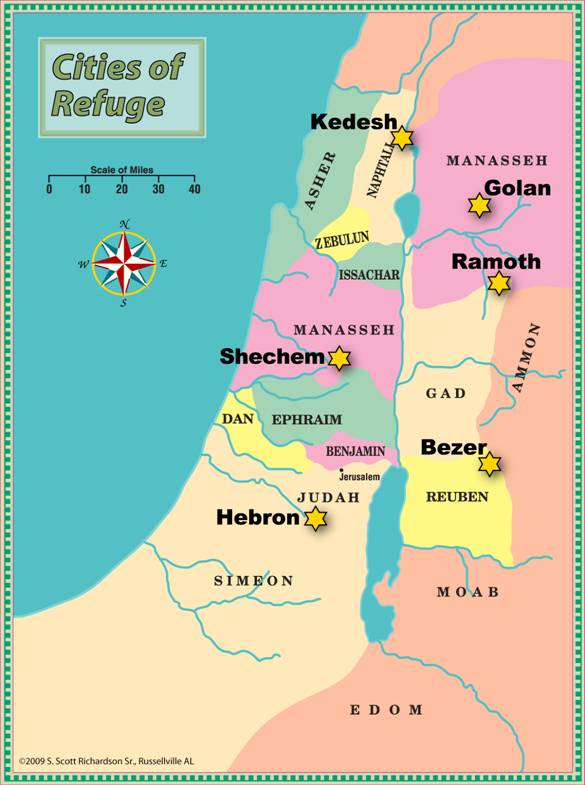
The cities of refuge. God instructed Moses to set aside six different cities, located throughout the land of Canaan, and designate them as cities of refuge. Occupied by Levites, these cities were strategically placed and easily accessible from all parts of the land. Their purpose was to provide a safe haven to anyone who had committed unpremeditated murder.  If an Israelite inadvertently and unintentionally caused the death of a fellow Israelite, he could flee to one of these cities and seek refuge from the avenger.

In that cultural context, It was up to the relatives of a murder victim to seek vengeance. This “blood avenger” (Numbers 35:19) was not just free to kill the murdered, he was obligated to do so (Numbers 35:19, 21). It was his duty. He was called the “avenger of blood.”

But in order to prevent the blood avenger from taking the life of an innocent individual, the cities of refuge were established. If an Israelite accidentally killed someone else, he could run to one of these cities and seek refuge. As long as he remained there, he would be protected from the blood avenger. It was up to the residents of the city (Levites) to help determine the guilt of innocence of the accused. If it was determined that his actions were premeditated and intentional, he was to be handed over to the blood avenger for retribution. But if he was deemed innocent of having committed voluntary manslaughter, he would be allowed to remain in the city of refuge until the high priest died. In essence, the city became his prison. If he ever left, he would be guilty of violating his sentence and the blood avenger could seek his death.

All of this sounds very barbaric to us, but you have to remember that Israel had no police force for enforcing laws or dispensing justice. According to the Mosaic Law, murder was a crime worthy of death. The guilty must be punished. But involuntary manslaughter was to be dealt with in a different manner. That is why the cities were established. God was protecting the innocent.

God dwelt among His people, and His very presence demanded that they live set-apart lives. His holiness and righteousness required that they live differently and distinctively, abiding by a stringent set of rules and regulations that governed their behavior and interactions with one another. And yet God knew their weaknesses and fully understood their incapacity to live up to His exacting standards. The entire sacrificial system was designed to deal with their ongoing struggle with sin.

To unjustly execute the innocent would have been as evil in God’s sight as to excuse the guilty. So He provided those who had committed involuntary manslaughter a means for finding justice. They could live in the city of refuge and enjoy permanent protection from the “blood avenger.” They were still guilty of murder, but their lives were spared. The city of refuge became their prison until the day that the high priest died. Then his death would serve as an atonement for their sin, providing them with release from their guilt and the right to live among their kinsmen again – innocent and free.

The ongoing presence of God was constantly in jeopardy due to the sinfulness of men. Yet He provided them with countless means by which they could receive restoration and assure His continued existence among them. It was God who set them apart. Without them, they would have been nothing. His presence provided them their distinctiveness. And it was their sin that threatened their uniqueness as His chosen people.

From the day that Adam and Eve sinned in the garden, God has been actively and aggressively seeking to restore order to the chaos created by their actions. Their sin brought disorder, disobedience, and, ultimately, death into the world. It wasn’t long after Eve listened to the lies of the enemy and convinced her husband to join her in rejecting God’s word, that murder showed up on the scene. One of Eve’s own sons killed his brother. Death entered the scene. And disease would not be far behind it. Their bodies would undergo the inevitable effects of aging. Sin would increase. Rebellion against God would run rampant. And yet God continued to reach out to mankind, offering a form of refuge from the consequences of sin.

In a real sense, God’s choosing of Abraham made him and his descendants a “city of refuge” for mankind. The people of Israel would become a single source of God’s abiding presence and divine protection from the guilt and condemnation of sin. It was among the children of God that men could find access to their Creator. It was through the law of God that men could learn of the divine requirements and expectations of a holy God. It was through the sacrificial system instituted by God that men could find atonement for their sins and freedom from the penalty of death they so justly deserved. God had provided a city of refuge among the sons of men. And eventually, God would send His own Son as the ultimate and final means of refuge and escape from sin’s destructive power and God’s righteous judgment.

The Scriptures make it painfully clear that all men are guilty of sin.

For all have sinned and fall short of the glory of God.– Romans 3:23 ESV

Surely there is not a righteous man on earth who does good and never sins. – Ecclesiastes 7:20 ESV

Who can say, “I have made my heart pure; I am clean from my sin?” – Proverbs 20:9 ESV

We are all infected and impure with sin. When we display our righteous deeds, they are nothing but filthy rags. – Isaiah 64:6 NLT

The law of God was given to reveal to men the reality and gravity of their sins. Like a speed limit sign on the side of the freeway, the law provided a constant reminder of man’s proclivity for disobedience and rebellion. Our guilt is unquestionable and undeniable. Sinful humanity stands condemned before a holy and righteous God due to the sinful nature passed down to them from Adam and Eve. All are guilty and all stand condemned. And the very presence of disease and death in our world is an outward reminder of the reality of sin’s devastating consequences.

In the case of someone seeking refuge in one of these cities, if they remained there until the high priest died, their sin was forgiven. They walked away free and clear. The death of the high priest had atoning value just as Jesus’ death for us atones for our sins. No one could accuse this person once the high priest had died. And we stand as unaccused and uncondemned because of what Christ has done for us.

Who dares accuse us whom God has chosen for his own? Will God? No! He is the one who has given us right standing with himself. Who then will condemn us? Will Christ Jesus? No, for he is the one who died for us and was raised to life for us and is sitting at the place of highest honor next to God, pleading for us. – Romans 8:33-34 NLT

We can take refuge in Christ. He is our high priest and He has died for us. His death has set us free once and for all.

God also bound himself with an oath, so that those who received the promise could be perfectly sure that he would never change his mind. So God has given us both his promise and his oath. These two things are unchangeable because it is impossible for God to lie. Therefore, we who have fled to him for refuge can take new courage, for we can hold on to his promise with confidence. This confidence is like a strong and trustworthy anchor for our souls. It leads us through the curtain of heaven into God’s inner sanctuary. Jesus has already gone in there for us. He has become our eternal High Priest in the line of Melchizedek. – Hebrews 6:17-20 NLT

English Standard Version (ESV) The Holy Bible, English Standard Version. ESV® Permanent Text Edition® (2016). Copyright © 2001

New Living Translation (NLT) Holy Bible, New Living Translation, copyright © 1996, 2004, 2015 by Tyndale House Foundation. Used by permission of Tyndale House Publishers Inc., Carol Stream, Illinois 60188. All rights reserved.

Close, But Yet So Far

13 But Moses said to the Lord, “Then the Egyptians will hear of it, for you brought up this people in your might from among them, 14 and they will tell the inhabitants of this land. They have heard that you, O Lord, are in the midst of this people. For you, O Lord, are seen face to face, and your cloud stands over them and you go before them, in a pillar of cloud by day and in a pillar of fire by night. 15 Now if you kill this people as one man, then the nations who have heard your fame will say, 16 ‘It is because the Lord was not able to bring this people into the land that he swore to give to them that he has killed them in the wilderness.’ 17 And now, please let the power of the Lord be great as you have promised, saying, 18 ‘The Lord is slow to anger and abounding in steadfast love, forgiving iniquity and transgression, but he will by no means clear the guilty, visiting the iniquity of the fathers on the children, to the third and the fourth generation.’ 19 Please pardon the iniquity of this people, according to the greatness of your steadfast love, just as you have forgiven this people, from Egypt until now.”

20 Then the Lord said, “I have pardoned, according to your word. 21 But truly, as I live, and as all the earth shall be filled with the glory of the Lord, 22 none of the men who have seen my glory and my signs that I did in Egypt and in the wilderness, and yet have put me to the test these ten times and have not obeyed my voice, 23 shall see the land that I swore to give to their fathers. And none of those who despised me shall see it. 24 But my servant Caleb, because he has a different spirit and has followed me fully, I will bring into the land into which he went, and his descendants shall possess it. 25 Now, since the Amalekites and the Canaanites dwell in the valleys, turn tomorrow and set out for the wilderness by the way to the Red Sea.” Numbers 14:13-25 ESV

God was angry. He had deemed the ungrateful and disobedient response of the people to His leadership as unacceptable and worthy of judgment.

“How long will this people despise me? And how long will they not believe in me, in spite of all the signs that I have done among them? I will strike them with the pestilence and disinherit them, and I will make of you a nation greater and mightier than they.” – Numbers 14:11-12 ESV

But this was not the first time that God had grown impatient with His chosen people. When they had been camped at the base of Mount Sinai, He had reached a similar conclusion because of their blatant display of rebellion. While Moses had been on the mountaintop receiving the Ten Commandments from God, the people had decided to fashion and worship a golden calf. To make matters worse, the Israelites were crediting their new idol with their recent deliverance from Egypt. So, God told Moses:

“I have seen this people, and behold, it is a stiff-necked people. Now therefore let me alone, that my wrath may burn hot against them and I may consume them, in order that I may make a great nation of you.” – Exodus 32:9-10 ESV

In both cases, God declared His intent to destroy the people of Israel and start from scratch. But notice that in neither scenario would His destruction have included Moses and his family. God was willing to spare His chosen leader and start the process of building a great nation all over again. He had started the original plan with Abraham, and there was nothing to prevent Him from doing so with Moses. Except for Moses.

On both occasions, one person stood in the way of God carrying out His plan to completely destroy His rebellious people. Moses intervened. He interceded on behalf of his fellow Israelites. Despite the fact that these very same people had repeatedly questioned his leadership and had even attempted to replace him, he boldly defended them.  In Exodus, we read that “Moses implored the Lord his God…” (Exodus 32:11 ESV). And in Numbers, it states that “Moses said to the Lord…” (Numbers 14:13 ESV).

This beleaguered and often discredited man stood by his fellow Israelites and begged God to consider the impact His destruction would have on His reputation. At Sinai, Moses had raised the prospect of the Egyptians gloating over the annihilation of the Jewish people by their own God.

“Why should the Egyptians say, ‘With evil intent did he bring them out, to kill them in the mountains and to consume them from the face of the earth’?” – Exodus 32:12 ESV

Moses appealed to God’s sense of honor and reminded Him of the covenant commitment He had made to Abraham, Isaac, and Jacob.

“Remember Abraham, Isaac, and Israel, your servants, to whom you swore by your own self, and said to them, ‘I will multiply your offspring as the stars of heaven, and all this land that I have promised I will give to your offspring, and they shall inherit it forever.’” – Exodus 32:13 ESV

As a result, “the Lord relented from the disaster that he had spoken of bringing on his people” (Exodus 32:14 ESV).

In the wilderness of Paran, Moses employed a similar tactic with God, arguing that news of His destruction of the people would get back to the Egyptians and they would spread rumors among the Canaanites about His unfaithfulness.

“Then the Egyptians will hear of it, for you brought up this people in your might from among them, and they will tell the inhabitants of this land…” – Numbers 14:13-14 ESV

Moses reminded God that the nations that occupied Canaan had already heard of His presence among the people of Israel.

“They have heard that you, O Lord, are in the midst of this people. For you, O Lord, are seen face to face, and your cloud stands over them and you go before them, in a pillar of cloud by day and in a pillar of fire by night.” – Numbers 14:14 ESV

News of Israel’s deliverance from Egypt had already reached Canaan. They had heard about God’s power and the devastating plagues He had poured out on the Egyptians. Rumors concerning this massive host of people traveling through the wilderness had made their way to the Amalekites, Hittites, Jebusites, and Amorites. Reports of Israel’s God going before them in the form of a pillar of cloud by day and a pillar of fire by night had reached their ears and left them shaking in terror.

But Moses warns God that if He follows through with His plan to wipe out the Israelites, it could do irreparable damage to His reputation among the Canaanites. They will go from fearing Him to feeling sorry for Him.

“Now if you kill this people as one man, then the nations who have heard your fame will say, ‘It is because the Lord was not able to bring this people into the land that he swore to give to them that he has killed them in the wilderness.’” – Numbers 14:15-16 ESV

So, Moses appeals to God’s love, patience, and faithfulness.

“The Lord is slow to anger and abounding in steadfast love, forgiving iniquity and transgression, but he will by no means clear the guilty, visiting the iniquity of the fathers on the children, to the third and the fourth generation.” – Numbers 14:18 ESV

Moses was not denying the guilt of the people; he was simply calling on God to only punish those who were responsible for the rebellion. He pleaded with God to “pardon the iniquity of this people, according to the greatness of your steadfast love” (Numbers 14:19 ESV). From Moses’ perspective, the people had been misled and negatively influenced by the report of the ten spies. These men had coerced the people into rejecting God’s command to enter the land of Canaan. Moses believed the spies were deserving of God’s judgment but the people deserved God’s forgiveness. And God agreed. He pardoned the people but declared His intent to punish the ten spies.

“…none of the men who have seen my glory and my signs that I did in Egypt and in the wilderness, and yet have put me to the test these ten times and have not obeyed my voice, shall see the land that I swore to give to their fathers. And none of those who despised me shall see it.” – Numbers 14:22-23 ESV

But what Moses failed to understand was the deep-rooted rebellion among that generation of Israelites. The problem was greater than Moses realized. And while God was willing to pardon the nation as a whole, He would not forgive those who had questioned His integrity and rejected His command to enter the land. The ten spies would suffer immediate death as a result of a God-ordained plague (Numbers 14:36-38). But the rest of that generation would be spared. Yet, as the following verses reveal, they would ultimately die of natural causes in the wilderness (Numbers 14:32-33).

They had listened to the report of the spies and refused to obey God’s command to enter the land of promise. In doing so, they were denying God’s power to give them victory over their enemies. They were discrediting God’s promises, inferring that He was incapable of doing what He had said He would do. And they were displaying their ingratitude for all that He had done on their behalf. God would remain faithful. He would continue to display His steadfast love and extend His grace and mercy. But that generation would pay dearly for their refusal to do His will. He had wanted to bless them but they had forfeited that right through their stubborn disobedience.

God would not destroy them, but they would never set foot in Canaan. They had been delivered by God but would never experience the joy of entering into His rest.

“…when your fathers put me to the test
    and put me to the proof, though they had seen my work.
For forty years I loathed that generation
    and said, “They are a people who go astray in their heart,
    and they have not known my ways.”
Therefore I swore in my wrath,
    “They shall not enter my rest.” – Psalm 90:9-11 ESV

English Standard Version (ESV) The Holy Bible, English Standard Version. ESV® Permanent Text Edition® (2016). Copyright © 2001

New Living Translation (NLT) Holy Bible, New Living Translation, copyright © 1996, 2004, 2015 by Tyndale House Foundation. Used by permission of Tyndale House Publishers Inc., Carol Stream, Illinois 60188. All rights reserved.

Son, Servant, Savior

19 So they went up to the steward of Joseph’s house and spoke with him at the door of the house, 20 and said, “Oh, my lord, we came down the first time to buy food. 21 And when we came to the lodging place we opened our sacks, and there was each man’s money in the mouth of his sack, our money in full weight. So we have brought it again with us, 22 and we have brought other money down with us to buy food. We do not know who put our money in our sacks.” 23 He replied, “Peace to you, do not be afraid. Your God and the God of your father has put treasure in your sacks for you. I received your money.” Then he brought Simeon out to them. 24 And when the man had brought the men into Joseph’s house and given them water, and they had washed their feet, and when he had given their donkeys fodder, 25 they prepared the present for Joseph’s coming at noon, for they heard that they should eat bread there.

26 When Joseph came home, they brought into the house to him the present that they had with them and bowed down to him to the ground. 27 And he inquired about their welfare and said, “Is your father well, the old man of whom you spoke? Is he still alive?” 28 They said, “Your servant our father is well; he is still alive.” And they bowed their heads and prostrated themselves. 29 And he lifted up his eyes and saw his brother Benjamin, his mother’s son, and said, “Is this your youngest brother, of whom you spoke to me? God be gracious to you, my son!” 30 Then Joseph hurried out, for his compassion grew warm for his brother, and he sought a place to weep. And he entered his chamber and wept there. 31 Then he washed his face and came out. And controlling himself he said, “Serve the food.” 32 They served him by himself, and them by themselves, and the Egyptians who ate with him by themselves, because the Egyptians could not eat with the Hebrews, for that is an abomination to the Egyptians. 33 And they sat before him, the firstborn according to his birthright and the youngest according to his youth. And the men looked at one another in amazement. 34 Portions were taken to them from Joseph’s table, but Benjamin’s portion was five times as much as any of theirs. And they drank and were merry with him. – Genesis 43:19-34 ESV

The sons of Jacob returned to Egypt, accompanied by their younger brother, Benjamin. Eleven men made the arduous journey from Canaan to the land of the Pharaohs, not knowing what fate awaited them upon their arrival. They were bringing with them gifts to offer Zaphenath-paneah, the governor of Egypt, who was holding their brother, Simeon, as a hostage. They had also brought the money that had somehow made its way into the sacks of grain they had brought back to Canaan on their first trip. For some inexplicable reason, their payment for the first shipment of grain had never made it to the hands of the royal governor, so they feared they would be viewed as thieves and treated accordingly.

Upon their arrival in Egypt, the brothers headed straight to the governor’s palace, and anxiously explained their predicament to his household steward. They declared their innocence and professed ignorance as to how the money had ended up back in their possession. They wanted the steward to know that they were anxious to settle their debt and to purchase additional grain for their families back in Canaan.

Then the brothers received the first of what would be many surprises. The steward attempted to calm their fears by informing them that they owed nothing. He had received full payment for their initial order. And then, this pagan Egyptian informed them that the money found in their grain sacks must have been a gift from ‘ĕlōhîm, the God of their father Jacob. This statement must have left the brothers speechless and staring at one another in astonishment. Was the steward suggesting that the money had been a gift from God? But before they had time to ascertain just what the steward meant, they found themselves reunited with Simeon. At this point, they had to be wondering why things were going so unexpectedly well.

But the brothers had little time to discuss their good fortune because the steward ushered them into the palace and told them to clean up for lunch. Much to their ongoing surprise, they discovered that they would be dining with the governor himself. These 11 sons of Jacob would be treated to a sumptuous feast in the royal palace as the honored guests of Zaphenath-paneah, the second-most powerful man in all of Egypt. As they prepared for this high honor, they must have debated and discussed the surrealistic nature of their unexpected welcome. All of this would have been a shock to theirs systems. It was far beyond anything they could have ever imagined.

And then, just as they were beginning to wrap their minds around these unprecedented events, the governor showed up. Upon seeing this powerful dignitary enter the room, the 11 brothers bowed down before him as sign of honor and deference. And as Joseph stood looking down on his prostrate brothers, the images he had seen in his long-forgotten dreams must have flooded into his mind.

As a young boy, Joseph had been given a vision in his sleep that portrayed he and his 11 brothers as bundles of grain. But what made the dream so offensive to his brothers when he shared it with them was that their sheaves of grain all bowed down to his. And Joseph had a second dream that conveyed the same basic message. In it, he saw the sun, moon, and 11 stars all bowing down before him. And when he shared this dream with his father and brothers, it was met with the same degree of anger and animosity.

Yet, years later, Joseph stood in his royal palace with his brothers lying on their faces before him. The irony of this moment would not have escaped Joseph. His dreams had become vividly and indisputably true. But Joseph didn’t gloat. Instead, he recalled his aging father back in Canaan and inquired as to the status of his health.

“How is your father, the old man you spoke about? Is he still alive?”  Genesis 43:27 NLT

The brothers affirmed that their father was alive and well, and humbly referred to him as a servant of the governor. They followed this statement by bowing before Joseph yet a second time. This action would have been done on behalf of Jacob, illustrating his humble subservience to the Egyptian governor.

News of his father’s good health pleased Joseph greatly. He probably harbored hopes that he might live to see his father once again. But it was the presence of his younger brother, Benjamin, that drew Joseph’s attention. For the first time in years, he stood face to face with his blood brother, and the experience moved him deeply.

Joseph hurried from the room because he was overcome with emotion for his brother. He went into his private room, where he broke down and wept. – Genesis 43:30 NLT

But Joseph regained his composure and returned to the dining room where he ordered the food to be served. Then he treated his brothers to a royal feast fit for a king. To the brothers’ amazement, the governor ushered each of them to their seat, arranging them in the proper chronological order based on their birth. How would this pagan Egyptian have known who was the oldest and who was the youngest? And, once again, the brothers received an additional shock when the governor took it upon himself to serve their plates with food from his own table. Little did they know that the brother whom they had treated with disdain and contempt was showing them honor and reverence. The innocent young man whom they hold sold into slavery was now performing the task of a lowly household servant. In a sense, he was taking the food from his own table and feeding it to the “dogs” who had treated him as less than animal, throwing him into a pit and selling him for a few pieces of silver.

Without realizing it, Joseph was modeling the life of Christ, long before He left His throne in glory and took on human flesh. Jesus said of Himself, “the Son of Man came not to be served but to serve others and to give his life as a ransom for many” (Matthew 20:28 NLT). In a real sense, Joseph had “given his life” when his brothers sold him into slavery. When the Ishmaelite slave traders dragged him away in chains, he had left behind his place of honor in his father’s house. And he soon found himself living as a common slave. He ended up being falsely accused and eventually arrested for a crime he didn’t commit. But, like Jesus, Joseph had been sent to bring rescue to God’s people. But he had ended up humiliated and humbled. But the day came when he was glorified and lifted up, and invested with the power to offer help and hope to those in need. His brothers, undeserving of his grace and mercy, would receive redemption instead of retribution. They would be forgiven and their crime would be forgotten. And, in time, they would discover the true identity of their benefactor. Zaphenath-paneah would end up being their long lost brother and their unlikely savior.

English Standard Version (ESV) The Holy Bible, English Standard Version. ESV® Permanent Text Edition® (2016). Copyright © 2001 by Crossway Bibles, a publishing ministry of Good News Publishers.

New Living Translation (NLT) Holy Bible, New Living Translation, copyright © 1996, 2004, 2015 by Tyndale House Foundation. Used by permission of Tyndale House Publishers Inc., Carol Stream, Illinois 60188. All rights reserved.

New English Translation (NET)NET Bible® copyright ©1996-2017 by Biblical Studies Press, L.L.C. http://netbible.com All rights reserved.


You Can Mourn Now or Mourn Later

26 And as they led him away, they seized one Simon of Cyrene, who was coming in from the country, and laid on him the cross, to carry it behind Jesus. 27 And there followed him a great multitude of the people and of women who were mourning and lamenting for him. 28 But turning to them Jesus said, “Daughters of Jerusalem, do not weep for me, but weep for yourselves and for your children. 29 For behold, the days are coming when they will say, ‘Blessed are the barren and the wombs that never bore and the breasts that never nursed!’ 30 Then they will begin to say to the mountains, ‘Fall on us,’ and to the hills, ‘Cover us.’ 31 For if they do these things when the wood is green, what will happen when it is dry?”

32 Two others, who were criminals, were led away to be put to death with him. Luke 23:26-32 ESV

Jesus’ legal trials may have come to an end, but His physical trials were just about to begin. A condemned criminal had been allowed to walk free, while Jesus, an innocent man, was subjected to a range of violent physical and verbal abuse. Luke goes out of his way to record the overwhelming consensus of opinion that Jesus was an innocent man.

Then Pilate said to the chief priests and the crowds, “I find no guilt in this man.” – Luke 23:4 ESV

“…behold, I did not find this man guilty of any of your charges against him. Neither did Herod, for he sent him back to us. Look, nothing deserving death has been done by him.” – Luke 23:14-15 ESV

A third time he said to them, “Why? What evil has he done? I have found in him no guilt deserving death.  – Luke 23:22 ESV

“…this man has done nothing wrong.” – Luke 23:41 ESV

Now when the centurion saw what had taken place, he praised God, saying, “Certainly this man was innocent! – Luke 23:47 ESV

As soon as Pilate relented to the demands of the Jewish religious leaders and authorized the crucifixion of Jesus, the matter fell under the jurisdiction of the Roman soldiers. These hardened legionnaires were responsible for carrying out the governor’s orders by subjecting Jesus to the gruesome ordeal of crucifixion – the Roman government’s preferred form of capital punishment. But like a cat cruelly playing with a mouse before subjecting it to death, Pilate’s guards decided to subject Jesus to a range of degrading physical and emotional abuses. With the entire regiment looking on, “They stripped him and put a scarlet robe on him. They wove thorn branches into a crown and put it on his head, and they placed a reed stick in his right hand as a scepter. Then they knelt before him in mockery and taunted, ‘Hail! King of the Jews!’” (Matthew 27:29-29 NLT).

These men, having overheard the accusations leveled against Jesus, found it laughable that this powerless and unimpressive Jewish Rabbi would consider Himself to be a king. So, they ruthlessly and mercilessly mocked Jesus, with every cruelty they poured out intended to leave Him humiliated and degraded. And Matthew describes with painful clarity the unsparing nature of their torturous treatment of Jesus.

…they spit on him and grabbed the stick and struck him on the head with it. When they were finally tired of mocking him, they took off the robe and put his own clothes on him again. Then they led him away to be crucified. – Matthew 27:30-31 NLT

John provides the added detail that Pilate ordered Jesus to be flogged. This barbaric practice, also known as scourging, was an especially cruel and inhuman form of punishment that was designed to inflict extreme pain and hasten death. According to an article by Ian Tuttle published in National Review, “The Romans meted out whippings with particular zeal, inventing new tools to increase the misery: on the mild end, a flat leather strap; on the mortal end, long whips with, at their ends, balls of metal with protruding metal fragments or pieces of bone. It was not uncommon for the scourging that preceded a crucifixion to prove fatal” (https://www.nationalreview.com/2015/01/flogging-through-centuries-ian-tuttle/).

By the time Jesus left the Roman governor’s palace, He would have been in a severely weakened state, suffering from extreme pain and blood loss. Yet, as a condemned man, Jesus was expected to carry His own cross to the place of crucifixion. But it appears that the flogging had taken its toll on Jesus, leaving Him incapable of bearing the weight of the cross. So, the Romans conscripted a stranger from the crowd to assist Him. And as Jesus painfully navigated the final steps to the crucifixion site, He was followed by “a great multitude of the people and of women who were mourning and lamenting for him” (Luke 23:27 ESV).

But rather than thank them for their compassionate display of sorrow, Jesus turned to these individuals and gave them a sobering word of warning.

“Daughters of Jerusalem, don’t weep for me, but weep for yourselves and for your children. For the days are coming when they will say, ‘Fortunate indeed are the women who are childless, the wombs that have not borne a child and the breasts that have never nursed.’ People will beg the mountains, ‘Fall on us,’ and plead with the hills, ‘Bury us.’” – Luke 23:28-30 NLT

His words are similar to the ones He spoke to His disciples while they sat with Him on the Mount of Olives, just prior to His arrest in the garden.

“Then those in Judea must flee to the hills. A person out on the deck of a roof must not go down into the house to pack. A person out in the field must not return even to get a coat. How terrible it will be for pregnant women and for nursing mothers in those days. And pray that your flight will not be in winter or on the Sabbath. For there will be greater anguish than at any time since the world began. And it will never be so great again…“ – Matthew 24:16-21 NLT

In both cases, Jesus was speaking of future events. He was warning them that even darker days lie ahead, when the judgment of God will fall upon the world for its rejection of His Son. Those weeping at the sight of Jesus’ deplorable condition and mourning the thought of His pending death had no idea He was referring to events associated with the end of time. The book of Revelation describes a future day when God will reign down judgment upon the earth.

Then everyone—the kings of the earth, the rulers, the generals, the wealthy, the powerful, and every slave and free person—all hid themselves in the caves and among the rocks of the mountains. And they cried to the mountains and the rocks, “Fall on us and hide us from the face of the one who sits on the throne and from the wrath of the Lamb. For the great day of their wrath has come, and who is able to survive?” – Revelation 6:15-17 NLT

This was the day to which Jesus was referring. While His death would be the key to salvation and eternal life, it would also result in God’s wrath being poured out on all those who refused to accept HIs Son as Savior. And that would include many in Israel. God’s chosen people would refuse to accept God’s Son as their Messiah and King. In fact, they would participate in His execution, demanding that He be put to death. When He had entered Jerusalem just a few days earlier, the crowds had shouted, “Hosanna to the Son of David! Blessed is he who comes in the name of the Lord! Hosanna in the highest!” (Matthew 21:9 ESV). But those joyous shouts of adoration and acclimation had quickly turned to cries of “Crucify Him!” And one day, all those who have chosen to reject the King of kings and Lord of lords will suffer the consequences of their decision and mourn, not for Jesus, but for their own coming destruction.

But when Jesus arrived at the placed called Golgotha, He found himself joined by two other men, both criminals, who would be executed alongside Him, “one on either side, and Jesus between them” (John 19:18 ESV). This seemingly innocuous statement conjures up memories of the conversation Jesus had with James and John. On an earlier occasion, these two brothers had approached Jesus and asked, “Grant that one of us may sit at Your right hand and the other at Your left in Your glory” (Mark 10:37 BSB). And Jesus had responded to their presumptuous request by stating, You do not know what you are asking…Can you drink the cup I will drink, or be baptized with the baptism I will undergo?” (Mark 10:38 BSB).

Little did they know at the time, that the two places of prominence they had requested would not be royal thrones, but cruel Roman crosses. For Jesus, the cross was a place of honor. He had been chosen by God the Father to lay down His life, and it was something Jesus was prepared to do – willingly and gladly. Jesus had come to lay down His life for the sheep.

“…the Son of Man came not to be served but to serve others and to give his life as a ransom for many.” – Matthew 20:28 NLT

And that time had come.

English Standard Version (ESV) The Holy Bible, English Standard Version. ESV® Permanent Text Edition® (2016). Copyright © 2001 by Crossway Bibles, a publishing ministry of Good News Publishers.

New Living Translation (NLT) Holy Bible, New Living Translation, copyright © 1996, 2004, 2015 by Tyndale House Foundation. Used by permission of Tyndale House Publishers Inc., Carol Stream, Illinois 60188. All rights reserved.

The Message (MSG)Copyright © 1993, 1994, 1995, 1996, 2000, 2001, 2002 by Eugene H. Peterson