Saved by Faith

By faith Noah, being warned by God concerning events as yet unseen, in reverent fear constructed an ark for the saving of his household. By this he condemned the world and became an heir of the righteousness that comes by faith. – Hebrews 11:7 ESV

Can things get any worse? That’s a question every person living on planet earth seems to be asking themselves these days. With each passing day, the global state of affairs seems to be on a decidedly downward spiral. But as bad as things may seem to be in our day and age, there was a time when things were far worse. In fact, according to the book of Genesis, the moral conditions on earth had degraded to such a degree that God decided to do something about it. Dissatisfied with the degenerated moral state of humanity, He vowed to wipe out everything and start over.

The Lord observed the extent of human wickedness on the earth, and he saw that everything they thought or imagined was consistently and totally evil. So the Lord was sorry he had ever made them and put them on the earth. It broke his heart. And the Lord said, “I will wipe this human race I have created from the face of the earth. Yes, and I will destroy every living thing—all the people, the large animals, the small animals that scurry along the ground, and even the birds of the sky. I am sorry I ever made them.” But Noah found favor with the Lord. – Genesis 6:5-8 NLT

Now before we get smug and pat ourselves on the back for not being near as bad as our antediluvian ancestors, we should consider that the only reason we haven’t experienced the same fate is because of the covenant God made with Noah promising to never destroy the world by water again. But the apostle Paul gives us another reason we should refrain from thinking that we are somehow better than our pre-flood relatives.

…even though God has the right to show his anger and his power, he is very patient with those on whom his anger falls, who are destined for destruction. He does this to make the riches of his glory shine even brighter on those to whom he shows mercy, who were prepared in advance for glory. – Romans 9:22-23 NLT

It is simply because of God’s desire to shower His mercy through the gift of His Son that He has not chosen to destroy each and every one of us.

But back to Noah. Notice what it says at the end of the passage in Genesis: “But Noah found favor with the Lord.” In the midst of all the human wickedness on the earth, Noah had managed to remain in a right standing with God. We might ask ourselves how Noah stayed the course while everyone else was headed in the opposite direction morally and spiritually. How was he able to stay faithful in the face of such rampant wickedness? What kept him from giving up and giving in to the constant peer pressure? The author of Hebrews tells us. As he did when speaking about Enoch, he opens his short essay on Noah with the words, “By faith…”

Noah was a man of faith. He believed God existed and was a rewarder of those who seek Him (Hebrews 11:6). Moses, under the inspiration of the Spirit, wrote, “Noah was a righteous man, the only blameless person living on earth at the time, and he walked in close fellowship with God.” (Genesis 6:9 NLT). Noah wasn’t perfect or sinless. The word “blameless” simply means that he was whole or complete in his devotion to God. He lived his entire life before God with no hidden areas. He kept no secrets from God.  He practiced complete transparency, rather than trying to compartmentalize his life into secular and sacred categories.

He had managed to remain faithful to God because he believed God was faithful. Noah was well aware of the wickedness of the culture in which he lived, and he knew that God was aware as well. So, when Noah was “warned by God concerning events as yet unseen,” he listened and believed. God shared with him the bad news concerning His decision to destroy mankind.

Now God saw that the earth had become corrupt and was filled with violence. God observed all this corruption in the world, for everyone on earth was corrupt. So God said to Noah, “I have decided to destroy all living creatures, for they have filled the earth with violence. Yes, I will wipe them all out along with the earth! – Genesis 6:11-13 NLT

In one sense, God was not telling Noah anything he did not already know. He knew the world around him was corrupt and filled with violence. He knew his neighbors well. He had been living his life in an ever-increasing climate of sin. But the news of God’s plan to wipe out everything and everyone must have left him shocked and surprised. God’s divine decision to destroy all that He had made would have been difficult to understand. So, God followed up the bad news with some very good news. He was going to spare Noah and his family, and this is the part where Noah’s faith comes into play. God gave Noah one more detail concerning His plan that was going to have a dramatic, life-altering impact on Noah.

“Build a large boat from cypress wood and waterproof it with tar, inside and out. Then construct decks and stalls throughout its interior. Make the boat 450 feet long, 75 feet wide, and 45 feet high. Leave an 18-inch opening below the roof all the way around the boat. Put the door on the side, and build three decks inside the boat—lower, middle, and upper. “Look! I am about to cover the earth with a flood that will destroy every living thing that breathes. Everything on earth will die. But I will confirm my covenant with you. So enter the boat—you and your wife and your sons and their wives. Bring a pair of every kind of animal—a male and a female—into the boat with you to keep them alive during the flood. Pairs of every kind of bird, and every kind of animal, and every kind of small animal that scurries along the ground, will come to you to be kept alive. And be sure to take on board enough food for your family and for all the animals.” – Genesis 6:14-21 NLT

There are a number of things we have to keep in mind when reading this all-too-familiar account. First of all, Noah had never seen a boat before. In fact, there is no indication that Noah had even seen a body of water large enough to float a boat before. And there are those who believe that Noah had never seen rain before. They arrive at this conclusion from a passage found earlier in Genesis that describes conditions on the earth before God had made man.

When no bush of the field was yet in the land and no small plant of the field had yet sprung up—for the Lord God had not caused it to rain on the land, and there was no man to work the ground, and a mist was going up from the land and was watering the whole face of the ground. – Genesis 2:5-6 ESV

On top of all this, we know that Noah was nearly 600 years old when he received this devastating news from God. He was being asked by God to build a massive boat and collect two of every kind of animal, all under a looming deadline that was bringing the destruction of the entire planet. Oh, and as if there wasn’t enough pressure on Noah, this boat was going to be his only means of salvation. So, how did Noah respond to this unbelievable and seemingly impossible assignment from God? Moses tells us, rather matter-of-factly: “So Noah did everything exactly as God had commanded him” (Genesis 6:22 NLT).

What was the description of faith given to us in verse one of Hebrews 11? “Now faith is the assurance of things hoped for, the conviction of things not seen.” In the Genesis account, there is no indication that Noah questioned God or tried to talk Him out of His plan. He didn’t complain about the scope of the project or the impossibility of the assignment. He simply did what God told him to do. Why? Because he had faith in God. In “reverent fear” he went about constructing the ark that would prove to be the means of his salvation. It all sounded implausible and impossible. The task before him had to feel overwhelming and insurmountable. This was not a typical do-it-yourself project. He wasn’t adding a deck onto the back of his house. He was building a massive boat, and all on blind faith. Yet he had an assurance of what he was hoping for – that he and his family would survive the flood. He had a conviction of things unseen – that this boat would float and that this entire project would not end in disaster. Because he had faith in God.

When all is said and done, Noah was saved by faith, not a boat. Actually, Noah was saved by God. But it took belief in the plan of God for Noah to experience that salvation. Had he never built the boat, he would have died, along with his entire family. But he listened, believed, and obeyed. And he was saved. Noah had to believe in the wrath of God as well as the mercy of God. He had to believe that God, in His justice, would destroy mankind because of their sin. But he also had to believe that God was offering him a way of escape, a means of salvation – by faith. And we read the sobering words in Genesis:

All were destroyed. The only people who survived were Noah and those with him in the boat. – Genesis 7:23 NLT

God kept His word. He did what He said He would do. Including to provide Noah and his family with salvation from death. Noah’s actions, based on his faith in God, resulted not only in his salvation but in him becoming “an heir of the righteousness that comes by faith” (Hebrews 11:7b). His example of faith and trust in the promises of God was a foreshadowing of the salvation that God would make possible for all those who would eventually place their hope in the promise of eternal life through faith in His Son. Noah provided a model of faithfulness for generations of his own descendants. He wasn’t saved because he built an ark. He wasn’t saved because he was righteous. He was saved because he believed God and stepped out in faith and obeyed God.

Salvation has always been accomplished through faith. It was true in Noah’s day and it remains true even now. No matter how bad things may get in this world, there is always hope in the promises of God, and the apostle Paul provides us with a much-needed reminder of God’s power to save – by faith.

For I am not ashamed of the gospel, for it is the power of God for salvation to everyone who believes, to the Jew first and also to the Greek. For in it the righteousness of God is revealed from faith for faith, as it is written, “The righteous shall live by faith.” – Romans 1:16-17 ESV

English Standard Version (ESV) The Holy Bible, English Standard Version. ESV® Permanent Text Edition® (2016). Copyright © 2001

New Living Translation (NLT) Holy Bible, New Living Translation, copyright © 1996, 2004, 2015 by Tyndale House Foundation. Used by permission of Tyndale House Publishers Inc., Carol Stream, Illinois 60188. All rights reserved.

The Ultimate Reward

By faith Enoch was taken up so that he should not see death, and he was not found, because God had taken him. Now before he was taken he was commended as having pleased God. And without faith it is impossible to please him, for whoever would draw near to God must believe that he exists and that he rewards those who seek him. – Hebrews 11:5-6 ESV

We don’t know a whole lot about Enoch. Other than what we read about him here in Hebrews, the only other mention of him is found in the book of Genesis. He’s part of a genealogical list that shows the line of mankind from Adam all the way to Noah.

When Enoch had lived 65 years, he fathered Methuselah. Enoch walked with God after he fathered Methuselah 300 years and had other sons and daughters. Thus all the days of Enoch were 365 years. Enoch walked with God, and he was not, for God took him. –  Genesis 5:21-24 ESV

Enoch lived to the ripe old age of 365, but his time on earth was short compared to that of his father (962 years) and son (969 years). Enoch, as the genealogical list suggests, lived in the days before the flood. While there have been many suggestions to explain why men lived so much longer in those days, no one really knows why. But we do see that, over time, the longevity of man diminished dramatically; most likely as a result of the ongoing effects of sin and the curse of death on the human body.

But Enoch lived over three centuries. In our day, it is rare for anyone to make it to the single-century mark. But the remarkable thing about Enoch was not his lifespan, but his departure from this earth. The Genesis account tells us “Enoch walked with God, and he was not, for God took him.” The Septuagint, the Greek translation of the Old Testament, says he “was not found.”

He was on this earth for 365 years and then, one day, he was gone. But unlike every other man listed in the genealogical record found in Genesis 5, Enoch didn’t die. He is the only one on the list whose name is not followed by the words, “and he died.” Enoch was taken. He could have lived longer, but God decided to remove Enoch from the earth and transport him to heaven. The author of Hebrews adds another strange twist to this already bizarre tale.

By faith Enoch was taken up so that he should not see death. – Hebrews 11:5 ESV

Verse 5 stands in direct contrast to verse 4 and the life of the first character in the great “hall of faith.” Abel, the son of Adam and Eve, is commended for his faith but recognized for his untimely death.

…he was commended as righteous, God commending him by accepting his gifts. And through his faith, though he died, he still speaks. – Hebrews 11:4 ESV

Abel exhibited faith but died at the hands of his own brother. Yet, Enoch was spared the fate that all men have faced ever since the fall. He was glorified and received his redeemed body without having to suffer the inevitable and inescapable reality of death. He was there one day and gone the next. The Scriptures simply tell us “he was not found, because God had taken him.”

But why was Enoch rewarded with this one-of-a-kind experience? The text simply states that it was because of his faith. Living in a time of unparalleled evil and immorality, Enoch remained faithful to God. When everyone else around him was pursuing wickedness and involved in rampant evil, this man had chosen to believe in the promises of God. To fully understand Enoch’s status as a righteous man living among the unrighteous, one must consider the sorry state of affairs on earth at the time. Ever since the fall, the moral decline of mankind had spiraled out of control. Some 669 years after the “rapture” of Enoch, things had become so bad that God decided to wipe out all of humanity.

The Lord saw that the wickedness of man was great in the earth, and that every intention of the thoughts of his heart was only evil continually. And the Lord regretted that he had made man on the earth, and it grieved him to his heart. So the Lord said, “I will blot out man whom I have created from the face of the land, man and animals and creeping things and birds of the heavens, for I am sorry that I have made them.” – Genesis 6:5-7 ESV

At that point in the human story, there was only one man left who remained faithful to God, and that was Noah. The Genesis account states that “Noah found favor in the eyes of the Lord” (Genesis 6:8 ESV), and then it adds that “Noah was a righteous man, blameless in his generation. Noah walked with God” (Genesis 6:9 ESV). Notice that last sentence. It is the same thing said of Enoch.

Enoch walked with God – Genesis 5:22 ESV

Two times in the Genesis passage, we are told that “Enoch walked with God.” The Hebrew word translated as “walked” is hālaḵ and it can be used to refer to the physical act of movement or to living one’s life. Another way of translating this statement is that Enoch lived his life in communion with God. It is the same idea expressed by God to Abraham in Genesis 17. “When Abram was ninety-nine years old the LORD appeared to Abram and said to him, ‘I am God Almighty; walk before me, and be blameless’” (Genesis 17:1 ESV).

Abraham was to live his life with an awareness that he was doing so under the watchful eye of God Almighty. Every aspect of his life was being conducted in the presence of the all-knowing, all-seeing God. But when God told Abraham to “be blameless,” He was not demanding perfection. The Hebrew word for “blameless” is tamiym and it means “complete, whole, entire, sound” (Hebrew Lexicon :: H8549 (KJV). Blue Letter Bible). Abraham was being told to live his entire life, his whole life, with the constant awareness that God was watching. There was to be no compartmentalization, no hidden areas. He was to live as if God was with him at all times because He was.

And that is how Enoch lived. He lived by faith, believing that God was with Him every day and in every circumstance. Enoch couldn’t see God, but he believed in Him. The author of Hebrews explains that “without faith it is impossible to please him, for whoever would draw near to God must believe that he exists and that he rewards those who seek him” (Hebrews 11:6 ESV).

Enoch believed that God existed even though many around him did not. That genealogical record found in Genesis 5 gives us an abbreviated glimpse of mankind’s trajectory from the fall of Adam to the days of Noah. In the very next chapter of Genesis, we read, “The Lord observed the extent of human wickedness on the earth, and he saw that everything they thought or imagined was consistently and totally evil. So the Lord was sorry he had ever made them and put them on the earth. It broke his heart” (Genesis 6:5-6 NLT).

By the time we get to the days of Noah, we find that “God saw that the earth had become corrupt and was filled with violence. God observed all this corruption in the world, for everyone on earth was corrupt.” (Genesis 6:11-12 NLT). The path from Adam to Noah was not an easy one. It was filled with increasing sin, violence, godlessness, and wickedness. The further man got away from the garden, the dimmer his recollection of God became. And in the midst of this downward spiral, Enoch stood out like a bright light. He was a beacon of faith in the midst of the darkness of man’s increasing sinfulness. He believed God existed and that He would reward those who pleased Him.

The text tells us, “before he was taken he was commended as having pleased God.” He had lived a life that pleased God – by faith. He was not self-seeking, but God-pleasing. He lived as if God existed and as if God was walking with him every moment of every day. His God was not distant or disinterested in his life. His God was near and lovingly involved in every aspect of his daily walk. He lived to please God – by faith. He lived to obey God – by faith. He lived to bring glory and honor to God – by faith.

To walk with God requires faith in God. You have to believe that He exists and that He is a rewarder of those who seek Him (Hebrews 11:6). You have to believe that He sees and that He cares. Enoch longed and hoped for the reward of God without ever really knowing exactly what the reward might be. It is likely that Enoch would have lived many more years on this earth, just like his father and son. But God rewarded Enoch by taking him in mid-life, and by sparing him the suffering and pain associated with death. He also didn’t have to endure what would have likely been a prolonged period of old age. In those days before the flood, men enjoyed long lives, but they still had to face the inevitable reality of sin.

Enoch had faith in God and he was rewarded by God with escape from the curse of death.

By faith Enoch was taken up so that he should not see death. – Hebrews 11:5a ESV

Enoch provides a foreshadowing of the hope that is found in Jesus Christ. There is an ultimate reward for all those who place their faith in God by trusting in His Son’s sacrifice on the cross on their behalf. As Jesus told Mary and Martha at the graveside of their brother, “I am the resurrection and the life. Anyone who believes in me will live, even after dying. Everyone who lives in me and believes in me will never ever die” (John 11:25-26 NLT). Enoch was raptured and never died. Because of his faith, he was rewarded with his immediate glorification and entrance into God’s presence.  He went to be with the LORD. And that same hope awaits all those who place their faith in Christ. That is why the author opened this chapter with the reassuring words: “Now faith is the assurance of things hoped for, the conviction of things not seen” (Hebrews 11:1 ESV).

Every child of God is to live their life on this earth believing that God is a rewarder of those who seek Him and that His ultimate reward is a death-defying escape from this world into His eternal Kingdom. Whether by death or by rapture, every saint will experience the fulfillment of God’s promise of eternal life, but that reward can only be accessed by faith.

Anyone who wants to come to him must believe that God exists and that he rewards those who sincerely seek him. – Hebrews 11:6 NLT

English Standard Version (ESV) The Holy Bible, English Standard Version. ESV® Permanent Text Edition® (2016). Copyright © 2001

New Living Translation (NLT) Holy Bible, New Living Translation, copyright © 1996, 2004, 2015 by Tyndale House Foundation. Used by permission of Tyndale House Publishers Inc., Carol Stream, Illinois 60188. All rights reserved.

Faith in the Faithfulness of God

By faith Abel offered to God a more acceptable sacrifice than Cain, through which he was commended as righteous, God commending him by accepting his gifts. And through his faith, though he died, he still speaks. – Hebrews 11:4 ESV

This chapter of Hebrews opens with the familiar words, “Now faith is the assurance of things hoped for, the conviction of things not seen.” But as 21st-century Christians, we struggle to understand exactly what this statement means. Faith is a nebulous and sometimes mysterious thing to us. We claim to possess it, but we’re not exactly sure what it is or even looks like. Is it something we have to muster up or is it given to us by God?

Even when we think we have faith, we wonder if we have enough. While most of us would define ourselves as a “people of faith,” we regularly wrestle with the concept and even question whether our faith measures up. So, the author of Hebrews has provided us with a much-needed lesson on the subject. Chapter 11 has been called the “Hall of Faith.” In it, we find a list of Old Testament men and women who exemplify the life of faith. Their stories, familiar to the author’s predominantly Jewish audience, are intended to demonstrate the non-negotiable nature of faith. Long before Jesus appeared on the scene, the people of God were expected to be people of faith, placing their hope and trust in the One who had created them and revealed Himself to them.

The author starts out by reminding his readers that “By faith we understand that the entire universe was formed at God’s command” (Hebrews 11:3 NLT). No one was there when creation took place. There were no witnesses to God’s grand display of divine power and creativity. We didn’t see it happen, so we have to take God at His word – by faith. The book of Genesis tells us how the universe was created by God, and we must believe that it happened just as it says it did. When we do, we exhibit faith. We are giving evidence of a “conviction of things not seen.”

Faith involves trust. It requires belief. And it is based on hope. But we tend to use the word “hope” in a purely speculative sense. We say things like, “I hope I win the lottery!” or “I hope he asks me out!” Our hope usually lacks assurance or a sense of confidence. It tends to be little more than wishful thinking. But that is not what the author of Hebrews is talking about. So he gives us further evidence of faith from the lives of the Old Testament saints.

Nineteen different times in this chapter, the author uses the phrase, “by faith.” His point seems to be that faith was both the motivator and the power behind the actions of each of the individuals he lists. What they did was done because of faith; faith in something hoped for and as yet unseen. Faith is God-focused and future-oriented. It has its roots in the faithfulness of God. It gets its strength from the promises made by God. So, when Abel, the son of Adam and Eve, is said to have “offered to God a more acceptable sacrifice than Cain,” faith is central to understanding the difference between his sacrifice and that of his brother. It has less to do with the content of their individual sacrifices than the hearts of the men who made them.

The question we have to ask is why either of these two sons of Adam and Eve were making sacrifices to God at all. Where did they learn to make sacrifices? We don’t see evidence of this practice in the Garden of Eden. We see no command given by God to Adam and Eve to offer up sacrifices to Him. So why were their sons doing so? If you go back to the original story in Genesis, which the author’s Jewish audience would have known well, it simply states:

Now Abel was a keeper of sheep, and Cain a worker of the ground. In the course of time Cain brought to the Lord an offering of the fruit of the ground, and Abel also brought of the firstborn of his flock and of their fat portions. And the Lord had regard for Abel and his offering, but for Cain and his offering he had no regard. – Genesis 4:2-5 ESV

The phrase, “in the course of time,” would seem to indicate that this was a regular occurrence. The first family must have established a habit of offering sacrifices to God., but there is no indication that this was something that God required of them. It appears to be wholly voluntary. And each son brought an offering that was consistent with his area of expertise. By this time in the creation narrative, both young men were old enough to have joined their father and mother in keeping the creation mandate.

“Be fruitful and multiply and fill the earth and subdue it, and have dominion over the fish of the sea and over the birds of the heavens and over every living thing that moves on the earth.” – Genesis 1:28 ESV

Despite the fall, they were still caring for the world that God had made. One son had become a shepherd and the other had become a farmer, and there is no indication from the text that one occupation was deemed to be better or more acceptable than the other.

Abel brought the firstborn of his flock and Cain brought the fruit of the ground. One brought animals while the other brought produce. We are not given any insight into the quality or quantity of their offerings. So, it doesn’t appear that God’s response to the two men had anything to do with the content of their offerings. The issue was their faith.

Cain gave an offering of the fruit of the ground. He most likely gave grain, dates, figs, or whatever else he had grown. But keep in mind, he gave “the fruit of the ground.” He did not give God the tree from which the fruit grew. So, he was assured of having more fruit to replace that which he had given. It also doesn’t say that he gave God the best of his fruit. He simply gave God a portion.

Yet, concerning Abel, it says that he gave the “firstborn of his flock and their fat portions.” This would seem to indicate that some kind of blood sacrifice was involved. In the sacrificial system that God would later mandate for the people of Israel, the fat, kidneys, and lobe of the liver of an animal were given to God as a burnt offering. These were considered the best portion of the animal and were reserved solely for God.

When Abel brought his offering to God, he not only gave the best of what he had, but he made a permanent and costly sacrifice. He didn’t just give the firstborn of his flock to God, he sacrificed its life. This means that Abel would never receive any benefit from that firstborn animal again. He would never be able to breed that animal to produce more sheep. It would not produce more of its kind, and it would never serve as food for Abel’s family. He had given the best of what he had to God and placed his faith in God that He would provide for his future needs.

We know from the Genesis account that Cain went on to kill his brother. Why? The author of Hebrews tells us that Abel’s offering was “commended as righteous” because he made it based on faith. The apostle John provides additional insight into this first recorded case of fratricide.

We should not be like Cain, who was of the evil one and murdered his brother. And why did he murder him? Because his own deeds were evil and his brother’s righteous. – 1 John 3:12 ESV

If Abel’s offering or deed was commended as righteous because of his faith, then it would seem that Cain’s offering was deemed unrighteous by God because of his lack of faith. He was not trusting God for His future provision. He had not given God the best and what he had, therefore he was not having to trust God to provide for his future needs. He was simply going through the motions. And when God rejected his offering, Cain became angry. And God’s response to Cain’s display of anger reveals a lot about what was really taking place in the young man’s heart.

Why are you angry, and why has your face fallen? If you do well, will you not be accepted? And if you do not do well, sin is crouching at the door. Its desire is for you, but you must rule over it.” – Genesis 4:6-7 ESV

What did God mean by, “if you do well”? It would seem that He was talking about faith. Cain hoped for more crops. He hoped for abundant fruit. He wanted success. His concern was for future provision. But rather than trust God, he chose to trust in his own effort to meet his needs. He lacked faith in God and his offering demonstrated it. His offering required no sacrifice and displayed no sense of dependence upon God.

By sacrificing the life of the firstborn among his flock, Abel was putting his hope of future provision in the hands of God. There can be no doubt that he wanted his flocks to grow, but by offering his firstborn to God, he was having to place his assurance in God, not his flocks. He was showing that his faith was in God, the one who created the entire universe. Abel’s actions demonstrated that his hope was in the One who had provided all that he had, including the firstborn of his flock. Cain’s faith was in the fruit he had grown and his own ability to grow more. Whatever fruit he had given, he still had the tree or vine from which it came. So, in a way, his offering was more of a statement of self-reliance. It was as if he was declaring to God, “look what I have done!”

Yet Abel’s offering was an expression of thanks to God for all He had done and a statement of faith in all that God was going to do in the future. In other words, it was a clear demonstration of “the assurance of things hoped for, the conviction of things not seen” (Hebrews 11:1 ESV).

English Standard Version (ESV) The Holy Bible, English Standard Version. ESV® Permanent Text Edition® (2016). Copyright © 2001

New Living Translation (NLT) Holy Bible, New Living Translation, copyright © 1996, 2004, 2015 by Tyndale House Foundation. Used by permission of Tyndale House Publishers Inc., Carol Stream, Illinois 60188. All rights reserved.
The Faith Factor

1 Now faith is the assurance of things hoped for, the conviction of things not seen. For by it the people of old received their commendation. By faith we understand that the universe was created by the word of God, so that what is seen was not made out of things that are visible. – Hebrews 11:1-3 ESV

What exactly is faith? How do you know when you have it? When do you know that you are living by it? The author of Hebrews, like the apostle Paul, spent a great deal of time defending the doctrine of faith. They both believed it was essential to salvation and a non-negotiable part of the Christian life. The author of Hebrews even goes so far as to say that “without faith it is impossible to please God, for whoever would draw near to God must believe that he exists and that he rewards those who seek him” (Hebrews 11:6 ESV).

Both Paul and the author of Hebrews borrow a phrase from the book of Habakkuk, “but the righteous shall live by his faith,” to support their position on faith. For each man, faith and righteousness were inseparable. You couldn’t have one without the other. To attempt to achieve the kind of righteousness that God demands, apart from faith, would be impossible and illogical. He had given His Law to the people of Israel to show them the extent of the righteousness He required and to reveal the utter futility of trying to live up to His righteous standard in their own strength. They couldn’t do it.

God knew they would be unable to keep the Law, so He provided them with the sacrificial system to atone for the sins they would inevitably commit. As the author has already revealed, the law and the sacrificial system were “but a shadow of the good things to come instead of the true form of these realities” (Hebrews 10:1a ESV).

The people sinned and then offered sacrifices for those sins, year after year. But this unending cycle of sin and sacrifice could never bring about true righteousness. As the author pointed out in the last chapter, these repetitive sacrifices “were never able to provide perfect cleansing for those who came to worship” (Hebrews 10:1b NLT).

The Law was intended to reveal God’s righteous standards and expose man’s sin. Paul explained, “For no one can ever be made right with God by doing what the law commands. The law simply shows us how sinful we are” (Romans 3:20 NLT). God’s mandated sacrificial system demonstrated that His wrath against sin was real and required the shedding of blood to atone for those sins.

In fact, according to the law of Moses, nearly everything was purified with blood. For without the shedding of blood, there is no forgiveness. – Hebrews 9:22 NLT

The blood of bulls and goats could only provide temporary atonement for sins, so God sent His Son to provide a permanent solution to man’s sin problem and a way to escape the sentence of death hanging over his head. But this new plan of salvation would require faith – “the assurance of things hoped for, the conviction of things not seen” (Hebrews 11:1 ESV).

Faith is always forward-looking. It is based on the yet unseen and the as-yet unfulfilled. Peter gives us a wonderful glimpse of what faith should be like for us as believers:

So be truly glad. There is wonderful joy ahead, even though you have to endure many trials for a little while. These trials will show that your faith is genuine. It is being tested as fire tests and purifies gold—though your faith is far more precious than mere gold. So when your faith remains strong through many trials, it will bring you much praise and glory and honor on the day when Jesus Christ is revealed to the whole world. You love him even though you have never seen him. Though you do not see him now, you trust him; and you rejoice with a glorious, inexpressible joy. The reward for trusting him will be the salvation of your souls. – 1 Peter 1:6-9 NLT

The author of Hebrews shared a similar admonition.

…let us go right into the presence of God with sincere hearts fully trusting him. For our guilty consciences have been sprinkled with Christ’s blood to make us clean, and our bodies have been washed with pure water. – Hebrews 10:22 NLT

We are to “hold fast the confession of our hope without wavering” (Hebrews 10:23 ESV). He praised his readers for their willingness to endure difficulties and trials with joy.

You suffered along with those who were thrown into jail, and when all you owned was taken from you, you accepted it with joy. You knew there were better things waiting for you that will last forever. – Hebrews 10:34 NLT

They were willing to put up with loss in this world because of their confidence in the promise of God that assured them of great gain in the world to come. They were “not like those who turn away from God to their own destruction,” but instead, they were “the faithful ones, whose souls will be saved” (Hebrews 10:39 NLT). Their faith was future-oriented because they firmly believed in the promises of God. They had an assurance of things hoped for and a conviction of things not seen. That is exactly what Paul encouraged the believers in Corinth to keep doing.

That is why we never give up. Though our bodies are dying, our spirits are being renewed every day. For our present troubles are small and won’t last very long. Yet they produce for us a glory that vastly outweighs them and will last forever! So we don’t look at the troubles we can see now; rather, we fix our gaze on things that cannot be seen. For the things we see now will soon be gone, but the things we cannot see will last forever. – 2 Corinthians 4:16-18 NLT

If we take our eyes off the hope of God’s future promises, we will find it hard to endure the present trials of this life. If we live as if this earthly existence is all there is, then we will grow weary, disappointed, and disillusioned. The “great salvation” (Hebrews 2:3) the author referred to earlier in his letter will begin to appear weak and ineffective. But it is essential for every believer to understand that God’s salvation includes our future glorification. There is more to our faith than simply the assurance that we have been saved and our sins are forgiven. We will one day be redeemed and given new bodies. We will be freed once and for all from our battle with indwelling sin.

Our faith must always have a future focus. The apostle John, as a loving pastor, reminds us, “Dear friends, we are already God’s children, but he has not yet shown us what we will be like when Christ appears. But we do know that we will be like him, for we will see him as he really is” (1 John 3:2 NLT).

That is our hope. That is the basis of our faith, and the author of Hebrews will spend the rest of this chapter demonstrating what this kind of faith looks like in real life, using Old Testament saints as examples of a future-focused faith lived out in real life. This list of long-deceased individuals who lived long before the incarnation of Jesus is intended to provide us with hope. They illustrate that God’s redemptive work has always been based on faith. From Abel and Abraham to Noah and Moses, each of these children of God demonstrated faith in the faithfulness of God. Their lives are living examples of what it looks like to have “the assurance of things hoped for, the conviction of things not seen” (Hebrews 11:1 ESV).

In their own way, each of them revealed their trust in God by stepping out in faith and relying on nothing more than His word. Abel offered the very best of his flock, potentially sacrificing his future livelihood but trusting that God would care for his needs. Abraham was willing to sacrifice his only son because he fully believed that God would keep His promise to produce a great nation from his offspring. Noah built and entered the ark, based on nothing more than the promise of salvation offered by God. And Moses took a leap of faith and delivered the people of Israel from their captivity in Egypt with little more than a sight-unseen promise from God about a land of their own.

Faith is the unifying factor in each of their stories. And, according to the apostle Paul, faith is still the sole means of accessing the salvation and future glorification that God has in store for each of His children.

For I am not ashamed of this Good News about Christ. It is the power of God at work, saving everyone who believes—the Jew first and also the Gentile. This Good News tells us how God makes us right in his sight. This is accomplished from start to finish by faith. As the Scriptures say, “It is through faith that a righteous person has life.” – Romans 1:15-17 NLT

English Standard Version (ESV) The Holy Bible, English Standard Version. ESV® Permanent Text Edition® (2016). Copyright © 2001

New Living Translation (NLT) Holy Bible, New Living Translation, copyright © 1996, 2004, 2015 by Tyndale House Foundation. Used by permission of Tyndale House Publishers Inc., Carol Stream, Illinois 60188. All rights reserved.

God’s Plan and God’s Man

14 These are the heads of their fathers’ houses: the sons of Reuben, the firstborn of Israel: Hanoch, Pallu, Hezron, and Carmi; these are the clans of Reuben. 15 The sons of Simeon: Jemuel, Jamin, Ohad, Jachin, Zohar, and Shaul, the son of a Canaanite woman; these are the clans of Simeon. 16 These are the names of the sons of Levi according to their generations: Gershon, Kohath, and Merari, the years of the life of Levi being 137 years. 17 The sons of Gershon: Libni and Shimei, by their clans. 18 The sons of Kohath: Amram, Izhar, Hebron, and Uzziel, the years of the life of Kohath being 133 years. 19 The sons of Merari: Mahli and Mushi. These are the clans of the Levites according to their generations. 20 Amram took as his wife Jochebed his father’s sister, and she bore him Aaron and Moses, the years of the life of Amram being 137 years. 21 The sons of Izhar: Korah, Nepheg, and Zichri. 22 The sons of Uzziel: Mishael, Elzaphan, and Sithri. 23 Aaron took as his wife Elisheba, the daughter of Amminadab and the sister of Nahshon, and she bore him Nadab, Abihu, Eleazar, and Ithamar. 24 The sons of Korah: Assir, Elkanah, and Abiasaph; these are the clans of the Korahites. 25 Eleazar, Aaron’s son, took as his wife one of the daughters of Putiel, and she bore him Phinehas. These are the heads of the fathers’ houses of the Levites by their clans.

26 These are the Aaron and Moses to whom the Lord said: “Bring out the people of Israel from the land of Egypt by their hosts.” 27 It was they who spoke to Pharaoh king of Egypt about bringing out the people of Israel from Egypt, this Moses and this Aaron.

28 On the day when the Lord spoke to Moses in the land of Egypt, 29 the Lord said to Moses, “I am the Lord; tell Pharaoh king of Egypt all that I say to you.” 30 But Moses said to the Lord, “Behold, I am of uncircumcised lips. How will Pharaoh listen to me?” – Exodus 6:14-30 ESV

In the second half of Genesis 6, Moses includes his own genealogy. This listing of obscure and difficult-to-pronounce names seems out of place and unnecessary, but it provides the reader with validation of Moses’ role as Israel’s deliverer. In it, Moses traces his ancestry back to Levi, one of the 12 sons of Jacob, who himself was a grandson of Abraham. This direct line back to the patriarch of the Hebrew people provides an essential link to the covenant promises made to Abraham by God.

Not long after Abraham had arrived in the land of Canaan from Haran, God had made a covenant commitment to him. He promised to produce from Abraham a great nation. But there was one problem; Moses was childless and his wife was barren. And this apparent setback prompted Moses to ask God to accept Eliezer, his man-servant, as his heir. But God had other plans.

“This man shall not be your heir; your very own son shall be your heir.” And he brought him outside and said, “Look toward heaven, and number the stars, if you are able to number them.” Then he said to him, “So shall your offspring be.” – Genesis 15:4-5 ESV

God was not going to accomplish His covenant promises through Eliezer. He would produce a long line of descendants through a son of Abraham who would be born through Sarah, the patriarch’s barren wife.

But this promise of a miraculous provision of a son and numberless descendants was accompanied by a rather dire prediction of future suffering.

“Know for certain that your offspring will be sojourners in a land that is not theirs and will be servants there, and they will be afflicted for four hundred years. Genesis 15:13 ESV

Abraham’s progeny would end up spending four centuries living in a foreign land where they would suffer great affliction and pain. In time, Abraham’s yet-to-be-born son, Isaac, would bear a son named Jacob, whose own 12 sons and their families would be forced to relocate to the land of Egypt in order to escape the devastating effects of a worldwide famine. Once there, their number would increase greatly and strike fear into the heart of the Pharaoh, causing him to institute a systematic program of persecution and extermination of the Hebrew people. But God promised Abraham that this period of suffering had an end date. There would be a time of great deliverance.

But I will bring judgment on the nation that they serve, and afterward they shall come out with great possessions. As for you, you shall go to your fathers in peace; you shall be buried in a good old age. And they shall come back here in the fourth generation…” – Genesis 15:14-16 ESV

And though, at the time, God did not reveal the nature of this deliverance, Moses provides the evidence that the long-awaited release from bondage would take place through another descendant of Abraham: Himself.

This book, like the other four books of the Pentateuch, was written by Moses long after the events it records took place. Its content was originally intended for the benefit of the second generation of Israelites who were preparing to enter Canaan, the land promised to them by God as their inheritance. These were the sons and daughters of the very people that Moses and Aaron were trying to convince to leave Egypt.

When Moses showed up in Egypt with a message declaring Yahweh’s intentions to deliver His people out of bondage, he was originally met with eager excitement. But when he floated the idea by Pharaoh, he got a rather icy reception. The king of Egypt was unwilling to let the Israelites go, even for a few days. Instead, he intensified their workload and increased their suffering. And this unexpected reaction from Pharaoh caused the people of Israel to turn on Moses and his brother.  Little did they know at the time, that Moses was a direct descendant of Abraham and God’s chosen instrument of deliverance.

But this genealogical record, placed as it is rather awkwardly in the middle of the historical narrative, is meant to remind the reader that this entire episode is the work of God. Moses is not some arrogant, self-appointed savior who assigned himself the responsibility of delivering the people of Israel from bondage. He is God’s preordained, hand-picked deliverer who just happens to be a descendant of Levi, one of the 12 sons of Jacob. His entire life story is a testimony to the sovereign hand of God. The author of the book of Hebrews reveals God’s providential plan for this man’s life and the role that faith played all along the way.

By faith Moses, when he was born, was hidden for three months by his parents, because they saw that the child was beautiful, and they were not afraid of the king’s edict. By faith Moses, when he was grown up, refused to be called the son of Pharaoh’s daughter, choosing rather to be mistreated with the people of God than to enjoy the fleeting pleasures of sin. – Hebrews 11:23-25 ESV

And Moses follows up his own family tree with the summary statement: “These are the Aaron and Moses to whom the Lord said: ‘Bring out the people of Israel from the land of Egypt by their hosts.’ It was they who spoke to Pharaoh king of Egypt about bringing out the people of Israel from Egypt, this Moses and this Aaron” (Exodus 6:26-27 ESV).

These men were destined for their roles. Their lives were the divinely ordained outcome of God’s predetermined will and their arrival in Egypt was in direct fulfillment of God’s sovereign plan. He had a job for them to do.

But when Moses and his brother were attempting to carry out the assignment God had given them, things were not looking up. Their impressive genealogical background was not providing them with confidence or assurance that their task was going to work. Being a legitimate descendant of Abraham was all well and good, but Pharaoh couldn’t care less. And the people of Israel, suffering under the oppressive hand of this powerful despot, had a lot more to worry about than the genealogy of Moses. And, at the time, even Moses was less than impressed with his own pedigree. His good genes and stellar ancestral roots were proving to be of no use in his confrontations with Pharaoh.

“Behold, I am of uncircumcised lips. How will Pharaoh listen to me?” – Genesis 6:30 ESV

Moses was living out his greatest fear. He had warned God that he was a lousy speaker and had no business serving as a mouthpiece for the Almighty. His reference to “uncircumcised lips” was a rather clever way of claiming that his words were unacceptable and unworthy. The message may have been God’s, but it was coming out of the mouth of a man who was unworthy to speak on God’s behalf. At least, that was Moses’ take on it, and this is the second time he has used this excuse (Exodus 6:12).

But as the genealogy was meant to prove, God had not made a mistake. Moses had been born for this role and would be used by God to accomplish His sovereign will for the descendants of Israel. One of Abraham’s offspring would become the designated savior who would redeem God’s people from slavery and lead them to freedom. But that role would not be easy and those whose lives he had come to deliver would prove to be less than receptive to his message. But, in time, God would harden the heart of Pharaoh and soften the hearts of His chosen people. His will would be done and His deliverer would be successful. All in God’s own time.

English Standard Version (ESV) The Holy Bible, English Standard Version. ESV® Permanent Text Edition® (2016). Copyright © 2001

New Living Translation (NLT) Holy Bible, New Living Translation, copyright © 1996, 2004, 2015 by Tyndale House Foundation. Used by permission of Tyndale House Publishers Inc., Carol Stream, Illinois 60188. All rights reserved.

The Unfolding Plan of God

11 One day, when Moses had grown up, he went out to his people and looked on their burdens, and he saw an Egyptian beating a Hebrew, one of his people. 12 He looked this way and that, and seeing no one, he struck down the Egyptian and hid him in the sand. 13 When he went out the next day, behold, two Hebrews were struggling together. And he said to the man in the wrong, “Why do you strike your companion?” 14 He answered, “Who made you a prince and a judge over us? Do you mean to kill me as you killed the Egyptian?” Then Moses was afraid, and thought, “Surely the thing is known.” 15 When Pharaoh heard of it, he sought to kill Moses. But Moses fled from Pharaoh and stayed in the land of Midian. And he sat down by a well.

16 Now the priest of Midian had seven daughters, and they came and drew water and filled the troughs to water their father’s flock. 17 The shepherds came and drove them away, but Moses stood up and saved them, and watered their flock. 18 When they came home to their father Reuel, he said, “How is it that you have come home so soon today?” 19 They said, “An Egyptian delivered us out of the hand of the shepherds and even drew water for us and watered the flock.” 20 He said to his daughters, “Then where is he? Why have you left the man? Call him, that he may eat bread.” 21 And Moses was content to dwell with the man, and he gave Moses his daughter Zipporah. 22 She gave birth to a son, and he called his name Gershom, for he said, “I have been a sojourner in a foreign land.”

23 During those many days the king of Egypt died, and the people of Israel groaned because of their slavery and cried out for help. Their cry for rescue from slavery came up to God. 24 And God heard their groaning, and God remembered his covenant with Abraham, with Isaac, and with Jacob. 25 God saw the people of Israel—and God knew. – Exodus 2:11-25 ESV

Moses fast-forwards this section of his biography by skipping from his infancy to his young adulthood as a member of Pharaoh’s household. As the adopted son of Pharaoh’s daughter, Moses enjoyed the privileges and prerogatives that came as a grandson of the most powerful man in the land of Egypt. He was raised in an atmosphere of opulence and wealth. He would have received a first-class education and had access to all the trappings that come with his royal rank.

But while it appears that Moses grew up in relative isolation as a member of the royal family, he was not ignorant of his Hebrew heritage. His mother had played a role in the early years of his life, acting as his nursemaid on behalf of Pharaoh’s daughter. It seems likely that Moses continued to have contact with his parents, Amram and Jochabed, as well as his sister Miriam and his brother Aaron. This means he would have been aware of his heritage and the conditions under which his fellow Hebrews were living as a result of his adopted grandfather’s policies.

So, Moses relates a day came when he ventured outside the walls of the royal palace in order to observe the situation among his people, the Hebrews. It is not clear if this was a first for Moses or whether he made these excursions on a regular basis. But on this particular occasion, he witnessed “an Egyptian beating a Hebrew, one of his people” (Exodus 2:11 ESV). Perhaps Moses had seen this kind of harsh treatment before and chosen to ignore it. But in this instance, he decided to take matters into his own hands and teach the offending Egyptian a lesson he would not soon forget.

Moses killed the man and buried his body in the sand, and the only witness was the Hebrew whose life he had protected. But somehow, word got out. The very next day, Moses attempted to insert himself in the middle of a confrontation between two Hebrews, but they did not appreciate his interference in their affair.

“Who made you a ruler and a judge over us? Are you planning to kill me like you killed that Egyptian?” – Exodus 2:14 NLT

Suddenly, Moses realized that his little secret from the day before was anything but secret. This thought petrified and rightfully so, because Pharaoh got wind of Moses’ little stunt playing judge, jury, and executioner and was livid. His grandfather had no love affair with the Hebrews and when he heard that his adopted Hebrew grandson had taken the life of an Egyptian, he was livid. So much so, that he put a bounty on Moses’ head.

So Moses fled from Pharaoh and settled in the land of Midian, and he settled by a certain well. – Exodus 2:15 NLT

Moses fled for his life. It appears that he took no time to say goodbye to his adoptive mother or his biological parents and siblings. He simply ran and he didn’t stop until he got all the way to Midian. This proved to be quite a trek and it covered territory that would become very familiar to Moses in the days ahead. To get to Midian, Moses had to cross the Sinai Peninsula, a path that would take him through the wilderness of Shur, Paran, and, possibly Sin. It would have been a long and arduous journey, made even more difficult by the knowledge that Pharaoh could have sent a posse in hot pursuit of his runaway grandson/murderer.

At this point in the narrative, it is important to consider how the author of the book of Hebrews describes Moses’ flight to Midian. In chapter 11 of his book, the author includes Moses in his “hall of faith,” a compilation of Old Testament characters whose lives exhibited faith in God. Of Moses, he writes:

By faith, when he grew up, Moses refused to be called the son of Pharaoh’s daughter, choosing rather to be ill-treated with the people of God than to enjoy sin’s fleeting pleasure. He regarded abuse suffered for Christ to be greater wealth than the treasures of Egypt, for his eyes were fixed on the reward. By faith he left Egypt without fearing the king’s anger, for he persevered as though he could see the one who is invisible. – Hebrews 11:24-27 NLT

This gives a whole new perspective on what was going on behind the scenes and within Moses’ heart during this critical period of his young life. According to the author of Hebrews, Moses had long ago made the conscious decision to reject his royal status and embrace his true ethnic roots. He had heard about Jehovah, the God of his people, from his mother, and he had embraced the promises of God that made been passed down from Abraham all the way to Jacob. The author of Hebrews suggests that Moses knew about all the promises concerning the land of Canaan. He knew that Egypt was just a temporary holding place for the people of Israel, the descendants of Jacob. Moses was aware of the promise that Jehovah had made to Abraham.

“You can be sure that your descendants will be strangers in a foreign land, where they will be oppressed as slaves for 400 years. But I will punish the nation that enslaves them, and in the end they will come away with great wealth. – Genesis 15:13-14 NLT

And Moses had been willing to jeopardize his standing in the royal court in order to align himself with the much-maligned and hated Hebrews. They were his people and he was willing to give up his status, wealth, and life of privilege in order to secure the better future God had in store for them. It even states that he “left Egypt without fearing the king’s anger” (Hebrews 11:17 NLT). He didn’t leave Egypt in a state of fear, but in a state of hopeful anticipation that God was going to do something for his people. He had no idea what the future had in store, but he was willing to give up all he had to be part of whatever God was going to do.

Moses eventually arrived in Midian, where he came into contact with seven daughters of the priest of Midian. These people were descendants of Abraham through Keturah, the wife he took after the death of Sarah. So, they were blood relatives of Moses. And in this distant land, Moses would meet his wife and settle down to a much different life than the one he led back in Egypt.

God was preparing Moses for something significant, but this young exile from Egypt was unaware of all that God had in store for him in the days ahead. And while Moses was settling into his new life in Midian, God was busy orchestrating things back in Egypt.

During that long period of time the king of Egypt died, and the Israelites groaned because of the slave labor. They cried out, and their desperate cry because of their slave labor went up to God. God heard their groaning; God remembered his covenant with Abraham, with Isaac, and with Jacob. God saw the Israelites, and God understood. – Exodus 2:23-25 NLT

Moses was living in relative peace and security, oblivious to the conditions his family back in Egypt was having to endure. The persecution of the Hebrews had only increased in intensity. A new Pharaoh on the throne did not bring about any change in their conditions. Moses could not hear their cries, but God was listening and watching, and He had a plan in place that was going to radically alter their lives forever.  And soon, Moses would know the role he was going play in God’s grand redemptive plan for the people of Israel.

English Standard Version (ESV) The Holy Bible, English Standard Version. ESV® Permanent Text Edition® (2016). Copyright © 2001

New Living Translation (NLT) Holy Bible, New Living Translation, copyright © 1996, 2004, 2015 by Tyndale House Foundation. Used by permission of Tyndale House Publishers Inc., Carol Stream, Illinois 60188. All rights reserved.

A Powerful Prayer for God’s People

And so, from the day we heard, we have not ceased to pray for you, asking that you may be filled with the knowledge of his will in all spiritual wisdom and understanding, 10 so as to walk in a manner worthy of the Lord, fully pleasing to him: bearing fruit in every good work and increasing in the knowledge of God; 11 being strengthened with all power, according to his glorious might, for all endurance and patience with joy; 12 giving thanks to the Father, who has qualified you to share in the inheritance of the saints in light. 13 He has delivered us from the domain of darkness and transferred us to the kingdom of his beloved Son, 14 in whom we have redemption, the forgiveness of sins. – Colossians 1:9-14 ESV

Paul’s response upon hearing of the Colossians’ ongoing display of faith, hope, and love was to let them know that this was an answer to his prayers for them. He states that he and Timothy had regularly and zealously prayed that God would fill them with “the knowledge of his will in all spiritual wisdom and understanding” (Colossians 1:9 ESV).

The prayers of Paul, many of which are recorded in his letters, reveal a shepherd’s heart for his dispersed and ever-increasing flock. These prayers provide a rare glimpse into the approach to ministry and discipleship of this great 1st-Century apostle, missionary, and church planter. Paul had a passion for the gospel and a love for people that revealed itself in how he prayed for them. While it’s likely that he received many personal requests from Christians he met along the way during his many journeys, his recorded prayers are more universal in nature and deal with the spiritual needs of the congregations to which he wrote. There is little doubt that he faithfully lifted up to the Lord the personal requests of individual believers, his real passion for people went way beyond the surface needs, wants, and desires they may have had. While he took their physical needs seriously and cared deeply about their health and well-being, his real concern was for their spiritual lives and their relationship with God.

In the opening lines of his letter to the believers in Colossae, Paul encourages them by informing them that they have been in his prayers – constantly. He tells them that he and Timothy have not ceased to pray for them. What a blessing it is to hear that someone has been praying for you. What an encouragement to know that someone cares enough about you to lift you up before the throne of God. And Paul reveals to them the content of his prayers. This is where it gets interesting and revealing.

Paul says that his request to God for them was that they would have a knowledge of His will. Paul has been asking God to give them knowledge or awareness of His will. But he is doing much more than just asking. Paul is begging. The Greek word, proseuchomai,  carries much more force behind it than our English word for prayer. It means “to pray earnestly for” and reflects Paul’s strong desire for God to provide the believers in Colossae knowledge of His will for them. Not only that, he wants God to fill them with that knowledge.

Once again, the original Greek language is much more rich and forceful in its meaning. When Paul asks God to fill them, he means “to fill to the top: so that nothing shall be wanting to full measure, fill to the brim.” In other words, he is asking God to fill them so fully that there isn’t room for anything else – including their own wills. For the believer, knowing the will of God is essential. It is what directs our actions and influences our attitudes. It is what gives us direction in our lives. As we live life in this world, we will be constantly influenced by our own sin nature and the world around us. We will constantly be tempted to control our lives according to our own will.

Paul warned the believers in Rome, “Don’t copy the behavior and customs of this world, but let God transform you into a new person by changing the way you think. Then you will learn to know God’s will for you, which is good and pleasing and perfect” (Romans 12:2 NLT). So there is a sense in which we have to turn our attention from the things of this world and concentrate on God’s will as revealed in His Word. God is out to transform us by influencing our thinking and altering our behavior – from the inside out.

But Paul goes on to qualify his request. He says that he is asking that they be filled with a knowledge of God’s will in all spiritual wisdom and understanding. In other words, God’s will must be spiritually discerned. It is not of this world. In fact, the wisdom of God will often, if not always, stand in conflict with the ways of this world. It will make no sense from a human perspective. It will appear illogical. To know God’s will requires spiritual wisdom and understanding, which can only be provided by the Spirit of God. Paul told the believers in Corinth, “The natural person does not accept the things of the Spirit of God, for they are folly to him, and he is not able to understand them because they are spiritually discerned” (1 Corinthians 2:14 ESV). Then he reminded them, “But we have the mind of Christ” (1 Corinthians 2:16 ESV). We have the mind of Christ because we have the Spirit of Christ living within us. We are spiritual creatures with a God-given capacity to understand and know His will. And Paul’s prayer was that his brothers and sisters in Christ be filled to overflowing with that knowledge.

But for Paul, to be aware of and filled with the knowledge of God was not enough. Knowing the will of God is useless if it is not put into action. That is why Paul states that his prayers for them had an objective. He wanted them “to walk in a manner worthy of the Lord, fully pleasing to him: bearing fruit in every good work and increasing in the knowledge of God” (Colossians 1:10 ESV). The knowledge of God should produce obedience to God. Knowing His will should produce a desire to live it out in daily life.

While the Greek word, peripateō, can be translated as “walk,” it can also convey the idea of conducting one’s life. Paul is expressing his prayerful desire that the Colossians live their daily lives in submission to and in keeping with God’s will. Doing so will please the Father, produce a life of spiritual fruitfulness, and result in an even greater awareness of His will. Paul wanted them to know that, as they expended energy in doing God’s will, they would tap into an inexhaustible supply of power based on His “glorious might” (Colossians 1:11 ESV). Rather than growing weak or weary, they would find themselves with an overabundance of endurance and patience even amid the trials of life. God would supply them with strength for the task and they would respond with joyful thanksgiving. 

Paul desperately desired for the Colossian believers to understand the magnitude of the gift they had received upon placing their faith in Jesus. Something truly remarkable had taken place when they accepted the free gift of salvation through faith alone in Christ alone. They had been immediately “delivered…from the domain of darkness and transferred…to the kingdom of his beloved Son” (Colossians 1:13 ESV). As a result, they shared in the inheritance of the saints in light. They had a permanent place reserved for them in God’s eternal kingdom. The apostle Peter expressed it this way:

All praise to God, the Father of our Lord Jesus Christ. It is by his great mercy that we have been born again, because God raised Jesus Christ from the dead. Now we live with great expectation, and we have a priceless inheritance—an inheritance that is kept in heaven for you, pure and undefiled, beyond the reach of change and decay. And through your faith, God is protecting you by his power until you receive this salvation, which is ready to be revealed on the last day for all to see. – 1 Peter 1:3-5 NLT

The author of Hebrews also wrote of this inheritance of the saints. In his great “Hall of Faith,” he mentions such Old Testament luminaries as Abel, Enoch, Noah, Abraham, and Sarah, and describes how they were distinguished by their faith in God.

All these people died still believing what God had promised them. They did not receive what was promised, but they saw it all from a distance and welcomed it. They agreed that they were foreigners and nomads here on earth. Obviously people who say such things are looking forward to a country they can call their own. If they had longed for the country they came from, they could have gone back. But they were looking for a better place, a heavenly homeland. That is why God is not ashamed to be called their God, for he has prepared a city for them. – Hebrews 11:13-16 NLT

And when Paul tells the Colossians that God has “delivered us from the domain of darkness and transferred us to the kingdom of his beloved Son” (Colossians 1:13 ESV), he is letting them know that they are as good as there. The promises of God are so sure and certain that the Colossians can live in perfect peace in the here-and-now because their hereafter has been guaranteed by God. They were already citizens of that eternal kingdom, even while living their lives here on earth.

And Paul lets them know that this kingdom to come belongs to Jesus Christ, the one who made possible their redemption and forgiveness from sin. Jesus was not only their Savior but their coming King. Their redemption and justification would one day result in their glorification. And Paul’s ongoing prayer for them was that they might continue to grow in their knowledge of the full scope of God’s grand redemptive plan for them.

It would seem that this prayer of Paul is a great example of how we should be praying for one another. There is nothing wrong with praying for someone’s physical healing, for their marriage, their financial needs, or any other concern they may have. But how much more important it is to desire that they grow in their knowledge of God’s will. One of the problems believers face is understanding what it is we’re supposed to do in life. We need to know how we are to use our time, talents, and resources. We need to know what it is that God is trying to teach us through the trials and troubles we face in life. How God would have us respond to the situations and circumstances in which we find ourselves? It is not difficult to discern our will. That comes easy. But knowing the will of God takes intention. It requires listening to the Spirit of God and patiently waiting to hear God speak. But what greater prayer could anyone pray for a friend or family member than that God would fill them with a knowledge of His will – his good, pleasing, and perfect will?

English Standard Version (ESV) The Holy Bible, English Standard Version. ESV® Permanent Text Edition® (2016). Copyright © 2001 by Crossway Bibles, a publishing ministry of Good News Publishers.

New Living Translation (NLT) Holy Bible, New Living Translation, copyright © 1996, 2004, 2015 by Tyndale House Foundation. Used by permission of Tyndale House Publishers Inc., Carol Stream, Illinois 60188. All rights reserved.

New English Translation (NET)NET Bible® copyright ©1996-2017 by Biblical Studies Press, L.L.C. http://netbible.com All rights reserved.


The Weight of Waiting

20 These are the sons of Seir the Horite, the inhabitants of the land: Lotan, Shobal, Zibeon, Anah, 21 Dishon, Ezer, and Dishan; these are the chiefs of the Horites, the sons of Seir in the land of Edom. 22 The sons of Lotan were Hori and Hemam; and Lotan’s sister was Timna. 23 These are the sons of Shobal: Alvan, Manahath, Ebal, Shepho, and Onam. 24 These are the sons of Zibeon: Aiah and Anah; he is the Anah who found the hot springs in the wilderness, as he pastured the donkeys of Zibeon his father. 25 These are the children of Anah: Dishon and Oholibamah the daughter of Anah. 26 These are the sons of Dishon: Hemdan, Eshban, Ithran, and Cheran. 27 These are the sons of Ezer: Bilhan, Zaavan, and Akan. 28 These are the sons of Dishan: Uz and Aran. 29 These are the chiefs of the Horites: the chiefs Lotan, Shobal, Zibeon, Anah, 30 Dishon, Ezer, and Dishan; these are the chiefs of the Horites, chief by chief in the land of Seir.

31 These are the kings who reigned in the land of Edom, before any king reigned over the Israelites. 32 Bela the son of Beor reigned in Edom, the name of his city being Dinhabah. 33 Bela died, and Jobab the son of Zerah of Bozrah reigned in his place. 34 Jobab died, and Husham of the land of the Temanites reigned in his place. 35 Husham died, and Hadad the son of Bedad, who defeated Midian in the country of Moab, reigned in his place, the name of his city being Avith. 36 Hadad died, and Samlah of Masrekah reigned in his place. 37 Samlah died, and Shaul of Rehoboth on the Euphrates reigned in his place. 38 Shaul died, and Baal-hanan the son of Achbor reigned in his place. 39 Baal-hanan the son of Achbor died, and Hadar reigned in his place, the name of his city being Pau; his wife’s name was Mehetabel, the daughter of Matred, daughter of Mezahab.

40 These are the names of the chiefs of Esau, according to their clans and their dwelling places, by their names: the chiefs Timna, Alvah, Jetheth, 41 Oholibamah, Elah, Pinon, 42 Kenaz, Teman, Mibzar, 43 Magdiel, and Iram; these are the chiefs of Edom (that is, Esau, the father of Edom), according to their dwelling places in the land of their possession. Genesis 36:20-43 ESV

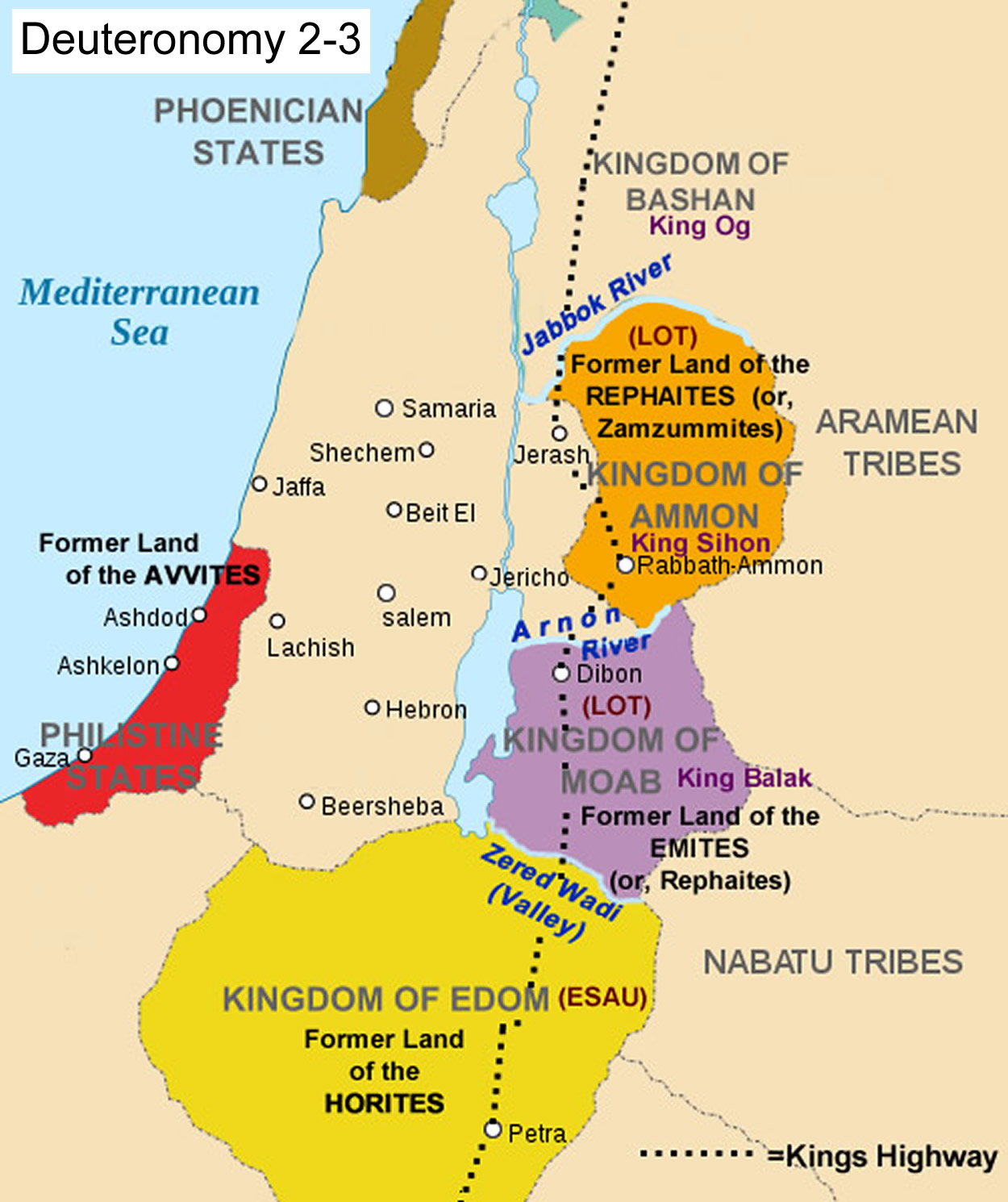
Moses makes it clear that the land in which Esau and his descendants eventually settled was far from empty. It had been occupied by another group of people known as the Horites. The first mention we have of them is found in Genesis 14, where they are listed among a group of nations that were defeated by an alliance of four kings. This confederation of kings attacked and defeated the people living in the area around Mount Seir,  in the far south of Canaan. They ended up conquering the cities of Sodom and Gomorrah, taking captive all the citizens, including the nephew of Abraham.

When Esau separated from his brother, Jacob, he ended up settling in the very same region as the Horites and, eventually, his sons and their children would supplant the Horites as the official inhabitants of the land. Hundreds of years later, when Moses prepared to lead the people of Israel into the promised land, he would receive instruction from God regarding this southern region and its inhabitants.

“You are about to pass through the territory of your brothers, the people of Esau, who live in Seir; and they will be afraid of you. So be very careful. Do not contend with them, for I will not give you any of their land, no, not so much as for the sole of the foot to tread on, because I have given Mount Seir to Esau as a possession.” – Deuteronomy 2:4-5 ESV

Moses records that Esau and his clan didn’t simply overwhelm the Horites with their superior numbers and strength, but that God orchestrated the transference of the land from one group to the other.

“…he [God] destroyed the Horites before them and they dispossessed them and settled in their place even to this day.” – Deuteronomy 2:22 ESV

The leader of the Horites was a man named Seir, and a large mountain in the region aptly bore his name. The Horites proved to be quite prolific, as the genealogy found in verses 20-43 reflects. But the chiefs of Seir and the chiefs of Esau would end up engaged in an ongoing conflict over control of the land around Mount Seir.

These are the sons of Dishan: Uz and Aran. These are the chiefs of the Horites: the chiefs Lotan, Shobal, Zibeon, Anah, Dishon, Ezer, and Dishan; these are the chiefs of the Horites, chief by chief in the land of Seir. – Genesis 36:28-30 ESV

These are the names of the chiefs of Esau, according to their clans and their dwelling places, by their names: the chiefs Timna, Alvah, Jetheth, Oholibamah, Elah, Pinon, Kenaz, Teman, Mibzar, Magdiel, and Iram; these are the chiefs of Edom (that is, Esau, the father of Edom), according to their dwelling places in the land of their possession. – Genesis 436:40-43 ESV

These two groups of “chiefs” or leaders of their clans would have gone head-to-head in battle with one another over control of the land. But what is interesting is that Moses provides a list of the kings who ruled over the land of Edom, and not one chief among the Horites or Edomites can be found on that list. It contains the name of eight Edomite kings, but none appear to be sons of Esau or Seir. In fact, one is referred to as a Temanite, another hales from Rehoboth, and still another comes from a place called Masrekah.  This sequential order of kings seems to reveal that there was a constant shift of power among the people groups that occupied this region. And Moses points out that the land of Edom had many kings long before the nation of Israel had their first monarch. Part of the reason for this disparity is that the people of Israel would eventually make their way to Egypt where they would remain for 400 years. During that time, the land of Edom would go through a long list of kings, chiefs, and leaders, while the Israelites were biding their time in Egypt. But the land of promise, like Edom, would not go unoccupied during the Israelites’ long absence. Canaan would be filled with nations, and overrun by the sins of idolatry and immorality.

And by the time Moses led the people of Israel back into the land, the  descendants of Esau (the Edomites) would be well established around Mount Seir. In keeping with God’s directive, the Israelites would view Edom as off-limits, restricting themselves to the purchase of food and supplies, but avoiding the confiscation of any Edomite territory because it had been given to them by God. And Moses states, “So we went on, away from our brothers, the people of Esau, who live in Seir, away from the Arabah road from Elath and Ezion-geber (Deuteronomy 2:8 ESV).

All of this sets up the next section of Moses’ historical record of the people of Israel. While Esau and his descendants were busy making themselves at home in Edom, Israel and his descendants would be continuing the nomadic lifestyle established by Abraham and Isaac. Moses opens up chapter seven with the statement: “Jacob lived in the land of his father’s sojournings, in the land of Canaan” (Genesis 37:1 ESV).

The Hebrew word that Moses used is מָגוּר (māḡûr), which can also be translated “to be a stranger.” That is why the New Living Translation translates verse 1 this way: “So Jacob settled again in the land of Canaan, where his father had lived as a foreigner.

Isaac, like his father before him, lived in the land of Canaan, more like an alien and a stranger than as a legal citizen. Neither Abraham or Isaac lived in a city or built a permanent dwelling place. They were sojourners, moving from one place to another, and never staying long enough to consider anywhere in the land of Canaan as their true home. And it is the author of the book of Hebrews who explains the reason behind this vagabond existence that was passed down from father to sin to grandson.

It was by faith that Abraham obeyed when God called him to leave home and go to another land that God would give him as his inheritance. He went without knowing where he was going. And even when he reached the land God promised him, he lived there by faith—for he was like a foreigner, living in tents. And so did Isaac and Jacob, who inherited the same promise. Abraham was confidently looking forward to a city with eternal foundations, a city designed and built by God. – Hebrews 11:8-10 NLT

And the author of Hebrews indicates that Abraham, Isaac, and Jacob never got to see that city – in their lifetimes.

All these people died still believing what God had promised them. They did not receive what was promised, but they saw it all from a distance and welcomed it. They agreed that they were foreigners and nomads here on earth. – Hebrews 11:13 NLT

The Edomites had kings and kingdoms. Even the Horites had a long list of chiefs and enjoyed that benefit of living in cities built by human hands. But the people of God would have to wait a long time before they experienced the fulfillment of God’s promise. God had promised to give them the land of Canaan as their inheritance, but neither Abraham, Isaac, or Jacob would make ever find their permanent home in the land of promise because God had something better in store.

Obviously people who say such things are looking forward to a country they can call their own. If they had longed for the country they came from, they could have gone back. But they were looking for a better place, a heavenly homeland. That is why God is not ashamed to be called their God, for he has prepared a city for them. – Hebrews 11:14-15 NLT

The wait would be difficult but well worth it.

English Standard Version (ESV) The Holy Bible, English Standard Version. ESV® Permanent Text Edition® (2016). Copyright © 2001 by Crossway Bibles, a publishing ministry of Good News Publishers.

New Living Translation (NLT) Holy Bible, New Living Translation, copyright © 1996, 2004, 2015 by Tyndale House Foundation. Used by permission of Tyndale House Publishers Inc., Carol Stream, Illinois 60188. All rights reserved.

New English Translation (NET)NET Bible® copyright ©1996-2017 by Biblical Studies Press, L.L.C. http://netbible.com All rights reserved.

Buried in the Land of Promise

1 Sarah lived 127 years; these were the years of the life of Sarah. And Sarah died at Kiriath-arba (that is, Hebron) in the land of Canaan, and Abraham went in to mourn for Sarah and to weep for her. And Abraham rose up from before his dead and said to the Hittites, “I am a sojourner and foreigner among you; give me property among you for a burying place, that I may bury my dead out of my sight.” The Hittites answered Abraham, “Hear us, my lord; you are a prince of God among us. Bury your dead in the choicest of our tombs. None of us will withhold from you his tomb to hinder you from burying your dead.” Abraham rose and bowed to the Hittites, the people of the land. And he said to them, “If you are willing that I should bury my dead out of my sight, hear me and entreat for me Ephron the son of Zohar, that he may give me the cave of Machpelah, which he owns; it is at the end of his field. For the full price let him give it to me in your presence as property for a burying place.”

10 Now Ephron was sitting among the Hittites, and Ephron the Hittite answered Abraham in the hearing of the Hittites, of all who went in at the gate of his city, 11 “No, my lord, hear me: I give you the field, and I give you the cave that is in it. In the sight of the sons of my people I give it to you. Bury your dead.” 12 Then Abraham bowed down before the people of the land. 13 And he said to Ephron in the hearing of the people of the land, “But if you will, hear me: I give the price of the field. Accept it from me, that I may bury my dead there.” 14 Ephron answered Abraham, 15 “My lord, listen to me: a piece of land worth four hundred shekels of silver, what is that between you and me? Bury your dead.” 16 Abraham listened to Ephron, and Abraham weighed out for Ephron the silver that he had named in the hearing of the Hittites, four hundred shekels of silver, according to the weights current among the merchants.

17 So the field of Ephron in Machpelah, which was to the east of Mamre, the field with the cave that was in it and all the trees that were in the field, throughout its whole area, was made over 18 to Abraham as a possession in the presence of the Hittites, before all who went in at the gate of his city. 19 After this, Abraham buried Sarah his wife in the cave of the field of Machpelah east of Mamre (that is, Hebron) in the land of Canaan. 20 The field and the cave that is in it were made over to Abraham as property for a burying place by the Hittites. Genesis 23:1-20 ESV

For 62 years, Abraham and Sarah had lived together as husband and wife in the land of Canaan. Since the day God had called Abraham out of Haran, this couple had spent over a half-century wandering through the land that God had promised to give Abraham as an inheritance. But other than a small plot and a well that he had purchased from Abimelech in Beersheba, Abraham never owned any real estate of significance. The author of the book of Hebrews describes Abraham’s nomadic lifestyle, living in tents and caring for his flocks and herds.

…when he reached the land God promised him, he lived there by faith—for he was like a foreigner, living in tents. – Hebrews 11:9 NLT

And yet, God had repeatedly promised to give Abraham all the land of Canaan as his inheritance.

“Look as far as you can see in every direction—north and south, east and west. I am giving all this land, as far as you can see, to you and your descendants as a permanent possession. – Genesis 13:14-15 NLT

“I have given this land to your descendants, all the way from the border of Egypt to the great Euphrates River — the land now occupied by the Kenites, Kenizzites, Kadmonites, Hittites, Perizzites, Rephaites, Amorites, Canaanites, Girgashites, and Jebusites.” – Genesis 15:18-21 NLT

Now, 62 years after arriving in the land that was to be his inheritance, Abraham lost the woman who had been his constant companion. She had born him the son through whom the promises of God would be fulfilled. This woman had endured decades of infertility. She had put up with Abraham’s occasional displays of lousy leadership. In fact, on two separate occasions, her husband had sold her as a concubine in order to save his own skin. Of course, Sarah had not been an icon of virtue and righteousness. As she had grown increasingly more frustrated with her own barrenness and God’s apparent inability to fulfill His promise, she had attempted to provide a solution. Her bright idea to have Abraham sire a son through her Egyptian handmaid had worked, but it only resulted in conflict and not an heir. Sarah grew jealous of Hagar and her son, eventually having them exiled and disinherited – twice.

But despite Sarah’s many malevolent machinations, God eventually rewarded her with a son of her own. At the ripe old age of 90, she had given birth to Isaac. And now, 37 years later, Sarah breathed her last. Her death took place at Kiriath-arba, which would later become known as Hebron. Her death, while probably not unexpected, hit Abraham hard. After a proper period of mourning, he made an appeal to the local occupants of the land, requesting permission to purchase a burial site. This request is significant because it reveals Abraham’s commitment to the land of promise. Since Abraham and Sarah were both natives of Ur in Mesopotamia, it would have been acceptable for him to return to their native land and bury her body there. Yet, he wanted to inter his wife’s remains in Canaan, the land that God had promised to give him as an inheritance.

Moses reveals that Abraham approached the sons of Heth. According to Genesis 10, these would have been the direct descendants of Canaan, the grandson of Noah.

Canaan fathered Sidon his firstborn and Heth, and the Jebusites, the Amorites, the Girgashites, the Hivites, the Arkites, the Sinites, the Arvadites, the Zemarites, and the Hamathites. Afterward the clans of the Canaanites dispersed. And the territory of the Canaanites extended from Sidon in the direction of Gerar as far as Gaza, and in the direction of Sodom, Gomorrah, Admah, and Zeboiim, as far as Lasha. – Genesis 10:15-19 ESV

While the English Standard Version refers to these occupants of Canaan as Hittites, they should not be confused with the much-later Hittite Empire that came out of Asia Minor. These were Canaanites, the descendants of Ham’s son, and they occupied and controlled the land surrounding Hebron. So, Abraham was forced to negotiate with the sons of Heth in order to purchase a burial site.

“Here I am, a stranger and a foreigner among you. Please sell me a piece of land so I can give my wife a proper burial.” – Genesis 23:4 NLT

This entire transaction, while conducted with civility and politeness, is actually little more than a protracted case of bartering over a purchase price for the land. As a foreigner, Abraham had no right to own land in Hebron and was totally subject to the whims of the sons of Heth. What makes this story so intriguing is that land was one of the greatest assets a man could own. The ownership of land was critical to a family’s survival and it was carefully passed down from generation to generation. So, Abraham knew that his request for land was going to cost him dearly. He would have to pay a premium and was more than willing to do so. And what makes this so ironic is that, according to God, all this land was Abraham’s rightful inheritance. He was having to purchase what was already rightfully his.

But Abraham played the game and negotiated with the sons of Heth. What takes place appears to be a well-orchestrated legal transaction between Abraham and Ephron, the property’s legal owner. According to local custom, Abraham attempts to broker the deal in full view of the elders of the community. They will serve as witnesses to the agreement. And, with the sons of Heth acting as mediators, Abraham negotiated the details of the transaction with Ephron.

What takes place next is a kind of dance between the two men. Abraham offers to pay full price for the land, but Ephron plays the part of the gracious and overly generous patron by offering to give it to Abraham as a gift. But Abraham knew this offer was insincere and simply a bargaining tool. Ephron was attempting to portray himself as disinterested in profiting from Abraham’s loss. But Abraham reiterated his offer to pay full price for the land. This led Ephron to respond with a highly inflated asking price. Despite all his outward displays of feigned sorrow and sympathy, Ephron was taking full advantage of Abraham’s predicament. He knew he had the unfortunate widower right where he wanted him. And his price of 400 shekels of silver must have brought a sly grin to the faces of his neighbors. They knew this was highway robbery. But Abraham didn’t bat an eye.

So Abraham agreed to Ephron’s price and paid the amount he had suggested—400 pieces of silver, weighed according to the market standard. The Hittite elders witnessed the transaction. – Genesis 23:16 NLT

And Moses points out that, upon the exchange of the 100 pounds of silver, the land “was transferred to Abraham as his permanent possession in the presence of the Hittite elders at the city gate” (Genesis 23:18 NLT). At this point in his long tenure in Canaan, Abraham owned two pieces of land. He owned a well and the plot on which it was located in Beersheba, and he owned a burial cave in Hebron. One represented life while the other was a symbol of death.

Abraham had already experienced much life in the land of Canaan. Now, he was experiencing the pain and sorrow of death. But he remained committed to the land because he believed in the promises of God. Over the years, this burial plot would be put to good use. Abraham, Isaac, Rebekah, Jacob, and Leah would all be buried there. And this burial site would remain the property of Abraham for generations to come. So, almost half a millennium later, when the descendants of Abraham returned to the land of Canaan from their 400 years of captivity in Egypt, “the cave of the field of Machpelah east of Mamre (that is, Hebron) in the land of Canaan” (Genesis 23:19 ESV), would still belong to Abraham. And, in time, God would expand the landholdings of Abraham to include all of Canaan, just as He had promised.

In life and in death, Abraham would remain fully committed to the promise of God. This great patriarch of the Hebrew nation would eventually die and be buried alongside his wife in Hebron. But the author of Hebrews portrays Abraham as having died in faith, resting, even in death, on the future promises of God.

These all died in faith, not having received the things promised, but having seen them and greeted them from afar, and having acknowledged that they were strangers and exiles on the earth. For people who speak thus make it clear that they are seeking a homeland. If they had been thinking of that land from which they had gone out, they would have had opportunity to return. But as it is, they desire a better country, that is, a heavenly one. Therefore God is not ashamed to be called their God, for he has prepared for them a city. – Hebrews 11:13-16 ESV

English Standard Version (ESV) The Holy Bible, English Standard Version. ESV® Permanent Text Edition® (2016). Copyright © 2001 by Crossway Bibles, a publishing ministry of Good News Publishers.

New Living Translation (NLT) Holy Bible, New Living Translation, copyright © 1996, 2004, 2015 by Tyndale House Foundation. Used by permission of Tyndale House Publishers Inc., Carol Stream, Illinois 60188. All rights reserved.

New English Translation (NET)NET Bible® copyright ©1996-2017 by Biblical Studies Press, L.L.C. http://netbible.com All rights reserved.

God Begins Again

1 Then the Lord said to Noah, “Go into the ark, you and all your household, for I have seen that you are righteous before me in this generation. Take with you seven pairs of all clean animals, the male and his mate, and a pair of the animals that are not clean, the male and his mate, and seven pairs of the birds of the heavens also, male and female, to keep their offspring alive on the face of all the earth. For in seven days I will send rain on the earth forty days and forty nights, and every living thing that I have made I will blot out from the face of the ground.” And Noah did all that the Lord had commanded him.

Noah was six hundred years old when the flood of waters came upon the earth. And Noah and his sons and his wife and his sons’ wives with him went into the ark to escape the waters of the flood. Of clean animals, and of animals that are not clean, and of birds, and of everything that creeps on the ground, two and two, male and female, went into the ark with Noah, as God had commanded Noah. 10 And after seven days the waters of the flood came upon the earth.

11 In the six hundredth year of Noah’s life, in the second month, on the seventeenth day of the month, on that day all the fountains of the great deep burst forth, and the windows of the heavens were opened. 12 And rain fell upon the earth forty days and forty nights. 13 On the very same day Noah and his sons, Shem and Ham and Japheth, and Noah’s wife and the three wives of his sons with them entered the ark, 14 they and every beast, according to its kind, and all the livestock according to their kinds, and every creeping thing that creeps on the earth, according to its kind, and every bird, according to its kind, every winged creature. 15 They went into the ark with Noah, two and two of all flesh in which there was the breath of life. 16 And those that entered, male and female of all flesh, went in as God had commanded him. And the Lord shut him in.

17 The flood continued forty days on the earth. The waters increased and bore up the ark, and it rose high above the earth. 18 The waters prevailed and increased greatly on the earth, and the ark floated on the face of the waters. 19 And the waters prevailed so mightily on the earth that all the high mountains under the whole heaven were covered. 20 The waters prevailed above the mountains, covering them fifteen cubits deep. 21 And all flesh died that moved on the earth, birds, livestock, beasts, all swarming creatures that swarm on the earth, and all mankind. 22 Everything on the dry land in whose nostrils was the breath of life died. 23 He blotted out every living thing that was on the face of the ground, man and animals and creeping things and birds of the heavens. They were blotted out from the earth. Only Noah was left, and those who were with him in the ark. 24 And the waters prevailed on the earth 150 days. Genesis 7:1-24 ESV

For the second time in his narrative of Noah’s life, Moses asserts that he “did all that the Lord had commanded him.”  And while it is easy to take this statement at face value, it’s sometimes difficult to understand just how remarkable a feat Noah’s obedience really was. So, three times in chapter seven alone, Moses attempts to emphasize the incredible nature of Noah’s faithful adherence to the far-from-simple assignment given to him by God.

In chapter six, Moses recorded the detailed instructions given by God to Noah for constructing a massive ark.

Make for yourself an ark of cypress wood. Make rooms in the ark, and cover it with pitch inside and out.  This is how you should make it: The ark is to be 450 feet long, 75 feet wide, and 45 feet high.  Make a roof for the ark and finish it, leaving 18 inches from the top. Put a door in the side of the ark, and make lower, middle, and upper decks. – Genesis 6:14-16 NET

It has been estimated that, when completed, this giant boat contained 1 million cubic feet of space. It was as long as 1-1/2 football fields and as tall as a 4-story building. It was less a navigable vessel than a floating shipping container. Having no rudder or sail, this boat was designed to weather the coming floodwaters and provide shelter for Noah, his immediate family, and all the pairs of living creatures God was commanded Noah to collect and protect.

The scale of this project was massive and, even by today’s modern construction standards, it would have posed an impossible feat for one man to pull off. Yet, Noah did it. And nowhere along the way does Noah balk at God’s far-fetched and seemingly impossible assignment. At no point does he question God’s wisdom, second-guess God’s plan, or express doubt in his own ability to pull off such a strange and seemingly impossible task. Noah simply did as he was told.

Moses described Noah as a righteous and blameless man who “walked with God” (Genesis 6:9 ESV). This was a man who lived his life in keeping with God’s will. Over his lifetime, Noah had developed an intimate relationship with God and had learned to trust God for all his needs. Unlike his peers, Noah’s life was not marked by unbridled wickedness and unrighteousness. He was far from perfect, but when compared to the rest of humanity, he was blameless in his generation. It seems that Noah had developed a track record of obeying God. Even the author of Hebrews points out Noah’s penchant for taking God at His word and faithfully following His command.

He obeyed God, who warned him about things that had never happened before. – Hebrews 11:7 NLT

The sheer scale of this project would suggest a rather lengthy construction timeline. The number of trees that had to be harvested and milled would have been staggering. There is no way to ascertain how Noah managed to accomplish a project of this magnitude, even with the help of his three sons. Perhaps God intervened and miraculously provided the materials required to construct the ark. But the text doesn’t seem to indicate any kind of divine superintendence. Even the collecting of the creatures was left up to Noah and his family.

This entire project took time, patience, and years of dogged determination on Noah’s part. And it’s important to remember that Noah was motivated by what he believed to be God’s pending judgment. The whole reason he was building a giant boat far from any body of water was that God had declared His plan to destroy the earth.

“Look! I am about to cover the earth with a flood that will destroy every living thing that breathes. Everything on earth will die.” – Genesis 6:17 NLT

He believed God and, as a result, he obeyed God. And for however many years it took Noah to complete his assignment, he labored faithfully and unceasingly. And the apostle Peter indicates that, while Noah worked, God withheld His judgment.

God waited patiently while Noah was building his boat. Only eight people were saved from drowning in that terrible flood. – 1 Peter 3:20 NLT

But the day finally came when Noah put the finishing touches on the ark. His work was done and now it was time for God to fulfill His covenant commitment.

“Go into the ark, you and all your household, for I have seen that you are righteous before me in this generation. – Genesis 7:1 ESV

Noah had proven his faith in God. Against all odds and contrary to human reasoning, Noah had taken God at His word and obeyed. And the author of Hebrews includes Noah among those who are enshrined in his great “Hall of Faith.”

By faith Noah, being warned by God concerning events as yet unseen, in reverent fear constructed an ark for the saving of his household. By this he condemned the world and became an heir of the righteousness that comes by faith. – Hebrews 11:7 ESV

While Noah’s ungodly neighbors continued to live in open rebellion to God, he faithfully submitted his life to the will of God. He demonstrated his complete reliance upon God by hearing and obeying the word of God. And, because of his faith, Noah was declared righteous by God. Even before commending Noah for his faith, the author of Hebrews declared the non-negotiable role that faith plays in mankind’s relationship with God.

…without faith it is impossible to please him, for whoever would draw near to God must believe that he exists and that he rewards those who seek him. – Hebrews 11:6 ESV

Noah had spent his life drawing near to God. The building of the ark was just the latest and greatest example of his complete reliance upon God. And because Noah trusted God, he was rewarded with the gift of life while everyone else around him was experiencing the judgment of death.

God did not spare the ancient world—except for Noah and the seven others in his family. Noah warned the world of God’s righteous judgment. So God protected Noah when he destroyed the world of ungodly people with a vast flood. – 2 Peter 2:5 NLT

For 150 days, Noah and his family weathered the storm that deluged the earth. They floated safely above the waters, as the rest of sinful humanity perished. This faithful man and his family were protected and preserved by God. They were graciously spared the judgment that had come upon the earth. But everything and everyone else was subjected to God’s righteous and holy wrath.

Everything on the dry land in whose nostrils was the breath of life died. He blotted out every living thing that was on the face of the ground, man and animals and creeping things and birds of the heavens. They were blotted out from the earth. Only Noah was left, and those who were with him in the ark. – Genesis 7:22-23 ESV

English Standard Version (ESV) The Holy Bible, English Standard Version. ESV® Permanent Text Edition® (2016). Copyright © 2001 by Crossway Bibles, a publishing ministry of Good News Publishers.

New Living Translation (NLT) Holy Bible, New Living Translation, copyright © 1996, 2004, 2015 by Tyndale House Foundation. Used by permission of Tyndale House Publishers Inc., Carol Stream, Illinois 60188. All rights reserved.

New English Translation (NET)NET Bible® copyright ©1996-2017 by Biblical Studies Press, L.L.C. http://netbible.com All rights reserved.