The Journey from Merit to Mercy

18 For you have not come to what may be touched, a blazing fire and darkness and gloom and a tempest 19 and the sound of a trumpet and a voice whose words made the hearers beg that no further messages be spoken to them. 20 For they could not endure the order that was given, “If even a beast touches the mountain, it shall be stoned.” 21 Indeed, so terrifying was the sight that Moses said, “I tremble with fear.” 22 But you have come to Mount Zion and to the city of the living God, the heavenly Jerusalem, and to innumerable angels in festal gathering, 23 and to the assembly of the firstborn who are enrolled in heaven, and to God, the judge of all, and to the spirits of the righteous made perfect, 24 and to Jesus, the mediator of a new covenant, and to the sprinkled blood that speaks a better word than the blood of Abel. – Hebrews 12:18-24 ESV
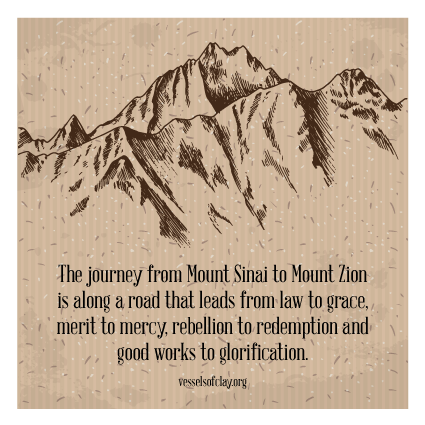
Two-MountainsThe author of Hebrews compares the Christian life to that of a long and arduous journey. Because of his Hebrew audience, he most likely had in mind the more than 40-year journey the people of Israel took to get to the land promised by God to their forefather, Abraham.

That trek had ended up being an ultra-marathon, covering thousands of miles and four decades, and it required incredible endurance and a constant awareness that there truly was a goal in mind. They were headed somewhere. The seemingly endless journey had an actual destination. Even on those days when it all felt pointless and mind-numbingly repetitious, they had to keep walking and trusting that God knew what He was doing and that Moses knew where he was going. At times, they had their doubts and felt free to make them known.

In these verses, the author contrasts Mount Sinai with Mount Zion. The first mountain was from their past. It was the place, early on in the Exodus story, where God had met with Moses and given him the Ten Commandments and the Book of the Covenant. That fateful day, when Moses prepared to ascend Mount Sinai had been a terrifying and life-changing moment for the people of God.

On the morning of the third day there were thunders and lightnings and a thick cloud on the mountain and a very loud trumpet blast, so that all the people in the camp trembled. Then Moses brought the people out of the camp to meet God, and they took their stand at the foot of the mountain. Now Mount Sinai was wrapped in smoke because the Lord had descended on it in fire. The smoke of it went up like the smoke of a kiln, and the whole mountain trembled greatly. And as the sound of the trumpet grew louder and louder, Moses spoke, and God answered him in thunder. – Exodus 19:16-19 ESV

The physical manifestations that accompanied the presence of God on the pinnacle of the mountain had left the people in a state of fear and anxiety. The Exodus account goes on to say, “when all the people saw the thunder and the flashes of lightning and the sound of the trumpet and the mountain smoking, the people were afraid and trembled, and they stood far off and said to Moses, ‘You speak to us, and we will listen; but do not let God speak to us, lest we die’” (Exodus 20:18-19 ESV).

The dramatic pyrotechnic display they witnessed that day left them terrified. None of them missed the significance or symbolism of it all. Their God was powerful, holy, transcendent, and not to be trifled with. The dramatic display on the top of Mount Sinai was intended to reinforce in their minds the holiness of God. It was also a reminder of their own sinfulness. That fact would be reinforced by God’s giving of the Ten Commandments to Moses.

But as the book of Exodus recounts, the first time Moses returned from the top of the mountain with the tablets in his hands, he found the people worshiping the golden calf. Just days after the dramatic and frightening display of God’s presence on the mountain that had left them trembling in fear, they had determined to make their own god. Moses had been gone for 40 days and the people began to doubt that he would ever return. So, in his absence, they convinced Aaron, Moses’ older brother, to fashion a false god out of their trinkets of gold.

When the people saw how long it was taking Moses to come back down the mountain, they gathered around Aaron. “Come on,” they said, “make us some gods who can lead us. We don’t know what happened to this fellow Moses, who brought us here from the land of Egypt.” – Exodus 32:1 NLT

Angered by the actions of His rebellious people, God informed Moses of His intentions to destroy them.

“I have seen how stubborn and rebellious these people are. Now leave me alone so my fierce anger can blaze against them, and I will destroy them. Then I will make you, Moses, into a great nation.” – Exodus 32:9-10 NLT

But Moses interceded on behalf of the people, pleading with God to remember the covenant He had made with Abraham.

“Change your mind about this terrible disaster you have threatened against your people! Remember your servants Abraham, Isaac, and Jacob. You bound yourself with an oath to them, saying, ‘I will make your descendants as numerous as the stars of heaven. And I will give them all of this land that I have promised to your descendants, and they will possess it forever.’” – Exodus 32:12-13 NLT

But their sinful actions produced painful consequences. That very day, God used the Levites to execute 3,000 individuals who had instigated the rebellion. So, from that day forward, the remaining Israelites would always view Mount Sinai as a symbol of God’s holiness and their own unrighteousness, and the Law God gave them would prove to be a constant reminder of their own sinfulness and incapacity to live obediently.

But for the believer, Mount Zion is a radically different mountain that represents an altogether different encounter with God. Mount Sinai was physical in nature and could be seen and touched, albeit on pain of death. Yet Mount Zion is a spiritual mountain. There is no smoke, fire, thunder, lightning, or ban against drawing near. Mount Zion is not only approachable, it is preferable. It is our final destination. It represents “the city of the living God, the heavenly Jerusalem” (Hebrews 12:22 ESV).

During the reigns of David and Solomon, Jerusalem was a powerful city, the capital of the Jewish empire. It was in Jerusalem that Solomon built the temple. It was there that the people came each year on the Day of Atonement to make sacrifices to God. As the people journeyed from the surrounding areas up to Jerusalem, they would sing the Songs of Ascent found in the Psalms. One of them says, “Those who trust in the Lord are like Mount Zion, which cannot be moved, but abides forever. As the mountains surround Jerusalem, so the Lord surrounds his people, from this time forth and forevermore” (Psalm 125:1-2 ESV).

Jerusalem, the royal city, sat on the top of Mount Zion, where it represented the presence of God. It was there that God dwelt in the Holy of Holies of the temple. It was to Zion that the people walked in order to celebrate the various feasts and festivals. It was to Mount Zion they ascended to receive forgiveness of sin and to have their relationship with God restored.

For those who have placed their faith in Jesus, Mount Zion is the final destination on their spiritual journey. It represents the believer’s heavenly home – “the city of the living God, the heavenly Jerusalem.” Christ-followers are on a journey to a place where they will encounter God, but rather than experiencing fear and trembling, they will enjoy peace, acceptance, joy, and freedom from sin and sorrow. There will be no condemnation. There will be no need for the law to remind us of God’s holy expectations. We will be holy.

There will be no conviction of sin or any need for the law to expose our sin anymore because we will be sinless. In a sense, the Christian life is a journey from one mountain to another. It is a long, sometimes difficult trip away from the mountain where man’s relationship with God was marked by law, rule-keeping, disobedience, fear, and failure. It is a daily walk toward another mountain where we will find complete forgiveness, the redemption of our bodies, and our final glorification.

Paul reminds us, “But our citizenship is in heaven, and from it we await a Savior, the Lord Jesus Christ, who will transform our lowly body to be like his glorious body” (Philippians 3:20-21 ESV).

We are on our way to Mount Zion. That is our final destination. It is our home. And while the journey there may seem long and at times difficult, we must keep our eye on the prize. We must never turn back to Mount Sinai, marked by rules and a constant reminder of our guilt and sin. Mount Zion is our home, where we will be with all those who have gone before us and enjoy unbroken fellowship with God and “Jesus, the mediator of a new covenant” (Hebrews 12:24 ESV).

English Standard Version (ESV) The Holy Bible, English Standard Version. ESV® Permanent Text Edition® (2016). Copyright © 2001

New Living Translation (NLT) Holy Bible, New Living Translation, copyright © 1996, 2004, 2015 by Tyndale House Foundation. Used by permission of Tyndale House Publishers Inc., Carol Stream, Illinois 60188. All rights reserved.

The Grace to Grow

12 Therefore lift your drooping hands and strengthen your weak knees, 13 and make straight paths for your feet, so that what is lame may not be put out of joint but rather be healed. 14 Strive for peace with everyone, and for the holiness without which no one will see the Lord. 15 See to it that no one fails to obtain the grace of God; that no “root of bitterness” springs up and causes trouble, and by it many become defiled; 16 that no one is sexually immoral or unholy like Esau, who sold his birthright for a single meal. 17 For you know that afterward, when he desired to inherit the blessing, he was rejected, for he found no chance to repent, though he sought it with tears. – Hebrews 12:12-17 ESV

Even with your eyes focused on Jesus, the Christian life can be difficult. As sons and daughters of God, we will experience His loving discipline so that we might share in His holiness. As the author of Hebrews reminded us, “For the moment all discipline seems painful rather than pleasant, but later it yields the peaceful fruit of righteousness to those who have been trained by it” (Hebrews 12:11 ESV).

Learning to live a life of holiness in the midst of a world and culture that is diametrically opposed to it is anything but easy. But holiness is to be our goal because holiness is God’s will for us.

For this is the will of God, your sanctification –1 Thessalonians 4:3 ESV

Sanctification refers to our ongoing transformation into holiness marked by the increasing presence of righteousness. Ultimately, God’s goal for us is our glorification, the day in which we will be completely free from the influence of sin and totally righteous in His eyes, both positionally and morally. Paul puts it this way: “but we ourselves, who have the firstfruits of the Spirit, groan inwardly as we wait eagerly for adoption as sons, the redemption of our bodies. For in this hope we were saved” (Romans 8:23-24 ESV).

He told the Galatian believers, “For through the Spirit, by faith, we ourselves eagerly wait for the hope of righteousness” (Galatians 5:5 ESV). Redeemed bodies, free from the effects of the fall and a righteousness unhampered by a sin nature – that is to be our hope. That is to be our goal. Yet, while it is something promised to us in the hereafter, we are to strive for it in the here and now.

We are to “strive for peace with everyone, and for the holiness without which no one will see the Lord” (Hebrews 12:14 ESV). The Greek word translated “strive” is diōkō and it means “to seek after eagerly, earnestly endeavor to acquire” (Greek Lexicon :: G1377 (KJV). Blue Letter Bible). But it can also mean “to persecute, in any way whatever to harass, trouble, molest one.”

In this world where enmity and hostility are the norms, we are to pursue peace with all men. When the world returns our love with hatred, we are to persevere and continue to love regardless of what happens. And we are to pursue holiness in the same way, persistently and purposefully. It will not be easy. That’s why the author tells us, “take a new grip with your tired hands and strengthen your weak knees. Mark out a straight path for your feet so that those who are weak and lame will not fall but become strong” (Hebrews 12:12-13 NLT).

Notice that this is not to be an individual journey, but a shared one. The life of sanctification is to be a community affair.

Look after each other so that none of you fails to receive the grace of God. Watch out that no poisonous root of bitterness grows up to trouble you, corrupting many. Make sure that no one is immoral or godless – Hebrews 12:15-16 NLT

We have a mutual responsibility to our brothers and sisters in Christ to see that we all strive after holiness. No one is to be left behind. The pursuit of holiness is not a solo event; it is a team sport. We are members of the body of Christ and so, we are in this together.

The author warns us against three things: gracelessness, bitterness, and unholiness. Back in chapter four, he wrote, “Let us then with confidence draw near to the throne of grace, that we may receive mercy and find grace to help in time of need” (Hebrews 4:16 ESV). Grace is undeserved favor or “the merciful kindness by which God, exerting his holy influence upon souls, turns them to Christ, keeps, strengthens, increases them in Christian faith” (Greek Lexicon :: G5485 (KJV). Blue Letter Bible).

Grace is made available to us by God. But to live gracelessly is to attempt to live our lives without His help and apart from His strength. Yet, holiness is impossible without God’s help. We can’t make ourselves holy; it is a work of the Holy Spirit within us. But we can become grace-less through prayerlessness. We can fail to tap into God’s life-giving grace when we refuse to spend time in His Word and the fellowship of His people.

And gracelessness can lead to bitterness. When we fail to live in God’s grace, availing ourselves of His power, we become defeated. Our pursuit of holiness becomes nothing more than a self-fueled effort in futility. We try and fail. We strive, in our own strength, and experience nothing more than disappointment and disillusionment. This “root” can spread unseen through the body of Christ, strangling the life out of the fellowship and damaging its witness. When we see our brothers and sisters in Christ failing to avail themselves of the grace of God, we must be willing to step in and speak up. Gracelessness is infectious and highly dangerous. It can become like cancer, spreading unseen through the body of Christ, sapping the life and vitality of the people of God.

And the end result of gracelessness and bitterness is unholiness. The author describes it as defilement. The Greek word is miainō and it means “to defile, pollute, sully, contaminate, soil” (Greek Lexicon :: G3392 (KJV). Blue Letter Bible). It was a word often used to refer to the dyeing or staining of a cloth. Gracelessness can lead to bitterness and bitterness can end up contaminating the body of Christ, leaving it less than holy.

The author uses Esau as an example of unholiness. The slightly older twin brother of Jacob, Esau sold his birthright to his younger sibling for a bowl of porridge. Driven by his passions and his physical appetites, he gave up what was of value for what was temporal and, ultimately, worthless. And while he would live to regret his decision, it was irreversible. Esau was consumed with the here and now, and for the fleeting pleasure of a bowl of stew, he sold his future birthright. John Calvin describes someone like Esau as…

“…those in whom the love of the world so holds sway and prevails, that they forget heaven as men who are carried away by ambition, addicted to money and riches, given over to gluttony, and entangled with other kinds of pleasures, and give the spiritual kingdom of Christ either no place or the last place in their concerns.” – William B. Johnston, trans., Calvin’s Commentaries: The Epistle of Paul the Apostle to the Hebrews and the First and Second Epistles of St. Peter

The walk of faith can be long and arduous, but it is not impossible. Peter would have us remember, “His divine power has granted to us all things that pertain to life and godliness, through the knowledge of him who called us to his own glory and excellence, by which he has granted to us his precious and very great promises, so that through them you may become partakers of the divine nature, having escaped from the corruption that is in the world because of sinful desire” (2 Peter 1:3-4 ESV).

Through His grace, we have what we need to strive after holiness. We may experience drooping hands and weak knees, but we have the power of the indwelling Spirit at our disposal. Holiness is not only possible but it is inevitable for the Christ-follower because it is the promise of God. And our pursuit of it in this life reveals our confidence that we will receive it in full in the life to come.

English Standard Version (ESV) The Holy Bible, English Standard Version. ESV® Permanent Text Edition® (2016). Copyright © 2001

New Living Translation (NLT) Holy Bible, New Living Translation, copyright © 1996, 2004, 2015 by Tyndale House Foundation. Used by permission of Tyndale House Publishers Inc., Carol Stream, Illinois 60188. All rights reserved.

Great Gain But Not Without Pain

Consider him who endured from sinners such hostility against himself, so that you may not grow weary or fainthearted. In your struggle against sin you have not yet resisted to the point of shedding your blood. And have you forgotten the exhortation that addresses you as sons?

“My son, do not regard lightly the discipline of the Lord,
    nor be weary when reproved by him.
For the Lord disciplines the one he loves,
    and chastises every son whom he receives.”

It is for discipline that you have to endure. God is treating you as sons. For what son is there whom his father does not discipline? If you are left without discipline, in which all have participated, then you are illegitimate children and not sons. Besides this, we have had earthly fathers who disciplined us and we respected them. Shall we not much more be subject to the Father of spirits and live? 10 For they disciplined us for a short time as it seemed best to them, but he disciplines us for our good, that we may share his holiness. 11 For the moment all discipline seems painful rather than pleasant, but later it yields the peaceful fruit of righteousness to those who have been trained by it. – Hebrews 12:3-11 ESV

As we live our lives on this planet, we are to fix our eyes on Jesus, the author and perfecter of our faith. He is to be our focus. We must constantly remember that He has returned to heaven where He sits at the right hand of God the Father and, yet, He has promised to come back one day so that we might receive our glorified bodies and spend eternity with Him.

In the meantime, we must deal with the unmistakable reality that our earthy lives are marked by difficulties and even the discipline of God. This is why the author of Hebrews tells us to “Consider him who endured from sinners such hostility against himself” (Hebrews 12:3 ESV). The word, “consider” is translated from the Greek word, analogizomai, which means “to think over, consider, ponder” (Greek Lexicon :: G357 (KJV). Blue Letter Bible).

In addition to fixing our eyes on Jesus and His resurrected and glorified state in heaven, the author wants us to give careful consideration to all that Jesus went through during His earthly ministry. His time on earth was anything but easy. He was the Son of God, yet He experienced rejection, ridicule, temptation, testing, and false accusations. He was considered a liar and a lunatic. He was called a “glutton and a drunkard, a friend of tax collectors and sinners” (Matthew 11:19 ESV). He was regularly accused of blasphemy. There was even a vicious rumor that He was an illegitimate child because Joseph wasn’t His real father.

His own family thought He was crazy. The Jewish religious leadership hated Him and plotted to kill Him. To many, He was nothing more than a novelty act, a traveling miracle worker who performed inexplicable, jaw-dropping signs and wonder. To others, He was a means to an end – either for healing or even a free meal.

And to top it all off, His life ended in death, leaving the impression that His earthly ministry had been a brief and abysmal failure. But through it all, He had been doing the will of His Father in heaven.

Earlier in this same letter, the author wrote, “In the days of his flesh, Jesus offered up prayers and supplications, with loud cries and tears, to him who was able to save him from death, and he was heard because of his reverence. Although he was a son, he learned obedience through what he suffered. And being made perfect, he became the source of eternal salvation to all who obey him” (Hebrews 5:7-9 ESV).

Notice that the author qualifies what he says with the words, “in the days of his flesh.” He is specifically talking about Jesus’ incarnation, the time He spent on earth in human form. During the thirty-plus years of Jesus’ life, He experienced something He had never had to go through before: What it means to live life as a human being. He knew what it meant to grow tired, to experience pain, to hunger and thirst, to feel loneliness and sorrow. He regularly spent time in prayer to His heavenly Father, crying out “with loud cries and tears.” And he learned obedience through what He suffered. In other words, He learned what was required for a human being to obey God in the midst of all the pain, suffering, and temptations that come with life on this planet.

In chapter four, the author reminded us, “For we do not have a high priest who is unable to sympathize with our weaknesses, but one who in every respect has been tempted as we are, yet without sin” (Hebrews 4:15 ESV). Jesus knew firsthand what it was like to suffer while serving. He knew what it felt like to experience the pain of rejection while attempting to obey the will of His Father. And He knew what it was like to obey God even when doing so would result in His own death.

But the author reminds us that few, in any of us, have had to suffer as Jesus did.

In your struggle against sin you have not yet resisted to the point of shedding your blood. – Hebrews 12:4 ESV

We have not been required to experience what Jesus went through. Yet we are encouraged to “not grow weary of fainthearted.” We are to view ourselves as sons and daughters of God, living under His loving discipline, as He molds and shapes us into the likeness of His Son. God disciplines us because He loves us, in the same way a human father lovingly disciplines or corrects his son. God always has our best in mind. He longs to see us grow in Christ-likeness and increase in dependence upon Him. He wants to see us filled with and controlled by His indwelling Spirit. He desires for us to learn to rely on and rest in Him.

God “disciplines us for our good, that we may share his holiness” (Hebrews 12:10 ESV), and while the discipline of God may seem painful and unpleasant at the moment, we must always remember that it will result in “the peaceful fruit of righteousness to those who have been trained by it” (Hebrews 12:11 ESV).

God is out to make us increasingly more holy because our holiness is His ultimate goal (1 Thessalonians 4:3). In his letter to the Christians in Rome, Paul made an interesting and seemingly paradoxical statement: “…we rejoice in our sufferings, knowing that suffering produces endurance, and endurance produces character, and character produces hope, and hope does not put us to shame (Romans 5:3-5 ESV).

We rejoice in sufferings. Why? Because they teach us endurance, and endurance improves our character, and as we experience the change in our character, our hope in God is strengthened. In the end, our hope in the promises of God will not disappoint us because the day is coming when all our suffering, trials, tests, and lessons in discipline will be over. We will complete God’s earthly school of sanctification and experience our “graduation,” the glorification of our bodies, and the reward of our eternal state.

John tells us, “Dear friends, we are already God’s children, but he has not yet shown us what we will be like when Christ appears. But we do know that we will be like him, for we will see him as he really is” (1 John 3:2 ESV).

This is why we must constantly focus our eyes on Jesus, remembering what He endured and rejoicing in the reality of where He is. He suffered, but He was glorified. He was crucified but brought back to life. He came to earth but eventually returned to heaven. And one day, He is coming back to get us. When that moment arrives, our days of suffering, discipline, testing, and trials will be over.

This is what led Paul to say, “I consider that the sufferings of this present time are not worth comparing with the glory that is to be revealed to us.” (Romans 8:18 ESV). So, as we wait, we must keep our eyes on the prize. We must constantly remind ourselves that where Jesus has gone is where we truly belong. This world is not our home. It is a temporary and far-from-perfect part of our spiritual journey through which we must pass on our way to our final destination. And while the journey may at times seem difficult and the lessons of life may feel unfair, we must remember that God loves us and is transforming and preparing us for something far greater and better than this life could ever offer.

English Standard Version (ESV) The Holy Bible, English Standard Version. ESV® Permanent Text Edition® (2016). Copyright © 2001

New Living Translation (NLT) Holy Bible, New Living Translation, copyright © 1996, 2004, 2015 by Tyndale House Foundation. Used by permission of Tyndale House Publishers Inc., Carol Stream, Illinois 60188. All rights reserved.

A Firmly Fixed Faith

1 Therefore, since we are surrounded by so great a cloud of witnesses, let us also lay aside every weight, and sin which clings so closely, and let us run with endurance the race that is set before us, looking to Jesus, the founder and perfecter of our faith, who for the joy that was set before him endured the cross, despising the shame, and is seated at the right hand of the throne of God. – Hebrews 12:1-2 ESV

Let us also lay aside every weight and sin which clings so close. How?

Let us run. To where?

With endurance. For how long?

Looking to Jesus. Why?

After providing us with a long list of the faithful from history past, the author of Hebrews gives us the application: We are to do as they did.

We are to live as they lived. Each of their lives are witness to the faith life to which we have been called. It is not easy, but is filled with moments of apprehension and periods of doubt. We are told to have an assurance of things hoped for and a strong conviction in things we can’t even see. We are encouraged to take God at His word and rest in the promises He has given us, even when they seem doubtful and their fulfillment is so far out in the distance as to make them seemingly out of reach.

The two verses above are beautifully composed and provide a wonderful summary of the previous chapter, but do we believe them? Better yet, do we heed the counsel they provide? The four simple questions found at the beginning of this blog are legitimate and beg for answers. I will attempt to answer them but in reverse order.

First, why should we look to Jesus, and, better yet, what does that even mean? The New English Bible translates it as “keeping our eyes fixed on Jesus.” The New International Version says, “Let us fix our eyes on Jesus.” The English Standard Version has “looking to Jesus.”

The Greek word is aphoraō and it means “to turn the eyes away from other things and fix them on something” (Greek Lexicon :: G872 (KJV). Blue Letter Bible). This definition provides us with invaluable insight into what it means for us to look to Jesus. This word does not refer to a casual glance or one-time look but to an ongoing focus bordering on fixation. We are to look to Jesus and not take our eyes off of Him and, in doing so, we inevitably have to take our eyes off of other things.

But first things first. What does it mean to look to Jesus? How are we supposed to pull that off when we can’t even see Him? The Scriptures provide us with some insight. Jesus Himself told the Jewish religious leaders,  “But from now on the Son of Man shall be seated at the right hand of the power of God” (Luke 22:69 ESV). Stephen, just moments before he was stoned to death, received a vision of Jesus.

But he, full of the Holy Spirit, gazed into heaven and saw the glory of God, and Jesus standing at the right hand of God. And he said, “Behold, I see the heavens opened, and the Son of Man standing at the right hand of God.” – Acts 7:55-56 ESV

Paul provided the believers in Rome with insight into the location or whereabouts of Jesus. Who is to condemn? Christ Jesus is the one who died—more than that, who was raised—who is at the right hand of God, who indeed is interceding for us” (Romans 8:34 ESV). On another occasion, Paul told the Ephesian believers that the Father of glory “raised him [Jesus] from the dead and seated him at his right hand in the heavenly places, far above all rule and authority and power and dominion, and above every name that is named, not only in this age but also in the one to come” (Ephesians 1:16-21 ESV).

So where is Jesus? He is seated at the right hand of the Father in heaven. So when the author of Hebrews tells us to look to Jesus, to fix our eyes on Jesus, he is not simply telling us to rely on Him. He is encouraging us to remember where He is and what He is doing at this moment. Paul tells us, “Christ Jesus is the one who died—more than that, who was raised—who is at the right hand of God, who indeed is interceding for us” (Romans 8:34 ESV).

Jesus is in heaven, and it is from there that He intercedes for us. It is from there that He will one day return for us. And it is to there that He will take us.

Just prior to His death, Jesus told His disciples, “Let not your hearts be troubled. Believe in God; believe also in me. In my Father’s house are many rooms. If it were not so, would I have told you that I go to prepare a place for you? And if I go and prepare a place for you, I will come again and will take you to myself, that where I am you may be also” (John 14:1-3 ESV). Heaven is our destination. Eternal life with God the Father and Jesus Christ His Son is the objective. We must never forget where Jesus is because that is where we are going. That is the ultimate fulfillment of the promise of God. Our salvation culminates with our glorification. 

When will our glorification take place? We don’t know. Which is why we need endurance. Jesus didn’t tell us when He would return. He didn’t tell us how long we would have to wait. But that is where faith comes in. It is the assurance of things hoped for. But do we hope for His return? Do we long for His coming? Do we prefer heaven over earth and our future life to our current one?

Like Abraham, are we “looking forward to the city that has foundations, whose designer and builder is God” (Hebrews 11:10 ESV)? We must remain fixated on where Jesus is because that is where we belong and where we are going. And we are to run in that direction. That must be the primary aim and objective of our lives. To do so effectively,  we must lay aside every weight and sin which clings so close. The things of this earth can only inhibit our progress toward heaven, not enhance it. Earthly things can become distractions and weigh us down from the pursuit of our heavenly calling. That is why the apostle John reminded us:

Do not love this world nor the things it offers you, for when you love the world, you do not have the love of the Father in you. For the world offers only a craving for physical pleasure, a craving for everything we see, and pride in our achievements and possessions. These are not from the Father, but are from this world. And this world is fading away, along with everything that people crave. But anyone who does what pleases God will live forever. – 1 John 2:15-17 NLT

Jesus is to be our model for life. When He lived on this earth, He had a clear focus and calling. He knew why He had come and what He was to do. He also knew where He was going. The author of Hebrews tells us this concerning Jesus:

…who for the joy that was set before him endured the cross, despising the shame, and is seated at the right hand of the throne of God. – Hebrews 12:2 ESV

Jesus endured. He had a future-focused faith. He ran the race with endurance, looking forward to His return to heaven and His reunion with His Heavenly Father. He knew His time on this earth was temporary. His suffering would be intense but impermanent. His humiliation would result in His resurrection. His death would end in life. His agony would result in glory.

We must keep our eyes fixed on Jesus. To do so, we have to take our eyes off the things of this world. We can’t live as if this is our home. We can’t afford to act as if this is our final destination. Focusing on where Jesus is will help us remember that heaven is where we belong. Our true home will be with Him and God the Father. Paul summed it up well when he wrote. “For I consider that the sufferings of this present time are not worth comparing with the glory that is to be revealed to us.” (Romans 8:18 ESV).

And there are countless millions of faithful “witnesses” who have gone ahead of us into God’s presence and whose lives bear witness to the truth of God’s word and the reality of His promises. They cheer us on from their vantage point in heaven, shouting out their words of encouragement to keep the faith and run the race with endurance. They have achieved their eternal reward and eagerly and enthusiastically challenge us to fix our eyes on Jesus and our hope fixated on the finish line of faith.

English Standard Version (ESV) The Holy Bible, English Standard Version. ESV® Permanent Text Edition® (2016). Copyright © 2001

New Living Translation (NLT) Holy Bible, New Living Translation, copyright © 1996, 2004, 2015 by Tyndale House Foundation. Used by permission of Tyndale House Publishers Inc., Carol Stream, Illinois 60188. All rights reserved.

Well Worth the Wait

39 And all these, though commended through their faith, did not receive what was promised, 40 since God had provided something better for us, that apart from us they should not be made perfect. – Hebrews 11:39-40 ESV

Now that we’ve reached the end of the chapter, let’s go back through the list of the faithful again.

Abel died at the hands of his brother. Enoch was taken by God in the prime of life. Noah survived the flood that destroyed the earth, only to watch sin raise its ugly head again and infect his own family. Abraham would never occupy the land God had promised to give him, and he would die long before his offspring would grow to be as numerous as the stars in the sky. Sarah would bear a son in spite of her old age and barrenness but die without ever giving birth again. Isaac would watch his sons, Jacob and Esau, spend years of their lives separated from and loathing one another. Jacob would die in the land of Egypt, the patriarch of a family that numbered no more than 70 – not exactly a mighty nation as God had promised. Moses led the people of Israel to the promised land but never stepped foot into it himself because of his sin against God. The people of Israel made it into the land but failed to obey God’s commands and eventually ended up being removed by God and forced to live in exile in Babylon. For Rahab, other than her mention in the lineage of Jesus, she passed into obscurity, living among the people of Israel.

Their life stories, while marked by faith, are not all pictures of the good life. Their lives were not trouble-free or devoid of difficulty and doubt. They are recognized for their faith, but the author makes it clear that though they lived lives of faith, they also experienced their fair share of trials and troubles. He describes those who were tortured for their faith, “refusing to accept release, so that they might rise again to a better life” (Hebrews 11:35 ESV).

These unnamed but faith-filled individuals refused to recant their faith in God even under the pain of torture. Instead, they trusted that, should they die, God would raise them again to eternal life. The author speaks of women who “received back their dead by resurrection” (Hebrews 11:35 ESV). I don’t think this means that their dead loved ones were raised back to life, but that these women had faith that they would see them again in heaven. They were willing to suffer loss in this life because of their faith in the life to come.

What is amazing is that the author makes it clear that many on his list “did not receive what was promised” (Hebrews 11:39 ESV). Why? Because the promise was future-oriented. The fulfillment of the promise made to Abraham was ultimately fulfilled in Christ. His death and resurrection opened up the gospel to all people. No longer would the Jews be the sole beneficiaries of God’s blessings. Today, people from every tribe, nation, and tongue have placed their faith in Jesus Christ and have become part of the family of Abraham. The book of Revelation tells us of a scene that will take place in the future where all the offspring of Abraham, both Jew and Gentile, will gather before the throne of God.

After this I looked, and behold, a great multitude that no one could number, from every nation, from all tribes and peoples and languages, standing before the throne and before the Lamb, clothed in white robes, with palm branches in their hands, and crying out with a loud voice, “Salvation belongs to our God who sits on the throne, and to the Lamb!” – Revelation 7:9-10 ESV

Abraham longed to see that day and died believing that it would come. He was a living, breathing example of the author’s definition of faith.

Faith is the assurance of things hoped for, the conviction of things not seen. – Hebrews 11:1 ESV

Each of the individuals in the Hebrews 11 list received something better in the end. Because of their faith in the promises of God, they eventually received entrance into His presence. Ultimately, their faith was in the hope of God’s redemption. None of them lived long enough to see the coming of Jesus into the world. Yet, they lived their lives longing for a Messiah, a deliverer from the sin that surrounded them. Paul tells us, “But the Scripture imprisoned everything under sin, so that the promise by faith in Jesus Christ might be given to those who believe” (Galatians 3:22 ESV).

This includes those who lived before the coming of Christ. Their belief in the promises and power of God was considered by God to be faith in the coming Messiah. They were willing to trust God with their present circumstances, knowing that He had a future solution in mind.

Ultimately, their faith was in God. They trusted Him for things they could not see. They had hope for the future because they had an assurance that He could deliver what He had promised. They were able to endure because they believed He would come through. And every promise God made to these individuals was finally realized in the coming of Jesus Christ. He was and is mankind’s hope. And while they may not have fully realized it, every one of the people in the Hebrews “Hall of Faith” was placing their faith in Christ; God’s redeemer, deliverer, savior, sinless sacrifice, and the ultimate key to experiencing all the blessings God has in store.

Abraham lived in tents all of his life, but we’re told “he was looking forward to the city that has foundations, whose designer and builder is God” (Hebrews 11:10 ESV). He knew that God had something better in store for him and he died believing in that reality. But Abraham was not alone. The author of Hebrews tells us that every one of the individuals on his list “died in faith, not having received the things promised, but having seen them and greeted them from afar” (Hebrews 11:13 ESV).

They knew something better was in store for them, so they were willing to live as “strangers and exiles on the earth” (Hebrews 11:13 ESV). They desired “a better country, that is, a heavenly one” (Hebrews 11:16 ESV). They put their faith in God and their hope in something they could not see. “Therefore God is not ashamed to be called their God, for he has prepared for them a city” (Hebrews 11:16 ESV). And the Book of Revelation paints a vivid picture of what that long-awaited city will look like when it comes.

Then I saw a new heaven and a new earth, for the first heaven and the first earth had passed away, and the sea was no more. And I saw the holy city, new Jerusalem, coming down out of heaven from God, prepared as a bride adorned for her husband. And I heard a loud voice from the throne saying, “Behold, the dwelling place of God is with man. He will dwell with them, and they will be his people, and God himself will be with them as their God. He will wipe away every tear from their eyes, and death shall be no more, neither shall there be mourning, nor crying, nor pain anymore, for the former things have passed away.” And he who was seated on the throne said, “Behold, I am making all things new.” Also he said, “Write this down, for these words are trustworthy and true.” And he said to me, “It is done! I am the Alpha and the Omega, the beginning and the end. To the thirsty I will give from the spring of the water of life without payment. The one who conquers will have this heritage, and I will be his God and he will be my son. Revelation 21:1-7 ESV

English Standard Version (ESV) The Holy Bible, English Standard Version. ESV® Permanent Text Edition® (2016). Copyright © 2001

New Living Translation (NLT) Holy Bible, New Living Translation, copyright © 1996, 2004, 2015 by Tyndale House Foundation. Used by permission of Tyndale House Publishers Inc., Carol Stream, Illinois 60188. All rights reserved.

Faith Is Simple, But Never Easy

32 And what more shall I say? For time would fail me to tell of Gideon, Barak, Samson, Jephthah, of David and Samuel and the prophets— 33 who through faith conquered kingdoms, enforced justice, obtained promises, stopped the mouths of lions, 34 quenched the power of fire, escaped the edge of the sword, were made strong out of weakness, became mighty in war, put foreign armies to flight. 35 Women received back their dead by resurrection. Some were tortured, refusing to accept release, so that they might rise again to a better life. 36 Others suffered mocking and flogging, and even chains and imprisonment. 37 They were stoned, they were sawn in two, they were killed with the sword. They went about in skins of sheep and goats, destitute, afflicted, mistreated— 38 of whom the world was not worthy—wandering about in deserts and mountains, and in dens and caves of the earth. – Hebrews 11:32-38 ESV

The list goes on. The author of Hebrews draws this chapter to a close, but can’t help but add a few more names to his growing list of the faithful. He mentions Gideon, who lived in Israel during a time of spiritual apathy and moral depravity. As a result of their rebellious behavior, God gave the Israelites over to the hands of the Midians as punishment.

For whenever the Israelites planted crops, the Midianites and the Amalekites and the people of the East would come up against them. They would encamp against them and devour the produce of the land, as far as Gaza, and leave no sustenance in Israel and no sheep or ox or donkey. – Judges 6:3-4 ESV

But when the people cried out to God, He sent them Gideon as a judge to deliver them. But Gideon was a reluctant deliverer. When God called him, his response was less than enthusiastic.

Please, Lord, how can I save Israel? Behold, my clan is the weakest in Manasseh, and I am the least in my father’s house. – Judges 6:15 ESV

And God’s response to him was simple and direct: “But I will be with you, and you shall strike the Midianites as one man” (Judges 6:16 ESV). Gideon would go on to accomplish great things for God, delivering His people from the oppression of the Midianites and, according to the book of Hebrews, he did so by faith. Each step of the way, Gideon had to believe God’s promise that He would be with him.

This is true of each of the individuals listed in the verses above. Barak had to face the overwhelmingly superior armies of Sisera on the words of Deborah, a prophetess. The odds were against him, but He obeyed the word of the Lord and God gave Israel a great victory.

Then there was Samson, a somewhat surprising addition to the list. His story is a sad one and does not end well. He was driven by his desires and eventually defeated by them. But on the final day of his life, having been blinded by the Philistines and chained between two pillars, he called out to God in faith.

O Lord God, please remember me and please strengthen me only this once, O God, that I may be avenged on the Philistines for my two eyes.” – Judges 16:28 ESV

That prayer of faith lifted up in his vulnerable and weak condition was answered by God.

Then he bowed with all his strength, and the house fell upon the lords and upon all the people who were in it. So the dead whom he killed at his death were more than those whom he had killed during his life. – Judges 16:30 ESV

He died in faith, trusting in His God and giving the last minutes of his life to destroy the enemies of God.

What about Jephthah? He had been born as a result of his father’s immoral affair with a prostitute, and when he became an adult, Jephthah was thrown out of the family by his brothers. He ended up living in exile from his family and found himself in the companionship of “worthless men.” But when the Ammonites began to oppress the Israelites, they sought out Jephthah to deliver them because he was a mighty warrior. In his newfound position as the judge of Israel, Jephthah turned to the Lord, and he made a vow to God.

If you will give the Ammonites into my hand, then whatever comes out from the doors of my house to meet me when I return in peace from the Ammonites shall be the Lord‘s, and I will offer it up for a burnt offering.” – Judges 11:30-31 ESV

Jephthah believed that God could and would deliver His people. But he wrongly assumed that God would want something in return, so he bargained with God. I suggest that Jephthah fully believed that God would come through and that he would be required to follow through on his vow. But little did he know that after God had given him the victory over the Ammonites, it would be his own daughter who came out of the house to greet him, and he would go on to keep his rash vow and sacrifice his daughter.

This is a bizarre and disturbing story, and it seems a bit strange to include the “hero” of the story in the great “Hall of Faith.” But while Jephthah’s understanding of God was somewhat flawed, he did believe in the power and deliverance of God. He trusted that Yahweh could and would come through. His problem was that his faith in God was marred by a faulty comprehension of God’s nature.

In the case of David, the stories that exemplify his faith in God are many. The psalms he wrote echo his belief in God and his unwavering faith that God was his savior and sustainer. From the moment David was anointed the next king of Israel, he had to live a life of faith in God, spending years trusting in the promise of God while running for his life from the wrath of King Saul. He had been anointed king by the prophet of God, but Saul was still on the throne. David learned to wait on God, believe in God, trust in God, and rely on God. And his life reflects that faith.

From his earliest days as a young boy serving in the house of the Lord under the watchful eye of Eli the priest, Samuel developed a growing faith in God. He would become a prophet for God, speaking on his behalf and leading the people of Israel to obey the will and word of God. Samuel would eventually be called on by God to anoint Israel’s first king. And while he was reluctant to do so, he obeyed. Throughout his life, Samuel would learn to trust God. He had to believe that God knew what He was doing, even when it seemed to make no sense. His faith is best seen in his unwavering obedience to the will of God. What God said, he would do. What God declared, he would believe. Trusting that God knows what He is doing even when you can’t comprehend it or completely appreciate it is a hallmark of faith.

The author of Hebrews goes on to illustrate that faith is oftentimes accompanied by rousing success, including great military victories. Faith is often illustrated by strength in the midst of weakness, deliverance by the hand of God, and mind-blowing miracles. But just as often, faith can be accompanied by less-than-ideal circumstances. He mentions torture, mocking, flogging, chains, imprisonment, stoning, destitution, and even death.

Faith doesn’t always result in a happy ending. Samson died under the very rubble that destroyed the Philistines. David died never getting to build the temple he dreamed of constructing for God. Jephthah would see the accolades for the victory over the Ammonites go to a woman.

The focus of our faith should always be God. Faith is trusting Him regardless of what we see happening or not happening around us. The presence of difficulty does not mean the absence of God. The lack of an answer is not proof of God’s lack of power or interest. Faith that is God-focused is willing to wait and comfortable accepting seemingly unacceptable outcomes knowing that God is not yet done.

English Standard Version (ESV) The Holy Bible, English Standard Version. ESV® Permanent Text Edition® (2016). Copyright © 2001

New Living Translation (NLT) Holy Bible, New Living Translation, copyright © 1996, 2004, 2015 by Tyndale House Foundation. Used by permission of Tyndale House Publishers Inc., Carol Stream, Illinois 60188. All rights reserved.

Faith That Changed the World

31 By faith Rahab the prostitute did not perish with those who were disobedient, because she had given a friendly welcome to the spies. – Hebrews 11:31 ESV

The Israelites followed the strange-sounding commands of God and enjoyed a lopsided victory over the city of Jericho. This first battle in their efforts to occupy the land of Canaan had gone off without a hitch because they followed God’s instructions down to the last detail. But now the story gets really interesting.

Up to this point in the chapter, the author of Hebrews has been dealing with some fairly significant and well-known individuals in the family tree of Israel – Abel, Enoch, Noah, Abraham, Sarah, Isaac, Joseph, and by extension, Joshua. But it should catch us a bit by surprise to find the name of a prostitute in this great “Hall of Faith.”

To understand her presence in this list of the faithful we have to go back to the original story found in the book of Joshua. When it came time for the people of Israel to begin their God-ordained occupation of the land of Canaan, Joshua sent out spies to reconnoiter the cities on the western side of the Jordan River.

And Joshua the son of Nun sent two men secretly from Shittim as spies, saying, ‘Go, view the land, especially Jericho.’ And they went and came into the house of a prostitute whose name was Rahab and lodged there. – Joshua 2:1 ESV

There are a lot of details left out of this story. We aren’t told why the spies chose Rahab’s home as a safe house. Had they been given her name by someone else? Were they aware that she was a follower of Yahweh? Did they choose a prostitute’s house because they believed no one would think to look for them there? Or was their selection of her house because of its location within the walls of the city (Joshua 2:15)?

The passage doesn’t provide us with answers to these questions. But we do know that someone informed on the two spies, and the king of Jericho sent soldiers to Rahab’s house to find them.

Then the king of Jericho sent to Rahab, saying, “Bring out the men who have come to you, who entered your house, for they have come to search out all the land.” – Joshua 2:3 ESV

But rather than turn the two spies over to the king’s soldiers, Rahab chose to protect them and even concocted a story that diverted the soldiers from her home, giving the men time to escape.

But the woman had taken the two men and hidden them. And she said, “True, the men came to me, but I did not know where they were from. And when the gate was about to be closed at dark, the men went out. I do not know where the men went. Pursue them quickly, for you will overtake them.” – Joshua 2:4-5 ESV

But why did this woman take such a dangerous risk? Because she was a God-fearer. Rahab had somehow heard about the God of Israel and believed in Him. News of God’s powerful and miraculous deliverance of the Israelites’ captivity in Egypt had gotten out, and Rahab determined that their God must be the one true God. Without realizing it, she was living out the truth of the following verse.

…without faith it is impossible to please him, for whoever would draw near to God must believe that he exists and that he rewards those who seek him. – Hebrews 11:6 ESV

Rahab had somehow deduced that her city would prove to be no match for the God of Israel, so she chose to protect the spies and asked them to return the favor when the time came. She believed that this powerful God of the Israelites was going to destroy her hometown and she wanted to live. She greatly desired to be saved from the coming destruction.

Before the men lay down, she came up to them on the roof and said to the men, “I know that the Lord has given you the land, and that the fear of you has fallen upon us, and that all the inhabitants of the land melt away before you. For we have heard how the Lord dried up the water of the Red Sea before you when you came out of Egypt, and what you did to the two kings of the Amorites who were beyond the Jordan, to Sihon and Og, whom you devoted to destruction. And as soon as we heard it, our hearts melted, and there was no spirit left in any man because of you, for the Lord your God, he is God in the heavens above and on the earth beneath. Now then, please swear to me by the Lord that, as I have dealt kindly with you, you also will deal kindly with my father’s house, and give me a sure sign that you will save alive my father and mother, my brothers and sisters, and all who belong to them, and deliver our lives from death.” – Joshua 2:9-13 ESV

I tend to believe that the two spies inadvertently ended up at Rahab’s house and that they had no idea she was a believer in Yahweh. That would have been the last thing they expected from a woman who made her living as a prostitute in a pagan city. But according to His divine and sovereignly ordained plan, God arranged for them to go to the very house where they would find a woman who had placed her faith in the God of Israel. She was so convinced of God’s power that she knew Jericho was going to fall, and only asked that she and her family be spared. She believed with all her heart that the God of Israel was the “God in the heavens above and on the earth beneath.”

The spies made an agreement with Rahab, instructing her to tie a scarlet thread in her window. That would serve as a sign, much like the blood that was placed on the doorpost and lintels of the Israelite homes during the Passover. That red-colored thread would tell the Israelite troops to spare all the individuals found within that house. The book of Joshua reveals that when the walls of Jericho fell, Rahab and her family were protected from the devastation and escaped death.

…they devoted all in the city to destruction, both men and women, young and old, oxen, sheep, and donkeys, with the edge of the sword. But to the two men who had spied out the land, Joshua said, “Go into the prostitute’s house and bring out from there the woman and all who belong to her, as you swore to her.” – Joshua 6:22-23 ESV

The spies kept their word and Rahab was spared.

Rahab the prostitute and her father’s household and all who belonged to her, Joshua saved alive. And she has lived in Israel to this day, because she hid the messengers whom Joshua sent to spy out Jericho.Joshua 6:25 ESV

One might be tempted to say that Rahab’s faith was in the two spies. She had to trust that these men would do as they had promised. She had no guarantees from the God of Israel. She had been given no promises by Yahweh. But while it’s true that she had to have faith in the two spies, the thing that drove her actions from the outset was her belief that God was the one true God and that He would give the city into the hands of the Israelite troops. The Israelites’ God was greater. And in providing protection for the two spies, she was acknowledging that she believed in this superior God of Israel.

Hebrews 11:6 states, “…without faith it is impossible to please him [God], for whoever would draw near to God must believe that he exists and that he rewards those who seek him.” Rahab believed in God’s existence, and she was seeking His protection and the reward of her life being spared. Rahab had no track record with God. She had simply heard the stories of His deliverance of the people of Israel from their captivity in Egypt. News of His redemptive power as illustrated by the parting of the Red Sea had reached her ears. God’s role in the Israelites’ defeat of the Amorites had gotten her attention. For her, all the rumors and hearsay about God had become cause for belief. Her faith that this God was real and that He had the power to save as well as to destroy led to life, rather than death. While everyone else in the city was doomed to destruction, Rahab’s faith in God resulted in her salvation and that of her family.

Rahab would go on to spend the rest of her life living among God’s people. She would marry and have children. In fact, her name appears in the gospel of Matthew in the lineage of King David.

Abraham was the father of Isaac, and Isaac the father of Jacob, and Jacob the father of Judah and his brothers, and Judah the father of Perez and Zerah by Tamar, and Perez the father of Hezron, and Hezron the father of Ram, and Ram the father of Amminadab, and Amminadab the father of Nahshon, and Nahshon the father of Salmon, and Salmon the father of Boaz by Rahab, and Boaz the father of Obed by Ruth, and Obed the father of Jesse, and Jesse the father of David the king. – Matthew 1:2-6 ESV

But Matthew’s record of David’s lineage doesn’t stop there. His list goes on to include the name of Jesus, the Messiah of Israel. Not only did Rahab’s faith result in the sparing of her own life, but it paved the way for the coming of Jesus, the Savior of the world. Her faith saved her and her family, but it had much longer-lasting repercussions. Out of faith in God, she gave a friendly welcome to the spies, and that faith would result in her redemption but also pave the way for the coming of the Redeemer of the world.

English Standard Version (ESV) The Holy Bible, English Standard Version. ESV® Permanent Text Edition® (2016). Copyright © 2001

New Living Translation (NLT) Holy Bible, New Living Translation, copyright © 1996, 2004, 2015 by Tyndale House Foundation. Used by permission of Tyndale House Publishers Inc., Carol Stream, Illinois 60188. All rights reserved.

Walking in Faith

30 By faith the walls of Jericho fell down after they had been encircled for seven days. – Hebrews 11:30 ESV

Moses was gone. An entire generation of Israelites had died during their forty years of wandering in the wilderness, all because they had refused to believe God and enter the land He had promised them. Their disobedience had brought God’s judgment and that generation would never enter the rest that God had promised to provide for them.

Now, Joshua led a new generation of Israelites into the promised land. They would not just waltz into the land and take over without a fight. The occupants of the land of Canaan were going to have a real problem with the descendants of Abraham showing up and making claims that the land belonged to them because Yahweh, their God, had given it to them. The land and all its provisions were not going to come without a fight. But God would give some important news to Israel’s new leader, Joshua.

When Joshua was by Jericho, he lifted up his eyes and looked, and behold, a man was standing before him with his drawn sword in his hand. And Joshua went to him and said to him, “Are you for us, or for our adversaries?” And he said, “No; but I am the commander of the army of the Lord. Now I have come.” And Joshua fell on his face to the earth and worshiped and said to him, “What does my lord say to his servant?” And the commander of the Lord‘s army said to Joshua, “Take off your sandals from your feet, for the place where you are standing is holy.” And Joshua did so. – Joshua 5:13-15 ESV

This occasion is reminiscent of Moses’ experience at the burning bush. Joshua, like Moses, had a personal and up-close encounter with God Himself in the form of a theophany. Joshua saw what he believed to be a man and this stranger announced himself as the commander of the army of the Lord. The word “commander” can be translated as “prince” or “captain.” Some believe that this “man” was actually the pre-incarnate Christ, and Joshua’s immediate reaction reveals his awareness that he was speaking with more than just a man. He fell on his face and worshiped. The very next chapter records the words that the commander of the army of the Lord shared with Joshua.

Now Jericho was shut up inside and outside because of the people of Israel. None went out, and none came in. And the Lord said to Joshua, “See, I have given Jericho into your hand, with its king and mighty men of valor. You shall march around the city, all the men of war going around the city once. Thus shall you do for six days. Seven priests shall bear seven trumpets of rams’ horns before the ark. On the seventh day you shall march around the city seven times, and the priests shall blow the trumpets. And when they make a long blast with the ram’s horn, when you hear the sound of the trumpet, then all the people shall shout with a great shout, and the wall of the city will fall down flat, and the people shall go up, everyone straight before him.” – Joshua 6:1-5 ESV

These instructions must have sounded strange to Joshua. The city of Jericho was the very first city they encountered after crossing the Jordan River and entering Canaan, it was well-fortified and heavily armed. Yet, the Lord was telling Joshua that He would give the city into their hands. But the conditions for achieving this victory were a bit odd.

The Lord was explicit in His details, leaving nothing to chance or to Joshua’s imagination. For six days, they would make a single circuit around the walls of the city. No arrows would be fired. No spears would be thrown. Imagine the reactions they would have gotten from the people inside the city and the soldiers looking down on this strange spectacle from the tops of the walls. Safely ensconced within their walled fortress,  the citizens of Jericho would have hurled taunts and rained down ridicule on the hapless Israelites as Joshua led them on the bizarre parade around the city walls.

The men of Israel would have struggled with feelings of shame and embarrassment as they marched in a silent column around the city, listening to their enemies question their sanity and manhood. Their swords hung at their side, unused. They were exerting their energy walking in circles rather than fighting their enemy. Under the direction of Joshua, the fighting men of Israel faithfully obeyed the instructions of the commander of the army of the Lord.

The armed men were walking before the priests who were blowing the trumpets, and the rear guard was walking after the ark, while the trumpets blew continually. – Joshua 6:9 ESV

No one said a word. No one fired off a single arrow. And in keeping with the commander’s instructions, no one could respond to the jeers and insults coming from behind the walls of Jericho. But the people of Israel continued to walk day after day for six days. But then the seventh day came.

On the seventh day they rose early, at the dawn of day, and marched around the city in the same manner seven times. It was only on that day that they marched around the city seven times. And at the seventh time, when the priests had blown the trumpets, Joshua said to the people, “Shout, for the Lord has given you the city. And the city and all that is within it shall be devoted to the Lord for destruction.” – Joshua 6:15-17 ESV

This day was going to be different. Six days of seemingly pointless activity were going to be followed by an incredible miracle from God. Just as they had the previous six days, the people marched in silence, but this time they circled the city seven times. And after their final trip around the city, “the people shouted, and the trumpets were blown. As soon as the people heard the sound of the trumpet, the people shouted a great shout, and the wall fell down flat, so that the people went up into the city, every man straight before him, and they captured the city. Then they devoted all in the city to destruction, both men and women, young and old, oxen, sheep, and donkeys, with the edge of the sword” (Joshua 6:20-21 ESV).

For seven days they had walked and waited. For a solid week, they had done as they had been told. They had been faithful and obedient to the Lord’s command. That doesn’t mean they didn’t struggle with doubts or questions regarding the Lord’s plan. There was most likely a fair share of grumbling and grousing around the campfires at night. The people probably wondered if Joshua had really heard from God at all. There was probably a lot of Monday morning quarterbacking going on.

But they walked. For seven days they did as they had been told. Their walking was evidence that they were trusting God. They didn’t know exactly how the walls were going to fall because God had not explained that part of the plan. But they knew the role they were assigned to play. They were to march. They were to obey. And they were to wait on the Lord.

God’s plan required that their pride take a back seat. Their physical abilities had to be used for walking and not fighting. But as the author of Hebrews tells us, “by faith the walls of Jericho fell down.”

It wasn’t their faith that caused the walls to fall. That miraculous accomplishment was God’s doing. But their faith was instrumental in God’s power being unleashed and put on display. Had they stopped walking, the walls would not have fallen. Had they decided to take up their swords and attack the city in their own strength, the outcome would have been radically different.

Their faith was in God. Over a seven-day period, they maintained an “assurance of things hoped for, the conviction of things not seen” (Hebrews 11:1 ESV). They kept walking because they believed God would deliver a victory. They were convinced it would happen, not because they marched but because their God had promised it. Their marching was simply an expression of their faith in God. Sometimes trusting God requires us to step out – in faith – and walk in seemingly meaningless circles. We have to do what appears to be pointless and sometimes even ridiculous so that God can prove His faithfulness.

But if we truly trust God, walking and waiting is well worth the effort. He always comes through – in His way and according to His will. The walls will fall. The victory will come. The enemy will be defeated. And our obedience will further increase our faith in His power, provision, and protection.

English Standard Version (ESV) The Holy Bible, English Standard Version. ESV® Permanent Text Edition® (2016). Copyright © 2001

New Living Translation (NLT) Holy Bible, New Living Translation, copyright © 1996, 2004, 2015 by Tyndale House Foundation. Used by permission of Tyndale House Publishers Inc., Carol Stream, Illinois 60188. All rights reserved.

Faith is the Victory

29 By faith the people crossed the Red Sea as on dry land, but the Egyptians, when they attempted to do the same, were drowned. – Hebrews 11:29 ESV

After God had destroyed the firstborn of Egypt, including the son of Pharaoh, the Egyptians were ready to show the Israelites the door.

All the Egyptians urged the people of Israel to get out of the land as quickly as possible, for they thought, “We will all die!” – Exodus 12:33 NLT

Not only did they urge them to leave, they literally paid them to do so, just as God had said they would.

And the people of Israel did as Moses had instructed; they asked the Egyptians for clothing and articles of silver and gold. The Lord caused the Egyptians to look favorably on the Israelites, and they gave the Israelites whatever they asked for. So they stripped the Egyptians of their wealth! – Exodus 12:25-26 NLT

And they marched out, more than a million strong, under the leadership of Moses and the direction of God. This is where the story gets interesting. The Israelites are free to go and have their pockets lined with the treasures of the former Egyptian overlords. But watch what God does next.

When Pharaoh finally let the people go, God did not lead them along the main road that runs through Philistine territory, even though that was the shortest route to the Promised Land. – Exodus 13:17 NLT

Instead, “God led them in a roundabout way through the wilderness toward the Red Sea” (Exodus 13:18 NLT). In other words, God sent them on the less direct route, and not only that, He eventually had them do a U-turn.

Then the Lord gave these instructions to Moses: “Order the Israelites to turn back and camp by Pi-hahiroth between Migdol and the sea. Camp there along the shore, across from Baal-zephon.” – Exodus 14:1-2 NLT

They were headed right back to where they had started. At this point, the people must have begun to question Moses’ leadership skills or, at the least, his sense of direction. Their sudden about-face and march back toward Egypt would have made no sense. But God provided Moses with the method to His seeming madness.

“Pharaoh will think, ‘The Israelites are confused. They are trapped in the wilderness!’ And once again I will harden Pharaoh’s heart, and he will chase after you. I have planned this in order to display my glory through Pharaoh and his whole army. After this the Egyptians will know that I am the Lord!’ So the Israelites camped there as they were told.” – Exodus 14:3-4 NLT

God was not done with Pharaoh. This stubborn, egotistical, and self-proclaimed god had dared to do battle with Yahweh and despite all the plagues his people had suffered, his overblown sense of pride would not allow him to admit defeat. So, God had one last surprise for the recalcitrant Pharaoh. God knew that once Pharaoh heard that the Israelites were camped nearby, he would change his mind once again and go on the attack. What happened next was all part of God’s plan.

Pharaoh didn’t disappoint. As soon as news of the Israelites’ circuitous trek reached his ears, he assembled his army, complete with 600 chariots, and went in hot pursuit of his former slaves. Much to his surprise and delight, Pharaoh found the Israelites camped along the banks of the Red Sea. He had them trapped. They had nowhere to run and no way to resist the might of his army. And he wasn’t the only one to recognize the dire nature of the situation.

As Pharaoh approached, the people of Israel looked up and panicked when they saw the Egyptians overtaking them. They cried out to the Lord, and they said to Moses, “Why did you bring us out here to die in the wilderness? Weren’t there enough graves for us in Egypt? What have you done to us? Why did you make us leave Egypt?  Didn’t we tell you this would happen while we were still in Egypt? We said, ‘Leave us alone! Let us be slaves to the Egyptians. It’s better to be a slave in Egypt than a corpse in the wilderness!’” – Exodus 14:10-12 NLT

The newly freed Israelites were not happy. The arrival of Pharaoh’s army had them in a full-blown panic. And yet, the author of Hebrews states, “By faith the people crossed the Red Sea as on dry land.”

In the Exodus account, these people appear to be anything but faithful. In fact, they don’t seem to display any faith at all – either in God or Moses. They were scared, disillusioned, and confused. This was not what they had been expecting. Everything had looked so promising when they marched out of Egypt with their pockets filled with treasure. The future was bright and their hopes were high. But now they were facing potential annihilation by the Egyptian army.

They were in a bad spot. They were in a jam. Their circumstances could not have been any worse. But remember, God had led them there. This entire scenario was all part of His divinely ordained and predetermined plan. What looked like the beginning of an unmitigated disaster was actually going to be a scene of divine deliverance.

Moses knew something the people didn’t know, so he calmly encouraged them to resist the urge to panic and run.

Fear not, stand firm, and see the salvation of the Lord, which he will work for you today. For the Egyptians whom you see today, you shall never see again. The Lord will fight for you, and you have only to be silent.” – Exodus 14:13-14 ESV)

His words must have sounded like the ravings of a madman. How was Yahweh going to eck out a victory from this lopsided showdown between unarmed former slaves and the chariots of Egypt?

But what they failed to realize was that they had front-row seats to what would be the greatest show on earth. Despite the circumstances surrounding them, they had nothing to fear because God was with them. So, Moses encouraged them to stand their ground. But look closely. He doesn’t give them the choice between fight or flight. Running away would prove pointless. But attempting to go toe-to-toe with the Egyptian army would not bode well either. No, Moses simply told them to fear not and stand firm. They had no other responsibility than to watch God work. And we know the rest of the story.

Moses stretched out his hand over the sea, and the Lord drove the sea back by a strong east wind all night and made the sea dry land, and the waters were divided. And the people of Israel went into the midst of the sea on dry ground, the waters being a wall to them on their right hand and on their left. – Exodus 14:21-22 ESV

There are those who say that the people of Israel displayed no faith. The faith to which the author of Hebrews refers must have been that of Moses. After all, it was his faith that got them across the sea. But the Exodus passage makes it clear that “the people of Israel went into the midst of the sea” (Exodus 14:22 ESV).

First of all, they had to heed Moses’ admonition to stop fearing, stand firm, and see the salvation of the Lord. The temptation to run would have been strong. Fear, doubt, and pessimism would have been natural and normal reactions to such a devastatingly difficult situation.

Yet, each and every one of them had to place their sandals on the ground between those two walls of standing water. They had to take that initial step of faith and walk the path that God had provided. It would have been scary. It would have been intimidating. They would have had doubts along the way, wondering if the walls of water would suddenly crash down, drowning them all. And it would have taken a long time for more than a million people to make that crossing. The ones in the back of the line must have been wondering if they would ever make it across before Pharaoh’s army caught up with them. And yet, “By faith the people crossed the Red Sea as on dry land.”

Their salvation required that they step out in obedience. They had to walk if they wanted to live. They had to take the path God had provided, in spite of their fears, doubts, and apprehensions.

As we walk on this earth as followers of Christ, we will find ourselves facing difficult and sometimes disillusioning circumstances. God’s path for us is not always easy and doesn’t always make sense. There will be days filled with doubts and fears, second thoughts, and last-minute temptations to stop in our tracks and refuse to walk the path God has placed before us. But in those moments, we must remember the words of Moses, “Fear not, stand firm, and see the salvation of the Lord” (Exodus 14:13 ESV).

That doesn’t mean our fear is sin. It simply means that, at some point, we have to stop fearing and start trusting. We have to remember that God is in control and He has a plan for our lives. The path He lays out before us may seem illogical and even dangerous at times. His solution may appear worse than the problem we’re facing. But we must learn to trust Him and step out in faith.

The people of Israel doubted, but they walked. They feared, but they took the first step. When there had been no way of escape, God provided one. And they took it – in faith – weak and wavering as that faith may have been. And because they walked by faith, they arrived at the other side and were able to watch as God destroyed the enemy they had formerly feared. With their own eyes, they witnessed the salvation of the Lord.

English Standard Version (ESV) The Holy Bible, English Standard Version. ESV® Permanent Text Edition® (2016). Copyright © 2001

New Living Translation (NLT) Holy Bible, New Living Translation, copyright © 1996, 2004, 2015 by Tyndale House Foundation. Used by permission of Tyndale House Publishers Inc., Carol Stream, Illinois 60188. All rights reserved.

It All Begins With Faith

28 By faith he kept the Passover and sprinkled the blood, so that the Destroyer of the firstborn might not touch them. – Hebrews 11:28 ESV

The author of Hebrews skips over a large section of the biography of Moses, leaping straight from his hasty departure from Egypt after killing another Egyptian to the days just prior to his second departure when he led the entire nation of Israel into the wilderness. The account in Hebrews leaves out large, seemingly significant sections of Moses’ life, including his call at the burning bush, his somewhat reluctant return to Egypt, his encounters with Pharaoh, and the first nine plagues. Yet, all of these events in Moses’ life required faith. From the moment God called Moses in Midian and told him he would be the deliverer of God’s people, Moses had to have faith in the word of God.

When God had appeared to him at the burning bush in Midian, He told Moses:

“I have surely seen the affliction of my people who are in Egypt and have heard their cry because of their taskmasters. I know their sufferings, and I have come down to deliver them out of the hand of the Egyptians and to bring them up out of that land to a good and broad land, a land flowing with milk and honey, to the place of the Canaanites, the Hittites, the Amorites, the Perizzites, the Hivites, and the Jebusites. And now, behold, the cry of the people of Israel has come to me, and I have also seen the oppression with which the Egyptians oppress them.– Exodus 3:7-9 ESV

This would have been good news to Moses. But then he heard the rest of God’s plan.

Come, I will send you to Pharaoh that you may bring my people, the children of Israel, out of Egypt.” – Exodus 3:10 ESV

Moses was reluctant, even resistant to God’s plan. But God told him, “I will be with you, and this shall be the sign for you, that I have sent you: when you have brought the people out of Egypt, you shall serve God on this mountain” (Exodus 3:12 ESV). God had given Moses a promise; an assurance that he was the one to do the job. God would be with him and God would bring him and the people of Israel back to the very same spot – Mount Horeb, also known as Mount Sinai. God went on to tell Moses the rest of His plan.

“But I know that the king of Egypt will not let you go unless compelled by a mighty hand.  So I will stretch out my hand and strike Egypt with all the wonders that I will do in it; after that he will let you go. And I will give this people favor in the sight of the Egyptians; and when you go, you shall not go empty, but each woman shall ask of her neighbor, and any woman who lives in her house, for silver and gold jewelry, and for clothing. You shall put them on your sons and on your daughters. So you shall plunder the Egyptians.” – Exodus 23:19-22 ESV

So Moses eventually obeyed God, and everything went just as God had said.; all the way up to the point to which the author of Hebrews refers in verse 28 of chapter 11. There was going to be one last plague that God would bring to the land of Egypt. And while the first nine had been troubling and even devastating at times, the final plague would be deadly. God warned Pharaoh through His servant Moses.

Thus says the Lord: ‘About midnight I will go out in the midst of Egypt, and every firstborn in the land of Egypt shall die, from the firstborn of Pharaoh who sits on his throne, even to the firstborn of the slave girl who is behind the handmill, and all the firstborn of the cattle.’” – Exodus 11:4-5 ESV

While God had protected the people of Israel from most of the other plagues, this one was going to be nationwide and non-discriminatory. All the first-born males throughout the land would die, both man and animal, including the firstborn of the Israelites – unless they followed God’s directions.

On the tenth day of the month, every household was to select a lamb – a one-year-old, unblemished male lamb. They were to “keep it until the fourteenth day of this month, when the whole assembly of the congregation of Israel shall kill their lambs at twilight” (Exodus 12:6 ESV). What the Israelites were to do next was not left up to their imaginations or up for debate.

“Then they shall take some of the blood and put it on the two doorposts and the lintel of the houses in which they eat it. They shall eat the flesh that night, roasted on the fire; with unleavened bread and bitter herbs they shall eat it. Do not eat any of it raw or boiled in water, but roasted, its head with its legs and its inner parts. And you shall let none of it remain until the morning; anything that remains until the morning you shall burn. In this manner you shall eat it: with your belt fastened, your sandals on your feet, and your staff in your hand. And you shall eat it in haste. It is the Lord‘s Passover. For I will pass through the land of Egypt that night, and I will strike all the firstborn in the land of Egypt, both man and beast; and on all the gods of Egypt I will execute judgments: I am the Lord. The blood shall be a sign for you, on the houses where you are. And when I see the blood, I will pass over you, and no plague will befall you to destroy you, when I strike the land of Egypt. – Exodus 12:7-13 ESV

The people of Israel were instructed to take the blood of their lambs and sprinkle it on the doorposts and lentils of their homes. This final step was essential for their salvation. God had told them, “For the Lord will pass through to strike the Egyptians, and when he sees the blood on the lintel and on the two doorposts, the Lord will pass over the door and will not allow the destroyer to enter your houses to strike you” (Exodus 12:23 ESV).

The blood of the innocent lamb would protect them. But this entire process would require both faith and obedience. Of all the plagues, this one hit the closest to home – literally. If the people of Israel failed to follow God’s commands, they would suffer the same fate as the Egyptians. Their protection and preservation required faith and action. And Moses led the way.

He placed his faith in God and did as he was told to do. The whole scenario must have sounded bizarre to Moses. There was no precedent for killing a lamb and sprinkling its blood as a form of protection from death. The sacrificial system had not yet been given. In addition, this would have been a costly command to keep because as shepherds the people of Israel put a high value on their livestock, especially those that were one year old and without blemish. A male lamb would have been prime breeding stock and invaluable to the future value of the flock.

God’s plan would have sounded far-fetched and fairly sketchy to most of the Israelites. They most likely had doubts as to whether it would work. You can imagine their fear and dismay as the “destroyer” passed over the city that night and they heard the cries coming from the homes of all those who had lost a firstborn. They would have wondered if the blood would work. But as the dawn came and they discovered their firstborn alive and well, they were greatly relieved. But what saved them from the pain of death and loss was not the quantity or quality of their faith, but the presence of the blood. The death angel looked for the sign of the blood. It was the blood of the unblemished lamb that saved them, not their faith. It was God who protected them, not their faith. Their faith was simply an instrument through which they expressed their trust in God. Moses and the people had to put their faith in God’s plan of salvation. And when they did, it worked. 

So, the author of Hebrews states that it was Moses’ faith in the word of God that ultimately convinced the people of God to sprinkle the blood on their doorposts and lentils. He believed what God had said, and his faith was influential and infectious. By faith, he obeyed the command of God. By faith, he instructed the people of God. His faith in God was instrumental in saving tens of thousands of firstborn Israelites. By faith, he kept the Passover and sprinkled the blood. His faith showed up in action. He took God at His word and took steps to obey God’s word. And his faith in God resulted in the salvation of God’s people. His obedience led the Israelites to do the unimaginable and sprinkle the blood of a lamb on the doorposts of their home. And because they did, they were spared the penalty and pain of death. The death angel “passed over” their homes and their firstborn were allowed to live. And it all began with Moses’ faith in God.

English Standard Version (ESV) The Holy Bible, English Standard Version. ESV® Permanent Text Edition® (2016). Copyright © 2001

New Living Translation (NLT) Holy Bible, New Living Translation, copyright © 1996, 2004, 2015 by Tyndale House Foundation. Used by permission of Tyndale House Publishers Inc., Carol Stream, Illinois 60188. All rights reserved.