The Danger of Misplaced Faith

17 By faith Abraham, when he was tested, offered up Isaac, and he who had received the promises was in the act of offering up his only son, 18 of whom it was said, “Through Isaac shall your offspring be named.” 19 He considered that God was able even to raise him from the dead, from which, figuratively speaking, he did receive him back. – Hebrews 11:17-19 ESV

There will be times when the life of faith seems illogical. By definition, it involves “the assurance of things hoped for, the conviction of things not seen” (Hebrews 11:1 ESV). Faith has a future orientation. It looks ahead and maintains an eternal perspective. Because of those things, it will be tested on this earth.

God had promised Abraham a son. There would be no plan B, no adoption of an heir, no acceptance of another son born through a slave girl. The son God had in mind would be born through Sarah, in spite of Abraham’s old age and her barrenness. Not only that, God had also promised a multitude of descendants and a land in which they would live. And God kept His word.

The Lord visited Sarah as he had said, and the Lord did to Sarah as he had promised. And Sarah conceived and bore Abraham a son in his old age at the time of which God had spoken to him. Abraham called the name of his son who was born to him, whom Sarah bore him, Isaac. And Abraham circumcised his son Isaac when he was eight days old, as God had commanded him. Abraham was a hundred years old when his son Isaac was born to him. And Sarah said, “God has made laughter for me; everyone who hears will laugh over me.” And she said, “Who would have said to Abraham that Sarah would nurse children? Yet I have borne him a son in his old age.” – Genesis 21:1-7 ESV

God came through. When Abraham had celebrated his 100th birthday, God provided him with a son. He and Sarah must have been beside themselves with joy and a deep sense of relief. They had waited so long. They had hoped for a son and now God had delivered on His promise. And they would enjoy every moment of every day with their young son, Isaac. Every time they looked at him, they would remember the faithfulness of God and realize that this young boy was the hope they had been waiting for for so long. But was he?

The day came when God gave Abraham the hardest choice he would ever make.

After these things God tested Abraham and said to him, “Abraham!” And he said, “Here I am.” He said, “Take your son, your only son Isaac, whom you love, and go to the land of Moriah, and offer him there as a burnt offering on one of the mountains of which I shall tell you.” – Genesis 22:1-2 ESV

Can you imagine the shock? Can you begin to feel the sense of incredulity Abraham must have felt? As God acknowledged in His statement to Abraham, this was his only son, the son he loved. And now God was asking; no He was commanding Abraham to offer up that long-awaited son as a sacrifice. He was telling Abraham to take the life of his own son, his only son, the one who was the key to Abraham becoming the father of a multitude of nations.

Or was he? You see, as much as we may be appalled at the idea of God commanding Abraham to make a human sacrifice, we must keep in mind that, as the Scriptures say, this was a test. It was God’s way of determining if Abraham had mistakenly transferred his hope in God to his son. Had the gift he had been given become more important than the Giver of the gift?

It’s interesting to note the response of Abraham to this shocking news from God. The Scriptures somewhat matter-of-factly record: “So Abraham rose early in the morning, saddled his donkey, and took two of his young men with him, and his son Isaac. And he cut the wood for the burnt offering and arose and went to the place of which God had told him” (Genesis 22:3 ESV).

He didn’t argue or remind God of His earlier promise. He didn’t accuse God of unfairness or injustice. He simply obeyed. While he probably didn’t understand all that was going on, he kept trusting God. When his young son asked him, “My father, behold, the fire and the wood, but where is the lamb for a burnt offering?” (Genesis 22:7 ESV), Abraham calmly replied, “God will provide for himself the lamb for a burnt offering, my son” (Genesis 22:8 ESV).

Whether Abraham was simply hiding the grim reality from his son in order to protect him or he truly believed that God would provide a substitute lamb, the passage doesn’t say. The very fact that Abraham ended up binding his son, placing him on the altar, and raising the knife to take his life, gives us ample evidence that he was willing to go through with God’s command. In his heart of hearts, Abraham trusted God and believed that He could still keep all His promises even if Isaac had to die. In fact, the author of Hebrews tells us, “He considered that God was able even to raise him from the dead” (Hebrews 11:19 ESV).

Abraham passed the test. God sent an angel to stay his hand and prevent the death of Isaac. The angel of the Lord said to Abraham, “Do not lay your hand on the boy or do anything to him, for now I know that you fear God, seeing you have not withheld your son, your only son, from me” (Genesis 22:12 ESV). Then God miraculously provided a ram caught by its horns in a thicket to act as a substitute sacrifice. Isaac was spared. Abraham had shown that his faith was in God, not his son. He had proven that he trusted the Giver more than he did the gift. His hope was in God and he had full assurance and a strong conviction that God was going to do all that He had promised, and nothing, even the death of his own son was going to prevent it from happening. He had faith in God.

God had asked Abraham to do the unthinkable. He had commanded Abraham to take the life of his only son, his most precious possession. Not only was Isaac the fulfillment of a long-awaited dream, but he was also the hope of God’s promise of a multitude of descendants taking place.

Or was he? You see, the problem we all face is the tendency to take our eyes off of God and place them on things other than Him. Isaac was not to be Abraham’s hope. He was just a boy who would grow up to be a man. But Isaac would not bring about the fulfillment of God’s promises. Only God could do that. No man or woman will ever be able to bring to fruition the promises of God. For the divine will of God to happen, it must be accomplished by God Himself. We must never take our hope off of God and place it on anyone or anything else.

Abraham’s test was one of allegiance. It was a test of his hope and, ultimately, a test of his faith. Now that he had a son, was he going to transfer his hope from God to Isaac? He passed the test. His faith was in God. His assurance of things hoped for was in God. His conviction of things not seen was in God. He had an eternal perspective that would not allow the illogical and seemingly unthinkable to deter his faith in his faithful God.

English Standard Version (ESV) The Holy Bible, English Standard Version. ESV® Permanent Text Edition® (2016). Copyright © 2001

New Living Translation (NLT) Holy Bible, New Living Translation, copyright © 1996, 2004, 2015 by Tyndale House Foundation. Used by permission of Tyndale House Publishers Inc., Carol Stream, Illinois 60188. All rights reserved.
Growing Confidence

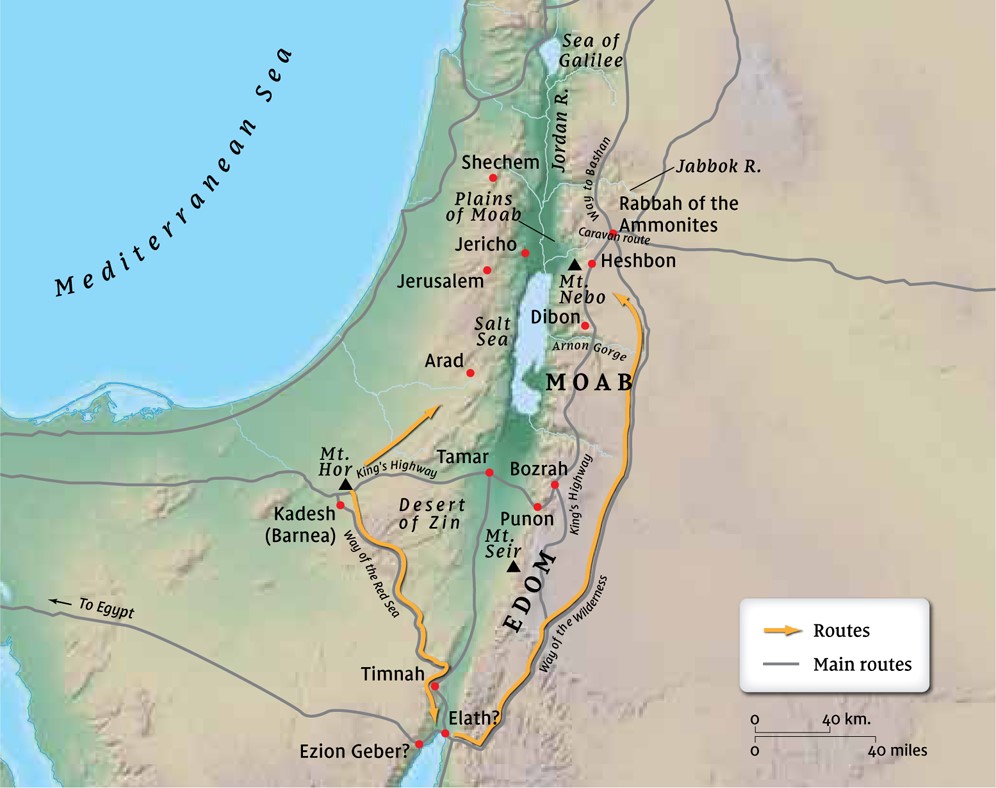
10 And the people of Israel set out and camped in Oboth. 11 And they set out from Oboth and camped at Iye-abarim, in the wilderness that is opposite Moab, toward the sunrise. 12 From there they set out and camped in the Valley of Zered. 13 From there they set out and camped on the other side of the Arnon, which is in the wilderness that extends from the border of the Amorites, for the Arnon is the border of Moab, between Moab and the Amorites. 14 Therefore it is said in the Book of the Wars of the Lord,

“Waheb in Suphah, and the valleys of the Arnon,
15 and the slope of the valleys
that extends to the seat of Ar,
and leans to the border of Moab.”

16 And from there they continued to Beer; that is the well of which the Lord said to Moses, “Gather the people together, so that I may give them water.” 17 Then Israel sang this song:

“Spring up, O well!—Sing to it!—
18 the well that the princes made,
that the nobles of the people dug,
with the scepter and with their staffs.”

And from the wilderness they went on to Mattanah, 19 and from Mattanah to Nahaliel, and from Nahaliel to Bamoth, 20 and from Bamoth to the valley lying in the region of Moab by the top of Pisgah that looks down on the desert. Numbers 21:10-20 ESV

Having been denied safe passage through the land of Edom, the Israelites had attempted to make their way through the Negev. But their efforts were hampered by the Canaanites who occupied that territory. So, they reversed their steps and headed east around the borders of Edom and on to the western borders of Moab. This would have been a long and circuitous journey that left the Israelites frustrated by their slow progress. It was an unexpected and unwelcome detour that required the people of God to extend their time in the wilderness. But there was a reason for this delay. God was waiting for the last of the rebellious generous that had refused to enter Canaan the first time to die off. In the book of Deuteronomy, Moses recalls the nearly 40-year death march the Israelites were forced to make because of their disobedience to God’s command.

“Thirty-eight years passed from the time we first left Kadesh-barnea until we finally crossed the Zered Brook! By then, all the men old enough to fight in battle had died in the wilderness, as the Lord had vowed would happen. The Lord struck them down until they had all been eliminated from the community.” – Deuteronomy 2:14-15 NLT

And as that earlier generation slowly died off, the time was growing closer when the next crop of Israelites would face the decision to obey God and enter the land of Canaan. But as they drew closer to Canaan’s border, God warned the people to give the people of Moab a wide berth.

“Do not bother the Moabites, the descendants of Lot, or start a war with them. I have given them Ar as their property, and I will not give you any of their land.” – Deuteronomy 2:9 NLT

When the very last member of the earlier generation died, the Israelites were given permission to cross the border of Moab and enter the land of Ammon,

“Today you will cross the border of Moab at Ar and enter the land of the Ammonites, the descendants of Lot. But do not bother them or start a war with them. I have given the land of Ammon to them as their property, and I will not give you any of their land.’” – Deuteronomy 2:18-19 NLT

As before, the Israelites were to refrain from taking any land from the Ammonites. These people were close relatives of the Israelites and God declared their property to be off limits. God had awarded Lot’s descendants this land and the Israelites had no claim to it.

But the day came when God ordered the Israelites to begin their conquest of the land of Canaan. The older generation was gone and, after a nearly 40-year delay, it was time for God’s people to obey His command and enter the land of promise.

“Then the Lord said, ‘Now get moving! Cross the Arnon Gorge. Look, I will hand over to you Sihon the Amorite, king of Heshbon, and I will give you his land. Attack him and begin to occupy the land. Beginning today I will make people throughout the earth terrified because of you. When they hear reports about you, they will tremble with dread and fear.’” – Deuteronomy 2:24-25 NLT

Moses attempted to negotiate a treaty with Sihon, the king of the Amorites, but he was not interested in peace talks. That’s when God informed Moses to drop the peace overtures and have the people pick up their weapons.

“Look, I have begun to hand King Sihon and his land over to you. Begin now to conquer and occupy his land.” – Deuteronomy 2:31 NLT

And the victory was overwhelming. Moses indicates that “the Lord our God handed him over to us, and we crushed him, his sons, and all his people.  We conquered all his towns and completely destroyed everyone—men, women, and children. Not a single person was spared” (Deuteronomy 2:33-34 NLT).

Moses refers to “the Book of the Wars of the Lord” (Numbers 21:14 ESV. This was a record of Israel’s victories in the form of songs. The people were just beginning to witness the overwhelming power of God on their behalf. This victory over the Amorites was to be the first of many and it was intended to promote a sense of hope and confidence among the people of God.

After their defeat of the Amorites, the Israelites continued on to Beer, where God quenched the thirst of the people with refreshing water. And the people responded in grateful song.

“Spring up, O well!
    Yes, sing its praises!
Sing of this well,
    which princes dug,
which great leaders hollowed out
    with their scepters and staffs.” – Numbers 21:17-18 NLT

Israel was experiencing a sense of renewed confidence as they witnessed firsthand the power and providence of God. He was graciously preparing them for the days ahead and helping them to understand that anything was possible when they placed their faith in Him.

But while they were getting closer to the land of Canaan, they were not quite ready to take on the challenged that lie across the border. So, God continue to prepare them for the difficult days ahead.

Their enthusiasm, while admirable, would not be enough to bring victory against the nations living in Canaan. What the Israelites really needed was increased confidence in the power of God. Ultimately, the conquest of the land would be up to Him. They were going to need to learn to trust Him implicitly. Cockiness was not an acceptable substitute for confidence in God.

English Standard Version (ESV) The Holy Bible, English Standard Version. ESV® Permanent Text Edition® (2016). Copyright © 2001

New Living Translation (NLT) Holy Bible, New Living Translation, copyright © 1996, 2004, 2015 by Tyndale House Foundation. Used by permission of Tyndale House Publishers Inc., Carol Stream, Illinois 60188. All rights reserved.

Two Daughters. Two Destinies.

17 Our eyes failed, ever watching
    vainly for help;
in our watching we watched
    for a nation which could not save.

18 They dogged our steps
    so that we could not walk in our streets;
our end drew near; our days were numbered,
    for our end had come.

19 Our pursuers were swifter
    than the eagles in the heavens;
they chased us on the mountains;
    they lay in wait for us in the wilderness.

20 The breath of our nostrils, the Lord’s anointed,
    was captured in their pits,
of whom we said, “Under his shadow
    we shall live among the nations.”

21 Rejoice and be glad, O daughter of Edom,
    you who dwell in the land of Uz;
but to you also the cup shall pass;
    you shall become drunk and strip yourself bare.

22 The punishment of your iniquity, O daughter of Zion, is accomplished;
    he will keep you in exile no longer;
but your iniquity, O daughter of Edom, he will punish;
   he will uncover your sins. – Lamentations 4:17-22 ESV

During the Babylonian siege of Jerusalem, the people of Judah had fully expected their allies, the Egyptians, to step up and rescue them. After the death of King Josiah, his son Jehoahaz had ascended to the throne, but his reign lasted a scant three months. He was imprisoned by Pharaoh and replaced on the throne by his younger brother, who agreed to pay the exorbitant tribute levied against them by the Egyptians.

Jehoahaz was twenty-three years old when he became king, and he reigned three months in Jerusalem. His mother was Hamutal the daughter of Jeremiah, from Libnah. He did evil in the sight of the Lord as his ancestors had done. Pharaoh Necho imprisoned him in Riblah in the land of Hamath and prevented him from ruling in Jerusalem. He imposed on the land a special tax of 100 talents of silver and a talent of gold. Pharaoh Necho made Josiah’s son Eliakim king in Josiah’s place, and changed his name to Jehoiakim. He took Jehoahaz to Egypt, where he died. Jehoiakim paid Pharaoh the required amount of silver and gold, but to meet Pharaoh’s demands Jehoiakim had to tax the land. He collected an assessed amount from each man among the people of the land in order to pay Pharaoh Necho. – 2 Kings 23:31-35 NLT

But this costly alliance with the Egyptians never produced the rescue they longed for. Pharaoh Necho was content to leave the people of Judah high and dry, having gladly taken their tribute money but never providing them the protection due to a vassal state. The Babylonians were the new bad boy on the block and the Egyptians chose to stay out of the fray altogether.

The king of Egypt did not march out from his land again, for the king of Babylon conquered all the territory that the king of Egypt had formerly controlled between the Stream of Egypt and the Euphrates River. – 2 Kings 24:7 NLT

Even back during the days when the Assyrians were making their way through the land of Canaan capturing city after city, Sennacherib, the king of the Assyrians, warned Judah’s King Hezekiah not to put his trust in Egypt.

“This is what the great king of Assyria says: What are you trusting in that makes you so confident? Do you think that mere words can substitute for military skill and strength? Who are you counting on, that you have rebelled against me? On Egypt? If you lean on Egypt, it will be like a reed that splinters beneath your weight and pierces your hand. Pharaoh, the king of Egypt, is completely unreliable!” – 2 Kings 18:19-22 NLT

And King Sennacherib proved to be right about Egypt. His assessment of Pharaoh’s reliability had been spot-on. But this was something God had known for some time. He had warned His people not to put their faith in military might – their own or that of their allies.

Those who go down to Egypt for help are as good as dead;
those who rely on war horses,
and trust in Egypt’s many chariots
and in their many, many horsemen.
But they do not rely on the Holy One of Israel
and do not seek help from the Lord.
Yet he too is wise and he will bring disaster;
he does not retract his decree.
He will attack the wicked nation,
and the nation that helps those who commit sin.
The Egyptians are mere humans, not God;
their horses are made of flesh, not spirit.
The Lord will strike with his hand;
the one who helps will stumble
and the one being helped will fall.
Together they will perish. – Isaiah 31:1-3 NLT

God’s people were never to have placed their hope and trust in other nations. King David himself wrote:

Now I know that the Lord saves his anointed;
    he will answer him from his holy heaven
    with the saving might of his right hand.
Some trust in chariots and some in horses,
    but we trust in the name of the Lord our God.
They collapse and fall,
    but we rise and stand upright. – Psalm 20:6-8 ESV

God was to have been their champion. He had promised to be their defender and their help against any and all adversaries. But their serial unfaithfulness to Him had left Him with no other choice but to bring judgment upon them. They had somehow decided that God was not enough. So, they put their hope in human saviors. They turned to kings and their armies when they had the King of kings on their side.

And because they chose to place their hope and trust in something other than God Almighty, they suffered the consequences. They had wrongly assumed that their king, the Lord’s anointed, would save them.

Our king—the Lord’s anointed, the very life of our nation—
    was caught in their snares.
We had thought that his shadow
    would protect us against any nation on earth! – Lamentations 4:20 NLT

But a king who fails to honor God with his life will offer no hope in times of despair. A man who neglects the wisdom of God and turns His back on the ways of God will prove to be a lousy deliverer when times get tough.

But Jeremiah wraps up this dirge with a reminder to the daughters of Edom and the daughters of Zion.

Rejoice and be glad, O daughter of Edom,
    you who dwell in the land of Uz;
but to you also the cup shall pass;
    you shall become drunk and strip yourself bare.

The punishment of your iniquity, O daughter of Zion, is accomplished;
    he will keep you in exile no longer;
but your iniquity, O daughter of Edom, he will punish;
    he will uncover your sins. – Lamentations 4:21-22 ESV

These two daughters represent two different lands: The land of Judah and the land of Babylon. The daughters of Edom living in the land of Ur or Babylon have every reason to rejoice over their great victory. Their men have returned home victorious, with great spoil, tens of thousands of captives in two, and stories of their conquest of the nation of Judah.

But Jeremiah warns them to consider tapping the brake a bit. Their enthusiasm is going to be shortlived. Yes, they were the new bully on the block and their success was undeniable. But what they didn’t realize was that their victory had been the handiwork of God. And God has a habit of putting kings on thrones and removing them at His discretion. Their 15-minutes of fame was going to be over before they knew it and, as Jeremiah points out, they will be forced to “drink from the cup of the Lord’s anger” (Lamentations 4:21 NLT). 

In contrast, Jerusalem would see an end to its exile. After 70 years in captivity, God would return a remnant of His people from the land of Babylon and allow them to rebuild and reoccupy the city of Jerusalem. The gates and walls would be restored. The temple would be refurbished. The sacrificial system would be reinstituted. And the faithful God of Judah would shower His rebellious people with His undeserved grace and mercy.

While the story looked like it had a very unhappy ending, there was more to come that the people of Judah could not see. The Babylonians looked victorious. They had been on the winning end of the equation. But God was not done. His plan was not yet complete. And the circumstances of life do not always provide an accurate assessment of reality. God was still on His throne. He was still the covenant-keeping God of Judah. He was faithful and He was far from done with His chosen people.

English Standard Version (ESV)
The Holy Bible, English Standard Version. ESV® Permanent Text Edition® (2016). Copyright © 2001 by Crossway Bibles, a publishing ministry of Good News Publishers.

New Living Translation (NLT)
Holy Bible, New Living Translation, copyright © 1996, 2004, 2015 by Tyndale House Foundation. Used by permission of Tyndale House Publishers Inc., Carol Stream, Illinois 60188. All rights reserved.

The Message (MSG)Copyright © 1993, 1994, 1995, 1996, 2000, 2001, 2002 by Eugene H. Peterson

Nothing Is Too Hard For You.

“After I had given the deed of purchase to Baruch the son of Neriah, I prayed to the Lord, saying: ‘Ah, Lord God! It is you who have made the heavens and the earth by your great power and by your outstretched arm! Nothing is too hard for you. You show steadfast love to thousands, but you repay the guilt of fathers to their children after them, O great and mighty God, whose name is the Lord of hosts, great in counsel and mighty in deed, whose eyes are open to all the ways of the children of man, rewarding each one according to his ways and according to the fruit of his deeds. You have shown signs and wonders in the land of Egypt, and to this day in Israel and among all mankind, and have made a name for yourself, as at this day. You brought your people Israel out of the land of Egypt with signs and wonders, with a strong hand and outstretched arm, and with great terror. And you gave them this land, which you swore to their fathers to give them, a land flowing with milk and honey. And they entered and took possession of it. But they did not obey your voice or walk in your law. They did nothing of all you commanded them to do. Therefore you have made all this disaster come upon them. Behold, the siege mounds have come up to the city to take it, and because of sword and famine and pestilence the city is given into the hands of the Chaldeans who are fighting against it. What you spoke has come to pass, and behold, you see it. Yet you, O Lord God, have said to me, “Buy the field for money and get witnesses”—though the city is given into the hands of the Chaldeans.’” Jeremiah 32:16-25 ESV

If anybody but God had recommended to Jeremiah that he make a long-term investment in real estate located in Judah, he would have told them to take a hike. But when God commanded that Jeremiah buy land from his cousin, Hanamel, he obeyed. No, it didn’t make any sense. Paying good money for land that had been confiscated by the occupying forces of King Nebuchadnezzar had to have seemed like a lousy investment strategy – even to Jeremiah. But he did what the Lord commanded. Then he prayed. And in his prayer, he communicated to God his confusion over what had just transpired. But first, he started by praising God for His great power. He acknowledge that God was the creator of the universe. He acknowledged God’s unfailing love, but also noted that God was just and righteous, giving people exactly what they deserve. He confessed that God had a reputation for doing great things for His people, having delivered them from captivity in Egypt. Then He had given them the land of Canaan, a land flowing with milk and honey, helping them take it from the pagan people groups that occupied upon their arrival. And Jeremiah praises God’s all-powerful capacity to come to the aid of His people, acknowledging that “Nothing is too hard for you” (Jeremiah 32:17 ESV). Now, part of that is probably Jeremiah speaking what he cognitively knows to be true, but he is obviously wrestling with it on a practical level. While he has praised God for His power and the unquestionable reliability of His word, he ends his prayer with the statement:

Yet you, O Lord God, have said to me, ‘Buy the field for money and get witnesses’—though the city is given into the hands of the Chaldeans.” – Jeremiah 32:25 ESV

Everything God had said would happen to the people of Judah had happened. He had brought disaster upon them in the form of the Babylonians. Siege walls had been erected the city of Jerusalem. Famine and pestilence had already begun with the city because of the blockade created by the Babylonian forces. Food was not making its way into Jerusalem. People were dying of hunger and, as a result, disease was spreading among the living. And Jeremiah tells God, “What you spoke has come to pass, and behold, you see it” (Jeremiah 32:24 ESV).

And this is where Jeremiah becomes a bit incredulous. With all that is taking place, he can’t believe that God would have him buy land in Judah. Even though he believes that nothing is too difficult for God, he is having a hard time getting his head around the idea that one day land in Judah will be of any value again. This prayer is a great reminder to each of us that trusting God will not always be painless or doubt-free. Jeremiah believed in God. He had seen God do incredible things. He had watched as every single one of God’s pronouncements against Judah had come about. He knew God was reliable and trustworthy. He was convinced that God was fully capable of accomplishing anything and everything He promised to do. But now that Jeremiah had a personal investment in the future of God’s restoration of Judah, he was struggling with some doubts. Now, he was personally dependent upon God to one day restore the people to the land. And it had to have crossed Jeremiah’s mind that he would not be around when that event took place. God had already said that the people of Judah would be in captivity for 70 years.

“For thus says the Lord: When seventy years are completed for Babylon, I will visit you, and I will fulfill to you my promise and bring you back to this place. For I know the plans I have for you, declares the Lord, plans for welfare and not for evil, to give you a future and a hope” – Jeremiah 29:10-11 ESV

There is no way Jeremiah would live long enough to see that day. So, God’s command that he buy land in Judah had to have seemed that much more strange to him. How would he ever know how things turned out in the future? What guarantees did he have that his descendants would occupy the land he purchased? He was going to have to trust God. As we looked at yesterday. the author of Hebrews describes faith as “being sure of what we hope for, being convinced of what we do not see” (Hebrews 11:1 NLT). Jeremiah could see the Babylonian troops and the siege walls. He was fully convinced that God’s promises come true, because they were staring him straight in the face. But when it came to the promise of the restoration of the people to the land, something God had said would happen 70 years later, Jeremiah was a bit less adamant in his belief.

In speaking of the faith of Abraham and Sarah, the author of Hebrews says they “died in faith without receiving the things promised, but they saw them in the distance and welcomed them and acknowledged that they were strangers and foreigners on the earth” (Hebrews 11:13 NLT). That is exactly what God was asking Jeremiah to do. By having Jeremiah purchase the land in Anathoth, God was forcing Jeremiah to put his hope and trust in something he couldn’t yet see. Not only that, he would never live to see it happen. But this was about far more than just a piece of property in Anathoth. This was about the far-in-the-distance promises of God. At the end of Hebrews 11, the author states:

And these all were commended for their faith, yet they did not receive what was promised. For God had provided something better for us, so that they would be made perfect together with us. – Hebrews 11:39-40 NLT

Each of the patriarchs listed in this great “Hall of Faith” died without having seen the promises of God fulfilled in their entirety. Moses never entered the land of promise. Jacob and his son Joseph would each die in Egypt, but both believing that their descendants would one day return to the land. Joseph even made his brothers promise to take his bones with them when the did return. Sarah had to believe that God was going to bless her with many descendants, even though Isaac would be the only one she would live long enough to see with her own eyes. She never lived to see the incredible fulfillment of God’s promise to she and Abraham. But she believed. And Jeremiah was going to have to believe God as well. The land purchased by Jeremiah would one day be inhabited by his descendants. No, he would not be around to see it, but he could trust God for it. And as Jeremiah stated in his prayer, nothing is too difficult for God. But he was going to have to trust God for that which he could not see. The apostle Paul puts it this way:

Now hope that is seen is not hope. For who hopes for what he sees? But if we hope for what we do not see, we wait for it with patience. – Romans 8:24-25 NLT

Paul emphasized the same thing to the Corinthian believers.

So we don’t look at the troubles we can see now; rather, we fix our gaze on things that cannot be seen. For the things we see now will soon be gone, but the things we cannot see will last forever. – 2 Corinthians 4:18 NLT

For we live by believing and not by seeing. – 2 Corinthians 5:7 NLT

Jeremiah had been forced to invest in the trustworthiness of God. And isn’t that what each of us does when we place our faith in Jesus? We are believing in that which we cannot see. We are investing in a future that has not yet happened or realized. In His great Sermon on the Mount, Jesus spoke these powerful words that echo the expectation God was placing on Jeremiah by having him buy the land.

“Don’t store up treasures here on earth, where moths eat them and rust destroys them, and where thieves break in and steal. Store your treasures in heaven, where moths and rust cannot destroy, and thieves do not break in and steal. Wherever your treasure is, there the desires of your heart will also be.” – Matthew 6:19-21 NLT

In essence, Jeremiah’s investment was a heavenly one. He was buying temporal land, but it was based on eternal and spiritual promises given by God Himself. His purchase was not based on earthly financial strategies. It was in obedience to the word of God and solely based on the trustworthiness of God to accomplish His divine will – even if Jeremiah never lived to see it happen. Now, that is faith.

English Standard Version (ESV)
The Holy Bible, English Standard Version. ESV® Permanent Text Edition® (2016). Copyright © 2001 by Crossway Bibles, a publishing ministry of Good News Publishers.

New Living Translation (NLT)
Holy Bible, New Living Translation, copyright © 1996, 2004, 2015 by Tyndale House Foundation. Used by permission of Tyndale House Publishers Inc., Carol Stream, Illinois 60188. All rights reserved.

Copyright © 1993, 1994, 1995, 1996, 2000, 2001, 2002 by Eugene H. Peterson≠≠