Just When Things Were Looking Up

1 Afterward Moses and Aaron went and said to Pharaoh, “Thus says the Lord, the God of Israel, ‘Let my people go, that they may hold a feast to me in the wilderness.’” 2 But Pharaoh said, “Who is the Lord, that I should obey his voice and let Israel go? I do not know the Lord, and moreover, I will not let Israel go.” 3 Then they said, “The God of the Hebrews has met with us. Please let us go a three days’ journey into the wilderness that we may sacrifice to the Lord our God, lest he fall upon us with pestilence or with the sword.” 4 But the king of Egypt said to them, “Moses and Aaron, why do you take the people away from their work? Get back to your burdens.” 5 And Pharaoh said, “Behold, the people of the land are now many, and you make them rest from their burdens!” 6 The same day Pharaoh commanded the taskmasters of the people and their foremen, 7 “You shall no longer give the people straw to make bricks, as in the past; let them go and gather straw for themselves. 8 But the number of bricks that they made in the past you shall impose on them, you shall by no means reduce it, for they are idle. Therefore they cry, ‘Let us go and offer sacrifice to our God.’ 9 Let heavier work be laid on the men that they may labor at it and pay no regard to lying words.” – Exodus 5:1-9 ESV

Chapter four ends with the promising statement, “And the people believed; and when they heard that the Lord had visited the people of Israel and that he had seen their affliction” (Exodus 4:31 ESV). Moses and Aaron had presented God’s message word for word.

“Yahweh, the God of your ancestors—the God of Abraham, Isaac, and Jacob—has appeared to me. He told me, ‘I have been watching closely, and I see how the Egyptians are treating you. I have promised to rescue you from your oppression in Egypt. I will lead you to a land flowing with milk and honey…’” – Exodus 3:16-17 NLT

Then, as God had commanded, they backed up their words with actions, performing the signs Moses had received in the wilderness of Horeb. And evidently, their efforts proved successful in convincing the Israelites to believe that Jehovah had heard their cries and had come to deliver them from their miserable conditions in Egypt. Encouraged by what they heard and saw, “they bowed their heads and worshiped” (Exodus 3:31 ESV).

Having faithfully communicated God’s message to the people of Israel, Moses’ next stop was the royal throne room, where he and his brother hand-delivered an ultimate to Pharaoh.

“This is what the Lord, the God of Israel, says: Let my people go so they may hold a festival in my honor in the wilderness.” – Exodus 5:1 NLT

Moses and Aaron were sticking with the plan and, so far, everything was happening just as God had said it would.

“The elders of Israel will accept your message. Then you and the elders must go to the king of Egypt and tell him, ‘The Lord, the God of the Hebrews, has met with us. So please let us take a three-day journey into the wilderness to offer sacrifices to the Lord, our God.’” – Exodus 3:18 NLT

But God had already warned Moses that Pharaoh would prove to be a hard nut to crack. This powerful, self-deified monarch was not going to play along with Moses’ request. In fact, he would find the very thought of it ridiculous and not worthy of consideration. But even that was part of God’s sovereign plan.

“I know that the king of Egypt will not let you go unless a mighty hand forces him. So I will raise my hand and strike the Egyptians, performing all kinds of miracles among them. Then at last he will let you go…” – Exodus 3:19-20 NLT

And as if reading a script written by the hand of God, Pharaoh responded, “Is that so?…and who is the Lord? Why should I listen to him and let Israel go? I don’t know the Lord, and I will not let Israel go” (Exodus 5:2 NLT). Overflowing with hubris, Pharaoh mocked his two visitors and belittled the status of this Jehovah (Yᵊhōvâ) who dared to order him around.

Interestingly enough, back when God called Moses to serve as His deliverer, Moses had expressed concern that the Israelites might know who Jehovah was.

“If I go to the people of Israel and tell them, ‘The God of your ancestors has sent me to you,’ they will ask me, ‘What is his name?’ Then what should I tell them?” – Exodus 3:13 NLT

But according to the opening verses of this chapter, it was not the Hebrews who needed a primer on Jehovah’s identity, it was Pharaoh. And, in response to Pharaoh’s sarcastic inquiry, “who is the Lord?”, Moses simply stated, “The God of the Hebrews” (Exodus 5:3 NLT). He uses the generic term ĕlōhîm, which is a Hebrew word used of Jehovah, but also of all other gods. But Moses makes it clear that he is talking about a very specific “God,” the God of the Hebrews. The one true God who created the heavens and the earth.

Moses reiterates his request for Pharaoh to permit the Israelites a take what would be a six-day break from their work so that they can travel into the wilderness and worship their God. In a sense, he was asking Pharaoh to agree to unpaid time off for all Hebrew workers. But he insisted this was not so they could go on holiday, but so that they might worship their God. And then he added a previously undisclosed bit of information.

“If we don’t, he will kill us with a plague or with the sword.” – Exodus 5:3 NLT

Moses was insisting that they were obligated to obey the commands of their God. If they refused, Pharaoh could end up losing all his laborers, not just for six days, but for good. The ball was in Pharaoh’s court. He could accommodate Moses’ request and suffer a drop in productivity for about a week, or he could refuse and watch his primary labor force get wiped off the face of the earth. It was up to him.

After 400 years, the Egyptians had become familiar with the strange religious rites of the Israelites. They would have known that the offerings they made to their God involved animal sacrifices, and the Egyptians considered many of those animals to be sacred. They believed their gods manifested themselves through these creatures, and the idea of the Israelites sacrificing bulls and goats within the borders of Egypt would have appalled and disgusted them. That is why Moses asked permission to journey three days outside of the borders of Egypt.

But Pharaoh was not buying what Moses was selling. He was not about to release the Israelites into the wilderness for any reason or for any length of time, for fear that they might try to escape. So, Pharaoh doubled down on his previous answer and rebuked his two visitors for wasting his time and filling the heads of the Israelites with false hope.

“Moses and Aaron, why are you distracting the people from their tasks? Get back to work! Look, there are many of your people in the land, and you are stopping them from their work.” – Exodus 5:4 NLT

Having drawn a line in the sand, Pharaoh upped the ante and ordered his Egyptian slave drivers to make the lives of the Israelites worse than before. Even the Hebrew foremen who oversaw the chain gangs of laborers were ordered to drive their fellow Israelites harder than before. To increase their suffering and get their mind off of the messages of Moses and Aaron, Pharaoh ordered that all brick production be done without the benefit of straw. It wasn’t that the Israelites were permitted to make strawless bricks, but that they now had to gather the hay and stubble on their own. It added another layer of back-breaking labor to their already difficult task.

Pharaoh concluded that the Israelites were lazy and easily distracted by Moses’ offer of a week off from work to worship in the wilderness. He was going to teach them a valuable and painful lesson they would not soon forget.

“Load them down with more work. Make them sweat! That will teach them to listen to lies!” – Exodus 5:9 NLT

It doesn’t take a psychologist to deduce that this treatment was going to produce an adverse reaction among the people of God. They had been pumped by Moses’ announcement that Jehovah had heard their cries. They were looking forward to seeing how God was going to improve their lot in life. Now, things had taken a very dark turn for the worse. Rather than experiencing deliverance, their pain and suffering had actually increased. And it wouldn’t take them long to decide that they had been far better off before Moses and his brother showed up on their doorstep.

But little did the Israelites know that this was all part of God’s sovereign plan. Their God was not up in heaven wringing His hands in worry. He had not been caught off guard by Pharaoh’s harsh reaction. God had known all along that this would be Pharaoh’s response. It was built into the whole plan and was part of the sequence of events that would ultimately lead to the release of the Israelites and the judgment of the Egyptians.

English Standard Version (ESV) The Holy Bible, English Standard Version. ESV® Permanent Text Edition® (2016). Copyright © 2001

New Living Translation (NLT) Holy Bible, New Living Translation, copyright © 1996, 2004, 2015 by Tyndale House Foundation. Used by permission of Tyndale House Publishers Inc., Carol Stream, Illinois 60188. All rights reserved.
Divine Payback

1 The word of the Lord came to me: 2 “Son of man, set your face against Mount Seir, and prophesy against it, 3 and say to it, Thus says the Lord God: Behold, I am against you, Mount Seir, and I will stretch out my hand against you, and I will make you a desolation and a waste. 4 I will lay your cities waste, and you shall become a desolation, and you shall know that I am the Lord. 5 Because you cherished perpetual enmity and gave over the people of Israel to the power of the sword at the time of their calamity, at the time of their final punishment, 6 therefore, as I live, declares the Lord God, I will prepare you for blood, and blood shall pursue you; because you did not hate bloodshed, therefore blood shall pursue you. 7 I will make Mount Seir a waste and a desolation, and I will cut off from it all who come and go. 8 And I will fill its mountains with the slain. On your hills and in your valleys and in all your ravines those slain with the sword shall fall. 9 I will make you a perpetual desolation, and your cities shall not be inhabited. Then you will know that I am the Lord.

10 “Because you said, ‘These two nations and these two countries shall be mine, and we will take possession of them’—although the Lord was there— 11 therefore, as I live, declares the Lord God, I will deal with you according to the anger and envy that you showed because of your hatred against them. And I will make myself known among them, when I judge you. 12 And you shall know that I am the Lord.

“I have heard all the revilings that you uttered against the mountains of Israel, saying, ‘They are laid desolate; they are given us to devour.’ 13 And you magnified yourselves against me with your mouth, and multiplied your words against me; I heard it. 14 Thus says the Lord God: While the whole earth rejoices, I will make you desolate. 15 As you rejoiced over the inheritance of the house of Israel, because it was desolate, so I will deal with you; you shall be desolate, Mount Seir, and all Edom, all of it. Then they will know that I am the Lord.” – Ezekiel 35:1-15 ESV

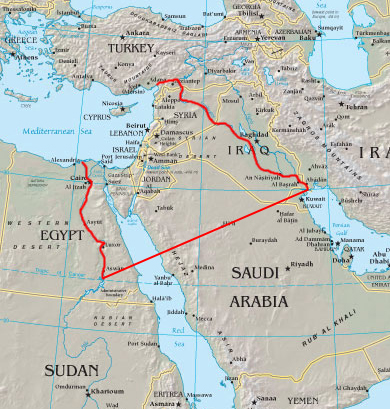
In the last chapter, God delivered the good news regarding Israel’s eventual restoration to the land of Canaan. He announced that in the distant future, He will return His people to their former land where will enjoy the blessings of His presence and His gracious provision for all their needs. This as-yet-to-be-fulfilled prophecy includes their reoccupation of the northern kingdom of Israel as well as the southern kingdom of Judah. But God will not stop there. He intends to expand the land of promise back to the original boundaries He had promised to Abraham and had articulated to Moses as the people prepared to conquer Canaan.

“I will send terror ahead of you to drive out the Hivites, Canaanites, and Hittites. But I will not drive them out in a single year, because the land would become desolate and the wild animals would multiply and threaten you. I will drive them out a little at a time until your population has increased enough to take possession of the land. And I will fix your boundaries from the Red Sea to the Mediterranean Sea, and from the eastern wilderness to the Euphrates River. I will hand over to you the people now living in the land, and you will drive them out ahead of you.” – Exodus 23:28-31 NLT

But when the people were preparing to enter the land for the very first time, God gave them strict instructions to not take any land from the Edomites, who were the direct descendants of Esau, the son of Isaac and the twin brother of Jacob.

Give these orders to the people: “You will pass through the country belonging to your relatives the Edomites, the descendants of Esau, who live in Seir. The Edomites will feel threatened, so be careful. Do not bother them, for I have given them all the hill country around Mount Seir as their property, and I will not give you even one square foot of their land.” – Deuteronomy 2:4-5 NLT

But now, centuries later, as God delivers His news of future restoration, He informs Ezekiel that the rules of the game will be drastically different. He gives Ezekiel a message to deliver to Mount Seir, but the recipient is really the Edomites, the people who occupied the land of Seir.

While God had chosen Isaac’s son, Jacob over his brother Esau to be the son of the promise, God had awarded Esau’s descendants the land of Seir as their homeland.

He had done the same for the descendants of Esau who lived in Seir, for he destroyed the Horites so they could settle there in their place. The descendants of Esau live there to this day. – Deuteronomy 2:22 NLT

All during the reigns of David and Solomon, the Edomites had occupied the land of Seir. This region just south and east of the Dead Sea remained under Edomite control even after God had divided Israel into two kingdoms. And during the Babylonian occupation of Judah and while Ezekiel and his fellow Jews lived in exile in Babylon, the Edomites maintained their control of the land.

Over the centuries, the descendants of Jacob and the descendants of Esau had endured an ongoing love-hate relationship. They were like the Hatfields and McCoys, blood relatives who just couldn’t get along, and this fraternal conflict was predicted by God even before the two patriarchs of these people groups were born. While Isaac’s wife, Rebekah, was carrying Jacob and Esau in her womb, God informed her, “The sons in your womb will become two nations. From the very beginning, the two nations will be rivals. One nation will be stronger than the other; and your older son will serve your younger son” (Genesis 25:23 NLT).

This conflict that began in the womb continued after the birth of the two boys and expanded into an internecine battle between their descendants. Bad blood existed between the Israelites and Edomites for generations, and even when the nation of Judah was under attack by the Babylonians, the Edomites would take advantage of Judah’s vulnerable state by conducting raids against their towns and villages. So, there was no love loss between the two nations.

But for God to fulfill His promise of future restoration as outlined in chapter 34, He reveals that even the Edomites will have to relinquish their land. It belonged to His chosen people, the descendants of Jacob. So, He gives Ezekiel as far-from-promising message for the Edomites.

“I am your enemy, O Mount Seir,
    and I will raise my fist against you
    to destroy you completely.
I will demolish your cities
    and make you desolate.
Then you will know that I am the Lord.” – Ezekiel 35:3-4 NLT

They had aligned themselves against God’s chosen people and now they would pay the price for their misguided decision. From God’s perspective, the Edomites were guilty of piling on. While He was bringing judgment against His chosen people, the descendants of Esau decided to exploit the situation for their own advantage.

“Your eternal hatred for the people of Israel led you to butcher them when they were helpless, when I had already punished them for all their sins.” – Ezekiel 35:5 NLT

God had not ordered them to do this. It was not part of His disciplinary protocol for the rebellious people of Judah. The Edomites had acted on their own accord and sought to enrich themselves at Judah’s expense. And the day was coming when they would be held accountable for their mistake. The land God had graciously given them would be taken away and awarded to the people of Israel.

Their real crime was their open disdain for God. As the descendants of Abraham and Isaac, they should have understood the sovereignty and power of Yahweh. They should have had an awe and respect for Him but, instead, they flaunted their will right in His face. They arrogantly declared, “The lands of Israel and Judah will be ours. We will take possession of them. What do we care that the Lord is there!” (Ezekiel 35:10 NLT). And God states that their hubris will be their undoing.

“I will make myself known to Israel by what I do to you.” – Ezekiel 35:11 NLT

Some day in the future, the descendants of Jacob will recognize the greatness of God when they watch Him destroy the Edomites and make the land of Seir part of the inheritance of Israel. At this point in human history, the nation of Edom no longer exists. They would eventually fall to the Babylonians, then to the Medo-Persians, and, ultimately to the Hasmoneans in 126 B.C.

But to date, the land of Edom remains outside of Israel’s control. It is not currently a part of the modern state of Israel but lies within the borders of southwestern Jordan, located between the Dead Sea and the Gulf of Aqaba. But God is not done yet. His plan is far from finished and His promise to restore His people to the land will one day be accomplished. Their enemies will be defeated. The land will become theirs, “from the Red Sea to the Mediterranean Sea, and from the eastern wilderness to the Euphrates River” (Exodus 23:31 NLT). 

English Standard Version (ESV) The Holy Bible, English Standard Version. ESV® Permanent Text Edition® (2016). Copyright © 2001

New Living Translation (NLT) Holy Bible, New Living Translation, copyright © 1996, 2004, 2015 by Tyndale House Foundation. Used by permission of Tyndale House Publishers Inc., Carol Stream, Illinois 60188. All rights reserved.

The Day of the Lord.

1 The oracle concerning Babylon which Isaiah the son of Amoz saw.

2 On a bare hill raise a signal;
    cry aloud to them;
wave the hand for them to enter
    the gates of the nobles.
3 I myself have commanded my consecrated ones,
    and have summoned my mighty men to execute my anger,
    my proudly exulting ones.

4 The sound of a tumult is on the mountains
    as of a great multitude!
The sound of an uproar of kingdoms,
    of nations gathering together!
The Lord of hosts is mustering
    a host for battle.
5 They come from a distant land,
    from the end of the heavens,
the Lord and the weapons of his indignation,
    to destroy the whole land.

6 Wail, for the day of the Lord is near;
    as destruction from the Almighty it will come!
7 Therefore all hands will be feeble,
    and every human heart will melt.
8 They will be dismayed:
    pangs and agony will seize them;
    they will be in anguish like a woman in labor.
They will look aghast at one another;
    their faces will be aflame.

9 Behold, the day of the Lord comes,
    cruel, with wrath and fierce anger,
to make the land a desolation
    and to destroy its sinners from it. – Isaiah 13:1-9 ESV

At this point, the emphasis shifts from that of good news to bad news, and the focus shifts from Judah to Babylon. This is the first of ten oracles that God will pronounce and Isaiah will deliver. And what makes this particular oracle unique is that it deals with a nation that will not even come to power and prominence for another century. In fact, the details concerning Babylon are so specific and accurate that some have concluded that the book of Isaiah could not have been written by him. Rather than accept the fact that God, through the Holy Spirit, provided Isaiah with prophetic insights into the future, these individuals find it more plausible to believe that some unknown author, living long after the events described by Isaiah, wrote down the details of what had happened.

But the claim of the author, namely Isaiah, is that he received these five oracles from God Himself. These are not post-event, historic recollections disguised as prophecy. They are the oracles of God concerning nations that had not yet risen to power and events that had not yet taken place.

The Hebrew word that is translated as “oracle” is massa’ and it carries a range of meanings. It literally means, “a burden.” In this context it is used as a message from God, but it contains burdensome news from God that will be difficult for the hearer to bear.

Babylon was an ancient city that had a well-known reputation for its arrogance and pride. While it was not yet a global super-power, it had been around long enough to influence many of the nations around it. It’s story goes all the way back to Genesis 11 and the story of Babel. In the preceding chapters of Genesis, we have recorded the story of the flood that God had sent to destroy the earth. The only survivors of this global, God-ordained disaster, were Noah and his family, as well as all the birds, animals and reptiles he had loaded on the ark. When the flood had subsided, God had commanded Noah:

“Leave the boat, all of you—you and your wife, and your sons and their wives. Release all the animals—the birds, the livestock, and the small animals that scurry along the ground—so they can be fruitful and multiply throughout the earth.” – Genesis 8:15 NLT

They were to be fruitful and multiply on the earth, the same command God had given to Adam and Eve in the garden.

“Be fruitful and multiply. Fill the earth and govern it.” – Genesis 1:28 NLT

By the time we get to Genesis 11 and a time period long after the flood, we find the descendants of Noah spreading out across the earth. The text tells us that they shared a common language because they shared a common ancestry. But something happened.

…they found a plain in the land of Babylonia and settled there.  – Genesis 11:2 NLT

This sounds innocent enough, but the heart behind their actions is revealed in the following verses.

Then they said, “Come, let’s build a great city for ourselves with a tower that reaches into the sky. This will make us famous and keep us from being scattered all over the world.” – Genesis 11:4 NLT

In direct violation of God’s command, they determined to locate in one place, construct a monument to their own significance, and build a reputation to their own glory. But we’re told, “the Lord came down to look at the city and the tower the people were building” (Genesis 11:5 NLT). And, being God, He saw into their hearts. He knew their intentions and the motivation behind their actions.

“The people are united, and they all speak the same language. After this, nothing they set out to do will be impossible for them!” – Genesis 11:6 NLT

Their sense of community and their commonly shared language promoted a spirit of pride and arrogance within them. They viewed themselves as self-sufficient and capable of accomplishing anything they determined to do. But there is no mention of God. There is no display of humble obedience to the commands of God. So, God removed their capacity to communicate with one another by creating other languages. The immediate result was their inability to complete construction on the city they had begun to build, and then they scattered across the globe. But the city remained and its name became Babel. And people continued to occupy that city over the centuries, all the way to Isaiah’s day.

While Babylon was a real nation, it appears to be used here as a symbol of man’s pride and arrogance. It represents all those who would refuse to honor and obey God, choosing instead to view themselves as their own gods, the masters of their own fates.

As has been the case so far, God continues to speak of a coming day – that day – when He will send His Son as the King of kings and Lord of lords. But in that day, while things will go especially well for the people of Israel, the Babylons of the world will suffer His wrath. Isaiah warns, “the day of the Lord is near” (Isaiah 13:6 ESV). And that news should cause the people of Babylon to wail, because that day will bring with it the judgment of God in the form of “a great multitude,” “a host for battle” (Isaiah 13:4 ESV). And that army will bring destruction upon the nations of the earth.

For see, the day of the Lord is coming—
    the terrible day of his fury and fierce anger.
The land will be made desolate,
    and all the sinners destroyed with it.
– Isaiah 13:9 NLT

The picture here is one of global judgment. While the oracle is directed at Babylon, the content of the oracle is much more widespread and universal in terms of its impact. Babylon represents an attitude that will one day be widespread on the earth. The hubris modeled by Babylon will have spread to all the nations of the earth. So, God will use “the weapons of his indignation to destroy the whole land” (Isaiah 13:5 ESV). 

This is speaking of a future judgment to come. Just as Israel and Judah would enjoy a restored relationship with God “in that day,” the pagan nations will be forced to endure the unrelenting judgment of God for their refusal to acknowledge Him as God.

And Isaiah describes this coming day of the Lord as near. The Hebrew word is qarowb and it conveys the idea of readiness. In other words, God has prepared the day and has it set on His divine calendar. So that, when the time arrives, it will happen quickly and without delay. The use of the term, “near” does not indicate imminence, but inevitability. Isaiah is not saying “that day” is right around the corner, but that when the day comes, it will come quickly and prove to be unavoidable and unstoppable.

In Revelation 11, John is given a vision of that day. With the blowing of the seventh and final trumpet, the seven bowl judgments will be poured out on the earth. But with the blowing of the trumpet, John heard voices in heaven shouting, “The kingdom of the world has become the kingdom of our Lord and of his Christ, and he shall reign forever and ever” (Revelation 11:15 ESV). Even before the pouring out of the final judgments on the earth and the return of Christ, the heavenly host are celebrating His victory as if it has already taken place. It is so inevitable, they speak as if it has already happened. And they go on to sing:

“We give thanks to you, Lord God, the Almighty,
    the one who is and who always was,
for now you have assumed your great power
    and have begun to reign.
The nations were filled with wrath,
    but now the time of your wrath has come.
It is time to judge the dead
    and reward your servants the prophets,
    as well as your holy people,
and all who fear your name,
    from the least to the greatest.
It is time to destroy
    all who have caused destruction on the earth.” – Revelation 11:17-18 NLT

This is the day of which Isaiah speaks. The nations rage, but God rules. The people of earth, in their pride and arrogance, shake their fists in the face of God, but He brings them to nothing. He humbles their hubris. He punishes their pride. He destroys their petty kingdoms and sets up His Son as the sole sovereign of the universe. And Isaiah reminds us, “the day of the Lord is near; as destruction from the Almighty it will come!” (Isaiah 13:6 ESV).

English Standard Version (ESV)
The Holy Bible, English Standard Version. ESV® Permanent Text Edition® (2016). Copyright © 2001 by Crossway Bibles, a publishing ministry of Good News Publishers.

New Living Translation (NLT)
Holy Bible, New Living Translation, copyright © 1996, 2004, 2015 by Tyndale House Foundation. Used by permission of Tyndale House Publishers Inc., Carol Stream, Illinois 60188. All rights reserved.

The Message (MSG)
Copyright © 1993, 1994, 1995, 1996, 2000, 2001, 2002 by Eugene H. Peterson