God In Human Flesh

14 And the Word became flesh and dwelt among us, and we have seen his glory, glory as of the only Son from the Father, full of grace and truth. 15 (John bore witness about him, and cried out, “This was he of whom I said, ‘He who comes after me ranks before me, because he was before me.’”) 16 For from his fullness we have all received, grace upon grace. 17 For the law was given through Moses; grace and truth came through Jesus Christ. 18 No one has ever seen God; the only God, who is at the Father’s side, he has made him known. – John 1:14-18 ESV

In verse 14 John returns to the focal point of his entire gospel: The Word of God. But now, he adds another crucial element to the identity of this one who “was in the beginning with God” (John 1:2 ESV). This life-giving “light” penetrated the darkness of the sin-saturated world.

He was in the world, and the world was made through him, yet the world did not know him. – John 1:10 ESV

And adding an important point of specificity, John states:

He came to his own, and his own people did not receive him. – John 1:11 ESV

But how did He He come? In what form did the Word of God appear? In verse 14, John shares the incredible truth regarding the incarnation – the miraculous moment when God took on human flesh. In this one verse, John brings together the two seemingly opposing doctrines of God’s transcendence and immanence. The holy and wholly righteous God of the universe not only made Himself known to mankind, He became one with them.

…the Word became flesh and dwelt among us… – John 1:14 ESV

God had made Himself known before. He had regularly conversed with Adam and Eve in the garden. He spoke to Noah and Abraham. He appeared to Moses in the form of the burning bush. He revealed Himself to the people of Israel through the pillars of fire and smoke that led them through the wilderness. And God had repeatedly spoken to His prophets, providing them with the words to convey to His rebellious people, warning them of the judgment to come.

But what John is describing here is something different altogether. He is declaring that deity and humanity became one. The God of the universe stepped out of His heavenly palace and took up residence among us. Jesus, the Son of God, left His throne in glory and willingly assumed the nature of an ordinary human being. The apostle Paul describes this remarkable transformation this way:

…though he was in the form of God, did not count equality with God a thing to be grasped, but emptied himself, by taking the form of a servant, being born in the likeness of men. – Philippians 2:6-7 ESV

At the time at which John wrote his gospel, there would have been few who denied the existence of Jesus. His ministry had made Him a celebrity throughout Judea. His miracles and messages had attracted huge crowds which gained Him the attention of the religious and political leaders. Ultimately, Jesus’ growing celebrity status had threatened the powerful Jewish religious leaders, so they had Him crucified. And even that fateful event had been well-attended and well-documented. So, there would have been little debate over the humanity of Jesus.

But the deity of Jesus was a whole other matter. One of the primary reasons Jesus had been crucified was because the Jewish religious leaders had deemed Him guilty of blasphemy, for having claimed to be God. At one point, Jesus had said to a group of Pharisees, “I and the Father are one” (John 10:30 ESV). And their immediate reaction had been to stone Him to death. And they had justified their action by saying, “It is not for a good work that we are going to stone you but for blasphemy, because you, being a man, make yourself God” (John 10:33 ESV).

On another occasion, Jesus had said to the religious leaders: “Truly, truly, I say to you, before Abraham was, I am” (John 8:58 ESV), and again, they responded by picking up stones to kill Him. Why? Because with His seemingly innocuous statement, Jesus had identified Himself as God. He had purposefully used the identifier “I am,” a direct reference to God’s own self-identification spoken to Moses at the burning bush.

God said to Moses, “I am who I am.” And he said, “Say this to the people of Israel: ‘I am has sent me to you.’” – Exodus 3:14 ESV

The religious leaders had picked up on Jesus’ meaning and immediately understood that He was claiming to be divine. But they refused to accept that Jesus was anything but a man. He was nothing more than a non-descript, uneducated rabbi from the backwater town of Nazareth. He may have been a nuisance and a threat, but He was anything but God.

But for John, the deity of Jesus was essential to understanding the humanity of Jesus. God had taken on human flesh and John claims to have been one of many eye-witnesses to the reality of Jesus’ divinity.

…we have seen his glory, glory as of the only Son from the Father, full of grace and truth. – John 1:14 ESV

This is most likely a reference to the transfiguration of Jesus that John, James, and Peter had been privileged to witness. Matthew describes this event in his gospel account.

And after six days Jesus took with him Peter and James, and John his brother, and led them up a high mountain by themselves. And he was transfigured before them, and his face shone like the sun, and his clothes became white as light. And behold, there appeared to them Moses and Elijah, talking with him. – Matthew 17:1-3 ESV

John had been given an eye-witness glimpse of the glory of Jesus. The humanity of Jesus had been transfigured right before John’s eyes, revealing the full divinity and holiness of the one he called master and friend.

John even recalls how John the Baptist had recognized the unique nature of Jesus, describing Him as far more than just another man. When John the Baptist had stated, “He who comes after me ranks before me, because he was before me” (John 1:15 ESV), he was declaring the divinity and eternality of Jesus.

But why is all this so important? Why is John beginning his gospel account by stressing the deity and humanity of Jesus? Because there were those who denied that Jesus had been divine. Just like today, there were many who were willing to admit that Jesus had been a good man, a wise teacher, and a worker of miracles. They would even confess that Jesus had lived a life worth emulating. But they could not bring themselves to believe that He had been God in human flesh. That was outside their capacity to comprehend and accept.

But for John, the deity of Jesus was a non-negotiable aspect of His identity. If Jesus was not God in human flesh, then He was just another man who died a martyr’s death. And that death accomplished nothing of long-lasting value.

Yet, as his gospel will reveal, because Jesus was who He says He was, His death did have value. It was efficacious. There was a reason why God sent His Son to earth to live and die as a human being. The author of Hebrews reminds us, “without the shedding of blood there is no forgiveness of sins” (Hebrews 9:22 ESV). The entire Jewish sacrificial system had been ordained by God as a means for sin-stained men and women to receive atonement and cleansing for their sins. But those sacrifices had always been temporary and imperfect. The blood of the animals sacrificed on behalf of sinful men and women was incapable of providing permanent deliverance from the penalty of sin. They provided temporary cleansing from ceremonial impurity and nothing more. Again, the author of Hebrews provides us with an explanation.

Under the old system, the blood of goats and bulls and the ashes of a heifer could cleanse people’s bodies from ceremonial impurity. Just think how much more the blood of Christ will purify our consciences from sinful deeds so that we can worship the living God. For by the power of the eternal Spirit, Christ offered himself to God as a perfect sacrifice for our sins. – Hebrews 9:13-14 NLT

Jesus, the Word of God, had to become a man so that He could become the ultimate sacrifice for the sins of man. As John will share later on in this same chapter, when John the Baptist first saw Jesus, he described Him as “the Lamb of God, who takes away the sin of the world!” (John 1:29 ESV). Jesus said of Himself, “the Son of Man came not to be served but to serve, and to give his life as a ransom for many” (Mark 10:45 ESV). When the angel appeared to Joseph, letting him know that his fiance was pregnant, he announced, “She will bear a son, and you shall call his name Jesus, for he will save his people from their sins” (Mathew 1:21 ESV).

Jesus took on human flesh so that He could live as a man. But He was born as a Jew so that He would be required to live according to the law given by God to Moses. And because He was divine, He was able to live in perfect obedience to God’s law, making Him the sinless, unblemished, perfect sacrifice to atone for the sins of man.

According to John, Jesus had been “full of grace and truth” (John 1:14 ESV), and that fulness expressed itself in the form of “grace upon grace” (John 1:17 ESV). What John seems to be saying here is that Jesus provided a new measure of God’s grace that was greater than that which had been made available through the law. Rather than temporary forgiveness from sin, God was making available permanent forgiveness and the right sinful men and women to be justified before Him. And it was all made possible through the God-man, Jesus Christ.

Up until the incarnation, the law reigned supreme. It was the only means by which sinful men could receive forgiveness. But as the apostle Paul states, “no one can ever be made right with God by doing what the law commands. The law simply shows us how sinful we are” (Romans 3:20 NLT). He communicated the same idea to the believers in Galatia.

“…no one can be made right with God by trying to keep the law. For the Scriptures say, “It is through faith that a righteous person has life.” – Galatians 3:11 NLT

John states that Moses brought the law, but that Jesus made possible grace and truth. It is only through faith in Jesus, that sinful men can receive the grace of God and be truly freed from the penalty of sin. The law could never save. But Jesus, the God-man can and does save. And He made salvation possible by taking on human flesh and making God known to man. He made the invisible God visible. He made the unapproachable God approachable. Because He was God in human flesh.

“I am the way, the truth, and the life. No one can come to the Father except through me. If you had really known me, you would know who my Father is. From now on, you do know him and have seen him!” – John 14:6-7 NLT

English Standard Version (ESV) The Holy Bible, English Standard Version. ESV® Permanent Text Edition® (2016). Copyright © 2001 by Crossway Bibles, a publishing ministry of Good News Publishers.

New Living Translation (NLT)
Holy Bible, New Living Translation, copyright © 1996, 2004, 2015 by Tyndale House Foundation. Used by permission of Tyndale House Publishers Inc., Carol Stream, Illinois 60188. All rights reserved.

The Message (MSG)Copyright © 1993, 1994, 1995, 1996, 2000, 2001, 2002 by Eugene H. Peterson
The Truth Vs. The Lie

For many deceivers have gone out into the world, people who do not confess Jesus as Christ coming in the flesh. This person is the deceiver and the antichrist! Watch out, so that you do not lose the things we have worked for, but receive a full reward. – 2 John 1:7-8 ESV

John is encouraging his readers to live their lives according to the truth of the Gospel. And at the core of the gospel message can be found the love of God. The “good news” is that God sent His Son to be the payment for mankind’s sin debt. Jesus Christ took on human flesh so that He might do what no other human being has ever been able to do: Obey every single law given by God. And Jesus did so willingly and perfectly.  The apostle Paul points out the necessity for Jesus to become a man so that He might obey God’s commands “in the flesh.”

The law of Moses was unable to save us because of the weakness of our sinful nature. So God did what the law could not do. He sent his own Son in a body like the bodies we sinners have. And in that body God declared an end to sin’s control over us by giving his Son as a sacrifice for our sins. – Romans 8:3 NLT

The author of Hebrews supports Paul’s point, adding that Jesus became like us so that He might become the acceptable substitute for us.

…it was necessary for him to be made in every respect like us, his brothers and sisters, so that he could be our merciful and faithful High Priest before God. Then he could offer a sacrifice that would take away the sins of the people. – Hebrews 2:17 NLT

And Paul expands the scope of God’s actions by pointing out that it was Jesus’ sinlessness or purity that made Him an acceptable sacrifice to God. He paid for our sins with His life and provided a means by which we can be restored to a right relationship with God.

For God made Christ, who never sinned, to be the offering for our sin, so that we could be made right with God through Christ. – 2 Corinthians 5:21 NLT

And all of this was done because God “so loved the world” (John 3:16). The truly amazing thing is that God’s love was despite us, not because of us. He loved us when we were at our worst. As Paul points out in Romans, it was “while we were still sinners, Christ died for us.” (Romans 5:8 ESV). And it is that same kind of selfless, sacrificial love that we are to share with those around us, especially to those within the body of Christ. We are to live our lives according to the truth of the Gospel – in keeping with the love displayed through the Gospel.

But John had some words of warning for the local fellowship to whom he was writing. He wanted them to recognize the very real threat of those who would seek to distort the truth. John had been around long enough to know that the message of the Gospel was under constant attack, from without and from within. There were those outside the church who opposed the truth regarding Jesus Christ. They rejected the claims that He was the Messiah and the Savior of the world. They denied the reality of the resurrection. To them, Christianity was nothing more than just another cult or sect of Judaism. But even the Jews themselves took issue with this movement they labeled “the way.” To them, Christians were, at best, a nuisance and, at worst, a very real threat to their religious system. So, the Jews persecuted Christians wherever and whenever they could.

But the greatest threats to the faith usually come from within. And the agents behind these threats are subtle and sinister, disguising themselves as purveyors of truth and beacons of light. But notice that John describes these people as “deceivers.” They claim to be fellow followers of Christ, yet all the while denying His deity.  John pulls no punches when he states that they “do not confess Jesus as Christ coming in the flesh” (2 John 1:7 ESV). The New Living Translation puts it this way: “They deny that Jesus Christ came in a real body.

The truth regarding the incarnation of Jesus was under constant attack. And there were those who, while claiming to be followers of Jesus, regularly denied the teaching that Jesus took on human flesh. And you can see why this bothered John. If Jesus did not become a man, then the Gospel lost its power. It was the humanity of Jesus that made Him the perfect sacrifice for the sins of man. Yet these deceivers were eliminating the possibility of the incarnation. In fact, John talked about the impact of these false teachers in his first letter.

For there are many false prophets in the world. This is how we know if they have the Spirit of God: If a person claiming to be a prophet acknowledges that Jesus Christ came in a real body, that person has the Spirit of God. – 1 John 4:2 NLT

So, what were these “deceivers” saying about Jesus? Obviously, they denied His humanity. They were claiming that Jesus, the man, had not been born of the Father and was, therefore, not divine. By denying the deity of Jesus, they were contradicting the testimony of God Himself, and John pointed this out in his previous letter.

All who believe in the Son of God know in their hearts that this testimony is true. Those who don’t believe this are actually calling God a liar because they don’t believe what God has testified about his Son. – 1 John 5:10 NLT

These false teachers denied that Jesus was God’s Anointed One who had come in the flesh. And John labels anyone propagating these lies as “the deceiver and the antichrist!” (2 John 1:7 ESV). In essence, John accuses these people of being Satan himself. John remembered how Jesus had described Satan: “He has always hated the truth, because there is no truth in him. When he lies, it is consistent with his character; for he is a liar and the father of lies” (John 8:44 NLT).

In his second letter to the believers in Thessalonica, Paul warned them about a future day when the Antichrist, the man of lawlessness, would appear on the scene.

This man will come to do the work of Satan with counterfeit power and signs and miracles. He will use every kind of evil deception to fool those on their way to destruction, because they refuse to love and accept the truth that would save them. So God will cause them to be greatly deceived, and they will believe these lies. Then they will be condemned for enjoying evil rather than believing the truth. – 2 Thessalonians 2:9-12 NLT

This end-times character will show up on the world scene, exhibiting great power and utilizing deception to turn the world away from the truth of the Gospel. As a pawn of Satan, the Antichrist will convince people to reject the truth that could save them – the truth regarding God’s love as displayed through the incarnation of His Son, and demonstrated by His sacrificial death on the cross as the payment for their sin debt.

And while the Antichrist is not scheduled to appear until the period known as the Great Tribulation, his spirit is alive and well. Even in John’s day, this deceptive influence was making its way through the local church as these false teachers spread around the world, disseminating their half-truths and pious-sounding platitudes about Jesus. That is why John warned his readers to “Watch out, so that you do not lose the things we have worked for, but receive a full reward” (2 John 1:8 ESV). 

But what is John saying here? Is he inferring that the believers to whom he is writing can somehow lose their salvation? John refers to them losing “the things we have worked for.” He and the rest of the apostles had spent their lives spreading the truth of the Gospel all around the known world. They had diligently and faithfully preached the life-transformative power of the gospel to save and sanctify. John had fully believed and taught the words of Jesus: “The thief comes only to steal and kill and destroy. I came that they may have life and have it abundantly” (John 10:10 ESV).

He wanted his fellow Christ-followers to experience all that Jesus had died to deliver to them. He longed for them to experience the abundant life Jesus had promised. But if they bought into the lies of the false teachers and began to question the very deity of Jesus, they would find themselves doubting the very truth of the Gospel and questioning their own salvation.

John is in no way suggesting that Christians can lose their reward. They are at no risk of missing out on eternity. In fact, it seems that John is warning that if you accept the lies of the false teachers, you never really believed the truth of the Gospel to begin with. Your faith was false all along. Which brings us back to love, the topic John covered in the previous verses of his letter. Love is the driving force of the Gospel message, as illustrated in God sending His own Son in the likeness of human flesh. The apostle Paul points out that Jesus…“gave up his divine privileges; he took the humble position of a slave and was born as a human being. When he appeared in human form,
he humbled himself in obedience to God and died a criminal’s death on a cross” (Philippians 2:7-8 NLT).

And He did it out of love. If you fail to believe that, you have failed to experience the love of God. And you will never experience the abundant life Jesus came to offer. And if you deny that Jesus was God in the flesh, you have no hope of ever enjoying the ultimate reward of eternal life.

English Standard Version (ESV)
The Holy Bible, English Standard Version. ESV® Permanent Text Edition® (2016). Copyright © 2001 by Crossway Bibles, a publishing ministry of Good News Publishers.

New Living Translation (NLT)
Holy Bible, New Living Translation, copyright © 1996, 2004, 2015 by Tyndale House Foundation. Used by permission of Tyndale House Publishers Inc., Carol Stream, Illinois 60188. All rights reserved.

The Message (MSG)Copyright © 1993, 1994, 1995, 1996, 2000, 2001, 2002 by Eugene H. Peterson

Your Will Be Done

36 Then Jesus went with them to a place called Gethsemane, and he said to his disciples, “Sit here, while I go over there and pray.” 37 And taking with him Peter and the two sons of Zebedee, he began to be sorrowful and troubled. 38 Then he said to them, “My soul is very sorrowful, even to death; remain here, and watch with me.” 39 And going a little farther he fell on his face and prayed, saying, “My Father, if it be possible, let this cup pass from me; nevertheless, not as I will, but as you will.” 40 And he came to the disciples and found them sleeping. And he said to Peter, “So, could you not watch with me one hour? 41 Watch and pray that you may not enter into temptation. The spirit indeed is willing, but the flesh is weak.” 42 Again, for the second time, he went away and prayed, “My Father, if this cannot pass unless I drink it, your will be done.” 43 And again he came and found them sleeping, for their eyes were heavy. 44 So, leaving them again, he went away and prayed for the third time, saying the same words again. 45 Then he came to the disciples and said to them, “Sleep and take your rest later on. See, the hour is at hand, and the Son of Man is betrayed into the hands of sinners. 46 Rise, let us be going; see, my betrayer is at hand.” – Matthew 26:36-46 ESV

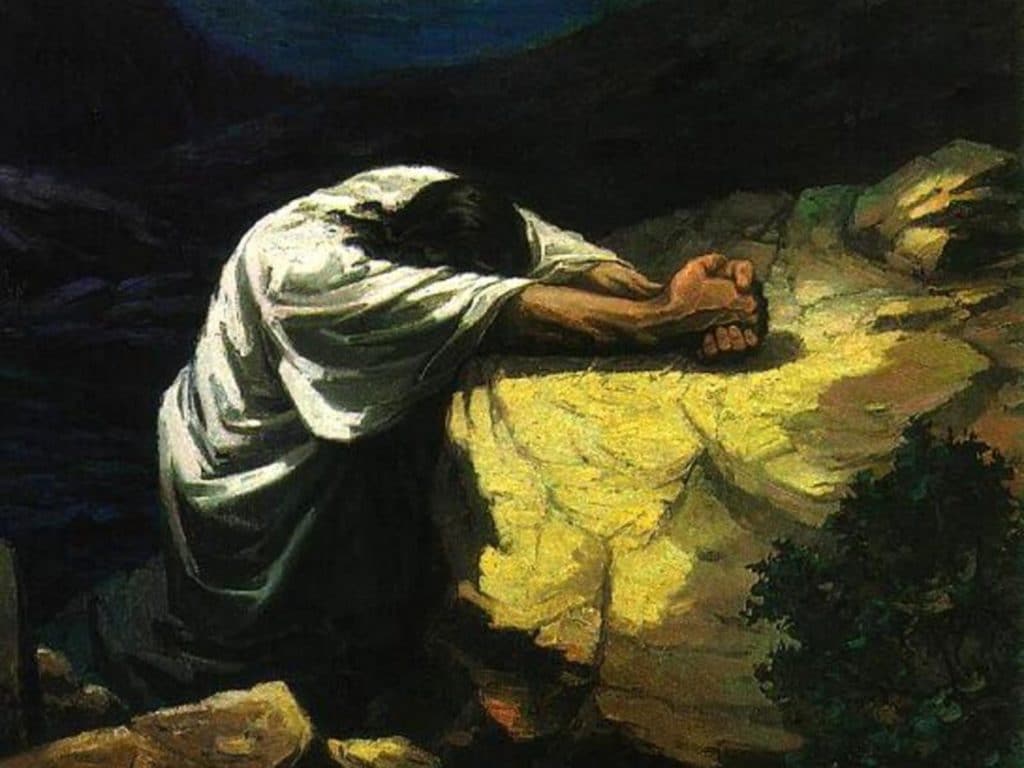
agony-in-the-garden-1-1024x768.jpgHaving completed the Passover meal, Jesus and His disciples made their way through the city of Jerusalem, out the eastern gate, and onto the Mount of Olives. They stopped at a place called Gethsemane, which means “an olive press.” Here, Jesus took three of His disciples, Peter, James and John, and found a secluded place where He could pray. These are the same three men who had accompanied Him and been eyewitnesses to His transfiguration. But on this occasion, rather than seeing Jesus in His glorified state, they would watch as He agonized over His coming trials.

Jesus described to them His state of mind: “My soul is very sorrowful, even to death” (Matthew 26:38 ESV). His emotional state was one of deep and overwhelming sadness over what was about to happen. His sorrow alone was enough to kill Him. But what was it that caused such a drastic state of deep melancholy in Jesus? Was He afraid to die? Did He regret His decision to sacrifice Himself on behalf of sinful mankind? Was He having second thoughts? The text, along with the words and actions of Jesus, provide us with the answers.

Matthew relates that Jesus went off by Himself and immediately fell on His face before His Father in a state of prayer. He pleaded, “My Father, if it be possible, let this cup pass from me” (Matthew 26:39 ESV).

One of the things this passage reveals is the human side of Jesus’ nature. He was 100 percent God, but also 100 percent human – a state often referred to as the hypostatic union. At His incarnation, Jesus, the eternal, second person of the Trinity, became the God-man. His assumption of a human nature was essential to the role He would play as the Savior of mankind. The author of Hebrews explains:

Because God’s children are human beings – made of flesh and blood – the Son also became flesh and blood. For only as a human being could he die, and only by dying could he break the power of the devil, who had the power of death. – Hebrews 2:14 NLT

The apostle Paul would put it this way:

[God] sent his own Son in a body like the bodies we sinners have. And in that body God declared an end to sin’s control over us by giving his Son as a sacrifice for our sins. – Romans 8:3 NLT

Jesus never relinquished any of His divine attributes, but, in becoming a man, He combined His human and divine natures into one person. And as a man, Jesus felt pain, experienced hunger, grew tired, and, as we will see, became susceptible to death.

In His humanity, Jesus knew that what He was about to endure would be excruciatingly painful. He would be scourged mercilessly with a flagellum, a whip featuring multiple leather strands, each weighted with lead balls or pieces of bone. He would be beaten, spit upon, slapped, and degraded. And eventually, He would be nailed to a wooden cross and left to die by exposure and suffocation. Jesus’ human nature was repulsed by the prospect of facing such a painful and gruesome death. He longed for another way, a plan B.

But, in His divinity, He knew that this was all part of His Father’s sovereign will. This is why He stated, “nevertheless, not as I will, but as you will” (Matthew 26:39 ESV).

But there is a second explanation behind Jesus’ intense sorrow and His cry for an alternative plan. He was fully aware that, upon the cross, He would be taking on the sin debt of the entire world. He who never committed a single sin would bear the full brunt of God’s wrath against all the sins of men for all time.

For God made Christ, who never sinned, to be the offering for our sin, so that we could be made right with God through Christ. – 2 Corinthians 5:21 NLT

Sin separates mankind from God. And Jesus knew that when He took on the sin debt of mankind, He would become separated from His Father for the first time in all of eternity. Their fellowship would be broken. And, in His divine nature, that prospect was unfathomable and unthinkable to Jesus. Yet again, He knew it was all part of God’s plan and, therefore, necessary.

Jesus longed for this “cup of wrath” to pass. If you recall, back in chapter 20, Matthew recorded an encounter between Jesus and the mother of James and John, the two brothers who were with Him in Gethsemane that night. She had asked Jesus to allow her two sons to sit on His right and on His left when He established His kingdom on earth. But Jesus had responded to her two sons, “You don’t know what you are asking! Are you able to drink from the bitter cup of suffering I am about to drink?” (Matthew 20:22 NLT).

Only He was worthy to suffer for the sins of mankind. He alone could meet God’s demanding criteria for an acceptable sacrifice – an unblemished, sinless Lamb.

And it’s interesting to note that when Jesus stopped to check on Peter, James, and John, He had found them asleep. While He had been agonizing over His coming death, these three were obviously unconcerned with and unsympathetic to His pain. They slept while Jesus wept. And Jesus made an interesting observation, stating, “The spirit indeed is willing, but the flesh is weak” (Matthew 26:41 ESV). This was most likely aimed at Peter, who had been the one who had vehemently denied Jesus prediction that they would all bail on Him in His time of greatest need.

“Though they all fall away because of you, I will never fall away.” – Matthew 26:33 ESV).

And yet, here was Peter finding it difficult even to stay awake while His master suffered under the weight of His pending death.

Three separate times Jesus expressed His feelings to His heavenly Father, and three times He communicated His willingness to do His Father’s will. He was committed. Every ounce of His humanity longed to escape what was to come, but His divinity provided the strength He needed to do what He had been called to do.

In his commentary on the book of Matthew, D.A. Carson writes:

“In the first garden ‘Not your will but mine’ changed Paradise to desert and brought man from Eden to Gethsemane. Now ‘Not my will but yours’ brings anguish to the man who prays it but transforms the desert into the kingdom and brings man from Gethsemane to the gates of glory.” – D.A. Carson, Matthew, p. 545.

Jesus was willing to face the fate God had planned for Him because He trusted His heavenly Father. He knew there was no other way. Salvation was only possible through His obedient submission to the sovereign will of God the Father. And the hour had come for Him to begin His journey from Gethsemane to Golgotha. Having finished His prayer time with the Father, Jesus turned to His disciples and said, “the hour is at hand, and the Son of Man is betrayed into the hands of sinners” (Matthew 26:45 ESV).

Judas was on his way, bringing with him the guards of the high priest. The darkness of that night was about to deepen as the forces of evil began their ill-fated attempt to snuff out the Light of the world. But as John would later write:

The light shines in the darkness, and the darkness can never extinguish it. – John 1:5 NLT

God’s light came into the world, but people loved the darkness more than the light, for their actions were evil. All who do evil hate the light and refuse to go near it for fear their sins will be exposed. But those who do what is right come to the light so others can see that they are doing what God wants. – John 3:19-21 NLT

Jesus would end up buried in the darkness of a borrowed tomb. His life would be forcefully taken from Him, but as He had predicted, it would be on His terms.

“No one can take my life from me. I sacrifice it voluntarily. For I have the authority to lay it down when I want to and also to take it up again. For this is what my Father has commanded.” – John 10:18 NLT

Jesus lived to do the will of His Father. And He died in obedience to the will of His Father. When Jesus had stated, “I and the Father are one” (John 10:30 ESV), He had meant it. Their wills were united, and their love for sinful mankind was unified around the sole solution to man’s problem: The sacrificial death of the sinless Son of God.

English Standard Version (ESV)
The Holy Bible, English Standard Version. ESV® Permanent Text Edition® (2016). Copyright © 2001 by Crossway Bibles, a publishing ministry of Good News Publishers.

New Living Translation (NLT)
Holy Bible, New Living Translation, copyright © 1996, 2004, 2015 by Tyndale House Foundation. Used by permission of Tyndale House Publishers Inc., Carol Stream, Illinois 60188. All rights reserved.

The Message (MSG)Copyright © 1993, 1994, 1995, 1996, 2000, 2001, 2002 by Eugene H. Peterson

One With Christ

 – 8  Now in putting everything in subjection to him, he left nothing outside his control. At present, we do not yet see everything in subjection to him. But we see him who for a little while was made lower than the angels, namely Jesus, crowned with glory and honor because of the suffering of death, so that by the grace of God he might taste death for everyone.

10 For it was fitting that he, for whom and by whom all things exist, in bringing many sons to glory, should make the founder of their salvation perfect through suffering. 11 For he who sanctifies and those who are sanctified all have one source. That is why he is not ashamed to call them brothers. – Hebrews 2:8-11 ESV

Any sanctification we enjoy or would hope to achieve in this life would be impossible without Christ’s incarnation. Had Jesus not taken on human flesh, suffered at the hands of men, willingly endured the humiliation of a series of trials based on false charges, and allowed Himself to be publicly tortured and crucified, there would be no sanctification available. But the apostles Paul reminds us that Jesus, “who though he existed in the form of God did not regard equality with God as something to be grasped, but emptied himself by taking on the form of a slave, by looking like other men, and by sharing in human nature” (Philippians 2:6-7 NLT).

He became one of us so that He might become one with us. His deliverance of mankind from slavery to sin and the condemnation of death required that He become a man. The author of the book of Hebrews takes the incarnation of Jesus way beyond the iconic image of baby Jesus in a manger and emphasizes the necessity of Jesus in the body of a man, “made in every respect like us.”

Because God’s children are human beings—made of flesh and blood—the Son also became flesh and blood. For only as a human being could he die, and only by dying could he break the power of the devil, who had the power of death. Only in this way could he set free all who have lived their lives as slaves to the fear of dying.

it was necessary for him to be made in every respect like us, his brothers and sisters, so that he could be our merciful and faithful High Priest before God. Then he could offer a sacrifice that would take away the sins of the people. – Hebrews 2:14-15, 17 NLT

Jesus took on human flesh and, in doing so, became one of us. The author of Hebrews makes it clear that the incarnation was a demotion, not a promotion.

Jesus, who for a little while was given a position “a little lower than the angels.” – Hebrews 2:9 NLT

Jesus left His rightful place at His Father’s side in heaven and came to live among men. But not in the form of a burning bush, a pillar of fire, a cloud, or accompanied by flashes of lightning and peals of thunder. No, He took on human flesh so that He might become the visible expression of the invisible God. Look closely at how Paul describes this vital aspect of Jesus’ incarnation.

Christ is the visible image of the invisible God. He existed before anything was created and is supreme over all creation, for through him God created everything in the heavenly realms and on earth. – Colossians 1:15-16 NLT

He is the co-Creator of the universe, the second person of the Trinity and yet, He humbled Himself and took the form of one of those whom He created. But Paul goes on to explain that Jesus never sacrificed an ounce of His divinity while taking on humanity.

For God in all his fullness was pleased to live in Christ, and through him God reconciled everything to himself. He made peace with everything in heaven and on earth by means of Christ’s blood on the cross. – Colossians 1:19-20 NLT

It was His perfect combination of divinity and humanity that allowed Jesus to serve as God the Father’s reconciler. Jesus lived as a man, experiencing everything that we experience, enduring trials and temptations just as we do, and yet, without sin.

This High Priest of ours understands our weaknesses, for he faced all of the same testings we do, yet he did not sin. – Hebrews 4:15 NLT

It was His sinlessness that made Jesus the acceptable sacrifice for the sins of men. He was the unblemished Lamb of God, who takes away the sins of the world. His death on the cross was an offering, made on behalf of sinful men, and approved by God as an acceptable sacrifice. He paid our sin debt with His own life. He died the death we deserved, offering Himself as sinless substitute whose blood satisfied the just demands of a holy God. And here is the incredible reality of it all:

For in Christ lives all the fullness of God in a human body. So you also are complete through your union with Christ. – Colossians 2:9-10 NLT

Notice what Paul says: You also are complete through your union with Christ. Paul used the Greek word, plēroō and it conveys the idea of consummation. It means “to make complete in every particular, to render perfect.” It can also mean “to furnish or supply liberally.” Jesus’ incarnation and crucifixion have furnished all that sinful men and women need to be made complete or perfectly righteous in God’s eyes. And all it requires from us is faith – a belief that Jesus paid it all and all to Him I owe. Sin had left a crimson stain, but He washed it white as snow.

And all of this, His incarnation, sinless existence, death, and resurrection, point to the remarkable truth that Jesus sanctified Himself so that we might be sanctified. Read and consider carefully the words of Jesus expressed to His Heavenly Father just hours before His death.

For their sakes I sanctify Myself, that they themselves also may be sanctified in truth. – John 17:19 NASB

Jesus set Himself apart for God’s use, obediently answering the Father’s call for a sinless sacrifice so that sinful mankind might be reconciled. Jesus, the holy Son of God, sanctified Himself. But what does that mean? Had He made Himself more holy? Was He claiming that His coming death was going to be some kind of righteous performance that would earn Him favor with God?

Unto what did Christ allude when he there spoke of sanctifying himself? Certainily he could not possibly be referring to anything subjective or experimental, for in his own person he was “the Holy One of God”, and as such, he could not increase in holiness, or become more holy. His language then must have respect unto what was objective, relating to the exercise of his mediatorial office. – A. W. Pink, The Doctrine of Sanctification

No, Jesus was completely righteous and fully holy. He was without sin. He was the Son of God. And His death on the cross would not add to His holiness or enhance His righteousness. It would serve as proof of who He was and act as an expression of His humble submission to the will of His Heavenly Father. Jesus sanctified Himself by committing Himself to do the will of God.

“Behold, I have come to do your will. – Hebrews 10:9 ESV

And because Jesus set Himself apart to the will of God, He made it possible for sinful men to be set apart (sanctified) as well. His obedience made provision for man’s salvation and sanctification. As the author of Hebrews states: “he who sanctifies and those who are sanctified all have one source”: Jesus Christ. He is everything – the sanctified and the sanctifier. And when we place our faith in Him, we become one with Him. Christ devoted Himself to the will of His Father, so that we might be sanctified as the sons and daughters of His Father.

As a result of Christ’s sanctifying himself – devoting himself as a whole burnt offering to God, his people are perfectly sanctified; their sins are put away, their persons are cleansed from all defilement; and not only so, but the excellency of his infinitely meritorious work is imputed to them, so that they are perfectly acceptable to God, meet for his presence, fitted for his worship. – A. W. Pink, The Doctrine of Sanctification

Jesus became one of us so that we might become one with Him – set apart as God’s children and enjoying all the riches of our inheritance as His fellow heirs of the Kingdom.

English Standard Version (ESV) The Holy Bible, English Standard Version. ESV® Permanent Text Edition® (2016). Copyright © 2001 by Crossway Bibles, a publishing ministry of Good News Publishers.

New Living Translation (NLT) Holy Bible, New Living Translation, copyright © 1996, 2004, 2015 by Tyndale House Foundation. Used by permission of Tyndale House Publishers Inc., Carol Stream, Illinois 60188. All rights reserved.

The Message (MSG) Copyright © 1993, 1994, 1995, 1996, 2000, 2001, 2002 by Eugene H. Peterson