The Original Reformation

Then the king sent, and all the elders of Judah and Jerusalem were gathered to him. And the king went up to the house of the Lord, and with him all the men of Judah and all the inhabitants of Jerusalem and the priests and the prophets, all the people, both small and great. And he read in their hearing all the words of the Book of the Covenant that had been found in the house of the Lord. And the king stood by the pillar and made a covenant before the Lord, to walk after the Lord and to keep his commandments and his testimonies and his statutes with all his heart and all his soul, to perform the words of this covenant that were written in this book. And all the people joined in the covenant.

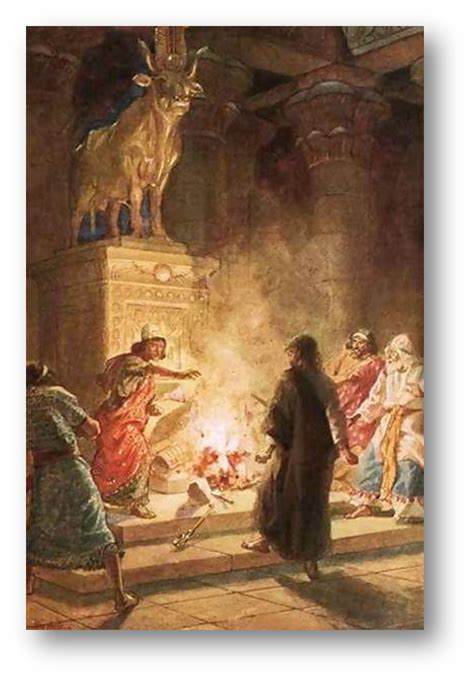
And the king commanded Hilkiah the high priest and the priests of the second order and the keepers of the threshold to bring out of the temple of the Lord all the vessels made for Baal, for Asherah, and for all the host of heaven. He burned them outside Jerusalem in the fields of the Kidron and carried their ashes to Bethel. And he deposed the priests whom the kings of Judah had ordained to make offerings in the high places at the cities of Judah and around Jerusalem; those also who burned incense to Baal, to the sun and the moon and the constellations and all the host of the heavens. And he brought out the Asherah from the house of the Lord, outside Jerusalem, to the brook Kidron, and burned it at the brook Kidron and beat it to dust and cast the dust of it upon the graves of the common people. And he broke down the houses of the male cult prostitutes who were in the house of the Lord, where the women wove hangings for the Asherah. And he brought all the priests out of the cities of Judah, and defiled the high places where the priests had made offerings, from Geba to Beersheba. And he broke down the high places of the gates that were at the entrance of the gate of Joshua the governor of the city, which were on one’s left at the gate of the city. However, the priests of the high places did not come up to the altar of the Lord in Jerusalem, but they ate unleavened bread among their brothers. 10 And he defiled Topheth, which is in the Valley of the Son of Hinnom, that no one might burn his son or his daughter as an offering to Molech. 11 And he removed the horses that the kings of Judah had dedicated to the sun, at the entrance to the house of the Lord, by the chamber of Nathan-melech the chamberlain, which was in the precincts. And he burned the chariots of the sun with fire. 12 And the altars on the roof of the upper chamber of Ahaz, which the kings of Judah had made, and the altars that Manasseh had made in the two courts of the house of the Lord, he pulled down and broke in pieces and cast the dust of them into the brook Kidron. 13 And the king defiled the high places that were east of Jerusalem, to the south of the mount of corruption, which Solomon the king of Israel had built for Ashtoreth the abomination of the Sidonians, and for Chemosh the abomination of Moab, and for Milcom the abomination of the Ammonites. 14 And he broke in pieces the pillars and cut down the Asherim and filled their places with the bones of men.

15 Moreover, the altar at Bethel, the high place erected by Jeroboam the son of Nebat, who made Israel to sin, that altar with the high place he pulled down and burned, reducing it to dust. He also burned the Asherah. 16 And as Josiah turned, he saw the tombs there on the mount. And he sent and took the bones out of the tombs and burned them on the altar and defiled it, according to the word of the Lord that the man of God proclaimed, who had predicted these things. 17 Then he said, “What is that monument that I see?” And the men of the city told him, “It is the tomb of the man of God who came from Judah and predicted these things that you have done against the altar at Bethel.” 18 And he said, “Let him be; let no man move his bones.” So they let his bones alone, with the bones of the prophet who came out of Samaria. 19 And Josiah removed all the shrines also of the high places that were in the cities of Samaria, which kings of Israel had made, provoking the Lord to anger. He did to them according to all that he had done at Bethel. 20 And he sacrificed all the priests of the high places who were there, on the altars, and burned human bones on them. Then he returned to Jerusalem. – 2 Kings 23:1-20 ESV

When it came to reforming and healing the deadly spiritual malaise in Judah, Josiah had his work cut out for him. And when reading the list of his reforms, it’s easy to focus on all the positive steps he took to course-correct Judah’s spiritual trajectory. But why was all of this necessary? How had things gotten so bad in Judah that the king was forced to commit all his time and resources to this spiritual reclamation project? The reader should be shocked and appalled by the abysmal condition of the nation’s faith community. The moral state of the people of Judah had reached an all-time low. And Josiah revealed the extent of their moral decline by reading to them portions of the rediscovered Book of the Covenant – the Pentateuch. And it seems likely that his reading included this foundational and oft-repeated admonition from the original Ten Commandments.

“Do not make idols or set up carved images, or sacred pillars, or sculptured stones in your land so you may worship them. I am the Lord your God. You must keep my Sabbath days of rest and show reverence for my sanctuary. I am the Lord. – Leviticus 26:1-2 NLT

Josiah had already begun an aggressive temple renovation project designed to repair the long-neglected house of God. But these restoration efforts were more than cosmetic in nature. Josiah was having to purge and purify the sanctuary of God from the desecrating presence of altars to a litany of idols. His predecessors had repeatedly displayed their disregard for God by defiling the temple that bore His name. They had turned God’s house into a veritable showroom for displaying all their false gods, and the sheer volume of these abominations is staggering.

Then the king instructed Hilkiah the high priest and the priests of the second rank and the Temple gatekeepers to remove from the Lord’s Temple all the articles that were used to worship Baal, Asherah, and all the powers of the heavens. – 2 Kings 23:4 NLT

The king removed the Asherah pole from the Lord’s Temple… – 2 Kings 23:6 NLT

He also tore down the living quarters of the male and female shrine prostitutes that were inside the Temple of the Lord – 2 Kings 23:7 NLT

He removed from the entrance of the Lord’s Temple the horse statues that the former kings of Judah had dedicated to the sun – 2 Kings 23:11 NLT

The king destroyed the altars that Manasseh had built in the two courtyards of the Lord’s Temple. – 2 Kings 23:12 NLT

Josiah was a busy man, and his reforms didn’t stop at the temple. He was determined to do whatever it took to remove every last vestige of idolatry from the land of Judah. He ordered the destruction of every last shrine or altar dedicated to a false god, and there were a lot of them. Pagan shrines and high places could be found through Judah, from the capital city of Jerusalem to Geba in the north and Beersheba in the south. Their ubiquitous presence required Josiah to launch an extensive seek-and-destroy mission that began in the temple, extended to the valleys just out Jerusalem, and then reached all the way to the northern territory of Israel.

While the northern kingdom of Israel had fallen to the Assyrians and the people had been taken captive, the shrines and altars to their false gods remained. So, Josiah sent special demolition teams as far as Bethel to destroy the altar that Jeroboam had erected years earlier.

The king also tore down the altar at Bethel—the pagan shrine that Jeroboam son of Nebat had made when he caused Israel to sin. He burned down the shrine and ground it to dust, and he burned the Asherah pole. – 2 Kings 23:15 NLT

This was in direct fulfillment of a centuries-old prophecy declared by God against the rebellious Jeroboam. After God had split the kingdom of Solomon in half, He had awarded the kingship of the ten northern tribes oto Jeroboam. But Jeroboam had displayed his loyalty and gratitude by erecting a golden calf in the city of Bethel. This newly appointed king of Israel repaid God by abandoning Him. So, God sent a young, unnamed prophet with a message.

“O altar, altar! This is what the Lord says: A child named Josiah will be born into the dynasty of David. On you he will sacrifice the priests from the pagan shrines who come here to burn incense, and human bones will be burned on you.” – 1 Kings 13:2 NLT

Now, hundreds of years later, the prophecy of God became a reality. Josiah tore down the altar dedicated to the golden calf and then had the ground desecrated by burning human bones on it.

Then Josiah turned around and noticed several tombs in the side of the hill. He ordered that the bones be brought out, and he burned them on the altar at Bethel to desecrate it. (This happened just as the Lord had promised through the man of God when Jeroboam stood beside the altar at the festival.) – 2 Kings 23:16 NLT

The scope of Josiah’s reformation initiative is truly staggering, and it reveals just how bad things had gotten in Judah. The sheer volume of false gods being worshiped by the people of God should leave us dumbfounded. There were shrines to Baal, Topheth, Ashtoreth, Chemosh, and Molech – just to name a few. But there also altars dedicated “to the sun, the moon, the constellations, and to all the powers of the heavens” (2 Kings 23:5 NLT), as well as horse and chariot statues dedicated to the sun (2 Kings 23:11).

Josiah was faced with a truly formidable task but he took it on with dedicated determination. He tore down, burned down, cut down, smashed, and desecrated the thousands of altars to the myriad of false gods that permeated the landscape and the hearts of the people of Judah. Josiah took his role seriously because he feared God greatly. His reading of the Book the Covenant had reminded him of the dire consequences facing the people of God if they failed to remain faithful to their covenant commitment. He was well aware of what had happened to the northern kingdom, and he knew that Judah was just as deserving of God’s judgment. They had been equally unfaithful and the evidence was everywhere. So, Josiah took it upon himself to cleanse the land of its idolatrous stain. But the greatest challenge he faced was turning the hearts of the people back to Yahweh. He could remove the idols from the land, but could he remove the spirit of idolatry from their hearts? Time would tell.

English Standard Version (ESV) The Holy Bible, English Standard Version. ESV® Permanent Text Edition® (2016). Copyright © 2001 by Crossway Bibles, a publishing ministry of Good News Publishers.

New Living Translation (NLT) Holy Bible, New Living Translation, copyright © 1996, 2004, 2015 by Tyndale House Foundation. Used by permission of Tyndale House Publishers Inc., Carol Stream, Illinois 60188. All rights reserved.

The Message (MSG)Copyright © 1993, 1994, 1995, 1996, 2000, 2001, 2002 by Eugene H. Peterson

Things That Were Not Right

1 In the twelfth year of Ahaz king of Judah, Hoshea the son of Elah began to reign in Samaria over Israel, and he reigned nine years. And he did what was evil in the sight of the Lord, yet not as the kings of Israel who were before him. Against him came up Shalmaneser king of Assyria. And Hoshea became his vassal and paid him tribute. But the king of Assyria found treachery in Hoshea, for he had sent messengers to So, king of Egypt, and offered no tribute to the king of Assyria, as he had done year by year. Therefore the king of Assyria shut him up and bound him in prison. Then the king of Assyria invaded all the land and came to Samaria, and for three years he besieged it.

In the ninth year of Hoshea, the king of Assyria captured Samaria, and he carried the Israelites away to Assyria and placed them in Halah, and on the Habor, the river of Gozan, and in the cities of the Medes.

And this occurred because the people of Israel had sinned against the Lord their God, who had brought them up out of the land of Egypt from under the hand of Pharaoh king of Egypt, and had feared other gods and walked in the customs of the nations whom the Lord drove out before the people of Israel, and in the customs that the kings of Israel had practiced. And the people of Israel did secretly against the Lord their God things that were not right. They built for themselves high places in all their towns, from watchtower to fortified city. 10 They set up for themselves pillars and Asherim on every high hill and under every green tree, 11 and there they made offerings on all the high places, as the nations did whom the Lord carried away before them. And they did wicked things, provoking the Lord to anger, 12 and they served idols, of which the Lord had said to them, “You shall not do this.” 13 Yet the Lord warned Israel and Judah by every prophet and every seer, saying, “Turn from your evil ways and keep my commandments and my statutes, in accordance with all the Law that I commanded your fathers, and that I sent to you by my servants the prophets.”

14 But they would not listen, but were stubborn, as their fathers had been, who did not believe in the Lord their God. 15 They despised his statutes and his covenant that he made with their fathers and the warnings that he gave them. They went after false idols and became false, and they followed the nations that were around them, concerning whom the Lord had commanded them that they should not do like them. 16 And they abandoned all the commandments of the Lord their God, and made for themselves metal images of two calves; and they made an Asherah and worshiped all the host of heaven and served Baal. 17 And they burned their sons and their daughters as offerings and used divination and omens and sold themselves to do evil in the sight of the Lord, provoking him to anger. 18 Therefore the Lord was very angry with Israel and removed them out of his sight. None was left but the tribe of Judah only. 2 Kings 17:1-18 ESV

Chapter 17 marks the beginning of the end of the northern kingdom of Israel. It had been two centuries since God had divided Solomon’s domain in half and placed the ten northern tribes under the leadership of Jeroboam. Now, some 200 years later, God was about to bring judgment upon His disobedient children. And it all takes place during the reign of Hoshea, who will have the not-so-pleasant privilege of serving as the last king of Israel. Like many of his predecessors, Hoshea had come to the throne by means of intrigue and insurrection. Under King Pekah’s leadership, Israel had suffered great losses in terms of both land and lives. King Tiglath-Pileser had conducted a relentless campaign of terror, eventually capturing “the towns of Ijon, Abel-beth-maacah, Janoah, Kedesh, and Hazor. He also conquered the regions of Gilead, Galilee, and all of Naphtali, and he took the people to Assyria as captives” (2 Kings 15:29 ESV). 

These actions left the nation in a state of disarray and weakened Pekah’s hold on the throne of Israel. Hoshea took full advantage of the volatile conditions and launched a coup that results in Pekah’s assassination and his own ascension to the throne of Israel. But he had chosen a poor time to become king. The Assyrians had completely dominated and demoralized the Israelite army, leaving Hoshea with no choice but to become a vassal to King Tiglath-Pileser. He was nothing more than a puppet king, answering to the more powerful king of Assyria. But when Tiglath-Pileser was forced to return to Mesopotamia to deal with problems in his own land, Hoshea rebelled and declared Israel to be free from Assyrian rule. He stopped all tribute payments to Assyria and, in an effort to prevent further invasions, he made an alliance with the Egyptians. Things appeared to be going in his favor.

Tiglath-Pileser eventually died and was replaced by his son, Shalmaneser. For two years, the new king of Assyria remained preoccupied with problems on the home front. But in 725 BC, he once again set his sights on the land of Philistia. One of the first things Shalmaneser did was order the arrest and imprisonment of the recalcitrant king of Israel. Hoshea was removed from the throne and placed in a prison cell, where he would wait out the fall of his kingdom. For three years, the Assyrians laid siege to the capital city of Samaria, and in 722 BC it fell.

…in the ninth year of King Hoshea’s reign, Samaria fell, and the people of Israel were exiled to Assyria. They were settled in colonies in Halah, along the banks of the Habor River in Gozan, and in the cities of the Medes. – 2 Kings 17:6 NLT

But even worse than the fall of the capital was the capture and deportation of the people. They were forcibly removed from the land and taken as prisoners to Assyria. They were herded like animals and marched out of Israel, never to step foot in the land of promise again. And the author makes it painfully clear why they were suffering this horrific fate.

This disaster came upon the people of Israel because they worshiped other gods. They sinned against the Lord their God, who had brought them safely out of Egypt and had rescued them from the power of Pharaoh, the king of Egypt. – 2 Kings 17:7 NLT

And none of this should have come as a surprise. God had warned them repeatedly that they would face serious consequences if they chose to rebel against Him. Long before they had entered the land of Canaan, God had given them a detailed description of what would happen if they refused to remain faithful to their covenant commitment to Him. Moses pulled no punches when he outlined for them the devastating consequences for their rebellion.

“The Lord will exile you and your king to a nation unknown to you and your ancestors. There in exile you will worship gods of wood and stone! You will become an object of horror, ridicule, and mockery among all the nations to which the Lord sends you.” – Deuteronomy 28:36-37 NLT

“You will have sons and daughters, but you will lose them, for they will be led away into captivity.” – Deuteronomy 28:41 NLT

“Just as the Lord has found great pleasure in causing you to prosper and multiply, the Lord will find pleasure in destroying you. You will be torn from the land you are about to enter and occupy. – Deuteronomy 28:63 NLT

And now, centuries later, the words of Moses had been proven true. God had done what He had said He would do. And the author of 2 Kings puts all the blame on the people of Israel.

They had followed the practices of the pagan nations – vs 8

The people of Israel had also secretly done many things that were not pleasing to the Lord their God. – vs 9

They built pagan shrines for themselves – vs 9

They set up sacred pillars and Asherah poles – vs 10

They offered sacrifices on all the hilltops, just like the nations the Lord had driven from the land ahead of them – vs 11

Yes, they worshiped idols, despite the Lord’s specific and repeated warnings. – vs 12

And they had done all of this despite the repeated warnings of God’s prophets.

Again and again the Lord had sent his prophets and seers to warn both Israel and Judah: “Turn from all your evil ways. Obey my commands and decrees—the entire law that I commanded your ancestors to obey, and that I gave you through my servants the prophets.” – 2 Kings 17:13 NLT

But they had refused to listen. They rejected the words of the prophets and refused to believe that God would follow through on His warnings. In fact, the author states that “they despised all his warnings” (2 Kings 17:15 NLT). And it had all begun as soon as God had placed the ten northern tribes in the hands of Jeroboam. In response to this tremendous responsibility given to him by God, Jeroboam had ordered the creation of two idols of gold made in the form of a calf. These false gods became the first of many that the people of Israel would worship in place of Yahweh.

They set up an Asherah pole and worshiped Baal and all the forces of heaven. They even sacrificed their own sons and daughters in the fire. They consulted fortune-tellers and practiced sorcery and sold themselves to evil, arousing the Lord’s anger. – 2 Kings 17:16-17 NLT

King after king, generation after generation, the people of Israel would repeat the sins of their fathers. And the prophets of God would repeat the warnings of Moses, calling the people to repent and return to their covenant commitment.

But the Israelites would not listen. They were as stubborn as their ancestors who had refused to believe in the Lord their God. – 2 Kings 17:14 NLT

So, God “swept them away from his presence” (2 Kings 17:18 NLT). In a sense, the ten northern tribes ceased to exist. Yes, even after the exile, there would be many who remained in the land, but they would never have another king to rule over them. They would live under the constant threat of enemy attack. The land of promise would become a place of hopelessness and heartache. The residual impact of the Assyrian invasion would be long-term and devastatingly difficult, just as God had warned.

Its armies will devour your livestock and crops, and you will be destroyed. They will leave you no grain, new wine, olive oil, calves, or lambs, and you will starve to death. – Deuteronomy 28:51 NLT

The people of God had turned their backs on Him. Despite His many blessings and the constant reminders of His covenant faithfulness, they had made a conscious decision to replace Him. He had warned them, but they had refused to listen. And now they were facing the consequences.

English Standard Version (ESV) The Holy Bible, English Standard Version. ESV® Permanent Text Edition® (2016). Copyright © 2001 by Crossway Bibles, a publishing ministry of Good News Publishers.

New Living Translation (NLT) Holy Bible, New Living Translation, copyright © 1996, 2004, 2015 by Tyndale House Foundation. Used by permission of Tyndale House Publishers Inc., Carol Stream, Illinois 60188. All rights reserved.

The Message (MSG)Copyright © 1993, 1994, 1995, 1996, 2000, 2001, 2002 by Eugene H. Peterson


There is No Other God

1 Naaman, commander of the army of the king of Syria, was a great man with his master and in high favor, because by him the Lord had given victory to Syria. He was a mighty man of valor, but he was a leper. Now the Syrians on one of their raids had carried off a little girl from the land of Israel, and she worked in the service of Naaman’s wife. She said to her mistress, “Would that my lord were with the prophet who is in Samaria! He would cure him of his leprosy.” So Naaman went in and told his lord, “Thus and so spoke the girl from the land of Israel.” And the king of Syria said, “Go now, and I will send a letter to the king of Israel.”

So he went, taking with him ten talents of silver, six thousand shekels of gold, and ten changes of clothing. And he brought the letter to the king of Israel, which read, “When this letter reaches you, know that I have sent to you Naaman my servant, that you may cure him of his leprosy.” And when the king of Israel read the letter, he tore his clothes and said, “Am I God, to kill and to make alive, that this man sends word to me to cure a man of his leprosy? Only consider, and see how he is seeking a quarrel with me.”

But when Elisha the man of God heard that the king of Israel had torn his clothes, he sent to the king, saying, “Why have you torn your clothes? Let him come now to me, that he may know that there is a prophet in Israel.” So Naaman came with his horses and chariots and stood at the door of Elisha’s house. 10 And Elisha sent a messenger to him, saying, “Go and wash in the Jordan seven times, and your flesh shall be restored, and you shall be clean.” 11 But Naaman was angry and went away, saying, “Behold, I thought that he would surely come out to me and stand and call upon the name of the Lord his God, and wave his hand over the place and cure the leper. 12 Are not Abana and Pharpar, the rivers of Damascus, better than all the waters of Israel? Could I not wash in them and be clean?” So he turned and went away in a rage. 13 But his servants came near and said to him, “My father, it is a great word the prophet has spoken to you; will you not do it? Has he actually said to you, ‘Wash, and be clean’?” 14 So he went down and dipped himself seven times in the Jordan, according to the word of the man of God, and his flesh was restored like the flesh of a little child, and he was clean.

15 Then he returned to the man of God, he and all his company, and he came and stood before him. And he said, “Behold, I know that there is no God in all the earth but in Israel; so accept now a present from your servant.” 2 Kings 5:1-15 ESV

Elisha appears to have been a prophet to the people. At this point in the narrative, his interactions with the kings of Israel have been few and far between. Yet, we have seen him provide the widow of Zarephath with a miraculous supply of oil that allowed her and her two young sons to escape poverty and avoid possible enslavement. Next, he rewarded the Shunammite woman’s hospitality by replacing the sorrow of her barrenness with the joy of motherhood. But years later, when that young son unexpectedly died, the prophet intervened again, raising him back to life and restoring the joy of his mother. And then there’s the story of the poisoned stew. A young prophet had inadvertently and innocently added wild gourds to a stew that Elisha’s servant had prepared, not knowing that they were poisonous. This deadly concoction could have resulted in the deaths of all the prophets who ate it, but Elisha had intervened, purifying the contents and protecting the lives of God’s messengers.

All of these stories are meant to reveal God’s interest in and interactions with His people. The average Israelite had to live in a land permeated by idolatry and under the judgment of God. On two separate occasions, God had brought famine on the land because of the apostasy of its godless kings. Yet, the stories of Elijah and Elisha reveal how God stepped into the lives of his people, graciously providing them with sustenance in the midst of His divine judgment. These stories are meant to showcase the mercy and love of God. Despite the ongoing unfaithfulness of Israel’s kings, the God of Israel remained committed to the covenant promises He had made to His people.

And in chapter five, we’re given another story that illustrates God’s sovereign hand over not only Israel but all the nations. While the kings of Israel continued to abuse their power by leading the people into idolatry and apostasy, God operated behind the scenes, demonstrating His unparalleled sovereignty over faithless kings, false gods, and even those outside the flock of Israel.

Suddenly, in chapter five, the author expands the scope of his narrative by including the plight of a Syrian general who suffered from the debilitating and potentially deadly disease known as leprosy. This story’s inclusion was meant to shock and surprise the Jewish audience to whom the author originally wrote. Their attention would have been piqued as soon as they read, “Naaman, commander of the army of the king of Syria, was a great man with his master and in high favor, because by him the Lord had given victory to Syria” (2 Kings 5:1 ESV). Why in the world would the God of Israel have given this pagan idol-worshiper a victory of any kind? This would have made no sense. And to make matters worse, this non-Hebrew is described as “a mighty man of valor” (2 Kings 5:1 ESV) who had led raids into Israel and captured and enslaved a young Jewish girl. To the Jewish reader, the only positive aspect of this story would have been that Naaman had leprosy.

Over the centuries, the Syrians had enjoyed a love-hate relationship with the nation of Israel. And ever since God had divided the nation in two, creating the northern kingdom of Israel and the southern kingdom of Judah, the Syrians had made a habit of playing one against the other. Treaties had been signed and then broken. Alliances had been made, only to have been reneged upon. Syria had repeatedly taken advantage of the discord between Israel and Judah, choosing to align itself with one or the other based on what could be gained from the arrangement.

The Syrians were not to be trusted. They were self-promoting opportunists who regularly switch sides and deftly manipulated the strained relationship between Israel and Judah to their advantage. And yet, here we have the unexpected and shocking story about a Syrian general who receives healing from the prophet of God.

Everything about this story is intended to reveal God’s sovereign hand. He is described as the source behind Syria’s victory, and that victory was over the nation of Israel. Not only that, the victory included the capture of a young Jewish girl. But providentially, that same young girl ended up as a servant to Naaman’s wife. Like Moses being adopted into Pharaoh’s family or Joseph ending up serving in Pharaoh’s court, this young, unidentified Jewish girl found herself serving in the home of one of the most powerful men in Syria. Her plight, while difficult, had been God-ordained.

Because of her providential presence in Naaman’s household, she had become aware of his leprosy and was able to tell her mistress about a possible solution to his problem.

“I wish my master would go to see the prophet in Samaria. He would heal him of his leprosy.” – 2 Kings 5:3 NLT

Despite her predicament, she was still a faithful follower of Yahweh, and she believed that her God had the power to provide healing, even to the pagan commander who had enslaved her. Not only does this young girl display an amazing amount of faith, but she reveals a kind and compassionate heart. Rather than rejoicing over her captor’s plight, she expresses her desire that he be healed, even declaring her wish that he could meet the prophet of God.

Once again, God’s sovereignty is revealed through the rather strange chain of events that ensue. Naaman goes to Ben-Hadad II, the king of Syria, and received permission to visit Samaria. The king even provides Naaman with a letter of introduction to Jehoram, the king of Israel. And in an attempt to guarantee Jehoram’s assistance, Ben-Hadad II sends 750 pounds of silver, 150 pounds of gold, and 10 changes of royal apparel. Don’t miss the irony in all of this. At the suggestion of a young Israelite slave girl, a pagan Syrian general has made an appeal to his pagan Syrian king. And that idol-worshiping Syrian king has sent a sizeable tribute to an apostate Israelite king begging that he help his leprosy-stricken general get healing from the God of Israel. You can’t make this stuff up.

When Naaman presented his letter of introduction and the generous gifts from King King Ben-hadad, he was met with both surprise and suspicion. Jehoram thinks the whole thing is a set-up.

“Am I God, that I can give life and take it away? Why is this man asking me to heal someone with leprosy? I can see that he’s just trying to pick a fight with me.” – 2 Kings 5:7 NLT

It never seems to cross Jehoram’s mind to seek the aid of Yahweh or His prophet. He simply panics, assuming the whole thing is a clever ploy by Ben-Hadad to justify military action in the guise of revenge. But while Jehoram decided to leave God out of the equation, Elisha got wind of what was happening and contacted the king.

“Why are you so upset? Send Naaman to me, and he will learn that there is a true prophet here in Israel.” – 2 Kings 5:8 NLT

Once again, God’s prophet came to the rescue. But what happens next is almost humorous. The famous general from Syria had to get in his chariot and, along with his retinue, make his way to Elisha’s humble home. But before Naaman could get there, the prophet sent a messenger to meet him with a rather strange set of instructions.

“Go and wash yourself seven times in the Jordan River. Then your skin will be restored, and you will be healed of your leprosy.” – 2 Kings 5:10 NLT

But the proud military commander, who was used to having all his subordinates report to him, was offended that Elisha didn’t bother to meet him. And it’s clear that he had expected something a bit showier when it came to how he would be healed.

“I expected him to wave his hand over the leprosy and call on the name of the Lord his God and heal me! – 2 Kings 5:11 NLT

But to Naaman’s disappointment, Elisha’s only instructions had been to bathe seven times in the Jordan River. This sounded ridiculous to the general, and he let his frustration be known in no uncertain terms.

Aren’t the rivers of Damascus, the Abana and the Pharpar, better than any of the rivers of Israel? Why shouldn’t I wash in them and be healed?” – 2 Kings 5:12 NLT

But as Naaman was preparing to walk away in a huff, one of his own servants convinced him to do what the prophet had said. After all, what did he have to lose? Yes, the whole bathing-in-the-Jordan thing would be a blow to his pride, but it might very well be worth it. So, Naaman took the advice of his servant and obeyed the command of the prophet. And when he came up out of the water the seventh time, he was completely cleansed of his leprosy. In fact, the author describes the condition of his skin as that of a young child – no scars, scabs, or lesions of any kind. Naaman the Syrian had experienced a miracle, and he clearly recognized that it had been the work of Yahweh, the God of Israel.

“Now I know that there is no God in all the world except in Israel. – 2 Kings 5:15 NLT

That’s an amazing admission to come from the lips of a pagan Syrian general. He had spent his entire life worshiping Baal, and it’s likely that he had often petitioned his god for healing from his condition. But his requests had remained unheeded because they had gone unheard. His leprosy had been real, but his god was not. Yet, here was Naaman standing before Yahweh’s prophet, healed and whole, and declaring his belief in the one true God of Israel.

English Standard Version (ESV) The Holy Bible, English Standard Version. ESV® Permanent Text Edition® (2016). Copyright © 2001 by Crossway Bibles, a publishing ministry of Good News Publishers.

New Living Translation (NLT) Holy Bible, New Living Translation, copyright © 1996, 2004, 2015 by Tyndale House Foundation. Used by permission of Tyndale House Publishers Inc., Carol Stream, Illinois 60188. All rights reserved.

The Message (MSG)Copyright © 1993, 1994, 1995, 1996, 2000, 2001, 2002 by Eugene H. Peterson

So Close, But Yet So Far

11 Now an old prophet lived in Bethel. And his sons came and told him all that the man of God had done that day in Bethel. They also told to their father the words that he had spoken to the king. 12 And their father said to them, “Which way did he go?” And his sons showed him the way that the man of God who came from Judah had gone. 13 And he said to his sons, “Saddle the donkey for me.” So they saddled the donkey for him and he mounted it. 14 And he went after the man of God and found him sitting under an oak. And he said to him, “Are you the man of God who came from Judah?” And he said, “I am.” 15 Then he said to him, “Come home with me and eat bread.” 16 And he said, “I may not return with you, or go in with you, neither will I eat bread nor drink water with you in this place, 17 for it was said to me by the word of the Lord, ‘You shall neither eat bread nor drink water there, nor return by the way that you came.’” 18 And he said to him, “I also am a prophet as you are, and an angel spoke to me by the word of the Lord, saying, ‘Bring him back with you into your house that he may eat bread and drink water.’” But he lied to him. 19 So he went back with him and ate bread in his house and drank water.

20 And as they sat at the table, the word of the Lord came to the prophet who had brought him back. 21 And he cried to the man of God who came from Judah, “Thus says the Lord, ‘Because you have disobeyed the word of the Lord and have not kept the command that the Lord your God commanded you, 22 but have come back and have eaten bread and drunk water in the place of which he said to you, “Eat no bread and drink no water,” your body shall not come to the tomb of your fathers.’” 23 And after he had eaten bread and drunk, he saddled the donkey for the prophet whom he had brought back. 24 And as he went away a lion met him on the road and killed him. And his body was thrown in the road, and the donkey stood beside it; the lion also stood beside the body. 25 And behold, men passed by and saw the body thrown in the road and the lion standing by the body. And they came and told it in the city where the old prophet lived.

26 And when the prophet who had brought him back from the way heard of it, he said, “It is the man of God who disobeyed the word of the Lord; therefore the Lord has given him to the lion, which has torn him and killed him, according to the word that the Lord spoke to him.” 27 And he said to his sons, “Saddle the donkey for me.” And they saddled it. 28 And he went and found his body thrown in the road, and the donkey and the lion standing beside the body. The lion had not eaten the body or torn the donkey. 29 And the prophet took up the body of the man of God and laid it on the donkey and brought it back to the city to mourn and to bury him. 30 And he laid the body in his own grave. And they mourned over him, saying, “Alas, my brother!” 31 And after he had buried him, he said to his sons, “When I die, bury me in the grave in which the man of God is buried; lay my bones beside his bones. 32 For the saying that he called out by the word of the Lord against the altar in Bethel and against all the houses of the high places that are in the cities of Samaria shall surely come to pass.”

33 After this thing Jeroboam did not turn from his evil way, but made priests for the high places again from among all the people. Any who would, he ordained to be priests of the high places. 34 And this thing became sin to the house of Jeroboam, so as to cut it off and to destroy it from the face of the earth. 1 Kings 13:11-34 ESV

After delivering God’s message of judgment to Jeroboam and having destroyed the altar dedicated to one of Jeroboam’s false gods, the young prophet had begun his return journey to Judah. He had successfully fulfilled His God-ordained mission and had been given strict instructions to spend no additional time among the northern tribes. He was to accept no forms of hospitality or allow anyone or anything to delay his return home. He was even warned to take a different route back to Judah in order to prevent anyone from interfering with his mission. And this young prophet had proved to be obedient to the will of God. He had rejected Jeroboam’s tempting offer of a meal and a reward, declaring his intentions to remain faithful to every detail of God’s instructions.

“Even if you gave me half of everything you own, I would not go with you. I would not eat or drink anything in this place. For the Lord gave me this command: ‘You must not eat or drink anything while you are there, and do not return to Judah by the same way you came.’” So he left Bethel and went home another way. – 1 Kings 13:8-10 NLT

But as the story continues to unfold, we find the young prophet taking what appears to be an unsanctioned break under a large tree. Having not yet crossed the border into Judah, he decided to take a much-needed rest. While the text does not tell where the young man began his journey to Judah that day, it is likely that he had spent many hours making the trip to Bethel. If he began his trip from Jerusalem, it would have been a 90-mile trek to Bethels. And now, after having destroyed the Jeroboam’s altar to his false god, the prophet was having to walk all the way back. So, it makes perfect sense that he was weary from all the activity and excitement of the day. He was tired, hungry, and alone. But he had not yet completed his mission. He had been instructed by God to return to Judah without delay and to avoid all distractions.

Yet, as the young man rested under the tree, he was approached by a stranger – an old prophet who happened to live in Bethel. The author provides few details about this man, except that he was a prophet and a father. His sons, who had witnessed the events at the altar that day, returned home and told him all about all that the young prophet had said and done. Intrigued by what he heard, the elder prophet commanded his sons to saddle a donkey so that he could seek out his young peer. It seems likely that he simply wanted to verify the message the younger prophet had delivered. As a prophet himself, this older man would have been interested in whether the message delivered by the young man was actually from God. If it was, there were dark days ahead for the northern kingdom. Remember what the young prophet had declared at the altar earlier that day.

“A child named Josiah will be born into the dynasty of David. On you he will sacrifice the priests from the pagan shrines who come here to burn incense, and human bones will be burned on you.” – 1 Kings 13:2 NLT

Those were serious words that implied future judgment against the northern kingdom and this senior prophet was anxious to verify their veracity. So, he mounted his donkey and began his search for the one who had delivered this foreboding message. And because the young prophet had decided to take his unscheduled rest stop under the tree, the older prophet caught up with him before he had crossed over into Judah. This is where it gets interesting.

Based on what happens next, it is difficult to understand the motives of the older man. But we are clearly told that he used deception in order to convince the younger prophet to return to his home for a meal. His offer had been rejected by the young man because it violated the command of God.

“I am not allowed to eat or drink anything here in this place. For the Lord gave me this command: ‘You must not eat or drink anything while you are there, and do not return to Judah by the same way you came.’” – 1 Kings 13:16-17 NLT

It is clear that they were still within the borders of Israel. The young prophet had not yet made it to the safety of Judah. But, anxious to hear more about the young man’s message from God, the older prophet lied to him. He falsely claimed to have been given a message from an angel commanding him to bring the young man to his home for a meal. Driven by hunger, the young prophet lowered his defenses and accepted the offer. But in doing so, he disobeyed the command of God. He allowed his physical appetites to cloud his thinking and compromise his convictions.

The text indicates that the young prophet ended up violating the divine decree by sharing a meal in the older prophet’s home. And as soon as he had eaten the food he had been commanded to avoid, the young man received a stinging rebuke from God delivered by the very man who had just deceived him.

“This is what the Lord says: You have defied the word of the Lord and have disobeyed the command the Lord your God gave you. You came back to this place and ate and drank where he told you not to eat or drink. Because of this, your body will not be buried in the grave of your ancestors.” – 1 Kings 13:21-22 NLT

This time, the older prophet had spoken the truth. His lie had caused the younger prophet to disobey God. And now, he had the unpleasant responsibility of delivering God’s message of judgment against the very man he had deceived and caused to disobey. The rest of the story reads like something out of Grimms’ Fairy Tales. The young man, with a full stomach and a heavy heart, began his journey home. But before he could make it into Judah, he was attacked by a lion. The beast killed the prophet but left the donkey unmolested, then stood sentry over the fallen body. And passing travelers saw the strange scene and reported it back in Bethel. Upon hearing the news, the older prophet retrieved the body of the young man and placed it in his own tomb, located in the city of Bethel.

The old man was now fully convinced that what the young prophet had said had been the word of God.

“For the message the Lord told him to proclaim against the altar in Bethel and against the pagan shrines in the towns of Samaria will certainly come true.” – 1 Kings 13:32 NLT

Yahweh had used this young, unnamed prophet to declare His judgment against the ten northern tribes. Their continued apostasy would eventually lead to their destruction. When it came to His chosen people, God was deadly serious that they obey Him. Whether they were a fully united confederation of 12 tribes or divided into two rival kingdoms, they remained His prized possession and were obligated to live according to His commands. Obedience would bring the blessings of God. But disobedience would bring His curses. And the young prophet had learned the costly lesson that partial obedience was insufficient and unacceptable to God. He had almost completed his mission but had ultimately failed. He had been sent by God but had ended up being punished by God for allowing the things of this world to distract him from his end goal. Had he crossed the border into Judah, he could have eaten his fill of food. But he compromised. He allowed his physical appetites to cloud his thinking and distract him from his God-given assignment. And he paid dearly for his mistake. This young man’s life is a perfect illustration of what the apostle John warned about in his first epistle. The young prophet’s desire for physical pleasure ended up superseding his love for God and it proved not only disappointing, but deadly.

Do not love this world nor the things it offers you, for when you love the world, you do not have the love of the Father in you. For the world offers only a craving for physical pleasure, a craving for everything we see, and pride in our achievements and possessions. These are not from the Father, but are from this world. And this world is fading away, along with everything that people crave. But anyone who does what pleases God will live forever. – 1 John 2:15-17 NLT

English Standard Version (ESV) The Holy Bible, English Standard Version. ESV® Permanent Text Edition® (2016). Copyright © 2001 by Crossway Bibles, a publishing ministry of Good News Publishers.

New Living Translation (NLT) Holy Bible, New Living Translation, copyright © 1996, 2004, 2015 by Tyndale House Foundation. Used by permission of Tyndale House Publishers Inc., Carol Stream, Illinois 60188. All rights reserved.

The Message (MSG)Copyright © 1993, 1994, 1995, 1996, 2000, 2001, 2002 by Eugene H. Peterson

Uncompromising Conviction

1 And behold, a man of God came out of Judah by the word of the Lord to Bethel. Jeroboam was standing by the altar to make offerings. And the man cried against the altar by the word of the Lord and said, “O altar, altar, thus says the Lord: ‘Behold, a son shall be born to the house of David, Josiah by name, and he shall sacrifice on you the priests of the high places who make offerings on you, and human bones shall be burned on you.’” And he gave a sign the same day, saying, “This is the sign that the Lord has spoken: ‘Behold, the altar shall be torn down, and the ashes that are on it shall be poured out.’” And when the king heard the saying of the man of God, which he cried against the altar at Bethel, Jeroboam stretched out his hand from the altar, saying, “Seize him.” And his hand, which he stretched out against him, dried up, so that he could not draw it back to himself. The altar also was torn down, and the ashes poured out from the altar, according to the sign that the man of God had given by the word of the Lord. And the king said to the man of God, “Entreat now the favor of the Lord your God, and pray for me, that my hand may be restored to me.” And the man of God entreated the Lord, and the king’s hand was restored to him and became as it was before. And the king said to the man of God, “Come home with me, and refresh yourself, and I will give you a reward.” And the man of God said to the king, “If you give me half your house, I will not go in with you. And I will not eat bread or drink water in this place, for so was it commanded me by the word of the Lord, saying, ‘You shall neither eat bread nor drink water nor return by the way that you came.’” 10 So he went another way and did not return by the way that he came to Bethel. 1 Kings 13:1-10 ESV

In an effort to preserve the kingdom given to him by God, Jeroboam had made a boneheaded decision that ended up offending God. He knew that the Israelites were a religious people and feared that they would continue to travel to Judah to offer sacrifices at the temple Solomon had built in Jerusalem. This continued spiritual connection to the holy city might influence them to restore their relationship with Rehoboam and the people of Judah. So, to prevent this from happening, Jeroboam had made the fateful decision to create an alternate religion for the ten tribes of Israel, complete with priests and golden idols made to look like calves, which he had placed in the cities of Dan and Bethel. Then he convinced the people to turn their backs on Yahweh by offering their sacrifices to the two golden calves.

“It is too much trouble for you to worship in Jerusalem. Look, Israel, these are the gods who brought you out of Egypt!”

He placed these calf idols in Bethel and in Dan—at either end of his kingdom. But this became a great sin, for the people worshiped the idols, traveling as far north as Dan to worship the one there. – 1 Kings 12:28-30 NLT

In following Jeroboam’s lead, the people no longer sought forgiveness, cleansing, and blessing from God Almighty, but placed their hopes in lifeless statues made by human hands. Years later, the prophet Isaiah would describe the futility of worshiping false gods.

How foolish are those who manufacture idols.
    These prized objects are really worthless.
The people who worship idols don’t know this,
    so they are all put to shame.
Who but a fool would make his own god—
    an idol that cannot help him one bit?
All who worship idols will be disgraced
    along with all these craftsmen—mere humans—
    who claim they can make a god.
They may all stand together,
    but they will stand in terror and shame. – Isaiah 44:9-11 NLT

But to Jeroboam, his decision made all the sense in the world. He was a pragmatist who was more interested in preserving his newfound status as king than in promoting the ongoing worship of the one who had made him king. And his decision, while initially successful, was about to prove seriously flawed.

Jeroboam had traveled to Bethel in order to offer sacrifices to one of his false gods. But while there, he received a visit from a prophet of the one true God. This unnamed man had come from Judah with a message from the Almighty. So, as Jeroboam was about to offer sacrifices to his visible, but lifeless god, he was given a word from the invisible, yet all-powerful God of Israel. And the prophet, seemingly ignoring Jeroboam, directed his message at the altar the king had constructed. In a sense, this was one god speaking to another. Yahweh was challenging the false god of Jeroboam by delivering a prophecy concerning its coming destruction.

O altar, altar! This is what the Lord says: A child named Josiah will be born into the dynasty of David. On you he will sacrifice the priests from the pagan shrines who come here to burn incense, and human bones will be burned on you.” – 1 Kings 13:2 NLT

Jeroboam’s god was going to meet an untimely end. When faced with the power of God Almighty, Jeroboam’s false god proved incapable of defending itself. It remained speechless because it was lifeless. And the warning delivered by the prophet of God carried long-term ramifications. It would be 290 years later before God fulfilled His word, and all during that time, the nation of Israel would continue to worship their false gods. But eventually, God would raise up a king over Judah whose name was Josiah, and he would institute a series of religious reforms in both Judah and Israel. And, in doing so, he would fulfill God’s prophecy against the altar of Jeroboam’s false god.

The king also tore down the altar at Bethel—the pagan shrine that Jeroboam son of Nebat had made when he caused Israel to sin. He burned down the shrine and ground it to dust, and he burned the Asherah pole. Then Josiah turned around and noticed several tombs in the side of the hill. He ordered that the bones be brought out, and he burned them on the altar at Bethel to desecrate it. (This happened just as the Lord had promised through the man of God when Jeroboam stood beside the altar at the festival.) – 2 Kings 23:15-16 NLT

The very fact that this altar was still in existence and in use nearly 300 years later reveals the level of apostasy in Israel. Jeroboam’s decision to replace Yahweh with false gods was going to have long-lasting consequences. In an effort to preserve his kingdom Jeroboam was willing to sacrifice the spiritual well-being of his own people.

And to demonstrate that the words he had spoken were true, “the man of God gave a sign to prove his message” (1 Kings 13:3 NLT).

He said, “The Lord has promised to give this sign: This altar will split apart, and its ashes will be poured out on the ground.” – 1 Kings 13:3 NLT

God was going to validate His word with a powerful sign. There would be an immediate judgment on Jeroboam’s apostasy. His shrine and the golden calf it contained would be destroyed. But, once again, Jeroboam attempted to preserve his kingdom by rejecting the will of God. After the prophet had spoken his word of warning, Jeroboam commanded that he be arrested. He wrongly assumed that he could thwart the will of God by binding the messenger of God. And, in doing so, Jeroboam would establish a precedent that would carry over for generations. His successors to the throne of Israel would continue to reject the will of God by resisting and refusing the messengers of God. Rather than repent and return in humble submission to Yahweh, they would each cling stubbornly to their false gods, dooming their people to the judgment of God.

But Jeroboam’s attempt to stop God’s prophet proved ineffective and injurious. He still ended up with a shattered altar and a paralyzed hand. Suddenly convinced of the prophet’s position as God’s spokesman, Jeroboam begged him to intercede with Yahweh on his behalf.

“Entreat now the favor of the Lord your God, and pray for me, that my hand may be restored to me.” – 1 Kings 13:6 ESV

The prophet prayed and God responded, restoring full mobility to Jeroboam’s paralyzed hand. But Jeroboam’s response to this miracle is revealing. Having just witnessed the miraculous destruction of the altar to his false god and having had his hand paralyzed by God, you would think that Jeroboam would have begged for forgiveness. But instead, he tries to win over the favor of the prophet by inviting him to dinner and offering him a reward. Perhaps Jeroboam feared that the prophet might turn his attention to Dan and destroy the altar there. So, in another attempt to preserve his kingdom, he tried to bribe the prophet of God.

But God, knowing the true nature of Jeroboam’s heart, had warned the prophet not to accept any invitation from this conniving and calculating king.

“Even if you gave me half of everything you own, I would not go with you. I would not eat or drink anything in this place. For the Lord gave me this command: ‘You must not eat or drink anything while you are there, and do not return to Judah by the same way you came.’” – 1 Kings 13:8-9 NLT

Jeroboam was a man who, for the sake of his kingdom, had been willing to compromise his faith in God. And he assumed that this unnamed prophet would be just as willing to make concessions in exchange for monetary gain. But he was wrong. This young prophet was unwilling to sell out his God for personal reward. Even when faced with Jeroboam’s offer of a reward, this faithful servant of God remained uncompromising in his commitment to the will of God. He recognized Yahweh as the one true God and would not allow Jeroboam or anyone else to cause him to compromise his convictions. And his actions reflect his firm and unwavering belief in his God.

This is what the Lord says—
    your Redeemer and Creator:
“I am the Lord, who made all things.
    I alone stretched out the heavens.
Who was with me
    when I made the earth?
I expose the false prophets as liars
    and make fools of fortune-tellers.
I cause the wise to give bad advice,
    thus proving them to be fools.
But I carry out the predictions of my prophets!” – Isaiah 44:24-26 NLT

English Standard Version (ESV) The Holy Bible, English Standard Version. ESV® Permanent Text Edition® (2016). Copyright © 2001 by Crossway Bibles, a publishing ministry of Good News Publishers.

New Living Translation (NLT) Holy Bible, New Living Translation, copyright © 1996, 2004, 2015 by Tyndale House Foundation. Used by permission of Tyndale House Publishers Inc., Carol Stream, Illinois 60188. All rights reserved.

The Message (MSG)Copyright © 1993, 1994, 1995, 1996, 2000, 2001, 2002 by Eugene H. Peterson

Wise But Disobedient

And the Lord was angry with Solomon, because his heart had turned away from the Lord, the God of Israel, who had appeared to him twice 10 and had commanded him concerning this thing, that he should not go after other gods. But he did not keep what the Lord commanded. 11 Therefore the Lord said to Solomon, “Since this has been your practice and you have not kept my covenant and my statutes that I have commanded you, I will surely tear the kingdom from you and will give it to your servant. 12 Yet for the sake of David your father I will not do it in your days, but I will tear it out of the hand of your son. 13 However, I will not tear away all the kingdom, but I will give one tribe to your son, for the sake of David my servant and for the sake of Jerusalem that I have chosen.”

14 And the Lord raised up an adversary against Solomon, Hadad the Edomite. He was of the royal house in Edom. 15 For when David was in Edom, and Joab the commander of the army went up to bury the slain, he struck down every male in Edom 16 (for Joab and all Israel remained there six months, until he had cut off every male in Edom). 17 But Hadad fled to Egypt, together with certain Edomites of his father’s servants, Hadad still being a little child. 18 They set out from Midian and came to Paran and took men with them from Paran and came to Egypt, to Pharaoh king of Egypt, who gave him a house and assigned him an allowance of food and gave him land. 19 And Hadad found great favor in the sight of Pharaoh, so that he gave him in marriage the sister of his own wife, the sister of Tahpenes the queen. 20 And the sister of Tahpenes bore him Genubath his son, whom Tahpenes weaned in Pharaoh’s house. And Genubath was in Pharaoh’s house among the sons of Pharaoh. 21 But when Hadad heard in Egypt that David slept with his fathers and that Joab the commander of the army was dead, Hadad said to Pharaoh, “Let me depart, that I may go to my own country.” 22 But Pharaoh said to him, “What have you lacked with me that you are now seeking to go to your own country?” And he said to him, “Only let me depart.”

23 God also raised up as an adversary to him, Rezon the son of Eliada, who had fled from his master Hadadezer king of Zobah. 24 And he gathered men about him and became leader of a marauding band, after the killing by David. And they went to Damascus and lived there and made him king in Damascus. 25 He was an adversary of Israel all the days of Solomon, doing harm as Hadad did. And he loathed Israel and reigned over Syria. 1 Kings 11:9-25 ESV

Solomon’s name is derived from the Hebrew word, shalowm, which means “peace.” And Solomon had lived up to his name, delivering to his people an unprecedented time of peace and tranquility.

Solomon’s dominion extended over all the kingdoms west of the Euphrates River, from Tiphsah to Gaza. And there was peace on all his borders. During the lifetime of Solomon, all of Judah and Israel lived in peace and safety. – 1 Kings 4:24-25 NLT

While Solomon used his great wealth to purchase thousands of horses and chariots to equip his army, his investment proved unwise and unnecessary because there were no enemies to fight. He had managed to secure the peace through carefully negotiated treaties with the surrounding nations and through marital alliances with princesses from Moab, Ammon, Edom, Sidon, and from among the Hittites.

But those very same women ended up turning Solomon’s heart away from the Lord. By choosing to align himself with these women from pagan nations, Solomon had exposed himself to their false gods. And driven by his own lust for sensual pleasure, Solomon had compromised his convictions, disobeying the command of God.

“You shall not enter into marriage with them, neither shall they with you, for surely they will turn away your heart after their gods.” – 1 Kings 11:2 ESV

To say that Solomon was obsessed with women is not an exaggeration. He had managed to accumulate for himself 700 wives of royal birth, in direct violation of God’s word. And the text reveals that Solomon “clung to these in love” (1 Kings 11:2 ESV). The image conveyed in the Hebrew is that Solomon was clinging to these women, like a child with a toy he refuses to give up. And the Hebrew word for “love” in this passage is ‘ahab, and in the context of this passage, it carries a somewhat negative connotation.  The author seems to be portraying Solomon as driven by lustful, sensual motives that blind him to the dangers of his actions. This man had the financial resources and the power to deny himself nothing his heart desired. He was like an addict with full access to his drug of choice. Solomon loved women and he had more than 700 of them to satisfy his seemingly insatiable sexual desires.

In an attempt to please his many wives, Solomon had constructed altars and shrines to their various gods. To do so would have cost Solomon a great deal of money. Just as he had invested his financial resources to build a temple to the one true God, now he was pouring money and human resources into the construction of worship sites dedicated to the false gods of his many wives. And the presence of these shrines became a source of temptation to the people of Israel, causing them to turn their backs on Yahweh.

God had promised to give Solomon wealth and fame. But now Solomon was using the financial blessings of God to promote the worship of false gods. And his actions would cost him dearly. God delivered a stinging rebuke to Solomon, informing him that his disobedience would have dire consequences.

“Since you have not kept my covenant and have disobeyed my decrees, I will surely tear the kingdom away from you and give it to one of your servants.” – 1 Kings 11:11 NLT

God had chosen Solomon to be the next king of Israel, following in the footsteps of his father David. But Solomon had “refused to follow the Lord completely, as his father, David, had done” (1 Kings 11:6 NLT). Unlike David, Solomon had failed to remain faithful to God. He had a divided allegiance, allowing his love for God to become diluted by his love of the world and his lust for sensual pleasures. So, God was going to bring judgment upon Solomon by dividing his kingdom in half. The vast empire that Solomon had spent so much time, energy, and money building, would be reduced to a fraction of its former glory. And, not only that, the peace that Israel had enjoyed would be disrupted by the arrival of “adversaries” – enemies sent by God to punish His disobedient king and people.

Out of His respect for David, God graciously allowed Solomon to complete his reign with his kingdom intact. It would be Solomon’s son who would have to suffer the consequences of his father’s sin. But, in the meantime, Solomon would have to endure the unpleasant prospect of war. The text clearly states that “the Lord raised up Hadad the Edomite, a member of Edom’s royal family, to be Solomon’s adversary” (1 Kings 11:14 NLT). This was a sovereign act of God. Hadad had been chosen by God to be an instrument of His judgment against Solomon.

Hadad was a member of the Edomite royal family, who had been living in exile in Egypt ever since David’s forces had conquered and occupied their land.

So David became even more famous when he returned from destroying 18,000 Edomites in the Valley of Salt. He placed army garrisons throughout Edom, and all the Edomites became David’s subjects. In fact, the Lord made David victorious wherever he went. – 2 Samuel 8:13-14 NLT

In an attempt to explain Hadad’s animosity toward Solomon, the author reveals that “Hadad and a few of his father’s royal officials escaped and headed for Egypt” (1 Kings 11:17 NLT). Joab, the general over David’s armies, had remained in Edom with a contingent of troops, orchestrating a clean-up operation. They had spent six months methodically and systematically eradicating every last male among the Edomites.

Having fled to Egypt for refuge, Hadad found himself welcomed by Pharaoh with open arms. He was even allowed to marry the sister of the queen. This very brief history of Hadad’s time in Egypt mirrors that of Moses. The one who would become the eventual deliverer of Israel had been born in Egypt, during a perilous time when Pharaoh had ordered the deaths of all the male children of the Hebrews. But Moses had been miraculously delivered, ending up a member of Pharoah’s household. And this young man would eventually be used by God to rescue His people from their enslavement in Egypt. Yet, in Hadad’s case, he was an Edomite who had fled to Egypt for refuge and would be used by God, not to deliver the people of Israel, but to punish them. He would return to the land of promise to bring judgment, not blessing. He would deliver the punishment of God, not peace.

But he would not be alone in his role as God’s agent of judgment. God would also raise up Rezon son of Eliada. While Hadad represented the Edomites in the south, Rezon would rally the northern enemies of Israel. Essentially, God was creating a pincer movement designed to envelop the Israelites from two sides. Solomon was going to find himself surrounded by adversaries. And these two men would use their intense hatred for David and the people of Israel to fuel their ongoing and unrelenting harassment of Solomon.

Rezon was Israel’s bitter adversary for the rest of Solomon’s reign, and he made trouble, just as Hadad did. Rezon hated Israel intensely and continued to reign in Aram. – 1 Kings 11:25 NLT

Solomon’s “love” for his many wives had led him to disobey God. His unbridled lust had led him to make unwise decisions that resulted in ungodly behavior. And now, he was going to pay the consequences.

English Standard Version (ESV) The Holy Bible, English Standard Version. ESV® Permanent Text Edition® (2016). Copyright © 2001 by Crossway Bibles, a publishing ministry of Good News Publishers.

New Living Translation (NLT) Holy Bible, New Living Translation, copyright © 1996, 2004, 2015 by Tyndale House Foundation. Used by permission of Tyndale House Publishers Inc., Carol Stream, Illinois 60188. All rights reserved.

The Message (MSG)Copyright © 1993, 1994, 1995, 1996, 2000, 2001, 2002 by Eugene H. Peterson
The Love of the World

1 Now King Solomon loved many foreign women, along with the daughter of Pharaoh: Moabite, Ammonite, Edomite, Sidonian, and Hittite women, from the nations concerning which the Lord had said to the people of Israel, “You shall not enter into marriage with them, neither shall they with you, for surely they will turn away your heart after their gods.” Solomon clung to these in love. He had 700 wives, who were princesses, and 300 concubines. And his wives turned away his heart. For when Solomon was old his wives turned away his heart after other gods, and his heart was not wholly true to the Lord his God, as was the heart of David his father. For Solomon went after Ashtoreth the goddess of the Sidonians, and after Milcom the abomination of the Ammonites. So Solomon did what was evil in the sight of the Lord and did not wholly follow the Lord, as David his father had done. Then Solomon built a high place for Chemosh the abomination of Moab, and for Molech the abomination of the Ammonites, on the mountain east of Jerusalem. And so he did for all his foreign wives, who made offerings and sacrificed to their gods. 1 Kings 11:1-8 ESV


In this chapter, the author pulls back the curtain on Solomon’s life, revealing the poorly veiled secret that would prove to be his ultimate downfall. Solomon loved women. And he used his position and power as king to more than satisfy his insatiable desire for the opposite sex. The text reveals the staggering fact that Solomon had amassed a harem of 1,000 wives and concubines. And it had all started with his marriage to the daughter of the Egyptian Pharaoh (1 Kings 3:1). This had probably been a marriage of convenience, allowing Solomon to form a close alliance with another powerful nation. He certainly made the most of this marital union by purchasing thousands of horses and chariots from the Egyptians to equip his army (1 Kings 10:28-29).

But Solomon’s infatuation with women didn’t stop with Pharaoh’s daughter. He went on to add other foreign women to his growing harem, including “Moabite, Ammonite, Edomite, Sidonian, and Hittite women” (1 Kings 11:1 ESV). And the author points out the underlying problem with Solomon’s actions. Solomon had chosen to love foreign women “from the nations concerning which the Lord had said to the people of Israel, ‘You shall not enter into marriage with them, neither shall they with you, for surely they will turn away your heart after their gods’” (1 Kings 11:2 ESV).

Solomon was in direct violation of the command of God, given to the people of Israel during their journey from Egypt to Canaan. God had warned the Israelites that they were not to intermarry with the pagans who currently occupied the land He was giving them as their inheritance. Moses conveyed this command in no uncertain terms.

“When the Lord your God brings you into the land you are about to enter and occupy, he will clear away many nations ahead of you: the Hittites, Girgashites, Amorites, Canaanites, Perizzites, Hivites, and Jebusites. These seven nations are greater and more numerous than you. When the Lord your God hands these nations over to you and you conquer them, you must completely destroy them. Make no treaties with them and show them no mercy. You must not intermarry with them. Do not let your daughters and sons marry their sons and daughters, for they will lead your children away from me to worship other gods. Then the anger of the Lord will burn against you, and he will quickly destroy you.” – Deuteronomy 7:1-4 NLT

And God had also prohibited the Israelites from having anything to do with the Ammonites and Moabites.

These nations did not welcome you with food and water when you came out of Egypt. Instead, they hired Balaam son of Beor from Pethor in distant Aram-naharaim to curse you. But the Lord your God refused to listen to Balaam. He turned the intended curse into a blessing because the Lord your God loves you. As long as you live, you must never promote the welfare and prosperity of the Ammonites or Moabites. – Deuteronomy 23:4-6 NLT

But Solomon was a collector. He had a passion for fine things and filled his palace with treasures of all kinds, including women from all over the known world. He treated them like prized possessions, living symbols of his unsurpassed wealth and proof of his obsession with fulfilling his heart’s every desire. Years later, Solomon would confess his narcissistic propensities.

“I collected great sums of silver and gold, the treasure of many kings and provinces. I hired wonderful singers, both men and women, and had many beautiful concubines. I had everything a man could desire!

So I became greater than all who had lived in Jerusalem before me, and my wisdom never failed me. Anything I wanted, I would take. I denied myself no pleasure. – Ecclesiastes 2:8-9 NLT

Despite the warnings of God, Solomon “clung to these in love” (1 Kings 11:2 ESV). Even though Solomon had been gifted with wisdom beyond compare, his obsessive-compulsive tendencies led him to make decisions that were clearly foolish and, ultimately, destructive. God had made His will perfectly and plainly clear.

“The king must not take many wives for himself, because they will turn his heart away from the Lord.” – Deuteronomy 17:17 NLT

But Solomon, emboldened by his wisdom and empowered by his position as king, decided that he knew what was best. Fulfilling his physical desires and passions took precedence over his obedience to God. And he would suffer the consequences for his unfaithfulness.

Whenever a child of God places his will above that of God, he will find himself making constant compromises and concessions in order to justify his actions. He will rationalize his decisions in an attempt to convince himself that he is doing the right thing. In doing so, he allows himself to be driven by his desires, rather than guided by the loving hand of God Almighty. And this pattern of behavior can be clearly seen in the life of Solomon. Back in chapter 3, the author declared Solomon’s love for and commitment to God.

Solomon loved the Lord, walking in the statutes of David his father – 1 Kings 3:3 ESV

But by chapter 11, things had begun to change.

King Solomon loved many foreign women – 1 Kings 11:1 ESV

Solomon never stopped loving God, but he soon found himself with divided affections and a diminished devotion. His love, or better yet, lust for his many wives made it impossible for Solomon to love God with all his heart, soul, mind, and strength. His capacity to love God had been severely diluted. He had allowed himself to become distracted by the things of this world. And, as the apostle John makes clear, this love affair with material possessions and physical passions always leads to diminished devotion for God.

Do not love this world nor the things it offers you, for when you love the world, you do not have the love of the Father in you. For the world offers only a craving for physical pleasure, a craving for everything we see, and pride in our achievements and possessions. These are not from the Father, but are from this world. And this world is fading away, along with everything that people crave. But anyone who does what pleases God will live forever.  – 1 John 2:15-17 NLT

Chapter 11 provides the sad and sobering turning point in the life of Solomon. Everything had started out so well. He had been appointed by God to replace his father as king of Israel. He had been gifted with great wisdom and rewarded with wealth and fame. His kingdom was marked by peace and prosperity. And he had been given the privilege and honor of building a temple for God. But the honeymoon was over.

Solomon had failed to heed his father’s warning.

“Take courage and be a man. Observe the requirements of the Lord your God, and follow all his ways. Keep the decrees, commands, regulations, and laws written in the Law of Moses so that you will be successful in all you do and wherever you go.” – 1 Kings 2:2-3 NLT

God had made a covenant commitment to David.

“Furthermore, the Lord declares that he will make a house for you—a dynasty of kings! For when you die and are buried with your ancestors, I will raise up one of your descendants, your own offspring, and I will make his kingdom strong. He is the one who will build a house—a temple—for my name. And I will secure his royal throne forever.” – 2 Samuel 7:11-13 NLT

But David had understood that this promise came with conditions. He knew that the covenant blessings would be forfeited if his son refused to remain faithful to God. And David had shared this important caveat with his son while lying on his deathbed.

“If your descendants live as they should and follow me faithfully with all their heart and soul, one of them will always sit on the throne of Israel.” – 1 Kings 2:4 NLT

Yet here we find the son of David committing the unpardonable sin. He had not only disobeyed God by marrying foreign women, but he had begun to worship their false gods.

Solomon went after Ashtoreth the goddess of the Sidonians, and after Milcom the abomination of the Ammonites. So Solomon did what was evil in the sight of the Lord and did not wholly follow the Lord, as David his father had done. – 1 Kings 11:5-6 NLT

His love for the world and all the tempting pleasures it offered had turned his heart from the Lord. His life had become a living example of something Jesus later warned about.

“No one can serve two masters. For you will hate one and love the other; you will be devoted to one and despise the other. You cannot serve God and be enslaved to money.” – Matthew 6:24 NLT

It is fascinating to note that Solomon’s love of women eventually produced in him a devotion for their pagan gods. And his affection for these false gods would prompt him to erect shrines or places of worship in their honor. The man who had built the house for Yahweh, the one true God, found himself building altars to Chemosh and Molech, the gods of the Moabites and Ammonites. But notice where he built them – “on the mountain east of Jerusalem” (1 Kings 11:7 ESV). This was the Mount of Olives, the very same place where, hundreds of years later, another son of David would pray the following prayer: “Father… not my will, but yours, be done” (Luke 22:42 ESV). On the same location where Solomon had erected altars to false gods, Jesus would declare His commitment to faithfully fulfill the will of God.

It was on the Mount of Olives that Solomon and his many wives offered up their sacrifices to  Molech and  Chemosh. But in the very same place, Jesus, the Son of David and the Savior of the world would humbly and obediently sacrifice His own will for that of His Heavenly Father.

English Standard Version (ESV) The Holy Bible, English Standard Version. ESV® Permanent Text Edition® (2016). Copyright © 2001 by Crossway Bibles, a publishing ministry of Good News Publishers.

New Living Translation (NLT) Holy Bible, New Living Translation, copyright © 1996, 2004, 2015 by Tyndale House Foundation. Used by permission of Tyndale House Publishers Inc., Carol Stream, Illinois 60188. All rights reserved.

The Message (MSG)Copyright © 1993, 1994, 1995, 1996, 2000, 2001, 2002 by Eugene H. Peterson
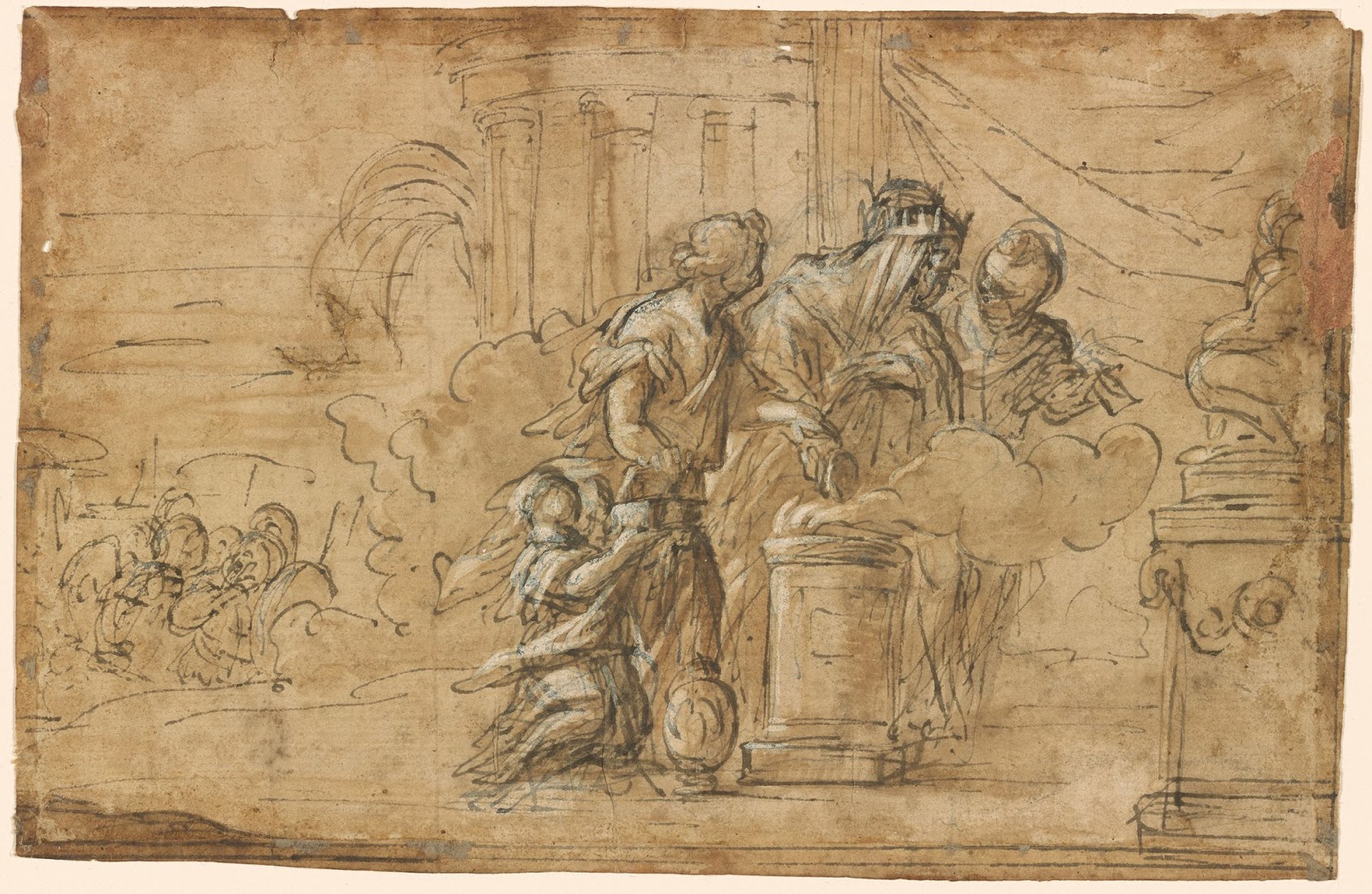
When the Blessings Become a Curse

14 Now the weight of gold that came to Solomon in one year was 666 talents of gold, 15 besides that which came from the explorers and from the business of the merchants, and from all the kings of the west and from the governors of the land. 16 King Solomon made 200 large shields of beaten gold; 600 shekels of gold went into each shield. 17 And he made 300 shields of beaten gold; three minas of gold went into each shield. And the king put them in the House of the Forest of Lebanon. 18 The king also made a great ivory throne and overlaid it with the finest gold. 19 The throne had six steps, and the throne had a round top, and on each side of the seat were armrests and two lions standing beside the armrests, 20 while twelve lions stood there, one on each end of a step on the six steps. The like of it was never made in any kingdom. 21 All King Solomon’s drinking vessels were of gold, and all the vessels of the House of the Forest of Lebanon were of pure gold. None were of silver; silver was not considered as anything in the days of Solomon. 22 For the king had a fleet of ships of Tarshish at sea with the fleet of Hiram. Once every three years the fleet of ships of Tarshish used to come bringing gold, silver, ivory, apes, and peacocks.

23 Thus King Solomon excelled all the kings of the earth in riches and in wisdom. 24 And the whole earth sought the presence of Solomon to hear his wisdom, which God had put into his mind. 25 Every one of them brought his present, articles of silver and gold, garments, myrrh, spices, horses, and mules, so much year by year.

26 And Solomon gathered together chariots and horsemen. He had 1,400 chariots and 12,000 horsemen, whom he stationed in the chariot cities and with the king in Jerusalem. 27 And the king made silver as common in Jerusalem as stone, and he made cedar as plentiful as the sycamore of the Shephelah. 28 And Solomon’s import of horses was from Egypt and Kue, and the king’s traders received them from Kue at a price. 29 A chariot could be imported from Egypt for 600 shekels of silver and a horse for 150, and so through the king’s traders they were exported to all the kings of the Hittites and the kings of Syria. 1 Kings 10:14-29 ESV

Up to this point in his narrative of Solomon’s reign, the author of 1 Kings seems to have spent far more time describing Solomon’s vast wealth than providing evidence of his great wisdom. He has only provided one concrete example where Solomon utilized his God-given gift of wisdom to settle a dispute between two prostitutes who were fighting over legal custody of a newborn baby (1 Kings 3:16-28). There have been several allusions to Solomon’s wisdom, such as the statement made by the Queen of Sheba.

“Everything I heard in my country about your achievements and wisdom is true! I didn’t believe what was said until I arrived here and saw it with my own eyes. In fact, I had not heard the half of it! Your wisdom and prosperity are far beyond what I was told. – 1 Kings 10:6-7 NLT

But it would appear that the author has purposefully placed more emphasis on Solomon’s rapidly expanding financial portfolio. God had promised to bless Solomon with riches and honor (1 Kings 3:13), and it is quite evident that God had kept that promise. In just a single year, nearly 25 tons of gold was added to Solomon’s treasury. That’s a staggering figure. But it represents only a fraction of the revenue that flowed into the kingdom each year. Income for his many business ventures, tributes paid by vassal states, and gifts from various kings and dignitaries further enhanced his annual revenue. His proverbial cup was running over.

People from every nation came to consult him and to hear the wisdom God had given him. Year after year everyone who visited brought him gifts of silver and gold, clothing, weapons, spices, horses, and mules. – 1 Kings 10:24-25 NLT

As a result, “King Solomon became richer and wiser than any other king on earth” (1 Kings 10:23 NLT). It seems that his wisdom and wealth shared a symbiotic relationship. Both were gifts that had been made possible by God. And yet, like all gifts given by God to men, the real test lies in how they are put to use. Both wisdom and wealth can be misused and abused. Any God-given gift can be exploited for ungodly purposes. And it would appear that Solomon had allowed his wisdom and wealth to become a distraction. Somewhere along the way, Solomon had lost sight of the divine purpose for his gifts – that he might govern the people of Israel with justice (1 Kings 3:11). He began to repurpose his wisdom and riches in a vain search for meaning in life. He would later write of his

I became greater than all who had lived in Jerusalem before me, and my wisdom never failed me. Anything I wanted, I would take. I denied myself no pleasure. I even found great pleasure in hard work, a reward for all my labors. But as I looked at everything I had worked so hard to accomplish, it was all so meaningless—like chasing the wind. There was nothing really worthwhile anywhere. – Ecclesiastes 2:9-11 NLT

Notice how many times Solomon uses the personal pronoun, “I.” He had become totally self-consumed, focusing all his attention on what he could gain from what he had been given. Even his God-given wisdom became little more than a tool for trying to decipher the mysteries of life. And while he understood wisdom’s inherent value, it wasn’t long before he came to despise this valuable gift from God.

Yet I saw that the wise and the foolish share the same fate. Both will die. So I said to myself, “Since I will end up the same as the fool, what’s the value of all my wisdom? This is all so meaningless!” For the wise and the foolish both die. The wise will not be remembered any longer than the fool. In the days to come, both will be forgotten.

So I came to hate life because everything done here under the sun is so troubling. Everything is meaningless—like chasing the wind. – Ecclesiastes 3:14-17 NLT

Twenty years after ascending to the throne of his father David, Solomon was experiencing unparalleled success. He had the Midas touch. It seems that everything he touched turned to literal gold. In fact, gold was so prevalent in his kingdom that “silver was considered worthless in Solomon’s day” (1 Kings 10:21 NLT).

Solomon had built his own fleet of ships that returned every three years with their holds full of additional treasures of “gold, silver, ivory, apes, and peacocks” (1 Kings 10:22 NLT). He had amassed “a huge force of chariots and horses. He had 1,400 chariots and 12,000 horses” ( 1 Kings 10:26 NLT). And many of those horses had been imported from as far away as Egypt.

All of these descriptions of Solomon’s incredible wealth must be placed within the context of the commands God had given concerning all those who would serve as kings over His people.

“The king must not build up a large stable of horses for himself or send his people to Egypt to buy horses, for the Lord has told you, ‘You must never return to Egypt.’ The king must not take many wives for himself, because they will turn his heart away from the Lord. And he must not accumulate large amounts of wealth in silver and gold for himself.” – Deuteronomy 17:16-17 NLT

God had blessed Solomon with unparalleled resources, but Solomon was using them in ways that were contradictory to God’s will. His use of God’s gracious gift was in clear violation of God’s command. Solomon’s wealth had never been intended to feed his ego or fulfill his wildest dreams. It was meant to enable him to provide the people of Israel with proper care and protection. And while accumulating chariots and horses may have sounded like a good strategy for ensuring Israel’s national security, it was against the will of God. Solomon’s own father had written about the futility of placing one’s hope in such things.

Now I know that the Lord saves his anointed;
he will answer him from his holy heaven
with the saving might of his right hand.
Some trust in chariots and some in horses,
but we trust in the name of the Lord our God.
They collapse and fall,
but we rise and stand upright. – Psalm 20:6-8 NLT

Solomon seems to have been obsessed with all the outward trappings of royalty. He had built for himself an opulent palace, where exquisite meals were served on golden plates and the finest wine was served in golden goblets. And when it came to the throne upon which he sat, Solomon spared no expense.

Then the king made a huge throne, decorated with ivory and overlaid with fine gold. The throne had six steps and a rounded back. There were armrests on both sides of the seat, and the figure of a lion stood on each side of the throne. There were also twelve other lions, one standing on each end of the six steps. No other throne in all the world could be compared with it! – 1 Kings 10:18-20 NLT

Solomon looked like a king and lived like one. He had all the trappings of success and, from the outsider’s perspective, was living the dream. Yet, the day would come when Solomon finally recognized that he had confused the gift with the Giver.

Those who love money will never have enough. How meaningless to think that wealth brings true happiness! The more you have, the more people come to help you spend it. So what good is wealth—except perhaps to watch it slip through your fingers! – Ecclesiastes 10-11 NLT

The wisdom and wealth given to him by God had never been intended to fulfill his every self-centered desire or provide him with some form of personal satisfaction. Solomon had been anointed and blessed by God so that he might lead the nation of Israel into a period of peace, prosperity, and faithful service to God. Solomon had started out well, even asking God for the capacity to lead the people of Israel with wisdom and discernment.

“Give me an understanding heart so that I can govern your people well and know the difference between right and wrong. For who by himself is able to govern this great people of yours?” – 1 Kings 3:9 NLT

But somewhere along the way, Solomon had let the blessings of God go to his head. He had allowed the gifts to take precedence over the Giver and, in doing so, turned the blessings into a curse.

English Standard Version (ESV) The Holy Bible, English Standard Version. ESV® Permanent Text Edition® (2016). Copyright © 2001 by Crossway Bibles, a publishing ministry of Good News Publishers.

New Living Translation (NLT) Holy Bible, New Living Translation, copyright © 1996, 2004, 2015 by Tyndale House Foundation. Used by permission of Tyndale House Publishers Inc., Carol Stream, Illinois 60188. All rights reserved.

The Message (MSG)Copyright © 1993, 1994, 1995, 1996, 2000, 2001, 2002 by Eugene H. Peterson

The Lunacy of Idolatry

18 “What profit is an idol
    when its maker has shaped it,
    a metal image, a teacher of lies?
For its maker trusts in his own creation
    when he makes speechless idols!
19 Woe to him who says to a wooden thing, Awake;
    to a silent stone, Arise!
Can this teach?
Behold, it is overlaid with gold and silver,
    and there is no breath at all in it.
20 But the Lord is in his holy temple;
    let all the earth keep silence before him.” Habakkuk 2:18-20 ESV

In this final “woe,” God deals with the ubiquitous problem of idolatry. Ever since the Fall, mankind had been on a virtual binge, seeking for comfort, guidance, provision, and protection from anything and everything other than their creator God. In the opening chapter of Romans, Paul portrays this wholesale abandonment of God by fallen humanity in stark terms.

Yes, they knew God, but they wouldn’t worship him as God or even give him thanks. And they began to think up foolish ideas of what God was like. As a result, their minds became dark and confused. Claiming to be wise, they instead became utter fools. And instead of worshiping the glorious, ever-living God, they worshiped idols made to look like mere people and birds and animals and reptiles. – Romans 1:21-23 NLT

They traded the truth about God for a lie. So they worshiped and served the things God created instead of the Creator himself, who is worthy of eternal praise! – Romans 1:25 NLT

Man, made in the image of God, was wired for worship. Adam and Eve had been created by God to have unbroken fellowship with Him. Their lives were intended to bring Him glory through their faithful obedience to His creation mandate.

Then God said, “Let us make human beings in our image, to be like us. They will reign over the fish in the sea, the birds in the sky, the livestock, all the wild animals on the earth, and the small animals that scurry along the ground.”

So God created human beings in his own image.
    In the image of God he created them;
    male and female he created them.

Then God blessed them and said, “Be fruitful and multiply. Fill the earth and govern it. Reign over the fish in the sea, the birds in the sky, and all the animals that scurry along the ground.” – Genesis 1:26-28 NLT

But because of their decision to disobey God by eating the fruit of the one tree He had forbidden, any further access into His presence was denied, and the focal point of their worship was lost. And it didn’t take long before sin had so marred the image of God in man, that the Almighty determined to wipe them from the face of the earth.

The Lord observed the extent of human wickedness on the earth, and he saw that everything they thought or imagined was consistently and totally evil. So the Lord was sorry he had ever made them and put them on the earth. It broke his heart. And the Lord said, “I will wipe this human race I have created from the face of the earth.” – Genesis 6:5-7 NLT

Yet, God had chosen to spare Noah and his family, allowing them to begin the process of repopulating the earth again.

And you, be fruitful and multiply, increase greatly on the earth and multiply in it.”  – Genesis 9:7 ESV

And, obviously, Noah and his family were successful in fulfilling God’s creation mandate. They were fruitful and refilled the earth. But their fruitfulness was accompanied by ever-increasing faithlessness. According to the apostle Paul, the nations of the earth developed a perverse penchant for substitute gods, choosing to replace the one true God with deities of their own making. And it wasn’t long before their decision to displace God resulted in rampant godlessness.

Their lives became full of every kind of wickedness, sin, greed, hate, envy, murder, quarreling, deception, malicious behavior, and gossip. They are backstabbers, haters of God, insolent, proud, and boastful. They invent new ways of sinning, and they disobey their parents. They refuse to understand, break their promises, are heartless, and have no mercy. They know God’s justice requires that those who do these things deserve to die, yet they do them anyway. Worse yet, they encourage others to do them, too. – Romans 1:29-32 NLT

And yet, God, in His grace and mercy, chose to begin again. He chose a single man, Abraham, and promised to make of him a great nation. This man’s descendants would become God’s treasured possession on whom He would pour out His blessings and with whom He would make an everlasting covenant.

“If you fully obey the Lord your God and carefully keep all his commands that I am giving you today, the Lord your God will set you high above all the nations of the world. You will experience all these blessings if you obey the Lord your God…” – Deuteronomy 28:1-2 NLT

But one of the primary criteria associated with God’s covenant commitment with the descendants of Abraham would be their refusal to worship any other gods.

“You must not have any other god but me. You must not make for yourself an idol of any kind or an image of anything in the heavens or on the earth or in the sea. You must not bow down to them or worship them, for I, the LORD your God, am a jealous God who will not tolerate your affection for any other gods.” – Exodus 20:3-5 NLT

And yet, generations after the death of Abraham, his progeny would have proven their inability to keep their end of the agreement. The nation which had been set apart by God as His own would have established an unprecedented track record of spiritual infidelity. And by the time Habakkuk penned the words of the book that bears his name, the apostasy of God’s people would have become untenable and unforgivable.

The whole reason God was sending the Babylonians against the people of Judah was due to their unfaithfulness. And God had chosen to use an idolatrous nation to bring His judgment upon His idolatrous children. The people of Judah, like their northern kin in Israel, had made a habit of worshiping false gods. So, God was going to fulfill His promise to discipline them for their disobedience. He would do to them exactly as Moses had warned generations earlier.

“The Lord will exile you and your king to a nation unknown to you and your ancestors. There in exile you will worship gods of wood and stone! – Deuteronomy 28:36 NLT

If they wanted to continue to worship false gods, Yahweh would make sure they had every opportunity – but not in the land that He had graciously provided for them. They would find themselves exiled in a foreign land, surrounded by pagan gods and powerful enemies.

And this final woe points directly at the primary problem going on in Judah. God’s chosen people were guilty of spiritual adultery. They had “exchanged the glory of the immortal God for images resembling mortal man and birds and animals and creeping things” (Romans 1:23 ESV). Or, as the New Living Translation puts it, “…instead of worshiping the glorious, ever-living God, they worshiped idols made to look like mere people and birds and animals and reptiles.”

God reveals the sheer idiocy behind their decision to replace Him with man-made gods.

“Woe to him who says to a wooden thing, Awake;
    to a silent stone, Arise!” – Habakkuk 2:19 ESV

Their decision to substitute the one true God with gods of their own creation was ludicrous. It made no sense. And God sarcastically portrays the stupidity of their decision.

“What good is an idol carved by man,
    or a cast image that deceives you?
How foolish to trust in your own creation—
    a god that can’t even talk! – Habakkuk 1:18 NLT

“To speechless stone images you say,
    ‘Rise up and teach us!’
    Can an idol tell you what to do?
They may be overlaid with gold and silver,
    but they are lifeless inside. – Habakkuk 1:19 NLT

This is not the first and only time God had exposed the ridiculous nature of Judah’s idolatry. He had also spoken through Isaiah, clearly denunciating and debunking the veracity and value of idols.

The idol makers encourage one another,
    saying to each other, “Be strong!”
The carver encourages the goldsmith,
    and the molder helps at the anvil.
    “Good,” they say. “It’s coming along fine.”
Carefully they join the parts together,
    then fasten the thing in place so it won’t fall over. – Isaiah 41:6-7 NLT

How foolish are those who manufacture idols.
    These prized objects are really worthless.
The people who worship idols don’t know this,
    so they are all put to shame.
Who but a fool would make his own god—
    an idol that cannot help him one bit? – Isaiah 44:9-10 NLT

The person who made the idol never stops to reflect,
    “Why, it’s just a block of wood!
I burned half of it for heat
    and used it to bake my bread and roast my meat.
How can the rest of it be a god?
    Should I bow down to worship a piece of wood?” – Isaiah 44:19 NLT

Only a fool would fail to recognize the obvious absurdity of idolatry.

The poor, deluded fool feeds on ashes.
    He trusts something that can’t help him at all.
Yet he cannot bring himself to ask,
    “Is this idol that I’m holding in my hand a lie?” – Isaiah 44:20 NLT

And yet, here was the nation of Judah facing the very real prospect of having another idolatrous nation invade their borders and destroy their cities and towns. They were poor, deluded fools who had put their hope and trust in pieces of wood and stone. These lifeless and utterly helpless icons of man’s arrogant pride would prove to be unreliable when the judgment of God fell.

Later on, in the book of Isaiah, God issues a tongue-in-cheek challenge to the people of Judah. They could put their trust in their false gods, but the outcome of their efforts would prove less-than-successful.

“Let’s see if your idols can save you
    when you cry to them for help.
Why, a puff of wind can knock them down!
    If you just breathe on them, they fall over!
But whoever trusts in me will inherit the land
    and possess my holy mountain.” – Isaiah 57:13 NLT

And God points out to Habakkuk that the man-made, lifeless gods the people of Judah had chosen to worship were no substitute for Him.

“But the Lord is in his holy temple;
    let all the earth keep silence before him.” – Habakkuk 2:20 ESV

God was not some elf-on-a-shelf, made from human hands and carried from one place to another. He was “the Lord,” Jehovah, “the existing one.” And He was in His holy temple, looking down on His disobedient and unfaithful people, and preparing to unleash His righteous indignation upon them.

The God of the universe is a jealous God who will not share His glory with anyone or anything. He will not put up with the worship of false gods. Yes, He will tolerate this behavior for a time, patiently putting up with the fickleness and unfaithfulness of fallen humanity. But the day is coming when He will eliminate all the false gods manufactured by fallen men. And all the earth will stand before Him in reverent awe and stunned silence.

English Standard Version (ESV)
The Holy Bible, English Standard Version. ESV® Permanent Text Edition® (2016). Copyright © 2001 by Crossway Bibles, a publishing ministry of Good News Publishers.

New Living Translation (NLT)
Holy Bible, New Living Translation, copyright © 1996, 2004, 2015 by Tyndale House Foundation. Used by permission of Tyndale House Publishers Inc., Carol Stream, Illinois 60188. All rights reserved.

The Message (MSG)Copyright © 1993, 1994, 1995, 1996, 2000, 2001, 2002 by Eugene H. Peterson

To the Glory of God

“I have heard the taunts of Moab
    and the revilings of the Ammonites,
how they have taunted my people
    and made boasts against their territory.
Therefore, as I live,” declares the Lord of hosts,
    the God of Israel,
“Moab shall become like Sodom,
    and the Ammonites like Gomorrah,
a land possessed by nettles and salt pits,
    and a waste forever.
The remnant of my people shall plunder them,
    and the survivors of my nation shall possess them.”
10 This shall be their lot in return for their pride,
    because they taunted and boasted
    against the people of the Lord of hosts.
11 The Lord will be awesome against them;
    for he will famish all the gods of the earth,
and to him shall bow down,
    each in its place,
    all the lands of the nations. Zephaniah 2:8-11 ESV

After having issued His warning of coming judgment upon the Philistines, God now addresses Judah’s neighbors to the east. Moab and Ammon lie on the opposite side of the Dead Sea in land that is often referred to as the Transjordan.

Hundreds of years earlier, when the people of Israel were making their way from Egypt to the land of Canaan, they had to pass through this region of the Transjordan. And when they arrived at the border of Moab, God commanded Moses to avoid any confrontation with the people who lived there.

“And we turned and went in the direction of the wilderness of Moab. And the Lord said to me, ‘Do not harass Moab or contend with them in battle, for I will not give you any of their land for a possession, because I have given Ar to the people of Lot for a possession.’” – Deuteronomy 2:8-9 ESV

God also commanded that the Israelites treat the people of Ammon in the same way and for a similar reason.

“And when you approach the territory of the people of Ammon, do not harass them or contend with them, for I will not give you any of the land of the people of Ammon as a possession, because I have given it to the sons of Lot for a possession.…” – Deuteronomy 2:19 ESV

To grasp what’s going on here, you have to understand why God had given “the sons of Lot” possession of these territories. Lot was the nephew of Abraham who, according to the book of Genesis, accompanied his uncle when he began his God-ordained relocation to Canaan.

And Abram took Sarai his wife, and Lot his brother’s son, and all their possessions that they had gathered, and the people that they had acquired in Haran, and they set out to go to the land of Canaan. – Genesis 12:12:5 ESV

Upon their arrival in the land of Canaan, Lot and Abram eventually parted ways.

And Lot lifted up his eyes and saw that the Jordan Valley was well watered everywhere like the garden of the Lord, like the land of Egypt, in the direction of Zoar. (This was before the Lord destroyed Sodom and Gomorrah.) So Lot chose for himself all the Jordan Valley, and Lot journeyed east. Thus they separated from each other. Abram settled in the land of Canaan, while Lot settled among the cities of the valley and moved his tent as far as Sodom. Now the men of Sodom were wicked, great sinners against the Lord. – Genesis 13:10-13 ESV

This little bit of historical context is going to be important as we move through God’s judgment upon Moab and Ammon. Lot ended up settling in the wicked city of Sodom, rather than taking up residence in the “well-watered” Jordan Valley. And sometime later, when God brought judgment upon the cities of Sodom and Gomorrah, He would spare Lot and his family “because he was a righteous man who was sick of the shameful immorality of the wicked people around him” (2 Peter 4:7 NLT).

But during their escape from the city of Sodom, Lot’s wife would die for violating God’s command. He had commanded them, “Escape for your life. Do not look back or stop anywhere in the valley. Escape to the hills, lest you be swept away” (Genesis 19:17 ESV). 

But Lot’s wife, behind him, looked back, and she became a pillar of salt” (Genesis 19:26 ESV). With the death of his wife, “Lot went up out of Zoar and lived in the hills with his two daughters” (Genesis 19:30 ESV). And it didn’t take long before the negative influence of having grown up in Sodom became apparent. Fearful that they would both become old maids, unmarried and childless, the two daughters of Lot conspired to get their father drunk and have sex with him. The result of their illicit and immoral decision would be the nations of Moab and Ammon.

Thus both the daughters of Lot became pregnant by their father. The firstborn bore a son and called his name Moab. He is the father of the Moabites to this day. The younger also bore a son and called his name Ben-ammi. He is the father of the Ammonites to this day. – Genesis 19:36-38 ESV

Now that we have the historical context, let’s got back to the prophecy of Zephaniah. God specifically calls out Moab and Ammon, the descendants of Lot and the close relatives of God’s chosen people. And He accuses them of having taunted and reviled the people of Judah. As far back as Israel’s exodus from Egypt, the Moabites had been guilty of trying to prevent the Israelites from settling in the land of Canaan. The sheer number of Israelites had frightened the people of Moab.

And Moab was in great dread of the people, because they were many. Moab was overcome with fear of the people of Israel. And Moab said to the elders of Midian, “This horde will now lick up all that is around us, as the ox licks up the grass of the field.” – Numbers 22:3-4 ESV

So, the king of Moab had hired a local diviner named Balaam, ordering him to pronounce a curse of the people of Israel.

Come now, curse this people for me, since they are too mighty for me. Perhaps I shall be able to defeat them and drive them from the land, for I know that he whom you bless is blessed, and he whom you curse is cursed.” – Numbers 22:6 ESV

But God prevented Balaam from cursing the people of Israel. In fact, he would actually end up pronouncing a God-ordained blessing upon the people of Israel. And that blessing would take the form of a prophetic message concerning the coming Messiah and the Savior of the world.

“I see him, but not now;
    I behold him, but not near:
a star shall come out of Jacob,
    and a scepter shall rise out of Israel;
it shall crush the forehead of Moab
    and break down all the sons of Sheth.
Edom shall be dispossessed;
    Seir also, his enemies, shall be dispossessed.
    Israel is doing valiantly.
And one from Jacob shall exercise dominion
    and destroy the survivors of cities!” – Numbers 24:17-19 ESV

The Ammonites would also prove to be a constant source of animosity for the people of Israel, waging war against them throughout the period of the judges and well into the reigns of Saul and David. The Ammonites and Moabites, while descendants of Lot, were a pagan people who worshiped false gods. And God commanded the Israelites not to intermarry with them because those relationships would lead the Israelites to turn their backs on Him. Yet, even King Solomon would choose to disobey God, marrying Naamah, who was an Ammonite (1 Kings 14:21). And Solomon would end up worshiping the gods of his many pagan wives and concubines, resulting in God dividing his kingdom in half, creating the northern nation of Israel and the southern nation of Judah.

But back to Moab and Ammon. God had plans for them. They were not going to enjoy their pagan ways forever. Their pride and arrogance and their hostility toward the people of Judah would be repaid.

“Moab shall become like Sodom,
    and the Ammonites like Gomorrah,
a land possessed by nettles and salt pits,
    and a waste forever.
The remnant of my people shall plunder them,
    and the survivors of my nation shall possess them.” – Zephaniah 2:9 ESV

God foreshadows the coming destruction of these two nations, comparing their fall to that of Sodom and Gomorrah. Isn’t it fascinating that God chooses to use these two wicked cities to describe the fall of Ammon and Moab? The common link is Lot, the progenitor of the Ammonites and Moabites. But the two cities and the two nations also share a track record of wickedness, pride, sin, immorality, and godlessness.

Ultimately, the sins of Moab and Ammon were against God. By rejecting Israel, they had rejected Him.

“Make him drunk, because he magnified himself against the Lord, so that Moab shall wallow in his vomit, and he too shall be held in derision.

We have heard of the pride of Moab—
    he is very proud—
of his loftiness, his pride, and his arrogance,
    and the haughtiness of his heart.
I know his insolence, declares the Lord;
    his boasts are false,
    his deeds are false.” – Jeremiah 48:26, 29-30 ESV

“I will make Rabbah a pasture for camels and Ammon a fold for flocks. Then you will know that I am the Lord. For thus says the Lord God: Because you have clapped your hands and stamped your feet and rejoiced with all the malice within your soul against the land of Israel…” – Ezekiel 25:5-6 ESV

The day is coming, the “great day of the Lord,” when He will bring His judgment against all the nations of the earth. And there will be a reason for God’s destruction of these pagan nations.

The Lord will terrify them
    as he destroys all the gods in the land.
Then nations around the world will worship the Lord,
    each in their own land. – Zephaniah 2:11 NLT

He will remove all vestiges of the false gods that have led the nations to live in open rebellion to Him. He will destroy them, making it perfectly clear that He is the one and only God. And the end result will be that the nations of the world will bow down in worship of Him and Him alone.

“‘As surely as I live,’ says the LORD, ‘every knee will bend to me, and every tongue will declare allegiance to God.’” – Romans 14:11 NLT

English Standard Version (ESV)
The Holy Bible, English Standard Version. ESV® Permanent Text Edition® (2016). Copyright © 2001 by Crossway Bibles, a publishing ministry of Good News Publishers.

New Living Translation (NLT)
Holy Bible, New Living Translation, copyright © 1996, 2004, 2015 by Tyndale House Foundation. Used by permission of Tyndale House Publishers Inc., Carol Stream, Illinois 60188. All rights reserved.

The Message (MSG)Copyright © 1993, 1994, 1995, 1996, 2000, 2001, 2002 by Eugene H. Peterson