Be Wise As Serpents and Innocent As Doves

16 “Behold, I am sending you out as sheep in the midst of wolves, so be wise as serpents and innocent as doves. 17 Beware of men, for they will deliver you over to courts and flog you in their synagogues, 18 and you will be dragged before governors and kings for my sake, to bear witness before them and the Gentiles. 19 When they deliver you over, do not be anxious how you are to speak or what you are to say, for what you are to say will be given to you in that hour. 20 For it is not you who speak, but the Spirit of your Father speaking through you. 21 Brother will deliver brother over to death, and the father his child, and children will rise against parents and have them put to death, 22 and you will be hated by all for my name’s sake. But the one who endures to the end will be saved. 23 When they persecute you in one town, flee to the next, for truly, I say to you, you will not have gone through all the towns of Israel before the Son of Man comes.” Matthew 10:16-23 ESV

Try to put yourself in the sandals of the disciples. It was still early in their relationship with Jesus, and He had just told them that He was going to send them out on their own with the responsibility of sharing the news of His Kingdom with their fellow Jews. Not only that, He has informed them that they will be able to perform the same incredible miracles He has done. All of this must have sounded strange but also a bit exciting. They were being commissioned by the Messiah and given a level of responsibility that must have seemed way above their pay grade. After all, they were simple fishermen, laborers, and tax collectors. Yet, Jesus had chosen to send them, and this assignment must have left them with a sense of pride. However, Jesus was about to tap the brakes on their enthusiasm.

He could probably tell from the looks in their eyes that they were thrilled with the prospect of being able to perform miracles. They couldn’t hide their excitement at being able to pronounce blessings and curses on those to whom they spoke. That kind of power and authority would make anyone’s head swim. So, He threw a bit of cold water on their enthusiasm by telling them, “I am sending you out as sheep in the midst of wolves” (Matthew 10:16 ESV). He had just described the people of Israel as “lost sheep” (Matthew 10:6). Now, He compares the disciples to sheep, a reference they would have well understood. Sheep are innocent and highly vulnerable animals. They are virtually defenseless, lacking the capacity to protect themselves from harm. Which made Jesus’ next warning even more distressing. These men would be as vulnerable as innocent, unprotected sheep grazing among wolves. – not exactly an encouraging picture. Then He followed this up with a warning that borrows from two other creatures of the animal kingdom. 

“…be wise as serpents and innocent as doves.” – Matthew 10:16 ESV

The Greek word translated as “wise” implies prudence or shrewdness. This kind of street savvy would allow them to survive in a very difficult environment. The phrase, “Be wise as serpents,” was likely a common proverbial statement familiar to the disciples that needed no explanation. They understood that snakes avoided danger at all costs. They were well-adapted creatures adept at concealment and the avoidance of confrontation. But to prevent them from becoming jaded and ruthless in their behavior, Jesus warned them to maintain a sense of innocence. They were not to mimic the defensive posture of a cornered snake, lashing out at those who threatened or opposed them. They were also to avoid the temptation of mirroring the behavior of wolves. Jesus didn’t want His disciples to become predatory or ruthless in the face of cancer. Rather, they were to be aware of the enemy’s wiles without emulating his ways.

Earlier, Jesus warned His disciples about false prophets “who come disguised as harmless sheep but are really vicious wolves” (Matthew 7:15 NLT). This thinly veiled reference to the religious leaders of the day was intended to expose their hypocrisy and duplicity. Jesus said, “You can identify them by their fruit, that is, by the way they act” (Matthew 7:16 NLT). The disciples would need shrewdness to discern the actions of the Jewish religious leaders who would oppose them in their efforts to share the good news.

The prophet Ezekiel recorded God’s indictment of such men.

“What sorrow awaits you shepherds who feed yourselves instead of your flocks. Shouldn’t shepherds feed their sheep? You drink the milk, wear the wool, and butcher the best animals, but you let your flocks starve. You have not taken care of the weak. You have not tended the sick or bound up the injured. You have not gone looking for those who have wandered away and are lost. Instead, you have ruled them with harshness and cruelty. So my sheep have been scattered without a shepherd, and they are easy prey for any wild animal. They have wandered through all the mountains and all the hills, across the face of the earth, yet no one has gone to search for them.” – Ezekiel 34:2-6 NLT

The disciples were called to minister in that environment. What they didn’t realize at the time was that Jesus was preparing them for the days after His death, resurrection, and ascension. He knew that when He returned to His Father’s side in heaven, the focus of the religious leaders’ wrath would fall on His disciples. But even when confronted by the hatred of the Pharisees, the disciples were to remain innocent as doves. This was a call to remain pure and guileless in the face of persecution. Jesus talked about this very thing in His Sermon on the Mount.

“Blessed are you when others revile you and persecute you and utter all kinds of evil against you falsely on my account. Rejoice and be glad, for your reward is great in heaven, for so they persecuted the prophets who were before you. – Matthew 5;11-12 ESV

Jesus’ command to be innocent as doves was not a call to gullibility or weakness. It was a reminder that purity and holiness must mark the life of a true disciple. That is why Jesus told them to love their enemies and to pray for those who persecute them. Vengeance and retribution have no place in the life of a Christ follower. Innocence is also not a call to ignorance. He wanted His disciples to be fully informed of the dangers they faced. That’s why He refused to withhold the sinister nature of their future ministry.

Beware of men, for they will deliver you over to courts and flog you in their synagogues, and you will be dragged before governors and kings for my sake, to bear witness before them and the Gentiles. – Matthew 10:17-18 ESV

What the disciples didn’t know was that Jesus was talking about the future. He was addressing events that would take place after His death, resurrection and ascension. At this point in their relationship with Jesus, they had no way of knowing that His earthly ministry would end in His violent death by crucifixion. He had yet to break that news to them. They were oblivious to the fact that, upon His return to heaven, they would find themselves serving as His ambassadors and earthly representatives, tasked with the responsibility of taking the good news of His sacrificial death on the cross to the world. They would be His witnesses “in Jerusalem and in all Judea and Samaria, and to the end of the earth” (Acts 1:8 ESV). And they would find themselves facing stiff resistance in the form of persecution and even death.

This disconcerting news must have left the disciples slack-jawed and dumbfounded. All this talk of courts, floggings, and death must have left them shaking their heads in confusion. Their eager enthusiasm would have turned to abject fear and revulsion at the thought of enduring such things. But Jesus gave them some good news, informing them that the Spirit of God would be with them, so they had no reason to be anxious. The Holy Spirit would give them the words they needed to defend themselves when standing before the courts. And even if their own families turned against them and they found themselves facing the hatred of those who once claimed to love them, they could rest in knowing that God would be with them. They would be saved. This doesn’t mean they would escape death, but that they would ultimately be delivered to eternal life.

None of this would have sounded like good news to the disciples. They must have been staring at one another in disbelief and confusion, trying to comprehend all that Jesus told them. It’s important to remember that they believed Jesus to be the Messiah, but their understanding was that He had come to set up His Kingdom on earth NOW. They were looking for a new day to dawn for the people of Israel. They had joined up with Jesus because they thought He would restore Israel to its place of power and prominence, and they hoped to get in on the ground floor of His new administration.

But now, Jesus had clouded their vision of the future. In essence, Jesus was revealing that God’s agenda was far different than their own. There was a divine plan in place that would include not only Jesus’ first coming, but a second one that would finalize God’s plan for the redemption of mankind and the recreation of the world. But in the meantime, some important events would have to take place, including Jesus’ death on the cross, His return to heaven, the Rapture of the church, and His Second Coming at the end of the Tribulation.

The disciples lived with a here-and-now mentality that focused all their attention on the time in which they lived. They weren’t thinking about the distant future and were unconcerned about things that might happen after they were gone. But Jesus was trying to expand their understanding and open their eyes to the reality that His mission was far greater than they imagined. The redemptive plan of God went beyond the physical restoration of the nation of Israel as a political force on earth.

The Son of Man had come, but He would have to come again. And it would be at His second coming that Jesus would accomplish many of the things the disciples were expecting. They would be long gone by that time, but they were the first of many who would spread the good news about Jesus to the world. They would start with the Jews, but after Jesus’ death, they would be told to take the gospel to the nations. After the disciples were gone, the offer of salvation through Christ would be carried around the world by future disciples who would face persecution, rejection, and even death. But one day Jesus will return to complete the mission He has been given by God.

In the meantime, we are called to be like our Teacher. We are to serve as He served, love as He loved, share as He shared. As a result, we will suffer as He has suffered. We will be falsely accused and maligned just as He was. But we have the knowledge and reassurance that one day He is coming back. We also rest in the fact that our destiny is secure and our eternal state guaranteed by His death and resurrection. We have nothing to fear and everything to look forward to. In the meantime, we must be wise as serpents and gentle as doves.

English Standard Version (ESV)
The Holy Bible, English Standard Version. ESV® Permanent Text Edition® (2016). Copyright © 2001 by Crossway Bibles, a publishing ministry of Good News Publishers.

New Living Translation (NLT)
Holy Bible, New Living Translation, copyright © 1996, 2004, 2015 by Tyndale House Foundation. Used by permission of Tyndale House Publishers Inc., Carol Stream, Illinois 60188. All rights reserved.

The Case for Character Over Competence

14 And Sheba passed through all the tribes of Israel to Abel of Beth-maacah, and all the Bichrites assembled and followed him in. 15 And all the men who were with Joab came and besieged him in Abel of Beth-maacah. They cast up a mound against the city, and it stood against the rampart, and they were battering the wall to throw it down. 16 Then a wise woman called from the city, “Listen! Listen! Tell Joab, ‘Come here, that I may speak to you.’” 17 And he came near her, and the woman said, “Are you Joab?” He answered, “I am.” Then she said to him, “Listen to the words of your servant.” And he answered, “I am listening.” 18 Then she said, “They used to say in former times, ‘Let them but ask counsel at Abel,’ and so they settled a matter. 19 I am one of those who are peaceable and faithful in Israel. You seek to destroy a city that is a mother in Israel. Why will you swallow up the heritage of the Lord?” 20 Joab answered, “Far be it from me, far be it, that I should swallow up or destroy! 21 That is not true. But a man of the hill country of Ephraim, called Sheba the son of Bichri, has lifted up his hand against King David. Give up him alone, and I will withdraw from the city.” And the woman said to Joab, “Behold, his head shall be thrown to you over the wall.” 22 Then the woman went to all the people in her wisdom. And they cut off the head of Sheba the son of Bichri and threw it out to Joab. So he blew the trumpet, and they dispersed from the city, every man to his home. And Joab returned to Jerusalem to the king.

23 Now Joab was in command of all the army of Israel; and Benaiah the son of Jehoiada was in command of the Cherethites and the Pelethites; 24 and Adoram was in charge of the forced labor; and Jehoshaphat the son of Ahilud was the recorder; 25 and Sheva was secretary; and Zadok and Abiathar were priests; 26 and Ira the Jairite was also David’s priest. 2 Samuel 20:14-26 ESV

Finally, like a cool breeze on a hot summer day, we get a refreshing glimpse of true wisdom amid all the folly that filled the preceding chapters. Time after time, we have seen impulsiveness, anger, fear, and recrimination rule the day. Decisions have been made based on nothing more than raw emotion. Extremely intelligent people have made some very dumb choices. Godly individuals have made ungodly decisions, and the results have been death and destruction.

Joab has just brutally murdered Amasa, leaving his body lying in the middle of the road for all to see. Now he is besieging the city of Abel, in an attempt to capture Sheba, the instigator of yet another rebellion against David. Israelite forces have surrounded the city and erected siege walls against it. They are in the process of attempting to knock down the city’s walls, and the prospects of yet more bloodshed loom large. Then wisdom shows up.

Located where it is in the narrative of David’s life, this short little vignette provides a stark counterpoint to all that has taken place so far. In it, we are introduced to an unnamed woman from the city of Abel who is simply referred to as a “wise woman.” Other than that, we know nothing else about her. She is a resident of the besieged city and, like all her fellow citizens, she is forced to watch as David’s troops batter its walls. The fearful residents are at a loss as to the purpose of the siege because they remain unaware of Abel’s presence within their walls. There is no indication that anyone inside the city knew that an insurrectionist was hiding among them, so the presence of Israelite troops must have left them confused and concerned about their fate.

Outside the walls, Joab has made no attempt to parlay with the city officials to negotiate the handover of Sheba. Driven by the same emotions that led him to kill Absalom and Amasa, Joab is foolishly and stubbornly focused on one thing: The capture and death of Sheba. Obsessed with capturing Sheba and clearing his own name, Joab is willing to destroy an entire city filled with fellow Israelites. Nothing and no one is going to stand in his way.

Then wisdom showed up, in the form of a nameless woman who saw a serious problem and had the foresight to do something about it. As the city’s leaders stood by helplessly and hopelessly, this unidentified woman decided to act. She called out to Joab, asking for an opportunity to talk with him. During all the chaos and confusion surrounding the siege, she calmly called for a conversation, a chance to discuss what was going on and how they might avert a tragedy. Once she had Joab’s attention, she said to him:

“There used to be a saying, ‘If you want to settle an argument, ask advice at the town of Abel.’ I am one who is peace loving and faithful in Israel. But you are destroying an important town in Israel. Why do you want to devour what belongs to the Lord?” – 2 Samuel 20:18-19 NLT

She informs Joab that her hometown was once recognized as an important city in Israel and was renowned for its wisdom. She wants Joab to know that he is not attacking a foreign city filled with pagans; he is threatening the lives of his fellow Israelites. The woman describes herself as peace-loving and faithful, intentionally contrasting herself with Joab and his troops. She wants peace while Joab seems intent on devouring what belongs to God. Confused by Joab’s actions, she demands to know why he has chosen to attack her beloved city.

Like a scene from an action movie, the focus shifts to Joab, standing amid the rubble at the base of the city wall, adorned in his armor and surrounded by his fellow soldiers. In response to the woman’s question, Joab informs her of Sheba’s presence in their midst and of the crime for which he was guilty. This was apparently news to the woman and the rest of the people inside the city walls. They had no idea they were harboring a fugitive from justice. As soon as the woman discovered the cause of all their problems, she took action. Armed with the news of Sheba’s presence within their walls, the woman agreed to turn him over and then took the matter before the people of Abel.

What happens next is intriguing. It’s unlikely that this woman had the authority to speak on behalf of the entire community, so she must have consulted with the city officials to come up with their response to Joab’s demands. It seems that some doubted Joab’s integrity and worried that he would not keep his word. They were willing to seek out and turn over the fugitive Sheba, but they were not willing to open up their gates to do so. That would have provided Joab with easy access to their city and left them vulnerable to attack. So this wise woman negotiated a different response to Joab’s demands. She convinced the leaders of the city to cut off Sheba’s head and throw it over the wall.

Everyone in the city knew that the penalty for insurrection was death, so Sheba was a dead man walking. It was only a matter of time until he was executed for his crime, so they simply sped up the process and threw his severed head over the wall. Joab got what he had come for. The case was closed and their city gates remained tightly shut. If Joab was being honest and the death of Sheba was all he wanted, then justice had been served. Joab had the head of Sheba as proof that the guilty one had been dealt with effectively.

By keeping the city gates closed and throwing Sheba’s head over the wall, she protected the citizens inside and tested the reliability of Joab’s words. If, after having his demands met, Joab had failed to call off the siege, the woman would have exposed his deceit with a minimum of risk. Her decision to cut off Sheba’s head was a wise move on her part and it accomplished what she had set out to do: Deliver her city from further harm. Joab and his troops dispersed, leaving the residents of Abel unharmed. Her wise counsel spared the city and prevented Joab from committing yet another crime of passion.

What is interesting is how this section of the story is immediately followed by a seemingly out-of-place listing of David’s key administrative heads. You see the names of men like Joab, Benaiah, Adoniram, Jehoshaphat, Sheva, Zakok, Abiathar, and Ira. Among them are David’s military commander, the captain of his bodyguard, his royal historian, his court secretary, and priests.

These prominent men served as David’s inner circle, sitting on his royal cabinet and providing him with counsel. They were well-known and revered. They were powerful and influential. Their names and titles are mentioned, but nothing is said about their character. The appearance of their names at this point in the narrative is intended to serve as a counterpoint to the woman in the story. To this day, she remains unknown and unnamed, but she is remembered and recognized for her wisdom. It wasn’t who she was that mattered. It was what she was – she was a wise and well-respected woman whose godly character preserved the lives of her entire community. This “wise woman” was known for having the character quality of wisdom and she proved it by her behavior.

The men whose names are listed in the closing verses of this chapter are distinguished by their royal titles and the prestige of serving as the king’s advisors. But without wisdom, their positions and prominence would prove meaningless. Solomon, David’s son and the successor to his throne, was known for his wisdom. In the early days of his reign, Solomon asked God, “give your servant a discerning mind so he can make judicial decisions for your people and distinguish right from wrong. Otherwise no one is able to make judicial decisions for this great nation of yours” (1 Kings 3:9 NLT).

God granted Solomon’s request, stating, “Because you asked for the ability to make wise judicial decisions, and not for long life, or riches, or vengeance on your enemies, I grant your request and give you a wise and discerning mind superior to that of anyone who has preceded or will succeed you” (1 Kings 3:11-12 NLT). 

Years later, Solomon would pen these important words concerning wisdom.

For the Lord grants wisdom!
    From his mouth come knowledge and understanding.
He grants a treasure of common sense to the honest.
    He is a shield to those who walk with integrity.
He guards the paths of the just
    and protects those who are faithful to him.

Then you will understand what is right, just, and fair,
    and you will find the right way to go.
For wisdom will enter your heart,
    and knowledge will fill you with joy.
Wise choices will watch over you.
    Understanding will keep you safe. – Proverbs 2:6-11 NLT

It was the woman’s wisdom that diverted a tragedy. She had knowledge and understanding. She possessed common sense. She knew what was right, just, and fair. She discerned the right way to go and never turned back. Her wisdom kept her city safe and resulted in much joy. We can only imagine the celebration that took place inside the city walls of Abel that night after the siege was lifted and the troops had dispersed. Wisdom brought joy. This is why Solomon went on to say, “So follow the steps of the good, and stay on the paths of the righteous” (Proverbs 2:20 NLT).

David would have done well to surround himself with individuals like the wise woman from Abel. But he seems to have had a tendency to choose men who were untrustworthy and prone to foolishness. When it comes to leadership, character should always trump charisma and capabilities. It is not that qualifications are unimportant or should be ignored. But God is looking for more than competencies and credentials.

When God sent Samuel to the house of Jesse to find the next king of Israel, He told the prophet: “Don’t judge by his appearance or height, for I have rejected him. The LORD doesn’t see things the way you see them. People judge by outward appearance, but the LORD looks at the heart” (1 Samuel 16:7 NLT).

Wisdom is God-given and resides in the heart, not the brain. It involves far more than intellect. Some of the brightest people can be the greatest fools because the essence of foolishness is the rejection of God. It is to live as if God doesn’t exist or doesn’t matter. Paul describes the plight of those who, in their human intelligence, dismiss the existence of God or end up creating a god of their own choosing.

Yes, they knew God, but they wouldn’t worship him as God or even give him thanks. And they began to think up foolish ideas of what God was like. As a result, their minds became dark and confused. Claiming to be wise, they instead became utter fools. – Romans 1:21-22 NLT

Wisdom really works but it is only available to those who know God and fear Him – like the wise woman from Abel.

English Standard Version (ESV) The Holy Bible, English Standard Version. ESV® Permanent Text Edition® (2016). Copyright © 2001 by Crossway Bibles, a publishing ministry of Good News Publishers.

New Living Translation (NLT) Holy Bible, New Living Translation, copyright © 1996, 2004, 2015 by Tyndale House Foundation. Used by permission of Tyndale House Publishers Inc., Carol Stream, Illinois 60188. All rights reserved.
The Divine Delay Begins

1 Then David fled from Naioth in Ramah and came and said before Jonathan, “What have I done? What is my guilt? And what is my sin before your father, that he seeks my life?” And he said to him, “Far from it! You shall not die. Behold, my father does nothing either great or small without disclosing it to me. And why should my father hide this from me? It is not so.” But David vowed again, saying, “Your father knows well that I have found favor in your eyes, and he thinks, ‘Do not let Jonathan know this, lest he be grieved.’ But truly, as the Lord lives and as your soul lives, there is but a step between me and death.” Then Jonathan said to David, “Whatever you say, I will do for you.” David said to Jonathan, “Behold, tomorrow is the new moon, and I should not fail to sit at table with the king. But let me go, that I may hide myself in the field till the third day at evening. If your father misses me at all, then say, ‘David earnestly asked leave of me to run to Bethlehem his city, for there is a yearly sacrifice there for all the clan.’ If he says, ‘Good!’ it will be well with your servant, but if he is angry, then know that harm is determined by him. Therefore deal kindly with your servant, for you have brought your servant into a covenant of the Lord with you. But if there is guilt in me, kill me yourself, for why should you bring me to your father?” And Jonathan said, “Far be it from you! If I knew that it was determined by my father that harm should come to you, would I not tell you?” 10 Then David said to Jonathan, “Who will tell me if your father answers you roughly?” 11 And Jonathan said to David, “Come, let us go out into the field.” So they both went out into the field.

12 And Jonathan said to David, “The Lord, the God of Israel, be witness! When I have sounded out my father, about this time tomorrow, or the third day, behold, if he is well disposed toward David, shall I not then send and disclose it to you? 13 But should it please my father to do you harm, the Lord do so to Jonathan and more also if I do not disclose it to you and send you away, that you may go in safety. May the Lord be with you, as he has been with my father. 14 If I am still alive, show me the steadfast love of the Lord, that I may not die; 15 and do not cut off your steadfast love from my house forever, when the Lord cuts off every one of the enemies of David from the face of the earth.” – 1 Samuel 20:1-15 ESV

It would still seem as though David was unaware of the true meaning behind his anointing by Samuel. He is at a loss as to why Saul would want to have him killed. He even asked Jonathan, “What have I done? What is my crime? How have I offended your father that he is so determined to kill me?” (1 Samuel 20:1 NLT). If David had been aware that he was to be the next king of Israel and Saul’s replacement, he would have put two and two together and recognized Saul’s attempts on his life for what they were: Acts of jealousy and anger. But instead, David seems to think that he has done something to offend Saul. He is trying to figure out what he could have done that would cause the king to want him dead. David even begs his friend, Jonathan, “kill me yourself if I have sinned against your father. But please don’t betray me to him!” (1 Samuel 20:8 NLT).

The difficult part of this story is that David’s fear for his life is well-justified. Saul was out to kill him. But what made it all so difficult was that David was oblivious as to the reason. He couldn’t figure out the cause of the king’s anger. In effect, David saw himself as innocent and unworthy of such treatment from his father-in-law. How many nights did David lie awake worrying about his fate and questioning his own guilt? It seems that David would have gladly confessed whatever it was he had done to offend the king if he could just figure out what it was. Years later, David composed a psalm that reflects his innate desire to have a guilt-free conscience. David was not content to live with unconfessed sin in his life.

Search me, O God, and know my heart;
    test me and know my anxious thoughts.
Point out anything in me that offends you,
    and lead me along the path of everlasting life. – Psalm 139:23-24 NLT

But no matter how hard he tried, David was unable to find any sin to confess or a crime he had committed against Saul for which he could accept responsibility. So he was left with no other option than to run for his life. But he appealed to Jonathan in a last-gasp attempt to resolve his situation with Saul.

In his desperation to solve the mystery of Saul’s deep hatred for him, David turned to his friend Jonathan. Estranged from his wife, Michal, and forced into hiding, David hoped that Jonathan could shed some light on the circumstances. But Jonathan seemed shocked by David’s accusations concerning his father.

“Far from it! You shall not die. Behold, my father does nothing either great or small without disclosing it to me. And why should my father hide this from me? It is not so.” – 1 Samuel 20:2 ESV

Yet, this declaration of his father’s innocence rings a bit hollow. He had already been commissioned by his own father to take the life of his best friend, so why would this news be so shocking? But it seems that Jonathan is claiming ignorance regarding this latest case of his father’s psychotic behavior. As the son of the king, he has received no news of a hit ordered by his father. But this may be the result of his father having lost confidence in Jonathan’s trustworthiness. After all, the last time he brought Jonathan into the loop, David somehow discovered his plans and escaped.

Saul now urged his servants and his son Jonathan to assassinate David. But Jonathan, because of his strong affection for David, told him what his father was planning. “Tomorrow morning,” he warned him, “you must find a hiding place out in the fields. I’ll ask my father to go out there with me, and I’ll talk to him about you. Then I’ll tell you everything I can find out.” – 1 Samuel 19:1-3 NLT

Saul knew he had a mole in his administration and probably assumed it was his own son. This likely led him to hide his future plans from Jonathan.

Despite Jonathan’s seeming reluctance to believe the worst about his father, David insists on remaining in hiding. Knowing that his absence from the annual New Moon feast will cause suspicion, David comes up with a cover story. The reference to the “new moon” has to do with a God-appointed sacrifice and meal that was to be celebrated on the first day of each new month.

On the first day of each month, present an extra burnt offering to the Lord of two young bulls, one ram, and seven one-year-old male lambs, all with no defects. These must be accompanied by grain offerings of choice flour moistened with olive oil—six quarts with each bull, four quarts with the ram, and two quarts with each lamb. This burnt offering will be a special gift, a pleasing aroma to the Lord. You must also present a liquid offering with each sacrifice: two quarts of wine for each bull, a third of a gallon for the ram, and one quart for each lamb. Present this monthly burnt offering on the first day of each month throughout the year.

On the first day of each month, you must also offer one male goat for a sin offering to the Lord. This is in addition to the regular burnt offering and its accompanying liquid offering. – Deuteronomy 28:11-15 NLT

David’s plan was to use this feast day as a means to discern the true nature of Saul’s relationship with him. He usually celebrated this feast day in the presence of the king and his family, but on this occasion, David chose to remain in hiding. He instructed Jonathan to inform Saul that he had returned home to Bethlehem to celebrate the festival with his own family. If Saul became angry, as David seemed to know he would, it would be proof to Jonathan that David’s fears were well-justified. And the truth is, Jonathan knew of his father’s intense anger with David, but as a loyal son, he was probably having a difficult time understanding what was really going on. He knew Saul loved David just as much as he did, which made his father’s actions so difficult to understand. Jonathan seems to have wanted everything to return to the way it was before. But, sadly, that would not be the case.

Jonathan made a pact with David, saying, “I promise by the Lord, the God of Israel, that by this time tomorrow, or the next day at the latest, I will talk to my father and let you know at once how he feels about you” (1 Samuel 20:12 NLT). And Jonathan made David swear that, no matter what happened, he would remain faithful to him.

And may you treat me with the faithful love of the Lord as long as I live. But if I die, treat my family with this faithful love, even when the Lord destroys all your enemies from the face of the earth.” – 1 Samuel 20:14-15 NLT

Jonathan was convinced that God’s favor was upon David. He sensed that his best friend would go on to do great things and continue to experience victories over the enemies of God and Israel. Jonathan also seemed to have a premonition that things were not going to turn out well for him or his father. Years later, after Saul and Jonathan were dead and David was king, David would recall the pact he made with Jonathan, showing favor to Mephibosheth, the sole remaining son of Jonathan.

Do not fear, for I will show you kindness for the sake of your father Jonathan, and I will restore to you all the land of Saul your father, and you shall eat at my table always. – 2 Samuel 9:7 NLT

It is easy to see why God had referred to David as a man after His own heart. With each passing scene, we are given a glimpse into the character of this young man. He is faithful, loving, and determined to serve his God and his king well. After each attempt by Saul to kill him, David simply returned to duty, conducting himself with honor and integrity. Not once did he attempt to defend himself. We never see him get angry or vindictive toward Saul. He never utters a single harsh word about his nemesis. All David wanted to know was what he had done to make Saul angry. If he was guilty, he would confess it. If he had done something wrong, he would attempt to rectify it. Despite all that had happened to him, David continued to treat Saul with respect, viewing him as God’s anointed and the king of Israel. Not once do we hear him utter the words, “This is unfair!” He doesn’t point his finger at Saul and declare him as the guilty one. He doesn’t defend himself before God or even Jonathan, for that matter. He was confused. He was obviously frustrated. But he remained faithful and willing to accept his lot in life as having come from the hand of God.

Jonathan made a statement to David that rings with prophetic weight: “May the Lord destroy all your enemies!” (1 Samuel 20:16 NLT).  Little did Jonathan know that his words would come true. God would end up bringing about the destruction of Saul, the man who would become David’s most persistent and perplexing enemy.

But in the meantime, Saul would remain king and would persistently pursue David, treating him as a fugitive and as an enemy of the state. Yet David would never feel the freedom to defend himself against Saul. He would never sense God’s permission to take Saul’s life. For the next years of his life, David would become dependent upon God’s mercy and grace to sustain and protect him. He would learn to endure the divine delay and wait for the sovereign will of God to bring about the resolution of his trials and the fulfillment of God’s plan for his life.

English Standard Version (ESV) The Holy Bible, English Standard Version. ESV® Permanent Text Edition® (2016). Copyright © 2001 by Crossway Bibles, a publishing ministry of Good News Publishers.

New Living Translation (NLT) Holy Bible, New Living Translation, copyright © 1996, 2004, 2015 by Tyndale House Foundation. Used by permission of Tyndale House Publishers Inc., Carol Stream, Illinois 60188. All rights reserved.

A Demand for Justice or Judgment

1 “I have made a covenant with my eyes;
    how then could I gaze at a virgin?
What would be my portion from God above
    and my heritage from the Almighty on high?
Is not calamity for the unrighteous,
    and disaster for the workers of iniquity?
Does not he see my ways
    and number all my steps?

“If I have walked with falsehood
    and my foot has hastened to deceit;
(Let me be weighed in a just balance,
    and let God know my integrity!)
if my step has turned aside from the way
    and my heart has gone after my eyes,
    and if any spot has stuck to my hands,
then let me sow, and another eat,
    and let what grows for me be rooted out.

“If my heart has been enticed toward a woman,
    and I have lain in wait at my neighbor’s door,
10 then let my wife grind for another,
    and let others bow down on her.
11 For that would be a heinous crime;
    that would be an iniquity to be punished by the judges;
12 for that would be a fire that consumes as far as Abaddon,
    and it would burn to the root all my increase.

13 “If I have rejected the cause of my manservant or my maidservant,
    when they brought a complaint against me,
14 what then shall I do when God rises up?
    When he makes inquiry, what shall I answer him?
15 Did not he who made me in the womb make him?
    And did not one fashion us in the womb?

16 “If I have withheld anything that the poor desired,
    or have caused the eyes of the widow to fail,
17 or have eaten my morsel alone,
    and the fatherless has not eaten of it
18 (for from my youth the fatherless grew up with me as with a father,
    and from my mother’s womb I guided the widow),
19 if I have seen anyone perish for lack of clothing,
    or the needy without covering,
20 if his body has not blessed me,
    and if he was not warmed with the fleece of my sheep,
21 if I have raised my hand against the fatherless,
    because I saw my help in the gate,
22 then let my shoulder blade fall from my shoulder,
    and let my arm be broken from its socket.
23 For I was in terror of calamity from God,
    and I could not have faced his majesty.Job 31:1-23 ESV

In what appears to be Job’s closing argument, he provides a long list of accusations that have been leveled against him. Since the first moment his three friends arrived in Uz, Job has endured a steady barrage of finger-pointing and fault-finding as they attempted to determine the cause of his suffering. In their minds, Job’s circumstances could only be explained by one thing: Sin.

To have suffered such inexplicable loss and pain, Job must have done something to offend God. That was the only reasonable explanation Job’s self-appointed prosecutors could come up with. So, in this rather lengthy speech, Job addresses each and every one of their accusations head-on but he does it in the form of a call for divine justice or judgment.

Repeatedly, Job uses the conditional statement formula, “If…then. In this rather strange declaration of innocence, Job uses their very accusations to say, “If I have done these things, then let me suffer the consequences.” But inferred by his statement is the counter-argument: “If have not committed these crimes, then may God vindicate me.”

Job is not confessing guilt; he is demanding justice. He remains resolutely committed to his innocence and firmly confident that justice will be done. For Job, the one point of consistency in his topsy-turvy life was the sovereignty of God. While everything else crumbled around him, Job clung to his belief in God’s providential care and commitment to justice.

Let God weigh me on the scales of justice,
    for he knows my integrity. – Job 31:6 NLT

Job’s theological underpinnings were quite simple and straightforward. His view of God was fairly one-dimensional and based on a righteousness-reward model. If you do what is right and good, you will be rewarded by God. If you don’t, you will suffer the consequences. Job provides the following synopsis of his thoughts about God.

“Isn’t it calamity for the wicked
    and misfortune for those who do evil?
Doesn’t he see everything I do
    and every step I take? – Job 31:3-4 NLT

It would appear that Job’s view of God was somewhat unsophisticated. His entire theology was based on a belief that God’s omniscience allows Him to reward the righteous and punish the wicked. In Job’s simplistic worldview, good deeds guarantee a good life.

“As a consequence of his suffering, Job viewed man’s relationship to God as being based on God’s sovereign caprice; therefore man could hope for happiness only by adhering to an ethical rightness superior to God’s whereby he could demand vindication.” – Gregory W. Parsons, “The Structure and Purpose of the Book of Job.” Bibliotheca Sacra

It’s easy to see how this view of God required Job to defend his innocence so rigorously. There had to be another reason for his suffering, otherwise, his friends would be proven right and he would be forced to acknowledge his own wickedness.

What if I were in Job’s shoes? What if I found myself in a similar situation? Could I respond the way Job did? Would I be able to claim my innocence with unwavering confidence? No, I would probably be able to come up with more than a handful of reasons for why I was going through what I was going through. I could find plenty of things for which I was guilty and deserving of some kind of punishment. But not Job. Just take a look at his speech in chapter 31. Job continues to claim his innocence, and he does it by giving a list of possible options for sins that might result in the kind of suffering he is enduring.

If I have stolen…

If I have coveted…

If I have lusted…

If I have taken advantage of…

If I have been selfish and unmerciful…

If I have not been generous…

If I have shown no compassion…

If I have abused the defenseless…

If I have been greedy…

If I have made prosperity my god…

If I have enjoyed watching others fail…

If I have not shared with those in need…

If I have tried to hide my sins…

If Job had done any of these things, he would have understood why he was suffering. But, in his mind, he stood before God and men as innocent.

Could I say the same thing? No, I’m afraid not. I would be guilty. In fact, I would never have played the “What if game” that Job played. Too dangerous. Too risky. Too condemning. I have done all of those things and more. I know it and so does God. Because, just as Job stated in his rhetorical question at the beginning of his little speech, “Isn’t God looking, observing how I live? Doesn’t he mark every step I take?” (Job 31:4 MSG).

God knew every detail of Job’s life and the same thing is true of me. But what is amazing for us as believers is that we get to stand before God as righteous – justified and pure – all because of what Jesus Christ did for us on the cross. God looks at me through the blood of His Son and sees me as righteousness. I have had Christ’s righteousness imputed to my account. He sees me as guiltless and, therefore, He does not condemn me. I am positionally righteous.

But I still sin. That is why I am called to become progressively more righteous. Paul commands us to “lead a life worthy of your calling, for you have been called by God” (Ephesians 4:1 NLT). In Colossians he tells us, “So if you’re serious about living this new resurrection life with Christ, [act] like it. Pursue the things over which Christ presides. Don’t shuffle along, eyes to the ground, absorbed with the things right in front of you. Look up, and be alert to what is going on around Christ–that’s where the action is. See things from his perspective. Your old life is dead. Your new life, which is your [real] life–even though invisible to spectators–is with Christ in God. [He] is your life” (Colossians 3:1-3 MSG).

Yes, God is watching us. But He is also indwelling us and empowering us. He is providing us with all we need to live the life of righteousness to which He has called us. Peter reminds us, “Everything that goes into a life of pleasing God has been miraculously given to us by getting to know, personally and intimately, the One who invited us to God. The best invitation we ever received!” (2 Peter 31:3 MSG).

We have all we need to live a life of righteousness. And even when we fail and fall, we have the right to bring our sins before the throne of God and confess them. And “if we confess our sins to him, he is faithful and just to forgive us and to cleanse us from every wrong” (1 John 1:9 NLT).

So, in actuality, we can stand before God just as Job did and say, “If I…” The key is confession and repentance. Our sins have been paid for in full on the cross. There is no more punishment for sin. We confess our sins not so we can incur God’s wrath and judgment, but so that He can cleanse us and make us more into the likeness of His Son. He progressively makes us more righteous. In 1 Peter 1:16, we are told by God to “Be holy, because I am holy.” God is not telling us to become something new. He is not telling us to change who we are. He is telling us to become what we already are – holy, set apart, and uniquely His. Peter tells us, “But you are a chosen people, a royal priesthood, a holy nation, a people belonging to God, that you may declare the praises of him who called you out of darkness into his wonderful light” (1 Peter 2:10 NIV).

We have the power within us to change everything about us. So that we can actually stand before God and say, “If I…”

English Standard Version (ESV) The Holy Bible, English Standard Version. ESV® Permanent Text Edition® (2016). Copyright © 2001

New Living Translation (NLT) Holy Bible, New Living Translation, copyright © 1996, 2004, 2015 by Tyndale House Foundation. Used by permission of Tyndale House Publishers Inc., Carol Stream, Illinois 60188. All rights reserved.

Playing God Is No Game

1 Then Eliphaz the Temanite answered and said:

“Can a man be profitable to God?
    Surely he who is wise is profitable to himself.
Is it any pleasure to the Almighty if you are in the right,
    or is it gain to him if you make your ways blameless?
Is it for your fear of him that he reproves you
    and enters into judgment with you?
Is not your evil abundant?
    There is no end to your iniquities.
For you have exacted pledges of your brothers for nothing
    and stripped the naked of their clothing.
You have given no water to the weary to drink,
    and you have withheld bread from the hungry.
The man with power possessed the land,
    and the favored man lived in it.
You have sent widows away empty,
    and the arms of the fatherless were crushed.
10 Therefore snares are all around you,
    and sudden terror overwhelms you,
11 or darkness, so that you cannot see,
    and a flood of water covers you.

12 “Is not God high in the heavens?
    See the highest stars, how lofty they are!
13 But you say, ‘What does God know?
    Can he judge through the deep darkness?
14 Thick clouds veil him, so that he does not see,
    and he walks on the vault of heaven.’
15 Will you keep to the old way
    that wicked men have trod?
16 They were snatched away before their time;
    their foundation was washed away.
17 They said to God, ‘Depart from us,’
    and ‘What can the Almighty do to us?’
18 Yet he filled their houses with good things—
    but the counsel of the wicked is far from me.
19 The righteous see it and are glad;
    the innocent one mocks at them,
20 saying, ‘Surely our adversaries are cut off,
    and what they left the fire has consumed.’

21 “Agree with God, and be at peace;
    thereby good will come to you.
22 Receive instruction from his mouth,
    and lay up his words in your heart.
23 If you return to the Almighty you will be built up;
    if you remove injustice far from your tents,
24 if you lay gold in the dust,
    and gold of Ophir among the stones of the torrent-bed,
25 then the Almighty will be your gold
    and your precious silver.
26 For then you will delight yourself in the Almighty
    and lift up your face to God.
27 You will make your prayer to him, and he will hear you,
    and you will pay your vows.
28 You will decide on a matter, and it will be established for you,
    and light will shine on your ways.
29 For when they are humbled you say, ‘It is because of pride’;
    but he saves the lowly.
30 He delivers even the one who is not innocent,
    who will be delivered through the cleanness of your hands.” – Job 22:1-30 ESV

It doesn’t take long for Eliphaz to jump back into the mix, responding to Job with his signature blend of sarcasm and sardonic wit. Openly disgusted with Job’s incessant claims of righteousness and innocence, Eliphaz not only maintains his belief in Job’s guilt but now insinuates that his entire life has been an elaborate cover-up. He accuses Job of trying to pull a fast one on God.

“God is so great—higher than the heavens,
    higher than the farthest stars.
But you reply, ‘That’s why God can’t see what I am doing!
    How can he judge through the thick darkness?
For thick clouds swirl about him, and he cannot see us.
    He is way up there, walking on the vault of heaven.’” – Job 22:12-14 NLT

He confidently asserts that Job has spent his entire life pretending to be something other than what he truly was. He had lived the life of a hypocrite, giving off the aura of a godly man while practicing wickedness behind closed doors. This is a serious accusation and one that Eliphaz fails to back up with any evidence. In Eliphaz’s eyes, Job is guilty until proven innocent.

In the opening line of his speech, Eliphaz ridicules the very idea that Job was a righteous man, claiming that even if he was, God would not be beholden to him in any way. According to Eliphaz’s theology, God doesn’t need help from anyone, including the righteous.

“Can a person do anything to help God?
    Can even a wise person be helpful to him?
Is it any advantage to the Almighty if you are righteous?
    Would it be any gain to him if you were perfect? – Job 22:2-3 NLT

Of course, the obvious answer to his question is, “No.” God does need man’s help. He does not require our input or assistance. Even the righteous provide no real benefit to God Almighty. But while this may be true, it does not accurately reflect God’s view of the righteous and godly.

David paints a much more optimistic view of God’s relationship with the righteous.

the Lord is in his holy Temple;
    the Lord still rules from heaven.
He watches everyone closely,
    examining every person on earth.
The Lord examines both the righteous and the wicked.
    He hates those who love violence.
He will rain down blazing coals and burning sulfur on the wicked,
    punishing them with scorching winds.
For the righteous Lord loves justice.
    The virtuous will see his face. – Psalm 11:4-7 NLT

For the Lord loves justice,
    and he will never abandon the godly.

He will keep them safe forever,
    but the children of the wicked will die. – Psalm 37:28 NLT

Yet Eliphaz won’t even admit that Job is righteous. In his mind, it made no sense to view Job as godly and guiltless.

“Is it because you’re so pious that he accuses you
    and brings judgment against you?
No, it’s because of your wickedness!
    There’s no limit to your sins.” – Job 22:4-5 NLT

That was the only logical conclusion Eliphaz could come to, and nothing would sway him from that view. No amount of denial on Job’s part would convince Eliphaz to reconsider his position or back down from his relentless attacks. He would not be satisfied until Job confessed or God completed His punishment by taking Job’s life.

His entire argument is based on conjecture. He offers no concrete evidence of Job’s guilt but doesn’t seem to think any is necessary. He just assumes that Job’s suffering is evidence enough.

“For example, you must have lent money to your friend
    and demanded clothing as security.
    Yes, you stripped him to the bone.
You must have refused water for the thirsty
    and food for the hungry.” – Job 22:6-7 NLT

Eliphaz’s entire prosecution strategy is based on an if-then premise. If Job was suffering, then he must have done something to make God angry. His hypothesis that Job was guilty was built on a shaky foundation of conditional statements. The circumstances surrounding Job’s life were proof that he had sinned against God. It didn’t seem to matter to Eliphaz that he had no proof of Job’s suppositional guilt.

You must have sent widows away empty-handed
    and crushed the hopes of orphans.
That is why you are surrounded by traps
    and tremble from sudden fears.
That is why you cannot see in the darkness,
    and waves of water cover you. – Job 22:9-11 NLT

It was all so black and white to Eliphaz. His conclusion was the only one that made any sense to him. And the longer Job defended himself, the more Eliphaz wished for his downfall. He was becoming increasingly more volatile in his attacks and anxious to see himself proven to be right. He even infers that Job’s inevitable destruction will bring him great joy.

“The righteous will be happy to see the wicked destroyed,
    and the innocent will laugh in contempt. – Job 22:19 NLT

But then he softens his stance, in an attempt to portray himself as a loving and compassionate friend. He pleads with Job to confess and repent. It’s not too late. If Job will only drop his charade of righteous indignation and admit that he is all Eliphaz, Bildad, and Zophar have claimed him to be, he can experience forgiveness and healing. In other words, Eliphaz tells Job to simply shut up, give up, and own up to his sins.

“Submit to God, and you will have peace;
    then things will go well for you.
Listen to his instructions,
    and store them in your heart.
If you return to the Almighty, you will be restored—
    so clean up your life.” – Job 22:21-23 NLT

Hidden in the somewhat empathetic-sounding rhetoric of this statement is Eliphaz’s belief that he is speaking on behalf of God. He is the one whom God is using to “instruct” the wayward and stubbornly sinful Job. If Job will only listen to what Eliphaz and his friends have to say, he will be restored to a right relationship with God. They are the key to Job’s restoration.

But there is one more thing that Job will have to do. He will have to clean up his act and give up all his wicked ways. According to Eliphaz, Job was a gluttonous materialist whose love of money had led him to commit all kinds of unjust and ungodly crimes. If he would only repent of his love affair with money and materialism, Job could see an end to his suffering and pain. At least, that was how Eliphaz saw it.

This led Eliphaz to make Job an attractive and difficult-to-resist offer. If Job would only admit his guilt, he could be on the pathway to righteousness and restoration.

“Then you will take delight in the Almighty
    and look up to God.
You will pray to him, and he will hear you,
    and you will fulfill your vows to him.
You will succeed in whatever you choose to do,
    and light will shine on the road ahead of you. – Job 22:26-28 NLT

Once again, there is an element of truth in what Eliphaz has to say. His words align with those of the apostle John.

…if we confess our sins to him, he is faithful and just to forgive us our sins and to cleanse us from all wickedness. – 1 John 1:9 NLT

The Proverbs of Solomon also support Eliphaz’s conclusion.

People who conceal their sins will not prosper, but if they confess and turn from them, they will receive mercy. – Proverbs 28:13 NLT

But the problem was that Eliphaz was assuming guilt when he had no right or authority to do so. He and his two companions were playing God. Ever since their arrival in Uz, they had done nothing but condemn their friend for having sinned against God, with nothing to prove their assertion except circumstantial and unsubstantiated evidence of wrongdoing. Yet, they were right, God does forgive sinners. He can and will restore the repentant. But they had no proof that Job was a sinner in need of repentance. They had assumed the worst and pronounced Job as guilty based on nothing more than their opinions and observations. And in time, God will rebuke them for their insensitivity and insufferable arrogance.

English Standard Version (ESV) The Holy Bible, English Standard Version. ESV® Permanent Text Edition® (2016). Copyright © 2001

New Living Translation (NLT) Holy Bible, New Living Translation, copyright © 1996, 2004, 2015 by Tyndale House Foundation. Used by permission of Tyndale House Publishers Inc., Carol Stream, Illinois 60188. All rights reserved.

Bildad the Insufferable Bully

1 Then Bildad the Shuhite answered and said:

“How long will you hunt for words?
    Consider, and then we will speak.
Why are we counted as cattle?
    Why are we stupid in your sight?
You who tear yourself in your anger,
    shall the earth be forsaken for you,
    or the rock be removed out of its place?

“Indeed, the light of the wicked is put out,
    and the flame of his fire does not shine.
The light is dark in his tent,
    and his lamp above him is put out.
His strong steps are shortened,
    and his own schemes throw him down.
For he is cast into a net by his own feet,
    and he walks on its mesh.
A trap seizes him by the heel;
    a snare lays hold of him.
10 A rope is hidden for him in the ground,
    a trap for him in the path.
11 Terrors frighten him on every side,
    and chase him at his heels.
12 His strength is famished,
    and calamity is ready for his stumbling.
13 It consumes the parts of his skin;
    the firstborn of death consumes his limbs.
14 He is torn from the tent in which he trusted
    and is brought to the king of terrors.
15 In his tent dwells that which is none of his;
    sulfur is scattered over his habitation.
16 His roots dry up beneath,
    and his branches wither above.
17 His memory perishes from the earth,
    and he has no name in the street.
18 He is thrust from light into darkness,
    and driven out of the world.
19 He has no posterity or progeny among his people,
    and no survivor where he used to live.
20 They of the west are appalled at his day,
    and horror seizes them of the east.
21 Surely such are the dwellings of the unrighteous,
    such is the place of him who knows not God.” – Job 18:1-21 ESV

In Bildad’s second speech to Job, one can sense his growing frustration and disdain for his “patient.” He is put out by Job’s persistent claims of innocence and more than a bit offended that his ungrateful friend refuses to recognize the wisdom of his words. So, Bildad resorts to name-calling and sarcasm. He turns into the neighborhood bully who picks on the one kid who can’t effectively defend himself.

First, he attacks Job’s verbosity, accusing him of being a pompous blowhard who seems to think that he can talk his way out of his dilemma.

“How long before you stop talking?
    Speak sense if you want us to answer!
Do you think we are mere animals?
    Do you think we are stupid? – Job 18:2-3 NLT

Bildad finds Job’s little monologues to be nothing more than “a tale told by an idiot, full of sound and fury, signifying nothing.” He isn’t buying what Job is selling and is, frankly, fed up with having to listen to Job’s incessant claims of victimhood. In a highly unsympathetic tone, Bildad tells Job that his displays of self-righteous anger are a total waste of time.

You may tear out your hair in anger,
    but will that destroy the earth?
    Will it make the rocks tremble? – Job 18:4 NLT

Throwing a fit and putting on a show of mock mourning isn’t going to change anything. Job is wasting his time and his breath because Bildad and his companions remain stubbornly convinced that Job is guilty as charged. In fact, Bildad pulls no punches, clearly labeling Job as a wicked man who is getting exactly what he deserves.

“Surely the light of the wicked will be snuffed out.
    The sparks of their fire will not glow.
The light in their tent will grow dark.
    The lamp hanging above them will be quenched.
The confident stride of the wicked will be shortened.
    Their own schemes will be their downfall. – Job 18:5-7 NLT

Throughout this relatively short speech, Bildad repeatedly associates Job with the wicked. There is nothing subtle about his insinuation and his words must have cut deep into Job’s psyche. How could a man whom Job considered to be a close friend end up being so brutally cruel and heartless? Bildad provides Job with no hope but, instead, he presents his friend with a bleak picture of further suffering that will end in Job’s demise. Unwilling to declare Job’s wickedness to his face, Bildad takes the more tactful but no less hurtful course. He simply infers Job’s guilt by referring to “the wicked,” and he makes it clear that “those people” always end up getting what they deserve.

“All memory of their existence will fade from the earth;
    no one will remember their names.” – Job 18:17 NLT

Job had lost everything but his mind. He could still understand what Bildad was saying and it must have cut like a knife. Bildad’s words were as subtle as a brick to the forehead. He practically describes Job’s personal plight word for word, in a less-than-compassionate attempt to prove just how wicked Job is.

“Terrors surround the wicked
    and trouble them at every step.
Hunger depletes their strength,
    and calamity waits for them to stumble.
Disease eats their skin;
    death devours their limbs.
They are torn from the security of their homes
    and are brought down to the king of terrors.
The homes of the wicked will burn down;
    burning sulfur rains on their houses. – Job 18:11-15 NLT

Virtually every one of these things had happened to Job and Bildad was using them as evidence of the fate awaiting “the wicked.” In Bildad’s estimation, Job was living proof that the wicked always get what they deserve. Job’s litany of losses gave ample testimony to his life of unrighteousness; they were the just judgments of a holy God on an unholy man.

And in an almost demonic display of insensitivity, Bildad claims that any lingering hope that Job may have of leaving a legacy is nothing more than wishful thinking.

“They [the wicked] will be thrust from light into darkness,
    driven from the world.
They will have neither children nor grandchildren,
    nor any survivor in the place where they lived.” – Job 18:18-19 NLT

If anyone is wicked, it’s Bildad. He displays an inordinate amount of disdain for his friend, using his words to wound rather than to heal. He shows no desire to lift up his brother with words of encouragement. His speech is destructive rather than instructive. His callous conclusions are meant to defend himself rather than Job, and the longer he talks, the more damage he does.

Bildad finally runs out of things to say, but he makes sure to end his speech with a knock-out punch. He tells Job that, one day, long after Job is gone, people will come by the ruins of his former home and say, “This was the home of a wicked person, the place of one who rejected God” (Job 18:21 NLT).

According to Bildad, Job will leave a legacy, but it will not be the one he had hoped for. There will be no memories of Job’s blamelessness. There will be no heirs to carry on his good name. All that will be left to memorialize Job will be the remnants of his destroyed life. These are the words that Bildad leaves ringing in the ears of his suffering friend. And with friends like this, who needs enemies?

English Standard Version (ESV) The Holy Bible, English Standard Version. ESV® Permanent Text Edition® (2016). Copyright © 2001

New Living Translation (NLT) Holy Bible, New Living Translation, copyright © 1996, 2004, 2015 by Tyndale House Foundation. Used by permission of Tyndale House Publishers Inc., Carol Stream, Illinois 60188. All rights reserved.

A Place of Refuge and Atonement

And the Lord spoke to Moses, saying, 10 “Speak to the people of Israel and say to them, When you cross the Jordan into the land of Canaan, 11 then you shall select cities to be cities of refuge for you, that the manslayer who kills any person without intent may flee there. 12 The cities shall be for you a refuge from the avenger, that the manslayer may not die until he stands before the congregation for judgment. 13 And the cities that you give shall be your six cities of refuge. 14 You shall give three cities beyond the Jordan, and three cities in the land of Canaan, to be cities of refuge. 15 These six cities shall be for refuge for the people of Israel, and for the stranger and for the sojourner among them, that anyone who kills any person without intent may flee there.

16 “But if he struck him down with an iron object, so that he died, he is a murderer. The murderer shall be put to death. 17 And if he struck him down with a stone tool that could cause death, and he died, he is a murderer. The murderer shall be put to death. 18 Or if he struck him down with a wooden tool that could cause death, and he died, he is a murderer. The murderer shall be put to death. 19 The avenger of blood shall himself put the murderer to death; when he meets him, he shall put him to death. 20 And if he pushed him out of hatred or hurled something at him, lying in wait, so that he died, 21 or in enmity struck him down with his hand, so that he died, then he who struck the blow shall be put to death. He is a murderer. The avenger of blood shall put the murderer to death when he meets him.

22 “But if he pushed him suddenly without enmity, or hurled anything on him without lying in wait 23 or used a stone that could cause death, and without seeing him dropped it on him, so that he died, though he was not his enemy and did not seek his harm, 24 then the congregation shall judge between the manslayer and the avenger of blood, in accordance with these rules. 25 And the congregation shall rescue the manslayer from the hand of the avenger of blood, and the congregation shall restore him to his city of refuge to which he had fled, and he shall live in it until the death of the high priest who was anointed with the holy oil. 26 But if the manslayer shall at any time go beyond the boundaries of his city of refuge to which he fled, 27 and the avenger of blood finds him outside the boundaries of his city of refuge, and the avenger of blood kills the manslayer, he shall not be guilty of blood. 28 For he must remain in his city of refuge until the death of the high priest, but after the death of the high priest the manslayer may return to the land of his possession. 29 And these things shall be for a statute and rule for you throughout your generations in all your dwelling places.

30 “If anyone kills a person, the murderer shall be put to death on the evidence of witnesses. But no person shall be put to death on the testimony of one witness. 31 Moreover, you shall accept no ransom for the life of a murderer, who is guilty of death, but he shall be put to death. 32 And you shall accept no ransom for him who has fled to his city of refuge, that he may return to dwell in the land before the death of the high priest. 33 You shall not pollute the land in which you live, for blood pollutes the land, and no atonement can be made for the land for the blood that is shed in it, except by the blood of the one who shed it. 34 You shall not defile the land in which you live, in the midst of which I dwell, for I the Lord dwell in the midst of the people of Israel.”  Numbers 35:9-34 ESV

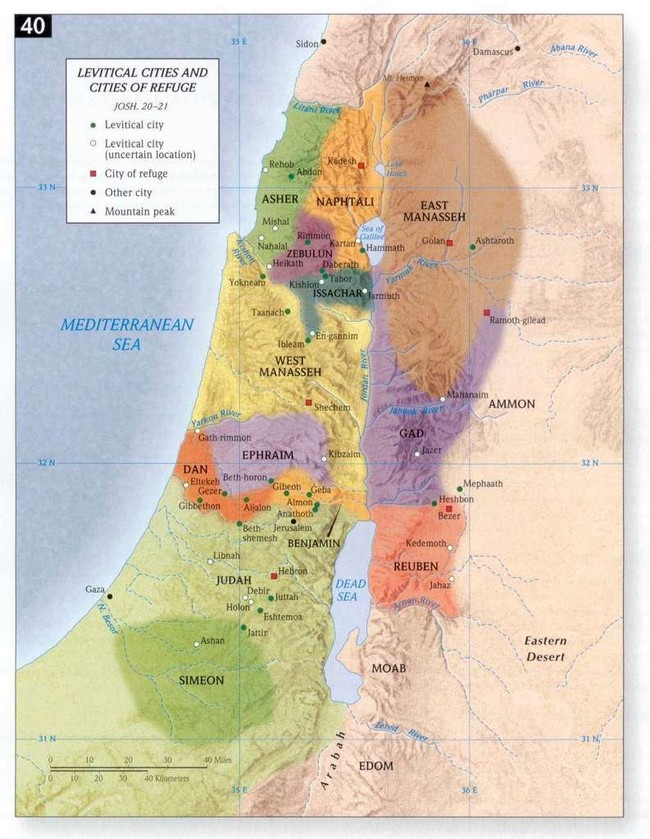
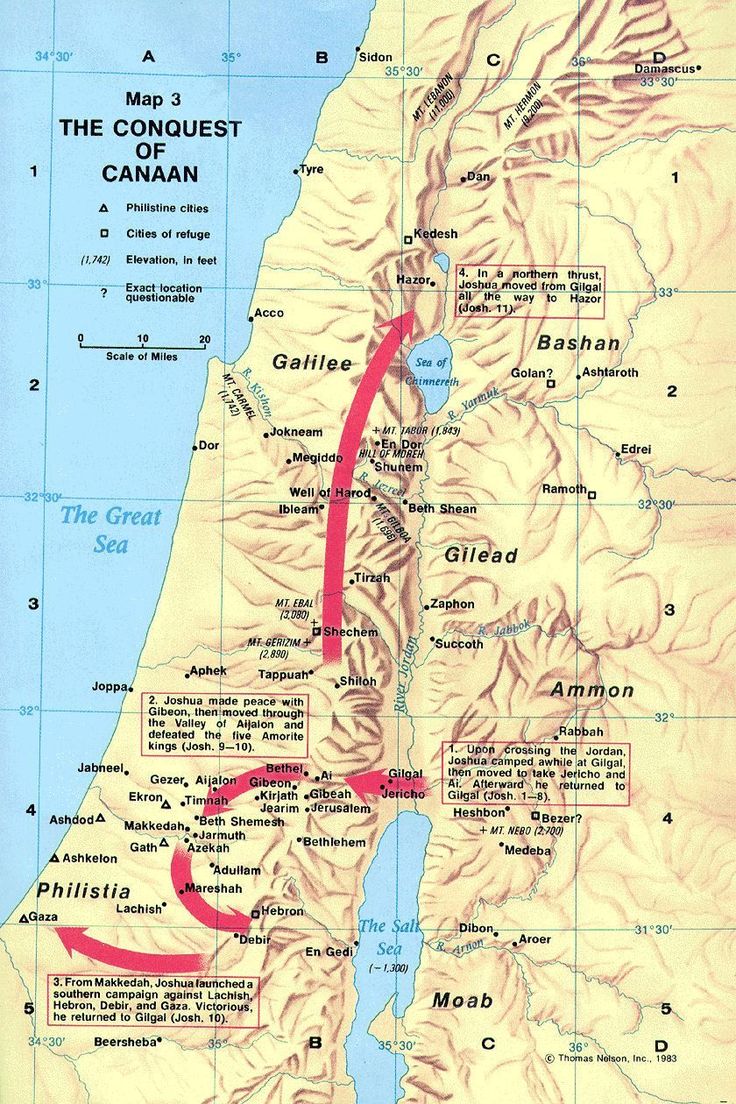
The cities of refuge. God instructed Moses to set aside six different cities, located throughout the land of Canaan, and designate them as cities of refuge. Occupied by Levites, these cities were strategically placed and easily accessible from all parts of the land. Their purpose was to provide a safe haven to anyone who had committed unpremeditated murder.  If an Israelite inadvertently and unintentionally caused the death of a fellow Israelite, he could flee to one of these cities and seek refuge from the avenger.

In that cultural context, It was up to the relatives of a murder victim to seek vengeance. This “blood avenger” (Numbers 35:19) was not just free to kill the murdered, he was obligated to do so (Numbers 35:19, 21). It was his duty. He was called the “avenger of blood.”

But in order to prevent the blood avenger from taking the life of an innocent individual, the cities of refuge were established. If an Israelite accidentally killed someone else, he could run to one of these cities and seek refuge. As long as he remained there, he would be protected from the blood avenger. It was up to the residents of the city (Levites) to help determine the guilt of innocence of the accused. If it was determined that his actions were premeditated and intentional, he was to be handed over to the blood avenger for retribution. But if he was deemed innocent of having committed voluntary manslaughter, he would be allowed to remain in the city of refuge until the high priest died. In essence, the city became his prison. If he ever left, he would be guilty of violating his sentence and the blood avenger could seek his death.

All of this sounds very barbaric to us, but you have to remember that Israel had no police force for enforcing laws or dispensing justice. According to the Mosaic Law, murder was a crime worthy of death. The guilty must be punished. But involuntary manslaughter was to be dealt with in a different manner. That is why the cities were established. God was protecting the innocent.

God dwelt among His people, and His very presence demanded that they live set-apart lives. His holiness and righteousness required that they live differently and distinctively, abiding by a stringent set of rules and regulations that governed their behavior and interactions with one another. And yet God knew their weaknesses and fully understood their incapacity to live up to His exacting standards. The entire sacrificial system was designed to deal with their ongoing struggle with sin.

To unjustly execute the innocent would have been as evil in God’s sight as to excuse the guilty. So He provided those who had committed involuntary manslaughter a means for finding justice. They could live in the city of refuge and enjoy permanent protection from the “blood avenger.” They were still guilty of murder, but their lives were spared. The city of refuge became their prison until the day that the high priest died. Then his death would serve as an atonement for their sin, providing them with release from their guilt and the right to live among their kinsmen again – innocent and free.

The ongoing presence of God was constantly in jeopardy due to the sinfulness of men. Yet He provided them with countless means by which they could receive restoration and assure His continued existence among them. It was God who set them apart. Without them, they would have been nothing. His presence provided them their distinctiveness. And it was their sin that threatened their uniqueness as His chosen people.

From the day that Adam and Eve sinned in the garden, God has been actively and aggressively seeking to restore order to the chaos created by their actions. Their sin brought disorder, disobedience, and, ultimately, death into the world. It wasn’t long after Eve listened to the lies of the enemy and convinced her husband to join her in rejecting God’s word, that murder showed up on the scene. One of Eve’s own sons killed his brother. Death entered the scene. And disease would not be far behind it. Their bodies would undergo the inevitable effects of aging. Sin would increase. Rebellion against God would run rampant. And yet God continued to reach out to mankind, offering a form of refuge from the consequences of sin.

In a real sense, God’s choosing of Abraham made him and his descendants a “city of refuge” for mankind. The people of Israel would become a single source of God’s abiding presence and divine protection from the guilt and condemnation of sin. It was among the children of God that men could find access to their Creator. It was through the law of God that men could learn of the divine requirements and expectations of a holy God. It was through the sacrificial system instituted by God that men could find atonement for their sins and freedom from the penalty of death they so justly deserved. God had provided a city of refuge among the sons of men. And eventually, God would send His own Son as the ultimate and final means of refuge and escape from sin’s destructive power and God’s righteous judgment.

The Scriptures make it painfully clear that all men are guilty of sin.

For all have sinned and fall short of the glory of God.– Romans 3:23 ESV

Surely there is not a righteous man on earth who does good and never sins. – Ecclesiastes 7:20 ESV

Who can say, “I have made my heart pure; I am clean from my sin?” – Proverbs 20:9 ESV

We are all infected and impure with sin. When we display our righteous deeds, they are nothing but filthy rags. – Isaiah 64:6 NLT

The law of God was given to reveal to men the reality and gravity of their sins. Like a speed limit sign on the side of the freeway, the law provided a constant reminder of man’s proclivity for disobedience and rebellion. Our guilt is unquestionable and undeniable. Sinful humanity stands condemned before a holy and righteous God due to the sinful nature passed down to them from Adam and Eve. All are guilty and all stand condemned. And the very presence of disease and death in our world is an outward reminder of the reality of sin’s devastating consequences.

In the case of someone seeking refuge in one of these cities, if they remained there until the high priest died, their sin was forgiven. They walked away free and clear. The death of the high priest had atoning value just as Jesus’ death for us atones for our sins. No one could accuse this person once the high priest had died. And we stand as unaccused and uncondemned because of what Christ has done for us.

Who dares accuse us whom God has chosen for his own? Will God? No! He is the one who has given us right standing with himself. Who then will condemn us? Will Christ Jesus? No, for he is the one who died for us and was raised to life for us and is sitting at the place of highest honor next to God, pleading for us. – Romans 8:33-34 NLT

We can take refuge in Christ. He is our high priest and He has died for us. His death has set us free once and for all.

God also bound himself with an oath, so that those who received the promise could be perfectly sure that he would never change his mind. So God has given us both his promise and his oath. These two things are unchangeable because it is impossible for God to lie. Therefore, we who have fled to him for refuge can take new courage, for we can hold on to his promise with confidence. This confidence is like a strong and trustworthy anchor for our souls. It leads us through the curtain of heaven into God’s inner sanctuary. Jesus has already gone in there for us. He has become our eternal High Priest in the line of Melchizedek. – Hebrews 6:17-20 NLT

English Standard Version (ESV) The Holy Bible, English Standard Version. ESV® Permanent Text Edition® (2016). Copyright © 2001

New Living Translation (NLT) Holy Bible, New Living Translation, copyright © 1996, 2004, 2015 by Tyndale House Foundation. Used by permission of Tyndale House Publishers Inc., Carol Stream, Illinois 60188. All rights reserved.

Our Proactive and Protective God

16 The Lord spoke to Moses, saying, 17 “These are the names of the men who shall divide the land to you for inheritance: Eleazar the priest and Joshua the son of Nun. 18 You shall take one chief from every tribe to divide the land for inheritance. 19 These are the names of the men: Of the tribe of Judah, Caleb the son of Jephunneh. 20 Of the tribe of the people of Simeon, Shemuel the son of Ammihud. 21 Of the tribe of Benjamin, Elidad the son of Chislon. 22 Of the tribe of the people of Dan a chief, Bukki the son of Jogli. 23 Of the people of Joseph: of the tribe of the people of Manasseh a chief, Hanniel the son of Ephod. 24 And of the tribe of the people of Ephraim a chief, Kemuel the son of Shiphtan. 25 Of the tribe of the people of Zebulun a chief, Elizaphan the son of Parnach. 26 Of the tribe of the people of Issachar a chief, Paltiel the son of Azzan. 27 And of the tribe of the people of Asher a chief, Ahihud the son of Shelomi. 28 Of the tribe of the people of Naphtali a chief, Pedahel the son of Ammihud.” 29 These are the men whom the Lord commanded to divide the inheritance for the people of Israel in the land of Canaan. 

1 The Lord spoke to Moses in the plains of Moab by the Jordan at Jericho, saying, “Command the people of Israel to give to the Levites some of the inheritance of their possession as cities for them to dwell in. And you shall give to the Levites pasturelands around the cities. The cities shall be theirs to dwell in, and their pasturelands shall be for their cattle and for their livestock and for all their beasts. The pasturelands of the cities, which you shall give to the Levites, shall reach from the wall of the city outward a thousand cubits all around. And you shall measure, outside the city, on the east side two thousand cubits, and on the south side two thousand cubits, and on the west side two thousand cubits, and on the north side two thousand cubits, the city being in the middle. This shall belong to them as pastureland for their cities.

“The cities that you give to the Levites shall be the six cities of refuge, where you shall permit the manslayer to flee, and in addition to them you shall give forty-two cities. All the cities that you give to the Levites shall be forty-eight, with their pasturelands. And as for the cities that you shall give from the possession of the people of Israel, from the larger tribes you shall take many, and from the smaller tribes you shall take few; each, in proportion to the inheritance that it inherits, shall give of its cities to the Levites.” Numbers 34:16-35:8 ESV

God provided Moses with the name of one man from each of the ten tribes of Israel. These men, hand-picked by God, would assist Eleazar, the high priest, and Joshua in the distribution of the land. The tribes of Gad and Reuben were not included because they had chosen to settle outside the boundaries of Canaan. These men were well-respected leaders among their respective tribes and would help to guarantee that the land was fairly apportioned and that each tribe, regardless of its size, was treated equitably and fairly. There was to be no favoritism or any form of nepotism. The larger tribes, whose numbers would be based on the recent census taken by Moses, would be allotted more extensive land allotments. But that did not mean they would get the best land. God was giving these ten men the weighty responsibility of dividing up the Israelites’ inheritance in a way that would satisfy all the parties involved, and that would not be an easy task.

The next thing on God’s agenda was to arrange for the needs of the tribe of Levi. He had already informed Moses that the Levites would inherit no land in Canaan. He had set apart the tribe of Levi as His special possession and had dedicated them to the care and maintenance of the tabernacle. As a result, God promised to be their inheritance.

“Remember that the Levitical priests—that is, the whole of the tribe of Levi—will receive no allotment of land among the other tribes in Israel. Instead, the priests and Levites will eat from the special gifts given to the Lord, for that is their share. They will have no land of their own among the Israelites. The Lord himself is their special possession, just as he promised them.” – Deuteronomy 18:1-2 NLT

But while the Levites would be allotted no land in Canaan, they would be awarded the deeds to 48 cities located within the territories of each of the other 11 tribes (Joshua 21). Even the tribes of Gad, Reuben, and the half-tribe of Manasseh were required to provide the Levites with towns and pastureland for their flocks. God had made accommodations for the Levites.

These Levitical cities were to be strategically located throughout the nation of Israel so that every Israelite was no more than ten miles from one of them. This helped to ensure that the people of God were never far away from a member of the Levitical priesthood, whose job was to provide instruction in the ways of God. The Levitical priests served as judges (Deuteronomy 17:8-13) and teachers of God’s law (Deuteronomy 33:10). So, it was essential that every Israelite had ready access to a Levitical town and a priest of God.

Of the 48 towns awarded to the Levites, six were to be designated as cities of refuge. These were specially sanctioned zones within the boundaries of Israel where anyone guilty of committing a non-premediated murder could seek asylum. God had already declared His ruling concerning murder (Exodus 20:13), but He had Moses present a special provision for cases involving accidental homicide.

“If someone kills another person unintentionally, without previous hostility, the slayer may flee to any of these cities to live in safety. – Deuteronomy 19:4 NLT

He even had Moses provide a potential scenario in which a city of refuge would become necessary.

“For example, suppose someone goes into the forest with a neighbor to cut wood. And suppose one of them swings an ax to chop down a tree, and the ax head flies off the handle, killing the other person. In such cases, the slayer may flee to one of the cities of refuge to live in safety.” – Deuteronomy 19:5 NLT

God knew that life would happen and that deadly accidents would be a part of the Israelites’ existence in the land. Men would be killed and justice would need to be pursued. But what He didn’t want was some form of vigilante justice running rampant through the nation. Yet God knew that the relatives of a murder victim would tend to seek revenge against the guilty party and ask questions later. The cities of refuge were intended to protect the innocent while justice was being served.

Since Israel had no professional police force, these kinds of accidents could easily turn into bloodbaths where the relatives of the victim sought to avenge their loved one’s death. So, these cities, occupied by the Levites, would provide a place where the guilty party could find solace and seek a fair judgment concerning his guilt or innocence. In His plans for the land of promise, God was leaving nothing to chance. He was creating a well-designed system for dealing with the inevitable problem of sin among His chosen people. He was going to distribute the Levitical priesthood among them to provide spiritual enlightenment and He was going to create safe havens for those who unwittingly committed even the gravest of sins. God was providing for and protecting His people.

English Standard Version (ESV) The Holy Bible, English Standard Version. ESV® Permanent Text Edition® (2016). Copyright © 2001

New Living Translation (NLT) Holy Bible, New Living Translation, copyright © 1996, 2004, 2015 by Tyndale House Foundation. Used by permission of Tyndale House Publishers Inc., Carol Stream, Illinois 60188. All rights reserved.

The Short Journey from Doubt to Disobedience

1 Now the serpent was more crafty than any other beast of the field that the Lord God had made.

He said to the woman, “Did God actually say, ‘You shall not eat of any tree in the garden’?” And the woman said to the serpent, “We may eat of the fruit of the trees in the garden, but God said, ‘You shall not eat of the fruit of the tree that is in the midst of the garden, neither shall you touch it, lest you die.’” But the serpent said to the woman, “You will not surely die. For God knows that when you eat of it your eyes will be opened, and you will be like God, knowing good and evil.” So when the woman saw that the tree was good for food, and that it was a delight to the eyes, and that the tree was to be desired to make one wise, she took of its fruit and ate, and she also gave some to her husband who was with her, and he ate. Then the eyes of both were opened, and they knew that they were naked. And they sewed fig leaves together and made themselves loincloths. Genesis 3:1-7 ESV

With the opening of chapter three, the story takes a sudden and decidedly dark turn. The preceding chapter ended with the first marriage ceremony, officiated over by God Himself, as He joined together as “one flesh,” the man and woman He had created. It had been an idyllic scene, as Adam welcomed his new wife.

“At last!” the man exclaimed.

“This one is bone from my bone,
    and flesh from my flesh!
She will be called ‘woman,’
    because she was taken from ‘man.’” – Genesis 2:25 NLT

And Moses ended that chapter by noting that “the man and his wife were both naked, but they felt no shame” (Genesis 2:25 NLT). They enjoyed a relationship built on innocence, transparency, and complete trust. They were just as God had intended them to be and, together, they enjoyed the bountiful and beautiful environment He had prepared for them. Yet, their state of unadulterated innocence and intimacy was about to change – forever.

One day, as Eve walked in the garden, she was confronted by one of the other “living creatures.“ In a scene straight out of a Harry Potter novel, Eve is confronted by a beautiful and particularly beguiling serpent. Surprisingly, Eve does not seem to be shocked at the creature’s capacity to speak. Due to her recent arrival on the scene, Eve may have not yet interacted with any of the other animals, so she would have been unaware that the capacity of speech was solely restricted to humans. The fact that the serpent spoke to her does not seem to surprise her. But the words that come from the mouth of the serpent will have life-altering implications.

It is interesting to note the wordplay that takes place between verse 25 of chapter two and verse 1 of chapter three. In Hebrew, the word for “naked” is עָרוֹם (ʿārôm), and the word used to describe the craftiness of the serpent is עָרוּם (ʿārûm). Moses, writing under the inspiration of the Holy Spirit, uses these two words to differentiate between Eve, the innocent protagonist, and the serpent, the clever and cunning antagonist. The serpent is going to make a full-frontal assault on the child-like innocence and inexperience of Eve.

But before preceding, we have to address the issue of the serpent’s identity. Was this just another snake in the garden? It would seem that the answer is no. This serpent displayed the capacity to reason and speak. Moses describes it as being “more crafty than any other beast of the field that the Lord God had made” (Genesis 3:1 ESV). This statement could indicate that the serpent was not one of God’s creations. Then where did it come from? Most biblical scholars agree that the serpent was a manifestation of Satan himself. The prophet Ezekiel describes Satan as being in Eden.

You were in Eden, the garden of God;
    every precious stone was your covering,
sardius, topaz, and diamond,
    beryl, onyx, and jasper,
sapphire, emerald, and carbuncle;
    and crafted in gold were your settings
    and your engravings.
On the day that you were created
    they were prepared.
You were an anointed guardian cherub.
    I placed you; you were on the holy mountain of God;
    in the midst of the stones of fire you walked.
You were blameless in your ways
    from the day you were created,
    till unrighteousness was found in you. – Ezekiel 28:13-15 ESV

And Ezekiel describes the ignominious fall of this “anointed guardian cherub” who had been “full of wisdom and perfect in beauty” (Ezekiel 28:12 ESV).

Your heart was proud because of your beauty;
    you corrupted your wisdom for the sake of your splendor.
I cast you to the ground;
    I exposed you before kings,
    to feast their eyes on you. – Ezekiel 28:17 ESV

And the prophet Isaiah provides further insights into Satan’s epic fall from grace.

“How you are fallen from heaven,
    O Day Star, son of Dawn!
How you are cut down to the ground,
    you who laid the nations low!
You said in your heart,
    ‘I will ascend to heaven;
above the stars of God
    I will set my throne on high;
I will sit on the mount of assembly
    in the far reaches of the north;
I will ascend above the heights of the clouds;
    I will make myself like the Most High.’” – Isaiah 14:12-14 ESV

Satan, desiring to be as God, had led an angelic insurrection against the Almighty. But his attempt to overthrow and replace God had failed and he was cast down to earth. In the book of Revelation, John provides an apt description of this former ministering angel. He refers to him as “that ancient serpent, who is called the devil and Satan, the deceiver of the whole world” (Revelation 12:9 ESV). Jesus described Satan as “a murderer from the beginning” (John 8:44 ESV). With this statement, Jesus seems to indicate Satan’s role in the fall. He played the part of the deceiver, using lies and half-truths to persuade Adam and Eve to rebel against God. And Jesus went on to explain that Satan “does not stand in the truth, because there is no truth in him. When he lies, he speaks out of his own character, for he is a liar and the father of lies” (John 8:44 ESV).

It seems clear that the serpent was merely a tool, a deceptive prop in the hands of Satan. It could be that Satan even disguised himself in the guise of a serpent in order to infiltrate the garden and catch the unsuspecting Eve off guard. The apostle Paul, when calling the false teachers who were deceiving local congregations, he described them as “deceitful workman, disguising themselves as apostles of Christ” (2 Corinthians 11:13 ESV). Then, he went on to explain the source of their deception.

And no wonder, for even Satan disguises himself as an angel of light. So it is no surprise if his servants, also, disguise themselves as servants of righteousness. Their end will correspond to their deeds. – 2 Corinthians 11:14-15 ESV

It doesn’t require a stretch of the imagination to consider Satan as disguising himself as a serpent. In that form, he was able to approach Eve and raise questions about the integrity and trustworthiness of God. He may have been cast down, but he had not yet given up his desire to replace God. This time, he chose to attack God’s chosen image-bearers in an effort to dissuade them from the kingdom mandate they had been given. And his weapon of choice was deceit, designed to produce doubt, which would eventually lead to disobedience. He began his conversation with Eve by asking a cleverly worded question:

“Did God actually say, ‘You shall not eat of any tree in the garden’?” – Genesis 2:1 ESV

He was testing her knowledge and understanding of God’s command concerning the trees of the garden. But he was also subtly encouraging Eve to doubt the integrity of God’s word.

But Eve calmly responded, “We may eat of the fruit of the trees in the garden, but God said, ‘You shall not eat of the fruit of the tree that is in the midst of the garden, neither shall you touch it, lest you die’” (Genesis 3:2-3 ESV). But Eve exposed her ignorance of God’s command by adding the inaccurate prohibition against touching the tree. Her answer was only partially correct, and this opened the door to Satan’s next salvo.

“You will not surely die. For God knows that when you eat of it your eyes will be opened, and you will be like God, knowing good and evil.” – Genesis 3:4-5 ESV

With this one statement, Satan planted the seeds of doubt that would soon spring forth into full-grown disobedience. He blatantly refuted the word of God by declaring that eating the fruit of the forbidden tree would result in life, not death. He insinuated to Even that God was holding out on them. The Almighty was trying to prevent them from experiencing all that they were meant to be. He asserted that if they actually disobeyed God and ate of the tree of the knowledge of good and evil, they would be like God. In other words, the fruit would give them the capacity to determine right from wrong. They would become autonomous and self-governing. In a sense, they would be like God in that they would be able to determine what was best for themselves. They would no longer have to live by God’s restrictive and repressive rules.

Satan portrayed God as the deceiver. He turned the tables and cast God as the villain in the story. It was Yahweh who was keeping them from enjoying their well-deserved freedom and right to self-determination.

And Eve quickly succumbed to Satan’s tempting ploy. Moses states that “the woman saw that the tree was good for food, and that it was a delight to the eyes, and that the tree was to be desired to make one wise” (Genesis 3:6 ESV). She immediately experienced what the apostle John would later describe as “a craving for physical pleasure, a craving for everything we see, and pride in our achievements and possessions” (1 John 2:16 NLT). She fell in love with the fruit and all that it could offer. And she ate. She gave in to the temptation. Not only that, she shared the forbidden fruit with her husband. Yes, Adam was there. He had been the entire time. He had heard the entire conversation between Eve and the serpent and had never spoken up. It had been to Adam that God had given the original warning concerning the tree.

And the Lord God commanded the man, saying, “You may surely eat of every tree of the garden, but of the tree of the knowledge of good and evil you shall not eat, for in the day that you eat of it you shall surely die.” – Genesis 2:16-17 ESV

He knew exactly what God had said and should have refuted the lies of the serpent. But, instead, Adam followed his wife’s lead and accepted her offer of the fruit. He too, doubted God’s word and made the fateful decision to disobey God’s command. And the rest, they say, is history. Moses sadly states, “the eyes of both were opened, and they knew that they were naked” (Genesis 3:7 ESV). They got exactly what the serpent had promised: Their eyes were opened. But what they saw disturbed them. Rather looking on one another’s innocence, they viewed themselves in the guise of guilt. They had sinned and they knew it. And they immediately tried to cover their nakedness and hide themselves from the all-seeing eyes of God.  

English Standard Version (ESV) The Holy Bible, English Standard Version. ESV® Permanent Text Edition® (2016). Copyright © 2001 by Crossway Bibles, a publishing ministry of Good News Publishers.

New Living Translation (NLT) Holy Bible, New Living Translation, copyright © 1996, 2004, 2015 by Tyndale House Foundation. Used by permission of Tyndale House Publishers Inc., Carol Stream, Illinois 60188. All rights reserved.

New English Translation (NET)NET Bible® copyright ©1996-2017 by Biblical Studies Press, L.L.C. http://netbible.com All rights reserved.

You Can Mourn Now or Mourn Later

26 And as they led him away, they seized one Simon of Cyrene, who was coming in from the country, and laid on him the cross, to carry it behind Jesus. 27 And there followed him a great multitude of the people and of women who were mourning and lamenting for him. 28 But turning to them Jesus said, “Daughters of Jerusalem, do not weep for me, but weep for yourselves and for your children. 29 For behold, the days are coming when they will say, ‘Blessed are the barren and the wombs that never bore and the breasts that never nursed!’ 30 Then they will begin to say to the mountains, ‘Fall on us,’ and to the hills, ‘Cover us.’ 31 For if they do these things when the wood is green, what will happen when it is dry?”

32 Two others, who were criminals, were led away to be put to death with him. Luke 23:26-32 ESV

Jesus’ legal trials may have come to an end, but His physical trials were just about to begin. A condemned criminal had been allowed to walk free, while Jesus, an innocent man, was subjected to a range of violent physical and verbal abuse. Luke goes out of his way to record the overwhelming consensus of opinion that Jesus was an innocent man.

Then Pilate said to the chief priests and the crowds, “I find no guilt in this man.” – Luke 23:4 ESV

“…behold, I did not find this man guilty of any of your charges against him. Neither did Herod, for he sent him back to us. Look, nothing deserving death has been done by him.” – Luke 23:14-15 ESV

A third time he said to them, “Why? What evil has he done? I have found in him no guilt deserving death.  – Luke 23:22 ESV

“…this man has done nothing wrong.” – Luke 23:41 ESV

Now when the centurion saw what had taken place, he praised God, saying, “Certainly this man was innocent! – Luke 23:47 ESV

As soon as Pilate relented to the demands of the Jewish religious leaders and authorized the crucifixion of Jesus, the matter fell under the jurisdiction of the Roman soldiers. These hardened legionnaires were responsible for carrying out the governor’s orders by subjecting Jesus to the gruesome ordeal of crucifixion – the Roman government’s preferred form of capital punishment. But like a cat cruelly playing with a mouse before subjecting it to death, Pilate’s guards decided to subject Jesus to a range of degrading physical and emotional abuses. With the entire regiment looking on, “They stripped him and put a scarlet robe on him. They wove thorn branches into a crown and put it on his head, and they placed a reed stick in his right hand as a scepter. Then they knelt before him in mockery and taunted, ‘Hail! King of the Jews!’” (Matthew 27:29-29 NLT).

These men, having overheard the accusations leveled against Jesus, found it laughable that this powerless and unimpressive Jewish Rabbi would consider Himself to be a king. So, they ruthlessly and mercilessly mocked Jesus, with every cruelty they poured out intended to leave Him humiliated and degraded. And Matthew describes with painful clarity the unsparing nature of their torturous treatment of Jesus.

…they spit on him and grabbed the stick and struck him on the head with it. When they were finally tired of mocking him, they took off the robe and put his own clothes on him again. Then they led him away to be crucified. – Matthew 27:30-31 NLT

John provides the added detail that Pilate ordered Jesus to be flogged. This barbaric practice, also known as scourging, was an especially cruel and inhuman form of punishment that was designed to inflict extreme pain and hasten death. According to an article by Ian Tuttle published in National Review, “The Romans meted out whippings with particular zeal, inventing new tools to increase the misery: on the mild end, a flat leather strap; on the mortal end, long whips with, at their ends, balls of metal with protruding metal fragments or pieces of bone. It was not uncommon for the scourging that preceded a crucifixion to prove fatal” (https://www.nationalreview.com/2015/01/flogging-through-centuries-ian-tuttle/).

By the time Jesus left the Roman governor’s palace, He would have been in a severely weakened state, suffering from extreme pain and blood loss. Yet, as a condemned man, Jesus was expected to carry His own cross to the place of crucifixion. But it appears that the flogging had taken its toll on Jesus, leaving Him incapable of bearing the weight of the cross. So, the Romans conscripted a stranger from the crowd to assist Him. And as Jesus painfully navigated the final steps to the crucifixion site, He was followed by “a great multitude of the people and of women who were mourning and lamenting for him” (Luke 23:27 ESV).

But rather than thank them for their compassionate display of sorrow, Jesus turned to these individuals and gave them a sobering word of warning.

“Daughters of Jerusalem, don’t weep for me, but weep for yourselves and for your children. For the days are coming when they will say, ‘Fortunate indeed are the women who are childless, the wombs that have not borne a child and the breasts that have never nursed.’ People will beg the mountains, ‘Fall on us,’ and plead with the hills, ‘Bury us.’” – Luke 23:28-30 NLT

His words are similar to the ones He spoke to His disciples while they sat with Him on the Mount of Olives, just prior to His arrest in the garden.

“Then those in Judea must flee to the hills. A person out on the deck of a roof must not go down into the house to pack. A person out in the field must not return even to get a coat. How terrible it will be for pregnant women and for nursing mothers in those days. And pray that your flight will not be in winter or on the Sabbath. For there will be greater anguish than at any time since the world began. And it will never be so great again…“ – Matthew 24:16-21 NLT

In both cases, Jesus was speaking of future events. He was warning them that even darker days lie ahead, when the judgment of God will fall upon the world for its rejection of His Son. Those weeping at the sight of Jesus’ deplorable condition and mourning the thought of His pending death had no idea He was referring to events associated with the end of time. The book of Revelation describes a future day when God will reign down judgment upon the earth.

Then everyone—the kings of the earth, the rulers, the generals, the wealthy, the powerful, and every slave and free person—all hid themselves in the caves and among the rocks of the mountains. And they cried to the mountains and the rocks, “Fall on us and hide us from the face of the one who sits on the throne and from the wrath of the Lamb. For the great day of their wrath has come, and who is able to survive?” – Revelation 6:15-17 NLT

This was the day to which Jesus was referring. While His death would be the key to salvation and eternal life, it would also result in God’s wrath being poured out on all those who refused to accept HIs Son as Savior. And that would include many in Israel. God’s chosen people would refuse to accept God’s Son as their Messiah and King. In fact, they would participate in His execution, demanding that He be put to death. When He had entered Jerusalem just a few days earlier, the crowds had shouted, “Hosanna to the Son of David! Blessed is he who comes in the name of the Lord! Hosanna in the highest!” (Matthew 21:9 ESV). But those joyous shouts of adoration and acclimation had quickly turned to cries of “Crucify Him!” And one day, all those who have chosen to reject the King of kings and Lord of lords will suffer the consequences of their decision and mourn, not for Jesus, but for their own coming destruction.

But when Jesus arrived at the placed called Golgotha, He found himself joined by two other men, both criminals, who would be executed alongside Him, “one on either side, and Jesus between them” (John 19:18 ESV). This seemingly innocuous statement conjures up memories of the conversation Jesus had with James and John. On an earlier occasion, these two brothers had approached Jesus and asked, “Grant that one of us may sit at Your right hand and the other at Your left in Your glory” (Mark 10:37 BSB). And Jesus had responded to their presumptuous request by stating, You do not know what you are asking…Can you drink the cup I will drink, or be baptized with the baptism I will undergo?” (Mark 10:38 BSB).

Little did they know at the time, that the two places of prominence they had requested would not be royal thrones, but cruel Roman crosses. For Jesus, the cross was a place of honor. He had been chosen by God the Father to lay down His life, and it was something Jesus was prepared to do – willingly and gladly. Jesus had come to lay down His life for the sheep.

“…the Son of Man came not to be served but to serve others and to give his life as a ransom for many.” – Matthew 20:28 NLT

And that time had come.

English Standard Version (ESV) The Holy Bible, English Standard Version. ESV® Permanent Text Edition® (2016). Copyright © 2001 by Crossway Bibles, a publishing ministry of Good News Publishers.

New Living Translation (NLT) Holy Bible, New Living Translation, copyright © 1996, 2004, 2015 by Tyndale House Foundation. Used by permission of Tyndale House Publishers Inc., Carol Stream, Illinois 60188. All rights reserved.

The Message (MSG)Copyright © 1993, 1994, 1995, 1996, 2000, 2001, 2002 by Eugene H. Peterson