An Unshakeable Future

25 See that you do not refuse him who is speaking. For if they did not escape when they refused him who warned them on earth, much less will we escape if we reject him who warns from heaven. 26 At that time his voice shook the earth, but now he has promised, “Yet once more I will shake not only the earth but also the heavens.” 27 This phrase, “Yet once more,” indicates the removal of things that are shaken—that is, things that have been made—in order that the things that cannot be shaken may remain. 28 Therefore let us be grateful for receiving a kingdom that cannot be shaken, and thus let us offer to God acceptable worship, with reverence and awe, 29 for our God is a consuming fire. – Hebrews 12:25-29 ESV

A Kingdom

It pays to listen to God. That should go without saying. Yet when God spoke to the Israelites from Mount Sinai, they trembled in fear but refused to obey what He had to say. They were scared out of their wits by all the booming thunder, lightning, and smoke, but that fear didn’t turn into faithful obedience to God’s commands.

The author tells us “the sound of a trumpet and a voice whose words made the hearers beg that no further messages be spoken to them” (Hebrews 12:19 ESV). They heard, but they felt like they had heard enough. Even Moses trembled in fear at the sight of God descending upon the top of Mount Sinai. And it was from the top of that mountain that God gave him the Ten Commandments and the Book of the Covenant. From that point forward, the righteous expectations of God would be clearly articulated and scrupulously regulated through the Law. Sin went from being a somewhat subjective, arbitrary thing to a highly objective, non-debatable trespass against a holy God.

The author of Hebrews warns his readers not to repeat the mistake of their ancestors.

See that you do not refuse him who is speaking. – Hebrews 12:25a ESV

God had come down from heaven and descended upon Mount Sinai. There He gave to Moses His list of commands. As God Almighty met with His servant on the mountaintop, His voice shook the heavens, and His physical glory could be seen from the valley below in the form of thunder, lightning, smoke, and fire. But while this spectacular sight petrified the Israelites, it failed to produce obedience.

…they did not escape when they refused him who warned them on earth… – Hebrews 12:25b ESV

While Moses had been up on the mountain receiving the Ten Commandments from God, the people were down in the valley worshiping and dancing before a false god they had made. As a result of their disobedience, Moses commanded the Levites, “Put your sword on your side each of you, and go to and fro from gate to gate throughout the camp, and each of you kill his brother and his companion and his neighbor.’ And the sons of Levi did according to the word of Moses. And that day about three thousand men of the people fell” (Exodus 32:27-28 ESV).

While God spared the majority of His rebellious people, the history of the Israelites reveals that they failed to learn the lesson from that fateful day. Throughout their generations, the people of Israel would be marked by disobedience and disloyalty to God. Their ancestors heard His voice from Mount Sinai and yet, they refused to listen and suffered the consequences. This pattern would repeat itself over the centuries, as the people of Israel continued to hear but not heed the word of God.

And so, the author of Hebrews warns his readers not to repeat the same mistake. The glory of God no longer resides on Mount Sinai. Instead, He speaks from His throneroom in heaven, where He is accompanied by His Son. Yet, despite the distance, His words ring loud and clear.

Quoting from the Old Testament book of Haggai, the author of Hebrews credits God with the words, “Yet once more I will shake not only the earth but also the heavens” (Hebrews 12:26 ESV). The actual quote from the prophecies of Haggai is “For thus says the Lord of hosts: Yet once more, in a little while, I will shake the heavens and the earth and the sea and the dry land” (Haggai 2:6 ESV).

When Haggai penned these words, the people of God had recently returned from exile in the land of Babylon and had completed the reconstruction of the temple. But the once-glorious temple of Solomon was just a shadow of its former glory. The city of Jerusalem was still being reconstructed and the nation was in a highly weakened state, with no king and no army to protect it. Yet, in the midst of that less-than-glorious setting, Haggai went on to deliver the following promise from God.

And I will shake all nations, so that the treasures of all nations shall come in, and I will fill this house with glory, says the Lord of hosts. The silver is mine, and the gold is mine, declares the Lord of hosts. The latter glory of this house shall be greater than the former, says the Lord of hosts. And in this place I will give peace, declares the Lord of hosts.” – Haggai 2:7-9 ESV

That prophecy has yet to be fulfilled. But the author of Hebrews is reminding his readers that the day is coming when it will be.

God is going to one day shake the earth again. This time, it will involve “the removal of things that are shaken—that is, things that have been made—in order that the things that cannot be shaken may remain” (Hebrews 12:27 ESV). God is going to redeem what He has made. He will destroy the old created order, marred by sin, and replace it with something new and free from the effects of sin. The apostle John was given a vision of this future day and he recorded it in his Book of Revelation.

Then I saw a new heaven and a new earth, for the first heaven and the first earth had passed away, and the sea was no more. And I saw the holy city, new Jerusalem, coming down out of heaven from God, prepared as a bride adorned for her husband. And I heard a loud voice from the throne saying, “Behold, the dwelling place of God is with man. He will dwell with them, and they will be his people, and God himself will be with them as their God. He will wipe away every tear from their eyes, and death shall be no more, neither shall there be mourning, nor crying, nor pain anymore, for the former things have passed away.”  – Revelation 21:1-4 ESV

Centuries earlier, the prophet Isaiah recorded the words of God describing the same incredible end-times event:

“For behold, I create new heavens and a new earth, and the former things shall not be remembered or come into mind. But be glad and rejoice forever in that which I create; for behold, I create Jerusalem to be a joy, and her people to be a gladness. I will rejoice in Jerusalem and be glad in my people; no more shall be heard in it the sound of weeping and the cry of distress.” – Isaiah 65:17-19 ESV

The apostle Peter provided his readers with another glimpse of that coming day.

But do not overlook this one fact, beloved, that with the Lord one day is as a thousand years, and a thousand years as one day. The Lord is not slow to fulfill his promise as some count slowness, but is patient toward you, not wishing that any should perish, but that all should reach repentance. But the day of the Lord will come like a thief, and then the heavens will pass away with a roar, and the heavenly bodies will be burned up and dissolved, and the earth and the works that are done on it will be exposed. Since all these things are thus to be dissolved, what sort of people ought you to be in lives of holiness and godliness, waiting for and hastening the coming of the day of God, because of which the heavens will be set on fire and dissolved, and the heavenly bodies will melt as they burn! But according to his promise we are waiting for new heavens and a new earth in which righteousness dwells. – 2 Peter 3:8-13 ESV

So what should our response be to all of this? The author of Hebrews tells us.

Since we are receiving a Kingdom that is unshakable, let us be thankful and please God by worshiping him with holy fear and awe. For our God is a devouring fire. – Hebrews 12:28-29 NLT

We have much for which to be grateful. Our God is in control. He has a perfect plan, and He will one day complete that plan and restore things back to the way He made them before the fall. So, let us hear His words of promise and rest in His holy character, fully believing that we will receive a Kingdom that cannot be shaken. This future Kingdom is the same one for which Abraham longed.

For he was looking forward to the city that has foundations, whose designer and builder is God. – Hebrews 11:10 ESV

All those listed in the great “Hall of Faith” lived their lives on earth, waiting for “a better country, that is, a heavenly one” (Hebrews 11:16a ESV). The author of Hebrews goes on to say, “Therefore God is not ashamed to be called their God, for he has prepared for them a city” (Hebrews 11:16b ESV).

Unlike the Israelites who stood at the base of Mount Sinai and heard the voice of God, let us not “refuse him who is speaking” (Hebrews 12:25 ESV). Instead, let us “offer to God acceptable worship, with reverence and awe” (Hebrews 12:28 ESV). By faith, we are to rest in the reality of the future Kingdom God has reserved for us because He is trustworthy and true, and He never fails to fulfill His promises. He has prepared for us a city and one day His Son will return and that promise will become reality.

English Standard Version (ESV) The Holy Bible, English Standard Version. ESV® Permanent Text Edition® (2016). Copyright © 2001

New Living Translation (NLT) Holy Bible, New Living Translation, copyright © 1996, 2004, 2015 by Tyndale House Foundation. Used by permission of Tyndale House Publishers Inc., Carol Stream, Illinois 60188. All rights reserved.

The Feast of Booths

33 And the Lord spoke to Moses, saying, 34 “Speak to the people of Israel, saying, On the fifteenth day of this seventh month and for seven days is the Feast of Booths to the Lord. 35 On the first day shall be a holy convocation; you shall not do any ordinary work. 36 For seven days you shall present food offerings to the Lord. On the eighth day you shall hold a holy convocation and present a food offering to the Lord. It is a solemn assembly; you shall not do any ordinary work.

37 “These are the appointed feasts of the Lord, which you shall proclaim as times of holy convocation, for presenting to the Lord food offerings, burnt offerings and grain offerings, sacrifices and drink offerings, each on its proper day, 38 besides the Lord’The s Sabbaths and besides your gifts and besides all your vow offerings and besides all your freewill offerings, which you give to the Lord.

39 “On the fifteenth day of the seventh month, when you have gathered in the produce of the land, you shall celebrate the feast of the Lord seven days. On the first day shall be a solemn rest, and on the eighth day shall be a solemn rest. 40 And you shall take on the first day the fruit of splendid trees, branches of palm trees and boughs of leafy trees and willows of the brook, and you shall rejoice before the Lord your God seven days. 41 You shall celebrate it as a feast to the Lord for seven days in the year. It is a statute forever throughout your generations; you shall celebrate it in the seventh month. 42 You shall dwell in booths for seven days. All native Israelites shall dwell in booths, 43 that your generations may know that I made the people of Israel dwell in booths when I brought them out of the land of Egypt: I am the Lord your God.”

44 Thus Moses declared to the people of Israel the appointed feasts of the Lord. Leviticus 23:33-44 ESV


Five days after the Day of Atonement, on the 15th day of Tishri, the people of Israel were to celebrate the last of the seven feasts on Israel’s religious calendar. This feast goes by many names, including the Feast of Booths and the Feast of Tabernacles. Earlier in Israel’s history, it was known as the Festival of the Final Harvest (Exodus 23:16) or the Festival of Ingathering. Today it is known by its Hebrew name, Sukkot or Succoth, which can be translated as “booth” or “tabernacle,” and most often refers to a temporary shelter.

This seven-day-long festival came in the autumn, at the end of the harvest season, and was intended to be a time of thanksgiving and rejoicing. After months of laboring in the fields, orchards, and vineyards, the Israelites would have enjoyed the benefit of all their hard work. Their granaries would have been full. The threshing floors would have been busy. All the wine and olive presses would have been operating at full capacity. And it was at this time of fruitfulness and abundance that God called His people to spend seven days feasting and rejoicing in His presence.

“You shall keep the Feast of Booths seven days, when you have gathered in the produce from your threshing floor and your winepress. You shall rejoice in your feast, you and your son and your daughter, your male servant and your female servant, the Levite, the sojourner, the fatherless, and the widow who are within your towns. For seven days you shall keep the feast to the Lord your God at the place that the Lord will choose, because the Lord your God will bless you in all your produce and in all the work of your hands, so that you will be altogether joyful. – Deuteronomy 16:13-15 ESV

The Feast of Booths was one of three major holy days that required the Israelites to gather “at the place that the Lord will choose” (Deuteronomy 16:15 ESV). This is a reference not only to the Tabernacle but to the location within the land of Canaan where the Tabernacle would eventually reside. Once they conquered the land of Canaan, the Tabernacle would cease to be a temporary or portable structure. It would be set up as a permanent sanctuary to the Lord in the land that He had promised to His chosen people. After Joshua and the Israelites crossed the Jordan River and began their conquest of the land, they erected the Tabernacle in Gilgal, there it remained for seven years. Later, it was relocated to Shiloh, where it remained until the period of the Judges. In time, it was moved to Nob and Gibeon and then, during the reign of King David, it was moved to its final location in Jerusalem.

During the Feast of Booths, the Israelites were commanded to leave their homes and live in temporary shelters built within sight of the Tabernacle. These “booths” were to be constructed “from magnificent trees—palm fronds, boughs from leafy trees, and willows that grow by the streams” (Leviticus 23:40 NLT). Gathered from the lush and leafy trees that filled the land, these branches were to be used to make temporary shelters in which the Israelites would reside during the seven days of the festival.

God provides an explanation for this rather strange housing arrangement.

“This will remind each new generation of Israelites that I made their ancestors live in shelters when I rescued them from the land of Egypt. I am the Lord your God.” – Leviticus 23:43 NLT

One of the things God knew about His people was that they would be prone to self-sufficiency and forgetfulness. He would later remind them of their need to remember all that He had done for them.

“Remember how the Lord your God led you through the wilderness for these forty years, humbling you and testing you to prove your character, and to find out whether or not you would obey his commands. Yes, he humbled you by letting you go hungry and then feeding you with manna, a food previously unknown to you and your ancestors. He did it to teach you that people do not live by bread alone; rather, we live by every word that comes from the mouth of the Lord. For all these forty years your clothes didn’t wear out, and your feet didn’t blister or swell. Think about it: Just as a parent disciplines a child, the Lord your God disciplines you for your own good.” – Deuteronomy 8:2-5 NLT

He was leading them to “a land of wheat and barley; of grapevines, fig trees, and pomegranates; of olive oil and honey. It is a land where food is plentiful and nothing is lacking” (Deuteronomy 8:8-9 NLT). And this fruitful land, “of flowing streams and pools of water, with fountains and springs that gush out in the valleys and hills” (Deuteronomy 8:7 NLT) could prove to be a problem for God’s people if they were not careful. That’s why God warned them:

Beware that in your plenty you do not forget the Lord your God and disobey his commands, regulations, and decrees that I am giving you today. For when you have become full and prosperous and have built fine homes to live in, and when your flocks and herds have become very large and your silver and gold have multiplied along with everything else, be careful! Do not become proud at that time and forget the Lord your God…” – Deuteronomy 8:11-14 NLT

God knew that their success in the land would inflate their sense of self-worth and bolster their tendency toward self-sufficiency. And Moses reminded them that all the miraculous acts of provision and providence God did for them in the wilderness had been so they could never say in the future, “I have achieved this wealth with my own strength and energy” (Deuteronomy 8:17 NLT).

God wanted them to remember that He was their sole provider and protector. He was the one who gave them the land in the first place. It was He who caused the trees to bear fruit and the fields to yield grain. The rivers and streams that provided them with fresh water were gifts from Yahweh. Everything the Israelites would enjoy in the land of Canaan would be the result of God’s grace and mercy. And it is important to remember that this decree to celebrate the Feast of Booths came long before the people ever entered the land of Canaan. In fact, it would be more than four decades before the Israelites ever set foot in the promised land and enjoyed the fruits of its bounty.

But when they eventually did, God wanted them to be prepared to give Him thanks for all that He had done. Each day of the feast was to be marked by sacrifices and the book of Numbers provides the details concerning these elaborate and costly offerings. On the first day, they were to offer “thirteen bulls from the herd, two rams, fourteen male lambs a year old” (Numbers 29:13 ESV). These were to be accompanied by grain and drink offerings. On the second day, they were required to offer “twelve bulls from the herd, two rams, fourteen male lambs a year old without blemish” (Numbers 29:17 ESV). This pattern would continue over the next five days, with the number of bulls that were offered decreasing by one each day, until on the seventh day, they offered “seven bulls, two rams, fourteen male lambs a year old without blemish” (Numbers 29:32 ESV). In total, 70 bulls, 14 rams, 98 lambs, and 7 goats were to be sacrificed as burnt offerings to Yahweh.

It is important to note that this festival was inaugurated long before the Israelites entered the land of Canaan. In a time when they were living in tents and still eating manna and quail provided for them by God, they were expected to celebrate this festival that marked God’s bountiful provision. In doing so, the Israelites would be looking back on their time as slaves in Egypt, but they would also be looking forward to the day when they would enjoy all the blessings of the land of promise. Their God was good, gracious, and faithful to keep His promises. During a time when they owned no land to till, had no houses in which to live, or possessed no vineyards from which to harvest fruit or grapes, they were still expected to honor God for His faithfulness and abundant provision.

As Moses would later remind them, God had been abundantly faithful to them.

“Do not forget that he led you through the great and terrifying wilderness with its poisonous snakes and scorpions, where it was so hot and dry. He gave you water from the rock! He fed you with manna in the wilderness, a food unknown to your ancestors. He did this to humble you and test you for your own good.” – Deuteronomy 8:15-16 NLT

In the months and years ahead, the Israelites would continue to learn of the faithfulness of God. He would guide them and provide for them all during their days in the wilderness. Their shoes and clothes would not wear out. Their stomachs would never be empty. Their need for water would never go unmet. God would provide. But He expected them to honor His provision by giving Him the honor He was due. Right now, they needed Him and they knew it. But the day would come when they entered the land and they grew fat and happy because of its abundant provision for all their needs. They would forget their past and place all their hope for the future in their own ability to provide for themselves. But these feasts were intended to serve as powerful reminders of God’s power and provision. That is why Moses told them, “Remember the Lord your God. He is the one who gives you power to be successful” (Deuteronomy 8:18 NLT).

English Standard Version (ESV) The Holy Bible, English Standard Version. ESV® Permanent Text Edition® (2016). Copyright © 2001

New Living Translation (NLT) Holy Bible, New Living Translation, copyright © 1996, 2004, 2015 by Tyndale House Foundation. Used by permission of Tyndale House Publishers Inc., Carol Stream, Illinois 60188. All rights reserved.

Live Like It

1 And the Lord spoke to Moses, saying, “Speak to the people of Israel and say to them, I am the Lord your God. You shall not do as they do in the land of Egypt, where you lived, and you shall not do as they do in the land of Canaan, to which I am bringing you. You shall not walk in their statutes. You shall follow my rules and keep my statutes and walk in them. I am the Lord your God. You shall therefore keep my statutes and my rules; if a person does them, he shall live by them: I am the Lord. – Leviticus 18:1-5 ESV

God knew that His people would face the ongoing temptation to carry out His ceremonial law while, at the same time, living lives that contradicted the very intentions of those laws. In other words, they would run the risk of living hypocritical lives that reflected an outward appearance of obedience that covered up the true conditions of their hearts. It was the very same of which Jesus accused the Jewish religious leader of His day.

“What sorrow awaits you teachers of religious law and you Pharisees. Hypocrites! For you are so careful to clean the outside of the cup and the dish, but inside you are filthy—full of greed and self-indulgence! – Matthew 23:25 NLT

“What sorrow awaits you teachers of religious law and you Pharisees. Hypocrites! For you are like whitewashed tombs—beautiful on the outside but filled on the inside with dead people’s bones and all sorts of impurity. Outwardly you look like righteous people, but inwardly your hearts are filled with hypocrisy and lawlessness. – Matthew 23:27-28 NLT

Jesus was exposing these men for what they truly were: blatant charlatans who were adept at displaying outward conformity to God’s will but whose actions were nothing more than a carefully-orchestrated performance designed to earn the praise and respect of the people. They were little more than play actors. In fact, the Greek word for hypocrite is ὑποκριτής (hypokritēs), a term used to describe those who performed in the Greek plays that were so popular throughout the Roman world of Jesus’ day. Jesus was comparing the law-abiding religious leaders of His day to actors who used elaborate costumes and masks to fool their audiences into believing they were someone else.

Jesus pulled back the curtain on their little drama and exposed their deceptive masquerade. They were not what they appeared to be. And in the same way, God was warning the people of Israel about the danger of going through the motions by feigning obedience to His law while, at the same time, living in silent disregard to His desire that they live truly holy lives.

Yahweh has spent a great deal of time outlining the exacting details of His ceremonial law. He has provided His chosen people with clear and compelling regulations for conducting their daily lives, covering everything from the food they could eat to the various skin diseases that could render them unholy and unworthy of entering His Tabernacle. The entire sacrificial system was designed to mitigate their failure to keep His law. When they sinned, they had a way of receiving atonement by offering the appropriate sacrifice in the acceptable manner God had prescribed.

But the Israelites had proven themselves to be a stubborn people who were prone to doing things their own way. Their 400-year-long stint in Egypt had made them accustomed to the pagan practices of their captors. Idolatry had become a normal and acceptable part of their lives. The sexual promiscuity of their Egyptian overlords had dulled the moral sensibilities of the Israelites, leaving them open to increasingly more decadent and defiling types of behavior. Sins like adultery had become commonplace, even among God’s people, and no longer carried any social stigma or sense of impropriety. So, God took the time to discuss the need for behavior that reflected their status as God’s chosen and set-apart people.

In a real sense, the Israelites were going from the firepan into the fire. Their divinely-orchestrated escape from captivity had allowed them to leave the decadence of Egypt behind, but a great challenge lie in the future. God knew something of which they were completely oblivious. The land of Canaan, their future home, was a place filled with immoral and idolatrous nations that were going to make the Egyptians look like amateurs. Compared to the more sophisticated Egyptians, the Canaanites would take immorality to a whole new and much lower level. And God knew that His people would be prone to adopt and adapt the pagan practices of their new neighbors. That’s why He commanded Moses to warn the sin-prone Israelites to refrain from mimicking the ways of the world.

“…do not act like the people in Egypt, where you used to live, or like the people of Canaan, where I am taking you. You must not imitate their way of life.” – Leviticus 18:3 NLT

God had chosen the people of Israel to be His “treasured possession among all peoples,” and as such, they were to be “a kingdom of priests and a holy nation.” (Exodus 19:5-6 ESV). Their lives were to stand out from the crowd. Their behavior was to be radically different, dictated by the conditions established by God Himself and articulated in the Mosaic Law. They were not free to live according to their own wills or in keeping with the rest of the world. Their behavioral standards were God-ordained and came with severe consequences if disobeyed. God made it perfectly clear that obedience was mandatory and non-optional.

You must obey all my regulations and be careful to obey my decrees, for I am the Lord your God. – Leviticus 18:4 NLT

These were laws; not suggestions, and they came from the very throne of God in heaven, not the minds of mortal men. Yet, God knew that the Israelites would struggle obeying His law and lean toward living like their pagan neighbors. The law would set them apart, but failure to allow the law to transform their daily behavior would render them ineffective in their assignment to be a kingdom of priests and a holy nation.

Centuries later, the apostle Paul warned the Jewish Christians living in Rome of this very danger. He knew they were proud of their Jewish heritage and wore it like a badge of honor, but their outward actions did not reflect the kind of character God demanded.

You who call yourselves Jews are relying on God’s law, and you boast about your special relationship with him. You know what he wants; you know what is right because you have been taught his law. You are convinced that you are a guide for the blind and a light for people who are lost in darkness. You think you can instruct the ignorant and teach children the ways of God. For you are certain that God’s law gives you complete knowledge and truth.

Well then, if you teach others, why don’t you teach yourself? You tell others not to steal, but do you steal? You say it is wrong to commit adultery, but do you commit adultery? You condemn idolatry, but do you use items stolen from pagan temples? You are so proud of knowing the law, but you dishonor God by breaking it. No wonder the Scriptures say, “The Gentiles blaspheme the name of God because of you.” – Romans 2:17-24 NLT

And Paul would go on to downplay their inordinate pride in their Jewish heritage; instead calling them to live in a way that reflects the gospel’s power to transform the human heart and create true life change.

For you are not a true Jew just because you were born of Jewish parents or because you have gone through the ceremony of circumcision. No, a true Jew is one whose heart is right with God. And true circumcision is not merely obeying the letter of the law; rather, it is a change of heart produced by the Spirit. And a person with a changed heart seeks praise from God, not from people. – Romans 2:28-29 NLT

For the Jews of Moses’ day, obedience to God’s law came with striking benefits. It wasn’t merely about blind obedience and mindless adherence to a lengthy set of arbitrary rules and regulations. God’s law brought life.

“If you obey my decrees and my regulations, you will find life through them. I am the Lord.” – Leviticus 18:5 NLT

He wanted them to know that His laws were laws for living – bringing peace, joy, contentment, purpose, blessings, and the benefit of an ongoing relationship with Him. God was not a divine policeman enforcing arbitrary and needless rules designed to stifle human flourishing. He wasn’t some curmudgeonly old skinflint in the sky trying to rob mere mortals of all the joys of life. The Lord God was giving His chosen people a unique opportunity to live in perfect communion with Him, enjoying all the benefits of His divine goodness and glory as they lived in this fallen and sin-stained world. But those blessings would require obedience to His law. Rather than live like the Romans and Canaanites, the Israelites were to live like God’s chosen and set-apart people – for all the world to see.

English Standard Version (ESV) The Holy Bible, English Standard Version. ESV® Permanent Text Edition® (2016). Copyright © 2001

New Living Translation (NLT) Holy Bible, New Living Translation, copyright © 1996, 2004, 2015 by Tyndale House Foundation. Used by permission of Tyndale House Publishers Inc., Carol Stream, Illinois 60188. All rights reserved.

Food for Thought

1 They set out from Elim, and all the congregation of the people of Israel came to the wilderness of Sin, which is between Elim and Sinai, on the fifteenth day of the second month after they had departed from the land of Egypt. And the whole congregation of the people of Israel grumbled against Moses and Aaron in the wilderness, and the people of Israel said to them, “Would that we had died by the hand of the Lord in the land of Egypt, when we sat by the meat pots and ate bread to the full, for you have brought us out into this wilderness to kill this whole assembly with hunger.”

Then the Lord said to Moses, “Behold, I am about to rain bread from heaven for you, and the people shall go out and gather a day’s portion every day, that I may test them, whether they will walk in my law or not. On the sixth day, when they prepare what they bring in, it will be twice as much as they gather daily.” So Moses and Aaron said to all the people of Israel, “At evening you shall know that it was the Lord who brought you out of the land of Egypt, and in the morning you shall see the glory of the Lord, because he has heard your grumbling against the Lord. For what are we, that you grumble against us?” And Moses said, “When the Lord gives you in the evening meat to eat and in the morning bread to the full, because the Lord has heard your grumbling that you grumble against him—what are we? Your grumbling is not against us but against the Lord.”

Then Moses said to Aaron, “Say to the whole congregation of the people of Israel, ‘Come near before the Lord, for he has heard your grumbling.’” 10 And as soon as Aaron spoke to the whole congregation of the people of Israel, they looked toward the wilderness, and behold, the glory of the Lord appeared in the cloud. 11 And the Lord said to Moses, 12 “I have heard the grumbling of the people of Israel. Say to them, ‘At twilight you shall eat meat, and in the morning you shall be filled with bread. Then you shall know that I am the Lord your God.’”

13 In the evening quail came up and covered the camp, and in the morning dew lay around the camp. 14 And when the dew had gone up, there was on the face of the wilderness a fine, flake-like thing, fine as frost on the ground. 15 When the people of Israel saw it, they said to one another, “What is it?” For they did not know what it was. And Moses said to them, “It is the bread that the Lord has given you to eat. 16 This is what the Lord has commanded: ‘Gather of it, each one of you, as much as he can eat. You shall each take an omer, according to the number of the persons that each of you has in his tent.’” 17 And the people of Israel did so. They gathered, some more, some less. 18 But when they measured it with an omer, whoever gathered much had nothing left over, and whoever gathered little had no lack. Each of them gathered as much as he could eat. – Exodus 16:1-18 ESV

In the wilderness of Shur, God had answered the Israelites’ bitter discontentment over their lack of water by graciously and miraculously transforming the bitter water of Marah into a safe and plentiful source of refreshment. In doing so, He had proven His ability to care for any and all of their needs. They had been given a powerful lesson in the providential provision of their God, but it had come with a condition.

If you will diligently listen to the voice of the Lord your God, and do that which is right in his eyes, and give ear to his commandments and keep all his statutes, I will put none of the diseases on you that I put on the Egyptians, for I am the Lord, your healer.” – Exodus 15:26 ESV

In return for God’s gracious provision, the Israelites were expected to “do that which is right in his eyes.” God was demanding that they live in obedience to His revealed will. Up to this point, He had not articulated any of His commandments or statutes, but that day was quickly coming. As they made their way to the land of Canaan, the Lord would begin to reveal His will for them, and these incidents in the wilderness were designed to test their readiness to hear and obey what He had to say. The Hebrew word יָשָׁר (yāšār) can be translated as “right” or “pleasing, correct, proper, or upright.” It conveys the idea of doing that which is righteous in the eyes of God.

God described Himself as their “healer” or physician. He was the only one who could restore them to full spiritual health. The Hebrew word רָפָא (rāp̄ā’) was used to describe one who makes another whole or complete. God was in the process of transforming His spiritually deficient people into a nation of committed followers who would live in obedience to His sovereign will for them.

And He repeatedly showered them with undeserved grace and mercy in order to prove His love for them. In fact, when they left Marah and headed toward the wilderness of Sin, He led them to a place called Elim, “where there were twelve springs of water and seventy palm trees, and they encamped there by the water” (Exodus 15:27 ESV). Had they only trusted God and followed His leading, they would have arrived at Elim and found an ample source of water to meet their needs. The events at Marah would never have had to happen. But this was all part of the learning process they would have to go through as they made their way to Canaan. God was testing the degree of their faithfulness and assessing the level of their commitment to live according to His will.

So, as they made their way south, they eventually arrived at the wilderness of Sin, which Moses describes as lying “between Elim and Sinai” (Exodus 16:1 ESV). This point of reference will become important as the story unfolds because it will be at Sinai that the people receive the full complement of God’s law. But before they ever reach the base of Mount Sinai, they will have to answer for their less-than-righteous response to the situation in Sin.

For the third time since leaving Egypt, the Israelites will reveal their propensity for vocalizing their dissatisfaction. After completing the long and difficult journey from Shur to Sin, the people find another reason to complain.

the whole congregation of the people of Israel grumbled against Moses and Aaron in the wilderness.Exodus 16:2 ESV

This time, their complaint had to do with their lack of food. After nearly two months of traveling through some rather inhospitable places, the unleavened bread the people had brought with them from Egypt must have run out. This basic staple to their diet was essential for their survival and they began to worry that they were going to starve to death in the wilderness. Their overly dramatic portrayal of their circumstances conveys the degree of their concern and their lack of faith in God.

“If only we had died by the hand of the Lord in the land of Egypt, when we sat by the pots of meat, when we ate bread to the full, for you have brought us out into this wilderness to kill this whole assembly with hunger!” – Exodus 16:3 NLT

This melodramatic outburst from the people did not phase God. He simply responded by telling Moses, “I am going to rain bread from heaven for you, and the people will go out and gather the amount for each day, so that I may test them” (Exodus 16:4 NLT).

He had heard their complaint and He was going to address it in a miraculous way. But the key would be whether they were willing to obey the conditions that came with His provision. He was going to graciously “rain bread from heaven” so that they would have more than enough to eat each day. But would they do the right thing and follow God’s commands? Would their greed get the best of them? Whether they realized it or not, this was a divine test of their faith and faithfulness.

Moses gathered the people together and informed them of God’s plan to meet their perceived problem. Moses also let them know that their grumbling, while directed at him and Aaron, had really been an expression of dissatisfaction with God.

“…the Lord has heard your grumbling that you grumble against him—what are we? Your grumbling is not against us but against the Lord.” – Exodus 16:8 ESV

The people had a bad habit of shooting the messenger. But Moses wanted them to understand that God took their complaints seriously personally. They were a blatant display of disrespect for the very one who had delivered them from their captivity in Egypt.

As Moses and Aaron addressed the people, God appeared before them in the pillar of cloud. Somehow, God manifested His presence in a visual and audible way. Perhaps the people saw flashes of lightning and the sound of thunder emanating from the cloud. But whatever the case, they knew that God was near. And from the cloud, Moses heard God say, “During the evening you will eat meat, and in the morning you will be satisfied with bread, so that you may know that I am the Lord your God’” (Exodus 16:12 NLT).

God had decided to address their need by providing two different sources of sustenance. First, He would provide them with meat in the form of quail that would appear every evening in such vast quantities that the Israelites could catch as many as they wanted. Then, in the morning, God would cause a bread-like substance to appear on the ground. This would happen every day for six days, and the people were told to “Gather of it, each one of you, as much as he can eat. You shall each take an omer, according to the number of the persons that each of you has in his tent” (Exodus 16:16 ESV). And Moses makes it clear that if the people followed God’s instructions, no one would go without.

Once again, God proved Himself to be their faithful provider. He could and would meet all their needs, but He demanded that they trust and obey Him.  He wanted them to replace their complaints with willing compliance to His will. He would provide for them. He would graciously sustain them. They would never face a need that He could not meet. But His provision must be accompanied by their adherence to His commands. They were going to learn to do things His way or suffer the consequences. Providing His people with bread and meat was no problem for God. But convincing His people to comply with His commands was going to be another matter altogether.

Moses would later remind the Israelites of the lesson found in the miracle of the manna.

“Yes, he humbled you by letting you go hungry and then feeding you with manna, a food previously unknown to you and your ancestors. He did it to teach you that people do not live by bread alone; rather, we live by every word that comes from the mouth of the LORD.” – Deuteronomy 8:3 NLT

English Standard Version (ESV) The Holy Bible, English Standard Version. ESV® Permanent Text Edition® (2016). Copyright © 2001

New Living Translation (NLT) Holy Bible, New Living Translation, copyright © 1996, 2004, 2015 by Tyndale House Foundation. Used by permission of Tyndale House Publishers Inc., Carol Stream, Illinois 60188. All rights reserved.

Who Am I and the Great I Am

1 Now Moses was keeping the flock of his father-in-law, Jethro, the priest of Midian, and he led his flock to the west side of the wilderness and came to Horeb, the mountain of God. And the angel of the Lord appeared to him in a flame of fire out of the midst of a bush. He looked, and behold, the bush was burning, yet it was not consumed. And Moses said, “I will turn aside to see this great sight, why the bush is not burned.” When the Lord saw that he turned aside to see, God called to him out of the bush, “Moses, Moses!” And he said, “Here I am.” Then he said, “Do not come near; take your sandals off your feet, for the place on which you are standing is holy ground.” And he said, “I am the God of your father, the God of Abraham, the God of Isaac, and the God of Jacob.” And Moses hid his face, for he was afraid to look at God.

Then the Lord said, “I have surely seen the affliction of my people who are in Egypt and have heard their cry because of their taskmasters. I know their sufferings, and I have come down to deliver them out of the hand of the Egyptians and to bring them up out of that land to a good and broad land, a land flowing with milk and honey, to the place of the Canaanites, the Hittites, the Amorites, the Perizzites, the Hivites, and the Jebusites. And now, behold, the cry of the people of Israel has come to me, and I have also seen the oppression with which the Egyptians oppress them. 10 Come, I will send you to Pharaoh that you may bring my people, the children of Israel, out of Egypt.” 11 But Moses said to God, “Who am I that I should go to Pharaoh and bring the children of Israel out of Egypt?” 12 He said, “But I will be with you, and this shall be the sign for you, that I have sent you: when you have brought the people out of Egypt, you shall serve God on this mountain.” – Exodus 3:1-12 ESV

Moses is living in the land of Midian, on the far side of the Gulf of Aqaba. He has married a daughter of Jethro, the priest of Midian, and settled into his new life as a husband, father, and sheep herder. Moses has experienced a great deal of change since leaving Egypt. Long gone are the fine clothes and gourmet meals served in regal splendor in the Pharaoh’s palace. He was once a member of the royal family, but now he is a murderer and a fugitive from justice. He finds himself living on the lam in a distant land and relegated to the lowly role of a common shepherd. Safely ensconced hundreds of miles away from the scene of his crime, Moses is oblivious to all that is taking place back in Egypt. He has no way of knowing that, in his absence, the suffering of his fellow Hebrews has increased significantly. He may be living in relative peace and security, but they are not.

the Israelites continued to groan under their burden of slavery. They cried out for help, and their cry rose up to God. – Exodus 2:23 NLT

It’s interesting to note that Moses, the author of the book of Exodus, penned these words long after the events took place. Somewhere between the exodus of the people from Egypt and their arrival in the land of Canaan, God inspired Moses to record all the events that led up to his calling as God’s deliverer. He is writing from a different vantage point which enables him to look back with clarity and see how the hand of God was orchestrating every phase of his life.

While he was living in Midian, he had no concept of the difficult circumstances under which his parents, siblings, and fellow Israelites were being forced to endure. In retrospect, he writes that they were suffering so greatly that they cried out for help. They were desperately praying for someone to deliver them from their pain and misery. And he states that “their cry rose up to God” (Exodus 2:23 NLT).

God heard their groaning, and he remembered his covenant promise to Abraham, Isaac, and Jacob. He looked down on the people of Israel and knew it was time to act. – Exodus 2:24-25 NLT

Moses was oblivious, but God was not. Moses was ignorant of their plight, but God was fully aware. Moses could not hear their cries, but God not only heard, but He decided to do something about it. It was time to act.

And what Moses didn’t realize at the time, was that he was going to play a major role in God’s unfolding drama of deliverance.

At the same time that God heard the cries of His people, He made a surprise visit to Moses. Unhindered by time or space, God was able to hear and act. But this does not mean that God was reacting to what He heard. He was responding as if He had just become aware of the Israelites’ plight. He had known all along that they would suffer, and He already had a plan and an appointed time in which He would act.

Centuries earlier, God had told broken the news to Abraham that his descendants would one day end up living in a foreign land as slaves.

Know for certain that your offspring will be sojourners in a land that is not theirs and will be servants there, and they will be afflicted for four hundred years. – Genesis 15:13 ESV

This prophecy had a timeline attached to it, and the end date had come. Four hundred years had passed, which meant it was time to implement the second phase of His promise.

But I will bring judgment on the nation that they serve, and afterward they shall come out with great possessions. – Genesis 15:14 ESV

The persecution of the Israelites was about to end and the judgment of the Egyptians was about to begin. But before any of that could happen, God needed to notify the one He was going to use to bring it all about, and that happened to be Moses.

The scene for this divine encounter was a place called Mount Horeb, located in the southern region of the Sinai Peninsula. It lies opposite the land of Midian, on the other side of the Gulf of Aqaba. The memory of that life-altering day has been seared into Moses’ brain. Writing in the third person, Moses vividly recalls exactly what he was doing when God showed up.

Moses was keeping the flock of his father-in-law, Jethro, the priest of Midian, and he led his flock to the west side of the wilderness and came to Horeb, the mountain of God. – Exodus 3:1 ESV

His reference to Horeb as “the mountain of God” is a hint that the much older and wiser Moses is the one recording this story. The Moses shepherding sheep near the base of Horeb would have had no reason to see this particular mountain as holy or associated with Jehovah. It was just another mountain in the middle of the wilderness of Sinai. But Moses, the author, is hinting that this place is about to become a sacred spot in his life and that of the people of Israel, Mount Horeb, also known as Mount Sinai would become the place where God revealed Himself to His chosen people, and it would begin with Moses.

Moses, the shepherd, suddenly stumbles upon a startling scene.

…the angel of the Lord appeared to him in a flame of fire out of the midst of a bush. He looked, and behold, the bush was burning, yet it was not consumed. – Exodus 3:2 ESV

It seems that Moses saw the bush before he ever saw the angel of the Lord. He came upon this flame-engulfed shrub and noticed that it kept on burning as if fueled by some outside source. The brittle branches of the bush were not consumed by the heat of the fire, and Moses was forced to take a closer look. And as Moses stepped forward, God spoke up.

Moses! Moses!…Do not come any closer…Take off your sandals, for you are standing on holy ground.” – Exodus 3:4-5 NLT

Moses was stunned to hear a voice emanating from the middle of the burning bush. It completely caught him off guard. And then he received a second and even more discomforting shock when the disembodied voice introduced itself.

“I am the God of your father—the God of Abraham, the God of Isaac, and the God of Jacob.” – Exodus 3:6 NLT

And recalling that incredible moment, Moses records that he “covered his face because he was afraid to look at God” (Exodus 3:6 NLT). It can’t be ignored that Moses knew he was a murderer, and to find himself standing before the holy and wholly righteous God of his ancestors must have left him in paralyzing fear. He was in the presence of God Almighty, the maker of heaven and earth. He was under the gaze of the judge of the universe and he stood condemned before Him. But God was not there to condemn Moses; He was there to call him.

“I have certainly seen the oppression of my people in Egypt. I have heard their cries of distress because of their harsh slave drivers. Yes, I am aware of their suffering. So I have come down to rescue them from the power of the Egyptians and lead them out of Egypt into their own fertile and spacious land. – Exodus 3:7-8 NLT

For the first time since leaving Egypt, Moses receives an update concerning the situation back home, and it came from the lips of God Himself. The Lord wanted Moses to know that things were not going well but that He already had a plan in place that would guarantee not only their deliverance but the inheritance of their own homeland. Moses would have been familiar with the stories of Abraham, Isaac, and Jacob. He probably heard his birthmother tell of God’s covenant promises regarding the land of Canaan. Now, God was assuring this displaced Hebrew that those promises were about to be fulfilled.

And just in case Moses isn’t quite sure what “fertile and spacious land” God is talking about, the Lord provides clarification.

It is a land flowing with milk and honey—the land where the Canaanites, Hittites, Amorites, Perizzites, Hivites, and Jebusites now live.” – Exodus 3:8 NLT

In other words, the descendants of Jacob, who had arrived in Egypt 400 years earlier, were about to return to Canaan. They were going home. But for that to happen, God was going to need a deliverer/leader who could act as His representative. And what Moses didn’t realize at the time was that he was God’s choice.

“Look! The cry of the people of Israel has reached me, and I have seen how harshly the Egyptians abuse them. Now go, for I am sending you to Pharaoh. You must lead my people Israel out of Egypt.” – Exodus 3:9-10 NLT

This news must have hit Moses like a brick to the forehead. What in the world was God thinking? Why would Jehovah choose a convicted murderer and the disinherited adoptive son of Pharaoh to lead His people? When Moses left Egypt, he was disliked by Egyptians and Hebrews alike. Yet, here was God issuing Moses a summons to enter His service. This was not an invitation to be accepted, but a call to be obeyed.

But Moses responded to God’s call with a simple three-word statement: “Who am I?”

Moses knew exactly who he was. He was the son of Amram and Jochebed, two obscure Hebrews who had been forced to give up their son and watch him be raised by Egyptians. He was a well-read and sophisticated byproduct of the Egyptian educational system. He was a convicted murderer and a fugitive from justice. As far as he could tell, he broke every HR protocol for hiring effective leaders. He had no business standing before Pharaoh, especially with a bounty on his head. And he was the worst possible candidate for taking on the extraction of a disenfranchised and disheartened people group. But Moses was about to learn that arguing with God was both pointless and unproductive. His reluctance, disqualifying resume, and debilitating fear were irrelevant. God assured Moses:

“I will be with you. And this is your sign that I am the one who has sent you: When you have brought the people out of Egypt, you will worship God at this very mountain.” – Exodus 3:12 NLT

The problem had been revealed. The plan for its solution had been disclosed. And the person to implement it had been called. But Moses would prove to be a tough sell. “Who am I” had just had a personal encounter with the great “I am” and his life would never be the same.

English Standard Version (ESV) The Holy Bible, English Standard Version. ESV® Permanent Text Edition® (2016). Copyright © 2001

New Living Translation (NLT) Holy Bible, New Living Translation, copyright © 1996, 2004, 2015 by Tyndale House Foundation. Used by permission of Tyndale House Publishers Inc., Carol Stream, Illinois 60188. All rights reserved.

The Pitiful Plans of Men

Now there arose a new king over Egypt, who did not know Joseph. And he said to his people, “Behold, the people of Israel are too many and too mighty for us. 10 Come, let us deal shrewdly with them, lest they multiply, and, if war breaks out, they join our enemies and fight against us and escape from the land.” 11 Therefore they set taskmasters over them to afflict them with heavy burdens. They built for Pharaoh store cities, Pithom and Raamses. 12 But the more they were oppressed, the more they multiplied and the more they spread abroad. And the Egyptians were in dread of the people of Israel. 13 So they ruthlessly made the people of Israel work as slaves 14 and made their lives bitter with hard service, in mortar and brick, and in all kinds of work in the field. In all their work they ruthlessly made them work as slaves.

15 Then the king of Egypt said to the Hebrew midwives, one of whom was named Shiphrah and the other Puah, 16 “When you serve as midwife to the Hebrew women and see them on the birthstool, if it is a son, you shall kill him, but if it is a daughter, she shall live.” 17 But the midwives feared God and did not do as the king of Egypt commanded them, but let the male children live. 18 So the king of Egypt called the midwives and said to them, “Why have you done this, and let the male children live?” 19 The midwives said to Pharaoh, “Because the Hebrew women are not like the Egyptian women, for they are vigorous and give birth before the midwife comes to them.” 20 So God dealt well with the midwives. And the people multiplied and grew very strong. 21 And because the midwives feared God, he gave them families. 22 Then Pharaoh commanded all his people, “Every son that is born to the Hebrews you shall cast into the Nile, but you shall let every daughter live.” – Exodus 1:8-22 ESV

As the story of Exodus begins, approximately 360 years have passed since Jacob’s descendants first arrived in the land of Egypt. During the nearly four centuries they had lived in Goshen, a rich and fertile land located in the Nile delta, their numbers had exploded. Moses explains that “the people of Israel were fruitful and increased greatly; they multiplied and grew exceedingly strong, so that the land was filled with them” (Exodus 1:7 ESV). This statement is intended to prepare the reader for what comes next. It is essential to recognize that the Israelites’ 360-year stay in Egypt had been marked by relative peace and prosperity. They were living in the well-water plains of Lower Egypt and had plenty of pasture lands for their growing flocks and herds. While Jacob’s son, Joseph, was still alive and functioning as Pharaoh’s right-hand man, they enjoyed his patronage and protection. With Pharaoh’s permission, Joseph settled his family in Goshen and provided them food from the storehouses of Egypt.

Joseph settled his father and his brothers and gave them a possession in the land of Egypt, in the best of the land, in the land of Rameses, as Pharaoh had commanded. And Joseph provided his father, his brothers, and all his father’s household with food, according to the number of their dependents. – Genesis 47:11-12 ESV

And for 360 years they enjoyed a full and satisfying life in Egypt. This is important to understand because, too often, we operate under the impression that the Israelites lived as slaves in Egypt for 400 years. But the reality is that the vast majority of their time in Egypt had been marked by God’s blessings. He had greatly increased their numbers and had graciously multiplied their flocks and herds. They actually lived better lives than many of the Egyptians from the lower classes who must have resented the prosperity of these Hebrew refugees.

And Moses points out that the burgeoning numbers of the Israelites had gotten the attention of none other than Pharaoh himself.

Now there arose a new king over Egypt, who did not know Joseph. And he said to his people, “Behold, the people of Israel are too many and too mighty for us. Come, let us deal shrewdly with them, lest they multiply, and, if war breaks out, they join our enemies and fight against us and escape from the land.” – Exodus 1:8-10 ESV

Moses does not provide the name of this Pharaoh because it is not relevant to the storyline. There has been much debate and scholarly speculation as to the identity of this “king over Egypt.” Some have identified him as Ahmose, while others have determined him to be Amenhotep I or Thutmose I. It is virtually impossible to know with any certainty which of these men was the Pharaoh mentioned in Exodus 1:8. But, whoever he was, he saw the Hebrews as a threat to his kingdom. From his throne in Zoan, the capital of Egypt at the time, he likely received regular reports that kept him informed about the expansive Hebrew population in Goshen. He describes them as being “too many and too mighty.” For nearly four decades they had lived alongside the Egyptian people and had posed no threat to the nation. But for some reason, this particular Pharaoh became paranoid about their presence and decided to take steps to bring them under control and mitigate their potential for joining forces with one of Egypt’s adversaries.

“…if a war breaks out, they will ally themselves with our enemies and fight against us and leave the country.”

So they put foremen over the Israelites to oppress them with hard labor. As a result they built Pithom and Rameses as store cities for Pharaoh. – Exodus 1:10-11 NLT

This represents the turning point in the Israelites’ existence in Egypt. For the next 40 years, things would grow increasingly difficult for the descendants of Jacob. Almost overnight, their prospects in the land of Egypt would take a decidedly negative turn.

Notice that Pharaoh had no desire for the Israelites to leave the land of Egypt. He was not looking to expel them but was only interested in bringing them under his control. It is likely that the Egyptians benefited from the presence of the Israelites. During the days of Joseph, his brothers had served as shepherds over the royal herds.

Pharaoh said to Joseph, “Your father and your brothers have come to you. The land of Egypt is before you; settle your father and your brothers in the best region of the land. They may live in the land of Goshen. If you know of any highly capable men among them, put them in charge of my livestock.” – Genesis 47:5-6 NLT

It is likely that this arrangement still existed and the new Pharaoh had benefited from shepherding skills of the Hebrews. And the sheer number of Israelites would have made them a powerful trading and economic force in Egypt. So, Pharaoh decided to institute a series of measures that would bring the Israelites under his mastery.

It began with what can only be described as forced enslavement. Pharaoh ordered the conscription of all able-bodied Hebrews and used them as an unpaid labor force to build the cities of Pithom and Rameses. These construction projects would have taken decades and would have subjected the Israelites to grueling conditions designed to crush their morale and beat them into submission. Yet, Moses indicates that “the more the Egyptians oppressed them, the more they multiplied and spread” (Exodus 1:12 NLT).

The resilience of the Hebrews frustrated and enraged the Egyptians, causing them to increase the intensity of their oppression.

They made their lives bitter by hard service with mortar and bricks and by all kinds of service in the fields. Every kind of service the Israelites were required to give was rigorous. – Exodus 1:14 NLT

But despite the brutal conditions placed upon them, the Israelites seemed to prosper. This led Pharaoh to turn up the heat. This time, he ordered a pogrom that utilized infanticide as a means of controlling the ever-increasing numbers of Israelites. If he couldn’t beat them into submission, he would simply eradicate them.

The king of Egypt said to the Hebrew midwives, one of whom was named Shiphrah and the other Puah, “When you assist the Hebrew women in childbirth, observe at the delivery: If it is a son, kill him, but if it is a daughter, she may live.” But the midwives feared God and did not do what the king of Egypt had told them; they let the boys live. – Exodus 1:15-17 NLT

Pharaoh attempted to lower the birthrates of the Hebrews by ordering the immediate execution of every male infant, and he chose to implement this sadistic strategy by enlisting the services of the Hebrew midwives. These women were ordered to carry out this gruesome plan by using their intimate role as midwives to murder innocent newly-born male babies. But they refused to carry out those orders. Fearing God more than Pharaoh, they risked their own lives by sparing the lives of every baby boy they helped deliver. And when Pharaoh caught wind of what they were doing, he confronted them.

Then the king of Egypt summoned the midwives and said to them, “Why have you done this and let the boys live?” – Exodus 1:18 NLT

These women responded with what appears to be a lie.

“Because the Hebrew women are not like the Egyptian women—for the Hebrew women are vigorous; they give birth before the midwife gets to them!” – Exodus 1:19 NLT

It seems that these two women oversaw a network of midwives who served the large Hebrew population. In an attempt to explain the higher-than-expected number of successful male births, they chalked it up to the “vigor” of the Hebrew women. The labor time of the Hebrews was so fast, that the midwives weren’t able to get there in time to help with the birth. It’s likely that there was an element of truth to Shiphrah and Puah’s statement, but they were also disguising the fact that they had ordered non-compliance to Pharaoh’s edict among their fellow midwives. They were not going to play his sadistic game. And Moses makes it clear that God was pleased with their actions.

God dealt well with the midwives. And the people multiplied and grew very strong. And because the midwives feared God, he gave them families. – Exodus 1:20-21 ESV

God blessed them because their sacrificial efforts resulted in the saving of many lives. As a result, the people of Israel continued to increase in number and God blessed these women with families of their own.

In a final, last-gasp attempt to control the Hebrew population, Pharaoh ordered every Egyptian to play a part in his nationwide infanticide program.

Then Pharaoh commanded all his people, “Every son that is born to the Hebrews you shall cast into the Nile, but you shall let every daughter live.” – Exodus 1:22 ESV

He was not giving up. His fear of and hatred for the Hebrews only intensified with time and with each setback to his plan. But this conflict was going to set the stage for the rest of the story. because God also had a plan. And His plan was bigger and greater than that of Pharaoh. The persecutions and pogrom of Pharaoh were not going to get in the way of what God had in store for His chosen people. As a matter of fact, it was going to be the very thing God would use to set His people free. Slavery and persecution would become the backdrop for His plan of redemption for them. But to set them free, they would have to be enslaved. Had they never been persecuted by the Egyptians, the Israelites would never have wanted to leave. They had nothing to go back to. They had no land, no home, no gardens, and no farms.

They were content living in Egypt. But things were about to change. The situation was about to heat up because God was about to do something unexpected and unprecedented. He had a promise He was going to fulfill.

English Standard Version (ESV) The Holy Bible, English Standard Version. ESV® Permanent Text Edition® (2016). Copyright © 2001

New Living Translation (NLT) Holy Bible, New Living Translation, copyright © 1996, 2004, 2015 by Tyndale House Foundation. Used by permission of Tyndale House Publishers Inc., Carol Stream, Illinois 60188. All rights reserved.

Man Rages and God Laughs

13 And Balak said to him, “Please come with me to another place, from which you may see them. You shall see only a fraction of them and shall not see them all. Then curse them for me from there.” 14 And he took him to the field of Zophim, to the top of Pisgah, and built seven altars and offered a bull and a ram on each altar. 15 Balaam said to Balak, “Stand here beside your burnt offering, while I meet the Lord over there.” 16 And the Lord met Balaam and put a word in his mouth and said, “Return to Balak, and thus shall you speak.” 17 And he came to him, and behold, he was standing beside his burnt offering, and the princes of Moab with him. And Balak said to him, “What has the Lord spoken?” 18 And Balaam took up his discourse and said,

“Rise, Balak, and hear;
    give ear to me, O son of Zippor:
19 God is not man, that he should lie,
    or a son of man, that he should change his mind.
Has he said, and will he not do it?
    Or has he spoken, and will he not fulfill it?
20 Behold, I received a command to bless:
    he has blessed, and I cannot revoke it.
21 He has not beheld misfortune in Jacob,
    nor has he seen trouble in Israel.
The Lord their God is with them,
    and the shout of a king is among them.
22 God brings them out of Egypt
    and is for them like the horns of the wild ox.
23 For there is no enchantment against Jacob,
    no divination against Israel;
now it shall be said of Jacob and Israel,
    ‘What has God wrought!’
24 Behold, a people! As a lioness it rises up
    and as a lion it lifts itself;
it does not lie down until it has devoured the prey
    and drunk the blood of the slain.”

25 And Balak said to Balaam, “Do not curse them at all, and do not bless them at all.” 26 But Balaam answered Balak, “Did I not tell you, ‘All that the Lord says, that I must do’?” Numbers 23:13-26 ESV

Balak was doggedly determined in his efforts to have the Israelites cursed. And he seems to have believed that Balaam’s reluctance to do so was based on fear of their overwhelming numbers. After all, from his earlier vantage point, Balaam had stressed the size of the Israelite camp.

“I see them from the cliff tops;
    I watch them from the hills.
I see a people who live by themselves,
    set apart from other nations.
Who can count Jacob’s descendants, as numerous as dust?
    Who can count even a fourth of Israel’s people?” – Numbers 23:9-10 NLT

So, Balak suggested a change of venue where Balaam’s view of the Israelite encampment might be somewhat restricted. Perhaps if the seer saw fewer Israelites he would be less wary of issuing a curse on them.

“Please come with me to another place, from which you may see them. You shall see only a fraction of them and shall not see them all. Then curse them for me from there.” – Numbers 23:13 NLT

Balak’s desperation was at an all-time high, and he was willing to do anything to ensure that his hired diviner carried out his assignment. He even built seven more altars and sacrificed an additional seven bulls in the hopes that this location might create the right environment for Balaam to conjure up a devastating curse on the enemy camp. But, once again, Balaam informed the king that he would have to consult Jehovah, the God of the Israelites.

“Stand here by your burnt offerings while I go over there to meet the Lord.” – Numbers 23: 15 NLT

By this point, Balaam knew that he would be a fool to do anything that angered Israel’s God. It wasn’t the size of Israel’s camp that scared Balaam; it was the power of their God. Yet, there seems to be a part of Balaam that hoped he could convince Jehovah to change His mind. Why else would he agree to offer additional sacrifices and call on Jehovah yet again? He must have harbored hopes that this time would be different.

“Balaam is constantly shifting, prevaricating, equivocating, changing—he is himself the prime example of the distinction between God and man.” – Ronald B. Allen, “Numbers.” In Genesis—Numbers. Vol. 2 of The Expositor’s Bible Commentary

But, unlike Balaam, God would prove to be unchanging in His covenant commitment to Israel. He was not fickle or easily swayed to change His mind. So, when Balaam heard from God a second time, the message he received was aimed directly at Balak and it contained a stern lesson concerning God’s faithfulness and His commitment to bless His chosen people. There was nothing Balaam or Balak could do to alter His plans for the nation of Israel.

First, God had Balaam teach Balaam the doctrine of divine immutability.

“Rise up, Balak, and listen!
    Hear me, son of Zippor.
God is not a man, so he does not lie.
    He is not human, so he does not change his mind.
Has he ever spoken and failed to act?
    Has he ever promised and not carried it through? – Numbers 23:18-19 NLT

Jehovah was not anything like the false gods that Balak worshiped. He wasn’t a human on steroids, a mere man with supernatural powers and a flawed character. Israel’s God was otherworldly and without equal. He could not be bought off, coerced, or expected to do anything that would violate His divine will.

And Balaam delivered the less-than-encouraging news that there was nothing he could do to thwart God’s plans for Israel.

“God has blessed, and I cannot reverse it!
No misfortune is in his plan for Jacob;
    no trouble is in store for Israel.
For the Lord their God is with them;
    he has been proclaimed their king.” – Numbers 23:20-21 NLT

This not-so-subtle point was aimed directly at Balak. God was letting this inconsequential king know he was no match for the one true King. Balak was outclassed and out of his league. His paltry army and insignificant kingdom were up against the God of the universe and the odds were totally against him. And Balaam was forced to admit that his parlor tricks would be of no use against the all-powerful God of Israel.

“God brought them out of Egypt;
    for them he is as strong as a wild ox.
No curse can touch Jacob;
    no magic has any power against Israel.” – Numbers 23:22-23 NLT

Whether Balaam realized it or not, he was echoing the failures of the Egyptian magicians who had tried to replicate the supernatural miracles of Moses.

So Moses and Aaron did just as the Lord had commanded them. When Aaron raised his hand and struck the ground with his staff, gnats infested the entire land, covering the Egyptians and their animals. All the dust in the land of Egypt turned into gnats. Pharaoh’s magicians tried to do the same thing with their secret arts, but this time they failed. – Exodus 8:17-18 NLT

Magicians and magistrates are powerless against Jehovah. Human kings and kingdoms have no hope of victory against the King of kings. And the psalmist pointed out the futility of attempting to wage war against the Almighty.

Why do the nations rage
    and the peoples plot in vain?
The kings of the earth set themselves,
    and the rulers take counsel together,
    against the Lord and against his Anointed, saying,
“Let us burst their bonds apart
    and cast away their cords from us.”

He who sits in the heavens laughs;
    the Lord holds them in derision.
Then he will speak to them in his wrath,
    and terrify them in his fury, saying,
“As for me, I have set my King
    on Zion, my holy hill.” – Psalm 2:1-6 ESV

The King on Zion had one last bit of bad news for the king of Moab. And this final part of the message must have left Balak on the verge of depression.

“For now it will be said of Jacob,
    ‘What wonders God has done for Israel!’
These people rise up like a lioness,
    like a majestic lion rousing itself.
They refuse to rest
    until they have feasted on prey,
    drinking the blood of the slaughtered!” – Numbers 23:23-24 NLT

Desperate to find a silver lining on this dark cloud of depressing news, Balak pleaded with Balaam, “if you won’t curse them, at least don’t bless them!” (Numbers 23:25 NLT). He was grasping for any semblance of hope among all the doom and gloom of Balaam’s latest message. But, once again, the hapless sage was forced to confess his powerlessness to do anything that would conflict with God’s will.

“Didn’t I tell you that I can do only what the Lord tells me?” – Numbers 23:26 NLT

But it will become evident that Balak was just as unchanging and immutable as Jehovah. Unwilling to take no for an answer, the stubborn potentate would try one last time to convince Balaam to curse the Israelites. It was his only hope. But his stubbornness would prove to be no match for God’s covenant faithfulness.

English Standard Version (ESV) The Holy Bible, English Standard Version. ESV® Permanent Text Edition® (2016). Copyright © 2001

New Living Translation (NLT) Holy Bible, New Living Translation, copyright © 1996, 2004, 2015 by Tyndale House Foundation. Used by permission of Tyndale House Publishers Inc., Carol Stream, Illinois 60188. All rights reserved.

God’s Unlikely Spokesman

1 And Balaam said to Balak, “Build for me here seven altars, and prepare for me here seven bulls and seven rams.” Balak did as Balaam had said. And Balak and Balaam offered on each altar a bull and a ram. And Balaam said to Balak, “Stand beside your burnt offering, and I will go. Perhaps the Lord will come to meet me, and whatever he shows me I will tell you.” And he went to a bare height, and God met Balaam. And Balaam said to him, “I have arranged the seven altars and I have offered on each altar a bull and a ram.” And the Lord put a word in Balaam’s mouth and said, “Return to Balak, and thus you shall speak.” And he returned to him, and behold, he and all the princes of Moab were standing beside his burnt offering. And Balaam took up his discourse and said,

“From Aram Balak has brought me,
    the king of Moab from the eastern mountains:
‘Come, curse Jacob for me,
    and come, denounce Israel!’
How can I curse whom God has not cursed?
    How can I denounce whom the Lord has not denounced?
For from the top of the crags I see him,
    from the hills I behold him;
behold, a people dwelling alone,
    and not counting itself among the nations!
10 Who can count the dust of Jacob
    or number the fourth part of Israel?
Let me die the death of the upright,
    and let my end be like his!”

11 And Balak said to Balaam, “What have you done to me? I took you to curse my enemies, and behold, you have done nothing but bless them.” 12 And he answered and said, “Must I not take care to speak what the Lord puts in my mouth?” Numbers 23:1-12 ESV

In the following two chapters, Moses will reveal a series of oracles or divine pronouncements from Jehovah but delivered through Balaam, a pagan and profit-hungry diviner. For whatever reason, God had chosen to use this unworthy vessel to deliver a series of blessings upon His chosen people, the nation of Israel. And this unexpected turn of events would leave King Balak in a state of confusion and rage. After all, he had offered Balaam a sizeable reward to pronounce a curse upon the unwelcome Israelites who had invaded his realm.

This story, recorded by Moses for the benefit of the people of Israel, was meant to accentuate the sovereign will of God and provide encouragement to the Israelites. In it, God reveals His unparalleled power over any and all forces that might attempt to stand against His chosen people. Jehovah could utilize any and all resources to accomplish His divine will, including a pagan diviner who had hoped to score a big payday from King Balak by issuing a curse on the Israelites.

Neither Balak nor Balaam were a threat to the people of God. They were both nothing more than pawns in the hand of the all-powerful, all-knowing Jehovah. No curse uttered by this pseudo-prophet would have made any impact on God’s people. Yet, much to Balaam’s surprise and Balak’s chagrin, God would use this imposter to deliver a series of powerful and irreversible blessings on the descendants of Abraham.

“The most arresting element of the introductory section is in the words ‘God met with him’ (v. 4) and ‘the LORD put a message in Balaam’s mouth’ (v. 5). Despite the pagan and unsavory actions of this ungodly man, the Lord deigns to meet with him and to speak through him. This is utterly remarkable. We often say that God will never use an unclean vessel. This is not quite accurate. God may use whatever vessel he wishes; the issue concerns what happens to an unclean vessel when God has finished using it for his purposes.” – Ronald B. Allen, “Numbers.” In Genesis—Numbers. Vol. 2 of The Expositor’s Bible Commentary

It is no coincidence that, earlier in the story, God spoke to Balaam through a donkey. When the revered soothsayer had been unable to see the angel of God standing in his path with a drawn sword, Balaam’s donkey had seen the danger and veered away from the danger. This prompted Balaam to beat the donkey severely and, much to his surprise, the donkey responded by questioning Balaam’s unjust treatment. Much to Balaam’s surprise, the donkey spoke to him. This “dumb” beast held a reasoned and well-articulated conversation with a man who was renowned for his ability to “speak” with the gods.

And now, Jehovah would use Balaam to deliver His divinely ordained words of blessings on Israel. Through the lips of this pagan oracle from Aram, God would issue a series of powerful messages concerning the fate of His chosen people. And each time Balaam opened his mouth, his hopes of making a profit diminished and Balak’s anger increased exponentially.

The whole scene has a somewhat theatrical flavor to it. One can almost sense Balaam’s desire to buy himself time. He is still harboring some hope of turning this entire affair in his favor. He has not given up on the idea of issuing a curse and gaining his reward. So, he buys himself time by having Balak set up an elaborate altar complex.

“Build me seven altars here, and prepare seven young bulls and seven rams for me to sacrifice.” – Numbers 23:1 NLT

This bit of showmanship was probably intended to impress Balak. It had all the trappings of a cultic sacrificial ceremony and would have given Balak the impression that Balaam was preparing to call down the wrath of the gods upon the unsuspecting Israelites. Balaam encouraged Balak’s hopes by offering a series of blood sacrifices on the altars, signifying his attempt to call on divine aid. But nothing happened.

By this time, Balaam knew that he was dealing with the one true God and he would have to seek His will. So, he left Balak standing by his blood-soaked altars and went to the top of a nearby hill to see if Jehovah had a word for him.

“Stand here by your burnt offerings, and I will go to see if the Lord will respond to me. Then I will tell you whatever he reveals to me.” – Numbers 23:3 NLT

And Jehovah didn’t disappoint. Moses states that “God met Balaam” (Numbers 23:4 ESV) and the Almighty gave him a message to deliver to Balak. And Balaam must have felt a sense of panic and fear as he heard the words he was to repeat to the king. This was not going to go well. But Balaam, motivated by his earlier vision of the well-armed angel, wisely obeyed God’s command and delivered the message he had been given.

God had Balaam begin by recounting the nature of Balak’s request.

“Balak summoned me to come from Aram;
    the king of Moab brought me from the eastern hills.
‘Come,’ he said, ‘curse Jacob for me!
    Come and announce Israel’s doom.’ – Numbers 23:7 NLT

Then, he dropped the bombshell.

“But how can I curse those
    whom God has not cursed?
How can I condemn those
    whom the Lord has not condemned?” – Numbers 23:8 NLT

This was not what Balak wanted to hear. And it was going to get worse. What Balaam said next would leave the king in a rage. Rather than hearing a pronouncement of doom, Balak would have to listen to Balaam wax eloquent about Israel’s numbers and seemingly charmed status as a nation. They were blessed by God.

I see them from the cliff tops;
    I watch them from the hills.
I see a people who live by themselves,
    set apart from other nations.
Who can count Jacob’s descendants, as numerous as dust?
    Who can count even a fourth of Israel’s people?” – Numbers 23:9-10 NLT

This rather cryptic-sounding message was crystal clear to Balak. The Israelites were uniquely gifted people who enjoyed the favor of their God. Their extensive numbers were evidence that Jehovah’s hand was upon them and no one would be able to stand against them. And Balaam makes things even worse when he states his own jealousy of their status as God’s chosen people.

“Let me die like the righteous;
    let my life end like theirs.” – Numbers 23:10 NLT

What Balaam didn’t realize was that the words God had given him to speak were intended to reflect the words of the promise God had given to Abraham centuries earlier.

“Leave your native country, your relatives, and your father’s family, and go to the land that I will show you. I will make you into a great nation. I will bless you and make you famous, and you will be a blessing to others.  I will bless those who bless you and curse those who treat you with contempt. All the families on earth will be blessed through you.” – Genesis 12:1-3 NLT

God had Balaam express his own desire to be blessed rather than cursed. To stand against the people of God was a death sentence. Anyone who chose to resist them would face the judgment of God. And Balaam was learning the painful lesson that any attempt on his part to curse God’s people would end in futility and failure.

But Balak was incensed. He felt that Balaam had deceived him.

“What have you done to me? I brought you to curse my enemies. Instead, you have blessed them!” – Numbers 23:11 NLT

And yet, Balaam admitted that he was powerless to resist the sovereign will of Jehovah. He was dealing with a force that was unlike anything he had ever encountered before. And he confessed that he was unwilling to the will of God.

“I will speak only the message that the Lord puts in my mouth.” – Numbers 23:12 NLT

This so-called “wise” man was increasing in wisdom with each passing minute. And while it is doubtful that his original intention had been to call on the name of Jehovah, he had now discovered that the God of Israel and His chosen people were not to be trifled with.

English Standard Version (ESV) The Holy Bible, English Standard Version. ESV® Permanent Text Edition® (2016). Copyright © 2001

New Living Translation (NLT) Holy Bible, New Living Translation, copyright © 1996, 2004, 2015 by Tyndale House Foundation. Used by permission of Tyndale House Publishers Inc., Carol Stream, Illinois 60188. All rights reserved.

Blessed to Be a Blessing

28 He had sent Judah ahead of him to Joseph to show the way before him in Goshen, and they came into the land of Goshen. 29 Then Joseph prepared his chariot and went up to meet Israel his father in Goshen. He presented himself to him and fell on his neck and wept on his neck a good while. 30 Israel said to Joseph, “Now let me die, since I have seen your face and know that you are still alive.” 31 Joseph said to his brothers and to his father’s household, “I will go up and tell Pharaoh and will say to him, ‘My brothers and my father’s household, who were in the land of Canaan, have come to me. 32 And the men are shepherds, for they have been keepers of livestock, and they have brought their flocks and their herds and all that they have.’ 33 When Pharaoh calls you and says, ‘What is your occupation?’ 34 you shall say, ‘Your servants have been keepers of livestock from our youth even until now, both we and our fathers,’ in order that you may dwell in the land of Goshen, for every shepherd is an abomination to the Egyptians.” 

1 So Joseph went in and told Pharaoh, “My father and my brothers, with their flocks and herds and all that they possess, have come from the land of Canaan. They are now in the land of Goshen.” And from among his brothers he took five men and presented them to Pharaoh. Pharaoh said to his brothers, “What is your occupation?” And they said to Pharaoh, “Your servants are shepherds, as our fathers were.” They said to Pharaoh, “We have come to sojourn in the land, for there is no pasture for your servants’ flocks, for the famine is severe in the land of Canaan. And now, please let your servants dwell in the land of Goshen.” Then Pharaoh said to Joseph, “Your father and your brothers have come to you. The land of Egypt is before you. Settle your father and your brothers in the best of the land. Let them settle in the land of Goshen, and if you know any able men among them, put them in charge of my livestock.” – Genesis 46:28-47:6 ESV

As Jacob approached the land of Egypt, he pulled a page out of his long and storied playbook. Almost as if he was reliving his long-delayed reunion with his brother, Esau (Genesis 32:3), Jacob sent Judah ahead of the caravan, with instructions to find Joseph and request his assistance in finding the land granted to them by Pharaoh. Perhaps Jacob harbored suspicions and was attempting to ensure that the entire family was not walking into a trap set for them by the Egyptians. But Judah did as his father suggested and soon returned with Joseph, riding in his royal chariot. This scene must have the aged Jacob staggering from unbelief and overwhelmed by joy. There, standing right in front of him was the son that he had long thought to be dead. It was like witnessing a miracle, a veritable resurrection.

Joseph had grown up and was not wearing the familiar multicolored robe that Jacob had given him, but even in his old age and with failing eyesight, Jacob had no problem recognizing his boy. And their reunion was an emotional affair. Both men wept as they clung to one another in joy and disbelief. Neither had ever expected to see the other again. But God had graciously made it happen.

Having been given the unexpected blessing of seeing his son again, Jacob expressed his gratitude to God by stating that his long and adventure-filled life was now complete. He had lived to witness the impossible and was now ready to be with God.

“Now I am ready to die, since I have seen your face again and know you are still alive.” – Genesis 46:30 NLT

He could now die in peace, knowing that Joseph was alive, but also that his family had been preserved from certain death had they stayed in Canaan. All of his sons were together again and his family was under the watchful eye of Joseph and the gracious protection of Pharaoh.

Jacob and his sons were primarily sheepherders. It had been while he was living in Haran with his inlaws, that Jacob had been blessed by God with great wealth in the form of herds and flocks.

Thus the man increased greatly and had large flocks, female servants and male servants, and camels and donkeys. – Genesis 30:43 ESV

But eventually, Jacob made the fateful decision to return home to Canaan, the land that had been promised to his father and grandfather by God.

So Jacob arose and set his sons and his wives on camels. He drove away all his livestock, all his property that he had gained, the livestock in his possession that he had acquired in Paddan-aram, to go to the land of Canaan to his father Isaac. – Genesis 31:17-18 ESV

And, once Jacob returned to Canaan, his assets had continued to increase. It had been while pasturing their father’s flocks in Dothan, that the brothers of Joseph had made the decision to turn against Joseph, eventually selling him into slavery. But now, years later, these very same shepherds and their vast flocks would find employment in the most unlikely of places. Joseph informed his father and brothers that he was going to request permission from Pharaoh that they be allowed to settle in the land of Goshen with their flocks. This was an ingenious plan on the part of Joseph because he knew that the  Egyptians held shepherds in great disdain. If he could convince Pharaoh to let his family settle in the fertile land of Goshen, he knew the Egyptians would give them wide berth, avoiding them at all costs “for everyone who takes care of sheep is disgusting to the Egyptians” (Genesis 46:28 NET).

Unsurprisingly, Pharaoh agreed with Joseph’s plan, decreeing that Jacob and his sons should settle in the land of Goshen. And in addition, he hired Joseph’s brothers to tend his herds and flocks as well. In other words, he guaranteed the Israelites a steady income for as long as they lived in the land.

“Now that your father and brothers have joined you here, choose any place in the entire land of Egypt for them to live. Give them the best land of Egypt. Let them live in the region of Goshen. And if any of them have special skills, put them in charge of my livestock, too.” – Genesis 47:5-6 NLT

In a sense, Jacob’s family was set for life. They had gone from facing a famine in Canaan to a land of fruitfulness where their flocks could thrive and their clan could survive. It was all almost too good to be true. But it was all in keeping with the promise that God had made to Abraham.

“I will bless you and make your name great, so that you will be a blessing. I will bless those who bless you…” – Genesis 12:2-3 ESV

And this was the very same promise that God had reiterated to Jacob when he had returned to Canaan from his time in Haran.

“Your name is Jacob; no longer shall your name be called Jacob, but Israel shall be your name.” So he called his name Israel. And God said to him, “I am God Almighty: be fruitful and multiply. A nation and a company of nations shall come from you, and kings shall come from your own body. The land that I gave to Abraham and Isaac I will give to you, and I will give the land to your offspring after you.” – Genesis 35:10-12 ESV

Little did Jacob know at the time that this promise would require a not-so-brief detour to the land of Egypt. But it would be in Egypt that God would greatly increase the number of Jacob’s descendants. As they made themselves at home in the land of Canaan, they found themselves unharassed by enemies and able to enjoy relative peace and prosperity in their new home.

In the book of Exodus, Moses reveals what transpired while the Israelites lived in the land of Egypt. They had entered Egypt, few in number, but they did not stay that way.

All the descendants of Jacob were seventy persons; Joseph was already in Egypt. Then Joseph died, and all his brothers and all that generation. But the people of Israel were fruitful and increased greatly; they multiplied and grew exceedingly strong, so that the land was filled with them. – Exodus 1:5-7 ESV

God was behind this entire transition from Canaan to Egypt. It had all been for a much greater purpose than anyone realized at the time. Pharaoh had been generous and Joseph showed his gratitude by conveying a blessing on him. In keeping with the promise of God, the descendants of Abraham were proving to be a blessing to the nations. Because of Joseph, Pharaoh and his countrymen had been spared the effects of a seven-year famine. He was now more rich and powerful than he had ever been, thanks to Joseph’s ingenuity and foresight.  And God would use the once-despised, falsely accused, and unjustly imprisoned Joseph to bless the family of Israel.

So Joseph assigned the best land of Egypt—the region of Rameses—to his father and his brothers, and he settled them there, just as Pharaoh had commanded. And Joseph provided food for his father and his brothers in amounts appropriate to the number of their dependents, including the smallest children. – Genesis 47:11-12 ESV

English Standard Version (ESV) The Holy Bible, English Standard Version. ESV® Permanent Text Edition® (2016). Copyright © 2001 by Crossway Bibles, a publishing ministry of Good News Publishers.

New Living Translation (NLT) Holy Bible, New Living Translation, copyright © 1996, 2004, 2015 by Tyndale House Foundation. Used by permission of Tyndale House Publishers Inc., Carol Stream, Illinois 60188. All rights reserved.
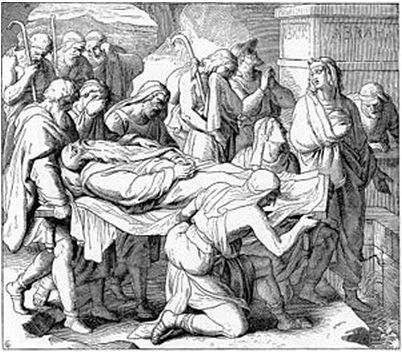
New English Translation (NET)NET Bible® copyright ©1996-2017 by Biblical Studies Press, L.L.C. http://netbible.com All rights reserved.

A New Chapter Begins

1 Abraham took another wife, whose name was Keturah. She bore him Zimran, Jokshan, Medan, Midian, Ishbak, and Shuah. Jokshan fathered Sheba and Dedan. The sons of Dedan were Asshurim, Letushim, and Leummim. The sons of Midian were Ephah, Epher, Hanoch, Abida, and Eldaah. All these were the children of Keturah. Abraham gave all he had to Isaac. But to the sons of his concubines Abraham gave gifts, and while he was still living he sent them away from his son Isaac, eastward to the east country.

These are the days of the years of Abraham’s life, 175 years. Abraham breathed his last and died in a good old age, an old man and full of years, and was gathered to his people. Isaac and Ishmael his sons buried him in the cave of Machpelah, in the field of Ephron the son of Zohar the Hittite, east of Mamre, 10 the field that Abraham purchased from the Hittites. There Abraham was buried, with Sarah his wife. 11 After the death of Abraham, God blessed Isaac his son. And Isaac settled at Beer-lahai-roi.

12 These are the generations of Ishmael, Abraham’s son, whom Hagar the Egyptian, Sarah’s servant, bore to Abraham. 13 These are the names of the sons of Ishmael, named in the order of their birth: Nebaioth, the firstborn of Ishmael; and Kedar, Adbeel, Mibsam, 14 Mishma, Dumah, Massa, 15 Hadad, Tema, Jetur, Naphish, and Kedemah. 16 These are the sons of Ishmael and these are their names, by their villages and by their encampments, twelve princes according to their tribes. 17 (These are the years of the life of Ishmael: 137 years. He breathed his last and died, and was gathered to his people.) 18 They settled from Havilah to Shur, which is opposite Egypt in the direction of Assyria. He settled over against all his kinsmen. Genesis 25:1-18 ESV

The 25th chapter marks the midway point in the book of Genesis. And while the chapter designations came long after the book was written, the details recorded in this section of Moses’ chronicle serve as a turning point in the narrative. For the last 14 chapters, Abraham has served as the story’s central character. Since the moment God called him out of Haran and disclosed the terms of the covenant, Abraham has been the protagonist and the promised progenitor of God’s grand plan. It would be through Abraham that God would fulfill His covenant promise to establish a great nation. And yet, here at the midway point of the Genesis account, Abraham is old and quite wealthy, but he has only one son. It would be a gross understatement to say that Abraham’s quiver was full. And even that one son is 37-year-old, newly married, and currently childless. Where is this great nation that God had promised?

But 24 chapters remain, and God is far from done. It is as if God is turning a page in the storyline and beginning something new. Isaac has found and married his bride – with the help of God. Sarah has died and, as these verses reveal, Abraham is not long for this world. He has reached the ripe old age of 175 and yet, Moses describes him in terms that belie his elderly status. He may not be a spring chicken, but he is far from a doddering old man. When Sarah had died, Abraham had been 137 years old. And while he mourned the loss of his wife, he eventually married a woman named Keturah. Up to this point in the story, Abraham had fathered only two children, Ishmael and Isaac. But his marriage to Keturah would result in the births of six additional children.

This insight into Abraham’s procreative capabilities seems intended to underscore the unique nature of Isaac’s birth. Abraham had always been capable of fathering children. He had no trouble in impregnating his wife’s handmaiden, Hagar. And even as he neared the latter days of his life, he proved to be fully capable of producing descendants. But the text makes it clear that children were not to be heirs of the promise. After providing the identities of Abraham’s latest offspring, Moses states:

All these were the children of Keturah. Abraham gave all he had to Isaac. – Genesis 25:5 ESV

These children were not destined to be part of the “great nation” that God had promised to produce from Abraham and Sarah. God had even told Abraham that Ishmael, the son born to him by Hagar, was not to be an heir of the covenant.

“As for Ishmael, I have heard you; behold, I have blessed him and will make him fruitful and multiply him greatly. He shall father twelve princes, and I will make him into a great nation. But I will establish my covenant with Isaac, whom Sarah shall bear to you at this time next year.” – Genesis 17:20-21 ESV

It is important to remember that Sarah always resented the presence of Ishmael. Even though his very existence had been the result of her bright idea to have Hagar bear a son for Abraham, Sarah despised this son of a slave woman (Galatians 4:22-23). And the day had come, after the birth of Isaac, that she demanded that Ishmael be disinherited.

“Cast out this slave woman with her son, for the son of this slave woman shall not be heir with my son Isaac.” – Genesis 21:10 ESV

While Abraham found his wife’s anger to be unjust and disturbing, God encouraged him to give in to her demands.

“Be not displeased because of the boy and because of your slave woman. Whatever Sarah says to you, do as she tells you, for through Isaac shall your offspring be named. And I will make a nation of the son of the slave woman also, because he is your offspring.” – Genesis 21:12-13 ESV

And, just like always, God kept His word. Moses records that Abraham sent away each of the sons born to his concubine, Keturah. He provided them with gifts, but they would not share in the inheritance of Isaac. They suffered the same fate as that of Ishmael. They were cast out but they were far from forgotten by God. Notice how Moses records the children born to Ishmael. Why would he bother to add that seemingly unimportant detail?

These are the generations of Ishmael, Abraham’s son, whom Hagar the Egyptian, Sarah’s servant, bore to Abraham. These are the names of the sons of Ishmael, named in the order of their birth: Nebaioth, the firstborn of Ishmael; and Kedar, Adbeel, Mibsam, Mishma, Dumah, Massa, Hadad, Tema, Jetur, Naphish, and Kedemah. – Genesis 25:12-15 ESV

These names mean nothing to us. And yet, their very mention is designed to prove the integrity of God’s word. Remember what God had said to Sarah: “As for Ishmael, I have heard you; behold, I have blessed him and will make him fruitful and multiply him greatly. He shall father twelve princes, and I will make him into a great nation” (Genesis 17:20 ESV).

Now, look closely at the list of obscure and difficult-to-pronounce names recorded in verses 12-15 of Genesis 25. There were twelves sons born to Ishmael. In spite of Sarah’s ill-treatment of this young man, God had chosen to keep His word and bless him. He would make of Ishmael a great nation. The whole point seems to be that Abraham had always been fully capable of procreating and producing a long line of descendants. Ishmael had been prolific and produced 12 sons. In the same way, the six sons born to Keturah would go on to produce many offspring. But only the descendants of Isaac would become the nation through whom the other nations of the earth would be blessed. Only the line of Isaac would produce a chosen people, set apart by God, and destined to become the conduit through which He would pour out His divine blessing on humanity.

God fulfilled His promise and made Ishmael the father of “12 princes.” It is interesting to note the correlation between these 12 “tribes” and the 12 tribes that would eventually come through the line of Isaac. Moses indicates that Ishmael’s descendants “settled from Havilah to Shur, which is opposite Egypt in the direction of Assyria. He settled over against all his kinsmen” (Genesis 25:18 ESV). The Ishmaelites eventually settled in the region of Arabia, southeast of Canaan, and would have a less-than-ideal relationship with their distant relatives, the Israelites. But God had kept His word. He had faithfully fulfilled His promise.

And with the fate of Ishmael’s descendants established, Moses records that, at the age of 175, “Abraham breathed his last and died in a good old age, an old man and full of years, and was gathered to his people” (Genesis 25:8 ESV). The life of Abraham came to an end. But the fulfillment of God’s promises had only just begun. The story is far from over. And verse 19 will begin a new chapter in God’s grand redemptive plan as Moses records the births of Esau and Jacob. But this story will contain many familiar features and themes. Yet another woman will find herself cursed by barrenness. There will be seemingly irreconcilable conflicts between siblings. Glaring examples of jealousy, anger, deceit, and disobedience will fill the storyline. But through it all, God will be operating behind the scenes, orchestrating His sovereign plan to fulfill the covenant he made with Abraham. Yahweh is fully committed to His promise to bless the nations. 

English Standard Version (ESV) The Holy Bible, English Standard Version. ESV® Permanent Text Edition® (2016). Copyright © 2001 by Crossway Bibles, a publishing ministry of Good News Publishers.

New Living Translation (NLT) Holy Bible, New Living Translation, copyright © 1996, 2004, 2015 by Tyndale House Foundation. Used by permission of Tyndale House Publishers Inc., Carol Stream, Illinois 60188. All rights reserved.

New English Translation (NET)NET Bible® copyright ©1996-2017 by Biblical Studies Press, L.L.C. http://netbible.com All rights reserved.