Never Again

25 “Therefore thus says the Lord God: Now I will restore the fortunes of Jacob and have mercy on the whole house of Israel, and I will be jealous for my holy name. 26 They shall forget their shame and all the treachery they have practiced against me, when they dwell securely in their land with none to make them afraid, 27 when I have brought them back from the peoples and gathered them from their enemies’ lands, and through them have vindicated my holiness in the sight of many nations. 28 Then they shall know that I am the Lord their God, because I sent them into exile among the nations and then assembled them into their own land. I will leave none of them remaining among the nations anymore. 29 And I will not hide my face anymore from them, when I pour out my Spirit upon the house of Israel, declares the Lord God.” – Ezekiel 39:25-29 ESV

In verse 25, God singles out the patriarch, Jacob, for special attention, and God makes it a point to use Jacob’s old name. Jacob was the son of Isaac and the grandson of Abraham, whose name (yaʿăqōḇ) means “heel-holder” or “supplanter.” According to the Gesenius’ Hebrew-Chaldee Lexicon, it can also mean “layer of snares.” And Jacob lived up to his name. He was a deceiver, an old-fashioned con artist who repeatedly used his uncanny ability to manipulate others for self-promotion. He somehow convinced his slightly older twin brother, Esau, to sell his birthright for a bowl of stew. Later on, with advice from his mother, Jacob tricked his own father into giving him the blessing of the firstborn that rightfully belonged to Esau. Years later, Jacob would use further subterfuge against his unsuspecting father-in-law in order to build his own flock while decimating the flock of Laban.

It was not long after leaving the land of Haran where he had lived as part of Laban’s family for 20 years, that Jacob received his new name from God.

“Your name shall no longer be called Jacob, but Israel, for you have striven with God and with men, and have prevailed.” – Genesis 32:28 ESV

At this encounter with God, Jacob received far more than a new name; he was given a new identity. Just moments earlier, he had been engaged in a wrestling match with an unidentified “man” who he later recognized as none other than God.

“I have seen God face to face, and yet my life has been delivered.” – Genesis 32:30 ESV

Jacob had literally wrestled with God, who had appeared to him in human form. But Jacob had not bested God. There was no cry of “uncle” from the lips of God. Jacob had tried to manipulate God by demanding a blessing from Him, but the blessing had been Jacob’s all along. No manipulation was necessary. Jacob didn’t need to try and manhandle God to get what he wanted. It was already his. So, based on the context, Jacob’s new name, Israel, would be best translated “let God rule.” The Almighty was placing on Jacob an expectation of willful submission to His sovereign authority.

The new name given to Jacob is Israel, and the explanation following is that Jacob has struggled with God, and with men have succeeded. There is a play on sound in yiśrā’ēl (“Israel”) and śāritā (“you have struggled”). The original meaning of Israel is much debated (“God rules?”, “God heals?”, “God judges?”), as is the relationship between yiśrā’ēl and the verb śārâ (“struggled”). Uncertaintly about the meaning of śārâ is engendered by the fact that it occurs only one other time in the OT, Hos. 12:4. Hosea’s reference to Jacob, “he strove with [śārâ ‘et] God.” The ancient versions disagreed on the meaning of śāritā in Gen. 32:29. LXX, Vulg., and Pesh. derive it from srr (Aramaic), “be strong.” Aquila and Symm. derive it from śārâr, “to rule.” As already noted, Targ. Onqelos attempts to eliminate the idea of a mortal engaged in combat with God: “For you are great [or: ‘a prince,’ reading sar for śāritā] before the Lord and among men, therefore you have prevailed.

It seems that in Gen. 32 one must interpret Israel as “El will rule or strive,” or “Let El rule,” rather than as “he has striven with El. For one thing, it is very unusual for the theophoric element in a personal name to serve as anything but subject. Up to this point in Jacob’s life Jacob may well have been called “Israjacob,” “Jacob shall rule” or “let Jacob rule.” In every confrontation he has emerged as the victor; over Esau, over Isaac, over Laban, and even more startingly over this “man.” – Victor P. Hamilton, Genesis

In verse 25 of Ezekiel 39, God uses both names to drive home an important point.

“Now I will restore the fortunes of Jacob and have mercy on the whole house of Israel.” – Ezekiel 39:25 ESV

The “fortunes of Jacob” refers to God’s promise of a land, a seed, and a blessing. It was the same promise given to Abraham and Isaac.

“I am the Lord, the God of your grandfather Abraham, and the God of your father, Isaac. The ground you are lying on belongs to you. I am giving it to you and your descendants. Your descendants will be as numerous as the dust of the earth! They will spread out in all directions—to the west and the east, to the north and the south. And all the families of the earth will be blessed through you and your descendants.” – Genesis 28:13-14 NLT

Jacob, the deceiver, and manipulator, had been graciously given the promise of the inheritance offered to Abraham and Isaac, and he had done nothing to deserve it. In fact, his progeny had continued to follow his deceptive practices, living in open rebellion against God. They feigned obedience through the observance of His required feasts and festivals but, all the while, their lives were marked by idolatry and immorality. Yet, God promises to restore their fortunes by returning them to the land and restoring them to a right relationship with Himself.

And God states that He will “have mercy on the whole house of Israel.” By using Jacob’s new name, God is including all 12 tribes of Israel, the descendants of Jacob’s 12 sons. Even though the kingdom of Israel was divided immediately after the reign of King Solomon and remained two separate kingdoms for centuries, God announces that there will be a grand reunion and reunification of His chosen people. He will show mercy to them all and, for the first time since their inception as a nation, they will “let God rule.”

“For I will gather you up from all the nations and bring you home again to your land.

“Then I will sprinkle clean water on you, and you will be clean. Your filth will be washed away, and you will no longer worship idols. And I will give you a new heart, and I will put a new spirit in you. I will take out your stony, stubborn heart and give you a tender, responsive heart. And I will put my Spirit in you so that you will follow my decrees and be careful to obey my regulations.” – Ezekiel 36:24-27 NLT

“I will give them hearts that recognize me as the LORD. They will be my people, and I will be their God, for they will return to me wholeheartedly.” – Jeremiah 24:7 NLT

God has punished His people for their sins. The audience to whom Ezekiel spoke and for whom he penned the words of this book were experiencing the reality of God’s judgment. They were living as exiles in Babylon, as divine punishment for their failure to “let God rule.” And even when future generations of Israelites find themselves graciously relocated and restored to the land of promise, they will fully recognize how undeserving they are of this marvelous act of mercy from God.

“They will accept responsibility for their past shame and unfaithfulness after they come home to live in peace in their own land, with no one to bother them.” – Ezekiel 39:26 NLT

God states that He will vindicate His holiness in the sight of many nations. How does He intend to do that? By making the unholy holy. By transforming His unrighteous and disobedient children into faithful sons and daughters of God. And this miraculous transformation of His people will allow Him to take up residence among them – for eternity.

“I will unify them into one nation on the mountains of Israel. One king will rule them all; no longer will they be divided into two nations or into two kingdoms. They will never again pollute themselves with their idols and vile images and rebellion, for I will save them from their sinful apostasy. I will cleanse them. Then they will truly be my people, and I will be their God.” – Ezekiel 37:22-23 NLT

“I will make a covenant of peace with them, an everlasting covenant. I will give them their land and increase their numbers, and I will put my Temple among them forever. I will make my home among them. I will be their God, and they will be my people. And when my Temple is among them forever, the nations will know that I am the LORD, who makes Israel holy.” – Ezekiel 37:26-28 NLT

There is a day coming when God will restore the fortunes of Jacob and have mercy on the whole house of Israel. God’s people will no longer suffer division, dispersion, attack, or mistreatment. They will no longer be apostate, idolatrous, and immoral. And they will never have to fear falling from God’s grace again.

“And I will never again turn my face from them, for I will pour out my Spirit upon the people of Israel. I, the Sovereign Lord, have spoken!” – Ezekiel 39:29 NLT

English Standard Version (ESV) The Holy Bible, English Standard Version. ESV® Permanent Text Edition® (2016). Copyright © 2001

New Living Translation (NLT) Holy Bible, New Living Translation, copyright © 1996, 2004, 2015 by Tyndale House Foundation. Used by permission of Tyndale House Publishers Inc., Carol Stream, Illinois 60188. All rights reserved.
Divine Payback

1 The word of the Lord came to me: 2 “Son of man, set your face against Mount Seir, and prophesy against it, 3 and say to it, Thus says the Lord God: Behold, I am against you, Mount Seir, and I will stretch out my hand against you, and I will make you a desolation and a waste. 4 I will lay your cities waste, and you shall become a desolation, and you shall know that I am the Lord. 5 Because you cherished perpetual enmity and gave over the people of Israel to the power of the sword at the time of their calamity, at the time of their final punishment, 6 therefore, as I live, declares the Lord God, I will prepare you for blood, and blood shall pursue you; because you did not hate bloodshed, therefore blood shall pursue you. 7 I will make Mount Seir a waste and a desolation, and I will cut off from it all who come and go. 8 And I will fill its mountains with the slain. On your hills and in your valleys and in all your ravines those slain with the sword shall fall. 9 I will make you a perpetual desolation, and your cities shall not be inhabited. Then you will know that I am the Lord.

10 “Because you said, ‘These two nations and these two countries shall be mine, and we will take possession of them’—although the Lord was there— 11 therefore, as I live, declares the Lord God, I will deal with you according to the anger and envy that you showed because of your hatred against them. And I will make myself known among them, when I judge you. 12 And you shall know that I am the Lord.

“I have heard all the revilings that you uttered against the mountains of Israel, saying, ‘They are laid desolate; they are given us to devour.’ 13 And you magnified yourselves against me with your mouth, and multiplied your words against me; I heard it. 14 Thus says the Lord God: While the whole earth rejoices, I will make you desolate. 15 As you rejoiced over the inheritance of the house of Israel, because it was desolate, so I will deal with you; you shall be desolate, Mount Seir, and all Edom, all of it. Then they will know that I am the Lord.” – Ezekiel 35:1-15 ESV

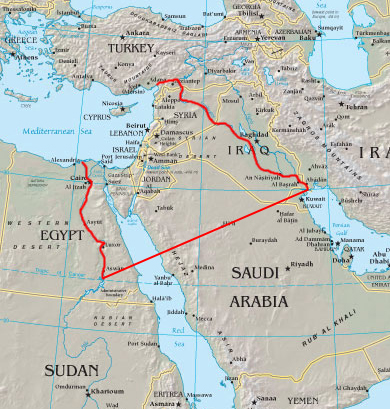
In the last chapter, God delivered the good news regarding Israel’s eventual restoration to the land of Canaan. He announced that in the distant future, He will return His people to their former land where will enjoy the blessings of His presence and His gracious provision for all their needs. This as-yet-to-be-fulfilled prophecy includes their reoccupation of the northern kingdom of Israel as well as the southern kingdom of Judah. But God will not stop there. He intends to expand the land of promise back to the original boundaries He had promised to Abraham and had articulated to Moses as the people prepared to conquer Canaan.

“I will send terror ahead of you to drive out the Hivites, Canaanites, and Hittites. But I will not drive them out in a single year, because the land would become desolate and the wild animals would multiply and threaten you. I will drive them out a little at a time until your population has increased enough to take possession of the land. And I will fix your boundaries from the Red Sea to the Mediterranean Sea, and from the eastern wilderness to the Euphrates River. I will hand over to you the people now living in the land, and you will drive them out ahead of you.” – Exodus 23:28-31 NLT

But when the people were preparing to enter the land for the very first time, God gave them strict instructions to not take any land from the Edomites, who were the direct descendants of Esau, the son of Isaac and the twin brother of Jacob.

Give these orders to the people: “You will pass through the country belonging to your relatives the Edomites, the descendants of Esau, who live in Seir. The Edomites will feel threatened, so be careful. Do not bother them, for I have given them all the hill country around Mount Seir as their property, and I will not give you even one square foot of their land.” – Deuteronomy 2:4-5 NLT

But now, centuries later, as God delivers His news of future restoration, He informs Ezekiel that the rules of the game will be drastically different. He gives Ezekiel a message to deliver to Mount Seir, but the recipient is really the Edomites, the people who occupied the land of Seir.

While God had chosen Isaac’s son, Jacob over his brother Esau to be the son of the promise, God had awarded Esau’s descendants the land of Seir as their homeland.

He had done the same for the descendants of Esau who lived in Seir, for he destroyed the Horites so they could settle there in their place. The descendants of Esau live there to this day. – Deuteronomy 2:22 NLT

All during the reigns of David and Solomon, the Edomites had occupied the land of Seir. This region just south and east of the Dead Sea remained under Edomite control even after God had divided Israel into two kingdoms. And during the Babylonian occupation of Judah and while Ezekiel and his fellow Jews lived in exile in Babylon, the Edomites maintained their control of the land.

Over the centuries, the descendants of Jacob and the descendants of Esau had endured an ongoing love-hate relationship. They were like the Hatfields and McCoys, blood relatives who just couldn’t get along, and this fraternal conflict was predicted by God even before the two patriarchs of these people groups were born. While Isaac’s wife, Rebekah, was carrying Jacob and Esau in her womb, God informed her, “The sons in your womb will become two nations. From the very beginning, the two nations will be rivals. One nation will be stronger than the other; and your older son will serve your younger son” (Genesis 25:23 NLT).

This conflict that began in the womb continued after the birth of the two boys and expanded into an internecine battle between their descendants. Bad blood existed between the Israelites and Edomites for generations, and even when the nation of Judah was under attack by the Babylonians, the Edomites would take advantage of Judah’s vulnerable state by conducting raids against their towns and villages. So, there was no love loss between the two nations.

But for God to fulfill His promise of future restoration as outlined in chapter 34, He reveals that even the Edomites will have to relinquish their land. It belonged to His chosen people, the descendants of Jacob. So, He gives Ezekiel as far-from-promising message for the Edomites.

“I am your enemy, O Mount Seir,
    and I will raise my fist against you
    to destroy you completely.
I will demolish your cities
    and make you desolate.
Then you will know that I am the Lord.” – Ezekiel 35:3-4 NLT

They had aligned themselves against God’s chosen people and now they would pay the price for their misguided decision. From God’s perspective, the Edomites were guilty of piling on. While He was bringing judgment against His chosen people, the descendants of Esau decided to exploit the situation for their own advantage.

“Your eternal hatred for the people of Israel led you to butcher them when they were helpless, when I had already punished them for all their sins.” – Ezekiel 35:5 NLT

God had not ordered them to do this. It was not part of His disciplinary protocol for the rebellious people of Judah. The Edomites had acted on their own accord and sought to enrich themselves at Judah’s expense. And the day was coming when they would be held accountable for their mistake. The land God had graciously given them would be taken away and awarded to the people of Israel.

Their real crime was their open disdain for God. As the descendants of Abraham and Isaac, they should have understood the sovereignty and power of Yahweh. They should have had an awe and respect for Him but, instead, they flaunted their will right in His face. They arrogantly declared, “The lands of Israel and Judah will be ours. We will take possession of them. What do we care that the Lord is there!” (Ezekiel 35:10 NLT). And God states that their hubris will be their undoing.

“I will make myself known to Israel by what I do to you.” – Ezekiel 35:11 NLT

Some day in the future, the descendants of Jacob will recognize the greatness of God when they watch Him destroy the Edomites and make the land of Seir part of the inheritance of Israel. At this point in human history, the nation of Edom no longer exists. They would eventually fall to the Babylonians, then to the Medo-Persians, and, ultimately to the Hasmoneans in 126 B.C.

But to date, the land of Edom remains outside of Israel’s control. It is not currently a part of the modern state of Israel but lies within the borders of southwestern Jordan, located between the Dead Sea and the Gulf of Aqaba. But God is not done yet. His plan is far from finished and His promise to restore His people to the land will one day be accomplished. Their enemies will be defeated. The land will become theirs, “from the Red Sea to the Mediterranean Sea, and from the eastern wilderness to the Euphrates River” (Exodus 23:31 NLT). 

English Standard Version (ESV) The Holy Bible, English Standard Version. ESV® Permanent Text Edition® (2016). Copyright © 2001

New Living Translation (NLT) Holy Bible, New Living Translation, copyright © 1996, 2004, 2015 by Tyndale House Foundation. Used by permission of Tyndale House Publishers Inc., Carol Stream, Illinois 60188. All rights reserved.

No Shortcuts to Holiness

14 Moses sent messengers from Kadesh to the king of Edom: “Thus says your brother Israel: You know all the hardship that we have met: 15 how our fathers went down to Egypt, and we lived in Egypt a long time. And the Egyptians dealt harshly with us and our fathers. 16 And when we cried to the Lord, he heard our voice and sent an angel and brought us out of Egypt. And here we are in Kadesh, a city on the edge of your territory. 17 Please let us pass through your land. We will not pass through field or vineyard, or drink water from a well. We will go along the King’s Highway. We will not turn aside to the right hand or to the left until we have passed through your territory.” 18 But Edom said to him, “You shall not pass through, lest I come out with the sword against you.” 19 And the people of Israel said to him, “We will go up by the highway, and if we drink of your water, I and my livestock, then I will pay for it. Let me only pass through on foot, nothing more.” 20 But he said, “You shall not pass through.” And Edom came out against them with a large army and with a strong force. 21 Thus Edom refused to give Israel passage through his territory, so Israel turned away from him.

22 And they journeyed from Kadesh, and the people of Israel, the whole congregation, came to Mount Hor. 23 And the Lord said to Moses and Aaron at Mount Hor, on the border of the land of Edom, 24 “Let Aaron be gathered to his people, for he shall not enter the land that I have given to the people of Israel, because you rebelled against my command at the waters of Meribah. 25 Take Aaron and Eleazar his son and bring them up to Mount Hor. 26 And strip Aaron of his garments and put them on Eleazar his son. And Aaron shall be gathered to his people and shall die there.” 27 Moses did as the Lord commanded. And they went up Mount Hor in the sight of all the congregation. 28 And Moses stripped Aaron of his garments and put them on Eleazar his son. And Aaron died there on the top of the mountain. Then Moses and Eleazar came down from the mountain. 29 And when all the congregation saw that Aaron had perished, all the house of Israel wept for Aaron thirty days. – Numbers 20:14-29 ESV

The Israelites were nearing their final destination and as they approached the borders of Canaan, God was cleaning house. Chapter 20 opens with the death of Miriam. But the end of the chapter records the death of her brother, Aaron, the high priest of Israel. He too was disciplined by God for his part in the affair at Meribah. God had accused both Aaron and Moses of treating Him disrespectfully before the people.

“Because you did not believe in me, to uphold me as holy in the eyes of the people of Israel, therefore you shall not bring this assembly into the land that I have given them.” – Numbers 20:12 ESV

While Moses had been the one to strike the rock three times in anger, Aaron had done nothing to stop his brother from disobeying God’s command. God had clearly communicated His orders to both men.

“You and Aaron must take the staff and assemble the entire community. As the people watch, speak to the rock over there, and it will pour out its water. You will provide enough water from the rock to satisfy the whole community and their livestock.” – Numbers 20:8 NLT

But Moses and Aaron were fed up with the constant bickering and complaining of the people. Despite what God had ordered them to do, they were going to use this God-ordained miracle as an opportunity to teach the people a lesson.

Then he and Aaron summoned the people to come and gather at the rock. “Listen, you rebels!” he shouted. “Must we bring you water from this rock?” Then Moses raised his hand and struck the rock twice with the staff, and water gushed out. So the entire community and their livestock drank their fill. – Numbers 20:10-11 NLT

Moses, speaking on behalf of himself and his brother, tried to leave the impression that they were the ones who would meet the Israelite’s needs by providing water from the rock. In essence, they tried to rob God of glory. Then, by striking the rock rather than speaking to it, Moses violated the command of God. And God would hold both men accountable for their actions.

It was on the southern border of the land of Edom that God delivered the devastating news to Aaron and Moses.

“He will not enter the land I am giving the people of Israel, because the two of you rebelled against my instructions concerning the water at Meribah.” – Numbers 20:24 NLT

In a rather sobering ceremony atop Mount Hor, Moses took the priestly robes off of Aaron and gave them to Aaron’s son, Eleazar. It appears from the text that Aaron did not get to live out the rest of his life wandering in the wilderness, but died on top of the mountain while Moses and Eleazar looked on. They descended the mountain without him and the people of Israel mourned his death for 30 days.

Now Moses was alone. For nearly 40 years he had led the people of Israel with the help of his brother and sister, but their deaths had left him with the sole responsibility of getting the people of Israel to the land of Canaan. But Moses knew that he was never going to set foot in the land because of his role in the affair at Meribah. Like Aaron, he would be denied access to the land of promise and breathe his last breath in the wilderness.

But Moses continued to fulfill the duties God had given to him some four decades earlier. He mourned the loss of his brother but then set about leading the people of Israel to the border of Canaan. To do so, he had attempted to take a shortcut through the land of Edom.

Edom was located on the southernmost border of Canaan and was occupied by distant relatives of the Israelites. The Edomites were the descendants of Esau, the firstborn son of Isaac and the twin brother of Jacob. When Esau had been cheated out of his birthright by Jacob, he decided to relocate his family to another part of Canaan.

Esau took his wives, his children, and his entire household, along with his livestock and cattle—all the wealth he had acquired in the land of Canaan—and moved away from his brother, Jacob. There was not enough land to support them both because of all the livestock and possessions they had acquired. So Esau (also known as Edom) settled in the hill country of Seir. – Genesis 36:6-8 NLT

Once there, Esau’s descendants prospered and developed a thriving kingdom. During the four centuries that the Israelites were enslaved in Egypt, the Edomites lived under a long line of kings (Genesis 36:31) and enjoyed a measure of peace and prosperity.

So, when Moses sent emissaries to the king of Edom seeking permission to pass through their territory, he expected a favorable response.

“This is what your relatives, the people of Israel, say: You know all the hardships we have been through. Our ancestors went down to Egypt, and we lived there a long time, and we and our ancestors were brutally mistreated by the Egyptians. But when we cried out to the Lord, he heard us and sent an angel who brought us out of Egypt. Now we are camped at Kadesh, a town on the border of your land. Please let us travel through your land. We will be careful not to go through your fields and vineyards. We won’t even drink water from your wells. We will stay on the king’s road and never leave it until we have passed through your territory.”– Numbers 20:14-17 NLT

The kingdom of Edom covered a large swath of land and without the right of safe passage through its territory, Moses and the people of Israel would be forced to take a much longer route around it. But no matter how hard Moses pleaded, the king of Edom refused to grant access to their land. He even threatened them with war if they tried. He even “mobilized his army and marched out against them with an imposing force” (Numbers 20:20 NLT). 

Rejected by their own kin, the Israelites were forced to reverse course and take the long detour around Edom. What’s interesting to consider is that the Israelites had always been led by the pillar of cloud by day and the pillar of fire by night. God had used these two phenomena to guide His people throughout their four-decade-long journey. So, was Moses’ attempt to go through Edom an unauthorized decision on his part? Had the cloud led him to this point or was the negotiations with Edom something he had come up with on his own? Was Moses trying to shorten the distance to Canaan by taking an unauthorized path through the land of Edom?

It seems unlikely that God would have chosen to use the Edomites to help His chosen people reach the land He had promised to provide for them. These two nations remained in constant conflict with one another long after Israel conquered and occupied the land of Canaan. And the book of Obadiah describes God’s anger against Edom for the way it took advantage of Israel’s later misfortunes when the Babylonians conquered them and left the land desolate and depopulated.

“Because of the violence you did
    to your close relatives in Israel,
you will be filled with shame
    and destroyed forever.
When they were invaded,
    you stood aloof, refusing to help them.
Foreign invaders carried off their wealth
    and cast lots to divide up Jerusalem,
    but you acted like one of Israel’s enemies.

“You should not have gloated
    when they exiled your relatives to distant lands.
You should not have rejoiced
    when the people of Judah suffered such misfortune.
You should not have spoken arrogantly
    in that terrible time of trouble.
You should not have plundered the land of Israel
    when they were suffering such calamity.
You should not have gloated over their destruction
    when they were suffering such calamity.
You should not have seized their wealth
    when they were suffering such calamity.
You should not have stood at the crossroads,
    killing those who tried to escape.
You should not have captured the survivors
    and handed them over in their terrible time of trouble.” – Obadiah 10-14 ESV

The Israelites received no assistance from their distant relatives and were forced to travel southeasterly toward the Arabian desert. This unexpected setback must have disappointed Moses and it’s clear from the next chapter that it left the people of Israel far from pleased.

From Mount Hor they set out by the way to the Red Sea, to go around the land of Edom. And the people became impatient on the way. – Numbers 21:4 ESV

God was not done teaching them the lessons they needed to learn. They were not yet ready to enter His rest. So, God continued to purge their leadership and purify their hearts in preparation for the day when He would lead them into their promised inheritance.

English Standard Version (ESV) The Holy Bible, English Standard Version. ESV® Permanent Text Edition® (2016). Copyright © 2001

New Living Translation (NLT) Holy Bible, New Living Translation, copyright © 1996, 2004, 2015 by Tyndale House Foundation. Used by permission of Tyndale House Publishers Inc., Carol Stream, Illinois 60188. All rights reserved.

Cursed to be a Blessing

47 But the Levites were not listed along with them by their ancestral tribe. 48 For the Lord spoke to Moses, saying, 49 “Only the tribe of Levi you shall not list, and you shall not take a census of them among the people of Israel. 50 But appoint the Levites over the tabernacle of the testimony, and over all its furnishings, and over all that belongs to it. They are to carry the tabernacle and all its furnishings, and they shall take care of it and shall camp around the tabernacle. 51 When the tabernacle is to set out, the Levites shall take it down, and when the tabernacle is to be pitched, the Levites shall set it up. And if any outsider comes near, he shall be put to death. 52 The people of Israel shall pitch their tents by their companies, each man in his own camp and each man by his own standard. 53 But the Levites shall camp around the tabernacle of the testimony, so that there may be no wrath on the congregation of the people of Israel. And the Levites shall keep guard over the tabernacle of the testimony.” 54 Thus did the people of Israel; they did according to all that the Lord commanded Moses. – Numbers 1:47-54 ESV

In the census taken to determine the number of men eligible for military service, Moses had ordered that every tribe be counted, except that of Levi. God had expressly excluded the Levites from military service because they had already been given the responsibility of serving as priests and caretakers of the tabernacle. They had been consecrated by God for His service and, therefore, were exempt from military duty. But why did this one tribe receive the special designation as God’s priests? What had they done to deserve such an important and prominent role?

The rise of the tribe of Levi is a remarkable story that begins in the book of Genesis. In chapter 34, Moses records the dark story of the rape of Dinah, the daughter of Jacob, by Shechem, the son of the Hivite king. When Jacob received news of the defilement of his daughter, he did nothing about it. His inaction engaged his sons.

They were shocked and furious that their sister had been raped. Shechem had done a disgraceful thing against Jacob’s family, something that should never be done. – Genesis 34:7 NLT

Shechem’s father, Hamor, begged Jacob and his sons to overlook his son’s indiscretion and allow him to marry Dinah. He even suggested that their two nations make an alliance that would allow their sons and daughters to intermarry. But the sons of Jacob had other plans. They agreed to the alliance on the condition that all the Hivite men undergo the rite of circumcision. Sensing an opportunity to take advantage of the Israelites and confiscate their livestock and possessions, the Hivite men were summarily circumcised.

…three days later, when their wounds were still sore, two of Jacob’s sons, Simeon and Levi, who were Dinah’s full brothers, took their swords and entered the town without opposition. Then they slaughtered every male there, including Hamor and his son Shechem. They killed them with their swords, then took Dinah from Shechem’s house and returned to their camp. – Genesis 34:25-26 NLT

When Jacob received word of what his two sons had done, he was appalled and angered because he feared reprisals from the other nations in the region.

“You have ruined me! You’ve made me stink among all the people of this land—among all the Canaanites and Perizzites. We are so few that they will join forces and crush us. I will be ruined, and my entire household will be wiped out!” – Genesis 34:30 NLT

Years later, while on his deathbed, Jacob revealed that he had never forgiven Simeon and Levi for their deceitful treatment of the Hivites. When it was their turn to receive a blessing from their father, what they heard sounded more like a curse.

“Simeon and Levi are two of a kind;
    their weapons are instruments of violence.
May I never join in their meetings;
    may I never be a party to their plans.
For in their anger they murdered men,
    and they crippled oxen just for sport.
A curse on their anger, for it is fierce;
    a curse on their wrath, for it is cruel.
I will scatter them among the descendants of Jacob;
    I will disperse them throughout Israel.” – Genesis 49:5-7 NLT

Fast forward to the time when Moses was leading the people of Israel through the wilderness on their way to Canaan. It just so happens that Moses and his brother, Aaron, were of the tribe of Levi. So, when God ordered Moses to set apart Aaron and his sons to serve as priests, He was bringing about the fulfillment of Jacob’s “blessing.”

“Call for your brother, Aaron, and his sons, Nadab, Abihu, Eleazar, and Ithamar. Set them apart from the rest of the people of Israel so they may minister to me and be my priests.” – Exodus 28:1 NLT

It’s important to note that when God was preparing to deliver the people of Israel from their captivity in Egypt, He ordered Moses to set apart or consecrate the firstborn from among the Israelites as His possession.

Then the Lord said to Moses, “Dedicate to me every firstborn among the Israelites. The first offspring to be born, of both humans and animals, belongs to me.” – Exodus 13:1 NLT

God had just graciously spared the firstborn among the Israelites when His death angel had gone throughout the land destroying all the firstborn of the Egyptians, including Pharoah’s son and heir (Exodus 12:29-32). God demanded that the firstborn among the Israelites be dedicated to His service as an offering of thanksgiving. But, sometime later, when God spoke to Moses on Mount Sinai, He declared that all Israelites were to consider themselves as His priests.

“‘Now if you will obey me and keep my covenant, you will be my own special treasure from among all the peoples on earth; for all the earth belongs to me. And you will be my kingdom of priests, my holy nation.’ This is the message you must give to the people of Israel.” – Exodus 19:5-6 NLT

But God later determined to set apart the Levites to serve as His priests. These descendants of Levi, who had been cursed by his own father, were destined to play a vital role in the spiritual well-being of the nation of Israel. God later declared to Aaron His intent to dedicate this one tribe for His glory and the good of the people.

“You yourselves must perform the sacred duties inside the sanctuary and at the altar. If you follow these instructions, the Lord’s anger will never again blaze against the people of Israel. I myself have chosen your fellow Levites from among the Israelites to be your special assistants. They are a gift to you, dedicated to the Lord for service in the Tabernacle.” – Numbers 18:5-6 NLT

Not all Levites were priests, but the entire tribe was dedicated to the service of God’s tabernacle. While some served in the priestly function, others were assigned the task of caring for the tabernacle itself. Many were responsible for the tear-down and set-up of the tabernacle so it could be transported from one place to another. Others were responsible for its protection. And while the Levites would not receive an allotment of land in Canaan, God promised to take care of their every need.

“You priests will receive no allotment of land or share of property among the people of Israel. I am your share and your allotment. As for the tribe of Levi, your relatives, I will compensate them for their service in the Tabernacle. Instead of an allotment of land, I will give them the tithes from the entire land of Israel.” – Numbers 18:20-21 NLT

Interestingly enough, God even fulfilled Jacob’s promise that the descendants of Levi would be scattered among the rest of the tribes. When the time came for the Israelites to enter the land of Canaan, God had Moses divide up the land between the tribes, but the Levites received no allotment. Instead, they were given possession of 48 cities spread through the tribes of Israel.

“Six of the towns you give the Levites will be cities of refuge, where a person who has accidentally killed someone can flee for safety. In addition, give them forty-two other towns. In all, forty-eight towns with the surrounding pastureland will be given to the Levites. These towns will come from the property of the people of Israel. The larger tribes will give more towns to the Levites, while the smaller tribes will give fewer. Each tribe will give property in proportion to the size of its land.” – Numbers 35:6-8 NLT

Six of the cities were to be set apart as cities of refuge, where any Israelite could seek asylum if they were guilty of unintentionally murdering someone. As long as they remained within the walls of one of these cities, they were protected. It’s fascinating to consider that Jacob cursed his son Levi for having murdered the Hivites, now God was using the descendants of Levi to provide protection for those who committed involuntary manslaughter.

These cities will be places of protection from a dead person’s relatives who want to avenge the death. The slayer must not be put to death before being tried by the community. Designate six cities of refuge for yourselves, three on the east side of the Jordan River and three on the west in the land of Canaan. These cities are for the protection of Israelites, foreigners living among you, and traveling merchants. Anyone who accidentally kills someone may flee there for safety. – Numbers 35:12-15 NLT

Just as Jacob predicted, the Levites ended up scattered throughout the land of Canaan. Other than the allotted cities, they never owned any property within the borders of the promised land. Yet, they were given the right and responsibility to serve as God’s priests. And when the rest of the illegible men were conscripted into Israel’s army, the Levites were excluded so that they could preserve the presence of God among the people.

“Do not include the tribe of Levi in the registration; do not count them with the rest of the Israelites. Put the Levites in charge of the Tabernacle of the Covenant, along with all its furnishings and equipment. They must carry the Tabernacle and all its furnishings as you travel, and they must take care of it and camp around it. Whenever it is time for the Tabernacle to move, the Levites will take it down. And when it is time to stop, they will set it up again. But any unauthorized person who goes too near the Tabernacle must be put to death.” – Numbers 1:50-51 NLT

God had a plan for His people and it included their physical and spiritual well-being. Some would fight the enemy using swords and spears. Others would do battle with incense and offerings, protecting the name of God and preserving the spiritual health of the people of God.

English Standard Version (ESV) The Holy Bible, English Standard Version. ESV® Permanent Text Edition® (2016). Copyright © 2001

New Living Translation (NLT) Holy Bible, New Living Translation, copyright © 1996, 2004, 2015 by Tyndale House Foundation. Used by permission of Tyndale House Publishers Inc., Carol Stream, Illinois 60188. All rights reserved.

Unwavering Faith In An Unfailing God

14 After he had buried his father, Joseph returned to Egypt with his brothers and all who had gone up with him to bury his father.

15 When Joseph’s brothers saw that their father was dead, they said, “It may be that Joseph will hate us and pay us back for all the evil that we did to him.” 16 So they sent a message to Joseph, saying, “Your father gave this command before he died: 17 ‘Say to Joseph, “Please forgive the transgression of your brothers and their sin, because they did evil to you.”’ And now, please forgive the transgression of the servants of the God of your father.” Joseph wept when they spoke to him. 18 His brothers also came and fell down before him and said, “Behold, we are your servants.” 19 But Joseph said to them, “Do not fear, for am I in the place of God? 20 As for you, you meant evil against me, but God meant it for good, to bring it about that many people should be kept alive, as they are today. 21 So do not fear; I will provide for you and your little ones.” Thus he comforted them and spoke kindly to them.

22 So Joseph remained in Egypt, he and his father’s house. Joseph lived 110 years. 23 And Joseph saw Ephraim’s children of the third generation. The children also of Machir the son of Manasseh were counted as Joseph’s own. 24 And Joseph said to his brothers, “I am about to die, but God will visit you and bring you up out of this land to the land that he swore to Abraham, to Isaac, and to Jacob.” 25 Then Joseph made the sons of Israel swear, saying, “God will surely visit you, and you shall carry up my bones from here.” 26 So Joseph died, being 110 years old. They embalmed him, and he was put in a coffin in Egypt. – Genesis 50:14-26 ESV

Joseph and his brothers returned to Egypt after having buried their father Jacob in Canaan. It must have been difficult to leave behind the land of promise yet again. But for the time being, Egypt had become their home away from home. So, having interred their father’s body in the cave of the field at Machpelah, they made the long journey back to Egypt.

It appears that, along the way, Joseph’s brothers became apprehensive about what might happen upon their return. With their father and protector dead, perhaps Joseph would take advantage of the situation and enact his revenge for their former treatment of him. Their fear of Joseph had never really subsided, despite the many ways he had shown them love and honor. It had been Joseph who had personally subsidized their food allotment all throughout the years of the famine. He had helped arrange their resettlement in Goshen. And yet, deep down inside, his brothers still did not trust him.

Upon their return to Egypt, the brothers held a discussion on the matter and reached a consensus.

“Now Joseph will show his anger and pay us back for all the wrong we did to him,” they said. – Genesis 50:15 NLT

So, they crafted a message and had it delivered to Joseph.

“Before your father died, he instructed us to say to you: ‘Please forgive your brothers for the great wrong they did to you—for their sin in treating you so cruelly.’ So we, the servants of the God of your father, beg you to forgive our sin.” – Genesis 50:16-17 NLT

His brothers had never really believed that Joseph had forgiven them. And they had always feared that he would one day use his power to repay them for the crime they had committed against him. They wrongly assumed that their father’s death would provide the perfect opportunity for Joseph to seek vengeance.

At the heart of their distrust was disbelief. It wasn’t that they failed to trust Joseph, it was that they lacked trust in the promises and provision of God. Years earlier, when Joseph had revealed his identity to his brothers, he had clearly told them that their actions against him had been part of God’s sovereign plan to preserve their people.

“I am Joseph, your brother, whom you sold into slavery in Egypt. But don’t be upset, and don’t be angry with yourselves for selling me to this place. It was God who sent me here ahead of you to preserve your lives. This famine that has ravaged the land for two years will last five more years, and there will be neither plowing nor harvesting. God has sent me ahead of you to keep you and your families alive and to preserve many survivors. So it was God who sent me here, not you! And he is the one who made me an adviser to Pharaoh—the manager of his entire palace and the governor of all Egypt.” – Genesis 45:4-8 NLT

And yet, they couldn’t bring themselves to believe that their God had been orchestrating every facet of their relationship with Joseph. By this time, they must have realized that Joseph’s dreams, which had infuriated them, had come true. They had lived to experience Joseph’s prediction that they would one day bow down to him. And despite all the ways in which God had miraculously preserved them, they couldn’t seem to believe that He would continue to do so. They saw Joseph’s power as a problem, not a God-ordained proof of divine protection.

Joseph was grieved by their message. What more could he do to prove his love for them? He longed to be restored to a right relationship with all of his brothers and he harbored no ill will toward any of them. So as he read their message, he wept bitterly. But, once again, Joseph took action, calling his brothers into his presence. He refused to allow this divisive wedge to remain between him and his brothers.

The brothers arrived at Joseph’s palace ready to throw themselves at his mercy. In fact, as soon as they entered they threw themselves at his feet, declaring, “Look, we are your slaves!” (Genesis 50:18 NLT). Preferring to face a lifetime of slavery rather than death, they begged Joseph for mercy. But what they got was another powerful reminder of the sovereignty of God.

“Don’t be afraid of me. Am I God, that I can punish you? You intended to harm me, but God intended it all for good. He brought me to this position so I could save the lives of many people. No, don’t be afraid. I will continue to take care of you and your children.” – Genesis 50:19-21 NLT

Joseph knew what they had done. Not only that, he knew he would have been fully in his rights to seek revenge against them. He not only had the motive, but he had the power to pull it off. But that is not what Joseph wanted because it was not what God had intended. Their crime against him, while untenable and contemptible, had been part of God’s providential plan for protecting and preserving the offspring of Abraham, Isaac, and Jacob. Joseph fully believed in the sovereignty of God and he wanted his brothers to put aside their fears and replace them with faith in the God of their father.

For 25 chapters, Moses has chronicled the life of Jacob and his family. And now, as his history of Jacob’s lineage comes to a close, Moses reminds his readers that Yahweh can and should be trusted at all times – regardless of how dire and desperate the situation may appear. And this was a message they needed to hear. The original readers of Moses’ book had been the Israelites whom he had led out of Egypt to the edge of the promised land. Moses died before the people had ever entered the land, so this historical narrative would have been intended to provide them with impetus and encouragement as they prepared to enter the land without him. Even as Moses faced death and knew he would never enter the land of Canaan, he composed a song for his people to sing. And, in that song, he mentioned the days that Jacob had spent in Egypt.

 “For the people of Israel belong to the Lord;
    Jacob is his special possession.
He found them in a desert land,
    in an empty, howling wasteland.
He surrounded them and watched over them;
    he guarded them as he would guard his own eyes.
Like an eagle that rouses her chicks
    and hovers over her young,
so he spread his wings to take them up
    and carried them safely on his pinions.
The Lord alone guided them;
    they followed no foreign gods.
He let them ride over the highlands
    and feast on the crops of the fields.
He nourished them with honey from the rock
    and olive oil from the stony ground.
He fed them yogurt from the herd
    and milk from the flock,
    together with the fat of lambs.
He gave them choice rams from Bashan, and goats,
    together with the choicest wheat.
You drank the finest wine,
    made from the juice of grapes.” – Deuteronomy 32:9-14 NLT

God had cared for the descendants of Jacob for more than 400 years. He had protected them and provided for all their needs. He had multiplied them in number and miraculously transformed the 12 sons of Jacob into a vast army of more than 600,000 men by the time they left Egypt.

The story of Jacob, Joseph, and his brothers is intended to be a reminder of the sovereign power of the Almighty God. His plan is never thwarted. His will is never overcome. What Joseph’s brothers had done to him had been meant for ill, but God had intended it for good.

Joseph assuaged the fears and guilt of his brothers, assuring them that he had no intentions of bringing them harm. And he lived alongside them in peace until he reached the age of 110. Joseph lived long enough to become a great-great-grandfather, witnessing three generations worth of descendants through his son, Ephraim. But with death closing in, Joseph took one last opportunity to encourage his brothers to maintain their faith in Yahweh.

“Soon I will die,” Joseph told his brothers, “but God will surely come to help you and lead you out of this land of Egypt. He will bring you back to the land he solemnly promised to give to Abraham, to Isaac, and to Jacob.” – Genesis 50:24 NLT

Joseph never stopped believing in the promises of God. He had taken his father’s body back to Canaan because he knew that was their true home. Egypt had been nothing but a divinely ordained detour. The day would come when God would restore His people to the land He had promised to them. And Joseph believed his brothers or their descendants would live to see that day. His faith was so strong that he demanded his brothers swear an oath to take his mummified body with them when they returned to Canaan. He, like his father Jacob, had always harbored an intense desire to go home.

It’s interesting to note that the book of Genesis began with a couple who displayed their lack of faith in God by questioning His Word and disobeying His command. Rather than trusting God, they tried to become like him. But the book ends with a man of faith who never stopped believing in the promises of God. In fact, Joseph is mentioned in the great “Hall of Faith” found in the 11th chapter of Hebrews.

It was by faith that Joseph, when he was about to die, said confidently that the people of Israel would leave Egypt. He even commanded them to take his bones with them when they left. – Hebrews 11:22 NLT

Joseph died in Egypt, but his heart had always been in Canaan. And one day, his faith in God was proven worthy, because his body was returned to the land of promise, just as he had hoped.

Thus the Israelites left Egypt like an army ready for battle.

Moses took the bones of Joseph with him, for Joseph had made the sons of Israel swear to do this. He said, “God will certainly come to help you. When he does, you must take my bones with you from this place.”

The Israelites left Succoth and camped at Etham on the edge of the wilderness. The Lord went ahead of them. He guided them during the day with a pillar of cloud, and he provided light at night with a pillar of fire. – Exodus 13:18-21 NLT

English Standard Version (ESV) The Holy Bible, English Standard Version. ESV® Permanent Text Edition® (2016). Copyright © 2001 by Crossway Bibles, a publishing ministry of Good News Publishers.

New Living Translation (NLT) Holy Bible, New Living Translation, copyright © 1996, 2004, 2015 by Tyndale House Foundation. Used by permission of Tyndale House Publishers Inc., Carol Stream, Illinois 60188. All rights reserved.

New English Translation (NET)NET Bible® copyright ©1996-2017 by Biblical Studies Press, L.L.C. http://netbible.com All rights reserved.

The Beginning, Not the End

1 Then Joseph fell on his father’s face and wept over him and kissed him. 2 And Joseph commanded his servants the physicians to embalm his father. So the physicians embalmed Israel. 3 Forty days were required for it, for that is how many are required for embalming. And the Egyptians wept for him seventy days.

4 And when the days of weeping for him were past, Joseph spoke to the household of Pharaoh, saying, “If now I have found favor in your eyes, please speak in the ears of Pharaoh, saying, 5 ‘My father made me swear, saying, “I am about to die: in my tomb that I hewed out for myself in the land of Canaan, there shall you bury me.” Now therefore, let me please go up and bury my father. Then I will return.’” 6 And Pharaoh answered, “Go up, and bury your father, as he made you swear.” 7 So Joseph went up to bury his father. With him went up all the servants of Pharaoh, the elders of his household, and all the elders of the land of Egypt, 8 as well as all the household of Joseph, his brothers, and his father’s household. Only their children, their flocks, and their herds were left in the land of Goshen. 9 And there went up with him both chariots and horsemen. It was a very great company. 10 When they came to the threshing floor of Atad, which is beyond the Jordan, they lamented there with a very great and grievous lamentation, and he made a mourning for his father seven days. 11 When the inhabitants of the land, the Canaanites, saw the mourning on the threshing floor of Atad, they said, “This is a grievous mourning by the Egyptians.” Therefore the place was named Abel-mizraim; it is beyond the Jordan. 12 Thus his sons did for him as he had commanded them, 13 for his sons carried him to the land of Canaan and buried him in the cave of the field at Machpelah, to the east of Mamre, which Abraham bought with the field from Ephron the Hittite to possess as a burying place. – Genesis 50:1-13 ESV

Jacob’s last dying wish was for his body to be taken back to Canaan and placed in the Cave of Machpelah near Hebron, the land purchased by Abraham as a burial plot for his wife, Sarah (Genesis23:10-20). That land had remained in the possession of Abraham’s descendants and became the official family burial plot, containing the bones of Sarah, Abraham, Isaac, Rebecca, Jacob, and his second wife, Leah. His first wife, Rachel, had been buried near Bethlehem, not long after Jacob’s return from Mesopotamia.

Now, it was time for Jacob’s bones to be placed alongside those of his deceased family members. So, Joseph sent news to Pharaoh, informing him of his father’s passing and requesting a  leave of absence from his official administrative duties so that he might return to Canaan and bury his father. Pharaoh graciously agreed to Joseph’s request, but nearly two-and-a-half months would pass before Joseph was ready to make the long journey home.

Joseph ordered his personal physicians to prepare his father’s body for burial, using the traditional Egyptian method of embalmment, which most likely included mummification. The elaborate and laborious process of embalmment took 40 days to complete but would have properly preserved the body of Jacob for its long journey back to Canaan. And Jacob’s return trip back to the land of promise would be radically different than the one he had made 17 years earlier. On that occasion, his small entourage had consisted of only 70 family members, and he had come in fear and trembling, an insignificant Hebrew in hopes of saving his family from famine.

But this trip was marked by pomp and circumstance. In death, Jacob was treated like a king and given a royal funeral procession fitting for a Pharaoh. In fact, the people of Egypt showed their deep respect for Jacob by mourning his death for 70 days, one day less than they would have mourned the death of a Pharaoh. And when the time came to make the journey back to Canaan, Joseph and his brothers were accompanied by a host of Egyptian officials and dignitaries.

So Joseph went up to bury his father. He was accompanied by all of Pharaoh’s officials, all the senior members of Pharaoh’s household, and all the senior officers of Egypt. Joseph also took his entire household and his brothers and their households. But they left their little children and flocks and herds in the land of Goshen. A great number of chariots and charioteers accompanied Joseph. – Genesis 50:7-9 NLT

This strange scene seems to foreshadow a number of significant events in Israel’s future, and the original readers of Moses’ book would have made at least one of the connections. The audience to whom Moses addressed his historical narrative were the descendants of Abraham, Isaac, and Jacob. And, at the time they read this chronology of their own history, they were preparing to enter the land of Canaan, having been delivered by God from their 400-year captivity in Egypt. And they would have seen the similarities between their exodus from Egypt and that of Jacob’s elaborate funeral procession. In the book of Exodus, Moses recorded the day when the people of Israel walked out of Egypt as free men.

When Pharaoh finally let the people go, God did not lead them along the main road that runs through Philistine territory, even though that was the shortest route to the Promised Land. God said, “If the people are faced with a battle, they might change their minds and return to Egypt.” So God led them in a roundabout way through the wilderness toward the Red Sea. Thus the Israelites left Egypt like an army ready for battle.

Moses took the bones of Joseph with him, for Joseph had made the sons of Israel swear to do this. He said, “God will certainly come to help you. When he does, you must take my bones with you from this place.” – Exodus 13:17-19 NLT

That too had been a funeral procession, but it had also been a celebratory occasion, as the people of Israel walked out a mighty army prepared for battle. Estimates are, that over the four centuries they had been in Egypt, they had multiplied greatly so that when they left, they were probably well over a million in number. Moses indicates that there were “six hundred thousand men on foot, besides women and children” (Exodus 12:13 ESV). And they didn’t go alone.

A rabble of non-Israelites went with them, along with great flocks and herds of livestock. – Exodus 12:38 NLT

Not only that, but the Israelites left Egypt loaded down with great wealth, provided to them by the Egyptians, but according to the sovereign will of God Almighty.

The Lord caused the Egyptians to look favorably on the Israelites, and they gave the Israelites whatever they asked for. So they stripped the Egyptians of their wealth! – Exodus 12:36 NLT

The funeral procession of Jacob foreshadowed the exodus of the people of Israel, an event that would take place more than four centuries later.

But there is a second event foreshadowed by Jacob’s funeral that Moses’ readers would not have recognized because it had not yet happened. And that will be the future exaltation and reverent treatment that an offspring of Jacob will one day receive. Jesus, as a descendant of Jacob, will also be shown great honor and respect. But it will not be because of His passing, but it will be due to His long-awaited second coming. According to the apostle Paul, even after Jesus ascended into heaven after His death and resurrection, He was afforded great honor and glory.

Therefore God has highly exalted him and bestowed on him the name that is above every name, so that at the name of Jesus every knee should bow, in heaven and on earth and under the earth, and every tongue confess that Jesus Christ is Lord, to the glory of God the Father. – Philippians 2:9-11 ESV

But the day is coming when Jesus will return and be afforded even greater honor as the King of kings and Lord of lords. Paul discussed this reality in his letter to the believers in Rome.

For the Scriptures say,

“‘As surely as I live,’ says the Lord,
‘every knee will bend to me,
    and every tongue will declare allegiance to God.’” – Romans 14:11 NLT

Jacob was honored in death. But Jesus will be honored in life. As a descendant of Abraham, born through the tribe of Judah (one of the sons of Jacob), Jesus fulfilled God’s promise to produce a king from Jacob’s family tree.

“Your name is Jacob; no longer shall your name be called Jacob, but Israel shall be your name.” So he called his name Israel. And God said to him, “I am God Almighty: be fruitful and multiply. A nation and a company of nations shall come from you, and kings shall come from your own body.” – Genesis 35:10-11 ESV

And that King will one day rule over the New Jerusalem, God’s eternal kingdom which will descend from heaven to earth, and all the nations of the earth will honor the one true King in his never-ending kingdom.

I saw no temple in the city, for the Lord God Almighty and the Lamb are its temple. And the city has no need of sun or moon, for the glory of God illuminates the city, and the Lamb is its light. The nations will walk in its light, and the kings of the world will enter the city in all their glory. Its gates will never be closed at the end of day because there is no night there. And all the nations will bring their glory and honor into the city. Nothing evil will be allowed to enter, nor anyone who practices shameful idolatry and dishonesty—but only those whose names are written in the Lamb’s Book of Life. – Revelation 21:22-27 NLT

So, there is far more to Jacob’s death and funeral than meets the eye. Like the rest of the story of his life, it is a representation of God’s sovereign will and providential provision for His people. Jacob’s death was not the end, but only the beginning of great things yet to come.

English Standard Version (ESV) The Holy Bible, English Standard Version. ESV® Permanent Text Edition® (2016). Copyright © 2001 by Crossway Bibles, a publishing ministry of Good News Publishers.

New Living Translation (NLT) Holy Bible, New Living Translation, copyright © 1996, 2004, 2015 by Tyndale House Foundation. Used by permission of Tyndale House Publishers Inc., Carol Stream, Illinois 60188. All rights reserved.

New English Translation (NET)NET Bible® copyright ©1996-2017 by Biblical Studies Press, L.L.C. http://netbible.com All rights reserved.

Count Your Blessings

13 “Zebulun shall dwell at the shore of the sea;
    he shall become a haven for ships,
    and his border shall be at Sidon.

14 “Issachar is a strong donkey,
    crouching between the sheepfolds.
15 He saw that a resting place was good,
    and that the land was pleasant,
so he bowed his shoulder to bear,
    and became a servant at forced labor.

16 “Dan shall judge his people
    as one of the tribes of Israel.
17 Dan shall be a serpent in the way,
    a viper by the path,
that bites the horse’s heels
    so that his rider falls backward.
18 I wait for your salvation, O Lord.

19 “Raiders shall raid Gad,
    but he shall raid at their heels.

20 “Asher’s food shall be rich,
    and he shall yield royal delicacies.

21 “Naphtali is a doe let loose
    that bears beautiful fawns.

22 “Joseph is a fruitful bough,
    a fruitful bough by a spring;
    his branches run over the wall.
23 The archers bitterly attacked him,
    shot at him, and harassed him severely,
24 yet his bow remained unmoved;
    his arms were made agile
by the hands of the Mighty One of Jacob
    (from there is the Shepherd, the Stone of Israel),
25 by the God of your father who will help you,
    by the Almighty who will bless you
    with blessings of heaven above,
blessings of the deep that crouches beneath,
    blessings of the breasts and of the womb.
26 The blessings of your father
    are mighty beyond the blessings of my parents,
    up to the bounties of the everlasting hills.
May they be on the head of Joseph,
    and on the brow of him who was set apart from his brothers.

27 “Benjamin is a ravenous wolf,
    in the morning devouring the prey
    and at evening dividing the spoil.”

28 All these are the twelve tribes of Israel. This is what their father said to them as he blessed them, blessing each with the blessing suitable to him. 29 Then he commanded them and said to them, “I am to be gathered to my people; bury me with my fathers in the cave that is in the field of Ephron the Hittite, 30 in the cave that is in the field at Machpelah, to the east of Mamre, in the land of Canaan, which Abraham bought with the field from Ephron the Hittite to possess as a burying place. 31 There they buried Abraham and Sarah his wife. There they buried Isaac and Rebekah his wife, and there I buried Leah— 32 the field and the cave that is in it were bought from the Hittites.” 33 When Jacob finished commanding his sons, he drew up his feet into the bed and breathed his last and was gathered to his people. – Genesis 49:13-33 ESV

Having blessed Reuben, Simeon, Levi, and Judah, Jacob now turned his attention to his remaining eight sons. He continued to work his way through the list moving from oldest to youngest, and providing each son with a specific and personalized blessing. When compared with the blessing Jacob spoke over Judah, these pronouncements appear not only much shorter in length but less impressive in terms of significance. It is not until Jacob reaches his two last sons, Joseph and Benjamin, that his blessings become, once again, lengthier and richer in detail.

It is interesting to note that Zebulun is told that his people will be associated with the sea. Yet, the region they eventually inherited in Canaan would leave them land-locked and far from either the Mediterranean or the Sea of Galilee. But the location of this land put them in touch with Phoenician traders and prove to be a lucrative trade route from the coast to the interior of the country. There is some speculation that Jacob’s prophecy extends all the way to the Millennial Kingdom, when Zebulun’s borders will extend all the way to the Mediterranean Sea.

The descendants of Issachar would inherit a rich and fertile land just below the Sea of Galilee, leading them to become farmers and sheepherders. An agrarian lifestyle would supplant any aspirations to play a political role in the future of the people of Israel. It seems that the Issacharites would even become willing to enslave themselves to the Canaanites in order to enjoy material prosperity and peace.

The Danites would prove to be a tribe of mighty warriors but they would fail to remove the Canaanites from the land given to them by God as an inheritance.

As for the tribe of Dan, the Amorites forced them back into the hill country and would not let them come down into the plains. – Judges 1:34 NLT

Like a deadly viper, the Danites would bring disaster upon the people of Israel, leading them into idolatry (Judges 18). But from this tribe would come Samson, one of the most renowned and controversial judges in all of Israel.

Next comes Gad. His name in Hebrew means “good fortune,” but it sounds similar to the Hebrew word gûḏ, which means “overcome.” From their location on the eastern borders of Israel, the Gadites would experience constant attacks from their enemies, but they would prove to be fierce raiders who successfully stood their ground.

The descendants of Asher would inherit some of the most fertile land in all of Canaan, located along the Mediterranean coast. From this location they would produce food fit for a king’s table.

It is difficult to understand the exact meaning of Jacob’s prophecy concerning Naphtali. The language of this verse is complicated and its interpretation remains illusive. Scholars have long debated the meaning of this passage and there remains no consensus as to what Jacob was trying to convey. But history reveals that within the land awarded to the tribe of Naphtali, King Jeroboam would eventually set up a golden idol in the city of Dan (1 Kings 12:29-30).

The lengthiest blessing in this section is reserved for Joseph, the 11th son of Jacob who had once been considered dead but was found to be alive and well in Egypt. Jacob had already adopted Ephraim and Manasseh, the two sons of Joseph, and the descendants of these two boys would inherit a large section of land in the very heart of Canaan.

Jacob referred to Joseph as “him who was set apart from his brothers” (Genesis 49:26 ESV), a phrase that seems to carry a double meaning. Joseph had been literally “set apart” by his brothers when they sold him into slavery. But God had set him apart by preordaining his role as the savior of his people. While Joseph had been “bitterly attacked” and severely harassed, God had blessed him greatly. And Jacob prayed that God would continue to bless his favored son.

“…may the Almighty bless you
with the blessings of the heavens above,
    and blessings of the watery depths below,
    and blessings of the breasts and womb.” – Genesis 49:25 NLT

Jacob was fully aware that God’s hand had been on his son, Joseph. Had not Joseph been sold into slavery, he would never have become the second-highest-ranking ruler in all the land of Egypt. And had that not happened, Jacob’s family would have died out in Canaan, the victims of the devastating famine that God had brought upon the land. It was because of Joseph that the promises of God concerning Israel would be fulfilled and Jacob was eternally grateful.

Finally, from the tribe of Benjamin would come a host of mighty warriors. This smallest of all the tribes would have a lasting impact on the safety and security of the entire nation of Israel. Yet, the book of Judges reveal that this fierce tribe would fail to follow the command of God by eliminating the Canaanites from their allotted land.

But the people of Benjamin did not drive out the Jebusites who lived in Jerusalem, so the Jebusites have lived with the people of Benjamin in Jerusalem to this day. – Judges 1:21 ESV

Jacob left no son out. He knew that each of them would have a vital role to play in the future well-being of his descendants. Some would prove more important and vital to the cause than others. But for the promise of God to be fulfilled, each of Jacob’s 12 sons would have to work together to ensure the legacy of Abraham, Isaac, and Jacob.

As the patriarch of the family, Jacob knew that God was not yet done. The Almighty had much more in store for Jacob’s descendants and it would take place in the land of Canaan, in keeping with His promises. That is why Jacob closed out his blessings to his sons by reiterating his wish to have his body taken back to Canaan for burial. While he would never live to see the promised land again, he was convinced that his people would one day return and he was determined to have his bones interred alongside his wife, Rachel.

Even when facing the prospect of death, Jacob was hopeful and faithful. He was fully convinced that God would accomplish all that He had promised and that the legacy of Abraham would be kept alive through his sons and grandsons. Egypt had been a detour and not a final destination. The people of Israel would one day return to the land of Israel because God was not yet done.

English Standard Version (ESV) The Holy Bible, English Standard Version. ESV® Permanent Text Edition® (2016). Copyright © 2001 by Crossway Bibles, a publishing ministry of Good News Publishers.

New Living Translation (NLT) Holy Bible, New Living Translation, copyright © 1996, 2004, 2015 by Tyndale House Foundation. Used by permission of Tyndale House Publishers Inc., Carol Stream, Illinois 60188. All rights reserved.

New English Translation (NET)NET Bible® copyright ©1996-2017 by Biblical Studies Press, L.L.C. http://netbible.com All rights reserved.

Future Blessings

1 Then Jacob called his sons and said, “Gather yourselves together, that I may tell you what shall happen to you in days to come.

2 “Assemble and listen, O sons of Jacob,
    listen to Israel your father.

3 “Reuben, you are my firstborn,
    my might, and the firstfruits of my strength,
    preeminent in dignity and preeminent in power.
4 Unstable as water, you shall not have preeminence,
    because you went up to your father’s bed;
    then you defiled it—he went up to my couch!

5 “Simeon and Levi are brothers;
    weapons of violence are their swords.
6 Let my soul come not into their council;
    O my glory, be not joined to their company.
For in their anger they killed men,
    and in their willfulness they hamstrung oxen.
7 Cursed be their anger, for it is fierce,
    and their wrath, for it is cruel!
I will divide them in Jacob
    and scatter them in Israel.

8 “Judah, your brothers shall praise you;
    your hand shall be on the neck of your enemies;
    your father’s sons shall bow down before you.
9 Judah is a lion’s cub;
    from the prey, my son, you have gone up.
He stooped down; he crouched as a lion
    and as a lioness; who dares rouse him?
10 The scepter shall not depart from Judah,
    nor the ruler’s staff from between his feet,
until tribute comes to him;
    and to him shall be the obedience of the peoples.
11 Binding his foal to the vine
    and his donkey’s colt to the choice vine,
he has washed his garments in wine
    and his vesture in the blood of grapes.
12 His eyes are darker than wine,
    and his teeth whiter than milk.” – Genesis 49:1-12 ESV

Nearing death, Jacob called his 12 sons to him. It was time for him to share his patriarchal blessing on the young men who would carry on the legacy of his name and play vital roles in the fulfillment of God’s promises. Jacob understood that his time on earth was over and it was time to pass the baton the next generation of Israelites. It would be through them that God would create a great nation that would eventually return to and fill the land of Canaan.

As Jacob gathered his sons around him, he pronounced a prophetic word concerning each of their futures. This section of Genesis is written in a poetic style, but is no less historical or reliable. In it, the words of Jacob are intended to convey future realities that will be based on the sovereign will of God as it is played out through the personalities and character qualities of each son. His 12 sons, each bearing distinctively different temperaments, will be the progenitors of the 12 tribes of Israel.

Jacob, under divine inspiration, conveys to each of them the vital, yet divergent, roles they will play in the creation of the Israelite nation. No two sons is alike and the tribes that will emanate from them will end up reflecting their disparate characters.

Beginning with the oldest to the youngest, Jacob delivers a brief, yet powerful prophetic pronouncement concerning each son. And what they heard must have surprised and confused them. It is not clear whether they knew about the blessing he had given to Ephraim and Manasseh, the sons of Joseph.

“By you Israel will pronounce blessings, saying,
‘God make you as Ephraim and as Manasseh.’” – Genesis 48:20 ESV

Jacob had already made the unexpected decision to adopt Joseph’s two sons, born to him by an Egyptian woman. Jacob had chosen to make his two grandsons heirs to his inheritance, placing them on equal standing with his own sons. He had declared a powerful and irrevocable blessing on both of them.

“…in them let my name be carried on, and the name of my fathers Abraham and Isaac; and let them grow into a multitude in the midst of the earth.” – Genesis 48:16 ESV

And while Jacob had frustrated Joseph by purposefully awarding the blessing of the firstborn to Ephraim, the younger of his two sons, Jacob had also assured that Joseph that Manasseh would not be forgotten.

“He also shall become a people, and he also shall be great. Nevertheless, his younger brother shall be greater than he, and his offspring shall become a multitude of nations.” – Genesis 48:19 ESV

But now Jacob turned his attention to his own sons, speaking over them a word of blessing and prophecy.

“Each son learned how his branch of the family would benefit from and be a channel of blessing relative to the patriarchal promises. The natural character of each son and the consequences of that character would have their outcome in the future of the Israelites. The choices and consequently the characters of the patriarchs affected their descendants for generations to come, as is usually true.” – Thomas L. Constable, Notes on Genesis

It is unlikely that Jacob understood the full import of his own words. Much of what he had to say to his sons was future-oriented, stretching from the not-so-distant future all the way to the Millennial Age. Jacob did not possess the power of clairvoyance. He could not see into the future or discern with accuracy and confidence the outcome of his words, but he knew that what he was saying was divinely inspired.

Like any loving father, Jacob longed for each of his sons to be successful and to leave a lasting legacy that would positively impact the world in which they lived. So, beginning with Reuben, his firstborn, Jacob delivered a brief, but timeless prediction concerning each of their fates.

Reuben was in for a not-so-pleasant surprise. Because of his ill-fated decision to sleep with Bilhah, his father’s concubine (Genesis 35:22), he would forfeit his right to the blessing of the firstborn. It must have stung Reuben deeply to hear his father pronounce, “you will be first no longer.
For you went to bed with my wife; you defiled my marriage couch” (Genesis 49:4 NLT). Like his uncle, Esau, Reuben had allowed his physical passions to rule over him and rob him of his rightful place of prominence and power among his brothers. And his decision would have long-lasting effects, determining the fate of his future descendants.

Simeon and Levi were probably also a bit surprised when they heard their father’s pronouncement over them. These two sons had brought shame to the name of Jacob by murdering all the men of Shechem for the rape of their sister, Dinah (Genesis 34). They had chosen to take matters into their own hands and, as a result, had made the Israelites “stink among all the people of this land—among all the Canaanites and Perizzites” (Genesis 34:30 NLT). Now, they were having to pay the consequences for their rash and costly action.

Yet, despite the rather negative nature of Jacob’s words concerning Reuben, Simeon, and Levi, he still declared that they would each enjoy fruitfulness and future blessings from God. Their natural role as leaders over the clan had been forfeited but not their right to enjoy status as heirs of the patriarchal blessing.

At this point, Jacob turns his attention to Judah, and it is to this son that he dedicates the greatest portion of his time and his most positive statements of praise and prophetic revelation. Among all his brothers, Judah was destined to play the most vital role of all. It must have been a rather awkward moment when Jacob declared of Judah in the hearing of all his brothers, “your brothers shall praise you…your father’s sons shall bow down before you” (Genesis 49:8 ESV). For each of the sons, this would have brought back the memories of Joseph’s dreams. And while those dreams had already been fulfilled, now they were hearing that they would have to bow before yet another brother.

And while Jacob’s words would have short-term implications, he was really speaking of events that lie in the distant future. The tribe of Judah would become a leading faction among the nation of Israel, but it would not be until the coming of the Messiah that most of these prophecies would be fulfilled.

Jacob declared that “The scepter shall not depart from Judah, nor the ruler’s staff from between his feet” (Genesis 49:10 ESV), and this would eventually be fulfilled through King David and his royal line. But it would ultimately be fulfilled with the coming of the King of kings and Lord of lord, the Messiah of Israel.

All of the imagery used by Jacob points to a future fulfillment that has yet to take place. Even during the days when Moses penned these words, the people of Israel had not yet entered the land of promised, the dynasty of David had not yet come, and the prediction of Judah’s preeminence had not yet taken place. But it would. All of those things would come to pass, just as Jacob predicted. Yet, even today, the scepter has passed from the hand of Judah. There is no king in Israel. No son of David sits on the throne in Jerusalem. But the day is coming when even those prophetic words will be fulfilled.

Jacob declared some rather cryptic words concerning the future of Judah that must have left each of the brothers scratching their heads in confusion.

“He ties his foal to a grapevine,
    the colt of his donkey to a choice vine.
He washes his clothes in wine,
    his robes in the blood of grapes.” – Genesis 49:11 NLT

None of this would have made sense to them. This imagery is nonsensical and counterintuitive. No one would tie his foal to a grapevine. To do so would end up damaging the valuable vine. And who in their right mind would wash garments in wine? The result would be far from productive or beneficial.

Yet, Jacob was predicting a future event that would result in the judgment of Israel. Though he did not know it at the time, Jacob was predicting the coming of the seed of Judah who would rule and reign over Israel. Jesus would be the Son of David who would be the foal who was tied to the vine of Israel. God would send His Son to be the relatively innocent looking and unimpressive Rabbi whose very existence would bring judgment upon the God-blessed, but rebellious vine of Israel.

And the day will come when this very same Son of David will return to earth and wash his garments in the blood (wine) of His enemies – all those who refuse to recognize Him as the Messiah and Savior sent from God, including the people of Israel. The book of Revelation describes the day when the King will return to earth a second time and “clothed in a robe dipped in blood, and the name by which he is called is The Word of God” (Revelation 19:13 13 ESV).

And the apostle John goes on to declare that the Messiah “will tread the winepress of the fury of the wrath of God the Almighty. On his robe and on his thigh he has a name written, King of kings and Lord of lords” (Revelation 19:15-16 ESV).

Jacob was speaking of future events both near and distant. And God would see that each and every statement made by the dying patriarch would be fulfilled at just the right time and in perfect keeping with His divine will.

English Standard Version (ESV) The Holy Bible, English Standard Version. ESV® Permanent Text Edition® (2016). Copyright © 2001 by Crossway Bibles, a publishing ministry of Good News Publishers.

New Living Translation (NLT) Holy Bible, New Living Translation, copyright © 1996, 2004, 2015 by Tyndale House Foundation. Used by permission of Tyndale House Publishers Inc., Carol Stream, Illinois 60188. All rights reserved.

New English Translation (NET)NET Bible® copyright ©1996-2017 by Biblical Studies Press, L.L.C. http://netbible.com All rights reserved.

The Sovereign Switch

1 After this, Joseph was told, “Behold, your father is ill.” So he took with him his two sons, Manasseh and Ephraim. 2 And it was told to Jacob, “Your son Joseph has come to you.” Then Israel summoned his strength and sat up in bed. 3 And Jacob said to Joseph, “God Almighty appeared to me at Luz in the land of Canaan and blessed me, 4 and said to me, ‘Behold, I will make you fruitful and multiply you, and I will make of you a company of peoples and will give this land to your offspring after you for an everlasting possession.’ 5 And now your two sons, who were born to you in the land of Egypt before I came to you in Egypt, are mine; Ephraim and Manasseh shall be mine, as Reuben and Simeon are. 6 And the children that you fathered after them shall be yours. They shall be called by the name of their brothers in their inheritance. 7 As for me, when I came from Paddan, to my sorrow Rachel died in the land of Canaan on the way, when there was still some distance to go to Ephrath, and I buried her there on the way to Ephrath (that is, Bethlehem).”

8 When Israel saw Joseph’s sons, he said, “Who are these?” 9 Joseph said to his father, “They are my sons, whom God has given me here.” And he said, “Bring them to me, please, that I may bless them.” 10 Now the eyes of Israel were dim with age, so that he could not see. So Joseph brought them near him, and he kissed them and embraced them. 11 And Israel said to Joseph, “I never expected to see your face; and behold, God has let me see your offspring also.” 12 Then Joseph removed them from his knees, and he bowed himself with his face to the earth. 13 And Joseph took them both, Ephraim in his right hand toward Israel’s left hand, and Manasseh in his left hand toward Israel’s right hand, and brought them near him. 14 And Israel stretched out his right hand and laid it on the head of Ephraim, who was the younger, and his left hand on the head of Manasseh, crossing his hands (for Manasseh was the firstborn). 15 And he blessed Joseph and said,

“The God before whom my fathers Abraham and Isaac walked,
    the God who has been my shepherd all my life long to this day,
16 the angel who has redeemed me from all evil, bless the boys;
    and in them let my name be carried on, and the name of my fathers Abraham and Isaac;
    and let them grow into a multitude in the midst of the earth.”

17 When Joseph saw that his father laid his right hand on the head of Ephraim, it displeased him, and he took his father’s hand to move it from Ephraim’s head to Manasseh’s head. 18 And Joseph said to his father, “Not this way, my father; since this one is the firstborn, put your right hand on his head.” 19 But his father refused and said, “I know, my son, I know. He also shall become a people, and he also shall be great. Nevertheless, his younger brother shall be greater than he, and his offspring shall become a multitude of nations.” 20 So he blessed them that day, saying,

“By you Israel will pronounce blessings, saying,
‘God make you as Ephraim and as Manasseh.’”

Thus he put Ephraim before Manasseh. 21 Then Israel said to Joseph, “Behold, I am about to die, but God will be with you and will bring you again to the land of your fathers. 22 Moreover, I have given to you rather than to your brothers one mountain slope that I took from the hand of the Amorites with my sword and with my bow.” – Genesis 48:1-22 ESV

As Moses begins to bring the book of Genesis to a close, he also narrates the closing days of Jacob’s life. As the patriarch of his family, Jacob had a responsibility to pass on his blessings to his sons, preparing the way for the future of their clan after his departure from this life. He had lived a long and was ready to pass the mantel of leadership to his 12 sons, allowing them to guide the next generation as they awaited the fulfillment of the promise that God had made to him so many years earlier.

Jacob, while 147-years-old, was far from senile. His eyes were failing but his memory was as sharp ever. He could recall with vivid detail the day when God had ordered him to leave Mesopotamia and return to Canaan. Along the way, God had appeared to him and delivered the following promise:

“Your name is Jacob; no longer shall your name be called Jacob, but Israel shall be your name.” So he called his name Israel. And God said to him, “I am God Almighty: be fruitful and multiply. A nation and a company of nations shall come from you, and kings shall come from your own body. The land that I gave to Abraham and Isaac I will give to you, and I will give the land to your offspring after you.” – Genesis 35:10-12 ESV

But now, Jacob and his family were living in the land of Egypt. Because of the devastating famine that had ravaged Canaan, they had been forced to seek refuge in Goshen, taking up residence in the land graciously provided to them by Pharaoh. Due to Joseph’s high rank in the Egyptian administration, they were provided with ample food to meet all their needs, even as their clan continued to grow in number.

Even during their self-imposed exile in Egypt, Jacob and his sons had been fulfilling God’s command to be fruitful and multiply. And while they may not have recognized it, their small clan was slowly evolving into a great nation. When they had arrived in Egypt, they had only been 70 in number, but during the 17 years that Jacob lived in Egypt, “they were fruitful, and their population grew rapidly” (Genesis 47:27 NLT).

God was at work, blessing the offspring of Abraham just as He had promised to do. And while their detour into Egypt may have appeared to them as an unexpected glitch in God’s plan, it had part of the plan all along. While in Egypt, they were sequestered safely in the land of Goshen, protected by the hand of Pharaoh, and amply provided for by Joseph. They were safe, secure, and sovereignly provided for by God Almighty.

Yet, Jacob’s days were numbered. He would not be leaving Egypt or returning to the land of Canaan. And he would not live to see his growing clan transformed by God into a mighty nation. But, as the patriarch, he could do his part to pass on his blessings to those who would carry on after his death.

Joseph, upon hearing that his father’s health was diminishing, brought his two sons, Manasseh and Ephraim, to pay their last respects to their grandfather. These two boys had been born to Joseph and his Egyptian wife, “Asenath, the daughter of Potiphera priest of On” (Genesis 41:45 ESV). So, they were half Egyptian and half Hebrew. But Jacob was not phased by this seemingly disqualifying detail. He too had fathered sons from non-Hebrew women. And to illustrate his full acceptance of Joseph’s two sons, he announced that he was adopting them as his own. They would be given equal standing with the rest of his sons and afforded full rights as his descendants.

The scene that Moses describes is somewhat confusing and can leave the impression that Jacob was an old, doddering man who didn’t know what he was doing. As he called for Joseph to bring the two boys forward so that he might bless them, Jacob appears to mistakenly place his hands on the heads of the two boys. Moses is quite precise in his language, stating that Joseph purposefully placed his older son, Manasseh before Jacob’s right hand. It was from Jacob’s right hand that Manasseh would have received the blessing of the firstborn. But at the last second, Jacob switched his hands, placing his right hand on the head of Joseph’s younger son, Ephraim.

Israel stretched out his right hand and laid it on the head of Ephraim, who was the younger, and his left hand on the head of Manasseh, crossing his hands (for Manasseh was the firstborn). – Genesis 48:14 ESV

Joseph was unaware of this “slight of hands,” because he had “bowed himself with his face to the earth” (Genesis 48:12 ESV). He did not notice Jacob’s subtle, yet significant change of plans until it was too late.

While the blessing that Jacob uttered seems equitable in nature, his switching of the hands gave greater precedence to the younger son. Jacob asked that God would bless both boys and make them fruitful, but he seems to have intended that Ephraim receive the blessing of the double blessing due to the firstborn.

Under the inspiration of God, Jacob deliberately gave Ephraim the privileged first-born blessing and predicted his preeminence. This was the fourth consecutive generation of Abraham’s descendants in which the normal pattern of the firstborn assuming prominence over the second born was reversed: Isaac over Ishmael, Jacob over Esau, Joseph over Reuben, and Ephraim over Manasseh. – Thomas L. Constable, Notes on Genesis

This was a deliberate action on Jacob’s part, not the feeble-minded mistake of an old man. He knew exactly what he was doing. The text does not reveal why Jacob made this decision, but it would seem that he was acting under divine inspiration. This was the will of God. This conclusion is not based on conjecture, but on the words written by the author of Hebrews. In chapter 11, the great “Hall of Faith,” Jacob is included in the long list of Old Testament saints who exhibited faith in the promises of Yahweh. And Jacob’s demonstration of faith is tied to his blessing of the two sons of Joseph.

By faith Jacob, when dying, blessed each of the sons of Joseph, bowing in worship over the head of his staff. – Hebrews 11:21 ESV

The switching of his hands and the pronouncement of blessing had been an act of worship. Just had been proven true in his life, God was going to use the younger son to accomplish His will.

But when Joseph realized what was happening, he tried to intervene and correct the mistake by switching his father’s hands. Yet Jacob refused to budge. His decision had been deliberate and was final. He informed Joseph, “I know, my son; I know,…Manasseh will also become a great people, but his younger brother will become even greater. And his descendants will become a multitude of nations” (Genesis 48:19 NLT).

The die was cast. The blessings were awarded. And Ephraim would eventually be the name associated with the northern tribe of Israel after the nation was split in two. God would fulfill the blessing and make of Ephraim a great nation.

Moses makes it quite clear that this was a deliberate action on the part of Jacob.

Thus he put Ephraim before Manasseh. – Genesis 48:20 ESV

And while Joseph was not happy with the results, it was exactly what God had intended all along. His ways are not our ways. His plans do not always align with our own. Every detail of the story was happening according to God’s divine will and the ultimate outcome of each decision would not be fully revealed or realized for centuries. But there were no mistakes in God’s sovereign agenda.

English Standard Version (ESV) The Holy Bible, English Standard Version. ESV® Permanent Text Edition® (2016). Copyright © 2001 by Crossway Bibles, a publishing ministry of Good News Publishers.

New Living Translation (NLT) Holy Bible, New Living Translation, copyright © 1996, 2004, 2015 by Tyndale House Foundation. Used by permission of Tyndale House Publishers Inc., Carol Stream, Illinois 60188. All rights reserved.

New English Translation (NET)NET Bible® copyright ©1996-2017 by Biblical Studies Press, L.L.C. http://netbible.com All rights reserved.

A Famine and Fruitfulness

20 So Joseph bought all the land of Egypt for Pharaoh, for all the Egyptians sold their fields, because the famine was severe on them. The land became Pharaoh’s. 21 As for the people, he made servants of them from one end of Egypt to the other. 22 Only the land of the priests he did not buy, for the priests had a fixed allowance from Pharaoh and lived on the allowance that Pharaoh gave them; therefore they did not sell their land.

23 Then Joseph said to the people, “Behold, I have this day bought you and your land for Pharaoh. Now here is seed for you, and you shall sow the land. 24 And at the harvests you shall give a fifth to Pharaoh, and four fifths shall be your own, as seed for the field and as food for yourselves and your households, and as food for your little ones.” 25 And they said, “You have saved our lives; may it please my lord, we will be servants to Pharaoh.” 26 So Joseph made it a statute concerning the land of Egypt, and it stands to this day, that Pharaoh should have the fifth; the land of the priests alone did not become Pharaoh’s.

27 Thus Israel settled in the land of Egypt, in the land of Goshen. And they gained possessions in it, and were fruitful and multiplied greatly. 28 And Jacob lived in the land of Egypt seventeen years. So the days of Jacob, the years of his life, were 147 years.

29 And when the time drew near that Israel must die, he called his son Joseph and said to him, “If now I have found favor in your sight, put your hand under my thigh and promise to deal kindly and truly with me. Do not bury me in Egypt, 30 but let me lie with my fathers. Carry me out of Egypt and bury me in their burying place.” He answered, “I will do as you have said.” 31 And he said, “Swear to me”; and he swore to him. Then Israel bowed himself upon the head of his bed. – Genesis 47:20-31 ESV

With his family comfortably settled in the land of Goshen, Joseph returned to his duties of stewarding the well-being of Pharaoh’s empire. Throughout the year seven years of famine, he used the grain he had stockpiled during the seven years of plenty to feed the starving citizens of the country. But didn’t set up a welfare state. Instead, he sold the grain to the people. And when their money ran out, he traded grain for livestock. When their supply of livestock was exhausted, the people were allowed to trade in their land holdings for grain, amassing an extensive real estate empire for the state. Then, when the people no longer had any money to spend, livestock to sell, or land to trade, they were left with only one option: To become the indentured servants of Pharaoh. And while this may appear as an egregious example of government overreach, Joseph was actually using the government’s administrative capabilities to protect and preserve the people and the nation.

Joseph allowed the people to continue living on the land, raising crops as they had done before. But he imposed a 20 percent tax on all agricultural production. This levy, while high, would allow Pharaoh’s administration to continue their food assistance program throughout the remaining years of the famine. The people were allowed to keep four-fifths of whatever they harvested, but the remaining one-fifth went into the royal granaries. And the people did not see any of this as a land grab or a form of government-led extortion. They were grateful to be alive.

“You have saved our lives; may it please my lord, we will be servants to Pharaoh.” – Genesis 47:25 ESV

Yet, it should not be overlooked that, while the people of Egypt were slowly handing over their resources, lands, and freedoms to the state, the people of Israel were enjoying the blessings of God in Goshen.

Meanwhile, the people of Israel settled in the region of Goshen in Egypt. There they acquired property, and they were fruitful, and their population grew rapidly. – Genesis 47:27 NLT

It seems that the Israelites were able to take advantage of the dire situation in Egypt by buying up land that their Egyptian neighbors were being forced to sell. All during the famine, Joseph provided Jacob and the rest of his family with food. Jacob had entered Egypt a very wealthy man, and he used his formidable resources to accumulate a growing real estate portfolio in Egypt. As his family grew, so did his land holdings. God was fulfilling the promise He had made to Jacob years earlier.

“Your name is Jacob; no longer shall your name be called Jacob, but Israel shall be your name.” So he called his name Israel. And God said to him, “I am God Almighty: be fruitful and multiply.” – Genesis 35:10-11 ESV

At that time, Jacob had no idea that the fruitfulness and multiplication of his family would take place in Egypt and not Canaan. But that had been God’s plan all along. Even Joseph understood that reality. Everything that had happened in his life had been according to the preordained, sovereign will of God Almighty. He would later emphasize that fact to his brothers.

“Do not fear, for am I in the place of God? As for you, you meant evil against me, but God meant it for good, to bring it about that many people should be kept alive, as they are today. So do not fear; I will provide for you and your little ones.” – Genesis 50:19-21 ESV

So, Jacob’s migration to Egypt had been God’s will. He had planned it, orchestrated it, and was now fulfilling it in real-time. But Jacob would not live long enough to see Canaan again. In fact, none of his sons, including Joseph would ever set foot in the promised land again. Jacob would live an additional 17 years, dying at the ripe old age of 147. But as he looked around him, he could see the signs of God’s blessings everywhere. He had lived to see his long-lost son restored to his side. He was the proud patriarch of a rapidly growing clan living in a fruitful land that God had miraculously provided. And while he had never owned an acre of land in Canaan, he had been able to take title to a large portion of the land in Egypt’s rich Nile delta.

But Jacob never saw Egypt as his home. To the end of his life, he still retained his love and longing for the land of Canaan. He had not forgotten God’s promise to provide the land of Canaan as his inheritance. And, while he knew he would never make it back there alive, he made Joseph swear that his body would be returned to Canaan for burial, in the very same plot of land that Abraham had bought to bury Sarah. Even in death, he wanted to be associated with the land of promise. And Joseph swore an oath to fulfill his father’s dying wish.

For Jacob, Egypt was simply a temporary, but necessary diversion in the journey toward God’s fulfillment of the promise. Whether or not he knew the details that God had shared with his grandfather, Abraham, is unclear. In Genesis 15:13, Moses records God’s announcement to Abraham that his descendants would spend 400 years in a foreign land. But at the end of that end lengthy period of time, they would return to the land of Canaan. And whether Jacob had a four-century delay in mind, he knew that the day would come when God returned His people to their land.

English Standard Version (ESV) The Holy Bible, English Standard Version. ESV® Permanent Text Edition® (2016). Copyright © 2001 by Crossway Bibles, a publishing ministry of Good News Publishers.

New Living Translation (NLT) Holy Bible, New Living Translation, copyright © 1996, 2004, 2015 by Tyndale House Foundation. Used by permission of Tyndale House Publishers Inc., Carol Stream, Illinois 60188. All rights reserved.

New English Translation (NET)NET Bible® copyright ©1996-2017 by Biblical Studies Press, L.L.C. http://netbible.com All rights reserved.