The Called and the Curious

18 While walking by the Sea of Galilee, he saw two brothers, Simon (who is called Peter) and Andrew his brother, casting a net into the sea, for they were fishermen. 19 And he said to them, “Follow me, and I will make you fishers of men.” 20 Immediately they left their nets and followed him. 21 And going on from there he saw two other brothers, James the son of Zebedee and John his brother, in the boat with Zebedee their father, mending their nets, and he called them. 22 Immediately they left the boat and their father and followed him.

23 And he went throughout all Galilee, teaching in their synagogues and proclaiming the gospel of the kingdom and healing every disease and every affliction among the people. 24 So his fame spread throughout all Syria, and they brought him all the sick, those afflicted with various diseases and pains, those oppressed by demons, those having seizures, and paralytics, and he healed them. 25 And great crowds followed him from Galilee and the Decapolis, and from Jerusalem and Judea, and from beyond the Jordan. – Matthew 4:18-25 ESV

With John the Baptist having been arrested by Herod, Jesus picked up where John left off, continuing to declare the same prophetic message concerning the kingdom of heaven.

From that time Jesus began to preach, saying, “Repent, for the kingdom of heaven is at hand.” – Matthew 4:17 ESV

The phrase, “from that time” is used twice by Matthew, and in each instance, it indicates a major shift in the ministry of Jesus. Here it reveals that Jesus was making His ministry much more public than before. It is not that Jesus had been silent up to this point, but that His efforts became much more visible and aimed at a larger audience. He was moving from relative obscurity to increasing notoriety.

And one of the first things Jesus did was begin the process of selecting the men who would be His disciples. It was a common practice among the Jews for a rabbi or teacher to gather students or disciples who would align themselves with him in order to sit under his teaching. These individuals were known as mathētēs, a Greek word that means “pupil” or “learner.”

Matthew’s account of the selection of the two brothers, Simon (Peter) and Andrew, seems to conflict with that of John in his Gospel. There, John records that Jesus first met Simon and Andrew before John the Baptist was arrested. It seems that Andrew had been a disciple of John the Baptist and had heard him refer to Jesus as “the Lamb of God” (John 1:36 ESV). Upon hearing this news, Andrew and another one of the disciples of John the Baptist had spent the day talking to Jesus. When they had finished, Andrew made a beeline to his brother, Simon, in order to tell him what he had discovered.

One of the two who heard John speak and followed Jesus was Andrew, Simon Peter’s brother. He first found his own brother Simon and said to him, “We have found the Messiah” (which means Christ). He brought him to Jesus. Jesus looked at him and said, “You are Simon the son of John. You shall be called Cephas” (which means Peter). – John 1:40-42 ESV

Yet, Matthew paints a somewhat different picture, describing Jesus as encountering and calling Andrew and Simon while they were fishing along the Sea of Galilee. But this seeming contradiction can easily be explained. It is clear from John’s account that Jesus had previously met these two men. But there is no calling mentioned by John. He only indicates that Jesus gave Simon a new nickname: Cephas, which means, “Peter.” So, Matthew is simply picking up the story at a later point when Jesus met these two brothers a second time. He found them casting their nets into the sea, a common occupation by many who lived in the region. And it was at this point that Jesus issued His official invitation to Simon and Andrew to become His disciples: “Follow me, and I will make you fishers of men” (Matthew 4:19 ESV).

According to John’s Gospel, Simon and Andrew would join Philip and Nathanael, whom Jesus had already included in His growing list of disciples (John 1:43-51). To each of these men, Jesus issued a call to follow Him. To Simon and Andrew, He explained the radical change this call would have on their chosen occupation.  From now on, their fishing would be for men. It is unlikely that this statement made sense to these two brothers when they heard it, but Matthew indicates that they didn’t hesitate to accept Jesus’ invitation. “Immediately they left their nets and followed him” (Matthew 4:20 ESV). John’s account of Andrew’s initial encounter with Jesus makes what appears to be a somewhat knee-jerk response by these two men more plausible. After His first meeting with Jesus, Andrew had become convinced that Jesus was the Messiah, and had told his brother, “We have found the Messiah” (which means Christ)” (John 1:41 ESV). So, the fact that Andrew and Simon walked away from their nets and followed Jesus was due to their belief that Jesus truly was the long-awaited Messiah.

And John records that Nathanael had been blown away by his initial encounter with Jesus, declaring his revelation with the words, “Rabbi, you are the Son of God! You are the King of Israel!” (John 1:49 ESV). These men were not just dropping everything to follow some obscure rabbi they had just met. They were aligning themselves with the one they believed to be the Son of God and the future King of Israel. They had high hopes.

And Matthew indicates that Jesus added two more men to His team when He extended the same invitation to two more brothers, James and John. They, too, were fishermen, and Luke indicates that they were business partners with Simon (Luke 5:10). And they had been eyewitnesses to a miracle that Jesus had performed.

One day as Jesus was preaching on the shore of the Sea of Galilee, great crowds pressed in on him to listen to the word of God. He noticed two empty boats at the water’s edge, for the fishermen had left them and were washing their nets. Stepping into one of the boats, Jesus asked Simon, its owner, to push it out into the water. So he sat in the boat and taught the crowds from there.

When he had finished speaking, he said to Simon, “Now go out where it is deeper, and let down your nets to catch some fish.”

“Master,” Simon replied, “we worked hard all last night and didn’t catch a thing. But if you say so, I’ll let the nets down again.” And this time their nets were so full of fish they began to tear! A shout for help brought their partners in the other boat, and soon both boats were filled with fish and on the verge of sinking.

When Simon Peter realized what had happened, he fell to his knees before Jesus and said, “Oh, Lord, please leave me—I’m such a sinful man.” For he was awestruck by the number of fish they had caught, as were the others with him. His partners, James and John, the sons of Zebedee, were also amazed. – Luke 5:1-10 NLT

This initial encounter with Jesus explains why these two men were so ready and willing to accept the invitation from Jesus and immediately leave their boats and their father behind in order to follow this miracle-working man who claimed to be the Messiah of Israel.

And Matthew summarizes the early ministry of Jesus by stating: “And he went throughout all Galilee, teaching in their synagogues and proclaiming the gospel of the kingdom and healing every disease and every affliction among the people” (Matthew 4:23 ESV). Simon, Andrew, Nathanael, Philip, James, and John were all given a first-hand view of the remarkable power and wisdom of Jesus. Their initial experience as His disciples were a whirlwind of miraculous healings and messages regarding the coming kingdom. It was a lot to take in.

These simple men had to have been blown away by what they saw. Everywhere they went, Jesus was attracting huge crowds. People were bringing the sick and the lame in order to receive healing from Jesus. The groundswell of support from the people had to have encouraged them. They were witnessing a revolution taking place. And they had to have thought how lucky they were to have aligned themselves with Jesus. They were His disciples, and they were going to benefit from their close association with Him. Or so they thought. When they saw the great crowds that followed them “from Galilee and the Decapolis, and from Jerusalem and Judea, and from beyond the Jordan” (Matthew 4:25 ESV), they must have assumed that it would not be long before Jesus had the numbers He needed to make His way into Jerusalem to claim His rightful place as the King of Israel. And, as His closest associates, they were bound to enjoy a place at His side.

But what we see here is a case of man’s misperception of Jesus’ ministry and message. There were many who followed Him because He performed miracles. They were curious to see this man who could heal the sick, cast out demons, give sight to the blind, and restore the ability to walk to the lame. Others were attracted to His messages regarding the kingdom. They were anxious for someone, anyone, to rid them of the oppressive rule of the Romans. Jesus was not the first person to give the people hope that the Messiah had arrived. But maybe He was the real deal.

And James, John, Simon, Andrews, Nathanael, and Philip had accepted the call of Jesus, but their motives had been all over the map. Perhaps they saw it as a chance to leave behind their dead-end occupation as fishermen. Or, believing as Nathanael did, that Jesus was the Son of God and the King of Israel, they probably thought they were getting in on the ground floor of an exciting opportunity.

These early days of Jesus’ ministry were filled with wonder, excitement, and awe. There was a great deal of enthusiasm associated with His growing reputation. But it would not be long before His fame turned to infamy. His popularity would end up polarizing Him from the religious leaders of the day. His miracles would attract crowds and raise the suspicions of the Pharisees and scribes. And the very next section of Matthew’s Gospel will outline Jesus’ message to the people, His Sermon on the Mount, that will describe what life will look like in His Kingdom. It will be an eye-opening, game-changing, paradigm-shifting introduction into the gospel message He came to deliver and the impossible lifestyle He came to make possible.

English Standard Version (ESV) The Holy Bible, English Standard Version. ESV® Permanent Text Edition® (2016). Copyright © 2001 by Crossway Bibles, a publishing ministry of Good News Publishers.

New Living Translation (NLT) Holy Bible, New Living Translation, copyright © 1996, 2004, 2015 by Tyndale House Foundation. Used by permission of Tyndale House Publishers Inc., Carol Stream, Illinois 60188. All rights reserved.
The Message (MSG) Copyright © 1993, 1994, 1995, 1996, 2000, 2001, 2002 by Eugene H. Peterson

Fruitful Faith

14 What good is it, dear brothers and sisters, if you say you have faith but don’t show it by your actions? Can that kind of faith save anyone? 15 Suppose you see a brother or sister who has no food or clothing, 16 and you say, “Good-bye and have a good day; stay warm and eat well”—but then you don’t give that person any food or clothing. What good does that do?

17 So you see, faith by itself isn’t enough. Unless it produces good deeds, it is dead and useless.

18 Now someone may argue, “Some people have faith; others have good deeds.” But I say, “How can you show me your faith if you don’t have good deeds? I will show you my faith by my good deeds.”

19 You say you have faith, for you believe that there is one God. Good for you! Even the demons believe this, and they tremble in terror. 20 How foolish! Can’t you see that faith without good deeds is useless? – James 2:14-2 0NLT

Without the indwelling presence of the Holy Spirit, the Christian life would be impossible to pull off. Not only that, without the Holy Spirit, the hope of anyone becoming a Christian would be impossible. It is only by the work of the Spirit that anyone is transformed from darkness to light, from death to life, and from condemned sinner to forgiven saint. Paul told Titus that prior to the Spirit’s divine help, “we, too, were foolish and disobedient. We were misled and became slaves to many lusts and pleasures. Our lives were full of evil and envy, and we hated each other. ” (Titus 3:3 NLT). But Paul followed up this less-than-flattering portrait of our pre-salvation condition with some very good news.

But when the goodness and loving kindness of God our Savior appeared, he saved us, not because of works done by us in righteousness, but according to his own mercy, by the washing of regeneration and renewal of the Holy Spirit, whom he poured out on us richly through Jesus Christ our Savior. – Titus 3:4-6 ESV

God saved us, out of His mercy, by the washing of regeneration and renewal of the Holy Spirit. And the Spirit was made possible because of the sacrificial death of Jesus. His perfect obedience to the will of His Father, demonstrated by His incarnation and, ultimately, His crucifixion, is what made the Holy Spirit available to sinful men and women. And it is the Holy Spirit who gives new life to those dead in their trespasses and sins, enabling them to see for the very first time the wonderful gift of God’s grace as expressed through the sacrifice of His own Son for the sins of mankind.

Yet, the Spirit is often treated like the red-headed stepchild of the Trinity. We can easily overlook His significance and underappreciate His role in our spiritual lives. Or we can over-emphasize those aspects of the Spirit’s presence and power that are more flamboyant and fantastic. The gifts of the Spirit can suddenly become our primary focus, causing us to seek those gifts that come with greater authority, increased visibility, and that give us an air of superior spirituality. This was the problem Paul confronted among the believers in Corinth.

It seems that the congregation in Corinth was using the gifts of the Spirit as a litmus test for measuring spirituality. There were those who were guilty of viewing their particular gift as a badge of honor, rather than seeing it as an undeserved byproduct of the Spirit’s presence within them. And those who had the more pretentious and visible gifts, such as tongues or prophecy, were wrongly assuming that their more ostentatious gifts were proof of their superior spirituality. But Paul corrected this misperception.

There are different kinds of spiritual gifts, but the same Spirit is the source of them all. There are different kinds of service, but we serve the same Lord. God works in different ways, but it is the same God who does the work in all of us. – 1 Corinthians 12:4-6 NLT

Each and every gift present within the church in Corinth had been given by the Spirit, based on His divine determination alone. It had nothing to do with the spirituality of the one receiving the gift. And just as with the fruit of the Spirit, the spiritual gift given by the Spirit was not intended for the blessing of the recipient. As Paul makes clear…

A spiritual gift is given to each of us so we can help each other. – 1 Corinthians 12:7 NLT

And every gift was necessary. There was no particular gift that carried greater weight or worth. The gifts, made possible by the Holy Spirit and meted out at His discretion, were intended to bless the body of Christ, not the individuals who possessed the gifts.

To one person the Spirit gives the ability to give wise advice; to another the same Spirit gives a message of special knowledge. The same Spirit gives great faith to another, and to someone else the one Spirit gives the gift of healing. He gives one person the power to perform miracles, and another the ability to prophesy. He gives someone else the ability to discern whether a message is from the Spirit of God or from another spirit. Still another person is given the ability to speak in unknown languages, while another is given the ability to interpret what is being said. It is the one and only Spirit who distributes all these gifts. He alone decides which gift each person should have. – 1 Corinthians 12:8-11 NLT

Don’t miss what Paul is saying here. Notice how many times he writes, “the Spirit gives.” There is no indication that any of the gifts are given based on merit. No, Paul states that it is the Spirit who distributes all these gifts and He alone decides which gift each person should have. It’s not based on personality, spirituality, or inherent capability. It is a gift, and it is intended for the well-being of the body of Christ.

So, what does this any of this have to do with the words of James concerning faith and works? Paul is talking about gifts given by the Spirit, and James seems to be talking about practical expressions of faith. Paul mentions such things as tongues, prophecy, healing, wisdom, and discernment, but James focuses on what appear to be more mundane and practical expressions of faith like sharing food or clothing with a brother or sister in need.

But there is a common thread between these two passages, and it has to do with our outward behavior. Both men are dealing with the outer expressions of an inner faith. Paul is discussing spiritual gifts, and James is dealing with practical manifestations of faith. And both men would strongly assert that any hope we have of doing either is based on God, not us. As Paul told the church in Philippi: “For God is working in you, giving you the desire and the power to do what pleases him” (Philippians 2:13 NLT).

And James told the believers to whom he wrote, “If you need wisdom, ask our generous God, and he will give it to you” (James 1:5 NLT). James wanted them to know that God was the source of all their needs. Which is why he reminded them, “Whatever is good and perfect is a gift coming down to us from God our Father” (James 1:17 NLT).

Both of these men are dealing with the reality of the Spirit’s presence within us flowing out of us in practical ways that end up blessing all those around us. For James, a declaration of faith in Christ that wasn’t accompanied by Christ-like behavior was worthless. It wasn’t true, saving faith. Because saving faith results in the Spirit’s presence and power. And that power is practical, producing spiritual fruit that blesses all those around us and gifts that minister to the body of Christ. And not only that, the power of the Spirit is evidenced by the simple, yet practical ways in which we love and care for those around us.

James will not allow us to over-spiritualize our faith. He will not let us become so heavenly minded that we are no earthly good. Which is why he uses a very practical, real-life illustration to keep us grounded.

Suppose you see a brother or sister who has no food or clothing, and you say, “Good-bye and have a good day; stay warm and eat well”—but then you don’t give that person any food or clothing. What good does that do? – James 2:15-16 NLT

In Corinth, the believers were bickering over who had the most important spiritual gift. They were jockeying for position within the church based on what they believed to be the perceived importance of the various gifts. And, in doing so, they were missing the point entirely.

James was dealing with people who were putting way too much emphasize on their displays of religiosity. They were consumed with impressing one another and intent of giving the appearance of spirituality. But James wouldn’t let them get away with it.

If you claim to be religious but don’t control your tongue, you are fooling yourself, and your religion is worthless. – James 1:26 NLT

They were guilty of showing partiality by showing preference for the haves over the have-nots. In doing so, they were violating the royal law: “Love your neighbor as yourself” (James 2:8 NLT).

The practice of partiality, the desire for prominence, the jockeying for spiritual stature, and the fruitlessness of faith are all constant dangers we face as believers. And Paul and James would both have us understand that any hope we have of avoiding these pitfalls begins with an awareness of our complete dependence upon the Holy Spirit’s presence and power. He has given us gifts, and they are meant to bless others. He will produce fruit that is meant for the good of others. And His power will result in good deeds being done by us – giving ample evidence that our faith is real.

English Standard Version (ESV) The Holy Bible, English Standard Version. ESV® Permanent Text Edition® (2016). Copyright © 2001 by Crossway Bibles, a publishing ministry of Good News Publishers.

New Living Translation (NLT) Holy Bible, New Living Translation, copyright © 1996, 2004, 2015 by Tyndale House Foundation. Used by permission of Tyndale House Publishers Inc., Carol Stream, Illinois 60188. All rights reserved.

The Message (MSG) Copyright © 1993, 1994, 1995, 1996, 2000, 2001, 2002 by Eugene H. Peterson


Faithful In the Face of Death.

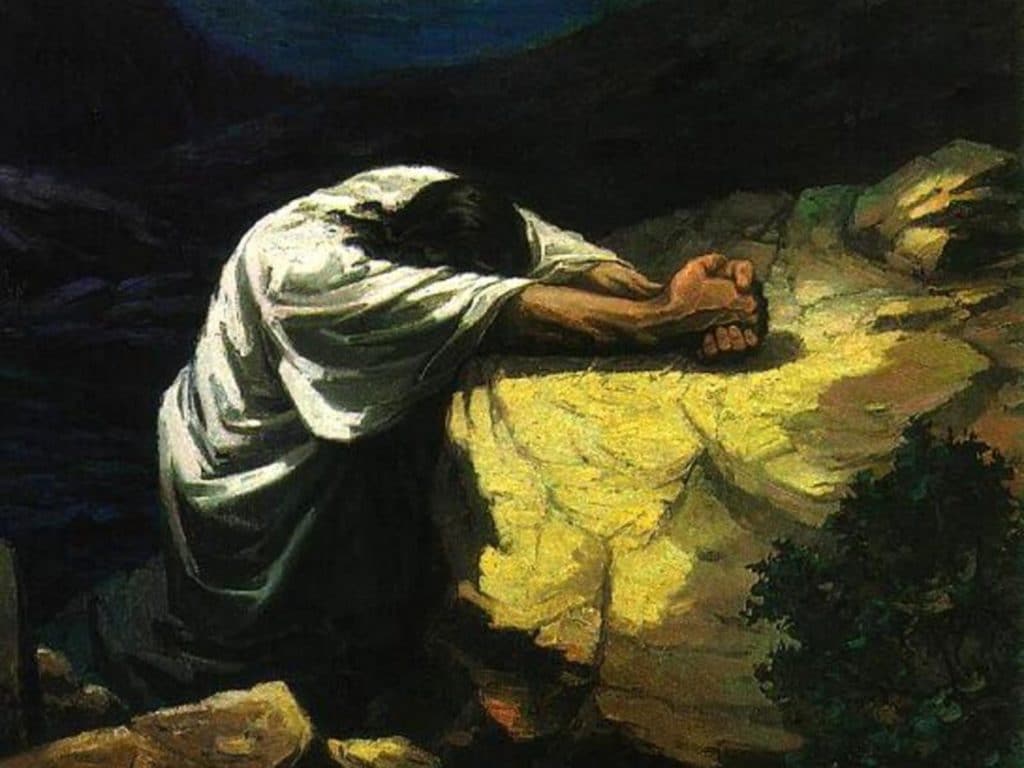
36 Then Jesus went with them to a place called Gethsemane, and he said to his disciples, “Sit here, while I go over there and pray.” 37 And taking with him Peter and the two sons of Zebedee, he began to be sorrowful and troubled. 38 Then he said to them, “My soul is very sorrowful, even to death; remain here, and watch with me.” 39 And going a little farther he fell on his face and prayed, saying, “My Father, if it be possible, let this cup pass from me; nevertheless, not as I will, but as you will.” 40 And he came to the disciples and found them sleeping. And he said to Peter, “So, could you not watch with me one hour? 41 Watch and pray that you may not enter into temptation. The spirit indeed is willing, but the flesh is weak.” 42 Again, for the second time, he went away and prayed, “My Father, if this cannot pass unless I drink it, your will be done.” 43 And again he came and found them sleeping, for their eyes were heavy. 44 So, leaving them again, he went away and prayed for the third time, saying the same words again. 45 Then he came to the disciples and said to them, “Sleep and take your rest later on. See, the hour is at hand, and the Son of Man is betrayed into the hands of sinners. 46 Rise, let us be going; see, my betrayer is at hand.” – Matthew 26:36-46 ESV

agony-in-the-garden-1-1024x768.jpgHaving completed the Passover meal, Jesus and His disciples made their way through the city of Jerusalem, out the eastern gate, and onto the Mount of Olives. They stopped at a place called Gethsemane, which means “an olive press.” Here, Jesus took three of His disciples, Peter, James and John, and found a secluded place where He could pray. These are the same three men who had accompanied Him and been eyewitnesses to His transfiguration. But on this occasion, rather than seeing Jesus in His glorified state, they would watch as He agonized over His coming trials.

Jesus described to them His state of mind: “My soul is very sorrowful, even to death” (Matthew 26:38 ESV). His emotional state was one of deep and overwhelming sadness over what was about to happen. His sorrow alone was enough to kill Him. But what was it that caused such a drastic state of deep melancholy in Jesus? Was He afraid to die? Did He regret His decision to sacrifice Himself on behalf of sinful mankind? Was He having second thoughts? The text, along with the words and actions of Jesus, provide us with the answers.

Matthew relates that Jesus went off by Himself and immediately fell on His face before His Father in a state of prayer. He pleaded, “My Father, if it be possible, let this cup pass from me” (Matthew 26:39 ESV).

One of the things this passage reveals is the human side of Jesus’ nature. He was 100 percent God, but also 100 percent human – a state often referred to as the hypostatic union. At His incarnation, Jesus, the eternal, second person of the Trinity, became the God-man. His assumption of a human nature was essential to the role He would play as the Savior of mankind. The author of Hebrews explains:

Because God’s children are human beings – made of flesh and blood – the Son also became flesh and blood. For only as a human being could he die, and only by dying could he break the power of the devil, who had the power of death. – Hebrews 2:14 NLT

The apostle Paul would put it this way:

[God] sent his own Son in a body like the bodies we sinners have. And in that body God declared an end to sin’s control over us by giving his Son as a sacrifice for our sins. – Romans 8:3 NLT

Jesus never relinquished any of His divine attributes, but, in becoming a man, He combined His human and divine natures into one person. And as a man, Jesus felt pain, experienced hunger, grew tired, and, as we will see, became susceptible to death.

In His humanity, Jesus knew that what He was about to endure would be excruciatingly painful. He would be scourged mercilessly with a flagellum, a whip featuring multiple leather strands, each weighted with lead balls or pieces of bone. He would be beaten, spit upon, slapped, and degraded. And eventually, He would be nailed to a wooden cross and left to die by exposure and suffocation. Jesus’ human nature was repulsed by the prospect of facing such a painful and gruesome death. He longed for another way, a plan B.

But, in His divinity, He knew that this was all part of His Father’s sovereign will. This is why He stated, “nevertheless, not as I will, but as you will” (Matthew 26:39 ESV).

But there is a second explanation behind Jesus’ intense sorrow and His cry for an alternative plan. He was fully aware that, upon the cross, He would be taking on the sin debt of the entire world. He who never committed a single sin would bear the full brunt of God’s wrath against all the sins of men for all time.

For God made Christ, who never sinned, to be the offering for our sin, so that we could be made right with God through Christ. – 2 Corinthians 5:21 NLT

Sin separates mankind from God. And Jesus knew that when He took on the sin debt of mankind, He would become separated from His Father for the first time in all of eternity. Their fellowship would be broken. And, in His divine nature, that prospect was unfathomable and unthinkable to Jesus. Yet again, He knew it was all part of God’s plan and, therefore, necessary.

Jesus longed for this “cup of wrath” to pass. If you recall, back in chapter 20, Matthew recorded an encounter between Jesus and the mother of James and John, the two brothers who were with Him in Gethsemane that night. She had asked Jesus to allow her two sons to sit on His right and on His left when He established His kingdom on earth. But Jesus had responded to her two sons, “You don’t know what you are asking! Are you able to drink from the bitter cup of suffering I am about to drink?” (Matthew 20:22 NLT).

Only He was worthy to suffer for the sins of mankind. He alone could meet God’s demanding criteria for an acceptable sacrifice – an unblemished, sinless Lamb.

And it’s interesting to note that when Jesus stopped to check on Peter, James, and John, He had found them asleep. While He had been agonizing over His coming death, these three were obviously unconcerned with and unsympathetic to His pain. They slept while Jesus wept. And Jesus made an interesting observation, stating, “The spirit indeed is willing, but the flesh is weak” (Matthew 26:41 ESV). This was most likely aimed at Peter, who had been the one who had vehemently denied Jesus prediction that they would all bail on Him in His time of greatest need.

“Though they all fall away because of you, I will never fall away.” – Matthew 26:33 ESV).

And yet, here was Peter finding it difficult even to stay awake while His master suffered under the weight of His pending death.

Three separate times Jesus expressed His feelings to His heavenly Father, and three times He communicated His willingness to do His Father’s will. He was committed. Every ounce of His humanity longed to escape what was to come, but His divinity provided the strength He needed to do what He had been called to do.

In his commentary on the book of Matthew, D.A. Carson writes:

“In the first garden ‘Not your will but mine’ changed Paradise to desert and brought man from Eden to Gethsemane. Now ‘Not my will but yours’ brings anguish to the man who prays it but transforms the desert into the kingdom and brings man from Gethsemane to the gates of glory.” – D.A. Carson, Matthew, p. 545.

Jesus was willing to face the fate God had planned for Him because He trusted His heavenly Father. He knew there was no other way. Salvation was only possible through His obedient submission to the sovereign will of God the Father. And the hour had come for Him to begin His journey from Gethsemane to Golgotha. Having finished His prayer time with the Father, Jesus turned to His disciples and said, “the hour is at hand, and the Son of Man is betrayed into the hands of sinners” (Matthew 26:45 ESV).

Judas was on his way, bringing with him the guards of the high priest. The darkness of that night was about to deepen as the forces of evil began their ill-fated attempt to snuff out the Light of the world. But as John would later write:

The light shines in the darkness, and the darkness can never extinguish it. – John 1:5 NLT

God’s light came into the world, but people loved the darkness more than the light, for their actions were evil. All who do evil hate the light and refuse to go near it for fear their sins will be exposed. But those who do what is right come to the light so others can see that they are doing what God wants. – John 3:19-21 NLT

Jesus would end up buried in the darkness of a borrowed tomb. His life would be forcefully taken from Him, but as He had predicted, it would be on His terms.

“No one can take my life from me. I sacrifice it voluntarily. For I have the authority to lay it down when I want to and also to take it up again. For this is what my Father has commanded.” – John 10:18 NLT

Jesus lived to do the will of His Father. And He died in obedience to the will of His Father. When Jesus had stated, “I and the Father are one” (John 10:30 ESV), He had meant it. Their wills were united, and their love for sinful mankind was unified around the sole solution to man’s problem: The sacrificial death of the sinless Son of God.

English Standard Version (ESV)
The Holy Bible, English Standard Version. ESV® Permanent Text Edition® (2016). Copyright © 2001 by Crossway Bibles, a publishing ministry of Good News Publishers.

New Living Translation (NLT)
Holy Bible, New Living Translation, copyright © 1996, 2004, 2015 by Tyndale House Foundation. Used by permission of Tyndale House Publishers Inc., Carol Stream, Illinois 60188. All rights reserved.

The Message (MSG)Copyright © 1993, 1994, 1995, 1996, 2000, 2001, 2002 by Eugene H. Peterson

Faithless and Twisted.

14 And when they came to the crowd, a man came up to him and, kneeling before him, 15 said, “Lord, have mercy on my son, for he has seizures and he suffers terribly. For often he falls into the fire, and often into the water. 16 And I brought him to your disciples, and they could not heal him.” 17 And Jesus answered, “O faithless and twisted generation, how long am I to be with you? How long am I to bear with you? Bring him here to me.” 18 And Jesus rebuked the demon, and it came out of him, and the boy was healed instantly. 19 Then the disciples came to Jesus privately and said, “Why could we not cast it out?” 20 He said to them, “Because of your little faith. For truly, I say to you, if you have faith like a grain of mustard seed, you will say to this mountain, ‘Move from here to there,’ and it will move, and nothing will be impossible for you.” –  Matthew 17:14-20 ESV

While Peter, James and John had been on the mountaintop witnessing the miracle of Jesus’ transfiguration, the rest of the disciples had been down in the valley trying to manufacture a miracle of their own. But they had failed miserably. While Jesus had been away, the crowds had not stopped showing up. A man had approached the disciples seeking help for his son, who was possessed by a demon that caused the young boy to have violent, uncontrollable seizures. The disciples had tried to help the boy, but had been unsuccessful. Now, the man had returned, bringing his need directly to Jesus.

This story sets up an interesting contrast between the three disciples who had been privileged to witness the transfiguration and the nine who had remained behind. The primary issue is that of faith. Peter, James and John had seen Jesus transformed into a glorified state. They had seen Moses and Elijah “who appeared in glory and spoke of his departure” (Luke 9:31 ESV). The word translated “departure” is actually the Greek word exodos, which refers to “one’s final fate” or “departure from life” (“G1841 – exodos – Strong’s Greek Lexicon (KJV).” Blue Letter Bible. Web. 7 Sep, 2018). Peter, James and John had heard Moses and Elijah discussing Jesus’ coming death and then had heard God say, “This is my beloved Son, with whom I am well pleased; listen to him” (Matthew 17:5 ESV). But the rest of the disciples had experienced none of this and Peter, James and John had been sworn to secrecy by Jesus. 

So, when Jesus heard the report of the father regarding the disciples’ unsuccessful attempt to heal his son, Jesus was immediately faced with the lagging faith of the men He had chosen as His followers. This scene is reminiscent of the time Moses came down off Mount Sinai, holding the tablets containing the law of God in his hands. When he arrived in the camp of the Israelites, he had found them dancing before the golden calf. They had lost faith. In their minds, Moses had abandoned them, so they had turned to Aaron and said, “Up, make us gods who shall go before us. As for this Moses, the man who brought us up out of the land of Egypt, we do not know what has become of him” (Exodus 32:1 ESV). Their creation of the false god was simply a sign of their lack of faith in the one true God.

And when Jesus returned from the mountaintop and heard His disciples had been unable to heal in His absence, He recognized it as a lack of faith. It’s important to note that these are the same men whom Jesus had sent out earlier and had empowered to preach the gospel and perform miracles in His name.

1 And he called the twelve together and gave them power and authority over all demons and to cure diseases, 2 and he sent them out to proclaim the kingdom of God and to heal. – Luke 9:1-12 ESV

And according to Matthew’s account, Jesus had been very specific in what He expected them to do with the power He was giving them.

“Heal the sick, raise the dead, cleanse lepers, cast out demons.” – Matthew 10:6 ESV

Luke tells us that they did just as Jesus had commanded them.

6 And they departed and went through the villages, preaching the gospel and healing everywhere. – Luke 9:6 ESV

Yet, in this most recent case, they had been unable to heal the boy. They had tried, but failed. And the response of Jesus seems surprisingly harsh.

“You unbelieving and perverse generation! How much longer must I be with you? How much longer must I endure you?” – Matthew 17:17 NLT

Jesus was constantly surrounded by unbelief. The Pharisees, scribes and Sadducees refused to believe in Him. The Jewish people, while enamored with His power, were unwilling to recognize Him as their Messiah. And now, He had to witness the lack of faith of His own disciples. What a letdown from His experience on the mountaintop. There, He had been encouraged by Moses and Elijah, who spoke to Him of the necessity of His coming death. He had been confirmed by His heavenly Father who spoke of His pleasure in Him. But to return from the mountaintop to the valley and find His disciples struggling with their faith was a rude reminder of the enormity of His task.

The words of Jesus echo those of God, spoken in regard to the people of Israel hundreds of years earlier.

“…they are a perverse generation,
    children in whom is no faithfulness…” – Deuteronomy 32:20 ESV

The disciples were Jesus’ hand-picked followers in whom He was going to place the responsibility to carrying on His ministry after His departure. They were to be His apostles, His messengers of the good news. But at this point, they were still struggling with a lack of faith. After they had watched Jesus heal the boy, they asked Him why they had been unsuccessful. And His answer was probably difficult for them to hear.

“Because of your little faith. For truly, I say to you, if you have faith like a grain of mustard seed, you will say to this mountain, ‘Move from here to there,’ and it will move, and nothing will be impossible for you.” – Matthew 17:20 ESV

It would seem that the disciples had divorced their ability to heal from their faith in Jesus. To them, the capacity to heal was nothing more than some kind of new power they possessed, in and of themselves. They must have seen themselves as permantly endowed with the same kind of miraculous powers that Jesus had. In a way, they had placed their faith in their ability to heal. They had experienced it before, so why not think they could do it again. But what was missing? Jesus. Or better yet, their faith in Jesus. They had tried to heal the boy in their own strength. And they had failed. The source of their miraculous powers was Jesus. In fact, it was their faith in Jesus as the Son of God that would enable them to do great things in His name. The apostle Paul would later explain the focus of his faith and the source of his strength.

For I can do everything through Christ, who gives me strength. – Philippians 4:13 NLT

Jesus would later tell the disciples, “whatever you ask in prayer, you will receive, if you have faith” (Matthew 21:22 ESV). The disciples had lacked faith. And it was not the quantity of their faith that was the issue. It was the focus of their faith. A little faith properly placed in Jesus can move mountains. But great faith placed in something or someone other than Jesus will always prove powerless.

It’s likely that the disciples had tried to heal the boy in order to impress the crowds with their supernatural powers. They wanted everyone to know that they could do what Jesus could do. But without Jesus, they were impotent. Left to themselves, they had no power. And Jesus described them as faithless and twisted. They were without faith in Him. And they were actually twisted in their perceptions of why Jesus had come. It wasn’t about healing and miracles. It was about the kingdom of heaven. Their focus was on the wrong thing. Their minds were set on something other than what Jesus had come to do. And until they placed their fledgling faith fully in Jesus, they would continue to struggle.

English Standard Version (ESV)
The Holy Bible, English Standard Version. ESV® Permanent Text Edition® (2016). Copyright © 2001 by Crossway Bibles, a publishing ministry of Good News Publishers.

New Living Translation (NLT)
Holy Bible, New Living Translation, copyright © 1996, 2004, 2015 by Tyndale House Foundation. Used by permission of Tyndale House Publishers Inc., Carol Stream, Illinois 60188. All rights reserved.

The Message (MSG)Copyright © 1993, 1994, 1995, 1996, 2000, 2001, 2002 by Eugene H. Peterson

A Glimpse of Things to Come.

1 And after six days Jesus took with him Peter and James, and John his brother, and led them up a high mountain by themselves. 2 And he was transfigured before them, and his face shone like the sun, and his clothes became white as light. 3 And behold, there appeared to them Moses and Elijah, talking with him. 4 And Peter said to Jesus, “Lord, it is good that we are here. If you wish, I will make three tents here, one for you and one for Moses and one for Elijah.” 5 He was still speaking when, behold, a bright cloud overshadowed them, and a voice from the cloud said, “This is my beloved Son, with whom I am well pleased; listen to him.” 6 When the disciples heard this, they fell on their faces and were terrified. 7 But Jesus came and touched them, saying, “Rise, and have no fear.” 8 And when they lifted up their eyes, they saw no one but Jesus only.

9 And as they were coming down the mountain, Jesus commanded them, “Tell no one the vision, until the Son of Man is raised from the dead.” 10 And the disciples asked him, “Then why do the scribes say that first Elijah must come?” 11 He answered, “Elijah does come, and he will restore all things. 12 But I tell you that Elijah has already come, and they did not recognize him, but did to him whatever they pleased. So also the Son of Man will certainly suffer at their hands.” 13 Then the disciples understood that he was speaking to them of John the Baptist. –  Matthew 17:1-13 ESV

It’s important to remember that there were no chapter designations in the original version of Matthew’s gospel. So the closing sentence of chapter 16 would have flowed directly into our passage for today.

“Truly, I say to you, there are some standing here who will not taste death until they see the Son of Man coming in his kingdom.” – Matthew 16:28 ESV

Just six days later, Jesus would choose three of His disciples to accompany Him to the top of a nearby mountain. While there has been much speculation over the years as to the exact identity of the mountain to which Matthew referred, none of the gospel writers provide us with the identity. The location of the mountain was not the point of the story, but the details of event that took place on the mountain.

Jesus handpicked Peter, James and John to join Him on this particular occasion. They were given the unique privilege of witnessing a once-in-a-lifetime scene that was designed to confirm Jesus’ identity as the Messiah.

What the disciples witnessed must have blown them away. And the fact that this incredible scene took place on a mountaintop, accompanied by the presence of Moses and Elijah, would not have escaped them. These two men had also had mountaintop encounters with God. They’re described in Exodus 19 and 1 Kings 19 respectively. And in both cases, their divine encounters had taken place on Mt Sinai. So, for the three disciples, who would have very familiar with the stories of Moses and Elijah, God’s choice of location at which to appear would have made all the sense in the world.

But they were not prepared for what they witnessed. In fact, when they had gone up on the mountain they don’t appear to have been expecting much to happen, because Luke points out that the three of them had fallen fast asleep. But they woke up to find that Jesus had been transfigured. The Greek word is metamorphoō, from which we get our English word, metamorphosis. Jesus was literally transformed in His appearance.

…his face shone like the sun, and his clothes became white as light… – Matthew 17:2 ESV

The change that came over Him was visible and undeniable. Mark describes the brightness of His clothes “as no one on earth could bleach them” (Mark 9:3 ESV). But that’s not all that happened. Matthew states that the figures of Moses and Elijah appeared alongside Jesus. And Matthew and Mark both emphasize that these two men appeared before them – the disciples. Peter, James and John were given the privilege of seeing these two great patriarchs appear next to Jesus. We’re not told how they recognized them. Moses and Elijah had lived hundreds of years earlier and there would have been no photographic record of their appearance. But somehow, the three disciples knew that they were watching Jesus dialogue with these two long-deceased heros of the Hebrew faith.

And Luke includes the content of their discussion with Jesus. They “spoke of his departure, which he was about to accomplish at Jerusalem” (Luke 9:31 ESV). Remember what Jesus had told the disciples just six days earlier:

From that time Jesus began to show his disciples that he must go to Jerusalem and suffer many things from the elders and chief priests and scribes, and be killed, and on the third day be raised. – Matthew 16:21 ESV

The words of Jesus were confirmed for Peter, James and John as they overheard Moses and Elijah discussing the very same topic. This whole scene was for the benefit of the three disciples. This was a God-ordained event designed to fully confirm the disciples’ belief that Jesus was the Messiah. It’s important to consider the significance of the appearance of Moses and Elijah. Moses was synonymous with the law of God. Elijah was one of the premier prophets of God. And later, after Jesus had died and resurrected, He would appear to the two disciples on the road to Emmaus, and Luke records that “beginning with Moses and all the Prophets, he interpreted to them in all the Scriptures the things concerning himself” (Luke 24:27 ESV).

Later on, in Luke’s account, Jesus appeared before all His disciples and told them:

44 “These are my words that I spoke to you while I was still with you, that everything written about me in the Law of Moses and the Prophets and the Psalms must be fulfilled.” 45 Then he opened their minds to understand the Scriptures, 46 and said to them, “Thus it is written, that the Christ should suffer and on the third day rise from the dead, 47 and that repentance for the forgiveness of sins should be proclaimed in his name to all nations, beginning from Jerusalem.” – Luke 24:44-47 ESV

Through the transfiguration of Jesus and the appearance of Moses and Elijah, God was letting the disciples know, beyond a shadow of a doubt, that Jesus was the Messiah, in fulfillment of all that had been written in the law and the prophets.

But look Peter’s response. He immediately offers to build shelters for Jesus, Moses and Elijah. In essence, he wants to prolong the moment and extend the stay of the two patriarchs. He completely forgot that Moses and Elijah had discussed Jesus’ departure, not his stay. But Peter didn’t want this little get-together to end. And Matthew reports that, while the words were still on Peter’s lips, “a bright cloud overshadowed them, and a voice from the cloud said, ‘This is my beloved Son, with whom I am well pleased; listen to him’”  (Matthew 17:5 ESV). God wanted Peter to shut up and listen. Jesus had been telling them what was going to happen. He had tried to let them know what was going to take place next. But the news Jesus had shared had prompted Peter to rebuke Him.

God wanted Peter, James and John to know that He was pleased with Jesus. The coming suffering and death of Jesus was not a sign of God’s wrath or judgment. It was all part of His divine plan for man’s redemption. And the obedience of Jesus brought great joy to the Father’s heart. He knew His Son was committed to carry out His assignment. Now, God wanted the disciples on board. And long after Jesus’ death and resurrection, Peter would write of this incredible experience.

16 …we were eyewitnesses of his majesty. 17 For when he received honor and glory from God the Father, and the voice was borne to him by the Majestic Glory, “This is my beloved Son, with whom I am well pleased,” 18 we ourselves heard this very voice borne from heaven, for we were with him on the holy mountain. 19 And we have the prophetic word more fully confirmed, to which you will do well to pay attention as to a lamp shining in a dark place, until the day dawns and the morning star rises in your hearts… – 2 Peter 1:16-19 ESV

His experience on the mountaintop that day had obviously made an impression. Watching the transfiguration of Jesus had had a life-transforming effect on Peter and the other two disciples.

But as they left the mountain and descended back to the valley below, Jesus told them to keep what they had seen to themselves, until He was resurrected. It was only then that they were to proclaim the King and His kingdom. And as good Jews, they were curious to know that, if Jesus was the Messiah, why He had appeared before the return of Elijah. According to Malachi 4:5-6, Elijah was to precede the coming of the Messiah. And Jesus informed them that he had – in the form of John the Baptist. Everything was happening according to God’s plan and in keeping with and in fulfillment of Old Testament prophecy.

But Jesus still had to suffer and die. His resurrection could not take place until He had gone through the humiliation of death on a cross. The disciples had had the mountain top experience. They had seen Jesus in all His glory. But now that they were back in the valley, they would have to endure the slow, steady march of Jesus as He made His way to Jerusalem and the cross.

English Standard Version (ESV)
The Holy Bible, English Standard Version. ESV® Permanent Text Edition® (2016). Copyright © 2001 by Crossway Bibles, a publishing ministry of Good News Publishers.

New Living Translation (NLT)
Holy Bible, New Living Translation, copyright © 1996, 2004, 2015 by Tyndale House Foundation. Used by permission of Tyndale House Publishers Inc., Carol Stream, Illinois 60188. All rights reserved.

The Message (MSG)Copyright © 1993, 1994, 1995, 1996, 2000, 2001, 2002 by Eugene H. Peterson

Fishers of Men.

18 While walking by the Sea of Galilee, he saw two brothers, Simon (who is called Peter) and Andrew his brother, casting a net into the sea, for they were fishermen. 19 And he said to them, “Follow me, and I will make you fishers of men.” 20 Immediately they left their nets and followed him. 21 And going on from there he saw two other brothers, James the son of Zebedee and John his brother, in the boat with Zebedee their father, mending their nets, and he called them. 22 Immediately they left the boat and their father and followed him.

23 And he went throughout all Galilee, teaching in their synagogues and proclaiming the gospel of the kingdom and healing every disease and every affliction among the people. 24 So his fame spread throughout all Syria, and they brought him all the sick, those afflicted with various diseases and pains, those oppressed by demons, those having seizures, and paralytics, and he healed them. 25 And great crowds followed him from Galilee and the Decapolis, and from Jerusalem and Judea, and from beyond the Jordan. – Matthew 4:18-25 ESV

In Luke’s Gospel, he records that immediately after His temptation in the wilderness, Jesus had returned to Nazareth, His hometown. While there, He had attended the synagogue one day and was given the privilege of reading from the Old Testament Scriptures, as was the custom. He opened up the scroll containing the writings of the prophet, Isaiah, and read from a particular passage.

16 When he came to the village of Nazareth, his boyhood home, he went as usual to the synagogue on the Sabbath and stood up to read the Scriptures. 17 The scroll of Isaiah the prophet was handed to him. He unrolled the scroll and found the place where this was written:

18 “The Spirit of the Lord is upon me,
    for he has anointed me to bring Good News to the poor.
He has sent me to proclaim that captives will be released,
    that the blind will see,
that the oppressed will be set free,
19     and that the time of the Lord’s favor has come.” – Luke 4:16-19 NLT

Having read the passage, Jesus sat down and then stated in the hearing of all those in attendance: “The Scripture you’ve just heard has been fulfilled this very day!” (Luke 4:21 NLT). Jesus had taken an Old Testament prophecy concerning the Messiah and applied it to Himself. He was claiming to be the fulfillment of Isaiah’s prophetic prediction of the coming of the anointed one – He who would bring good news to the poor. And as Matthew pointed out earlier, Jesus was the fulfillment of Isaiah’s prophecy concerning the great light that was to dawn, illuminating the spiritual darkness of the world.  

Jesus had begun His earthly ministry with the anointing of the Holy Spirit and was now prepared to take His message concerning the gospel of the kingdom to the world. But rather than begin His ministry within the confines of Jerusalem, the spiritual and political capital of Israel, Jesus had focused His attention on the region of Galilee, to the north. And instead of appealing to the powerful religious leaders of His day, Jesus took His message of good news to the peasants, even focusing His attention on common fishermen. Matthew specifically mentions two sets of brothers: Simon and Andrew and James and John. In his own Gospel account, John records that Jesus had actually met Simon, Andrew, Philip, and Nathanael some time earlier.

35 The next day again John was standing with two of his disciples, 36 and he looked at Jesus as he walked by and said, “Behold, the Lamb of God!” 37 The two disciples heard him say this, and they followed Jesus. 38 Jesus turned and saw them following and said to them, “What are you seeking?” And they said to him, “Rabbi” (which means Teacher), “where are you staying?” 39 He said to them, “Come and you will see.” So they came and saw where he was staying, and they stayed with him that day, for it was about the tenth hour. 40 One of the two who heard John speak and followed Jesus was Andrew, Simon Peter’s brother. 41 He first found his own brother Simon and said to him, “We have found the Messiah” (which means Christ). 42 He brought him to Jesus. Jesus looked at him and said, “You are Simon the son of John. You shall be called Cephas” (which means Peter).” – John 1:35-42 ESV

After their initial encounter with Jesus, it seems that Simon and Andrew had returned to their nets, having failed to sense any clear calling from Jesus to become His disciples. But when Jesus met them the second time, He made His intentions perfectly clear, commanding the two brothers to follow Him.

“Follow me, and I will make you fishers of men.” – Matthew 4:19 ESV

This statement must have sounded odd to the two men. What could Jesus have meant by the phrase, “fishers of men”? It seems unlikely that the men to whom Jesus uttered His command to follow Him understood what He was talking about. But Jesus’ wording was intentional and carried great significance. He was calling these men to a task that was far greater than anything they could have ever imagined. Their lives were about to be radically changed and the entire focus of their existence was to become irreversibly altered. Four common fishermen were about to become key players in a drama that would have eternal implications on not only the nation of Israel, but the entire world.

Jesus’ use of the term, “fishers of men” was a direct reference to another Old Testament passage in which God spoke of His plan to return His people from their captivity in Babylon. Because of the generations of unfaithfulness on the part of the people of Judah, God had allowed them to suffer defeat at the hands of the Babylonians and sent them into exile for a period of 70 years. But God had also promised to restore them to the land.

14 “Therefore, behold, the days are coming, declares the Lord, when it shall no longer be said, ‘As the Lord lives who brought up the people of Israel out of the land of Egypt,’ 15 but ‘As the Lord lives who brought up the people of Israel out of the north country and out of all the countries where he had driven them.’ For I will bring them back to their own land that I gave to their fathers.

16 “Behold, I am sending for many fishers, declares the Lord, and they shall catch them. And afterward I will send for many hunters, and they shall hunt them from every mountain and every hill, and out of the clefts of the rocks.” – Jeremiah 16:14-16 ESV

The Hebrew word for “fishers” is dayag, and it refers to fishermen. God had promised to send fishermen to catch all those who were in exile, returning them to the land of promise. And while God had fulfilled this promise, eventually returning the people of Judah from their captivity in Babylon and restoring them to the land, they were still living in open rebellion to Him. Even at the time Jesus had begun His ministry, the nation of Israel was marked by spiritual darkness, living in the land, but still separated from God by their unrighteous and unfaithful behavior. What was missing was any kind of a right relationship with God. And Jesus was calling these four men to a task that would involve the seeking and searching for all those whom God desired to be returned to a right relationship with Himself. Simon, Andrew, James and John had spent their lives casting their nets in the waters of the Sea of Galilee, hoping to catch fish. Now, Jesus was calling them to assist in His mission to catch men.

These four unimpressive men from inauspicious backgrounds, were going to be used by God to accomplish something far greater than any of them could have ever imagined. They were to be part of a divine plan to restore sinful mankind to a right relationship with God. And these common Galilean fishermen would end up making an impact on the world that would have far-reaching implications for generations to come – on not only the Jewish people, but the nations of the world. Jeremiah wrote the words of God, promising to restore the lost and wandering people of God to a right relationship with Him.

8 Behold, I will bring them from the north country
    and gather them from the farthest parts of the earth,
among them the blind and the lame,
    the pregnant woman and she who is in labor, together;
    a great company, they shall return here. – Jeremiah 31:8 ESV

Notice that God focused on the needy? He emphasized the blind, the lame, the helpless and vulnerable. And Matthew records that Jesus began His ministry by focusing on those who had needs, “healing every disease and every affliction among the people” (Matthew 4:23 ESV). Matthew emphasized that “they brought him all the sick, those afflicted with various diseases and pains, those oppressed by demons, those having seizures, and paralytics, and he healed them” (Matthew 4:24 ESV). The hurting, the helpless and the hopeless were the focus of Jesus’ earthly ministry. He enlisted the aid of the unimpressive and unqualified in order to minister to the unwanted and undesirable. And Jesus’ fame spread and His following grew.

English Standard Version (ESV) The Holy Bible, English Standard Version. ESV® Permanent Text Edition® (2016). Copyright © 2001

New Living Translation (NLT) Holy Bible, New Living Translation, copyright © 1996, 2004, 2015 by Tyndale House Foundation. Used by permission of Tyndale House Publishers Inc., Carol Stream, Illinois 60188. All rights reserved.

The Message (MSG)  Copyright © 1993, 1994, 1995, 1996, 2000, 2001, 2002 by Eugene H. Peterson

A Delicate Balancing Act.

17 When we had come to Jerusalem, the brothers received us gladly. 18 On the following day Paul went in with us to James, and all the elders were present. 19 After greeting them, he related one by one the things that God had done among the Gentiles through his ministry. 20 And when they heard it, they glorified God. And they said to him, “You see, brother, how many thousands there are among the Jews of those who have believed. They are all zealous for the law, 21 and they have been told about you that you teach all the Jews who are among the Gentiles to forsake Moses, telling them not to circumcise their children or walk according to our customs. 22 What then is to be done? They will certainly hear that you have come. 23 Do therefore what we tell you. We have four men who are under a vow; 24 take these men and purify yourself along with them and pay their expenses, so that they may shave their heads. Thus all will know that there is nothing in what they have been told about you, but that you yourself also live in observance of the law. 25 But as for the Gentiles who have believed, we have sent a letter with our judgment that they should abstain from what has been sacrificed to idols, and from blood, and from what has been strangled, and from sexual immorality.” 26 Then Paul took the men, and the next day he purified himself along with them and went into the temple, giving notice when the days of purification would be fulfilled and the offering presented for each one of them. – Acts 21:17-26 ESV

In this next section of Luke’s account, he is going to provide a precise record of Paul’s return to Jerusalem and the interactions that took place between Paul and the leadership of the church there. Upon arrival back in Jerusalem, Paul appeared before James and the rest of the leadership of the church, including the other apostles. He reported the details of his latest mission trip among the Gentiles, explaining all that God was doing to bring those outside of Judaism to faith in Christ. His third missionary journey had been similar to the previous two, further confirming that the gospel message was bearing much fruit, in spite of increasing opposition from Jews who were dispersed abroad and from the Gentiles who found Christianity to be a threat to their own pagan religions.

One of the striking features of Paul’s report was the way he gave all the credit to God. Luke reports that Paul “related one by one the things that God had done among the Gentiles through his ministry” (Acts 21:19 ESV). Yes, Paul had played a vital and indispensable role, but he knew that nothing worthy would have taken place without the sovereign hand of God. No one would have come to faith in Christ if God had not called them and the Holy Spirit had not regenerated their hearts. Paul knew his place. He was no more than a messenger, a herald of the truth, communicating the good news concerning Jesus Christ to those who had never heard it. Any converts produced were the result of God’s handiwork, not Paul’s. In fact, he admitted as much in his first letter to the believers in Corinth.

3 I came to you in weakness—timid and trembling. 4 And my message and my preaching were very plain. Rather than using clever and persuasive speeches, I relied only on the power of the Holy Spirit. 5 I did this so you would trust not in human wisdom but in the power of God. – 1 Corinthians 2:3-5 NLT

And in that same letter, Paul made it clear that his role had been simple and somewhat one-dimensional.

17 For Christ did not send me to baptize but to preach the gospel, and not with words of eloquent wisdom, lest the cross of Christ be emptied of its power. – 1 Corinthians 1:17 ESV

Because Paul had been quick to give all the credit to God, the apostles were able to direct their praise to God and not to Paul. At no point did Paul attempt to rob God of glory by allowing himself to receive unwarranted praise. He was more than content in the knowledge that his efforts on behalf of God, done in the power of God, had accomplished the will of God.

But James and the other apostles, while grateful for all that God had done, were forced to bring up a potential conflict that loomed as a result of Paul’s report. While Paul had been away, the Spirit of God had been at work in Jerusalem as well, resulting in the conversions of thousands of faithful, law-abiding Jews. These individuals, while having put their faith in Jesus Christ as their Messiah and Savior, still held tenaciously to their Hebrew heritage and the ways of their ancestors. They maintained their allegiance to the Mosaic law and the religious rites and rituals of Judaism. Obedience to the law of Moses was still a non-negotiable, non-optional requirement for them. Earlier in his book, Luke had recorded the findings of the Jerusalem council, when they had been forced to deal with the demands of certain Jewish believers that all Gentile converts be required to live according to the law of Moses just as they did. James and the apostles had determined that this was unnecessary because it was not a requirement that God had placed on the Gentile believers. That dispute had been settled. But now, James was bringing up a different issue altogether. It seems that the latest rumor circulating among the Jewish believers in Jerusalem was that Paul had been trying to convince Jews living among the Gentiles where he ministered, to abandon their allegiance to the Mosaic law. They were falsely reporting that Paul was teaching Jews not to circumcise their children or to follow other Jewish customs and laws.

Part of what was going here was a misunderstanding of Paul’s outlook on the law. He outlines his perspective regarding the Mosaic law in his first letter to the church in Corinth.

20 When I was with the Jews, I lived like a Jew to bring the Jews to Christ. When I was with those who follow the Jewish law, I too lived under that law. Even though I am not subject to the law, I did this so I could bring to Christ those who are under the law. 21 When I am with the Gentiles who do not follow the Jewish law, I too live apart from that law so I can bring them to Christ. But I do not ignore the law of God; I obey the law of Christ. – 1 Corinthians 9:20-21 NLT

When living among his fellow Jews, Paul chose to keep the law, just as they did. But when he found himself living among Gentiles, he chose not to follow the Jewish law, because he did not want it to be a stumbling block for them. It was important to him that they not see him living in obedience to the law and wrongly assume that this represented an added requirement for coming to faith in Christ. In no way did Paul ever diminish or demean the law of Moses. But he made it clear that he saw himself and all other Jews, as no longer subject to the law. The law had served its God-appointed purpose. In his letter to the Galatian believers, Paul had clearly stated that the law had been given by God “to show people their sins. But the law was designed to last only until the coming of the child who was promised” (Galatians 3:19 NLT). The child had come. Jesus had been born, had lived a sinless life, having kept the law perfectly, and had died on behalf of sinners as the sinless sacrifice. “God did what the law could not do. He sent his own Son in a body like the bodies we sinners have. And in that body God declared an end to sin’s control over us by giving his Son as a sacrifice for our sins” (Romans 8:3 NLT).

In his letter to the believers in Rome, Paul explained that the Jewish nation had failed to understand that the law could not make anyone righteous. Attempting to live up to God’s holy standard in their own strength, striving to seek a righteousness of their own making, had left them weary and defeated. But when Jesus had appeared and offered Himself as the only means of being made right with God, the Jews had rejected Him.

3 For, being ignorant of the righteousness of God, and seeking to establish their own, they did not submit to God’s righteousness. 4 For Christ is the end of the law for righteousness to everyone who believes. – Romans 10:3-4 ESV

And while Paul was proud of his Jewish heritage and understood the value of the law, he also understood that the law had never been intended to make anyone right with God. It could only reveal man’s sinfulness, not produce righteousness. And nowhere does Paul make that point more clear than in his letter to the Galatian believers.

15 “You and I are Jews by birth, not ‘sinners’ like the Gentiles. 16 Yet we know that a person is made right with God by faith in Jesus Christ, not by obeying the law. And we have believed in Christ Jesus, so that we might be made right with God because of our faith in Christ, not because we have obeyed the law. For no one will ever be made right with God by obeying the law.”

17 But suppose we seek to be made right with God through faith in Christ and then we are found guilty because we have abandoned the law. Would that mean Christ has led us into sin? Absolutely not! 18 Rather, I am a sinner if I rebuild the old system of law I already tore down. 19 For when I tried to keep the law, it condemned me. So I died to the law—I stopped trying to meet all its requirements—so that I might live for God. – Galatians 2:15-19 NLT

And yet, Paul had been misunderstood by the Jews. They saw him as anti-law. But Paul himself said, “the law itself is holy, and its commands are holy and right and good” (Romans 7:12 NLT). The problem was not with the law, but with man’s failure to understand that adherence to the law could never save anyone, because man’s sin nature made it impossible.

But the problem was real. James knew that when those Jews who were “zealous for the law” got wind that Paul was in town, they were going to be upset. And the rumors would fly. So, James suggested a plan to alleviate any potential for conflict or unnecessary tension. He recommended that Paul join four other men who had recently made vows to God and were preparing to complete their vows by having themselves ceremonially cleansed at the temple. Paul was encouraged to join them and to underwrite any costs associated with the sacrifices they would need to make. In doing so, Paul would show that he had not abandoned the rites and rituals of Judaism. His actions would go a long way in convincing others that he was still a faithful Jew and not anti-law.

James made it clear that nothing had changed regarding their previous decision to place no undue or unnecessary burden on the Gentiles. The Jerusalem council had already determined that Gentile converts were not required to be circumcised or to keep the Mosaic law. It was enough that they “abstain from eating food offered to idols, from consuming blood or the meat of strangled animals, and from sexual immorality”, out of deference for their Jewish brothers and sisters in Christ.

The early church was equal parts melting pot and powder keg. The unique and unlikely blending of so many ethnic, social and religious perspectives had created a potentially toxic cocktail. Part of the responsibility of the leadership was to manage this sensitive and volatile environment with wisdom and diplomacy. The church was growing rapidly and each day brought with it new issues and potential conflicts that required careful and prayerful administration. The diverse constituency of the church demanded that the elders, apostles and other leaders manage all the competing expectations and conflicting perspectives with godly grace and brotherly love. It is no wonder that one of Jesus’ primary requests in His high priestly prayer on the night He was betrayed, was for unity among those who would be His followers. Paul could have easily rejected the suggestion of James, demanding that it was well within his rights to do so. But he cared more about the gospel than he did about his rights. He was always willing to sacrifice his rights for the cause of Christ. He was ready, willing and able to die to self in order that others might discover what it means to live for Christ. He summed up his outlook quite succinctly in his first letter to the Corinthian church.

31 So if you eat or drink or whatever you do, do everything to honor God. 32 Do nothing that would make trouble for a Greek or for a Jew or for the church of God. 33 I want to please everyone in all that I do. I am not thinking of myself. I want to do what is best for them so they may be saved from the punishment of sin. – 1 Corinthians 10:31-33 NT


The Holy Bible, English Standard Version. ESV® Permanent Text Edition® (2016). Copyright © 2001

New Living Translation (NLT)
Holy Bible, New Living Translation, copyright © 1996, 2004, 2015 by Tyndale House Foundation. Used by permission of Tyndale House Publishers Inc., Carol Stream, Illinois 60188. All rights reserved.

The Message (MSG)  Copyright © 1993, 1994, 1995, 1996, 2000, 2001, 2002 by Eugene H. Peterson


What God Had Done.

12 And all the assembly fell silent, and they listened to Barnabas and Paul as they related what signs and wonders God had done through them among the Gentiles. 13 After they finished speaking, James replied, “Brothers, listen to me. 14 Simeon has related how God first visited the Gentiles, to take from them a people for his name. 15 And with this the words of the prophets agree, just as it is written,

16 “‘After this I will return,
and I will rebuild the tent of David that has fallen;
I will rebuild its ruins,
     and I will restore it,
17 that the remnant of mankind may seek the Lord,
    and all the Gentiles who are called by my name,
     says the Lord, who makes these things 18 known from of old.’

19 Therefore my judgment is that we should not trouble those of the Gentiles who turn to God, 20 but should write to them to abstain from the things polluted by idols, and from sexual immorality, and from what has been strangled, and from blood. 21 For from ancient generations Moses has had in every city those who proclaim him, for he is read every Sabbath in the synagogues.” – Acts 15:12-21 ESV

After Peter had addressed the council in Jerusalem, Barnabas and Paul were given an opportunity to describe all that God had done among the Gentiles during their most recent road trip. The crowd sat in rapt silence as these two men share what “God had done through them.” This is important. Barnabas and Paul were not bragging about their own personal exploits or trying to pad their resumes by highlighting the irreplaceable role they had played in the evangelism of the Gentiles. No, they told of what God had done through them. They had merely been the conduits through whom His grace and mercy flowed. Their contribution had been to share the gospel. Everything else that had taken place had been God’s doing. And they qualify that what God had done had been done among the Gentiles. This had all been His doing and, obviously, His decision. The receptivity of the Gentiles among whom Barnabas and Saul had ministered, had been the result of God’s Spirit moving among them. He had prepared their hearts to hear what Barnabas and Paul had to share. There were three essential ingredients that had made the journey of Barnabas and Paul a success. First, they had been willing to go. They had submitted to the will of the leadership of the church in Antioch and left the safe and secure confines of their local congregation, all so they could take the message of the gospel to those who had not yet heard. And that brings up the second non-negotiable ingredient that made their trip spiritually successful: They took the gospel. Everywhere they had gone, they preached the good news regarding Jesus Christ. And God’s Spirit provided the third essential ingredient: Power. The most willing of witnesses, eagerly sharing the message of good news, will accomplish nothing apart from the power of the Holy Spirit. Salvation is a work of God. And no one believed that more than Paul. But he also believed that there was an essential role that he and others had to play. He would later write in his letter to the church in Rome:

13 For “Everyone who calls on the name of the Lord will be saved.”

14 But how can they call on him to save them unless they believe in him? And how can they believe in him if they have never heard about him? And how can they hear about him unless someone tells them? 15 And how will anyone go and tell them without being sent? That is why the Scriptures say, “How beautiful are the feet of messengers who bring good news!”

16 But not everyone welcomes the Good News… – Romans 10:13-16 NLT

You see, Paul knew that, as beautiful as the message of the good news of Jesus Christ was, it was useless without messengers. It was a message that could bring life to those who heard it, but they couldn’t believe in a message they had never heard. And for those whose job it was to take the message, it was necessary that they had a strong sense of calling and commission. Otherwise, they would be tempted to quit when the going got tough or the message seemed to be falling on deaf ears. Paul seemed to understand that not everyone who would hear would believe. Not all who heard the good news would welcome or accept it. That’s where the Spirit comes in. He is the trump card in the conversion process. Without His regenerating role, no one can or will come to faith. In a conversation He had with a Pharisee named Nicodemus, Jesus said:

5 “I assure you, no one can enter the Kingdom of God without being born of water and the Spirit. 6 Humans can reproduce only human life, but the Holy Spirit gives birth to spiritual life.  – John 3:5-6 NLT

What Paul and Barnabas had seen happen in Iconium, Lystra, Derby and Pisidian Antioch was the regenerating power of the Holy Spirit, opening spiritually blind eyes and softening hearts hardened by sin. They had witnesses the Spirit bring life to those who had been dead in their trespasses and sins. Paul would describe this wonderful, Spirit-empowered process in his letter to Titus.

3 For we ourselves were once foolish, disobedient, led astray, slaves to various passions and pleasures, passing our days in malice and envy, hated by others and hating one another. 4 But when the goodness and loving kindness of God our Savior appeared, 5 he saved us, not because of works done by us in righteousness, but according to his own mercy, by the washing of regeneration and renewal of the Holy Spirit, 6 whom he poured out on us richly through Jesus Christ our Savior, 7 so that being justified by his grace we might become heirs according to the hope of eternal life. – Titus 3:3-7 ESV

The pattern of salvation is always the same. Those who were foolish, disobedient, led astray and slaves to various passions and pleasures are, somehow, suddenly transformed and made right with God. At one point, they were completely separated from and enemies of God, because of their sin. They they suddenly find themselves friends of God, fully righteous in His sight. Why? Because someone was sent with the message of the gospel, they shared it, and the Spirit prepared the hearts of those who heard it. The end result: They believed. You see, the Bible makes it clear that the things of God are spiritually discerned.

10 these things God has revealed to us through the Spirit. For the Spirit searches everything, even the depths of God. 11 For who knows a person’s thoughts except the spirit of that person, which is in him? So also no one comprehends the thoughts of God except the Spirit of God. – 1 Corinthians 2:10-11 ESV

The natural person does not accept the things of the Spirit of God, for they are folly to him, and he is not able to understand them because they are spiritually discerned. – 1 Corinthians 2:14 ESV

What Paul and Barnabas had witnessed had been the unquestionable work of the Spirit of God. And James, the half-brother of Jesus and a recognized leader in the Jerusalem church, came to their defense, fully agreeing with and confirming their assessment. He reminds those in his audience that Peter (Simeon) had already given ample proof that God was at work among the Gentiles, after he had returned from Caesarea and shared of the conversions of Cornellius and his household.

“Simeon has related how God first visited the Gentiles, to take from them a people for his name.” – Acts 15:14 ESV

Notice his emphasis: It was God who had first visited the Gentiles. He doesn’t give Peter the credit. It was god who had chosen to take from among the Gentiles a people for His name. And it had taken a vision from God to get Peter on board and fully convinced that this mission had God’s full blessing. God had sent Peter. Peter had gone. The gospel had been declared and the Spirit had moved. Bottom line? Gentiles were saved.

And James further confirms that divine nature of the mission of Paul and Barnabas by citing a passage from the Old Testament book of Amos.

16 “‘After this I will return,
and I will rebuild the tent of David that has fallen;
I will rebuild its ruins,
     and I will restore it,
17 that the remnant of mankind may seek the Lord,
    and all the Gentiles who are called by my name,
     says the Lord, who makes these things 18 known from of old.’” – Acts 15:16-18 ESV

According to James, the prophets had predicted the very thing Paul and Barnabas had described. Amos spoke of the “remnant of mankind”, not the remnant of Israel. He specifically mentioned “all the Gentiles who are called by my name.” And nowhere does he include a requirement that this remnant of Gentiles must first become full-fledged, card-carrying Jews, having submitted to the rite of circumcision and agreed to keep the Mosaic law in its entirety. And that was the real crux of the matter. The whole reason this council had been convened was to deal with the demands of the Judaizers that all Gentile converts to Christianity become Jewish proselytes first. By citing the passage from Amos, James was turning the focus away from a matter regarding Jewish ethnicity and a kingdom that mirrored that of David and Solomon. This was about a future Messianic Kingdom that would be ruled over by Christ Himself and made up of people from every tribe, nation and tongue. It is not to say that God does not have a place for the people of Israel in His eschatological plans. He does. But for those Jews in the audience that day in Jerusalem, they were thinking in a purely ethnic and Jewish-centric manner. For them, the Messiah was a Jew, and His Kingdom would be a Jewish Kingdom. Therefore, any Gentiles who wished to be a part of that Kingdom, must first become Jews themselves.

But Paul, Barnabas, Peter and, now, James, would strongly and vehemently disagree. So much so, that James would flatly state, “Therefore my judgment is that we should not trouble those of the Gentiles who turn to God” (Acts 15:19 ESV). By “trouble” he meant require them to submit to circumcision and adhere to the Mosaic law. In other words, demand that they become Jewish proselytes. The decision was made. The die had been cast. The only thing James suggested was that a letter be written and sent to all the Christians in the places where Paul and Barnabas had ministered, encouraging these Gentile believers to “abstain from things defiled by idols and from sexual immorality and from what has been strangled and from blood” (Acts 15:20 NLT). And James qualifies his words by saying that these very things were commonly taught in every synagogue and had been since the times of Moses. For Gentiles to remain ignorant of these typical Jewish prohibitions and to then violate them in ignorance, would have made the gospel onerous and repulsive to the unbelieving Jewish community. And the apostle Paul would later describe that he lived his own life with the very same attitude that James was prescribing in mind.

20 When I was with the Jews, I lived like a Jew to bring the Jews to Christ. When I was with those who follow the Jewish law, I too lived under that law. Even though I am not subject to the law, I did this so I could bring to Christ those who are under the law. 21 When I am with the Gentiles who do not follow the Jewish law, I too live apart from that law so I can bring them to Christ. But I do not ignore the law of God; I obey the law of Christ. – 1 Corinthians 9:20-21 NLT

The objective? That as many as possible might come to Christ. James was not willing to allow circumcision or the Mosaic law to become a stumbling block to belief. Paul was not willing to let his freedom from the law to act as a deterrent to his fellow Jews receiving the gospel. He was also not willing to let his own personal love for the law of God to turn Gentiles away from the love of God found in the gospel.


The Holy Bible, English Standard Version. ESV® Permanent Text Edition® (2016). Copyright © 2001

New Living Translation (NLT)
Holy Bible, New Living Translation, copyright © 1996, 2004, 2015 by Tyndale House Foundation. Used by permission of Tyndale House Publishers Inc., Carol Stream, Illinois 60188. All rights reserved.

The Message (MSG)  Copyright © 1993, 1994, 1995, 1996, 2000, 2001, 2002 by Eugene H. Peterson

Rescued by God.

1 About that time Herod the king laid violent hands on some who belonged to the church. 2 He killed James the brother of John with the sword, 3 and when he saw that it pleased the Jews, he proceeded to arrest Peter also. This was during the days of Unleavened Bread. 4 And when he had seized him, he put him in prison, delivering him over to four squads of soldiers to guard him, intending after the Passover to bring him out to the people. 5 So Peter was kept in prison, but earnest prayer for him was made to God by the church.

6 Now when Herod was about to bring him out, on that very night, Peter was sleeping between two soldiers, bound with two chains, and sentries before the door were guarding the prison. 7 And behold, an angel of the Lord stood next to him, and a light shone in the cell. He struck Peter on the side and woke him, saying, “Get up quickly.” And the chains fell off his hands. 8 And the angel said to him, “Dress yourself and put on your sandals.” And he did so. And he said to him, “Wrap your cloak around you and follow me.” 9 And he went out and followed him. He did not know that what was being done by the angel was real, but thought he was seeing a vision. 10 When they had passed the first and the second guard, they came to the iron gate leading into the city. It opened for them of its own accord, and they went out and went along one street, and immediately the angel left him. 11 When Peter came to himself, he said, “Now I am sure that the Lord has sent his angel and rescued me from the hand of Herod and from all that the Jewish people were expecting.” – Acts 12:1-11 ESV

In the preceding chapter, Luke mentioned the famine taking place in the land of Judea. This devastating natural disaster had left the congregation in Jerusalem in a state of great need and physical suffering. So much so, that an effort was made on the part of the new Gentile converts to raise funds to send to the church in Jerusalem to assist them in their time of need. Luke records that Barnabas and Saul made a trip to Jerusalem to deliver the generous gift of the Gentile church.

29 So the believers in Antioch decided to send relief to the brothers and sisters in Judea, everyone giving as much as they could. 30 This they did, entrusting their gifts to Barnabas and Saul to take to the elders of the church in Jerusalem. – Acts 11:29-30 NLT

But chapter 12 presents an even greater problem taking place back in Jerusalem. The persecution of the church was continuing to increase in magnitude and intensity. Now, Herod, the pseudo king of the Jews, who had been appointed by Rome, was getting in on the act. Herod Agrippa I was part-Jewish, but was greatly disliked by the Jewish people because of his close association with the Roman emperor Gaius, who had given him his position. In an effort to curry favor of the Jewish people, Herod used his political office to carry out attacks on the church, even going so far as to have James, the brother of John, executed. And when he saw how much this pleased the Jews, he made plans to do the same thing to Peter. The murder of James, one of the original apostles and a leader in the Jerusalem church, would have had a devastating impact on its members. And, while the news of his death would have been surprising and unexpected, Jesus Himself had predicted it. Years earlier, while Jesus was still on the earth, James and his brother, John, had come to Jesus with a request.

35 Then James and John, the sons of Zebedee, came over and spoke to him. “Teacher,” they said, “we want you to do us a favor.”

36 “What is your request?” he asked.

37 They replied, “When you sit on your glorious throne, we want to sit in places of honor next to you, one on your right and the other on your left.”

38 But Jesus said to them, “You don’t know what you are asking! Are you able to drink from the bitter cup of suffering I am about to drink? Are you able to be baptized with the baptism of suffering I must be baptized with?”

39 “Oh yes,” they replied, “we are able!”

Then Jesus told them, “You will indeed drink from my bitter cup and be baptized with my baptism of suffering.” – Mark 10:35-39 NLT

Now, James was dead. And Peter was next. At least, that was Herod’s plan. It was as if his plan was to eliminate the leadership of the church, one man at a time. And he was serious about it, having Peter arrested and thrown in jail.

This entire section of the Book of Acts provides us with an important interlude or break that separates the spread of the church to the Gentiles, as recorded in chapter 11, with the trip of Saul and Barnabas to Cyprus, where they continued their evangelistic efforts among the Gentiles. As the gospel made its way into the world, the heat in Jerusalem was intensifying and the rejection of the gospel by the Jews was becoming increasingly volatile and violent. Yes, there had been thousands of Jews who had come to faith in Jesus, but as a nation, both politically and religiously, they were standing opposed to Jesus’ claim to be their Messiah. John, the brother of James, recorded the nature of Israel’s rejection of Jesus, illustrated in their corporate refusal to accept Him as their Messiah.

37 But despite all the miraculous signs Jesus had done, most of the people still did not believe in him. 38 This is exactly what Isaiah the prophet had predicted:

“Lord, who has believed our message?
    To whom has the Lord revealed his powerful arm?”

39 But the people couldn’t believe, for as Isaiah also said,

40 “The Lord has blinded their eyes
    and hardened their hearts—
so that their eyes cannot see,
    and their hearts cannot understand,
and they cannot turn to me
    and have me heal them.”

41 Isaiah was referring to Jesus when he said this, because he saw the future and spoke of the Messiah’s glory. 42 Many people did believe in him, however, including some of the Jewish leaders. But they wouldn’t admit it for fear that the Pharisees would expel them from the synagogue. 43 For they loved human praise more than the praise of God. – John 12:37-43 NLT

Now, years later, and long after Jesus had been put to death by the joint efforts of the religious authorities of Israel and the Roman government, His disciples were facing the same threat of execution. But the hardness of the hearts of the people of Israel, while disappointing, had a purpose. It opened up the door to the Gentiles. Because of Israel’s rejection of Jesus as their Messiah, the gospel was taken to non-Jews, so that they might enjoy the righteousness and redemption provided by faith in Jesus Christ as their Savior. And Paul, himself a devout Jew, would later write that Israel’s rejection of Jesus would not be permanent in nature.

11 Did God’s people stumble and fall beyond recovery? Of course not! They were disobedient, so God made salvation available to the Gentiles. But he wanted his own people to become jealous and claim it for themselves. 12 Now if the Gentiles were enriched because the people of Israel turned down God’s offer of salvation, think how much greater a blessing the world will share when they finally accept it. – Romans 11:11-12 NLT

This was all part of God’s divine plan. Had the Jewish nation, as a whole, not turned its back on Jesus, the persecution and scattering of the church would not have taken place. But it did, because that was the way God had ordained it. Even Peter’s arrest, while clearly the decision of Herod, was part of God’s sovereign, preestablished will.

Luke tells us that when Peter was arrested, the rest of the church got busy lifting him up in prayer. They feared for the worst. James was dead, and they had no reason to expect that the same thing would not happen to Peter. So, they took their need to God. Luke doesn’t tell us what they prayed, but we can easily assume that they pleaded for God to spare Peter’s life and to deliver him from the hands of Herod. And God did just that. The story of Peter’s deliverance provides us with a startling, but often overlooked reminder of God’s power. Herod, the king of the Jews, who had the full authority of the Roman empire behind him, had placed Peter in jail and had every intent to put him to death. And Luke tells us that, on the very night he had determined to carry out his plan, God stepped in. And He did so in a dramatic and memorable way. Peter was sound asleep, chained to two Roman solders, when suddenly, an angel of the Lord appeared, filling the cell with dazzling light. Luke doesn’t tell us what happened to the two guards, but they were either paralyzed or, perhaps, even killed by the angel. All we know is that Peter’s chains dropped off and, after having gotten dressed, he walked out of the prison a free man. And the whole time this was going on, Peter thought he was dreaming. It wasn’t until he had made his way out of the prison complex and the angel suddenly disappeared, that Peter realized that what had happened was real and not a dream.

“Now I am sure that the Lord has sent his angel and rescued me from the hand of Herod and from all that the Jewish people were expecting.” – Acts 12:11 ESV

God had much more for Peter to do. His work on behalf of the kingdom was not yet complete. In John 21, we have Jesus’ prediction of Peter’s death, but this was not the time or the place. Herod, even as powerful as he was, stood powerless before God Almighty. His execution of James, could not have happened without God’s approval. We don’t know why God allowed James to die by the sword, any more than we know why God allowed Stephen to be stoned to death. And God is not obligated to explain Himself to us. But we can rest in the fact that God, in His sovereign will and almighty power, was in full control of all the circumstances surrounding His church. He was going to use each and every event – the good, the bad and the ugly – to accomplish His divine will for the spread of the gospel and the growth of the church. And as we will see later on in this same chapter, God would eventually deal with Herod, revealing that no one stands outside of or aloof from God’s sovereign hand and righteous judgment.

English Standard Version (ESV)
The Holy Bible, English Standard Version. ESV® Permanent Text Edition® (2016). Copyright © 2001

New Living Translation (NLT)
Holy Bible, New Living Translation, copyright © 1996, 2004, 2015 by Tyndale House Foundation. Used by permission of Tyndale House Publishers Inc., Carol Stream, Illinois 60188. All rights reserved.

The Message (MSG)  Copyright © 1993, 1994, 1995, 1996, 2000, 2001, 2002 by Eugene H. Peterson

Feeding the Monster Within.

In the spring of the year, the time when kings go out to battle, David sent Joab, and his servants with him, and all Israel. And they ravaged the Ammonites and besieged Rabbah. But David remained at Jerusalem.

It happened, late one afternoon, when David arose from his couch and was walking on the roof of the king’s house, that he saw from the roof a woman bathing; and the woman was very beautiful. And David sent and inquired about the woman. And one said, “Is not this Bathsheba, the daughter of Eliam, the wife of Uriah the Hittite?” So David sent messengers and took her, and she came to him, and he lay with her. (Now she had been purifying herself from her uncleanness.) Then she returned to her house. And the woman conceived, and she sent and told David, “I am pregnant.”

So David sent word to Joab, “Send me Uriah the Hittite.” And Joab sent Uriah to David. When Uriah came to him, David asked how Joab was doing and how the people were doing and how the war was going. Then David said to Uriah, “Go down to your house and wash your feet.” And Uriah went out of the king’s house, and there followed him a present from the king. But Uriah slept at the door of the king’s house with all the servants of his lord, and did not go down to his house. When they told David, “Uriah did not go down to his house,” David said to Uriah, “Have you not come from a journey? Why did you not go down to your house?” Uriah said to David, “The ark and Israel and Judah dwell in booths, and my lord Joab and the servants of my lord are camping in the open field. Shall I then go to my house, to eat and to drink and to lie with my wife? As you live, and as your soul lives, I will not do this thing.” Then David said to Uriah, “Remain here today also, and tomorrow I will send you back.” So Uriah remained in Jerusalem that day and the next. And David invited him, and he ate in his presence and drank, so that he made him drunk. And in the evening he went out to lie on his couch with the servants of his lord, but he did not go down to his house. – 2 Samuel 11:1-13 ESV

There is a saying found in the book of Proverbs that reads: “Stolen bread tastes sweet, but it turns to gravel in the mouth” (Proverbs 20:17 NLT). This little proverb is very applicable to the story found in chapter 11 of 2 Samuel, and what makes it even more interesting is that the book of Proverbs, in which it is found, was compiled by Solomon, the son of David and Bathsheba. It’s a simple proverbs, but carries profound weight. What is forbidden often has a strong appeal to us and, when we get what we desire, it can provide a short-lived sense of gratification. But the proverb goes on to warn that the forbidden, once consumed, quickly loses its appeal and can have serious consequences. Stolen bread that turns to gravel in the mouth would not only leave a disappointingly bad taste in your mouth, but a face full of broken teeth as well.

The story of David and Bathsheba is probably one of the most well-known stories in the Bible. How would you like it if one of the worst sins you have ever committed was chronicles in a book for everyone to read? One of the things about the Bible is its brutal honesty. It gives us the good, the bad, and the ugly regarding men. It doesn’t attempt to paint a rosy picture about mankind, but goes out of its way to reveal the presence of sin in the lives of even the most faithful characters. All you have to do is look at the lives of Abraham, Isaac, Jacob, Moses, Noah, Peter and a host of other biblical characters to realize that sin is an ever-present problem even for the most godly individuals. And David was no exception. As has been pointed out before, David had an inordinate love affair with women. His attraction to women was his Achilles Heel, his weak spot. He had already amassed for himself a collection of wives who had fathered him a number of children. And this had been in direct disobedience to the command of God. And it’s interesting to note that David’s growing collection of wives never seemed to scratch the itch he had. His lust was never satisfied. He never seemed to reach the point where enough was enough. He had more than enough wives to satisfy his sexual needs, yet there seemed to be in David a desire for the forbidden, an overwhelming drive for “stolen bread”. He wanted what he could not have.

In the case of Bathsheba, David was in the wrong spot at the wrong time. The passage makes it painfully clear that it was spring, “the time when kings go out to battle” (2 Samuel 11:1 ESV). But David had chosen to remain in Jerusalem while his troops went off the war. He was the warrior-king. It was his responsibility to lead his troops into battle. He was to be the protector of the kingdom. He had a God-appointed role to fulfill, but he had delegated it to Joab. And this was the first step in David feeding the monster within. David knew he had a problem. He was well aware of the lust that lurked within himself. And by staying home in Jerusalem, David set himself up for failure. He created the ideal opportunity in which to allow his lust to get the better of him. He was not doing what he was supposed to be doing. He was not where he was supposed to be. And Satan, the enemy, took advantage of the situation, knowing David’s weakness and casting the perfect bait to lure David into sin. The apostle James reminds us:

“…remember, when you are being tempted, do not say, “God is tempting me.” God is never tempted to do wrong, and he never tempts anyone else. Temptation comes from our own desires, which entice us and drag us away. These desires give birth to sinful actions. And when sin is allowed to grow, it gives birth to death.” – James 1:13-15 NLT

Full fish don’t usually take the bait. Well-fed fish are not as susceptible to the lure. And David’s lust for women had yet to be satisfied because he had a heart problem. He had an insatiable desire for women. And no amount of wives was going to satisfy what was, in actuality, a spiritual problem. By staying in Jerusalem and refusing to go to war, David set himself up for failure. He found himself with idle time and an overactive libido. And it just so happened that, as he woke in the afternoon from a nap, he went onto the roof of his palace and spied a woman bathing. And his desires enticed him and drug him away. He saw and he had to have. He lusted and he had to satisfy that lust. Even though he was clearly told that Bathsheba was the wife of Uriah, who happened to be one of David’s warriors. She was married, but that little fact carried no weight with David. David’s lust led him to commit adultery. And before he could realize it, the sweetness of the stolen bread turned to gravel in his mouth. Bathsheba broke the news to David that she was pregnant. The text had pointed out that Bathsheba, having just finished the cleansing for her menstrual cycle as prescribed by the law, was ready to conceive. And she did.

This surprising bit of news threw David into overdrive. He immediately attempted to do damage control, trying to come up with a way to cover up his sin. He called Uriah home from the battle front. David naturally assumed that Uriah would make a beeline to his home, have sexual relations with his wife, and the problem would be solved. But what David didn’t take into account was Uriah’s dedication to the king and allegiance to his fellow soldiers. He wasn’t going to allow himself the pleasure of his wife’s company while his brothers were still at war. So he slept with the servants of the king. And even when David got Uriah drunk, this faithful servant refused to go home. What a contrast we see between Uriah’s behavior and that of David, the king. It’s interesting to note that Uriah was a Hittite, a non-Jew, yet he proved to more faithful than the man after God’s own heart. His response to David’s enticement to go home and be with his wife reveals a great deal about Uriah’s integrity.

“The Ark and the armies of Israel and Judah are living in tents, and Joab and my master’s men are camping in the open fields. How could I go home to wine and dine and sleep with my wife? I swear that I would never do such a thing.” – 2 Samuel 11:11 NLT

David’s attempt at a cover up was blowing up in his face. His little deception was falling apart right before his eyes. And David was growing desperate. He had committed adultery. Now he was attempting to cover it up. He was also trying to get another man to sin against his own conscience. All in an attempt to cover up his own sin. David had made the mistake of feeding the monster within and now he was being devoured by it. His life was being consumed by his own sin nature.

The apostle Paul gives us a less-than-attractive list of the “fruit” that come as a result of giving our sin nature free reign in our lives:

When you follow the desires of your sinful nature, the results are very clear: sexual immorality, impurity, lustful pleasures, idolatry, sorcery, hostility, quarreling, jealousy, outbursts of anger, selfish ambition, dissension, division, envy, drunkenness, wild parties, and other sins like these.– Galatians 5:19-21 NLT

It all had begun with David not being where he was supposed to be. Staying home in Jerusalem wasn’t necessarily a sin, but it proved to be unwise. Had David gone off to war like he was supposed to do, he wouldn’t have been on his rooftop that day. He wouldn’t have seen Bathsheba bathing. He wouldn’t have lusted. He wouldn’t have committed adultery. And there would have been no sin to cover up. Take a look again at the passage in James: “Temptation comes from our own desires, which entice us and drag us away. These desires give birth to sinful actions. And when sin is allowed to grow, it gives birth to death.” Do you see the pattern?

Temptation – desires – enticement – sinful action – increased sin – death

The key to defeating the monster within is to starve it. Paul reminds us, “So I say, let the Holy Spirit guide your lives. Then you won’t be doing what your sinful nature craves” (Galatians 5:16 NLT). As long as David fed the monster within, he was going to find himself devoured from within. But if he had chosen to listen to the Spirit of God, and do what God had called him to do, this whole affair could have been avoided.

English Standard Version (ESV)
The Holy Bible, English Standard Version. ESV® Permanent Text Edition® (2016). Copyright © 2001 by Crossway Bibles, a publishing ministry of Good News Publishers.
New Living Translation (NLT)
Holy Bible, New Living Translation, copyright © 1996, 2004, 2015 by Tyndale House Foundation. Used by permission of Tyndale House Publishers Inc., Carol Stream, Illinois 60188. All rights reserved.

The Message (MSG)Copyright © 1993, 1994, 1995, 1996, 2000, 2001, 2002 by Eugene H. Peterson