You Can Run, But You Can’t Hide

1 After the death of Ahab, Moab rebelled against Israel.

Now Ahaziah fell through the lattice in his upper chamber in Samaria, and lay sick; so he sent messengers, telling them, “Go, inquire of Baal-zebub, the god of Ekron, whether I shall recover from this sickness.” But the angel of the LORD said to Elijah the Tishbite, “Arise, go up to meet the messengers of the king of Samaria, and say to them, ‘Is it because there is no God in Israel that you are going to inquire of Baal-zebub, the god of Ekron? Now therefore thus says the LORD, You shall not come down from the bed to which you have gone up, but you shall surely die.’” So Elijah went.

The messengers returned to the king, and he said to them, “Why have you returned?” And they said to him, “There came a man to meet us, and said to us, ‘Go back to the king who sent you, and say to him, Thus says the LORD, Is it because there is no God in Israel that you are sending to inquire of Baal-zebub, the god of Ekron? Therefore you shall not come down from the bed to which you have gone up, but you shall surely die.’” He said to them, “What kind of man was he who came to meet you and told you these things?” They answered him, “He wore a garment of hair, with a belt of leather about his waist.” And he said, “It is Elijah the Tishbite.”

Then the king sent to him a captain of fifty men with his fifty. He went up to Elijah, who was sitting on the top of a hill, and said to him, “O man of God, the king says, ‘Come down.’” 10 But Elijah answered the captain of fifty, “If I am a man of God, let fire come down from heaven and consume you and your fifty.” Then fire came down from heaven and consumed him and his fifty.

11 Again the king sent to him another captain of fifty men with his fifty. And he answered and said to him, “O man of God, this is the king’s order, ‘Come down quickly!’” 12 But Elijah answered them, “If I am a man of God, let fire come down from heaven and consume you and your fifty.” Then the fire of God came down from heaven and consumed him and his fifty.

13 Again the king sent the captain of a third fifty with his fifty. And the third captain of fifty went up and came and fell on his knees before Elijah and entreated him, “O man of God, please let my life, and the life of these fifty servants of yours, be precious in your sight. 14 Behold, fire came down from heaven and consumed the two former captains of fifty men with their fifties, but now let my life be precious in your sight.” 15 Then the angel of the LORD said to Elijah, “Go down with him; do not be afraid of him.” So he arose and went down with him to the king 16 and said to him, “Thus says the LORD, ‘Because you have sent messengers to inquire of Baal-zebub, the god of Ekron—is it because there is no God in Israel to inquire of his word?—therefore you shall not come down from the bed to which you have gone up, but you shall surely die.’”

17 So he died according to the word of the LORD that Elijah had spoken. Jehoram became king in his place in the second year of Jehoram the son of Jehoshaphat, king of Judah, because Ahaziah had no son. 18 Now the rest of the acts of Ahaziah that he did, are they not written in the Book of the Chronicles of the Kings of Israel? 2 Kings 1:1-18 ESV

The Book of 2 Kings continues the chronicle of the kings of Judah and Israel. With Ahab’s death, his son Ahaziah ascended to the throne, and he proved to be cut from the same cloth. “He did what was evil in the sight of the Lord and walked in the way of his father and in the way of his mother…” (1 Kings 22:52 ESV). In other words, he was just as immoral and spiritually bankrupt as every other king who had ruled over the northern kingdom. He not only inherited his father’s kingdom but also his predilection for false gods.  “He served Baal and worshiped him and provoked the LORD, the God of Israel, to anger in every way that his father had done” (1 Kings 22:53 ESV). And, as the opening chapter of 2 Kings reveals, his penchant for idolatry would prove to be his undoing.

But before the author reveals the fate of Ahaziah, he opens the second half of his history of the kings of Israel and Judah with a somewhat parenthetical statement: “After the death of Ahab, Moab rebelled against Israel” (2 Kings 1:1 ESV). It seems that Ahab had been extracting a sizeable annual tribute from the Moabites, literally fleecing his smaller neighbor to the east. But upon Ahab’s death, King Mesha put an end to these debilitating payments. 

Now Mesha king of Moab was a sheep breeder, and he had to deliver to the king of Israel 100,000 lambs and the wool of 100,000 rams. But when Ahab died, the king of Moab rebelled against the king of Israel. – 2 Kings 3:4-5 ESV

Before the very outset of his reign, Ahaziah would find himself having to deal with the sins of his father. Ahab had been a harsh and uncaring king who made a lot of enemies along the way, and Ahaziah would have his hands full trying to manage the royal mess his father had left him.
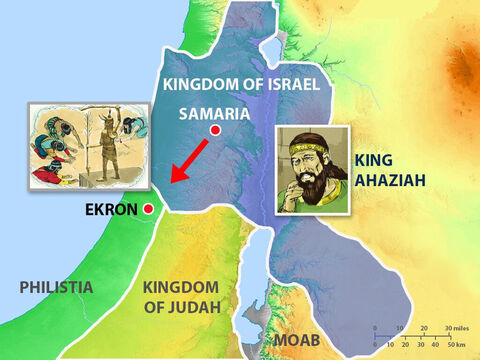
But before Ahaziah had a chance to deal with the rebellious Moabites, he suffered a life-threatening fall that left him confined to his bed in the royal palace in Samaria. His injuries were severe enough that he was concerned about whether he would fully recover. So, he sent messengers to the temple of Baal-zebub, the god of Ekron, seeking a divine prediction concerning his fate. It had been Ahaziah’s parents who had introduced Baal worship to Israel, and he proved to be a faithful adherent to their false religion. In his time of suffering, he sought the counsel of Baal rather than Yahweh, the covenant God of Israel. While Baal worship was rampant throughout the northern kingdom, Ahaziah sent his messengers to Ekron, which was located on Israel’s eastern border with Philistia. Ekron was a renowned occult center, and it was far enough away from Samaria that the news of the king’s injuries might be kept a secret.

However, Ahaziah’s messengers never reached Ekron. They were met along the way by Elijah, the prophet of Yahweh. Ahab’s old nemesis appears on the scene once again, but this time, he has bad news for Ahab’s son. Elijah had received instructions from Yahweh, commanding him to intercept the king’s messengers and inform them of their master’s fate. Ahaziah was hoping to hear a positive word from Baal, but instead, he would receive bad news from the God of Israel.

“Is there no God in Israel? Why are you going to Baal-zebub, the god of Ekron, to ask whether the king will recover? Now, therefore, this is what the LORD says: You will never leave the bed you are lying on; you will surely die.” – 2 Kings 1:3-4 NLT

There is a hint of sarcasm in this message. Yahweh is chiding Ahaziah for sending his messengers all the way to Ekron to seek a word from his false god. Baal worship was rampant within the nation of Israel. There were shrines and high places dedicated to Baal and Asherah all over the northern kingdom. In fact, Ahaziah had access to a Baal temple that his father had built in the capital city of Samaria.

He [Ahab] erected an altar for Baal in the house of Baal, which he built in Samaria. – 1 Kings 15:32 ESV

And there were literally hundreds of priests and prophets who served on behalf of Baal. Yet, Ahaziah had sent his messengers on a field trip all the way to Ekron in hopes of hearing something from his god. Perhaps he had started his search for an answer at the local temple, but had come up empty-handed. This could have led him to his “long-distance-call” to Ekron.

When Ahaziah heard the less-than-positive pronouncement his messengers delivered, he grew suspicious. This was not the news he had been expecting. So, he asked for a description of the man who had predicted his pending death. As soon as he heard what the man looked like, his suspicions were confirmed; it was Elijah the Tishbite. As the son of Ahab and Jezebel, Ahaziah would have grown up hearing the stories of Elijah and his defeat of the prophets of Baal on Mount Carmel. He would have been very familiar with his mother’s intense hatred for this prophet of Yahweh. The ongoing battle of words and will between his father and Elijah would have taken place right in front of him. So, when he discovered that Elijah had once again interjected himself into Israel’s affairs, he sent guards to arrest him. But, just like the messengers he had sent to Ekron, the guards never made it to their destination.

As visible proof of his role as a spokesman for Yahweh, Elijah called down fire from heaven that wiped out all 50 men, including their captain. But this display of power made no impression on the stubborn and unrepentant Ahaziah. He simply sent another 50 guards who suffered the very same fate. The third commander recognized the divine nature of Elijah’s role and wisely chose to beg for mercy.

“O man of God, please spare my life and the lives of these, your fifty servants. See how the fire from heaven came down and destroyed the first two groups. But now please spare my life!” – 2 Kings 1:13-14 NLT

The angel of God intervened, instructing Elijah to spare the lives of these men and accompany them back to Samaria. When he arrived in the capital city, Elijah reiterated his earlier message, but this time, directly to Ahaziah. He confirmed that the king would not recover from his injuries. Ahaziah’s stubborn refusal to seek God even in his time of greatest need would come with a death sentence. His unjustified yet unwavering allegiance to Baal had sealed his fate. As always, the words of Elijah proved to be true.

So Ahaziah died, just as the LORD had promised through Elijah. – 2 Kings 1:17 NLT

Yet another king of Israel met an untimely but well-deserved end. The legacy of unfaithfulness, begun by Jeroboam, had been passed down from generation to generation, infecting each successive king and bringing the just and righteous judgment of God upon them. And because Ahaziah had no male heir to whom he could leave the throne, his brother Jehoram became king of Israel.

Ahaziah, like his predecessors, failed to recognize Yahweh as the one true God. He acted as if Yahweh no longer existed in Israel. But he had been proven wrong. Yahweh was still alive and well, and His power was undiminished. While Ahaziah refused to seek Yahweh’s face, he could not escape Yahweh’s sovereign will. The God of Israel could be ignored, but He would not go away.

Ahaziah had made the fateful mistake of rejecting the one true God. Like his father, Ahaziah had stubbornly refused to acknowledge the supremacy of Yahweh, choosing instead to act as if the God of Israel was non-existent and powerless. But as King David declared in one of his psalms, only a fool would dare deny Yahweh’s existence.

Only fools say in their hearts,
    “There is no God.”
They are corrupt, and their actions are evil;
    not one of them does good!

The LORD looks down from heaven
    on the entire human race;
he looks to see if anyone is truly wise,
    if anyone seeks God.
But no, all have turned away;
    all have become corrupt.
No one does good,
    not a single one!

Will those who do evil never learn?
    They eat up my people like bread
    and wouldn’t think of praying to the Lord.
Terror will grip them,
    for God is with those who obey him.
The wicked frustrate the plans of the oppressed,
    but the LORD will protect his people. – Psalm 14:1-6 NLT

Ahaziah tried to pretend that Yahweh didn’t exist, but he paid for his folly with his life.

English Standard Version (ESV) The Holy Bible, English Standard Version. ESV® Permanent Text Edition® (2016). Copyright © 2001 by Crossway Bibles, a publishing ministry of Good News Publishers.

New Living Translation (NLT) Holy Bible, New Living Translation, copyright © 1996, 2004, 2015 by Tyndale House Foundation. Used by permission of Tyndale House Publishers Inc., Carol Stream, Illinois 60188. All rights reserved.

He Rules Over the Nations

1 Thus says the Lord:

“For three transgressions of Moab,
    and for four, I will not revoke the punishment,
because he burned to lime
    the bones of the king of Edom.
So I will send a fire upon Moab,
    and it shall devour the strongholds of Kerioth,
and Moab shall die amid uproar,
    amid shouting and the sound of the trumpet;
I will cut off the ruler from its midst,
    and will kill all its princes with him,”
says the Lord. Amos 2:1-3 ESV

The nation of Moab shared more than a border with Ammon and Israel. Located along the eastern shore of the Dead Sea, this Semitic nation held close genealogical as well as geographic ties to the people of Israel. As the story in Genesis reveals, the Moabites were the result of an incestuous relationship between Abraham’s nephew Lot and his oldest daughter (Genesis 19:30-38). In Hebrew, the name Moab sounds similar to the word that means “from father.” Moab’s very name seemed to celebrate the fact he was the son of his mother’s father – a child born from immorality.

The Bible provides virtually no information regarding the destiny of Lot’s son, Moab. And the Scriptures provide scant record regarding the fate of his descendants. They originally settled in the plain of Zoar at the southern tip of the Dead Sea. From there they expanded their borders north and south, gradually claiming all the territory east of the Dead Sea. One of the most detailed accounts we have of the Moabites is found in 2 Kings 3. In this chapter, the kings of Israel and Judah join forces with the king of Edom to do battle with the Moabites. This conflict was precipitated by the king of Moab’s decision to stop paying tribute to the king of Israel.

King Mesha of Moab was a sheep breeder. He used to pay the king of Israel an annual tribute of 100,000 lambs and the wool of 100,000 rams. But after Ahab’s death, the king of Moab rebelled against the king of Israel. – 2 Kings 3:4-5 NLT

Jehoram had inherited the crown of Israel after the death of his father, Ahab. King Mesha of Moab seems to have viewed the change in Israel’s leadership as an official termination of the agreement he had made with Ahab. His refusal to send any more tribute payments to Samaria infuriated Jehoram and led him to declare war on Moab.

The ensuing battle did not fare well for King Mesha. Even though Jehoram “did what was evil in the sight of the Lord” (2 Kings 3:2 ESV), God promised to give him victory over the Moabites. Elisha, the prophet of Yahweh, delivered the good news:

“…he [God] will make you victorious over the army of Moab! You will conquer the best of their towns, even the fortified ones. You will cut down all their good trees, stop up all their springs, and ruin all their good land with stones.” – 2 Kings 3:18-19 NLT

And the prophecy of Elisha proved to be true. God gave the kings of Israel, Judah, and Edom a great victory over the Moabites. And, in a last-ditch effort to sway the battle in his favor, King Mesha resorted to offering his own son as a sacrifice to the god Chemosh.

When the king of Moab saw that he was losing the battle, he led 700 of his swordsmen in a desperate attempt to break through the enemy lines near the king of Edom, but they failed. Then the king of Moab took his oldest son, who would have been the next king, and sacrificed him as a burnt offering on the wall. So there was great anger against Israel, and the Israelites withdrew and returned to their own land. – 2 Kings 3:26-27 NLT

This story is significant because it has been used to explain the indictment delivered by God against the Moabites as found in the Amos 2 passage. Amos’ mention of the Moabites having “burned to lime the bones of the king of Edom” (Amos 2:1 NLT) has been linked to the human sacrifice described in the 2 Kings passage. There are those who believe that when the author of 2 Kings states that “he took his oldest son who was to reign in his place and offered him for a burnt offering on the wall” (2 Kings 3:27 ESV), it is a reference to the son of the king of Edom. In other words, King Mesha captured and sacrificed the son of the king of Edom, who would have been the successor to his throne. But there is little evidence to support this conclusion. It makes much more sense that Mesha, a worshiper of the god, Chemosh, used his own son as a human sacrifice, in a last desperate attempt to garner divine intervention.

The fact is, we don’t know when the Moabites burned the bones of the king of Edom. It could have taken place sometime after the battle, an act of revenge against the Edomites for their role in Moab’s defeat. It seems likely that the Moabites desecrated the grave of a former Edomite king, disinterring and burning the bones. It could be that the king of Edom died in the battle described in 2 Kings 3, and that the Moabites later came and dug up his bones, burning them as a sign of disrespect and as payback for their defeat. 

Amos provides no explanation or elaboration concerning Moab’s transgression. He simply states that God will pay them back. By desecrating the grave and the body of the king of Edom, the Moabites were thumbing their noses in the face of God Almighty. They were refusing to admit that their defeat had been His doing. God had given Israel, Judah, and Edom a decisive victory over the Moabites. And just as King Mesha had refused to pay tribute to King Jehoram, the Moabites refused to pay tribute to Yahweh. These descendants of Lot stood opposed to the God of Abraham, and they would pay dearly for their stubborn resistance to His will.

“So I will send a fire upon Moab,
    and it shall devour the strongholds of Kerioth,
and Moab shall die amid uproar,
    amid shouting and the sound of the trumpet;
I will cut off the ruler from its midst,
    and will kill all its princes with him,”
says the Lord. – Amos 2:2-3 NLT

The prophet Isaiah provides further insight into the coming destruction of Moab.

This message came to me concerning Moab:

In one night the town of Ar will be leveled,
    and the city of Kir will be destroyed.
Your people will go to their temple in Dibon to mourn.
    They will go to their sacred shrines to weep.
They will wail for the fate of Nebo and Medeba,
    shaving their heads in sorrow and cutting off their beards.
They will wear burlap as they wander the streets.
    From every home and public square will come the sound of wailing.
The people of Heshbon and Elealeh will cry out;
    their voices will be heard as far away as Jahaz!
The bravest warriors of Moab will cry out in utter terror.
    They will be helpless with fear. – Isaiah 15:1-4 NLT

At the root of Moab’s rebellion lie the sin of pride. They were an arrogant and self-possessed people who refused to acknowledge the sovereignty and superiority of Yahweh. And Isaiah makes this point painfully clear.

We have heard about proud Moab—
    about its pride and arrogance and rage.
    But all that boasting has disappeared. – Isaiah 16:6 NLT

Despite their defeat, the Moabites would remain deluded by their visions of grandeur, and committed to their false gods to restore their good fortunes. But Isaiah reveals that their aspirations of corporate revitalization are ill-founded.

The people of Moab will worship at their pagan shrines,
    but it will do them no good.
They will cry to the gods in their temples,
    but no one will be able to save them. – Isaiah 16:12 NLT

It was only a matter of time before the God of Israel paid back the Moabites for their many transgressions. Like all the rest of the nations outlined in these opening chapters of Amos, the Moabites stood condemned before God and would face His righteous indignation. Their pride would be broken. Their false gods would be exposed as unreliable. And their days of glory would come to an abrupt and decisive end.

But now the Lord says, “Within three years, counting each day, the glory of Moab will be ended. From its great population, only a feeble few will be left alive.” – 2 Kings 3:14 NLT

In 598 B.C., King Nebuchadnezzar would invade the land of Canaan and bring the nation of Moab to its knees, fulfilling the word of God spoken through the prophet Jeremiah.

Because you have trusted in your wealth and skill,
    you will be taken captive.
Your god Chemosh, with his priests and officials,
    will be hauled off to distant lands! – Jeremiah 48:7 NLT

The Moabites would experience the judgment of God. Their pride, arrogance, independence, and stubborn resistance to the will of God would eventually catch up with them. All the nations of the world will one day answer for their actions because “kingship belongs to the Lord, and he rules over the nations” (Psalm 22:28 ESV).

English Standard Version (ESV) The Holy Bible, English Standard Version. ESV® Permanent Text Edition® (2016). Copyright © 2001 by Crossway Bibles, a publishing ministry of Good News Publishers.

New Living Translation (NLT) Holy Bible, New Living Translation, copyright © 1996, 2004, 2015 by Tyndale House Foundation. Used by permission of Tyndale House Publishers Inc., Carol Stream, Illinois 60188. All rights reserved.

The Message (MSG)Copyright © 1993, 1994, 1995, 1996, 2000, 2001, 2002 by Eugene H. Peterson

The Lord’s Anointed

1 Then Elisha the prophet called one of the sons of the prophets and said to him, “Tie up your garments, and take this flask of oil in your hand, and go to Ramoth-gilead. And when you arrive, look there for Jehu the son of Jehoshaphat, son of Nimshi. And go in and have him rise from among his fellows, and lead him to an inner chamber. Then take the flask of oil and pour it on his head and say, ‘Thus says the Lord, I anoint you king over Israel.’ Then open the door and flee; do not linger.”

So the young man, the servant of the prophet, went to Ramoth-gilead. And when he came, behold, the commanders of the army were in council. And he said, “I have a word for you, O commander.” And Jehu said, “To which of us all?” And he said, “To you, O commander.” So he arose and went into the house. And the young man poured the oil on his head, saying to him, “Thus says the Lord, the God of Israel, I anoint you king over the people of the Lord, over Israel. And you shall strike down the house of Ahab your master, so that I may avenge on Jezebel the blood of my servants the prophets, and the blood of all the servants of the Lord. For the whole house of Ahab shall perish, and I will cut off from Ahab every male, bond or free, in Israel. And I will make the house of Ahab like the house of Jeroboam the son of Nebat, and like the house of Baasha the son of Ahijah. 10 And the dogs shall eat Jezebel in the territory of Jezreel, and none shall bury her.” Then he opened the door and fled.

11 When Jehu came out to the servants of his master, they said to him, “Is all well? Why did this mad fellow come to you?” And he said to them, “You know the fellow and his talk.” 12 And they said, “That is not true; tell us now.” And he said, “Thus and so he spoke to me, saying, ‘Thus says the Lord, I anoint you king over Israel.’” 13 Then in haste every man of them took his garment and put it under him on the bare steps, and they blew the trumpet and proclaimed, “Jehu is king.” 2 Kings 9:1-13 ESV

In 1 Kings 19:15-16, we have the record of God’s final commission to Elijah. He had given the prophet three tasks to accomplish. One of them was to anoint Hazael to be the next king of Syria. A second was to anoint Jehu to be the king of Israel. And the third was to anoint Elisha as his own successor.

It’s clear that Elijah followed God’s instructions regarding Elisha. At this point in the story, the new prophet has fully established himself as Elijah’s God-ordained replacement. It would also appear that Elijah kept God’s command concerning the anointing of Hazael. In 2 Kings 8, the author revealed the morbid details concerning Hazael’s ascension to the throne of Syria. While King Ben-hadad was weak and recovering from a recent illness, Hazael murdered him by suffocating him to death with a wet sheet. And the prophet Elisha had wept when he realized the deadly consequences for Israel that would accompany this man’s rise to power.

“Because I know the evil that you will do to the people of Israel. You will set on fire their fortresses, and you will kill their young men with the sword and dash in pieces their little ones and rip open their pregnant women.” – 2 Kings 8:12 ESV

But as 2 Kings 9 opens up, it becomes apparent that there was one aspect of Elijah’s assignment he had neglected to complete. Either that, or he had chosen to pass on the responsibility to his successor. Jehu had not yet been anointed King of Israel. Jehoram, the son of Ahab and Jezebel, still occupied the throne and was continuing his parents’ legacy of apostasy and unfaithfulness. But the time had come for God’s prophecy concerning Ahab and his descendants to be fulfilled. He had warned Ahab that his stubborn determination to lead the people of Israel into idolatry would not go unpunished.

“So now the Lord says, ‘I will bring disaster on you and consume you. I will destroy every one of your male descendants, slave and free alike, anywhere in Israel! I am going to destroy your family as I did the family of Jeroboam son of Nebat and the family of Baasha son of Ahijah, for you have made me very angry and have led Israel into sin.’” – 1 Kings 21:21-22 NLT

God had used the prophet, Elijah, to deliver this message of pending destruction. He was not going to allow Ahab and Jezebel to go unpunished for their blatant disregard for His law or their arrogant dismissal of His sovereignty over Israel. God would do to them what He had done to Jeroboam and Baasha. He would completely wipe out their hopes for establishing a dynasty by destroying all their male descendants.  When considering this curse that God leveled against Ahab, it is important to compare it with the promise God had made to King David.

“When your days are fulfilled and you lie down with your fathers, I will raise up your offspring after you, who shall come from your body, and I will establish his kingdom. He shall build a house for my name, and I will establish the throne of his kingdom forever. I will be to him a father, and he shall be to me a son. When he commits iniquity, I will discipline him with the rod of men, with the stripes of the sons of men, but my steadfast love will not depart from him, as I took it from Saul, whom I put away from before you. And your house and your kingdom shall be made sure forever before me. Your throne shall be established forever.’” – 2 Samuel 7:12-16 ESV

While Ahab, Jeroboam, and Baasha would all see their dreams of establishing long-lasting dynasties come to an end, God had promised David that his house and throne would be established forever. And God was going to fulfill this promise through the southern kingdom of Judah. Despite the fact that most of the kings who eventually ruled over Judah proved to be just as godless and wicked as the northern kings, God would keep His promise to secure the Davidic dynasty. And He would do so through Jesus Christ, the descendant of David and the Messiah of Israel.

But God had something far less glorious in store for King Jehoram of Israel. As he sat in his summer palace in Jezreel, he had no idea that God was about to remove him from power and bring his father’s wicked legacy to an abrupt and permanent end.

Once again, it would appear that Elijah had never completed his assignment to anoint Jehu as the next king of Israel. So, Elisha was left with the responsibility of completing God’s three-part anointing plan. But even Elisha seems to have delegated this final job to an underling. He selected one of the prophets and gave him very specific instructions: “take this flask of olive oil with you. Go to Ramoth-gilead, and find Jehu son of Jehoshaphat, son of Nimshi. Call him into a private room away from his friends, and pour the oil over his head. Say to him, ‘This is what the Lord says: I anoint you to be the king over Israel.’ Then open the door and run for your life!” (2 Kings 9:1-3 NLT). That last sentence could not have left the young prophet feeling confident and encouraged as he made his way to Ramoth-gilead.

But despite the fact that Elijah had passed the buck to Elisha and Elisha had reassigned the responsibility to someone else, God’s will was going to be done. This young prophet, flask in hand, was going to be used to anoint Jehu as the divine instrument of God’s wrath against Ahab and his descendants.

When the prophet arrived in Ramoth-gilead, he found Jehu in a meeting with his fellow generals. He summoned Jehu into a private room, where he poured the oil on his head and informed the surprised general of his new position and commission.

“This is what the Lord, the God of Israel, says: I anoint you king over the Lord’s people, Israel. You are to destroy the family of Ahab, your master. In this way, I will avenge the murder of my prophets and all the Lord’s servants who were killed by Jezebel. The entire family of Ahab must be wiped out. I will destroy every one of his male descendants, slave and free alike, anywhere in Israel.” – 2 Kings 9:6-8 NLT

All of this was unexpected news to Jehu. There is no indication that he had been plotting Jehoram’s death and his own ascension to the throne. But the shocking news of his kingship had to have been overshadowed by the clear conditions associated with it. He was to completely wipe out every last male descendant of Ahab. Not only that, he was to see to it that Jezebel met her end as well.

Dogs will eat Ahab’s wife Jezebel at the plot of land in Jezreel, and no one will bury her.” – 2 Kings 9:10 NLT

God was commanding Jehu to launch an insurrection against the king and his family. And as Jehu sat with oil running down his head and the prophet’s words racing through his brain, the king’s generals waited with curiosity on the other side of the door. Having completed his assignment, the prophet fled for his life, leaving Jehu to rejoin his fellow generals and face their questions about what had just happened. He attempted to downplay his encounter with the prophet, but they sensed he was hiding something and pressed him for details.

Jehu wisely chose not to divulge all the specifics of his conversation with the prophet. He simply stated, “He said to me, ‘This is what the Lord says: I have anointed you to be king over Israel’” (2 Kings 9:12 NLT). And, must to his relief and surprise, the reaction he received from his peers was positive and encouraging. 

Then they quickly spread out their cloaks on the bare steps and blew the ram’s horn, shouting, “Jehu is king!” – 2 Kings 9:13 NLT

His fellow generals declared their overwhelming support of his anointing as the next king of Israel. Of course, they weren’t aware of the second half of the prophet’s message concerning the complete annihilation of Ahab’s family. But at this point, they were fully on board with Jehoram’s removal and Jehu’s rise to power. Some of their enthusiasm could have been the result of the king’s recent defeat against the Syrians at Ramoth-gilead. Jehoram had been wounded in the battle and was recuperating at Jezreel. These generals could have lost confidence in Jehoram’s leadership ability and welcomed the idea of having a king with a military background. The Syrians remained a threat to the nation and Jehoram had proven himself to be a less-than-reliable commander-in-chief.

But, as always, this was the sovereign hand of God orchestrating every single detail of the storyline so that His divine will might be accomplished. He had pledged to destroy Ahab’s dynasty and now He was about to implement His plan to make it happen. And that plan was going to include Jehu, who found himself in the unexpected but highly important role of the Lord’s anointed.

English Standard Version (ESV) The Holy Bible, English Standard Version. ESV® Permanent Text Edition® (2016). Copyright © 2001 by Crossway Bibles, a publishing ministry of Good News Publishers.

New Living Translation (NLT) Holy Bible, New Living Translation, copyright © 1996, 2004, 2015 by Tyndale House Foundation. Used by permission of Tyndale House Publishers Inc., Carol Stream, Illinois 60188. All rights reserved.

The Message (MSG)Copyright © 1993, 1994, 1995, 1996, 2000, 2001, 2002 by Eugene H. Peterson


No Match For Yahweh

16 In the fifth year of Joram the son of Ahab, king of Israel, when Jehoshaphat was king of Judah, Jehoram the son of Jehoshaphat, king of Judah, began to reign. 17 He was thirty-two years old when he became king, and he reigned eight years in Jerusalem. 18 And he walked in the way of the kings of Israel, as the house of Ahab had done, for the daughter of Ahab was his wife. And he did what was evil in the sight of the Lord. 19 Yet the Lord was not willing to destroy Judah, for the sake of David his servant, since he promised to give a lamp to him and to his sons forever.

20 In his days Edom revolted from the rule of Judah and set up a king of their own. 21 Then Joram passed over to Zair with all his chariots and rose by night, and he and his chariot commanders struck the Edomites who had surrounded him, but his army fled home. 22 So Edom revolted from the rule of Judah to this day. Then Libnah revolted at the same time. 23 Now the rest of the acts of Joram, and all that he did, are they not written in the Book of the Chronicles of the Kings of Judah? 24 So Joram slept with his fathers and was buried with his fathers in the city of David, and Ahaziah his son reigned in his place.

25 In the twelfth year of Joram the son of Ahab, king of Israel, Ahaziah the son of Jehoram, king of Judah, began to reign. 26 Ahaziah was twenty-two years old when he began to reign, and he reigned one year in Jerusalem. His mother’s name was Athaliah; she was a granddaughter of Omri king of Israel. 27 He also walked in the way of the house of Ahab and did what was evil in the sight of the Lord, as the house of Ahab had done, for he was son-in-law to the house of Ahab.

28 He went with Joram the son of Ahab to make war against Hazael king of Syria at Ramoth-gilead, and the Syrians wounded Joram. 29 And King Joram returned to be healed in Jezreel of the wounds that the Syrians had given him at Ramah, when he fought against Hazael king of Syria. And Ahaziah the son of Jehoram king of Judah went down to see Joram the son of Ahab in Jezreel, because he was sick. 2 Kings 8:16-29 ESV

At this point in the narrative, the author provides a brief summary of the dynastic legacies of the two divided kingdoms. While much of his time has been spent dealing with the interactions between the two prophets of God and the kings of Israel, he now gives an overview of the most recent lines of succession in both kingdoms.

Due to the extended emphasis he has given to the northern kingdom of Israel, the author seems compelled to step back and revisit the somewhat complex and overlapping nature of the two kingly lines. It was back in 1 Kings 15 that we were first introduced to Jehoshaphat, the king of Judah. He had succeeded his father Asa to the throne. But from 1 Kings 16 to 2 Kings 8, the vast majority of the content focuses on Israel, detailing King Ahab’s rise to power, his wicked reign, and the long line of kings who followed in his footsteps. But the author wants his readers to know that things had not fared any better in the southern kingdom. While Jehoram was ruling in Israel, a young man with the very same name was reigning in Judah. He was the son of Jehoshaphat and he served for five years as his father’s coregent. He would reign an additional eight years once the crown was his alone. But his reign would be marked by apostasy just like the kings of Israel.

Jehoram followed the example of the kings of Israel and was as wicked as King Ahab, for he had married one of Ahab’s daughters. So Jehoram did what was evil in the Lord’s sight. – 2 Kings 8:18 NLT

Jehoram had married into the ungodly and wicked family of King Ahab, taking as his wife, Athaliah, a young woman who would prove to be just as evil as her mother, Jezebel. In fact, 2 Kings 11 will chronicle how she rose to power, crowning herself the queen of Judah after having slaughtered all her sons who were legitimate heirs to the throne.

This woman had an obvious influence over Jehoram. His less-than-stellar choice of a marriage partner proved to be a contributing factor in the downward spiral of his reign. Yet, the author reminds his readers that there was a greater power at work behind the scenes. Despite Jehoram’s wickedness and stubborn refusal to honor the God of Abraham, Isaac, and Jacob, Yahweh was keeping the promise He had made to King David.

Yet the Lord was not willing to destroy Judah, for the sake of David his servant, since he promised to give a lamp to him and to his sons forever. – 2 Kings 8:19 ESV

God was faithfully preserving the line of David, but not because they deserved it. It was because He had a much longer-term plan in place that He was going to fulfill. That is what He had told David long before Solomon ascended to the throne after him.

“When your days are fulfilled and you lie down with your fathers, I will raise up your offspring after you, who shall come from your body, and I will establish his kingdom. He shall build a house for my name, and I will establish the throne of his kingdom forever. I will be to him a father, and he shall be to me a son. When he commits iniquity, I will discipline him with the rod of men, with the stripes of the sons of men, but my steadfast love will not depart from him, as I took it from Saul, whom I put away from before you. And your house and your kingdom shall be made sure forever before me. Your throne shall be established forever.” – 2 Samuel 7:12-16 ESV

This promise was partially fulfilled in Solomon. He would go on to build the temple of God in Jerusalem. But while was blessed by God with great wisdom and wealth, he would prove to be unfaithful in his later years, succumbing to the influence of his many pagan wives and their false gods. It would be because of his apostasy that God eventually split his kingdom in two, creating the northern kingdom of Israel and leaving Solomon’s son, Rehoboam, the southern kingdom of Judah.

With each successive king of Judah, the problem seemed to worsen. Now Jehoram was king over and his apostasy deserved God’s divine judgment. But rather than destroy Jehoram, God graciously disciplined him by causing the neighboring nations of Edom and Libnah to revolt. His entire reign was marked by warfare.

And the Lord stirred up against Jehoram the anger of the Philistines and of the Arabians who are near the Ethiopians. And they came up against Judah and invaded it and carried away all the possessions they found that belonged to the king’s house, and also his sons and his wives, so that no son was left to him except Jehoahaz, his youngest son. – 2 Chronicles 21:16-17 ESV

And his final days in office would be excruciatingly painful due to a divinely-ordained  disease that eventually took his life.

…after all this the Lord struck him in his bowels with an incurable disease. In the course of time, at the end of two years, his bowels came out because of the disease, and he died in great agony. – 2 Chronicles 21:18-19 ESV

Upon his death, his son, Ahaziah, ascended to the throne. This 21-year-old king proved to be just as wicked as his father. “He also walked in the way of the house of Ahab and did what was evil in the sight of the Lord, as the house of Ahab had done” (2 Kings 8:27 ESV). But this should come as no surprise because he was the grandson of Ahab. Wickedness was in his DNA. The fact that his mother was the daughter of Ahab ensured that Ahaziah maintained a close and, ultimately, deadly relationship with the northern kingdom. He would join King Jehoram of Israel in an ill-fated attack on the Syrian stronghold of Ramoth-gilead. King Jehoram was eventually wounded in that battle and forced to return to Jezreel in order to recuperate. And King Ahaziah would make a fateful decision to visit his uncle. But little did he know that this was all part of God’s providential plan for bringing an end to his wicked reign.

But it was ordained by God that the downfall of Ahaziah should come about through his going to visit Joram. – 2 Chronicles 22:7 ESV

God was in control. The kings of Israel and Judah could sit on their royal thrones, issue decrees, flaunt their power and revel in their sovereign authority, but they were no match for Yahweh. Ultimately, their wickedness would come head-to-head with His holiness. Their rebellion would result in His judgment. The sovereign will of God would be done.

English Standard Version (ESV) The Holy Bible, English Standard Version. ESV® Permanent Text Edition® (2016). Copyright © 2001 by Crossway Bibles, a publishing ministry of Good News Publishers.

New Living Translation (NLT) Holy Bible, New Living Translation, copyright © 1996, 2004, 2015 by Tyndale House Foundation. Used by permission of Tyndale House Publishers Inc., Carol Stream, Illinois 60188. All rights reserved.

The Message (MSG)Copyright © 1993, 1994, 1995, 1996, 2000, 2001, 2002 by Eugene H. Peterson


Our Sovereign God

1 Now Elisha had said to the woman whose son he had restored to life, “Arise, and depart with your household, and sojourn wherever you can, for the Lord has called for a famine, and it will come upon the land for seven years.” So the woman arose and did according to the word of the man of God. She went with her household and sojourned in the land of the Philistines seven years. And at the end of the seven years, when the woman returned from the land of the Philistines, she went to appeal to the king for her house and her land. Now the king was talking with Gehazi the servant of the man of God, saying, “Tell me all the great things that Elisha has done.” And while he was telling the king how Elisha had restored the dead to life, behold, the woman whose son he had restored to life appealed to the king for her house and her land. And Gehazi said, “My lord, O king, here is the woman, and here is her son whom Elisha restored to life.” And when the king asked the woman, she told him. So the king appointed an official for her, saying, “Restore all that was hers, together with all the produce of the fields from the day that she left the land until now.”

Now Elisha came to Damascus. Ben-hadad the king of Syria was sick. And when it was told him, “The man of God has come here,” the king said to Hazael, “Take a present with you and go to meet the man of God, and inquire of the Lord through him, saying, ‘Shall I recover from this sickness?’” So Hazael went to meet him, and took a present with him, all kinds of goods of Damascus, forty camels’ loads. When he came and stood before him, he said, “Your son Ben-hadad king of Syria has sent me to you, saying, ‘Shall I recover from this sickness?’” 10 And Elisha said to him, “Go, say to him, ‘You shall certainly recover,’ but the Lord has shown me that he shall certainly die.” 11 And he fixed his gaze and stared at him, until he was embarrassed. And the man of God wept. 12 And Hazael said, “Why does my lord weep?” He answered, “Because I know the evil that you will do to the people of Israel. You will set on fire their fortresses, and you will kill their young men with the sword and dash in pieces their little ones and rip open their pregnant women.” 13 And Hazael said, “What is your servant, who is but a dog, that he should do this great thing?” Elisha answered, “The Lord has shown me that you are to be king over Syria.” 14 Then he departed from Elisha and came to his master, who said to him, “What did Elisha say to you?” And he answered, “He told me that you would certainly recover.” 15 But the next day he took the bed cloth and dipped it in water and spread it over his face, till he died. And Hazael became king in his place. 2 Kings 8:1-15 ESV

Hazael meets prophet Elisha and asks for healing for his master, King Ben Hadad of Syria (2 Kings 8). Wood engraving, published in 1886.

It’s difficult to determine exactly when the two stories that open up chapter eight took place. But the author’s decision to include them at this point in his narrative doesn’t appear to have been based on a desire for chronological accuracy. He was trying to make a point about the spiritual conditions in and around Israel, and so he used the stories of two very different characters as illustrations. One we have met before. The Shunammite woman was first introduced to us in chapter four. She was a faithful follower of Yahweh who had shown gracious hospitality to Elisha and his servant, providing them with shelter and food every time they passed through her town. And God had rewarded her generosity to His servant by allowing her to conceive and bear a son, something she had never been able to do. But sometime in his early childhood, her son became ill and died. Her joy turned to sorrow. But the prophet of God intervened and restored the child to life. And now, in chapter eight, the author decides to pick up the story where he left off.

Now Elisha had said to the woman whose son he had restored to life, “Arise, and depart with your household, and sojourn wherever you can, for the Lord has called for a famine, and it will come upon the land for seven years.” – 2 Kings 8:1 ESV

The prophet informed the Shunammite woman about a famine that God was about to bring upon the land because of Israel’s ongoing apostasy. He gave this faithful servant of Yahweh the opportunity to escape and find shelter until the seven years of famine had passed. And she took the prophet’s advice and fled with her family to the land of the Philistines. But seven years later, when the famine was over and she returned to Shunem, she was homeless and landless. It could be that she sold her husband’s inheritance before she left seven years earlier. But it could be that the crown had confiscated her land in her absence. But in either case, the Mosaic law required that she be given the right to reclaim her land at any time (Leviticus 25:23-28). It would have been part of her husband’s inheritance and protected by law.

So, upon her return, she headed straight to the palace to make an appeal to the king. It seems likely that her husband had died. We know from chapter four that he was more advanced in years (2 Kings 4:14). Yet it could be that he was alive but physically incapable of presenting his case before the king, so his wife acted on his behalf.

This is where the story gets interesting. In a display of divinely inspired timing, the woman arrived at the palace at the exact moment when Gehazi, the servant of Elisha, was having a conversation with King Jehoram. The fact that Gehazi was standing before the king would indicate that this story took place before he had been stricken with leprosy (2 Kings 5:20-27). The author doesn’t reveal the purpose behind Gehazi’s appointment with the king, but he does let us know what they discussed.

Now the king was talking with Gehazi the servant of the man of God, saying, “Tell me all the great things that Elisha has done.” – 2 Kings 8:4 ESV

Jehoram’s relationship with Elisha had been anything but cordial. Like all the kings of Israel, he had a love-hate relationship with God’s prophet. Jehoram was the son of Jezebel and, like his wicked mother, he had continued to lead the people of Israel in the practice of idolatry. So, it seems a bit out of character for him to ask Gehazi to regale him with all the exploits of the prophet of God. But, once again, this reveals the divine timing and providential planning behind all that is taking place in the story. God was orchestrating everything, down to the last detail.

It just so happened that as Gehazi was telling Jehoram how Elisha had restored the woman’s son to life, she walked in the door. Gehazi, shocked at seeing the woman show up at just that moment, exclaimed, “My lord, O king, here is the woman, and here is her son whom Elisha restored to life” (2 Kings 8:5 ESV). This wasn’t a case of kismet, karma, fate, or good luck. It was the sovereign will of God Almighty on display. He had pre-ordained and orchestrated it all. And the result was that the king ordered the immediate restoration of the woman’s land, “including the value of any crops that had been harvested during her absence” (2 Kings 8:6 NLT). He richly rewarded her for her faithfulness.

And this sets up the second story. In this one, the location shifts from Samaria, the capital city of Israel, to Damascus, the capital city of Syria. In verses 1-6, the author presented the story of a faithful servant and a curious king. But in verses 7-15, he tells a strikingly different story about an unfaithful servant and a critically ill king. These stories are arranged as they are for a reason. They are meant to stand in stark contrast to one another. But they are also intended to demonstrate the sovereign hand of God over all that takes place. From the palace of the king of Israel to the royal court of the pagan king of Syria, God is in full control of all things. There is nothing that escapes His notice or falls outside His divine jurisdiction.

In another display of divine timing, Elisha has arrived in Damascus at the very same time that Ben-hadad, the king of Syria, has become ill. Upon hearing of Elisha’s presence in his capital, Ben-hadad determines to take advantage of this fortunate opportunity. He sends Hazael, the governor of Damascus, to ask Elisha whether he will recover from his illness. And, in a not-so-subtle attempt to garner a favorable response from the prophet, Ben-hadad includes a lucrative welcome gift. And when Hazael delivers the king’s gift and message to Elisha, the prophet responds with a rather cryptic answer.

“Go and tell him, ‘You will surely recover.’ But actually the Lord has shown me that he will surely die!” – 2 Kings 8:10 NLT

What followed this exchange was a long and awkward staredown between Elisha and Hazael. The prophet knew exactly what was going on in Hazael’s heart. God had revealed to Elisha exactly what the governor was planning to do. So, he locked eyes with Hazael, perhaps hoping that the awkward silence would lead the governor to have second thoughts about his evil plan. But there was no confession from Hazael. Instead, Elisha began to weep. He knew exactly what was going to happen and the long-term ramifications for the people of Israel.

“I know the terrible things you will do to the people of Israel. You will burn their fortified cities, kill their young men with the sword, dash their little children to the ground, and rip open their pregnant women!” – 2 Kings 8:12 NLT

God had given Elisha a glimpse into all that was going to take place. Ben-hadad would recover from his illness but would die at the hands of Hazael. And when Hazael ascended to the throne of Syria, he would wreak havoc and destruction upon the nation of Israel. He would become God’s chosen instrument of judgment upon His unfaithful people. And this had always been part of God’s sovereign plan.

All the way back in chapter 19 of 1 Kings, we have the story of Elijah running from the threat of Jezebel’s revenge. He escaped to the wilderness where he sought shelter in a cave. But while there, he received a visit and a message from God.

And the Lord said to him, “Go, return on your way to the wilderness of Damascus. And when you arrive, you shall anoint Hazael to be king over Syria. And Jehu the son of Nimshi you shall anoint to be king over Israel, and Elisha the son of Shaphat of Abel-meholah you shall anoint to be prophet in your place.” – 1 Kings 19:15-16 ESV

Don’t miss the significance of what is going on here. Years earlier, God had commanded Elijah to anoint Hazael to be the next king of Syria. And Elijah had obeyed that command. This means that long before Elisha showed up in Damascus and had his face-to-face encounter with Hazael, this man already had God’s divine seal of approval to be the next king of Syria. He had already been anointed by Elijah but had not yet assumed the throne. But it was just a matter of time. It was inevitable and unavoidable because it had been ordained by God.

And God had made it clear to Elijah that He would one day use Hazael as His instrument of judgment upon the rebellious people of Israel.

And the one who escapes from the sword of Hazael shall Jehu put to death, and the one who escapes from the sword of Jehu shall Elisha put to death. Yet I will leave seven thousand in Israel, all the knees that have not bowed to Baal, and every mouth that has not kissed him.” – 1 Kings 19:17-18 ESV

Now, that prophecy was about to be fulfilled. God had shown Elisha what was about to happen and the thought of it brought him to tears.

“The Lord has shown me that you are to be king over Syria.” – 2 Kings 8:13 ESV

The judgment of God was about to come upon the people of Israel. And while He had rewarded the Shunammite woman for her faithfulness, He was about to bring death and destruction upon unfaithful Israel. And the author closes his story with the fateful words: “the next day he [Hazael] took the bed cloth and dipped it in water and spread it over his face, till he died. And Hazael became king in his place” (2 Kings 8:15 ESV).

The man whom God had ordered Elijah to anoint years earlier, was now the king. The sovereign will of God had been fulfilled. And the next phase of His plan for the rebellious people of Israel was about to begin.

English Standard Version (ESV) The Holy Bible, English Standard Version. ESV® Permanent Text Edition® (2016). Copyright © 2001 by Crossway Bibles, a publishing ministry of Good News Publishers.

New Living Translation (NLT) Holy Bible, New Living Translation, copyright © 1996, 2004, 2015 by Tyndale House Foundation. Used by permission of Tyndale House Publishers Inc., Carol Stream, Illinois 60188. All rights reserved.

The Message (MSG)Copyright © 1993, 1994, 1995, 1996, 2000, 2001, 2002 by Eugene H. Peterson

A Day of Good News

Now there were four men who were lepers at the entrance to the gate. And they said to one another, “Why are we sitting here until we die? If we say, ‘Let us enter the city,’ the famine is in the city, and we shall die there. And if we sit here, we die also. So now come, let us go over to the camp of the Syrians. If they spare our lives we shall live, and if they kill us we shall but die.” So they arose at twilight to go to the camp of the Syrians. But when they came to the edge of the camp of the Syrians, behold, there was no one there. For the Lord had made the army of the Syrians hear the sound of chariots and of horses, the sound of a great army, so that they said to one another, “Behold, the king of Israel has hired against us the kings of the Hittites and the kings of Egypt to come against us.” So they fled away in the twilight and abandoned their tents, their horses, and their donkeys, leaving the camp as it was, and fled for their lives. And when these lepers came to the edge of the camp, they went into a tent and ate and drank, and they carried off silver and gold and clothing and went and hid them. Then they came back and entered another tent and carried off things from it and went and hid them.

Then they said to one another, “We are not doing right. This day is a day of good news. If we are silent and wait until the morning light, punishment will overtake us. Now therefore come; let us go and tell the king’s household.” 10 So they came and called to the gatekeepers of the city and told them, “We came to the camp of the Syrians, and behold, there was no one to be seen or heard there, nothing but the horses tied and the donkeys tied and the tents as they were.” 11 Then the gatekeepers called out, and it was told within the king’s household. 12 And the king rose in the night and said to his servants, “I will tell you what the Syrians have done to us. They know that we are hungry. Therefore they have gone out of the camp to hide themselves in the open country, thinking, ‘When they come out of the city, we shall take them alive and get into the city.’” 13 And one of his servants said, “Let some men take five of the remaining horses, seeing that those who are left here will fare like the whole multitude of Israel who have already perished. Let us send and see.” 14 So they took two horsemen, and the king sent them after the army of the Syrians, saying, “Go and see.” 15 So they went after them as far as the Jordan, and behold, all the way was littered with garments and equipment that the Syrians had thrown away in their haste. And the messengers returned and told the king.

16 Then the people went out and plundered the camp of the Syrians. So a seah of fine flour was sold for a shekel, and two seahs of barley for a shekel, according to the word of the Lord. 17 Now the king had appointed the captain on whose hand he leaned to have charge of the gate. And the people trampled him in the gate, so that he died, as the man of God had said when the king came down to him. 18 For when the man of God had said to the king, “Two seahs of barley shall be sold for a shekel, and a seah of fine flour for a shekel, about this time tomorrow in the gate of Samaria,” 19 the captain had answered the man of God, “If the Lord himself should make windows in heaven, could such a thing be?” And he had said, “You shall see it with your own eyes, but you shall not eat of it.” 20 And so it happened to him, for the people trampled him in the gate and he died. 2 Kings 7:3-20 ESV

A protracted siege by the Syrians had left the royal city of Samaria in dire straits. The people inside the walls were starving to death due to the lack of food and some had even resorted to cannibalism, eating their own children to survive. Jehoram, the king of Israel, was powerless to do anything about the situation. He recognized that this was some form of punishment from the hand of Yahweh, but he refused to repent of his apostasy and idolatry. Defenseless against the Syrians and completely powerless to thwart the divine wrath of Yahweh, Jehoram turned his anger and frustration against the prophet Elisha.

Jehoram knew that Elisha was somehow to blame for the devastating conditions in Samaria. And he fully expected the prophet to bring nothing but bad news regarding the ultimate outcome of the siege. But to his surprise, Elisha predicted a dramatic and virtually instantaneous reversal of fortunes.

“By this time tomorrow in the markets of Samaria, six quarts of choice flour will cost only one piece of silver, and twelve quarts of barley grain will cost only one piece of silver.” – 2 Kings 7:1 NLT

Elisha informed the king that within 24 hours, the conditions within the walls of Samaria would improve so dramatically that it would be as if the siege never took place. But Elisha provided no explanation as to how this remarkable transformation would take place. And at least one individual responded to his words with doubt and derision.

The officer assisting the king said to the man of God, “That couldn’t happen even if the Lord opened the windows of heaven!” – 2 Kings 7:2 NLT

The author then transitions his story from the doubting officer to four lepers who sat at the gate of the city. Because of their disease, these men were social outcasts whose survival was based on the generosity of others. They were forced to beg for handouts in order to survive. And the siege had made their circumstances worse than ever. Their appearance in the story at this particular point in time is purely intentional. In a sense, they serve as proxies for the entire nation of Israel. Their disease reflects the spiritual state of God’s people. And their abject state of hopelessness and helplessness is meant to mirror the plight of all those who have abandoned Yahweh.

As they sat at the gate of the city, these four men assessed their situation and determined to do something about it. They could stay where they were and starve to death, or they could risk entering the Syrian camp and placing themselves at the mercy of the enemy. So, sometime before sunrise, they made their fateful decision and walked the short distance from the walls of Samaria to the Syrian encampment. Fully expecting to encounter a Syrian sentry somewhere along the way, they were surprised to find that they were able to walk into the camp uninhibited and unaccosted. The place was a virtual ghost town with not a single Syrian sight. It was as if the entire Syrian army had just evaporated into thin air, leaving behind all their tents, equipment,  and provisions, including mass quantities of food and wine. These four starving lepers found themselves living in a dream come true. Suddenly and unexpectedly, these men who had spent their entire lives begging for food, found themselves surrounded by a seemingly endless supply of delicious delicacies and fine wines.

…they went into one tent after another, eating and drinking wine; and they carried off silver and gold and clothing and hid it. – 2 Kings 7:8 NLT

Like kids let loose in a candy store, they greedily stuffed their faces and their pockets. They had no idea what had happened to the Syrians, and they didn’t seem to care. Their minds were focused on the perpetual feast in front of them and all the silver and gold that had been left for them. Little did they know that their good fortune had been an act of God.

For the Lord had caused the Aramean army to hear the clatter of speeding chariots and the galloping of horses and the sounds of a great army approaching. – 2 Kings 7:6 NLT

Sometime before the lepers had made their decision to enter the Syrian camp, God had performed a miracle. He had caused the Syrians to hear what sounded like a large army headed their way. They immediately concluded that the Israelites had somehow gotten word to their allies and help was on the way.

“The king of Israel has hired the Hittites and Egyptians to attack us!” they cried to one another. So they panicked and ran into the night, abandoning their tents, horses, donkeys, and everything else, as they fled for their lives. – 2 Kings 7:6-7 NLT

There were no Hittites or Egyptians. There were no chariots or horses. It had all been a divine ruse. And when the four lepers finally stopped pillaging long enough to consider the incredible nature of what they were witnessing, they had second thoughts.

“This is not right. This is a day of good news, and we aren’t sharing it with anyone! If we wait until morning, some calamity will certainly fall upon us. Come on, let’s go back and tell the people at the palace.” – 2 Kings 7:9 NLT

But when their good news reached the ears of King Jehoram, he reacted with derision. He saw it as nothing more than a clever ploy by the Syrians to lure the Israelite troops out of the safety of the city. It was all too good to be true. Jehoram could not bring himself to believe that victory could come that easily. There was no way that the long-standing siege could end without a fight and the fall of the city. So, he sent scouts to verify the report of the lepers, and they discovered “a trail of clothing and equipment that the Arameans had thrown away in their mad rush to escape” (2 Kings 7:15 NLT).

It was true. The Syrians were gone and the siege was over. But not only that, the Syrian camp was filled with more than enough food to feed the citizens of the city. And when the Israelites had finished plundering the camp, the conditions within the walls of Samaria were instantaneously reversed.

Then the people of Samaria rushed out and plundered the Aramean camp. So it was true that six quarts of choice flour were sold that day for one piece of silver, and twelve quarts of barley grain were sold for one piece of silver, just as the Lord had promised. – 2 Kings 7:16 NLT

And the author makes sure that we understand the nature of this amazing turn of events.

…everything happened exactly as the man of God had predicted. – 2 Kings 7:17 NLT

God had intervened on behalf of His disobedient children. He had graciously and mercifully delivered them from their enemy and rescued them from imminent death. Overnight, the four lepers had experienced a dramatic shift in their fortunes. They not only had full stomachs but they had hidden enough treasure to transform themselves from paupers to princes. And the people of Samaria were blessed with food they didn’t deserve and riches they had not earned. Their good and gracious God had lovingly spared them – one more time.

But the one man who had expressed doubt concerning God’s ability to deliver His people would find himself suffering a different fate. Elisha had warned him, “You will see it happen with your own eyes, but you won’t be able to eat any of it!” (2 Kings 7:2 NLT). And when the starving masses flowed out of the city to plunder the Syrian camp, this man was crushed to death. He never lived long enough to see what God had done. And not one morsel of the fine Syrian cuisine or one drop of their wine ever touched his lips. He had doubted the power of God and suffered the consequences. The day of good news turned out to be very bad news for him.

English Standard Version (ESV) The Holy Bible, English Standard Version. ESV® Permanent Text Edition® (2016). Copyright © 2001 by Crossway Bibles, a publishing ministry of Good News Publishers.

New Living Translation (NLT) Holy Bible, New Living Translation, copyright © 1996, 2004, 2015 by Tyndale House Foundation. Used by permission of Tyndale House Publishers Inc., Carol Stream, Illinois 60188. All rights reserved.

The Message (MSG)Copyright © 1993, 1994, 1995, 1996, 2000, 2001, 2002 by Eugene H. Peterson

Famine to Feasting

24 Afterward Ben-hadad king of Syria mustered his entire army and went up and besieged Samaria. 25 And there was a great famine in Samaria, as they besieged it, until a donkey’s head was sold for eighty shekels of silver, and the fourth part of a kab of dove’s dung for five shekels of silver.’ 26 Now as the king of Israel was passing by on the wall, a woman cried out to him, saying, “Help, my lord, O king!” 27 And he said, “If the Lord will not help you, how shall I help you? From the threshing floor, or from the winepress?” 28 And the king asked her, “What is your trouble?” She answered, “This woman said to me, ‘Give your son, that we may eat him today, and we will eat my son tomorrow.’ 29 So we boiled my son and ate him. And on the next day I said to her, ‘Give your son, that we may eat him.’ But she has hidden her son.” 30 When the king heard the words of the woman, he tore his clothes—now he was passing by on the wall—and the people looked, and behold, he had sackcloth beneath on his body— 31 and he said, “May God do so to me and more also, if the head of Elisha the son of Shaphat remains on his shoulders today.”

32 Elisha was sitting in his house, and the elders were sitting with him. Now the king had dispatched a man from his presence, but before the messenger arrived Elisha said to the elders, “Do you see how this murderer has sent to take off my head? Look, when the messenger comes, shut the door and hold the door fast against him. Is not the sound of his master’s feet behind him?” 33 And while he was still speaking with them, the messenger came down to him and said, “This trouble is from the Lord! Why should I wait for the Lord any longer?” 

1 But Elisha said, “Hear the word of the Lord: thus says the Lord, Tomorrow about this time a seah of fine flour shall be sold for a shekel, and two seahs of barley for a shekel, at the gate of Samaria.” Then the captain on whose hand the king leaned said to the man of God, “If the Lord himself should make windows in heaven, could this thing be?” But he said, “You shall see it with your own eyes, but you shall not eat of it.”2 Kings 6:24-7:2 ESV

One thing that becomes painfully evident when reading God’s Word is that it tends to paint humanity in far-from-flattering terms. The characters found in the Bible are presented with all their flaws fully exposed. We get to see the good, the bad, and the ugly aspects of their character. There are examples of mankind’s more positive traits, but they seem few and far between. From the opening pages of the book of Genesis to the closing chapters of Revelation, the fallen nature of humanity is presented with painstaking accuracy. Throughout the book, we see a litany of vices on display, including all of the seven deadly sins: pride, greed, lust, envy, gluttony, anger, and sloth. There are countless stories that chronicle mankind’s stubbornness, arrogance, and selfishness. And they are intended to stand in stark contrast to the righteousness of God. All throughout the Bible, we see fallen humanity displayed against the stark backdrop of God’s incomparable holiness. Yet the stories of their unfaithfulness, arrogance, pride, and sin are seamlessly woven together with the countless examples of God’s power and sovereignty. We have one such example in today’s passage.

For some time, Ben-hadad II, the king of Syria, had been trying to develop secret plans to invade Israel. But each time he attempted to put them into action, the Israelites were one step ahead of him. He discovered that Elisha the prophet had been receiving secret intel on all their planning sessions, and it had come directly from Yahweh, the God of Israel. Since Ben-hadad couldn’t do anything to stop Yahweh, he decided to capture Elisha. But, once again, his strategy failed miserably. When his troops laid siege to the city of Dothan, where Elisha was living, God blinded them. Then Elisha led them to Samaria, where the king of Israel spared their lives and threw them a feast. These men returned home, grateful to be alive.

But then we read, “Afterward Ben-hadad king of Syria mustered his entire army and went up and besieged Samaria” (2 Kings 6:24 ESV). We’re not told how much time transpired between Ben-hadad’s last failed attempt to attack Israel and this latest campaign. But it’s quite clear that he had not given up his intentions to conquer the nation of Israel. This man’s stubborn persistence is on display. Despite what had happened to his troops the last time they went into Israelite territory, he was determined to carry out his latest plans.

As a result of the siege, the conditions inside Samaria quickly deteriorated. Food became scarce and the people within the walls of the city became desperate. Price gouging was prevalent because there was nothing to eat. People were willing to pay exorbitant prices for anything that even remotely resembled food.

The siege lasted so long that a donkey’s head sold for eighty pieces of silver, and a cup of dove’s dung sold for five pieces of silver. –  2 Kings 6:25 NLT 

These were desperate times. And to make sure we understand just how bad things had become, the author reveals that the people had resorted to cannibalism. And to make matters worse, it involved a mother sacrificing her infant son so that she and her friends could survive. This sickening story is told to King Jehoram as he walked along the walls of the city, surveying the worsening conditions of his people. What makes this incident all the more repulsive is that it involved deceit and dishonesty. Facing starvation, two mothers had agreed to kill their own children and eat their flesh in order to survive. One had followed through on her commitment, but when it came time for the second mother to kill her child, she couldn’t bring herself to do it.

King Jehoram was sickened by what he heard and tore his clothes as a sign of mourning. Yet, rather than see the situation as a sign of God’s judgment against apostate Israel, the king decided to blame Elisha.

“May God strike me and even kill me if I don’t separate Elisha’s head from his shoulders this very day.” – 2 Kings 6:31 NLT

Jehoram was about to make the age-old mistake of killing the messenger. He knew that Elisha spoke for God, so he assumed that if he could eliminate the prophet, the conditions in Samaria would improve. But Elisha was not the cause of his problem or the source behind the judgment he was experiencing. It was the sovereign, all-powerful hand of God.

Jehoram’s decision to kill God’s prophet was doomed to failure. But fueled by anger, arrogance, and pride, the king sent a messenger to retrieve Elisha and bring him back to the palace. But Elisha was one step ahead of Jehoram, having been informed by God of the king’s intentions.

“A murderer has sent a man to cut off my head. When he arrives, shut the door and keep him out. We will soon hear his master’s steps following him.” – 2 Kings 6:32 NLT

When the messenger arrived, he found the door to Elisha’s home blocked. So, he delivered his message from the king.

“All this misery is from the Lord! Why should I wait for the Lord any longer?” – 2 Kings 6:33 NLT

Jehoram acknowledged that God was behind the siege, but he also revealed his doubt that God would ever rescue them. Since he couldn’t take out his frustration on God, he had decided to kill God’s prophet. He was following the same strategy his mother Jezebel had used. When Elijah had defeated and killed the 450 prophets of Baal, she had ordered his death (1 Kings 19:2). Now, years later, here was her son attempting to thwart the plan of God by killing the prophet of God. Jehoram’s pride, arrogance, and anger are on full display. But at no point does he take ownership of his godless leadership of the nation. He displays no remorse or repentance.

But the prophet delivered an unexpected and inexplicable message to the king.

“Listen to this message from the Lord! This is what the Lord says: By this time tomorrow in the markets of Samaria, six quarts of choice flour will cost only one piece of silver, and twelve quarts of barley grain will cost only one piece of silver.” – 2 Kings 7:1 NLT

Things were about to take a dramatic turn for the better. In just 24 hours, God was going to miraculously reverse the conditions in Samaria. The long-lasting famine would come to an abrupt end and the people living inside the walls of Samaria would suddenly find food readily available and at affordable prices. But the king’s messenger found Elisha’s prediction to be far-fetched and refused to believe a word he said.

“That couldn’t happen even if the Lord opened the windows of heaven!” – 2 Kings 7:2 NLT

This arrogant man questioned the words of the prophet but, more importantly, he doubted the power of God. And Elisha warned him that he would pay dearly for his mistake.

“You will see it happen with your own eyes, but you won’t be able to eat any of it!” – 2 Kings 7:2 NLT

God was about to do something incredible but this emissary of the king refused to believe that any of it was possible. Like his boss, he had long ago given up any belief in the sovereignty and power of Yahweh. From his godless and apostate perspective, this problem was too big, even for God.

English Standard Version (ESV) The Holy Bible, English Standard Version. ESV® Permanent Text Edition® (2016). Copyright © 2001 by Crossway Bibles, a publishing ministry of Good News Publishers.

New Living Translation (NLT) Holy Bible, New Living Translation, copyright © 1996, 2004, 2015 by Tyndale House Foundation. Used by permission of Tyndale House Publishers Inc., Carol Stream, Illinois 60188. All rights reserved.

The Message (MSG)Copyright © 1993, 1994, 1995, 1996, 2000, 2001, 2002 by Eugene H. Peterson

A Floating Ax Head and Chariots of Fire

1 Now the sons of the prophets said to Elisha, “See, the place where we dwell under your charge is too small for us. Let us go to the Jordan and each of us get there a log, and let us make a place for us to dwell there.” And he answered, “Go.” Then one of them said, “Be pleased to go with your servants.” And he answered, “I will go.” So he went with them. And when they came to the Jordan, they cut down trees. But as one was felling a log, his axe head fell into the water, and he cried out, “Alas, my master! It was borrowed.” Then the man of God said, “Where did it fall?” When he showed him the place, he cut off a stick and threw it in there and made the iron float. And he said, “Take it up.” So he reached out his hand and took it. 

Once when the king of Syria was warring against Israel, he took counsel with his servants, saying, “At such and such a place shall be my camp.” But the man of God sent word to the king of Israel, “Beware that you do not pass this place, for the Syrians are going down there.” 10 And the king of Israel sent to the place about which the man of God told him. Thus he used to warn him, so that he saved himself there more than once or twice.

11 And the mind of the king of Syria was greatly troubled because of this thing, and he called his servants and said to them, “Will you not show me who of us is for the king of Israel?” 12 And one of his servants said, “None, my lord, O king; but Elisha, the prophet who is in Israel, tells the king of Israel the words that you speak in your bedroom.” 13 And he said, “Go and see where he is, that I may send and seize him.” It was told him, “Behold, he is in Dothan.” 14 So he sent there horses and chariots and a great army, and they came by night and surrounded the city.

15 When the servant of the man of God rose early in the morning and went out, behold, an army with horses and chariots was all around the city. And the servant said, “Alas, my master! What shall we do?” 16 He said, “Do not be afraid, for those who are with us are more than those who are with them.” 17 Then Elisha prayed and said, “O Lord, please open his eyes that he may see.” So the Lord opened the eyes of the young man, and he saw, and behold, the mountain was full of horses and chariots of fire all around Elisha. 18 And when the Syrians came down against him, Elisha prayed to the Lord and said, “Please strike this people with blindness.” So he struck them with blindness in accordance with the prayer of Elisha. 19 And Elisha said to them, “This is not the way, and this is not the city. Follow me, and I will bring you to the man whom you seek.” And he led them to Samaria.

20 As soon as they entered Samaria, Elisha said, “O Lord, open the eyes of these men, that they may see.” So the Lord opened their eyes and they saw, and behold, they were in the midst of Samaria. 21 As soon as the king of Israel saw them, he said to Elisha, “My father, shall I strike them down? Shall I strike them down?” 22 He answered, “You shall not strike them down. Would you strike down those whom you have taken captive with your sword and with your bow? Set bread and water before them, that they may eat and drink and go to their master.” 23 So he prepared for them a great feast, and when they had eaten and drunk, he sent them away, and they went to their master. And the Syrians did not come again on raids into the land of Israel. 2 Kings 6:1-23 ESV

Let’s face it, even for a prophet of God, Elisha had some rather strange experiences. And the two that are recorded in the opening verses of this chapter are among the most bizarre. At first glance, the only thing they appear to have in common is Elisha. But upon further examination, one can see that both stories are meant to accentuate the power of God’s prophet. The first is short and to the point but displays the supernatural, yet highly practical nature of Elisha’s divine enablement. This man was God’s representative and, as such, he was to display the caring concern that Yahweh had for His children.

Elisha’s fellow prophets approach him, seeking his approval to build a larger complex in which to house their growing number. They had chosen a spot near the Jordan River and were intending to work as a team in the construction of their new home. Elisha gave them his blessing to begin the project, but they requested that he accompany them. Which he did. But as they were going through the laborious process of cutting down the trees to make logs for their new headquarters, one of the men lost the head to his ax. It flew off the handle and landed in the river, disappearing from sight. To our minds, this doesn’t appear to be a life-and-death situation. Obviously, they had more than one ax, but the author reveals that this particular ax had been borrowed and iron was a costly commodity in those days. So, the one who had borrowed the ax was deeply concerned over his bit of bad luck. He would have been required to replace the lost ax head and, on a prophet’s salary, that would have been difficult.

It’s difficult not to read this story and not think about the words that Solomon recorded in the book of Ecclesiastes.

One who digs a pit may fall into it,
and one who breaks through a wall may be bitten by a snake.
One who quarries stones may be injured by them;
one who splits logs may be endangered by them.
If an iron axhead is blunt and a workman does not sharpen its edge,
he must exert a great deal of effort;
so wisdom has the advantage of giving success. – Ecclesiastes 10:8-10 NET

Chopping wood with a loose ax head would have certainly fit into this category of unwise decisions. But rather than embarrass this poor man for his lack of forethought, Elisha simply asked him for a general idea of where the ax head entered the water. Then Elisha did something completely unexpected but highly practical. He “cut a stick and threw it into the water at that spot. Then the ax head floated to the surface” (2 Kings 6:6 NLT). Miraculously, the heavy iron ax head rose to the surface where the man easily and eagerly retrieved it. His problem was solved, thanks to Elisha’s quick thinking and practical application of the divine resources at his disposal.

The second story is a bit more complex, and far more in line with what we would expect a prophet of God to do. Rather than the prophets of Yahweh constructing a new dwelling place, we have the Syrian king and his officers plotting an invasion of Israel. But before they could implement their strategy, Elisha received divine insight into their plans and warned the king of Israel. And much to Ben-hadad’s frustration, this happened repeatedly.

This led the Syrian king to assume that he had a traitor in his camp. Someone was passing on their top-secret plans to the Israelites.  But his officers assured him that the problem was far worse than he thought. Yahweh, the God of Israel, had been listening in on all their secret strategy sessions and then passing the information on to Elisha, who warned the king of Israel.

Determined to put a stop to this leak in his communications network, Ben-hadad sent a large contingent of troops and chariots to capture Elisha. When Elisha’s servant woke up the next morning, he saw Syrian troops as far as the eye could see and he cried out, “Oh, sir, what will we do now?” (2 Kings 6:15 NLT). But the prophet handled the news with the same degree of calmness he had exhibited when he heard about the lost ax head. He simply stated, “Don’t be afraid! For there are more on our side than on theirs!” (2 Kings 6:16 NLT). 

The petrified servant must have questioned his mater’s sanity. How in the world could the prophet think that they had the Syrians outnumbered. But Elisha had every confidence that the same God who raised the ax head from the bottom of the Jordan could raise an army to defeat the Syrians. So, he confidently called on the power of Yahweh.

Then Elisha prayed, “O Lord, open his eyes and let him see!” The Lord opened the young man’s eyes, and when he looked up, he saw that the hillside around Elisha was filled with horses and chariots of fire. – 2 Kings 6:17 NLT

This “heavenly host” was intended to bolster the faith of Elisha’s servant. But, interestingly enough, the horses and chariots of fire did not engage the Syrians in battle. They were a tangible visual representation of God’s power. It’s similar to what happened when Elisha witnessed God take Elijah to be with Him.

As they were walking along and talking, suddenly a fiery chariot pulled by fiery horses appeared. They went between Elijah and Elisha, and Elijah went up to heaven in a windstorm. – 2 Kings 2:11 NLT

God didn’t use the fiery chariots to transport Elijah and He would not use them to save Elisha and the city of Dothan. Instead, Elisha asked God to blind the eyes of the advancing enemy. Then, the prophet led the confused and completely helpless Syrian army to the capital city of Samaria. When they arrived, “the Lord opened their eyes, and they discovered that they were in the middle of Samaria” (2 Kings 6:20 NLT).

But rather than order the slaughter of the disoriented and disadvantaged Syrians, Elisha instructed King Jehoram: “Give them food and drink and send them home again to their master” (2 Kings 6:22 NLT). So, Jehoram threw a great feast and then sent the Syrians home. The details of this incredible Israelite victory would make it all the way to the palace of Ben-hadad, informing him that the God of Israel was greater than the gods of the Syrians. God had protected His prophet and had provided the innocent people of Dothan with a gracious and merciful rescue from certain destruction. The same God who cared enough to return a lost ax head was willing to display His supernatural power over the enemies of Israel. There is no water too deep, no enemy too powerful, and no problem too difficult for God.

English Standard Version (ESV) The Holy Bible, English Standard Version. ESV® Permanent Text Edition® (2016). Copyright © 2001 by Crossway Bibles, a publishing ministry of Good News Publishers.

New Living Translation (NLT) Holy Bible, New Living Translation, copyright © 1996, 2004, 2015 by Tyndale House Foundation. Used by permission of Tyndale House Publishers Inc., Carol Stream, Illinois 60188. All rights reserved.

The Message (MSG)Copyright © 1993, 1994, 1995, 1996, 2000, 2001, 2002 by Eugene H. Peterson

There is No Other God

1 Naaman, commander of the army of the king of Syria, was a great man with his master and in high favor, because by him the Lord had given victory to Syria. He was a mighty man of valor, but he was a leper. Now the Syrians on one of their raids had carried off a little girl from the land of Israel, and she worked in the service of Naaman’s wife. She said to her mistress, “Would that my lord were with the prophet who is in Samaria! He would cure him of his leprosy.” So Naaman went in and told his lord, “Thus and so spoke the girl from the land of Israel.” And the king of Syria said, “Go now, and I will send a letter to the king of Israel.”

So he went, taking with him ten talents of silver, six thousand shekels of gold, and ten changes of clothing. And he brought the letter to the king of Israel, which read, “When this letter reaches you, know that I have sent to you Naaman my servant, that you may cure him of his leprosy.” And when the king of Israel read the letter, he tore his clothes and said, “Am I God, to kill and to make alive, that this man sends word to me to cure a man of his leprosy? Only consider, and see how he is seeking a quarrel with me.”

But when Elisha the man of God heard that the king of Israel had torn his clothes, he sent to the king, saying, “Why have you torn your clothes? Let him come now to me, that he may know that there is a prophet in Israel.” So Naaman came with his horses and chariots and stood at the door of Elisha’s house. 10 And Elisha sent a messenger to him, saying, “Go and wash in the Jordan seven times, and your flesh shall be restored, and you shall be clean.” 11 But Naaman was angry and went away, saying, “Behold, I thought that he would surely come out to me and stand and call upon the name of the Lord his God, and wave his hand over the place and cure the leper. 12 Are not Abana and Pharpar, the rivers of Damascus, better than all the waters of Israel? Could I not wash in them and be clean?” So he turned and went away in a rage. 13 But his servants came near and said to him, “My father, it is a great word the prophet has spoken to you; will you not do it? Has he actually said to you, ‘Wash, and be clean’?” 14 So he went down and dipped himself seven times in the Jordan, according to the word of the man of God, and his flesh was restored like the flesh of a little child, and he was clean.

15 Then he returned to the man of God, he and all his company, and he came and stood before him. And he said, “Behold, I know that there is no God in all the earth but in Israel; so accept now a present from your servant.” 2 Kings 5:1-15 ESV

Elisha appears to have been a prophet to the people. At this point in the narrative, his interactions with the kings of Israel have been few and far between. Yet, we have seen him provide the widow of Zarephath with a miraculous supply of oil that allowed her and her two young sons to escape poverty and avoid possible enslavement. Next, he rewarded the Shunammite woman’s hospitality by replacing the sorrow of her barrenness with the joy of motherhood. But years later, when that young son unexpectedly died, the prophet intervened again, raising him back to life and restoring the joy of his mother. And then there’s the story of the poisoned stew. A young prophet had inadvertently and innocently added wild gourds to a stew that Elisha’s servant had prepared, not knowing that they were poisonous. This deadly concoction could have resulted in the deaths of all the prophets who ate it, but Elisha had intervened, purifying the contents and protecting the lives of God’s messengers.

All of these stories are meant to reveal God’s interest in and interactions with His people. The average Israelite had to live in a land permeated by idolatry and under the judgment of God. On two separate occasions, God had brought famine on the land because of the apostasy of its godless kings. Yet, the stories of Elijah and Elisha reveal how God stepped into the lives of his people, graciously providing them with sustenance in the midst of His divine judgment. These stories are meant to showcase the mercy and love of God. Despite the ongoing unfaithfulness of Israel’s kings, the God of Israel remained committed to the covenant promises He had made to His people.

And in chapter five, we’re given another story that illustrates God’s sovereign hand over not only Israel but all the nations. While the kings of Israel continued to abuse their power by leading the people into idolatry and apostasy, God operated behind the scenes, demonstrating His unparalleled sovereignty over faithless kings, false gods, and even those outside the flock of Israel.

Suddenly, in chapter five, the author expands the scope of his narrative by including the plight of a Syrian general who suffered from the debilitating and potentially deadly disease known as leprosy. This story’s inclusion was meant to shock and surprise the Jewish audience to whom the author originally wrote. Their attention would have been piqued as soon as they read, “Naaman, commander of the army of the king of Syria, was a great man with his master and in high favor, because by him the Lord had given victory to Syria” (2 Kings 5:1 ESV). Why in the world would the God of Israel have given this pagan idol-worshiper a victory of any kind? This would have made no sense. And to make matters worse, this non-Hebrew is described as “a mighty man of valor” (2 Kings 5:1 ESV) who had led raids into Israel and captured and enslaved a young Jewish girl. To the Jewish reader, the only positive aspect of this story would have been that Naaman had leprosy.

Over the centuries, the Syrians had enjoyed a love-hate relationship with the nation of Israel. And ever since God had divided the nation in two, creating the northern kingdom of Israel and the southern kingdom of Judah, the Syrians had made a habit of playing one against the other. Treaties had been signed and then broken. Alliances had been made, only to have been reneged upon. Syria had repeatedly taken advantage of the discord between Israel and Judah, choosing to align itself with one or the other based on what could be gained from the arrangement.

The Syrians were not to be trusted. They were self-promoting opportunists who regularly switch sides and deftly manipulated the strained relationship between Israel and Judah to their advantage. And yet, here we have the unexpected and shocking story about a Syrian general who receives healing from the prophet of God.

Everything about this story is intended to reveal God’s sovereign hand. He is described as the source behind Syria’s victory, and that victory was over the nation of Israel. Not only that, the victory included the capture of a young Jewish girl. But providentially, that same young girl ended up as a servant to Naaman’s wife. Like Moses being adopted into Pharaoh’s family or Joseph ending up serving in Pharaoh’s court, this young, unidentified Jewish girl found herself serving in the home of one of the most powerful men in Syria. Her plight, while difficult, had been God-ordained.

Because of her providential presence in Naaman’s household, she had become aware of his leprosy and was able to tell her mistress about a possible solution to his problem.

“I wish my master would go to see the prophet in Samaria. He would heal him of his leprosy.” – 2 Kings 5:3 NLT

Despite her predicament, she was still a faithful follower of Yahweh, and she believed that her God had the power to provide healing, even to the pagan commander who had enslaved her. Not only does this young girl display an amazing amount of faith, but she reveals a kind and compassionate heart. Rather than rejoicing over her captor’s plight, she expresses her desire that he be healed, even declaring her wish that he could meet the prophet of God.

Once again, God’s sovereignty is revealed through the rather strange chain of events that ensue. Naaman goes to Ben-Hadad II, the king of Syria, and received permission to visit Samaria. The king even provides Naaman with a letter of introduction to Jehoram, the king of Israel. And in an attempt to guarantee Jehoram’s assistance, Ben-Hadad II sends 750 pounds of silver, 150 pounds of gold, and 10 changes of royal apparel. Don’t miss the irony in all of this. At the suggestion of a young Israelite slave girl, a pagan Syrian general has made an appeal to his pagan Syrian king. And that idol-worshiping Syrian king has sent a sizeable tribute to an apostate Israelite king begging that he help his leprosy-stricken general get healing from the God of Israel. You can’t make this stuff up.

When Naaman presented his letter of introduction and the generous gifts from King King Ben-hadad, he was met with both surprise and suspicion. Jehoram thinks the whole thing is a set-up.

“Am I God, that I can give life and take it away? Why is this man asking me to heal someone with leprosy? I can see that he’s just trying to pick a fight with me.” – 2 Kings 5:7 NLT

It never seems to cross Jehoram’s mind to seek the aid of Yahweh or His prophet. He simply panics, assuming the whole thing is a clever ploy by Ben-Hadad to justify military action in the guise of revenge. But while Jehoram decided to leave God out of the equation, Elisha got wind of what was happening and contacted the king.

“Why are you so upset? Send Naaman to me, and he will learn that there is a true prophet here in Israel.” – 2 Kings 5:8 NLT

Once again, God’s prophet came to the rescue. But what happens next is almost humorous. The famous general from Syria had to get in his chariot and, along with his retinue, make his way to Elisha’s humble home. But before Naaman could get there, the prophet sent a messenger to meet him with a rather strange set of instructions.

“Go and wash yourself seven times in the Jordan River. Then your skin will be restored, and you will be healed of your leprosy.” – 2 Kings 5:10 NLT

But the proud military commander, who was used to having all his subordinates report to him, was offended that Elisha didn’t bother to meet him. And it’s clear that he had expected something a bit showier when it came to how he would be healed.

“I expected him to wave his hand over the leprosy and call on the name of the Lord his God and heal me! – 2 Kings 5:11 NLT

But to Naaman’s disappointment, Elisha’s only instructions had been to bathe seven times in the Jordan River. This sounded ridiculous to the general, and he let his frustration be known in no uncertain terms.

Aren’t the rivers of Damascus, the Abana and the Pharpar, better than any of the rivers of Israel? Why shouldn’t I wash in them and be healed?” – 2 Kings 5:12 NLT

But as Naaman was preparing to walk away in a huff, one of his own servants convinced him to do what the prophet had said. After all, what did he have to lose? Yes, the whole bathing-in-the-Jordan thing would be a blow to his pride, but it might very well be worth it. So, Naaman took the advice of his servant and obeyed the command of the prophet. And when he came up out of the water the seventh time, he was completely cleansed of his leprosy. In fact, the author describes the condition of his skin as that of a young child – no scars, scabs, or lesions of any kind. Naaman the Syrian had experienced a miracle, and he clearly recognized that it had been the work of Yahweh, the God of Israel.

“Now I know that there is no God in all the world except in Israel. – 2 Kings 5:15 NLT

That’s an amazing admission to come from the lips of a pagan Syrian general. He had spent his entire life worshiping Baal, and it’s likely that he had often petitioned his god for healing from his condition. But his requests had remained unheeded because they had gone unheard. His leprosy had been real, but his god was not. Yet, here was Naaman standing before Yahweh’s prophet, healed and whole, and declaring his belief in the one true God of Israel.

English Standard Version (ESV) The Holy Bible, English Standard Version. ESV® Permanent Text Edition® (2016). Copyright © 2001 by Crossway Bibles, a publishing ministry of Good News Publishers.

New Living Translation (NLT) Holy Bible, New Living Translation, copyright © 1996, 2004, 2015 by Tyndale House Foundation. Used by permission of Tyndale House Publishers Inc., Carol Stream, Illinois 60188. All rights reserved.

The Message (MSG)Copyright © 1993, 1994, 1995, 1996, 2000, 2001, 2002 by Eugene H. Peterson

When Dreams Turn Into Nightmares

One day Elisha went on to Shunem, where a wealthy woman lived, who urged him to eat some food. So whenever he passed that way, he would turn in there to eat food. And she said to her husband, “Behold now, I know that this is a holy man of God who is continually passing our way. 10 Let us make a small room on the roof with walls and put there for him a bed, a table, a chair, and a lamp, so that whenever he comes to us, he can go in there.”

11 One day he came there, and he turned into the chamber and rested there. 12 And he said to Gehazi his servant, “Call this Shunammite.” When he had called her, she stood before him. 13 And he said to him, “Say now to her, ‘See, you have taken all this trouble for us; what is to be done for you? Would you have a word spoken on your behalf to the king or to the commander of the army?’” She answered, “I dwell among my own people.” 14 And he said, “What then is to be done for her?” Gehazi answered, “Well, she has no son, and her husband is old.” 15 He said, “Call her.” And when he had called her, she stood in the doorway. 16 And he said, “At this season, about this time next year, you shall embrace a son.” And she said, “No, my lord, O man of God; do not lie to your servant.” 17 But the woman conceived, and she bore a son about that time the following spring, as Elisha had said to her.

18 When the child had grown, he went out one day to his father among the reapers. 19 And he said to his father, “Oh, my head, my head!” The father said to his servant, “Carry him to his mother.” 20 And when he had lifted him and brought him to his mother, the child sat on her lap till noon, and then he died. 21 And she went up and laid him on the bed of the man of God and shut the door behind him and went out. 22 Then she called to her husband and said, “Send me one of the servants and one of the donkeys, that I may quickly go to the man of God and come back again.” 23 And he said, “Why will you go to him today? It is neither new moon nor Sabbath.” She said, “All is well.” 24 Then she saddled the donkey, and she said to her servant, “Urge the animal on; do not slacken the pace for me unless I tell you.” 25 So she set out and came to the man of God at Mount Carmel. 2 Kings 4:8-25 ESV

When Elijah had been the prophet of God to Israel, his ministry seemed to focus on the royal household. Virtually all of the interactions he had were with King Ahab or his wife, Jezebel. And while Elisha had begun his own prophetic ministry with a confrontation between himself and King Jehoram, he seems to have been a prophet to the people. In the last story, Elisha came to the aid of a recently widowed woman who was facing the prospect of having her two sons sold into slavery because of an unpaid debt. In a sense, this woman represented the nation of Israel. She had been left destitute by her husband, a former prophet of God. While alive, this man of God had incurred a sizeable debt, and had he made no plans for its repayment in the case of his death. In a real sense, the people of Israel found themselves spiritually destitute and owing a large debt to God Almighty. Their kings had taken advantage of God’s love and mercy, using His resources to fund their own profligate lifestyles. They had lived for the moment, never considering what would happen when God called their debt due. Jeroboam, Ahab, Ahaziah, and now, Jehoram, all led the people into idolatry and left them with a debt they could not pay.

But Elisha had intervened on the widow’s behalf, providing her with a miracle that eliminated her debt, spared her sons, and met her needs for a long time to come. Through the actions of His faithful prophet, the God of Israel revealed His love and concern for His covenant people. Now, the story shifts to yet another encounter between Elisha and a woman in need. But this time, the woman isn’t even aware that she has a need.

For some unspecified reason, Elisha and his servant, Gehazi, made regular trips to the northern region of Israel that took them to the city of Shunem. In this city, Elisha made the acquaintance of a local woman who offered the prophet and his servant access to her home so they could rest. Realizing that Elisha was a prophet of Yahweh she showed him hospitality and even had her husband construct a room on the roof of their home where the two men could stay when they were in town.

Unlike the widow in the previous story, this woman was apparently wealthy and well-cared for. She had a husband and enjoyed a comfortable lifestyle. But she was also generous and willing to share what she had with others. The gracious hospitality she extended to the prophet of God reveals that, despite the apostasy all around her, she had maintained her dedication to Yahweh.

Desiring to thank the woman for her courtesy and care, Elisha sent his servant to ask what they could do for her. He wanted to repay her for her kindness. But it’s interesting to note that he offered to speak a good word on her behalf to the king or the commander of the army. Why would the prophet of Yahweh offer to act as an intermediary between this woman and these two apostate leaders of Israel? Perhaps it was a test, designed to see if the woman was a true follower of Yahweh. Would his offer of access to the king pique her interest and reveal a self-aggrandizing side to her personality? Or, instead, would she ask the prophet of God to appeal to Yahweh on her behalf?

But the woman simply responded, “I dwell among my own people” (2 Kings 4:13 ESV). This rather cryptic-sounding statement was her way of saying, “I’m just fine. I’m well-taken care of and in need of nothing.”

Yet, Elisha somehow senses that her answer was not quite honest. She was hiding something. And it was Gehazi who made the keen observation that she and her husband were childless. She had a husband and enjoyed a comfortable lifestyle, but she had no sons to carry on the family name. And Gehazi had recognized that her husband was advanced in years.

While the woman in the previous story had been without a husband, she had been blessed with two sons. But the Shunnamite woman had a husband but no children. For the moment, the woman had no perceived need, but the day was coming when her husband would die with no male heirs to whom he could leave his land and estate. In that culture, the inheritance could not be passed on to the wife. So, without a son, she would be left with nothing. She didn’t realize it, but her predicament was far more precarious than she imagined.

So, Elisha called the woman in and informed her, “Next year at this time you will be holding a son in your arms!” (2 Kings 4:16 NLT). Her reaction to this news reveals that she had long ago given up hope of ever having a son.

“No, my lord!” she cried. “O man of God, don’t deceive me and get my hopes up like that.” – 2 Kings 4:16 NLT

When Elisha had asked the woman what he could do for her, she had hidden the desire of her heart. She gave the impression that she had no need and was perfectly fine. But she had lied. Her heart longed for a son but she had become convinced that her dream would never become a reality. So, she lived with a constant fear of the future. What would happen to her when her husband died? How would she survive?

But, once again, Elisha, operating on behalf of Yahweh, spoke a word of blessing over the woman, predicting that she would give birth to a son. And his words proved true. God did a miracle and gave the woman the desire of her heart. She conceived and gave birth to a son. But the story doesn’t stop there.

In the space of just a few verses, the author reveals that the storybook ending was about to take a dark turn. This precious gift from God was going to be suddenly and unexpectedly taken away. One day, while visiting his father in the fields, the young boy complained of a headache. He was rushed home and, later that same day, he passed away in the arms of his mother. Every detail of this story makes the reader want to ask, “Why?” None of this makes sense. Why would God give this woman a son and then allow him to be taken away? What good did it do for her to give birth to a son if he would never live long enough to become the heir? The woman was no better off than before. If anything, her sorrow was only intensified by the loss of her long-awaited son.

But the actions of the woman reveal something about her faith. Upon her son’s death, she took the body and laid it on the prophet’s bed. Then she ordered her husband to saddle a donkey so she could fetch the prophet. At this point, it seems that the boy’s father was unaware that his son had died. For whatever reason, the woman chose to keep him in the dark, assuring him, “All is well” (2 Kings 4:23 ESV). Her son was dead but she still had hope. She knew that the very same man who had predicted the birth of her son would know what to do. This time, rather than hide her need, she sought the one who could do something about it. And she found Elisha at Mount Carmel, the site of Elijah’s victory over the prophets of Baal.

English Standard Version (ESV) The Holy Bible, English Standard Version. ESV® Permanent Text Edition® (2016). Copyright © 2001 by Crossway Bibles, a publishing ministry of Good News Publishers.

New Living Translation (NLT) Holy Bible, New Living Translation, copyright © 1996, 2004, 2015 by Tyndale House Foundation. Used by permission of Tyndale House Publishers Inc., Carol Stream, Illinois 60188. All rights reserved.

The Message (MSG)Copyright © 1993, 1994, 1995, 1996, 2000, 2001, 2002 by Eugene H. Peterson