Conviction Over Compromise

1 For three years Syria and Israel continued without war. 2 But in the third year Jehoshaphat the king of Judah came down to the king of Israel. 3 And the king of Israel said to his servants, “Do you know that Ramoth-gilead belongs to us, and we keep quiet and do not take it out of the hand of the king of Syria?” 4 And he said to Jehoshaphat, “Will you go with me to battle at Ramoth-gilead?” And Jehoshaphat said to the king of Israel, “I am as you are, my people as your people, my horses as your horses.”

5 And Jehoshaphat said to the king of Israel, “Inquire first for the word of the LORD.” 6 Then the king of Israel gathered the prophets together, about four hundred men, and said to them, “Shall I go to battle against Ramoth-gilead, or shall I refrain?” And they said, “Go up, for the Lord will give it into the hand of the king.” 7 But Jehoshaphat said, “Is there not here another prophet of the LORD of whom we may inquire?” 8 And the king of Israel said to Jehoshaphat, “There is yet one man by whom we may inquire of the LORD, Micaiah the son of Imlah, but I hate him, for he never prophesies good concerning me, but evil.” And Jehoshaphat said, “Let not the king say so.” 9 Then the king of Israel summoned an officer and said, “Bring quickly Micaiah the son of Imlah.” 10 Now the king of Israel and Jehoshaphat the king of Judah were sitting on their thrones, arrayed in their robes, at the threshing floor at the entrance of the gate of Samaria, and all the prophets were prophesying before them. 11 And Zedekiah the son of Chenaanah made for himself horns of iron and said, “Thus says the LORD, ‘With these you shall push the Syrians until they are destroyed.’” 12 And all the prophets prophesied so and said, “Go up to Ramoth-gilead and triumph; the LORD will give it into the hand of the king.”

13 And the messenger who went to summon Micaiah said to him, “Behold, the words of the prophets with one accord are favorable to the king. Let your word be like the word of one of them, and speak favorably.” 14 But Micaiah said, “As the LORD lives, what the LORD says to me, that I will speak.” – 1 Kings 22:1-14 ESV
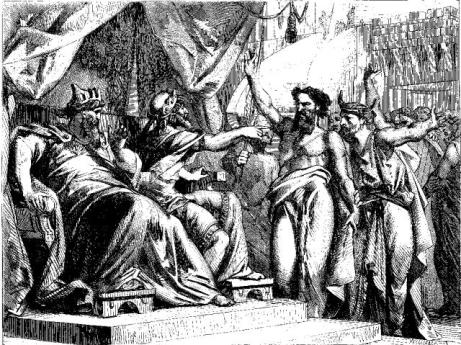
King Ahab had been placed under a curse from God for having spared the life of Ben-hadad, the king of Syria. Rather than obey God’s command to put his enemy to death, Ahab had chosen to sign a peace treaty with him that would allow Israel to profit from Syria’s lucrative trading business. Yet, despite the judgment leveled against him by God, Ahab’s decision seems to have produced positive results.

The treaty that Ahab brokered produced three years of peace and prosperity between the two nations. Israel and Syria became allies and trading partners. According to an inscription on an Assyrian tablet discovered in 1861, Ahab and Ben-hadad were part of a 12-nation confederation that faced Emperor Shalmaneser and the Assyrians in the Battle of Qarqar in 853 BC. So, while God had decreed that Ahab’s dynasty would come to an end with his death, the king of Israel continued to enjoy a small measure of success. His insatiable desire for glory and self-aggrandizement would eventually drive him to jeopardize his peaceful and prosperous relationship with Syria.

During the time Ahab was on the throne of Israel, Jehoshaphat became the king of Judah. He succeeded his father, Asa, and, according to the book of 2 Chronicles, Jehoshaphat proved to be a good king.

The LORD was with Jehoshaphat, because he walked in the earlier ways of his father David. He did not seek the Baals, but sought the God of his father and walked in his commandments, and not according to the practices of Israel. Therefore the LORD established the kingdom in his hand. And all Judah brought tribute to Jehoshaphat, and he had great riches and honor. His heart was courageous in the ways of the LORD. And furthermore, he took the high places and the Asherim out of Judah. – 2 Chronicles 17:3-6 ESV

Because Jehoshaphat chose to remove all the false gods and restore the worship of the one true God, his reign was blessed, and the southern kingdom of Judah became a powerful force in the region. But Jehoshaphat, like his father before him, made the mistake of placing his trust in the Syrians. When King Baasha of Israel began to build a fortified city on the border between Israel and Judah, King Asa sought the help of Ben-hadad and the Syrians. Asa “took silver and gold from the treasures of the house of the LORD and the king’s house and sent them to Ben-hadad king of Syria” (2 Chronicles 16:2 ESV). He used these funds to convince Ben-hadad to break his covenant with Israel and join forces with him. His ploy worked, and Baasha stopped construction on his military outpost. But God condemned Asa for his alliance with Ben-hadad, warning that Judah would face non-stop war during the rest of his reign. Rather than trust God, Asa had placed his hope in a foreign king who worshiped false gods.

And while his son Jehoshaphat would prove to be faithful to God, he would also make an alliance with an ungodly, idol-worshiping king.

Now Jehoshaphat had great riches and honor, and he made a marriage alliance with Ahab. After some years he went down to Ahab in Samaria. And Ahab killed an abundance of sheep and oxen for him and for the people who were with him, and induced him to go up against Ramoth-gilead. – 2 Chronicles 18:1-2 ESV

This marital alliance ultimately put Jehoshaphat in a difficult position. While visiting Israel’s capital city of Samaria, Jehoshaphat was presented with an official request from Ahab for military assistance in recapturing the town of Ramoth-gilead from the Syrians. It galled Ahab that the Syrians had stolen a city that had once belonged to Israel, and nothing had been done about it.

“Do you know that Ramoth-gilead belongs to us, and we keep quiet and do not take it out of the hand of the king of Syria?” – 1 Kings 22:3 ESV

So, he called on Jehoshaphat to help him right this apparent wrong, and Jehoshaphat quickly and readily agreed.

“I am as you are, my people as your people, my horses as your horses.” – 1 Kings 22:4 ESV

But Jehoshaphat, anxious to remain obedient to God, asked Ahab to seek Yahweh’s counsel. It’s important to understand that Jehoshaphat wanted to know what the “LORD” (Yahweh) would have them do. But when Ahab commissioned his 400 prophets to seek the will of the gods, they came back with the answer:

“Go up, for the Lord (ăḏōnāy) will give it into the hand of the king.” – 1 Kings 22:6 ESV

These men did not mention the name of Yahweh, and Jehoshaphat seems to have immediately recognized that these were false prophets who had been seeking the will of their false god. So, he asked Ahab if there were no prophets of the one true God left in Israel. Ahab reluctantly confessed that one prophet of Yahweh remained, a man named Micaiah, whom he hated with a passion.

“He never prophesies anything but trouble for me!” – 1 Kings 22:8 NLT

Micaiah never told Ahab what he wanted to hear, so the king avoided him like the plague. But Jehoshaphat insisted that Micaiah be consulted before any action was taken against the Syrians.  So, Ahab sent someone to fetch his least-favorite prophet. In the meantime, his 400 false prophets bombarded Jehoshaphat with their cheery predictions of success.

“Go up to Ramoth-gilead and triumph; the LORD (Yahweh) will give it into the hand of the king.” – 1 Kings 22:12 ESV

This time, the prophets of Baal changed their tune and mentioned the name of Yahweh. Perhaps they hoped this reference to the God of Israel would convince Jehoshaphat to acquiesce and give his approval for the joint venture against the Syrians.

The text doesn’t reveal how long it took for Micaiah to be located and brought to Samaria. However, during the delay, Jehoshaphat found himself pressured to listen to the false prophets and join forces with Ahab. The temptation to compromise his convictions was great. He could have easily given in and listened to the popular opinions of the crowd, but instead, Jehoshaphat waited to hear a word from Yahweh.

Even Micaiah found himself pressured to follow the party line. The messenger who located him delivered a not-so-subtle warning that there was only one answer King Ahab wanted to hear.

“Look, all the prophets are promising victory for the king. Be sure that you agree with them and promise success.” – 1 Kings 22:13 NLT

But Micaiah would not be bullied into submission. He knew how much Ahab hated him, and he would be risking his life to disobey a direct order from the king. Yet his allegiance to Yahweh was greater than his fear of Ahab. So, he told the messenger, “As surely as the LORD lives, I will say only what the LORD tells me to say” (1 Kings 22:14 NLT).

It must have been a long and awkward trip back to Samaria for the messenger. He probably feared for his own life because he knew the prophet was determined to deliver bad news to the king. Everyone who worked for Ahab and all the people who lived in Israel knew that their king had no love affair with Yahweh. He had spent his entire reign promoting the worship of false gods like Baal and Asherah, and he had done everything he could do to ignore and even eliminate the prophets of God. Ahab knew exactly what Micaiah was going to say when he showed up, and it would not be what he wanted to hear.

Ahab needed Jehoshaphat’s help against the Syrians, and he knew that Jehoshaphat’s God would stand opposed to his ambitious plans to recapture Ramoth-gilead. Ahab didn’t want to hear from God because he was unwilling to do God’s will. Like a petulant child, Ahab was determined to get his way, even if it meant disobeying Yahweh’s will. But the prophet of the LORD was unwilling to succumb to the pressure to compromise his convictions and tell the king what he wanted to hear. He would speak the truth, even if it cost him his life. This obscure and little-known prophet was going to choose character over conformity and stand up to the threats of the wicked and powerful king of Israel.

Micaiah’s commitment to Yahweh was unassailable and non-negotiable. Nothing would convince him to compromise or sell out. He was determined to remain faithful to his God, whatever the cost. His bold determination to stand his ground in the face of intense opposition and even the threat of death is reminiscent of the actions of Shadrach, Meshach, and Abednego, the Hebrew friends of Daniel who found themselves facing a death sentence for refusing to bow to the statue King Nebuchadnezzar had erected.

“I will give you one more chance to bow down and worship the statue I have made when you hear the sound of the musical instruments. But if you refuse, you will be thrown immediately into the blazing furnace. And then what god will be able to rescue you from my power?”

Shadrach, Meshach, and Abednego replied, “O Nebuchadnezzar, we do not need to defend ourselves before you. If we are thrown into the blazing furnace, the God whom we serve is able to save us. He will rescue us from your power, Your Majesty. But even if he doesn’t, we want to make it clear to you, Your Majesty, that we will never serve your gods or worship the gold statue you have set up.” – Daniel 3:15-18 NLT

These three young men were willing to die for their beliefs and gladly faced the fires of the furnace with their commitment to Yahweh uncompromised. And their unwavering faith was rewarded.

So Shadrach, Meshach, and Abednego stepped out of the fire. Then the high officers, officials, governors, and advisers crowded around them and saw that the fire had not touched them. Not a hair on their heads was singed, and their clothing was not scorched. They didn’t even smell of smoke! – Daniel 3:26-27 NLT

The Book of Acts records another story of uncompromising faith in the face of unrelenting pressure. Peter and John had been jailed by the powerful Jewish Sanhedrin for preaching “that through Jesus there is a resurrection of the dead” (Acts 4:2 NLT). The following morning, when the two men were dragged before the council, they were ordered to cease and desist. The high priest commanded them, “never again to speak or teach in the name of Jesus” (Acts 4:18 NLT). 

But Peter and John replied, “Do you think God wants us to obey you rather than him? We cannot stop telling about everything we have seen and heard.” – Acts 4:18-20 NLT

Facing the threat of additional jail time or worse, Peter and John stood their ground and declared their intention to continue preaching the truth concerning Jesus. They could be threatened, but they would not be silenced. And, in doing so, they joined the ranks of other faithful men like Micaiah, Daniel, Shadrach, Meshach, and Abednego.

English Standard Version (ESV) The Holy Bible, English Standard Version. ESV® Permanent Text Edition® (2016). Copyright © 2001 by Crossway Bibles, a publishing ministry of Good News Publishers.

New Living Translation (NLT) Holy Bible, New Living Translation, copyright © 1996, 2004, 2015 by Tyndale House Foundation. Used by permission of Tyndale House Publishers Inc., Carol Stream, Illinois 60188. All rights reserved.

The High Price of Getting Your Own Way

1 Now Naboth the Jezreelite had a vineyard in Jezreel, beside the palace of Ahab king of Samaria. 2 And after this Ahab said to Naboth, “Give me your vineyard, that I may have it for a vegetable garden, because it is near my house, and I will give you a better vineyard for it; or, if it seems good to you, I will give you its value in money.” 3 But Naboth said to Ahab, “The LORD forbid that I should give you the inheritance of my fathers.” 4 And Ahab went into his house vexed and sullen because of what Naboth the Jezreelite had said to him, for he had said, “I will not give you the inheritance of my fathers.” And he lay down on his bed and turned away his face and would eat no food.

5 But Jezebel his wife came to him and said to him, “Why is your spirit so vexed that you eat no food?” 6 And he said to her, “Because I spoke to Naboth the Jezreelite and said to him, ‘Give me your vineyard for money, or else, if it please you, I will give you another vineyard for it.’ And he answered, ‘I will not give you my vineyard.’” 7 And Jezebel his wife said to him, “Do you now govern Israel? Arise and eat bread and let your heart be cheerful; I will give you the vineyard of Naboth the Jezreelite.”

8 So she wrote letters in Ahab’s name and sealed them with his seal, and she sent the letters to the elders and the leaders who lived with Naboth in his city. 9 And she wrote in the letters, “Proclaim a fast, and set Naboth at the head of the people. 10 And set two worthless men opposite him, and let them bring a charge against him, saying, ‘You have cursed God and the king.’ Then take him out and stone him to death.” 11 And the men of his city, the elders and the leaders who lived in his city, did as Jezebel had sent word to them. As it was written in the letters that she had sent to them, 12 they proclaimed a fast and set Naboth at the head of the people. 13 And the two worthless men came in and sat opposite him. And the worthless men brought a charge against Naboth in the presence of the people, saying, “Naboth cursed God and the king.” So they took him outside the city and stoned him to death with stones. 14 Then they sent to Jezebel, saying, “Naboth has been stoned; he is dead.”

15 As soon as Jezebel heard that Naboth had been stoned and was dead, Jezebel said to Ahab, “Arise, take possession of the vineyard of Naboth the Jezreelite, which he refused to give you for money, for Naboth is not alive, but dead.” 16 And as soon as Ahab heard that Naboth was dead, Ahab arose to go down to the vineyard of Naboth the Jezreelite, to take possession of it. – 1 Kings 21:1-16 ESV

Chapter 20 ended with the statement: “And the king of Israel went to his house vexed and sullen and came to Samaria” (1 Kings 20:43 ESV). The author used two Hebrew words, sar and zāʿēp̄, to describe Ahab’s state of mind, and like most words in the Hebrew language, these two words carry a range of meanings. When we read that Ahab was “vexed and sullen,” it conjures up images of an unhappy child who is pouting because he didn’t get his way. But Ahab wasn’t just throwing himself a pity party; he was angry and resentful. And it’s easy to understand the intensity of his emotions when we consider the severity of God’s judgment. Ahab had chosen to spare the life of Ben-hadad so that he could sign a potentially lucrative treaty with him. But this decision had not been God’s will, and Ahab would suffer greatly for it.

“Because you have let go out of your hand the man whom I had devoted to destruction, therefore your life shall be for his life, and your people for his people.” – 1 Kings 20:42 ESV

With that bit of bad news still ringing in his ears, Ahab left the Valley of Aphek and returned to his palace in Samaria. When he arrived, he was in a dark mental state. The New English Translation describes him as “bitter and angry.” He deeply resented the punishment meted out to him by God. The Hebrew word sar conveys the idea of a stubborn, almost rebellious resistance to his God-ordained fate. The word zāʿēp̄ lets the reader know that Ahab was wearing his emotions on his sleeve. His anger was visible, and since he could not take out his rage on Yahweh, it spilled over onto all those around him. Even his neighbor, Naboth.

At some point after the victory over the Syrians, Ahab visited his summer palace in Jezreel. One day, while surveying the grounds of his palace, he noticed Naboth’s vineyard, which was located nearby. Seeing that this was fertile land, Ahab determined that it would make a fine spot to plant a garden for his palace. So, he approached Naboth with an offer.

“Since your vineyard is so convenient to my palace, I would like to buy it to use as a vegetable garden. I will give you a better vineyard in exchange, or if you prefer, I will pay you for it.” – 1 Kings 21:2 NLT

But Naboth politely turned down the king’s generous offer, explaining that the land on which the vineyard was located was part of his inheritance. According to the Mosaic Law, the Israelites were forbidden from selling the land that God had given them as their inheritance. The book of Leviticus outlined this divine prohibition against property transactions involving land dedicated to the various tribes of Israel.

“The land must never be sold on a permanent basis, for the land belongs to me. You are only foreigners and tenant farmers working for me.” – Leviticus 25:23 NLT

The book of Numbers provides further clarification concerning God’s ban on the transfer or sale of any of the land He had allotted to the 12 tribes.

The inheritance of the people of Israel shall not be transferred from one tribe to another, for every one of the people of Israel shall hold on to the inheritance of the tribe of his fathers. – Numbers 36:7 NLT

Naboth was simply obeying the law as given to Moses by God. He was legally prohibited from accepting Ahab’s offer. But none of this mattered to Ahab, and Naboth’s firm but polite response produced in Ahab the same effect as God’s earlier warning of judgment.

And Ahab went into his house vexed and sullen because of what Naboth the Jezreelite had said to him… – 1 Kings 21:4 ESV

Ahab responded with bitterness and anger. But notice that his anger was not directed at Naboth but at what Naboth had said. When Naboth informed the king that he could not sell him the land, his justification had been based on the law of God. Once again, Yahweh, the God of Israel, had interfered with Ahab’s plans, producing in him a strong sense of resentment and frustration. His anger was directed at God for His constant intervention in his affairs. Ahab couldn’t even buy a vineyard without running into this ever-present God who seemed to stick His nose into everything. Denied his desire for a garden, Ahab allowed his anger to turn to depression and deep despondency, even refusing to eat.

Concerned about the deteriorating condition of her husband’s mental health, Jezebel asked Ahab for an explanation. But notice the brevity of his reply. Rather than give Jezebel the full context of his conversation with Naboth, he simply states that he made a fair offer that was summarily rebuffed. His recollection of what Naboth said is anything but accurate, and he mentions nothing about God’s ban on the sale of tribal land. He simply states that Naboth refused his offer.

Frustrated by her husband’s sullen state and apparent lack of initiative, she accuses him of forgetting who he is and the kind of power he possesses. “Are you the king of Israel or not?” she asks him. From Jezebel’s perspective, Ahab had abdicated his divine rights as the king. He was the sovereign over all of Israel, and he had the power to do whatever he wanted to do. No one, including Naboth, had the right to stand in his way, and to prove it, she implemented a plan to put Naboth in his place and the vineyard in her husband’s possession.

This pagan queen, who had introduced the worship of Baal to the nation of Israel, hired false witnesses to accuse Naboth of cursing the God of Israel. These men were to show up at a fast, held in honor of Yahweh, and declare that Naboth had cursed both God and the king. Jezebel had pre-arranged with the elders of Jezreel that they would immediately stone Naboth to death for this fictitious crime.

And everything went just as Jezebel had planned. Naboth was falsely accused and executed. When the elders of Jezreel informed Jezebel that Naboth was dead, she immediately shared the good news with Ahab.

“Arise, take possession of the vineyard of Naboth the Jezreelite, which he refused to give you for money, for Naboth is not alive, but dead.” – 1 Kings 21:15 ESV

Notice that Ahab demands no explanations. He doesn’t ask his wife a single question concerning Naboth’s well-timed death. He simply got out of bed, put on his royal robes, and took possession of the land that would soon be his new garden. He got what he wanted and didn’t seem to care how it had happened. But Jezebel’s actions had only made things worse. She had falsely accused an innocent man and had orchestrated his unlawful execution. In addition, she violated God’s law concerning the land inheritance. According to Mosaic Law, Naboth’s land would have passed on to his descendants. God had made it clear that the land He had given to the tribes as their inheritance was to remain within their possession.

“…give the following instructions to the people of Israel: If a man dies and has no son, then give his inheritance to his daughters. And if he has no daughter either, transfer his inheritance to his brothers. If he has no brothers, give his inheritance to his father’s brothers. But if his father has no brothers, give his inheritance to the nearest relative in his clan. This is a legal requirement for the people of Israel, just as the LORD commanded Moses.”  – Numbers 27:8-11 NLT

Jezebel’s murder of Naboth was wrong on every level. She had violated a range of divine decrees to obtain what her husband wanted. Her blind ambition resulted in unconscionable behavior that would only exacerbate God’s judgment against her husband. Ahab had his vineyard, and Jezebel had her husband back. But their joy would soon turn to sorrow. They had both achieved what they desired, but their personal gains would come with a high price. Ahab’s new garden, while free, would cost him dearly. And Jezebel’s plot to murder Naboth, while successful, would come with a hefty price tag she was not prepared to pay.

This wicked woman and her man-child of a husband are the epitome of what James talks about in the letter that bears his name.

What is causing the quarrels and fights among you? Don’t they come from the evil desires at war within you? You want what you don’t have, so you scheme and kill to get it. You are jealous of what others have, but you can’t get it, so you fight and wage war to take it away from them. Yet you don’t have what you want because you don’t ask God for it. And even when you ask, you don’t get it because your motives are all wrong—you want only what will give you pleasure. – James 4:1-3 NLT

The pouting Ahab and conniving Jezebel acted like two spoiled children, allowing their unbridled passions to control their actions. They were accustomed to getting their own way and refused to accept “no” for an answer. Naboth was a roadblock in their preferred path to personal gain and pleasure. So, fueled by their ambitions and empowered by their unquestioned authority, this power couple let nothing stand in their way, including Naboth and the God of Israel. But that would be a mistake they would learn to regret.

English Standard Version (ESV) The Holy Bible, English Standard Version. ESV® Permanent Text Edition® (2016). Copyright © 2001 by Crossway Bibles, a publishing ministry of Good News Publishers.

New Living Translation (NLT) Holy Bible, New Living Translation, copyright © 1996, 2004, 2015 by Tyndale House Foundation. Used by permission of Tyndale House Publishers Inc., Carol Stream, Illinois 60188. All rights reserved.

I Am the LORD

16 And they went out at noon, while Ben-hadad was drinking himself drunk in the booths, he and the thirty-two kings who helped him. 17 The servants of the governors of the districts went out first. And Ben-hadad sent out scouts, and they reported to him, “Men are coming out from Samaria.” 18 He said, “If they have come out for peace, take them alive. Or if they have come out for war, take them alive.”

19 So these went out of the city, the servants of the governors of the districts and the army that followed them. 20 And each struck down his man. The Syrians fled, and Israel pursued them, but Ben-hadad king of Syria escaped on a horse with horsemen. 21 And the king of Israel went out and struck the horses and chariots, and struck the Syrians with a great blow.

22 Then the prophet came near to the king of Israel and said to him, “Come, strengthen yourself, and consider well what you have to do, for in the spring the king of Syria will come up against you.”

23 And the servants of the king of Syria said to him, “Their gods are gods of the hills, and so they were stronger than we. But let us fight against them in the plain, and surely we shall be stronger than they. 24 And do this: remove the kings, each from his post, and put commanders in their places, 25 and muster an army like the army that you have lost, horse for horse, and chariot for chariot. Then we will fight against them in the plain, and surely we shall be stronger than they.” And he listened to their voice and did so. 

26 In the spring, Ben-hadad mustered the Syrians and went up to Aphek to fight against Israel. 27 And the people of Israel were mustered and were provisioned and went against them. The people of Israel encamped before them like two little flocks of goats, but the Syrians filled the country.

28 And a man of God came near and said to the king of Israel, “Thus says the LORD, ‘Because the Syrians have said, “The LORD is a god of the hills but he is not a god of the valleys,” therefore I will give all this great multitude into your hand, and you shall know that I am the LORD.’” – 1 Kings 20:16-28 ESV

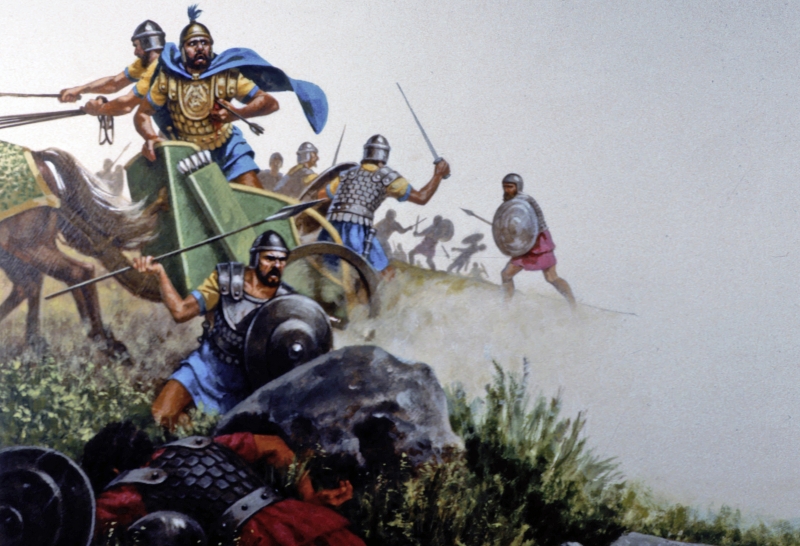
King Ahab found himself in a strange predicament. His capital city, Samaria, was under attack by a confederation of 32 kings, led by King Ben-hadad of Syria. But much to Ahab’s surprise, a prophet of Yahweh appeared with a plan for Israel’s deliverance.

“Thus says the LORD, Have you seen all this great multitude? Behold, I will give it into your hand this day, and you shall know that I am the LORD.” – 1 Kings 20:13 ESV

The very God whom Ahab and Jezebel had attempted to replace with their false gods announced that He was going to rescue His disobedient and unfaithful people. And Yahweh had told Ahab exactly how the victory would take place.

“By the servants of the governors of the districts.” – 1 Kings 20:14 ESV

God was not going to utilize Ahab’s army to fight the Syrians. This is significant because Ahab, like all his predecessors, had assembled a large military force. Evidence of that fact has been found on an ancient Assyrian stone tablet that bears an inscription describing the battle of Qarqar between Ahab and his enemy, King Shalmaneser III of Assyria. The tablet records the size of the army that assembled to do battle that day as consisting of “2,000 chariots and 10,000 men of Ahab king of Israel.”

But on this occasion, Yahweh chose to place Ahab’s formidable resources in a secondary position, choosing instead to use “servants” – a group of ordinary people who, when assembled, amounted to only 7,000 in number.

Confident that he would defeat the Israelites, Ben-hadad and his vassal kings were drinking themselves drunk in a pre-victory celebration. So, when scouts arrived with a report that Israelite forces had been seen leaving the city, Beh-hadad assumed they were bringing news of Israel’s surrender or their decision to continue the battle. While he and his military commanders continued to toast their inevitable victory, the 7,000 servants made their way to the Syrian camp, followed by Ahab and his army.

This surprise attack caught the Syrian forces completely unawares and unable to respond. Led by the 7,000 servants, Ahab’s army quickly routed the Syrians, forcing them to abandon camp and run for their lives. Quickly sobered by this unexpected reversal of fortunes, Beh-hadad managed to escape, but the rest of his forces didn’t fare as well.

And the king of Israel went out and struck the horses and chariots, and struck the Syrians with a great blow. – 1 Kings 20:21 ESV

Notice that the author conveniently eliminates any mention of Ahab’s name. He simply refers to him as “the king of Israel.” He repeats this obvious slight in the very next verse, refusing to give Ahab any credit for the victory. He simply warns him that the battle may be done, but the war is far from over.

“Come, strengthen yourself, and consider well what you have to do, for in the spring the king of Syria will come up against you.” – 1 Kings 20:22 ESV

Ben-hadad would be back. He had suffered a devastating defeat, but once he had time to assess what had happened that day, the Syrian king would return, more determined than ever to avenge his loss by destroying the Israelites. Ben-hadad’s advisors encouraged his plans by suggesting that his loss had been divinely ordained. In their pagan way of thinking, the only thing that could explain a loss of this magnitude was the intervention of the gods. They rationalized away their defeat by concluding that they had chosen the wrong place to do battle.  They absolved Beh-hadad of any responsibility for the loss by assuring him, “Their gods are gods of the hills, and so they were stronger than we. But let us fight against them in the plain, and surely we shall be stronger than they” (1 Kings 20:23 ESV).

Little did they know how right they were. Their defeat had been the result of divine intervention, but geographic location had played no role in it. Yahweh was the God of the hills and the valleys; He was sovereign over all the earth. Unlike their false gods, Yahweh was unbound by time and space. The extent of His power was limitless. To the God of Israel, the battle location and the size of the opposing army made no difference. And so, when Ben-hadad’s advisors counseled him to rebuild his army and restructure his military command, it would prove to be futile advice. They had no idea what they were dealing with, and their ignorance led them to make some hazardous assumptions.

First, they assumed that the God of Israel was similar to their own gods – limited in power and vulnerable to defeat. Their “theology” relegated the gods to various regions or geographic jurisdictions. In their simplistic way of thinking, some gods ruled over the valleys while other gods had dominion over the hills. Their god had failed to deliver them a victory because they had chosen the wrong location for their battle. So, if they could lure the Israelites into the valley, they would expose Yahweh’s weak spot, and the battle would go their way.

Eager to avenge his loss, Ben-hadad took their advice and spent the winter rebuilding his army. He replaced the 32 kings with seasoned military commanders and ordered the construction of new chariots. He also made plans to take the fight to the valley, where the God of Israel would have no power and play no role in the outcome of the battle.

It is fascinating to consider that all of this was according to the sovereign will of God. He had orchestrated all the details concerning the original battle, including Ben-hadad’s escape. God had even told Ahab that the Syrians would return. Ben-hadad’s rebuilding and reconfiguring of his army had been part of God’s plan. The original battle had been intended to restore the Israelites’ belief in God. Prior to their victory, God had told them, “I will give it into your hand this day, and you shall know that I am the LORD” (1 Kings 20:13 ESV).

But Yahweh knew that little had changed in Israel. Even after their miraculous defeat of the Syrians, the people remained unconvinced of Yahweh’s status as the one true God. When spring rolled around, they found themselves facing their former foe again. This time, Beh-hadad showed up with a much larger and better-equipped army than before, and rather than laying siege to the city, his troops gathered in the Valley of Aphek. Ben-hadad had brought a bigger, better army and had chosen a battleground that was outside the reach of Yahweh’s power. Or so he thought.

The stage was set. The enemy of Israel had returned. And the author paints a rather bleak and foreboding picture of the situation.

Israel then mustered its army, set up supply lines, and marched out for battle. But the Israelite army looked like two little flocks of goats in comparison to the vast Aramean forces that filled the countryside! – 1 Kings 20:27 NLT

Here was Israel, outnumbered and underequipped yet again. They were no match for the Syrians. And this time, they would not have the walls of the city to protect them. They would be fighting on open terrain, facing an army equipped with chariots and horses and motivated by revenge.

But God sent another prophet with a promise of His presence and power.

“Thus says the LORD, ‘Because the Syrians have said, “The LORD is a god of the hills but he is not a god of the valleys,” therefore I will give all this great multitude into your hand, and you shall know that I am the LORD.’” – 1 Kings 20:28 ESV

Despite the overwhelming odds, God would provide another victory over their enemy. By the time this day was over, they would know that He was the one true God. But in verse 28, the author leaves out Ahab’s name again, simply referring to him as “the king of Israel.” God was going to deliver this victory despite Ahab, not because of him. Not only did Ahab deserve to lose this battle, but he also deserved to die for his idolatry and apostasy. But Yahweh was acting on behalf of His covenant people and protecting the integrity and honor of His name. He had made covenant promises to Abraham, Isaac, and Jacob, and given His word to Moses and David. And while Ahab had failed to use his position as the shepherd of Israel to lead them in faithful obedience, Yahweh would prove Himself true to His word and committed to His covenant promises.

English Standard Version (ESV) The Holy Bible, English Standard Version. ESV® Permanent Text Edition® (2016). Copyright © 2001 by Crossway Bibles, a publishing ministry of Good News Publishers.

New Living Translation (NLT) Holy Bible, New Living Translation, copyright © 1996, 2004, 2015 by Tyndale House Foundation. Used by permission of Tyndale House Publishers Inc., Carol Stream, Illinois 60188. All rights reserved.

Limping Between Two Spiritual Opinions

1 After many days the word of the LORD came to Elijah, in the third year, saying, “Go, show yourself to Ahab, and I will send rain upon the earth.” 2 So Elijah went to show himself to Ahab. Now the famine was severe in Samaria. 3 And Ahab called Obadiah, who was over the household. (Now Obadiah feared the LORD greatly, 4 and when Jezebel cut off the prophets of the LORD, Obadiah took a hundred prophets and hid them by fifties in a cave and fed them with bread and water.) 5 And Ahab said to Obadiah, “Go through the land to all the springs of water and to all the valleys. Perhaps we may find grass and save the horses and mules alive, and not lose some of the animals.” 6 So they divided the land between them to pass through it. Ahab went in one direction by himself, and Obadiah went in another direction by himself.

7 And as Obadiah was on the way, behold, Elijah met him. And Obadiah recognized him and fell on his face and said, “Is it you, my lord Elijah?” 8 And he answered him, “It is I. Go, tell your lord, ‘Behold, Elijah is here.’” 9 And he said, “How have I sinned, that you would give your servant into the hand of Ahab, to kill me? 10 As the LORD your God lives, there is no nation or kingdom where my lord has not sent to seek you. And when they would say, ‘He is not here,’ he would take an oath of the kingdom or nation, that they had not found you. 11 And now you say, ‘Go, tell your lord, “Behold, Elijah is here.”’ 12 And as soon as I have gone from you, the Spirit of the LORD will carry you I know not where. And so, when I come and tell Ahab and he cannot find you, he will kill me, although I your servant have feared the LORD from my youth. 13 Has it not been told my lord what I did when Jezebel killed the prophets of the Lord, how I hid a hundred men of the Lord’s prophets by fifties in a cave and fed them with bread and water? 14 And now you say, ‘Go, tell your lord, “Behold, Elijah is here”’; and he will kill me.” 15 And Elijah said, “As the LORD of hosts lives, before whom I stand, I will surely show myself to him today.” 16 So Obadiah went to meet Ahab, and told him. And Ahab went to meet Elijah.

17 When Ahab saw Elijah, Ahab said to him, “Is it you, you troubler of Israel?” 18 And he answered, “I have not troubled Israel, but you have, and your father’s house, because you have abandoned the commandments of the LORD and followed the Baals. 19 Now therefore send and gather all Israel to me at Mount Carmel, and the 450 prophets of Baal and the 400 prophets of Asherah, who eat at Jezebel’s table.”

20 So Ahab sent to all the people of Israel and gathered the prophets together at Mount Carmel. 21 And Elijah came near to all the people and said, “How long will you go limping between two different opinions? If the LORD is God, follow him; but if Baal, then follow him.” And the people did not answer him a word. – 1 Kings 18:1-22 ESV

For nearly three years, Elijah has been living in exile among the Sidonians. God had sent him there to protect and preserve him for the next phase of his mission. Three years earlier, Elijah had delivered God’s message of judgment to King Ahab and his pagan queen, Jezebel. Their joint decision to use their royal power to legislate the worship of Baal had brought down the anger of Yahweh in the form of a devastating famine. Knowing this godless couple would seek to kill His messenger, God sent Elijah away so that he could live to fight another day, and that day had finally come.

In his original encounter with Ahab, Elijah had boldly declared that the famine would last until God ordered him to bring it to an end.

“As surely as the LORD, the God of Israel, lives—the God I serve—there will be no dew or rain during the next few years until I give the word!” – 1 Kings 17:1 NLT

Now, three years later, Elijah had received his marching orders from God.

“Go, show yourself to Ahab, and I will send rain upon the earth.” – 1 Kings 18:1 ESV

God had allowed the drought to take its toll. Three years without rain had resulted in a widespread famine that had even impacted the capital city of Samaria. It was there that Ahab had ordered the construction of a temple to Baal, the Phoenician fertility god.

He erected an altar for Baal in the house of Baal, which he built in Samaria. And Ahab made an Asherah. Ahab did more to provoke the LORD, the God of Israel, to anger than all the kings of Israel who were before him. – 1 Kings 16:32-33 ESV

But Baal’s presence had not spared the royal city. Whatever power the people believed their beloved fertility god possessed had failed to stem the ravaging effects of the drought and the life-threatening nature of the resulting famine. Things had gotten so bad that Ahab ordered a search for any land where there might be grass to feed his horses and mules. As king, he was more concerned about the fate of his livestock than he was about the well-being of the people under his care. So, he sent his household manager on a desperate, but futile search for green grass in the midst of a famine. But what Obadiah ended up finding was something neither he nor the king ever expected.

As Obadiah was walking along, he suddenly saw Elijah coming toward him. Obadiah recognized him at once and bowed low to the ground before him. “Is it really you, my lord Elijah?” he asked. – 1 Kings 18:7 NLT

Obadiah was shocked to run into Elijah. After three years, he had probably assumed that the prophet had met an untimely end. But out of reverence and honor, he bowed before Elijah. This man, who served as a royal official in the court of King Ahab, was still a faithful follower of Yahweh, and the author provides an essential parenthetical description that lets the reader know that Obadiah can be trusted.

Obadiah was a devoted follower of the LORD. Once when Jezebel had tried to kill all the LORD’s prophets, Obadiah had hidden 100 of them in two caves. He put fifty prophets in each cave and supplied them with food and water. – 1 Kings 18:3-4 NLT

This little detail concerning Obadiah will prove to be important as the narrative unfolds. First, it lets the reader know that after Elijah had delivered God’s message concerning the drought, Jezebel had launched a campaign to liquidate any and all of God’s prophets from the land of Israel. It seems reasonable to believe that her goal had been to catch and eliminate Elijah. Still, she was willing to execute any prophet of Yahweh who might stand in opposition to her will and the worship of her false god.

But the author’s little aside provides a second detail that will prove crucial. Jezebel’s death squads had failed to find and kill 100 prophets of Yahweh because they had been protected by Obadiah. At significant risk to his own life, this royal official had willfully violated the queen’s command by aiding and abetting those whose executions she had ordered. God had chosen to use ravens to deliver food for Elijah. But in the case of the 100 prophets, He had selected a member of Ahab’s royal court. Once again, God had used an unlikely and unexpected source to preserve His messengers. The fact that these 100 prophets exist will become more important as the story unfolds.

Recognizing Obadiah as a member of the royal court, Elijah instructed him to return to the palace with a message for the king.

“Go, tell your lord, ‘Behold, Elijah is here.’” – 1 Kings 18:8 ESV

Obadiah, while a faithful follower of Yahweh, was not thrilled at the prospect of sharing this news with King Ahab. He knew that Elijah was a wanted man with a bounty on his head, and Ahab had gone to great lengths to locate and eliminate this proverbial thorn in his side.

“I swear by the Lord your God that the king has searched every nation and kingdom on earth from end to end to find you” – 1 Kings 18:10 NLT

After three years, Ahab’s quest to find Elijah had proven unsuccessful, and his frustration would have been at an all-time high. Obadiah was afraid that if he delivered Elijah’s message and then the prophet disappeared again, the king would take out his anger on him. In an attempt to let Elijah know that he had already risked his life in the cause of Yahweh, Obadiah shared the story of his rescue of the 100 prophets. Hadn’t that been enough? Was God now requiring him to put his life on the line again just so he could deliver Elijah’s message to the king?

But Elijah promised his reluctant friend that he would not put his life in jeopardy; he would not be going anywhere because he had a job to do. In fact, he assured Obadiah that he would appear before the king that very day. So, Obadiah did as the prophet commanded and rode to find the king, who was also conducting a futile search for green grass.

When Ahab heard the news, he dropped everything and rode to meet Elijah. Upon seeing the man he loathed and despised, the king sarcastically asked, “Is it you, you troubler of Israel?” (1 Kings 18:17 ESV). This arrogant and apostate king tried to blame Elijah for the nation’s woes. He knew that Elijah had spoken the drought into existence, and he held him personally responsible for all the pain and suffering it had caused. His stubborn and unrepentant heart would not allow him to admit his own culpability for what had happened. It was the sin of Ahab and his wife that had brought down the judgment of God. Elijah had just been the messenger, and he immediately placed the blame for Israel’s woes right where it belonged.

“I have made no trouble for Israel,” Elijah replied. “You and your family are the troublemakers, for you have refused to obey the commands of the LORD and have worshiped the images of Baal instead.” – 1 Kings 18:18 NLT

Ahab and his father Omri had led the people of Israel into apostasy by promoting the worship of false gods. They had turned their backs on Yahweh, causing God’s chosen people to commit spiritual adultery by giving their allegiance and affections to the gods of the Canaanites. They were to blame for the drought and the famine it caused.

But it’s important to recall that God had told Elijah to deliver a message to Ahab that would have sounded like good news: “Tell him that I will soon send rain!” (1 Kings 18:1 NLT). Yet, while the drought was about to end, the judgment was far from over. God was about to deliver a devastating blow to the royal couple that would reveal the impotence of their false god and the futility of abandoning the one true God.

Elijah threw down the gauntlet, challenging the king to a public showdown that would pit Baal against Yahweh.

“Now summon all Israel to join me at Mount Carmel, along with the 450 prophets of Baal and the 400 prophets of Asherah who are supported by Jezebel.” – 1 Kings 18:19 NLT

Driven by pride, the king took the challenge and called for an assembly of all the people of Israel. He ordered all the prophets of his false gods to gather together to do battle with Elijah and his God. Just consider the arrogance required to do what Ahab did. He was willingly and deliberately going to war with God Almighty, and he legitimately thought he could win, but his ego was in for a rude awakening. His gods were about to be exposed for what they were: Figments of man’s fertile and futile imagination that would be proven lifeless and powerless before the God of the universe.

In an epic showdown, Elijah was going to take on the god of Ahab and Jezebel, and challenge the people of Israel to end their vacillating indecision about which God they would serve. In a sense, Elijah was following the lead of Joshua, who, centuries earlier, had issued a similar challenge to the indecisive and unfaithful Israelites of his day.

“…choose today whom you will serve. Would you prefer the gods your ancestors served beyond the Euphrates? Or will it be the gods of the Amorites in whose land you now live? But as for me and my family, we will serve the LORD.” – Joshua 24:15 NLT

English Standard Version (ESV) The Holy Bible, English Standard Version. ESV® Permanent Text Edition® (2016). Copyright © 2001 by Crossway Bibles, a publishing ministry of Good News Publishers.

New Living Translation (NLT) Holy Bible, New Living Translation, copyright © 1996, 2004, 2015 by Tyndale House Foundation. Used by permission of Tyndale House Publishers Inc., Carol Stream, Illinois 60188. All rights reserved.

Just When You Thought It Couldn’t Get Any Worse

29 In the thirty-eighth year of Asa king of Judah, Ahab the son of Omri began to reign over Israel, and Ahab the son of Omri reigned over Israel in Samaria twenty-two years. 30 And Ahab the son of Omri did evil in the sight of the LORD, more than all who were before him. 31 And as if it had been a light thing for him to walk in the sins of Jeroboam the son of Nebat, he took for his wife Jezebel the daughter of Ethbaal king of the Sidonians, and went and served Baal and worshiped him. 32 He erected an altar for Baal in the house of Baal, which he built in Samaria. 33 And Ahab made an Asherah. Ahab did more to provoke the LORD, the God of Israel, to anger than all the kings of Israel who were before him. 34 In his days Hiel of Bethel built Jericho. He laid its foundation at the cost of Abiram his firstborn, and set up its gates at the cost of his youngest son Segub, according to the word of the LORD, which he spoke by Joshua the son of Nun. – 1 Kings 16:29-34 ESV

Things have not been going well in the northern kingdom of Judah. The downward spiritual spiral that began with the reign of Jeroboam has continued unabated. His decision to re-image the God of Israel as a golden calf had been in direct violation of the command given to Moses by God hundreds of years earlier.

“I am the LORD your God, who rescued you from the land of Egypt, the place of your slavery. You must not have any other god but me. You must not make for yourself an idol of any kind or an image of anything in the heavens or on the earth or in the sea. You must not bow down to them or worship them, for I, the LORD your God, am a jealous God who will not tolerate your affection for any other gods. I lay the sins of the parents upon their children; the entire family is affected—even children in the third and fourth generations of those who reject me.” – Exodus 20:1-5 NLT

And yet, despite God’s clear instructions, Jeroboam made his own gods and then attempted to claim that they, not Yahweh, had delivered the nation from their captivity in Egypt.

So on the advice of his counselors, the king made two gold calves. He said to the people, “It is too much trouble for you to worship in Jerusalem. Look, Israel, these are the gods who brought you out of Egypt!”

He placed these calf idols in Bethel and in Dan—at either end of his kingdom. But this became a great sin, for the people worshiped the idols, traveling as far north as Dan to worship the one there. – 1 Kings 12:28-30 NLT

Jeroboam’s decision brought a curse from God upon his dynasty. As a result, his son, Abijah, died in infancy. Another son, Nadab, inherited the throne upon Jeroboam’s death, but in the second year of his reign, he was assassinated by a man named Baasha, who declared himself king. Baasha fulfilled the curse God had placed over the house of Jeroboam by putting to death every one of his descendants. But because Baasha proved to be a wicked king who led the people into further idolatry, God placed a curse on his house as well. Baasha was assassinated by Zimri, the commander of his chariots, who then proceeded to wipe out the entire royal household. But Zimri’s reign would last only seven days. When faced with a coup led by Omri, his former superior officer, Zimri chose to commit suicide. Omri then declared himself to be the legitimate king of Israel. But his reign would prove to be no better than that of his predecessor. In fact, the author flatly states, “Omri did what was evil in the sight of the LORD, and did more evil than all who were before him. For he walked in all the way of Jeroboam the son of Nebat, and in the sins that he made Israel to sin, provoking the LORD, the God of Israel, to anger by their idols” (1 Kings 16:25-26 ESV).

There has been no break in Israel’s downward trajectory. Like water in a sink when the plug is pulled, the spiritual state of the nation continued to spiral down the drain. And just when it appears that Israel has reached an all-time low, another character is introduced who manages to establish himself as the official record holder for apostasy and wickedness.

Omri was succeeded by his son, Ahab, and in more ways than one. Not only did this young man ascend to his father’s throne, but he managed to eclipse his father’s record of sin and rebellion. The author introduces Ahab’s reign with the stinging indictment: “Ahab the son of Omri did evil in the sight of the LORD, more than all who were before him” (1 Kings 16:30 ESV). Then he follows up that far-from-flattering assessment with tangible proof.

He compares the wickedness of Ahab with that of Jeroboam, the first king of the northern tribes of Israel. Jeroboam had been guilty of making his own false gods and attributing to them the credit for something Yahweh had done. In a sense, Jeroboam had tried to create his own version of the one true God. But Ahab decided to abandon Yahweh altogether, replacing Him with Baal, the god of the Canaanites, and his choice of this particular god was influenced by his wife, Jezebel. His marriage to Jezebel had been orchestrated by his father as part of a treaty he had made with Ethbaal, the king of Tyre and Sidon. To form an alliance with this pagan nation, Omri arranged a marriage between his son and Ethbaal’s daughter. This unholy alliance was in direct violation of God’s command.

When the LORD your God hands these nations over to you and you conquer them, you must completely destroy them. Make no treaties with them and show them no mercy. You must not intermarry with them. Do not let your daughters and sons marry their sons and daughters, for they will lead your children away from me to worship other gods. – Deuteronomy 7:2-3 NLT

While the marriage had been Omri’s idea, the author refuses to absolve Ahab of any guilt for his role in the affair. He had been fully compliant and complicit.

…he took for his wife Jezebel the daughter of Ethbaal king of the Sidonians, and went and served Baal and worshiped him. – 1 Kings 16:31 ESV

Just as God had warned, Ahab’s pagan wife ended up having a powerful and detrimental influence over him. This marriage, arranged purely for political purposes, was destined to have dire spiritual implications. What Omri had done to secure the state of his kingdom would end up sealing its fate. Jezebel would do more to degrade the spiritual health of the nation than any king, including her own husband.

This pagan princess introduced her new husband to the gods of her people. The Phoenicians and Canaanites considered Baal to be the most powerful of all the gods. According to their mythology, he was the offspring of El, the chief god, and Asherah, the moon goddess. Baal was sometimes referred to as the sun god or the god of thunder. He was considered a fertility god who rewarded those who worshiped him with fruitfulness, in the form of children and abundant crops.

Ahab willingly and eagerly adopted the false gods of Jezebel, ordering the construction of a temple dedicated to Baal and the erection of an Asherah pole for the worship of Baal’s mother, the moon goddess. These actions stand in stark contrast to those of Solomon, who constructed a Temple for Yahweh in the capital city of Jerusalem. Now, here was Ahab, the king of the northern tribes of Judah, building a temple in the capital city of Samaria dedicated to the worship of the false god of the Canaanites. The people of Israel had sunk to an all-time low, and it was going to get even worse.

The author provided a foreshadowing of things to come when he stated that Ahab “did more to provoke the anger of the LORD, the God of Israel, than any of the other kings of Israel before him” (1 Kings 16:33 NLT). This foreboding statement is followed by another tangible expression of Ahab’s ill-fated actions. It seems that Ahab had given orders to rebuild the destroyed city of Jericho. This task was assigned to a man named Hiel, but the endeavor proved costly. While overseeing the construction of the city, Hiel ended up losing two of his own sons. 

This somewhat strange and seemingly out-of-place narrative is meant to illustrate Ahab’s blatant disregard for the will of God. His determination to rebuild the city of Jericho was in direct violation of God’s command. Hundreds of years earlier, when the Israelites had first entered the land of Canaan, Jericho had been the first city they had defeated and destroyed. God had given them a supernatural victory over the city and its inhabitants, and then He commanded its destruction, placing a curse on anyone who tried to rebuild the ruins.

“Cursed before the Lord be the man who rises up and rebuilds this city, Jericho.

“At the cost of his firstborn shall he
    lay its foundation,
and at the cost of his youngest son
    shall he set up its gates.” – Joshua 6:26 ESV

Hiel, under direct orders from Ahab, ended up violating the command of God, and, as a result, he inadvertently found himself suffering the curse of God. The author sadly states that this poor man “laid its foundation at the cost of Abiram his firstborn, and set up its gates at the cost of his youngest son Segub, according to the word of the LORD” (1 Kings 16:34 ESV).

The marriage of Ahab and Jezebel would prove to be one of the worst things that ever happened to the people of God. This unholy alliance ended up bringing great sorrow upon the nation, leading the people into further rebellion against God. Eventually, Jezebel became the poster girl for wickedness and evil. Her very name would become a byword for all that stands opposed to God. In fact, her name appears in the very last book of the Bible, as a less-than-flattering description of a woman who would end up leading the church at Thyatira into immorality and the worship of false gods.

“But I have this complaint against you. You are permitting that woman—that Jezebel who calls herself a prophet—to lead my servants astray. She teaches them to commit sexual sin and to eat food offered to idols. I gave her time to repent, but she does not want to turn away from her immorality.” – Revelation 2:20-21 NLT

But the devastating exploits of this power couple were just beginning. As will become painfully evident, their evil actions would not go unnoticed or unpunished by God. He is omniscient and omnipotent, possessing the divine capacity to see and know all things, and the power to deal with the wickedness of man justly and sovereignly. Ahab and Jezebel would wield tremendous authority and display an unbridled arrogance toward Yahweh. Their failure to honor and revere Him as God would come back to haunt them. The actions of this royal couple would bring down God’s wrath, not just because they refused to honor Him, but because they influenced others to follow their lead. The apostle Paul describes the fate of all those who follow the path of Ahab and Jezebel.

Since they thought it foolish to acknowledge God, he abandoned them to their foolish thinking and let them do things that should never be done. Their lives became full of every kind of wickedness, sin, greed, hate, envy, murder, quarreling, deception, malicious behavior, and gossip. They are backstabbers, haters of God, insolent, proud, and boastful. They invent new ways of sinning, and they disobey their parents. They refuse to understand, break their promises, are heartless, and have no mercy. They know God’s justice requires that those who do these things deserve to die, yet they do them anyway. Worse yet, they encourage others to do them, too. – Romans 1:28-32 NLT

English Standard Version (ESV) The Holy Bible, English Standard Version. ESV® Permanent Text Edition® (2016). Copyright © 2001 by Crossway Bibles, a publishing ministry of Good News Publishers.

New Living Translation (NLT) Holy Bible, New Living Translation, copyright © 1996, 2004, 2015 by Tyndale House Foundation. Used by permission of Tyndale House Publishers Inc., Carol Stream, Illinois 60188. All rights reserved.

A Song of Victory

1 Praise the LORD!
Sing to the LORD a new song,
    his praise in the assembly of the godly!
2 Let Israel be glad in his Maker;
    let the children of Zion rejoice in their King!
3 Let them praise his name with dancing,
    making melody to him with tambourine and lyre!
4 For the LORD takes pleasure in his people;
    he adorns the humble with salvation.
5 Let the godly exult in glory;
    let them sing for joy on their beds.
6 Let the high praises of God be in their throats
    and two-edged swords in their hands,
7 to execute vengeance on the nations
    and punishments on the peoples,
8 to bind their kings with chains
    and their nobles with fetters of iron,
9 to execute on them the judgment written!
    This is honor for all his godly ones.
Praise the LORD!
 – Psalm 149:1-9 ESV

The unidentified author of this psalm begins with the same opening phrase found in the three previous psalms: “Praise the LORD!” This fourth in a series of five Hallel (praise) psalms continues the theme of well-deserved adoration for Yahweh. Written for a Hebrew audience that should understand the glory and greatness of Yahweh, this psalm accentuates their unique status as His covenant people. They are “the assembly of the godly” (Psalm 149:1 ESV), not because they perform godly acts but because Yahweh has set them apart as His own. The Hebrew word the psalmist used is ḥāsîḏ, which is derived from ḥāsaḏ, a word that describes Yahweh’s loving kindness for His chosen people. They had done nothing to earn His love and affection. He had not chosen them because they were greater in number or more righteous in their actions. Moses made this fact painfully clear to the Israelites not long after their miraculous deliverance from slavery in Egypt by the gracious hand of Yahweh.

“The LORD did not set his heart on you and choose you because you were more numerous than other nations, for you were the smallest of all nations! Rather, it was simply that the LORD loves you, and he was keeping the oath he had sworn to your ancestors. That is why the LORD rescued you with such a strong hand from your slavery and from the oppressive hand of Pharaoh, king of Egypt. Understand, therefore, that the LORD your God is indeed God. He is the faithful God who keeps his covenant for a thousand generations and lavishes his unfailing love on those who love him and obey his commands. But he does not hesitate to punish and destroy those who reject him. Therefore, you must obey all these commands, decrees, and regulations I am giving you today.” – Deuteronomy 7:7-11 NLT

Yahweh “lavishes his unfailing love [ḥeseḏ] on those who love him and obey his commands.” That word ḥeseḏ is the root word from which the term “godly ones” is derived. It is Yahweh’s unfailing love that sets His people apart. They were godly because they belonged to Him; He willingly set them apart as His own possession and showered them with His unmerited favor and love.

That is why the psalmist charges his audience to respond to Yahweh with grateful praise.

O Israel, rejoice in your Maker.
    O people of Jerusalem, exult in your King. – Psalm 149:2 NLT

The Israelite’s existence as a nation was the work of their Maker and King. Like the entire universe, which Yahweh fashioned out of nothing, the Israelites were the byproduct of His creative powers. He began the process with one man and his barren wife. He chose an obscure and undeserving individual named Abram, who was a Chaldean living in the land of Ur in Mesopotamia.

The LORD had said to Abram, “Leave your native country, your relatives, and your father’s family, and go to the land that I will show you. I will make you into a great nation. I will bless you and make you famous, and you will be a blessing to others. I will bless those who bless you and curse those who treat you with contempt. All the families on earth will be blessed through you.” – Genesis 12:1-3 NLT

Yahweh led Abram and his wife, Sarah, to the land of Canaan, where they waited 65 years before Sarah was able to bear a son. But from that long-awaited son, Yahweh raised up another son named Jacob, whom He would later rename Israel. It would be from Israel’s small family of 70 individuals that Yahweh would produce a “great nation” that numbered in the millions. That transformation would take place during the 400 years they lived in the land of Egypt as slaves. This was all in keeping with the promise that Yahweh had made to Abram.

Then the Lord said to Abram, “You can be sure that your descendants will be strangers in a foreign land, where they will be oppressed as slaves for 400 years. But I will punish the nation that enslaves them, and in the end they will come away with great wealth. (As for you, you will die in peace and be buried at a ripe old age.) After four generations your descendants will return here to this land…” – Genesis 15:13-16 NLT

Yahweh kept that promise and delivered His chosen people from their captivity and returned them to the land of Canaan. Now, centuries later, the psalmist calls on those very same people to express their gratitude to Yahweh for His unfailing love, mercy, and grace.

Praise his name with dancing,
    accompanied by tambourine and harp.
For the LORD delights in his people;
    he crowns the humble with victory.
Let the faithful rejoice that he honors them.
    Let them sing for joy as they lie on their beds. – Psalm 149:3-5 NLT

But then the psalm takes a decidedly different turn. The second half of this Hallel (praise) song suddenly becomes dark and warlike in its tone.

Let the praises of God be in their mouths,
    and a sharp sword in their hands—
to execute vengeance on the nations
    and punishment on the peoples,
to bind their kings with shackles
    and their leaders with iron chains,
to execute the judgment written against them.
    This is the glorious privilege of his faithful ones. – Psalm 149:6-9 NLT

These last five psalms of the psalter are hymns of praise to God, encouraging His people to praise Him for His power, provision, mercy and grace. But right in the middle of Psalm 149, the psalmist mixes in a bit of weaponry and war-like language with his call to worship. He tells the people of God to praise Him with their lips, but to have a sword ready in their hands at the same time.

I think we sometimes forget that our God has called us to be a part of His glorious army. We are at war and engaged in an epic battle between the dark forces of this world that have aligned themselves against the rule and reign of God Almighty. Jesus told us that the enemy (Satan) seeks to steal, kill, and destroy (John 10:10). Paul reminds us that we have weapons we are to use in this battle – the weapons of our warfare.

We use God’s mighty weapons, not mere worldly weapons, to knock down the Devil’s strongholds. – 2 Corinthians 7:4 NLT

Paul also tells us to equip ourselves with the armor of God.

Use every piece of God’s armor to resist the enemy in the time of evil, so that after the battle you will still be standing firm. – Ephesians 6:13 NLT

We don’t live in Disneyland. This is a battlefield, and there are casualties of war all around us. Every day, we see marriages destroyed, relationships blown apart, children rebel, individuals succumb to addictions of all kinds, and fellow believers fall prey to the attacks of the enemy because they were ill-prepared for battle.

This psalm is a vivid reminder that we have been called to praise God, but to also be ready to serve as faithful soldiers in His army. As Paul reminds us, our enemies are spiritual, not physical. Our weapons are not made of steel and chrome; instead, they are the Word of God and the power derived from our faith in God. Paul tells us, “Be strong with the Lord’s mighty power. Put on all of God’s armor so that you will be able to stand firm against all strategies and tricks of the Devil. For we are not fighting against people made of flesh and blood, but against the evil rulers and authorities of the unseen world, against those mighty powers of darkness who rule this world, and against wicked spirits in the heavenly realms (Ephesians 6:10-12 NLT).

We have the promises of God’s Word, the power of believing prayer, the presence of the Holy Spirit, the protection of our faith in God’s love for us, and the peace-providing reality of our ultimate salvation and victory over the enemy. So praise God and be ready to defend the cause of God.

One day, His Son will return. He will not come as an innocent, helpless baby in a manger, but as the King of kings and Lord of lords. He will come in might and power, bringing the army of heaven with Him. At His second coming, He will put an end to the war between the forces of darkness and light. He will destroy the kingdom of Satan and restore the earth to its former glory. We fight for the side that will come out victorious in the end! And that’s something worth shouting about.

The apostle John was given a glimpse of this incredible scene, which he recorded in the Book of Revelation.

Then I saw heaven opened, and a white horse was standing there. And the one sitting on the horse was named Faithful and True. For he judges fairly and then goes to war. His eyes were bright like flames of fire, and on his head were many crowns. A name was written on him, and only he knew what it meant. He was clothed with a robe dipped in blood, and his title was the Word of God. The armies of heaven, dressed in pure white linen, followed him on white horses. From his mouth came a sharp sword, and with it he struck down the nations. He ruled them with an iron rod, and he trod the winepress of the fierce wrath of almighty God. On his robe and thigh was written this title: King of kings and Lord of lords. – Revelation 19:11-16 NLT

As we wait for this future fulfillment of Yahweh’s promise, we are to praise Him with our voices and stand ready to fight the fight of faith with the weapons He has provided. The apostle Paul gave a charge to his young protegé Timothy, reminding him of his duty as a soldier in the army of God. He wanted Timothy to know that he was no longer a civilian, free to do as he pleased.

Endure suffering along with me, as a good soldier of Christ Jesus. Soldiers don’t get tied up in the affairs of civilian life, for then they cannot please the officer who enlisted them. And athletes cannot win the prize unless they follow the rules. – 2 Timothy 2:3-5 NLT

Like Timothy, we have been conscripted into service by Yahweh Sabaoth, the LORD of Heaven’s Armies. He has chosen us to fight in His battle “against the evil rulers and authorities of the unseen world, against those mighty powers of darkness who rule this world, and against wicked spirits in the heavenly realms” (Ephesians 6:12 NLT). But He has not left us unprepared, out-gunned, or ill-trained.

Therefore, put on every piece of God’s armor so you will be able to resist the enemy in the time of evil. Then after the battle you will still be standing firm. Stand your ground, putting on the belt of truth and the body armor of God’s righteousness. For shoes, put on the peace that comes from the Good News so that you will be fully prepared. In addition to all of these, hold up the shield of faith to stop the fiery arrows of the devil. Put on salvation as your helmet, and take the sword of the Spirit, which is the word of God. – Ephesians 6:13-17 NLT

And as we fight, we are to praise the LORD because the battle is His and the victory is assured.

Father, we praise You, but we also want to be ready to fight alongside You in this earthly struggle between the kingdom of righteousness and the kingdom of wickedness. Never let us forget that we are at war. While we sing songs and worship You on Sunday, there are countless people dying at the hands of the enemy all around us. As we read our Bibles and study Your truths, there are people who are being destroyed by the enemy as they listen to his lies. We have the means to rescue them. Show us how to be warriors, not just worshipers. Amen

English Standard Version (ESV) The Holy Bible, English Standard Version. ESV® Permanent Text Edition® (2016). Copyright © 2001 by Crossway Bibles, a publishing ministry of Good News Publishers.

New Living Translation (NLT) Holy Bible, New Living Translation, copyright © 1996, 2004, 2015 by Tyndale House Foundation. Used by permission of Tyndale House Publishers Inc., Carol Stream, Illinois 60188. All rights reserved.

The Lord is Coming

A Psalm of David.

1 The LORD says to my Lord:
    “Sit at my right hand,
until I make your enemies your footstool.”

2 The LORD sends forth from Zion
    your mighty scepter.
    Rule in the midst of your enemies!
3 Your people will offer themselves freely
    on the day of your power,
    in holy garments;
from the womb of the morning,
    the dew of your youth will be yours.
4 The LORD has sworn
    and will not change his mind,
“You are a priest forever
    after the order of Melchizedek.”

5 The Lord is at your right hand;
    he will shatter kings on the day of his wrath.
6 He will execute judgment among the nations,
    filling them with corpses;
he will shatter chiefs
    over the wide earth.
7 He will drink from the brook by the way;
    therefore he will lift up his head. – Psalm 110:1-7 ESV

This is a somewhat confusing psalm. It was written by David, but he appears to be talking about someone else. In the opening line, David writes, “The LORD (Yᵊhōvâ) says to my Lord (‘āḏôn),” using two different Hebrew words that are translated in English as “Lord.” But who is David referring to, and what is the context of this somewhat cryptic psalm? Some scholars speculate that David is speaking of his own son, Solomon, who crowned David’s successor while David was still alive.

When it appears in all caps, the term LORD is a designation for Jehovah, the name of God. Adon is the Hebrew word for an owner, lord, master, or king. LORD is used three times in the passage, while Lord is used twice. But who is David referring to? Is he talking about himself or someone else? Are all the statements in this passage referring to him or another person? In the Hebrew culture, the term, The Lord, was understood to be a reference to the Messiah, the coming Savior of Israel. So in the psalm, David is referring not to himself, but to the future Messiah, God’s divinely appointed ruler over Israel.

Perhaps David believed his son Solomon would serve in that role. Like any father, David had high hopes for his son and longed for him to be the future deliverer of Israel. But what David didn’t know was that this Spirit-inspired psalm was a prophetic vision concerning one of his future descendants who would rule in righteousness for eternity.

It is easy to see how David could have had his son Solomon in mind when writing this psalm. Years earlier, the prophet Nathan conveyed a message to him from Jehovah (the LORD).

“…the LORD (Yᵊhōvâ) declares to you that the LORD (Yᵊhōvâ) will make you a house. When your days are fulfilled and you lie down with your fathers, I will raise up your offspring after you, who shall come from your body, and I will establish his kingdom. He shall build a house for my name, and I will establish the throne of his kingdom forever. I will be to him a father, and he shall be to me a son. When he commits iniquity, I will discipline him with the rod of men, with the stripes of the sons of men, but my steadfast love will not depart from him, as I took it from Saul, whom I put away from before you. And your house and your kingdom shall be made sure forever before me. Your throne shall be established forever.” – 2 Samuel 7:11-16 ESV

David’s son Solomon did build a house for God. He carried out his father’s wishes and constructed the Temple in Jerusalem. But this grand accomplishment did not solidify his kingdom or prevent him from becoming unfaithful to the One for whom the Temple was built. Solomon was wise, wealthy, and powerful, but he also had an unbridled love affair with women. At one point, his harem included 300 wives and 700 concubines (1 Kings 11:3). This obsession with the opposite sex was in direct violation of God’s decree.

“The king must not take many wives for himself, because they will turn his heart away from the Lord. And he must not accumulate large amounts of wealth in silver and gold for himself.” – Deuteronomy 17:17 NLT

Solomon accumulated great wealth and many wives.

Now King Solomon loved many foreign women. Besides Pharaoh’s daughter, he married women from Moab, Ammon, Edom, Sidon, and from among the Hittites. The LORD had clearly instructed the people of Israel, “You must not marry them, because they will turn your hearts to their gods.” Yet Solomon insisted on loving them anyway. He had 700 wives of royal birth and 300 concubines. And in fact, they did turn his heart away from the Lord.

In Solomon’s old age, they turned his heart to worship other gods instead of being completely faithful to the LORD his God, as his father, David, had been. Solomon worshiped Ashtoreth, the goddess of the Sidonians, and Molech, the detestable god of the Ammonites. In this way, Solomon did what was evil in the LORD’s sight; he refused to follow the LORD completely, as his father, David, had done. – 1 Kings 11:1-6 NLT

So it is clear that the “Lord” referred to in Psalm 110 cannot be Solomon. He kingdom was not eternal. It came to an end because of his unfaithfulness. In fact, because of Solomon’s idolatry and apostasy, the LORD split his kingdom in half.

“Since you have not kept my covenant and have disobeyed my decrees, I will surely tear the kingdom away from you and give it to one of your servants. But for the sake of your father, David, I will not do this while you are still alive. I will take the kingdom away from your son. And even so, I will not take away the entire kingdom; I will let him be king of one tribe, for the sake of my servant David and for the sake of Jerusalem, my chosen city.” – 1 Kings 12:11-13 NLT

So, who is David referring to when he writes the following?:

The LORD will extend your powerful kingdom from Jerusalem;
    you will rule over your enemies.
When you go to war,
    your people will serve you willingly.
You are arrayed in holy garments,
    and your strength will be renewed each day like the morning dew. – Psalm 110:2-3 NLT

This psalm is a prophecy concerning Jesus and His future role as the conquering Messiah. Under the inspiration of the Holy Spirit, David prophesied about the Millennial reign of Jesus, which would take place at His second coming. David knew there was a day coming when all the enemies of Israel and God would be completely destroyed by the King of kings and LORD of Lords, but he had no way of knowing it would be Jesus, the incarnate Son of God.

The book of Matthew records an incident between Jesus and the Pharisees, where Jesus used this very passage to point to himself.

Then, surrounded by the Pharisees, Jesus asked them a question: “What do you think about the Messiah? Whose son is he?”

They replied, “He is the son of David.”

Jesus responded, “Then why does David, speaking under the inspiration of the Spirit, call the Messiah ‘my Lord’? For David said,

‘The LORD said to my Lord,
Sit in the place of honor at my right hand
    until I humble your enemies beneath your feet.’

Since David called the Messiah ‘my Lord,’ how can the Messiah be his son?”

No one could answer him. And after that, no one dared to ask him any more questions.  – Matthew 22:41-46 NLT

Jesus knew this Psalm predicted a future event that had not yet occurred. But there was no doubt in Jesus’ mind that Psalm 110 spoke of Himself. This Old Testament passage serves as a reminder to us that there is a day coming when Jesus, as the Christ (the Greek word for Messiah), will return to the earth to complete the plan of God for Israel and all mankind. Jesus’ work is not yet done. He currently sits at the right hand of the Father (Colossians 3:1), but when God is ready, He will send Jesus to finish what He began with His death and resurrection.

He will strike down many kings when his anger erupts.
He will punish the nations
    and fill their lands with corpses;
    he will shatter heads over the whole earth.
But he himself will be refreshed from brooks along the way.
    He will be victorious. – Psalm 110:5-7 NLT

As a king, David saw this as a wonderful picture of victory over his enemies. He knew that someday God would give Israel complete victory over every one of their foes. David lived in a time when battle was a daily ordeal. He was surrounded by enemies and regularly confronted by war. There was never a day when someone didn’t want to destroy him or the nation over which he ruled. So the idea of final victory and perfect peace was appealing to him. And it should be to us as well.

Like David, we are surrounded by enemies who oppose God and His ways. They live for this world and are influenced by the Prince of this world, Satan himself. Every day, we do battle with our flesh, the world, and the devil. We are under constant attack. There is never a time when we can take a day off or remove our armor. We must be constantly prepared to defend ourselves because the war and the casualties are real. We see them in the form of broken marriages, rebellious children, addictions, depression, anxiety, and disease.

This psalm assures us that a day is coming when God will set all things right. His plan will be finalized. His Son, the Messiah, will complete what He came to do. In His first advent, Jesus came to provide a means of salvation for mankind. He made it possible for sinful humanity to be restored to a right relationship with God. Through the sacrifice of His life, He offered men and women a means by which they could escape the coming wrath of God against all who refuse Him.

But there is a day coming when Christ will return a second time, but not as Savior, but as a conquering King. He will do battle with all those who stand opposed to God and He will be victorious. The enemy will be defeated once and for all, and Christ will set up His kingdom on earth and rule from the throne of David in Jerusalem. There will be peace in the world for the first time since the creation of the world. Order will be restored, and shalom (peace) will be present again.

The apostle John was given a vision of this fulfillment of the scene that David tried to describe.

No longer will there be a curse upon anything. For the throne of God and of the Lamb will be there, and his servants will worship him. And they will see his face, and his name will be written on their foreheads. And there will be no night there—no need for lamps or sun—for the Lord God will shine on them. And they will reign forever and ever. – Revelation 22:3-5 NLT

Jesus will return someday. He will complete the assignment given to Him by God the Father, and the glorious future David envisioned will come to pass. David did not live long enough to see it. Neither did Solomon. But the promise remains, and its fulfillment is assured because God is faithful and all-powerful.

This is a Messianic Psalm. It predicts the coming return and reign of Christ on earth. It is short and sweet, painting the future rule of Christ in just a few lines. It establishes Jesus as a descendant of David and his Lord and Master. He is the Messiah.

This psalm should comfort all who call themselves Christ-followers. It is a reminder of how the story ends. Even though we see a lot of suffering in the world and even question how this whole mess will sort itself out, David reminds us that Christ still reigns and rules in heaven, and one day He will return and put all things right.

Jesus may have come as an innocent baby the first time, but He isn’t going to return that way. He will be the conquering king and warrior who defeats all the enemies of God and sets up His righteous rule on earth. That is not just a hope; it is a certainty. It will happen, and we can count on it. It is all part of God’s divine plan. When Jesus returns, He will judge the nations justly and righteously. He will make all things right. And that future hope should bring us present peace.

Crown him with many crowns,
the Lamb upon his throne.
Hark! how the heavenly anthem drowns
all music but its own.
Awake, my soul, and sing
of him who died for thee,
and hail him as thy matchless king
through all eternity. – Matthew Bridges, “Crown Him With Many Crowns” (1851)

Father, in the midst of the daily battles of life it is so easy to get defeated by what appears to be a hopeless cause. It can be so easy to want to give up and give in. Our efforts seem to make no difference. The battles we fight don’t seem to be winning the war. But in the Psalm You remind us that the ultimate victory is Yours, not ours. David had to fight his battles, but he rested in the knowledge that You will one day bring about complete victory. Never let me forget that. Amen

English Standard Version (ESV) The Holy Bible, English Standard Version. ESV® Permanent Text Edition® (2016). Copyright © 2001 by Crossway Bibles, a publishing ministry of Good News Publishers.

New Living Translation (NLT) Holy Bible, New Living Translation, copyright © 1996, 2004, 2015 by Tyndale House Foundation. Used by permission of Tyndale House Publishers Inc., Carol Stream, Illinois 60188. All rights reserved.

Keep Trusting

To the choirmaster: with stringed instruments. A Maskil of David, when the Ziphites went and told Saul, “Is not David hiding among us?”

1 O God, save me by your name,
    and vindicate me by your might.
2 O God, hear my prayer;
    give ear to the words of my mouth.

3 For strangers have risen against me;
    ruthless men seek my life;
    they do not set God before themselves. Selah

4 Behold, God is my helper;
    the Lord is the upholder of my life.
5 He will return the evil to my enemies;
    in your faithfulness put an end to them.

6 With a freewill offering I will sacrifice to you;
    I will give thanks to your name, O Lord, for it is good.
7 For he has delivered me from every trouble,
    and my eye has looked in triumph on my enemies. – Psalm 54:1-7 ESV

This psalm continues David’s diatribe against the godless fools who have made his life a living hell. David had been forced to live like a fugitive because of King Saul’s relentless pursuit of his death. When Ahimelech the priest aided and abetted David, Doeg the Edomite murdered all the priests of Nob, as well as their families, in an act of revenge, and in an attempt to win favor with King Saul. In this psalm, David complains to God about the Ziphites, who sold him out to King Saul. Everywhere David turned, he found himself surrounded by enemies intent on his destruction.

These weren’t the mutterings of an overwrought conspiracy theorist prone to over-exaggeration and hyperbole. David was describing real-life events that had produced less-than-ideal outcomes. He remained an exiled fugitive with a bounty on his head, and the senseless deaths of the priests of Nob would haunt him for a long time.

In this penitential psalm, David tells God the dire nature of his circumstances.

For strangers are attacking me;
    violent people are trying to kill me.
    They care nothing for God. – Psalm 54:3 NLT

The Ziphites had not personally threatened David, but their actions had put his life at risk. By informing King Saul that David was hiding out in nearby Horesh, the Ziphites increased the chances of his capture and death. Their betrayal of David was meant to win favor with King Saul, even though they knew it would likely result in David’s execution. In turning him over, they would be complicit in his death.

But David paints their actions as a blatant disregard for God’s will. He could recall the day when the prophet Samuel had anointed him with oil and the Spirit of God had come upon him (1 Samuel 16). Samuel had received a clear message from Yahweh that he would find the next king of Israel residing at the house of Jesse.

“You have mourned long enough for Saul. I have rejected him as king of Israel, so fill your flask with olive oil and go to Bethlehem. Find a man named Jesse who lives there, for I have selected one of his sons to be my king.” – 1 Samuel 16:1 NLT

As Jesse paraded all his sons before the prophet, God disqualified each of them.

“Don’t judge by his appearance or height, for I have rejected him. The Lord doesn’t see things the way you see them. People judge by outward appearance, but the Lord looks at the heart.” – 1 Samuel 16:7 NLT

When David, the young son of Jesse, was brought before the prophet, God affirmed him by stating, “This is the one; anoint him” (1 Samuel 16:12 NLT). Then Samuel “took the flask of olive oil he had brought and anointed David with the oil. And the Spirit of the Lord came powerfully upon David from that day on” (1 Samuel 16:13 NLT).

It’s unclear how much David knew about what took place that day. The text doesn’t say that Samuel gave David all the details concerning his anointing. At no point is David told that he has just been chosen as the next king of Israel, but he knew that something significant had just taken place. He understood that there was more to Saul’s obsession with his death than mere jealousy. The king saw David as a threat to his throne, and David knew that Saul’s unjustified pursuit of his death could not be in God’s will. That’s why he begged God to protect and avenge him.

Come with great power, O God, and rescue me!
    Defend me with your might.
Listen to my prayer, O God.
    Pay attention to my plea. – Psalm 54:1-2 NLT

David viewed Saul’s actions as unjustified and undeserved. Yet, when given the opportunity to seek revenge and take Saul’s life, David refused. Chapter 24 of 1 Samuel records the story of David’s chance encounter with Saul while hiding in the wilderness of Engedi. David and Saul had been engaged in a cat-and-mouse game involving “3,000 elite troops from all Israel” (1 Samuel 24:2 NLT). These well-armed and highly experienced troops had been chasing David and his men for days. At one point, King Saul took a break from the action “to relieve himself. But as it happened, David and his men were hiding farther back in that very cave” (1 Samuel 24:3 NLT). 

David’s men saw this as a God-ordained opportunity for David to take matters into his own hand and put an end to their misery.

“Now’s your opportunity!” David’s men whispered to him. “Today the Lord is telling you, ‘I will certainly put your enemy into your power, to do with as you wish.’” – 1 Samuel 24:4 NLT

David was tempted but refused to take the life of Saul. Instead, he told his men, “The Lord forbid that I should do this to my lord the king. I shouldn’t attack the Lord’s anointed one, for the Lord himself has chosen him.” (1 Samuel 24:6 NLT). But while David spared Saul’s life, he did take advantage of the opportunity to declare his innocence. 

“Why do you listen to the people who say I am trying to harm you? This very day you can see with your own eyes it isn’t true. For the Lord placed you at my mercy back there in the cave. Some of my men told me to kill you, but I spared you. For I said, ‘I will never harm the king—he is the Lord’s anointed one.’ Look, my father, at what I have in my hand. It is a piece of the hem of your robe! I cut it off, but I didn’t kill you. This proves that I am not trying to harm you and that I have not sinned against you, even though you have been hunting for me to kill me.” – 1 Samuel 249-11 NLT

David had taken the high road. What appeared to his men as a divinely appointed opportunity to kill the king was actually a test of David’s allegiance and faithfulness. Was he willing to leave his fate in the hands of God? Would he trust the Almighty to settle matters between himself and King Saul?

Psalm 54 reveals that David was committed to relying on God despite what happened around him. Yes, he desperately wanted to see God step in and resolve the situation. He begged God to show up in power and rescue him. But even as Saul pursued him and the Ziphites betrayed him, David could say, “God is my helper. The Lord keeps me alive!” (Psalm 54:4 NLT). When David penned this psalm, he had not experienced some grand deliverance or dramatic change in his fortunes. He had just been betrayed by the Ziphites. King Saul remained determined to take his life. His men were growing weary of living on the run. Yet, David remained confident in God’s goodness, grace, and mercy. He understood that the very fact he was still alive was proof of God’s power and presence in his life. 

Despite Saul’s best efforts to end his life, Doeg’s murderous treatment of the priests of Nob, and the Ziphites’ betrayal of his location, David remained alive. And he didn’t take this point lightly. David promises that the next opportunity he has to return to Jerusalem, he will offer the appropriate sacrifices to God for His care and compassion.

I will sacrifice a voluntary offering to you;
    I will praise your name, O Lord,
    for it is good.
For you have rescued me from my troubles
    and helped me to triumph over my enemies. – Psalm 54:6-7 NLT

David’s problems were far from over, but his faith in God was far from expended. He was willing to keep trusting even though his circumstances had not changed for the better. His exile had not ended. Saul had not called off the dogs. His days of running were far from over, and his enemies were growing in number. But he knew he could trust God.

Father, what a great reminder that I should never view Your faithfulness through the lens of my circumstances. Yet, when things don’t turn out quite the way I expected, the first thing I do is begin to doubt Your goodness and grace. I question Your presence. I complain about Your apparent lack of concern for my predicament. But if I would stop long enough to think about it, I would realize that my very existence is proof of Your goodness. Even in the darkness, You are with me. When I feel all alone and abandoned, You are there. You never leave me or forsake me. No enemy is too great for me. No problem is too overwhelming for me because You are by my side — at all times. Thank you for that much-needed reminder. Amen

English Standard Version (ESV) The Holy Bible, English Standard Version. ESV® Permanent Text Edition® (2016). Copyright © 2001 by Crossway Bibles, a publishing ministry of Good News Publishers.

New Living Translation (NLT) Holy Bible, New Living Translation, copyright © 1996, 2004, 2015 by Tyndale House Foundation. Used by permission of Tyndale House Publishers Inc., Carol Stream, Illinois 60188. All rights reserved.

Sovereign Over All

13 Then, according to the word sent by Darius the king, Tattenai, the governor of the province Beyond the River, Shethar-bozenai, and their associates did with all diligence what Darius the king had ordered. 14 And the elders of the Jews built and prospered through the prophesying of Haggai the prophet and Zechariah the son of Iddo. They finished their building by decree of the God of Israel and by decree of Cyrus and Darius and Artaxerxes king of Persia; 15 and this house was finished on the third day of the month of Adar, in the sixth year of the reign of Darius the king.

16 And the people of Israel, the priests and the Levites, and the rest of the returned exiles, celebrated the dedication of this house of God with joy. 17 They offered at the dedication of this house of God 100 bulls, 200 rams, 400 lambs, and as a sin offering for all Israel 12 male goats, according to the number of the tribes of Israel. 18 And they set the priests in their divisions and the Levites in their divisions, for the service of God at Jerusalem, as it is written in the Book of Moses.

19 On the fourteenth day of the first month, the returned exiles kept the Passover. 20 For the priests and the Levites had purified themselves together; all of them were clean. So they slaughtered the Passover lamb for all the returned exiles, for their fellow priests, and for themselves. 21 It was eaten by the people of Israel who had returned from exile, and also by every one who had joined them and separated himself from the uncleanness of the peoples of the land to worship the Lord, the God of Israel. 22 And they kept the Feast of Unleavened Bread seven days with joy, for the Lord had made them joyful and had turned the heart of the king of Assyria to them, so that he aided them in the work of the house of God, the God of Israel. – Ezra 6:13-22 ESV

When reading a story like this, it is easy to see the machinations of men as they plot and scheme their way to a chosen outcome. Local governors and high officials pose questions, cast dispersions, and sow seeds of doubt. Disgruntled citizens write letters of protest containing a list of their grievances and demanding immediate redress. Kings examine royal records, deliberate with learned men, and issue binding and irrevocable decrees. But behind all men’s intrigues and self-interested strategies lies God’s sovereignty. He controls the narrative and orchestrates events so that His will is accomplished.

It was God who moved Cyrus to issue the original decree giving the people of Judah permission to return to Judah and rebuild their capital city and its once-glorious Temple.

In the first year of King Cyrus of Persia, the Lord fulfilled the prophecy he had given through Jeremiah. He stirred the heart of Cyrus to put this proclamation in writing and to send it throughout his kingdom… – Ezra 1:1 NLT

This pagan king of the Persian Empire made the fateful decision to end the 70-year exile of the people of Judah and allow them to return home. But he also acknowledged that Yahweh, the God of the Jews, had commissioned him with the task of rebuilding the Temple.

“The LORD, the God of heaven, has given me all the kingdoms of the earth. He has appointed me to build him a Temple at Jerusalem, which is in Judah. Any of you who are his people may go to Jerusalem in Judah to rebuild this Temple of the LORD, the God of Israel, who lives in Jerusalem. And may your God be with you!” – Ezra 1:2-3 NLT

His decision and ultimate decree were the result of God’s leading. He would not have done what he did had God not intervened and moved his idolatrous heart to fulfill a divine decree issued 70 years earlier. God had orchestrated Judah’s fall to Babylon but had also promised their eventual return.

“This entire land will become a desolate wasteland. Israel and her neighboring lands will serve the king of Babylon for seventy years.

“Then, after the seventy years of captivity are over, I will punish the king of Babylon and his people for their sins,” says the Lord.” – Jeremiah 25:11-12 NLT

“You will be in Babylon for seventy years. But then I will come and do for you all the good things I have promised, and I will bring you home again. For I know the plans I have for you,” says the Lord. “They are plans for good and not for disaster, to give you a future and a hope.” – Jeremiah 29:10-11 NLT

God had raised up Cyrus and the Persian Empire to defeat the Babylonians. This fulfilled God’s promise of judgment against the Babylonians for their role in Judah’s demise. But it also set the stage for the next phase of God’s plan: the return of His people to the land of their inheritance. He had promised they would return and was providentially ensuring that it happened on time and in keeping with His will.

Yet, the remnant who returned to Jerusalem found a city in disarray and a Temple that was nothing but a pile of rubble. The city’s walls had been destroyed and many of the surrounding towns and villages had been claimed by displaced immigrants sent to Judah by the king of Assyria. In the intervening decades, these foreigners had intermarried with the Jews who had been left behind, creating a new mixed-race people group that came to be known as Samaritans. Having settled in the land that once belonged to Judah, the Samaritans were not thrilled with the arrival of the returning Jews. They opposed the plans to rebuild Jerusalem and the Temple. They plotted against the Jews and tried to curtail all construction efforts through verbal attacks and acts of subterfuge. At times, their strategies proved to be effective. As despair set in, the people of Judah set aside their trowels and shovels. They lost sight of God’s plan and gave up hope of seeing their work completed.

But God was not done. He used three different Persian kings to ensure His plan was carried out. Cyrus, Darius, and Artaxerxes each played a significant role in fulfilling God’s will for His chosen people. These pagan and idolatrous kings were instruments in the hands of Yahweh, motivated by His Spirit and obedient to His divine will – each in their own way and at just the right time. And as God moved in the lives of these Persian potentates, He also spoke to and through His prophets; men like Haggai and Zechariah who, under the inspiration of the Holy Spirit, penned His messages to the people of Judah. It was Haggai who wrote a letter to Zerubbabel and Jehozadak the high priest, commanding that the people restart construction on the Temple.

When they heard the words of the prophet Haggai, whom the Lord their God had sent, the people feared the Lord. Then Haggai, the Lord’s messenger, gave the people this message from the Lord: “I am with you, says the Lord!” – Haggai 1:12-13 NLT

Regardless of their circumstances or the efforts of their enemies, God was with them and He always had been. The promises God had made to Zechariah would be fulfilled.

“This is what the Lord of Heaven’s Armies says: Once again old men and women will walk Jerusalem’s streets with their canes and will sit together in the city squares. And the streets of the city will be filled with boys and girls at play.

“This is what the Lord of Heaven’s Armies says: All this may seem impossible to you now, a small remnant of God’s people. But is it impossible for me? says the Lord of Heaven’s Armies.” – Zechariah 8:4-6 NLT

God had plans for them but He also had the power to bring those plans about. What seemed impossible to them was no problem for Yahweh. He could and would accomplish all that He had promised to do. But the people needed to remain firm in their faith and determined to carry out God’s will, even in the face of opposition. That is exactly the message God delivered to His dispirited people through Zechariah.

“Be strong and finish the task! Ever since the laying of the foundation of the Temple of the Lord of Heaven’s Armies, you have heard what the prophets have been saying about completing the building. Before the work on the Temple began, there were no jobs and no money to hire people or animals. No traveler was safe from the enemy, for there were enemies on all sides. I had turned everyone against each other.

“But now I will not treat the remnant of my people as I treated them before, says the Lord of Heaven’s Armies. For I am planting seeds of peace and prosperity among you. The grapevines will be heavy with fruit. The earth will produce its crops, and the heavens will release the dew. Once more I will cause the remnant in Judah and Israel to inherit these blessings. Among the other nations, Judah and Israel became symbols of a cursed nation. But no longer! Now I will rescue you and make you both a symbol and a source of blessing. So don’t be afraid. Be strong, and get on with rebuilding the Temple!” – Zechariah 8:9-13 NLT

Ezra reveals that the people heeded the words of God’s prophets and accomplished the task at hand.

…the Jewish elders continued their work, and they were greatly encouraged by the preaching of the prophets Haggai and Zechariah son of Iddo. The Temple was finally finished, as had been commanded by the God of Israel and decreed by Cyrus, Darius, and Artaxerxes, the kings of Persia. – Ezra 6:14 NLT

The Temple was completed on March 12, during the sixth year of King Darius’s reign. This momentous occasion was accompanied by feasting and sacrifices. The work was done and the worship began. The Levites renewed their role as God’s priests, offering sacrifices on behalf of the people and atoning for the sins of the nation through the shedding of the innocent blood of an unblemished lamb. Forgiveness was made available and a right standing with God was made possible – for the first time in a very long time. This is an important point because, during their 70 years in exile, the Israelites had no Temple in which to offer sacrifices. No atonement was available because there was no Holy of Holies or Mercy Seat. In fact, even after the newly constructed Temple was finished, the Holy of Holies remained empty because the Ark of the Covenant had been pillaged by the Babylonians, never to be returned. It was once a year on the Day of Atonement that the High Priest would enter the Holy of Holies and sprinkle the atoning blood on the Mercy Seat located on the top of the Ark of the Covenant. The Temple was restored, but things would never be quite the same.

Just over a month later, the people celebrated the Passover together. This ancient annual festival was a celebration and commemoration of God’s miraculous deliverance of His chosen people when the death angel passed over the nation of Egypt. All firstborn males living in the homes where the blood of the Passover lamb was sprinkled on the doorpost and lintel were spared (Exodus 12). This night of divine deliverance was to be celebrated every year without fail for perpetuity. There is no indication that the Jews were able to keep the Passover during their seven decades in captivity. So, this day was especially significant for the remnant who returned. It was a reminder of God’s deliverance of Israel from their captivity in Egypt and a celebration of His more recent deliverance from captivity in Babylon.

The final celebration was the seven-day-long Feast of Unleavened Bread which followed Passover. Leaven, which symbolized sin and impurity, was to be avoided during this week-long celebration. The people of Israel were to set aside all leaven, thus setting themselves apart as holy to God. This symbolic act was meant to illustrate their unique status as God’s chosen people. They had been set apart by God and provided with a distinctive relationship with Him based on a covenant and marked by a one-of-a-kind standard of conduct.

“Now if you will obey me and keep my covenant, you will be my own special treasure from among all the peoples on earth; for all the earth belongs to me. And you will be my kingdom of priests, my holy nation.” – Exodus 19:5-6 NLT

They were back in the land. The Temple had been rebuilt. Atonement had been made. Forgiveness had been given. Now it was time for them to live up to their original calling as God’s chosen people. This was a joyous occasion marked by relief and a sense of hope for the future. But while the people could rejoice over the work they had accomplished, there was more to be done. Something was missing. During their 70 years of captivity, the people had lost their knowledge of God. They could reinstitute the sacrificial system and keep the annual feasts and festivals, but none of it would matter if they failed to know and understand the One behind it all: The God of Abraham, Isaac, and Jacob.

English Standard Version (ESV)
The Holy Bible, English Standard Version. ESV® Permanent Text Edition® (2016). Copyright © 2001 by Crossway Bibles, a publishing ministry of Good News Publishers.

New Living Translation (NLT)
Holy Bible, New Living Translation, copyright © 1996, 2004, 2015 by Tyndale House Foundation. Used by permission of Tyndale House Publishers Inc., Carol Stream, Illinois 60188. All rights reserved.

The Message (MSG)Copyright © 1993, 1994, 1995, 1996, 2000, 2001, 2002 by Eugene H. Peterson

Consider the Source

46 Then King Nebuchadnezzar fell upon his face and paid homage to Daniel, and commanded that an offering and incense be offered up to him. 47 The king answered and said to Daniel, “Truly, your God is God of gods and Lord of kings, and a revealer of mysteries, for you have been able to reveal this mystery.” 48 Then the king gave Daniel high honors and many great gifts, and made him ruler over the whole province of Babylon and chief prefect over all the wise men of Babylon. 49 Daniel made a request of the king, and he appointed Shadrach, Meshach, and Abednego over the affairs of the province of Babylon. But Daniel remained at the king’s court. – Daniel 2:46-49 ESV

After revealing the meaning of the king’s dream, Daniel confidently asserted, “A great God has made known to the king what shall be after this. The dream is certain, and its interpretation sure” (Daniel 2:45 ESV). The young man took the opportunity to promote the superiority of his God and the certainty of the vision and its message. Despite any aspersions the magicians, sorcerers, and Chaldeans might cast his way,  Daniel wanted Nebuchadnezzar to know that his words could be trusted because their source was divine. Unlike the gods of Babylon, Daniel’s God was all-knowing and all-powerful. He could “predict” the future because He was already aware of it. He knew it in advance. According to the Book of Isaiah, the God of Israel operates outside the limits of time and space. He is transcendent and eternal, having no beginning or end.

“Do not forget this! Keep it in mind!
    Remember this, you guilty ones.
Remember the things I have done in the past.
    For I alone am God!
    I am God, and there is none like me.
Only I can tell you the future
    before it even happens.
Everything I plan will come to pass,
    for I do whatever I wish.” – Isaiah 46:8-10 NLT

As a well-educated Hebrew, Daniel would have been familiar with the Psalms of David. In them, David acknowledged his own awareness of God’s omniscience.

O Lord, you have examined my heart
    and know everything about me.
You know when I sit down or stand up.
    You know my thoughts even when I’m far away.
You see me when I travel
    and when I rest at home.
    You know everything I do.
You know what I am going to say
    even before I say it, Lord.
You go before me and follow me.
    You place your hand of blessing on my head.
Such knowledge is too wonderful for me,
    too great for me to understand!.
– Psalm 139:1-6 NLT

Nebuchadnezzar’s dream had not been the result of a poorly prepared meal or indigestion; it was the handiwork of God. It was He who created its content and orchestrated its timing. Because God was involved, it was more than a dream; it was prophetic. God used Nebuchadnezzar’s own political aspirations and dreams of world domination as the stage on which to reveal His own message of dominion. The vision was simply how God communicated His plans for Nebuchadnezzar’s kingdom and the future of the world. The God of the universe was letting this power-obsessed king know that his authority was limited and his kingdom was temporary.

In a real sense, the interpretation of the dream was less for Nebuchadnezzar’s benefit than it was for Daniel, his friends, and the people of Israel. God wanted His people to know that He was in charge. It was His plans that would be carried out, not those of Nebuchadnezzar. God held the fates of Daniel, Shadrach, Meshach, and Abednego in His hands. They were not the helpless pawns of the Babylonian king. Their deportation had been God’s doing. Their recent graduations from the king’s training program had been God’s will. Daniel’s capacity to interpret dreams and visions was a gift from God.

No one in the room, including Daniel, understood the import of the interpretation. God provided little in the way of details. Even to this day, scholars debate the nature of the kingdoms represented by the statue. There is even disagreement about the dream’s climactic ending as biblical scholars continue to debate the nature of the everlasting kingdom to come.

The whole point of the dream and its interpretation was to accentuate the will and sovereignty of God. Daniel and his friends needed to know that their God was in complete control of all that was going on in their lives, the world, and the future. Kingdoms come and go, but God is eternal. The plans of men are powerless before the will of God. The gods of this world are no match for the God of Abraham, Isaac, and Jacob.

Once again, the writings of King David must have brought comfort and encouragement to Daniel and his companions as they attempted to acclimate themselves to their new surroundings.

In times of trouble, may the Lord answer your cry.
    May the name of the God of Jacob keep you safe from all harm.
May he send you help from his sanctuary
    and strengthen you from Jerusalem.
May he remember all your gifts
    and look favorably on your burnt offerings. Interlude

May he grant your heart’s desires
    and make all your plans succeed.
May we shout for joy when we hear of your victory
    and raise a victory banner in the name of our God.
May the Lord answer all your prayers.

Now I know that the Lord rescues his anointed king.
    He will answer him from his holy heaven
    and rescue him by his great power.
Some nations boast of their chariots and horses,
    but we boast in the name of the Lord our God.
Those nations will fall down and collapse,
    but we will rise up and stand firm.

Give victory to our king, O Lord!
    Answer our cry for help. – Psalm 20:1-9 NLT

Nebuchadnezzar was powerful but he was far from invincible. He could threaten his wise men with death but he couldn’t preserve his own kingdom from collapse. He could make plans to conquer the world but was incapable of controlling his own subconscious mind. He could not prevent his dreams of world domination from turning into nightmares of future devastation.

Daniel’s Spirit-induced interpretation reflects the non-negotiable reality of God’s sovereignty over the affairs of men and the future of mankind. Again, the words of the Psalms would have provided Daniel with comfort and security as he faced the threat of execution. He would have been reminded that, ultimately, all kings and kingdoms stand opposed to God. But God will have the last laugh.

Why are the nations so angry?
    Why do they waste their time with futile plans?
The kings of the earth prepare for battle;
    the rulers plot together
against the Lord
    and against his anointed one.
“Let us break their chains,” they cry,
    “and free ourselves from slavery to God.”

But the one who rules in heaven laughs.
    The Lord scoffs at them.
Then in anger he rebukes them,
    terrifying them with his fierce fury.
For the Lord declares, “I have placed my chosen king on the throne
    in Jerusalem, on my holy mountain.” – Psalm 2:1-6 NLT

Daniel and his friends had nothing to fear; their God was in complete control. But they weren’t the only ones who received an unforgettable lesson in Yahweh’s sovereignty.  The king was blown away by the entire experience and displayed his awe by bowing down before Daniel and worshiping him. The significance of that scene should not be overlooked. The most powerful man in the world was kneeling before a young man who was a member of a conquered and subjugated nation. It is unlikely that Nebuchadnezzar treated his magicians, sorcerers, and Chaldeans with the same respect. But the king revealed the motivation behind his genuflection.

“Truly, your God is the greatest of gods, the Lord over kings, a revealer of mysteries, for you have been able to reveal this secret.” – Daniel 2:47 NLT

He knew that Daniel was nothing more than the spokesman for “the greatest of gods.” But he also knew that Daniel had access to a deity who was preeminent and all-powerful. Daniel’s God was worthy of reverence and, as his messenger, Daniel was deserving of honor.

Then the king appointed Daniel to a high position and gave him many valuable gifts. He made Daniel ruler over the whole province of Babylon, as well as chief over all his wise men. – Daniel 2:48 NLT

It’s telling to note that Daniel’s first official act in his new capacity was to request a promotion for each of his friends. He recognized that God had blessed him with the king’s favor and he used it, not to his own advantage, but to secure the future of his companions. By seeing that his friends were elevated alongside him, Daniel ensured that he would have not only their companionship but also their spiritual support. He was living out the truth found in the Book of Ecclesiastes.

A person standing alone can be attacked and defeated, but two can stand back-to-back and conquer. Three are even better, for a triple-braided cord is not easily broken. – Ecclesiastes 4:12 NLT

English Standard Version (ESV) The Holy Bible, English Standard Version. ESV® Permanent Text Edition® (2016). Copyright © 2001 by Crossway Bibles, a publishing ministry of Good News Publishers.

New Living Translation (NLT) Holy Bible, New Living Translation, copyright © 1996, 2004, 2015 by Tyndale House Foundation. Used by permission of Tyndale House Publishers Inc., Carol Stream, Illinois 60188. All rights reserved.

New English Translation (NET)NET Bible® copyright ©1996-2017 by Biblical Studies Press, L.L.C. http://netbible.com All rights reserved.