Yet…

So he went and took Gomer, the daughter of Diblaim, and she conceived and bore him a son.

And the Lord said to him, “Call his name Jezreel, for in just a little while I will punish the house of Jehu for the blood of Jezreel, and I will put an end to the kingdom of the house of Israel. And on that day I will break the bow of Israel in the Valley of Jezreel.”

She conceived again and bore a daughter. And the Lord said to him, “Call her name No Mercy, for I will no more have mercy on the house of Israel, to forgive them at all. But I will have mercy on the house of Judah, and I will save them by the Lord their God. I will not save them by bow or by sword or by war or by horses or by horsemen.”

When she had weaned No Mercy, she conceived and bore a son. And the Lord said, “Call his name Not My People, for you are not my people, and I am not your God.”

10 Yet the number of the children of Israel shall be like the sand of the sea, which cannot be measured or numbered. And in the place where it was said to them, “You are not my people,” it shall be said to them, “Children of the living God.” 11 And the children of Judah and the children of Israel shall be gathered together, and they shall appoint for themselves one head. And they shall go up from the land, for great shall be the day of Jezreel. Hosea 1:3-11 ESV

Hosea has received a difficult assignment from God. He’s been instructed to marry a woman who has a reputation as a prostitute. In that day and age, this would have been an act of social suicide, rendering Hosea an outcast from polite society. Women were already viewed as second-class citizens, with few rights and little value other than that of bearing and raising children. So, an adulterous or promiscuous woman was considered particularly repugnant and worthy of the community’s scorn and rejection. No self-respecting, God-honoring Hebrew male would knowingly choose to marry a woman of “ill-repute.” But here we have Hosea being commanded by God to do just that. And to make matters worse, God let Hosea know that this was not going to be some kind of symbolic marriage or acted-out parable intended to teach a moral lesson. Hosea and his new bride were expected to begin a family. And with a prostitute for a wife, Hosea must have known that his children would face the constant whispers and rumors questioning the identity of their “real” father.

None of this was going to be easy for Hosea. Yet, at no point in the story do we see or hear of Hosea questioning the will of his heavenly Father. There are no signs of resistance or declarations of divine injustice. Hosea doesn’t argue or bargain with God. He doesn’t offer an alternative plan. He simply obeys. When the Lord said, “Go,” Hosea went.

So he went and took Gomer, the daughter of Diblaim, and she conceived and bore him a son. – Hosea 1:3 ESV

Verses 4-8 present what is obviously a highly compressed chronology of Hosea’s life. In just five verses, Hosea goes from being a single, unmarried prophet to a husband and the father of three children. But what makes this abbreviated timeline so interesting is that God was the one to name each of Hosea’s offspring. And each name had a specific meaning or connotation. With each child’s birth, they would quickly become the talk of the town. The gossips would have a field day. And when the names of each child became common knowledge, the people of Israel would realize that God was making a not-so-subtle statement about them.

God named Hosea’s firstborn son, Jezreel. Interestingly enough, this name was not particularly bad. It actually means, “God sows.” But God lets Hosea know that the boys name in linked to a particular geographic location, the Valley of Jezreel. Years earlier, in that very valley, King Jehu of Israel had fulfilled the pronouncement that God had made against the wicked king, Ahab, and his equally wicked wife, Jezebel.

“This is what the Lord, the God of Israel, says: I anoint you king over the Lord’s people, Israel. You are to destroy the family of Ahab, your master. In this way, I will avenge the murder of my prophets and all the Lord’s servants who were killed by Jezebel. The entire family of Ahab must be wiped out. I will destroy every one of his male descendants, slave and free alike, anywhere in Israel. – 2 Kings 9:6-8 NLT

Jehu had been anointed by the prophet of God to become the next king of Israel. But Joram was the reigning king at the time. It was in the Valley of Jezreel that Jehu killed King Joram, and declared himself the rightful king of Israel. Jehu went on to kill King Ahaziah of Judah as well, and ordered the slaughter of 42 of his relatives. This merciless and unnecessary action was not part of God’s plan. And it seems that God has chosen the name Jezreel as a way of commemorating Jehu’s egregious overreach. God tells Hosea that his son’s name will be Jezree as a constant reminder to the people of Israel that He will “punish the house of Jehu for the blood of Jezreel” (Hosea 1: 4 ESV). God swore to “put an end to the kingdom of the house of Israel” (Hosea 1:4 ESV), just as He did to the dynasty of Jehu. Despite his initial obedience, Jehu had proved to be as godless as all the kings before him.

 But Jehu did not obey the Law of the Lord, the God of Israel, with all his heart. He refused to turn from the sins that Jeroboam had led Israel to commit. – 2 Kings 10:31 ESV

So, only four generations of Jehu’s descendants would rule over the kingdom of Israel. And God warned Hosea that the Valley of Jezreel would be the site of another slaughter and it would take place “on that day.” This was fulfilled in 733 B.C. when King Tiglath-Pilesar III  and the Assyrians defeated the armies of Israel in the Valley of Jezreel.

Hosea’s second child, a girl, received the Hebrew name, Lo-ruhama, which means, “No mercy.”  And the meaning behind this name takes far less brain-power to figure out. God makes it perfectly clear.

“I will no more have mercy on the house of Israel, to forgive them at all.” – Hosea 1:6 ESV

This poor little girl would be a constant reminder to Hosea that Yahweh was done extending mercy and grace to the rebellious and unrepentant nation of Israel. Every time Hosea called her name, he would have to recall the sobering words of God, and the disheartening news that, while Israel would receive no forgiveness from God, the southern kingdom of Judah would enjoy His undeserved mercy and grace.

“But I will have mercy on the house of Judah, and I will save them by the Lord their God. I will not save them by bow or by sword or by war or by horses or by horsemen.” – Hosea 1:7 ESV

As will become painfully clear, the names of Hosea’s children only get worse with time. The third child, another boy, is saddled with the very awkward name, Lo-ammi, which means “not my people.” This poor kid would constantly bear the brunt of cruel jokes and hurtful comments questioning his birth legitimacy. As if being born to a mother with a reputation for being a prostitute, this boy’s name would be like a billboard declaring that Hosea was not his father.

But God had a much greater purpose behind the name. It was meant to be an indictment against the entire nation of Israel. The day was coming when they could find themselves living in exile in a foreign land. God would have them physically removed them from their homes and cities, and relocated to a distant where He would become little more than a fading memory.

But despite all the unattractive names and their equally unpleasant meanings, God left Hosea with good news for the people of Israel.

“Yet the time will come when Israel’s people will be like the sands of the seashore—too many to count! Then, at the place where they were told, ‘You are not my people,’ it will be said, ‘You are children of the living God.’” – Hosea 1:10 NLT

These names, while far from flattering, would not end up defining the children of Hosea and Gomer. While we know nothing about their childhood experiences or what happened to them after they grew up, we can assume that they went on to marry, have children, and live their lives just like any other Hebrew. And though the people of Israel would eventually suffer defeat and deportation at the hands of the Assyrians, God was not done with them. God speaks of a future day when He will restore and reunite His people.

Then the people of Judah and Israel will unite together. They will choose one leader for themselves, and they will return from exile together. What a day that will be—the day of Jezreel—when God will again plant his people in his land. – Hosea 1:11 NLT

At this point, Hosea is being given a glimpse into God’s preordained and preferred future for His disobedient children. Yes, there will be a time of judgment. The people of Israel will have to face the consequences for their rebellion and failure to repent. But, as God will reveal to Hosea, His judgment will be followed by mercy. His discipline will accompanied by His desire to bless those whom He has chosen as His own possession. Just as Hosea has married an unfaithful wife, God has covenanted with an unfaithful people. But He will remain unwavering in His love and totally committed to His covenant promises to them.

English Standard Version (ESV) The Holy Bible, English Standard Version. ESV® Permanent Text Edition® (2016). Copyright © 2001 by Crossway Bibles, a publishing ministry of Good News Publishers.

New Living Translation (NLT) Holy Bible, New Living Translation, copyright © 1996, 2004, 2015 by Tyndale House Foundation. Used by permission of Tyndale House Publishers Inc., Carol Stream, Illinois 60188. All rights reserved.

The Message (MSG)Copyright © 1993, 1994, 1995, 1996, 2000, 2001, 2002 by Eugene H. Peterson

Zeal is No Excuse for Disobedience

1 Now Ahab had seventy sons in Samaria. So Jehu wrote letters and sent them to Samaria, to the rulers of the city, to the elders, and to the guardians of the sons of Ahab, saying, “Now then, as soon as this letter comes to you, seeing your master’s sons are with you, and there are with you chariots and horses, fortified cities also, and weapons, select the best and fittest of your master’s sons and set him on his father’s throne and fight for your master’s house.” But they were exceedingly afraid and said, “Behold, the two kings could not stand before him. How then can we stand?” So he who was over the palace, and he who was over the city, together with the elders and the guardians, sent to Jehu, saying, “We are your servants, and we will do all that you tell us. We will not make anyone king. Do whatever is good in your eyes.” Then he wrote to them a second letter, saying, “If you are on my side, and if you are ready to obey me, take the heads of your master’s sons and come to me at Jezreel tomorrow at this time.” Now the king’s sons, seventy persons, were with the great men of the city, who were bringing them up. And as soon as the letter came to them, they took the king’s sons and slaughtered them, seventy persons, and put their heads in baskets and sent them to him at Jezreel. When the messenger came and told him, “They have brought the heads of the king’s sons,” he said, “Lay them in two heaps at the entrance of the gate until the morning.” Then in the morning, when he went out, he stood and said to all the people, “You are innocent. It was I who conspired against my master and killed him, but who struck down all these? 10 Know then that there shall fall to the earth nothing of the word of the Lord, which the Lord spoke concerning the house of Ahab, for the Lord has done what he said by his servant Elijah.” 11 So Jehu struck down all who remained of the house of Ahab in Jezreel, all his great men and his close friends and his priests, until he left him none remaining.

12 Then he set out and went to Samaria. On the way, when he was at Beth-eked of the Shepherds, 13 Jehu met the relatives of Ahaziah king of Judah, and he said, “Who are you?” And they answered, “We are the relatives of Ahaziah, and we came down to visit the royal princes and the sons of the queen mother.” 14 He said, “Take them alive.” And they took them alive and slaughtered them at the pit of Beth-eked, forty-two persons, and he spared none of them.

15 And when he departed from there, he met Jehonadab the son of Rechab coming to meet him. And he greeted him and said to him, “Is your heart true to my heart as mine is to yours?” And Jehonadab answered, “It is.” Jehu said, “If it is, give me your hand.” So he gave him his hand. And Jehu took him up with him into the chariot. 16 And he said, “Come with me, and see my zeal for the Lord.” So he had him ride in his chariot. 17 And when he came to Samaria, he struck down all who remained to Ahab in Samaria, till he had wiped them out, according to the word of the Lord that he spoke to Elijah. 2 Kings 10:1-17 ESV

Jehu was methodical and ruthless in carrying out God’s judgment against the house of Ahab. After killing King Jehoram and ordering the execution of the queen-mother, Jezebel, he turned his attention to Ahab’s 70 male descendants. Jehu knew that as long as any of them remained alive, his hopes of consolidating the kingdom under his rule would be in jeopardy. These boys and young men were under the care and protection of royal guardians who served in Ahab’s administration. More than likely, they had answered to Jezebel. But now that she was out of the picture, Jehu issued a challenge to these protectors of Ahab’s dynasty.

“…select the best qualified of your master’s sons to be your king, and prepare to fight for Ahab’s dynasty.” – 2 Kings 10:3 NLT

Jehu proposed that they do battle for control of the kingdom. He and his allies would go up against the chosen heir of Ahab and the forces of Israel, and whoever was left standing would become the next king of the northern kingdom. But his offer was quickly rejected. The elders and officials of Samaria recognized that Jehu had the upper hand and any attempt to defeat him in battle would be ill-advised and ill-fated.

So, these men informed Jehu that they had no intentions of protecting or promoting the heirs of Ahab. But he demanded that they prove their loyalty by beheading all 70 of Ahab’s sons. The next day, the elders and officials of Samaria showed up in Jezreel and presented to Jehu their rather macabre coronation gift. He ordered that the 70 heads be placed in two piles beside the city gate, as a gruesome reminder of God’s divine judgment against the house of Ahab. No one who entered or exited the city of Jezreel could miss the message this hideous sight was meant to convey.

But the next morning, Jehu called the nervous citizens of Jezreel together. These people were caught in the middle of a violent and deadly change in administrations. For more than 30 years they had lived under the rule of Ahab and Jezebel. But almost overnight, their way of life had come to an abrupt end. They had witnessed the assassination of their king, the violent death of his mother, and the annihilation of every living male heir to the throne. They had no way of knowing what kind of king Jehu would be. So, in an effort to assuage their fear and apprehension, Jehu took full responsibility for the death of King Jehoram but then vowed that he would avenge the deaths of Ahab’s sons. This rather disingenuous display of righteous indignation was intended to win over the hearts of the people. But he failed to admit that he had been the one who ordered their executions. In his zeal to carry out the command of God, Jehu overstepped his authority. Rather than simply punishing the house of Ahab as God had ordered, Jehu used his newfound power to enact a bloody purging that spread far beyond his original assignment.

Jehu killed all who were left of Ahab’s relatives living in Jezreel and all his important officials, his personal friends, and his priests. So Ahab was left without a single survivor. – 2 Kings 10:11 NLT

We are not told the motivation behind Jehu’s actions, but we are given God’s response to it. Over in the book of Hosea, God provides a glimpse into His displeasure with Jehu’s overzealous and bloody purge. In the opening verses of the book, the prophet Hosea has just discovered that he is a new father. His wife, Gomer, a former prostitute, has given birth to a son. And God informs Hosea that he is to call the boy Jezreel.

And the Lord said to him, “Call his name Jezreel, for in just a little while I will punish the house of Jehu for the blood of Jezreel, and I will put an end to the kingdom of the house of Israel. And on that day I will break the bow of Israel in the Valley of Jezreel.” – Hosea 1:4-5 ESV

The entire book of Hosea is meant to display the unfaithfulness of Israel through the relationship between the prophet and his unfaithful wife. The name given to their son was meant to be a permanent reminder of Jehu’s ungodly actions that day in Jezreel. He had decided to do God’s will his way. By taking the lives of the elders and officials of Samaria, Jehu had overstepped his God-given authority. He had exceeded his role as an instrument of God’s judgment against the house of Ahab. Innocent people had died unnecessarily and he would pay for his costly mistake.

In a sense, Jehu was obedient to the command of God. He had been anointed by the prophet of God and given the task of eliminating the house of Ahab. And he did as he had been told. He killed King Jehoram. He ordered the death of Jezebel. He orchestrated the executions of all of Ahab’s heirs. He had even taken it upon himself to kill King Ahaziah of Judah because he was the grandson of Jezebel. The tentacles of Jezebel’s influence had reached all the way into the southern kingdom, infecting Judah and its people.

At one point, Jehu had an unexpected encounter with some of these royal relatives of Jezebel from Judah. Unaware of all that had transpired in Israel, they were on their way to visit the queen-mother. But when Jehu discovered their identity, he ordered their immediate executions.

“We are relatives of King Ahaziah. We are going to visit the sons of King Ahab and the sons of the queen mother.”

“Take them alive!” Jehu shouted to his men. And they captured all forty-two of them and killed them at the well of Beth-eked. None of them escaped. – 2 Kings 10:14 NLT

His determination to eliminate every last vestige of Ahab’s influence was comprehensive and commendable. He left no stone unturned. This dedicated servant of God did what he had been anointed to do.

…he struck down all who remained to Ahab in Samaria, till he had wiped them out, according to the word of the Lord that he spoke to Elijah. – 2 Kings 10:17 ESV

But in doing so, he had gone above and beyond his official commission, ordering the deaths of the innocent. While Jehu could justify his actions by claiming that the elders and officials had murdered the sons of Ahab, they had only done so because he had given them no other choice. Jehu had delegated to these men a responsibility that had been given to him alone. It was he who should have taken the lives of the 70 sons of Ahab. It was he who should have executed Jezebel. But he had ordered her death by commanding her servants to throw her down from the window of the palace. Jehu had used his newfound power and authority in ways that God had not ordered or ordained. He had chosen to accomplish God’s will according to his ways. And no amount of zeal, enthusiasm, or good intentions can justify disobedience.

Hundreds of years later, the apostle Paul would commend the nation of Israel for its enthusiasm toward the things of God. But he would also point out that their zeal was misplaced and misdirected. In their energetic effort to please God, they were actually living in disobedience to His will and in violation of His ways.

I know what enthusiasm they have for God, but it is misdirected zeal. For they don’t understand God’s way of making people right with himself. Refusing to accept God’s way, they cling to their own way of getting right with God by trying to keep the law. – Romans 10:2-3 NLT

Zeal is never an excuse for disobedience.


English Standard Version (ESV) The Holy Bible, English Standard Version. ESV® Permanent Text Edition® (2016). Copyright © 2001 by Crossway Bibles, a publishing ministry of Good News Publishers.

New Living Translation (NLT) Holy Bible, New Living Translation, copyright © 1996, 2004, 2015 by Tyndale House Foundation. Used by permission of Tyndale House Publishers Inc., Carol Stream, Illinois 60188. All rights reserved.

The Message (MSG)Copyright © 1993, 1994, 1995, 1996, 2000, 2001, 2002 by Eugene H. Peterson


A Prophet Pity Party

But he himself went a day’s journey into the wilderness and came and sat down under a broom tree. And he asked that he might die, saying, “It is enough; now, O Lord, take away my life, for I am no better than my fathers.” And he lay down and slept under a broom tree. And behold, an angel touched him and said to him, “Arise and eat.” And he looked, and behold, there was at his head a cake baked on hot stones and a jar of water. And he ate and drank and lay down again. And the angel of the Lord came again a second time and touched him and said, “Arise and eat, for the journey is too great for you.” And he arose and ate and drank, and went in the strength of that food forty days and forty nights to Horeb, the mount of God.

There he came to a cave and lodged in it. And behold, the word of the Lord came to him, and he said to him, “What are you doing here, Elijah?” 10 He said, “I have been very jealous for the Lord, the God of hosts. For the people of Israel have forsaken your covenant, thrown down your altars, and killed your prophets with the sword, and I, even I only, am left, and they seek my life, to take it away.” 11 And he said, “Go out and stand on the mount before the Lord.” And behold, the Lord passed by, and a great and strong wind tore the mountains and broke in pieces the rocks before the Lord, but the Lord was not in the wind. And after the wind an earthquake, but the Lord was not in the earthquake. 12 And after the earthquake a fire, but the Lord was not in the fire. And after the fire the sound of a low whisper. 13 And when Elijah heard it, he wrapped his face in his cloak and went out and stood at the entrance of the cave. And behold, there came a voice to him and said, “What are you doing here, Elijah?” 14 He said, “I have been very jealous for the Lord, the God of hosts. For the people of Israel have forsaken your covenant, thrown down your altars, and killed your prophets with the sword, and I, even I only, am left, and they seek my life, to take it away.” 1 Kings 19:4-14 ESV

While everything had gone extremely well for Elijah on Mount Carmel, he soon found himself disappointed in how things turned out. His challenge of Baal and his false prophets had proven to be successful and, from the immediate reaction of the people, it had appeared that revival had come to the land. And this spiritual renewal of the people seemed to be symbolized by the torrential rain that had brought an end to the three-and-a-half-years of drought. It all appeared as if the nation was headed in the right direction. And as a prophet of God, Elijah longed to see the repentance and restoration of the people of God.

But upon his triumphant return to Jezreel, he was met with intense opposition from the very woman who had begun all this trouble in Israel. Queen Jezebel had become incensed when she heard what had Elijah had done to the 450 prophets of her god. So, she sent Elijah a life-threatening message.

“So may the gods do to me and more also, if I do not make your life as the life of one of them by this time tomorrow.” – 1 Kings 19:2 ESV

She swore an oath to her gods that she would avenge the deaths of the prophets of Baal by killing Elijah within 24 hours. If she failed to do so, her gods could take her life as payment. Despite the abject failure of her god to defeat Yahweh on Mount Carmel, she was still very much a believer. She exhibited no remorse or repentance but instead, warned Elijah that while he had won the battle on Mount Carmel, the war was far from over. She was willing to fight to the death – either his or her own.  And Elijah did not take this news well.

…he was afraid, and he arose and ran for his life and came to Beersheba, which belongs to Judah, and left his servant there. – 1 Kings 19:3 ESV

The man who had run from Mount Carmel to Jezreel after his victory over the prophets of Baal was now running for his life. But this time, he was powered by fear, not faith. And Elijah didn’t stop running until he had reached Beersheba, the last town of any size in the southernmost region of Judah. Then, leaving his servant behind in the city, Elijah traveled another day’s journey into the wilderness, where he finally stopped to rest.

In a state of deep depression and disillusionment, Elijah asked God to take his life. Since Ahab and Jezebel remained fully committed to their false gods, Elijah had concluded that his prophetic mission had been an abysmal failure. There would be no revival in Israel as long as those two wielded all the power and influence over the people. They were calling the shots and determining the nation’s religious affiliation.

Elijah had run out of faith and energy. He was physically, emotionally, and spiritually spent. And in his despondent state, he cried out to God, saying, “I have had enough, Lord.…Take my life, for I am no better than my ancestors who have already died” (1 Kings 19:4 NLT). Exhausted, he fell asleep. But he was soon awakened by an angel who commanded him to eat. There beside him was a loaf of bread and a jar of water. Rather than taking Elijah’s life, God had provided his faith-famished prophet with sustenance, miraculously delivered by the hand of an angel. Elijah may have decided that he was done, but God was not done with Elijah. The prophet ate and fell back asleep. 

But his rest was disturbed yet again by another visit from the angel, who had brought more food and a message.

“Get up and eat some more, or the journey ahead will be too much for you.” – 1 Kings 19:7 NLT

Elijah had not reached his final destination. He had run, but not far enough. And when he had abruptly fled Jezreel, he had done so because he thought his life was over. Either Jezebel was going to take his life or God would. But God had other plans. He sent Elijah on a 40-day journey further south, all the way to Mount Sinai. And the food God provided miraculously sustained Elijah for this long and arduous journey.

…the food gave him enough strength to travel forty days and forty nights to Mount Sinai, the mountain of God. – 1 Kings 19:8 ESV

This trip should have taken no more than 15-20 days by foot, but Elijah found himself wandering in the wilderness for 40 days and nights. This number is significant because it corresponds to the 40 years that the disobedient Israelites had spent wandering in the wilderness because they had failed to obey God and enter the land of Canaan (Numbers 13-14). Having heard the report of the spies that the land was full of giants and well-fortified cities, the people of Israel had refused to trust God and made plans to return to Egypt.

“If only we had died in Egypt, or even here in the wilderness!” they complained. “Why is the Lord taking us to this country only to have us die in battle? Our wives and our little ones will be carried off as plunder! Wouldn’t it be better for us to return to Egypt?” – Numbers 14:2-3 NLT

Now, centuries later, Elijah, the prophet of God, had chosen death in the wilderness rather than face the “giants” in his day. He had determined that Jezebel was too big for God. But God had brought Elijah to the very place where He had revealed Himself to the people of Israel. It had been at Mount Sinai that God had given His law to Moses. And it had been on Mount Sinai that God had displayed His glory and demonstrated His unparalleled power.

And when God had safely sequestered Elijah in the recesses of a cave, He asked His doubting prophet a question: “What are you doing here, Elijah?” (1 Kings 19:9 ESV). He was wanting Elijah to explain the motivation behind his most recent actions, and the prophet responded with a pitiful portrait of his Don-Quixote-like quest to defeat the enemies of God. He deemed himself the last-man-standing, the sole survivor of an ill-fated battle against the forces of evil.

“I have zealously served the Lord God Almighty. But the people of Israel have broken their covenant with you, torn down your altars, and killed every one of your prophets. I am the only one left, and now they are trying to kill me, too.” – 1 Kings 19:10 NLT

Elijah was throwing himself a pity party and he had invited God to attend. But God was not interested in celebrating Elijah’s accomplishments or validating his woe-is-me mentality. Instead, God instructed His despondent prophet to step out of the cave and into the shadow of Mount Sinai. And as Elijah stood there, God revealed Himself. At first, He came in the form of a fierce windstorm so powerful that it blew boulders off the face of the mountain. Then He appeared in the form of a massive earthquake that shook the ground under Elijah’s feet. Finally, God disclosed Himself to Elijah in the form of fire. And all of these manifestations of God’s glory and power were exactly what the people of Israel had seen when God had appeared to them centuries earlier at the very same spot.

On the morning of the third day, thunder roared and lightning flashed, and a dense cloud came down on the mountain. There was a long, loud blast from a ram’s horn, and all the people trembled.… All of Mount Sinai was covered with smoke because the Lord had descended on it in the form of fire. The smoke billowed into the sky like smoke from a brick kiln, and the whole mountain shook violently. – Exodus 19:16, 18 NLT

But in Elijah’s case, these dramatic revelations of God, while impressive, were not meant to represent the presence of God. The text clearly states that the Lord was not in the wind, the earthquake, or the fire. Yes, they were manifestations of His greatness, but they were not how God was going to speak to His prophet. After the ear-piercing blast of the wind, the earth-shaking rumble of the earthquake, and the roar of the fire, Elijah heard “the sound of a low whisper” ( 1 Kings 19:12 ESV). Evidently, the three previous displays of God’s power had driven Elijah back into the recesses of the cave. But upon hearing the gentle sound of the whisper, he timidly made his way back outside. And there, in the quiet of that moment, he heard God repeat His previous question: “What are you doing here, Elijah?” (1 Kings 19:13 NLT). 

And, once again, Elijah gave the same well-rehearsed reply. And don’t miss the focus of Elijah’s response. It was all about him. He alone had zealously served Yahweh. While everyone else in Israel had turned their backs on God, Elijah had remained faithful and fully committed. He was the last line of defense against the forces of evil, and now he was as good as dead.

Where was God? Even after the dramatic displays of divine power on Mount Sinai, Elijah had been unable to get his mind off of himself. For some reason, he believed that the future of Israel had been dependent upon him, and he had failed. He had let God down. Despite his victory over the prophets of Baal, Ahab and Jezebel were firmly entrenched and in charge of the affairs of the nation, or so Elijah thought. From his perspective, all was lost. But God had news for Elijah. And He had plans for Ahab and Jezebel. God was about to whisper His sovereign secret for Israel’s future in the ear of his self-consumed prophet. And Elijah was going to discover God’s answer to the question: “What are you doing here, Elijah?”

English Standard Version (ESV) The Holy Bible, English Standard Version. ESV® Permanent Text Edition® (2016). Copyright © 2001 by Crossway Bibles, a publishing ministry of Good News Publishers.

New Living Translation (NLT) Holy Bible, New Living Translation, copyright © 1996, 2004, 2015 by Tyndale House Foundation. Used by permission of Tyndale House Publishers Inc., Carol Stream, Illinois 60188. All rights reserved.

The Message (MSG)Copyright © 1993, 1994, 1995, 1996, 2000, 2001, 2002 by Eugene H. Peterson
When Faith Turns to Fear

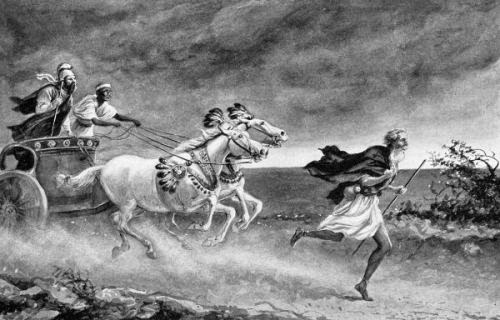
41 And Elijah said to Ahab, “Go up, eat and drink, for there is a sound of the rushing of rain.” 42 So Ahab went up to eat and to drink. And Elijah went up to the top of Mount Carmel. And he bowed himself down on the earth and put his face between his knees. 43 And he said to his servant, “Go up now, look toward the sea.” And he went up and looked and said, “There is nothing.” And he said, “Go again,” seven times. 44 And at the seventh time he said, “Behold, a little cloud like a man’s hand is rising from the sea.” And he said, “Go up, say to Ahab, ‘Prepare your chariot and go down, lest the rain stop you.’” 45 And in a little while the heavens grew black with clouds and wind, and there was a great rain. And Ahab rode and went to Jezreel. 46 And the hand of the Lord was on Elijah, and he gathered up his garment and ran before Ahab to the entrance of Jezreel. 

1 Ahab told Jezebel all that Elijah had done, and how he had killed all the prophets with the sword. Then Jezebel sent a messenger to Elijah, saying, “So may the gods do to me and more also, if I do not make your life as the life of one of them by this time tomorrow.” Then he was afraid, and he arose and ran for his life and came to Beersheba, which belongs to Judah, and left his servant there. 1 Kings 18:41-19:3 ESV

Chapter 18 opened up with the words God spoke to Elijah: “Go, show yourself to Ahab, and I will send rain upon the earth” (1 Kings 18:1 ESV). This statement contains a command as well as a promise from God. After his three-and-a-half-year absence, Elijah was to return to Israel from Sidon and confront King Ahab one more time. But while this command would likely involve great risk to the prophet, his obedience would result in a tremendous blessing on the people. God would end the long drought and restore rain to the land.

It is impossible to know if Elijah was aware of all that would have to happen before the rain returned. There is no indication as to when God divulged the rest of His plan and Elijah’s role in it. But before the physical drought could end, the spiritual drought afflicting the people would have to come to a decisive conclusion that involved a dramatic confrontation between Elijah and the 450 prophets of Baal. But the real battle would be between Yahweh, the God of Israel, and Baal, the god of Ahab and Jezebel.

And God had won the day. He displayed His power by sending fire from heaven that “consumed the burnt offering and the wood and the stones and the dust, and licked up the water that was in the trench” (1 Kings 18:38 ESV). This demonstrative exhibition of God’s omnipotence brought the people to their knees in fear and worship of God. What they had just witnessed left them thoroughly convinced that Yahweh was the one true God, and that newly revived awareness left them crying out, “The Lord, he is God; the Lord, he is God” (1 Kings 18:39 ESV). And as if to put an exclamation point on the whole scene, Elijah had ordered the capture and execution of all 450 of Baal’s so-called prophets. When they had cried out to their god, he had remained silent. Now the prophet of Yahweh silenced them – for good. They would no longer deceive and mislead the people of Israel with fallacious promises concerning their false god.

But there was still one thing missing: The rain that God had promised. Baal had been discredited, his prophets had been eliminated, and the peoples’ reverence for Yahweh had been rejuvenated. But the land remained under the God-ordained drought that had turned Israel into a dust bowl where water and food were scarce and daily survival had become critical. The land that God had once described as “flowing with milk and honey” (Exodus 33:3 ESV) had become fruitless and lifeless, reflecting the spiritual state of the people who occupied it.

Hundreds of years earlier, long before the people of Israel took possession of the land of Canaan, Moses had warned them what would happen if they proved unfaithful.

“And if you will indeed obey my commandments that I command you today, to love the Lord your God, and to serve him with all your heart and with all your soul, he will give the rain for your land in its season, the early rain and the later rain, that you may gather in your grain and your wine and your oil. And he will give grass in your fields for your livestock, and you shall eat and be full. Take care lest your heart be deceived, and you turn aside and serve other gods and worship them; then the anger of the Lord will be kindled against you, and he will shut up the heavens, so that there will be no rain, and the land will yield no fruit, and you will perish quickly off the good land that the Lord is giving you.” – Deuteronomy 11:13-17 ESV

And years later, when God’s people continued to display their propensity for unfaithfulness, His prophet, Joel, would offer this promise of divine restoration even in the face of their disobedience.

Surely the Lord has done great things!
    Don’t be afraid, O land.
Be glad now and rejoice,
    for the Lord has done great things.
Don’t be afraid, you animals of the field,
    for the wilderness pastures will soon be green.
The trees will again be filled with fruit;
    fig trees and grapevines will be loaded down once more.
Rejoice, you people of Jerusalem!
    Rejoice in the Lord your God!
For the rain he sends demonstrates his faithfulness.
    Once more the autumn rains will come,
    as well as the rains of spring.
The threshing floors will again be piled high with grain,
    and the presses will overflow with new wine and olive oil.

The Lord says, “I will give you back what you lost…” – Joel 2:20-25 ESV

That day on Mount Carmel, the people had seen the fire of God fall from heaven, completely consuming the altar, sacrifice, and water. But they had not yet seen or felt His blessing. As Joel stated, “the rain he sends demonstrates his faithfulness.” Their land was in desperate need of restoration and rejuvenation, and so were they. After three-and-a-half-years of spiritual drought, their hearts were parched and hardened. They had lost the capacity for fruitfulness and faithfulness and they needed an outpouring of God’s grace and mercy.

Elijah knew what God had in store. So, he informed the shell-shocked king to “Go get something to eat and drink, for I hear a mighty rainstorm coming!” (1 Kings 18:41 NLT). There was a blessing on the horizon. In spite of Ahab and Jezebel’s wickedness, God was about to pour out His goodness on the land.

The fact that Ahab had food to eat is symbolic of his self-centered approach to leadership. His sins had brought God’s curse upon the nation. But while they suffered severely from the lack of rain, Ahab and Jezebel lived in royal comfort and ease. God would later issue an indictment against the leaders of Israel, warning them of their blatant disregard for the care of His people.

“What sorrow awaits you shepherds who feed yourselves instead of your flocks. Shouldn’t shepherds feed their sheep?” – Ezekiel 34:2 NLT

And as Ahab was busy satisfying his own needs, Elijah interceded on behalf of the people of Israel. He “climbed to the top of Mount Carmel and bowed low to the ground and prayed with his face between his knees” (1 Kings 18:42 NLT). At one point during his prayer, he stops and sends his servant to look toward the Mediterranean Sea in the east. But the servant sees nothing. This pattern repeats itself five more times with the same disappointing result. But the seventh time, the servant returns with a different report.

“I saw a little cloud about the size of a man’s hand rising from the sea.” – 1 Kings 18:44 NLT

Out on the distant horizon, the servant had seen what appeared to be a small glimmer of hope. It was a small and seemingly insignificant cloud. But Elijah knew what it meant. The blessing of God was about to fall and, when it did, it would come in torrents. So, he instructed his servant to warn Ahab to leave immediately or he may not make it back to his winter palace in Jezreel. When Elijah’s servant had looked to the east, he only saw a faint possibility. But through his eyes of faith,  Elijah saw something altogether different. He perceived the imminent arrival of the outpouring of God’s blessing. And before long that small cloud had developed into a massive storm that brought strong winds and torrential rains. And as Ahab tried to outrun the storm in his chariot, “the Lord gave special strength to Elijah. He tucked his cloak into his belt and ran ahead of Ahab’s chariot all the way to the entrance of Jezreel” (1 Kings 18:46 NLT).

Because Jezreel was anywhere from 10-20 miles east of Mount Carmel, some commentators attempt to explain this last verse by saying that Ahab’s chariot got caught in the mud and delayed his arrival. Others speculate that Elijah simply took a shortcut over the ridge of Mount Carmel. But everything about this story has been focused on the matchless power of God. And it should not seem out of the question that God might endow his prophet with a supernatural capacity to outrun the chariot of his arch-nemesis. God had defeated Baal. Now, the prophet of God had defeated the benefactor of Baal.

But while Elijah had won the victory at Mount Carmel and the race to Jezreel, he would have little time to celebrate. Upon hearing the unexpected news of all that had transpired on Mount Carmel, Jezebel was outraged and directed all her anger at Elijah.

“May the gods strike me and even kill me if by this time tomorrow I have not killed you just as you killed them.” – 1 Kings 19:2 NLT

Despite all that Ahab told her about the day’s events, she remained unconvinced of Yahweh’s power. She even called on Baal and his queen mother, Asherah, to come to her aid so that she might avenge the deaths of the prophets by killing Elijah. She was still putting her hope and trust in her false gods. Even the sudden arrival of long-awaited rain did nothing to diminish her misplaced trust in her lifeless and powerless gods.

But even more surprising than Jezebel’s stubborn resistance to God was Elijah’s sudden display of fear and doubt. This man who had called down fire from heaven and had singlehandedly executed 450 prophets of Baal found himself intimidated by the idle threats of this self-absorbed, idol-worshiping queen. Her vow to avenge her false god should have made Elijah laugh with scorn. Her god had proven himself to be speechless, powerless, and utterly helpless in the face of Yahweh. Yet, the formerly faithful Elijah was suddenly fearful, and this time, rather than running to the problem in the strength of God, he ran away from it. He fled for his life, covering the 25 miles from Jezreel to Beersheba motivated by fear and in the strength of his own flesh. Faced with the threats of Jezebel, Elijah took his eyes off of God and took his fate into his own hands.

English Standard Version (ESV) The Holy Bible, English Standard Version. ESV® Permanent Text Edition® (2016). Copyright © 2001 by Crossway Bibles, a publishing ministry of Good News Publishers.

New Living Translation (NLT) Holy Bible, New Living Translation, copyright © 1996, 2004, 2015 by Tyndale House Foundation. Used by permission of Tyndale House Publishers Inc., Carol Stream, Illinois 60188. All rights reserved.

The Message (MSG)Copyright © 1993, 1994, 1995, 1996, 2000, 2001, 2002 by Eugene H. Peterson