The Will of God and the Ways of Men

28 Now the rest of the acts of Josiah and all that he did, are they not written in the Book of the Chronicles of the Kings of Judah? 29 In his days Pharaoh Neco king of Egypt went up to the king of Assyria to the river Euphrates. King Josiah went to meet him, and Pharaoh Neco killed him at Megiddo, as soon as he saw him. 30 And his servants carried him dead in a chariot from Megiddo and brought him to Jerusalem and buried him in his own tomb. And the people of the land took Jehoahaz the son of Josiah, and anointed him, and made him king in his father’s place.

31 Jehoahaz was twenty-three years old when he began to reign, and he reigned three months in Jerusalem. His mother’s name was Hamutal the daughter of Jeremiah of Libnah. 32 And he did what was evil in the sight of the LORD, according to all that his fathers had done. 33 And Pharaoh Neco put him in bonds at Riblah in the land of Hamath, that he might not reign in Jerusalem, and laid on the land a tribute of a hundred talents of silver and a talent of gold. 34 And Pharaoh Neco made Eliakim the son of Josiah king in the place of Josiah his father, and changed his name to Jehoiakim. But he took Jehoahaz away, and he came to Egypt and died there. 35 And Jehoiakim gave the silver and the gold to Pharaoh, but he taxed the land to give the money according to the command of Pharaoh. He exacted the silver and the gold of the people of the land, from everyone according to his assessment, to give it to Pharaoh Neco.

36 Jehoiakim was twenty-five years old when he began to reign, and he reigned eleven years in Jerusalem. His mother’s name was Zebidah the daughter of Pedaiah of Rumah. 37 And he did what was evil in the sight of the LORD, according to all that his fathers had done. 

1 In his days, Nebuchadnezzar king of Babylon came up, and Jehoiakim became his servant for three years. Then he turned and rebelled against him. 2 And the LORD sent against him bands of the Chaldeans and bands of the Syrians and bands of the Moabites and bands of the Ammonites, and sent them against Judah to destroy it, according to the word of the LORD that he spoke by his servants the prophets. 3 Surely this came upon Judah at the command of the LORD, to remove them out of his sight, for the sins of Manasseh, according to all that he had done, 4 and also for the innocent blood that he had shed. For he filled Jerusalem with innocent blood, and the LORD would not pardon. – 2 Kings 23:28-24:4 ESV

In his ongoing attempt to redeem the spiritual soul of the nation, King Josiah had bitten off more than he could chew. His many reforms and his ongoing battle against idolatry and apostasy were more than enough to keep him busy. But as the king of a powerful nation, he also had the responsibility to keep abreast of all the military and political machinations taking place in the region. At this point in history, the Assyrians were still the dominant force in the region, but the Babylonians were beginning to exert a formidable influence. They were an up-and-coming superpower that posed a real threat to Assyria’s global empire.

Josiah received word that the Egyptian army was on its way to Carchemish on the Euphrates River, where they were to join Assyrian forces in a battle against the upstart Babylonians. For some reason, Josiah made the fateful decision to oppose this military alliance between Egypt and Assyria.

After Josiah had finished restoring the Temple, King Neco of Egypt led his army up from Egypt to do battle at Carchemish on the Euphrates River, and Josiah and his army marched out to fight him. But King Neco sent messengers to Josiah with this message:

“What do you want with me, king of Judah? I have no quarrel with you today! I am on my way to fight another nation, and God has told me to hurry! Do not interfere with God, who is with me, or he will destroy you.” – 2 Chronicles 23:20-21 NLT

Perhaps Josiah was hoping that the Babylonians would bring an end to Assyria’s longstanding stranglehold on the region. Long after the Assyrians had called off their siege of Jerusalem, they remained a constant threat to Judah. So, Josiah rallied his troops and intercepted the Egyptian army as it made its way to Carchemish. But King Neco, the Pharaoh of Egypt, warned Josiah not to interfere, claiming to have a divine mandate from God.

But Josiah refused to listen to Neco, to whom God had indeed spoken, and he would not turn back. Instead, he disguised himself and led his army into battle on the plain of Megiddo. – 2 Chronicles 23:22 NLT

Josiah refused to believe that Yahweh was behind this unholy alliance between the Egyptians and the Assyrians. He couldn’t see any reason why Yahweh would direct the pagan king of the Egyptians to join forces with the already powerful and deadly kingdom of Assyria. It made no sense. But Josiah failed to understand that Yahweh was orchestrating His sovereign will and raising up the nation of Babylon as His agent of judgment against Assyria for its role in the destruction of the northern kingdom of Israel. Josiah was also unaware that God was preparing to use Babylon to destroy the nation of Judah.
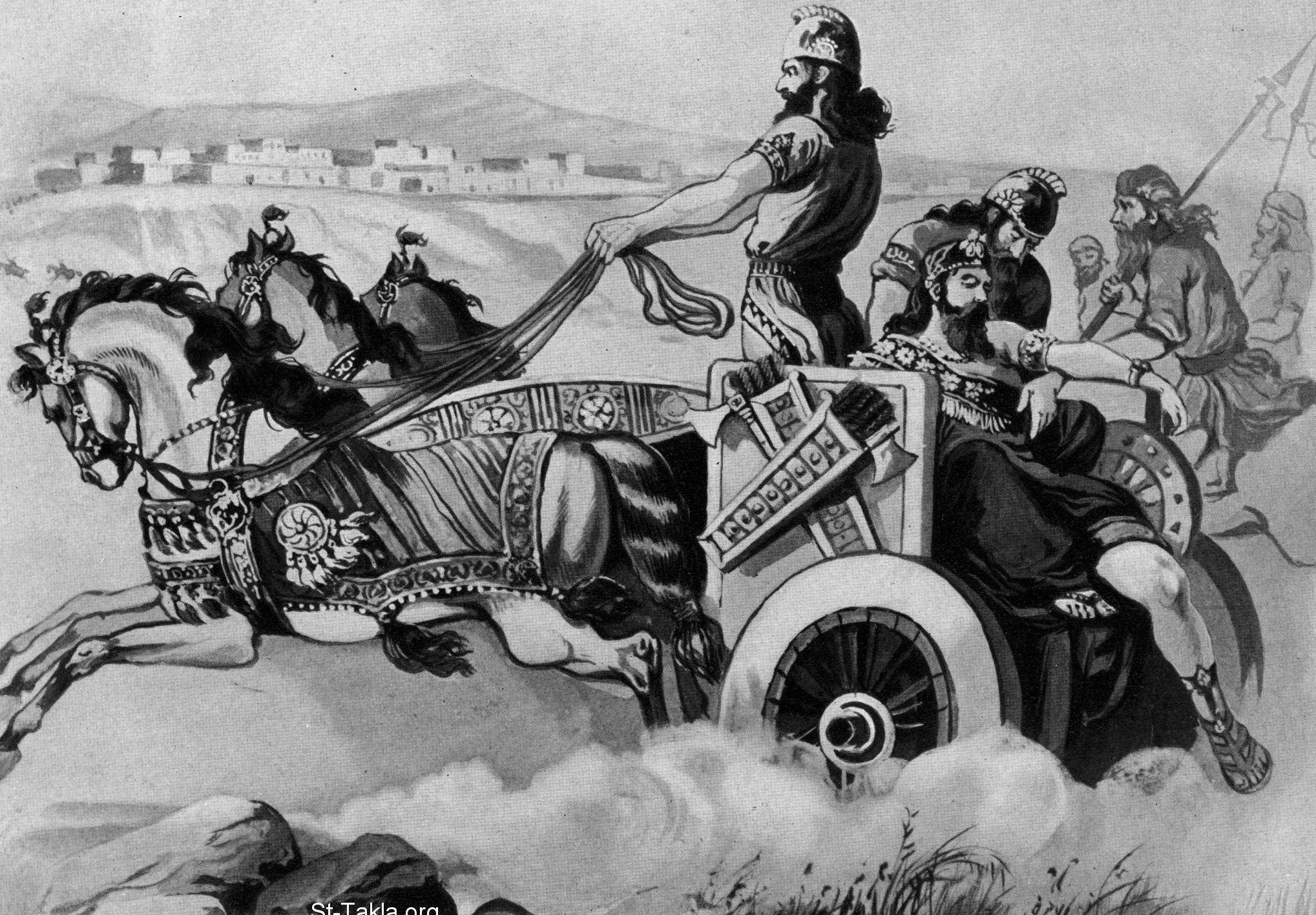
Ignorant of God’s plans, King Josiah decided to take matters into his own hands and led his troops into battle against the Egyptians. They intercepted the Egyptian army at a place called Megiddo, and in the ensuing battle, King Josiah was killed. The author of 2 Kings states that “Pharaoh Neco killed him at Megiddo, as soon as he saw him” (2 Kings 23:29 ESV). But in 2 Chronicles 35, we’re told that Josiah had disguised himself before going into battle. It seems that Josiah’s little ploy to hide his kingly identity failed. King Neco recognized Josiah instantly and ordered his death.

But the enemy archers hit King Josiah with their arrows and wounded him. He cried out to his men, “Take me from the battle, for I am badly wounded!” – 2 Chronicles 35:23 NLT

The wounded king was placed in another chariot and evacuated to the city of Jerusalem, where he died. After giving their fallen king a state funeral, the people chose Jehoahaz as his replacement. This choice seems a bit odd because Jehoahaz was Josiah’s middle son and, therefore, not the next in line to the throne. But it seems that the people were looking for a king who would bring back the old way of life to which they had grown accustomed. They missed the days of Manasseh and regretted all the reforms that Josiah had instituted in Judah. So, they chose the one son of Josiah who represented their best chance at bringing back the good old days. And it appears that they picked just the right man for the job becaise “he did what was evil in the LORD’s sight, just as his ancestors had done” (2 Kings 23:32 NLT).

But Jehoahaz’s reign would be short-lived. The people failed to take into account that King Neco might have something to say about who took Josiah’s place on the throne of Judah. Just three months into his reign, Jehoahaz was deposed by the Pharaoh and taken captive to Egypt, where he died. Neco filled the vacancy with Eliakim, the older brother of Jehoahaz, and changed his name to Jehoiakim. This young man became little more than a puppet king who was forced to make an annual tribute payment to the Egyptians. To do this, he imposed a debilitating tax on the people of Judah. The prophet provides a brief but sobering summary of the sad state of affairs in the southern kingdom of Judah after the death of Josiah.
Do not weep for the dead king or mourn his loss. Instead, weep for the captive king being led away! For he will never return to see his native land again.

For this is what the LORD says about Jehoahaz, who succeeded his father, King Josiah, and was taken away as a captive: “He will never return. He will die in a distant land and will never again see his own country.” – Jeremiah 22:10-12 NLT

With Josiah’s death, the period of reformation in Judah came to an abrupt end. He had been the heart and soul behind all the changes that had taken place, and, without him, the people quickly reverted to their old ways. Virtually overnight, the conditions in Judah took a dramatic turn for the worse. Judah was now a vassal state, ruled by a powerless king who answered to the Pharaoh of Egypt.

Josiah’s attempt to stop the Egyptians from joining forces with the Assyrians had failed. In 605 BC, just four years after Josiah’s death, these two armies were defeated by the Babylonians at the Battle of Carchemish. This unexpected victory by the Babylonians over the Egyptians and Assyrians proved to be a game-changing event in the history of the Middle East. It catapulted King Nebuchadnezzar of Babylon into the role of the most powerful ruler on earth. With his defeat of the Assyrians, Nebuchadnezzar took over all the lands they had conquered, dramatically increasing the size and influence of his empire.

Eventually, the Babylonians would wrest control of Judah from the hands of King Neco of Egypt, and Jehoiakim would find himself answering to yet another, more powerful, king. But Jehoiakim will try to resist his new overlord, refusing to submit to his authority. Like his father, Josiah, Jehoiakim will fail to see the sovereign hand of God behind all that is taking place. His outlook is short-sighted, and he will attempt to make the most of his less-than-ideal circumstances.

The prophet Jeremiah records God’s stinging condemnation of Jehoiakim’s arrogant and self-centered approach to leadership.

And the LORD says, “What sorrow awaits Jehoiakim,
    who builds his palace with forced labor.
He builds injustice into its walls,
    for he makes his neighbors work for nothing.
    He does not pay them for their labor.
He says, ‘I will build a magnificent palace
    with huge rooms and many windows.
I will panel it throughout with fragrant cedar
    and paint it a lovely red.’
But a beautiful cedar palace does not make a great king!
    Your father, Josiah, also had plenty to eat and drink.
But he was just and right in all his dealings.
    That is why God blessed him.
He gave justice and help to the poor and needy,
    and everything went well for him.
Isn’t that what it means to know me?”
    says the LORD.
“But you! You have eyes only for greed and dishonesty!
    You murder the innocent,
    oppress the poor, and reign ruthlessly.” – Jeremiah 22:13-17 NLT

Unlike his reform-minded father, Jehoiakim had no heart for Yahweh. He was a self-obsessed man who used his power and position to improve his own lot in life while allowing the nation of Judah to continue its slide into apostasy. When Neco was forced to abandon his hold on Judah, Jehoiakim saw it as an opportunity to assert his independence, but he failed to understand the gravity of his situation. He had no clue that Yahweh had divinely ordained Nebuchadnezzar and the Babylonians to bring judgment against the nation of Judah. In attempting to resist the Babylonians, Jehoiakim was actually opposing the sovereign will of God, and he would pay dearly for his obstinacy.

For three years, Yahweh sent the Babylonians, Arameans, Moabites, and Ammonites against the rebellious nation of Judah. And the author leaves no doubt as to the purpose behind these raids.

These disasters happened to Judah because of the LORD’s command. He had decided to banish Judah from his presence because of the many sins of Manasseh. – 2 Kings 24:3 NLT

Little did Jehoiakim know that he was facing the beginning of the end. The coming judgment of Judah was imminent and unavoidable.

English Standard Version (ESV) The Holy Bible, English Standard Version. ESV® Permanent Text Edition® (2016). Copyright © 2001 by Crossway Bibles, a publishing ministry of Good News Publishers.

New Living Translation (NLT) Holy Bible, New Living Translation, copyright © 1996, 2004, 2015 by Tyndale House Foundation. Used by permission of Tyndale House Publishers Inc., Carol Stream, Illinois 60188. All rights reserved.

Too Little, Too Late

21 And the king commanded all the people, “Keep the Passover to the LORD your God, as it is written in this Book of the Covenant.” 22 For no such Passover had been kept since the days of the judges who judged Israel, or during all the days of the kings of Israel or of the kings of Judah. 23 But in the eighteenth year of King Josiah this Passover was kept to the LORD in Jerusalem.

24 Moreover, Josiah put away the mediums and the necromancers and the household gods and the idols and all the abominations that were seen in the land of Judah and in Jerusalem, that he might establish the words of the law that were written in the book that Hilkiah the priest found in the house of the LORD. 25 Before him there was no king like him, who turned to the LORD with all his heart and with all his soul and with all his might, according to all the Law of Moses, nor did any like him arise after him.

26 Still the LORD did not turn from the burning of his great wrath, by which his anger was kindled against Judah, because of all the provocations with which Manasseh had provoked him. 27 And the LORD said, “I will remove Judah also out of my sight, as I have removed Israel, and I will cast off this city that I have chosen, Jerusalem, and the house of which I said, My name shall be there.” – 2 Kings 23:21-27 ESV

Josiah’s efforts to restore the worship of Yahweh in Judah were unprecedented. He did more than any of the other kings of Judah to reestablish and reaffirm the nation’s commitment to the covenant they had made with God. But he faced a formidable and seemingly endless task. His own father had bequeathed to him a kingdom that was in a state of spiritual disarray and moral decline. It seems that everywhere Josiah looked, he found more idols, altars, and shrines to the many false gods his predecessors had erected in Judah. Their pervasive presence provided tangible evidence of the nation’s steep spiritual decline. Like cancer cells in the human body, idolatry had invaded the nation of Judah, spreading its deadly influence to the far corners of the kingdom. And Josiah spent a lifetime attempting to seek and destroy every last vestige of idolatry from the land.

But Josiah knew that even if he was successful in removing every idol, shrine, and altar,  there would still be a problem. The eradication of idolatry would not necessarily result in faithfulness to Yahweh. To restore the people’s faith in God, Josiah knew they would need to be reminded of the greatness of God. That is why he spent so much time and money restoring the Temple, the symbol of God’s presence and power. It also explains his determination to re institute the celebration of Passover.

This annual feast had been divinely ordained by God and was intended to serve as a perpetual reminder of God’s miraculous and gracious deliverance of the nation of Israel from their captivity in Egypt. On the night that God had sent the death angel to enact the tenth and final plague against the Egyptians, He had given the Israelites instructions that would guarantee their safety. Each family was to sacrifice a lamb and sprinkle its blood on the doorposts and lentil of their home. Then they were to gather inside their homes and “eat the meat the same night; they will eat it roasted over the fire with bread made without yeast and with bitter herbs” (Exodus 12:8 NLT).

The people of Israel were expected to faithfully observe this rather strange ritual in order to escape the judgment that was about to fall on the land of Egypt. And God assured them that if they would obey His instructions, they would be spared.

“I will pass through the land of Egypt in the same night, and I will attack all the firstborn in the land of Egypt, both of humans and of animals, and on all the gods of Egypt I will execute judgment. I am the LORD. The blood will be a sign for you on the houses where you are, so that when I see the blood I will pass over you, and this plague will not fall on you to destroy you when I attack the land of Egypt.” – Exodus 12:12-13 NLT

Even before the lambs were slaughtered and the death angel appeared, God commanded His people to make this an annual celebration.

This day will become a memorial for you, and you will celebrate it as a festival to the Lord—you will celebrate it perpetually as a lasting ordinance. – Exodus 12:14 NLT

They were to observe it every year as a reminder of God’s power and provision. Moses even told them what to say when the future generations of Israelites asked about the nature of this strange celebration.

“It is the sacrifice of the LORD’s Passover, when he passed over the houses of the Israelites in Egypt, when he struck Egypt and delivered our households.” – Exodus 12:27 NLT

However, by the time Josiah became king, the celebration of Passover had become a distant and fading memory. Many Israelite children had grown up having never celebrated this annual feast or hearing the story of God’s deliverance. As a result, they were ignorant of His goodness and greatness. In their minds, Yahweh was just one more god in the pantheon of deities worshiped in Judah. And when Josiah systematically removed all the other options, they found themselves left with a God they didn’t know and could not fully appreciate. And because they had not been taught the Book of the Covenant, they failed to understand the danger of their ignorance of and indifference to God. Centuries earlier, before the Israelites entered the land of promise, Moses had warned them:

“Then when the LORD your God brings you to the land he promised your ancestors Abraham, Isaac, and Jacob to give you—a land with large, fine cities you did not build, houses filled with choice things you did not accumulate, hewn-out cisterns you did not dig, and vineyards and olive groves you did not plant—and you eat your fill, be careful not to forget the LORD who brought you out of Egypt, that place of slavery. You must revere the LORD your God, serve him, and take oaths using only his name. You must not go after other gods, those of the surrounding peoples, for the LORD your God, who is present among you, is a jealous God—his anger will erupt against you and remove you from the land.” – Deuteronomy 6:10-15 NLT

Everything Moses had warned them about happened. They had forgotten God and had failed to revere and serve Him. That is why Josiah desperately tried to remedy the situation by calling the people to recommit themselves to Yahweh. He used all his authority and power as king to re-establish the primacy of the one true God. He poured every ounce of his passion into the process and spared no expense to see that Yahweh was honored in a manner worthy of His greatness and goodness. Josiah went out of his way to ensure that this Passover was a spectacular occasion that would reaffirm Yahweh’s incomparable value and reignite the people’s faithfulness to Him.

Never since the time of the prophet Samuel had there been such a Passover. None of the kings of Israel had ever kept a Passover as Josiah did, involving all the priests and Levites, all the people of Jerusalem, and people from all over Judah and Israel. – 2 Chronicles 35:18 NLT

Josiah’s tireless efforts to restore the worship of Yahweh in Judah would not go unnoticed. He would go down in history as one of the greatest kings of Judah.

Before him there was no king like him, who turned to the LORD with all his heart and with all his soul and with all his might, according to all the Law of Moses, nor did any like him arise after him. – 2 Kings 23:25 ESV

He was a man of great faith who used his divinely ordained authority as king to lead the people back to God. Like his ancestor David, Josiah was a man after God’s own heart who shepherded the flock of God “with a true heart and led them with skillful hands” (Psalm 78:72 NLT). He did all he could do to restore the holiness of God’s name among the people of Judah and reinvigorate their hearts to serve Him alone. But while his efforts were sincere, they proved unsuccessful. Yahweh knew the hearts of His covenant people remained unchanged, and He would not relent concerning their judgment.

Even so, the LORD was very angry with Judah because of all the wicked things Manasseh had done to provoke him. For the LORD said, “I will also banish Judah from my presence just as I have banished Israel. And I will reject my chosen city of Jerusalem and the Temple where my name was to be honored.” – 2 Kings 23:26-27 NLT

God knew their outward displays of repentance were insincere and insufficient. The idols had been removed, but their idolatrous hearts remained. Yahweh would use the prophet Isaiah to declare His sad assessment of their moral condition.

“These people say they are loyal to me;
they say wonderful things about me,
but they are not really loyal to me.
Their worship consists of
nothing but man-made ritual.” – Isaiah 29:13 NLT

Josiah had torn down all the idols, shrines, and altars, but he could do nothing to heal the hearts of the people. Despite all his efforts, the people remained just as unfaithful and unresponsive to God. The prophet Isaiah would accuse them of having a diminished view of God.

What sorrow awaits those who try to hide their plans from the LORD,
    who do their evil deeds in the dark!
“The LORD can’t see us,” they say.
    “He doesn’t know what’s going on!”
How foolish can you be?
    He is the Potter, and he is certainly greater than you, the clay!
Should the created thing say of the one who made it,
    “He didn’t make me”?
Does a jar ever say,
    “The potter who made me is stupid”? – Isaiah 29:15-16 NLT

Josiah had purged the land of idols, restored the Temple, re-instituted the Passover, and re-familiarized the people with the Book of the Covenant. But he could do nothing to legislate heart change. While he had successfully transformed the environment in which they lived, the people of Judah remained just as unfaithful as ever. God would later warn the prophet Ezekiel to be wary of the hypocritical hearts of the people of Judah.

“So my people come pretending to be sincere and sit before you. They listen to your words, but they have no intention of doing what you say. Their mouths are full of lustful words, and their hearts seek only after money.” – Ezekiel 33:31 NLT

Judah would experience the same fate as their neighbor to the north. Their disobedience and unfaithfulness to God would result in their destruction. Josiah had done his best, but the fall of Judah was inevitable and unavoidable because the hearts of the people remained unresponsive and unrepentant.

English Standard Version (ESV) The Holy Bible, English Standard Version. ESV® Permanent Text Edition® (2016). Copyright © 2001 by Crossway Bibles, a publishing ministry of Good News Publishers.

New Living Translation (NLT) Holy Bible, New Living Translation, copyright © 1996, 2004, 2015 by Tyndale House Foundation. Used by permission of Tyndale House Publishers Inc., Carol Stream, Illinois 60188. All rights reserved.

Reformation 1.0

1 Then the king sent, and all the elders of Judah and Jerusalem were gathered to him. 2 And the king went up to the house of the LORD, and with him all the men of Judah and all the inhabitants of Jerusalem and the priests and the prophets, all the people, both small and great. And he read in their hearing all the words of the Book of the Covenant that had been found in the house of the LORD. 3 And the king stood by the pillar and made a covenant before the LORD, to walk after the LORD and to keep his commandments and his testimonies and his statutes with all his heart and all his soul, to perform the words of this covenant that were written in this book. And all the people joined in the covenant.

4 And the king commanded Hilkiah the high priest and the priests of the second order and the keepers of the threshold to bring out of the temple of the LORD all the vessels made for Baal, for Asherah, and for all the host of heaven. He burned them outside Jerusalem in the fields of the Kidron and carried their ashes to Bethel. 5 And he deposed the priests whom the kings of Judah had ordained to make offerings in the high places at the cities of Judah and around Jerusalem; those also who burned incense to Baal, to the sun and the moon and the constellations and all the host of the heavens. 6 And he brought out the Asherah from the house of the LORD, outside Jerusalem, to the brook Kidron, and burned it at the brook Kidron and beat it to dust and cast the dust of it upon the graves of the common people. 7 And he broke down the houses of the male cult prostitutes who were in the house of the LORD, where the women wove hangings for the Asherah. 8 And he brought all the priests out of the cities of Judah, and defiled the high places where the priests had made offerings, from Geba to Beersheba. And he broke down the high places of the gates that were at the entrance of the gate of Joshua the governor of the city, which were on one’s left at the gate of the city. 9 However, the priests of the high places did not come up to the altar of the LORD in Jerusalem, but they ate unleavened bread among their brothers. 10 And he defiled Topheth, which is in the Valley of the Son of Hinnom, that no one might burn his son or his daughter as an offering to Molech. 11 And he removed the horses that the kings of Judah had dedicated to the sun, at the entrance to the house of the LORD, by the chamber of Nathan-melech the chamberlain, which was in the precincts. And he burned the chariots of the sun with fire. 12 And the altars on the roof of the upper chamber of Ahaz, which the kings of Judah had made, and the altars that Manasseh had made in the two courts of the house of the LORD, he pulled down and broke in pieces and cast the dust of them into the brook Kidron. 13 And the king defiled the high places that were east of Jerusalem, to the south of the mount of corruption, which Solomon the king of Israel had built for Ashtoreth the abomination of the Sidonians, and for Chemosh the abomination of Moab, and for Milcom the abomination of the Ammonites. 14 And he broke in pieces the pillars and cut down the Asherim and filled their places with the bones of men.

15 Moreover, the altar at Bethel, the high place erected by Jeroboam the son of Nebat, who made Israel to sin, that altar with the high place he pulled down and burned, reducing it to dust. He also burned the Asherah. 16 And as Josiah turned, he saw the tombs there on the mount. And he sent and took the bones out of the tombs and burned them on the altar and defiled it, according to the word of the LORD that the man of God proclaimed, who had predicted these things. 17 Then he said, “What is that monument that I see?” And the men of the city told him, “It is the tomb of the man of God who came from Judah and predicted these things that you have done against the altar at Bethel.” 18 And he said, “Let him be; let no man move his bones.” So they let his bones alone, with the bones of the prophet who came out of Samaria. 19 And Josiah removed all the shrines also of the high places that were in the cities of Samaria, which kings of Israel had made, provoking the LORD to anger. He did to them according to all that he had done at Bethel. 20 And he sacrificed all the priests of the high places who were there, on the altars, and burned human bones on them. Then he returned to Jerusalem. – 2 Kings 23:1-20 ESV

When it came to reforming and healing the deadly spiritual malaise in Judah, Josiah had his work cut out for him. And when reading the list of his reforms, it’s easy to focus on all the positive steps he took to course-correct Judah’s spiritual trajectory. But why was all of this necessary? How had things gotten so bad in Judah that the king was forced to commit all his time and resources to this spiritual reclamation project? The reader should be shocked and appalled by the abysmal condition of the nation’s faith community; the moral state of the people of Judah had reached an all-time low. And Josiah revealed the extent of their moral decline by reading to them portions of the rediscovered Book of the Covenant – the Pentateuch. It’s likely that his reading included this foundational and oft-repeated admonition from the original Ten Commandments.

“Do not make idols or set up carved images, or sacred pillars, or sculptured stones in your land so you may worship them. I am the LORD your God. You must keep my Sabbath days of rest and show reverence for my sanctuary. I am the LORD.” – Leviticus 26:1-2 NLT

Josiah had already begun an aggressive temple renovation project designed to repair the long-neglected house of God. But these restoration efforts were more than cosmetic in nature. Josiah was having to purge and purify the sanctuary of God from the desecrating presence of altars to a litany of pagan idols. His predecessors had repeatedly displayed their disregard for God by defiling the temple that bore His name. They had turned God’s house into a veritable showroom for displaying all their false gods, and the sheer volume of these abominations is staggering.

Then the king instructed Hilkiah the high priest and the priests of the second rank and the Temple gatekeepers to remove from the LORD’s Temple all the articles that were used to worship Baal, Asherah, and all the powers of the heavens. – 2 Kings 23:4 NLT

The king removed the Asherah pole from the LORD’s Temple… – 2 Kings 23:6 NLT

He also tore down the living quarters of the male and female shrine prostitutes that were inside the Temple of the LORD… – 2 Kings 23:7 NLT

He removed from the entrance of the LORD’s Temple the horse statues that the former kings of Judah had dedicated to the sun… – 2 Kings 23:11 NLT

The king destroyed the altars that Manasseh had built in the two courtyards of the LORD’s Temple. – 2 Kings 23:12 NLT

Josiah was a busy man, and his reforms didn’t stop at the Temple. He was determined to do whatever was necessary to remove every last vestige of idolatry from the land of Judah. He ordered the destruction of all shrines or altars dedicated to false gods, and there were a lot of them. Pagan shrines and high places could be found throughout Judah, from the capital city of Jerusalem to Geba in the north and Beersheba in the south. Their ubiquitous presence required Josiah to launch an extensive seek-and-destroy mission that began in the Temple, extended to the valleys just out Jerusalem, and reached all the way to the northern territory of Israel.

While the northern kingdom of Israel had fallen to the Assyrians and the people had been taken captive, the shrines and altars to their false gods remained. So, Josiah sent special mobile demolition teams as far as Bethel to destroy the altar that Jeroboam had erected decades earlier.

The king also tore down the altar at Bethel—the pagan shrine that Jeroboam son of Nebat had made when he caused Israel to sin. He burned down the shrine and ground it to dust, and he burned the Asherah pole. – 2 Kings 23:15 NLT

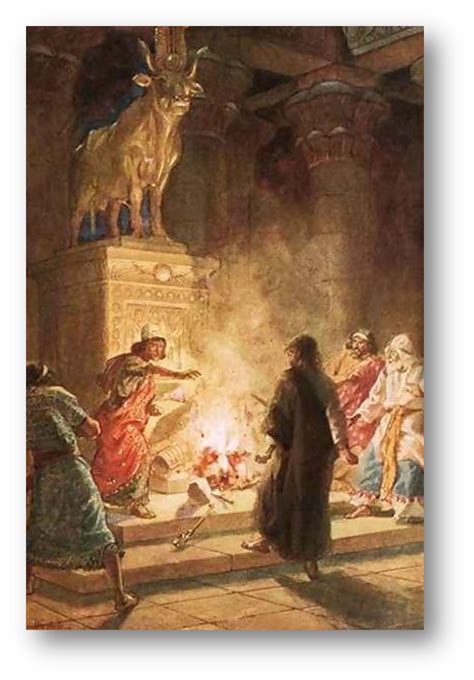
This was in direct fulfillment of a centuries-old prophecy God declared against rebellious Jeroboam. After God had split the kingdom of Solomon in half, He had awarded the kingship of the ten northern tribes to Jeroboam, who displayed his loyalty and gratitude by erecting a golden calf in the city of Bethel. This newly appointed king of Israel repaid God by abandoning Him. So, God sent a young, unnamed prophet with a message.

“O altar, altar! This is what the LORD says: A child named Josiah will be born into the dynasty of David. On you he will sacrifice the priests from the pagan shrines who come here to burn incense, and human bones will be burned on you.” – 1 Kings 13:2 NLT

Now, hundreds of years later, the prophecy of God became a reality. Josiah tore down the altar dedicated to the golden calf and then had the ground desecrated by burning human bones on it.

Then Josiah turned around and noticed several tombs in the side of the hill. He ordered that the bones be brought out, and he burned them on the altar at Bethel to desecrate it. (This happened just as the LORD had promised through the man of God when Jeroboam stood beside the altar at the festival.) – 2 Kings 23:16 NLT

The scope of Josiah’s reformation initiative is truly staggering, and it reveals just how bad things had gotten in Judah. The sheer volume of false gods being worshiped by the people of Yahweh should leave us dumbfounded. There were shrines to Baal, Topheth, Ashtoreth, Chemosh, and Molech – just to name a few. But there also altars dedicated “to the sun, the moon, the constellations, and to all the powers of the heavens” (2 Kings 23:5 NLT), as well as horse and chariot statues dedicated to the sun (2 Kings 23:11).

Josiah was faced with a truly formidable task but he took it on with dedicated determination. He tore down, burned down, cut down, smashed, and desecrated the thousands of altars to the myriad of false gods that permeated the landscape and the hearts of the people of Judah. Josiah took his role seriously because he feared God greatly.

His reading of the Book the Covenant reminded him of the dire consequences facing the people of God if they failed to remain faithful to their covenant commitment. He was well aware of what had happened to the northern kingdom, and he knew that Judah was just as deserving of God’s judgment. They had been equally unfaithful and the evidence was everywhere. So, Josiah took it upon himself to cleanse the land of its idolatrous stain. But the greatest challenge he faced was turning the hearts of the people back to Yahweh. He could remove the idols from the land, but could he remove the spirit of idolatry from their hearts? Time would tell.

English Standard Version (ESV) The Holy Bible, English Standard Version. ESV® Permanent Text Edition® (2016). Copyright © 2001 by Crossway Bibles, a publishing ministry of Good News Publishers.

New Living Translation (NLT) Holy Bible, New Living Translation, copyright © 1996, 2004, 2015 by Tyndale House Foundation. Used by permission of Tyndale House Publishers Inc., Carol Stream, Illinois 60188. All rights reserved.

Sincere, But Insufficient

1 Josiah was eight years old when he began to reign, and he reigned thirty-one years in Jerusalem. His mother’s name was Jedidah the daughter of Adaiah of Bozkath. 2 And he did what was right in the eyes of the LORD and walked in all the way of David his father, and he did not turn aside to the right or to the left.

3 In the eighteenth year of King Josiah, the king sent Shaphan the son of Azaliah, son of Meshullam, the secretary, to the house of the LORD, saying, 4 “Go up to Hilkiah the high priest, that he may count the money that has been brought into the house of the LORD, which the keepers of the threshold have collected from the people. 5 And let it be given into the hand of the workmen who have the oversight of the house of the LORD, and let them give it to the workmen who are at the house of the LORD, repairing the house 6 (that is, to the carpenters, and to the builders, and to the masons), and let them use it for buying timber and quarried stone to repair the house. 7 But no accounting shall be asked from them for the money that is delivered into their hand, for they deal honestly.”

8 And Hilkiah the high priest said to Shaphan the secretary, “I have found the Book of the Law in the house of the LORD.” And Hilkiah gave the book to Shaphan, and he read it. 9 And Shaphan the secretary came to the king, and reported to the king, “Your servants have emptied out the money that was found in the house and have delivered it into the hand of the workmen who have the oversight of the house of the LORD.” 10 Then Shaphan the secretary told the king, “Hilkiah the priest has given me a book.” And Shaphan read it before the king.

11 When the king heard the words of the Book of the Law, he tore his clothes. 12 And the king commanded Hilkiah the priest, and Ahikam the son of Shaphan, and Achbor the son of Micaiah, and Shaphan the secretary, and Asaiah the king’s servant, saying, 13 “Go, inquire of the LORD for me, and for the people, and for all Judah, concerning the words of this book that has been found. For great is the wrath of the LORD that is kindled against us, because our fathers have not obeyed the words of this book, to do according to all that is written concerning us.”

14 So Hilkiah the priest, and Ahikam, and Achbor, and Shaphan, and Asaiah went to Huldah the prophetess, the wife of Shallum the son of Tikvah, son of Harhas, keeper of the wardrobe (now she lived in Jerusalem in the Second Quarter), and they talked with her. 15 And she said to them, “Thus says the LORD, the God of Israel: ‘Tell the man who sent you to me, 16 Thus says the LORD, Behold, I will bring disaster upon this place and upon its inhabitants, all the words of the book that the king of Judah has read. 17 Because they have forsaken me and have made offerings to other gods, that they might provoke me to anger with all the work of their hands, therefore my wrath will be kindled against this place, and it will not be quenched. 18 But to the king of Judah, who sent you to inquire of the LORD, thus shall you say to him, Thus says the LORD, the God of Israel: Regarding the words that you have heard, 19 because your heart was penitent, and you humbled yourself before the LORD, when you heard how I spoke against this place and against its inhabitants, that they should become a desolation and a curse, and you have torn your clothes and wept before me, I also have heard you, declares the LORD. 20 Therefore, behold, I will gather you to your fathers, and you shall be gathered to your grave in peace, and your eyes shall not see all the disaster that I will bring upon this place.’” And they brought back word to the king. – 2 Kings 22:1-20 ESV

Just as Manasseh had reversed all the reforms of his father, Hezekiah, so Josiah used his authority as king to overturn Manasseh’s ungodly and pagan-inspired initiatives. The young king began an aggressive campaign to restore the spiritual health of Judah.

At the age of 16, just eight years into his reign, he began to “seek the God of his ancestor David” (2 Chronicles 34:3 NLT). Then, at the ripe old age of 20, he launched a widespread effort “to purify Judah and Jerusalem, destroying all the pagan shrines, the Asherah poles, and the carved idols and cast images” (2 Chronicles 34:3 NLT). These reformation projects continued well into his reign. At the age of 26, Josiah turned his attention to the Temple of God. In the 18th year of his reign, he “appointed Shaphan son of Azaliah, Maaseiah the governor of Jerusalem, and Joah son of Joahaz, the royal historian, to repair the Temple of the Lord his God” (2 Chronicles 34:8 NLT).

Due to Manasseh’s efforts to promote idol worship in Judah, the Temple had fallen into a state of neglect and disrepair. The former glory of the house that Solomon built had been greatly diminished by Manasseh’s shameless actions. He had desecrated God’s house and defamed the LORD’s name by ordering the placing of altars to some of his false gods right in the Temple grounds.

…he built altars for all the host of heaven in the two courts of the house of the LORD. – 2 Kings 21:5 ESV

Manasseh failed to recognize that the Temple was intended as a symbol of God’s abiding presence. Inside the Holy of Holies, the sacred inner sanctum of the Temple, was the Ark of the Covenant, in which were kept a variety of items designed to remind Israel of God’s faithfulness and providential care.

Inside the Ark were a gold jar containing manna, Aaron’s staff that sprouted leaves, and the stone tablets of the covenant. – Hebrews 9:4 NLT

During Israel’s years wandering in the wilderness, God’s presence dwelt above the mercy seat, which sat atop the Ark of the Covenant. Whenever God commanded Israel to stop and set up camp, they would erect the Tabernacle, and then God’s shekinah glory would take up residence within the Holy of Holies. The Book of Exodus provides a description of this divine manifestation of God’s presence.

Then the cloud covered the Tabernacle, and the glory of the LORD filled the Tabernacle. Moses could no longer enter the Tabernacle because the cloud had settled down over it, and the glory of the LORD filled the Tabernacle.

Now whenever the cloud lifted from the Tabernacle, the people of Israel would set out on their journey, following it. But if the cloud did not rise, they remained where they were until it lifted. The cloud of the LORD hovered over the Tabernacle during the day, and at night fire glowed inside the cloud so the whole family of Israel could see it. This continued throughout all their journeys. – Isaiah 40:34-38 NLT

When Solomon built his magnificent Temple in Jerusalem, he ordered the Ark of the Covenant to be moved into the Holy of Holies. Yahweh had promised to bless the Temple with His presence as long as the people of Israel remained obedient to His commands.

“My name will be honored forever in this Temple and in Jerusalem—the city I have chosen from among all the tribes of Israel. If the Israelites will be careful to obey my commands—all the laws my servant Moses gave them—I will not send them into exile from this land that I gave their ancestors.” – 2 Kings 21:7-8 NLT

But by the time Josiah became king of Judah, the northern kingdom of Israel had already fallen to the Assyrians, due to their unfaithfulness to God. The southern kingdom of Judah had come close to experiencing the same fate, but Hezekiah had repented, prompting God to miraculously deliver them from defeat at the hands of the Assyrians. Yet, the spiritual state of Judah had been greatly diminished by the ungodly leadership of men like Manasseh. His son, Josiah, was forced to repair all the damage he had done to the kingdom and its relationship with God Almighty.

Not only had the nation of Judah failed to care for God’s Temple, but they also refused to keep the laws He had handed down to Moses. In doing so, they had unknowingly placed themselves in a dangerous predicament. God had promised to dwell among them and provide protection for them, but only as long as they obeyed all His commands. However, they had failed to do so, and their neglect of God’s Temple was further exacerbated by their neglect of God’s law.

But in the process of repairing the temple, Hilkiah the high priest made an important discovery.

“I have found the Book of the Law in the LORD’s Temple!” – 2 Kings 22:8 NLT

This is most likely a reference to the Torah or Pentateuch, the first five books of the Old Testament. Somewhere in the recesses of the Temple, Hilkiah ran across a scroll containing God’s history of His relationship with Israel and the commands He had passed on to them through Moses. When the contents of this scroll were read to King Josiah, he was immediately and dramatically impacted by what he heard. He recognized that they were in serious trouble because they had failed to keep their covenant commitment to God. He could restore the Temple, but the people were going to have to restore their devotion to God and their determination to live in obedience to His holy law.

So, Josiah gave instructions to his high priest and other officials, ordering them to seek the LORD’s instructions. Josiah knew that they deserved Yahweh’s wrath and judgment, so he sought to know how they were to make up for all the years of disobedience.

“Go to the Temple and speak to the LORD for me and for the people and for all Judah. Inquire about the words written in this scroll that has been found. For the LORD’s great anger is burning against us because our ancestors have not obeyed the words in this scroll. We have not been doing everything it says we must do.” – 2 Kings 22:13 NLT

These men returned with a disturbing message from Hilduh, a prophetess of Yahweh. She informed the king that, because of their years of disobedience, the nation of Judah was going to experience all the curses described in the book of Deuteronomy.

“This is what the LORD says: I am going to bring disaster on this city and its people. All the words written in the scroll that the king of Judah has read will come true. For my people have abandoned me and offered sacrifices to pagan gods, and I am very angry with them for everything they have done. My anger will burn against this place, and it will not be quenched.” – 2 Kings 22:16-17 NLT

This news must have devastated Josiah; he had faithfully done all he could do to stop the nation’s spiritual decline, but now he was being told that it was too little, too late. But there was a second part to Hilduh’s message. God had taken note of Josiah’s response to the first part of the message. Rather than react in anger or resentment, Josiah displayed a heart of sorrow marked by repentance.

“You were sorry and humbled yourself before the LORD when you heard what I said against this city and its people—that this land would be cursed and become desolate. You tore your clothing in despair and wept before me in repentance. And I have indeed heard you, says the LORD. So I will not send the promised disaster until after you have died and been buried in peace. You will not see the disaster I am going to bring on this city.’” – 2 Kings 22:19-20 NLT

God was going to reward Josiah’s repentance by exempting him from the coming judgment. God would still fulfill His promise to punish Judah for its insubordination and blatant immorality, but He would spare Josiah the pain of having to witness it. Josiah’s reform efforts, while sincere, had not resulted in the people’s repentance. Yahweh knew their hearts and understood that they would never fully abandon their false gods and return to Him. Like their northern neighbors, Judah would stubbornly cling to its many idols and continue to reject Yahweh as the one true God. They would pay dearly for their spiritual infidelity, but Josiah would be spared.

English Standard Version (ESV) The Holy Bible, English Standard Version. ESV® Permanent Text Edition® (2016). Copyright © 2001 by Crossway Bibles, a publishing ministry of Good News Publishers.

New Living Translation (NLT) Holy Bible, New Living Translation, copyright © 1996, 2004, 2015 by Tyndale House Foundation. Used by permission of Tyndale House Publishers Inc., Carol Stream, Illinois 60188. All rights reserved.
God’s Impeccable Timing

16 Moreover, Manasseh shed very much innocent blood, till he had filled Jerusalem from one end to another, besides the sin that he made Judah to sin so that they did what was evil in the sight of the LORD.

17 Now the rest of the acts of Manasseh and all that he did, and the sin that he committed, are they not written in the Book of the Chronicles of the Kings of Judah? 18 And Manasseh slept with his fathers and was buried in the garden of his house, in the garden of Uzza, and Amon his son reigned in his place.

19 Amon was twenty-two years old when he began to reign, and he reigned two years in Jerusalem. His mother’s name was Meshullemeth the daughter of Haruz of Jotbah. 20 And he did what was evil in the sight of the LORD, as Manasseh his father had done. 21 He walked in all the way in which his father walked and served the idols that his father served and worshiped them. 22 He abandoned the LORD, the God of his fathers, and did not walk in the way of the LORD. 23 And the servants of Amon conspired against him and put the king to death in his house. 24 But the people of the land struck down all those who had conspired against King Amon, and the people of the land made Josiah his son king in his place. 25 Now the rest of the acts of Amon that he did, are they not written in the Book of the Chronicles of the Kings of Judah? 26 And he was buried in his tomb in the garden of Uzza, and Josiah his son reigned in his place. – 2 Kings 21:16-26 ESV

Manasseh seems to have been obsessed with overturning every one of the religious reforms his father had instituted in Judah. He systematically dismantled his father’s legacy of godly leadership, supplanting it with his own reign marked by moral decay and domestic terror. As the heir to his father’s throne, Manasseh did nothing to sustain or support his father’s policies or programs. Instead, he led the nation of Judah down a dark and dangerous path that ultimately led to the judgment of God. And his condemnation by God was well-deserved.

Manasseh also murdered many innocent people until Jerusalem was filled from one end to the other with innocent blood. This was in addition to the sin that he caused the people of Judah to commit, leading them to do evil in the LORD’s sight. – 2 Kings 21:16 NLT

Yet Yahweh continued to send His prophets, who called the wayward king to repent and restore the faith of the people. But the words of the prophets fell on deaf ears.

The LORD spoke to Manasseh and his people, but they ignored all his warnings. – 2 Chronicles 33:10 NLT

Their arrogant refusal to listen to Yahweh’s prophets led the Almighty to resort to brute force by sending His message of judgment in a much more persuasive form.

So the LORD sent the commanders of the Assyrian armies, and they took Manasseh prisoner. They put a ring through his nose, bound him in bronze chains, and led him away to Babylon. But while in deep distress, Manasseh sought the LORD his God and sincerely humbled himself before the God of his ancestors. And when he prayed, the LORD listened to him and was moved by his request. So the LORD brought Manasseh back to Jerusalem and to his kingdom. Then Manasseh finally realized that the LORD alone is God! – 2 Chronicles 33:11-13 NLT

Manasseh’s imprisonment and debasement by the Assyrians got his attention. In his miserable and hopeless condition, the formerly prideful king cried out to Yahweh, and the LORD graciously listened to his prayer and ended his exile in Babylon.

Manasseh was a changed man. Upon his return to Jerusalem, he began an aggressive campaign to reverse the downward spiritual decline he had helped to cause.

After this Manasseh rebuilt the outer wall of the City of David, from west of the Gihon Spring in the Kidron Valley to the Fish Gate, and continuing around the hill of Ophel. He built the wall very high. And he stationed his military officers in all of the fortified towns of Judah. Manasseh also removed the foreign gods and the idol from the LORD’s Temple. He tore down all the altars he had built on the hill where the Temple stood and all the altars that were in Jerusalem, and he dumped them outside the city. Then he restored the altar of the LORD and sacrificed peace offerings and thanksgiving offerings on it. He also encouraged the people of Judah to worship the LORD, the God of Israel. – 2 Chronicles 33:14-16 NLT

But, while his efforts were well-intentioned, they were only partially successful.

However, the people still sacrificed at the pagan shrines, though only to the LORD their God. – 2 Chronicles 33:17 NLT

He had helped to restore the worship of Yahweh, but the people remained strangely attached to the pagan shrines where they once worshiped the false gods of their enemies. They continued to frequent these unholy sites and desecrated the name of Yahweh by worshiping him in these unconsecrated locations. Manasseh’s reforms, while significant, couldn’t completely eradicate the years of damage he had done through his godless leadership. Before his humble return to God, Manasseh had “built pagan shrines and set up Asherah poles and idols” all over Judah (2 Chronicles 33:19 NLT). And because he failed to remove these physical sites where the people had regularly dishonored Yahweh, he allowed the roots of idolatry and apostasy to remain in the land of Judah.

Manasseh would leave this partially restored but highly unstable environment to his son. At the young age of 22, Amon ascended to the throne of his father and took over the reins of responsibility for a nation that wavered in the dangerous state between semi-faithfulness and outright rebellion. While Manasseh had ended his reign in repentance and made a concerted effort to restore the nation’s commitment to Yahweh, it proved to be too little, too late. His years of ungodly leadership and idolatrous behavior had negatively influenced his young son. So, when Amon became king, rather than continuing the reforms of his father, he returned the nation to the days of darkness that had marked the early years of Manasseh’s reign.

He did what was evil in the LORD’s sight, just as his father, Manasseh, had done. He worshiped and sacrificed to all the idols his father had made. But unlike his father, he did not humble himself before the LORD. Instead, Amon sinned even more. – 2 Chronicles 33:22-23 NLT

In less than two years, Amon managed to plunge Judah back into the dark ages of sin, idolatry, and moral instability. However, his chaotic and destructive reign abruptly ended with his assassination. His own disgruntled servants tried to take over Amon’s throne by taking his life, but their attempt at insurrection failed, and they were summarily executed.

With Amon’s abbreviated but sin-laced reign over, his eight-year-old son Josiah took his place. Everything about this succession plan has disaster written all over it. Josiah was just a child when he ascended to the throne, and he inherited a kingdom that was reeling from the effects of a failed coup attempt and a two-year campaign of state-enforced moral decline. Conditions in Judah could not have been worse and would have proven problematic for any newly crowned king. But Josiah was young and poorly prepared to step into such an unstable political and spiritual situation. Or was he?

A brief glimpse into 2 Chronicles 34 reveals that this innocent young boy was far better prepared than might be assumed. At the age of 16, Josiah would begin a passionate pursuit of God that would result in a revival within the land of Judah.

For in the eighth year of his reign, while he was yet a boy, he began to seek the God of David his father, and in the twelfth year he began to purge Judah and Jerusalem of the high places, the Asherim, and the carved and the metal images. – 2 Chronicles 34:3 NLT

Yahweh was at work behind the scenes, orchestrating events in such a way that Josiah would come to the throne at just the right time, equipped with a heart for the things of God. Despite his father’s less-than-ideal legacy, Josiah would prove to be a God-fearing king who began one of the most aggressive reform efforts ever seen in the nation of Judah. He was God’s man for the occasion.

English Standard Version (ESV) The Holy Bible, English Standard Version. ESV® Permanent Text Edition® (2016). Copyright © 2001 by Crossway Bibles, a publishing ministry of Good News Publishers.

New Living Translation (NLT) Holy Bible, New Living Translation, copyright © 1996, 2004, 2015 by Tyndale House Foundation. Used by permission of Tyndale House Publishers Inc., Carol Stream, Illinois 60188. All rights reserved.

Sovereign Over All

1 And behold, a man of God came out of Judah by the word of the LORD to Bethel. Jeroboam was standing by the altar to make offerings. 2 And the man cried against the altar by the word of the LORD and said, “O altar, altar, thus says the LORD: ‘Behold, a son shall be born to the house of David, Josiah by name, and he shall sacrifice on you the priests of the high places who make offerings on you, and human bones shall be burned on you.’” 3 And he gave a sign the same day, saying, “This is the sign that the LORD spoken: ‘Behold, the altar shall be torn down, and the ashes that are on it shall be poured out.’” 4 And when the king heard the saying of the man of God, which he cried against the altar at Bethel, Jeroboam stretched out his hand from the altar, saying, “Seize him.” And his hand, which he stretched out against him, dried up, so that he could not draw it back to himself. 5 The altar also was torn down, and the ashes poured out from the altar, according to the sign that the man of God had given by the word of the LORD. 6 And the king said to the man of God, “Entreat now the favor of the LORD your God, and pray for me, that my hand may be restored to me.” And the man of God entreated the LORD, and the king’s hand was restored to him and became as it was before. 7 And the king said to the man of God, “Come home with me, and refresh yourself, and I will give you a reward.” 8 And the man of God said to the king, “If you give me half your house, I will not go in with you. And I will not eat bread or drink water in this place, 9 for so was it commanded me by the word of the LORD, saying, ‘You shall neither eat bread nor drink water nor return by the way that you came.’” 10 So he went another way and did not return by the way that he came to Bethel. – 1 Kings 13:1-10 ESV

In an effort to preserve the kingdom given to him by God, Jeroboam made a boneheaded decision that ended up offending God. He knew that the members of the ten northern tribes were religious people and feared that they would continue to travel to Judah to offer sacrifices at the Temple Solomon had built in Jerusalem. This continued spiritual connection to the holy city might influence them to restore their relationship with Rehoboam and the people of Judah. So, to prevent this from happening, Jeroboam made the fateful decision to create an alternate religion for the ten tribes of Israel, complete with priests and golden idols made to look like calves, which he had placed in the cities of Dan and Bethel. Then he convinced the people to turn their backs on Yahweh by offering their sacrifices to the two golden calves.

“It is too much trouble for you to worship in Jerusalem. Look, Israel, these are the gods who brought you out of Egypt!”

He placed these calf idols in Bethel and in Dan—at either end of his kingdom. But this became a great sin, for the people worshiped the idols, traveling as far north as Dan to worship the one there. – 1 Kings 12:28-30 NLT

In following Jeroboam’s lead, the people no longer sought forgiveness, cleansing, and blessing from God Almighty, but placed their hopes in lifeless statues made by human hands. Years later, the prophet Isaiah would describe the futility of worshiping false gods.

How foolish are those who manufacture idols.
    These prized objects are really worthless.
The people who worship idols don’t know this,
    so they are all put to shame.
Who but a fool would make his own god—
    an idol that cannot help him one bit?
All who worship idols will be disgraced
    along with all these craftsmen—mere humans—
    who claim they can make a god.
They may all stand together,
    but they will stand in terror and shame. – Isaiah 44:9-11 NLT

But to Jeroboam, his decision made all the sense in the world. He was a pragmatist who was more interested in preserving his newfound status as king than in promoting the ongoing worship of the one who had made him king. And his decision, while initially successful, was about to prove seriously flawed.

Jeroboam had traveled to Bethel to offer sacrifices to one of his false gods. But while there, he received a visit from a prophet of the one true God. This unnamed man had come from Judah with a message from Yahweh. So, as Jeroboam was about to offer sacrifices to his visible, but lifeless god, he was given a word from the invisible, yet all-powerful God of Israel. And the prophet, seemingly ignoring Jeroboam, directed his message at the altar the king had constructed. In a sense, this was one deity speaking to another. Yahweh was challenging the false god of Jeroboam by delivering a prophecy concerning its coming destruction.

“O altar, altar! This is what the LORD says: A child named Josiah will be born into the dynasty of David. On you he will sacrifice the priests from the pagan shrines who come here to burn incense, and human bones will be burned on you.” – 1 Kings 13:2 NLT

Jeroboam’s god was going to meet an untimely end. When faced with the power of God Almighty, Jeroboam’s false god proved incapable of defending itself. It remained speechless because it was lifeless. And the warning delivered by the prophet of God carried long-term ramifications. It would be 290 years later before God fulfilled His word, and all during that time, the nation of Israel would continue to worship their false gods. But eventually, God would raise up a king over the southern kingdom of Judah named Josiah, and he would institute a series of religious reforms in both Judah and Israel. In doing so, he would fulfill God’s prophecy against the altar of Jeroboam’s false god.

The king also tore down the altar at Bethel—the pagan shrine that Jeroboam son of Nebat had made when he caused Israel to sin. He burned down the shrine and ground it to dust, and he burned the Asherah pole. Then Josiah turned around and noticed several tombs in the side of the hill. He ordered that the bones be brought out, and he burned them on the altar at Bethel to desecrate it. (This happened just as the LORD had promised through the man of God when Jeroboam stood beside the altar at the festival.) – 2 Kings 23:15-16 NLT

The very fact that this altar was still in existence and in use nearly 300 years later reveals the level of apostasy in Israel. Jeroboam’s decision to replace Yahweh with false gods was going to have long-lasting consequences. In an effort to preserve his kingdom, Jeroboam had been willing to sacrifice the spiritual well-being of his own people.

And to demonstrate that the words he had spoken were true, “the man of God gave a sign to prove his message” (1 Kings 13:3 NLT).

He said, “The LORD has promised to give this sign: This altar will split apart, and its ashes will be poured out on the ground.” – 1 Kings 13:3 NLT

God was going to validate His word with a powerful sign. There would be an immediate judgment on Jeroboam’s apostasy. His shrine and the golden calf it contained would be destroyed. But, once again, Jeroboam attempted to preserve his kingdom by rejecting the will of God. After the prophet had spoken his word of warning, Jeroboam commanded that he be arrested. He wrongly assumed that he could thwart the will of God by binding the messenger of God. In doing so, Jeroboam would establish a precedent that would carry over for generations. His successors to the throne of Israel would continue to reject the will of God by resisting and refusing the messengers of God. Rather than repent and return in humble submission to Yahweh, they would each cling stubbornly to their false gods, dooming their people to the judgment of God.

But Jeroboam’s attempt to stop God’s prophet proved ineffective and injurious. He still ended up with a shattered altar and a paralyzed hand. Suddenly convinced of the prophet’s position as God’s spokesman, Jeroboam begged him to intercede with Yahweh on his behalf.

“Entreat now the favor of the LORD your God, and pray for me, that my hand may be restored to me.” – 1 Kings 13:6 ESV

The prophet prayed and God responded, restoring full mobility to Jeroboam’s paralyzed hand. But Jeroboam’s response to this miracle is revealing. Having just witnessed the miraculous destruction of the altar to his false god and having had his hand paralyzed by God, you would think that Jeroboam would have begged for forgiveness. But instead, he tries to win over the favor of the prophet by inviting him to dinner and offering him a reward. Perhaps Jeroboam feared that the prophet might turn his attention to Dan and destroy the altar there. So, in another attempt to preserve his kingdom, he tried to bribe the prophet of God.

But God, knowing the true nature of Jeroboam’s heart, had warned the prophet not to accept any invitation from this conniving and calculating king.

“Even if you gave me half of everything you own, I would not go with you. I would not eat or drink anything in this place. For the Lord gave me this command: ‘You must not eat or drink anything while you are there, and do not return to Judah by the same way you came.’” – 1 Kings 13:8-9 NLT

Jeroboam was a man who, for the sake of his kingdom, had been willing to compromise his faith in God. And he assumed that this unnamed prophet would be just as willing to make concessions in exchange for monetary gain. But he was wrong. This unnamed prophet of Yahweh refused to compromise his convictions for personal gain. Even when faced with Jeroboam’s offer of a reward, this faithful servant remained uncompromising in his commitment to the will of God. He recognized Yahweh as the one true God and refused to be tempted by Jeroboam’s thinly veiled offer of monetary gain in exchange for spiritual infidelity. His actions reflect his firm and unwavering belief in his God, and echo the words Yahweh spoke through the prophet Isaiah.

This is what the LORD says—
    your Redeemer and Creator:
“I am the LORD, who made all things.
    I alone stretched out the heavens.
Who was with me
    when I made the earth?
I expose the false prophets as liars
    and make fools of fortune-tellers.
I cause the wise to give bad advice,
    thus proving them to be fools.
But I carry out the predictions of my prophets!” – Isaiah 44:24-26 NLT

Jeroboam’s reign over the ten northern tribes had been the work of God, not the result of his own ambition and ingenuity. Yahweh had ordained his rise to power as part of a judgment against Solomon for his spiritual infidelity that resulted in the proliferation of false gods in Israel. But rather than honor Yahweh for His providential role in his rise to power, Jeroboam had created his own religion, complete with its own gods, priestly caste, and sacrificial system. In a vain attempt to solidify his kingdom, Jeroboam led the ten northern tribes to abandon Yahweh and place their hope in the golden calves he had made.

Despite Jeroboam’s actions, the young prophet’s appearance serves as a sign that Yahweh was still in control. Jeroboam could create his own gods and erect shrines in their honor, but he could not escape the sovereign will of Yahweh. According to the word of the prophet, Jeroboam’s altar was destroyed and the ashes poured out. His god proved to be powerless before the one true God, and Jeroboam’s attempt to have the prophet arrested proved futile. As he pointed his finger at the prophet and ordered his arrest, Yahweh intervened, paralyzing Jeroboam’s arm and forcing him to watch as his precious altar was destroyed. Ironically, the rebellious Jeroboam was forced to beg the prophet to call on Yahweh for healing. Rather than appeal to his own self-manufactured god, Jeroboam knew that Yahweh was his only hope.

The prophet prayed, and the LORD answered. Despite his track record of unfaithfulness, Jeroboam received grace and mercy from Yahweh. The recalcitrant king’s hand was restored, and his kingdom was preserved because Yahweh had a much larger plan in place that Jeroboam or any other king could not oppose.

English Standard Version (ESV) The Holy Bible, English Standard Version. ESV® Permanent Text Edition® (2016). Copyright © 2001 by Crossway Bibles, a publishing ministry of Good News Publishers.

New Living Translation (NLT) Holy Bible, New Living Translation, copyright © 1996, 2004, 2015 by Tyndale House Foundation. Used by permission of Tyndale House Publishers Inc., Carol Stream, Illinois 60188. All rights reserved.

Control Over Kings and Countries

20 In the eleventh year, in the first month, on the seventh day of the month, the word of the Lord came to me: 21 “Son of man, I have broken the arm of Pharaoh king of Egypt, and behold, it has not been bound up, to heal it by binding it with a bandage, so that it may become strong to wield the sword. 22 Therefore thus says the Lord God: Behold, I am against Pharaoh king of Egypt and will break his arms, both the strong arm and the one that was broken, and I will make the sword fall from his hand. 23 I will scatter the Egyptians among the nations and disperse them through the countries. 24 And I will strengthen the arms of the king of Babylon and put my sword in his hand, but I will break the arms of Pharaoh, and he will groan before him like a man mortally wounded. 25 I will strengthen the arms of the king of Babylon, but the arms of Pharaoh shall fall. Then they shall know that I am the Lord, when I put my sword into the hand of the king of Babylon and he stretches it out against the land of Egypt. 26 And I will scatter the Egyptians among the nations and disperse them throughout the countries. Then they will know that I am the Lord.” – Ezekiel 30:20-26 ESV

Less than four months after receiving the first divine oracle concerning Egypt, Ezekiel was given another installment. The first part came in “the tenth year, in the tenth month, on the twelfth day of the month” (Ezekiel 29:1 ESV). This one arrived “in the eleventh year, in the first month, on the seventh day of the month” (Ezekiel 30:30 ESV). The New Living Translation places the date of this second oracle as “January 7, during the tenth year of King Jehoiachin’s captivity” (Ezekiel 30:20 NLT). Thomas L. Constable calculated the date in question to be April 29. But both agree that it took place in the year 587 B.C.

In this oracle, God informs Ezekiel that the king of Egypt has suffered a debilitating wound that has left him incapable of wielding a sword or putting up a fight. This divinely inflicted wound, while not life-threatening, would prove to be decisive.

“Son of man, I have broken the arm of Pharaoh, the king of Egypt. His arm has not been put in a cast so that it may heal. Neither has it been bound up with a splint to make it strong enough to hold a sword.” – Ezekiel 30:21 NLT

Pharaoh’s arm, a symbol of his power, had been broken by God but never set, so it had healed properly. Unable to grasp a sword, Pharaoh was reduced to a state of impotence and defenselessness. As the sovereign ruler over the mighty nation of Egypt, he was reduced to a weakened and helpless state. This imagery was meant to be symbolic in nature, using the king as the representative of the kingdom. Many scholars believe this passage is a reference to Egypt’s debilitating defeat at the Battle of Carchemish.

As the Babylonians continued to assert their will in that part of the world, the Egyptians attempted to play the spoiler, clandestinely assisting nations like the Assyrians and Israelites in their efforts to oppose Nebuchadnezzar’s advances. In 612 B.C., the Assyrian capital of Nineveh had fallen to Babylonian forces. Unwilling to admit defeat, the Assyrians moved their capital to Haran. But two years later, that capital suffered the same fate. Still refusing to capitulate, the Assyrians moved their headquarters to Carchemish, some 38 miles east of Haran.

As Pharaoh Neco and his Egyptian forces made their way to Carchemish to fight alongside the Assyrians, King Josiah of Judah decided to stand in his way. This would prove to be an unwise decision on Josiah’s part, resulting in his death from wounds suffered during the battle. The story is recorded in the book of 2 Chronicles.

After Josiah had finished restoring the Temple, King Neco of Egypt led his army up from Egypt to do battle at Carchemish on the Euphrates River, and Josiah and his army marched out to fight him. But King Neco sent messengers to Josiah with this message:

“What do you want with me, king of Judah? I have no quarrel with you today! I am on my way to fight another nation, and God has told me to hurry! Do not interfere with God, who is with me, or he will destroy you.”

But Josiah refused to listen to Neco, to whom God had indeed spoken, and he would not turn back. Instead, he disguised himself and led his army into battle on the plain of Megiddo. But the enemy archers hit King Josiah with their arrows and wounded him. He cried out to his men, “Take me from the battle, for I am badly wounded!”

So they lifted Josiah out of his chariot and placed him in another chariot. Then they brought him back to Jerusalem, where he died. – 2 Chronicles 35:20-24 NLT

This battle at Megiddo delayed Neco’s arrival in Carchemish. And with Josiah’s death, Neco found himself embroiled in the local politics of Judah. Jehoahaz, the son of Josiah, had ascended to the throne, but his reign only lasted three months before Neco had him imprisoned and replaced with one another of Josiah’s sons. Neco ended up pocketing a sizeable fortune in gold and silver in the form of tribute from Judah, but his eventual arrival in Carchemish proved too little, too late. Nebuchadnezzar had already defeated the Assyrians and, when the Egyptians arrived on the scene, they too were soundly routed. The battle of Carchemish brought about the end of the Assyrian Empire and reduced Egypt to a second-rate power in the region.

Now, some 25 years later, God warns that He is going to do a number of Egypt again. This time, He will break both arms, including the recently healed one.

“…this is what the Sovereign Lord says: I am the enemy of Pharaoh, the king of Egypt! I will break both of his arms—the good arm along with the broken one—and I will make his sword clatter to the ground. I will scatter the Egyptians to many lands throughout the world.” – Ezekiel 30:23-23 NLT

The Egyptians had failed to learn their lesson. Despite their weakened state, they continued to try to exert their will in the region. But God wants Ezekiel to know that the Egyptian’s hope of regaining their former stature was a pipe dream. He was going to use Nebuchadnezzar to end their centuries-long role as major players on the world stage.

“…when I put my sword in the hand of Babylon’s king and he brings it against the land of Egypt, Egypt will know that I am the Lord.” – Ezekiel 30:25 NLT

God describes Egypt’s defeat as a mortal blow, not just a couple of broken arms. Without any way to defend themselves against the Babylonians, the Egyptians would suffer a devastating defeat that would render them “mortally wounded, groaning in pain” (Ezekiel 30:24 NLT).

Like the Israelites and the people of Judah, the Egyptians would find themselves scattered to the four winds. Some would end up as captives in Babylon, while others would seek refuge in foreign lands where they would live as refugees and outcasts.

“I will scatter the Egyptians among the nations, dispersing them throughout the earth.” – Ezekiel 30:26 NLT

Their defeat will be God’s doing, as will be their dispersion among the nations. This great and powerful nation would fall as a result of God’s sovereign, omnipotent will. Each of these nations; the Egyptians, Assyrians, and Babylonians, were instruments in the hand of God. They served at His pleasure and were nothing more than bit players in the drama of His providential and irrepressible plan.

And, as always, God informs Ezekiel that. with their fall, the Egyptians will know beyond a shadow of a doubt that He is Lord. They will recognize that their defeat was His doing. And when they find themselves scattered to the four winds, living as helpless and hopeless exiles in foreign lands, their recognition of God’s Lordship will be confirmed.

“I will scatter the Egyptians among the nations, dispersing them throughout the earth. Then they will know that I am the Lord.” – Ezekiel 30:26 NLT

As the prophet Daniel so aptly put it, God “controls the course of world events; he removes kings and sets up other kings” (Daniel 2:21 NLT). Neco, Nebuchadnezzar, and even Josiah, lived their lives according to the will of God Almighty. They ruled at His discretion. Their countries flourished only as long as He deemed it necessary and critical to the accomplishment of His overarching plan. Their rise and fall was up to His sovereign will. Nothing happens on earth that is outside the providential plan of Yahweh.

In their hearts humans plan their course, but the LORD establishes their steps. – Proverbs 16:9 NIV

English Standard Version (ESV) The Holy Bible, English Standard Version. ESV® Permanent Text Edition® (2016). Copyright © 2001

New Living Translation (NLT) Holy Bible, New Living Translation, copyright © 1996, 2004, 2015 by Tyndale House Foundation. Used by permission of Tyndale House Publishers Inc., Carol Stream, Illinois 60188. All rights reserved.

The Inescapable, Unavoidable Will of God

28 Now the rest of the acts of Josiah and all that he did, are they not written in the Book of the Chronicles of the Kings of Judah? 29 In his days Pharaoh Neco king of Egypt went up to the king of Assyria to the river Euphrates. King Josiah went to meet him, and Pharaoh Neco killed him at Megiddo, as soon as he saw him. 30 And his servants carried him dead in a chariot from Megiddo and brought him to Jerusalem and buried him in his own tomb. And the people of the land took Jehoahaz the son of Josiah, and anointed him, and made him king in his father’s place.

31 Jehoahaz was twenty-three years old when he began to reign, and he reigned three months in Jerusalem. His mother’s name was Hamutal the daughter of Jeremiah of Libnah. 32 And he did what was evil in the sight of the Lord, according to all that his fathers had done. 33 And Pharaoh Neco put him in bonds at Riblah in the land of Hamath, that he might not reign in Jerusalem, and laid on the land a tribute of a hundred talents of silver and a talent of gold. 34 And Pharaoh Neco made Eliakim the son of Josiah king in the place of Josiah his father, and changed his name to Jehoiakim. But he took Jehoahaz away, and he came to Egypt and died there. 35 And Jehoiakim gave the silver and the gold to Pharaoh, but he taxed the land to give the money according to the command of Pharaoh. He exacted the silver and the gold of the people of the land, from everyone according to his assessment, to give it to Pharaoh Neco.

36 Jehoiakim was twenty-five years old when he began to reign, and he reigned eleven years in Jerusalem. His mother’s name was Zebidah the daughter of Pedaiah of Rumah. 37 And he did what was evil in the sight of the Lord, according to all that his fathers had done. 

1 In his days, Nebuchadnezzar king of Babylon came up, and Jehoiakim became his servant for three years. Then he turned and rebelled against him. 2 And the Lord sent against him bands of the Chaldeans and bands of the Syrians and bands of the Moabites and bands of the Ammonites, and sent them against Judah to destroy it, according to the word of the Lord that he spoke by his servants the prophets. 3 Surely this came upon Judah at the command of the Lord, to remove them out of his sight, for the sins of Manasseh, according to all that he had done, 4 and also for the innocent blood that he had shed. For he filled Jerusalem with innocent blood, and the Lord would not pardon. – 2 Kings 23:28-24:4 ESV

In his ongoing attempt to redeem the spiritual soul of the nation, King Josiah had bitten off more than he could chew. His many reforms and his ongoing battle against idolatry and apostasy were more than enough to keep him busy. But as the king of a powerful nation, he also had the responsibility to keep abreast of all the military and political machinations taking place in the region. At his point in history, the Assyrians were still the dominant force in the region, but the Babylonians were beginning to exert their formidable influence. They were an up-and-coming superpower that posed a real threat to Assyria’s global empire.

Josiah received word that the Egyptian army was on its way to Carchemish on the Euphrates River, where they were to join Assyrian forces in a battle against the upstart Babylonians. For some reason, Josiah made the fateful decision to oppose this military alliance between Egypt and Assyria.

After Josiah had finished restoring the Temple, King Neco of Egypt led his army up from Egypt to do battle at Carchemish on the Euphrates River, and Josiah and his army marched out to fight him. But King Neco sent messengers to Josiah with this message:

“What do you want with me, king of Judah? I have no quarrel with you today! I am on my way to fight another nation, and God has told me to hurry! Do not interfere with God, who is with me, or he will destroy you.” – 2 Chronicles 23:20-21 NLT

Perhaps Josiah was hoping that the Babylonians would bring an end to Assyria’s longstanding stranglehold on the region. Long after the Assyrians had called off their siege of Jerusalem, they remained a constant threat to Judah. So, Josiah rallied his troops and intercepted the Egyptian army as it made its way to Carchemish. But King Neco, the Pharaoh of Egypt, warned Josiah not to interfere, claiming to have a divine mandate from God.

But Josiah refused to listen to Neco, to whom God had indeed spoken, and he would not turn back. Instead, he disguised himself and led his army into battle on the plain of Megiddo. – 2 Chronicles 23:22 NLT

Josiah refused to believe that Yahweh was behind this unholy alliance between the Egyptians and the Assyrians. He couldn’t see any reason why God would direct the pagan king of the Egyptians to join forces with the already powerful and deadly kingdom of Assyrian. It made no sense. But Josiah failed to understand that God was orchestrating His sovereign will and raising up the nation of Babylon as His agent of judgment against Assyria for its role in the destruction of the northern kingdom of Israel. And Josiah was also unaware that God was preparing to use Babylon to destroy the nation of Judah.

Ignorant of God’s plans, King Josiah decided to take matters into his own hands and led his troops into battle against the Egyptians. They intercepted the Egyptian army at a place called Megiddo and in the ensuing battle, King Josiah was killed. The author of 2 Kings states that “Pharaoh Neco killed him at Megiddo, as soon as he saw him” (2 Kings 23:29 ESV). But in 2 Chronicles 35, we’re told that Josiah had disguised himself. It seems that Josiah’s little ploy to hide his kingly identity failed. King Neco recognized Josiah instantly and ordered his death.

But the enemy archers hit King Josiah with their arrows and wounded him. He cried out to his men, “Take me from the battle, for I am badly wounded!” – 2 Chronicles 35:23 NLT

The wounded king was placed in another chariot and returned to the city of Jerusalem, where he died. After giving their fallen king a state funeral, the people chose Jehoahaz as his replacement. This choice seems a bit odd because Jehoahaz was Josiah’s middle son and, therefore, not the next in line to the throne. But it seems that the people were looking for a king who would bring back the old way of life to which they had grown accustomed. They missed the days of Manasseh and were regretting all the reforms that Josiah had instituted in Judah. So, they chose the son of Josiah who represented their best chance at bringing back the good old days. And it appears that picked just the right man for the job.

He did what was evil in the Lord’s sight, just as his ancestors had done. – 2 Kings 23:32 NLT

But Jehoahaz’s reign would be short-lived. The people failed to take into account that King Neco might have something to say about who took Josiah’s place on the throne of Judah. Just three months into his reign, Jehoahaz was deposed by the Pharaoh and taken captive to Egypt, where he died. Neco filled the vacancy with Eliakim, the older brother of Jehoahaz, and changed his name to Jehoiakim. This young man became little more than a vassal to the Pharaoh and was forced to make an annual tribute payment to the Egyptians. To do this, he imposed a debilitating tax on the people of Judah. The prophet provides a brief but sobering summary of the sad state of affairs in the southern kingdom of Judah after the death of Josiah.

Do not weep for the dead king or mourn his loss.
    Instead, weep for the captive king being led away!
    For he will never return to see his native land again.

For this is what the Lord says about Jehoahaz, who succeeded his father, King Josiah, and was taken away as a captive: “He will never return. He will die in a distant land and will never again see his own country.” – Jeremiah 22:10-12 NLT

With Josiah’s death, the period of reformation in Judah came to an abrupt end. He had been the heart and soul behind all the changes that had taken place. And without him, the people would revert to their old ways. Virtually overnight, the conditions in Judah took a dramatic turn for the worse. Judah was now a vassal state, ruled by a puppet king who answered to the Pharaoh of Egypt. Josiah’s attempt to stop the Egyptians from joining forces with the Assyrians had failed. In 605 BC, just four years after Josiah’s death, these two armies would be defeated by the Babylonians at the Battle of Carchemish. This unexpected victory by the Babylonians over the Egyptians and Assyrians would prove to be a game-changing event in the history of the middle east. It was catapult Nebuchadnezzar, the king of Babylon, into the role of the most powerful ruler on earth. With his defeat of the Assyrians, Nebuchadnezzar took over all the lands they had conquered, dramatically increasing the size and influence of his empire.

Eventually, the Babylonians would rest control of Judah from the hands of King Neco of Egypt. And Jehoiakim would find himself answering to yet another, more powerful, king. But as we will see, Jehoiakim will try to resist his new overlord, refusing to submit to his authority. Like his father, Josiah, Jehoiakim fails to see the sovereign hand of God behind all that is taking place. He is short-sighted in his outlook, and intent on making the most of his less-than-ideal circumstances. And the prophet Jeremiah records God’s stinging condemnation of Jehoiakim’s arrogant and self-centered approach to leadership.

And the Lord says, “What sorrow awaits Jehoiakim,
    who builds his palace with forced labor.
He builds injustice into its walls,
    for he makes his neighbors work for nothing.
    He does not pay them for their labor.
He says, ‘I will build a magnificent palace
    with huge rooms and many windows.
I will panel it throughout with fragrant cedar
    and paint it a lovely red.’
But a beautiful cedar palace does not make a great king!
    Your father, Josiah, also had plenty to eat and drink.
But he was just and right in all his dealings.
    That is why God blessed him.
He gave justice and help to the poor and needy,
    and everything went well for him.
Isn’t that what it means to know me?”
    says the Lord.
“But you! You have eyes only for greed and dishonesty!
    You murder the innocent,
    oppress the poor, and reign ruthlessly.” – Jeremiah 22:13-17 NLT

Unlike his reform-minded father, Jehoiakim had no heart for God. He was a self-obsessed man who used his power and position to improve his own lot in life while allowing the nation of Judah to continue its slide into apostasy. When Neco was forced to abandon his hold on Judah, Jehoiakim saw it as an opportunity to assert his independence. But he failed to understand the gravity of his situation. He had no clue that Nebuchadnezzar and the Babylonians had been chosen by God to bring judgment against the nation of Judah. In attempting to resist the Babylonians, Jehoiakim was actually opposing the will of God. And he would pay dearly for his obstinance. For three years, God would send the Babylonians, Arameans, Moabites, and Ammonites against the rebellious nation of Judah. And the author leaves no doubt as to the purpose behind these raids.

These disasters happened to Judah because of the Lord’s command. He had decided to banish Judah from his presence because of the many sins of Manasseh. – 2 Kings 24:3 NLT

Little did Jehoiakim know that he was facing the beginning of the end. The coming judgment of Judah was imminent and unavoidable.

English Standard Version (ESV) The Holy Bible, English Standard Version. ESV® Permanent Text Edition® (2016). Copyright © 2001 by Crossway Bibles, a publishing ministry of Good News Publishers.

New Living Translation (NLT) Holy Bible, New Living Translation, copyright © 1996, 2004, 2015 by Tyndale House Foundation. Used by permission of Tyndale House Publishers Inc., Carol Stream, Illinois 60188. All rights reserved.

The Message (MSG)Copyright © 1993, 1994, 1995, 1996, 2000, 2001, 2002 by Eugene H. Peterson

Going Through the Motions

21 And the king commanded all the people, “Keep the Passover to the Lord your God, as it is written in this Book of the Covenant.” 22 For no such Passover had been kept since the days of the judges who judged Israel, or during all the days of the kings of Israel or of the kings of Judah. 23 But in the eighteenth year of King Josiah this Passover was kept to the Lord in Jerusalem.

24 Moreover, Josiah put away the mediums and the necromancers and the household gods and the idols and all the abominations that were seen in the land of Judah and in Jerusalem, that he might establish the words of the law that were written in the book that Hilkiah the priest found in the house of the Lord. 25 Before him there was no king like him, who turned to the Lord with all his heart and with all his soul and with all his might, according to all the Law of Moses, nor did any like him arise after him.

26 Still the Lord did not turn from the burning of his great wrath, by which his anger was kindled against Judah, because of all the provocations with which Manasseh had provoked him. 27 And the Lord said, “I will remove Judah also out of my sight, as I have removed Israel, and I will cast off this city that I have chosen, Jerusalem, and the house of which I said, My name shall be there.” – 2 Kings 23:21-27 ESV

Josiah’s efforts to restore the worship of Yahweh in Judah were unprecedented. He did more than any of the other kings of Judah to reestablish and reaffirm the nation’s commitment to the covenant they had made with God. But he faced a formidable and seemingly endless task. His own father had bequeathed to him a kingdom that was in a state of spiritual disarray and moral decline. It seems that everywhere Josiah looked, he found more idols, altars, and shrines to the many false gods his predecessors had erected in Judah. Their pervasive presence provided tangible evidence of the nation’s steep spiritual decline. Like cancer cells in the human body, idolatry had invaded the nation of Judah, spreading its deadly influence to the far corners of the kingdom. And Josiah spent a lifetime attempting to seek and destroy every last vestige of idolatry from the land.

But Josiah knew that even if he was successful in removing every idol, shrine, and altar,  there would still be a problem. The eradication of idolatry would not necessarily result in faithfulness to Yahweh. To restore the peoples’ faith in God, Josiah knew they would need to be reminded of the greatness of God. That is why he spent so much time and money restoring the temple, the symbol of God’s presence and power. It also explains his determination to reinstitute the celebration of Passover.

This annual feast had been divinely ordained by God and was intended to serve as a perpetual reminder of God’s miraculous and gracious deliverance of the nation of Israel from their captivity in Egypt. On the night that God had sent the death angel to enact the tenth and final plague against the Egyptians, He had given the Israelites instructions that would guarantee their safety. Each family was to sacrifice a lamb and sprinkle its blood on the doorposts and lentil of their home. Then they were to gather inside their homes and “eat the meat the same night; they will eat it roasted over the fire with bread made without yeast and with bitter herbs” (Exodus 12:8 NLT).

The people of Israel were expected to faithfully observe this rather strange ritual in order to escape the judgment that was about to fall on the land of Egypt. And God assured them that if they would obey His instructions, they would be spared.

“I will pass through the land of Egypt in the same night, and I will attack all the firstborn in the land of Egypt, both of humans and of animals, and on all the gods of Egypt I will execute judgment. I am the Lord. The blood will be a sign for you on the houses where you are, so that when I see the blood I will pass over you, and this plague will not fall on you to destroy you when I attack the land of Egypt.” – Exodus 12:12-13 NLT

And even before the lambs were slaughtered and the death angel appeared, God commanded His people to make this an annual celebration.

This day will become a memorial for you, and you will celebrate it as a festival to the Lord—you will celebrate it perpetually as a lasting ordinance. – Exodus 12:14 NLT

They were to observe it every year as a reminder of God’s power and provision. And Moses even told them what to say when the future generations of Israelites asked about the nature of this strange celebration.

“It is the sacrifice of the Lord’s Passover, when he passed over the houses of the Israelites in Egypt, when he struck Egypt and delivered our households.” – Exodus 12:27 NLT

But by the time Josiah became king, the celebration of Passover had become a distant and fading memory. Generations of Israelites had grown up having never celebrated this annual feast or having heard the story of God’s deliverance. As a result, they were ignorant of His goodness and greatness. In their minds, Yahweh was just one more God in the pantheon of gods worshiped in Judah. And when Josiah systematically removed all the other options, they found themselves left with a God they didn’t know and could not fully appreciate. And because they had not been taught the Book of the Covenant, they failed to understand the danger of their ignorance of and indifference to God. Centuries earlier, before the Israelites entered the land of promise, Moses had warned them:

“Then when the Lord your God brings you to the land he promised your ancestors Abraham, Isaac, and Jacob to give you—a land with large, fine cities you did not build, houses filled with choice things you did not accumulate, hewn-out cisterns you did not dig, and vineyards and olive groves you did not plant—and you eat your fill, be careful not to forget the Lord who brought you out of Egypt, that place of slavery. You must revere the Lord your God, serve him, and take oaths using only his name. You must not go after other gods, those of the surrounding peoples, for the Lord your God, who is present among you, is a jealous God—his anger will erupt against you and remove you from the land.” – Deuteronomy 6:10-15 NLT

Everything Moses had warned them about had happened. They had forgotten God. They had failed to revere and serve Him. And Josiah was desperately trying to remedy the situation by calling the people to recommit themselves to Yahweh. He used all his authority and power as king to reestablish the primacy of the one true God. He poured every ounce of his passion into the process and spared no expense to see that Yahweh was honored in a manner worthy of His greatness and goodness. Josiah went out of his way to ensure that this Passover was a spectacular occasion that would reaffirm God’s incomparable value and reignite the peoples’ faithfulness to Him.

Never since the time of the prophet Samuel had there been such a Passover. None of the kings of Israel had ever kept a Passover as Josiah did, involving all the priests and Levites, all the people of Jerusalem, and people from all over Judah and Israel. – 2 Chronicles 35:18 NLT

Josiah’s tireless efforts to restore the worship of Yahweh in Judah would not go unnoticed. He would go down in history as one of the greatest kings of Judah.

Before him there was no king like him, who turned to the Lord with all his heart and with all his soul and with all his might, according to all the Law of Moses, nor did any like him arise after him. – 2 Kings 23:25 ESV

He was a man of great faith who used his divinely ordained role as king to lead the people back to God. Like his ancestor David, Josiah was a man after God’s own heart who shepherded the flock of God “with a true heart and led them with skillful hands” (Psalm 78:72 NLT). He did all he could do to reestablish the holiness of God’s name and reinvigorate the hearts of the people to serve Him alone. But his efforts, while sincere, would prove unsuccessful. God was not going to relent concerning His judgment of Judah.

Even so, the Lord was very angry with Judah because of all the wicked things Manasseh had done to provoke him. For the Lord said, “I will also banish Judah from my presence just as I have banished Israel. And I will reject my chosen city of Jerusalem and the Temple where my name was to be honored.” – 2 Kings 23:26-27 NLT

God knew their hearts, and He was fully aware that their outward displays of repentance were insincere and insufficient. The idols had been removed, but their hardened hearts remained. And this sad state of affairs would lead God to declare through the prophet Isaiah:

“These people say they are loyal to me;
they say wonderful things about me,
but they are not really loyal to me.
Their worship consists of
nothing but man-made ritual.” – Isaiah 29:13 NLT

Josiah had torn down all the idols, shrines, and altars, but he could do nothing to heal the hearts of the people. Despite all his efforts, the people remained just as unfaithful and unresponsive to God. The prophet Isaiah would accuse them of having a diminished view of God.

Those who try to hide their plans from the Lord are as good as dead,
who do their work in secret and boast,
“Who sees us? Who knows what we’re doing?”
Your thinking is perverse!
Should the potter be regarded as clay?
Should the thing made say about its maker, “He didn’t make me”?
Or should the pottery say about the potter, “He doesn’t understand”? – Isaiah 29:15-16 NLT

Josiah had purged the land of idols, restored the temple, reinstituted the Passover, and refamiliarized the people with the Book of the Covenant. But he could do nothing to legislate heart change. While he had successfully transformed the environment in which they lived, the people of Judah remained just as unfaithful as ever. God would later warn the prophet Ezekiel to be wary of the hypocritical hearts of the people of Judah.

“So my people come pretending to be sincere and sit before you. They listen to your words, but they have no intention of doing what you say. Their mouths are full of lustful words, and their hearts seek only after money.” – Ezekiel 33:31 NLT

Judah would experience the same fate as their neighbor to the north. Their disobedience and unfaithfulness to God would result in their destruction. Josiah had done his best, but the fall of Judah was inevitable and unavoidable because the hearts of the people remained unresponsive and unrepentant.

English Standard Version (ESV) The Holy Bible, English Standard Version. ESV® Permanent Text Edition® (2016). Copyright © 2001 by Crossway Bibles, a publishing ministry of Good News Publishers.

New Living Translation (NLT) Holy Bible, New Living Translation, copyright © 1996, 2004, 2015 by Tyndale House Foundation. Used by permission of Tyndale House Publishers Inc., Carol Stream, Illinois 60188. All rights reserved.

The Message (MSG)Copyright © 1993, 1994, 1995, 1996, 2000, 2001, 2002 by Eugene H. Peterson

The Original Reformation

1 Then the king sent, and all the elders of Judah and Jerusalem were gathered to him. 2 And the king went up to the house of the Lord, and with him all the men of Judah and all the inhabitants of Jerusalem and the priests and the prophets, all the people, both small and great. And he read in their hearing all the words of the Book of the Covenant that had been found in the house of the Lord. 3 And the king stood by the pillar and made a covenant before the Lord, to walk after the Lord and to keep his commandments and his testimonies and his statutes with all his heart and all his soul, to perform the words of this covenant that were written in this book. And all the people joined in the covenant.

4 And the king commanded Hilkiah the high priest and the priests of the second order and the keepers of the threshold to bring out of the temple of the Lord all the vessels made for Baal, for Asherah, and for all the host of heaven. He burned them outside Jerusalem in the fields of the Kidron and carried their ashes to Bethel. 5 And he deposed the priests whom the kings of Judah had ordained to make offerings in the high places at the cities of Judah and around Jerusalem; those also who burned incense to Baal, to the sun and the moon and the constellations and all the host of the heavens. 6 And he brought out the Asherah from the house of the Lord, outside Jerusalem, to the brook Kidron, and burned it at the brook Kidron and beat it to dust and cast the dust of it upon the graves of the common people. 7 And he broke down the houses of the male cult prostitutes who were in the house of the Lord, where the women wove hangings for the Asherah. 8 And he brought all the priests out of the cities of Judah, and defiled the high places where the priests had made offerings, from Geba to Beersheba. And he broke down the high places of the gates that were at the entrance of the gate of Joshua the governor of the city, which were on one’s left at the gate of the city. 9 However, the priests of the high places did not come up to the altar of the Lord in Jerusalem, but they ate unleavened bread among their brothers. 10 And he defiled Topheth, which is in the Valley of the Son of Hinnom, that no one might burn his son or his daughter as an offering to Molech. 11 And he removed the horses that the kings of Judah had dedicated to the sun, at the entrance to the house of the Lord, by the chamber of Nathan-melech the chamberlain, which was in the precincts. And he burned the chariots of the sun with fire. 12 And the altars on the roof of the upper chamber of Ahaz, which the kings of Judah had made, and the altars that Manasseh had made in the two courts of the house of the Lord, he pulled down and broke in pieces and cast the dust of them into the brook Kidron. 13 And the king defiled the high places that were east of Jerusalem, to the south of the mount of corruption, which Solomon the king of Israel had built for Ashtoreth the abomination of the Sidonians, and for Chemosh the abomination of Moab, and for Milcom the abomination of the Ammonites. 14 And he broke in pieces the pillars and cut down the Asherim and filled their places with the bones of men.

15 Moreover, the altar at Bethel, the high place erected by Jeroboam the son of Nebat, who made Israel to sin, that altar with the high place he pulled down and burned, reducing it to dust. He also burned the Asherah. 16 And as Josiah turned, he saw the tombs there on the mount. And he sent and took the bones out of the tombs and burned them on the altar and defiled it, according to the word of the Lord that the man of God proclaimed, who had predicted these things. 17 Then he said, “What is that monument that I see?” And the men of the city told him, “It is the tomb of the man of God who came from Judah and predicted these things that you have done against the altar at Bethel.” 18 And he said, “Let him be; let no man move his bones.” So they let his bones alone, with the bones of the prophet who came out of Samaria. 19 And Josiah removed all the shrines also of the high places that were in the cities of Samaria, which kings of Israel had made, provoking the Lord to anger. He did to them according to all that he had done at Bethel. 20 And he sacrificed all the priests of the high places who were there, on the altars, and burned human bones on them. Then he returned to Jerusalem. – 2 Kings 23:1-20 ESV

When it came to reforming and healing the deadly spiritual malaise in Judah, Josiah had his work cut out for him. And when reading the list of his reforms, it’s easy to focus on all the positive steps he took to course-correct Judah’s spiritual trajectory. But why was all of this necessary? How had things gotten so bad in Judah that the king was forced to commit all his time and resources to this spiritual reclamation project? The reader should be shocked and appalled by the abysmal condition of the nation’s faith community. The moral state of the people of Judah had reached an all-time low. And Josiah revealed the extent of their moral decline by reading to them portions of the rediscovered Book of the Covenant – the Pentateuch. And it seems likely that his reading included this foundational and oft-repeated admonition from the original Ten Commandments.

“Do not make idols or set up carved images, or sacred pillars, or sculptured stones in your land so you may worship them. I am the Lord your God. You must keep my Sabbath days of rest and show reverence for my sanctuary. I am the Lord.” – Leviticus 26:1-2 NLT

Josiah had already begun an aggressive temple renovation project designed to repair the long-neglected house of God. But these restoration efforts were more than cosmetic in nature. Josiah was having to purge and purify the sanctuary of God from the desecrating presence of altars to a litany of idols. His predecessors had repeatedly displayed their disregard for God by defiling the temple that bore His name. They had turned God’s house into a veritable showroom for displaying all their false gods, and the sheer volume of these abominations is staggering.

Then the king instructed Hilkiah the high priest and the priests of the second rank and the Temple gatekeepers to remove from the Lord’s Temple all the articles that were used to worship Baal, Asherah, and all the powers of the heavens. – 2 Kings 23:4 NLT

The king removed the Asherah pole from the Lord’s Temple… – 2 Kings 23:6 NLT

He also tore down the living quarters of the male and female shrine prostitutes that were inside the Temple of the Lord… – 2 Kings 23:7 NLT

He removed from the entrance of the Lord’s Temple the horse statues that the former kings of Judah had dedicated to the sun… – 2 Kings 23:11 NLT

The king destroyed the altars that Manasseh had built in the two courtyards of the Lord’s Temple. – 2 Kings 23:12 NLT

Josiah was a busy man, and his reforms didn’t stop at the temple. He was determined to do whatever it took to remove every last vestige of idolatry from the land of Judah. He ordered the destruction of every last shrine or altar dedicated to a false god, and there were a lot of them. Pagan shrines and high places could be found through Judah, from the capital city of Jerusalem to Geba in the north and Beersheba in the south. Their ubiquitous presence required Josiah to launch an extensive seek-and-destroy mission that began in the temple, extended to the valleys just out Jerusalem, and then reached all the way to the northern territory of Israel.

While the northern kingdom of Israel had fallen to the Assyrians and the people had been taken captive, the shrines and altars to their false gods remained. So, Josiah sent special demolition teams as far as Bethel to destroy the altar that Jeroboam had erected years earlier.

The king also tore down the altar at Bethel—the pagan shrine that Jeroboam son of Nebat had made when he caused Israel to sin. He burned down the shrine and ground it to dust, and he burned the Asherah pole. – 2 Kings 23:15 NLT

This was in direct fulfillment of a centuries-old prophecy declared by God against the rebellious Jeroboam. After God had split the kingdom of Solomon in half, He had awarded the kingship of the ten northern tribes oto Jeroboam. But Jeroboam had displayed his loyalty and gratitude by erecting a golden calf in the city of Bethel. This newly appointed king of Israel repaid God by abandoning Him. So, God sent a young, unnamed prophet with a message.

“O altar, altar! This is what the Lord says: A child named Josiah will be born into the dynasty of David. On you he will sacrifice the priests from the pagan shrines who come here to burn incense, and human bones will be burned on you.” – 1 Kings 13:2 NLT

Now, hundreds of years later, the prophecy of God became a reality. Josiah tore down the altar dedicated to the golden calf and then had the ground desecrated by burning human bones on it.

Then Josiah turned around and noticed several tombs in the side of the hill. He ordered that the bones be brought out, and he burned them on the altar at Bethel to desecrate it. (This happened just as the Lord had promised through the man of God when Jeroboam stood beside the altar at the festival.) – 2 Kings 23:16 NLT

The scope of Josiah’s reformation initiative is truly staggering, and it reveals just how bad things had gotten in Judah. The sheer volume of false gods being worshiped by the people of God should leave us dumbfounded. There were shrines to Baal, Topheth, Ashtoreth, Chemosh, and Molech – just to name a few. But there also altars dedicated “to the sun, the moon, the constellations, and to all the powers of the heavens” (2 Kings 23:5 NLT), as well as horse and chariot statues dedicated to the sun (2 Kings 23:11).

Josiah was faced with a truly formidable task but he took it on with dedicated determination. He tore down, burned down, cut down, smashed, and desecrated the thousands of altars to the myriad of false gods that permeated the landscape and the hearts of the people of Judah. Josiah took his role seriously because he feared God greatly. His reading of the Book the Covenant had reminded him of the dire consequences facing the people of God if they failed to remain faithful to their covenant commitment. He was well aware of what had happened to the northern kingdom, and he knew that Judah was just as deserving of God’s judgment. They had been equally unfaithful and the evidence was everywhere. So, Josiah took it upon himself to cleanse the land of its idolatrous stain. But the greatest challenge he faced was turning the hearts of the people back to Yahweh. He could remove the idols from the land, but could he remove the spirit of idolatry from their hearts? Time would tell.

English Standard Version (ESV) The Holy Bible, English Standard Version. ESV® Permanent Text Edition® (2016). Copyright © 2001 by Crossway Bibles, a publishing ministry of Good News Publishers.

New Living Translation (NLT) Holy Bible, New Living Translation, copyright © 1996, 2004, 2015 by Tyndale House Foundation. Used by permission of Tyndale House Publishers Inc., Carol Stream, Illinois 60188. All rights reserved.

The Message (MSG)Copyright © 1993, 1994, 1995, 1996, 2000, 2001, 2002 by Eugene H. Peterson