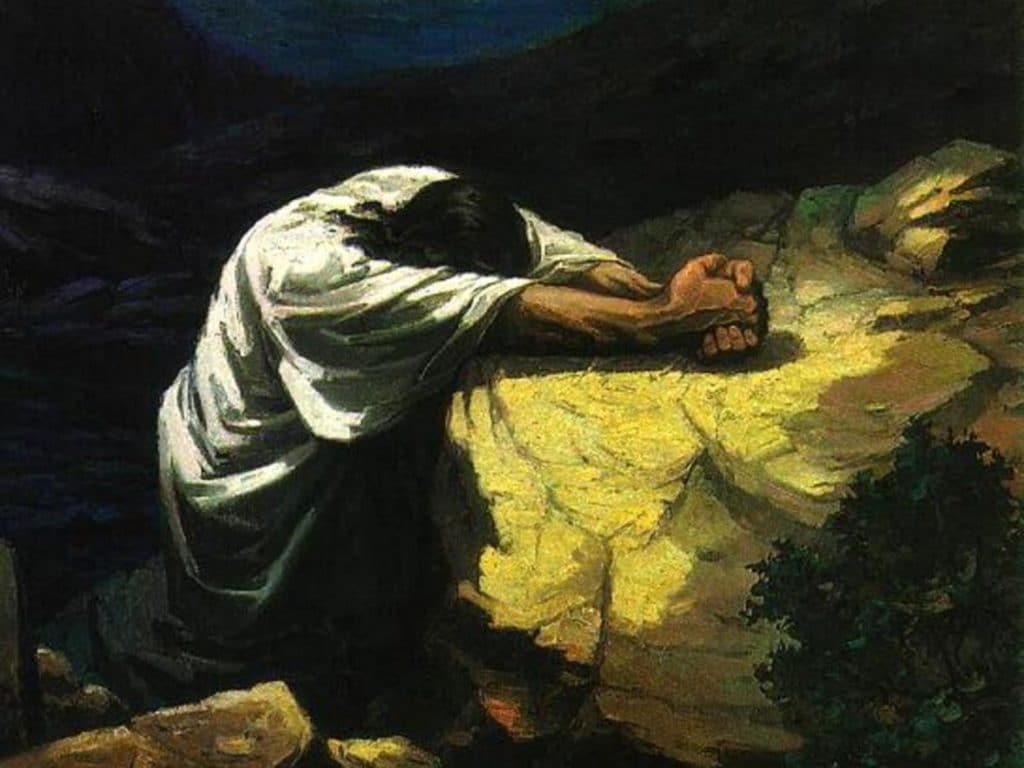
It Had To Happen

47 While he was still speaking, Judas came, one of the twelve, and with him a great crowd with swords and clubs, from the chief priests and the elders of the people. 48 Now the betrayer had given them a sign, saying, “The one I will kiss is the man; seize him.” 49 And he came up to Jesus at once and said, “Greetings, Rabbi!” And he kissed him. 50 Jesus said to him, “Friend, do what you came to do.” Then they came up and laid hands on Jesus and seized him. 51 And behold, one of those who were with Jesus stretched out his hand and drew his sword and struck the servant of the high priest and cut off his ear. 52 Then Jesus said to him, “Put your sword back into its place. For all who take the sword will perish by the sword. 53 Do you think that I cannot appeal to my Father, and he will at once send me more than twelve legions of angels? 54 But how then should the Scriptures be fulfilled, that it must be so?” 55 At that hour Jesus said to the crowds, “Have you come out as against a robber, with swords and clubs to capture me? Day after day I sat in the temple teaching, and you did not seize me. 56 But all this has taken place that the Scriptures of the prophets might be fulfilled.” Then all the disciples left him and fled. – Matthew 26:47-56 ESV

BetrayalWhile Jesus had prayed, the disciples had slept. Except for one of them whose night had been filled with plans of betrayal. Judas, after having been exposed by Jesus as the one who would betray Him, had left the upper room and gone straight to the home of the high priest, intent on following through with his plan to profit from his relationship with Jesus. And before long, he arrived on the scene, accompanied by a crowd consisting of Roman soldiers and a contingent of the high priest’s guards.

Judas, having been an intimate follower of Jesus, knew that He would likely be on the Mount of Olives that night. John tells us that Jesus “often met there with his disciples” (John 18:2 ESV). And Judas appeared just as Jesus told His disciples:

“See, the hour is at hand, and the Son of Man is betrayed into the hands of sinners. Rise, let us be going; see, my betrayer is at hand.” – Matthew 26:45-46 ESV

This scene is filled with tension and emotion. Jesus, having just poured out His heart to His heavenly Father, had fully committed Himself to accomplish what He had come to do. The disciples, having been awakened from their sleep, suddenly found themselves startled by the arrival of Judas and a large group of armed guards. They were surprised and scared. And Judas had to have been a jumble of raw nerves as he prepared to betray Jesus as well as the rest of the disciples with whom he had spent three years of his life.

The guards, carrying their swords and clubs, would have been on edge, not knowing what they would encounter when they attempted to arrest Jesus. Would His disciples put up a fight? Would there be a large crowd of His followers there, ready to defend Him at all costs?

And in the midst of this chaotic and potentially volatile scene, a strange moment of intimacy took place. Judas stepped forward and kissed Jesus on the cheek. This had been the pre-agreed-upon sign that would mark Jesus as the one they had come to arrest. One has to ask why Judas chose to betray the Lord in this particular way. He could have simply pointed to Jesus. But it’s almost as if Judas wanted to defuse the tension of the moment and to fool the rest of the disciples into thinking he was still a faithful follower of Jesus.

Each of the gospel writers provides their own recollections of what happened next. Matthew tells us that Judas walked up to Jesus and said, “Greetings, Rabbi!” and then kissed Him. Luke records that Jesus responded to this act of betrayal by asking, “Judas, would you betray the Son of Man with a kiss?” (Luke 22:48 ESV). John paints a slightly different picture, saying that “Jesus, knowing all that would happen to him, came forward and said to the soldiers, “Whom do you seek?’” (John 18:4 ESV). These are not discrepancies, but simply the personal recollections of those who witnessed these events firsthand. In the case of Luke, he was recording what he had gleaned from his interviews of the disciples themselves. This scene is far from static but is filled with energy, confusion, and fear. Each of the disciples saw and heard different things. And in the midst of the chaos, the ever-impulsive Peter drew a sword and attacked one of those who had come to arrest Jesus. It was as if Peter was attempting to live up to the rash vow he had made earlier that evening:

“Even if I must die with you, I will not deny you!” – Matthew 26:35 ESV

This is the same man who, upon hearing Jesus announce that He was going to die in Jerusalem, had rebuked Him, saying, “Heaven forbid, Lord, this will never happen to you!” (Matthew 16:22 NLT). Peter was trying to prevent the inevitable. More than that, he was trying to frustrate the expressed will of God. This is why Jesus had said to him, “Get away from me, Satan! You are a dangerous trap to me. You are seeing things merely from a human point of view, not from God’s” (Matthew 16:23 ESV).

Peter, like the rest of the disciples, could not believe this was happening. In spite of all Jesus had told them, they could not bring themselves to accept that this was God’s will concerning the Messiah. It was not what they had been taught. It was not the fulfillment of their hopes and dreams.

And the scene provides us with a dramatic dichotomy between the angry, impulsive actions of Peter and the peace-filled, submissive response of Jesus. He turned to Peter and said, “Put your sword back into its place. For all who take the sword will perish by the sword” (Matthew 26:52 ESV). This is an interesting statement and seems to conflict with one Jesus had made earlier in His ministry.

“Don’t imagine that I came to bring peace to the earth! I came not to bring peace, but a sword.” – Matthew 16:34 ESV

But on that occasion, Jesus had been talking about the future, after His death, resurrection, and ascension. His act of redemption would put all those who believed in Him at odds with the world around them. Some would express faith in Jesus, while others would reject Him, creating conflict and division even within families.

“I have come to set a man against his father, a daughter against her mother, and a daughter-in-law against her mother-in-law. Your enemies will be right in your own household!” – Matthew 16:35-36 ESV

Jesus had not been advocating armed conflict between Christians and non-Christians. He was simply warning His disciples that following Him would be costly and accompanied by relational conflict.

But the garden of Gethsemane was not the place to stage a revolt against the authorities. Peter’s battle would not be with the armed guards of the Sanhedrin, but “against the rulers, against the authorities, against the cosmic powers over this present darkness, against the spiritual forces of evil in the heavenly places” (Ephesians 6:12 ESV).

On this night, the actions of Judas and the guards who accompanied him were part of the sovereign will of God Almighty. It was all taking place according to the divine plan prescribed by God before the foundation of the world. These events were inevitable, unavoidable, and ordained by God. Jesus let Peter know that if God had not wanted this to happen, He was more than equipped to do something about it. If He deemed necessary, God could have sent 72,000 angels from heaven to defend His Son. But Jesus made it perfectly clear that all of this was necessary.

“But how then should the Scriptures be fulfilled, that it must be so?” – Matthew 26:54 ESV

This was all happening in direct fulfillment of prophecy. Things were taking place just as God had planned. And nothing and no one was going to be able to stand in His way. The will of God would not be delayed, detoured, or derailed. The armed soldiers, equipped with swords and clubs, may have believed that they were in control of the situation, but Jesus knew better. They were simply pawns in the hands of a sovereign God. In fact, John records that when Jesus had asked them, “Whom do you seek?,” they had responded, “Jesus of Nazareth.” And as soon as Jesus had said, “I am he,” John states, “they drew back and fell to the ground” (John 18:6 ESV).

Jesus was in control of the situation, not Peter, the guards, or the soldiers. And Jesus revealed that this entire scene was in fulfillment of God’s prophetic promises.

“…all this has taken place that the Scriptures of the prophets might be fulfilled.” – Matthew 26:56 ESV

And, as if to drive home that point, Matthew records that upon Jesus’ arrest, “all the disciples left him and fled” (Matthew 26:56 ESV). Over in the book of Zechariah, we have a prophetic pronouncement concerning the Messiah that forewarned of this very thing.

“Strike the shepherd, and the sheep will be scattered;
    I will turn my hand against the little ones.” – Zechariah 13:7 ESV

Jesus was on His own. The disciples had abandoned Him. Judas had done his dastardly deed and departed the scene. But Jesus, while devoid of any companionship from His followers, was far from alone. His heavenly Father was with Him. He would go through the next hours of suffering knowing that He was doing His Father’s will and was well within the divine grasp of His Father’s love. What Jesus was about to do, He did willingly. Because it had to happen. It was why He had come to earth. His incarnation would be meaningless without His crucifixion. His having taken on human flesh would be pointless if He did not become the sacrifice for the sins of mankind. It must be so. The journey to Calvary had begun and God’s plan for the redemption of man was well on its way.

English Standard Version (ESV)
The Holy Bible, English Standard Version. ESV® Permanent Text Edition® (2016). Copyright © 2001 by Crossway Bibles, a publishing ministry of Good News Publishers.

New Living Translation (NLT)
Holy Bible, New Living Translation, copyright © 1996, 2004, 2015 by Tyndale House Foundation. Used by permission of Tyndale House Publishers Inc., Carol Stream, Illinois 60188. All rights reserved.

The Message (MSG)Copyright © 1993, 1994, 1995, 1996, 2000, 2001, 2002 by Eugene H. Peterson

Selling Out the Savior

14 Then one of the twelve, whose name was Judas Iscariot, went to the chief priests 15 and said, “What will you give me if I deliver him over to you?” And they paid him thirty pieces of silver. 16 And from that moment he sought an opportunity to betray him.

17 Now on the first day of Unleavened Bread the disciples came to Jesus, saying, “Where will you have us prepare for you to eat the Passover?” 18 He said, “Go into the city to a certain man and say to him, ‘The Teacher says, My time is at hand. I will keep the Passover at your house with my disciples.’” 19 And the disciples did as Jesus had directed them, and they prepared the Passover.

20 When it was evening, he reclined at table with the twelve. 21 And as they were eating, he said, “Truly, I say to you, one of you will betray me.” 22 And they were very sorrowful and began to say to him one after another, “Is it I, Lord?” 23 He answered, “He who has dipped his hand in the dish with me will betray me. 24 The Son of Man goes as it is written of him, but woe to that man by whom the Son of Man is betrayed! It would have been better for that man if he had not been born.” 25 Judas, who would betray him, answered, “Is it I, Rabbi?” He said to him, “You have said so.” – Matthew 26:14-25 ESV

30 pieces of silver.jpgMary, the sister of Lazarus, the man whom Jesus had raised from the dead, had just anointed the head of Jesus using “an alabaster flask of very expensive ointment” (Matthew 26:7 ESV). In reaction to her exorbitant display of gratitude to Jesus, the disciples became incensed at what they believed to be an unnecessary waste of resources. But, in his gospel, John makes it clear that the disciple who showed the greatest concern over Mary’s actions was Judas. 

But Judas Iscariot, one of his disciples (he who was about to betray him), said, “Why was this ointment not sold for three hundred denarii and given to the poor?” – John 12:4-5 ESV

Judas conveyed his displeasure with what he deemed Mary’s extravagant and wasteful demonstration of gratitude. Jesus rewarded her act with words of commendation and praise, while Judas questioned the spendthrift nature of her actions. But John provides us with some context, explaining that Judas was responsible for the combined financial resources of Jesus and the disciples. At first glance, it might appear that he was simply practicing good stewardship. But John adds a less-than-flattering insight into the character of Judas.

He said this, not because he cared about the poor, but because he was a thief, and having charge of the moneybag he used to help himself to what was put into it. – John 12:6 ESV

Judas saw Mary’s display of worship as nothing more than a waste of money. Had the perfume been sold and the money turned over to him as treasurer, he could have benefited personally. But by pouring the expensive perfume on the head of Jesus, Mary had “robbed” Judas of the opportunity to line his own pockets. Yet, Jesus described what Mary had done as beautiful. He stressed that His time with them was short. His death was imminent, and Mary’s actions had actually anointed His body for His coming burial.

In this scene, we have the conflict between the selfless sacrifice of Mary and the selfish mindset of the disciples, exemplified by the words of Judas. They weren’t thinking about Jesus. They were seemingly unconcerned about His pending death. It’s all reminiscent of another scene involving Mary and Jesus, recorded in Luke’s gospel.

Now as they went on their way, Jesus entered a village. And a woman named Martha welcomed him into her house. And she had a sister called Mary, who sat at the Lord’s feet and listened to his teaching. But Martha was distracted with much serving. And she went up to him and said, “Lord, do you not care that my sister has left me to serve alone? Tell her then to help me.” But the Lord answered her, “Martha, Martha, you are anxious and troubled about many things, but one thing is necessary. Mary has chosen the good portion, which will not be taken away from her.”  – Luke 10:38-42 ESV

On this occasion, Mary had chosen to sit at the feet of Jesus, listening and learning from Him as He taught. In contrast, her sister Martha had busied herself with activities that left her with no time for Jesus. She was so busy doing things for Jesus that she didn’t have time to receive from Jesus. And Jesus informed Martha that Mary had “chosen the good portion” (Luke 10:42 ESV). She had made time for Him.

And in this passage, Matthew reveals that Mary, once again, had chosen the good portion. She had done the right thing. Her focus was on Jesus, not herself. She showed no concern for the cost of her actions. But that was not the case for the disciples. And the actions and attitudes of Judas exemplify and exaggerate the self-centered perspective of these men.

Matthew records that, after the scene at Bethany, Judas made his way to the religious leaders of Israel. Nowhere in the gospels are we given a rationale behind Judas’ actions. We are not told what motivated him to betray Jesus. But as John pointed out, Judas was a thief, and, as a thief, he was driven by a love for money. Like the rest of the disciples, Judas had chosen to follow Jesus because he had hopes that He was their long-awaited Messiah. And, as was true of the other disciples, his association with Jesus was tainted by purely selfish motives. If Jesus truly was the Messiah, Judas hoped to profit personally from his membership in Jesus’ inner circle of followers.

Perhaps, when he began to hear Jesus speak of His coming death, Judas had second thoughts and growing doubts about who Jesus was. He knew he would not benefit from following a dead Messiah. So, he decided to make the best of a bad situation. He came up with a plan to betray Jesus to the religious leaders, asking them, “What will you give me if I deliver him over to you?” (Matthew 26:15 ESV). They offered him the sum of 30 pieces of silver. Not exactly an exorbitant amount. Notice that Judas had estimated the worth of the perfume Mary had used to anoint Jesus as being 300 denarii. A single denarius was the equivalent of a day’s wage for a common laborer. So, Mary had sacrificed 10-months-worth of income to express her love for Jesus.

And if the silver coins Judas was given were denarii, it means he had been willing to betray Jesus for a single month’s income. He put little value in Jesus’ worth and placed his own desires above any display of love or loyalty to his master. The sum of 30 pieces of silver becomes even more important when we consider that it was the exact amount determined by the Mosaic law for the restitution of the lost value of a slave.

If the ox gores a slave, male or female, the owner shall give to their master thirty shekels of silver, and the ox shall be stoned. – Exodus21:32 ESV

Judas had bargained away the life of Jesus for the price of a common slave. Unlike Mary, he had placed little or no value on the life of Jesus. And his actions revealed that he had no true love for Jesus. Judas loved Judas.

One of the incredible aspects of this little vignette in the life of Jesus is its direct correlation to the prophecies of the Old Testament, Over in the book of Zechariah, there is a prophetic passage that tells of the coming Shepherd of God, who was to be the “shepherd of the flock doomed to slaughter” (Zechariah 11:4 ESV).

Zechariah goes on to say that this Shepherd would try to show favor to the doomed sheep, attempting to unify them under His leadership (Zechariah 11:7). But they would detest Him. So, the Shepherd removed his favor and said, “I will not be your shepherd” (Zechariah 11:9).

This is where it gets interesting. The rejected Shepherd demanded his wages.

Then I said to them, “If it seems good to you, give me my wages; but if not, keep them.” And they weighed out as my wages thirty pieces of silver. – Zechariah 11:12 ESV

And then, Zechariah records that God demanded that the Shepherd refuse the payment.

Then the Lord said to me, “Throw it to the potter”—the lordly price at which I was priced by them. So I took the thirty pieces of silver and threw them into the house of the Lord, to the potter. – Zechariah 11:13 ESV

Now, fast-forward to the very next chapter of Matthew, where he reveals what happened to Judas and his ill-gotten gain. After receiving his reward from the religious leaders, Judas had second thoughts about his decision to betray Jesus.

Then when Judas, his betrayer, saw that Jesus was condemned, he changed his mind and brought back the thirty pieces of silver to the chief priests and the elders, saying, “I have sinned by betraying innocent blood.” They said, “What is that to us? See to it yourself.” And throwing down the pieces of silver into the temple, he departed, and he went and hanged himself. But the chief priests, taking the pieces of silver, said, “It is not lawful to put them into the treasury, since it is blood money.” So they took counsel and bought with them the potter’s field as a burial place for strangers. Therefore that field has been called the Field of Blood to this day. – Matthew 27:3-8 ESV

For 30 pieces of silver, Judas had been willing to sell out the Messiah. He had lined his own pocket with blood money, made from his betrayal of the one whom he had followed for three years. Mary had willingly given the best of what she had in an attempt to express her love and appreciation to Jesus. Judas had sold out His master and friend, not to mention his fellow disciples, all in order to make up what he thought were his losses for having followed Jesus. But Judas had missed the point. He had not listened to the words of Jesus when He said:

And everyone who has left houses or brothers or sisters or father or mother or children or lands, for my name’s sake, will receive a hundredfold and will inherit eternal life.
 – Matthew 19:29 ESV

Judas sacrificed the promise of eternal life for temporary gain in this life. Rather than sacrificing everything so that he might enjoy salvation through Christ, Judas sacrificed Christ so that he might have the short-term joy of temporal treasure. He willingly sold out the Savior. And his regret over his actions would have eternal ramifications.

English Standard Version (ESV)
The Holy Bible, English Standard Version. ESV® Permanent Text Edition® (2016). Copyright © 2001 by Crossway Bibles, a publishing ministry of Good News Publishers.

New Living Translation (NLT)
Holy Bible, New Living Translation, copyright © 1996, 2004, 2015 by Tyndale House Foundation. Used by permission of Tyndale House Publishers Inc., Carol Stream, Illinois 60188. All rights reserved.

(MSG)Copyright © 1993, 1994, 1995, 1996, 2000, 2001, 2002 by Eugene H. Peterson

A Broken Man.

1 When morning came, all the chief priests and the elders of the people took counsel against Jesus to put him to death. 2 And they bound him and led him away and delivered him over to Pilate the governor.

3 Then when Judas, his betrayer, saw that Jesus was condemned, he changed his mind and brought back the thirty pieces of silver to the chief priests and the elders, 4 saying, “I have sinned by betraying innocent blood.” They said, “What is that to us? See to it yourself.” 5 And throwing down the pieces of silver into the temple, he departed, and he went and hanged himself. 6 But the chief priests, taking the pieces of silver, said, “It is not lawful to put them into the treasury, since it is blood money.” 7 So they took counsel and bought with them the potter’s field as a burial place for strangers. 8 Therefore that field has been called the Field of Blood to this day. 9 Then was fulfilled what had been spoken by the prophet Jeremiah, saying, “And they took the thirty pieces of silver, the price of him on whom a price had been set by some of the sons of Israel, 10 and they gave them for the potter’s field, as the Lord directed me.” – Matthew 27:1-10 ESV

509px-judasThe rooster crowed and the sun came up, just as it always does. Yet, this would be anything but just another morning. Jesus, the Son of God, had been betrayed, denied, libeled, mocked, and falsely condemned. Now, He was being dragged before Pilate, the Roman governor, because the Jews were going to demand His death. They were forbidden by Roman law from practicing capital punishment on their own. In John’s gospel, he records the Sanhedrin’s response when Pilate demanded that they judge Jesus according to their own law. He saw this as nothing more than a petty religious squabble. But they made their true intentions known when they demanded, “It is not lawful for us to put anyone to death” (John 18:31 ESV). They weren’t interested in a trial. They were intent on seeing Jesus put to death. These men had already pronounced their judgment against Jesus, when they stated, “He deserves death” (Matthew 26:66 ESV). And with the opening of this chapter, Matthew makes it clear that their plans were aimed at having Jesus crucified, the primary means of capital punishment practiced by the Romans.

…the chief priests and the elders of the people took counsel against Jesus to put him to death. – Matthew 27:1 ESV

But then, Matthew provides a brief detour from the journey of Jesus to the cross. He changes scenes and brings his readers up to speed on the whereabouts of Judas. His last appearance had been in Gethsemane, where he had betrayed Jesus with a kiss. Evidently, Judas had not gone far, having followed the guards who had arrested Jesus and taken Him to Caiaphas, the high priest. There are some who speculate that Judas was the second disciple John refers to in his gospel.

Simon Peter followed Jesus, and so did another disciple. Since that disciple was known to the high priest, he entered with Jesus into the courtyard of the high priest, but Peter stood outside at the door. So the other disciple, who was known to the high priest, went out and spoke to the servant girl who kept watch at the door, and brought Peter in. – John 18:15-16 ESV

Judas would have been known by the high priest. And it might explain why this particular disciple had not received the same treatment as Peter.

But somehow, Judas received the news that Jesus had been condemned, and Matthew states that he had a change of mind. The Greek word is metamelomai, and it is similar to metanoeō, the Greek word for “repent.” Judas had a change of mind. He regretted his decision to betray Jesus. It would appear that the news of Jesus’ death sentence was far more than he had anticipated. It is likely that Judas never expected the Sanhedrin to take things that far. We will never know what was in the heart of Judas when he made his fateful decision to betray Jesus, but Matthew makes it clear that he lived to regret it. But he wouldn’t live long.

Judas, in a state of despair, returned to the high priest and the Sanhedrin, bringing his 30 pieces of silver with him. Attempting to return the blood money, Judas confessed his guilt before these religious leaders: “I have sinned by betraying innocent blood” (Matthew 27:4 ESV). But they showed no compassion and exhibited no remorse of their own. They simply replied, “What is that to us? See to it yourself” (Matthew 27:4 ESV). These so-called religious leaders could have cared less about the emotional or spiritual well-being of Judas. They had one thing on their minds: The death of Jesus. The only semblance of conscience they revealed was their refusal to return the money Judas had returned to the temple treasure.

“It is not lawful to put them into the treasury, since it is blood money.” – Matthew 27:6 ESV

So, when Judas cast the tainted money onto the temple floor, the Sanhedrin took the 30 pieces of silver and purchased “the potter’s field as a burial place for strangers” (Matthew 27:7 ESV). This would have been a field outside the city gates where the potters discarded their broken or marred products. It was a landfill for broken pottery. Matthew reveals that this decision by the religious leaders was in keeping with Old Testament prophecy. He references Jeremiah but then quotes from a passage found in the book of Zechariah.

And they weighed out as my wages thirty pieces of silver. Then the Lord said to me, “Throw it to the potter”—the lordly price at which I was priced by them. So I took the thirty pieces of silver and threw them into the house of the Lord, to the potter. – Zechariah 11:12-13 ESV

But why did Matthew mention Jeremiah? It is probably because he was combining the two prophecies of Zechariah and Jeremiah into one composite prophecy, fulfilled in the actions of the Sanhedrin. In his book, Jeremiah records a message he received from God.

Thus says the Lord, “Go, buy a potter’s earthenware flask, and take some of the elders of the people and some of the elders of the priests, and go out to the Valley of the Son of Hinnom at the entry of the Potsherd Gate, and proclaim there the words that I tell you.”  – Jeremiah 19:1-2 ESV

Jeremiah was to purchase a clay pot and then take it to the Valley of the Son of Hinnom. In Hebrew, this place was called ge-hinnom. The Greek transliteration was  gehenna. This valley south of Jerusalem had a sordid history, having been the location where the ancient Israelites “passed children through the fire” (sacrificed their children) to the Canaanite god Molech (2 Chronicles 28:3). Because of its reputation, it became a site dedicated to the disposal of waste. The smoke of the fires used to burn the city’s refuse could be seen rising into the sky, marking this area as unclean. Jesus would later speak of Gehenna when referring to the reality of hell.

This is where God told Jeremiah to take the pot he had purchased. And it was in Gehenna that he was to break the pot “in the sight of the men who go with you” (Jeremiah 19:10 ESV). This was to be a visual illustration of what God was going to do to the people of Judah and Jerusalem for their rejection of Him. And God made the details of their guilt quite plain.

“…the people have forsaken me and have profaned this place by making offerings in it to other gods whom neither they nor their fathers nor the kings of Judah have known; and because they have filled this place with the blood of innocents…” – Jeremiah 19:4 ESV

Matthew saw the parallel. And he describes the actions of the Jewish religious leaders of his day as having fulfilled these two ancient prophecies. The high priest and the members of the Jewish high council were as guilty as their ancestors had been. They had forsaken God, and they had done so by rejecting the Son of God. And they had profaned the temple of God by actually worshiping a god of their own choosing. While they claimed to be faithful to Yahweh, the God of the Jews, Jesus accused them of having no relationship with God at all.

“Since you don’t know who I am, you don’t know who my Father is. If you knew me, you would also know my Father.” – John 8:19 NLT

“…you don’t even know him. I know him. If I said otherwise, I would be as great a liar as you! But I do know him and obey him.” – John 8:55 NLT

These men could not truly know God if they were incapable of recognizing the Son of God. The Messiah, the one they had longed to see, had shown up in their midst, but they had refused to accept Him. All because Jesus did not come as they expected or desired. They were blind to the reality of who He was, and Jesus pointed out their problem.

“You search the Scriptures because you think they give you eternal life. But the Scriptures point to me! Yet you refuse to come to me to receive this life.” – John 5:39-40 NLT

Yet, these men had no regrets. They showed no remorse. And they displayed no repentance. Like their ancestors, they remained stubbornly defiant. And they would end up like broken pots, discarded, and of no use to God. And yet, consider these comforting words written by the apostle Paul. He would pick up the theme of the clay pot and give it a whole new perspective. Having in mind all those who place their faith and hope in Jesus as their Savior, Paul wrote:

We now have this light shining in our hearts, but we ourselves are like fragile clay jars containing this great treasure. This makes it clear that our great power is from God, not from ourselves. – 2 Corinthians 4:7 NLT

Faith in Christ can transform broken clay pots into vessels of honor. When the light of the gospel of Jesus Christ takes up residence in a sinner’s life, the power of God is revealed through the cracks and flaws. Rather than being discarded as useless and of no value, the sinner is redeemed and made acceptable to God by the presence of the righteousness of Christ.

But what about Judas? After three years with Jesus, he would end up a broken man. And, in his desperation, he would take his own life. His time with Jesus had not resulted in the great power of God shining through his life, but with his life snuffed out and his legacy of betrayal sealed for generations to come. Like the religious leaders, Judas had been blind to the reality of who Jesus was. He had spent three years of his life with Jesus but had failed to recognize Him and accept Him as His Messiah and Savior. He would die a broken and shattered man.

But all those who place their faith in Jesus as their Savior will live eternally. Their brokenness is the key to their healing. Their recognition of their own unworthiness is the basis of their hope in Christ. It is through our brokenness and inherent uselessness that God chooses to reveal His great power. By placing our faith in Jesus, we become “a vessel for honorable use, set apart as holy, useful to the master of the house, ready for every good work” (2 Timothy 2:21 ESV).

English Standard Version (ESV)
The Holy Bible, English Standard Version. ESV® Permanent Text Edition® (2016). Copyright © 2001 by Crossway Bibles, a publishing ministry of Good News Publishers.

New Living Translation (NLT)
Holy Bible, New Living Translation, copyright © 1996, 2004, 2015 by Tyndale House Foundation. Used by permission of Tyndale House Publishers Inc., Carol Stream, Illinois 60188. All rights reserved.

The Message (MSG)Copyright © 1993, 1994, 1995, 1996, 2000, 2001, 2002 by Eugene H. Peterson

It Must Be So!

47 While he was still speaking, Judas came, one of the twelve, and with him a great crowd with swords and clubs, from the chief priests and the elders of the people. 48 Now the betrayer had given them a sign, saying, “The one I will kiss is the man; seize him.” 49 And he came up to Jesus at once and said, “Greetings, Rabbi!” And he kissed him. 50 Jesus said to him, “Friend, do what you came to do.” Then they came up and laid hands on Jesus and seized him. 51 And behold, one of those who were with Jesus stretched out his hand and drew his sword and struck the servant of the high priest and cut off his ear. 52 Then Jesus said to him, “Put your sword back into its place. For all who take the sword will perish by the sword. 53 Do you think that I cannot appeal to my Father, and he will at once send me more than twelve legions of angels? 54 But how then should the Scriptures be fulfilled, that it must be so?” 55 At that hour Jesus said to the crowds, “Have you come out as against a robber, with swords and clubs to capture me? Day after day I sat in the temple teaching, and you did not seize me. 56 But all this has taken place that the Scriptures of the prophets might be fulfilled.” Then all the disciples left him and fled. – Matthew 26:47-56 ESV

BetrayalWhile Jesus had prayed, the disciples had slept. Except for one of them whose night had been filled with plans of betrayal. Judas, after having been exposed by Jesus as the one who would betray Him, had left the upper room and gone straight to the home of the high priest, intent on following through with his plan to profit from his relationship with Jesus. And before long, he arrived on the scene, accompanied by a crowd consisting of Roman soldiers and a contingent of the high priest’s guards.

Judas, having been an intimate follower of Jesus, knew that He would likely be on the Mount of Olives that night. John tells us that Jesus “often met there with his disciples” (John 18:2 ESV). And Judas appeared just as Jesus told His disciples:

“See, the hour is at hand, and the Son of Man is betrayed into the hands of sinners. Rise, let us be going; see, my betrayer is at hand.” – Matthew 26:45-46 ESV

This scene is filled with tension and emotion. Jesus, having just poured out His heart to His heavenly Father, had fully committed Himself to accomplish what He had come to do. The disciples, having been awakened from their sleep, suddenly found themselves startled by the arrival of Judas and a large group of armed guards. They were surprised and scared. And Judas had to have been a jumble of raw nerves as he prepared to betray Jesus as well as the rest of the disciples with whom he had spent three years of his life.

The guards, carrying their swords and clubs, would have been on edge, not knowing what they would encounter when they attempted to arrest Jesus. Would His disciples put up a fight? Would there be a large crowd of His followers there, ready to defend Him at all costs?

And in the midst of this chaotic and potentially volatile scene, a strange moment of intimacy took place. Judas stepped forward and kissed Jesus on the cheek. This had been the pre-agreed-upon sign that would mark Jesus as the one they had come to arrest. One has to ask why Judas chose to betray the Lord in this particular way. He could have simply pointed to Jesus. But it’s almost as if Judas wanted to defuse the tension of the moment and to fool the rest of the disciples into thinking he was still a faithful follower of Jesus.

Each of the gospel writers provides their own recollections of what happened next. Matthew tells us that Judas walked up to Jesus and said, “Greetings, Rabbi!” and then kissed Him. Luke records that Jesus responded to this act of betrayal by asking, “Judas, would you betray the Son of Man with a kiss?” (Luke 22:48 ESV). John paints a slightly different picture, saying that “Jesus, knowing all that would happen to him, came forward and said to the soldiers, “Whom do you seek?’” (John 18:4 ESV). These are not discrepancies, but simply the personal recollections of those who witnessed these events firsthand. In the case of Luke, he was recording what he had gleaned from his interviews of the disciples themselves. This scene is far from static but is filled with energy, confusion, and fear. Each of the disciples saw and heard different things. And in the midst of the chaos, the ever-impulsive Peter drew a sword and attacked one of those who had come to arrest Jesus. It was as if Peter was attempting to live up to the rash vow he had made earlier that evening:

“Even if I must die with you, I will not deny you!” – Matthew 26:35 ESV

This is the same man who, upon hearing Jesus announce that He was going to die in Jerusalem, had rebuked Him, saying, “Heaven forbid, Lord, this will never happen to you!” (Matthew 16:22 NLT). Peter was trying to prevent the inevitable. More than that, he was trying to frustrate the expressed will of God. This is why Jesus had said to him, “Get away from me, Satan! You are a dangerous trap to me. You are seeing things merely from a human point of view, not from God’s” (Matthew 16:23 ESV).

Peter, like the rest of the disciples, could not believe this was happening. In spite of all Jesus had told them, they could not bring themselves to accept that this was God’s will concerning the Messiah. It was not what they had been taught. It was not the fulfillment of their hopes and dreams.

And the scene provides us with a dramatic dichotomy between the angry, impulsive actions of Peter and the peace-filled, submissive response of Jesus. He turned to Peter and said, “Put your sword back into its place. For all who take the sword will perish by the sword” (Matthew 26:52 ESV). This is an interesting statement and seems to conflict with one Jesus had made earlier in His ministry.

“Don’t imagine that I came to bring peace to the earth! I came not to bring peace, but a sword.” – Matthew 16:34 ESV

But on that occasion, Jesus had been talking about the future, after His death, resurrection, and ascension. His act of redemption would put all those who believed in Him at odds with the world around them. Some would express faith in Jesus, while others would reject Him, creating conflict and division even within families.

“I have come to set a man against his father, a daughter against her mother, and a daughter-in-law against her mother-in-law. Your enemies will be right in your own household!” – Matthew 16:35-36 ESV

Jesus had not been advocating armed conflict between Christians and non-Christians. He was simply warning His disciples that following Him would be costly and accompanied by relational conflict.

But the garden of Gethsemane was not the place to stage a revolt against the authorities. Peter’s battle would not be with the armed guards of the Sanhedrin, but “against the rulers, against the authorities, against the cosmic powers over this present darkness, against the spiritual forces of evil in the heavenly places” (Ephesians 6:12 ESV).

On this night, the actions of Judas and the guards who accompanied him were part of the sovereign will of God Almighty. It was all taking place according to the divine plan prescribed by God before the foundation of the world. These events were inevitable, unavoidable, and ordained by God. Jesus let Peter know that if God had not wanted this to happen, He was more than equipped to do something about it. If He deemed necessary, God could have sent 72,000 angels from heaven to defend His Son. But Jesus made it perfectly clear that all of this was necessary.

“But how then should the Scriptures be fulfilled, that it must be so?” – Matthew 26:54 ESV

This was all happening in direct fulfillment of prophecy. Things were taking place just as God had planned. And nothing and no one was going to be able to stand in His way. The will of God would not be delayed, detoured, or derailed. The armed soldiers, equipped with swords and clubs, may have believed that they were in control of the situation, but Jesus knew better. They were simply pawns in the hands of a sovereign God. In fact, John records that when Jesus had asked them, “Whom do you seek?,” they had responded, “Jesus of Nazareth.” And as soon as Jesus had said, “I am he,” John states, “they drew back and fell to the ground” (John 18:6 ESV).

Jesus was in control of the situation, not Peter, the guards, or the soldiers. And Jesus revealed that this entire scene was in fulfillment of God’s prophetic promises.

“…all this has taken place that the Scriptures of the prophets might be fulfilled.” – Matthew 26:56 ESV

And, as if to drive home that point, Matthew records that upon Jesus’ arrest, “all the disciples left him and fled” (Matthew 26:56 ESV). Over in the book of Zechariah, we have a prophetic pronouncement concerning the Messiah that forewarned of this very thing.

“Strike the shepherd, and the sheep will be scattered;
    I will turn my hand against the little ones.” – Zechariah 13:7 ESV

Jesus was on His own. The disciples had abandoned Him. Judas had done his dastardly deed and departed the scene. But Jesus, while devoid of any companionship from His followers, was far from alone. His heavenly Father was with Him. He would go through the next hours of suffering knowing that He was doing His Father’s will and was well within the divine grasp of His Father’s love. What Jesus was about to do, He did willingly. Because it had to happen. It was why He had come to earth. His incarnation would be meaningless without His crucifixion. His having taken on human flesh would be pointless if He did not become the sacrifice for the sins of mankind. It must be so. The journey to Calvary had begun and God’s plan for the redemption of man was well on its way.

English Standard Version (ESV)
The Holy Bible, English Standard Version. ESV® Permanent Text Edition® (2016). Copyright © 2001 by Crossway Bibles, a publishing ministry of Good News Publishers.

New Living Translation (NLT)
Holy Bible, New Living Translation, copyright © 1996, 2004, 2015 by Tyndale House Foundation. Used by permission of Tyndale House Publishers Inc., Carol Stream, Illinois 60188. All rights reserved.

The Message (MSG)Copyright © 1993, 1994, 1995, 1996, 2000, 2001, 2002 by Eugene H. Peterson

Faithful In the Face of Death.

36 Then Jesus went with them to a place called Gethsemane, and he said to his disciples, “Sit here, while I go over there and pray.” 37 And taking with him Peter and the two sons of Zebedee, he began to be sorrowful and troubled. 38 Then he said to them, “My soul is very sorrowful, even to death; remain here, and watch with me.” 39 And going a little farther he fell on his face and prayed, saying, “My Father, if it be possible, let this cup pass from me; nevertheless, not as I will, but as you will.” 40 And he came to the disciples and found them sleeping. And he said to Peter, “So, could you not watch with me one hour? 41 Watch and pray that you may not enter into temptation. The spirit indeed is willing, but the flesh is weak.” 42 Again, for the second time, he went away and prayed, “My Father, if this cannot pass unless I drink it, your will be done.” 43 And again he came and found them sleeping, for their eyes were heavy. 44 So, leaving them again, he went away and prayed for the third time, saying the same words again. 45 Then he came to the disciples and said to them, “Sleep and take your rest later on. See, the hour is at hand, and the Son of Man is betrayed into the hands of sinners. 46 Rise, let us be going; see, my betrayer is at hand.” – Matthew 26:36-46 ESV

agony-in-the-garden-1-1024x768.jpgHaving completed the Passover meal, Jesus and His disciples made their way through the city of Jerusalem, out the eastern gate, and onto the Mount of Olives. They stopped at a place called Gethsemane, which means “an olive press.” Here, Jesus took three of His disciples, Peter, James and John, and found a secluded place where He could pray. These are the same three men who had accompanied Him and been eyewitnesses to His transfiguration. But on this occasion, rather than seeing Jesus in His glorified state, they would watch as He agonized over His coming trials.

Jesus described to them His state of mind: “My soul is very sorrowful, even to death” (Matthew 26:38 ESV). His emotional state was one of deep and overwhelming sadness over what was about to happen. His sorrow alone was enough to kill Him. But what was it that caused such a drastic state of deep melancholy in Jesus? Was He afraid to die? Did He regret His decision to sacrifice Himself on behalf of sinful mankind? Was He having second thoughts? The text, along with the words and actions of Jesus, provide us with the answers.

Matthew relates that Jesus went off by Himself and immediately fell on His face before His Father in a state of prayer. He pleaded, “My Father, if it be possible, let this cup pass from me” (Matthew 26:39 ESV).

One of the things this passage reveals is the human side of Jesus’ nature. He was 100 percent God, but also 100 percent human – a state often referred to as the hypostatic union. At His incarnation, Jesus, the eternal, second person of the Trinity, became the God-man. His assumption of a human nature was essential to the role He would play as the Savior of mankind. The author of Hebrews explains:

Because God’s children are human beings – made of flesh and blood – the Son also became flesh and blood. For only as a human being could he die, and only by dying could he break the power of the devil, who had the power of death. – Hebrews 2:14 NLT

The apostle Paul would put it this way:

[God] sent his own Son in a body like the bodies we sinners have. And in that body God declared an end to sin’s control over us by giving his Son as a sacrifice for our sins. – Romans 8:3 NLT

Jesus never relinquished any of His divine attributes, but, in becoming a man, He combined His human and divine natures into one person. And as a man, Jesus felt pain, experienced hunger, grew tired, and, as we will see, became susceptible to death.

In His humanity, Jesus knew that what He was about to endure would be excruciatingly painful. He would be scourged mercilessly with a flagellum, a whip featuring multiple leather strands, each weighted with lead balls or pieces of bone. He would be beaten, spit upon, slapped, and degraded. And eventually, He would be nailed to a wooden cross and left to die by exposure and suffocation. Jesus’ human nature was repulsed by the prospect of facing such a painful and gruesome death. He longed for another way, a plan B.

But, in His divinity, He knew that this was all part of His Father’s sovereign will. This is why He stated, “nevertheless, not as I will, but as you will” (Matthew 26:39 ESV).

But there is a second explanation behind Jesus’ intense sorrow and His cry for an alternative plan. He was fully aware that, upon the cross, He would be taking on the sin debt of the entire world. He who never committed a single sin would bear the full brunt of God’s wrath against all the sins of men for all time.

For God made Christ, who never sinned, to be the offering for our sin, so that we could be made right with God through Christ. – 2 Corinthians 5:21 NLT

Sin separates mankind from God. And Jesus knew that when He took on the sin debt of mankind, He would become separated from His Father for the first time in all of eternity. Their fellowship would be broken. And, in His divine nature, that prospect was unfathomable and unthinkable to Jesus. Yet again, He knew it was all part of God’s plan and, therefore, necessary.

Jesus longed for this “cup of wrath” to pass. If you recall, back in chapter 20, Matthew recorded an encounter between Jesus and the mother of James and John, the two brothers who were with Him in Gethsemane that night. She had asked Jesus to allow her two sons to sit on His right and on His left when He established His kingdom on earth. But Jesus had responded to her two sons, “You don’t know what you are asking! Are you able to drink from the bitter cup of suffering I am about to drink?” (Matthew 20:22 NLT).

Only He was worthy to suffer for the sins of mankind. He alone could meet God’s demanding criteria for an acceptable sacrifice – an unblemished, sinless Lamb.

And it’s interesting to note that when Jesus stopped to check on Peter, James, and John, He had found them asleep. While He had been agonizing over His coming death, these three were obviously unconcerned with and unsympathetic to His pain. They slept while Jesus wept. And Jesus made an interesting observation, stating, “The spirit indeed is willing, but the flesh is weak” (Matthew 26:41 ESV). This was most likely aimed at Peter, who had been the one who had vehemently denied Jesus prediction that they would all bail on Him in His time of greatest need.

“Though they all fall away because of you, I will never fall away.” – Matthew 26:33 ESV).

And yet, here was Peter finding it difficult even to stay awake while His master suffered under the weight of His pending death.

Three separate times Jesus expressed His feelings to His heavenly Father, and three times He communicated His willingness to do His Father’s will. He was committed. Every ounce of His humanity longed to escape what was to come, but His divinity provided the strength He needed to do what He had been called to do.

In his commentary on the book of Matthew, D.A. Carson writes:

“In the first garden ‘Not your will but mine’ changed Paradise to desert and brought man from Eden to Gethsemane. Now ‘Not my will but yours’ brings anguish to the man who prays it but transforms the desert into the kingdom and brings man from Gethsemane to the gates of glory.” – D.A. Carson, Matthew, p. 545.

Jesus was willing to face the fate God had planned for Him because He trusted His heavenly Father. He knew there was no other way. Salvation was only possible through His obedient submission to the sovereign will of God the Father. And the hour had come for Him to begin His journey from Gethsemane to Golgotha. Having finished His prayer time with the Father, Jesus turned to His disciples and said, “the hour is at hand, and the Son of Man is betrayed into the hands of sinners” (Matthew 26:45 ESV).

Judas was on his way, bringing with him the guards of the high priest. The darkness of that night was about to deepen as the forces of evil began their ill-fated attempt to snuff out the Light of the world. But as John would later write:

The light shines in the darkness, and the darkness can never extinguish it. – John 1:5 NLT

God’s light came into the world, but people loved the darkness more than the light, for their actions were evil. All who do evil hate the light and refuse to go near it for fear their sins will be exposed. But those who do what is right come to the light so others can see that they are doing what God wants. – John 3:19-21 NLT

Jesus would end up buried in the darkness of a borrowed tomb. His life would be forcefully taken from Him, but as He had predicted, it would be on His terms.

“No one can take my life from me. I sacrifice it voluntarily. For I have the authority to lay it down when I want to and also to take it up again. For this is what my Father has commanded.” – John 10:18 NLT

Jesus lived to do the will of His Father. And He died in obedience to the will of His Father. When Jesus had stated, “I and the Father are one” (John 10:30 ESV), He had meant it. Their wills were united, and their love for sinful mankind was unified around the sole solution to man’s problem: The sacrificial death of the sinless Son of God.

English Standard Version (ESV)
The Holy Bible, English Standard Version. ESV® Permanent Text Edition® (2016). Copyright © 2001 by Crossway Bibles, a publishing ministry of Good News Publishers.

New Living Translation (NLT)
Holy Bible, New Living Translation, copyright © 1996, 2004, 2015 by Tyndale House Foundation. Used by permission of Tyndale House Publishers Inc., Carol Stream, Illinois 60188. All rights reserved.

The Message (MSG)Copyright © 1993, 1994, 1995, 1996, 2000, 2001, 2002 by Eugene H. Peterson

Broken For You.

26 Now as they were eating, Jesus took bread, and after blessing it broke it and gave it to the disciples, and said, “Take, eat; this is my body.” 27 And he took a cup, and when he had given thanks he gave it to them, saying, “Drink of it, all of you, 28 for this is my blood of the covenant, which is poured out for many for the forgiveness of sins. 29 I tell you I will not drink again of this fruit of the vine until that day when I drink it new with you in my Father’s kingdom.”

30 And when they had sung a hymn, they went out to the Mount of Olives. 31 Then Jesus said to them, “You will all fall away because of me this night. For it is written, ‘I will strike the shepherd, and the sheep of the flock will be scattered.’ 32 But after I am raised up, I will go before you to Galilee.” 33 Peter answered him, “Though they all fall away because of you, I will never fall away.” 34 Jesus said to him, “Truly, I tell you, this very night, before the rooster crows, you will deny me three times.” 35 Peter said to him, “Even if I must die with you, I will not deny you!” And all the disciples said the same. – Matthew 26:26-35 ESV

break-bread-300x178Jesus and His disciples had gathered in the upper room of a borrowed house somewhere in the city of Jerusalem in order to celebrate the Passover together. It was at this gathering that Jesus revealed the one who would betray Him: Judas. One of the original 12 disciples, Judas had already made a deal with the chief priests, agreeing to turn Jesus over to them in return for a bounty of 30 pieces of silver. And, when Jesus exposed Judas as the one who would betray Him, rather than repent and beg for forgiveness, Judas left the room, intent on doing what he had agreed to do.

Jesus shared some serious words of warning regarding Judas.

“…woe to that man by whom the Son of Man is betrayed! It would have been better for that man if he had not been born.” – Matthew 26:24 ESV

Judas’ decision to betray Jesus was part of God’s redemptive plan. Jesus had been well aware of it and knew it was necessary for God’s will to be fulfilled. But Judas had made the willful choice to betray his master and friend. He put his own self-interests ahead of any devotion he may have had for Jesus. And, evidently, Judas had done a masterful job of disguising his true nature from the rest of the disciples, because when Jesus had announced that one of them would betray Him, none of them assumed it would be Judas. Instead, they each wondered if he was speaking of them. But Jesus made it perfectly clear who the betrayer was.

“It is he to whom I will give this morsel of bread when I have dipped it.” So when he had dipped the morsel, he gave it to Judas, the son of Simon Iscariot. Then after he had taken the morsel, Satan entered into him. Jesus said to him, “What you are going to do, do quickly.” Now no one at the table knew why he said this to him. Some thought that, because Judas had the moneybag, Jesus was telling him, “Buy what we need for the feast,” or that he should give something to the poor. So, after receiving the morsel of bread, he immediately went out. And it was night.” – John 13:26-30 ESV

His departure must have left the rest of the disciples in a state of disbelief. It’s interesting to consider that no one among them attempted to stop Judas, not even the normally impulsive Peter. Judas simply left the room, and the meal continued.

What happened next takes on an even more serious tone when we consider that Judas was on his way to meet with the religious leaders in order to set in motion the betrayal and ultimate arrest and crucifixion of Jesus. He was about to initiate a chain of events that would lead to the death of the Son of God. And as Judas made his way through the streets of Jerusalem, with the words of Jesus echoing in his mind, Jesus addressed His remaining disciples.

He took a piece of unleavened bread, prayed over it, then divided it among them. And He announced, “Take, eat; this is my body.” In his gospel account, Luke adds, “which is given for you. Do this in remembrance of me” (Luke 22:19 ESV). It may be that, at this moment, some of the disciples recalled the words of Jesus spoken earlier in His ministry:

“…the bread of God is he who comes down from heaven and gives life to the world.” – John 6:33 ESV

“I am the bread of life; whoever comes to me shall not hunger, and whoever believes in me shall never thirst.” – John 6:35 ESV

“I am the bread of life. Your fathers ate the manna in the wilderness, and they died. This is the bread that comes down from heaven, so that one may eat of it and not die. I am the living bread that came down from heaven. If anyone eats of this bread, he will live forever. And the bread that I will give for the life of the world is my flesh.” – John 6:48-51 ESV

Jesus was about to lay down His life as a sacrifice for the sins of mankind. His body would be beaten, broken, and bruised. He would have His life brutally taken from Him by those whose very existence was His doing. Yet, for the sake of His disciples, Jesus commemorated what was about to happen, so that they might always remember the source of their salvation. His death would be the means of their eternal life. No amount of good works could earn for them what Jesus was about to provide for them by the sacrifice of His own life.

And then Jesus took one of the cups of wine, prayed over it, and said, “Drink of it, all of you, for this is my blood of the covenant, which is poured out for many for the forgiveness of sins” (Matthew 26:27-28 ESV). Jesus, as if to emphasize what He had just said, pointed the disciples to the sacrificial nature of His pending death. His blood would be poured out, like the lambs used in the temple sacrifices.

On the day that Jesus had appeared at the Jordan River to be baptized, John the Baptist had announced:

“Behold, the Lamb of God, who takes away the sin of the world!” – John 1:29 ESV

Jesus was the consummate paschal lamb, the sinless substitute who would offer up His life as payment for the sin debt of fallen humanity. And the author of Hebrews clarified the necessity of Jesus’ blood sacrifice.

…without the shedding of blood there is no forgiveness of sins. – Hebrews 9:22 ESV

There was no other way. Jesus had to die. His body would be broken, and His blood would be spilled because the just wrath of God against the sins of mankind had to be satisfied or propitiated. And the apostle John would later write, “He is the propitiation for our sins, and not for ours only but also for the sins of the whole world” (1 John 1:29 ESV). And John would go on to describe this sacrificial act of Jesus as an expression of God’s love for sinful mankind.

In this is love, not that we have loved God but that he loved us and sent his Son to be the propitiation for our sins. – 1 John 4:10 ESV

All of this had to have struck the disciples like a lead weight. It was all so unexpected and unbelievable. And none of it lined up with their hopes and dreams concerning the Messiah. With each word Jesus spoke, their world collapsed in on them, and it was about to get even darker as the night progressed.

Jesus informed them that this would be their last meal together, but assured them that they would feast together again at a later date, most likely a reference to the Marriage Supper of the Lamb.

But with the Passover meal completed, they made their way through the dark night, out the eastern gate of the city to the Mount of Olives. And Jesus dropped yet another bomb on His already shell-shocked disciples.

“You will all fall away because of me this night. For it is written, ‘I will strike the shepherd, and the sheep of the flock will be scattered.’” – Matthew 26:31 ESV

Every single one of them would desert Him at His greatest hour of need. Under the coming persecution of the religious leaders, the disciples would scatter and hide. But upon hearing this pronouncement from Jesus, the always impulsive Peter said, “Though they all fall away because of you, I will never fall away” (Matthew 26:33 ESV). Those words would come back to haunt Peter. And Peter would make matters even worse for himself by refuting Jesus’ claim that he would deny the Lord three times.

“Even if I must die with you, I will not deny you!” – Matthew 2:35 ESV

Peter was well-intentioned, and with his bold claim, he spoke for all of the disciples. But none of them knew what was about to happen. They had no idea just how bad things were going to get in the next few hours. But Jesus did. And yet, He gave them a subtle, yet confident bit of news:

“…after I am raised up, I will go before you to Galilee.” – Matthew 26:32 ESV

Jesus knew He was going to die, but He was also confident that He would rise again. That was the Father’s plan. His death was necessary, but so was His resurrection. His death would serve as the payment for the sins of mankind. But His restoration to life would be proof that His death had been sufficient and fully satisfactory to God.

This dark cloud had a silver lining, even though the events of the next few hours would be horrific for the disciples. They would be agonizingly painful for Jesus. But He faced it all with confidence and faith in His Father’s will. And what He was about to do, He did willingly.

“No one can take my life from me. I sacrifice it voluntarily. For I have the authority to lay it down when I want to and also to take it up again. For this is what my Father has commanded.” – John 10:18 NLT

English Standard Version (ESV)
The Holy Bible, English Standard Version. ESV® Permanent Text Edition® (2016). Copyright © 2001 by Crossway Bibles, a publishing ministry of Good News Publishers.

New Living Translation (NLT)
Holy Bible, New Living Translation, copyright © 1996, 2004, 2015 by Tyndale House Foundation. Used by permission of Tyndale House Publishers Inc., Carol Stream, Illinois 60188. All rights reserved.

The Message (MSG)Copyright © 1993, 1994, 1995, 1996, 2000, 2001, 2002 by Eugene H. Peterson

Worth the Sacrifice.

14 Then one of the twelve, whose name was Judas Iscariot, went to the chief priests 15 and said, “What will you give me if I deliver him over to you?” And they paid him thirty pieces of silver. 16 And from that moment he sought an opportunity to betray him.

17 Now on the first day of Unleavened Bread the disciples came to Jesus, saying, “Where will you have us prepare for you to eat the Passover?” 18 He said, “Go into the city to a certain man and say to him, ‘The Teacher says, My time is at hand. I will keep the Passover at your house with my disciples.’” 19 And the disciples did as Jesus had directed them, and they prepared the Passover.

20 When it was evening, he reclined at table with the twelve. 21 And as they were eating, he said, “Truly, I say to you, one of you will betray me.” 22 And they were very sorrowful and began to say to him one after another, “Is it I, Lord?” 23 He answered, “He who has dipped his hand in the dish with me will betray me. 24 The Son of Man goes as it is written of him, but woe to that man by whom the Son of Man is betrayed! It would have been better for that man if he had not been born.” 25 Judas, who would betray him, answered, “Is it I, Rabbi?” He said to him, “You have said so.” – Matthew 26:14-25 ESV

30 pieces of silver.jpgMary, the sister of Lazarus, the man whom Jesus had raised from the dead, had just anointed the head of Jesus using “an alabaster flask of very expensive ointment” (Matthew 26:7 ESV). In reaction to her exorbitant display of gratitude to Jesus, the disciples became incensed at what they believed to be an unnecessary waste of resources. But, in his gospel, John makes it clear that the disciple who showed the greatest concern over Mary’s actions was Judas. 

But Judas Iscariot, one of his disciples (he who was about to betray him), said, “Why was this ointment not sold for three hundred denarii and given to the poor?” – John 12:4-5 ESV

Judas conveyed his displeasure with what he deemed Mary’s extravagant and wasteful demonstration of gratitude. Jesus rewarded her act with words of commendation and praise, while Judas questioned the spendthrift nature of her actions. But John provides us with some context, explaining that Judas was responsible for the combined financial resources of Jesus and the disciples. At first glance, it might appear that he was simply practicing good stewardship. But John adds a less-than-flattering insight into the character of Judas.

He said this, not because he cared about the poor, but because he was a thief, and having charge of the moneybag he used to help himself to what was put into it. – John 12:6 ESV

Judas saw Mary’s display of worship as nothing more than a waste of money. Had the perfume been sold and the money turned over to him as treasurer, he could have benefited personally. But by pouring the expensive perfume on the head of Jesus, Mary had “robbed” Judas of the opportunity to line his own pockets. Yet, Jesus described what Mary had done as beautiful. He stressed that His time with them was short. His death was imminent, and Mary’s actions had actually anointed His body for His coming burial.

In this scene, we have the conflict between the selfless sacrifice of Mary and the selfish mindset of the disciples, exemplified by the words of Judas. They weren’t thinking about Jesus. They were seemingly unconcerned about His pending death. It’s all reminiscent of another scene involving Mary and Jesus, recorded in Luke’s gospel.

Now as they went on their way, Jesus entered a village. And a woman named Martha welcomed him into her house. And she had a sister called Mary, who sat at the Lord’s feet and listened to his teaching. But Martha was distracted with much serving. And she went up to him and said, “Lord, do you not care that my sister has left me to serve alone? Tell her then to help me.” But the Lord answered her, “Martha, Martha, you are anxious and troubled about many things, but one thing is necessary. Mary has chosen the good portion, which will not be taken away from her.”  – Luke 10:38-42 ESV

On this occasion, Mary had chosen to sit at the feet of Jesus, listening and learning from Him as He taught. In contrast, her sister Martha had busied herself with activities that left her with no time for Jesus. She was so busy doing things for Jesus that she didn’t have time to receive from Jesus. And Jesus informed Martha that Mary had “chosen the good portion” (Luke 10:42 ESV). She had made time for Him.

And in this passage, Matthew reveals that Mary, once again, had chosen the good portion. She had done the right thing. Her focus was on Jesus, not herself. She showed no concern for the cost of her actions. But that was not the case for the disciples. And the actions and attitudes of Judas exemplify and exaggerate the self-centered perspective of these men.

Matthew records that, after the scene at Bethany, Judas made his way to the religious leaders of Israel. Nowhere in the gospels are we given a rationale behind Judas’ actions. We are not told what motivated him to betray Jesus. But as John pointed out, Judas was a thief, and, as a thief, he was driven by a love for money. Like the rest of the disciples, Judas had chosen to follow Jesus because he had hopes that He was their long-awaited Messiah. And, as was true of the other disciples, his association with Jesus was tainted by purely selfish motives. If Jesus truly was the Messiah, Judas hoped to profit personally from his membership in Jesus’ inner circle of followers.

Perhaps, when he began to hear Jesus speak of His coming death, Judas had second thoughts and growing doubts about who Jesus was. He knew he would not benefit from following a dead Messiah. So, he decided to make the best of a bad situation. He came up with a plan to betray Jesus to the religious leaders, asking them, “What will you give me if I deliver him over to you?” (Matthew 26:15 ESV). They offered him the sum of 30 pieces of silver. Not exactly an exorbitant amount. Notice that Judas had estimated the worth of the perfume Mary had used to anoint Jesus as being 300 denarii. A single denarius was the equivalent of a day’s wage for a common laborer. So, Mary had sacrificed 10-months-worth of income to express her love for Jesus.

And if the silver coins Judas was given were denarii, it means he had been willing to betray Jesus for a single month’s income. He put little value in Jesus’ worth and placed his own desires above any display of love or loyalty to his master. The sum of 30 pieces of silver becomes even more important when we consider that it was the exact amount determined by the Mosaic law for the restitution of the lost value of a slave.

If the ox gores a slave, male or female, the owner shall give to their master thirty shekels of silver, and the ox shall be stoned. – Exodus21:32 ESV

Judas had bargained away the life of Jesus for the price of a common slave. Unlike Mary, he had placed little or no value on the life of Jesus. And his actions revealed that he had no true love for Jesus. Judas loved Judas.

One of the incredible aspects of this little vignette in the life of Jesus is its direct correlation to the prophecies of the Old Testament, Over in the book of Zechariah, there is a prophetic passage that tells of the coming Shepherd of God, who was to be the “shepherd of the flock doomed to slaughter” (Zechariah 11:4 ESV).

Zechariah goes on to say that this Shepherd would try to show favor to the doomed sheep, attempting to unify them under His leadership (Zechariah 11:7). But they would detest Him. So, the Shepherd removed his favor and said, “I will not be your shepherd” (Zechariah 11:9).

This is where it gets interesting. The rejected Shepherd demanded his wages.

Then I said to them, “If it seems good to you, give me my wages; but if not, keep them.” And they weighed out as my wages thirty pieces of silver. – Zechariah 11:12 ESV

And then, Zechariah records that God demanded that the Shepherd refuse the payment.

Then the Lord said to me, “Throw it to the potter”—the lordly price at which I was priced by them. So I took the thirty pieces of silver and threw them into the house of the Lord, to the potter. – Zechariah 11:13 ESV

Now, fast-forward to the very next chapter of Matthew, where he reveals what happened to Judas and his ill-gotten gain. After receiving his reward from the religious leaders, Judas had second thoughts about his decision to betray Jesus.

Then when Judas, his betrayer, saw that Jesus was condemned, he changed his mind and brought back the thirty pieces of silver to the chief priests and the elders, saying, “I have sinned by betraying innocent blood.” They said, “What is that to us? See to it yourself.” And throwing down the pieces of silver into the temple, he departed, and he went and hanged himself. But the chief priests, taking the pieces of silver, said, “It is not lawful to put them into the treasury, since it is blood money.” So they took counsel and bought with them the potter’s field as a burial place for strangers. Therefore that field has been called the Field of Blood to this day. – Matthew 27:3-8 ESV

For 30 pieces of silver, Judas had been willing to sell out the Messiah. He had lined his own pocket with blood money, made from his betrayal of the one whom he had followed for three years. Mary had willingly given the best of what she had in an attempt to express her love and appreciation to Jesus. Judas had sold out His master and friend, not to mention his fellow disciples, all in order to make up what he thought were his losses for having followed Jesus. But Judas had missed the point. He had not listened to the words of Jesus when He said:

And everyone who has left houses or brothers or sisters or father or mother or children or lands, for my name’s sake, will receive a hundredfold and will inherit eternal life.
 – Matthew 19:29 ESV

Judas sacrificed the promise of eternal life for temporary gain in this life. Rather than sacrificing everything so that he might enjoy salvation through Christ, Judas sacrificed Christ so that he might have the short-term joy of temporal treasure. He willingly sold out the Savior. And his regret over his actions would have eternal ramifications.

English Standard Version (ESV)
The Holy Bible, English Standard Version. ESV® Permanent Text Edition® (2016). Copyright © 2001 by Crossway Bibles, a publishing ministry of Good News Publishers.

New Living Translation (NLT)
Holy Bible, New Living Translation, copyright © 1996, 2004, 2015 by Tyndale House Foundation. Used by permission of Tyndale House Publishers Inc., Carol Stream, Illinois 60188. All rights reserved.

(MSG)Copyright © 1993, 1994, 1995, 1996, 2000, 2001, 2002 by Eugene H. Peterson

A Beautiful Thing.

1 When Jesus had finished all these sayings, he said to his disciples, 2 “You know that after two days the Passover is coming, and the Son of Man will be delivered up to be crucified.”

3 Then the chief priests and the elders of the people gathered in the palace of the high priest, whose name was Caiaphas, 4 and plotted together in order to arrest Jesus by stealth and kill him. 5 But they said, “Not during the feast, lest there be an uproar among the people.”

6 Now when Jesus was at Bethany in the house of Simon the leper, 7 a woman came up to him with an alabaster flask of very expensive ointment, and she poured it on his head as he reclined at table. 8 And when the disciples saw it, they were indignant, saying, “Why this waste? 9 For this could have been sold for a large sum and given to the poor.” 10 But Jesus, aware of this, said to them, “Why do you trouble the woman? For she has done a beautiful thing to me. 11 For you always have the poor with you, but you will not always have me. 12 In pouring this ointment on my body, she has done it to prepare me for burial. 13 Truly, I say to you, wherever this gospel is proclaimed in the whole world, what she has done will also be told in memory of her.” – Matthew 26:1-13 ESV

Jesus_Anointed_by_Mary_Magdalene.jpgJesus ended His discussion regarding the Kingdom of Heaven with a jarring reminder to His disciples of His upcoming crucifixion. Not only was the inauguration of His Kingdom going to be delayed, but He was also going to die. And while Jesus had made it clear that the coming of His Kingdom would not happen for some time, His death would take place in just a matter of days.

What a rude wakeup call for the disciples. And what an unpleasant reminder that things were not as they had hoped or supposed. Their king had come, but not as they had expected. His Kingdom was not of this earth. And, as they would soon discover, the crown He was destined to wear would be made of thorns, not gold. He would hang on a cross, not sit on a throne. And yet, it was all part of God’s sovereign plan.

And so was the plotting and planning of the religious leaders. Their role in the entire affair was not in opposition to God’s will, but an essential part of it. They were nothing more than instruments in His hands, unknowingly accomplishing His will even through their disobedience and rejection of His Son. What they did, they did in secret. They plotted behind the scenes. They hid their intentions from the people, because of Jesus’ popularity. But God was fully aware of their every move. And He was in total control of the entire timeline of events. From the clandestine collusion of the religious leaders to the self-serving plans of Judas to betray Jesus, nothing escaped God’s divine attention or threatened the outcome of His redemptive plan.

And this includes the anointing of Jesus by Mary. This has always been a fascinating story to me. It is full of interesting twists and turns and raises more than just a few questions. One of the most intriguing things about this passage is a statement made by Jesus. It is one that I overlooked for years.

After having been anointed by Mary and hearing the protests of Judas about the wastefulness of this action, Jesus responded by saying, “I tell you the truth, wherever the Good News is preached throughout the world, this woman’s deed will be remembered and discussed” (Mark 14:9 NLT).

I can’t help but read that statement and ask, “Was He right?” Have the actions of this woman been remembered and discussed wherever the Good News has been preached? There is no doubt that this passage and the events contained in it have been preached, but have Mary’s deeds been discussed throughout the world? I am not saying that Jesus was wrong, but I am suggesting that we may be missing the significance of the moment as Jesus saw it.

His statement suggests that the actions of Mary were not to be overlooked or misunderstood. The disciples, especially Judas, saw what she did as wasteful and unnecessary. It seemed extravagant and a tad over-zealous on Mary’s part. But Jesus said that what she did should be remembered and discussed among all believers everywhere and for all time. But why?

I think there are several things going on here. First of all, it is just days before Jesus’ trials, crucifixion, and death. He had told His disciples what was going to happen in Jerusalem, but they had refused to believe it. Jesus had His attention focused on the task at hand – His sacrificial death for the sins of all mankind. The disciples were focused on something altogether different: Jesus becoming the King of Israel. They were still anticipating that He was going to establish His earthly Kingdom, where they would rule and reign at His side. They had no room in their plans for a suffering Savior or a martyred Messiah.

Yet, Jesus was fully aware of all that was about to happen to Him. He knew about Judas’ plans to betray Him. He was painfully aware that Peter was going to deny Him. He knew that every one of the disciples would eventually desert Him. So, when He walked into the home of Simon the leper in order to attend a special dinner held in His honor, His mind was on the events that faced Him in the days ahead.

But this dinner was meant to be a celebration. Simon, the host of the event, had been healed by Jesus from leprosy. In attendance was Lazarus, who Jesus had miraculously raised from the dead just days earlier. Along with him were his sisters, Mary and Martha. This was a joyous occasion, and all in attendance were celebrating the life, health, and wholeness of these two men: Simon and Lazarus. And Jesus was the center of attention because He had made it all possible.

It was a feast, complete with fine food and good wine. And then, in the middle of it all, Mary, the sister of Lazarus, stood up and took a bottle of costly perfume and poured it on Jesus’ head and feet. This would have been a stop-down moment. The smell would have been overwhelming, as the pungent aroma of nard filled the room. All eyes would have been riveted on Mary as she knelt at Jesus’ feet, weeping and wiping up the excess perfume with her own hair. Jaws would have dropped. Whispers would have been passed back and forth. Mark tells us that some at the table were indignant at what they saw. Judas, the acting treasurer for the disciples, spoke up and commented on the wastefulness of it all. “That perfume was worth a year’s wages. It should have been sold and the money given to the poor” (John 12:5 NLT).

But what was Mary’s motivation? Jesus seemed to indicate that Mary knew what she was doing. He said, “Leave her alone. She did this in preparation for my burial” (John 12:7 NLT).

But I don’t think that was Mary’s intent. I don’t believe she anointed Jesus, aware that He was going to be dead in just a few days. Her action was purely out of gratitude for what He had done for her brother. He had raised Lazarus from the dead, and she was overwhelmed with appreciation. So, she took the best that she had and gave it to the Lord. She blessed Him for having been a blessing to her. Unknowingly, she was anointing Jesus for burial – while He was still alive.

The fragrance of that perfume would have been with Jesus even as He hung on the cross. The oil from the essence of nard would have mixed with His blood as He was scourged by the Roman guards. It would have mingled with His sweat as He hung on the cross, enduring the physical pain and the verbal abuse of the religious leaders. And as Jesus breathed His last breath, the smell of that perfume would have filled His nostrils.

This selfless, sacrificial gift would last much longer than the meal or the accolades of the guests. Even the shouts of “Hosanna” that had accompanied Jesus’ entry into Jerusalem that previous Sunday would die away and change into screams of “Crucify Him!”

The people at that dinner were there because they had seen or heard about Jesus’ miraculous raising of Lazarus from the dead. Jesus was a celebrity. He was a rock star. But none of them went out of their way to sacrificially thank Him for all that He had done. Except for one individual. Mary took the time and sacrificed her resources, to express gratitude to Jesus for His ministry in her life. And her thankful actions were seen by Jesus as a preparation for His coming death.

Jesus was on His way to die – on their behalf. The disciples were busy planning for the Kingdom, even debating who would have the highest positions in Jesus’ new administration. The people were thinking that things were looking up. The Messiah had arrived and, once He claimed His rightful throne, He was going to get rid of the Romans once and for all. But Mary could think of doing nothing else but expressing thanks for what Jesus had already done in her life. She showed Him her gratitude.

Jesus made a point of saying that what Mary had done for Him would be remembered and discussed among believers everywhere and for all time. Why? Because she alone expressed the proper response to Him. She was not asking for more. She was not demanding that He set up His Kingdom. She was not wanting Him to perform more miracles or prove Himself in any other way. He had already done more than enough for Mary and she showed Him just how grateful she was. And in doing so, she helped prepare His living body for His coming death. Her action of gratitude would have more impact than even she intended. She did what she could. She gave what she had. She showed how she felt. And she should be remembered and serve as a model for us all.

English Standard Version (ESV)
The Holy Bible, English Standard Version. ESV® Permanent Text Edition® (2016). Copyright © 2001 by Crossway Bibles, a publishing ministry of Good News Publishers.

New Living Translation (NLT)
Holy Bible, New Living Translation, copyright © 1996, 2004, 2015 by Tyndale House Foundation. Used by permission of Tyndale House Publishers Inc., Carol Stream, Illinois 60188. All rights reserved.

(MSG)Copyright © 1993, 1994, 1995, 1996, 2000, 2001, 2002 by Eugene H. Peterson

Some Last-Minute Business.

15 In those days Peter stood up among the brothers (the company of persons was in all about 120) and said, 16 “Brothers, the Scripture had to be fulfilled, which the Holy Spirit spoke beforehand by the mouth of David concerning Judas, who became a guide to those who arrested Jesus. 17 For he was numbered among us and was allotted his share in this ministry.” 18 (Now this man acquired a field with the reward of his wickedness, and falling headlong he burst open in the middle and all his bowels gushed out. 19 And it became known to all the inhabitants of Jerusalem, so that the field was called in their own language Akeldama, that is, Field of Blood.) 20 “For it is written in the Book of Psalms,

“‘May his camp become desolate,
    and let there be no one to dwell in it’; and

“‘Let another take his office.’

21 “So one of the men who have accompanied us during all the time that the Lord Jesus went in and out among us, 22 beginning from the baptism of John until the day when he was taken up from us—one of these men must become with us a witness to his resurrection.” 23 And they put forward two, Joseph called Barsabbas, who was also called Justus, and Matthias. 24 And they prayed and said, “You, Lord, who know the hearts of all, show which one of these two you have chosen 25 to take the place in this ministry and apostleship from which Judas turned aside to go to his own place.” 26 And they cast lots for them, and the lot fell on Matthias, and he was numbered with the eleven apostles.” – Acts 1:15-26 ESV

So, what happened to Judas? We know he died, but how? Matthew records that, after having returning the money he had been paid by the Jewish religious authorities, he went out and hung himself.

And throwing down the pieces of silver into the temple, he departed, and he went and hanged himself. – Matthew 27:5 ESV

But in today’s passage, we have Luke’s record of Peter’s words, which describe a seemingly different scenario.

Now this man acquired a field with the reward of his wickedness, and falling headlong he burst open in the middle and all his bowels gushed out. – Acts 1:18 ESV

Did he hang himself or jump off a cliff? In Matthew’s account, it states that the Jewish religious leaders took the silver coins that Judas had returned and “bought with them the potter’s field as a burial place for strangers” (Matthew 27:7 ESV). In Peter’s recollection, recorded in the book of Acts, he indicates that Judas “acquired a field with the reward of his wickedness” (Acts 1:18 ESV). Which was it? What really happened here? Is this a contradiction in Scripture? The answer is, “No” and the solution is simple. Judas, in his dismay at finding out his betrayal was going to result in the death of Jesus, was grief-stricken and attempted to return the blood money he had received. He confessed that he had betrayed an innocent man (Matthew 27:4). But the leading priests and elders of the people could have cared less. They had no concern for Judas’ remorse. They only problem they had was deciding what to do with the money he had returned.

“It wouldn’t be right to put this money in the Temple treasury,” they said, “since it was payment for murder.” – Matthew 27:6 NLT

After some discussion among themselves, they determined to buy a field with the 30 pieces of silver. And since the transaction required a name, they most likely used that of Judas. The field became his by default. So, in essence, he did buy a field. And the likely scenario surrounding his death was that he did hang himself. Most likely from a tree. And when it came time to dispose of his body, he was thrown into the field that had been purchased with the 30 pieces of silver, where his already decomposing body burst open, creating the graphic scene described by Peter. And it was likely this image that resulted in the potter’s field being renamed, Akeldama (Field of Blood).

Now, why does Peter go into such great detail to describe the death of Judas? Because he wants to address an important issue that this former disciple’s death has created. Jesus had originally chosen 12 disciples. Now, there were only 11. The number 12 had special significance to the Jews. It was the number of the tribes of Israel. And Jesus had told the disciples something very significant regarding their role in His future Kingdom.

Jesus replied, “I assure you that when the world is made new and the Son of Man sits upon his glorious throne, you who have been my followers will also sit on twelve thrones, judging the twelve tribes of Israel.” – Matthew 19:28 NLT

They were one disciple short. And Peter, quoting from two of the psalms of David (Psalm 69:5; Psalm 109:8), uses these Old Testament writings as proof that Judas’ betrayal of Jesus was part of God’s plan. Peter, most likely under divine inspiration, recognizes that Judas must be replaced. The Psalm 109:8 passage clearly says, “Let another take his office.” They could not continue their ministry a man down. So, Peter proposed that they remedy this problem immediately. They needed to take action and find a replacement for Judas as quickly as possible, before the fulfillment of Jesus’ promise of the Spirit took place.

What happens next is interesting. First of all, Peter laid out the criteria for their candidate search. The man they were looking for would have to be someone who had been there from the beginning.

21 “So now we must choose a replacement for Judas from among the men who were with us the entire time we were traveling with the Lord Jesus— 22 from the time he was baptized by John until the day he was taken from us. Whoever is chosen will join us as a witness of Jesus’ resurrection.” – Acts 1:21-22 NLT

This couldn’t be just anybody. They had to be someone who had been a part of Jesus’ entourage from the very start of His earthly ministry. They also had to have been an eye-witness of Jesus’ resurrection. These requirements would have narrowed the field significantly. And it leaves them with the names of two men: Joseph called Barsabbas, who was also called Justus, and Matthias. Both met the qualifications. Now, it was a matter of which one God wanted. This is where it gets interesting and a bit confusing. First of all, they prayed.

“You, Lord, who know the hearts of all, show which one of these two you have chosen to take the place in this ministry and apostleship from which Judas turned aside to go to his own place.” – Acts 1:24-25 ESV

Then, they cast lots. What? How in the world was this a spiritually viable means of determining the will of God? It seems like little more than a case of blind luck. But we have to keep in mind that both of the men they had picked were viable candidates for the role of replacing Judas. Now, it was a matter of which one God wanted. That was an important point. Jesus had chosen the original 12. So, it was important that God be the one to choose Judas’ replacement. This was not to be up to the disciples. They would not have a vote and go with the majority. Casting lots was a common way of making a determination over an important matter, because it left the decision up to God. They firmly believed that, after they had prayed over the matter, God would answer their prayer and reveal the right candidate. And the lot fell to Mathias.

The question we must ask ourselves is whether or not this scene creates a prescriptive model for the church to follow. In other words, is this an indication of the methodology we are to use within the church to determine God’s will regarding important decisions? The answer would seem to be no. Once the Holy Spirit comes, there is no other example of lots being used by the disciples or anyone else in the early church to make decisions. The coming of the Spirit and His indwelling of all believers seems to have created a new capacity for believers to know the will of God. They were given a Spirit-empowered discernment that they had not had before. So, lots were no longer necessary. Therefore, we are not dependent upon this methodology in order to know God’s will.

There are some who argue that Peter was impulsive and out of bounds in orchestrating this selection process. They believe that Peter acted on his own initiative and without the clear direction of God. Their argument is that Paul was God’s intended choice to replace Judas, but that Peter would not have known this. The problem with this viewpoint is that Paul would not have met the requirements set aside by Peter. Paul was not there from the beginning. He had not been a constant follower of Jesus from His baptism all the way to His death. In fact, at the point that this decision was being made, Paul was not a follower of Jesus at all. He was a Pharisee who could become a fierce opponent of any and all who claimed to be followers of Christ. And, while Paul would later be called by Christ and have a personal encounter with the resurrected Savior, he would spend a great deal of his ministry life defending his apostleship because he did not seem to fit the established criteria. Was he an apostle? Yes. Should he have been Judas’ replacement? Not likely. There is no indication from Luke that this election or selection process conducted by Peter and the other disciples was out of bounds or inappropriate. God never condemns there efforts. In fact, it seems that God confirmed the selection of Mathias through the casting of Lots. And as we will see, this selection process is immediately followed by the coming of the Holy Spirit, and Mathias was one of those who found himself filled with and empowered by the Spirit of God that fateful day.


English Standard Version (ESV)
The Holy Bible, English Standard Version. ESV® Permanent Text Edition® (2016). Copyright © 2001 by Crossway Bibles, a publishing ministry of Good News Publishers.

New Living Translation (NLT)
Holy Bible, New Living Translation, copyright © 1996, 2004, 2015 by Tyndale House Foundation. Used by permission of Tyndale House Publishers Inc., Carol Stream, Illinois 60188. All rights reserved.

The Message (MSG)  Copyright © 1993, 1994, 1995, 1996, 2000, 2001, 2002 by Eugene H. Peterson

Day 116 – Matthew 26:21-25; Mark 14:18-21; Luke 22:21-23; John 13:21-30

God’s Perfect Plan.

Matthew 26:21-25; Mark 14:18-21; Luke 22:21-23; John 13:21-30

Jesus responded, “It is the one to whom I give the bread I dip in the bowl.” And when he had dipped it, he gave it to Judas, son of Simon Iscariot. When Judas had eaten the bread, Satan entered into him.” – John 13:26-27 NLT

It is easy to read the account of Jesus and His disciples having their Passover meal together and treat each of the various elements as separate incidents. We see the washing of the feet as one scene. Then we see Jesus breaking the bread and giving it to His disciples as another. The revealing by Jesus that one of them would betray Him is yet another separate scene in our minds. But they are all part of a whole. This was one solitary evening that revolved around the Passover meal. In and of itself, this was a significant occasion, one that held great value in the hearts and minds of the disciples. But on this particular evening, it had taken on much greater significance because of what was about to happen. There is a tension in the room that, for the most part, goes unnoticed by the disciples. They are oblivious to all that is happening behind the scenes on both an earthly and spiritual level, that will bring this week and Jesus’ life to a climax.

It is important to remember that this was a spiritual battle. It had been since the day Jesus was born. Satan had been out to destroy Jesus from the moment He arrived in Bethlehem as a baby. You recall the efforts of Herod when he received news from the Magi that a king of the Jews had been born. This would have been up to two years after Jesus’ birth. As the Roman-appointed king of the Jews, Herod took this news badly and had all the baby boys two-years and younger living in the vicinity of Bethlehem killed. Who was driving his actions? Satan. Because he knew who Jesus was and he was desperate to eliminate Jesus. At the beginning of Jesus’ earthly ministry, immediately after His baptism, He was led by the Holy Spirit into the wilderness where He spent 40 days and nights fasting. At the end of that time, weakened by thirst and hunger, Satan showed up. His mission was to convince Jesus to give up His mission. He offered Him alternatives. He appealed to His senses, His vanity, His pride. All things any normal human being would have given in to. But Jesus was the God-man, and would not listen to the lies of the enemy. Eventually, Satan left Him, but he never gave up his quest to eliminate Jesus. He used the religious leaders to attack Him. He attempted over and over again to discredit Him. And finally, Satan would put it into the hearts of men to destroy Him. He believed that by killing Jesus he could destroy God’s plan. By eliminating the messenger, he could stop the message. You see, even Satan had a limited perspective. He didn’t know the end of the story.

It was in the middle of the Passover meal that Jesus chose to reveal the sobering news that one of their own would betray Him. “But here at this table, sitting among us as a friend, is the man who will betray me. For it has been determined that the Son of Man must die. But what sorrow awaits the one who betrays him.” (Luke 22:21 NLT). This news was shocking to the disciples. John records, “The disciples looked at each other, wondering whom he could mean” (John 13:22 NLT). Peter got John’s attention and had him ask Jesus who He was talking about? They wanted to know who it was who would do such a thing. A few even asked if it was them. Jesus responded, “It is the one to whom I give the bread I dip in the bowl” (John 13:26 NLT). This is significant.

There are many elements to the Passover meal that carried special significance and meaning. Everything had a purpose and was a symbol that was meant to communicate a spiritual truth. At this point in the meal, Jesus more than likely took a piece of unleavened bread, wrapped in around a small portion of the sacrificial lamb and then dipped it into a solution made with bitter herbs. Each of these elements on their own would have carried specific symbolism related to the release of the people of Israel from slavery in Egypt. The lamb represented the innocent, spotless lambs the people had killed and whose blood they had sprinkled on the door posts and lintels of their homes in order to turn away God’s wrath in the form of the death angel. The unleavened bread had always represented the haste by which the people departed Egypt. They had no time to add yeast to their flour. But during the meal, Jesus would state that the unleavened bread now represented His own body, which was going to be broken for them. The bitter herbs were symbolic of the suffering of the people. Do you catch the symbolism as it relates to Jesus? The broken body of the sacrificed lamb, wrapped in sinlessness and dipped in suffering.

It says that Jesus took the bread, dipped it into the bowl and handed to it Judas. What is amazing is that Judas ate it. You would have thought that he would have rejected it and vehemently denied that he was the one. But instead, he took the bread, wrapped around the small piece of lamb, dipped in the bitter herbs and ate it. And John makes it clear that it was at this point that Satan entered into him. He had already made up his mind to do what he was going to do long before Satan entered into him. But Satan is an opportunist and he sought to utilize Judas’ hardened heart to his advantage. The deal between Judas and the high priest had already been struck. Now it was just a matter of following through on his commitment. “So Judas left at once, going out into the night” (John 13:30 NLT). The sinless, innocent Son of God, was about to have His body broken and undergo the most severe suffering known to man. Satan thought this was all his doing. He thought he had come up with the perfect plan, but little did he know that this was all the preordained work of God Himself. Peter makes this point clear in his sermon preached immediately after the coming of the Holy Spirit at Pentecost. Addressing the predominantly Jewish audience, he said, “But God knew what would happen, and his prearranged plan was carried out when Jesus was betrayed” (Acts 2:23 NLT). This was all part of God’s perfect plan. It all happened just as God had orchestrated it, long before the foundation of the world. We don’t know what Judas was thinking or what his motivation was. But he had a limited perspective. So did Satan. He is not omniscient or all-knowing. He truly believed this was the beginning of the end of Jesus, but he would prove to be so wrong. This was beginning, but of the end of him. Jesus was going to conquer sin, death and Satan with His actions. His betrayal was part of the plan. It had to happen just the way it did. And Jesus had to die in just the way He did. It was all part of God’s perfect plan of redemption.

Father, I can’t thank You enough for what You planned and Your Son accomplished. At no point were you ever out of control. There was never a moment when Satan had the upper hand. You were working Your plan to perfection, down to the last detail. And so I should trust that You are still working Your perfect plan perfectly today. Amen.

Ken Miller
Grow Pastor & Minister to Men
kenm@christchapelbc.org