The Perils of Procrastination

10 Then David slept with his fathers and was buried in the city of David. 11 And the time that David reigned over Israel was forty years. He reigned seven years in Hebron and thirty-three years in Jerusalem. 12 So Solomon sat on the throne of David his father, and his kingdom was firmly established.

13 Then Adonijah the son of Haggith came to Bathsheba the mother of Solomon. And she said, “Do you come peacefully?” He said, “Peacefully.” 14 Then he said, “I have something to say to you.” She said, “Speak.” 15 He said, “You know that the kingdom was mine, and that all Israel fully expected me to reign. However, the kingdom has turned about and become my brother’s, for it was his from the LORD. 16 And now I have one request to make of you; do not refuse me.” She said to him, “Speak.” 17 And he said, “Please ask King Solomon—he will not refuse you—to give me Abishag the Shunammite as my wife.” 18 Bathsheba said, “Very well; I will speak for you to the king.”

19 So Bathsheba went to King Solomon to speak to him on behalf of Adonijah. And the king rose to meet her and bowed down to her. Then he sat on his throne and had a seat brought for the king’s mother, and she sat on his right. 20 Then she said, “I have one small request to make of you; do not refuse me.” And the king said to her, “Make your request, my mother, for I will not refuse you.” 21 She said, “Let Abishag the Shunammite be given to Adonijah your brother as his wife.” 22 King Solomon answered his mother, “And why do you ask Abishag the Shunammite for Adonijah? Ask for him the kingdom also, for he is my older brother, and on his side are Abiathar the priest and Joab the son of Zeruiah.” 23 Then King Solomon swore by the LORD, saying, “God do so to me and more also if this word does not cost Adonijah his life! 24 Now therefore as the LORD lives, who has established me and placed me on the throne of David my father, and who has made me a house, as he promised, Adonijah shall be put to death today.” 25 So King Solomon sent Benaiah the son of Jehoiada, and he struck him down, and he died. – 1 Kings 2:10-25 ESV

Why bother doing something today if you can simply put it off until tomorrow? And why do it at all, if you can leave it for someone else to do? Procrastination can be a powerful temptation, and King David appears to have succumbed to it regularly. Before crowning his son Solomon as successor, David gave him a series of unpleasant tasks to perform after his death. He ordered Solomon to avenge him by putting to death Joab and Shimei, two men who were both guilty of having offended him. But David’s passing of the buck wasn’t because he suffered from the lack of energy that can accompany old age. Procrastination and avoidance had been lifelong struggles for him. He seemed to have a knack for avoiding the unpleasant and delaying the inevitable. When looking back over his life, the examples of his penchant for procrastination are numerous, such as the time when his son, Amnon, raped his half-sister Tamar. David had actually been complicit in the immoral affair because he had sent Tamar to care for Amnon, whom he believed to be sick. To fulfill his lustful obsession with Tamar, Amnon had convinced David that he was ill and needed his sister’s care. When David heard what Amnon had done, he was incensed.

When King David heard of all these things, he was very angry – 2 Samuel 13:21 ESV

Yes, David was enraged by the news of Tamar’s rape, but he did nothing to deal with his son’s actions. For two years, David acted as if nothing had happened, leaving Tamar to live with the shame of her violation while her attacker went unpunished. But eventually, Tamar’s brother Absalom took matters into his own hands and murdered Amnon. When the news of Amnon’s death reached David, he “mourned for his son day after day” (2 Samuel 13:37 ESV), but he took no steps to have Absalom arrested for his crime.

Absalom fled Jerusalem and lived as a fugitive for three years, and, the entire time, David did nothing to avenge the death of his son. When Absalom eventually returned, David continued to put off his legal responsibilities as king, refusing to punish Absalom for murder. This lack of moral fortitude was interpreted by Absalom as weakness, causing him to lose all respect for his father. Eventually, he decided that he would make a better king and led a successful takeover of his father’s throne.

Now, as Solomon prepared to begin his own reign as the king of Israel, he found himself with the unpleasant task of cleaning up some of his father’s unfinished business. On top of that, he had his brother Adonijah to deal with. Just as he had done with Amnon and Absalom, David had left Adonijah unpunished for his crime. This ambitious and conniving young man had almost succeeded in stealing the kingship from Solomon, and yet David had taken no steps to mete out justice. By the time David died, Solomon found himself sitting on the throne, but with his former enemy living in the palace as if nothing had ever happened. Adonijah’s nearly successful coup attempt had gone completely unpunished. Both David and Solomon had allowed him to live, but Solomon had been wise enough to add one clear condition.

“If he proves himself to be loyal, not a hair on his head will be touched. But if he makes trouble, he will die.” – 1 Kings 1:52 NLT

But eventually, Adonijah showed his true colors. He made his way to the palace and approached the queen-mother, Bathsheba, to whom he made what appears to be a simple request. First, he reminded her that, as David’s oldest living son, he had been the rightful heir to the throne.

“As you know, the kingdom was rightfully mine; all Israel wanted me to be the next king.” – 1 Kings 2:15 NLT

Adonijah’s desire for the throne had not diminished. But he knew he needed to tread carefully if he wanted to stay alive long enough to make another attempt at stealing the crown from his younger brother. So, he wisely and cleverly admitted to Bathsheba that the failure of his attempted coup had been Yahweh’s will.

“But the tables were turned, and the kingdom went to my brother instead; for that is the way the LORD wanted it. So now I have just one favor to ask of you. Please don’t turn me down.” – 1 Kings 2:15-16 NLT

He appealed to Bathsheba for one concession. Having been forced to give up his rightful place on the throne, he asked for one thing in return: That Solomon would give him permission to marry Abishag, the maiden who had cared for David during his final days of life (1 Kings 1:1-4).

“Speak to King Solomon on my behalf, for I know he will do anything you request. Ask him to let me marry Abishag, the girl from Shunem.” – 1 Kings 2:17 NLT

Bathsheba agreed to take this seemingly benign request to her son but the reaction she got from Solomon must have surprised her.

“May God strike me and even kill me if Adonijah has not sealed his fate with this request. The Lord has confirmed me and placed me on the throne of my father, David; he has established my dynasty as he promised. So as surely as the Lord lives, Adonijah will die this very day!” – 1 Kings 2:23-24 NLT

To Bathsheba, this must have come across as a bit of an overreaction on Solomon’s part. After all, Abishag was just a Shunnamite servant girl. What difference did it make if Adonijah married her? But Solomon, evidencing the wisdom for which he would become world-renowned, saw through Adonijah’s seemingly innocuous request.

“Although Abishag had been only David’s nurse, in the eyes of the people she passed as his concubine; and among the Israelites, just as with the ancient Persians (Herod. iii. 68), taking possession of the harem of a deceased king was equivalent to an establishment of the claim to the throne . . .” – C. F. Keil, The Books of the Kings

This same scene was played out when Absalom had entered Jerusalem after having stolen the kingdom from David. One of the first pieces of advice Absalom received was to violate the concubines that had belonged to the former king.

“Sleep with your father’s concubines whom he left to care for the palace. All Israel will hear that you have made yourself repulsive to your father. Then your followers will be motivated to support you.” – 2 Samuel 1621 NLT

Solomon was not fooled by Adonijah’s ploy. He knew precisely what his conniving brother was attempting to do and dealt with him accordingly. He ordered the immediate execution of Adonijah, eliminating any further possibilities for his brother to usurp his throne.

Unlike his father, Solomon acted decisively. He did not put off until tomorrow what needed to be done today. While he knew his actions might be questioned by others, he did what needed to be done. He refused to allow this cancer to remain in his kingdom, choosing instead to remove the threat before it could do severe damage. In doing so, Solomon displayed a level of decisiveness that his father had lacked. Even at an early age, Solomon revealed a degree of wisdom and discernment that would serve him well for many years to come.

Procrastination and avoidance are constant threats in the lives of every God-follower.  Putting off those things we deem unpleasant and challenging is a persistent temptation for those who claim to be believers in Christ. Obeying God’s Word promptly and faithfully is not always easy; yet, Jesus said to His disciples, “If you love me, you will keep my commandments” (John 14:15, ESV). David knew what to do, but chose not to do it. Instead, he passed the buck to his son, expecting him to clean up the mess he left behind. But Solomon proved to be decisive and deliberate, wisely seeing through his brother’s ruse and eliminating the threat before it had time to become a problem.

Laziness lies at the heart of procrastination, and the Bible has much to say about those who exhibit this dangerous characteristic.

Work hard and become a leader;
    be lazy and become a slave. – Proverbs 12:24 NLT

Lazy people want much but get little,
    but those who work hard will prosper. – Proverbs 13:4 NLT

A lazy person’s way is blocked with briers,
    but the path of the upright is an open highway. – Proverbs 15:19 NLT

A lazy person is as bad as
    someone who destroys things. – Proverbs 18:9 NLT

The apostle Paul reminds us that all we do in life is to be done as if we were doing it for the Lord, as an act of service and sacrifice to Him.

Work willingly at whatever you do, as though you were working for the Lord rather than for people. – Colossians 3:23 NLT

Solomon could have taken his mother’s advice and allowed his brother to marry Abishag, but he realized doing so would only delay the inevitable. In his heart, he knew that Adonijah still posed a threat to his throne. While allowing his older brother to live would have been the easier path to take, Solomon did what needed to be done. He refused to put off what needed to be done today until tomorrow. In doing so, he likely disappointed his mother, but he fulfilled God’s will and protected his kingdom.

English Standard Version (ESV) The Holy Bible, English Standard Version. ESV® Permanent Text Edition® (2016). Copyright © 2001 by Crossway Bibles, a publishing ministry of Good News Publishers.

New Living Translation (NLT) Holy Bible, New Living Translation, copyright © 1996, 2004, 2015 by Tyndale House Foundation. Used by permission of Tyndale House Publishers Inc., Carol Stream, Illinois 60188. All rights reserved.

The Multiplying Effect of Poor Choices

3Then David said to Joab and to all the people who were with him, “Tear your clothes and put on sackcloth and mourn before Abner.” And King David followed the bier. 32 They buried Abner at Hebron. And the king lifted up his voice and wept at the grave of Abner, and all the people wept. 33 And the king lamented for Abner, saying,

“Should Abner die as a fool dies?
34 Your hands were not bound;
    your feet were not fettered;
as one falls before the wicked
    you have fallen.”

And all the people wept again over him. 35 Then all the people came to persuade David to eat bread while it was yet day. But David swore, saying, “God do so to me and more also, if I taste bread or anything else till the sun goes down!” 36 And all the people took notice of it, and it pleased them, as everything that the king did pleased all the people. 37 So all the people and all Israel understood that day that it had not been the king’s will to put to death Abner the son of Ner. 38 And the king said to his servants, “Do you not know that a prince and a great man has fallen this day in Israel? 39 And I was gentle today, though anointed king. These men, the sons of Zeruiah, are more severe than I. The Lord repay the evildoer according to his wickedness!” – 2 Samuel 3:31-39 ESV

The actions of David recorded in this chapter are difficult to discern and even harder to defend. On the one hand, he appears as a gracious and forgiving leader who is willing to overlook the sins of Abner for the better good of the nation. A sincere desire to unify the fractured country seems to be the motivating factor behind his behavior, but it all comes across as a bit heavy-handed and unnecessary. David treated the fallen Abner like a national hero, honoring him with an elaborate funeral and ordering a day of mourning in his memory.

But Abner was no saint. This was the man who helped lead a revolt against David and influenced 11 of the tribes of Israel to appoint Ish-bosheth as their king. He even led the Israelite troops in a pitched battle against the forces of David at Gibeon. Abner was anything but a loyal ally or faithful friend to David, yet he was given a funeral fit for a king.

Were David’s actions nothing more than a well-orchestrated and highly visible PR campaign designed to sway public opinion? It’s difficult to say. But there is no indication that David held a memorial for the death of Asahel, the young man that Abner murdered in cold blood. The text simply states that “they took up Asahel and buried him in the tomb of his father” (2 Samuel 2:32 ESV). David isn’t even mentioned as having attended Asahel’s funeral in Bethlehem, and this was the brother of Joab, David’s faithful military commander.

One of the most disheartening aspects of this entire scenario is David’s insensitive treatment of his friend and fellow warrior, Joab. Not only did he curse Joab and his family for the unsanctioned execution of Abner, but David also commanded Joab to publicly mourn Abner’s death.

Then David said to Joab and to all the people who were with him, “Tear your clothes and put on sackcloth and mourn before Abner.” – 2 Samuel 3:32 ESV

What a devastating slap in the face this must have been for the still-grieving Joab. On David’s orders, he was forced to fête the murderer of his own brother. To make matters worse, David publicly humiliated Joab by declaring that Abner’s death was a criminal act.

“Should Abner have died like a fool?
Your hands were not bound,
and your feet were not put into irons.
You fell the way one falls before criminals.” – 2 Samuel 3:33-34 NLT

In essence, he pronounced Abner as guiltless and portrayed him as the innocent victim of premeditated murder. Yet, according to Mosaic Law, Joab had simply fulfilled his role as the blood-avenger. Abner had killed his brother so Joab fulfilled the legal code of lex talionis – the law of retribution in kind.

But David viewed Joab’s actions as impulsive and potentially detrimental to his quest to unify the nation under his leadership. By executing Abner, Joab had jeopardized David’s kingly aspirations. So, he overcompensated and treated Abner like a martyr. He even practiced a self-imposed fast, refusing to eat until sunset. This was evidently a public display that caught the interest of his servants, who urged him to break his fast but David refused, stating, “May God strike me and even kill me if I eat anything before sundown” (2 Samuel 3:35 NLT). Once again, David appears to be putting on a public display to convince the Israelites of his great love for Abner. It was an Oscar-worthy performance designed to sway public opinion in his favor. The text even states, “This pleased the people very much. In fact, everything the king did pleased them! So everyone in Judah and all Israel understood that David was not responsible for Abner’s murder” (2 Samuel 3:36-37 NLT).

David’s ploy worked. Even though his own military commander had been responsible for Abner’s death, David somehow managed to escape responsibility or any form of culpability. He came out smelling like a rose but ensured that Joab and his brother, Abishai, suffered tarnished reputations and the possible threat of divine payback.

“…even though I am the anointed king, these two sons of Zeruiah—Joab and Abishai—are too strong for me to control. So may the Lord repay these evil men for their evil deeds.” – 2 Samuel 3:39 NLT

It seems odd that David held so much contempt for Joab and Abishai but failed to view the actions of Abner with suspicion. He posthumously called Abner “a prince and a great man” (2 Samuel 3:38 ESV) but labeled Joab and Abishai as wicked evildoers. These conflicting designations seem out of touch with reality and undeserved. Abner had done nothing to earn David’s respect and Israel’s adulation but neither had Joab done anything worthy of being treated as a common criminal.

Little did David know that his actions would have deadly consequences. His desire to unify the tribes and solidify his monarchy would end up costing Ish-bosheth his life. When Saul took his own life, Abner helped Ish-bosheth ascend to his father’s throne, securing the loyalty of 11 of the 12 tribes of Israel. But when Abner switched his allegiance to David, Ish-bosheth was left without a military commander and in a highly vulnerable position. As the next chapter records, Ish-bosheth became a target for those who wished to win the favor of Israel’s new king. His commander had switched sides leaving him with a precarious hold on his kingdom and a bullseye on his back.

It wouldn’t take long for David’s dream of unifying the nation to become Ish-bosheth’s nightmare. David’s unification-at-all-costs strategy began leaving a long line of bodies in its wake. God had promised him the kingdom but now David was trying to secure it through human means. His alliance with Abner was ill-conceived and less than successful. It led Joab to take matters into his own hands. If David wouldn’t punish Abner, Joab would. When Abner assured David that he could sway the 11 tribes to switch their allegiance, David never considered the implications for Saul’s son, Ish-bosheth.

He also failed to consider the long-term effects that his curse would have on Joab, Abishai, and their families. In the heat of the moment and fearing the fallout from Joab’s actions, David pronounced a generational curse on one of his dearest friends and trusted military commander.

“May the family of Joab be cursed in every generation with a man who has open sores or leprosy or who walks on crutches or dies by the sword or begs for food!” – 2 Samuel 3:29 NLT

Those are strong words and they must have hit Joab hard. After all, he was David’s nephew and had served at his uncle’s side all during the years of his exile. But with the death of Abner, the friendship of David and Joab would be stretched thin. He remained a commander in David’s army but ultimately lost his respect for his former friend. In time, their relationship would go south and Joab would prove to be a less-than-faithful ally to the king.

David’s reign was being solidified but at what cost? He would soon have the backing of all 12 tribes of Israel but would lose the benefit of his relationship with Joab.

English Standard Version (ESV) The Holy Bible, English Standard Version. ESV® Permanent Text Edition® (2016). Copyright © 2001 by Crossway Bibles, a publishing ministry of Good News Publishers.

New Living Translation (NLT) Holy Bible, New Living Translation, copyright © 1996, 2004, 2015 by Tyndale House Foundation. Used by permission of Tyndale House Publishers Inc., Carol Stream, Illinois 60188. All rights reserved.

Faithful to the End

53 “I will restore their fortunes, both the fortunes of Sodom and her daughters, and the fortunes of Samaria and her daughters, and I will restore your own fortunes in their midst, 54 that you may bear your disgrace and be ashamed of all that you have done, becoming a consolation to them. 55 As for your sisters, Sodom and her daughters shall return to their former state, and Samaria and her daughters shall return to their former state, and you and your daughters shall return to your former state. 56 Was not your sister Sodom a byword in your mouth in the day of your pride, 57 before your wickedness was uncovered? Now you have become an object of reproach for the daughters of Syria and all those around her, and for the daughters of the Philistines, those all around who despise you. 58 You bear the penalty of your lewdness and your abominations, declares the Lord.

59 “For thus says the Lord God: I will deal with you as you have done, you who have despised the oath in breaking the covenant, 60 yet I will remember my covenant with you in the days of your youth, and I will establish for you an everlasting covenant. 61 Then you will remember your ways and be ashamed when you take your sisters, both your elder and your younger, and I give them to you as daughters, but not on account of the covenant with you. 62 I will establish my covenant with you, and you shall know that I am the Lord, 63 that you may remember and be confounded, and never open your mouth again because of your shame, when I atone for you for all that you have done, declares the Lord God.”  Ezekiel 16:53-63 ESV

Sodom, Samaria, and Jerusalem are each accused of wickedness. Sodom is intended to represent the pagan nations with its blatant immorality and subsequent judgment and annihilation by God. Sodom and its sister city, Gomorrah, were the two poster cities for moral decadence and excess, and God destroyed them both. Samaria was the capital city of the northern kingdom of Israel. It was comprised of the ten northern tribes that God had split apart from Solomon’s kingdom as a result of his wicked behavior in the latter part of his reign. This son of David had chosen to erect idols to false gods all across his kingdom and, as a result, God divided his kingdom in half.

Jeroboam, who became the first king of the northern kingdom of Israel, proved to be a less-than-ideal leader. In an attempt to eliminate any allegiance the people might have to their former kingdom and to prevent them from returning to Jerusalem to worship at the temple, Jeroboam created his own capital in Shechem and then created two alternative worship centers dedicated to false gods.

…on the advice of his counselors, the king made two gold calves. He said to the people, “It is too much trouble for you to worship in Jerusalem. Look, Israel, these are the gods who brought you out of Egypt!”

He placed these calf idols in Bethel and in Dan—at either end of his kingdom. But this became a great sin, for the people worshiped the idols, traveling as far north as Dan to worship the one there.

Jeroboam also erected buildings at the pagan shrines and ordained priests from the common people—those who were not from the priestly tribe of Levi. And Jeroboam instituted a religious festival in Bethel, held on the fifteenth day of the eighth month, in imitation of the annual Festival of Shelters in Judah. There at Bethel he himself offered sacrifices to the calves he had made, and he appointed priests for the pagan shrines he had made. – 1 Kings 12:28-32 NLT

Decades later, Omri would ascend to the throne of the northern kingdom of Israel, and he would relocate the capital city to Samaria.

Omri bought the hill now known as Samaria from its owner, Shemer, for 150 pounds of silver. He built a city on it and called the city Samaria in honor of Shemer.

But Omri did what was evil in the Lord’s sight, even more than any of the kings before him. He followed the example of Jeroboam son of Nebat in all the sins he had committed and led Israel to commit. The people provoked the anger of the Lord, the God of Israel, with their worthless idols. – 1 Kings 16:24-26 NLT

Omri was succeeded by his son, Ahab, who managed to exceed his father in terms of wickedness. Early on his reign, Ahab “built a temple and an altar for Baal in Samaria. Then he set up an Asherah pole. He did more to provoke the anger of the Lord, the God of Israel, than any of the other kings of Israel before him” (1 Kings 16:32-33 NLT).

Yet as morally decadent and spiritually vacuous as Sodom and Samaria may have been, God declares that their wickedness paled in comparison to that of the city of Jerusalem. The capital city of the southern kingdom had become so evil that it made the deeds committed in Sodom and Samaria appear righteous in contrast. But despite this stark assessment, God declares that He will one day restore the fortunes of all three cities.

“But someday I will restore the fortunes of Sodom and Samaria, and I will restore you, too. Then you will be truly ashamed of everything you have done, for your sins make them feel good in comparison.” – Ezekiel 16:53-54 NLT

This astounding statement ties directly back to a promise given to the people of Israel long before they entered the land of Canaan. God had given the people of Israel His commands and ordered them to obey them. He even outlined the blessings they could expect if they obeyed and the curses that would befall them if they disobeyed. And then, Moses assured them that even if they failed to obey, they could experience God’s forgiveness and restoration if they returned to Him in humility and contrition.

then the Lord your God will restore your fortunes. He will have mercy on you and gather you back from all the nations where he has scattered you. Even though you are banished to the ends of the earth, the Lord your God will gather you from there and bring you back again. The Lord your God will return you to the land that belonged to your ancestors, and you will possess that land again. Then he will make you even more prosperous and numerous than your ancestors! – Deuteronomy 30:3-5 NLT

God was informing Ezekiel that the judgment for the sins of Jerusalem was about to come upon them. The Babylonians would soon arrive and bring devastation and destruction to the land of Judah. The capital of Jerusalem would fall and the temple would be destroyed. Then the exiles living in Babylon would see their ranks swell as the tens of thousands of captives began to arrive after their long march from Jerusalem.

And yet, God declares that He will one day restore the fortunes of all those living in the land of Canaan, including Sodom, Samaria, and Jerusalem.

“Yes, your sisters, Sodom and Samaria, and all their people will be restored, and at that time you also will be restored.” – Ezekiel 16:55 NLT

This prophetic statement has yet to be fulfilled. While Ezra and Nehemiah eventually led the people of Israel out of their captivity in Babylon and back to the land of Judah, their fortunes were not completely restored. They did rebuild the city of Jerusalem and restored the temple to a semblance of its former glory, but Israel would never rise to its former state of power and prominence in the region. They would never have a king who would reign over them as David or Solomon had. In fact, their lowly status as a nation would be a constant reminder of just how egregious their sin had been.

“…now your greater wickedness has been exposed to all the world, and you are the one who is scorned—by Edom and all her neighbors and by Philistia. This is your punishment for all your lewdness and detestable sins, says the Lord.” – Ezekiel 16:57-58 NLT

They would be back in the land, but their fortunes would be far from fully restored. God warns them, “I will give you what you deserve, for you have taken your solemn vows lightly by breaking your covenant” (Ezekiel 16:59 NLT). They will reap the consequences of their sin. He will graciously restore them to the land but they will have to suffer the constant reminder of their unfaithfulness in the form of their diminished status as a nation. No longer would they reflect their former lofty position as God’s chosen people. And they will remain in that state for centuries.

But God points to a future time when He will fully restore His wayward people. He will do for them what they were incapable of doing for themselves. He will heal their sick and sinful hearts and restore them to a right relationship with Himself.

“Then I will pour out a spirit of grace and prayer on the family of David and on the people of Jerusalem. They will look on me whom they have pierced and mourn for him as for an only son. They will grieve bitterly for him as for a firstborn son who has died. – Ezekiel 16:62-63 NLT

They will grieve, but only for a little while. God’s faithful adherence to His covenant commitments will cause the people of Israel to mourn their past behavior. They will regret their long history of rebellion against God, but God promises full restoration and a complete renewal of their relationship with Him. God will later provide Ezekiel with further details concerning this amazing transformation.

“Therefore, give the people of Israel this message from the Sovereign LORD: I am bringing you back, but not because you deserve it. I am doing it to protect my holy name, on which you brought shame while you were scattered among the nations. I will show how holy my great name is—the name on which you brought shame among the nations. And when I reveal my holiness through you before their very eyes, says the Sovereign LORD, then the nations will know that I am the LORD. For I will gather you up from all the nations and bring you home again to your land.

“Then I will sprinkle clean water on you, and you will be clean. Your filth will be washed away, and you will no longer worship idols. And I will give you a new heart, and I will put a new spirit in you. I will take out your stony, stubborn heart and give you a tender, responsive heart. And I will put my Spirit in you so that you will follow my decrees and be careful to obey my regulations.

“And you will live in Israel, the land I gave your ancestors long ago. You will be my people, and I will be your God.” – Ezekiel 36:22-28 NLT

Despite the unfaithfulness of His people, God will remain fully committed to His covenant promises. He will do all that He has promised to do, down to the smallest detail. While He had been forced to punish them for their sins, He had never stopped being their God, and He would never fail to fulfill each and every promise He had made.

God is not man, that he should lie, or a son of man, that he should change his mind. Has he said, and will he not do it? Or has he spoken, and will he not fulfill it? – Numbers 23:19 ESV

English Standard Version (ESV) The Holy Bible, English Standard Version. ESV® Permanent Text Edition® (2016). Copyright © 2001

New Living Translation (NLT) Holy Bible, New Living Translation, copyright © 1996, 2004, 2015 by Tyndale House Foundation. Used by permission of Tyndale House Publishers Inc., Carol Stream, Illinois 60188. All rights reserved.

A Man of Divided Allegiance

10 At the end of twenty years, in which Solomon had built the two houses, the house of the Lord and the king’s house, 11 and Hiram king of Tyre had supplied Solomon with cedar and cypress timber and gold, as much as he desired, King Solomon gave to Hiram twenty cities in the land of Galilee. 12 But when Hiram came from Tyre to see the cities that Solomon had given him, they did not please him. 13 Therefore he said, “What kind of cities are these that you have given me, my brother?” So they are called the land of Cabul to this day. 14 Hiram had sent to the king 120 talents of gold.

15 And this is the account of the forced labor that King Solomon drafted to build the house of the Lord and his own house and the Millo and the wall of Jerusalem and Hazor and Megiddo and Gezer 16 (Pharaoh king of Egypt had gone up and captured Gezer and burned it with fire, and had killed the Canaanites who lived in the city, and had given it as dowry to his daughter, Solomon’s wife; 17 so Solomon rebuilt Gezer) and Lower Beth-horon 18 and Baalath and Tamar in the wilderness, in the land of Judah, 19 and all the store cities that Solomon had, and the cities for his chariots, and the cities for his horsemen, and whatever Solomon desired to build in Jerusalem, in Lebanon, and in all the land of his dominion. 20 All the people who were left of the Amorites, the Hittites, the Perizzites, the Hivites, and the Jebusites, who were not of the people of Israel— 21 their descendants who were left after them in the land, whom the people of Israel were unable to devote to destruction—these Solomon drafted to be slaves, and so they are to this day. 22 But of the people of Israel Solomon made no slaves. They were the soldiers, they were his officials, his commanders, his captains, his chariot commanders and his horsemen.

23 These were the chief officers who were over Solomon’s work: 550 who had charge of the people who carried on the work.

24 But Pharaoh’s daughter went up from the city of David to her own house that Solomon had built for her. Then he built the Millo.

25 Three times a year Solomon used to offer up burnt offerings and peace offerings on the altar that he built to the Lord, making offerings with it before the Lord. So he finished the house.

26 King Solomon built a fleet of ships at Ezion-geber, which is near Eloth on the shore of the Red Sea, in the land of Edom. 27 And Hiram sent with the fleet his servants, seamen who were familiar with the sea, together with the servants of Solomon. 28 And they went to Ophir and brought from there gold, 420 talents, and they brought it to King Solomon. 1 Kings 9:10-28 ESV

Solomon doesn’t realize it, but he is at the midway point of his 40-year reign. He has just completed the construction of the temple, his royal palaces, and all the buildings that will house his administrative offices.

With these projects behind him, Solomon turns his attention to other pressing matters. First, he makes an attempt to compensate King Hiram of Phoenicia for all the material and financial aid he had provided over the years. Early on in his reign, Solomon had made an agreement with Hiram that provided Solomon with all the lumber he needed for his many construction projects, while Hiram received much-needed grain and olive oil in return.

So Hiram supplied as much cedar and cypress timber as Solomon desired. In return, Solomon sent him an annual payment of 100,000 bushels of wheat for his household and 110,000 gallons of pure olive oil. – 1 Kings 5:10-11 NLT

This agreement had lasted for 20 years, and during that time, Solomon had compensated King Hiram for all the lumber and he had paid wages to all the Phoenician wood-workers who had helped with the various construction projects (1 Kings 5:6). But now that all the work was done, Solomon wanted to make a gesture of goodwill to his friend in Phoenicia. So, he gave Hiram 20 cities located in the land of Galilee along the border between Israel and Phoenicia. This appears to be a gracious act of generosity on Solomon’s part, but it quickly becomes apparent that his gift was a bit disingenuous. When Hiram personally inspected the cities Solomon had given him, his response reveals his deep disappointment.

“What kind of towns are these, my brother?” he asked. So Hiram called that area Cabul (which means “worthless”), as it is still known today. – 1 Kings 9:13 NLT

Evidently, these towns were located in a region of Galilee that was not conducive to agricultural production. Since Phoenicia occupied a narrow strip of land along the Mediterranean Sea, they were woefully deficient in arable farmland. That’s why Solomon’s compensation for the lumber had taken the form of grain and olive oil. At first glance, it would appear that Solomon had given them what they had always needed: Land on which to grow crops. But Hiram described Solomon’s gift as “Cabul,” a word that means “bound” or “sterile.” And while these 20 towns expanded the range of Hiram’s kingdom, they were essentially worthless. They provided no practical value. And what makes Solomon’s gift that much more egregious is that, over the years, Hiram had given Solomon 120 talents of gold. To put that in perspective, that’s nearly 5 tons of gold.

One could almost draw the conclusion that Solomon was somewhat of a Scrooge, a financial tightwad who was more than willing to spend money on himself, but was a bit stingy when it came to others. And it’s interesting to note that Solomon had given away land that had been part of the inheritance given by God to the people of Israel.

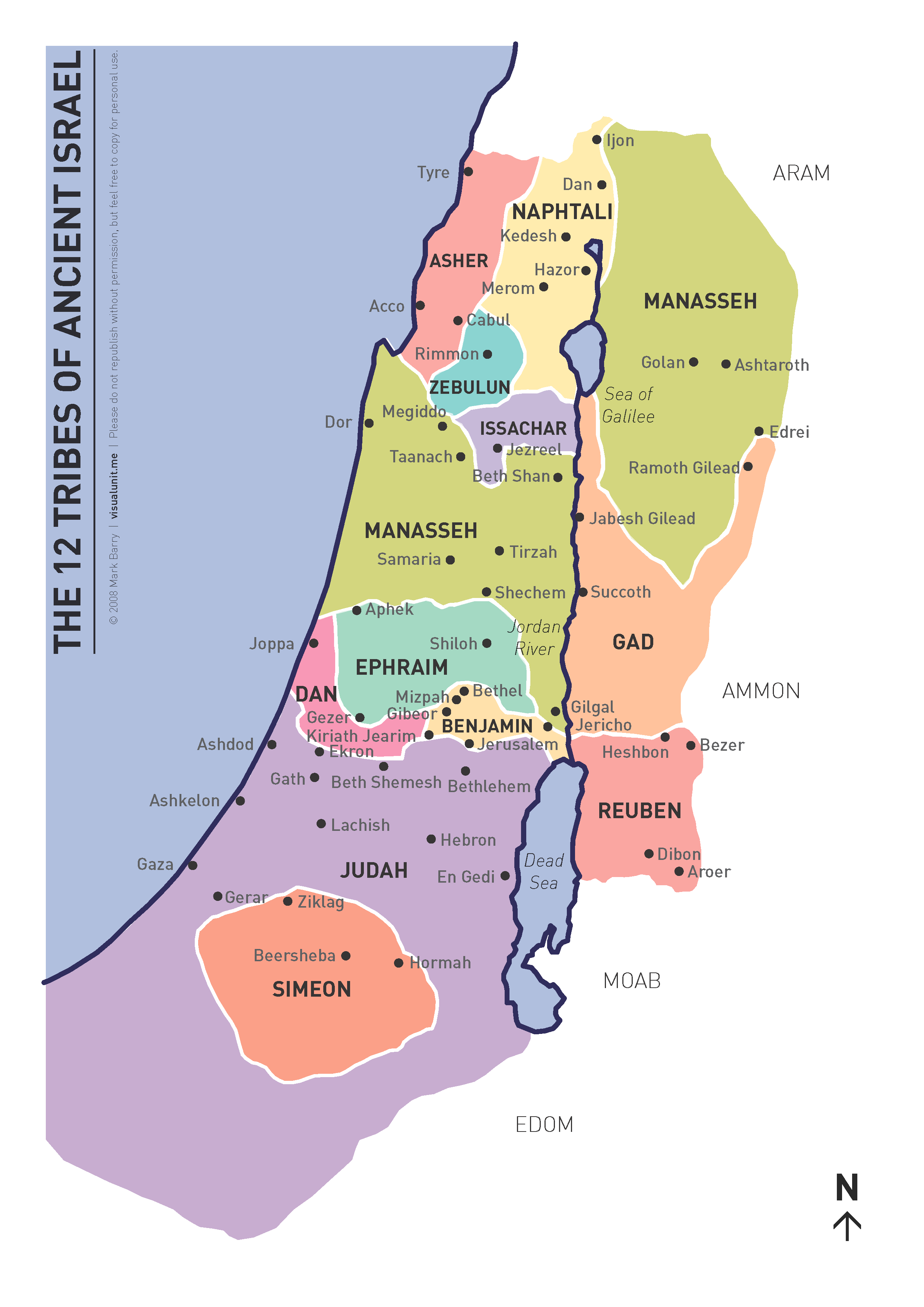
It’s most likely that the 20 towns were located in territory that had belonged to the tribes of Asher, Naphtali, and Zebulun. In awarding these cities to Hiram, Solomon was guilty of giving away land that belonged to the people of God. His willingness to give it away, coupled with Hiram’s poor assessment of it, reveals that it held no real value to Solomon.

One of the things that can be learned from studying the history of the Israelites is that every decision they made had long-term ramifications. The book of Judges reveals that, at one point, the tribes of Asher, Napthali, and Zebulun had been given the opportunity to conquer and occupy the land allotted to them by God, but they had failed.

The tribe of Zebulun failed to drive out the residents of Kitron and Nahalol, so the Canaanites continued to live among them. But the Canaanites were forced to work as slaves for the people of Zebulun.

The tribe of Asher failed to drive out the residents of Acco, Sidon, Ahlab, Aczib, Helbah, Aphik, and Rehob. Instead, the people of Asher moved in among the Canaanites, who controlled the land, for they failed to drive them out.

Likewise, the tribe of Naphtali failed to drive out the residents of Beth-shemesh and Beth-anath. Instead, they moved in among the Canaanites, who controlled the land. Nevertheless, the people of Beth-shemesh and Beth-anath were forced to work as slaves for the people of Naphtali. – Judges 1:30-33 NLT

One of the reasons the Phoenicians even existed was because of the failure of these three tribes to do what God had commanded them to do. As a result of their failure to drive out the inhabitants of the land, the Phoenicians occupied territory that was supposed to belong to the people of God. Now, Solomon had just awarded the Phoenicians with even more of Israel’s God-given inheritance.

Solomon’s main focus was the city of Jerusalem. Having willingly forfeited the cities located in the north, Solomon poured his time and energy into expanding his royal capital. To do so, Solomon enslaved thousands of non-Jews to work as laborers on his various rebuilding and enlargement projects. He conscripted Amorites, Hittites, Perizzites, Hivites, and Jebusites who were living in the land of Israel to provide slave labor for his ambitious expansion program. These people were used to extend the walls of Jerusalem, connecting the old City of David with the newer area surrounding the temple complex and the royal palaces and administrative headquarters. They “built towns as supply centers and constructed towns where his chariots and horses could be stationed” (1 Kings 9:19 NLT). Solomon was constructing a virtual theme park dedicated to his greatness; replete with palaces, terraces, stables for his many horses, and barracks for his growing army. 

And it’s important to remember that God had warned that His kings were not to refrain from certain actions.

The king must not build up a large stable of horses for himself… – Deuteronomy 17:16 NLT

The king must not take many wives for himself… – Deuteronomy 17:17 NLT

And he must not accumulate large amounts of wealth in silver and gold for himself… – Deuteronomy 17:17 NLT

Solomon was in violation of each of these commands. And while at this point, it appears that the daughter of Pharaoh was his only wife, it wouldn’t be long before he expanded his household greatly.

Now King Solomon loved many foreign women. Besides Pharaoh’s daughter, he married women from Moab, Ammon, Edom, Sidon, and from among the Hittites. The LORD had clearly instructed the people of Israel, “You must not marry them, because they will turn your hearts to their gods.” Yet Solomon insisted on loving them anyway. He had 700 wives of royal birth and 300 concubines. And in fact, they did turn his heart away from the LORD. – 1 Kings 11:1-3 NLT

Whether it was wives and concubines or horses and chariots, Solomon always seemed to be in building mode. Enough was never enough. He even built a fleet of boats and began an aggressive trading venture that netted him 16 tons of gold. For Solomon, bigger was always better. And yet, late in his life, Solomon would make a sad but telling admission.

I increased my possessions:
I built houses for myself;
I planted vineyards for myself.
I designed royal gardens and parks for myself,
and I planted all kinds of fruit trees in them.
I constructed pools of water for myself,
to irrigate my grove of flourishing trees.
I purchased male and female slaves,
and I owned slaves who were born in my house;
I also possessed more livestock—both herds and flocks—
than any of my predecessors in Jerusalem.
I also amassed silver and gold for myself,
as well as valuable treasures taken from kingdoms and provinces.
I acquired male singers and female singers for myself,
and what gives a man sensual delight—a harem of beautiful concubines.
So I was far wealthier than all my predecessors in Jerusalem,
yet I maintained my objectivity.
I did not restrain myself from getting whatever I wanted;
I did not deny myself anything that would bring me pleasure.
So all my accomplishments gave me joy;
this was my reward for all my effort.
Yet when I reflected on everything I had accomplished
and on all the effort that I had expended to accomplish it,
I concluded: “All these achievements and possessions are ultimately profitless—
like chasing the wind!
There is nothing gained from them on earth.” – Ecclesiastes 1:4-11 NLT

They say, “hindsight is 20-20,” and that would prove to be true in Solomon’s life. He would one day discover that his obsession with constant expansion, endless pleasure, and rampant materialism would never satisfy. But at the midway point of his reign, he didn’t know any better. So, he continued to try and balance his love for the things of this world with his love for God.  He kept accumulating material goods, while at the same time, offering sacrifices to God. Without even realizing it, he was worshiping two gods. Solomon was living out the very thing Jesus would later warn His disciples about.

“No one can serve two masters. For you will hate one and love the other; you will be devoted to one and despise the other. You cannot serve God and be enslaved to money.” – Matthew 6:24 NLT

English Standard Version (ESV) The Holy Bible, English Standard Version. ESV® Permanent Text Edition® (2016). Copyright © 2001 by Crossway Bibles, a publishing ministry of Good News Publishers.

New Living Translation (NLT) Holy Bible, New Living Translation, copyright © 1996, 2004, 2015 by Tyndale House Foundation. Used by permission of Tyndale House Publishers Inc., Carol Stream, Illinois 60188. All rights reserved.

The Message (MSG)Copyright © 1993, 1994, 1995, 1996, 2000, 2001, 2002 by Eugene H. Peterson