The Knowledge of God

To the choirmaster: for the flutes. A Psalm of David.

1 Give ear to my words, O Lord;
    consider my groaning.
Give attention to the sound of my cry,
    my King and my God,
    for to you do I pray.
O Lord, in the morning you hear my voice;
    in the morning I prepare a sacrifice for you and watch.

For you are not a God who delights in wickedness;
    evil may not dwell with you.
The boastful shall not stand before your eyes;
    you hate all evildoers.
You destroy those who speak lies;
    the Lord abhors the bloodthirsty and deceitful man.

But I, through the abundance of your steadfast love,
    will enter your house.
I will bow down toward your holy temple
    in the fear of you.
Lead me, O Lord, in your righteousness
    because of my enemies;
    make your way straight before me.

For there is no truth in their mouth;
    their inmost self is destruction;
their throat is an open grave;
    they flatter with their tongue.
10 Make them bear their guilt, O God;
    let them fall by their own counsels;
because of the abundance of their transgressions cast them out,
    for they have rebelled against you.

11 But let all who take refuge in you rejoice;
    let them ever sing for joy,
and spread your protection over them,
    that those who love your name may exult in you.
12 For you bless the righteous, O Lord;
    you cover him with favor as with a shield. Psalm 5:1-12 ESV

In this Psalm, David issues another prayer to God, asking for His favor and help in a time of great need. No timeline is provided or details given that might shed light on the circumstances David is facing, but it is clear that he is going through difficult days. He mentions his “groanings” and cries for help, which indicate that he is a man facing a desperate situation. For the Jews, each new day began at sundown, and David seems to indicate that his prayer began at that moment and lasted throughout the night. His situation was so dire that he regularly spent his nights in prayer and welcomed the dawn by continuing to call out to God.

…in the morning I will present my case to you and then wait expectantly for an answer. – Psalm 5:3 NET

David makes clear the motivation behind his all-night prayer sessions. He knew that God was the Judge, the differentiator between the righteous and the wicked. Only Yahweh could discern truth from lies and make a just determination on David’s guilt or innocence.

O God, you take no pleasure in wickedness;
    you cannot tolerate the sins of the wicked.
Therefore, the proud may not stand in your presence,
    for you hate all who do evil.
You will destroy those who tell lies.
    The Lord detests murderers and deceivers. – Psalm 5:4-6 NLT

David knew what it was like to be slandered and falsely accused by his enemies. His son Absalom had portrayed him as an unjust and uncaring king who regularly failed to mete out justice for his people (2 Samuel 15:1-4). As a king, David faced a constant barrage of false accusations designed to question his integrity and undermine his authority. But he knew that God was not fooled by these cleverly worded condemnations. Yahweh was all-knowing and could see into the hearts of men. He could not be deceived by their lies or manipulated by their false allegations against His servant. In fact, David rests in the confidence that his enemies have no access into God’s throne room. Because of their wickedness, they have no right to enter His presence to present their case against David.

But David is fully confident to come before God. He even boasts that his current situation will not prevent him from entering the Temple to offer sacrifices to God.

Because of your unfailing love, I can enter your house;
    I will worship at your Temple with deepest awe. – Psalm 5:7 NLT

His predicament would not prevent his access to the Almighty. Even when facing difficulty, David knew he was welcome to come before his Judge and King. In times of trouble, he would turn to the only One who could help. As a king himself, David understood the sovereign rule of God. He was in charge. He alone possessed the power and authority to do anything about David’s problem. But he was also David’s God, so He deserved honor, respect, and worship. David understood the holiness and righteousness of God, and never forgot that He was set apart and separate from the sinfulness of men – including the wicked, prideful, evil doers, liars, murderers, and deceitful.

God was not like earthly kings who could be all those things and more. He was a righteous, holy King who was just, good, and merciful. So David could appeal to His unfailing love and ask for protection and guidance.

Lead me in the right path, O Lord,
    or my enemies will conquer me.
Make your way plain for me to follow. – Psalm 5:8 NLT

Unlike David’s enemies, who lied and flattered for their own benefit, God was truthful, loving, and a righteous judge who always dealt justly and honestly with men. When David needed peace, he knew he could find it in God. When he needed direction, he could trust Yahweh to provide it. When he needed vindication, he knew God was the only reliable source.

David saw God as a place of refuge and protection. He could run to God in the tough times and find comfort in God’s open, loving arms. David understood the mercy and love of God because he had experienced it. That is why he could sing God’s praises even while suffering. He could experience joy even when surrounded by those who were out to destroy him. David had repeatedly found God to be his protector and provider. God had proven Himself faithful to David in the past, so he knew he could trust him for the future. He knew if he called, God would hear. He knew if he was under attack, verbally or physically, God would protect him. He knew if his enemies mistreated him, God would deal with them justly.

My enemies cannot speak a truthful word.
    Their deepest desire is to destroy others.
Their talk is foul, like the stench from an open grave.
    Their tongues are filled with flattery.
O God, declare them guilty.
    Let them be caught in their own traps.
Drive them away because of their many sins,
    for they have rebelled against you. – Psalm 5:9-10 NLT

David was humble enough to understand that he was not the real focus of his enemies’ attacks. Their assaults on him were really aimed at God. He was just the inconvenient intermediary. As God’s chosen king, David was the lightning rod for the attacks of the wicked and unrighteous. In rebelling against the Lord’s anointed, they were really rebelling against God. In questioning the sovereignty of David, they were denying the sovereignty of God. But David knew that his position and power had been ordained by God. He had not earned or deserved his role as king. Yahweh had placed David on the throne and he served at Yahweh’s pleasure.

This awareness of God’s sovereignty and providence caused David to take his problems to the only One who could do anything about them.

But let all who take refuge in you rejoice;
    let them sing joyful praises forever.
Spread your protection over them,
    that all who love your name may be filled with joy. – Psalm 5:11 NLT

He knew that when he was at a loss for what to do next, God would show him what to do because God was his King, guide, protector, provider, judge, advocate, and refuge. God was his source of joy and peace, the object of his praise, the focus of his prayers, the answer to his problems, the director of his paths, and the reason for his worship. The prophet Hosea calls on all the people of God to share that confident and unwavering perspective of God.

Oh, that we might know the Lord!
    Let us press on to know him.
He will respond to us as surely as the arrival of dawn
    or the coming of rains in early spring.Hosea 6:3 NLT

Father, I want to know You more. I want to have an understanding of Your character and nature like David did. Knowing You didn’t rid David of all his problems, but it gave him a different perspective on how to handle and view them. I want to respond to the circumstances of life as he did – prayerfully, expectantly, worshipfully, and joyfully. I want to understand Your holiness better, rest in Your love more often, and sing Your praises in the good times and the bad times. Amen

English Standard Version (ESV) The Holy Bible, English Standard Version. ESV® Permanent Text Edition® (2016). Copyright © 2001 by Crossway Bibles, a publishing ministry of Good News Publishers.

New Living Translation (NLT) Holy Bible, New Living Translation, copyright © 1996, 2004, 2015 by Tyndale House Foundation. Used by permission of Tyndale House Publishers Inc., Carol Stream, Illinois 60188. All rights reserved.
The Ultimate Reward

By faith Enoch was taken up so that he should not see death, and he was not found, because God had taken him. Now before he was taken he was commended as having pleased God. And without faith it is impossible to please him, for whoever would draw near to God must believe that he exists and that he rewards those who seek him. – Hebrews 11:5-6 ESV

We don’t know a whole lot about Enoch. Other than what we read about him here in Hebrews, the only other mention of him is found in the book of Genesis. He’s part of a genealogical list that shows the line of mankind from Adam all the way to Noah.

When Enoch had lived 65 years, he fathered Methuselah. Enoch walked with God after he fathered Methuselah 300 years and had other sons and daughters. Thus all the days of Enoch were 365 years. Enoch walked with God, and he was not, for God took him. –  Genesis 5:21-24 ESV

Enoch lived to the ripe old age of 365, but his time on earth was short compared to that of his father (962 years) and son (969 years). Enoch, as the genealogical list suggests, lived in the days before the flood. While there have been many suggestions to explain why men lived so much longer in those days, no one really knows why. But we do see that, over time, the longevity of man diminished dramatically; most likely as a result of the ongoing effects of sin and the curse of death on the human body.

But Enoch lived over three centuries. In our day, it is rare for anyone to make it to the single-century mark. But the remarkable thing about Enoch was not his lifespan, but his departure from this earth. The Genesis account tells us “Enoch walked with God, and he was not, for God took him.” The Septuagint, the Greek translation of the Old Testament, says he “was not found.”

He was on this earth for 365 years and then, one day, he was gone. But unlike every other man listed in the genealogical record found in Genesis 5, Enoch didn’t die. He is the only one on the list whose name is not followed by the words, “and he died.” Enoch was taken. He could have lived longer, but God decided to remove Enoch from the earth and transport him to heaven. The author of Hebrews adds another strange twist to this already bizarre tale.

By faith Enoch was taken up so that he should not see death. – Hebrews 11:5 ESV

Verse 5 stands in direct contrast to verse 4 and the life of the first character in the great “hall of faith.” Abel, the son of Adam and Eve, is commended for his faith but recognized for his untimely death.

…he was commended as righteous, God commending him by accepting his gifts. And through his faith, though he died, he still speaks. – Hebrews 11:4 ESV

Abel exhibited faith but died at the hands of his own brother. Yet, Enoch was spared the fate that all men have faced ever since the fall. He was glorified and received his redeemed body without having to suffer the inevitable and inescapable reality of death. He was there one day and gone the next. The Scriptures simply tell us “he was not found, because God had taken him.”

But why was Enoch rewarded with this one-of-a-kind experience? The text simply states that it was because of his faith. Living in a time of unparalleled evil and immorality, Enoch remained faithful to God. When everyone else around him was pursuing wickedness and involved in rampant evil, this man had chosen to believe in the promises of God. To fully understand Enoch’s status as a righteous man living among the unrighteous, one must consider the sorry state of affairs on earth at the time. Ever since the fall, the moral decline of mankind had spiraled out of control. Some 669 years after the “rapture” of Enoch, things had become so bad that God decided to wipe out all of humanity.

The Lord saw that the wickedness of man was great in the earth, and that every intention of the thoughts of his heart was only evil continually. And the Lord regretted that he had made man on the earth, and it grieved him to his heart. So the Lord said, “I will blot out man whom I have created from the face of the land, man and animals and creeping things and birds of the heavens, for I am sorry that I have made them.” – Genesis 6:5-7 ESV

At that point in the human story, there was only one man left who remained faithful to God, and that was Noah. The Genesis account states that “Noah found favor in the eyes of the Lord” (Genesis 6:8 ESV), and then it adds that “Noah was a righteous man, blameless in his generation. Noah walked with God” (Genesis 6:9 ESV). Notice that last sentence. It is the same thing said of Enoch.

Enoch walked with God – Genesis 5:22 ESV

Two times in the Genesis passage, we are told that “Enoch walked with God.” The Hebrew word translated as “walked” is hālaḵ and it can be used to refer to the physical act of movement or to living one’s life. Another way of translating this statement is that Enoch lived his life in communion with God. It is the same idea expressed by God to Abraham in Genesis 17. “When Abram was ninety-nine years old the LORD appeared to Abram and said to him, ‘I am God Almighty; walk before me, and be blameless’” (Genesis 17:1 ESV).

Abraham was to live his life with an awareness that he was doing so under the watchful eye of God Almighty. Every aspect of his life was being conducted in the presence of the all-knowing, all-seeing God. But when God told Abraham to “be blameless,” He was not demanding perfection. The Hebrew word for “blameless” is tamiym and it means “complete, whole, entire, sound” (Hebrew Lexicon :: H8549 (KJV). Blue Letter Bible). Abraham was being told to live his entire life, his whole life, with the constant awareness that God was watching. There was to be no compartmentalization, no hidden areas. He was to live as if God was with him at all times because He was.

And that is how Enoch lived. He lived by faith, believing that God was with Him every day and in every circumstance. Enoch couldn’t see God, but he believed in Him. The author of Hebrews explains that “without faith it is impossible to please him, for whoever would draw near to God must believe that he exists and that he rewards those who seek him” (Hebrews 11:6 ESV).

Enoch believed that God existed even though many around him did not. That genealogical record found in Genesis 5 gives us an abbreviated glimpse of mankind’s trajectory from the fall of Adam to the days of Noah. In the very next chapter of Genesis, we read, “The Lord observed the extent of human wickedness on the earth, and he saw that everything they thought or imagined was consistently and totally evil. So the Lord was sorry he had ever made them and put them on the earth. It broke his heart” (Genesis 6:5-6 NLT).

By the time we get to the days of Noah, we find that “God saw that the earth had become corrupt and was filled with violence. God observed all this corruption in the world, for everyone on earth was corrupt.” (Genesis 6:11-12 NLT). The path from Adam to Noah was not an easy one. It was filled with increasing sin, violence, godlessness, and wickedness. The further man got away from the garden, the dimmer his recollection of God became. And in the midst of this downward spiral, Enoch stood out like a bright light. He was a beacon of faith in the midst of the darkness of man’s increasing sinfulness. He believed God existed and that He would reward those who pleased Him.

The text tells us, “before he was taken he was commended as having pleased God.” He had lived a life that pleased God – by faith. He was not self-seeking, but God-pleasing. He lived as if God existed and as if God was walking with him every moment of every day. His God was not distant or disinterested in his life. His God was near and lovingly involved in every aspect of his daily walk. He lived to please God – by faith. He lived to obey God – by faith. He lived to bring glory and honor to God – by faith.

To walk with God requires faith in God. You have to believe that He exists and that He is a rewarder of those who seek Him (Hebrews 11:6). You have to believe that He sees and that He cares. Enoch longed and hoped for the reward of God without ever really knowing exactly what the reward might be. It is likely that Enoch would have lived many more years on this earth, just like his father and son. But God rewarded Enoch by taking him in mid-life, and by sparing him the suffering and pain associated with death. He also didn’t have to endure what would have likely been a prolonged period of old age. In those days before the flood, men enjoyed long lives, but they still had to face the inevitable reality of sin.

Enoch had faith in God and he was rewarded by God with escape from the curse of death.

By faith Enoch was taken up so that he should not see death. – Hebrews 11:5a ESV

Enoch provides a foreshadowing of the hope that is found in Jesus Christ. There is an ultimate reward for all those who place their faith in God by trusting in His Son’s sacrifice on the cross on their behalf. As Jesus told Mary and Martha at the graveside of their brother, “I am the resurrection and the life. Anyone who believes in me will live, even after dying. Everyone who lives in me and believes in me will never ever die” (John 11:25-26 NLT). Enoch was raptured and never died. Because of his faith, he was rewarded with his immediate glorification and entrance into God’s presence.  He went to be with the LORD. And that same hope awaits all those who place their faith in Christ. That is why the author opened this chapter with the reassuring words: “Now faith is the assurance of things hoped for, the conviction of things not seen” (Hebrews 11:1 ESV).

Every child of God is to live their life on this earth believing that God is a rewarder of those who seek Him and that His ultimate reward is a death-defying escape from this world into His eternal Kingdom. Whether by death or by rapture, every saint will experience the fulfillment of God’s promise of eternal life, but that reward can only be accessed by faith.

Anyone who wants to come to him must believe that God exists and that he rewards those who sincerely seek him. – Hebrews 11:6 NLT

English Standard Version (ESV) The Holy Bible, English Standard Version. ESV® Permanent Text Edition® (2016). Copyright © 2001

New Living Translation (NLT) Holy Bible, New Living Translation, copyright © 1996, 2004, 2015 by Tyndale House Foundation. Used by permission of Tyndale House Publishers Inc., Carol Stream, Illinois 60188. All rights reserved.

We Can Do This the Hard Way

1 The word of the Lord came to me: “Son of man, set your face toward the mountains of Israel, and prophesy against them, and say, You mountains of Israel, hear the word of the Lord God! Thus says the Lord God to the mountains and the hills, to the ravines and the valleys: Behold, I, even I, will bring a sword upon you, and I will destroy your high places. Your altars shall become desolate, and your incense altars shall be broken, and I will cast down your slain before your idols. And I will lay the dead bodies of the people of Israel before their idols, and I will scatter your bones around your altars. Wherever you dwell, the cities shall be waste and the high places ruined, so that your altars will be waste and ruined, your idols broken and destroyed, your incense altars cut down, and your works wiped out. And the slain shall fall in your midst, and you shall know that I am the Lord.

“Yet I will leave some of you alive. When you have among the nations some who escape the sword, and when you are scattered through the countries, then those of you who escape will remember me among the nations where they are carried captive, how I have been broken over their whoring heart that has departed from me and over their eyes that go whoring after their idols. And they will be loathsome in their own sight for the evils that they have committed, for all their abominations. 10 And they shall know that I am the Lord. I have not said in vain that I would do this evil to them.”

11 Thus says the Lord God: “Clap your hands and stamp your foot and say, Alas, because of all the evil abominations of the house of Israel, for they shall fall by the sword, by famine, and by pestilence. 12 He who is far off shall die of pestilence, and he who is near shall fall by the sword, and he who is left and is preserved shall die of famine. Thus I will spend my fury upon them. 13 And you shall know that I am the Lord, when their slain lie among their idols around their altars, on every high hill, on all the mountaintops, under every green tree, and under every leafy oak, wherever they offered pleasing aroma to all their idols. 14 And I will stretch out my hand against them and make the land desolate and waste, in all their dwelling places, from the wilderness to Riblah. Then they will know that I am the Lord.” – Ezekiel 6:1-14 ESV

Four separate times in 14 verses, God insists that when He is done, the rebellious people of Israel “will know that I am the Lord.” God is a relational being and He had chosen the nation of Israel to enjoy a unique relationship with Him. He had set them apart as His own prized possession with the intent of revealing to them His glory and goodness. Even all the way back in Egypt, long before Moses had delivered them from their captivity, God had promised to reveal Himself to them in powerful and highly tangible ways.

I am the Lord, and I will bring you out from under the burdens of the Egyptians, and I will deliver you from slavery to them, and I will redeem you with an outstretched arm and with great acts of judgment. I will take you to be my people, and I will be your God, and you shall know that I am the Lord your God, who has brought you out from under the burdens of the Egyptians. I will bring you into the land that I swore to give to Abraham, to Isaac, and to Jacob. I will give it to you for a possession. I am the Lord.” – Exodus 6:6-8 ESV

Their miraculous deliverance was intended to demonstrate the power, majesty, and sovereignty of God. He was greater than the Egyptians and their plethora of false gods. He was the covenant-keeping God who could be trusted to keep every promise He had made to Abraham, whose descendants would eventually escape captivity in Egypt and find themselves safely ensconced in the promised land of Canaan.

All along their journey from captivity to Canaan, God revealed Himself to His people. After miraculously delivering them across the Red Sea on dry ground and defeating the forces of Egypt, He had led them by a pillar of cloud by day and a pillar of fire by night. He had sustained them with manna from heaven and water from a rock. And during their four-decade-long journey through the wilderness of Sinai, He had even kept their clothes from wearing out. He had given them His law to reveal His holy expectations of them and regulate their behavior. And knowing that they would fail to keep His law perfectly, He provided them with the sacrificial system to atone for the sins they would commit so that they might be able to restore their broken relationship with Him.

God had repeatedly proven His greatness, and they should have known that He alone was the one true God. He had no equals. In His deliverance of the Israelites, He had exposed the gods of the Egyptians as frauds and nothing more than the figments of the imaginations of men. And when they began their conquest of the land of Canaan, God was with them, providing them with victories over much larger armies. The Canaanites and their gods proved to be powerless before Yahweh, the God of Abraham, Isaac, and Jacob.

And even before their conquest of the land had begun, God had warned them about adopting the religious practices of the Canaanites. They were not to emulate their pagan ways or worship their gods.

“When the Lord your God goes ahead of you and destroys the nations and you drive them out and live in their land, do not fall into the trap of following their customs and worshiping their gods. Do not inquire about their gods, saying, ‘How do these nations worship their gods? I want to follow their example.’ You must not worship the Lord your God the way the other nations worship their gods, for they perform for their gods every detestable act that the Lord hates. They even burn their sons and daughters as sacrifices to their gods.” – Deuteronomy 12:29-31 NLT

But the people of Israel would fail to keep God’s commands. Over the centuries, they developed an unhealthy love affair with the false gods of the Canaanites. The kings of Israel had a track record of adopting the false gods of their enemies and adulterating their worship of Yahweh with unacceptable practices that He found deplorable.

And all along the way, God had warned His people about the dangers of their rebellious ways. He was a jealous God who would not tolerate their unfaithfulness and spiritual infidelity. By this time, they should have known that He alone was God. But they were still prone to seek the help and favor of any pagan god who might be able to give them a leg up on their enemies. They had become equal-opportunity idolators, willing to cozy up to any god who might provide them with an advantage or satisfy their insatiable lust for power, possessions, and pleasure. For them, Yahweh was not enough. They wanted more. And they were willing to prostitute themselves before the false gods of the Canaanites in order to satisfy what the apostle John described as “a craving for physical pleasure, a craving for everything we see, and pride in our achievements and possessions” (1 John 2:16 NLT).

Their blatant unfaithfulness had resulted in the Babylonian invasion of Judah. God informed the prophet, Jeremiah, that King Nebuchadnezzar had been handpicked by God to serve as His agent of judgment against His rebellious people.

“I will send for all the tribes of the north, declares the Lord, and for Nebuchadnezzar the king of Babylon, my servant, and I will bring them against this land and its inhabitants, and against all these surrounding nations. I will devote them to destruction, and make them a horror, a hissing, and an everlasting desolation.” – Jeremiah 25:9 ESV

And by the time Ezekiel penned his book, King Nebuchadnezzar had already defeated Judah and taken thousands of its citizens captive. But God was not done. The people of Judah remained unrepentant and unwilling to give up their love affair with false gods. That is why God gave Ezekiel a message for the people living back in Judah. He was to declare God’s pending judgment against the “mountains of Israel” (Ezekiel 6:3). This reference most certainly included the most prominent and important mountain range in all of Israel: Mount Moriah. This mountain range included Mount Zion on which Jerusalem sat and within whose walls the temple of God was located.

But God made it clear that His holy mountain was surrounded by altars and shrines to false gods. The land of Judah was literally filled with sacred worship sights dedicated to the gods of the Canaanites, and God was not pleased.

“I am about to bring war upon you, and I will smash your pagan shrines. All your altars will be demolished, and your places of worship will be destroyed. I will kill your people in front of your idols. I will lay your corpses in front of your idols and scatter your bones around your altars. Wherever you live there will be desolation, and I will destroy your pagan shrines. Your altars will be demolished, your idols will be smashed, your places of worship will be torn down, and all the religious objects you have made will be destroyed. The place will be littered with corpses, and you will know that I alone am the Lord.” – Ezekiel 6:3-7 NLT

It’s as if God is saying, “We can do this the hard way or we can do this the easy way.” God is a relational God. He chose the people of Israel to have a relationship with Him and to get to know Him – intimately and personally. He chose to dwell among them. He gave them His law to follow. He led them, directed them, protected them, and even spoke to them. He revealed Himself to them through miracles and divine intervention. He won battles for them. He rescued and rewarded them. All so that they might know Him. But the people of Israel decided to reject this personal God for a litany of impersonal, impotent, man-made gods.

Instead of recognizing and appreciating the power and presence of Yahweh, they turned their attention and affections elsewhere. So, God decided to reveal Himself differently. They were going to get to know Him the hard way. They would experience the power of God moving in their midst, but it would bring destruction, not blessing. He was going to smash their pagan shrines, demolish their altars, and destroy the places of worship where they pursued other gods.

When all the dust had settled, they were going to know that God had been in their midst. They were going to know that He had spoken and He always does what he says He will do. They were going to know that God was powerful and deadly serious about His people living lives that were set apart and distinctive from those of the other nations.

“You people have behaved worse than your neighbors and have refused to obey my decrees and regulations. You have not even lived up to the standards of the nations around you.” – Ezekiel 5:7 NLT

One way or the other, the people of God were going to get to know their God. But they were choosing the hard way. They were making it difficult on themselves. God had wanted to reveal Himself through blessing and abundance. He had wanted to have an intimate relationship with them that was characterized by care and compassion. In His grace and mercy, He had chosen them from among all the nations, not because they deserved it, but because He wanted to reveal Himself in a special way to a very specific people. He had intended to use them to showcase His love. They were to be His living illustration to the world.

But they refused to accept His love and obey His commands. He pursued them, but they rejected Him. So now they were going to get to know God the hard way.

But this chapter provides a powerful lesson for every child of God. Why do we make it so hard on ourselves? Why do we force God to reveal Himself through discipline and prove Himself to us by rebuking us? God has given us His Son. He has chosen us for a personal, intimate relationship with Him. He wants us to know Him closely and deeply. But far too often, we choose the hard way over the easy way.

English Standard Version (ESV) The Holy Bible, English Standard Version. ESV® Permanent Text Edition® (2016). Copyright © 2001

New Living Translation (NLT) Holy Bible, New Living Translation, copyright © 1996, 2004, 2015 by Tyndale House Foundation. Used by permission of Tyndale House Publishers Inc., Carol Stream, Illinois 60188. All rights reserved.

Leaning Your Ladder Against the Wrong Wall

12 I the Preacher have been king over Israel in Jerusalem. 13 And I applied my heart to seek and to search out by wisdom all that is done under heaven. It is an unhappy business that God has given to the children of man to be busy with. 14 I have seen everything that is done under the sun, and behold, all is vanity and a striving after wind.

15 What is crooked cannot be made straight,
    and what is lacking cannot be counted.

16 I said in my heart, “I have acquired great wisdom, surpassing all who were over Jerusalem before me, and my heart has had great experience of wisdom and knowledge.” 17 And I applied my heart to know wisdom and to know madness and folly. I perceived that this also is but a striving after wind.

18 For in much wisdom is much vexation,
    and he who increases knowledge increases sorrow. – Ecclesiastes 1:12-18 ESV

Solomon established the theme of his book in verse two: “Vanity of vanities, says the Preacher, vanity of vanities! All is vanity.”

He is the “preacher” or speaker in the assembly, addressing his audience with words of wisdom and worldly experience. He is expressing what he has learned after years of living on this planet, and his words are intended to shock and surprise us. After all, he is the king of Israel, and one of the wisest and wealthiest men who has ever lived. He ruled over one of the greatest nations of the world, populated by a people who had been chosen and set apart by God. He lived in an opulent palace, surrounded by treasures of all kinds. His was a life marked by luxury and a lavish lifestyle that made him the envy of every man on earth, including other kings. And yet, as he neared the end of his life and looked back, he could not help but recognize that all his wealth, wisdom, and worldly goods had left him with a feeling of emptiness.

The Hebrew word he used to describe his storybook life is hebel and it can best be translated with English words such “vapor” or “breath.” But what does Solomon mean when he repeatedly states, “all is vanity?” The NLV and NIV translate it as “meaningless.” But the Hebrew word has a much richer and more illustrative meaning. It conjures up the image of something that is without form or substance; here one minute and then gone another. Like fog or dew, it appears and then disappears, leaving no trace that it ever existed. It’s not so much that has no meaning, as it lacks sustainability. It seems that Solomon is attempting to describe the transitory nature of life. Just look at the descriptions he used in the opening verses.

A generation goes, and a generation comes – vs 4

The sun rises, and the sun goes down – vs 5

The wind blows to the south and goes around to the north; around and around goes the wind, and on its circuits the wind returns… – vs 6

All streams run to the sea, but the sea is not full… – vs 7

There is a certain futility to life because it all appears to be cyclical in nature. These are the words of a man who is near the nadir of his life, and who recognizes that all his many accomplishments and acquisitions will amount to nothing when he is gone. His words would be echoed by James centuries later.

How do you know what your life will be like tomorrow? Your life is like the morning fog—it’s here a little while, then it’s gone. – James 4:14 NLT

It was this somewhat morbid perspective that had led Solomon to pen this book. But it is doubtful that his only motivation was to journal his dying thoughts. These are not the ramblings of a depressed man mired in self-pity, but the reflections of a wise man who had taken a wrong turn somewhere along the path of life and was warning those behind him not to make the same mistake.

At this stage of his life, he describes himself not as a king, but as a preacher, a proclaimer of important news, whose sole intent is to instruct others and to open their eyes to the realities of life. His role had changed. In fact, he describes his kingship in the past tense. He had been the king of Israel and he had lived in Jerusalem. It is not that he was no longer king when he wrote this book, but that he was looking back with a detached perspective, viewing his life from the outside. His is a message based on hindsight, the wisdom that comes from analyzing something in retrospect.

Solomon is contemplative and more objective than he had ever been in his role as king. As he nears the end of life, his position and possessions mean little to him. He is an old man nearing death, who knows that his days are numbered and that his title and treasures will do him no good when he is gone. This is what led him to conclude:

I have seen everything that is done under the sun, and behold, all is vanity and a striving after wind. – Ecclesiastes 3:14 ESV

Solomon had spent his life acquiring everything from wisdom and knowledge to wealth and women. He had been the consummate collector and consumer. He openly admits:

I have acquired great wisdom, surpassing all who were over Jerusalem before me, and my heart has had great experience of wisdom and knowledge. – Ecclesiastes 1:16 ESV

But Solomon’s quest for knowledge had been all-encompassing, including the pursuit of madness and folly. He will refer to these two things several more times in his book, always linking them together. What Solomon means by these two words is essential to understanding the rest of what he has to say in this book. Madness and folly are not references to mental illness, but to moral perversity. For Solomon, wisdom and knowledge represent his pursuit of truth and righteousness. He was on a quest to discover the meaning of life and to find significance in his life. But when he didn’t find what he was looking for, he turned to immorality. In some sense, Solomon used his brain and his body in an attempt to find meaning, purpose, and fulfillment. He pursued information by using his intelligence, but he also pursued experience by utilizing his physical senses and fulfilling his passions and desires.

Solomon describes his life in stark terms, stating:

I devoted myself to search for understanding and to explore by wisdom everything being done under heaven. – Ecclesiastes 1:13 NLT

Notice his words: Everything done under heaven. He had no barriers. He had removed the guard rails from his life, allowing himself the right to experiment with anything and everything, in a vain attempt to discover meaning and significance. But what is glaringly missing is any mention of God. He was not looking to God for meaning. He was not pursuing God for fulfillment and satisfaction. It had been God who had made him king and granted him his wisdom and wealth. But Solomon had an insatiable desire for more. He was no longer satisfied by or with God.

It brings to mind the scene in the Garden of Eden after God had made Adam and Eve. He placed them in the garden and surrounded them with everything they would need for life, including an intimate, unbroken relationship with Him.

And the Lord God planted a garden in Eden, in the east, and there he put the man whom he had formed. And out of the ground the Lord God made to spring up every tree that is pleasant to the sight and good for food. The tree of life was in the midst of the garden, and the tree of the knowledge of good and evil. – Genesis 2:8-9 ESV

They had it all. There was nothing they lacked. And the only thing God denied them was access to the tree of the knowledge of good and evil. He had warned them, “You may surely eat of every tree of the garden, but of the tree of the knowledge of good and evil you shall not eat, for in the day that you eat of it you shall surely die”(Genesis 2:16-17 ESV).

In other words, they could even eat from the tree of life. In fact, I believe it was the fruit of this tree that provided them with eternal life. As long as they ate it, they would live. Life was not forbidden. But the knowledge of good and evil was. They were to avoid that tree at all costs because God had told them that violating His command by eating its fruit would result in death. And it seems that the death to which He referred was not immediate extermination of life, but the slow, steady decline that comes with aging. Yet, they would suffer spiritual death in the form of immediate separation from fellowship with God. Physical death would come, but it would be the direct result of their removal from the garden and their inability to eat from the tree of life.

It’s important to note that, when Satan tempted Eve, he twisted the words of God, falsely accusing Him of having said, “You shall not eat of any tree in the garden.”

But that was a lie, and Eve had corrected him. Yet even she got it wrong because she inferred that God’s ban had included instructions not to even touch the tree. But Satan simply responded with more lies.

“You will not surely die. For God knows that when you eat of it your eyes will be opened, and you will be like God, knowing good and evil.” – Genesis 3:4-5 ESV

He contradicted God. Even worse, he called God a liar and painted him as nothing more than a cosmic killjoy. Satan presented the real goal in life as that of pursuing the knowledge of good and evil. He portrayed knowledge and experience as the twin values that make life truly meaningful. His portrayal of good and evil was not an attempt to set up one against the other, but to present them as equally valuable and significant. And that seems to be the thought behind Solomon’s strategy for conducting his life.

He tried it all. He dabbled in wisdom, but also in madness and folly. He tried his hand at living both the righteous and the wicked life. And none of it worked. None of it satisfied. This was a man who had 700 wives and 300 concubines. He denied himself nothing. He was an extremist. But when all was said and done, he found himself extremely unfulfilled and dissatisfied. In a sense, he had eaten a steady diet from the tree of the knowledge of good and evil. He had seen the forbidden fruit and eaten his fill but remained dissatisfied and disillusioned by it all.

And while Solomon was much the wiser for his efforts, he was far from content. This is why he so sadly concluded: “The greater my wisdom, the greater my grief. To increase knowledge only increases sorrow” (Ecclesiastes 1:18 NLT).

He knew things God never intended him to know. His eyes had been opened to things God had never meant for him to see. Satan had convinced Solomon that God was not enough. He had tempted Solomon to believe that God had been holding out and that the real meaning in life was to be found outside of God’s will, not in it. And now, the wisest man who ever lived was looking back on his life and recognizing that it had all been a lie. In a vain attempt to discover the secret to living a fulfilled life, Solomon lost sight of God. He had made gods out of his own intellectual prowess, the pursuit of physical pleasure, and the achievement of power and prominence – only to discover that “all is vanity and a striving after wind” (Ecclesiastes 1:14 ESV).

English Standard Version (ESV) The Holy Bible, English Standard Version. ESV® Permanent Text Edition® (2016). Copyright © 2001 by Crossway Bibles, a publishing ministry of Good News Publishers.

New Living Translation (NLT) Holy Bible, New Living Translation, copyright © 1996, 2004, 2015 by Tyndale House Foundation. Used by permission of Tyndale House Publishers Inc., Carol Stream, Illinois 60188. All rights reserved.

New English Translation (NET)NET Bible® copyright ©1996-2017 by Biblical Studies Press, L.L.C. http://netbible.com All rights reserved.

Getting to Know God

1 The words of Agur son of Jakeh. The oracle.

The man declares, I am weary, O God;
    I am weary, O God, and worn out.
Surely I am too stupid to be a man.
    I have not the understanding of a man.
I have not learned wisdom,
    nor have I knowledge of the Holy One.
Who has ascended to heaven and come down?
    Who has gathered the wind in his fists?
Who has wrapped up the waters in a garment?
    Who has established all the ends of the earth?
What is his name, and what is his son’s name?
    Surely you know!

Every word of God proves true;
    he is a shield to those who take refuge in him.
Do not add to his words,
    lest he rebuke you and you be found a liar.

Two things I ask of you;
    deny them not to me before I die:
Remove far from me falsehood and lying;
    give me neither poverty nor riches;
    feed me with the food that is needful for me,
lest I be full and deny you
    and say, “Who is the Lord?”
or lest I be poor and steal
    and profane the name of my God. – Proverbs 30:1-9 ESV

The closing chapters of the book of Proverbs are attributed to two different individuals whose identities remain a ministry. The first is Agur, the son of Jakeh. The second is referred to as King Lemuel. But we know nothing else about these men. Lemuel’s name does not appear anywhere in the list of the kings of Judah or Israel, found in the books of Kings or Chronicles. So, it is unclear where his kingdom was located. Some have speculated that Lemuel was a pen name for Solomon, but without evidence to back up their claim. The names Agur and Jakeh appear nowhere else in Scripture, so we have no way of knowing who they were or when and where they lived. But Agur and Lemuel were considered to be sages whose wise sayings were included in Solomon’s compendium of proverbs.

The first part of Agur’s collection of proverbs deals with man’s relationship with God. The author opens his list of three proverbial statements regarding God by speaking in the third person, describing himself as “weary and worn out” (Proverbs 30:1 NLT). He addresses his statements to God and makes a stunning confession:

I am too stupid to be human,
    and I lack common sense. – Proverbs 30:2 NLT

Agur acknowledges that his lack of wisdom has left him unable to truly know and understand God.

I have not mastered human wisdom,
    nor do I know the Holy One.
Proverbs 30:3 NLT

Agur is not declaring himself to be a fool, but he is simply acknowledging the transcendence of God. Agur’s wisdom is limited in scope and incapable of plumbing the depths of God’s character and nature. That is why Agur asks five probing questions that are intended to reveal man’s incapacity to fully know and appreciate the greatness of God.

Who but God goes up to heaven and comes back down?
Who holds the wind in his fists?
Who wraps up the oceans in his cloak?
Who has created the whole wide world?
What is his name—and his son’s name? Tell me if you know!

It’s almost as if Agur was familiar with the book of Job because he seems to mirror the questioning style found in chapters 38-42. In the book of Job, God confronts the main character with a series of questions that are designed to reestablish His own greatness and Job’s insignificance.

“Who is this that questions my wisdom
    with such ignorant words?
Brace yourself like a man,
    because I have some questions for you,
    and you must answer them.”  – Job 38:2-3 NLT

And God precedes to expose Job’s unwarranted boldness to question His goodness and glory by asking a series of rhetorical questions.

“Where were you when I laid the foundations of the earth?” – Job 38:4 NLT

“Have you ever commanded the morning to appear
    and caused the dawn to rise in the east? – Job 38:12 NLT

“Have you explored the springs from which the seas come?
    Have you explored their depths? – Job 38:16 NLT

For two solid chapters, God levels question after question to Job. And when He is done, God asks Job, “Do you still want to argue with the Almighty? You are God’s critic, but do you have the answers?” (Job 40:2 NLT). To which Job humbly responds:

“I am nothing—how could I ever find the answers?
    I will cover my mouth with my hand.
I have said too much already.
    I have nothing more to say.” – Job 40:4-5 NLT

Like Job, Agur understands that he has no right to question God. His wisdom is insufficient to comprehend the will and the ways of God. And he is worn out from attempting to gain enough wisdom to know and understand God.

But he has learned enough to know that God’s word is always true. Agur’s God is faithful and can be fully trusted.

In reading the book of Proverbs it would be easy to focus on what appear to be the main themes or topics of the book: Wisdom, knowledge, and understanding. There is a natural tendency to make the gaining of these three things our sole or primary objective. After all, no one wants to be a fool, so it would make sense to pursue wisdom, knowledge, and understanding. But in doing so, we would miss the real objective of the book.

If you recall, in the very first chapter, Solomon stated that “Fear of the Lord is the foundation of true knowledge” (Proverbs 1:7 NLT). In other words, while wisdom, knowledge, and understanding are worthy objectives, they are only available through a right relationship with God. The Message paraphrases Proverbs 1:7 this way: “Start with God — the first step in learning is bowing down to God.”

It all begins with God. In Proverbs 30, Agur confesses, “I am weary, O God; I am weary and worn out, O God. I am too stupid to be human, and I lack common sense. I have not mastered human wisdom, nor do I know the Holy One” (Proverbs 30:2-3 NLT). When we fail to start with God, and we neglect to get to know Him for who He is, we end up worn out, and lacking in the very things we need to survive and thrive in this world: wisdom, knowledge, and understanding.

Yet, when we make getting to know God our objective, we discover the true source of all wisdom. He is the creator of all things. His wisdom and knowledge are beyond our comprehension, yet He makes Himself known to us when we seek Him. He gives us His Word and it is completely reliable and true. Growing in our knowledge of God gives us a greater understanding of ourselves – our weaknesses, limitations, sinful tendencies, and our total dependence on Him.

Getting to know God gives us a new perspective on life. It changes our priorities, which is why Agur could say, “O God, I beg two favors from you; let me have them before I die. First, help me never to tell a lie. Second, give me neither poverty nor riches! Give me just enough to satisfy my needs. For if I grow rich, I may deny you and say, ‘Who is the Lord!’ And if I am too poor, I may steal and thus insult God’s holy name” (Proverbs 30:7-9 NLT).

Growing in our knowledge of God refocuses our priorities and puts Him at the center of our lives. When we begin to understand just how much God hates pride, we will no longer desire to see it in our own lives. When we see it in others, we are turned off by it. We understand the danger of pride, arrogance, and over-inflated self-worth in our children. A growing knowledge of God will expose the ever-present danger of gluttony in our lives – in all its forms.

We are prone to discontentment and incessantly desire more and more of just about everything, including pleasure, food, attention, accolades, money, and power. Like the leech, we cry out, “More, more!” A person who has an intimate understanding of God is able to see through the facade of temptation and spot the dangers that lurk behind the lure. The fool is simply that person who doesn’t know God and, as a result, lacks wisdom, knowledge, understanding, and basic common sense. Like Agur, they end up weary from trying to live life in this world with nothing but their own human understanding to rely upon. That’s why it pays to start with God. The first step in achieving wisdom is learning is bow down before God. He is the key to life.

English Standard Version (ESV) The Holy Bible, English Standard Version. ESV® Permanent Text Edition® (2016). Copyright © 2001 by Crossway Bibles, a publishing ministry of Good News Publishers.

New Living Translation (NLT) Holy Bible, New Living Translation, copyright © 1996, 2004, 2015 by Tyndale House Foundation. Used by permission of Tyndale House Publishers Inc., Carol Stream, Illinois 60188. All rights reserved.

New English Translation (NET)NET Bible® copyright ©1996-2017 by Biblical Studies Press, L.L.C. http://netbible.com All rights reserved.

Getting to Know God the Hard Way

16 And they went out at noon, while Ben-hadad was drinking himself drunk in the booths, he and the thirty-two kings who helped him. 17 The servants of the governors of the districts went out first. And Ben-hadad sent out scouts, and they reported to him, “Men are coming out from Samaria.” 18 He said, “If they have come out for peace, take them alive. Or if they have come out for war, take them alive.”

19 So these went out of the city, the servants of the governors of the districts and the army that followed them. 20 And each struck down his man. The Syrians fled, and Israel pursued them, but Ben-hadad king of Syria escaped on a horse with horsemen. 21 And the king of Israel went out and struck the horses and chariots, and struck the Syrians with a great blow.

22 Then the prophet came near to the king of Israel and said to him, “Come, strengthen yourself, and consider well what you have to do, for in the spring the king of Syria will come up against you.”

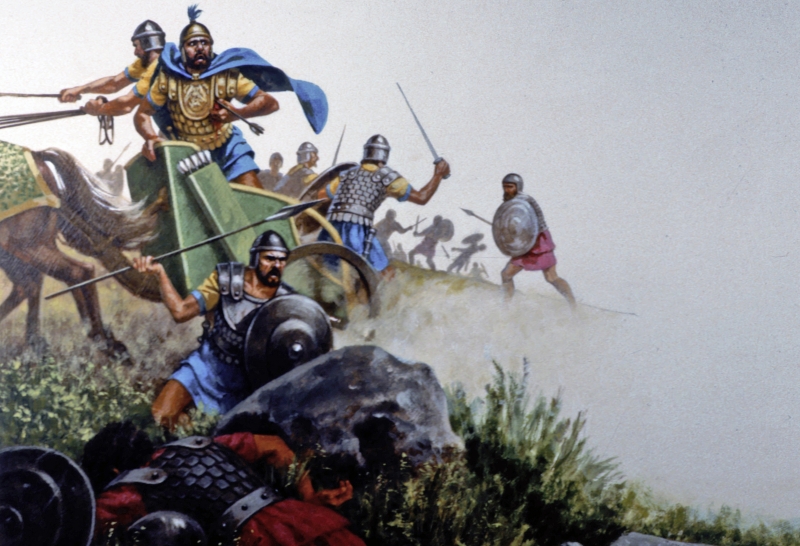
23 And the servants of the king of Syria said to him, “Their gods are gods of the hills, and so they were stronger than we. But let us fight against them in the plain, and surely we shall be stronger than they. 24 And do this: remove the kings, each from his post, and put commanders in their places, 25 and muster an army like the army that you have lost, horse for horse, and chariot for chariot. Then we will fight against them in the plain, and surely we shall be stronger than they.” And he listened to their voice and did so. 

26 In the spring, Ben-hadad mustered the Syrians and went up to Aphek to fight against Israel. 27 And the people of Israel were mustered and were provisioned and went against them. The people of Israel encamped before them like two little flocks of goats, but the Syrians filled the country.

28 And a man of God came near and said to the king of Israel, “Thus says the Lord, ‘Because the Syrians have said, “The Lord is a god of the hills but he is not a god of the valleys,” therefore I will give all this great multitude into your hand, and you shall know that I am the Lord.’”1 Kings 20:16-28 ESV

King Ahab found himself in a strange predicament. His capital city, Samaria, was under attack by a confederation of 32 kings, led by King Ben-hadad of Syria. But much to Ahab’s surprise, a prophet of Yahweh had appeared with a plan for Israel’s deliverance.

“Thus says the Lord, Have you seen all this great multitude? Behold, I will give it into your hand this day, and you shall know that I am the Lord.” – 1 Kings 20:13 ESV

The very God whom Ahab and Jezebel had attempted to replace with their false gods had announced that He was going to rescue His disobedient and unfaithful people. And God had told Ahab exactly how the victory would take place.

By the servants of the governors of the districts.” – 1 Kings 20:14 ESV

God was not going to utilize Ahab’s army to fight the Syrians. This is significant because Ahab, like all his predecessors, had assembled a large military force. There is even evidence to that fact, found on an ancient Assyrian stone tablet. It bears an inscription describing the battle of Qarqar between Ahab and his enemy King Shalmaneser III of Assyria. The tablet records the size of the army that assembled to do battle that day: “2,000 chariots and 10,000 men of Ahab king of Israel.”

But on this occasion, God chose to place Ahab’s formidable resources in a secondary position, choosing instead to use “servants” – a group of common people who, when assembled, amounted to only 7,000 in number.

Confident that he would defeat the Israelites, Ben-hadad and his vassal kings were drinking themselves drunk in a pre-victory celebration. So, when scouts arrived with a report that Israelite forces had been seen leaving the city, Beh-hadad had assumed they were bringing news of Israel’s surrender or their decision to continue the battle. While he and his military commanders continued to toast their inevitable victory, the 7,000 servants made their way to the Syrian camp, followed by Ahab and his army.

This surprise attack caught the Syrian forces completely unawares and unable to respond. Led by the 7,000 servants, Ahab’s army quickly routed the Syrians, forcing them to abandon camp and run for their lives. Quickly sobered by this unexpected reversal of fortunes, Beh-hadad managed to escape. But the rest of his forces didn’t fare as well.

And the king of Israel went out and struck the horses and chariots, and struck the Syrians with a great blow. – 1 Kings 20:21 ESV

Notice that the author conveniently eliminates any mention of Ahab’s name. He simply refers to him as “the king of Israel.” He repeats this obvious slight in the very next verse, refusing to give Ahab any credit for the victory. He simply warns him that the battle may be done, but the war is from over.

“Come, strengthen yourself, and consider well what you have to do, for in the spring the king of Syria will come up against you.” – 1 Kings 20:22 ESV

Ben-hadad would be back. He had suffered a devastating defeat, but once he had time to assess what had happened that day, the Syrian king would return, more determined than ever to avenge his loss by destroying the Israelites. And his advisors encouraged his plans by suggesting that his loss had been divinely ordained. In their pagan way of thinking, the only thing that could explain a loss of this magnitude was the intervention of the gods. They rationalized away their defeat by concluding that they had chosen the wrong place to do battle.  They absolved Beh-hadad of any responsibility for the loss by assuring him, “Their gods are gods of the hills, and so they were stronger than we. But let us fight against them in the plain, and surely we shall be stronger than they” (1 Kings 20:23 ESV).

Little did they know how right they were. Their defeat had been the result of divine intervention, but geographic location had played no role in it. Yahweh was the God of the hills and the valleys. He was sovereign over all the earth. Unlike their false gods, Yahweh was unbound by time and space. The extent of His power was limitless. To the God of Israel, the location and the size of the opposing army made no difference. And so, when Ben-hadad’s advisors counseled him to rebuild his army and restructure his military command, it would prove to be futile advice. They had no idea what they were dealing with and their ignorance led them to make some very dangerous assumptions. First, they assumed that the God of Israel was similar to their own gods – limited in power and vulnerable to defeat. After all, their gods had failed to deliver them. So, if they could find Yahweh’s weak spots, the next battle would go their way.

And Ben-hadad, eager to avenge his loss, took their advice and spent the winter rebuilding his army. He replaced the 32 kings with seasoned military commanders. He ordered the construction of new chariots. And he made plans to take the fight to the valley, where the God of Israel would have no power and play no role in the outcome of the battle.

It is fascinating to consider that all of this was in the sovereign will of God. He had orchestrated all the details concerning the original battle, including Ben-hadad’s escape. God had even told Ahab that the Syrians would return. Ben-hadad’s rebuilding and reconfiguring of his army had been part of God’s plan. The original battle had been intended to restore the Israelites’ belief in God. Prior to their victory, God had told them, “I will give it into your hand this day, and you shall know that I am the Lord” (1 Kings 20:13 ESV).

But God knew that little had changed in Israel. Even after their miraculous defeat of the Syrians, the people still remained unconvinced of Yahweh’s status as the one true God. When spring rolled around, they found themselves facing their former foe again. This time, Beh-hadad showed up with a much larger and better-equipped army than before, and rather than laying siege to the city, they gathered in the Valley of Aphek. Ben-hadad had brought a bigger, better army and had chosen a battleground that was outside the reach of Yahweh’s power. Or so he thought.

The stage was set. The enemy of Israel had returned. And the author paints a rather bleak and foreboding picture of the situation.

Israel then mustered its army, set up supply lines, and marched out for battle. But the Israelite army looked like two little flocks of goats in comparison to the vast Aramean forces that filled the countryside! – 1 Kings 20:27 NLT

Here was Israel, outnumbered and underequipped yet again. They were no match for the Syrians. And this time, they would not have the walls of the city to protect them. They would be fighting on open terrain, facing an army equipped with chariots and horses and motivated by revenge.

But God sent another prophet with a promise of His presence and power.

“Thus says the Lord, ‘Because the Syrians have said, “The Lord is a god of the hills but he is not a god of the valleys,” therefore I will give all this great multitude into your hand, and you shall know that I am the Lord.’” – 1 Kings 20:28 ESV

Despite the overwhelming odds, God would provide another victory over their enemy. By the time this day was over, they would know that He was the one true God. But notice that in verse 28, the author leaves out Ahab’s name again. He simply refers to him as “the king of Israel.” God was going to deliver this victory despite Ahab, not because of him. Not only did Ahab deserve to lose this battle, but he also deserved to die for his blatant rebellion against God. But God was acting on behalf of His covenant people. He was doing this to protect the integrity and honor of His name. He had made covenant promises to Abraham, Isaac, and Jacob. He had given His word to Moses and David. And while Ahab had failed to use his position as the shepherd of Israel to lead them in faithful obedience, God would prove Himself true to His word and committed to His covenant promises.

English Standard Version (ESV) The Holy Bible, English Standard Version. ESV® Permanent Text Edition® (2016). Copyright © 2001 by Crossway Bibles, a publishing ministry of Good News Publishers.

New Living Translation (NLT) Holy Bible, New Living Translation, copyright © 1996, 2004, 2015 by Tyndale House Foundation. Used by permission of Tyndale House Publishers Inc., Carol Stream, Illinois 60188. All rights reserved.

The Message (MSG)Copyright © 1993, 1994, 1995, 1996, 2000, 2001, 2002 by Eugene H. Peterson

Our Great God

“Can you solve the mysteries of God?
    Can you discover everything about the Almighty?
Such knowledge is higher than the heavens—
    and who are you?
It is deeper than the underworld—
    what do you know?
It is broader than the earth
    and wider than the sea.
 
– Job 11:7-9 NLT

33 Oh, how great are God’s riches and wisdom and knowledge! How impossible it is for us to understand his decisions and his ways!

34 For who can know the Lord’s thoughts?
    Who knows enough to give him advice?
35 And who has given him so much
    that he needs to pay it back?

36 For everything comes from him and exists by his power and is intended for his glory. All glory to him forever! Amen. – Romans 11:33-36 NLT

33 We cannot imagine the power of the Almighty; but even though he is just and righteous, he does not destroy us. – Job 37:33 NLT

We cannot even begin to comprehend the greatness of God. But we should try. While He remains far beyond our capacity to fully understand, He still expects us to desire and to pursue an ever-increasing awareness of Himself. The apostle Paul prayed regularly that the Colossian believers would grow in their knowledge of God.

So we have not stopped praying for you since we first heard about you. We ask God to give you complete knowledge of his will and to give you spiritual wisdom and understanding. Then the way you live will always honor and please the Lord, and your lives will produce every kind of good fruit. All the while, you will grow as you learn to know God better and better. – Colossians 1:9-10 NLT

Paul prayed a similar prayer for the believers in Ephesus.

I have not stopped thanking God for you. I pray for you constantly, asking God, the glorious Father of our Lord Jesus Christ, to give you spiritual wisdom and insight so that you might grow in your knowledge of God. I pray that your hearts will be flooded with light so that you can understand the confident hope he has given to those he called—his holy people who are his rich and glorious inheritance. – Ephesians 1:16-18 NLT

God is infinite. He is eternal, having no beginning or end. To attempt a study of God is to attempt the impossible. You will never fully know Him. You will never plumb the depths of His greatness. But that does not make it an exercise in futility. The pursuit of the knowledge of God is the calling of every child of God. The Bible is the Word of God, His revelation of Himself to mankind. Every page contained in the Scriptures contains glimpses of His glory and goodness. And He desires that we read His Word, not as some kind of self-help manual full of tips for living the good life, but as an indispensable resource for discovering eternal life through Him.

It is interesting to note what Jesus prayed in the garden on the night He was to be betrayed. In one of His last moments on earth before His crucifixion and death, Jesus spent time alone with His heavenly Father and poured out His heart.

“Father, the hour has come; glorify your Son that the Son may glorify you, since you have given him authority over all flesh, to give eternal life to all whom you have given him. And this is eternal life, that they know you, the only true God, and Jesus Christ whom you have sent.” – John 17:1-3 ESV

Jesus came that we might have eternal life. But eternal life is far more than just a promise of a life free from death. While the thought of a place where there will be “no more death or sorrow or crying or pain” (Revelation 21:4) sounds very appealing, those things are not what make eternal life well worth the wait. No, Jesus makes it quite clear. He states that “this is eternal life, that they may know you, the only true God, and Jesus Christ whom you have sent.”

The essence of eternal life is an intimate knowledge of God and His Son. Heaven will remove the blinders and barriers that prevent us from knowing God well. The presence of sin in our lives prevents us from seeing and knowing God clearly. It is like looking at a beautiful landscape through a dirty window or trying to view a sunset through a pair of glasses with foggy lenses. The glorious view is obscured and distorted by the flaw in our vision. And the apostle Paul reminds us that the day is coming when those limitations will all be removed, leaving us completely free to know God in all His glory.

Now we see things imperfectly, like puzzling reflections in a mirror, but then we will see everything with perfect clarity. All that I know now is partial and incomplete, but then I will know everything completely, just as God now knows me completely. Three things will last forever—faith, hope, and love—and the greatest of these is love. – 1 Corinthians 13:12-13 NLT

Getting to know God better should be the overarching desire of every child of God – to know the One who made us, saved us, and has an eternity in store for us. This all-knowing, all-powerful God has planned a future for us in which we will enjoy unbroken fellowship with Him. Yes, it will be a place free from pain, sin, sorrow, and death. But the real joy of heaven will be found in our ability to know God intimately and fully.

The truly amazing thing is that God considers us His children right here, right now. In spite of our ongoing struggle with sin and our persistent habit of disobeying His will, God calls us His own. He is the forever faithful, always loving, ever gracious, and consistently merciful God who never fails to keep His promises. And the apostle John would have us remember that our loving heavenly Father has adopted us into His family and has great things in store for us.

See how very much our Father loves us, for he calls us his children, and that is what we are! But the people who belong to this world don’t recognize that we are God’s children because they don’t know him. Dear friends, we are already God’s children, but he has not yet shown us what we will be like when Christ appears. But we do know that we will be like him, for we will see him as he really is. And all who have this eager expectation will keep themselves pure, just as he is pure. – 1 John 3:1-13 NLT

So, why wouldn’t we want to know our great God better?

English Standard Version (ESV)
The Holy Bible, English Standard Version. ESV® Permanent Text Edition® (2016). Copyright © 2001 by Crossway Bibles, a publishing ministry of Good News Publishers.

New Living Translation (NLT)
Holy Bible, New Living Translation, copyright © 1996, 2004, 2015 by Tyndale House Foundation. Used by permission of Tyndale House Publishers Inc., Carol Stream, Illinois 60188. All rights reserved.

The Message (MSG)Copyright © 1993, 1994, 1995, 1996, 2000, 2001, 2002 by Eugene H. Peterson

Getting to Know God

18 To whom then will you liken God,
    or what likeness compare with him? Isaiah 40:18 ESV

5 “To whom will you liken me and make me equal, and compare me, that we may be alike?” – Isaiah 46:5 ESV

11 Who is like you, O LORD, among the gods? Who is like you, majestic in holiness, awesome in glorious deeds, doing wonders? – Exodus 15:11 ESV

18 Who is a God like you, pardoning iniquity and passing over transgression for the remnant of his inheritance? – Micah 7:18 ESV

For those of us who claim to know God, there is a great deal of information concerning Him about which we are ignorant and even indifferent. Some of us have known Him for decades but, if put to the test, there would be little we could share that could give evidence that we knew Him intimately. So much of what we know about God is academic, a compilation of disconnected bits of information that bear little resemblance to the one true God.

If I asked you if you knew the president of the United States, you would probably respond by telling me his name. If pressed, you could probably tell me the year he was elected, his political party affiliation, the name of his wife, and your personal assessment of his administration’s policies and programs. But the truth would be that you do not know him at all. Your knowledge of him would have been gleaned from news reports, the op-ed section of the local paper, and from the opinions of others.

Sadly, the average Christian probably has more familiarity with the president of the United States than they do with God. Some of us spend far more time keeping up with the Kardashians than we do with the Creator God. We live in the information age, a time when access to knowledge about virtually any topic or individual is at our fingertips. And yet, we suffer from a lack of intimacy with and intelligence about God.

The goal of this series of blog posts is to help us get to know our God better. To do so, we will be exploring the attributes that God alone possesses. As the verses above so clearly state, our God is without equal. He is incomparable. He is not one among many, but He stands as the solitary and sovereign God of the universe whose power, knowledge, and all-pervading presence is unparalleled and non-reproducible. God can be mimicked, but never matched. He is, to put it mildly, one of a kind. And yet, how easy it is to treat Him with a familiarity that borders on contempt.

To know God. That was the divinely-ordained objective when God created Adam and Eve. They were made so that they might enjoy unbroken fellowship and undiminished intimacy with Him. But sin changed all that. Because the first man and woman chose to disobey God, they were banned from His presence. They found themselves cast from the garden and operating in isolation from the one who had made them. And with each succeeding generation, humanity moved further and further away from the garden and, at the same time, far from the presence of God.

But God still desires for men to know Him, and not just cognitively. He longs that mankind might know Him intimately and personally. And, as the apostle Paul points out, God has revealed Himself in the universe He created. He has placed signs of His presence and proofs of His character all around us. And yet, most of humanity has remained blind to the evidence and oblivious concerning the God to whom it points.

They know the truth about God because he has made it obvious to them. For ever since the world was created, people have seen the earth and sky. Through everything God made, they can clearly see his invisible qualities—his eternal power and divine nature. So they have no excuse for not knowing God.

Yes, they knew God, but they wouldn’t worship him as God or even give him thanks. And they began to think up foolish ideas of what God was like. As a result, their minds became dark and confused. Claiming to be wise, they instead became utter fools. And instead of worshiping the glorious, ever-living God, they worshiped idols made to look like mere people and birds and animals and reptiles. – Romans 1:19-23 NLT

Yet, as the prophet Jeremiah points out, God still longs for mankind to know Him. And He intimates that it is not only possible but preferable.

This is what the Lord says:
“Don’t let the wise boast in their wisdom,
    or the powerful boast in their power,
    or the rich boast in their riches.
But those who wish to boast
    should boast in this alone:
that they truly know me and understand that I am the Lord
    who demonstrates unfailing love
    and who brings justice and righteousness to the earth,
and that I delight in these things.
    I, the Lord, have spoken!” – Jeremiah 9:23-24 NLT

God is knowable. But He is also irreplicable. There is nothing in all creation that remotely resembles God Almighty. Even in His thought processes, God remains distinctly different from humanity.

“My thoughts are nothing like your thoughts,” says the Lord.
    “And my ways are far beyond anything you could imagine.
For just as the heavens are higher than the earth,
    so my ways are higher than your ways
    and my thoughts higher than your thoughts.” – Isaiah 55:8-9 NLT

Yet, we tend to view God as little more than a more powerful version of ourselves. The psalmist alludes to this common misconception when he quotes God as saying, “you thought that I was one like yourself” (Psalm 50:21 ESV). The French agnostic Voltaire said, “God created man in His own image, and man returned the favor.”

Psalm 97:9 describes God as “most high over all the earth” and as “exalted far above all gods.” He is transcendent. That simply means that He is totally distinct from all that He has made. He cannot be reproduced and there is nothing that remotely mirrors His likeness. Psalm 99:2 adds that God “is exalted over all the peoples.” Men are not mini-gods. Being made in His image does not infer that we resemble God. That is why Isaiah 40:18 asks the rhetorical question: “To whom then will you liken God, or what likeness compare with him?” The answer is “No one and nothing!” God alone is God.

And God is in need of nothing. He has no lack or insufficiencies. He requires no complement or counterpart to complete Himself. He did not create humanity because He was lonely or in need of fellowship. There is nothing missing in God’s character. His being is whole and holy. The apostle John would have us remember that “God is light, and in him is no darkness at all” (1 John 1:5 ESV). Timothy adds, “He alone is immortal and dwells in unapproachable light” (1 Timothy 6:16 BSB).

And yet, God has made Himself known to men. He has displayed His divine attributes through the universe He has made. All around us, we have evidence of His power, glory, wisdom, creativity, grace, mercy, and love. Our very existence is proof that He exists. Despite man’s wisdom, no one has been able to come up with an explanation for the existence of the universe. Our most educated and well-reasoned theories are little more than shots in the dark.

In the book of Job, we have recorded the words of God as He confronts the arrogance and audacity of mere humans who question His will and His work.

“Who is this that questions my wisdom
    with such ignorant words?
Brace yourself like a man,
    because I have some questions for you,
    and you must answer them.

“Where were you when I laid the foundations of the earth?
    Tell me, if you know so much.
Who determined its dimensions
    and stretched out the surveying line?
What supports its foundations,
    and who laid its cornerstone
as the morning stars sang together
    and all the angels shouted for joy?

“Who kept the sea inside its boundaries
    as it burst from the womb,
and as I clothed it with clouds
    and wrapped it in thick darkness?
For I locked it behind barred gates,
    limiting its shores.
I said, ‘This far and no farther will you come.
    Here your proud waves must stop!’” – Job 38:2-11 NLT

Man has no business questioning God or trying to explain the existence of the universe apart from God. All that exists, does so by the expressed will of God. He spoke and it came into being. And within all that He made God has revealed Himself. But that is the most important point regarding the solitary nature of God. He must reveal Himself to man in order to be known by man. Man cannot find God on His own. In fact, according to the apostle Paul, “no one seeks for God” (Romans 3:11 ESV). And Paul was simply echoing the sentiments of David.

God looks down from heaven
    on the entire human race;
he looks to see if anyone is truly wise,
    if anyone seeks God.
But no, all have turned away;
    all have become corrupt. – Psalm 53:2-3 NLT

Amazingly enough, this transcendent, invisible, and unfathomable God has chosen to reveal Himself to man. And we will see more of His divine attributes on display as we continue our quest to know God better.

English Standard Version (ESV)
The Holy Bible, English Standard Version. ESV® Permanent Text Edition® (2016). Copyright © 2001 by Crossway Bibles, a publishing ministry of Good News Publishers.

New Living Translation (NLT)
Holy Bible, New Living Translation, copyright © 1996, 2004, 2015 by Tyndale House Foundation. Used by permission of Tyndale House Publishers Inc., Carol Stream, Illinois 60188. All rights reserved.

The Message (MSG)Copyright © 1993, 1994, 1995, 1996, 2000, 2001, 2002 by Eugene H. Peterson

That We Might Know.

O Lord, my strength and my stronghold,
    my refuge in the day of trouble,
to you shall the nations come
    from the ends of the earth and say:
“Our fathers have inherited nothing but lies,
    worthless things in which there is no profit.
Can man make for himself gods?
    Such are not gods!”

“Therefore, behold, I will make them know, this once I will make them know my power and my might, and they shall know that my name is the Lord.” – Jeremiah 16:15-21 ESV

The majority of the nations of the earth reject God. It was true in Jeremiah’s day and it is true in ours. And yet, Jeremiah knew that there was a day coming when all of that would change. He had faith and hope in the ultimate sovereignty of God and believed that one day humanity would wake up to the reality that there is only one true God. He envisioned a day when people would realize the error of their ways.

Nations from around the world
    will come to you and say,
“Our ancestors left us a foolish heritage,
    for they worshiped worthless idols.
Can people make their own gods?
    These are not real gods at all!” – Jeremiah 16:19-20 NLT

And he was right, because God has said it would be so.

This is a vision that Isaiah son of Amoz saw concerning Judah and Jerusalem:

In the last days, the mountain of the Lord’s house
    will be the highest of all—
    the most important place on earth.
It will be raised above the other hills,
    and people from all over the world will stream there to worship.
People from many nations will come and say,
“Come, let us go up to the mountain of the Lord,
    to the house of Jacob’s God.
There he will teach us his ways,
    and we will walk in his paths.”
For the Lord’s teaching will go out from Zion;
    his word will go out from Jerusalem.
The Lord will mediate between nations
    and will settle international disputes.
They will hammer their swords into plowshares
    and their spears into pruning hooks.
Nation will no longer fight against nation,
    nor train for war anymore. – Isaiah 2:1-4 NLT

Ultimately, God is interested in revealing Himself to mankind. He has done so through His creation. Paul makes that point clear in his letter to the believers in Rome.

They know the truth about God because he has made it obvious to them. For ever since the world was created, people have seen the earth and sky. Through everything God made, they can clearly see his invisible qualities—his eternal power and divine nature. So they have no excuse for not knowing God. – Romans 2:19-20 NLT

The Bible is a chronicles of God’s revelation to man. He revealed Himself to Abraham, calling him out of Ur and leading him to the land of Canaan. He revealed Himself to Moses in a burning bush and called him to be the one to deliver the people of Israel from their captivity in Egypt. And all throughout the book of Exodus God assures Moses with the words: “You will know that I am the Lord your God.”

“I am the Lord. I will free you from your oppression and will rescue you from your slavery in Egypt. I will redeem you with a powerful arm and great acts of judgment. I will claim you as my own people, and I will be your God. Then you will know that I am the Lord your God who has freed you from your oppression in Egypt. I will bring you into the land I swore to give to Abraham, Isaac, and Jacob. I will give it to you as your very own possession. I am the Lord!” – Exodus 6:6-8 NLT

The plagues God brought on the Egyptians were intended to show the Israelites that their God, Yahweh, was more powerful than any of the gods of Egypt. He was proving Himself to the Israelites by revealing Himself in power. And God continued to do so throughout the book of Exodus as He freed them from slavery and led them to the land of promise. And by the time God was finished in Egypt, the Israelites would not be the only ones who would know that Yahweh was God. He made that point quite clear.

“When I raise my powerful hand and bring out the Israelites, the Egyptians will know that I am the Lord.” – Exodus 7:5 NLT

Ten devastating plagues later, and God would have the attention of the Egyptians and the Jews. He would clearly reveal Himself as the one true God. And God lets Jeremiah know that there is a day coming when God’s power and prominence will once again be displayed before the nations, convincing them of His status as the one and only God of the universe.

“This is what the Lord of Heaven’s Armies says: People from nations and cities around the world will travel to Jerusalem. The people of one city will say to the people of another, ‘Come with us to Jerusalem to ask the Lord to bless us. Let’s worship the Lord of Heaven’s Armies. I’m determined to go.’ Many peoples and powerful nations will come to Jerusalem to seek the Lord of Heaven’s Armies and to ask for his blessing.

“This is what the Lord of Heaven’s Armies says: In those days ten men from different nations and languages of the world will clutch at the sleeve of one Jew. And they will say, ‘Please let us walk with you, for we have heard that God is with you.’” – Zechariah 8:20-23 NLT

That day has yet to come, but it will. Because God has promised it. And God, speaking through the prophet, Ezekiel, told the people of Israel that one day return them to favor in His eyes. Not because they had done anything to deserve it, but because He had promised it and was going to prove to the nations that His word was trustworthy and His power, unequaled.

Therefore, give the people of Israel this message from the Sovereign Lord: I am bringing you back, but not because you deserve it. I am doing it to protect my holy name, on which you brought shame while you were scattered among the nations. I will show how holy my great name is—the name on which you brought shame among the nations. And when I reveal my holiness through you before their very eyes, says the Sovereign Lord, then the nations will know that I am the Lord. – Ezekiel 36:22-23 NLT

But in all this talk of future restoration and the nations recognizing Yahweh as the one true God, there remains the painful reality that Judah was still going to suffer for their sins. God was still bringing judgment on them because they had rebelled against Him. And yet, even His judgment would prove to them that He is God.

“Now I will show them my power;
    now I will show them my might.
At last they will know and understand
    that I am the Lord.” – Jeremiah 16:21 NLT

The painful reality is that God sometimes reveals Himself through judgment. He disciplines His children, because He loves them. He took the son born to David and Bathsheba as a result of their adulterous affair. And as a result, David knew that God was serious about sin. God took the lives of Ananias and Sapphira (Acts 5:1-11), when they lied about their gift of money to the church. And the church knew that God was serious about sin. God struck Miriam, the sister of Moses, with leprosy, because she and Aaron thought they had as much right to be leaders as Moses had (Numbers 12). And when Aaron saw what God had done to his sister, it got his attention. He suddenly feared God and begged Moses to intercede for her.

The people of Judah were going to experience the consequences of their sinful behavior. And they would learn a great deal about their God in the process. It’s sad to admit that, for many of us, we tend to learn better through difficulties. Our faith grows stronger during times of adversity and trials. But we must always remember that God is constantly revealing Himself to us, even in the difficult times. He wants us to know that He takes sin seriously. He wants us to recognize His power and to learn to rely upon it. He wants us to understand that He considers our call to holiness non-negotiable. He demands that we be holy, as He is holy. He requires obedience and faithfulness from His people. But sometimes, we doubt that He really means it. So, He reveals Himself through discipline. He manifests His displeasure by allowing us to suffer for our sinful habits. But the bottom line is that God is always there and is always revealing Himself to us. He is always proving His power to us and convincing us of His holiness and righteousness. Because His greatest desire is that we know and understand that He is the Lord.

English Standard Version (ESV)
The Holy Bible, English Standard Version. ESV® Permanent Text Edition® (2016). Copyright © 2001 by Crossway Bibles, a publishing ministry of Good News Publishers.

New Living Translation (NLT)
Holy Bible, New Living Translation, copyright © 1996, 2004, 2015 by Tyndale House Foundation. Used by permission of Tyndale House Publishers Inc., Carol Stream, Illinois 60188. All rights reserved.

The Message (MSG)Copyright © 1993, 1994, 1995, 1996, 2000, 2001, 2002 by Eugene H. Peterson

Knowing God.

For this reason, because I have heard of your faith in the Lord Jesus and your love toward all the saints, I do not cease to give thanks for you, remembering you in my prayers, that the God of our Lord Jesus Christ, the Father of glory, may give you the Spirit of wisdom and of revelation in the knowledge of him, having the eyes of your hearts enlightened, that you may know what is the hope to which he has called you, what are the riches of his glorious inheritance in the saints, and what is the immeasurable greatness of his power toward us who believe, according to the working of his great might that he worked in Christ when he raised him from the dead and seated him at his right hand in the heavenly places, far above all rule and authority and power and dominion, and above every name that is named, not only in this age but also in the one to come. And he put all things under his feet and gave him as head over all things to the church, which is his body, the fullness of him who fills all in all. – Ephesians 1:15-23 ESV

Paul was grateful to God for the believers in Ephesus. He was thankful to God that they had heard the word of truth, the gospel, and had believed. As a result, they had received the Holy Spirit, as a guarantee of their future inheritance of eternal salvation. And Paul gave God all the glory. But he also gave God his thanks. He thanked God for the news he had received about the believers in Ephesus regarding their faith in Christ and their love for one another. They were growing. Their relationship with Christ was maturing and the presence of the Spirit within them was bearing visible fruit. And Paul knew that it was all due to the gracious work of God in their lives. He had made it possible. He was the one who had called them and He was the one who was sanctifying them. And one day, He would be the one who would glorify them, “to the praise of his glory” (Ephesians 1:14 ESV).

But Paul didn’t just express gratitude to God for all that He had done. He let his readers know that he regularly petitioned God for their ongoing spiritual well-being. And he was very specific as to what he asked God for. This was not so much a prayer as it was an outline of his how he prayed for them. It seems that Paul wanted them to know just exactly what he viewed as necessary and of highest priority for their spiritual health. The first thing He asked God to do for them is quite revealing.

that the God of our Lord Jesus Christ, the Father of glory, may give you the Spirit of wisdom and of revelation in the knowledge of him… – Ephesians 1:17 ESV

Here Paul is asking God to give the believers in Ephesus the capacity to know Him better. God, the transcendent, holy, unapproachable God of the universe has chosen to make Himself known to men. Had God not chosen to reveal Himself, no man or woman would ever be able to comprehend Him or hope to have a relationship with Him. In his letter to the Romans, Paul expressed the “otherness” of God.

Oh, the depth of the riches and wisdom and knowledge of God! How unsearchable are his judgments and how inscrutable his ways!

“For who has known the mind of the Lord,
or who has been his counselor?”

“Or who has given a gift to him
that he might be repaid?” – Romans 11:33-35 ESV

Yet he told the believers in Corinth…

“What no eye has seen, nor ear heard,
nor the heart of man imagined,
what God has prepared for those who love him”—

these things God has revealed to us through the Spirit. For the Spirit searches everything, even the depths of God. For who knows a person’s thoughts except the spirit of that person, which is in him? So also no one comprehends the thoughts of God except the Spirit of God. Now we have received not the spirit of the world, but the Spirit who is from God, that we might understand the things freely given us by God. – 1 Corinthians 2:9-12 ESV

Because we have the Spirit of God living within us, we have the capacity to know the mind of God. We have been given the privilege of understanding the things of God. And it is primarily through the Word of God that He has chosen to reveal Himself to us. Paul was not praying for a mere intellectual knowledge of God, but an experiential, personal and intimate understanding of who He was and all that He was doing in their lives and in the world around them.

But Paul’s prayer for a growing knowledge of God had an ulterior motive. He wanted to see their hearts enlightened. For Paul, the heart was representative of the individual’s entire inner being. He knew that as they grew to know God better, they would be radically and totally transformed from the inside out. It is as we come to know God, that we truly come to know ourselves and the world around us. A clearer and more concise understanding of God gives allows us to comprehend truth and of view the world as it really is. It is as we have our understanding enlightened that we begin to see that this world is not all there is. There is more. Much more.

that you may know what is the hope to which he has called you, what are the riches of his glorious inheritance in the saints – Ephesians 1:18 ESV

…and what is the immeasurable greatness of his power toward us who believe… – Ephesians 1:19 ESV

Paul wanted them to know the hope to which God had called them. He knew that they were going to experience difficulties in this life. He knew that their faith journey was going to be rough at times. So he wanted them to fully understand that God’s divine plan for them included their future glorification. He wanted them to know that God’s power was great enough and His promise reliable enough to see them through any circumstance they may encounter in this life. God’s “immeasurable greatness” was working on their behalf at all times. And just so they would know how immeasurable that greatness really way, Paul described it for them.

…according to the working of his great might that he worked in Christ when he raised him from the dead and seated him at his right hand in the heavenly places… – Ephesians 1:19-20 ESV

The very power that raised Jesus from the dead and allowed Him to return to His rightful place at His Father’s side, is the power working on behalf of every believer. It is the power that will one day make possible our own glorification and the redemption of our bodies. What God did for Jesus, He will do for us. And He is already sanctifying us, transforming us into the likeness of His Son, day by day, through the power of His Spirit and according to His divine redemptive plan. Paul wanted his readers to know that God was in complete control. His Son was at His side and interceding on behalf of His body, the church.

And he put all things under his feet and gave him as head over all things to the church, which is his body, the fullness of him who fills all in all. – Ephesians 1:22-23 ESV

As we come to know God better, we come to trust Him more fully. We grow in our understanding of His sovereignty and His Son’s work on our behalf. We are His people. We are the temple of His Spirit. And as Peter reminds us, “you yourselves like living stones are being built up as a spiritual house, to be a holy priesthood, to offer spiritual sacrifices acceptable to God through Jesus Christ” (1 Peter 2:5 ESV). God is at work in us. He is doing great work through us. He has great plans for us. And the better we know Him, the more we will trust Him to do what He has promised.