Our Great High Priest

1 For every high priest chosen from among men is appointed to act on behalf of men in relation to God, to offer gifts and sacrifices for sins. 2 He can deal gently with the ignorant and wayward, since he himself is beset with weakness. 3 Because of this he is obligated to offer sacrifice for his own sins just as he does for those of the people. 4 And no one takes this honor for himself, but only when called by God, just as Aaron was.

5 So also Christ did not exalt himself to be made a high priest, but was appointed by him who said to him,

“You are my Son,
    today I have begotten you”;

6 as he says also in another place,

“You are a priest forever,
    after the order of Melchizedek.”

7 In the days of his flesh, Jesus offered up prayers and supplications, with loud cries and tears, to him who was able to save him from death, and he was heard because of his reverence. 8 Although he was a son, he learned obedience through what he suffered. 9 And being made perfect, he became the source of eternal salvation to all who obey him, 10 being designated by God a high priest after the order of Melchizedek. – Hebrews 5:1-10 ESV

In the early days of Israel, the high priest was an appointed position. Aaron was the original high priest, designated so by God Himself. His command to Moses to set aside  Aaron and his sons as priests is recorded in the book of Exodus.

“Then bring near to you Aaron your brother, and his sons with him, from among the people of Israel, to serve me as priests—Aaron and Aaron’s sons, Nadab and Abihu, Eleazar and Ithamar.” – Exodus 28:1 ESV

God would later qualify the vital nature of their calling.

“I will consecrate the tent of meeting and the altar. Aaron also and his sons I will consecrate to serve me as priests. I will dwell among the people of Israel and will be their God. And they shall know that I am the Lord their God, who brought them out of the land of Egypt that I might dwell among them. I am the Lord their God.” – Exodus 29:44-46 ESV

Aaron and his sons were set apart by God to serve as priests, offering sacrifices on behalf of the people. No one else could serve in this capacity. King Saul attempted to do so and lost his kingship because of it (1 Samuel 13:5-14). During the days of Israel’s wilderness wandering, Korah, a Levite, incited a rebellion against Moses and Aaron, demanding that he and his brothers be made priests. But Moses asked him, “would you seek the priesthood also? Therefore it is against the Lord that you and all your company have gathered. What is Aaron that you grumble against him?” (Numbers 16:10-11 ESV). As a result of their attempt to self-appoint themselves as priests, Korah, Dothan, Abiram, and all their families were literally swallowed alive by the earth.

The priesthood was a serious matter to God. The men whom God appointed for this role were responsible for the care and maintenance of the Tabernacle but also for administering the sacrificial system of Israel. But God also gave Aaron, the high priest, another directive that made their role pedagogic in nature. They were responsible for teaching the people the ways of God.

And the Lord spoke to Aaron, saying, “Drink no wine or strong drink, you or your sons with you, when you go into the tent of meeting, lest you die. It shall be a statute forever throughout your generations. You are to distinguish between the holy and the common, and between the unclean and the clean, and you are to teach the people of Israel all the statutes that the Lord has spoken to them by Moses.” – Leviticus 10:8-11 ESV

And so when we read of Jesus being appointed high priest “to act on behalf of men in relation to God” it should get our attention. Jesus was not a descendant of Aaron. He was a descendant of David, from the tribe of Judah. Technically, He was not qualified to be a priest, let alone the high priest. And the writer of Hebrews makes it perfectly clear that Jesus “did not exalt himself to be made high priest, but was appointed by him [God]” (Hebrews 5:5 ESV). So unlike Korah and his companions, Jesus was not guilty of trying to anoint Himself as high priest. He, like Aaron, was chosen by God to serve in this capacity.

Even in His humanity, Jesus served in His role as a priest, offering up “prayers and supplications, with loud cries and tears, to him who was able to save him from death” (Hebrews 5:7 ESV). Jesus prayed regularly during His time on earth, and He taught His disciples the importance of prayer in their own lives. And just hours before His death, He prayed what has become known as His High Priestly Prayer from the Garden of Olives. In that prayer, Jesus interceded on behalf of His disciples, declaring His love for them and expressing His desire that His Heavenly Father protect and preserve them so that they might one day enjoy the gift of eternal life.

“I have given them the glory you gave me, so they may be one as we are one. I am in them and you are in me. May they experience such perfect unity that the world will know that you sent me and that you love them as much as you love me. Father, I want these whom you have given me to be with me where I am. Then they can see all the glory you gave me because you loved me even before the world began!” – John 17:22-24 NLT

Jesus was of a different priesthood than that of Aaron. He was “designated by God a high priest after the order of Melchizedek” (Hebrews 5:10 ESV). Melchizedek was an obscure figure mentioned in Genesis 14. In this story, Abraham has just rescued his nephew Lot and his family, who had been taken captive when the cities of Sodom and Gomorrah had been overrun by an alliance of kings. After having defeated the kings and rescued Lot, his family, and all their possessions, Abraham was met by Melchizedek, king of Salem. The text tells us that Melchizedek was also a priest of God Most High. This priest-king blessed Abraham and, in return, Abraham gave Melchizedek a tenth of all the plunder he had taken. That is the extent of the information we have about Melchizedek. But the author of Hebrews tells us that Jesus was appointed by God after the order of Melchizedek. In other words, He was of a different priesthood than that of Aaron and his sons.

In chapter seven of this letter, we are given more insight into who this man was and why Jesus was appointed high priest after his order and not that of Aaron:

He [Melchizedek] is first, by translation of his name, king of righteousness, and then he is also king of Salem, that is, king of peace. He is without father or mother or genealogy, having neither beginning of days nor end of life, but resembling the Son of God he continues a priest forever. – Hebrews 7:2-3 ESV

This does not mean that Melchizedek was a divine being who was never born or died, but that there is no known record of his ancestry. He appears on the scene in the book of Genesis, then disappears. He serves as a foreshadowing of the future priest-king whom God would reveal. Melchizedek was the king of righteousness and the king of peace. Interestingly enough, his royal city, Salem, is the city that David would later make his capital and rename Jerusalem. And one day, Jesus will return and reign from the throne of David in Jerusalem when He establishes His millennial kingdom.

Unlike Aaron and his sons who served only as priests, Jesus was appointed both king and priest by God, and He received both titles when he ascended back to earth after His death and resurrection.

I also pray that you will understand the incredible greatness of God’s power for us who believe him. This is the same mighty power that raised Christ from the dead and seated him in the place of honor at God’s right hand in the heavenly realms. Now he is far above any ruler or authority or power or leader or anything else—not only in this world but also in the world to come. God has put all things under the authority of Christ and has made him head over all things for the benefit of the church. – Ephesians 1:19-22 NLT

For there is one God, and there is one mediator between God and men, the man Christ Jesus, who gave himself as a ransom for all, which is the testimony given at the proper time. – 1 Timothy 2:5-6 ESV

Jesus now sits by His Father’s side in heaven, where He reigns over all that He has made. But at the present time, not all humanity recognizes Him as King and Lord. So, Jesus maintains His priestly role, offering all mankind the opportunity to be reconciled with God through faith in His substitutionary death on the cross. Jesus is both King and High Priest, and He received these two divine appointments because He was obedient, faithfully completing the assignment given to Him by God the Father. Jesus did not simply offer sacrifices on behalf of the people as Aaron and his sons had done. Jesus offered Himself. He made the ultimate sacrifice of His own life. And even though He was the divine Son of God, in His human state Jesus, “learned obedience through what he suffered” (Hebrews 5:8 ESV). And while His obedience ultimately ended in death, it also resulted in His “perfection” or glorification. He was raised from the dead and restored to His rightful place at the side of God the Father. And “he became the source of eternal salvation to all who obey him” (Hebrews 5:9 ESV).

Jesus wasn’t just a different high priest than that of Aaron. He was a better high priest who offered a better sacrifice. He offered a permanent, once-for-all sacrifice that never has to be repeated. He was the sinless high priest who offered Himself as the unblemished Lamb of God that paid for the sins of humanity. And as a result, those who place their faith in His sacrifice can share in His righteousness and have peace with God. We can be justified or made right with God. That is why He is the great high priest.

English Standard Version (ESV) The Holy Bible, English Standard Version. ESV® Permanent Text Edition® (2016). Copyright © 2001

New Living Translation (NLT) Holy Bible, New Living Translation, copyright © 1996, 2004, 2015 by Tyndale House Foundation. Used by permission of Tyndale House Publishers Inc., Carol Stream, Illinois 60188. All rights reserved.
The Beauty of God’s Forgiveness and Forgetfulness

6 “Aaron shall offer the bull as a sin offering for himself and shall make atonement for himself and for his house. 7 Then he shall take the two goats and set them before the Lord at the entrance of the tent of meeting. 8 And Aaron shall cast lots over the two goats, one lot for the Lord and the other lot for Azazel. 9 And Aaron shall present the goat on which the lot fell for the Lord and use it as a sin offering, 10 but the goat on which the lot fell for Azazel shall be presented alive before the Lord to make atonement over it, that it may be sent away into the wilderness to Azazel.

11 “Aaron shall present the bull as a sin offering for himself, and shall make atonement for himself and for his house. He shall kill the bull as a sin offering for himself. 12 And he shall take a censer full of coals of fire from the altar before the Lord, and two handfuls of sweet incense beaten small, and he shall bring it inside the veil 13 and put the incense on the fire before the Lord, that the cloud of the incense may cover the mercy seat that is over the testimony, so that he does not die. 14 And he shall take some of the blood of the bull and sprinkle it with his finger on the front of the mercy seat on the east side, and in front of the mercy seat he shall sprinkle some of the blood with his finger seven times.

15 “Then he shall kill the goat of the sin offering that is for the people and bring its blood inside the veil and do with its blood as he did with the blood of the bull, sprinkling it over the mercy seat and in front of the mercy seat. 16 Thus he shall make atonement for the Holy Place, because of the uncleannesses of the people of Israel and because of their transgressions, all their sins. And so he shall do for the tent of meeting, which dwells with them in the midst of their uncleannesses. 17 No one may be in the tent of meeting from the time he enters to make atonement in the Holy Place until he comes out and has made atonement for himself and for his house and for all the assembly of Israel. 18 Then he shall go out to the altar that is before the Lord and make atonement for it, and shall take some of the blood of the bull and some of the blood of the goat, and put it on the horns of the altar all around. 19 And he shall sprinkle some of the blood on it with his finger seven times, and cleanse it and consecrate it from the uncleannesses of the people of Israel.

20 “And when he has made an end of atoning for the Holy Place and the tent of meeting and the altar, he shall present the live goat. 21 And Aaron shall lay both his hands on the head of the live goat, and confess over it all the iniquities of the people of Israel, and all their transgressions, all their sins. And he shall put them on the head of the goat and send it away into the wilderness by the hand of a man who is in readiness. 22 The goat shall bear all their iniquities on itself to a remote area, and he shall let the goat go free in the wilderness.” – Leviticus 16:6-22 ESV

God ordered Aaron to bring a bull, one ram, and two male goats to the Tabernacle for use as sacrifices on the Day of Atonement. Each of these animals had a different role to play in the annual ceremony and verses 6-10 provide a succinct summary of their use. The bull was to be offered by Aaron himself as a sin offering that was intended to provide purification for him and his family members. Once this process of atonement was complete, he was properly prepared to act on behalf of the people of Israel.

The next step in the process was to cast lots over the two goats. This was done to determine which goat would serve as a blood sacrifice and which goat would be released into the wilderness. It remains unclear how the casting of lots took place, but the Hebrews practiced this form of divination as a way to determine God’s will. The Book of Proverbs states that the “lot is cast into the lap, but its every decision is from the LORD” (Proverbs 16:33 ESV).

By casting lots, Aaron was allowing God to make the determination as to the fate of each of the goats. One was to be slaughtered for the sins of the people, with its blood used to purify the Tabernacle, the altar, and the Holy of Holies. The life of this innocent animal would serve as a form of substitutionary atonement so that all of the sins the people had committed that year could be forgiven and forgotten. King David wrote the following Psalm to celebrate the goodness and graciousness of God.

He revealed his character to Moses
    and his deeds to the people of Israel.
The Lord is compassionate and merciful,
    slow to get angry and filled with unfailing love.
He will not constantly accuse us,
    nor remain angry forever.
He does not punish us for all our sins;
    he does not deal harshly with us, as we deserve.
For his unfailing love toward those who fear him
    is as great as the height of the heavens above the earth.
He has removed our sins as far from us
    as the east is from the west. – Psalm 103:7-12 NLT

The imagery of the two goats aptly illustrates David’s point. The first goat died so that the Israelites might live. But the second goat lived so that the sins of the Israelites might be symbolically removed from them. This goat has come to be known as the “scapegoat,” a term first coined by William Tyndale. The Hebrew term used for this goat is עֲזָאזֵל (ʿazaʾzel), and it appears four times in the Scriptures, all in this passage. The exact meaning of the term has been much debated over the centuries.

The passage suggests that one goat was chosen “for the Lord,” while the other was to be “for Azazel.” Over the centuries, many scholars have determined that the word, “Azazel” could best be defined as “the goat that departs.” This is what led Tyndale and others to refer to this animal as the “scapegoat.” Even the modern definition of the term, “scapegoat” reflects the practice of using this animal as a substitute or proxy for the people. Dictionary.com defines a scapegoat as “a person or group made to bear the blame for others or to suffer in their place.”

Yet, more recent scholarship has arrived at a different meaning for the name, “Azazel.”

“The most common view among scholars today is that it is the proper name of a particular demon (perhaps even the Devil himself) associated with the wilderness desert regions.…Even if a demon or the demonic realm is the source for the name, however, there is no intention here of appeasing the demons. The goal is to remove the impurity and iniquity from the community in order to avoid offending the Lord and the repercussions of such.” – NET Bible Study Notes

Whatever the exact meaning of the word, Azazel, it is clear that this goat, like its companion, was intended to serve as a substitute. The only difference was that its life was spared. It was allowed to live but was forcibly banned from the community and sent out into the wilderness, bearing the sins of the entire nation.

“He will lay both of his hands on the goat’s head and confess over it all the wickedness, rebellion, and sins of the people of Israel. In this way, he will transfer the people’s sins to the head of the goat. Then a man specially chosen for the task will drive the goat into the wilderness. As the goat goes into the wilderness, it will carry all the people’s sins upon itself into a desolate land.” – Leviticus 16:21-22 NLT

These two goats served two separate but connected roles. One provided its blood as atonement for the sins of the people. This blood was sprinkled on the altar in order to “cleanse it and consecrate it from the uncleannesses of the people of Israel” (Leviticus 16:19 ESV). The presence of unconfessed and unatoned-for sin among the people had ended up contaminating the Tabernacle which required its purification. So, Aaron was required to sprinkle the blood “over the mercy seat and in front of the mercy seat” (Leviticus 16:14 ESV). In doing so, he would “make atonement for the Holy Place, because of the uncleannesses of the people of Israel and because of their transgressions, all their sins” (Leviticus 16:16 ESV).

But the second goat served a different but no less important purpose. The sins of the people were ceremonially transferred to this goat by the laying on of hands. As the God-ordained representative of the people, Aaron verbally confessed their sins and placed them on the “scapegoat.” If the name, Azazel, was meant to represent Satan, perhaps this ritual was intended to send the people’s sins back to where they belonged, back to the one who was the ultimate cause of all sin. By sending the goat into the wilderness, they were returning their sins to their source. The blood of the first goat provided purification and cleansing from their sins. But the life of the second goat provided a permanent separation from those sins.

Amazingly, both goats represent the Lamb of God who takes away the sins of the world (John 1:29). The apostle Peter describes how Jesus served as both the source of our atonement and the means of permanent separation from our sin.

He never sinned,
    nor ever deceived anyone.
He did not retaliate when he was insulted,
    nor threaten revenge when he suffered.
He left his case in the hands of God,
    who always judges fairly.
He personally carried our sins
    in his body on the cross
so that we can be dead to sin
    and live for what is right.
By his wounds
    you are healed.
Once you were like sheep
    who wandered away.
But now you have turned to your Shepherd,
    the Guardian of your souls. – 1 Peter 2:22-25 NLT

The “scapegoat” was exiled to the wilderness, where it would ultimately die from either exposure or by being eaten by a predator. Symbolically, the sins it carried would die along with it. In the same sense, Jesus bore our sins on the cross, and when He died, our sins died with Him. In a way, before coming to faith in Christ, each believer lived under the weight of sin and, like the scapegoat, wandered the wilderness of life waiting for death. But Jesus provided a means by which those sins could be paid for, forgiven, and removed forever. He paid the debt we owed with His own blood, atoning for all our sins – past, present, and future – and removing any trace of them from our record.

You were dead because of your sins and because your sinful nature was not yet cut away. Then God made you alive with Christ, for he forgave all our sins. He canceled the record of the charges against us and took it away by nailing it to the cross. – Colossians 2:13-14 NLT

As the Israelites stood and watched as that second goat was led into the wilderness, they must have felt a palpable sense of relief and thanksgiving. Sins they didn’t even know they had committed were disappearing into the distance. Sins they had committed but had refused to confess had been removed from their record and transferred to that innocent animal, never to be seen or heard from again. Many of them had lived with the burden of unconfessed sin all year long. But now, they were able to enjoy God’s forgiveness as well as His gracious forgetfulness. As the goat disappeared into the distance, so did the memory of their sin. That’s why the apostle John reminded his readers:

If we confess our sins, he is faithful and just to forgive us our sins and to cleanse us from all unrighteousness. – 1 John 1:9 ESV

English Standard Version (ESV) The Holy Bible, English Standard Version. ESV® Permanent Text Edition® (2016). Copyright © 2001

New Living Translation (NLT) Holy Bible, New Living Translation, copyright © 1996, 2004, 2015 by Tyndale House Foundation. Used by permission of Tyndale House Publishers Inc., Carol Stream, Illinois 60188. All rights reserved.


The Main Event

1 On the eighth day Moses called Aaron and his sons and the elders of Israel, 2 and he said to Aaron, “Take for yourself a bull calf for a sin offering and a ram for a burnt offering, both without blemish, and offer them before the Lord. 3 And say to the people of Israel, ‘Take a male goat for a sin offering, and a calf and a lamb, both a year old without blemish, for a burnt offering, 4 and an ox and a ram for peace offerings, to sacrifice before the Lord, and a grain offering mixed with oil, for today the Lord will appear to you.’” 5 And they brought what Moses commanded in front of the tent of meeting, and all the congregation drew near and stood before the Lord. 6 And Moses said, “This is the thing that the Lord commanded you to do, that the glory of the Lord may appear to you.” 7 Then Moses said to Aaron, “Draw near to the altar and offer your sin offering and your burnt offering and make atonement for yourself and for the people, and bring the offering of the people and make atonement for them, as the Lord has commanded.”

8 So Aaron drew near to the altar and killed the calf of the sin offering, which was for himself. 9 And the sons of Aaron presented the blood to him, and he dipped his finger in the blood and put it on the horns of the altar and poured out the blood at the base of the altar. 10 But the fat and the kidneys and the long lobe of the liver from the sin offering he burned on the altar, as the Lord commanded Moses. 11 The flesh and the skin he burned up with fire outside the camp.

12 Then he killed the burnt offering, and Aaron’s sons handed him the blood, and he threw it against the sides of the altar. 13 And they handed the burnt offering to him, piece by piece, and the head, and he burned them on the altar. 14 And he washed the entrails and the legs and burned them with the burnt offering on the altar.

15 Then he presented the people’s offering and took the goat of the sin offering that was for the people and killed it and offered it as a sin offering, like the first one. 16 And he presented the burnt offering and offered it according to the rule. 17 And he presented the grain offering, took a handful of it, and burned it on the altar, besides the burnt offering of the morning.

18 Then he killed the ox and the ram, the sacrifice of peace offerings for the people. And Aaron’s sons handed him the blood, and he threw it against the sides of the altar. 19 But the fat pieces of the ox and of the ram, the fat tail and that which covers the entrails and the kidneys and the long lobe of the liver— 20 they put the fat pieces on the breasts, and he burned the fat pieces on the altar, 21 but the breasts and the right thigh Aaron waved for a wave offering before the Lord, as Moses commanded.

22 Then Aaron lifted up his hands toward the people and blessed them, and he came down from offering the sin offering and the burnt offering and the peace offerings. 23 And Moses and Aaron went into the tent of meeting, and when they came out they blessed the people, and the glory of the Lord appeared to all the people. 24 And fire came out from before the Lord and consumed the burnt offering and the pieces of fat on the altar, and when all the people saw it, they shouted and fell on their faces. – Leviticus 9:1-24 ESV

The Israelites had just constructed the elaborately designed Tabernacle and its surrounding compound. Skilled craftsmen had painstakingly fabricated all the furniture that filled its courtyard and inner recesses, all according to God’s detailed plans. The people had donated their gold, silver, and bronze jewelry and it was repurposed to decorate God’s house and to create the various sacrificial components that filled the courtyard, Holy Place, and the Holy of Holies. Then Moses had led Aaron and his sons in a seven-day-long ordination ritual that involved their purification and atonement.

But why had Moses gone to such elaborate measures to carry out God’s plans for building the Tabernacle and preparing the priests for their service within it? What was the ultimate goal that Moses hoped to achieve by carrying out this massive project?

The answer is found in Exodus 29, where God told Moses His intentions behind the construction of the Tabernacle.

“I will meet the people of Israel there, in the place made holy by my glorious presence. Yes, I will consecrate the Tabernacle and the altar, and I will consecrate Aaron and his sons to serve me as priests. Then I will live among the people of Israel and be their God, and they will know that I am the Lord their God. I am the one who brought them out of the land of Egypt so that I could live among them. I am the Lord their God.” – Exodus 2:43-46 ESV

The Tabernacle was intended to be His earthly dwelling place. It would serve as His “mobile home” among the people of Israel as they journeyed from Sinai to the promised land. Whenever they set up camp, the Tabernacle was to be the first dwelling they erected and as long as they remained in that place, God’s presence would reside in the Holy of Holies above the Mercy Seat. It was to be a constant reminder of His presence and a visual symbol of His holiness.

So, on the eighth day, after having completed the entire dedication ceremony, Moses called Aaron, his sons, and the elders of Israel and commanded that they prepare the people of Israel for the arrival of God’s presence. This was going to be Yahweh’s move-in day. The Tabernacle was complete and fully consecrated. The priests had been purified and their sins had been atoned for. Everything was ready.

But one thing was missing. At this point, the Tabernacle was nothing more than a fancy tent filled with gold and bronze furniture, beautifully crafted tapestries, and a handful of priests dressed in their sacred robes. Smoke still rose from the bronze altar from the assortment of sacrifices Moses had offered on behalf of Aaron and his sons. But the Holy of Holies remained empty. God’s glory had yet to take up residence in His house.

There was one more thing that had to be done before God’s glory showed up, and Moses let Aaron know that the responsibility was his.

“This is the thing that the Lord commanded you to do, that the glory of the Lord may appear to you.” – Leviticus 9:6 ESV

As the newly ordained high priest, Aaron must now atone for the sins of the people so that the holy and sinless God might dwell among His people. This would be Aaron’s first act as God’s chosen mediator. So, Moses gave him concise instructions as to what to do.

“Come to the altar and sacrifice your sin offering and your burnt offering to purify yourself and the people. Then present the offerings of the people to purify them, making them right with the Lord, just as he has commanded.” – Leviticus 9:7 NLT

Aaron and his sons had already offered a series of sacrifices to the Lord. They had been cleansed, consecrated, and ordained for their role as priests. But now the real work began. As priests, they had a job to do and it was their responsibility to prepare the hearts of the people to welcome and worship their God.

In keeping with God’s commands, Aaron and his sons offered the various offerings in their proper sequence. They began with “the calf of the sin offering, which was for himself” (Leviticus 9:8 ESV). Even though Aaron had already been consecrated, in his inaugural role as high priest, he was expected to carry out every phase of the preparatory ritual that would ensure the arrival of God’s presence. There was a non-negotiable order that had to be followed down to the last detail. Nothing could be left out. No corners could be cut. To play fast and loose with God’s plan would be to risk the arrival of His divine presence.

A series of elaborate sacrifices were carried out by Aaron and his sons. There was the sin offering, the burnt offering. grain offering, and peace offering. Each was done in proper order and according to God’s instructions. And once Aaron had completed every phase of the ritual, he pronounced a blessing on the people, then entered the Tabernacle alongside his sons. When they came back out again, he blessed the people one more time and then “the glory of the Lord appeared to the whole community” (Leviticus 9:23 NLT). God showed up.

This had been the purpose behind the whole affair. From the moment the first piece of jewelry had been donated and the final curtain had been hung to when the last word of Aaron’s second blessing had been pronounced, every effort the people had expended had been aimed at this moment. This is what they had been waiting and hoping for. And God’s arrival did not disappoint.

Fire blazed forth from the Lord’s presence and consumed the burnt offering and the fat on the altar. – Leviticus 9:24 NLT

Yahweh put on a show. But this was more than just a divine display of pyrotechnics. He was giving His Good Housekeeping Seal of Approval on the Tabernacle and His people. He was pleased and gave an emphatic and powerful display to prove it. For eight days, the various sacrifices had been slow-burning on the altar but now, in a dramatic demonstration of power, God consumed everything on the altar with fire from above. In a bolt from on high, the final remnants of the sacrifices were consumed by God, and the people responded with appropriate awe and reverential worship.

When the people saw this, they shouted with joy and fell face down on the ground. – Leviticus 9:24 NLT

They could not help but worship the greatness of their God. They were filled with a mix of joy, relief, fear, awe, reverence, excitement, and wonder. The God of the universe had just approved the work of their hands. In His holiness, He had deemed to place His presence among His far-from-perfect people.

But His presence didn’t come without cost. Sacrifices had been made. Lives were lost. Blood was spilled. Confession was made. Atone was required. For the people of Israel to enjoy the abiding presence of God Almighty, they had to be purified, atoned for, forgiven, and provided with a righteousness that was not of their own making. The entire dedicatory process of the Tabernacle was designed to prepare the people for their close encounter with God. And every aspect of the Tabernacle, the sacrificial system, and the priesthood was designed to provide atonement so that the Israelites might enjoy a relationship with their holy God. And it became a foreshadowing of the ultimate sacrifice that God provided in the form of His Son – the sinless Lamb of God.

God made Him who knew no sin to be sin on our behalf, so that in Him we might become the righteousness of God. – 2 Corinthians 5:21 BSB

Paul, who referred to himself as “a Hebrew of Hebrews (Philippians 3:5), also recognized that any righteousness he possessed had been provided for him by Christ and was completely unearned and undeserved.

I no longer count on my own righteousness through obeying the law; rather, I become righteous through faith in Christ. For God’s way of making us right with himself depends on faith. – Philippians 3:9 NLT

The sacrificial system was a God-given means of making the people of Israel worthy of enjoying His abiding presence. Without it, His glory would have departed. Because of it, they were able to stand before Him fully forgiven and righteous in His eyes.

English Standard Version (ESV) The Holy Bible, English Standard Version. ESV® Permanent Text Edition® (2016). Copyright © 2001

New Living Translation (NLT) Holy Bible, New Living Translation, copyright © 1996, 2004, 2015 by Tyndale House Foundation. Used by permission of Tyndale House Publishers Inc., Carol Stream, Illinois 60188. All rights reserved.

Sanctified to Serve

14 Then he brought the bull of the sin offering, and Aaron and his sons laid their hands on the head of the bull of the sin offering. 15 And he killed it, and Moses took the blood, and with his finger put it on the horns of the altar around it and purified the altar and poured out the blood at the base of the altar and consecrated it to make atonement for it. 16 And he took all the fat that was on the entrails and the long lobe of the liver and the two kidneys with their fat, and Moses burned them on the altar. 17 But the bull and its skin and its flesh and its dung he burned up with fire outside the camp, as the Lord commanded Moses.

18 Then he presented the ram of the burnt offering, and Aaron and his sons laid their hands on the head of the ram. 19 And he killed it, and Moses threw the blood against the sides of the altar. 20 He cut the ram into pieces, and Moses burned the head and the pieces and the fat. 21 He washed the entrails and the legs with water, and Moses burned the whole ram on the altar. It was a burnt offering with a pleasing aroma, a food offering for the Lord, as the Lord commanded Moses.

22 Then he presented the other ram, the ram of ordination, and Aaron and his sons laid their hands on the head of the ram. 23 And he killed it, and Moses took some of its blood and put it on the lobe of Aaron’s right ear and on the thumb of his right hand and on the big toe of his right foot. 24 Then he presented Aaron’s sons, and Moses put some of the blood on the lobes of their right ears and on the thumbs of their right hands and on the big toes of their right feet. And Moses threw the blood against the sides of the altar. 25 Then he took the fat and the fat tail and all the fat that was on the entrails and the long lobe of the liver and the two kidneys with their fat and the right thigh, 26 and out of the basket of unleavened bread that was before the Lord he took one unleavened loaf and one loaf of bread with oil and one wafer and placed them on the pieces of fat and on the right thigh. 27 And he put all these in the hands of Aaron and in the hands of his sons and waved them as a wave offering before the Lord. 28 Then Moses took them from their hands and burned them on the altar with the burnt offering. This was an ordination offering with a pleasing aroma, a food offering to the Lord. 29 And Moses took the breast and waved it for a wave offering before the Lord. It was Moses’ portion of the ram of ordination, as the Lord commanded Moses.

30 Then Moses took some of the anointing oil and of the blood that was on the altar and sprinkled it on Aaron and his garments, and also on his sons and his sons’ garments. So he consecrated Aaron and his garments, and his sons and his sons’ garments with him. – Leviticus 8:14-30 ESV

Aaron and his sons had been cleansed, properly attired, and anointed with the oil of consecration, but they were still not ready to perform their priestly duties or enter into God’s presence. Atonement must be made on their behalf and that required the loss of life and the shedding of blood. Two separate sacrifices were necessary before these men could carry out their mediatory roles. Both of these sacrifices had been predetermined by God and communicated to Moses on Mount Sinai. The first involved the sacrifice of a bull as a sin offering.

“Then you shall bring the bull before the tent of meeting. Aaron and his sons shall lay their hands on the head of the bull. Then you shall kill the bull before the Lord at the entrance of the tent of meeting, and shall take part of the blood of the bull and put it on the horns of the altar with your finger, and the rest of the blood you shall pour out at the base of the altar. And you shall take all the fat that covers the entrails, and the long lobe of the liver, and the two kidneys with the fat that is on them, and burn them on the altar. But the flesh of the bull and its skin and its dung you shall burn with fire outside the camp; it is a sin offering.” – Exodus 29:10-14 ESV

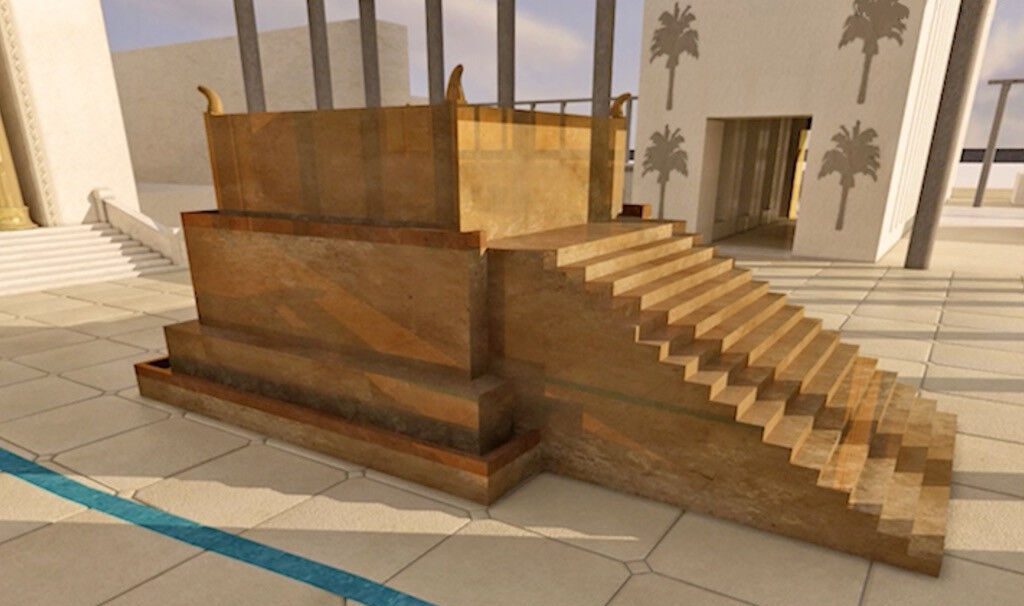
Some of the blood of this animal was smeared or sprinkled on the horns of the bronze altar to purify it, and the rest was poured out at its base to consecrate it. This entire process was intended “to make atonement for it” (Leviticus 8:15 ESV). The act of laying their hands on the head of the animal before it was killed symbolized the transference of their sins. The animal became the payment for their sins. It was their substitute, taking their place and suffering the death they deserved for the sins they had committed. And the blood of the animal consecrated, purified, and atoned for the altar as well. Made by human hands, it too was contaminated by sin and was in need of atonement. Centrally located in the courtyard of the Tabernacle, this large bronze altar would play a primary role in the sacrificial system of the Israelites, so it too had to be properly prepared for service.

Having completed this offering, Moses turned his attention to the ram of the burnt offering. This was the first of two rams offered on behalf of Aaron and his sons. Once again, they placed their hands on the head of the animal to symbolize the substitutionary nature of its role. This unblemished ram was standing in their place and suffering the fate they deserved.

“Then you shall take one of the rams, and Aaron and his sons shall lay their hands on the head of the ram, and you shall kill the ram and shall take its blood and throw it against the sides of the altar. Then you shall cut the ram into pieces, and wash its entrails and its legs, and put them with its pieces and its head, and burn the whole ram on the altar. It is a burnt offering to the Lord. It is a pleasing aroma, a food offering to the Lord.” – Exodus 29:15-18 ESV

This time, the blood of the animal was thrown against the side of the bronze altar, then the entire carcass of the animal was divided and burned on the altar. No part of the animal was to be reserved or spared, symbolizing that Aaron and his sons were being completely dedicated to God.

The third sacrifice involved a second ram, designated “the ram of ordination.” Aaron and his sons repeated the ritual of laying their hands on the animal, but this time, Moses took some of the blood and “put it on the lobe of Aaron’s right ear and on the thumb of his right hand and on the big toe of his right foot” (Leviticus 8:22 ESV). Then he repeated the process with Aaron’s sons. This rather bizarre ritual was intended to emphasize the mediatory role of the priests. Their ears would be essential for hearing God speak and for listening to the confessions and concerns of the people. They would need sanctified ears to serve both God and the people. Their hands would be used to prepare the sacrifices offered to God on behalf of the people, so they too would need to be sanctified. And their feet would be used to navigate the holy environments of the Tabernacle and to enter into the presence of God Almighty. They were to be God’s instruments, literally serving as His hands, feet, and ears.

Next, Moses took the fat portions of the animal and placed them in the hands of Aaron and his sons, along with three grain offerings that included a loaf of unleavened bread, a second loaf made with oil, and a thin baked wafer. Their hands literally overflowing with the bounty of the offerings, the priests then “waved” these items before the Lord, as a sign of dedication. They willingly offered up all their gifts to God as a statement that He alone deserved the first and the best that man had to offer.

Moses then took back the items and placed them on the altar where they were burned. Serving as a priest in this ritual, Moses was allowed to keep the thigh of the sacrificial animal as his portion.

The final step in the ceremony was for Moses to take some of the anointing oil and mix it with the blood from the three animals that had been comingled on the sides of the altar. He used this rather strange mixture to sprinkle the garments of the priests. Their formerly spotless robes of righteousness were now covered with blood, a powerful statement that their sanctification and atonement had been provided for them by another.

The apostle Peter would later remind his Christian brothers and sisters that their atonement had been made possible by the blood of another – the sinless, spotless Lamb of God.

So you must live in reverent fear of him during your time here as “temporary residents.” For you know that God paid a ransom to save you from the empty life you inherited from your ancestors. And it was not paid with mere gold or silver, which lose their value. It was the precious blood of Christ, the sinless, spotless Lamb of God. – 1 Peter 1:17-19 NLT

As believers, we are covered by His blood. We have been purified and sanctified by the sinless blood of the Son of God.

You have come to Jesus, the one who mediates the new covenant between God and people, and to the sprinkled blood, which speaks of forgiveness instead of crying out for vengeance like the blood of Abel. – Hebrews 12:23 NLT

And the apostle John describes this very same Jesus returning to earth at the end of the age and He will be wearing a robe sprinkled with blood. This return of the Son of God to earth will preface a might battle, but the blood on His robe will be His own.

Then I saw heaven opened, and behold, a white horse! The one sitting on it is called Faithful and True, and in righteousness he judges and makes war. His eyes are like a flame of fire, and on his head are many diadems, and he has a name written that no one knows but himself. He is clothed in a robe dipped in blood, and the name by which he is called is The Word of God. And the armies of heaven, arrayed in fine linen, white and pure, were following him on white horses. From his mouth comes a sharp sword with which to strike down the nations, and he will rule them with a rod of iron. He will tread the winepress of the fury of the wrath of God the Almighty. On his robe and on his thigh he has a name written, King of kings and Lord of lords. – Revelation 19:11-16 ESV

He paid mankind’s sin debt with His own precious blood and will return to earth someday to pass judgment on all those who refused to accept His gracious gift of atonement and restoration with the Father. The Word of God who became the sinless Lamb of God will return as the King of kings and Lord of lords, wearing His royal robes sprinkled with the blood of His righteousness.

English Standard Version (ESV) The Holy Bible, English Standard Version. ESV® Permanent Text Edition® (2016). Copyright © 2001

New Living Translation (NLT) Holy Bible, New Living Translation, copyright © 1996, 2004, 2015 by Tyndale House Foundation. Used by permission of Tyndale House Publishers Inc., Carol Stream, Illinois 60188. All rights reserved.

Atonement for Sin

22 “When a leader sins, doing unintentionally any one of all the things that by the commandments of the Lord his God ought not to be done, and realizes his guilt, 23 or the sin which he has committed is made known to him, he shall bring as his offering a goat, a male without blemish, 24 and shall lay his hand on the head of the goat and kill it in the place where they kill the burnt offering before the Lord; it is a sin offering. 25 Then the priest shall take some of the blood of the sin offering with his finger and put it on the horns of the altar of burnt offering and pour out the rest of its blood at the base of the altar of burnt offering. 26 And all its fat he shall burn on the altar, like the fat of the sacrifice of peace offerings. So the priest shall make atonement for him for his sin, and he shall be forgiven.

27 “If anyone of the common people sins unintentionally in doing any one of the things that by the Lord‘s commandments ought not to be done, and realizes his guilt, 28 or the sin which he has committed is made known to him, he shall bring for his offering a goat, a female without blemish, for his sin which he has committed. 29 And he shall lay his hand on the head of the sin offering and kill the sin offering in the place of burnt offering. 30 And the priest shall take some of its blood with his finger and put it on the horns of the altar of burnt offering and pour out all the rest of its blood at the base of the altar. 31 And all its fat he shall remove, as the fat is removed from the peace offerings, and the priest shall burn it on the altar for a pleasing aroma to the Lord. And the priest shall make atonement for him, and he shall be forgiven.

32 “If he brings a lamb as his offering for a sin offering, he shall bring a female without blemish 33 and lay his hand on the head of the sin offering and kill it for a sin offering in the place where they kill the burnt offering. 34 Then the priest shall take some of the blood of the sin offering with his finger and put it on the horns of the altar of burnt offering and pour out all the rest of its blood at the base of the altar. 35 And all its fat he shall remove as the fat of the lamb is removed from the sacrifice of peace offerings, and the priest shall burn it on the altar, on top of the Lord‘s food offerings. And the priest shall make atonement for him for the sin which he has committed, and he shall be forgiven. – Leviticus 4:22-35 ESV

Everyone sins. It’s an inevitable and unavoidable fact of life. The apostle Paul put it this way: “For everyone has sinned; we all fall short of God’s glorious standard” (Romans 3:23 NLT). King Solomon gave this rather sobering assessment of the problem.

Surely there is not a righteous man on earth who does good and never sins. – Ecclesiastes 7:20 ESV

And Solomon would double down on the same stark evaluation of sin’s relentless stranglehold on humanity.

…there is no one who does not sin. – 1 Kings 8:46 ESV

And it was the pervasive and inescapable reality of sin that caused the apostle John to encourage confession rather than denial.

If we say we have no sin, we deceive ourselves, and the truth is not in us. If we confess our sins, he is faithful and just to forgive us our sins and to cleanse us from all unrighteousness. If we say we have not sinned, we make him a liar, and his word is not in us. – 1 John 1:8-10 ESV

No one understands the damaging effects of sin better than God. While He is completely free from any form of unrighteousness, He understands that sin’s entrance into the world had a devastating impact on humanity. When Adam and Eve made the fateful decision to eat fruit from the Tree of the Knowledge of Good and Evil, they did far more than disobey God’s command; they expressed their desire to become their own gods. They listened to the lie of the enemy and asserted their right to run their own lives according to their own wills. What God had declared off-limits, they determined was rightfully theirs to have. Rather than trust God’s perfect will for their lives, they allowed their desire for autonomy to cloud their thinking and blind their eyes to the devastating outcome of self-rule.

God’s decision to set apart the people of Israel as His special possession was intended to show how sinful humanity might enjoy a restored relationship with its creator. By choosing the descendants of Abraham as participants in His divine case study, God was going to reveal how the pernicious presence of sin could be dealt with in a way that could result in their restoration to a right relationship with Him. He would use this one nation to showcase His grace, love, and forgiveness. He would make a covenant with them that would guarantee them status as His chosen people and assure them of His future blessings. But they would be required to live in obedience to all the laws and regulations associated with that covenant. Failure to do so would bring divine discipline. But knowing that His people would find it impossible to live in perfect obedience to His law, God provided the sacrificial system as a means to atone for the sins they would inevitably commit.

That brings us back to Leviticus chapter 4. God has already made it clear that sin was a problem for His people. Even the priests would have difficulty living in obedience to His commands. And it was only a matter of time before the entire nation came under the weight of God’s wrath for some inadvertent and unintentional sin committed by one of their own. The whole focus of the opening chapters of Leviticus seems to be God’s emphasis on the inescapable nature of sin. Even when the people of Israel thought they were doing well, there was the very real possibility that they had sinned without even knowing it. Sin was hardwired into their systems. It was part of their nature. And they were fully capable of committing sins both willingly and unwittingly.

That’s why God instituted these sin or purification offerings. Even if someone committed a sin by accident, they were still required to make atonement for that sin. As soon as they became aware of their offense, they needed to bring their offering before God in order to receive forgiveness and restoration. And this requirement applied to every Israelite, regardless of their social status or economic standing. God even made provisions to accommodate the poor by allowing them to offer less costly sacrifices. Everyone from priests, elders, the rich, and the poor was required to follow God’s purification process. It was mandatory and not up for debate. To refuse to make the proper sacrifice for sin would leave the individual separated from God and under a death sentence. Sin required confession, sacrifice, and purification. Forgiveness was available, but only if the sinner faithfully followed God’s gracious commands.

Verses 22-35 deal provide the same protocol for the leader and the common man. Their social status did not change anything. It didn’t matter if Moses had committed the sin or if the guilty party was an obscure member of the working class. Both were required to “bring as his offering a goat” (Leviticus 4:23, 28 ESV). The only difference was that God allowed the less affluent Israelite to substitute a less-expensive female goat as a sacrifice. But both animals had to be without blemish, and the same ritual had to be painstakingly followed in order for the sacrifice to be effective. When God’s program of purification was adhered to, both individuals received the same results.

“…the priest shall make atonement for him for his sin, and he shall be forgiven.” – Leviticus 4:26, 31 ESV

The goal was forgiveness. God knew that sin was inevitable, even among His chosen people. The presence of the law didn’t eliminate the Israelite’s propensity for sin. The law simply provided a clear and irrefutable outline of God’s expectations for His chosen people. The apostle Paul would later explain the purpose behind the law.

…the law applies to those to whom it was given, for its purpose is to keep people from having excuses, and to show that the entire world is guilty before God. For no one can ever be made right with God by doing what the law commands. The law simply shows us how sinful we are. – Romans 3:19-20 NLT

…the law always brings punishment on those who try to obey it. (The only way to avoid breaking the law is to have no law to break!) – Romans 4:15 NLT

The law of God established His standard of holiness. But He knew that the Israelites were incapable of living up to that standard. Their sinful natures made it impossible to live in perfect obedience to His righteous requirements. As a Jew, the apostle Paul could relate to the difficulty they faced.

In my mind I really want to obey God’s law, but because of my sinful nature I am a slave to sin. – Romans 7:25 NLT

So, God provided the sacrificial system as a way of mitigating the inevitable damage that sin would do to the Israelite’s relationship with Him. Sin would result in division between God and His people. In His holiness, He would be obligated to deal with their sin justly and righteously. He could not turn a blind eye or act as if it never happened. So, the sacrificial system was designed to offer atonement, make available forgiveness, and provide a restored relationship with God.

The author of Hebrews provides a powerful reminder of how the law was a foreshadowing of something far more significant to come. It was meant to serve as a sign of a greater program of sacrifice and atonement that God had in mind.

The old system under the law of Moses was only a shadow, a dim preview of the good things to come, not the good things themselves. The sacrifices under that system were repeated again and again, year after year, but they were never able to provide perfect cleansing for those who came to worship. If they could have provided perfect cleansing, the sacrifices would have stopped, for the worshipers would have been purified once for all time, and their feelings of guilt would have disappeared.

But instead, those sacrifices actually reminded them of their sins year after year. For it is not possible for the blood of bulls and goats to take away sins. – Hebrews 10:1-4 NLT

And the author goes on to reveal what the Old Testament sacrificial system was meant to point towards:

That is why, when Christ came into the world, he said to God,

“You did not want animal sacrifices or sin offerings.
    But you have given me a body to offer.
You were not pleased with burnt offerings
    or other offerings for sin.
Then I said, ‘Look, I have come to do your will, O God—
    as is written about me in the Scriptures.’” – Hebrews 10:5-7 NLT

God had always planned to send His Son as the final and all-sufficient sacrifice that would pay for the sins of mankind, once and for all.

For God’s will was for us to be made holy by the sacrifice of the body of Jesus Christ, once for all time. – Hebrews 10:10 NLT

But during the Old Testament dispensation, God provided the sacrificial system as a temporary and incomplete model of the greater plan to come. Jesus, the Lamb of God who takes away the sins of the world (John 1:29), had always been God’s ultimate plan of atonement, forgiveness, and restoration. And as the author of Hebrews states, “when sins have been forgiven, there is no need to offer any more sacrifices” (Hebrews 10:18 NLT). Jesus alone can offer full forgiveness from sin and freedom from future condemnation. And Paul sums up the incredible reality of God’s perfect plan of redemption, made possible through the sacrifice of His Son.

The law of Moses was unable to save us because of the weakness of our sinful nature. So God did what the law could not do. He sent his own Son in a body like the bodies we sinners have. And in that body God declared an end to sin’s control over us by giving his Son as a sacrifice for our sins. He did this so that the just requirement of the law would be fully satisfied for us, who no longer follow our sinful nature but instead follow the Spirit. – Romans 8:3-4 NLT

English Standard Version (ESV) The Holy Bible, English Standard Version. ESV® Permanent Text Edition® (2016). Copyright © 2001

New Living Translation (NLT) Holy Bible, New Living Translation, copyright © 1996, 2004, 2015 by Tyndale House Foundation. Used by permission of Tyndale House Publishers Inc., Carol Stream, Illinois 60188. All rights reserved.

Purified For His Presence

22 “You shall also take the fat from the ram and the fat tail and the fat that covers the entrails, and the long lobe of the liver and the two kidneys with the fat that is on them, and the right thigh (for it is a ram of ordination), 23 and one loaf of bread and one cake of bread made with oil, and one wafer out of the basket of unleavened bread that is before the Lord. 24 You shall put all these on the palms of Aaron and on the palms of his sons, and wave them for a wave offering before the Lord. 25 Then you shall take them from their hands and burn them on the altar on top of the burnt offering, as a pleasing aroma before the Lord. It is a food offering to the Lord.

26 “You shall take the breast of the ram of Aaron’s ordination and wave it for a wave offering before the Lord, and it shall be your portion. 27 And you shall consecrate the breast of the wave offering that is waved and the thigh of the priests’ portion that is contributed from the ram of ordination, from what was Aaron’s and his sons’. 28 It shall be for Aaron and his sons as a perpetual due from the people of Israel, for it is a contribution. It shall be a contribution from the people of Israel from their peace offerings, their contribution to the Lord.

29 “The holy garments of Aaron shall be for his sons after him; they shall be anointed in them and ordained in them. 30 The son who succeeds him as priest, who comes into the tent of meeting to minister in the Holy Place, shall wear them seven days.

31 “You shall take the ram of ordination and boil its flesh in a holy place. 32 And Aaron and his sons shall eat the flesh of the ram and the bread that is in the basket in the entrance of the tent of meeting. 33 They shall eat those things with which atonement was made at their ordination and consecration, but an outsider shall not eat of them, because they are holy. 34 And if any of the flesh for the ordination or of the bread remain until the morning, then you shall burn the remainder with fire. It shall not be eaten, because it is holy.

35 “Thus you shall do to Aaron and to his sons, according to all that I have commanded you. Through seven days shall you ordain them, 36 and every day you shall offer a bull as a sin offering for atonement. Also you shall purify the altar, when you make atonement for it, and shall anoint it to consecrate it. 37 Seven days you shall make atonement for the altar and consecrate it, and the altar shall be most holy. Whatever touches the altar shall become holy.

38 “Now this is what you shall offer on the altar: two lambs a year old day by day regularly. 39 One lamb you shall offer in the morning, and the other lamb you shall offer at twilight. 40 And with the first lamb a tenth measure of fine flour mingled with a fourth of a hin of beaten oil, and a fourth of a hin of wine for a drink offering. 41 The other lamb you shall offer at twilight, and shall offer with it a grain offering and its drink offering, as in the morning, for a pleasing aroma, a food offering to the Lord. 42 It shall be a regular burnt offering throughout your generations at the entrance of the tent of meeting before the Lord, where I will meet with you, to speak to you there. 43 There I will meet with the people of Israel, and it shall be sanctified by my glory. 44 I will consecrate the tent of meeting and the altar. Aaron also and his sons I will consecrate to serve me as priests. 45 I will dwell among the people of Israel and will be their God. 46 And they shall know that I am the Lord their God, who brought them out of the land of Egypt that I might dwell among them. I am the Lord their God.” – Exodus 29:22-46 ESV

God has revealed how Aaron and his sons were to be prepared for their roles as priests. They were to be washed, dressed, anointed, and atoned for, all before they could even enter the front gate of the Tabernacle complex. But even then, God mandated three separate sacrifices offered over a period of seven days to fully consecrate these men. By the time this elaborate ceremony was complete, Aaron and his sons would be drenched in oil and covered in blood, a sight that would have left an impression on all those who saw them.

“They were washed with water. They were robed in righteousness. They were anointed with oil. They were sprinkled with blood. They were purified, sanctified, anointed, and justified, and in this way there were consecrated for the holy service of God. In a word, they were ordained.” – Philip Graham Ryken, Exodus: Saved For God’s Glory

With this elaborate procedure completed, Aaron and his sons would be considered holy and officially ordained for service.

“He and his garments shall be holy, and his sons and his sons’ garments with him.” – Exodus 29:21 ESV

What happened next is significant and should not be overlooked. God commanded that His newly consecrated priests make yet another offering that would complete their ordination.

“…take the fat of the ram, including the fat of the broad tail, the fat around the internal organs, the long lobe of the liver, and the two kidneys and the fat around them, along with the right thigh. Then take one round loaf of bread, one thin cake mixed with olive oil, and one wafer from the basket of bread without yeast that was placed in the Lord’s presence. Put all these in the hands of Aaron and his sons to be lifted up as a special offering to the Lord.” – Exodus 29:22-24 NLT

After the final lamb was sacrificed and dismembered, the fat, liver, kidneys, and right thigh were to be placed in the hands of Aaron and his sons, along with bread from the Table of Presence. This rather grotesque-sounding ceremony had a purpose. Placing these elements in the hands of the consecrated priests was a sign of ownership. The best parts of the animal were given to Aaron and his sons but they were to offer them back to God as “a special gift for him” (Exodus 29:25 NLT). These elements were placed on the Bronze Altar and burned with fire, creating a pleasing aroma to God. This gift was given by Aaron and his sons, a sign of their commitment to give their best to God.

But God would reward them for their service. Aaron was allowed to keep the breast of the ordination ram, but only after lifting it up to God as a wave offering. In doing so, he acknowledged God’s ownership of all things, including himself and his sons. The breast of the ram was to be seen as a gracious gift from God. And Aaron’s sons would also receive a gift, in the form of the thigh of the ordination ram. These gifts, originally given by the people, were to become a form of divine compensation for Aaron and his sons. God would take care of His servants by meeting their physical needs.

“This was God’s permanent provision for the priesthood. The people brought their offerings to God, and God in turn gave the priests their share.” – Philip Graham Ryken, Exodus: Saved For God’s Glory

These gifts from God were reserved solely for the priests. No one else was allowed to consume any part of the ordination ram or the bread of the presence.

“Then Aaron and his sons will eat this meat, along with the bread in the basket, at the Tabernacle entrance. They alone may eat the meat and bread used for their purification in the ordination ceremony. No one else may eat them, for these things are set apart and holy.” – Exodus 29:32-33 NLT

These men were to be considered completely holy. From their outer robes to the literal inner recesses of their bodies, they were fully consecrated to God. They were covered in robes of righteousness, anointed with the oil that represented the Spirit of God, sprinkled with blood that atoned for their sins, and filled with food from the table of God. There is tremendous symbolism in this ritual. It pictured the future consecration that would be experienced by all those who placed their faith in Jesus, the Lamb of God who takes away the sins of the world” (John 1:29 ESV).

Jesus would later describe the process by which someone could experience the transformation from a sinner to a priest of the Most High God.

“I tell you the truth, unless you eat the flesh of the Son of Man and drink his blood, you cannot have eternal life within you. But anyone who eats my flesh and drinks my blood has eternal life, and I will raise that person at the last day. For my flesh is true food, and my blood is true drink. Anyone who eats my flesh and drinks my blood remains in me, and I in him. I live because of the living Father who sent me; in the same way, anyone who feeds on me will live because of me. I am the true bread that came down from heaven. Anyone who eats this bread will not die as your ancestors did (even though they ate the manna) but will live forever.” – John 6:53-58 NLT

And the apostle Peter provided further insight into this remarkable transformation.

…you are a chosen people. You are royal priests, a holy nation, God’s very own possession. As a result, you can show others the goodness of God, for he called you out of the darkness into his wonderful light.

“Once you had no identity as a people;
    now you are God’s people.
Once you received no mercy;
    now you have received God’s mercy.” – 1 Peter 2:9-10 NLT

For a Christian, this process is immediate and permanent. It is a one-time event that never needs to be repeated. But for Aaron and his sons, the sanctifying process was to last seven days and required repeated sacrifices to atone for the sins of the people and to purify the altar of God. Sin would be a constant problem for the people of Israel and, therefore, the sacrifices would be an ongoing necessity.

“These burnt offerings are to be made each day from generation to generation.” – Exodus 29:42 NLT

And the author of Hebrews explains the reason for this perpetual and never-ending cycle of sacrifice for sanctification.

The sacrifices under that system were repeated again and again, year after year, but they were never able to provide perfect cleansing for those who came to worship. If they could have provided perfect cleansing, the sacrifices would have stopped, for the worshipers would have been purified once for all time, and their feelings of guilt would have disappeared.

But instead, those sacrifices actually reminded them of their sins year after year. For it is not possible for the blood of bulls and goats to take away sins. – Hebews 10:1-4 NLT

Then he adds the fantastic news regarding Jesus’ once-for-all-time sacrifice for the sins of mankind.

For God’s will was for us to be made holy by the sacrifice of the body of Jesus Christ, once for all time.

Under the old covenant, the priest stands and ministers before the altar day after day, offering the same sacrifices again and again, which can never take away sins. But our High Priest offered himself to God as a single sacrifice for sins, good for all time. Then he sat down in the place of honor at God’s right hand… – Hebrews 10:10-12 NLT

Centuries ago, God made a provision for dealing with the sinfulness of His chosen people. In order that He might dwell in their midst, He provided an elaborate process for cleansing them from their sin and preparing them to enjoy the pleasure of His presence. His presence was predicated on their purification, and their purification was dependent upon the shedding of blood.

“Yes, I will consecrate the Tabernacle and the altar, and I will consecrate Aaron and his sons to serve me as priests. Then I will live among the people of Israel and be their God, and they will know that I am the Lord their God.” – Exodus 29:44-46 NLT

English Standard Version (ESV) The Holy Bible, English Standard Version. ESV® Permanent Text Edition® (2016). Copyright © 2001

New Living Translation (NLT) Holy Bible, New Living Translation, copyright © 1996, 2004, 2015 by Tyndale House Foundation. Used by permission of Tyndale House Publishers Inc., Carol Stream, Illinois 60188. All rights reserved.

Redemption Comes With a Price

1 The Lord said to Moses, 2 “Consecrate to me all the firstborn. Whatever is the first to open the womb among the people of Israel, both of man and of beast, is mine.”

3 Then Moses said to the people, “Remember this day in which you came out from Egypt, out of the house of slavery, for by a strong hand the Lord brought you out from this place. No leavened bread shall be eaten. 4 Today, in the month of Abib, you are going out. 5 And when the Lord brings you into the land of the Canaanites, the Hittites, the Amorites, the Hivites, and the Jebusites, which he swore to your fathers to give you, a land flowing with milk and honey, you shall keep this service in this month. 6 Seven days you shall eat unleavened bread, and on the seventh day there shall be a feast to the Lord. 7 Unleavened bread shall be eaten for seven days; no leavened bread shall be seen with you, and no leaven shall be seen with you in all your territory. 8 You shall tell your son on that day, ‘It is because of what the Lord did for me when I came out of Egypt.’ 9 And it shall be to you as a sign on your hand and as a memorial between your eyes, that the law of the Lord may be in your mouth. For with a strong hand the Lord has brought you out of Egypt. 10 You shall therefore keep this statute at its appointed time from year to year.

11 “When the Lord brings you into the land of the Canaanites, as he swore to you and your fathers, and shall give it to you, 12 you shall set apart to the Lord all that first opens the womb. All the firstborn of your animals that are males shall be the Lord’s. 13 Every firstborn of a donkey you shall redeem with a lamb, or if you will not redeem it you shall break its neck. Every firstborn of man among your sons you shall redeem. 14 And when in time to come your son asks you, ‘What does this mean?’ you shall say to him, ‘By a strong hand the Lord brought us out of Egypt, from the house of slavery. 15 For when Pharaoh stubbornly refused to let us go, the Lord killed all the firstborn in the land of Egypt, both the firstborn of man and the firstborn of animals. Therefore I sacrifice to the Lord all the males that first open the womb, but all the firstborn of my sons I redeem.’ 16 It shall be as a mark on your hand or frontlets between your eyes, for by a strong hand the Lord brought us out of Egypt.” – Exodus 13:1-16 ESV

As the people of Israel prepared to make their long-awaited exit from Egypt, God reminded them that their escape from death during the tenth plague was going to come with a cost. When the death angel had passed over their homes on that fateful night, their firstborn sons had been spared. They had obeyed His command and sprinkled the blood of the unblemished lambs on the doorpost and lintels of their homes and, as a result, God redeemed the firstborn males “both of man and of beast” (Exodus 13:1 ESV). But the Egyptians experienced no such deliverance from the hand of God.

…that night at midnight, the Lord struck down all the firstborn sons in the land of Egypt, from the firstborn son of Pharaoh, who sat on his throne, to the firstborn son of the prisoner in the dungeon. Even the firstborn of their livestock were killed. – Exodus 12:29 NLT

Now, God reminded the Israelites that His sparing of their firstborns would have long-term implications.

“Dedicate to me every firstborn among the Israelites. The first offspring to be born, of both humans and animals, belongs to me.” – Exodus 13:1 NLT

Like the newly inaugurated Passover meal and the Feast of Unleavened Bread, the dedication of the firstborn was to be a perpetual rite among the Israelites. Every spring, when God’s people found themselves surrounded by the signs of new life, they were to remember His deliverance of the firstborn and dedicate all those born into their homes over the last year.

Evidently, this dedication ceremony would not go into effect until the people of Israel reached the promised land and took possession of it. It was to be implemented once God fulfilled His end of the covenant commitment and had them safely ensconced in their new homeland.

“This is what you must do when the Lord fulfills the promise he swore to you and to your ancestors. When he gives you the land where the Canaanites now live, you must present all firstborn sons and firstborn male animals to the Lord, for they belong to him.” – Exodus 13:11-12 NLT

God had redeemed them. The Hebrew word for redeem is פָּדָה (pāḏâ) and it carries the idea of paying a ransom for something or someone. This redemption came with a cost – a life for a life. God had spared the lives of the firstborn, so they now belonged to Him. But the Israelites could redeem them back – for a price.

“A firstborn donkey may be bought back from the Lord by presenting a lamb or young goat in its place. But if you do not buy it back, you must break its neck. However, you must buy back every firstborn son.” – Exodus 13:13 NLT

The firstborn among their flocks and herds were no longer theirs to use at their discretion. They belonged to God. But He provided a way for the Israelites to redeem back their firstborn animals by allowing them to offer a substitute. To redeem back a donkey, the price was a lamb or young goat. An offering was required to buy back a firstborn male animal. Until this sacrifice was made, the animal was off-limits to the Israelites and unavailable for their use. And God would later reiterate His command regarding the dedication of the firstborn.

“You shall not delay to offer from the fullness of your harvest and from the outflow of your presses. The firstborn of your sons you shall give to me. You shall do the same with your oxen and with your sheep: seven days it shall be with its mother; on the eighth day you shall give it to me.” – Exodus 22:29-30 ESV

But the terms of this agreement would later change. When the people of Israel reached Mount Sinai, Moses went to the top of the mountain where he received the Ten Commandments from God. But meanwhile, down in the valley, the people had coerced Aaron to make for them an idol in the form of a golden calf. They had grown impatient waiting on Moses to return and decided to return to their worship of the false gods of Egypt.

…they gathered around Aaron. “Come on,” they said, “make us some gods who can lead us. We don’t know what happened to this fellow Moses, who brought us here from the land of Egypt.” – Exodus 32:1 NLT

Aaron caved into their demands and crafted a calf out of the gold that the Egyptians had given them before they left Egypt.

When the people saw it, they exclaimed, “O Israel, these are the gods who brought you out of the land of Egypt!” – Exodus 32:4 NLT

But this blatant abandonment of Yahweh would cost them dearly. When Moses returned from the mountaintop, he “saw the calf and the dancing, and he burned with anger. He threw the stone tablets to the ground, smashing them at the foot of the mountain. He took the calf they had made and burned it. Then he ground it into powder, threw it into the water, and forced the people to drink it” (Exodus 32:19-20 NLT). Then Moses stood at the entrance of the camp and called for any who remained committed to Yahweh and “all the Levites gathered around him” (Exodus 32:26 NLT).

Moses ordered the men of the tribe of Levi to take their swords and join him in cleansing the camp of all those who had joined in the decadent display of debauchery and apostasy.

“Each of you, take your swords and go back and forth from one end of the camp to the other. Kill everyone—even your brothers, friends, and neighbors.” The Levites obeyed Moses’ command, and about 3,000 people died that day. – Exodus 32:27-28 NLT

As a result of their efforts, the Levites were rewarded for their service and faithfulness.

“Today you have ordained yourselves for the service of the Lord, for you obeyed him even though it meant killing your own sons and brothers. Today you have earned a blessing.” – Exodus 32:29 NLT

God would eventually reward the Levites with the honor of serving Him as priests and caretakers of the tabernacle. Their role at Sinai earned them the right to become substitutes for all the firstborn males born to the rest of the tribes.

“Look, I have chosen the Levites from among the Israelites to serve as substitutes for all the firstborn sons of the people of Israel. The Levites belong to me, for all the firstborn males are mine. On the day I struck down all the firstborn sons of the Egyptians, I set apart for myself all the firstborn in Israel, both of people and of animals. They are mine; I am the Lord.” – Numbers 3:12-13 NLT

But because there were not enough Levites to serve as substitutes for every male son among the rest of the tribes, God came up with another form of redemption.

“Take the Levites as substitutes for the firstborn sons of the people of Israel. And take the livestock of the Levites as substitutes for the firstborn livestock of the people of Israel. The Levites belong to me; I am the Lord. There are 273 more firstborn sons of Israel than there are Levites. To redeem these extra firstborn sons, collect five pieces of silver for each of them (each piece weighing the same as the sanctuary shekel, which equals twenty gerahs). Give the silver to Aaron and his sons as the redemption price for the extra firstborn sons.” – Numbers 3:45-48 NLT

The Israelites would be required to pay five pieces of silver as a redemption price for their sons. So, even when the firstborns were no longer required to serve out their dedication to God, they were expected to pay the redemption price. Their lives belonged to God.

This dedication of the firstborn was to be an annual rite among the Hebrews. Performed alongside Passover and the Feast of Unleavened Bread, it was intended to serve as a perpetual reminder of God’s gracious deliverance. He had provided a way of salvation so that the firstborn among the Israelites might be spared from death. And the apostle Peter would remind Christ-followers that God sent His Son as the ultimate form of redemption for rebellious mankind.

For you know that God paid a ransom to save you from the empty life you inherited from your ancestors. And it was not paid with mere gold or silver, which lose their value. It was the precious blood of Christ, the sinless, spotless Lamb of God. God chose him as your ransom long before the world began, but now in these last days he has been revealed for your sake. – 1 Peter 1:18-20 NLT

God had redeemed the Israelites from their captivity in Egypt. The sacrifice of the innocent lambs was a foreshadowing of the consummate sacrifice of the spotless Lamb of God. He would be the ultimate ransom paid so that men might be set free from slavery to sin and death. Like the Levites who remained unstained by the sins of their brothers and were able to appease the wrath of God, so Christ became the sinless one who defeated sin and death by offering Himself as the sacrificial substitute.

English Standard Version (ESV) The Holy Bible, English Standard Version. ESV® Permanent Text Edition® (2016). Copyright © 2001

New Living Translation (NLT) Holy Bible, New Living Translation, copyright © 1996, 2004, 2015 by Tyndale House Foundation. Used by permission of Tyndale House Publishers Inc., Carol Stream, Illinois 60188. All rights reserved.

Hindsight is 20/20

1 “Thus says the Lord God: The gate of the inner court that faces east shall be shut on the six working days, but on the Sabbath day it shall be opened, and on the day of the new moon it shall be opened. 2 The prince shall enter by the vestibule of the gate from outside, and shall take his stand by the post of the gate. The priests shall offer his burnt offering and his peace offerings, and he shall worship at the threshold of the gate. Then he shall go out, but the gate shall not be shut until evening. 3 The people of the land shall bow down at the entrance of that gate before the Lord on the Sabbaths and on the new moons. 4 The burnt offering that the prince offers to the Lord on the Sabbath day shall be six lambs without blemish and a ram without blemish. 5 And the grain offering with the ram shall be an ephah, and the grain offering with the lambs shall be as much as he is able, together with a hin of oil to each ephah. 6 On the day of the new moon he shall offer a bull from the herd without blemish, and six lambs and a ram, which shall be without blemish. 7 As a grain offering he shall provide an ephah with the bull and an ephah with the ram, and with the lambs as much as he is able, together with a hin of oil to each ephah. 8 When the prince enters, he shall enter by the vestibule of the gate, and he shall go out by the same way.

9 “When the people of the land come before the Lord at the appointed feasts, he who enters by the north gate to worship shall go out by the south gate, and he who enters by the south gate shall go out by the north gate: no one shall return by way of the gate by which he entered, but each shall go out straight ahead. 10 When they enter, the prince shall enter with them, and when they go out, he shall go out.

11 “At the feasts and the appointed festivals, the grain offering with a young bull shall be an ephah, and with a ram an ephah, and with the lambs as much as one is able to give, together with a hin of oil to an ephah. 12 When the prince provides a freewill offering, either a burnt offering or peace offerings as a freewill offering to the Lord, the gate facing east shall be opened for him. And he shall offer his burnt offering or his peace offerings as he does on the Sabbath day. Then he shall go out, and after he has gone out the gate shall be shut.

13 “You shall provide a lamb a year old without blemish for a burnt offering to the Lord daily; morning by morning you shall provide it. 14 And you shall provide a grain offering with it morning by morning, one sixth of an ephah, and one third of a hin of oil to moisten the flour, as a grain offering to the Lord. This is a perpetual statute. 15 Thus the lamb and the meal offering and the oil shall be provided, morning by morning, for a regular burnt offering.

16 “Thus says the Lord God: If the prince makes a gift to any of his sons as his inheritance, it shall belong to his sons. It is their property by inheritance. 17 But if he makes a gift out of his inheritance to one of his servants, it shall be his to the year of liberty. Then it shall revert to the prince; surely it is his inheritance—it shall belong to his sons. 18 The prince shall not take any of the inheritance of the people, thrusting them out of their property. He shall give his sons their inheritance out of his own property, so that none of my people shall be scattered from his property.”

19 Then he brought me through the entrance, which was at the side of the gate, to the north row of the holy chambers for the priests, and behold, a place was there at the extreme western end of them. 20 And he said to me, “This is the place where the priests shall boil the guilt offering and the sin offering, and where they shall bake the grain offering, in order not to bring them out into the outer court and so transmit holiness to the people.”

21 Then he brought me out to the outer court and led me around to the four corners of the court. And behold, in each corner of the court there was another court— 22 in the four corners of the court were small courts, forty cubits long and thirty broad; the four were of the same size. 23 On the inside, around each of the four courts was a row of masonry, with hearths made at the bottom of the rows all around. 24 Then he said to me, “These are the kitchens where those who minister at the temple shall boil the sacrifices of the people.” – Ezekiel 46:1-24 ESV

God is giving Ezekiel a tour of the new temple that will exist in the Millennial Kingdom. This is the period of 1,000 years after Christ’s return when He will rule and reign in the city of Jerusalem from the throne of David. During this time, God will have the temple rebuilt, the priesthood reestablished, and the sacrificial system reinstated. But that begs the question, “Why?”

If Christ died for sins once for all (1 Peter 3:18), then why would there be the need for a sacrificial system? If Christ’s death on the cross paid the price for our sins and fully satisfied the just demands of a holy God, there seems to be no purpose for having the sacrifices reinstated during the Millennial Kingdom.

But God is very specific when describing what He will expect during those days. He provides precise details concerning which sacrifices are to be offered and the method for doing so. So, God must have a purpose.

It’s interesting to note that the two feasts God seems to emphasize are the Feast of Passover and the Feast of Tabernacles or Booths. Both of these events were associated with the Exodus and God’s deliverance of the people from their bondage in Egypt. The Passover was instituted as a memorial commemorating and celebrating God’s miraculous deliverance of the people of God from the Death Angel that visited the land of Egypt and struck down the firstborn male of every household. God spared the Israelites as long as they followed His instructions to sacrifice an unblemished lamb and put its blood on the doorways of their homes.

The Feast of Booths was meant to commemorate the time when the people had been forced to erect hastily-built shelters to protect them as they made their way through the wilderness on the way to the land of promise. All throughout their history, God had ordered them to reenact this event through this annual celebration. It was meant to remind them of the years they had spent wandering through the wilderness.

These festivals were to be symbols of God’s provision and protection during those difficult years as they made their way to the promised land. All of these sacrifices and celebrations were intended to serve as reminders of God’s grace, provision, and deliverance. They were all designed to point to God’s future provision and deliverance through Christ. They were representative of the future work of Christ.

In the Millennial Kingdom they will continue to be representative, but more by way of reminder. They will be looking BACK, not forward. These sacrifices, once symbolic of Christ’s coming and His future sacrifice on the cross, will be reminders of what Christ has DONE. He will be living among the people, reigning and ruling from the throne of David. They will be looking back, in retrospect, to Christ’s redemptive work on the cross. So in that sense, they will be memorials and will probably have nothing to do with forgiveness of sins.

But God is very clear with Ezekiel that these sacrifices will be a part of worship in the Millennial Kingdom and they must be done according to God’s exacting standards. It should remind us that God has a reason for everything that He does. The sacrificial system was not just a temporary requirement that lived out its usefulness and purpose. God has a reason behind all that He does and one day that same sacrificial system will be reinstated, completing its purpose of pointing men to Christ. The Lamb of God will sit on the throne in Jerusalem, and innocent, unblemished lambs will be sacrificed as a visual reminder of the redemptive work that Jesus did on the cross.

English Standard Version (ESV) The Holy Bible, English Standard Version. ESV® Permanent Text Edition® (2016). Copyright © 2001

New Living Translation (NLT) Holy Bible, New Living Translation, copyright © 1996, 2004, 2015 by Tyndale House Foundation. Used by permission of Tyndale House Publishers Inc., Carol Stream, Illinois 60188. All rights reserved.

The Lamb for Sinners Slain

13 “These are the measurements of the altar by cubits (the cubit being a cubit and a handbreadth): its base shall be one cubit high and one cubit broad, with a rim of one span around its edge. And this shall be the height of the altar: 14 from the base on the ground to the lower ledge, two cubits, with a breadth of one cubit; and from the smaller ledge to the larger ledge, four cubits, with a breadth of one cubit; 15 and the altar hearth, four cubits; and from the altar hearth projecting upward, four horns. 16 The altar hearth shall be square, twelve cubits long by twelve broad. 17 The ledge also shall be square, fourteen cubits long by fourteen broad, with a rim around it half a cubit broad, and its base one cubit all around. The steps of the altar shall face east.”

18 And he said to me, “Son of man, thus says the Lord God: These are the ordinances for the altar: On the day when it is erected for offering burnt offerings upon it and for throwing blood against it, 19 you shall give to the Levitical priests of the family of Zadok, who draw near to me to minister to me, declares the Lord God, a bull from the herd for a sin offering. 20 And you shall take some of its blood and put it on the four horns of the altar and on the four corners of the ledge and upon the rim all around. Thus you shall purify the altar and make atonement for it. 21 You shall also take the bull of the sin offering, and it shall be burned in the appointed place belonging to the temple, outside the sacred area. 22 And on the second day you shall offer a male goat without blemish for a sin offering; and the altar shall be purified, as it was purified with the bull. 23 When you have finished purifying it, you shall offer a bull from the herd without blemish and a ram from the flock without blemish. 24 You shall present them before the Lord, and the priests shall sprinkle salt on them and offer them up as a burnt offering to the Lord. 25 For seven days you shall provide daily a male goat for a sin offering; also, a bull from the herd and a ram from the flock, without blemish, shall be provided. 26 Seven days shall they make atonement for the altar and cleanse it, and so consecrate it. 27 And when they have completed these days, then from the eighth day onward the priests shall offer on the altar your burnt offerings and your peace offerings, and I will accept you, declares the Lord God.” – Ezekiel 43:13-27 ESV

It should be no surprise that the focus of everything in the Millennial Kingdom will be holiness. At that moment in human history, everything will be set apart unto God. His Son will rule over all the earth from His throne in Jerusalem, just as the angel had promised to his mother, Mary.

“You will conceive and give birth to a son, and you will name him Jesus. He will be very great and will be called the Son of the Most High. The Lord God will give him the throne of his ancestor David. And he will reign over Israel forever; his Kingdom will never end!” – Luke 1:31-33 NLT

This will be in fulfillment of the promise that God made to King David.

“And I will provide a homeland for my people Israel, planting them in a secure place where they will never be disturbed. Evil nations won’t oppress them as they’ve done in the past, starting from the time I appointed judges to rule my people Israel. And I will give you rest from all your enemies.…Your house and your kingdom will continue before me for all time, and your throne will be secure forever.” – 2 Samuel 7:10-11, 16 NLT

In this future kingdom, Jesus Christ, the Son of God, will be the King of kings and Lord of lords. He will rule supreme and His status as the Holy One of God will allow Him to mete out perfect righteousness as the sovereign head of state. With His sacrificial death and resurrection, Jesus earned the right to sit on David’s throne. Paul speaks of Jesus’ elevation to this highest honor because “he humbled himself in obedience to God and died a criminal’s death on a cross” (Philippians 2:8 NLT).

And because Jesus faithfully fulfilled the will of His Heavenly Father, He was rewarded with a return to His rightful place at His Father’s side.

God elevated him to the place of highest honor
    and gave him the name above all other names,
that at the name of Jesus every knee should bow,
    in heaven and on earth and under the earth,
and every tongue declare that Jesus Christ is Lord,
    to the glory of God the Father. – Philippians 2:9-11 NLT

But the latter part of this passage has yet to be fulfilled. We live in an age where the majority of people on earth refuse to honor the name of Christ or bow in submission to His will. They do not acknowledge Him as Lord. Yet, God’s redemptive plan includes a day when all that will change. The prophet, Micah, refers to this future restoration of the Kingdom of Israel and Christ’s reign as King.

In the last days, the mountain of the Lord’s house
    will be the highest of all—
    the most important place on earth.
It will be raised above the other hills,
    and people from all over the world will stream there to worship.
People from many nations will come and say,
“Come, let us go up to the mountain of the Lord,
    to the house of Jacob’s God.
There he will teach us his ways,
    and we will walk in his paths.”
For the Lord’s teaching will go out from Zion;
    his word will go out from Jerusalem.
The Lord will mediate between peoples
    and will settle disputes between strong nations far away. – Micah 4:1-3 NLT

Isaiah prophesied about the future earthly reign of Christ, declaring that “the government will rest on his shoulders” (Isaiah 9:6 NLT), and that government will be marked by peace.

His government and its peace
    will never end.
He will rule with fairness and justice from the throne of his ancestor David
    for all eternity. – Isaiah 9:7 NLT

Justice will rule in the wilderness
    and righteousness in the fertile field.
And this righteousness will bring peace.
    Yes, it will bring quietness and confidence forever.
My people will live in safety, quietly at home.
    They will be at rest. – Isaiah 32:16-18 NLT

So, why does God reveal to Ezekiel that this same Millennial Kingdom will be marked by a reinstitution of the sacrificial system? If Jesus’ paid the final debt for all sins and accomplished what the blood of bulls and goats could never do, why would God bring back the temple, the altar, and the practice of blood sacrifice?

“The existence of the millennial temple and the reinstatement of the sacrificial system [though not necessarily the reinstatement of the Mosaic Covenant] is not only understandable but predictable. Ezekiel’s vision of a restored sacrificial system was really not so amazing after all. The millennium will afford Israel the opportunity for the first time in its history to use the symbols of their covenant with Jesus as Messiah in view. It will be their first time to be a kingdom of priests and a holy nation showing forth to the world the redemptive work of Yahweh in the person of Jesus Christ the Messiah (Isa 53:7; 61:1-3; Zech 4:1 [sic 3:10]; John 1:29; Acts 8:32-35; 1 Pet 1:19; Rev 7:13-14; 5:9; 13:8; 15:3).” – L. E. Cooper Sr., Ezekiel

The author of Hebrews reminds us that the old sacrificial system functioned as a symbol or representation of something far greater to come.

The old system under the law of Moses was only a shadow, a dim preview of the good things to come, not the good things themselves. The sacrifices under that system were repeated again and again, year after year, but they were never able to provide perfect cleansing for those who came to worship. If they could have provided perfect cleansing, the sacrifices would have stopped, for the worshipers would have been purified once for all time, and their feelings of guilt would have disappeared.

But instead, those sacrifices actually reminded them of their sins year after year. For it is not possible for the blood of bulls and goats to take away sins. – Hebrews 10:1-4 NLT

According to this passage, the main purpose behind the Old Testament sacrificial system was to remind God’s people of their sins. It could never provide full and complete atonement. That’s why the sacrifices were perpetual and never-ending. The people lived in an endless cycle of sin-sacrifice-atonement-forgiveness. With their sins forgiven, they would simply repeat the cycle again, year after year. But Jesus came to be the “Lamb of God who takes away the sins of the world” (John 1:29). With His death on the cross, Jesus broke that endless cycle of sacrifice for sins.

So, why bring it back? It seems that the future sacrificial system described in Ezekiel has a distinctly different purpose. Rather than providing atonement for sins, it will point to the ultimate atoning sacrifice: Jesus Christ. The blood offered up on the Millennial Altar will commemorate “the precious blood of Christ, the sinless, spotless Lamb of God” (1 Peter 1:19 NLT).

When Christians partake of the elements of the Lord’s Table, they are not literally breaking the body of Christ or spilling His blood. They are practicing a symbolic rite designed to remind them of what Christ has done on their behalf. That’s why, on the night Jesus instituted the Lord’s Table, He told His disciples “do this in remembrance of me” (1 Corinthians 11:25).

God gives Ezekiel the dimensions for the altar of sacrifice. Then He provides very clear instructions regarding the ritual cleansing of the altar and the preparation of the sacrifices to be offered on it. This entire process is similar to that given by God to Moses when He first instituted the sacrificial system in the Judean wilderness. For the Israelites living in the Millennial Kingdom, this entire process of ceremonial cleansing and purification will be highly familiar, and it will serve as a powerful reminder of their past sins as a nation. But it will point them to the all-sufficient sacrifice of Jesus, whose blood has cleansed them from all their sins (1 John 1:7).

“The offerings presented thereon were meant to be memorials, much as the Lord’s Supper is no efficacious sacrifice but a memorial of a blessedly adequate and all-sufficient sacrifice for all time. Thus, whereas the sacrifices of the Old Testament economy were prospective, these are retrospective.” – Charles Lee Feinberg, The Prophecy of Ezekiel

The focus of this chapter is holiness – the holiness of God, His people, His Kingdom, and His Son. Everything in the Millennial Kingdom will be set apart for His glory. It will all be dedicated to His name and exist to point all people to Him alone. In a remarkable blending of old and new imagery, God provides Ezekiel a glimpse of a future age when the Old Testament sacrificial system will exist in perfect harmony with the resurrected and enthroned Lamb of God. During His thousand-year reign on earth, there will be believers and unbelievers living under His righteous rule. All those who survived the seven years of the Tribulation will have the pleasure of living as citizens of Christ’s earthly kingdom, but not all will worship Him as Lord. Perhaps this renewed sacrificial system will serve as a means of purification for all those who wish to enter the presence of the King of kings. Holiness will reign supreme in the Millennial Kingdom, and God has ordained a place and purpose for the sacrificial system in that time.

English Standard Version (ESV) The Holy Bible, English Standard Version. ESV® Permanent Text Edition® (2016). Copyright © 2001

New Living Translation (NLT) Holy Bible, New Living Translation, copyright © 1996, 2004, 2015 by Tyndale House Foundation. Used by permission of Tyndale House Publishers Inc., Carol Stream, Illinois 60188. All rights reserved.

The Lord Will Provide

4 On the third day Abraham lifted up his eyes and saw the place from afar. 5 Then Abraham said to his young men, “Stay here with the donkey; I and the boy will go over there and worship and come again to you.” 6 And Abraham took the wood of the burnt offering and laid it on Isaac his son. And he took in his hand the fire and the knife. So they went both of them together. 7 And Isaac said to his father Abraham, “My father!” And he said, “Here I am, my son.” He said, “Behold, the fire and the wood, but where is the lamb for a burnt offering?” 8 Abraham said, “God will provide for himself the lamb for a burnt offering, my son.” So they went both of them together.

9 When they came to the place of which God had told him, Abraham built the altar there and laid the wood in order and bound Isaac his son and laid him on the altar, on top of the wood. 10 Then Abraham reached out his hand and took the knife to slaughter his son. 11 But the angel of the Lord called to him from heaven and said, “Abraham, Abraham!” And he said, “Here I am.” 12 He said, “Do not lay your hand on the boy or do anything to him, for now I know that you fear God, seeing you have not withheld your son, your only son, from me.” 13 And Abraham lifted up his eyes and looked, and behold, behind him was a ram, caught in a thicket by his horns. And Abraham went and took the ram and offered it up as a burnt offering instead of his son. 14 So Abraham called the name of that place, “The Lord will provide”; as it is said to this day, “On the mount of the Lord it shall be provided.” – Genesis 22:4-14 ESV

Three days into their journey to the region of Moriah, Abraham saw their final destination in the distance and decided to leave his servants behind. He and Isaac would travel alone to the place of sacrifice. Abraham, perhaps hoping to hide his true intentions from his unwitting son, told his servants, “The boy and I will travel a little farther. We will worship there, and then we will come right back” (Genesis 22:5 NLT). Some have determined this to be a statement of faith on Abraham’s part, suggesting that he was confident that God would spare his son. But it seems more likely that Abraham was waiting until the last minute to let Isaac in on the true nature of their journey.

Moses describes how Abraham took all the elements he would need for the sacrifice, including a knife, a blazing torch, and wood. Then he adds the heartwrenching notation: “And Abraham took the wood of the burnt offering and laid it on Isaac his son” (Genesis 22:6 ESV). Isaac was carrying the very wood upon which his young life would be consumed.

For those of us living on this side of the crucifixion, it should be easy to recognize the similarities between Isaac and Jesus. Both entered the world through miraculous, God-ordained births. Isaac was born to an elderly and barren woman. Jesus was born to a young virgin girl. Each of them was deeply adored by their respective fathers. And just as Abraham was facing the prospect of sacrificing his son, centuries later, God would offer up His one and only Son as the Lamb who takes away the sins of the world (John 1:29). There is even a striking similarity between Isaac bearing the wood for his own sacrifice and Jesus carrying the cross upon which He would be crucified.

But for the Jews for whom Moses recorded this story, none of these links to the future death of the Messiah would have been apparent. For them, this story would have had significance because it involved Isaac, who would later become the father of Jacob, the man whom God later renamed, Israel. And it was from this one man that they owed their very existence. To hear the story of how Jacob’s father was almost put to death by order of Yahweh must have left them appalled and confused. How could their God, the God of Abraham, Isaac, and Jacob, order such a thing? And, of course, they would have been viewing this entire scene through the lens of the Mosaic Law. They had been given clear instructions to avoid the religious rituals and customs of their pagan neighbors.

You must not worship the Lord your God the way the other nations worship their gods, for they perform for their gods every detestable act that the Lord hates. They even burn their sons and daughters as sacrifices to their gods. – Leviticus 12:31 NLT

And yet, Abraham had no written law to guide his actions. He was operating according to the spoken word of God Almighty, and His instructions had been very clear.

“Take your son, your only son—yes, Isaac, whom you love so much—and go to the land of Moriah. Go and sacrifice him as a burnt offering on one of the mountains, which I will show you.” – Genesis 22:2 NLT

The disconcerting nature of this divine command would have left them filled with questions. Why would God require the sacrifice of the very son whom He had miraculously provided to Abraham and Sarah? What possible good could come from something so seemingly wicked? But the key is found in three words found in the opening verse of this chapter: God tested Abraham.

The people of Israel were very familiar with the concept of divine testing. In fact, their ancestors had spent 40 years wandering in the wilderness, enduring ongoing tests from Yahweh that were designed to increase their dependence upon Him. The book of Deuteronomy records Moses’ powerful words spoken to the people of Israel as they prepared to enter the land of Canaan for the first time.

“Remember how the LORD your God led you through the wilderness for these forty years, humbling you and testing you to prove your character, and to find out whether or not you would obey his commands. Yes, he humbled you by letting you go hungry and then feeding you with manna, a food previously unknown to you and your ancestors. He did it to teach you that people do not live by bread alone; rather, we live by every word that comes from the mouth of the LORD. For all these forty years your clothes didn’t wear out, and your feet didn’t blister or swell. Think about it: Just as a parent disciplines a child, the LORD your God disciplines you for your own good.” – Deuteronomy 8:2-5 NLT

So, it seems highly likely that they would have understood this test that Abraham was having to face. They knew that Yahweh expected obedience from His people because obedience was a sign of dependence and faith. And they knew what disobedience looked like because they had grumbled and whined about their dislike for manna. During their years wandering in the wilderness, they had spent more time complaining to Moses than they spent worshiping and expressing gratitude to God.

As Abraham and Isaac made their way to the site of the sacrifice, Isaac couldn’t help but notice that something was missing.

He said, “Behold, the fire and the wood, but where is the lamb for a burnt offering?” – Genesis 22:7 ESV

To the young Isaac, this was a glaring oversight. Why had his father failed to select an unblemished lamb before they left home? How were they going to find a suitable animal out in the wilderness? But Abraham calmly answered, “God will provide for himself the lamb for a burnt offering, my son” (Genesis 22:8 ESV). Once again, there are those who believe this was an expression of Abraham’s faith. They suggest that Abraham somehow knew that God would provide a substitute. But, according to the author of Hebrews, Abraham was declaring his belief that Isaac was the lamb that God had provided. The sacrifice would take place. But Abraham still believed that God would fulfill His covenant promise, even if it meant raising Isaac from the dead.

It was by faith that Abraham offered Isaac as a sacrifice when God was testing him. Abraham, who had received God’s promises, was ready to sacrifice his only son, Isaac, even though God had told him, “Isaac is the son through whom your descendants will be counted.” Abraham reasoned that if Isaac died, God was able to bring him back to life again. And in a sense, Abraham did receive his son back from the dead. – Hebrews 11:17-19 NLT

Abraham fully intended to go through with God’s command. He did not delay, hoping for a last-minute reprieve. He did not scan the horizon, hoping for a lamb to miraculously appear. No, Moses records that “Abraham built an altar and arranged the wood on it. Then he tied his son, Isaac, and laid him on the altar on top of the wood. And Abraham picked up the knife to kill his son as a sacrifice” (Genesis 22:0-10 NLT).

One can only imagine the turmoil going on in Abraham’s mind and heart. Every fiber of his being must have been conflicted as his fatherly instincts waged war against his desire to walk before God and be blameless (Genesis 17:1). Interestingly enough, Moses provides no insight into Isaac’s reactions. The young boy appears to remain eerily silent throughout this ordeal. He asked no further questions. He refused to put up a struggle. And, just as Abraham prepared to shed the blood of his own innocent son, God intervened.

“Do not lay your hand on the boy or do anything to him, for now I know that you fear God, seeing you have not withheld your son, your only son, from me.” – Genesis 22:21 ESV

Abraham clearly loved Isaac. But he reverenced God. The Hebrew word for “fear” is יָרֵא (yārē’) and, in this context, it refers to reverent awe for God that is expressed through obedience. Abraham did not do what he did out of fear of God’s wrath, but out of reverence for God’s holiness and power. His obedience was an expression of his faith in an all-powerful and perfectly righteous God.

As the author of Hebrews suggests, “Abraham did receive his son back from the dead” (Hebrews 11:17 NLT). In Abraham’s mind, Isaac’s death was a foregone conclusion. But, at the very last second, his son’s life was spared. God provided a substitute.

Abraham lifted up his eyes and looked, and behold, behind him was a ram, caught in a thicket by his horns. And Abraham went and took the ram and offered it up as a burnt offering instead of his son. – Genesis 22:17 ESV

This verse foreshadows another sacrifice that would take place centuries later. It too would involve a loving Father and His precious Son. But this time, there would be no last-minute reprieve. There would be no substitute. In fact, the Son would serve as the substitute for sinful mankind. And the apostle Paul reminds us of the tremendous cost that our Heavenly Father paid so that we might live to see another day.

He who did not spare his own Son but gave him up for us all, how will he not also with him graciously give us all things? – Romans 8:32 ESV

Abraham had his son returned to him, and out of gratitude and a growing reverence for this gracious and compassionate God, he named the place Yahweh-Yireh (which means “the Lord will provide”). Isaac was spared, not because he deserved it. But because God had plans to offer a far more significant and superior sacrifice. And the apostle Paul declares the glory of this future gift the Lamb who would take away the sins of the world.

For everyone has sinned; we all fall short of God’s glorious standard. Yet God, in his grace, freely makes us right in his sight. He did this through Christ Jesus when he freed us from the penalty for our sins. For God presented Jesus as the sacrifice for sin. People are made right with God when they believe that Jesus sacrificed his life, shedding his blood. This sacrifice shows that God was being fair when he held back and did not punish those who sinned in times past, for he was looking ahead and including them in what he would do in this present time. God did this to demonstrate his righteousness, for he himself is fair and just, and he makes sinners right in his sight when they believe in Jesus. – Romans 3:23-26 NLT

English Standard Version (ESV) The Holy Bible, English Standard Version. ESV® Permanent Text Edition® (2016). Copyright © 2001 by Crossway Bibles, a publishing ministry of Good News Publishers.

New Living Translation (NLT) Holy Bible, New Living Translation, copyright © 1996, 2004, 2015 by Tyndale House Foundation. Used by permission of Tyndale House Publishers Inc., Carol Stream, Illinois 60188. All rights reserved.

New English Translation (NET)NET Bible® copyright ©1996-2017 by Biblical Studies Press, L.L.C. http://netbible.com All rights reserved.