A Return to Normal

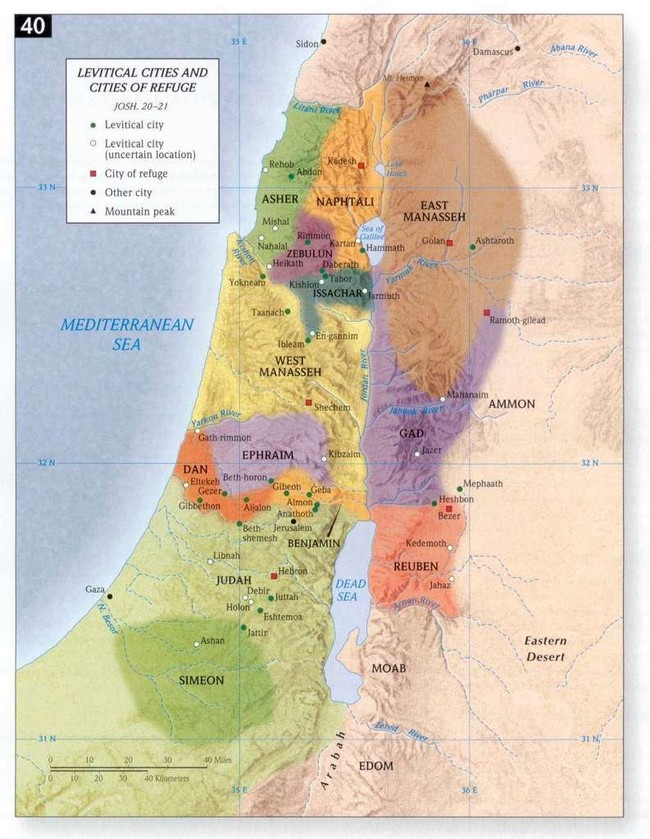
54 These are their dwelling places according to their settlements within their borders: to the sons of Aaron of the clans of Kohathites, for theirs was the first lot, 55 to them they gave Hebron in the land of Judah and its surrounding pasturelands, 56 but the fields of the city and its villages they gave to Caleb the son of Jephunneh. 57 To the sons of Aaron they gave the cities of refuge: Hebron, Libnah with its pasturelands, Jattir, Eshtemoa with its pasturelands, 58 Hilen with its pasturelands, Debir with its pasturelands, 59 Ashan with its pasturelands, and Beth-shemesh with its pasturelands; 60 and from the tribe of Benjamin, Gibeon, Geba with its pasturelands, Alemeth with its pasturelands, and Anathoth with its pasturelands. All their cities throughout their clans were thirteen.

61 To the rest of the Kohathites were given by lot out of the clan of the tribe, out of the half-tribe, the half of Manasseh, ten cities. 62 To the Gershomites according to their clans were allotted thirteen cities out of the tribes of Issachar, Asher, Naphtali and Manasseh in Bashan. 63 To the Merarites according to their clans were allotted twelve cities out of the tribes of Reuben, Gad, and Zebulun. 64 So the people of Israel gave the Levites the cities with their pasturelands. 65 They gave by lot out of the tribes of Judah, Simeon, and Benjamin these cities that are mentioned by name.

66 And some of the clans of the sons of Kohath had cities of their territory out of the tribe of Ephraim. 67 They were given the cities of refuge: Shechem with its pasturelands in the hill country of Ephraim, Gezer with its pasturelands, 68 Jokmeam with its pasturelands, Beth-horon with its pasturelands, 69 Aijalon with its pasturelands, Gath-rimmon with its pasturelands, 70 and out of the half-tribe of Manasseh, Aner with its pasturelands, and Bileam with its pasturelands, for the rest of the clans of the Kohathites.

71 To the Gershomites were given out of the clan of the half-tribe of Manasseh: Golan in Bashan with its pasturelands and Ashtaroth with its pasturelands; 72 and out of the tribe of Issachar: Kedesh with its pasturelands, Daberath with its pasturelands, 73 Ramoth with its pasturelands, and Anem with its pasturelands; 74 out of the tribe of Asher: Mashal with its pasturelands, Abdon with its pasturelands, 75 Hukok with its pasturelands, and Rehob with its pasturelands; 76 and out of the tribe of Naphtali: Kedesh in Galilee with its pasturelands, Hammon with its pasturelands, and Kiriathaim with its pasturelands. 77 To the rest of the Merarites were allotted out of the tribe of Zebulun: Rimmono with its pasturelands, Tabor with its pasturelands, 78 and beyond the Jordan at Jericho, on the east side of the Jordan, out of the tribe of Reuben: Bezer in the wilderness with its pasturelands, Jahzah with its pasturelands, 79 Kedemoth with its pasturelands, and Mephaath with its pasturelands; 80 and out of the tribe of Gad: Ramoth in Gilead with its pasturelands, Mahanaim with its pasturelands, 81 Heshbon with its pasturelands, and Jazer with its pasturelands. – 1 Chronicles 6:54-81 ESV

As the returning Israelites began the process of reoccupying the long-vacated land of their inheritance, they faced substantial obstacles. Many of their former cities, towns, and villages had been destroyed during the Babylonian invasion. To make matters worse, during their absence, other people groups had moved into the region, claiming the land as their own. There was also a remnant of Jews still living in the land, who had been left behind after the fall of Jerusalem. For 70 years, these abandoned Israelites were forced to fend for themselves, so when their brothers and sisters returned from captivity in Babylon, it would have been difficult for them to accept them with open arms.

Part of the purpose behind these seemingly never-ending genealogies was to remind all the people of Israel that God had a plan for them. Their very existence had been his doing and their heritage could be traced all the way back to Adam. Not only were they human beings made in the image of God, but they were His chosen people, the fulfillment of the promise He had made to Abraham.

“Leave your native country, your relatives, and your father’s family, and go to the land that I will show you. I will make you into a great nation. I will bless you and make you famous, and you will be a blessing to others. I will bless those who bless you and curse those who treat you with contempt. All the families on earth will be blessed through you.” – Genesis 12:1-3 NLT

The genealogies were intended to remind the people of Israel that they were still a great nation. Despite their rebellion and 70-year exile in Babylon, nothing had changed. God’s plans for them remained intact and His laws concerning their behavior remained in place. That included the division of the land. Their seven-decade-long absence had done nothing to alter God’s original allotment of the land. Each tribe had inherited their portion of the promised land and those boundaries remained intact. Even the Levites, the one tribe that received no land apportionment, would retain their right to settle in the towns God had granted to them.

levitical-cities-map.pngDuring the days of Israel’s wandering in the wilderness, God had given the tribe of Levi the responsibility of caring for the Tabernacle and everything associated with it. They were declared by God to be a priestly order, with their descendants holding the distinct honor of serving the rest of the tribes of Israel in a spiritual capacity. They were unique among all the other tribes, not only because of their special God-ordained role but because of God’s declaration that they not be allotted their own portion of land as an inheritance. In the book of Numbers, we have recorded God’s words to Moses that outlined His plans for the Levites.

“Bring the tribe of Levi near, and set them before Aaron the priest, that they may minister to him. They shall keep guard over him and over the whole congregation before the tent of meeting, as they minister at the tabernacle. They shall guard all the furnishings of the tent of meeting, and keep guard over the people of Israel as they minister at the tabernacle. And you shall give the Levites to Aaron and his sons; they are wholly given to him from among the people of Israel. And you shall appoint Aaron and his sons, and they shall guard their priesthood. But if any outsider comes near, he shall be put to death.” – Numbers 3:6-10 ESV

And God gave Moses the reasoning behind His decision.

“Behold, I have taken the Levites from among the people of Israel instead of every firstborn who opens the womb among the people of Israel. The Levites shall be mine, for all the firstborn are mine. On the day that I struck down all the firstborn in the land of Egypt, I consecrated for my own all the firstborn in Israel, both of man and of beast. They shall be mine: I am the Lord.” – Numbers 3:11-13 ESV

Later on, when God gave the law to Moses, He provided further details concerning the distinctive role of this particular tribe.

At that time the Lord set apart the tribe of Levi to carry the ark of the covenant of the Lord to stand before the Lord to minister to him and to bless in his name, to this day. Therefore Levi has no portion or inheritance with his brothers. The Lord is his inheritance, as the Lord your God said to him. – Deuteronomy 10:8-9 ESV

But who were the Levites and what led God to choose them for this very special honor? To understand what is going on here, we have to go back to Exodus chapter 2, where we have recorded the birth of Moses.

Now a man from the house of Levi went and took as his wife a Levite woman. The woman conceived and bore a son, and when she saw that he was a fine child, she hid him three months. – Exodus 2:1-2 ESV

Moses was a pure-blooded Levite. His father, Amram, was a Levite, born to Kohath, who was a son of Levi, the third son of Jacob. Moses’ mother was also a Levite. Moses and his brother, Aaron, would become the first priests overseeing the well-being of the tribes of Israel as a whole. The Levites would become God’s ordained instruments dedicated to His service and assigned the task of ministering to the spiritual needs of the people. They belonged to God and, as His servants, they were to be cared for by God. So, when it came time to apportion the land of promise, they were not given a particular portion of land like all the other tribes. Instead, God gave them cities located within the boundaries of the other tribes – 48 cities in all. Each tribe was required to provide four cities each, and the Levites were given pasture land around those cities for their own use. This plan resulted in the Levites being equally distributed among the other tribes, providing them with ready access to the people of God so that they might instruct them in the law and in the worship of Jehovah.

The Levites did not become the sole inhabitants of those cities and the cities did not become their possession. The cities remained the property of the tribes on whose land they existed. But the Levites were provided places to live and a means for raising flocks to care for their needs. In a real sense, God became their provider and benefactor.

God provided for His people. He had given them the land, but He had also provided them with a priestly clan, whose sole purpose was to teach the people the law and encourage them in their worship of God. God knew the people were going to need far more than land. He also recognized that their designation as His chosen people would not be enough to keep them faithful to His law and committed to faithful worship of Him alone. In fact, one of the key reasons the Levites had been chosen by God is because of the role they had played in God’s discipline of the people of Israel after they had made the golden calf in the wilderness. When Moses saw what Aaron and the people had done while He had been on the top of Mount Sinai receiving the law from God, he called for judgment to be enacted upon the people, and it was the Levites who responded.

…then Moses stood in the gate of the camp and said, “Who is on the Lord‘s side? Come to me.” And all the sons of Levi gathered around him. And he said to them, “Thus says the Lord God of Israel, ‘Put your sword on your side each of you, and go to and fro from gate to gate throughout the camp, and each of you kill his brother and his companion and his neighbor.’”  And the sons of Levi did according to the word of Moses. And that day about three thousand men of the people fell. And Moses said, “Today you have been ordained for the service of the Lord, each one at the cost of his son and of his brother, so that he might bestow a blessing upon you this day.” – Exodus 32:26-29 ESV

The Levites, the tribe of Moses, came to his aid and to the defense of God’s name and brought judgment upon all those who had worshiped the false god. This tribe was dispersed among all the other tribes so that they might hold the people of God accountable. They were to be a strong influence for good among the people,

“For they observed your word
    and kept your covenant.
They shall teach Jacob your rules
    and Israel your law;
they shall put incense before you
    and whole burnt offerings on your altar. – Deuteronomy 33:9-10 ESV

These men were dedicated to God. They belonged to Him and were given the indispensable and unenviable task of keeping the people of God faithful to God. From their 48 cities, spread all across the land of promise, they were to be salt and light among the tribes of Judah. Their job would not be an easy one, but it was vital to the spiritual well-being of the nation. Obedience was going to be the key to Israel getting the most out of their experience in the land. The Levites were God’s ambassadors, tasked with teaching the people the ways of God so that they might walk in obedience to Him and experience His blessings.

With the return to the land, the Levites were expected to reprise their role as God’s priests, caretakers of the Temple, and instructors of the people. So, God reminded the Israelites that the Levitical cities were to be reinstated and repopulated by the Levites. Despite all that had happened in the last 70 years, God wanted the Israelites to reestablish His ways and return to living according to His will. This included the Levites reprising their role as His servants and reoccupying the land He had provided for them.

English Standard Version (ESV)
The Holy Bible, English Standard Version. ESV® Permanent Text Edition® (2016). Copyright © 2001 by Crossway Bibles, a publishing ministry of Good News Publishers.

New Living Translation (NLT)
Holy Bible, New Living Translation, copyright © 1996, 2004, 2015 by Tyndale House Foundation. Used by permission of Tyndale House Publishers Inc., Carol Stream, Illinois 60188. All rights reserved.
The Holy and the Common

15 “But the Levitical priests, the sons of Zadok, who kept the charge of my sanctuary when the people of Israel went astray from me, shall come near to me to minister to me. And they shall stand before me to offer me the fat and the blood, declares the Lord God. 16 They shall enter my sanctuary, and they shall approach my table, to minister to me, and they shall keep my charge. 17 When they enter the gates of the inner court, they shall wear linen garments. They shall have nothing of wool on them, while they minister at the gates of the inner court, and within. 18 They shall have linen turbans on their heads, and linen undergarments around their waists. They shall not bind themselves with anything that causes sweat. 19 And when they go out into the outer court to the people, they shall put off the garments in which they have been ministering and lay them in the holy chambers. And they shall put on other garments, lest they transmit holiness to the people with their garments. 20 They shall not shave their heads or let their locks grow long; they shall surely trim the hair of their heads. 21 No priest shall drink wine when he enters the inner court. 22 They shall not marry a widow or a divorced woman, but only virgins of the offspring of the house of Israel, or a widow who is the widow of a priest. 23 They shall teach my people the difference between the holy and the common, and show them how to distinguish between the unclean and the clean. 24 In a dispute, they shall act as judges, and they shall judge it according to my judgments. They shall keep my laws and my statutes in all my appointed feasts, and they shall keep my Sabbaths holy. 25 They shall not defile themselves by going near to a dead person. However, for father or mother, for son or daughter, for brother or unmarried sister they may defile themselves. 26 After he has become clean, they shall count seven days for him. 27 And on the day that he goes into the Holy Place, into the inner court, to minister in the Holy Place, he shall offer his sin offering, declares the Lord God.

28 “This shall be their inheritance: I am their inheritance: and you shall give them no possession in Israel; I am their possession. 29 They shall eat the grain offering, the sin offering, and the guilt offering, and every devoted thing in Israel shall be theirs. 30 And the first of all the firstfruits of all kinds, and every offering of all kinds from all your offerings, shall belong to the priests. You shall also give to the priests the first of your dough, that a blessing may rest on your house. 31 The priests shall not eat of anything, whether bird or beast, that has died of itself or is torn by wild animals. Ezekiel 44:15-31 ESV

Ezekiel has been informed that not all of the descendants of the Levitical priesthood will be allowed to serve in the same capacity within the Millennial Temple. Some will be restricted in terms of their daily tasks and responsibilities because of the sins of their fathers.

“…the men of the tribe of Levi who abandoned me when Israel strayed away from me to worship idols must bear the consequences of their unfaithfulness. They may still be Temple guards and gatekeepers, and they may slaughter the animals brought for burnt offerings and be present to help the people.” – Ezekiel 44:10-11 NLT

The ancestors of these future Millennial priests were guilty of having led the people of Israel astray. Rather than modeling holiness and encouraging faithfulness among the people, they had set the precedence for apostasy.

 “…they encouraged my people to worship idols, causing Israel to fall into deep sin. – Ezekiel 44:12 NLT

As a result of the role these men played in Israel’s spiritual decline, their descendants would face punishment from God.

“They may not approach me to minister as priests. They may not touch any of my holy things or the holy offerings, for they must bear the shame of all the detestable sins they have committed.” – Ezekiel 4:13 NLT

This news must have concerned Ezekiel. How would the sacrificial system function without priests? What good was a rebuilt temple without qualified men to serve within its walls? Ezekiel would have known that only the descendants of Levi could fill this role, so hearing God’s plans to exclude them from service would have been disconcerting. For the new temple to function properly, the descendants of Levi were absolutely necessary. So, God quickly informed Ezekiel that there was nothing to worry about.

“…the Levitical priests of the family of Zadok continued to minister faithfully in the Temple when Israel abandoned me for idols. These men will serve as my ministers. They will stand in my presence and offer the fat and blood of the sacrifices, says the Sovereign Lord. They alone will enter my sanctuary and approach my table to serve me. They will fulfill all my requirements. – Ezekiel 44:15-16 NLT

Zadok was a descendant of Aaron, the brother of Moses and the first high priest of Israel. Zadok served during the reign of King David and was the one who anointed the head of Solomon, formerly setting him apart as David’s successor for the contested throne of Israel. God describes the family of Zadok as having been faithful to their calling. They took their roles seriously, serving as dedicated ministers in the temple and as committed servants to the kingdom. And for this, they would be rewarded by God.

In chapter 40, verse 46, God revealed to Ezekiel that a special room on the south side of the temple sanctuary was reserved for the descendants of Zadok.

“The room beside the south inner gate is for the priests in charge of the altar—the descendants of Zadok—for they alone of all the Levites may approach the Lord to minister to him.” – Ezekiel 40:46 NLT

This faithful remnant of the Levitical priesthood would find themselves serving as God’s personal ministers within the new Millennial Temple. In this passage, God reminds Ezekiel that these holy priests who served in the future temple would have the same job descriptions and responsibilities that they had in the old one. But God emphasizes their need for holiness. Repeatedly, God states, “they shall…”

they shall keep my charge – vs 16

they shall wear linen garments – vs 17

“they shall not bind themselves with anything that causes sweat – vs 18

“they shall not shave their heads or let their locks grow long – vs 20

“they shall not marry a widow or a divorced woman – vs 22

Each of these commands is tied to the issue of holiness. These men, as priests, were to remain consecrated to God at all times. Their behavior was to reflect their set-apart status as God’s chosen servants. Everything they did was to model holiness before the people. And, not only that, they were to teach the people the importance of holiness.

“They will teach my people the difference between what is holy and what is common, what is ceremonially clean and unclean.” – Ezekiel 44:23 NLT

One of the most significant roles they were to play was that of an instructor. Their very lives were to be a living example of what it means to live set apart to God. By keeping God’s regulations concerning the sacrifices, they would be showing the people what a set-apart life looks like. There was to be no cutting of corners, no concessions or compromises concerning God’s laws. As priests, they were responsible for the spiritual integrity of the people of God.

And along with providing instruction in holiness, they were to act as judges, resolving disagreements among the people based on the regulations handed down by God. God’s laws concerning defilement and impurity will still be in play, even in the Millennial Kingdom. With Christ serving as the righteous King of Israel, holiness will be of higher priority than ever before. And God makes it clear that all the rules and restrictions concerning the Levitical priesthood will remain as they were in the Old Testament. His laws and decrees are eternally holy and do not change.

Even now, during the church age, God demands holiness among His chosen people. At the present time, there is no temple, no sacrificial system, and no functioning Levitical priesthood. But according to the apostle Peter, there is a remnant of priests who are charged with serving God and instructing others about the difference between the holy and the common.

“for you are a chosen people. You are royal priests, a holy nation, God’s very own possession. As a result, you can show others the goodness of God, for he called you out of the darkness into his wonderful light. – 1 Peter 2:9 NLT

We are priests in the kingdom of God and we have a responsibility to model a life of holiness to the world. We are to teach others the difference between the holy and the ordinary, and there should be a clear and irrefutable difference. Our lives should not blend in with the world around us. We should be distinctive in more than just name or religious affiliation. We should not have to TELL someone we are Christians. It should be evident in the way we live our lives, and Peter describes the kind of life we are to live.

So think clearly and exercise self-control. Look forward to the gracious salvation that will come to you when Jesus Christ is revealed to the world. So you must live as God’s obedient children. Don’t slip back into your old ways of living to satisfy your own desires. You didn’t know any better then. But now you must be holy in everything you do, just as God who chose you is holy. For the Scriptures say, “You must be holy because I am holy.” – 1 Peter 1:13-16 NLT

They say the best lessons are caught, not taught. The most effective form of teaching is still modeling. It is in the way we live our lives that we convey the true difference between that which is holy and that which is common or ordinary. When we live as if we have been set apart by God for His use, we model holiness. When we live for His glory and not our own, we display holiness. When we put His will ahead of our own, we exude holiness. When we seek the good of His kingdom instead of our own, we demonstrate holiness. When we love others more than we love ourselves, we reveal what it means to be truly holy.

People were attracted to the distinctiveness of Jesus. The book of Acts records the explosive growth of the early church, and it was directly tied to the distinctiveness of the apostles and the unusual way in which they lived their lives. Holiness is attractive when modeled correctly and lived out sincerely. As priests of God, we are here to teach the difference between the holy way of life and the ways of this world. We are to be different, distinct, and set apart – holy unto the Lord.

English Standard Version (ESV) The Holy Bible, English Standard Version. ESV® Permanent Text Edition® (2016). Copyright © 2001

New Living Translation (NLT) Holy Bible, New Living Translation, copyright © 1996, 2004, 2015 by Tyndale House Foundation. Used by permission of Tyndale House Publishers Inc., Carol Stream, Illinois 60188. All rights reserved.

Our Proactive and Protective God

16 The Lord spoke to Moses, saying, 17 “These are the names of the men who shall divide the land to you for inheritance: Eleazar the priest and Joshua the son of Nun. 18 You shall take one chief from every tribe to divide the land for inheritance. 19 These are the names of the men: Of the tribe of Judah, Caleb the son of Jephunneh. 20 Of the tribe of the people of Simeon, Shemuel the son of Ammihud. 21 Of the tribe of Benjamin, Elidad the son of Chislon. 22 Of the tribe of the people of Dan a chief, Bukki the son of Jogli. 23 Of the people of Joseph: of the tribe of the people of Manasseh a chief, Hanniel the son of Ephod. 24 And of the tribe of the people of Ephraim a chief, Kemuel the son of Shiphtan. 25 Of the tribe of the people of Zebulun a chief, Elizaphan the son of Parnach. 26 Of the tribe of the people of Issachar a chief, Paltiel the son of Azzan. 27 And of the tribe of the people of Asher a chief, Ahihud the son of Shelomi. 28 Of the tribe of the people of Naphtali a chief, Pedahel the son of Ammihud.” 29 These are the men whom the Lord commanded to divide the inheritance for the people of Israel in the land of Canaan. 

1 The Lord spoke to Moses in the plains of Moab by the Jordan at Jericho, saying, “Command the people of Israel to give to the Levites some of the inheritance of their possession as cities for them to dwell in. And you shall give to the Levites pasturelands around the cities. The cities shall be theirs to dwell in, and their pasturelands shall be for their cattle and for their livestock and for all their beasts. The pasturelands of the cities, which you shall give to the Levites, shall reach from the wall of the city outward a thousand cubits all around. And you shall measure, outside the city, on the east side two thousand cubits, and on the south side two thousand cubits, and on the west side two thousand cubits, and on the north side two thousand cubits, the city being in the middle. This shall belong to them as pastureland for their cities.

“The cities that you give to the Levites shall be the six cities of refuge, where you shall permit the manslayer to flee, and in addition to them you shall give forty-two cities. All the cities that you give to the Levites shall be forty-eight, with their pasturelands. And as for the cities that you shall give from the possession of the people of Israel, from the larger tribes you shall take many, and from the smaller tribes you shall take few; each, in proportion to the inheritance that it inherits, shall give of its cities to the Levites.” Numbers 34:16-35:8 ESV

God provided Moses with the name of one man from each of the ten tribes of Israel. These men, hand-picked by God, would assist Eleazar, the high priest, and Joshua in the distribution of the land. The tribes of Gad and Reuben were not included because they had chosen to settle outside the boundaries of Canaan. These men were well-respected leaders among their respective tribes and would help to guarantee that the land was fairly apportioned and that each tribe, regardless of its size, was treated equitably and fairly. There was to be no favoritism or any form of nepotism. The larger tribes, whose numbers would be based on the recent census taken by Moses, would be allotted more extensive land allotments. But that did not mean they would get the best land. God was giving these ten men the weighty responsibility of dividing up the Israelites’ inheritance in a way that would satisfy all the parties involved, and that would not be an easy task.

The next thing on God’s agenda was to arrange for the needs of the tribe of Levi. He had already informed Moses that the Levites would inherit no land in Canaan. He had set apart the tribe of Levi as His special possession and had dedicated them to the care and maintenance of the tabernacle. As a result, God promised to be their inheritance.

“Remember that the Levitical priests—that is, the whole of the tribe of Levi—will receive no allotment of land among the other tribes in Israel. Instead, the priests and Levites will eat from the special gifts given to the Lord, for that is their share. They will have no land of their own among the Israelites. The Lord himself is their special possession, just as he promised them.” – Deuteronomy 18:1-2 NLT

But while the Levites would be allotted no land in Canaan, they would be awarded the deeds to 48 cities located within the territories of each of the other 11 tribes (Joshua 21). Even the tribes of Gad, Reuben, and the half-tribe of Manasseh were required to provide the Levites with towns and pastureland for their flocks. God had made accommodations for the Levites.

These Levitical cities were to be strategically located throughout the nation of Israel so that every Israelite was no more than ten miles from one of them. This helped to ensure that the people of God were never far away from a member of the Levitical priesthood, whose job was to provide instruction in the ways of God. The Levitical priests served as judges (Deuteronomy 17:8-13) and teachers of God’s law (Deuteronomy 33:10). So, it was essential that every Israelite had ready access to a Levitical town and a priest of God.

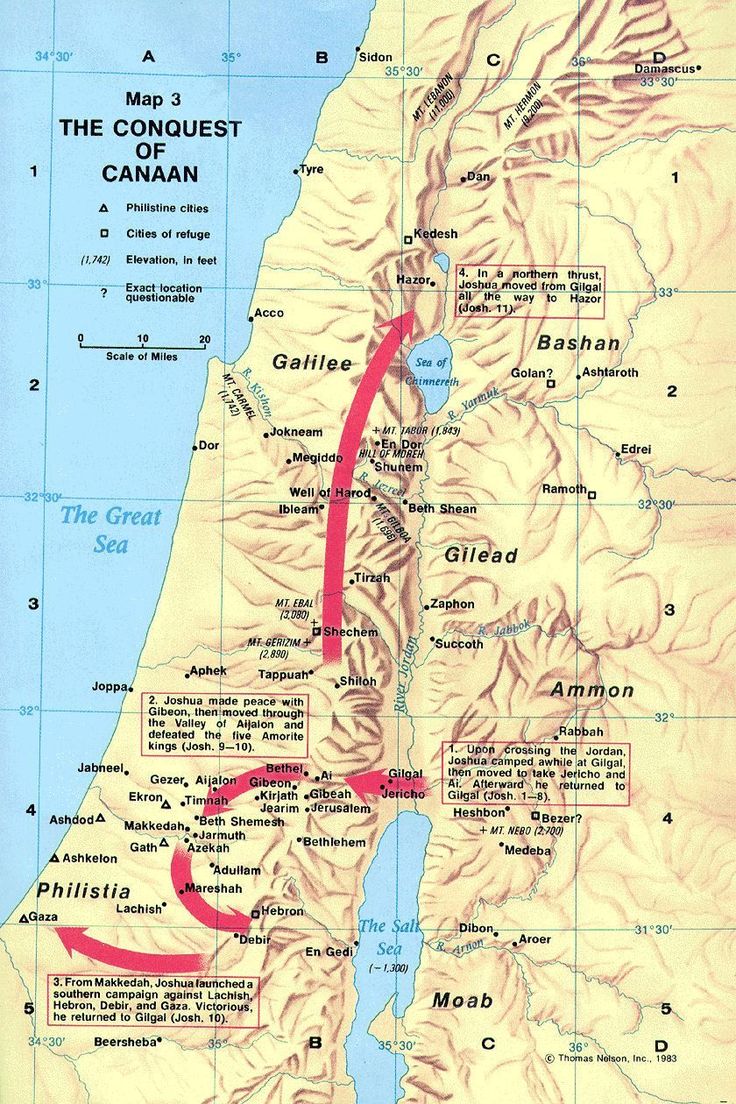
Of the 48 towns awarded to the Levites, six were to be designated as cities of refuge. These were specially sanctioned zones within the boundaries of Israel where anyone guilty of committing a non-premediated murder could seek asylum. God had already declared His ruling concerning murder (Exodus 20:13), but He had Moses present a special provision for cases involving accidental homicide.

“If someone kills another person unintentionally, without previous hostility, the slayer may flee to any of these cities to live in safety. – Deuteronomy 19:4 NLT

He even had Moses provide a potential scenario in which a city of refuge would become necessary.

“For example, suppose someone goes into the forest with a neighbor to cut wood. And suppose one of them swings an ax to chop down a tree, and the ax head flies off the handle, killing the other person. In such cases, the slayer may flee to one of the cities of refuge to live in safety.” – Deuteronomy 19:5 NLT

God knew that life would happen and that deadly accidents would be a part of the Israelites’ existence in the land. Men would be killed and justice would need to be pursued. But what He didn’t want was some form of vigilante justice running rampant through the nation. Yet God knew that the relatives of a murder victim would tend to seek revenge against the guilty party and ask questions later. The cities of refuge were intended to protect the innocent while justice was being served.

Since Israel had no professional police force, these kinds of accidents could easily turn into bloodbaths where the relatives of the victim sought to avenge their loved one’s death. So, these cities, occupied by the Levites, would provide a place where the guilty party could find solace and seek a fair judgment concerning his guilt or innocence. In His plans for the land of promise, God was leaving nothing to chance. He was creating a well-designed system for dealing with the inevitable problem of sin among His chosen people. He was going to distribute the Levitical priesthood among them to provide spiritual enlightenment and He was going to create safe havens for those who unwittingly committed even the gravest of sins. God was providing for and protecting His people.

English Standard Version (ESV) The Holy Bible, English Standard Version. ESV® Permanent Text Edition® (2016). Copyright © 2001

New Living Translation (NLT) Holy Bible, New Living Translation, copyright © 1996, 2004, 2015 by Tyndale House Foundation. Used by permission of Tyndale House Publishers Inc., Carol Stream, Illinois 60188. All rights reserved.

Shepherd My Sheep

22 The Lord spoke to Moses, saying, 23 “Speak to Aaron and his sons, saying, Thus you shall bless the people of Israel: you shall say to them,

24 The Lord bless you and keep you;
25 the Lord make his face to shine upon you and be gracious to you;
26 the Lord lift up his countenance upon you and give you peace.

27 “So shall they put my name upon the people of Israel, and I will bless them.” Numbers 6:22-27 ESV

At this point, God switches His focus back to Aaron and his sons, whom He had appointed to serve as priests. Aaron was the older brother of Moses (Exodus7:7) and had served at his sibling’s side ever since the days when God commissioned them to deliver the people of Israel from their captivity in Egypt. Moses was the God-appointed deliverer but Aaron was to serve as his brother’s mouthpiece.

“Is there not Aaron, your brother, the Levite? I know that he can speak well. Behold, he is coming out to meet you, and when he sees you, he will be glad in his heart. You shall speak to him and put the words in his mouth, and I will be with your mouth and with his mouth and will teach you both what to do. He shall speak for you to the people, and he shall be your mouth, and you shall be as God to him. – Exodus 4:14-16 ESV

In those days, Moses had been living in the land of Midian, having left Egypt out of fear for his life. In an attempt to protect a Jewish slave from mistreatment by an Egyptian, Moses inadvertently killed the oppressor and was forced to run for his life. It was while he was in Midian that he received God’s call to deliver the people of Israel. And, at the same time, Aaron, who was still living in Egypt, received his own divine commission to come to his brother’s aid.

The Lord said to Aaron, “Go into the wilderness to meet Moses.” So he went and met him at the mountain of God and kissed him. And Moses told Aaron all the words of the Lord with which he had sent him to speak, and all the signs that he had commanded him to do. Then Moses and Aaron went and gathered together all the elders of the people of Israel. Aaron spoke all the words that the Lord had spoken to Moses and did the signs in the sight of the people. And the people believed; and when they heard that the Lord had visited the people of Israel and that he had seen their affliction, they bowed their heads and worshiped. – Exodus 4:27-31 ESV

Later in the book of Genesis, Moses records the point at which God set apart Aaron and his sons to serve as priests. This was long after the people of Israel had made their miraculous escape from slavery in Egypt.

“Call for your brother, Aaron, and his sons, Nadab, Abihu, Eleazar, and Ithamar. Set them apart from the rest of the people of Israel so they may minister to me and be my priests. – Exodus 28:1 NLT

These men were given the privilege and responsibility of serving as God’s mediators and ministers. Their role was defined by God and could not be performed by anyone else in the Israelite community. As members of the tribe of Levi, Aaron, Nadab, Abihu, Eleazar, and Ithamar were doubly set apart. They were part of the Levitical cast whom God had chosen to serve in the place of all the firstborn males of Israel, but they were also the clan that would serve as priests within the tabernacle of God. And God ordered Moses to perform an elaborate ceremony that would consecrate them for their new role as His servants.

“Present Aaron and his sons at the entrance of the Tabernacle, and wash them with water. Dress Aaron in his priestly garments—the tunic, the robe worn with the ephod, the ephod itself, and the chestpiece. Then wrap the decorative sash of the ephod around him. Place the turban on his head, and fasten the sacred medallion to the turban. Then anoint him by pouring the anointing oil over his head. Next present his sons, and dress them in their tunics. Wrap the sashes around the waists of Aaron and his sons, and put their special head coverings on them. Then the right to the priesthood will be theirs by law forever. In this way, you will ordain Aaron and his sons.” – Exodus 29:4-9 NLT

God went on to tell Moses that Aaron and his sons would serve as priests for perpetuity. Unlike a Nazirite, whose service to God was voluntary and temporary, the Aaronic priesthood came with a mandatory and lifelong commitment.

“Yes, I will consecrate the Tabernacle and the altar, and I will consecrate Aaron and his sons to serve me as priests. Then I will live among the people of Israel and be their God, and they will know that I am the Lord their God. I am the one who brought them out of the land of Egypt so that I could live among them. I am the Lord their God.” – Exodus 29:44-46 NLT

As priests, their role was essential in maintaining the holiness of God’s people. One of their primary responsibilities was to offer sacrifices to God in the tabernacle, ensuring that the sins of the people were atoned for so that God’s presence would remain within their midst.

“Whereas Nazirites generally undertook their vows for a short period, the priests were always there pronouncing this blessing at the close of the daily morning service in the temple and later in the synagogues.” – Gordon J. Wenham, “Aaron’s Rod (Numbers 17:16-28).” Zeitschrift für die Alttestamentliche Wissenschaft 93:2 (1981):280-81.

After providing the requirements concerning the Nazirite vow of service, God ordered Aaron and his sons to pronounce a blessing on the people of Israel. This three-fold blessing was not intended to be a one-and-done event. In prescribing the exact wording of the blessing, God was giving Aaron and his sons an outline for determining all future blessings. God was revealing His heart for the people of Israel and was delegating to His priests the authority to speak on His behalf.

“Whenever Aaron and his sons bless the people of Israel in my name, I myself will bless them.” – Numbers 6:27 NLT

These men were to love the people under their care in the same way that God did. They were to be servant-shepherds, calling down the blessings of God upon the flock over which He had given them responsibility. They were to view their commission as a gift from God and a high and holy calling.

“But only you and your sons shall attend to your priesthood for everything concerning the altar and what is inside the veil, and you are to perform that service. I am giving you the work of the priesthood as a gift…” – Numbers 18:7 BSB

The apostle Peter shared similar words with the elders who served the congregation to whom he wrote.

Care for the flock that God has entrusted to you. Watch over it willingly, not grudgingly—not for what you will get out of it, but because you are eager to serve God. Don’t lord it over the people assigned to your care, but lead them by your own good example. And when the Great Shepherd appears, you will receive a crown of never-ending glory and honor.– 1 Peter 5:2-4 NLT

God gave His priests the authority to “bless” His sheep. They were ordered to pronounce a divinely inspired promise of future blessing upon a people who were preparing to enter the land of Canaan.

“May the Lord bless you
    and protect you.
May the Lord smile on you
    and be gracious to you.
May the Lord show you his favor
    and give you his peace.” – Numbers 6:24-26 NLT

“This blessing, like the preceding Nazirite legislation, deals with the purification of Israel. As the nation prepared to move out toward the Promised Land, God gave this benediction to the priests to offer for the sanctification of the people. God’s will was to bless all His people, not just the Nazirites. The priests were the mediators of this blessing from God to the Israelites.” – Thomas L. Constable, Notes on Numbers

For the people of Israel to enjoy God’s protection, grace, favor, and peace, they would need to remain holy and pure. And that would only happen if the priests carried out their God-ordained assignment to shepherd the people well. By dictating the content of the blessing, God was providing His undershepherds with a glimpse into His heart. The prophet Isaiah painted a vivid picture of Great Shepherd’s gentle and caring demeanor.

He tends His flock like a shepherd; He gathers the lambs in His arms and carries them close to His heart. He gently leads the nursing ewes. – Isaiah 40:11 BSB

And Aaron and his sons were to “bless” the people in the same way. Words would not be enough. Saying it would be insufficient. In a way, God was demanding that His priests be the conduits through which His protection, grace, favor, and peace flowed. And if they did their job faithfully and rightly, the presence of God would remain within the camp of Israel, and the people of God would be blessed. But if they failed, the people would suffer.

Years later, long after the people of Israel had conquered and populated the land of Canaan, the priests of Israel would fail to do their jobs and bring down His wrath rather than His blessing. And He would indict them for their dereliction of duty.

“The shepherds of my people have lost their senses. They no longer seek wisdom from the LORD. Therefore, they fail completely, and their flocks are scattered.” – Jeremiah 10:21 NLT

“What sorrow awaits the leaders of my people—the shepherds of my sheep—for they have destroyed and scattered the very ones they were expected to care for…” – Jeremiah 23:1 NLT

And the prophet Ezekiel provides a stinging rebuke from God against the derelict shepherds of Israel.

“Ah, shepherds of Israel who have been feeding yourselves! Should not shepherds feed the sheep? You eat the fat, you clothe yourselves with the wool, you slaughter the fat ones, but you do not feed the sheep. The weak you have not strengthened, the sick you have not healed, the injured you have not bound up, the strayed you have not brought back, the lost you have not sought, and with force and harshness you have ruled them. So they were scattered, because there was no shepherd, and they became food for all the wild beasts. My sheep were scattered; they wandered over all the mountains and on every high hill. My sheep were scattered over all the face of the earth, with none to search or seek for them.” – Ezekiel 34:2-6 ESV

Rather than providing protection, grace, favor, or peace, God’s shepherds had fleeced the flock of God. They had abused, used, and abandoned God’s people, bringing down curses rather than blessings. And God held them responsible.

So, when God ordered Aaron and his sons to bless the people, He was expecting far more than just lip service. He was demanding actions in keeping with the words.

English Standard Version (ESV) The Holy Bible, English Standard Version. ESV® Permanent Text Edition® (2016). Copyright © 2001

New Living Translation (NLT) Holy Bible, New Living Translation, copyright © 1996, 2004, 2015 by Tyndale House Foundation. Used by permission of Tyndale House Publishers Inc., Carol Stream, Illinois 60188. All rights reserved.

The Heaviness of Holiness

1 These are the generations of Aaron and Moses at the time when the Lord spoke with Moses on Mount Sinai. These are the names of the sons of Aaron: Nadab the firstborn, and Abihu, Eleazar, and Ithamar. These are the names of the sons of Aaron, the anointed priests, whom he ordained to serve as priests. But Nadab and Abihu died before the Lord when they offered unauthorized fire before the Lord in the wilderness of Sinai, and they had no children. So Eleazar and Ithamar served as priests in the lifetime of Aaron their father.

And the Lord spoke to Moses, saying, “Bring the tribe of Levi near, and set them before Aaron the priest, that they may minister to him. They shall keep guard over him and over the whole congregation before the tent of meeting, as they minister at the tabernacle. They shall guard all the furnishings of the tent of meeting, and keep guard over the people of Israel as they minister at the tabernacle. And you shall give the Levites to Aaron and his sons; they are wholly given to him from among the people of Israel. 10 And you shall appoint Aaron and his sons, and they shall guard their priesthood. But if any outsider comes near, he shall be put to death.”

11 And the Lord spoke to Moses, saying, 12 “Behold, I have taken the Levites from among the people of Israel instead of every firstborn who opens the womb among the people of Israel. The Levites shall be mine, 13 for all the firstborn are mine. On the day that I struck down all the firstborn in the land of Egypt, I consecrated for my own all the firstborn in Israel, both of man and of beast. They shall be mine: I am the Lord.” Numbers 3:1-13 ESV

God set apart the entire tribe of Levi to assist Aaron and his four sons, whom He had anointed to serve as priests. All adult males were exempt from military service but were expected to care for the maintenance and transportation of the tabernacle.

“Call forward the tribe of Levi, and present them to Aaron the priest to serve as his assistants. They will serve Aaron and the whole community, performing their sacred duties in and around the Tabernacle. They will also maintain all the furnishings of the sacred tent, serving in the Tabernacle on behalf of all the Israelites. – Numbers 3:6-8 NLT

While some of the Levites served as priests alongside Aaron and his sons, many were assigned the important task of caring for the tabernacle. They were divided into specific units with instructions to maintain the various elements that comprised the tabernacle and made the worship of Yahweh possible. The entire tabernacle was designed to be portable so that it could be transported from one place to another as the Israelites made their way to the land of promise. When it came time to move, the various clans of the tribe of Levi were assigned different sections of the tabernacle to disassemble and carry to the next location. Once there, they were responsible for the reconstruction of the tabernacle and for the maintenance of the items under their care.

Service in the priesthood was a high honor and was not to be taken lightly. It came with great responsibilities and God held all those who served as priests to an exacting standard.

They must be set apart as holy to their God and must never bring shame on the name of God. They must be holy, for they are the ones who present the special gifts to the Lord, gifts of food for their God. – Leviticus 21:6 NLT

One of the greatest responsibilities given to Aaron and his sons was that of providing the offering of atonement for the people of Israel. These men were expected to keep themselves morally and ceremonially pure so that they might intercede before God on behalf of the people. Moses instructed Aaron:

“Come to the altar and sacrifice your sin offering and your burnt offering to purify yourself and the people. Then present the offerings of the people to purify them, making them right with the Lord, just as he has commanded.” – Leviticus 9:7 NLT

For Aaron and his four sons to effectively mediate between God and the Israelite people, they had to maintain a holy lifestyle. Leviticus 22 outlines just how careful they had to be in order to keep from offending a holy God through personal impurity or disobedience to His commands.

“Tell Aaron and his sons to be very careful with the sacred gifts that the Israelites set apart for me, so they do not bring shame on my holy name. I am the Lord. – Leviticus 22:2 NLT

“The priests must follow my instructions carefully. Otherwise they will be punished for their sin and will die for violating my instructions. I am the Lord who makes them holy. – Leviticus 22:9 NLT

They were expected to take their role seriously, knowing that God would hold them accountable for any indiscretion or hint of physical or spiritual impurity. And Moses reveals that two of Aaron’s sons had been put to death for disobeying the commands of God.

Nadab and Abihu died in the Lord’s presence in the wilderness of Sinai when they burned before the Lord the wrong kind of fire, different than he had commanded. – Numbers 3:4 NLT

Leviticus 10 records what happened to Aaron’s two eldest sons.

Aaron’s sons Nadab and Abihu put coals of fire in their incense burners and sprinkled incense over them. In this way, they disobeyed the Lord by burning before him the wrong kind of fire, different than he had commanded. So fire blazed forth from the Lord’s presence and burned them up, and they died there before the Lord. – Leviticus 10: 1-2 NLT

The text doesn’t explain the exact nature of their sin but it makes it clear that they had violated the command of God. They had failed to take seriously God’s holiness and their own call to moral purity. Their offer of “strange fire” was outside the will of God. They had chosen to make an offering that was unsanctioned by God and, therefore, unacceptable. And Moses explained to Aaron that his sons’ unacceptable sacrifice had failed to bring glory to God.

Then Moses said to Aaron, “This is what the Lord meant when he said,

‘I will display my holiness
    through those who come near me.
I will display my glory
    before all the people.’”

And Aaron was silent. – Leviticus 10:3 NLT

It seems apparent that these two men had tried to glorify themselves. They had chosen to do God’s will their own way and their punishment was death. It’s interesting to note that Nadab and Abihu were executed by the very same heavenly fire that had consumed the offering that Aaron had offered up to God on behalf of the people.

After that, Aaron raised his hands toward the people and blessed them. Then, after presenting the sin offering, the burnt offering, and the peace offering, he stepped down from the altar. Then Moses and Aaron went into the Tabernacle, and when they came back out, they blessed the people again, and the glory of the Lord appeared to the whole community. Fire blazed forth from the Lord’s presence and consumed the burnt offering and the fat on the altar. When the people saw this, they shouted with joy and fell face down on the ground. – Leviticus 9:22-24 NLT

It seems that Nadab and Abihu had seen the reaction of the people to their father’s sacrifice and now desired to elicit a similar response by offering up their own unsolicited offering to God. But rather than the people falling on their faces before them, the fire of God fell from heaven and consumed them.

So fire blazed forth from the Lord’s presence and burned them up, and they died there before the Lord. – Leviticus 10:2 NLT

According to Leviticus 21:8, God considered each and every priest to be holy and they were to be treated as such. They belonged to Him and He expected their actions to reflect their status as His chosen servants.

“You must treat them as holy because they offer up food to your God. You must consider them holy because I, the Lord, am holy, and I make you holy.” – Leviticus 21:8 NLT

And even the Levites were expected to take seriously their status as God’s chosen tribe. They had been set apart by God for His use and they were to treat their role with a healthy dose of reverence and respect.

“Look, I have chosen the Levites from among the Israelites to serve as substitutes for all the firstborn sons of the people of Israel. The Levites belong to me…” – Numbers 3:12 NLT

And just so they understood the gravity of their position and the danger of taking it lightly, Moses warned them, “any unauthorized person who goes too near the sanctuary must be put to death” (Numbers 3:10 NLT). Their set-apart status would put them in close proximity to the tabernacle, but they were not to take that privilege lightly. Unlike Nadab and Abihu, there were to treat God with honor and reverence at all times. Their behavior mattered. The manner in which they treated His tabernacle was important. They had their God-given role to play and they were to honor Him through their obedience and faithfulness.

English Standard Version (ESV) The Holy Bible, English Standard Version. ESV® Permanent Text Edition® (2016). Copyright © 2001

New Living Translation (NLT) Holy Bible, New Living Translation, copyright © 1996, 2004, 2015 by Tyndale House Foundation. Used by permission of Tyndale House Publishers Inc., Carol Stream, Illinois 60188. All rights reserved.

Leadership Is a Privilege, Not a Right

1 “And now, O priests, this command is for you. If you will not listen, if you will not take it to heart to give honor to my name, says the Lord of hosts, then I will send the curse upon you and I will curse your blessings. Indeed, I have already cursed them, because you do not lay it to heart. Behold, I will rebuke your offspring, and spread dung on your faces, the dung of your offerings, and you shall be taken away with it. So shall you know that I have sent this command to you, that my covenant with Levi may stand, says the Lord of hosts. My covenant with him was one of life and peace, and I gave them to him. It was a covenant of fear, and he feared me. He stood in awe of my name. True instruction was in his mouth, and no wrong was found on his lips. He walked with me in peace and uprightness, and he turned many from iniquity. For the lips of a priest should guard knowledge, and people should seek instruction from his mouth, for he is the messenger of the Lord of hosts. But you have turned aside from the way. You have caused many to stumble by your instruction. You have corrupted the covenant of Levi, says the Lord of hosts, and so I make you despised and abased before all the people, inasmuch as you do not keep my ways but show partiality in your instruction.” – Malachi 2:1-9 ESV

The tribe of Levi had been given the special privilege of serving God with the responsibility of overseeing the tabernacle and everything associated with it.

Then the Lord said to Aaron: “You, your sons, and your relatives from the tribe of Levi will be held responsible for any offenses related to the sanctuary. But you and your sons alone will be held responsible for violations connected with the priesthood.

“Bring your relatives of the tribe of Levi—your ancestral tribe—to assist you and your sons as you perform the sacred duties in front of the Tabernacle of the Covenant.

“You yourselves must perform the sacred duties inside the sanctuary and at the altar. If you follow these instructions, the Lord’s anger will never again blaze against the people of Israel. I myself have chosen your fellow Levites from among the Israelites to be your special assistants. They are a gift to you, dedicated to the Lord for service in the Tabernacle.” – Numbers 18:1-2, 5-6 NLT

But at the time Malachi penned his prophetic pronouncement, the Levitical priesthood was guilty of neglecting its duties and treating its priestly responsibilities as a burden and not a blessing. The men given the responsibility of caring for God’s house found their duties to be a drudgery, not a delight. They even claimed, “It’s too hard to serve the Lord” (Malachi 1:13 NLT) and rejected God’s commands as too difficult and burdensome. In a real sense, their hearts were not in their work, and that is exactly what God has to say about their behavior.

“If you will not listen, if you will not take it to heart to give honor to my name, says the Lord of hosts, then I will send the curse upon you and I will curse your blessings. Indeed, I have already cursed them, because you do not lay it to heart.” – Malachi 2:2 ESV

God expected heartfelt obedience to His commands, and His emphasis on the condition of their hearts was meant to reveal the true nature of their problem. This wasn’t a case of simple neglect or poor planning. Their failure to follow through on their commitment wasn’t due to overwork or lack of resources. They simply didn’t have the heart for it because their hearts were far from God.

“The word ‘heart’ (leb/lebab) denotes in Hebrew what may be called the command center of a person’s life, where knowledge is collected and considered and where decisions and plans are made that determine the direction of one’s life.” – Footnote 173: H. W. Wolff, Anthropology of the Old Testament, p. 40.

These men were supposed to be the spiritual leaders of Israel but instead, they were setting a dangerous precedent for those under their care. If the restored remnant of Israel was going to survive their return to Judah and enjoy the blessings God had in store for them, it would only happen if the priests faithfully fulfilled their God-given responsibilities. But God’s priests were guilty of the very same sin that had led to Israel’s banishment from Judah in the first place.

“These people draw near to Me with their mouths and honor Me with their lips, but their hearts are far from Me. Their worship of Me is but rules taught by men. – Isaiah 29:13 BSB

God holds spiritual leaders to a higher standard because, as His shepherds, they are responsible for the care of His flock. They serve as His undershepherds and must give an account for the way they have nurtured those under their care. And as for the Levitical priests, they were also responsible for the sacrificial system God had decreed.

“Tell Aaron and his sons to be very careful with the sacred gifts that the Israelites set apart for me, so they do not bring shame on my holy name. I am the Lord.

“The priests must follow my instructions carefully. Otherwise they will be punished for their sin and will die for violating my instructions. I am the Lord who makes them holy. – Leviticus 22:2, 9 NLT

Malachi delivers God’s stinging rebuke to these heartless and faithless priests, warning them that they were about to be cursed for their infidelity.

“I will punish your descendants and splatter your faces with the manure from your festival sacrifices, and I will throw you on the manure pile.” – Malachi 2:3 NLT

“The disgusting picture is of God taking the internal waste of the sacrificial animals and smearing it on the priests’ faces. Consequently both sacrifices and priests would have to be taken outside for disposal. This play on words communicates a double curse.” – Thomas L. Constable, Notes of Malachi

God was threatening to use their defiled sacrifices to defile them. He would no longer allow them to defame His name by their failure to execute their priestly responsibilities with integrity and honor. In a sense, God was warning that He was about to clean house. He remained committed to His covenant with the tribe of Levi.

“They shall teach Jacob your rules
    and Israel your law;
they shall put incense before you
    and whole burnt offerings on your altar.” – Deuteronomy 33:10 ESV

But these particular men had forfeited their right to serve as God’s priests. And when God’s curse fell on them, they would finally understand the gravity of their sin and the sacredness of the priestly role they had once held. And God provides them with a much-needed reminder of how their forefathers had faithfully lived up to their job description, bringing God’s blessings upon the people.

“The purpose of my covenant with the Levites was to bring life and peace, and that is what I gave them. This required reverence from them, and they greatly revered me and stood in awe of my name. They passed on to the people the truth of the instructions they received from me. They did not lie or cheat; they walked with me, living good and righteous lives, and they turned many from lives of sin. – Malachi 2:5-6 NLT

God had kept His word and restored a remnant of His disobedient people to the land of Judah. Seventy years after Judah had fallen to the Babylonians, God had sovereignly arranged for King Cyrus to issue a decree that allowed a small band of exiled to make the long journey home and begin the restoration of Jerusalem. Under the leadership of such men as Zerubbabel, Ezra, and Nehemiah, the walls had been rebuilt, the gates rehung, and the temple had risen majestically from the rubble. And the priests had been given the opportunity to renew their role as the spiritual leaders of Israel, providing instruction in the law and overseeing the recently reinstituted sacrificial system. Yet, despite all the blessings God had poured out on the nation of Israel, the priests had dropped the ball.

“But you priests have left God’s paths. Your instructions have caused many to stumble into sin. You have corrupted the covenant I made with the Levites…” – Malachi 2:8 NLT

It’s essential to understand the serious nature of their sin. These men had not just led poorly, they had purposefully misled and misguided the people. Their teaching of the law had been inaccurate and confusing. They were guilty of misinterpreting and misrepresenting God’s commands, causing the people to unknowingly violate the will of God. Their propensity to offer unacceptable sacrifices meant that the peoples’ sins were never really atoned for. Unlike their forefathers, these men were liars and cheats, living unrighteous lives and causing the people to follow their example. And God was unwilling to allow their devastating actions to continue any longer.

“So I have made you despised and humiliated in the eyes of all the people. For you have not obeyed me but have shown favoritism in the way you carry out my instructions.” – Malachi 2:9 NLT

According to Numbers 18:32, their penalty should have been death, but God had chosen to punish them by diminishing their stature in the eyes of the people. Their fall from God’s good grace would be painful and swift. They had been set apart by God and given the responsibility of leading and feeding His flock. But they had ended up treating both their position and God’s flock with disdain. After 70 years in exile, the people of God desperately needed solid biblical instruction, godly leadership, and a sacrificial system that provided true atonement from sin. But these men provided none of the above. They twisted God’s words, misled His flock, and defiled the very sacrifices that should have brought atonement to God’s people.

English Standard Version (ESV) The Holy Bible, English Standard Version. ESV® Permanent Text Edition® (2016). Copyright © 2001 by Crossway Bibles, a publishing ministry of Good News Publishers.

New Living Translation (NLT) Holy Bible, New Living Translation, copyright © 1996, 2004, 2015 by Tyndale House Foundation. Used by permission of Tyndale House Publishers Inc., Carol Stream, Illinois 60188. All rights reserved.

New English Translation (NET)NET Bible® copyright ©1996-2017 by Biblical Studies Press, L.L.C. http://netbible.com All rights reserved.