The Blessing of Procreation

14 And God said, “Let there be lights in the expanse of the heavens to separate the day from the night. And let them be for signs and for seasons, and for days and years, 15 and let them be lights in the expanse of the heavens to give light upon the earth.” And it was so. 16 And God made the two great lights—the greater light to rule the day and the lesser light to rule the night—and the stars. 17 And God set them in the expanse of the heavens to give light on the earth, 18 to rule over the day and over the night, and to separate the light from the darkness. And God saw that it was good. 19 And there was evening and there was morning, the fourth day.

20 And God said, “Let the waters swarm with swarms of living creatures, and let birds fly above the earth across the expanse of the heavens.” 21 So God created the great sea creatures and every living creature that moves, with which the waters swarm, according to their kinds, and every winged bird according to its kind. And God saw that it was good. 22 And God blessed them, saying, “Be fruitful and multiply and fill the waters in the seas, and let birds multiply on the earth.” 23 And there was evening and there was morning, the fifth day. – Genesis 1:14-23 ESV

At this point in his creation account, Moses describes God’s making of the sun, moon, and stars. This appears to be a summary statement that would include the entire solar system. But out of all the innumerable celestial bodies, Moses places special emphasis on the three that would be the most familiar to his Hebrew audience. While the average Israelite would have had no scientific knowledge of the vast source of energy emanating from the sun, he would have understood and appreciated its role in producing crops, providing warmth, and sustaining life. The moon, while considered a “lesser light,” would have been equally vital in Jewish thought, playing a special role in daily life. According to JewishEncylcopedia.com:

Like the other celestial bodies, the moon was believed to have an influence on the universe. Its injurious influence on man is referred to in Ps. cxxi. 6, which passage probably refers to the blindness which, according to Eastern belief, results from sleeping in the moonlight with uncovered face (Carne, “Letters from the East,” p. 77). It was also believed that the moon caused epilepsy (comp. the Greek σεληυιαζόμευος and the Latin “lunaticus”; Matt. iv. 24). On the other hand, there are “precious things put forth by the moon” (Deut. xxxiii. 14); that is to say, the growth of certain plants is influenced by it.

According to verse 14, God said, “Let there be lights in the expanse of the heavens to separate the day from the night.” This Hebrew word for “lights” is different than the one used in verse 3 where God said, “Let there be light.” On the first day of creation, God made light – אוֹר (‘ôr). But now, on the fourth day, He made the lights – מָאוֹר (mā’ôr). The “light of day” was created three days before any physical sources of light even existed. This order of events establishes God as the source of all light and life, and explains why the worship of the sun or moon was to be off-limits to God’s people. Worship of the sun and moon was common among the ancients, but it was forbidden for the Jews. 

“…when you look up into the sky and see the sun, moon, and stars—all the forces of heaven—don’t be seduced into worshiping them. The LORD your God gave them to all the peoples of the earth.” – Deuteronomy 4:19 NLT

When the people of Israel were preparing to enter the land of Canaan, God had warned them again about the worship of the sun, moon, and stars.

“When you begin living in the towns the LORD your God is giving you, a man or woman among you might do evil in the sight of the LORD your God and violate the covenant. For instance, they might serve other gods or worship the sun, the moon, or any of the stars—the forces of heaven—which I have strictly forbidden. When you hear about it, investigate the matter thoroughly. If it is true that this detestable thing has been done in Israel, 5then the man or woman who has committed such an evil act must be taken to the gates of the town and stoned to death.” – Deuteronomy 17:2-5 NLT

God provided the sun and moon as visible and tangible sources of light. Their regular appearance in the sky would help to determine the length of a day and the various seasons of the year. They would be regular reminders of God’s faithfulness and life-sustaining power. The wording of the original text seems to stress that the sun, moon, and stars were to be viewed as created entities to be appreciated, and not deities to be worshiped.

“The narrative stresses their function as servants, subordinate to the interests of the earth. . . . This differs significantly from the superstitious belief within pagan religion that the earth’s destiny is dictated by the course of the stars.” – Kenneth A. Mathews, Genesis 1—11:26

God gave these greater and lesser lights specific roles to play. They were to separate day from night, provide divinely ordained signs, distinguish the seasons, and illuminate the earth. This brief synopsis of creation should have reminded Moses’ Hebrew audience that their God had created the so-called “gods” their pagan neighbors bowed down before and worshiped. He was the ultimate source of light and life, not the sun, moon, and stars. And yet, as the apostle Paul would later reveal, humanity has regularly mistaken the created order as the source of power, light, and life. Rather than recognizing the hand of God in all that has been made, they worshiped the creation instead.

They know the truth about God because he has made it obvious to them. For ever since the world was created, people have seen the earth and sky. Through everything God made, they can clearly see his invisible qualities—his eternal power and divine nature. So they have no excuse for not knowing God.

Yes, they knew God, but they wouldn’t worship him as God or even give him thanks. And they began to think up foolish ideas of what God was like. As a result, their minds became dark and confused. Claiming to be wise, they instead became utter fools. And instead of worshiping the glorious, ever-living God, they worshiped idols made to look like mere people and birds and animals and reptiles.

They traded the truth about God for a lie. So they worshiped and served the things God created instead of the Creator himself, who is worthy of eternal praise! – Romans 1:19-23, 25 NLT

Once again, Moses points out how God separated one thing from another. He used the sun and moon to separate the light from the darkness. There is a distinct differentiation established. From that point forward, there would be evening and morning, two diametrically opposite but integrally interwoven periods of time that, together, would form a single day. God had made land and sea. He had created earth and sky. Now He had formed day and night. Everything God created was to exist in a well-balanced and divinely ordered system that functioned according to His perfectly designed plan.

And it is at this point in the process that God begins to create new forms of life to populate the new environments He has made for them. First, He creates the fish and the birds.

“Let the waters swarm with swarms of living creatures, and let birds fly above the earth across the expanse of the heavens.” – Genesis 1:20 ESV

Then God gave these creatures a mandate: “Be fruitful and multiply and fill the waters in the seas, and let birds multiply on the earth” (Genesis 1:21 ESV). They were made to procreate and populate the planet and, in doing so, they would constantly demonstrate the ongoing nature of God’s life-giving power. God could have created a distinct number of each species and filled the earth with them. But He chose to give them the ability to mate and make more of their own kind. And with each new birth, they would illustrate the amazing nature of God’s power through His ongoing creation of life.

One of the primary ways in which God bestows His blessings on His creative order is through the birth process. Even the ability of plants to propagate more of their own is a reminder of God’s goodness and grace. Birth is a blessing and not a curse. Fruitfulness is a gift from God. It is, as God deemed it: Good.

God has given His creation the ability to procreate, to beget, to generate life. Every plant that sprouts from a seed, every oak that grows from an acorn, every chick that hatches from an egg, and every child that comes forth from a womb, is intended to shout the glory and goodness of God. His life-giving power is on display each and every day throughout His creation. And mankind, as the apex of His creative order, are to marvel in it and rejoice over it because it provides with undeniable proof of His power and presence.

English Standard Version (ESV) The Holy Bible, English Standard Version. ESV® Permanent Text Edition® (2016). Copyright © 2001 by Crossway Bibles, a publishing ministry of Good News Publishers.

New Living Translation (NLT) Holy Bible, New Living Translation, copyright © 1996, 2004, 2015 by Tyndale House Foundation. Used by permission of Tyndale House Publishers Inc., Carol Stream, Illinois 60188. All rights reserved.

New English Translation (NET)NET Bible® copyright ©1996-2017 by Biblical Studies Press, L.L.C. http://netbible.com All rights reserved.

The Light of the World

1 In the beginning, God created the heavens and the earth. 2 The earth was without form and void, and darkness was over the face of the deep. And the Spirit of God was hovering over the face of the waters. And God said, “Let there be light,” and there was light. – Genesis 1:1-3 ESV

Another way to translate the first three words of the book of Genesis is “when God created….” While God was “in the beginning,” this statement does not infer that He came into being at that moment in time. God is eternal and has always existed. His transcendent nature allows Him to operate free from the constraints of time and space. The “beginning” mentioned in the opening line of Genesis has to do with His creation of “the heavens and the earth.” According to His own divine prerogative, God made the executive decision to bring into existence that which had never existed before. And the opening chapters of Genesis record the amazing details of that epic and unprecedented event.

The opening two verses provide a summary statement of all that Moses describes in the verses that follow. Speaking of Moses, while there has been much debate as to the authorship of Genesis, I will be operating under the assumption that Jesus was right when He designated Moses as the one responsible for this book.

“But that the dead are raised, even Moses showed, in the passage about the bush, where he calls the Lord the God of Abraham and the God of Isaac and the God of Jacob.” – Luke 20:37 ESV

Jesus repeatedly referred to Moses in association with the first five books of the Hebrew Scriptures. And it seems that Jesus shared the view of His Jewish contemporaries who believed Moses to have been the author of all five books.

As we shall see, Moses plays a key role in the evolving narrative of the Hebrew people. And his record of this seminal moment in humanity’s history will eventually reveal his decidedly Hebraic bias. While his creation record provides an explanation for the “beginnings” of all mankind, Moses was attempting to explain the unique relationship shared between the Creator-God and a particular group of human beings that would later become known as the people of Israel. The books of Genesis, Exodus, Leviticus, Numbers, and Deuteronomy, commonly referred to as the Torah, form the first part of the Tanakh, the Hebrew term for their Scriptures. And throughout the pages of the Tanakh, the historical evolution of God’s chosen people is revealed in vivid and, sometimes, disturbing detail.

The book of Genesis, as its name implies, provides the genesis or beginning of the nation of Israel. Moses wrote this book to provide his own people with an explanation of their origins and to reveal to them the unique and unparalleled plan that God for them as a nation. The story of their birth as a nation was unlike any other. And while they shared a common heritage with the rest of humanity that dated back to the creation account, they enjoyed a privileged position as God’s chosen people. The question was, how had they acquired their unprecedented relationship with the God who made the heavens and the earth? What had they done to deserve such a favored position that set them apart from all the other nations of the earth?

The book of Genesis provides the answers to those questions and many more. It does so by returning its readers to the primordial darkness of the pre-creation age, long before anything existed including man.

The earth was without form and void, and darkness was over the face of the deep. – Genesis 1:2 ESV

This verse appears to describe God’s work of creation in mid-process. It is a summary verse that reveals that the earth had been created but was not yet fully formed or organized according to God’s well-designed plan. Moses paints a rather bleak picture, describing the a pervading and foreboding darkness “over the face of the deep.” The Hebrew word for deep is תְּהוֹם (tᵊhôm), and it means “the depths” or “a surging mass of water.” It was typically used to refer to the oceans. But in this case, it seems to be a reference to the earth itself, which, according to verses 9-10, was covered with water.

And God said, “Let the waters under the heavens be gathered together into one place, and let the dry land appear.” And it was so. God called the dry land Earth, and the waters that were gathered together he called Seas. And God saw that it was good. – Genesis 1:9-10 ESV

Up until that moment, the earth had been an undefined and uninhabitable mass, completely submerged under an impenetrable layer of water. But there’s hope in the midst of all the chaos and confusion: “…the Spirit of God was hovering over the face of the waters” (Genesis 1:3 ESV). The imagery is that of a mother bird brooding over her eggs as she waits for them to hatch. While the earth was “without form and void,” Moses describes the Spirit of God as lovingly brooding over this shapeless and humanly hostile environment. God had begun the creative process but was not yet finished. He had a divine plan in place that, when complete, would transform the earth into a literal garden of Eden.

It’s almost as if Moses is telegraphing a message to his people in an attempt to remind them that they worship a God of order, not confusion. And their God has a plan for their future. While there might be times when everything around them appeared dark and confusing, they could trust that God was not done. Hundreds of years after Moses wrote the book of Genesis, the prophet Jeremiah would record the following words from God. They were a reminder that, even after 70 years of forced captivity in Babylon, God would do something remarkable that would suddenly dispel the darkness of their current condition and replace it with light.

“For thus says the Lord: When seventy years are completed for Babylon, I will visit you, and I will fulfill to you my promise and bring you back to this place. For I know the plans I have for you, declares the LORD, plans for welfare and not for evil, to give you a future and a hope.”  – Jeremiah 20:10-11 ESV

Verse 2 of the opening chapter of Genesis conveys the same sense of hope. God’s creation plan had only just begun. The image of the Spirit of God hovering over the waters was meant to convey a sense of eager anticipation. Something incredible was about to take place that would escalate and expand to such a degree that the as-yet-unformed world would never be the same again.

And at this point in the narrative, Moses discloses, “And God said, ‘Let there be light,’ and there was light” (Genesis 1:3 ESV). The opening verses paint the picture of darkness and gloom but that depressing imagery is quickly replaced by the sudden appearance of light. But what is remarkable about this light is that it comes from an as-yet-undisclosed source. If we fast-forward to verses 14-18, we see that God has not yet created the sun, moon, or stars, so the source of the light mentioned in verse 3 cannot be cosmic in nature.

And God said, “Let there be lights in the expanse of the heavens to separate the day from the night. And let them be for signs and for seasons, and for days and years, and let them be lights in the expanse of the heavens to give light upon the earth.” And it was so. And God made the two great lights—the greater light to rule the day and the lesser light to rule the night—and the stars. And God set them in the expanse of the heavens to give light on the earth, to rule over the day and over the night, and to separate the light from the darkness. – Genesis 1:14-18 ESV

So, what was the source of this light? If it didn’t emanate from the sun, what could be the explanation for its sudden presence? God seems to have spoken it into existence but that does not necessarily mean the light had not existed up until that point. God simply said, “Let there be light…” and, as Moses states, there was light. It appeared. The former darkness and its concomitant chaos were suddenly penetrated and completely eliminated by the illuminating presence of this light from God. And it is essential that we recognize the undeniable fact that God was the source of the light.

Referring to God, the prophet Daniel stated that “light dwells with him” (Daniel 2:22 ESV). The apostle John would later declare, “God is light, and in him is no darkness at all” (1 John 1:5 ESV). And John would ascribe that same attribute of illuminating glory to the Son of God.

In the beginning was the Word, and the Word was with God, and the Word was God. He was in the beginning with God. All things were made through him, and without him was not any thing made that was made. In him was life, and the life was the light of men. The light shines in the darkness, and the darkness has not overcome it. – John 1:1-5 ESV

As this passage illustrates, light and the Godhead go hand-in-hand. In both the Old and New Testament Scriptures, light was used as a metaphor for such concepts as salvation, joy, knowledge, righteousness, and life. As John stated, Jesus was life and that life was the light of men. With His incarnation, He began the process of bringing true light and life to sinful men and women. His appearance brought the light of God into the spiritual darkness that permeated the world. As the light of the world, Jesus made salvation possible, joy accessible, the knowledge of God available, righteousness achievable, and eternal life attainable.

What is fascinating to consider is how John references Jesus’ role in the creation account. He states that all things were made through Him. In fact, he goes on to declare that “the world was made through him.”

The true light, which gives light to everyone, was coming into the world. He was in the world, and the world was made through him… – John 1:9-10 ESV

The apostle Paul adds further details that explain Jesus’ role in creation.

…for through him God created everything in the heavenly realms and on earth. He made the things we can see and the things we can’t see— such as thrones, kingdoms, rulers, and authorities in the unseen world. Everything was created through him and for him. – Colossians 1:16 NLT

And it’s no coincidence that Moses records God the Father declaring, “Let there be light…” and the light appeared. At the very beginning of the creation process God brings His “light” to bear. It would not be a reach to suggest that God called on His Son to join Him in the next phase of creation. And with His entrance into the scene, Jesus brought His light to bear as He “created everything in the heavenly realms and on earth” (Colossians 1:16 NLT).

One of the keys to understanding the source of this light that illuminated and eliminated the darkness can be found in the book of Revelation. There, the apostle John once again describes “the light of the world,” but this time this divine light source  will illuminate the future Kingdom of God.

And night will be no more. They will need no light of lamp or sun, for the Lord God will be their light, and they will reign forever and ever. – Revelation 22:5 ESV

Creation began with the light. Salvation was made possible by the light. And the light will be the source of illumination in the eternal state. As John put it so well, “In him was life, and the life was the light of men” (John 1:4 ESV).

English Standard Version (ESV) The Holy Bible, English Standard Version. ESV® Permanent Text Edition® (2016). Copyright © 2001 by Crossway Bibles, a publishing ministry of Good News Publishers.

New Living Translation (NLT) Holy Bible, New Living Translation, copyright © 1996, 2004, 2015 by Tyndale House Foundation. Used by permission of Tyndale House Publishers Inc., Carol Stream, Illinois 60188. All rights reserved.

New English Translation (NET)NET Bible® copyright ©1996-2017 by Biblical Studies Press, L.L.C. http://netbible.com All rights reserved.

In the Service of the King

24 A dispute also arose among them, as to which of them was to be regarded as the greatest. 25 And he said to them, “The kings of the Gentiles exercise lordship over them, and those in authority over them are called benefactors. 26 But not so with you. Rather, let the greatest among you become as the youngest, and the leader as one who serves. 27 For who is the greater, one who reclines at table or one who serves? Is it not the one who reclines at table? But I am among you as the one who serves.

28 “You are those who have stayed with me in my trials, 29 and I assign to you, as my Father assigned to me, a kingdom, 30 that you may eat and drink at my table in my kingdom and sit on thrones judging the twelve tribes of Israel. – Luke 22:24-30 ESV

This passage leaves most people a bit stunned at the audacity of the disciples. How in the world could these men be so insensitive after all that Jesus had just said to them? He had just used elements from the Passover meal to describe His coming death on their behalf. Then He had followed that up with a disclosure that one of them was going to betray Him. But the gravity of His words didn’t seem to sink in. Oh, they spent some time discussing who the possible identity of the betrayer, but that quickly devolved into a pride-filled comparison. Upon close inspection, it becomes painfully evident that these men were debating about which of them mighty be capable doing such a thing. It conjures up images of the 11 remaining disciples (because Judas had already left the room) pointing fingers at one another in a perverse version of the blame-game.

In Matthew’s account of that fateful night, he indicates that each of the disciples had asked Jesus, “Is it I, Lord?” (Luke 22:23 ESV). And while Jesus seems to have made the identity of His betrayer quite clear, them disciples missed it and continued to argue over who the culprit might be. This suggests that they had no suspicions about Judas. While he had left the room, they did not jump to conclusions and immediately assume he was the guilty party. 

And Luke seems to suggest that their debate soon turned into an argument about superiority. They went from distancing themselves from possible culpability for Jesus’ betrayal to bragging about their personal qualifications to to lay claim to the coveted title of “Greatest of all Disciples.”

It’s absolutely mind-boggling to think of these men having such an arrogant discussion in the very room where Jesus had just informed them, “This is my body, which is given for you” and “This cup that is poured out for you is the new covenant in my blood” (Luke 22:19, 20 NLT). Even if we assume they didn’t quite comprehend the meaning behind His words, there is no way they could have missed what He meant when He said, “…here at this table, sitting among us as a friend, is the man who will betray me. For it has been determined that the Son of Man must die. But what sorrow awaits the one who betrays him” (Luke 22:21-22 NLT).

But rather than console Jesus and offer their commitment to stand by His side to the bitter end, they made the focus of the entire evening all about themselves.

Then they began to argue among themselves about who would be the greatest among them. – Luke 22:24 NLT

What makes their self-centered obsession so egregious is that the Messiah, the Anointed One of God was standing right in front of them. And to make matters worse, John reports that Jesus, the Son of God, had prefaced the Passover meal by washing the feet of His disciples.

Jesus, knowing that the Father had given all things into his hands, and that he had come from God and was going back to God, rose from supper. He laid aside his outer garments, and taking a towel, tied it around his waist. Then he poured water into a basin and began to wash the disciples’ feet and to wipe them with the towel that was wrapped around him. – John 13:3-5 ESV

And John indicates that immediately after Jesus had performed this lowly, selfless act of servanthood, He went out of His way to ensure that they understood the meaning behind His actions.

“Do you understand what I have done to you? You call me Teacher and Lord, and you are right, for so I am. If I then, your Lord and Teacher, have washed your feet, you also ought to wash one another’s feet. For I have given you an example, that you also should do just as I have done to you. Truly, truly, I say to you, a servant is not greater than his master, nor is a messenger greater than the one who sent him. If you know these things, blessed are you if you do them.” – John 13:12-17 ESV

Their Lord and teacher had just washed their feet, providing them with a vivid illustration of the ministry they would soon be commissioned to carry on in His absence. And yet, they seemed to have missed His point altogether. Jesus was not calling them to become washers of feet, but to become the servants of all. In other words, Jesus was asking them to carry on His ministry.

Amazingly, this was not the only time Jesus had to have this discussion with His disciples. Matthew records another occasion when the mother of James and John approached Jesus and asked, “In your Kingdom, please let my two sons sit in places of honor next to you, one on your right and the other on your left” (Matthew 20:21 NLT). This rather presumptuous request was met with jealousy-fueled anger by the other disciples. They were convinced that James and John were behind this gratuitous act of self-promotion. But Jesus responded to their frustration with the same basic message about selflessness and service.

“You know that the rulers in this world lord it over their people, and officials flaunt their authority over those under them. But among you it will be different. Whoever wants to be a leader among you must be your servant, and whoever wants to be first among you must become your slave. ” – Matthew 20:25-27 NLT

Then, to make sure they understand His meaning, Jesus used His own life as an example .

“For even the Son of Man came not to be served but to serve others and to give his life as a ransom for many.” – Mathew 28:28 NLT

The disciples had a worldly based perspective on leadership that promoted power, prominence, and position. The goal was to work your way to the top and then enjoy all the benefits your hard work afforded. But Jesus gave them a completely counter-cultural model to follow.

“…let the greatest among you become as the youngest, and the leader as one who serves.” – Luke 22:26 NLT

And, once again, Jesus reminded of them act of service He had just performed a few minutes earlier.

“For who is the greater, one who reclines at table or one who serves? Is it not the one who reclines at table? But I am among you as the one who serves.” – Luke 22:27 ESV

There is no indication that the disciples answered Jesus’ question because it required none. He had just demonstrated that He, the greater one, had served those who were His inferiors in so many respects. He was their Lord and teacher. Not only that, He was the Son of God and yet, He “did not count equality with God a thing to be grasped, but emptied himself, by taking the form of a servant, being born in the likeness of men. And being found in human form, he humbled himself by becoming obedient to the point of death, even death on a cross” (Philippians 2:6-8 ESV).

Jesus declared, “I am among you as the one who serves” (Luke 22:27 ESV). That was the whole reason He had come to earth. And now, He was preparing them for the role they would play after He had given up His life in the ultimate act of selfless service.

Jesus wraps up this little lesson on leadership with a fascinating promise concerning the kingdom. It’s important to recognize that the kingdom is exactly what the disciples had been longing for ever since they began following Jesus. They had been hoping that He was their long-awaited Messiah and would set up the Kingdom of God on earth. But Jesus tells them something quite different.

“I assign to you, as my Father assigned to me, a kingdom…“ – Luke 22:29 ESV

In a sense, Jesus was giving them a mandate to have dominion over the world He had created. He was putting them in charge of His realm in His absence. But the kingdom to which He was assigning them authority would not be the final kingdom to come. It would not feature Jesus sitting on the throne of David in the city of Jerusalem. It would not feature James and John sitting on Jesus’ right and left in the royal palace. No, for the time being, it would consist of the disciples continuing His carrying the good news of the Kingdom of God to the ends of the earth. But then Jesus promised them that their longing for an earthly kingdom would one day be fulfilled. He assured them that one day they would “eat and drink at my table in my kingdom and sit on thrones judging the twelve tribes of Israel” (Luke 22:30 ESV). 

Now was not the time to argue about greatness. The days ahead would not be filled with power and prominence but with serving, suffering, and selfless obedience to the King and His mission.

“All authority in heaven and on earth has been given to me. Go therefore and make disciples of all nations, baptizing them in the name of the Father and of the Son and of the Holy Spirit, teaching them to observe all that I have commanded you. And behold, I am with you always, to the end of the age.” – Matthew 28:18-20 ESV

English Standard Version (ESV) The Holy Bible, English Standard Version. ESV® Permanent Text Edition® (2016). Copyright © 2001 by Crossway Bibles, a publishing ministry of Good News Publishers.

New Living Translation (NLT) Holy Bible, New Living Translation, copyright © 1996, 2004, 2015 by Tyndale House Foundation. Used by permission of Tyndale House Publishers Inc., Carol Stream, Illinois 60188. All rights reserved.

The Message (MSG)Copyright © 1993, 1994, 1995, 1996, 2000, 2001, 2002 by Eugene H. Peterson

God of the Living, Not the Dead

27 There came to him some Sadducees, those who deny that there is a resurrection, 28 and they asked him a question, saying, “Teacher, Moses wrote for us that if a man’s brother dies, having a wife but no children, the man must take the widow and raise up offspring for his brother. 29 Now there were seven brothers. The first took a wife, and died without children. 30 And the second 31 and the third took her, and likewise all seven left no children and died. 32 Afterward the woman also died. 33 In the resurrection, therefore, whose wife will the woman be? For the seven had her as wife.”

34 And Jesus said to them, “The sons of this age marry and are given in marriage, 35 but those who are considered worthy to attain to that age and to the resurrection from the dead neither marry nor are given in marriage, 36 for they cannot die anymore, because they are equal to angels and are sons of God, being sons of the resurrection. 37 But that the dead are raised, even Moses showed, in the passage about the bush, where he calls the Lord the God of Abraham and the God of Isaac and the God of Jacob. 38 Now he is not God of the dead, but of the living, for all live to him.” 39 Then some of the scribes answered, “Teacher, you have spoken well.” 40 For they no longer dared to ask him any question. – Luke 20:27-40 ESV

The spies of the scribes and chief priests failed to entrap Jesus with their question and, instead, they were left speechless by His response.

…they were not able in the presence of the people to catch him in what he said, but marveling at his answer they became silent. – Luke 20:26 ESV

This left the door open to the Sadducees, another religious sect in Israel. These men shared membership in the Sanhedrin with the Pharisees but held opposing views on a number of important doctrines. While they held a conservative view of Scripture, insisting on a literal interpretation of the text, they were the religious liberals of their day when it came to the afterlife, the doctrine of the resurrection, and the reality of angels. They rejected them all. For them, this life was all there was, and it was to be lived in strict adherence to the written law as found in the Torah. They were elitists who rejected the oral law of the Pharisees, the “traditions of the elders” that contained hundreds of additional laws or addendums to the written law. But while they were not exactly bosom buddies with the Pharisees, they shared one thing in common with them: A hatred for Jesus. So, in this passage, they come to Jesus posing a question intended to expose Jesus’ heretical views on the resurrection.

Their question is a lengthy one, presented in the form of a short story. It’s a fictitious scenario involving what was called the Levirate Law, part of the Law of Moses found in the book of Deuteronomy. This law ruled that when a man died, leaving his wife a widow with no children, one of his brothers was obligated to marry the woman. The intention behind the law was to carry on the deceased man’s name and ensure that any inheritance he might have had remain in the family.

The law stated, “If two brothers are living together on the same property and one of them dies without a son, his widow may not be married to anyone from outside the family. Instead, her husband’s brother should marry her and have intercourse with her to fulfill the duties of a brother-in-law. The first son she bears to him will be considered the son of the dead brother, so that his name will not be forgotten in Israel” (Deuteronomy 25:5-6 NLT).

These Sadducees had purposely created a highly unlikely scenario where the woman ends up marrying seven different brothers, each one dying before they could father a son with her. And their story ends with the woman’s death, having been seven times a widow and childless. This complicated and completely contrived tale had a purpose behind it. Luke makes it clear that the real point behind their question was the resurrection. They were not interested in hearing Jesus’ interpretation of the law but they simply wanted to expose His views concerning the resurrection. This is why they ended their story with the pointed question: “So tell us, whose wife will she be in the resurrection? For all seven were married to her!” (Luke 20:33).

They think they have Jesus trapped. Since the Torah did not explicitly teach about the resurrection, they did not believe in it. So, their little story was designed to expose the fallacy behind the doctrine of the resurrection. In their minds, they had shown that the very concept of the resurrection would conflict with the law itself. How could a woman have seven husbands in heaven?

But Jesus exposed the flaw in their thinking and the problem in their lives. According to Matthew’s gospel, Jesus responded to their question with a rather blunt and far-from-flattering statement.

“Your mistake is that you don’t know the Scriptures, and you don’t know the power of God.” – Matthew 22:29 NLT

This would have been like a sucker punch to the stomach. Jesus had caught them off guard and had wiped the smug look of satisfaction off their faces with one simple sentence. These men prided themselves on their knowledge and understanding of the Scriptures, and yet Jesus accused them of being unfamiliar with God’s Word and His power. They were intelligent yet ignorant. In all their study of the Scriptures, they had overlooked God’s power on display. They had relegated all they knew about life to the here-and-now and rejected the idea of a hereafter. So, Jesus rocked their religious sensibilities by informing them that the resurrection will render marriage unnecessary.

Jesus rendered their convoluted scenario pointless and irrelevant. In her resurrected state, the woman would not be married to any of the brothers.

“Marriage is for people here on earth. But in the age to come, those worthy of being raised from the dead will neither marry nor be given in marriage. And they will never die again.” – Luke 20:34-36 NLT

This statement by Jesus must have caught the arrogant Sadducees completely off guard. And it may be just as shocking to some who are reading these words right now.

It’s likely that your concept of heaven has always included marriage. You have assumed that if you are married here on earth, you will be married in heaven. But what would be the purpose of marriage in heaven? As an institution, it was designed to illustrate the relationship between Christ and His Bride, the Church. It was intended to be a physical representation of a spiritual reality.

In heaven, the union of Christ and the Church will be complete. There will no longer be a need for a symbol of that union. And while we may find that idea disturbing and possibly disappointing, we have to remember that our condition in our resurrected state will be one of perfection. We will be like Christ and have perfect fellowship with God the Father. Our primary relationship will be with Him. There will no longer be the need for another person to complete or complement us.

But Jesus knew that behind their question was their view concerning the resurrection, so He cut to the chase and took it head-on.

“But now, as to whether the dead will be raised—even Moses proved this when he wrote about the burning bush. Long after Abraham, Isaac, and Jacob had died, he referred to the Lord as ‘the God of Abraham, the God of Isaac, and the God of Jacob.’ So he is the God of the living, not the dead, for they are all alive to him.” – Luke 20:37-38 NLT

Once again, Jesus questions their knowledge of the Scriptures, letting them know that in spite of all their study, they had missed a key point. When God spoke to Moses about His relationship with the great patriarchs of the Hebrew people, He used the PRESENT tense.

God also said to Moses, “Say this to the people of Israel: ‘The Lord, the God of your fathers, the God of Abraham, the God of Isaac, and the God of Jacob, has sent me to you.’ This is my name forever, and thus I am to be remembered throughout all generations.” – Exodus 3:15 ESV

These words were spoken long after all three of these men were dead and gone, and yet God refers to His relationship with them in the present tense. He was still their God. Jesus made it clear that this was not a grammatical error but a theological truth. There is an afterlife, and there will be a resurrection. The Sadducees’ problem was that they tended to study the Scriptures with a biased view and a limited understanding of the power of God. The idea of the resurrection was impossible to them. It was inconceivable. So, they simply refused to believe in it. In establishing their doctrinal views, they had unknowingly limited the power of God. When they couldn’t comprehend something, they simply eliminated it from consideration. But Jesus made it clear that the resurrection was not only possible, but it was also undeniable and inevitable, because of the power of God.

For the Sadducees, life had become all about what they could see and explain. Their view was limited and restrictive. They had no room in their theology for an afterlife because it made no sense to them. So, they put all their eggs in one basket, concentrating all their efforts on making the most out of this life. In doing so, they missed the whole concept of the afterlife, of heaven, and the resurrected state. For them, this earthly life was the only life. Nothing more, nothing less.

And sadly, there are many who live with that same restrictive mindset today. Even those claiming to be Christ-followers live as if there is no eternal life, focusing all their attention and energies on making the most of this life. They simply ignore what they can’t see or explain. And yet, God’s Word encourages us to run the race of life with the end in mind. We are to set our affections on things above, not the things of this earth. We are told to consider ourselves as strangers and aliens here, always remembering that this world is not our home. We are simply passing through on our way to somewhere better. There is an afterlife. There is an eternal state. This is not all there is. And we should live with that reality in mind.

We worship a God of the living. The power of God assures us that the dead in Christ are not gone. They are experiencing the joys of heaven, and one day we will see them again. It is just as Jesus promised:

“For God so loved the world, that he gave his only Son, that whoever believes in him should not perish but have eternal life.” – John 3:16 ESV

English Standard Version (ESV) The Holy Bible, English Standard Version. ESV® Permanent Text Edition® (2016). Copyright © 2001 by Crossway Bibles, a publishing ministry of Good News Publishers.

New Living Translation (NLT) Holy Bible, New Living Translation, copyright © 1996, 2004, 2015 by Tyndale House Foundation. Used by permission of Tyndale House Publishers Inc., Carol Stream, Illinois 60188. All rights reserved.

The Message (MSG)Copyright © 1993, 1994, 1995, 1996, 2000, 2001, 2002 by Eugene H. Peterson

The Authority to Die

9 And he began to tell the people this parable: “A man planted a vineyard and let it out to tenants and went into another country for a long while. 10 When the time came, he sent a servant to the tenants, so that they would give him some of the fruit of the vineyard. But the tenants beat him and sent him away empty-handed. 11 And he sent another servant. But they also beat and treated him shamefully, and sent him away empty-handed. 12 And he sent yet a third. This one also they wounded and cast out. 13 Then the owner of the vineyard said, ‘What shall I do? I will send my beloved son; perhaps they will respect him.’ 14 But when the tenants saw him, they said to themselves, ‘This is the heir. Let us kill him, so that the inheritance may be ours.’ 15 And they threw him out of the vineyard and killed him. What then will the owner of the vineyard do to them? 16 He will come and destroy those tenants and give the vineyard to others.” When they heard this, they said, “Surely not!” 17 But he looked directly at them and said, “What then is this that is written:

“‘The stone that the builders rejected
    has become the cornerstone’?

18 Everyone who falls on that stone will be broken to pieces, and when it falls on anyone, it will crush him.” – Luke 20:9-18 ESV

The chief priests, scribes, and elders had come to Jesus in an uproar, demanding to know what gave Him the right to usurp their authority over the temple grounds.

“Tell us by what authority you do these things, or who it is that gave you this authority.” – Luke 20:1 ESV

They viewed His ransacking of the temple the day before as little more than another demonstration of His wanton disregard for their right to rule the religious affairs of the people. From their perspective, Jesus had come onto their turf and embarrassed them in front of the thousands of pilgrims who had flocked to Jerusalem for the Passover.

These men had hoped that Jesus would reiterate His claim to be the Son of God. If He did, that would give them ample proof to declare Him a blaspheme worthy of death. But Jesus had refused to play their little game of cat and mouse. Instead, He had put them on the spot with a question of His own, which they too refused to answer. But Jesus followed up this exchange with a parable. Luke records that “Jesus turned to the people again and told them this story” (Luke 20:9 NLT).

Jesus would use this simple story-telling format to address the topic at hand: The source of His authority. As the crowd gathered in the temple courtyard listened eagerly to Jesus’ words, the religious leaders overheard everything He said, and the point of His story did not escape them.

In the story, the man who planted the vineyard is meant to represent God. The tenant farmers are the religious leaders of Israel. The servants play the part of the prophets whom God had sent over the centuries to warn the kings and spiritual shepherds of Israel. And finally, the son is intended to be a clear reference to Jesus Himself.

With the telling of this seemingly innocuous story, Jesus encapsulated the long and sordid history of God’s relationship with the people of Israel. The man (God) planted a vineyard. This imagery of God as the vinedresser and Israel as the vine is found repeatedly in Scripture.

You brought us from Egypt like a grapevine;
    you drove away the pagan nations and transplanted us into your land.
You cleared the ground for us,
    and we took root and filled the land.
Our shade covered the mountains;
    our branches covered the mighty cedars.
We spread our branches west to the Mediterranean Sea;
    our shoots spread east to the Euphrates River. – Psalm 80:8-11 NLT

The nation of Israel is the vineyard of the Lord of Heaven’s Armies.
    The people of Judah are his pleasant garden.
He expected a crop of justice,
    but instead he found oppression.
He expected to find righteousness,
    but instead he heard cries of violence. – Isaiah 5:7 NLT

God had planted Israel in the promised land and cultivated them into a powerful and influential nation. Under King David, they had experienced unprecedented growth and prosperity, and this God-ordained spread of Israel’s fortunes had continued under the early leadership of Solomon, David’s son and successor. But because Solomon chose to worship idols, God split his kingdom in two. This resulted in two rival kingdoms, Israel and Judah, each ruled over by a succession of men who, for the most part, failed to follow David’s example. Unlike David, the man after God’s own heart, these kings would fail to shepherd God’s people with integrity of heart and skillful hands (Psalm 78:20). They, along with the priests and elders of the people, would prove to be ineffective caretakers for God’s vineyard. Their open disregard for the wishes of the vineyard’s owner and their misappropriation of His property led to a confrontation. The prophet Ezekiel records just one of the many indictments God leveled against the kings and religious rulers of Israel and Judah. Using the metaphor of shepherds and sheep, God would level His charges against these men and call them to account.

“Son of man, prophesy against the shepherds, the leaders of Israel. Give them this message from the Sovereign Lord: What sorrow awaits you shepherds who feed yourselves instead of your flocks. Shouldn’t shepherds feed their sheep? You drink the milk, wear the wool, and butcher the best animals, but you let your flocks starve. You have not taken care of the weak. You have not tended the sick or bound up the injured. You have not gone looking for those who have wandered away and are lost. Instead, you have ruled them with harshness and cruelty. So my sheep have been scattered without a shepherd, and they are easy prey for any wild animal. They have wandered through all the mountains and all the hills, across the face of the earth, yet no one has gone to search for them.” – Ezekiel 34:2-6 NLT

“This is what the Sovereign Lord says: I now consider these shepherds my enemies, and I will hold them responsible for what has happened to my flock. I will take away their right to feed the flock, and I will stop them from feeding themselves. I will rescue my flock from their mouths; the sheep will no longer be their prey.” – Ezekiel 34:10 NLT

God had repeatedly sent His prophets to declare His dissatisfaction with those to whom He had delegated the care of His people. The prophet Jeremiah also recorded God’s growing displeasure for His unfaithful servants.

“What sorrow awaits the leaders of my people—the shepherds of my sheep—for they have destroyed and scattered the very ones they were expected to care for,” says the Lord. – Jeremiah 23:1 NLT

God was expecting fruit from His vineyard, but because of the poor care provided by His servants, the vine had produced little in the way of return. And the men to whom God had delegated the well-being of His vineyard rejected His demands for restitution. The kings and religious leaders placed in authority over God’s people treated His prophets with disrespect and oftentimes subjected them to verbal abuse and physical harm. Back in chapter 14 of his gospel, Luke records the words of Jesus as He considered the fate that awaited Him in Jerusalem.

“Yes, today, tomorrow, and the next day I must proceed on my way. For it wouldn’t do for a prophet of God to be killed except in Jerusalem! O Jerusalem, Jerusalem, the city that kills the prophets and stones God’s messengers” – Luke 13:33-34 NLT

And Jesus refers to His ignominious demise in the parable. After repeated attempts to reason with the unfaithful servants, the vineyard owner resorts to sending his own son to act as a mediator on his behalf.

“Then the owner of the vineyard said, ‘What shall I do? I will send my beloved son; perhaps they will respect him.’” – Luke 20:13 ESV

But in Jesus’ story, the “beloved son” is not met with open arms, but he is subjected to ridicule, rejection, and, ultimately, death.

“But when the tenants saw him, they said to themselves, ‘This is the heir. Let us kill him, so that the inheritance may be ours.’” – Luke 20:14 ESV

Jesus, the beloved Son of God, was experiencing the very same reaction from the religious leaders of Israel. The chief priests, scribes, Pharisees, and elders were all conspiring against Him. They had already determined to put Him to death and were simply looking for the right evidence and waiting for the perfect opportunity to put their plan into action. And, in His story, Jesus reveals exactly what these men were going to do with Him and to Him.

“…they threw him out of the vineyard and killed him.” – Luke 20:15 ESV

As Jesus unfolded the plot of His parable, the crowd must have listened with eager anticipation to hear how the story would end. But this outcome must have shocked and surprised them. Even they would have found the actions of the tenant farmers to be unacceptable and worthy of retribution. And Jesus asks His audience what they think should happen to those wicked men.

“What then will the owner of the vineyard do to them?” – Luke 20:15 ESV

But before they can respond, He provides them with the answer.

“He will come and destroy those tenants and give the vineyard to others.” – Luke 20:16 ESV

By this time, they seem to have made the connection and understand the true meaning behind Jesus’ story. They have connected the dots and comprehended the underlying message behind the parable. So, when Jesus provides the shocking conclusion to the story, they respond: “May this never happen!” (Luke 20:16 NET). They fully understood that Jesus was suggesting the demise of Israel, not just its leadership, and this thought was unacceptable to them. But they were missing the primary point of Jesus’ message.

Jesus looked at them and said, “Then what does this Scripture mean?

‘The stone that the builders rejected
    has now become the cornerstone.’

Everyone who stumbles over that stone will be broken to pieces, and it will crush anyone it falls on.” – Luke 20:17-18 NLT

By rejecting Him as the Son of God, which they would ultimately do, they would be rejecting the source of their salvation. And the apostle John would later describe how the people of Israel refused to accept Jesus as the Son of God and the light of the world.

He came to his own, and his own people did not receive him. But to all who did receive him, who believed in his name, he gave the right to become children of God, who were born, not of blood nor of the will of the flesh nor of the will of man, but of God. – John 1:11-13 NLT

And with Israel’s refusal to accept Jesus as their Messiah, the message of the gospel would be taken to the Gentiles. And the judgment of God would fall on all those who refused to accept the Son of God. The apostle Peter would later expand on Jesus’ metaphor of the cornerstone, providing important insights into its meaning.

You are coming to Christ, who is the living cornerstone of God’s temple. He was rejected by people, but he was chosen by God for great honor.

And you are living stones that God is building into his spiritual temple. What’s more, you are his holy priests. Through the mediation of Jesus Christ, you offer spiritual sacrifices that please God. As the Scriptures say,

“I am placing a cornerstone in Jerusalem,
    chosen for great honor,
and anyone who trusts in him
    will never be disgraced.”

Yes, you who trust him recognize the honor God has given him. But for those who reject him,

“The stone that the builders rejected
    has now become the cornerstone.”

And,

“He is the stone that makes people stumble,
    the rock that makes them fall.”

They stumble because they do not obey God’s word, and so they meet the fate that was planned for them. – 1 Peter 2:4-8 NLT

With His death, Jesus would become the cornerstone of a significant new structure, the Church, made up of people from every tribe, nation, and tongue. And as Peter goes on to say, this “spiritual temple” would represent “a chosen race, a royal priesthood, a holy nation, a people for his own possession” (1 Peter 2:9 ESV). Israel’s rejection of Jesus would lead to the Gentiles’ inclusion. The death of the Son would not be the end, but it would be the beginning of something new and unexpected.

English Standard Version (ESV) The Holy Bible, English Standard Version. ESV® Permanent Text Edition® (2016). Copyright © 2001 by Crossway Bibles, a publishing ministry of Good News Publishers.

New Living Translation (NLT) Holy Bible, New Living Translation, copyright © 1996, 2004, 2015 by Tyndale House Foundation. Used by permission of Tyndale House Publishers Inc., Carol Stream, Illinois 60188. All rights reserved.

The Message (MSG)Copyright © 1993, 1994, 1995, 1996, 2000, 2001, 2002 by Eugene H. Peterson

Well Worth the Cost

51 When the days drew near for him to be taken up, he set his face to go to Jerusalem. 52 And he sent messengers ahead of him, who went and entered a village of the Samaritans, to make preparations for him. 53 But the people did not receive him, because his face was set toward Jerusalem. 54 And when his disciples James and John saw it, they said, “Lord, do you want us to tell fire to come down from heaven and consume them? 55 But he turned and rebuked them. 56 And they went on to another village.

57 As they were going along the road, someone said to him, “I will follow you wherever you go.” 58 And Jesus said to him, “Foxes have holes, and birds of the air have nests, but the Son of Man has nowhere to lay his head.” 59 To another he said, “Follow me.” But he said, “Lord, let me first go and bury my father.” 60 And Jesus said to him, “Leave the dead to bury their own dead. But as for you, go and proclaim the kingdom of God.” 61 Yet another said, “I will follow you, Lord, but let me first say farewell to those at my home.” 62 Jesus said to him, “No one who puts his hand to the plow and looks back is fit for the kingdom of God.” – Luke 9:51-62 ESV

The disciples were having difficulty understanding Jesus’ seeming obsession with suffering and dying. He had begun to disclose to them the details regarding the fate awaiting Him in Jerusalem, and they were not thrilled by what they heard. In fact, Jesus had just told them, “Listen to me and remember what I say. The Son of Man is going to be betrayed into the hands of his enemies” (Luke 9:44 NLT). And Luke indicates that this disclosure made no sense to the disciples. They were incapable of grasping its significance because it had been “hidden from them, so they couldn’t understand it, and they were afraid to ask him about it” (Luke 9:45 NLT).

But despite the inability of the disciples to comprehend the true nature of the Messiah’s mission, Jesus was fully aware of His Father’s plans and committed to carrying them out. And Luke subtly reveals the determination with which Jesus went about His divinely ordained task.

When the days drew near for him to be taken up, he set his face to go to Jerusalem. – Luke 9:51 ESV

In doing so, Jesus was fulfilling the prophecy concerning the obedient servant found in Isaiah 50.

The Sovereign Lord has spoken to me,
    and I have listened.
    I have not rebelled or turned away.
I offered my back to those who beat me
    and my cheeks to those who pulled out my beard.
I did not hide my face
    from mockery and spitting.

Because the Sovereign Lord helps me,
    I will not be disgraced.
Therefore, I have set my face like a stone,
    determined to do his will.
    And I know that I will not be put to shame. – Isaiah 50:5-7 NLT

Jesus was not an unwilling or helpless participant caught in the overwhelming flow of God’s grand redemptive plan. He was the fully committed and wholly dedicated co-author of this divine rescue operation. He knew what awaited Him in Jerusalem and He was totally prepared to carry out the assignment He had willingly taken on. And John makes it clear in his gospel that everything Jesus did was out of humble submission to His Heavenly Father and according to His own will.

“No one takes it from me, but I lay it down of my own accord. I have authority to lay it down, and I have authority to take it up again. This charge I have received from my Father.” – John 10:18 ESV

“I do as the Father has commanded me, so that the world may know that I love the Father.” – John 14:31 ESV

After an extended stay in the northern region of Galilee, Jesus was preparing to make the fateful return to Judea and the city of Jerusalem. This change of plans probably thrilled the disciples because they believed it would be in the capital city of Israel that Jesus would finally reveal Himself to be the long-awaited Messiah. It was in Jerusalem that King David had ruled and reigned, and it would be in Jerusalem that the heir to David’s throne would declare His kingship and deliver the people of Israel from their bondage to the Romans. With His return to Jerusalem, the disciples were hoping that Jesus would finally get down to business and use His divine power to “restore the kingdom to Israel” (Acts 1:6 ESV).

But Jesus had other plans. He had come to conquer sin and death, not the Romans. His incarnation had far greater implications than the national renewal of Israel. The apostle Paul explains the full import of Jesus’ earthly ministry.

Though he was God,
    he did not think of equality with God
    as something to cling to.
Instead, he gave up his divine privileges;
    he took the humble position of a slave
    and was born as a human being.
When he appeared in human form,
    he humbled himself in obedience to God
    and died a criminal’s death on a cross. – Philippians 2:6-8 NLT

When the disciples became aware of Jesus’ change in destination, they would envision a throne and a royal crown. But Jesus knew Jerusalem would be a place of rejection, suffering, and death. The only crown awaiting Him would be made of thorns, not gold. And instead of ascending to a royal throne, He would be lifted up and nailed to a wooden cross. But the disciples were oblivious to all of these things. While they were still naively hoping for a coronation, Jesus knew Jerusalem would be the place of His crucifixion. Yet, He set His face to go there.

To reach Jerusalem from Galilee, Jesus and His disciples would have to pass through the land of Samaria. This region was occupied by the descendants of Jews who had remained behind after the fall of the northern kingdom of Israel to the Assyrians. While many of their peers had been exiled to Assyria, these individuals were forced to fend for themselves and ended up intermarrying with other people groups. When the Israelites returned from their captivity, they declared these people to be half-breeds who had abandoned their Hebrew heritage and set up their own sacred site for the worship of Yahweh. The Jews considered them to be unclean and impure and would have nothing to do with them. That is why it was particularly upsetting to the disciples when Jesus had struck up a conversation with the Samaritan woman at the well (John 4).

So, it must have shocked the disciples when Jesus sent a few of them into Samaria to arrange for accommodations. It was one thing to pass through Samaria, but it would have been unthinkable to spend the night there. Yet that is exactly what Jesus intended.

He sent messengers ahead to a Samaritan village to prepare for his arrival. – Luke 9:52 NLT

The disciples who had been given this distasteful task would have been even more upset when they discovered that these unworthy Samaritans were unwilling to have Jesus stay in their village. James and John were particularly upset and offered to “call down fire from heaven to burn them up” (Luke 9:54 NLT). Their rather harsh reaction is almost humorous when you consider that the disciples had been unsuccessful in their attempt to cast out a demon. What led them to believe that they had the power to call down fire from heaven? But their reaction reveals the intensity of their hatred for the Samaritans. These men deemed the Samaritans’ treatment of Jesus as a sin worthy of death. But Jesus didn’t share their animosity. Instead, He rebuked the two “sons of thunder” (Mark 3:17), and made plans to stay in another village.

What the disciples failed to understand was that Jesus had just illustrated the rejection He had been talking about. Even the Samaritans refused to accept Him. They would have been aware of all the miracles He had performed throughout Galilee and it is likely that they would have longed to see Him do something similar among them. But when they heard that Jesus was headed to Jerusalem, they rejected Him. They shared the same sentiment as the woman at the well, who had boldly told Jesus, “you Jews insist that Jerusalem is the only place of worship, while we Samaritans claim it is here at Mount Gerizim, where our ancestors worshiped” (John 4:20 NLT).

They viewed Jesus as a false worshiper because He was headed to the wrong sacred site. But little did they know that, unless Jesus went to Jerusalem, there would be no way for anyone, Jew or Samaritan, to gain access to God. Jesus Himself was about to become the door through which all men had to enter if they wanted to worship God.

“Truly, truly, I say to you, I am the door of the sheep. All who came before me are thieves and robbers, but the sheep did not listen to them. I am the door. If anyone enters by me, he will be saved and will go in and out and find pasture.” – John 10:7-9 ESV

As they made their way to another village, someone in Jesus’ retinue stated, “I will follow you wherever you go” (Luke 9:57 NLT). But Jesus warned this well-meaning individual that there was a high cost to following Him. He had just been rejected by the Samaritans. In doing so, they had denied Him a place to lay His head. But that was nothing compared to the true cost of discipleship. Following Jesus was going to require significant sacrifice. So, when Jesus invited another individual in the crowd to follow Him, this man responded, “Lord, first let me return home and bury my father” (Luke 9:59 NLT). It would appear that this person wanted to delay his discipleship commitment until his father had died and he had received his inheritance. There is no indication that the man’s father was already dead. He was simply asking for a deferment. He was not quite ready to risk losing his future inheritance by following Jesus. But Jesus declared that there was something far more important than riches and temporal reward.

“Leave the dead to bury their own dead. But as for you, go and proclaim the kingdom of God.” – Luke 9:60 ESV

Discipleship required sacrifice and commitment. There was work to be done. The good news regarding the kingdom of God needed to be declared. Because without it, all were facing a fate worse than physical death. They were doomed to experience eternal separation from God the Father because of their sin. But Jesus had come to provide a means by which sinful men and women could experience new life, the forgiveness of sins, and a restored relationship with God as citizens of His kingdom.

Finally, a third person accepted Jesus’invitation to follow Him but with one caveat.

“Yes, Lord, I will follow you, but first let me say good-bye to my family.” – Luke 9:61 NLT

And Jesus rather bluntly and unsympathetically responded, “Anyone who puts a hand to the plow and then looks back is not fit for the Kingdom of God” (Luke 9:62 NLT). Jesus was attempting to teach His disciples that the kingdom of God was all about the future, not the past. Burying the dead, saying goodbye to relatives, debating over worship sites, and living with a preoccupation on the here-and-now would render a disciple unfit for the kingdom. Jesus had come to offer something new. He was not presenting a slightly improved version of the present, but a whole new future based on His sacrificial death on the cross. Following Him would be costly, it would be well worth it. Jesus wanted His disciples to consider the cost and, later on in his gospel account, Luke records these sobering words from the lips of Jesus.

“If you want to be my disciple, you must, by comparison, hate everyone else—your father and mother, wife and children, brothers and sisters—yes, even your own life. Otherwise, you cannot be my disciple. And if you do not carry your own cross and follow me, you cannot be my disciple. But don’t begin until you count the cost.” – Luke 14:26-28 NLT

English Standard Version (ESV) The Holy Bible, English Standard Version. ESV® Permanent Text Edition® (2016). Copyright © 2001 by Crossway Bibles, a publishing ministry of Good News Publishers.

New Living Translation (NLT) Holy Bible, New Living Translation, copyright © 1996, 2004, 2015 by Tyndale House Foundation. Used by permission of Tyndale House Publishers Inc., Carol Stream, Illinois 60188. All rights reserved.

The Message (MSG)Copyright © 1993, 1994, 1995, 1996, 2000, 2001, 2002 by Eugene H. Peterson

Raising the Dead Back to Life

10 In the thirty-seventh year of Joash king of Judah, Jehoash the son of Jehoahaz began to reign over Israel in Samaria, and he reigned sixteen years. 11 He also did what was evil in the sight of the Lord. He did not depart from all the sins of Jeroboam the son of Nebat, which he made Israel to sin, but he walked in them. 12 Now the rest of the acts of Joash and all that he did, and the might with which he fought against Amaziah king of Judah, are they not written in the Book of the Chronicles of the Kings of Israel? 13 So Joash slept with his fathers, and Jeroboam sat on his throne. And Joash was buried in Samaria with the kings of Israel.

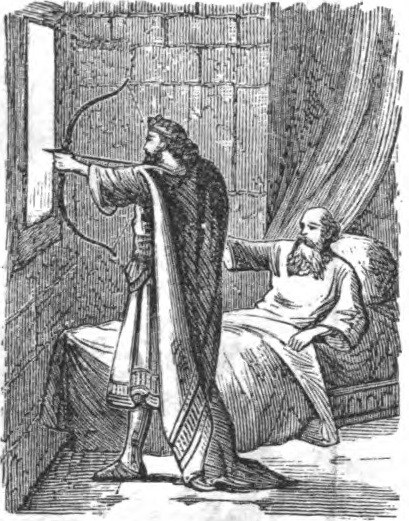
14 Now when Elisha had fallen sick with the illness of which he was to die, Joash king of Israel went down to him and wept before him, crying, “My father, my father! The chariots of Israel and its horsemen!” 15 And Elisha said to him, “Take a bow and arrows.” So he took a bow and arrows. 16 Then he said to the king of Israel, “Draw the bow,” and he drew it. And Elisha laid his hands on the king’s hands. 17 And he said, “Open the window eastward,” and he opened it. Then Elisha said, “Shoot,” and he shot. And he said, “The Lord‘s arrow of victory, the arrow of victory over Syria! For you shall fight the Syrians in Aphek until you have made an end of them.” 18 And he said, “Take the arrows,” and he took them. And he said to the king of Israel, “Strike the ground with them.” And he struck three times and stopped. 19 Then the man of God was angry with him and said, “You should have struck five or six times; then you would have struck down Syria until you had made an end of it, but now you will strike down Syria only three times.”

20 So Elisha died, and they buried him. Now bands of Moabites used to invade the land in the spring of the year. 21 And as a man was being buried, behold, a marauding band was seen and the man was thrown into the grave of Elisha, and as soon as the man touched the bones of Elisha, he revived and stood on his feet.

22 Now Hazael king of Syria oppressed Israel all the days of Jehoahaz. 23 But the Lord was gracious to them and had compassion on them, and he turned toward them, because of his covenant with Abraham, Isaac, and Jacob, and would not destroy them, nor has he cast them from his presence until now.

24 When Hazael king of Syria died, Ben-hadad his son became king in his place. 25 Then Jehoash the son of Jehoahaz took again from Ben-hadad the son of Hazael the cities that he had taken from Jehoahaz his father in war. Three times Joash defeated him and recovered the cities of Israel. – 2 Kings 13:10-25 ESV

Keeping up with the revolving door of kings who reigned over Israel and Judah is hard enough as it is, but it becomes even more difficult when two kings with the same name end up ruling at the same time. That’s the case in this particular passage. Jehoash ascends to the throne of Israel after the death of his father, Jehoahaz. And it just so happens that the king of Judah bears the same name. It seems only fitting and a bit ironic that these two nations that shared the same predilection for idolatry and apostasy would end up with rulers who shared the same name. And while their reigns would only intersect for a period of about two years, they shared far more than a common name. In the end, both men proved to be ungodly leaders who failed to lead their people back to the worship of Yahweh.

When Jehoash the king of Judah had received a less-than-encouraging message from God, he ordered the stoning of the messenger. It just so happened that the man he executed was Zechariah, the son of Jehoiada the priest. This was the same Jehoiada who had saved Jehoash from the hands of Queen Athaliah by providing him with sanctuary in the temple for six years. On Jehoash’s seventh birthday, Jehoiada had anointed him the king of Judah. But years later, when Jehoiada had died, Jehoash began to listen to the counsel of his ungodly advisors. He ended up forsaking Yahweh and, as a result, suffered defeat at the hands of a much smaller Syrian force. He was wounded in the battle and while recuperating from his injuries, he was assassinated by two of his own officials.

And the king of Israel, who bore the same name, shared a similar story of unfaithfulness and rebellion. The author sums up his 16-year reign with the words: “he did what was evil in the Lord’s sight. He refused to turn from the sins that Jeroboam son of Nebat had led Israel to commit” (2 Kings 13:11 NLT). He too forsook the Lord and led the people to continue their love affair with false gods. And it’s interesting to note that the heir to his throne was his son, Jeroboam II, whom he had named after the first king of the northern kingdom of Israel. His admiration for Jeroboam seems obvious but undeserved. After all, Jeroboam had been responsible for leading the Israelites into idolatry. When God had split the nation of Israel in two after the reign of Solomon, He had given the ten northern ten tribes to Jeroboam as his kingdom. But Jeroboam had responded to this gracious gift from God by erecting two golden calves and encouraging his people to forsake the worship of Yahweh. Yet, Jehoash thought enough of this man that he named his own son after him.

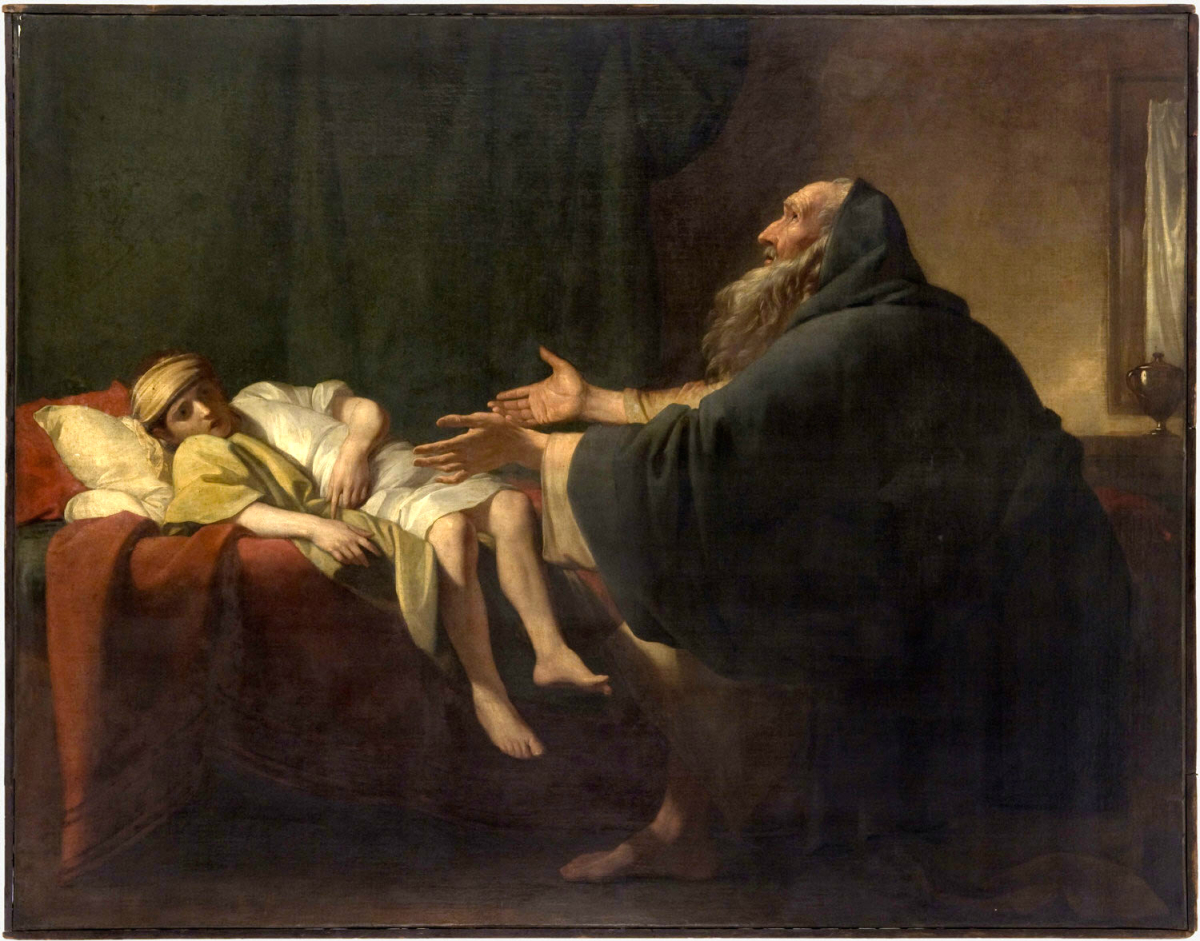
But sometime during his reign, Jehoash of Israel received word that the prophet Elisha was on his deathbed. Surprisingly, the king was grieved over this news and made a personal visit to see the dying prophet. While Jehoash was anything but a faithful worshiper of Yahweh, he knew that Elisha had great power and influence. This elderly prophet had proven time and time again that he spoke on behalf of God and was backed by the power of God. That’s why Jehoash greeted him with the somewhat cryptic statement: “My father, my father! The chariots of Israel and its horsemen!” (2 Kings 13:14 ESV). Evidently, Jehoash had heard the story of Elijah’s miraculous departure and Elisha’s role in it. Perhaps Elisha had shared with the king the details of that fateful day when God had used a whirlwind to  Elijah from the earth.

…as they still went on and talked, behold, chariots of fire and horses of fire separated the two of them. And Elijah went up by a whirlwind into heaven. And Elisha saw it and he cried, “My father, my father! The chariots of Israel and its horsemen!” And he saw him no more. – 2 Kings 2:11-12 ESV

This event had followed Elisha’s request for Elijah to provide him with a double portion of his spirit. He was to be Elijah’s replacement and he felt ill-equipped for the task. It could be that King Jehoash was hoping that Elisha would pour out his spirit on him as well. He understood that Elisha possessed power and had direct access to Yahweh. With the prophet’s death, all of that might be lost.

But rather than pour out his spirit on the apostate king, Elisha commanded him to take his bow and shoot an arrow out the window.

Elisha said, “Shoot,” and he shot. And he said, “The Lord‘s arrow of victory, the arrow of victory over Syria! For you shall fight the Syrians in Aphek until you have made an end of them.” – 2 Kings 13:17 ESV

Next, the prophet told the king to take his remaining arrows and shoot them into the ground. Jehoash dutifully obeyed, but when he stopped after the third arrow, Elisha responded in anger.

“You should have struck five or six times; then you would have struck down Syria until you had made an end of it, but now you will strike down Syria only three times.” – 2 Kings 13:19 ESV

In a sense, Elisha had poured out his spirit on King Jehoash. He had placed his hands on those of the king and, together, they had shot the first arrow out the window. He then assured the king of his victory over the Syrians. But the extent of that victory would be based on the faith of Jehoash. By limiting the number of arrows he shot into the ground, Jehoash was unwittingly revealing his lack of faith. The first arrow had symbolized the Lord’s victory over the Syrians. When Elisha had commanded Jehoash to shoot additional arrows, he should have understood that the symbolism remained the same. Each arrow was to have represented the Lord’s victory. But Jehoash had chosen to leave some of his arrows in the quiver. In doing so, he had inadvertently limited his chances of success over his enemy.

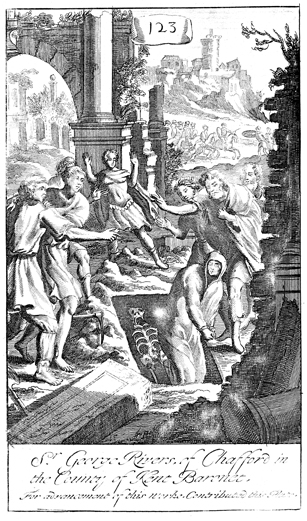
Having pronounced his last prophetic message, Elisha died. But the author relates a story that reveals one last miracle associated with the prophet of God. Sometime later, the body of a recently deceased man was inadvertently thrown into the cave containing Elisha’s bones. When the body of the dead man came into contact with Elisha’s remains, he was immediately restored to life. Amazingly, the author provides no further details to the story. We have no idea what happened to this newly resurrected man or how the story became known. But it was meant to reveal that, though Elisha was dead,  Yahweh was alive and well. Elisha’s departure was not meant to be mistaken as the abandonment of Israel by God. He was still fully capable of restoring life to the lifeless. The all-powerful God of Israel used the bones of a dead prophet to restore life to a dead Israelite, a clear symbol of His desire to renew those among His chosen people who were marked by spiritual death.

And the author reminds his readers that God remained faithful to His disobedient people, refusing to abandon them despite their constant rejection of Him.

…the Lord was gracious to them and had compassion on them, and he turned toward them, because of his covenant with Abraham, Isaac, and Jacob, and would not destroy them, nor has he cast them from his presence until now. – 2 Kings 13:23 ESV

The author also reveals that God kept His word concerning the fate of the Syrians. Jehoash experienced three separate victories over his enemy, matching the exact number of arrows he had shot into the ground. No more, no less. God gave allowed Jehoash to recover some of the territory stolen by the Syrians, but the fighting would continue throughout the rest of his reign. The sad reality is that the same God who raised a dead man back to life was fully capable of restoring a spiritually dead nation. But their continued stubbornness and lack of faithfulness would prevent them from experiencing the life-transformative power of Yahweh.

English Standard Version (ESV) The Holy Bible, English Standard Version. ESV® Permanent Text Edition® (2016). Copyright © 2001 by Crossway Bibles, a publishing ministry of Good News Publishers.

New Living Translation (NLT) Holy Bible, New Living Translation, copyright © 1996, 2004, 2015 by Tyndale House Foundation. Used by permission of Tyndale House Publishers Inc., Carol Stream, Illinois 60188. All rights reserved.

The Message (MSG)Copyright © 1993, 1994, 1995, 1996, 2000, 2001, 2002 by Eugene H. Peterson


The Battle for Belief

17 After this the son of the woman, the mistress of the house, became ill. And his illness was so severe that there was no breath left in him. 18 And she said to Elijah, “What have you against me, O man of God? You have come to me to bring my sin to remembrance and to cause the death of my son!” 19 And he said to her, “Give me your son.” And he took him from her arms and carried him up into the upper chamber where he lodged, and laid him on his own bed. 20 And he cried to the Lord, “O Lord my God, have you brought calamity even upon the widow with whom I sojourn, by killing her son?” 21 Then he stretched himself upon the child three times and cried to the Lord, “O Lord my God, let this child’s life come into him again.” 22 And the Lord listened to the voice of Elijah. And the life of the child came into him again, and he revived. 23 And Elijah took the child and brought him down from the upper chamber into the house and delivered him to his mother. And Elijah said, “See, your son lives.” 24 And the woman said to Elijah, “Now I know that you are a man of God, and that the word of the Lord in your mouth is truth.” – 1 Kings 17:17-24 ESV

God had used Elijah to deliver His message of judgment against King Ahab and his foreign queen, Jezebel. In marrying this princess from Sidon, Ahab had also adopted her false god, Baal, and built a temple for its worship. He had also erected a shrine to honor Asherah, the moon-goddess and supposed mother of this pagan deity. And God, angered by these blatant acts of rebellion and apostasy, had sent Elijah to tell the royal couple that their kingdom would suffer under a great drought. Their disrespect and disregard for God had brought His discipline.

But after Elijah had successfully delivered his message, God sent him away. He had ended up at a cave, where God had graciously and miraculously arranged for ravens to deliver all the food he needed to survive. But eventually, Elijah became a victim of the very drought he predicted. Soon, the brook dried up and the daily deliveries of bread and meat no longer appeared. So, God had sent Elijah to the Sidonian town of Zarephath, where he took up residence with a poor widow and her son. She too was suffering from the effects of the drought. But, once again, Yahweh proved Himself to be the one true God by causing her meager supply of flour and oil to miraculously multiply and never run out. In the midst of a drought and severe famine, she had more than enough to sustain herself, her son, and God’s prophet. And through it all, Elijah was learning to trust God for all His needs. But even more importantly, Elijah was discovering that his God was greater than the god of Ahab and Jezebel. While Baal, the so-called fertility god, was powerless to stop the drought or reverse the effects of the famine, Yahweh had turned “a handful of flour in a jar and a little oil in a jug” (1 Kings 17:12 ESV) into a never-ending food supply for Elijah and his gracious hostess.

Then suddenly, the story takes a dramatic turn for the worse. The woman’s young son dies unexpectedly. And, faced with this devastating change in her circumstances, the woman vented all her anger and frustration on the prophet of God.

“O man of God, what have you done to me? Have you come here to point out my sins and kill my son?” – 1 Kings 17:18 NLT

It seems that the woman had falsely assumed that her son’s death was a form of divine retribution for a former sin she had committed. Perhaps by this time, Elijah had shared the details of his encounter with Ahab and Jezebel, explaining that he had been the one to predict the drought as a punishment for their sin. So, when her son suddenly died, she would have naturally reasoned that God was using the prophet to deliver yet another judgment for sin – her own.

But ignoring her despair-driven accusation, Elijah took the lifeless body of her son and placed it on his own bed. Then Elijah turned his attention to God. But notice the tone of His prayer. He seems to echo the words of the widow, passing the blame up the food chain and questioning the goodness and graciousness of God.

“O Lord my God, why have you brought tragedy to this widow who has opened her home to me, causing her son to die?” – 1 Kings 17:20 NLT

Elijah’s response reveals his firm belief that God is sovereign over all things. But he is perplexed and confused by the seeming injustice of it all. And, in his frustration, He accuses God of doing something wicked. The Hebrew word is rāʿaʿ, which is most often translated as “evil.” The boy’s death makes no sense to Elijah. It seems unnecessary and completely unproductive. When Elijah had first met the woman, she had been fully expecting her son to die of starvation because of the drought. But God had intervened and provided more than enough food to keep all three of them alive. So, to Elijah, the boy’s death seemed pointless and, if anything, it appeared to be an act of cruelty.

But while Elijah was having a difficult time understanding the ways of God, he remained convinced of the power of God. Three times, he lay across the dead body of the boy and cried out, “O Lord my God, please let this child’s life return to him” (1 Kings 17:21 NLT). And the fact that Elijah repeated this process three separate times demonstrates both his persistence and dependence upon God.

It’s important to consider that Elijah had no precedence on which to base his prayer. He was asking Yahweh to do the impossible – to raise a dead body back to life. And there is no indication that Elijah had ever seen or heard of God doing such a thing. Elijah was not basing his request on some past miracle, recorded in the Hebrew scriptures. The Pentateuch, the first five books of the Bible, contains no instance of God raising the dead back to life. So, Elijah was asking God to something that had never been done before. His request was a tremendous act of faith.

And in a classic example of understatement, the author simply records, “The Lord heard Elijah’s prayer, and the life of the child returned, and he revived!” (1 Kings 17:22 NLT). One can only imagine Elijah’s shock and surprise that Elijah as the lifeless body of the boy was suddenly reanimated. Two times, nothing had happened. But on the third try, God had suddenly chosen to intervene and answer Elijah’s prayer. We’re not told why God didn’t answer Elijah’s prayer the first time. Perhaps it was a test of Elijah’s faith, to see if he would continue to ask and believe even when his request went unanswered. But God had heard and He ultimately answered – in a remarkable way. And you can sense Elijah’s unbridled excitement and enthusiasm as he announced the news to the boy’s grieving mother.

“See, your son lives.” – 1 Kings 17:23 ESV

It would be easy to misread this statement and assume that Elijah is saying something like, “See, I told you so!” It almost appears as if he is chastising the woman for her lack of faith. But at no point in the story did Elijah tell the woman that her son would live. He had no way of knowing that God was going to answer his prayer or not. And, at least two times, God had failed to do so. But when God had finally provided the miracle for which Elijah was asking, the prophet couldn’t contain his enthusiasm. The New Living Translation provides a much more accurate rendering of Elijah’s response.

“Look!” he said. “Your son is alive!” – 1 Kings 17:23 NLT

No one was as shocked as Elijah, and his joy overflowed in a display of emotional celebration. He most likely walked into the room, carrying the boy in his arms, and then handed him over to the smothering embrace of his overjoyed mother. And, through tears mixed with laughter, the woman managed to express her gratitude to the prophet by declaring her belief in his God.

“Now I know for sure that you are a man of God, and that the Lord truly speaks through you.” – 1 Kings 17:24 NLT

While Yahweh had been keeping her and her son alive, she must have had her doubts about Elijah and his God. But now, as she clutched her son in her arms, she finally recognized and confessed the sovereignty of God and the authority of His prophet. Her son had been dead but was now alive. Her greatest loss had been restored to her. Her sorrow had been turned to joy.

And don’t miss the fact that this miracle took place in an obscure village in the region of Sidon. While Jezebel had brought her false god to the land of Israel, Elijah had brought the God of Israel to the land of Sidon. The arrival of Baal had been accompanied by drought and famine. But when Yahweh made His appearance in the pagan land of the Sidonians, He had turned a widow’s poverty into plenty and had replaced death with life. And, in doing so, He had proved Himself to be the one and only God of the universe.

And God intended this powerful lesson to prepare His prophet for all that was about to come. Elijah didn’t know it yet, but the greatest test of his faith was in his future. After three years of a debilitating and devastating famine, God was going to send Elijah back to the land of Israel to go face-to-face with the king and queen and toe-to-toe with their false god.

English Standard Version (ESV) The Holy Bible, English Standard Version. ESV® Permanent Text Edition® (2016). Copyright © 2001 by Crossway Bibles, a publishing ministry of Good News Publishers.

New Living Translation (NLT) Holy Bible, New Living Translation, copyright © 1996, 2004, 2015 by Tyndale House Foundation. Used by permission of Tyndale House Publishers Inc., Carol Stream, Illinois 60188. All rights reserved.

The Message (MSG)Copyright © 1993, 1994, 1995, 1996, 2000, 2001, 2002 by Eugene H. Peterson

The Path to Glory

1 When Jesus had spoken these words, he lifted up his eyes to heaven, and said, “Father, the hour has come; glorify your Son that the Son may glorify you, 2 since you have given him authority over all flesh, to give eternal life to all whom you have given him. 3 And this is eternal life, that they know you, the only true God, and Jesus Christ whom you have sent. 4 I glorified you on earth, having accomplished the work that you gave me to do. 5 And now, Father, glorify me in your own presence with the glory that I had with you before the world existed. – John 17:1-5 ESV

Chapter 17 contains what has come to be known as Jesus’ “high priestly prayer.” This somewhat lofty designation is based on the role that the high priest of Israel played in mediating the spiritual needs of the people before God. Once a year, on the Day of Atonement, the high priest was allowed to enter the holy of holies and offer sacrifices intended to atone for the sins of the people. And God had warned Aaron, Moses’ brother and the high priest of Israel, that he was prohibited from entering the Most Holy Place at any other time.

“Tell Aaron your brother not to come at any time into the Holy Place inside the veil, before the mercy seat that is on the ark, so that he may not die. For I will appear in the cloud over the mercy seat.” – Leviticus 16:2 ESV

The author of the New Testament book of Hebrews picks up on this theme as he compares the role of the high priest with that of Jesus.

But only the high priest ever entered the Most Holy Place, and only once a year. And he always offered blood for his own sins and for the sins the people had committed in ignorance. By these regulations the Holy Spirit revealed that the entrance to the Most Holy Place was not freely open as long as the Tabernacle and the system it represented were still in use. This is an illustration pointing to the present time. – Hebrews 9:7-9 ESV

During the days of the Exodus, when the Israelites were making their way from Egypt to the land of Canaan, the  Most Holy Place in the Tabernacle was where the glory of God’s presence was said to dwell above the mercy seat on top of the Ark of the Covenant. And this sacred place was off-limits to all, including the high priest, except on the Day of Atonement. Even then, the high priest could only enter into God’s presence after performing a series of ritual cleansings to purify himself from sin.

Aaron shall come into the Holy Place: with a bull from the herd for a sin offering and a ram for a burnt offering. He shall put on the holy linen coat and shall have the linen undergarment on his body, and he shall tie the linen sash around his waist, and wear the linen turban; these are the holy garments. He shall bathe his body in water and then put them on. – Leviticus 16:3-4 ESV

Aaron, performing his role as the high priest, was also required to offer a bull as a sin offering for himself and a goat as a sin offering for the people. He would take some of the blood of the bull and sprinkle it on the mercy seat. Then he would do the same thing with the blood of the goat, “sprinkling it over the mercy seat and in front of the mercy seat. Thus he shall make atonement for the Holy Place, because of the uncleannesses of the people of Israel and because of their transgressions, all their sins” (Leviticus 16:15-16 ESV). 

These elaborate and mandatory rituals were designed to illustrate the glory and the holiness of God and to stress the unrighteousness of the people. It was not without the sacrifice of blood that the people of God could enter into His presence. Their sinfulness separated them from Him. And there was no way for them to stand before God in their sinful state. So, as the author of Hebrews states, atoning blood was required.

…according to the law of Moses, nearly everything was purified with blood. For without the shedding of blood, there is no forgiveness. – Hebrews 9:22 ESV

And according to Hebrews, Jesus had come to replace the old system with a new and better one.

So Christ has now become the High Priest over all the good things that have come. He has entered that greater, more perfect Tabernacle in heaven, which was not made by human hands and is not part of this created world. With his own blood—not the blood of goats and calves—he entered the Most Holy Place once for all time and secured our redemption forever. – Hebrew 9:11-12 NLT

So, when Jesus prayed this prayer, He was interceding on behalf of the people of God. He was acting as their high priest, mediating for them before God the Father. But in reality, Jesus would not be fully fulfilling His role as the high priest until He sacrificed His own blood on the cross as a payment for the sins of mankind.

Christ offered himself to God as a perfect sacrifice for our sins. – Hebrews 9:14 NLT

But this powerful prayer provides us with a glimpse into Jesus’ heart and mind as He prepared to fulfill His Father’s redemptive plan. He had just told His disciples, “But take heart; I have overcome the world” (John 16:33 ESV). And then John states, “When Jesus had spoken these words, he lifted up his eyes to heaven, and said…” (John 17:1 ESV). There is no break in the action. John doesn’t indicate that Jesus left the disciples and found a quiet place to be alone. He simply describes Jesus as lifting up His eyes and praying. One moment He had been talking to the disciples and then suddenly, He was talking to God. And John and the other disciples were allowed to eavesdrop on this intimate conversation between Jesus and His Heavenly Father.

Jesus had assured His disciples that they could take heart because He had overcome the world. His mission was as good as done. They could have complete confidence that what He had been sent to do, He would do. And Jesus expressed His complete commitment to fulfill His Father’s wishes by requesting that His glorification take place just as it had been planned.

“Father, the hour has come; glorify your Son that the Son may glorify you…” – John 17:1 ESV

Jesus is not just focusing His attention on His future resurrection and ascension. In other words, He’s not expressing His desire to get the crucifixion over with as quickly as possible so He can enjoy a restored relationship with the Father. For Jesus, the cross was a central part of the glorification process. By offering His life as an atonement for the sins of mankind, He would be faithfully fulfilling the will of His Father, performing the final act of obedience that would mark His life as pleasing to God.

“When you have lifted up the Son of Man, then you will know that I am he, and that I do nothing on my own authority, but speak just as the Father taught me. And he who sent me is with me. He has not left me alone, for I always do the things that are pleasing to him.” – John 8:28-29 ESV

Jesus knew that it was necessary for His death to proceed His glorification. The path to future glory passed through the shadow of the cross. It was just as He had told His disciples.

“Now the time has come for the Son of Man to enter into his glory. I tell you the truth, unless a kernel of wheat is planted in the soil and dies, it remains alone. But its death will produce many new kernels—a plentiful harvest of new lives.” – John 12:23-24 NLT

His death would produce new life – not only for Himself but for all those who placed their faith in Him. His crucifixion would result in His own glorification but also that of His followers. The apostle Paul reminds us of this incredible reality.

And we know that God works all things together for the good of those who love Him, who are called according to His purpose. For those God foreknew, He also predestined to be conformed to the image of His Son, so that He would be the firstborn among many brothers. And those He predestined, He also called; those He called, He also justified; those He justified, He also glorified. – Romans 8:28-30 BSB

Ultimately, Jesus was expressing His desire to bring glory to God. He knew that by sacrificing His life on the cross He would be expressing His Father’s love for mankind. The willingness of God to offer up His Son on behalf of sinful, undeserving humanity would end up glorifying Him by demonstrating His goodness and grace.

This is how God’s love was revealed among us: God sent His one and only Son into the world, so that we might live through Him. – 1 John 4:9 BSB

Jesus was the means by which God would extend His offer of eternal life to sinful humanity. And Jesus knew that He had been given divine authority to extend this offer on behalf of His Father.

For you have given him authority over everyone. He gives eternal life to each one you have given him. And this is the way to have eternal life—to know you, the only true God, and Jesus Christ, the one you sent to earth. – John 17:2-3 NLT

Everything that Jesus had done and said up until this point had brought glory to His Heavenly Father. He had done nothing of His own initiative or for His own glory.

“I have no wish to glorify myself, God is going to glorify me.” – John 8:50 NLT

He had come to earth in order to point people to God. The sole purpose behind His incarnation had been to be “the way, the truth, and the life” (John 14:6 NLT). There were no other means by which sinful men and women could find access to and a restored relationship with God.

Jesus indicates that He had done all He had been commissioned to do.

“I glorified you on earth, having accomplished the work that you gave me to do.” – John 17:4 ESV

His miracles and messages had all been in keeping with His Father’s will. And now, it was time to complete His mission and return to His Father’s side.

“And now, Father, glorify me in your own presence with the glory that I had with you before the world existed.” – John 17:5 ESV

Again, Jesus knew full well that the path to His glorification led through the cross. He would have to be “lifted up” before He could be raised up to His former place of glory at His Father’s side. The apostle Paul describes well this path of humility and suffering that would ultimately lead to Jesus’ glorification.

And being found in human form, he humbled himself by becoming obedient to the point of death, even death on a cross. Therefore God has highly exalted him and bestowed on him the name that is above every name, so that at the name of Jesus every knee should bow, in heaven and on earth and under the earth, and every tongue confess that Jesus Christ is Lord, to the glory of God the Father. – Philippians 2:8-11 ESV

English Standard Version (ESV) The Holy Bible, English Standard Version. ESV® Permanent Text Edition® (2016). Copyright © 2001 by Crossway Bibles, a publishing ministry of Good News Publishers.

New Living Translation (NLT) Holy Bible, New Living Translation, copyright © 1996, 2004, 2015 by Tyndale House Foundation. Used by permission of Tyndale House Publishers Inc., Carol Stream, Illinois 60188. All rights reserved.

The Message (MSG)Copyright © 1993, 1994, 1995, 1996, 2000, 2001, 2002 by Eugene H. Peterson

Father, Glorify Your Name

28 “Father, glorify your name.” Then a voice came from heaven: “I have glorified it, and I will glorify it again.” 29 The crowd that stood there and heard it said that it had thundered. Others said, “An angel has spoken to him.” 30 Jesus answered, “This voice has come for your sake, not mine. 31 Now is the judgment of this world; now will the ruler of this world be cast out. 32 And I, when I am lifted up from the earth, will draw all people to myself.” 33 He said this to show by what kind of death he was going to die. 34 So the crowd answered him, “We have heard from the Law that the Christ remains forever. How can you say that the Son of Man must be lifted up? Who is this Son of Man?” 35 So Jesus said to them, “The light is among you for a little while longer. Walk while you have the light, lest darkness overtake you. The one who walks in the darkness does not know where he is going. 36 While you have the light, believe in the light, that you may become sons of light.” – John 12:28-36 ESV

In four simple words, Jesus provides a succinct yet accurate summary of the attitude behind His entire earthly ministry. All He said or did was driven by His unwavering desire to bring glory to His Heavenly Father. And John has provided ample evidence of Jesus’ commitment to glorify God through His life.

“The one who speaks on his own authority seeks his own glory; but the one who seeks the glory of him who sent him is true, and in him there is no falsehood.” – John 7:18 ESV

“When you have lifted up the Son of Man, then you will know that I am he, and that I do nothing on my own authority, but speak just as the Father taught me. And he who sent me is with me. He has not left me alone, for I always do the things that are pleasing to him.” – John 8:28-29 ESV

“Yet I do not seek my own glory; there is One who seeks it, and he is the judge.” – John 8:50 ESV

Matthew records the impassioned words of Jesus that He prayed to His Father in the garden on the night He was betrayed.

“My Father, if it be possible, let this cup pass from me; nevertheless, not as I will, but as you will.” – Matthew 26:39 ESV

Earlier, in one of His confrontations with the religious leaders, Jesus had boldly proclaimed His unity with the Father when He stated, “I and the Father are one” (John 10:30 ESV). Jesus was claiming equality with God. He had been at His Father’s side at the creation of the world and, as John wrote, “All things were made through him, and without him was not any thing made that was made” (John 1:3 ESV).

And yet, though Jesus was the Son of God, the Co-Creator of the universe, and shared the same divine attributes of His Father, He was not out to make a name for Himself. In fact, Paul reminds us that Jesus “did not count equality with God a thing to be grasped, but emptied himself, by taking the form of a servant, being born in the likeness of men” (Philippians 2:6-7 ESV). And it is in His human state that Jesus is desiring to glorify God. Adam and Eve were created by the Holy Trinity and placed in the garden that they might serve as stewards over the rest of creation. They were created in the image of God and given a divine mandate to care for every other living thing on the earth.

“Let us make man in our image, after our likeness. And let them have dominion over the fish of the sea and over the birds of the heavens and over the livestock and over all the earth and over every creeping thing that creeps on the earth.” – Genesis 1:2 ESV

But Adam and Eve failed to bring God glory because they failed to live in obedience to His commands. He had deemed one tree in the garden as off-limits, prohibiting them from eating its fruit. But they willfully disobeyed Him, choosing to listen to the lie of Satan instead. Blatantly contradicting the words of God, Satan told Eve that if she ate the fruit of the forbidden tree, rather than experience death, she would become like God. She would experience self-glorification and have the same divine capabilities as God, knowing good and evil.

“You will not surely die. For God knows that when you eat of it your eyes will be opened, and you will be like God, knowing good and evil.” – Genesis 3:4-5 ESV

And Eve, enticed by the offer of glorification, ate of the fruit and shared it with her complacent and compliant husband. And the rest is history.

But Jesus, by taking on human flesh, was out to set the record straight and prove that a man could live according to the commands of God and glorify Him in the process. Jesus knew that the only way His life would bring glory to His Father would be to live in perfect obedience to His will, and that included suffering death on the cross. And Paul describes what this willful submission to the Father’s will looked like for Jesus.

[Jesus] emptied himself, by taking the form of a servant, being born in the likeness of men. And being found in human form, he humbled himself by becoming obedient to the point of death, even death on a cross. – Philippians 2:7-8 ESV

And in his letter to the believers in Rome, Paul juxtaposes the disobedience of Adam with the obedience of Jesus. One’s attempt to glorify himself resulted in condemnation for all men, while the other’s commitment to glorify God resulted in justification and forgiveness for many.

Yes, Adam’s one sin brings condemnation for everyone, but Christ’s one act of righteousness brings a right relationship with God and new life for everyone. Because one person disobeyed God, many became sinners. But because one other person obeyed God, many will be made righteous. – Romans 5:18-19 ESV

In response to Jesus’ request that God be glorified through His life, His Father responded, “I have glorified it, and I will glorify it again” (John 12:28 ESV). God was confirming that His Son’s entire life, up to that very moment, had been glorifying to Him. The incarnation of Jesus was God-glorifying because it the invisible God visible (Colossians 1:15). Every one of the miracles Jesus performed glorified the Father because He did them in keeping with the will of God and by the power of God. And the final and greatest act of glorification was coming. God would be glorified through Jesus’ death, burial, and resurrection.

Every aspect of Jesus’ life brought glory to God because all that He did was in obedience to the will of God. He did nothing for His own glory. He never allowed His own human will to supersede the will of His heavenly Father. This is exactly what He meant when He prayed, “I want your will to be done, not mine” (Matthew 26:39 NLT).

The crowd surrounding Jesus heard the voice of God but were unaware of who it was or what it meant. But Jesus clarified what His Father had meant when He had said “I will glorify it again” (John 12:28 ESV).

“Now is the judgment of this world; now will the ruler of this world be cast out. And I, when I am lifted up from the earth, will draw all people to myself.” He said this to show by what kind of death he was going to die.” – John 12:31-33 ESV

God was about to implement the final phase of His redemptive plan for mankind, and it would entail the death of His Son. By being “lifted up” on the cross, Jesus would “draw all people” to Himself. The cross would become the focal point of all human history. On the cross, the righteous wrath of God would be poured out on His sinless Son. But at the same time, the gracious love of God would be poured out in abundance on all who would lift their eyes to the broken and bloodied body of the Lamb of God and accept Him as the one who takes away the sins of the world.

After the death of Jesus, the cross, long a symbol of death in the Roman world, would become a symbol of life among believers. Because Jesus would faithfully fulfill the will of His Father, accepting His divine assignment to serve as the atoning sacrifice for the sins of mankind, God would be glorified. His will would be done. And, as a result, God would glorify Jesus by raising Him from the dead, proving that His sacrifice had been acceptable and effective. The resurrection of Jesus would be followed by His ascension. The faithful Son would be glorified, returning to His rightful place at His Father’s side.

But as usual, the crowd was confused by all they heard. They seem to have understood that Jesus was discussing His coming death, but this did not gel with the concept of the Messiah. They were expecting a conquering king, not a suffering servant. Their confusion is clearly evident in the questions they posed to Jesus.

“We understood from Scripture that the Messiah would live forever. How can you say the Son of Man will die? Just who is this Son of Man, anyway?” – John 12:34 NLT

But rather than answer their questions, Jesus reiterated His warning that the light of His presence would not always be with them. He was going away.

“My light will shine for you just a little longer. Walk in the light while you can, so the darkness will not overtake you. Those who walk in the darkness cannot see where they are going. Put your trust in the light while there is still time; then you will become children of the light.” – John 12:35-36 NLT

Like much of what Jesus said, these words were probably aimed at the ears of a small contingent of individuals, including His 12 disciples, and others like Mary, Martha, and Lazarus, who were His committed followers. Jesus is letting them know that the days ahead were going to become increasingly dark. The spiritual battle that had been taking place for years was going to intensify, and the full fury of the enemy was going to fall on Him. But regardless of all that was about to happen, Jesus wanted His followers to remain faithful and to continue to walk in the light of His word right up to the bitter end.

English Standard Version (ESV) The Holy Bible, English Standard Version. ESV® Permanent Text Edition® (2016). Copyright © 2001 by Crossway Bibles, a publishing ministry of Good News Publishers.

New Living Translation (NLT) Holy Bible, New Living Translation, copyright © 1996, 2004, 2015 by Tyndale House Foundation. Used by permission of Tyndale House Publishers Inc., Carol Stream, Illinois 60188. All rights reserved.

The Message (MSG)Copyright © 1993, 1994, 1995, 1996, 2000, 2001, 2002 by Eugene H. Peterson