No Love For God or Others

1 One Sabbath, when he went to dine at the house of a ruler of the Pharisees, they were watching him carefully. And behold, there was a man before him who had dropsy. And Jesus responded to the lawyers and Pharisees, saying, “Is it lawful to heal on the Sabbath, or not?” But they remained silent. Then he took him and healed him and sent him away. And he said to them, “Which of you, having a son or an ox that has fallen into a well on a Sabbath day, will not immediately pull him out?” And they could not reply to these things. – Luke 14:1-6 ESV

Luke has already established that there was a great divide between Jesus and the religious leaders of Israel, particularly the Pharisees. They viewed Jesus with disdain and distrust, having determined that He was a danger to their way of life. From their viewpoint, the teaching of Jesus was divisive, encouraging the people to question the status quo. His seemingly radical views regarding the law were undermining their authority and damaging the carefully crafted reputations of the Pharisees, Sadducees, and scribes. These men had fooled the people into believing that they were spiritually superior, having painstakingly kept every letter of the law. But Jesus had exposed them as hypocrites and fools.

“Now you Pharisees cleanse the outside of the cup and of the dish, but inside you are full of greed and wickedness. You fools! Did not he who made the outside make the inside also?” – Luke 11:39-40 ESV

They were all about appearances. Everything they did was meant to give the impression that they were faithful adherents to the law and, therefore, righteous before God and man. But Jesus was not fooled by their outward displays of righteousness because He knew the true condition of their hearts. And He repeatedly exposed them for what they were.

“…you are careful to tithe even the tiniest income from your herb gardens, but you ignore justice and the love of God.” – Luke 11:42 NLT

“…you love to sit in the seats of honor in the synagogues and receive respectful greetings as you walk in the marketplaces. – Luke 11:43 NLT

“…you are like hidden graves in a field. People walk over them without knowing the corruption they are stepping on.” – Luke 11:44 NLT

“…you crush people with unbearable religious demands, and you never lift a finger to ease the burden. – Luke 11:46 NLT

And these stinging indictments from Jesus infuriated these prideful and arrogant men, intensifying their hostility toward Him and prompting them to come up with plan for His elimination.

As Jesus was leaving, the teachers of religious law and the Pharisees became hostile and tried to provoke him with many questions. They wanted to trap him into saying something they could use against him. – Luke 11:53-54 NLT

Jesus had done little to win over these powerful and influential religious leaders. In fact, He had consistently exposed them as enemies of God, even describing them as the sons of Satan.

“For you are the children of your father the devil, and you love to do the evil things he does. He was a murderer from the beginning. He has always hated the truth, because there is no truth in him. When he lies, it is consistent with his character; for he is a liar and the father of lies. So when I tell the truth, you just naturally don’t believe me!” – John 8:44-45 NLT

And, much to their chagrin and anger, Jesus went on to declare that they were not even children of God.  “You don’t belong to God,” he told them (John 8:47 NLT). Not only that, they had no place in the kingdom of God.

“…you remove the key to knowledge from the people. You don’t enter the Kingdom yourselves, and you prevent others from entering.” – Luke 11:52 NLT

And yet, even after all this, Luke describes Jesus accepting an invitation to dine in the home of one of the rulers of the Pharisees. At first glance, this seems like a rather strange decision for Jesus to make. Luke even admits that the Pharisees, “were watching him carefully” (Luke 14:1 ESV). In a sense, these men didn’t want to let Jesus out of their sight. In their effort to expose Jesus as a fraud and a violator of the law, they maintained a close watch over His every move. And it would seem that this dinner engagement was arranged to take place on the Sabbath, in the hopes that Jesus would once again break one of the many laws the Pharisees and their cohorts had made to regulate that holy day.

This whole dinner was a well-orchestrated set-up and Jesus saw through it. On seven separate occasions, Jesus had violated their Sabbath laws. Luke chapter 4 contains the story of Jesus healing a demon-possessed man in the synagogue in Capernaum on the Sabbath. That very same day, He had chosen to heal Simon Peter’s mother-in-law of a fever. Luke chapter 6 records another occasion when Jesus healed someone of the Sabbath – in the synagogue. This time, it was a man who suffered from a withered hand. And in the audience that day were scribes and Pharisees who “watched him, to see whether he would heal on the Sabbath so that they might find a reason to accuse him” (Luke 6:7 ESV). And when Jesus healed the man, “they were filled with fury and discussed with one another what they might do to Jesus” (Luke 6:11 ESV).

Time and time again, Jesus had purposefully chosen to violate their Sabbath laws. At one point, He even declared, “The Son of Man is lord of the Sabbath” (Luke 6:5 ESV). He knew that the Pharisees and scribes found His actions to be unacceptable and appalling. They viewed Him as a law-breaker who treated their sacrosanct religious regulations with disdain. But Jesus wanted them to wrestle with the letter of the law. He wanted them to understand God’s intentions when He gave them the law.

“I ask you, is it lawful on the Sabbath to do good or to do harm, to save life or to destroy it?” – Luke 6:9 NLT

For the Pharisees, the rules and regulations took precedence. They had made strict adherence to the law the end game. But, as the Son of God, Jesus knew that His Father’s real intentions for the law were about regulating man’s love for God and love for others. That’s why, when Jesus was asked to list the greatest of the commandments, He stated, “You must love the Lord your God with all your heart, all your soul, and all your mind.’ This is the first and greatest commandment. A second is equally important: ‘Love your neighbor as yourself’” (Matthew 22:37-39 NLT).

The Pharisees were missing the point. Their love of law-keeping had long ago replaced their love for God and others. And the very fact that this ruler of the Pharisees had invited a man with dropsy to his dinner reveals the sad state of his heart. Most likely, this man suffered from edema, a painful condition that caused the accumulation of fluid in the body tissue or the body cavities. Luke seems to indicate that the man was little more than a prop, a predetermined tool of the Pharisee designed to set Jesus up. Luke states, “And behold, there was a man before him who had dropsy” (Luke 14:2 ESV). Seemingly out of nowhere, this man showed up. And the fact that he was at the party should send up red flags. The Pharisee would have viewed this man’s condition as the result of immorality. So, it would have been very uncharacteristic for this well-respected Pharisee to invite an obvious sinner into his home on the Sabbath – unless he had an ulterior motive. And Jesus seems to have seen through the Pharisee’s intentions. He raises the very same question he had asked in the synagogue just before He healed the man with the withered hand.

“Is it lawful to heal on the Sabbath, or not?” – Luke 14:3 ESV

He addressed this question to the ruler of the Pharisees and his esteemed guests, who were also Pharisees and scribes. These men were supposed to be the experts when it came to religious law, so Jesus asked them to deliver their outlook on the matter. But they remained silent. They were smart enough to know that this was a trick question. If they answered, anything they said could and would be used against them.

Since they refused to answer Jesus’ question, He took the liberty of healing the man and sending him on his way. And then Jesus turned to His host but addressed His question to everyone in the room.

Which of you, having a son or an ox that has fallen into a well on a Sabbath day, will not immediately pull him out?” – Luke 14:5 ESV

Jesus puts them on the spot by making the situation more practical and personal. If any of these men had a son who had fallen into a well on the Sabbath, they would do whatever it took to rescue him. They would even do the same thing for a beast of burden. And yet, they had probably become enraged when Jesus healed the man with dropsy. In their minds, the man had no value. He was of little worth because he was a sinner. They wrongly believed that he suffered from his debilitating disease because he had committed some egregious and unforgivable sin. In fact, he had probably violated one of God’s commandments.

But the question Jesus posed to his dinner companions was intended to expose their ignorance of God’s laws. Even Moses had recorded the heart behind the law when he wrote:

“If you come upon your enemy’s ox or donkey that has strayed away, take it back to its owner. If you see that the donkey of someone who hates you has collapsed under its load, do not walk by. Instead, stop and help. – Exodus 23:4-5 NLT

Jesus knew that the Pharisees despised the man He had just healed. They saw him as the enemy. They hated him because they viewed him as a sinner and a violator of their precious laws. And they were unwilling to do anything that might make this man’s life remotely easier and more bearable. In fact, Jesus would later indict them for their hypocritical adherence to the law while ignoring the plight of those for whom the law was intended to help.

“The teachers of religious law and the Pharisees are the official interpreters of the law of Moses. So practice and obey whatever they tell you, but don’t follow their example. For they don’t practice what they teach. They crush people with unbearable religious demands and never lift a finger to ease the burden.” – Matthew 23:2-4 NLT

The Pharisees were at a loss as to how to respond to Jesus’ question. So, they refused to answer and their silence condemned them. They had just demonstrated that they had no love for God because they showed no love for those whom God had made. Their disdain for the man with dropsy was only exceeded by their disgust for the one who had just healed him. They continued to see Jesus as a lawbreaker and troublemaker. And, in their minds, the man who had just experienced healing remained just as guilty and worthy of condemnation as before. The miraculous change in his physical health had done nothing to alter his spiritual condition. Or so they thought. They just couldn’t bring themselves to believe that Jesus was the long-awaited Messiah and that He had come to bring Good News to the poor…to proclaim that captives will be released, that the blind will see, that the oppressed will be set free, and that the time of the Lord’s favor has come” (Luke 4:18-19 NLT).

English Standard Version (ESV) The Holy Bible, English Standard Version. ESV® Permanent Text Edition® (2016). Copyright © 2001 by Crossway Bibles, a publishing ministry of Good News Publishers.

New Living Translation (NLT) Holy Bible, New Living Translation, copyright © 1996, 2004, 2015 by Tyndale House Foundation. Used by permission of Tyndale House Publishers Inc., Carol Stream, Illinois 60188. All rights reserved.
The Message (MSG)Copyright © 1993, 1994, 1995, 1996, 2000, 2001, 2002 by Eugene H. Peterson

Lord of the Sabbath

1 On a Sabbath, while he was going through the grainfields, his disciples plucked and ate some heads of grain, rubbing them in their hands. But some of the Pharisees said, “Why are you doing what is not lawful to do on the Sabbath?” And Jesus answered them, “Have you not read what David did when he was hungry, he and those who were with him: how he entered the house of God and took and ate the bread of the Presence, which is not lawful for any but the priests to eat, and also gave it to those with him?” And he said to them, “The Son of Man is lord of the Sabbath.”

On another Sabbath, he entered the synagogue and was teaching, and a man was there whose right hand was withered. And the scribes and the Pharisees watched him, to see whether he would heal on the Sabbath, so that they might find a reason to accuse him. But he knew their thoughts, and he said to the man with the withered hand, “Come and stand here.” And he rose and stood there. And Jesus said to them, “I ask you, is it lawful on the Sabbath to do good or to do harm, to save life or to destroy it?” 10 And after looking around at them all he said to him, “Stretch out your hand.” And he did so, and his hand was restored. 11 But they were filled with fury and discussed with one another what they might do to Jesus. Luke 6:1-11 ESV

Repressive and restrictive rules and regulations had become the mainstay of the prevailing religious system of the Jews, and its gatekeepers were the scribes and Pharisees who were closely evaluating the actions of Jesus. To these men, Jesus was a loose cannon, a renegade Rabbi from the small town of Nazareth who was teaching heresy and guilty of blasphemy. They couldn’t deny the fact that Jesus was a miracle worker but they were slowly gathering evidence that would prove His blatant disregard for their laws and His unacceptable association with moral reprobates and social outcasts. In their minds, Jesus was a troublemaker who refused to follow the rules and was leading the common people astray with His blasphemous offers of forgiveness for sins and the tantalizing promise of a coming kingdom.

The religious leaders had already confronted Jesus about His choice of dinner companions.

“Why do you eat and drink with tax collectors and sinners?” – Luke 5:30 ESV

They deemed Jesus as a poor judge of character. He willingly associated with the dregs of society, the very sinners who the religious leaders believed were preventing Israel from experiencing the full blessings of God. And His disciples were no better. These men were, for the most part, nothing but uneducated Galilean fishermen who were gluttonous and ignorant of the laws concerning prayer and fasting. And they had been more than willing to point out this apparent flaw in Jesus’ followers.

“The disciples of John fast often and offer prayers, and so do the disciples of the Pharisees, but yours eat and drink.” – Luke 5:33 ESV

But what these men failed to realize was that Jesus, as the Son of God, was not subject to their manmade laws and decrees. As the Creator-God, He had authority over all things. The apostle John described the basis for Jesus’ exemption from the Pharisees’ repressive rules.

In the beginning was the Word, and the Word was with God, and the Word was God. He was in the beginning with God. All things were made through him, and without him was not any thing made that was made. – John 1:1-3 ESV

And the apostle Paul would go on to explain the overarching nature of Jesus’ divine authority over everyone and everything.

He is the image of the invisible God, the firstborn of all creation. For by him all things were created, in heaven and on earth, visible and invisible, whether thrones or dominions or rulers or authorities—all things were created through him and for him. And he is before all things, and in him all things hold together. – Colossians 1:15-17 ESV

But as Jesus walked the earth, He appeared to these religious leaders as nothing more than a man who was violating their precious precepts and encouraging the uneducated peasants to do the same. He was threatening their way of life by diminishing their control over the people. Without rules, society would devolve into anarchy and chaos. These men had made a god out of the Mosaic Law. The righteous rules and regulations prescribed by God and handed down by Moses had become more important than the Law-Giver. Their strict adherence to the law had replaced their affection for God. And Jesus would later declare these very same men to be nothing more than pious-looking pretenders whose religious zeal was misplaced and whose love for God had been replaced by their lust for power and control.

“You hypocrites! Isaiah was right when he prophesied about you, for he wrote, ‘These people honor me with their lips, but their hearts are far from me. Their worship is a farce, for they teach man-made ideas as commands from God.’” – Matthew 15:7-9 NLT

At the heart of their monolithic legal system was the Sabbath and the seemingly endless list of rules they had developed to regulate its observance. So, it was not long before Jesus found Himself at odds with the religious leaders over His lack of protocol concerning this holy day. Luke records that Jesus and His disciples were making their way through a field of grain on the Sabbath. As they did so, “his disciples plucked and ate some heads of grain, rubbing them in their hands” (Luke 6:1 ESV). According to Deuteronomy 23:25, the Mosaic Law provided a waiver that allowed anyone to pluck grain by hand.

If you go into your neighbor’s standing grain, you may pluck the ears with your hand… – Deuteronomy 23:25 ESV

But as Luke reveals, the disciples were being watched by the Pharisees, who immediately deemed their actions as a violation of their laws concerning the Sabbath. According to their strict interpretation of the Mosaic Law, the disciples were guilty of harvesting, reaping, and meal preparation, which were all prohibited on the Sabbath. With legalistic zeal, they immediately confronted Jesus and His disciples, pointing out their seeming disregard for the Law.

“Why are you doing what is not lawful to do on the Sabbath?” – Luke 6:3 ESV

Rather than explain the actions of His disciples, Jesus took these men to the Scriptures. He reminded them of a story involving the great king, David. The book of 1st Samuel records an incident in which David ate bread that had been dedicated to the Lord. David was the anointed king of Israel, but he and his men were on the run from the current occupant of the throne: King Saul. When they arrived at Nob, David convinced the priest to give his men the bread of the Presence, holy bread that was unlawful for them to eat. In doing so, David violated the ceremonial law but because he was the Lord’s anointed, his actions did not violate God’s moral law. Human need took precedence over the ceremonial law. Jesus would later use this same logic to justify His healing of a man on the Sabbath. He would ask the Pharisees, “Which of you doesn’t work on the Sabbath? If your son or your cow falls into a pit, don’t you rush to get him out?” (Luke 14:5 NLT).

The Pharisees refused to answer Jesus’ question because to do so would have shot a hole in the logic behind their entire legal system. They cared more for their rules than they did for the people for whom they were responsible to God. And Jesus was not about to follow their lead.

According to Jesus, what David did was acceptable to God and, therefore, the behavior of His disciples was as well. Then He added a statement that must have left the Pharisees apoplectic with rage.

“The Son of Man is lord of the Sabbath.” – Luke 6:5 ESV

Jesus was clearly stating His divinity and authority. He was declaring His divine right to authorize the behavior of His disciples –even if it violated the Sabbath law – which it did not. As God, Jesus was the author of the Law, and He had not come to abolish or violate the Law, but to fulfill it (Matthew 5:17).

Luke follows up this story with a second occasion in which the Pharisees confront Jesus for His violation of Sabbath law. This time it involves Jesus’ decision to heal on the Sabbath, thereby doing “work” and willingly breaking the law. Luke makes it clear that this event took place on the Sabbath and in the local synagogue. And Jesus was fully aware that the entire scene was a setup, knowing that the Pharisees were waiting “to see whether he would heal on the Sabbath, so that they might find a reason to accuse him” (Luke 6:7 ESV). And He did not disappoint them. Jesus purposefully called forward a man who had a withered hand and had him stand in front of the congregation gathered in the synagogue. In a sense, this man became a prop in Jesus’ lesson on the Sabbath law. With the man standing in front of Him, Jesus directed a question at the Pharisees and scribes:

“I ask you, is it lawful on the Sabbath to do good or to do harm, to save life or to destroy it?” – Luke 6:9 ESV

There was no response. The religious leaders knew that they were caught between a rock and a hard place. If they said it was unlawful to do good on the Sabbath, they would come across as uncaring and unloving. If they answered in the affirmative, they would be validating the behavior of Jesus. So, they remained silent.

Luke records that Jesus looked at each of them, waiting for a response. This delay must have felt like an eternity to these men, as all eyes in the synagogue were fixed on them. But Jesus finally broke the silence by turning His attention to the man with the withered hand and stating, “Stretch out your hand” (Luke 6:10 ESV). And as soon as the man complied, his hand was immediately and miraculously restored.

But rather than responding with awe and amazement at Jesus’ supernatural display of power, the religious leaders became incensed. Luke reports that they “were filled with fury and discussed with one another what they might do to Jesus” (Luke 6:11 ESV). They had just witnessed living proof that Jesus was indeed Lord of the Sabbath, but they were furious because Jesus had made them look like fools. He had made a mockery of their ceremonial laws and further enhanced His reputation among the people – and all at their expense.

Jesus had displayed His power and authority over disease, demons, and even the Sabbath. But the religious leaders were convinced that He was a menace to society who showed them no respect and had no regard for their sacred traditions. By the time they made their way back to Jerusalem with the latest reports of Jesus’ exploits, their superiors would have already made their decision to eliminate this growing threat to the nation.

English Standard Version (ESV) The Holy Bible, English Standard Version. ESV® Permanent Text Edition® (2016). Copyright © 2001 by Crossway Bibles, a publishing ministry of Good News Publishers.

New Living Translation (NLT) Holy Bible, New Living Translation, copyright © 1996, 2004, 2015 by Tyndale House Foundation. Used by permission of Tyndale House Publishers Inc., Carol Stream, Illinois 60188. All rights reserved.

The Message (MSG)Copyright © 1993, 1994, 1995, 1996, 2000, 2001, 2002 by Eugene H. Peterson

Lord of the Sabbath

1 After this there was a feast of the Jews, and Jesus went up to Jerusalem.

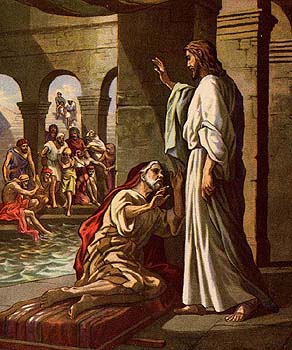
Now there is in Jerusalem by the Sheep Gate a pool, in Aramaic called Bethesda, which has five roofed colonnades. In these lay a multitude of invalids—blind, lame, and paralyzed. One man was there who had been an invalid for thirty-eight years. When Jesus saw him lying there and knew that he had already been there a long time, he said to him, “Do you want to be healed?” The sick man answered him, “Sir, I have no one to put me into the pool when the water is stirred up, and while I am going another steps down before me.” Jesus said to him, “Get up, take up your bed, and walk.” And at once the man was healed, and he took up his bed and walked.

Now that day was the Sabbath. 10 So the Jews said to the man who had been healed, “It is the Sabbath, and it is not lawful for you to take up your bed.” 11 But he answered them, “The man who healed me, that man said to me, ‘Take up your bed, and walk.’ 12 They asked him, “Who is the man who said to you, ‘Take up your bed and walk’?” John 5:1-12 ESV

With the opening of chapter 5, John begins to explore the growing tension between Jesus and the religious authorities. While the meeting between Jesus and Nicodemus, a Pharisees himself, had been somewhat controversial, it had remained cordial. But with Jesus’ return to Jerusalem, the anger and resentment of the Pharisees and Sadduccees will become increasingly more evident and intense.

John will not abandon the theme of belief that has characterized the first four chapters, but he will now juxtapose it with the growing unbelief of the religious elite of Israel. In a sense, John will use the Pharisees and Sadduccees as a counterpoint to Jesus. These men were to have been the shepherds of Israel, leading the people to the truth of God’s Word and exemplifying a life of obedience. But as John will point out, their legalistic, rule-keeping mindset and arrogant self-righteousness stand in stark contrast to Jesus’ commitment to put the will of God above all else.  

“For I have come down from heaven, not to do my own will but the will of him who sent me. And this is the will of him who sent me, that I should lose nothing of all that he has given me, but raise it up on the last day. For this is the will of my Father, that everyone who looks on the Son and believes in him should have eternal life, and I will raise him up on the last day.” – John 6:38-40 ESV

Jesus was on a mission and He would not allow anything or anyone to hinder Him fulfilling the role assigned to Him by His Heavenly Father. He had divine authority to do the things He did. As the Son of God, Jesus did not need the permission of the legal or religious authorities because He was acting on behalf of God Almighty. The will of God superseded that of all other human authorities and allowed Jesus to perform signs and wonders that appeared to contradict the laws of nature and violate the rules of men.

After His brief excursion into the northern region of Galilee, Jesus made a second trip to Jerusalem in order to attend yet another Jewish festival. There were three annual feasts that all Jewish males were required to attend: Passover, Pentecost, and Tabernacles. In recounting this particular story, John leaves the name of the festival out, evidently deeming it as irrelevant to the point he was trying to make.

But John was quite specific when describing the location for this event. The context was critical to understanding what is going on in the story. Jesus arrived at the Pool of Bethesda, just outside the walls of the temple compound. This was a well-known and well-trafficked spot in Jerusalem because the waters of the spring-fed pool were believed to have healing qualities. The setting is key to understanding what is about to take place. As John stated in verse 3, the pool was a magnet for the “blind, lame, and paralyzed.” They all made their way to the pool each day in the hopes that the miraculous powers of the water might make them whole.

While John pointed out that “a multitude of invalids” surrounded the pool, he focused his attention on one particular man whose paralytic condition had persisted for 38 years. It is not clear whether this man had been coming to the pool for nearly four decades or if this was his first time to seek help from its healing waters. But John’s emphasis on the length of time is meant to accentuate the hopelessness of the man’s plight. And Jesus, upon seeing the man, was immediately aware of the decades-long nature of his condition, which makes the question He asks sound so unnecessary and out-of-place.

“Do you want to be healed?” – John 5:6 ESV

Of course, he did. What kind of question is that to ask at a time like this? This poor man had somehow made it all the way to the pool, in spite of his paralysis. He would not have been lying beside the waters if he had not wanted to experience healing.

John does not explain why Jesus chose to single out this one man. There were obviously others at the pool that day, and each and every one of them was there hoping for the same thing: Healing. But Jesus chose to speak to this man. And in response to Jesus’ question, the man explained his plight.

Sir, I have no one to put me into the pool when the water is stirred up, and while I am going another steps down before me.” – John 4:7 ESV

His problem was not a lack of desire, but it was a lack of opportunity and capacity. His paralysis made it physically impossible for him to pursuit healing. His very condition proved to be a barrier to ever seeing his greatest desire fulfilled. Evidently, the pool’s healing powers were only available when the water was “stirred up.” It was only at that particular moment that a miracle could be expected, but it was reserved for the one who entered the water first. And this man, completely incapacitated by his illness and without anyone to assist him, was left to watch and wait, helplessly and hopelessly.

The description of the man’s plight is meant to stir the heart of the reader. But it is also meant to reveal the spiritual condition of each and every human being as they stand in need of healing but without the means by which to avail themselves of it. The healing waters were within this man’s reach, but he lacked the power to enter them. In a sense, he couldn’t heal himself. He needed help. And this is where Jesus stepped in.

Jesus said to him, “Get up, take up your bed, and walk.” And at once the man was healed, and he took up his bed and walked. – John 5:8-9 ESV

With a word, Jesus provided what the man lacked: The power to change. In a split second, this hopeless, helpless, bed-ridden paralytic was transformed into a completely healthy and whole specimen of a man. And no waters were necessary. Jesus spoke and the man walked.

But right when the story should be taking a decidedly upbeat turn, John reveals an underlying tension. He rather abruptly states, “Now that day was the Sabbath” (John 5:9 ESV). Rather than mentioning the celebration that would have followed such a miraculous moment, John simply points out that this had all taken place on the Sabbath. It was a holy day and, as such, it was to have been a day of rest. 

This significant detail is meant to point out the seeming problem with what Jesus said to the man and all that followed. Jesus specifically instructed the man to take up his bed and walk. He could have just told him to walk. Why was it necessary for him to gather up his bedroll? Because it was the Sabbath. Jesus knew exactly what day it was and His instructions to the man were given with that knowledge in mind. And His words produced the desired results. Yes, the man was healed, but not only that, the Pharisees were incensed. These religious rule-keepers witnessed the man carrying his bed and immediately confronted him for his blatant violation of the Sabbath law.

“It is the Sabbath, and it is not lawful for you to take up your bed.” – John 5:10 ESV

It is not clear whether these men had witnessed the healing, but even if they had, they were more concerned with what they saw as a flagrant disregard for the Mosaic Law.

The man, unaware of who Jesus was, told the religious leaders that he was simply obeying the words of the one who had healed him. But they still demanded to know the identity of this Sabbath law-breaker.

Jesus had specifically chosen the Sabbath day to perform this miracle. And His instructions to the lame man had been very precise. This entire scene was designed to set up a contrast between Jesus, the Son of God, and the religious leaders of Israel. He was their Messiah, sent from God to deliver the people from their bondage to sin and death. And as the Savior of the world, He had divine authority to accomplish the will of His Father. But for the religious leaders, their sacred rules and regulations were more important than the will of God. In their minds, adherence to the Sabbath blinded them to the presence of their Savior.

Yet, Jesus would later inform the Pharisees, “the Son of Man is Lord, even over the Sabbath!” (Matthew 12:8 NLT). This was all about authority and authenticity. Jesus was the Son of God and the long-awaited Messiah. And His audacious decision to heal on the Sabbath was proof of His deity and His divine authority.

English Standard Version (ESV) The Holy Bible, English Standard Version. ESV® Permanent Text Edition® (2016). Copyright © 2001 by Crossway Bibles, a publishing ministry of Good News Publishers.

New Living Translation (NLT)
Holy Bible, New Living Translation, copyright © 1996, 2004, 2015 by Tyndale House Foundation. Used by permission of Tyndale House Publishers Inc., Carol Stream, Illinois 60188. All rights reserved.

The Message (MSG)Copyright © 1993, 1994, 1995, 1996, 2000, 2001, 2002 by Eugene H. Peterson

Missing the Point

1 At that time Jesus went through the grainfields on the Sabbath. His disciples were hungry, and they began to pluck heads of grain and to eat. But when the Pharisees saw it, they said to him, “Look, your disciples are doing what is not lawful to do on the Sabbath.” He said to them, “Have you not read what David did when he was hungry, and those who were with him: how he entered the house of God and ate the bread of the Presence, which it was not lawful for him to eat nor for those who were with him, but only for the priests? Or have you not read in the Law how on the Sabbath the priests in the temple profane the Sabbath and are guiltless? I tell you, something greater than the temple is here. And if you had known what this means, ‘I desire mercy, and not sacrifice,’ you would not have condemned the guiltless. For the Son of Man is lord of the Sabbath.” – Matthew 12:1-8 ESV

From this point forward in his gospel, Matthew will reveal an increasing and palpable tension between Jesus and the Jewish religious leaders. Their disdain for Jesus will grow as His popularity among the people spreads. This obscure rabbi from Nazareth was rocking their religious world by openly contradicting their authority and establishing Himself as some kind of savior of the people. To them, Jesus was nothing more than a charlatan and the next in a long line of would-be Messiahs, attempting to garner His 15-minutes of prominence in the national spotlight.

One of the central themes that will arise in this conflict between Jesus and the Jewish religious leaders will be that of authority. In their minds, they were the sole arbiters of religious rules and decorum. They viewed themselves as the spiritual police force, with responsibility for maintaining a tight reign on the ethical and moral behavior of the people. They were the self-appointed enforcers of the law, and they took their job seriously. These pride-filled men were religious elitists, who looked down their noses at the common people, viewing them as law-breakers and the cause of all the nation’s problems.

It is important to remember what Matthew recorded at the end of chapter 11. He recounted Jesus’ offer of rest to those “who labor and are heavy laden” (Matthew 11:28). And now, Matthew reports a confrontation between Jesus and the Pharisees, all centered around the supposed violation of the laws regarding the Sabbath. For the Jews, the Sabbath, or seventh day of the week, was considered sacred. The ongoing observation of this day had been decreed by God as part of the Ten Commandments.

“Remember the Sabbath day, to keep it holy. Six days you shall labor, and do all your work, but the seventh day is a Sabbath to the Lord your God. On it you shall not do any work, you, or your son, or your daughter, your male servant, or your female servant, or your livestock, or the sojourner who is within your gates. For in six days the Lord made heaven and earth, the sea, and all that is in them, and rested on the seventh day. Therefore the Lord blessed the Sabbath day and made it holy.” – Exodus 20:8-11 ESV

The Sabbath was to be a day of rest and was intended to be a sign of the covenant between God and the people of Israel.

“Above all you shall keep my Sabbaths, for this is a sign between me and you throughout your generations, that you may know that I, the Lord, sanctify you.” – Exodus 31:13 ESV

But over time, God’s laws concerning the Sabbath had been heavily appended by the religious leaders, as they added a litany of man-made rules and regulations that made the keeping of the Sabbath onerous and burdensome. According to the Talmud, there were 39 categories of prohibitions tied to the keeping of the Sabbath. The first 11 categories featured restrictions associated with the baking of bread. The next 13 categories detailed rules concerning the making of a garment. Another 9 categories are restricted activities associated with the making of leather. And the final 6 categories were concerned with rules concerning the construction of any building.

In this passage, the disciples of Jesus are accused by the Pharisees as having violated the Sabbath restriction concerning reaping. They were caught picking the heads of grain and eating them. And in their self-righteous fervor, they confront Jesus for having allowed this egregious act to have happened.

“Look, your disciples are doing what is not lawful to do on the Sabbath.” – Matthew 12:2 ESV

But rather than admit any guilt or apologize on behalf of His disciples, Jesus gave the Pharisees a history lesson. He reminded them of a story concerning David that was recorded by the prophet, Samuel. David, who had been anointed by Samuel to be the next king of Israel, was running for his life. The current king, Saul, was out to kill him. So, David and his men came to Ahimelech, the priest in Nob, and requested that he provide them with bread. But all that Ahimelech had available was consecrated bread or the bread of the Presence. This was bread that was set out every Sabbath as an offering to God and, according to the book of Leviticus, was only to be eaten by the priests. But on this occasion, Ahimelech made an exception and gave the bread to David and his men.

This story, which would have been very familiar to the Pharisees, must have caught them off guard. It must have also infuriated them that Jesus was comparing He and His disciples to David and his men. After all, David had been the greatest King Israel ever had. Who was Jesus to place Himself on the same level as the one whom God had deemed “a man after his own heart” (1 Samuel 13:14 ESV)?

And Jesus made it clear that David and his men were in violation of the Sabbath law when they had taken the bread and eaten it.

“…it was not lawful for him to eat nor for those who were with him, but only for the priests?” – Matthew 12:4 ESV

David was the God-appointed and prophet-anointed king of Israel. He had been deemed by God to be Saul’s replacement, but the leadership of Israel had rejected him. David was the rightful ruler of Israel but had been relegated to living as a fugitive and an outcast. His followers were left to beg for assistance from the priest of God, who willingly broke with the accepted religious protocol in order to satisfy their hunger.

But the Pharisees were not about to bend the rules or make any concessions to Jesus and His followers. They were looking for any and every opportunity to expose Jesus as a Sabbath-breaker and serial violator of the law.

Next, Jesus used the priests themselves as examples of those who violate God’s law in order to keep it. In order to fulfill God’s commands concerning the Sabbath sacrifices, the priests must do work.

“‘On the Sabbath day, you must offer two unblemished lambs a year old, and two-tenths of an ephah of finely ground flour as a grain offering, mixed with olive oil, along with its drink offering. This is the burnt offering for every Sabbath, besides the continual burnt offering and its drink offering.’” – Numbers 28:9-10 NET

And Jesus pointed out this seeming discrepancy.

“…on the Sabbath the priests in the temple profane the Sabbath and are guiltless?” – Matthew 12:5 ESV

In keeping one command of God, they appear to in violation of another. But they were doing exactly what God had instructed them to do. God had the authority to deem the priests as guiltless when it came to violating the Sabbath because they were obeying His commands.

And then, Jesus makes an intriguing observation that must have left the Pharisees shocked and appalled.

“I tell you, something greater than the temple is here.” – Matthew 12:6 ESV

With this shift from discussing law-keeping to the temple, Jesus was indicating that the temple or house of God operated under a different set of standards. In the temple, the priests were allowed to do things that, for others, would be restricted and in violation of God’s law. The temple provided the priests who worked within it with a dispensation of grace. It allowed them to operate in seeming violation of God’s law while actually fulfilling His divine commands.

And Jesus announced that He was greater than the temple. As the Son of God, He operated under a divine mandate that granted He and His followers with authority to accomplish God’s will with immunity and impunity. That is why Jesus had no qualms about healing on the Sabbath, which He did regularly and, it seems, deliberately.

Jesus accused the Pharisees of having “condemned the guiltless” (Matthew 12:7 ESV) because they failed to understand His divine nature and God-appointed mission. The temple was where God had promised to dwell with and appear to His people. But now, in Jesus, God had come to dwell among men. The glory of God was no longer restricted to the Holy of Holies but had left the recesses of the temple and entered into the daily lives of the people. Jesus deemed Himself to be the Son of Man and “the Lord of the Sabbath” (Matthew 12:8 ESV). And, as such, He had the authority to grant special dispensations to His followers. They could pick grain on the Sabbath. They could even heal and cast out demons on the Sabbath. Why? Because, in doing so, they would be doing the will of God.

Jesus accused the Pharisees of being ignorant of the very will of God as expressed in their own Scriptures. He paraphrased the words of God found in the writings of the prophet Hosea.

“For I desire steadfast love and not sacrifice,
    the knowledge of God rather than burnt offerings.” – Hosea 6:6 ESV

The Pharisees were all about law-keeping. They cared nothing for Jesus or His disciples. In their minds, adherence to the law had taken precedence and priority over people. Obeying the commands of God had become more important than knowing God Himself. And their obsession with rules had prevented them from recognizing the Son of God standing in their midst. They loved their laws more than they loved God. And they loved their status as the religious elite more than they loved God’s people. But law-keeping without love is worthless. And elevating the Sabbath over the Lord of the Sabbath makes an idol out of the Sabbath.

English Standard Version (ESV) The Holy Bible, English Standard Version. ESV® Permanent Text Edition® (2016). Copyright © 2001 by Crossway Bibles, a publishing ministry of Good News Publishers.

New Living Translation (NLT)
Holy Bible, New Living Translation, copyright © 1996, 2004, 2015 by Tyndale House Foundation. Used by permission of Tyndale House Publishers Inc., Carol Stream, Illinois 60188. All rights reserved.

The Message (MSG)Copyright © 1993, 1994, 1995, 1996, 2000, 2001, 2002 by Eugene H. Peterson

Day 28 – Matthew 12:1-8; Mark 2:23-28; Luke 6:1-5

Lord of the Sabbath.

Matthew 12:1-8; Mark 2:23-28; Luke 6:1-5

“Then he said to them, “The Sabbath was made for people,not people for the Sabbath. For this reason the Son of Man is lord even of the Sabbath.” – Mark 2:27-28 NLT

The Pharisees had turned the requirements of God into a set of ridiculously impractical religious rules. They had expanded God’s law, adding an overwhelming list of additional prohibitions that made keeping it burdensome. All the while, they missed the point of the Law altogether. The Law, like the Sabbath, was created to protect man from himself. The original law given by God regarding harvesting on the Sabbath, was to prevent farmers from allowing their greed to allow them to ignore God and, in essence, worship material gain instead. It also protected them from forcing their workers to labor on the Sabbath. The Sabbath itself was designed that man might have rest one day out of the week. The fourth commandment given by God reads: “Remember to observe the Sabbath day by keeping it holy. You have six days each week for your ordinary work, but the seventh day is a Sabbath day of rest dedicated to the Lord your God. On that day no one in your household may do any work. This includes you, your sons and daughters, your male and female servants, your livestock, and any foreigners living among you. For in six days the Lord made the heavens, the earth, the sea, and everything in them; but on the seventh day he rested. That is why the Lord blessed the Sabbath day and set it apart as holy” (Exodus 20:8-11 NLT).

The Sabbath was to be a day of rest, It was a day to be set apart for the Lord. But the Pharisees had turned even the observance of that day into a list of rules to keep. Rather than restful, it had become laborious and cumbersome. For the average Jew, the day was filled with fear and trepidation because you never knew if some simple act you performed was violating some new rule added in by the religious leaders. So it is no surprise that the Pharisees confronted Jesus and His disciples, accusing them of harvesting on the Sabbath just for rubbing a few heads of grain together in order to satisfy their hunger. According to the Pharisees, they were working. But their keeping of their own laws was quite subjective in nature. On another occasion, Jesus had a similar conversation with the Pharisees after he had healed someone on the Sabbath. They were appalled. Jesus simply replies, “If you had a sheep that fell into a well on the Sabbath, wouldn’t you work to pull it out? Of course you would. And how much more valuable is a person than a sheep! Yes, the law permits a person to do good on the Sabbath” (Matthew 12:11-12 NLT). In other words, Jesus knows that these very same, self-righteous men would violate their own rules if it involved something of value to them. And that is Jesus’ point in this story. People are more valuable than the religious and ritualistic observance of the Sabbath. And because He is the Son of God, Jesus has authority over the Sabbath. He can do what He chooses to do, and because He is doing the will of His Father, it is NOT in violation of the Sabbath, but in keeping with God’s original intent. Jesus would later say, “Come to me, all of you who are weary and carry heavy burdens, and I will give you rest. Take my yoke upon you. Let me teach you, because I am humble and gentle at heart, and you will find rest for your souls” (Matthew 11:28-29 NLT). Jesus came to bring mankind rest from the weariness of trying to keep the Law. He came to bring rest from the burden of trying live under the overwhelming requirements of religious rule-keeping.

When asked one time what the greatest commandment was, Jesus replied, “You must love the Lord your God with all your heart, all your soul, and all your mind.’ This is the first and greatest commandment. A second is equally important: ‘Love your neighbor as yourself.’ The entire law and all the demands of the prophets are based on these two commandments.” (Matthew 22:37-40 NLT). Loving God and loving others trump all other laws. Every other law given by God was based on these two. The Pharisees had missed this point. They loved their rules more than they loved people. They loved their rules more than they loved God! Keeping their rules had become an idol to them. That is how they could look past the miraculous healing of a man on the Sabbath, and only see the violation of their rules. And we can be guilty of the same thing today. We can have our own list of denominational rules or standards. We can have a stack of religious requirements that we put on ourselves and others that are not based on a love of people, but a love of rules. We burden others with our own rules, burdening them down with requirements rather than easing their load with love. We require people to clean up their act, THEN we’ll love and accept them. Jesus loved people as they were. We require people to learn our rules and live by them, then we’ll consider them part of our community. Jesus accepted people as they were. We are to love God and love others just as He did. If any rule, requirement, or religious standard keeps us from doing either, it is not of God. If our rules drive others away from God rather than to Him, they are of our own making, not His. Jesus came to ease burdens, not create them. The same thing should be true of us.

Father, it is easy to fall into the role of the Pharisee. Without even knowing it, I can find myself creating rules and standards that I hold others to, but that are not from You. Those rules can become burdensome and drive others away from You rather than to You. Help me to see this tendency and change it. Show me how to put loving You and others ahead of any rule I may hold sacred. Amen.

Ken Miller

Grow Pastor & Minister to Men
kenm@christchapelbc.org