9 And the Lord spoke to Moses, saying, 10 “Speak to the people of Israel and say to them, When you cross the Jordan into the land of Canaan, 11 then you shall select cities to be cities of refuge for you, that the manslayer who kills any person without intent may flee there. 12 The cities shall be for you a refuge from the avenger, that the manslayer may not die until he stands before the congregation for judgment. 13 And the cities that you give shall be your six cities of refuge. 14 You shall give three cities beyond the Jordan, and three cities in the land of Canaan, to be cities of refuge. 15 These six cities shall be for refuge for the people of Israel, and for the stranger and for the sojourner among them, that anyone who kills any person without intent may flee there.
16 “But if he struck him down with an iron object, so that he died, he is a murderer. The murderer shall be put to death. 17 And if he struck him down with a stone tool that could cause death, and he died, he is a murderer. The murderer shall be put to death. 18 Or if he struck him down with a wooden tool that could cause death, and he died, he is a murderer. The murderer shall be put to death. 19 The avenger of blood shall himself put the murderer to death; when he meets him, he shall put him to death. 20 And if he pushed him out of hatred or hurled something at him, lying in wait, so that he died, 21 or in enmity struck him down with his hand, so that he died, then he who struck the blow shall be put to death. He is a murderer. The avenger of blood shall put the murderer to death when he meets him.
22 “But if he pushed him suddenly without enmity, or hurled anything on him without lying in wait 23 or used a stone that could cause death, and without seeing him dropped it on him, so that he died, though he was not his enemy and did not seek his harm, 24 then the congregation shall judge between the manslayer and the avenger of blood, in accordance with these rules. 25 And the congregation shall rescue the manslayer from the hand of the avenger of blood, and the congregation shall restore him to his city of refuge to which he had fled, and he shall live in it until the death of the high priest who was anointed with the holy oil. 26 But if the manslayer shall at any time go beyond the boundaries of his city of refuge to which he fled, 27 and the avenger of blood finds him outside the boundaries of his city of refuge, and the avenger of blood kills the manslayer, he shall not be guilty of blood. 28 For he must remain in his city of refuge until the death of the high priest, but after the death of the high priest the manslayer may return to the land of his possession. 29 And these things shall be for a statute and rule for you throughout your generations in all your dwelling places.
30 “If anyone kills a person, the murderer shall be put to death on the evidence of witnesses. But no person shall be put to death on the testimony of one witness. 31 Moreover, you shall accept no ransom for the life of a murderer, who is guilty of death, but he shall be put to death. 32 And you shall accept no ransom for him who has fled to his city of refuge, that he may return to dwell in the land before the death of the high priest. 33 You shall not pollute the land in which you live, for blood pollutes the land, and no atonement can be made for the land for the blood that is shed in it, except by the blood of the one who shed it. 34 You shall not defile the land in which you live, in the midst of which I dwell, for I the Lord dwell in the midst of the people of Israel.” – Numbers 35:9-34 ESV
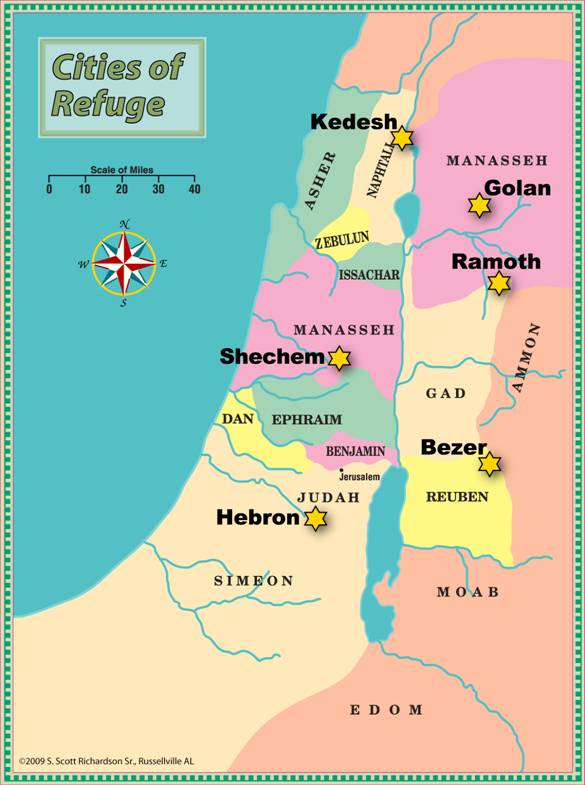 The cities of refuge. God instructed Moses to set aside six different cities, located throughout the land of Canaan, and designate them as cities of refuge. Occupied by Levites, these cities were strategically placed and easily accessible from all parts of the land. Their purpose was to provide a safe haven to anyone who had committed unpremeditated murder. If an Israelite inadvertently and unintentionally caused the death of a fellow Israelite, he could flee to one of these cities and seek refuge from the avenger.
In that cultural context, It was up to the relatives of a murder victim to seek vengeance. This “blood avenger” (Numbers 35:19) was not just free to kill the murdered, he was obligated to do so (Numbers 35:19, 21). It was his duty. He was called the “avenger of blood.”
But in order to prevent the blood avenger from taking the life of an innocent individual, the cities of refuge were established. If an Israelite accidentally killed someone else, he could run to one of these cities and seek refuge. As long as he remained there, he would be protected from the blood avenger. It was up to the residents of the city (Levites) to help determine the guilt of innocence of the accused. If it was determined that his actions were premeditated and intentional, he was to be handed over to the blood avenger for retribution. But if he was deemed innocent of having committed voluntary manslaughter, he would be allowed to remain in the city of refuge until the high priest died. In essence, the city became his prison. If he ever left, he would be guilty of violating his sentence and the blood avenger could seek his death.
All of this sounds very barbaric to us, but you have to remember that Israel had no police force for enforcing laws or dispensing justice. According to the Mosaic Law, murder was a crime worthy of death. The guilty must be punished. But involuntary manslaughter was to be dealt with in a different manner. That is why the cities were established. God was protecting the innocent.
God dwelt among His people, and His very presence demanded that they live set-apart lives. His holiness and righteousness required that they live differently and distinctively, abiding by a stringent set of rules and regulations that governed their behavior and interactions with one another. And yet God knew their weaknesses and fully understood their incapacity to live up to His exacting standards. The entire sacrificial system was designed to deal with their ongoing struggle with sin.
To unjustly execute the innocent would have been as evil in God’s sight as to excuse the guilty. So He provided those who had committed involuntary manslaughter a means for finding justice. They could live in the city of refuge and enjoy permanent protection from the “blood avenger.” They were still guilty of murder, but their lives were spared. The city of refuge became their prison until the day that the high priest died. Then his death would serve as an atonement for their sin, providing them with release from their guilt and the right to live among their kinsmen again – innocent and free.
The ongoing presence of God was constantly in jeopardy due to the sinfulness of men. Yet He provided them with countless means by which they could receive restoration and assure His continued existence among them. It was God who set them apart. Without them, they would have been nothing. His presence provided them their distinctiveness. And it was their sin that threatened their uniqueness as His chosen people.
From the day that Adam and Eve sinned in the garden, God has been actively and aggressively seeking to restore order to the chaos created by their actions. Their sin brought disorder, disobedience, and, ultimately, death into the world. It wasn’t long after Eve listened to the lies of the enemy and convinced her husband to join her in rejecting God’s word, that murder showed up on the scene. One of Eve’s own sons killed his brother. Death entered the scene. And disease would not be far behind it. Their bodies would undergo the inevitable effects of aging. Sin would increase. Rebellion against God would run rampant. And yet God continued to reach out to mankind, offering a form of refuge from the consequences of sin.
In a real sense, God’s choosing of Abraham made him and his descendants a “city of refuge” for mankind. The people of Israel would become a single source of God’s abiding presence and divine protection from the guilt and condemnation of sin. It was among the children of God that men could find access to their Creator. It was through the law of God that men could learn of the divine requirements and expectations of a holy God. It was through the sacrificial system instituted by God that men could find atonement for their sins and freedom from the penalty of death they so justly deserved. God had provided a city of refuge among the sons of men. And eventually, God would send His own Son as the ultimate and final means of refuge and escape from sin’s destructive power and God’s righteous judgment.
The Scriptures make it painfully clear that all men are guilty of sin.
For all have sinned and fall short of the glory of God.– Romans 3:23 ESV
Surely there is not a righteous man on earth who does good and never sins. – Ecclesiastes 7:20 ESV
Who can say, “I have made my heart pure; I am clean from my sin?” – Proverbs 20:9 ESV
We are all infected and impure with sin. When we display our righteous deeds, they are nothing but filthy rags. – Isaiah 64:6 NLT
The law of God was given to reveal to men the reality and gravity of their sins. Like a speed limit sign on the side of the freeway, the law provided a constant reminder of man’s proclivity for disobedience and rebellion. Our guilt is unquestionable and undeniable. Sinful humanity stands condemned before a holy and righteous God due to the sinful nature passed down to them from Adam and Eve. All are guilty and all stand condemned. And the very presence of disease and death in our world is an outward reminder of the reality of sin’s devastating consequences.
In the case of someone seeking refuge in one of these cities, if they remained there until the high priest died, their sin was forgiven. They walked away free and clear. The death of the high priest had atoning value just as Jesus’ death for us atones for our sins. No one could accuse this person once the high priest had died. And we stand as unaccused and uncondemned because of what Christ has done for us.
Who dares accuse us whom God has chosen for his own? Will God? No! He is the one who has given us right standing with himself. Who then will condemn us? Will Christ Jesus? No, for he is the one who died for us and was raised to life for us and is sitting at the place of highest honor next to God, pleading for us. – Romans 8:33-34 NLT
We can take refuge in Christ. He is our high priest and He has died for us. His death has set us free once and for all.
God also bound himself with an oath, so that those who received the promise could be perfectly sure that he would never change his mind. So God has given us both his promise and his oath. These two things are unchangeable because it is impossible for God to lie. Therefore, we who have fled to him for refuge can take new courage, for we can hold on to his promise with confidence. This confidence is like a strong and trustworthy anchor for our souls. It leads us through the curtain of heaven into God’s inner sanctuary. Jesus has already gone in there for us. He has become our eternal High Priest in the line of Melchizedek. – Hebrews 6:17-20 NLT
English Standard Version (ESV) The Holy Bible, English Standard Version. ESV® Permanent Text Edition® (2016). Copyright © 2001
New Living Translation (NLT) Holy Bible, New Living Translation, copyright © 1996, 2004, 2015 by Tyndale House Foundation. Used by permission of Tyndale House Publishers Inc., Carol Stream, Illinois 60188. All rights reserved.