Robbing God Is Risky

17 At that time Hazael king of Syria went up and fought against Gath and took it. But when Hazael set his face to go up against Jerusalem, 18 Jehoash king of Judah took all the sacred gifts that Jehoshaphat and Jehoram and Ahaziah his fathers, the kings of Judah, had dedicated, and his own sacred gifts, and all the gold that was found in the treasuries of the house of the LORD and of the king’s house, and sent these to Hazael king of Syria. Then Hazael went away from Jerusalem.

19 Now the rest of the acts of Joash and all that he did, are they not written in the Book of the Chronicles of the Kings of Judah? 20 His servants arose and made a conspiracy and struck down Joash in the house of Millo, on the way that goes down to Silla. 21 It was Jozacar the son of Shimeath and Jehozabad the son of Shomer, his servants, who struck him down, so that he died. And they buried him with his fathers in the city of David, and Amaziah his son reigned in his place. 2 Kings 12:17-21 ESV

With the death of Jehoiada the priest, King Jehoash became like a ship without a rudder. His former mentor and father figure had been a stabilizing factor in his life, and his departure left the king directionless and vulnerable to the influence of others. The book of 2 Chronicles reveals that not long after Jehoiada’s death, “the leaders of Judah came and bowed before King Joash and persuaded him to listen to their advice. They decided to abandon the Temple of the Lord, the God of their ancestors, and they worshiped Asherah poles and idols instead! Because of this sin, divine anger fell on Judah and Jerusalem” (2 Chronicles 24:17-18 NLT). Though God sent prophets who called the nation to repentance, the people refused to listen, and King Jehoash led the way in rejecting the messengers of Yahweh.

God placed His Spirit upon Zechariah, the son of Jehoiada, who delivered a stinging indictment against the nation.

“This is what God says: Why do you disobey the LORD’s commands and keep yourselves from prospering? You have abandoned the LORD, and now he has abandoned you!” – 2 Chronicles 24:20 NLT

But his words fell on deaf ears and hard hearts. Rather than call the people to repentance, King Jehoash repaid his former mentor, Jehoiada, by having his son stoned to death in the Temple courtyard. As Zechariah died, he cried out, “May the LORD see what they are doing and avenge my death!” (2 Chronicles 24:22 NLT).

This curse from the lips of God’s dying prophet would come to fruition. God would avenge the death of Zechariah, and He would use the pagan nation of Syria to do it. For years, the Syrians had been harassing the northern kingdom of Israel. All the while Jehoash had been king in Judah, his counterpart in Israel had been waging an ongoing war against the Syrians. King Jehoahaz had ascended to the throne of his father, Jehu, and had picked up where his father had left off, doing “what was evil in the sight of the LORD and followed the sins of Jeroboam the son of Nebat” (2 Kings 13:2 ESV). As a result, God “gave them continually into the hand of Hazael king of Syria and into the hand of Ben-hadad the son of Hazael” (2 Kings 13:3 ESV). This continued throughout the reign of King Jehoahaz.
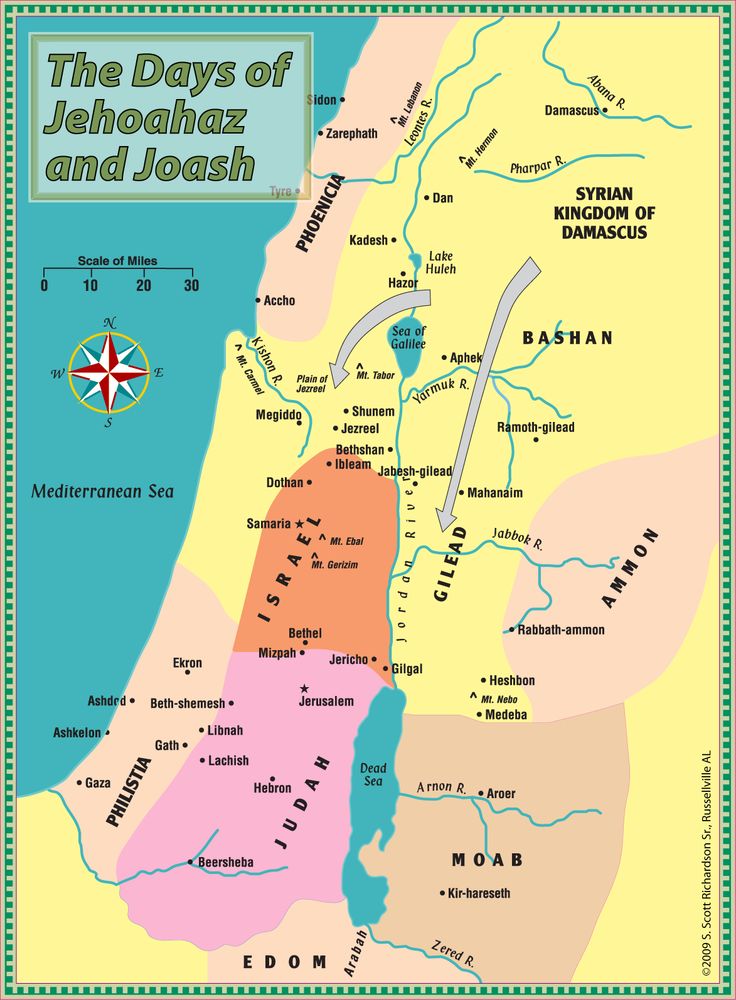
But now, God was going to use the Syrians to punish the rebellious and unrepentant nation of Judah. King Hazael took his campaign of terror further south, moving along the coast of the Mediterranean, and eventually capturing the city of Gath, deep within Judean territory. Then he set his sights on Jerusalem. In the spring of the year, Hazael and his army attacked the capital city, “and destroyed all the princes of the people from among the people and sent all their spoil to the king of Damascus” (2 Chronicles 24:23 ESV). The chronicler goes on to reveal that this victory was God-ordained.

Though the army of the Syrians had come with few men, the LORD delivered into their hand a very great army, because Judah had forsaken the LORD, the God of their fathers. Thus they executed judgment on Joash. – 2 Chronicles 24:24 ESV

The attack left Jehoash wounded, and, in desperation, the king decided to do whatever he had to do to keep Hazael from capturing the city. So, he stripped bare the Temple treasury, sending all the sacred items and the gold to Hazael as a form of ransom.

Jehoash king of Judah took all the sacred gifts that Jehoshaphat and Jehoram and Ahaziah his fathers, the kings of Judah, had dedicated, and his own sacred gifts, and all the gold that was found in the treasuries of the house of the LORD and of the king’s house, and sent these to Hazael king of Syria. Then Hazael went away from Jerusalem. – 2 Kings 12:18 ESV

This king, who had been raised by the priest of God in the house of God, sold out Yahweh. In the face of the Syrian assault, Jehoash resorted to paying off his attackers, stripping the Temple of all its holy treasures and priceless valuables. Rather than turning to Yahweh for help, Jehoash took what had been consecrated to God and used it to buy off the enemy, and his plan seemed to work.

Hazael took the treasure and left, but Jehoash’s troubles were far from over. Still suffering from the wounds he had received in the attack on Jerusalem, Jehoash was in a vulnerable state. His treasury was bankrupt, and he was a physically broken man. It seems that some of his officials recognized that Judah’s recent defeat at the hands of the Syrians had something to do with Jehoash’s decision to kill Zechariah. The curse uttered by the dying prophet had come true. So, they decided to eliminate the cause of all their troubles.

…his own officials plotted to kill him for murdering the son of Jehoiada the priest. They assassinated him as he lay in bed. – 2 Chronicles 24:25 NLT

The author of 2 Kings even provides the names of the two conspirators.

The assassins were Jozacar son of Shimeath and Jehozabad son of Shomer—both trusted advisers. – 2 Kings 12:21 NLT

These men would have had easy access to the king because he trusted them. They had become replacements for Jehoiada, providing the king with counsel and acting as his mentors. But unlike the former priest, these men had no love for Jehoash. They viewed him as a plague upon the nation and determined that his removal might placate God and prevent further judgment. Yet, it’s important to understand that their actions were ordained by God. It’s interesting to note that these two men were actually foreigners. One was the son of an Ammonite woman, and the other was the son of a Moabite woman. This reference to their birth mothers is significant because it links the events in this chapter all the way back to the Book of Genesis.

Genesis 19 contains the account of God’s rescue of Lot and his daughters from the wicked city of Sodom. Lot, the nephew of Abraham, had decided to settle in the fertile valleys of the Jordan, but it wasn’t long before he “moved his tent as far as Sodom” (Genesis 13:12 ESV). This proved to be a poor decision, becausethe men of Sodom were wicked, great sinners against the LORD” (Genesis 13:12 ESV). Eventually, Lot relocated his family inside the walls of the city of Sodom. When God determined to destroy Sodom and its neighboring city of Gomorrah for the wickedness of their inhabitants, Abraham convinced God to spare Lot and his daughters. But once they were rescued by the angels of God, Lot’s daughters displayed the negative influence of their time spent in Sodom. Fearful that they would never find husbands, they came up with a plan to get their father drunk and commit incest with him, all under the guise of prolonging their father’s lineage. Their mother was dead, and their father had no sons. So, in their minds, this was the only way of preserving the family line. But their sinful decision produced a less-than-ideal outcome.

…both of Lot’s daughters became pregnant by their own father. When the older daughter gave birth to a son, she named him Moab. He became the ancestor of the nation now known as the Moabites. When the younger daughter gave birth to a son, she named him Ben-ammi. He became the ancestor of the nation now known as the Ammonites. – Genesis 19:36 NLT

The descendants of these two young ladies became the Ammonites and Moabites. These distant relatives of the Israelites were pagan nations that worshiped false gods. It’s no coincidence that the men who plotted and carried out the assassination of Jehoash had ties to these two nations. God had used the Syrians to inflict judgment upon Judah. Now, He used an Ammonite and a Moabite to bring death to the rebellious and unrepentant Jehoash.

God had preserved and protected Jehoash, allowing him to find sanctuary in the Temple and receive instruction from Jehoiada the priest. But when his godly mentor died, Jehoash was exposed for what he really was — just another king who refused to acknowledge Yahweh as the one true Sovereign. Jehoash had started out so well but ended poorly, choosing to forsake God and listen to the advice of men. Rather than heed the warnings of God’s prophet, Jehoash put him to death. Instead of placing his trust in Yahweh, Jehoash attempted to buy his way out of trouble, using the treasury of God in a failed attempt to escape the judgment of God. And he died trying.

Joash was buried with his ancestors in the City of David. Then his son Amaziah became the next king. – 2 Kings 12:21 NLT

Another king had come to power and disappeared from the scene because he refused to honor the One who had placed him on the throne to begin with. Yahweh had graciously preserved the nation of Judah, providing ample evidence of His patience and love. He would later juxtapose His faithfulness against the backdrop of Judah’s ongoing apostasy, and, interestingly enough, He would accuse them of having robbed Him.

“For I the LORD do not change; therefore you, O children of Jacob, are not consumed. From the days of your fathers you have turned aside from my statutes and have not kept them. Return to me, and I will return to you, says the LORD of hosts. But you say, ‘How shall we return?’ Will man rob God? Yet you are robbing me. But you say, ‘How have we robbed you?’ In your tithes and contributions. You are cursed with a curse, for you are robbing me, the whole nation of you. Bring the full tithe into the storehouse, that there may be food in my house. And thereby put me to the test, says the LORD of hosts, if I will not open the windows of heaven for you and pour down for you a blessing until there is no more need. I will rebuke the devourer for you, so that it will not destroy the fruits of your soil, and your vine in the field shall not fail to bear, says the LORD of hosts. Then all nations will call you blessed, for you will be a land of delight, says the LORD of hosts. – Malachi 3:6-12 NLT

The people of Judah had robbed God of what was rightfully His: their divinely ordained contributions and tithes, which were intended to be expressions of their love for and dependence upon Him. What little they had given was consecrated to Yahweh and was to be used as He prescribed. But Jehoash had taken these dedicated gifts and handed them over to the king of a pagan nation in a vain attempt to protect his kingdom from the judgment of Yahweh. In doing so, Jehoash sealed his own fate. Had he turned to God rather than stealing from God, Jehoash would have enjoyed an outpouring of blessings. But instead, Jehoash died a violent death at the hands of an Ammonite and Moabite and was buried “with his fathers in the city of David” (2 Kings 12:21 ESV).

English Standard Version (ESV) The Holy Bible, English Standard Version. ESV® Permanent Text Edition® (2016). Copyright © 2001 by Crossway Bibles, a publishing ministry of Good News Publishers.

New Living Translation (NLT) Holy Bible, New Living Translation, copyright © 1996, 2004, 2015 by Tyndale House Foundation. Used by permission of Tyndale House Publishers Inc., Carol Stream, Illinois 60188. All rights reserved.

God of the Impossible

Then I came to the governors of the province Beyond the River and gave them the king’s letters. Now the king had sent with me officers of the army and horsemen. 10 But when Sanballat the Horonite and Tobiah the Ammonite servant heard this, it displeased them greatly that someone had come to seek the welfare of the people of Israel.

11 So I went to Jerusalem and was there three days. 12 Then I arose in the night, I and a few men with me. And I told no one what my God had put into my heart to do for Jerusalem. There was no animal with me but the one on which I rode. 13 I went out by night by the Valley Gate to the Dragon Spring and to the Dung Gate, and I inspected the walls of Jerusalem that were broken down and its gates that had been destroyed by fire. 14 Then I went on to the Fountain Gate and to the King’s Pool, but there was no room for the animal that was under me to pass. 15 Then I went up in the night by the valley and inspected the wall, and I turned back and entered by the Valley Gate, and so returned. 16 And the officials did not know where I had gone or what I was doing, and I had not yet told the Jews, the priests, the nobles, the officials, and the rest who were to do the work.

17 Then I said to them, “You see the trouble we are in, how Jerusalem lies in ruins with its gates burned. Come, let us build the wall of Jerusalem, that we may no longer suffer derision.” 18 And I told them of the hand of my God that had been upon me for good, and also of the words that the king had spoken to me. And they said, “Let us rise up and build.” So they strengthened their hands for the good work. 19 But when Sanballat the Horonite and Tobiah the Ammonite servant and Geshem the Arab heard of it, they jeered at us and despised us and said, “What is this thing that you are doing? Are you rebelling against the king?” 20 Then I replied to them, “The God of heaven will make us prosper, and we his servants will arise and build, but you have no portion or right or claim in Jerusalem.” Nehemiah 2:9-20 ESV

The time came for Nehemiah to leave behind his comfortable life in Persia and begin the 800-mile journey to Jerusalem. Nehemiah was accompanied by a contingent of royal guards who provided protection for the traveling party, which appears to have been small in number. Once they crossed the Euphrates River and entered “the province Beyond the River” (Nehemiah 2:7), Nehemiah presented the governors of the region with the letters of safe passage Artaxerxes provided.

Once Nehemiah arrived in Jerusalem, two local officials, Sanballat the Horonite and Tobiah the Ammonite, disclosed their displeasure.

they were very displeased that someone had come to help the people of Israel. – Nehemiah 2:10 NLT

When these two men became aware of Nehemiah’s intentions to rebuild the walls of Jerusalem, they couldn’t hide their anger. As Nehemiah’s building plans progressed, they would be joined by a third governor, Geshem the Arab, who assisted them in mocking the Jews.

But when Sanballat, Tobiah, and Geshem the Arab heard of our plan, they scoffed contemptuously. “What are you doing? Are you rebelling against the king?” they asked. – Nehemiah 2:19 NLT

These disgruntled governors were hoping to demoralize the Jews by accusing them of insurrection. They were hoping to turn the local Jewish population against Nehemiah by questioning the wisdom of his actions. If they could raise doubt concerning the viability of Nehemiah’s plans, he would lose his labor force. This intense pressure to intimidate and discourage the Jews was relentless. Chapter Four reveals that Sanballat and his fellow governors continued to ridicule Nehemiah and his grandiose plans.

Sanballat was very angry when he learned that we were rebuilding the wall. He flew into a rage and mocked the Jews, saying in front of his friends and the Samarian army officers, “What does this bunch of poor, feeble Jews think they’re doing? Do they think they can build the wall in a single day by just offering a few sacrifices? Do they actually think they can make something of stones from a rubbish heap—and charred ones at that?” – Nehemiah 4:1-2 NLT

Tobiah joined in the sarcasm-laced rhetoric, stating, “That stone wall would collapse if even a fox walked along the top of it!” (Nehemiah 4:3 NLT). When their words failed to dissuade the Jews, they would begin to consider violence as their only other option.

…when Sanballat and Tobiah and the Arabs, Ammonites, and Ashdodites heard that the work was going ahead and that the gaps in the wall of Jerusalem were being repaired, they were furious. They all made plans to come and fight against Jerusalem and throw us into confusion. – Nehemiah 4:7-8 NLT

But just three days after his arrival, Nehemiah and a few companions made a late-night inspection tour of the city’s walls. He had not yet disclosed his plans to anyone, including the local Jewish leaders, so this excursion was a fact-finding mission designed to determine the scope of the project. As he carefully navigated the rubble-strewn passage around the long-fallen walls, he could have become discouraged at the extent of the damage. At one point, the debris field was so dense that his donkey was unable to pass through. But despite the abysmal condition of the walls, Nehemiah did not lose heart. Upon completing his inspection, he gathered “the priests, the nobles, the officials, or anyone else in the administration” (Nehemiah 2:16 NLT) and presented them with an unexpected and unprecedented challenge.

“You know very well what trouble we are in. Jerusalem lies in ruins, and its gates have been destroyed by fire. Let us rebuild the wall of Jerusalem and end this disgrace!” – Nehemiah 2:17 NLT

For these men, Nehemiah’s words must have sounded like madness. What Nehemiah was suggesting was impossible. Had the darkness prevented him from seeing the full extent of the situation? Did he really believe he could do what no one else had done for nearly 150 years? The walls of Jerusalem had lain in ruins since 586 B.C. when Nebuchadnezzar’s forces leveled them as part of their long-standing siege and eventual takeover of the city.

on January 15, during the ninth year of Zedekiah’s reign, King Nebuchadnezzar of Babylon led his entire army against Jerusalem. They surrounded the city and built siege ramps against its walls. Jerusalem was kept under siege until the eleventh year of King Zedekiah’s reign. – 2 Kings 25:1-2 NLT

On August 14 of that year, which was the nineteenth year of King Nebuchadnezzar’s reign, Nebuzaradan, the captain of the guard and an official of the Babylonian king, arrived in Jerusalem. He burned down the Temple of the Lord, the royal palace, and all the houses of Jerusalem. He destroyed all the important buildings in the city. Then he supervised the entire Babylonian army as they tore down the walls of Jerusalem on every side. – 2 Kings 25:8-10 NLT

It had been 142 years since the walls fell and during that time, no attempt had been made to rebuild them. It was a project of such epic proportions that no one ever dared to take it on – until Nehemiah showed up on the scene.

This newcomer brought with him a renewed sense of hope and expectation. He told the people about his plans but made sure to disclose God’s role in it all. He wanted them to know that he was on a mission sanctioned by Yahweh Himself. The sovereign LORD had even moved the heart of King Artaxerxes to put the full weight of his royal authority behind the project. Nehemiah’s words had an immediate impact on his audience, causing them to declare, “Let us rise up and build” (Nehemiah 2:18 ESV). They were pumped and ready to begin. Nehemiah’s pep talk had left them so enthused that they conveniently overlooked the sheer size of the project and the relentless determination of their enemies.

But as verse 19 reveals, the enthusiastic Jews were soon reminded that their efforts would not come without opposition. Sanballat, Tobiah, and Geshem launched an immediate public relationship campaign designed to discourage and dissuade the Jews from accomplishing their God-ordained task. Yet, Nehemiah countered their attacks with a reminder of God’s presence and power.

“The God of heaven will help us succeed. We, his servants, will start rebuilding this wall. But you have no share, legal right, or historic claim in Jerusalem.” – Nehemiah 2:20 NLT

Nehemiah saw Sanballat, Tobiah, and Geshem as what they were – enemies of God who had no right to question God’s people and no claim on the land that He had given to the Israelites as their inheritance. These men weren’t just opposing the efforts of Nehemiah and his fellow Jews, they were directly violating the will of God Almighty.

Sanballat was probably a Moabite from Horonaim, a city of Moab. Tobiah was an Ammonite. Geshem was an Arab who governed over the region south of Judah. It is interesting to note that these three men represent three distinct people groups that had a love-hate relationship with Israel. The Moabites were descendants of Moab, the son born to Lot as a result of his incestuous relationship with his eldest daughter (Genesis 19:37). The Ammonites were descendants of Ben-ammi, the son born to Lot through his incestuous relationship with his younger daughter (Genesis 19:38). The “Arabs” mentioned in this passage is likely a reference to the Edomites who controlled an area east of the Arabah, from the Zered to the Gulf of Aqaba. They were the descendants of Esau, the twin brother of Jacob. So each of these nations was made up of people who were blood relatives of the Jews but they were not heirs of the promise God made to Abraham, Isaac, and Jacob.

As Nehemiah makes clear, they had “no portion or right or claim in Jerusalem” (Nehemiah 2:20 ESV). These nations had long ago compromised their spiritual standards and comingled with the pagan nations that lived in and around Canaan. They were idolatrous and polytheistic. During Israel’s 70-year exile in Babylon, each of these groups had taken advantage of the situation by claiming Israelite land as their own, and for the last 142 years, they had done everything in their power to oppose the Israelite’s repatriation of the land.

But Nehemiah had come to set things straight. The walls would be rebuilt and the security of Jerusalem would be restored. Despite the odds, Nehemiah knew they had Yahweh on their side.

“The God of heaven will make us prosper, and we his servants will arise and build…” – Nememiah 2:20 ESV

English Standard Version (ESV)
The Holy Bible, English Standard Version. ESV® Permanent Text Edition® (2016). Copyright © 2001 by Crossway Bibles, a publishing ministry of Good News Publishers.

New Living Translation (NLT)
Holy Bible, New Living Translation, copyright © 1996, 2004, 2015 by Tyndale House Foundation. Used by permission of Tyndale House Publishers Inc., Carol Stream, Illinois 60188. All rights reserved.

The Message (MSG)Copyright © 1993, 1994, 1995, 1996, 2000, 2001, 2002 by Eugene H. Peterson

The High Cost of Compromise

1 While Israel lived in Shittim, the people began to whore with the daughters of Moab. These invited the people to the sacrifices of their gods, and the people ate and bowed down to their gods. So Israel yoked himself to Baal of Peor. And the anger of the Lord was kindled against Israel. And the Lord said to Moses, “Take all the chiefs of the people and hang them in the sun before the Lord, that the fierce anger of the Lord may turn away from Israel.” And Moses said to the judges of Israel, “Each of you kill those of his men who have yoked themselves to Baal of Peor.”

And behold, one of the people of Israel came and brought a Midianite woman to his family, in the sight of Moses and in the sight of the whole congregation of the people of Israel, while they were weeping in the entrance of the tent of meeting. When Phinehas the son of Eleazar, son of Aaron the priest, saw it, he rose and left the congregation and took a spear in his hand and went after the man of Israel into the chamber and pierced both of them, the man of Israel and the woman through her belly. Thus the plague on the people of Israel was stopped. Nevertheless, those who died by the plague were twenty-four thousand.

10 And the Lord said to Moses, 11 “Phinehas the son of Eleazar, son of Aaron the priest, has turned back my wrath from the people of Israel, in that he was jealous with my jealousy among them, so that I did not consume the people of Israel in my jealousy. 12 Therefore say, ‘Behold, I give to him my covenant of peace, 13 and it shall be to him and to his descendants after him the covenant of a perpetual priesthood, because he was jealous for his God and made atonement for the people of Israel.’”

14 The name of the slain man of Israel, who was killed with the Midianite woman, was Zimri the son of Salu, chief of a father’s house belonging to the Simeonites. 15 And the name of the Midianite woman who was killed was Cozbi the daughter of Zur, who was the tribal head of a father’s house in Midian.

16 And the Lord spoke to Moses, saying, 17 “Harass the Midianites and strike them down, 18 for they have harassed you with their wiles, with which they beguiled you in the matter of Peor, and in the matter of Cozbi, the daughter of the chief of Midian, their sister, who was killed on the day of the plague on account of Peor.” Numbers 25:1-18 ESV

There is no way to escape the fact that this is a graphic and disturbing text, and its close proximity to the oracles of blessing pronounced by God through Balaam makes it all the more difficult to reconcile. In what appears to be a relatively short period of time, King Balak’s hopes of placing Israel under a curse seem to take place without the help of Balaam or any other seer or sage. The amazing thing is, the Israelites bring it on themselves.

Moses describes the situation in less-than-flattering terms: “…the people began to whore with the daughters of Moab” (Numbers 25:1 ESV). It seems that the residents of Moab had done what their king had been unable to do. They managed to find a chink in the armor of God’s chosen people, and it involved the two evils of immorality and idolatry. While Balaam had been unsuccessful in pronouncing a curse on the people of God, the citizens of Moab came up with an ingenious plan for destroying the Israelites from within.

But where did this idea come from? Who was behind the strategy that motivated the Moabite women to “whore” with the men of Israel? According to Moses, it was Balaam. Later in the book of Numbers, after the Israelites defeated the forces of Midian, Moses pointed out an apparent problem with their victory.

…the people of Israel took captive the women of Midian and their little ones, and they took as plunder all their cattle, their flocks, and all their goods. – Numbers 31:9 ESV

As far as Moses was concerned, this was not a positive outcome. The very source of the temptation that had caused the men of Israel to sin went unpunished. The Midianite women were allowed to live and taken as plunder. This decision only made matters worse and Moses pointed out the error of their ways.

Moses said to them, “Have you let all the women live? Behold, these, on Balaam’s advice, caused the people of Israel to act treacherously against the Lord in the incident of Peor, and so the plague came among the congregation of the Lord. – Numbers 31:15 ESV

Moses made it clear that Balaam had been the driving force behind this entire plan to get the Israelites to compromise their convictions. While the Israelites had been encamped in the plains of Moab, waiting for the next phase of their conquest of Canaan, the men became distracted by and attracted to the women of Moab. But the women had been encouraged to throw themselves at the Israelite men, in a last-gasp attempt to diminish the danger posed by this vast host of former slaves.

Before long, “the men defiled themselves by having sexual relations with local Moabite women” (Numbers 25:1 NLT). But this was actually a military strategy concocted by none other than Balaam. If the Lord wouldn’t let him curse the Israelites, he would simply use the old-fashioned tactic of temptation and sexual sin.

In the book of Revelation, the apostle John records the words that Jesus spoke to the church at Pergamum, comparing their actions to that of the immoral Israelites.

“But I have a few things against you: you have some there who hold the teaching of Balaam, who taught Balak to put a stumbling block before the sons of Israel, so that they might eat food sacrificed to idols and practice sexual immorality.” – Revelation 2:14 ESV

He accuses the believers in Pergamum of making concessions and compromises, the same thing that happened to the hapless Israelites. Because of the inability or the unwillingness of the Israelites males to deny their sexual desires or avoid the allure of idolatry, in no time the set-apart status of the Israelites was eventually jeopardized. What began as illicit sexual encounters between the men of Israel and the women of Moab turned into spiritual adultery and apostasy.

These women invited them to attend sacrifices to their gods, so the Israelites feasted with them and worshiped the gods of Moab. – Numbers 25:2 NLT

Uncontrolled sexual desires led to compromised convictions. Suddenly, the Israelites’ physical allure for the Moabite women created a spiritual attraction for their rogues’ gallery of deities. Forbidden fruit created an insatiable appetite for false gods.

What makes this whole affair so egregious is that it comes fresh on the heels of God’s promise to bless the people of Israel.

No curse can touch Jacob;
    no magic has any power against Israel.
For now it will be said of Jacob,
    ‘What wonders God has done for Israel!’” – Numbers 23:23 NLT

Balaam had not been allowed to curse them; his “magic” had proven unsuccessful. But the women of Moab had managed to cast a spell on the unsuspecting men of Israel. They simply used their feminine wiles to bewitch the hapless Israelites and cause them to turn their backs on Jehovah. Because men were responsible for the spiritual oversight of their households, it wasn’t long before the apostasy spread throughout the camp and got the attention of God.

Israel joined in the worship of Baal of Peor, causing the Lord’s anger to blaze against his people. – Numbers 25:3 NLT

The fallout from this act of unfaithfulness was immediate and widespread, but God quickly intervened, ordering Moses to take immediate action.

“Seize all the ringleaders and execute them before the Lord in broad daylight, so his fierce anger will turn away from the people of Israel.” – Numbers 25:4 NLT

There would be no compromise on God’s part. He would not tolerate sin in the camp of Israel, especially that involving immorality and idolatry. The guilty were to be made examples of, delivering a sobering warning to the rest of the nation of Israel.

Moses was quick to follow God’s instructions, calling on the judges of the tribes of Israel to carry out the executions of all those who had taken part in this act of rebellion against God. This is where the story earns its NC-17 rating. What happens next is both shocking and unimaginable. As a result of this corporate act of sin and God’s prescribed solution, the people had been called to gather before the Tabernacle. Moses describes the tone as sorrowful, likely because of the deaths of some of their sons, fathers, and husbands. Yet as the people wept over their sin and the loss of their loved ones, one of the guilty men did something difficult to believe. He brazenly took a Moabite woman into his tent, in full view of Moses and the rest of the assembly. He exhibited no shame and, completely controlled by his sexual desires, displayed a total lack of self-control.

He did the unthinkable. Either he was flaunting his personal preferences in the face of Moses and God, or he was so consumed by his physical appetites that he could no longer control himself. The apostle Paul describes such people in condemning terms: “Their god is their appetite, they brag about shameful things, and they think only about this life here on earth” (Philippians 3:19 NLT).

As Moses and the rest of the people looked on in shock, this moral reprobate flaunted his disdain for the holiness of God and rejected his own personal guilt. He showed no regret, remorse, or repentance. But his unprecedented display of disrespect for God got the attention of Phinehas, the son of Eleazar the high priest. This young man,  the grandson of Aaron the former high priest, took his role as a servant of God seriously. Unwilling to stand back and watch this affront to God’s holiness take place, he took matters into his own hands – literally. 

he jumped up and left the assembly. He took a spear and rushed after the man into his tent. Phinehas thrust the spear all the way through the man’s body and into the woman’s stomach. – Numbers 25:7-8 NLT

This was about far more than an uncontrolled sexual encounter with a pagan woman. This couple was engaged in an act of worship associated with Baal, the false god of the Moabites. Sexual promiscuity was a regular feature in the rites and rituals associated with this pagan deity. But Phinehas refused to turn a blind eye to their immorality and idolatry, executing the guilty couple on the spot. Moses indicates that the quick action of Phinehas brought an end to a plague that had already ravaged the lives of 24,000 Israelites.

As a result of his efforts, Phinehas received a covenant promise from God.

“Phinehas son of Eleazar and grandson of Aaron the priest has turned my anger away from the Israelites by being as zealous among them as I was. So I stopped destroying all Israel as I had intended to do in my zealous anger. Now tell him that I am making my special covenant of peace with him. In this covenant, I give him and his descendants a permanent right to the priesthood, for in his zeal for me, his God, he purified the people of Israel, making them right with me.” – Numbers 25:11-13 NLT

Phinehas was rewarded by God. This young man executed the righteous judgment of God and, in so doing, spared the nation from further deaths. God’s anger was satisfied and the nation’s sins were atoned for. But God was not done carrying out His judgment. Because the woman found in the tent was of Midianite extraction, God ordered that the Midianites be completely destroyed for the role they played in Israel’s rebellion against Him.

“Attack the Midianites and destroy them, because they assaulted you with deceit and tricked you into worshiping Baal of Peor, and because of Cozbi, the daughter of a Midianite leader, who was killed at the time of the plague because of what happened at Peor.” – Numbers 25:17-18 NLT

In a sense, Cozbi had accomplished what Balaam had failed to do. She and the other Midianite and Moabite women had successfully cursed a portion of the Israelite camp by luring them into immorality and idolatry. While this resulted in the deaths of 24,000 Israelites, it did nothing to thwart God’s plans to bless them and provide them with the inheritance He had promised to them. It would be the Moabites and Midianites who suffered the greatest losses due to this fateful event. But God would prove faithful to His covenant promises to Israel.

English Standard Version (ESV) The Holy Bible, English Standard Version. ESV® Permanent Text Edition® (2016). Copyright © 2001

New Living Translation (NLT) Holy Bible, New Living Translation, copyright © 1996, 2004, 2015 by Tyndale House Foundation. Used by permission of Tyndale House Publishers Inc., Carol Stream, Illinois 60188. All rights reserved.

A God-Ordained Glimpse Into Israel’s Future

15 And he took up his discourse and said,

“The oracle of Balaam the son of Beor,
    the oracle of the man whose eye is opened,
16 the oracle of him who hears the words of God,
    and knows the knowledge of the Most High,
who sees the vision of the Almighty,
    falling down with his eyes uncovered:
17 I see him, but not now;
    I behold him, but not near:
a star shall come out of Jacob,
    and a scepter shall rise out of Israel;
it shall crush the forehead of Moab
    and break down all the sons of Sheth.
18 Edom shall be dispossessed;
    Seir also, his enemies, shall be dispossessed.
    Israel is doing valiantly.
19 And one from Jacob shall exercise dominion
    and destroy the survivors of cities!”

20 Then he looked on Amalek and took up his discourse and said,

“Amalek was the first among the nations,
    but its end is utter destruction.”

21 And he looked on the Kenite, and took up his discourse and said,

“Enduring is your dwelling place,
    and your nest is set in the rock.
22 Nevertheless, Kain shall be burned
    when Asshur takes you away captive.”

23 And he took up his discourse and said,

“Alas, who shall live when God does this?
24     But ships shall come from Kittim
and shall afflict Asshur and Eber;
    and he too shall come to utter destruction.”

25 Then Balaam rose and went back to his place. And Balak also went his way. Numbers 24:15-25 ESV

Balaam, the seer, had seen and heard all he needed to determine the will of Jehovah. No more altars were necessary and there was no need to spill the blood of another animal. God had made Himself perfectly clear and left nothing up to doubt or debate. Meanwhile, King Balak was still holding out hope that a curse of the Israelites was forthcoming, But Balaan had seen the handwriting on the wall and was more than convinced that any attempt to curse the people of Israel would fail miserably. In a sense, he was saying, “I can see clearly now!”

“This is the message of Balaam son of Beor,
    the message of the man whose eyes see clearly,
the message of one who hears the words of God,
    who has knowledge from the Most High,
who sees a vision from the Almighty,
    who bows down with eyes wide open…” – Numbers 24:15-16 NLT

There was no further need to consult with the Lord. This newly enlightened soothsayer was transformed into a spokesman of God and given a series of disturbing prophecies to deliver to King Balak. First, true to his reputation as a seer, Balaam spoke of seeing an individual whose arrival was sometime in the distant future.

“I see him, but not now;
    I behold him, but not near…” – Numbers 24:17 ESV

Balaam informs King Balak that the origins of this coming one would be of a supernatural nature and accompanied by kingly authority.

“…a star shall come out of Jacob,
    and a scepter shall rise out of Israel…” – Numbers 24:17 ESV

God was informing Balaam and his royal patron that a future king would arise from the very people group that Balak had hoped to curse.

“That stars could be used metaphorically for kings is suggested by Isaiah 14:12, where the king of Babylon is called ‘Day Star’, and Revelation 22:16, which calls Jesus ‘the offspring of David, the bright morning star.’ That a king is meant here is confirmed by the second line of the couplet: a sceptre shall rise out of Israel, a sceptre being part of the royal insignia (Ps. 45:6; Amos 1:5,8; Gen. 49:10).” – Gordon J. Wenham, Numbers, Tyndale Old Testament Commentaries

And God informs Balak that his future king will “crush the forehead of Moab” (Numbers 24:17 ESV). This reference appears to be a direct message to Balak himself, the king of Moab. This bit of bad news only confirmed Balak’s earlier suspicions and further fueled his desire to see the Israelites cursed. They were a direct threat to his rule and reign.

But the news only gets worse. Balaam goes on to mention the sons of Sheth as well as the kingdoms of Edom and Seir. This coming king would defeat and dispossess them all.

“Edom will be taken over,
    and Seir, its enemy, will be conquered,
    while Israel marches on in triumph.” – Numbers 24:18 NLT

No one would be able to stand against God’s appointed leader and His chosen people; that included the Amalekites and the Kenites. This future king would be powerful and successful in leading the Israelites against all the inhabitants of the land of Canaan. This divine pronouncement was right in line with the blessing that Jacob had given to his son Judah centuries earlier.

“The scepter will not depart from Judah,
    nor the ruler’s staff from his descendants,
until the coming of the one to whom it belongs,
    the one whom all nations will honor.” – Genesis 49:10 NLT

Whether he realized it or not, Balaam was being used by God to confirm that very prophecy. The promise of a future king who would come from the tribe of Judah was still yet to be fulfilled. There is a sense in which much of this prophecy was fulfilled under the reign of King David, a member of the tribe of Judah. David would prove to be a warrior-king whose military victories helped put Israel on the map politically speaking. He would expand the boundaries of Israel through military conquest and create one of the most powerful nations on the face of the earth at that time. And he would bequeath that nation to his son, Solomon, who would continue to build and expand the kingdom of Israel. But the day would come when Solomon’s kingdom would be divided in half, never again to enjoy its former glory. So, the final phase of Balaam’s prophecy remains unfulfilled.

“Alas, who can survive
    unless God has willed it?
Ships will come from the coasts of Cyprus;
    they will oppress Assyria and afflict Eber,
but they, too, will be utterly destroyed.” – Numbers 24:23-24 NLT

This appears to be a reference to future kingdoms that will come to power in the region and attempt to overthrow God’s people. But even these powers-to-be will meet a similar fate as that of the Moabites, Kenites, and Edomites. They will be utterly destroyed by God’s people with the help of the “star” who holds the “scepter” in his hand. The book of Revelation predicts this coming time when a descendant of Jacob from the tribe of Judah will bring victory over all of Israel’s enemies once and for all.

To all who are victorious, who obey me to the very end,

To them I will give authority over all the nations.
They will rule the nations with an iron rod
    and smash them like clay pots.

They will have the same authority I received from my Father, and I will also give them the morning star! – Revelation 2:26-28 NLT

And in Revelation 22, the apostle John provides insight into the identity of “the morning star.”

“I, Jesus, have sent my angel to give you this message for the churches. I am both the source of David and the heir to his throne. I am the bright morning star.” – Revelation 22:16 NLT

Jesus is the one of whom Balaam spoke, and at some future date, He will bring destruction upon the enemies of Israel. The apostle John was given a vision of this end-times event, which he recorded in the book of Revelation.

Then I saw heaven opened, and a white horse was standing there. Its rider was named Faithful and True, for he judges fairly and wages a righteous war. His eyes were like flames of fire, and on his head were many crowns. A name was written on him that no one understood except himself. He wore a robe dipped in blood, and his title was the Word of God. The armies of heaven, dressed in the finest of pure white linen, followed him on white horses. From his mouth came a sharp sword to strike down the nations. He will rule them with an iron rod. He will release the fierce wrath of God, the Almighty, like juice flowing from a winepress. On his robe at his thigh was written this title: King of all kings and Lord of all lords. – Revelation 19:11-16 NLT

There is no way that Balaam understood the full import of his words. Despite being a seer, he could not see into the future and identify this conquering king to come. Once he had delivered his Spirit-inspired message to King Balak, he went on his way, leaving Balak to consider the words of Jehovah and the impact they might have on his life and kingdom.

But while this story ends with Balaam disappearing into the sunset as he returns to his hometown of Aram, his interactions with the Israelites are far from over. In fact, he will play a role in the sordid affairs described in the very next chapter. While he had been used by God to pronounce blessings on the people of Israel, he would show up again, this time providing the king of Moab with less-than-godly counsel designed to bring about the demise of the chosen people of God.

English Standard Version (ESV) The Holy Bible, English Standard Version. ESV® Permanent Text Edition® (2016). Copyright © 2001

New Living Translation (NLT) Holy Bible, New Living Translation, copyright © 1996, 2004, 2015 by Tyndale House Foundation. Used by permission of Tyndale House Publishers Inc., Carol Stream, Illinois 60188. All rights reserved.

The Lord of Heaven’s Armies

27 And Balak said to Balaam, “Come now, I will take you to another place. Perhaps it will please God that you may curse them for me from there.” 28 So Balak took Balaam to the top of Peor, which overlooks the desert. 29 And Balaam said to Balak, “Build for me here seven altars and prepare for me here seven bulls and seven rams.” 30 And Balak did as Balaam had said, and offered a bull and a ram on each altar.

1 When Balaam saw that it pleased the Lord to bless Israel, he did not go, as at other times, to look for omens, but set his face toward the wilderness. And Balaam lifted up his eyes and saw Israel camping tribe by tribe. And the Spirit of God came upon him, and he took up his discourse and said,

“The oracle of Balaam the son of Beor,
    the oracle of the man whose eye is opened,
the oracle of him who hears the words of God,
    who sees the vision of the Almighty,
    falling down with his eyes uncovered:
How lovely are your tents, O Jacob,
    your encampments, O Israel!
Like palm groves that stretch afar,
    like gardens beside a river,
like aloes that the Lord has planted,
    like cedar trees beside the waters.
Water shall flow from his buckets,
    and his seed shall be in many waters;
his king shall be higher than Agag,
    and his kingdom shall be exalted.
God brings him out of Egypt
    and is for him like the horns of the wild ox;
he shall eat up the nations, his adversaries,
    and shall break their bones in pieces
    and pierce them through with his arrows.
He crouched, he lay down like a lion
    and like a lioness; who will rouse him up?
Blessed are those who bless you,
    and cursed are those who curse you.”

10 And Balak’s anger was kindled against Balaam, and he struck his hands together. And Balak said to Balaam, “I called you to curse my enemies, and behold, you have blessed them these three times. 11 Therefore now flee to your own place. I said, ‘I will certainly honor you,’ but the Lord has held you back from honor.” 12 And Balaam said to Balak, “Did I not tell your messengers whom you sent to me, 13 ‘If Balak should give me his house full of silver and gold, I would not be able to go beyond the word of the Lord, to do either good or bad of my own will. What the Lord speaks, that will I speak’? 14 And now, behold, I am going to my people. Come, I will let you know what this people will do to your people in the latter days.” Numbers 23:27-24:14 ESV

The third time would be the charm, or so Balak hoped. In his relentless effort to have Balaam curse the Israelites, Balak suggested that they try their luck at a third location. He still harbored hopes that Balaam might be able to convince Jehovah to change His mind and curse His own people. In a sense, Balak was attempting to treat God as he had Balaam, by trying to buy Him off. Balak seemed to believe that deities were no different than humans and were susceptible to bribes and influence peddling. He had already authorized the construction of 14 altars and the sacrifice of 56 bulls and seven rams in an attempt to sway the mind of Israel’s God, and his obsession with defeating the Israelites drove him to up the ante one more time.

But on this occasion, Balaam refused to seek the will of Jehovah because he already knew what the answer would be. The seer had already determined that nothing would convince the God of Israel to do anything but bless His people. Balak’s sacrifices were an exercise in futility and a waste of time.

Rather than follow Balak to Mount Peor, Balaam headed to the wilderness, where it appears he was given a vision by God. As he lay prostrate on the ground, the Holy Spirit opened his eyes to see the Israelites “camping tribe by tribe” (Numbers 24:2 ESV). In the previous accounts, Balaam had stood on higher ground and seen a portion of the Israelite camp with his own eyes. But this time, he was given a vision that allowed him to see each of the 12 tribes of Israel, and this Spirit-induced dream was accompanied by yet another message from God.

“This is the message of Balaam son of Beor,
    the message of the man whose eyes see clearly,
the message of one who hears the words of God,
    who sees a vision from the Almighty,
    who bows down with eyes wide open…” – Numbers 24:3-4 NLT

Balaam was left without any doubts regarding the countless number of Israelites camped in the plains of Moab. He was given a panoramic vision of the entire nation of Israel and was overwhelmed by what he saw.

“How beautiful are your tents, O Jacob;
    how lovely are your homes, O Israel!
They spread before me like palm groves,
    like gardens by the riverside.
They are like tall trees planted by the Lord,
    like cedars beside the waters…” – Numbers 24:5-6 NLT

In his trance-like state, Balaam envisioned Israel as tall trees planted by the hand of God. They grew tall and strong beside the waters and were cared for by their divine gardener.

“He will pour the water out of his buckets,
and their descendants will be like abundant water;
their king will be greater than Agag,
and their kingdom will be exalted.” – Numbers 24:7 NET

As God had promised to Abraham centuries earlier, He was going to bless His people and transform them into a mighty nation.

“I will make of you a great nation, and I will bless you and make your name great, so that you will be a blessing. I will bless those who bless you, and him who dishonors you I will curse…” – Genesis 12:2-3 ESV

God had delivered them from their captivity in Egypt and led them through the wilderness for the last four decades. But soon, they would no longer be wanderers in the wilderness but citizens of a mighty kingdom ruled over by a powerful king. The promised blessings of Jehovah would be fully realized and there was nothing anyone could do to prevent this predetermined outcome.

“God brought them out of Egypt.
They have, as it were, the strength of a young bull;
they will devour hostile people,
and will break their bones,
and will pierce them through with arrows. – Numbers 24:8 NET

Once again, Balak was receiving far-from-pleasant news from his hired gun. Rather than pronouncing a curse on Israel, Balaam was singing the praises of their God and warning against any attempts to do them harm. None of this was what Balak wanted to hear. To make matters worse, Balaam describes God as a hungry apex predator, waiting to attack and destroy any who would dare stand against His will. Part of the message God gave to Balaam was a direct quote from His covenant promise to Abraham.

“Blessed are those who bless you,
    and cursed are those who curse you.” – Numbers 24:9 ESV

This reiteration of God’s commitment to curse all those who cursed His people was intended to provide Balak with one final warning to rethink his strategy. Israel was favored by God and there was nothing Balaam or anyone else could do to alter that fact. Their future was in the hands of Jehovah. He had great plans for them and would see to it that the covenant promises He made to Abraham were fully fulfilled.

But Balak refused to accept Balaam’s assessment and angrily fired his disappointing diviner. He reneged on his promise of reward and sent Balaam home empty-handed.

“I called you to curse my enemies! Instead, you have blessed them three times. Now get out of here! Go back home! I promised to reward you richly, but the Lord has kept you from your reward.” – Numbers 24:10-11 NLT

But before he departed, Balaam had one more thing to say to his former employer. He reminded Balak that from the very beginning, he had been open and above board about his inability to curse the Israelites. He had warned Balak that regardless of how much reward he was offered, he “would be powerless to do anything against the will of the Lord” (Numbers 24:13 NLT). While Balaam confessed that he could be easily bought off, Jehovah was not susceptible to bribes. The God of Israel had made promises to His people and He would faithfully fulfill them, despite anyone’s attempts to deter or dissuade Him.

As Balaam prepared to return home, he gave Balak one final series of messages that would leave the over-confident king in a state of despair and disillusionment. Not only would God never curse His own people, but He would use them to pour out curses on the nations of Canaan. This wandering band of former slaves would become a force to be reckoned with, as Jehovah carried out His promise to transform them into a mighty nation and give them the land of Canaan as their home. God would keep every covenant commitment He had made to Abraham, including the promise of many descendants and the gift of a homeland.

“Look as far as you can see in every direction—north and south, east and west. I am giving all this land, as far as you can see, to you and your descendants as a permanent possession. And I will give you so many descendants that, like the dust of the earth, they cannot be counted! Go and walk through the land in every direction, for I am giving it to you.” – Genesis 13:14-17 NLT

More than half a millennium later, God was preparing to fulfill the promise He had made to Abraham, and nothing would stand in his way. King Balak of Moab and his forces would prove to be little more than a speed bump for God Almighty. Like Pharaoh and the army of Egypt, this foreign power would discover the nation of Israel to be a formidable foe backed by an omnipotent God.

On his way out the door, Balaam will deliver one final message to his former client, detailing the fate of the nations of Canaan. Once again, this pagan seer from Aram will become God’s chosen instrument to declare a divine pronouncement on Israel’s future and Moab’s fate. But God will expand the scope of His plans for Israel’s future conquests by including the Kenites and Amalekites. This final message from Jehovah, delivered through this unlikely envoy, will outline an expansive plan for Israel’s destiny that spans thousands of years and will culminate with the second coming of the Messiah and the establishment of His Kingdom on earth.

Balak would soon learn the painful lesson that it doesn’t pay to curse God’s chosen people. The most powerful nations of this earth are no match for Jehovah Sabaoth – the Lord of Heaven’s Armies.

The kings of the earth prepare for battle;
    the rulers plot together
against the Lord
    and against his anointed one.
“Let us break their chains,” they cry,
    “and free ourselves from slavery to God.”

But the one who rules in heaven laughs.
    The Lord scoffs at them.
Then in anger he rebukes them,
    terrifying them with his fierce fury.
For the Lord declares, “I have placed my chosen king on the throne
    in Jerusalem, on my holy mountain.” – Psalm 2:2-6 NLT

English Standard Version (ESV) The Holy Bible, English Standard Version. ESV® Permanent Text Edition® (2016). Copyright © 2001

New Living Translation (NLT) Holy Bible, New Living Translation, copyright © 1996, 2004, 2015 by Tyndale House Foundation. Used by permission of Tyndale House Publishers Inc., Carol Stream, Illinois 60188. All rights reserved.

Driven by Greed

22 But God’s anger was kindled because he went, and the angel of the Lord took his stand in the way as his adversary. Now he was riding on the donkey, and his two servants were with him. 23 And the donkey saw the angel of the Lord standing in the road, with a drawn sword in his hand. And the donkey turned aside out of the road and went into the field. And Balaam struck the donkey, to turn her into the road. 24 Then the angel of the Lord stood in a narrow path between the vineyards, with a wall on either side. 25 And when the donkey saw the angel of the Lord, she pushed against the wall and pressed Balaam’s foot against the wall. So he struck her again. 26 Then the angel of the Lord went ahead and stood in a narrow place, where there was no way to turn either to the right or to the left. 27 When the donkey saw the angel of the Lord, she lay down under Balaam. And Balaam’s anger was kindled, and he struck the donkey with his staff. 28 Then the Lord opened the mouth of the donkey, and she said to Balaam, “What have I done to you, that you have struck me these three times?” 29 And Balaam said to the donkey, “Because you have made a fool of me. I wish I had a sword in my hand, for then I would kill you.” 30 And the donkey said to Balaam, “Am I not your donkey, on which you have ridden all your life long to this day? Is it my habit to treat you this way?” And he said, “No.”

31 Then the Lord opened the eyes of Balaam, and he saw the angel of the Lord standing in the way, with his drawn sword in his hand. And he bowed down and fell on his face. 32 And the angel of the Lord said to him, “Why have you struck your donkey these three times? Behold, I have come out to oppose you because your way is perverse before me. 33 The donkey saw me and turned aside before me these three times. If she had not turned aside from me, surely just now I would have killed you and let her live.” 34 Then Balaam said to the angel of the Lord, “I have sinned, for I did not know that you stood in the road against me. Now therefore, if it is evil in your sight, I will turn back.” 35 And the angel of the Lord said to Balaam, “Go with the men, but speak only the word that I tell you.” So Balaam went on with the princes of Balak.

36 When Balak heard that Balaam had come, he went out to meet him at the city of Moab, on the border formed by the Arnon, at the extremity of the border. 37 And Balak said to Balaam, “Did I not send to you to call you? Why did you not come to me? Am I not able to honor you?” 38 Balaam said to Balak, “Behold, I have come to you! Have I now any power of my own to speak anything? The word that God puts in my mouth, that must I speak.” 39 Then Balaam went with Balak, and they came to Kiriath-huzoth. 40 And Balak sacrificed oxen and sheep, and sent for Balaam and for the princes who were with him.

41 And in the morning Balak took Balaam and brought him up to Bamoth-baal, and from there he saw a fraction of the people. Numbers 22:22-41 ESV

Balak, the king of Moab, had summoned a well-known seer named Balaam and requested that he pronounce a curse on the people of Israel. But this pagan “wizard” had received a surprise visit from Yahweh, the God of the Israelites, forbidding him to say or do anything that might harm His chosen people.

“You shall not go with them. You shall not curse the people, for they are blessed.” – Numbers 22:12 ESV

Balaam obeyed God’s warning and informed Balak’s servants. “the Lord has refused to let me go with you” (Numbers 22:14 ESV). But Balak persisted, sending another contingent of dignitaries with offers of financial reward to sweeten the deal. But, once again, Balaam refused, saying, “Though Balak were to give me his house full of silver and gold, I could not go beyond the command of the Lord my God to do less or more” (Numbers 22:18 ESV). Yet Balaam offered to consult with Yahweh a second time to see if he could negotiate a different outcome. His actions would seem to indicate that he was tempted by Balak’s generous offer of remuneration.

It seems that Balaam’s efforts paid off because God responded differently the second time, telling him, “If the men have come to call you, rise, go with them; but only do what I tell you” (Numbers 22:20 ESV). The next morning, Balaam eagerly mounted his donkey to make the return trip to Moab. At this point, it would appear that Balaam was following the will of God. But something interesting happens along the way.

Somehow, Balaam had construed God’s command to go to Moab with permission to curse the Israelites. As he made his way from Pethor to Moab, Balaam must have been considering the financial windfall that awaited him when he reached Moab. He would conjure up the appropriate curse and cash in on King Balak’s fear of the Israelites. But God had other plans. Balaam appears to believe that he still might come out of this a very rich man because the text tells us that God was not happy with Balaam – even after giving him permission to go with the servants of Balak.

But God was furious that Balaam was going, so he sent the angel of the LORD to stand in the road to block his way. – Numbers 22:22 NLT

What was the cause of God’s anger? After all, it was God who told Balaam, “Since these men have come for you, get up and go with them” (Numbers 22:20 NLT). It would appear that Balaam was simply following the Lord’s instructions. But there was more going on in Balaam’s heart and mind than meets the eye. God knew that Balaam had concocted a plan that would allow him to profit from this unique once-in-a-lifetime situation.

Balaam was greedy and hoped to make money by cursing the people of God. He was a false prophet who thought he could turn a profit by disobeying God. The apostle Peter provides some much-needed insight into Balaam’s motivation that helps to explain God’s anger. Speaking of the false prophets of his own day, Peter states,They have wandered off the right road and followed the way of Balaam son of Beor, who loved to earn money by doing wrong. But Balaam was stopped from his mad course when his donkey rebuked him with a human voice” (2 Peter 2:15-16 NLT).

Balaam’s problem was that of greed. He was attempting to line his own pockets by masquerading as a prophet of God. This pagan diviner was little more than a con man who had made a healthy income posing as a spiritual sage who could level curses – for a price. But Balaam was in for a surprise. Jehovah, the God of the Israelites, whom he hoped to curse, had his number. God knew exactly what was going on in Balaam’s heart. The apostle Paul warned Timothy about the ever-present danger of letting the love of money influence one’s behavior.

…the love of money is the root of all kinds of evil. And some people, craving money, have wandered from the true faith and pierced themselves with many sorrows. 1 Timothy 6:10 NLT

God permitted Balaam to go with the servants of Balak, but only as a test, and since God already knew the content of Balaam’s heart, this test was meant for Balaam’s enlightenment. This prideful man was about to get a much-needed lesson about God’s holiness and his own sinfulness.

As Balaam and his escorts made their way to visit Balak, God sent an angel with a sword to block their path, but they were unaware of the divine messenger’s presence. Perhaps Balaam was so blinded by greed that he was unable to see the servant of God standing right in front of him, sword in hand. Yet the donkey on which Balaam rode saw the angel and made a detour from the roadway to a nearby field. Angered by the donkey’s actions, Balaam tried to force the animal back to the road by beating it with a stick but the petrified beast made its way to a narrow path between two walls. When the angel reappeared blocking the way once again, the animal attempted to flee, pressing Balaam’s leg against one of the stone walls. Once again, Balaam beat the donkey in anger. Then something remarkable happened. The donkey spoke.

“What have I done to you, that you have struck me these three times?” – Numbers 22:28 ESV

Rather than reacting in shock at hearing his donkey speak, Balaam defended his actions, saying, “Because you have made a fool of me. I wish I had a sword in my hand, for then I would kill you” (Numbers 22:29 ESV). It seems that Balaam was so angry and spiritually insensitive that it didn’t even register to him that he was having a conversation with an animal.

Then the Lord opened Balaam’s eyes, and he saw the angel of the Lord standing in the roadway with a drawn sword in his hand. Balaam bowed his head and fell face down on the ground before him. – Numbers 22:31 NLT

With Balaam cowering at his feet, the angel told Balaam, “I have come to block your way because you are stubbornly resisting me” (Numbers 22:32 NLT). Speaking as an official agent of Jehovah, the angel revealed the nature of his mission. He was there to prevent Balaam from carrying out his plan. A more accurate translation of the angel’s words might be: “The path you are taking is a reckless one.” Balaam had made the decision to go against the revealed will of God – all for a little financial gain. The angel had been sent by God to prevent Balaam from carrying out his ill-conceived plan.

Sadly, the donkey had more insight than the diviner. The man who was supposed to have special access to the gods had failed to see an armed angel of Yahweh standing right in front of him. But once his eyes were opened to the danger he faced, Balaam appears to have repented.

“I have sinned. I did not realize you were standing in the road to block my way. I will go back home if you are against my going.” – Numbers 22:34 NLT

But the only sin that Balaam seems to have confessed was his failure to see the angel standing in his way. He confessed the sin of ignorance. He never acknowledged his greed or admitted his plan to disobey the will of God. Balaam offered to turn back, but only because the angel had disclosed the reckless nature of his plan. Everything about Balaam’s intentions was wrong. He was greedy. His whole reason for going with the servants of Balak was to figure out a way to fulfill the request of the king of the Moabites and make himself rich.

Despite Balaam’s insincere confession, the angel gave him permission to continue his journey, using the very same words that God had spoken the night before.

“Go with these men, but say only what I tell you to say.” – Numbers 22:35 NLT

Balaam had his marching orders and they required Balaam to speak only when spoken to by God. He was not to add his two cents or dare to utter a word that had not been given to him by Yahweh. This would prove to be another test for the materialistic-minded and headstrong Balaam.

King Balak was relieved to see that Balaam had arrived and questioned his guest about his lengthy delay. He couldn’t understand why Balaam had not jumped at the chance to pad his bank account with the sizeable reward he had offered to pay.

“Didn’t I send you an urgent invitation? Why didn’t you come right away?” Balak asked Balaam. “Didn’t you believe me when I said I would reward you richly?” – Numbers 22:37 NLT

Even Balak seemed to know about Balaam’s love affair with money. But with the words of the angel still fresh in his mind, Balaam informed Balak that his lips were sealed. Any hope of him issuing a curse was off the table unless he received permission from Jehovah.

“Look, now I have come, but I have no power to say whatever I want. I will speak only the message that God puts in my mouth.” – Numbers 22:38 NLT

The situation will become increasingly difficult for Balaam. He knew exactly what Balak wanted him to do, but he also knew that he could do nothing without Yawheh’s permission. As he joined King Balak in his camp, he could look out over the plains of Moab and see the host of Israelites that appeared like locusts in a field. Balaam likely had no love for these unwanted interlopers, and as he gazed at their vast numbers, he probably saw dollar signs. He couldn’t resist thinking about the rich reward that lay within reach if he could simply figure out a way to do what Balak wanted. The temptation to disobey the will of God was fueled by greed for great gain. He could become a rich man if he would only fulfill the wishes of Balak, but it would risk disobeying and angering Yahweh, the God of the Israelites. The choice was Balaam’s but God would have the final say.

English Standard Version (ESV) The Holy Bible, English Standard Version. ESV® Permanent Text Edition® (2016). Copyright © 2001

New Living Translation (NLT) Holy Bible, New Living Translation, copyright © 1996, 2004, 2015 by Tyndale House Foundation. Used by permission of Tyndale House Publishers Inc., Carol Stream, Illinois 60188. All rights reserved.

A Seer With Poor Insight

1 Then the people of Israel set out and camped in the plains of Moab beyond the Jordan at Jericho. And Balak the son of Zippor saw all that Israel had done to the Amorites. And Moab was in great dread of the people, because they were many. Moab was overcome with fear of the people of Israel. And Moab said to the elders of Midian, “This horde will now lick up all that is around us, as the ox licks up the grass of the field.” So Balak the son of Zippor, who was king of Moab at that time, sent messengers to Balaam the son of Beor at Pethor, which is near the River in the land of the people of Amaw, to call him, saying, “Behold, a people has come out of Egypt. They cover the face of the earth, and they are dwelling opposite me. Come now, curse this people for me, since they are too mighty for me. Perhaps I shall be able to defeat them and drive them from the land, for I know that he whom you bless is blessed, and he whom you curse is cursed.”

So the elders of Moab and the elders of Midian departed with the fees for divination in their hand. And they came to Balaam and gave him Balak’s message. And he said to them, “Lodge here tonight, and I will bring back word to you, as the Lord speaks to me.” So the princes of Moab stayed with Balaam. And God came to Balaam and said, “Who are these men with you?” 10 And Balaam said to God, “Balak the son of Zippor, king of Moab, has sent to me, saying, 11 ‘Behold, a people has come out of Egypt, and it covers the face of the earth. Now come, curse them for me. Perhaps I shall be able to fight against them and drive them out.’” 12 God said to Balaam, “You shall not go with them. You shall not curse the people, for they are blessed.” 13 So Balaam rose in the morning and said to the princes of Balak, “Go to your own land, for the Lord has refused to let me go with you.” 14 So the princes of Moab rose and went to Balak and said, “Balaam refuses to come with us.”

15 Once again Balak sent princes, more in number and more honorable than these. 16 And they came to Balaam and said to him, “Thus says Balak the son of Zippor: ‘Let nothing hinder you from coming to me, 17 for I will surely do you great honor, and whatever you say to me I will do. Come, curse this people for me.’” 18 But Balaam answered and said to the servants of Balak, “Though Balak were to give me his house full of silver and gold, I could not go beyond the command of the Lord my God to do less or more. 19 So you, too, please stay here tonight, that I may know what more the Lord will say to me.” 20 And God came to Balaam at night and said to him, “If the men have come to call you, rise, go with them; but only do what I tell you.” 21 So Balaam rose in the morning and saddled his donkey and went with the princes of Moab. Numbers 22:1-21 ESV

God was leading the people of Israel ever closer to the borders of Canaan. The day was drawing nearer when they would be expected to cross over the Jordan River and begin their conquest of the land God promised to them as their rightful inheritance. All the battles in which they had recently been engaged had been meant to prepare them for the confrontations they would face in the conquest of their new homeland. While God had designated Canaan as their future home, it would not come without a fight or apart from faith in His power and providence.

News of the Israelites’ recent victory over the Amorites had begun to spread and the surrounding nations began to grow wary of this new kid on the block. The reputation of the Israelites had begun to change. They were no longer viewed as just a large but seemingly harmless group of former slaves and sheep herders. They had proved themselves to be a formidable fighting force that could easily overwhelm the small nation-states that occupied Canaan and the surrounding lands. With their conquest of the Amorites, the Israelites had become a real and present danger.

The Jordan River formed the eastern border of the land of Canaan, so when the Israelites set up camp on the plains of Moab, they were within “spitting distance” of the promised land. But news of their arrival soon reached the ears of Balak, the king of Moab, and he was not pleased.

Balak son of Zippor, the Moabite king, had seen everything the Israelites did to the Amorites. And when the people of Moab saw how many Israelites there were, they were terrified. The king of Moab said to the elders of Midian, “This mob will devour everything in sight, like an ox devours grass in the field!” – Numbers 22:2-4 NLT

The Israelites had descended upon Moab like a plague of locusts and Balak feared the worst. He realized that a group this large would require a source of food and envisioned them plundering the surrounding farms, orchards, and vineyards to fill their stomachs. Motivated by his growing sense of dread, Balak reached out to the elder of nearby Midian in an attempt to form an alliance against their newfound enemy.

When the Israelites had first appeared within the borders of Moab, the Moabites had extended a degree of tolerance, accepting payment in return for food and water. They probably assumed the Israelites would move on to greener pastures. But when Balak heard that the Israelites had set up camp on the plains, he became more than a bit concerned about the long-term implications of this latest report.

Unwilling to take on the Israelites in a head-to-head battle, he came up with a less risky plan. He sent for a diviner named Balaam. This man was some sort of pagan magician or soothsayer, and he had a reputation for his ability to pronounce curses. This led Balak to send emissaries to Balaam with the following message:

“Please come and curse these people for me because they are too powerful for me. Then perhaps I will be able to conquer them and drive them from the land. I know that blessings fall on any people you bless, and curses fall on people you curse.” – Numbers 22:6 NLT

Nowhere in the text does it indicate that Balaam was a worshiper of Yahweh, the God of the Israelites. However, he was believed to have supernatural abilities that allowed him to pronounce blessings and curses at will. Balak wanted this powerful “wizard” to work his magic and call down a curse upon the host of Israelites camping on his doorstep.

Balak is not specific regarding the nature of the curse he has in mind, but it seems that he was hoping for some kind of spell that might weaken the Israelite forces and make their defeat easier. In a sense, he was looking for a miracle, and he was willing to pay for it. No doubt, Balak believed that Balaam would invoke the assistance of some kind of deity or supernatural power. He seemed to understand that the defeat of the Israelites would require divine intervention.

When the envoys delivered the money and Balak’s message to Balaam, this so-called diviner agreed to consider the king’s proposition. But first, he asked for time to consult “the Lord” (Numbers 22:8 ESV). What’s interesting about this statement, is that Balaam used the proper name of Israel’s God – יְהֹוָה (Yᵊhōvâ). This doesn’t mean that Balaam was a worshiper of Jehovah, but may simply indicate that he knew the name of Israel’s God and was going to begin by seeking that deity’s permission to issue the curse. Rather than pit one god against another, Balaam was going to attempt to turn Israel’s God against them. But Balaam never got a chance to solicit an opinion from Jehovah because God came calling on him.

That night God came to Balaam and asked him, “Who are these men visiting you?” – Numbers 22:9 NLT

God was already aware of the situation but He went ahead and asked Balaam to summarize what was going on, beginning with the identity and mission of the visitors. This nocturnal encounter must have caught Balaam by surprise. There’s even a question of whether Balaam had ever intended to seek a word from Jehovah. It seems much more likely that Balaam would have returned to the messengers with some story he had concocted overnight. But instead, God showed up and provided this self-proclaimed prophet with a message meant solely for him.

“Do not go with them. You are not to curse these people, for they have been blessed!” – Numbers 22:12 NLT

Balaam was to show these men the door, and God made it crystal clear that the last thing Balaam should consider doing was to issue a curse upon the people of Israel. It’s not that God feared Balaam’s curse, but that Balaam needed to know that Israel was under God’s blessing. It was Balaam who needed to be afraid because God had promised to curse anyone who treated Abraham’s descendants with contempt.

I will bless those who bless you and curse those who treat you with contempt. All the families on earth will be blessed through you.” – Genesis 12:3 NLT

Even a fake curse would be met with God’s vengeance. If Balaam had decided to make a quick buck by going with the men and pronouncing a curse on the Israelites, he would have come to regret it.

Balaam didn’t take this word from Jehovah lightly. He may have been a false prophet but he recognized a real prophecy when He heard one. So, the next morning, he delivered to Balak’s messengers some disappointing news.

“Go on home! The Lord will not let me go with you.” – Numbers 22:13 NLT

But when the envoys returned with the bad news, Balak refused to accept it. Desperate for divine help, he sent an even larger contingent of dignitaries to persuade Balaam, and they were armed with an even greater offer of reward. Yet, Balaam remained adamant and refused to accept their bribe.

“Even if Balak were to give me his palace filled with silver and gold, I would be powerless to do anything against the will of the Lord my God. But stay here one more night, and I will see if the Lord has anything else to say to me.” – Numbers 22:18-19 NLT

At this point, it appears as if Balaam has had a “come-to-Jesus-moment.” He now refers to Jehovah as “my God.” Something has happened. This pagan prognosticator has suddenly realized that Jehovah is the one true God. Unlike all the other times Balaam had sought divine help, on this occasion, he had received an actual answer. Jehovah, the God of Israel had spoken, and Balaam was not about to risk angering an actual, bonified deity.

As before, Balaam invites the men to spend the night and agrees to seek additional insight from Jehovah. During the night, God spoke to Balaam again.

That night God came to Balaam and told him, “Since these men have come for you, get up and go with them. But do only what I tell you to do.” – Numbers 22:20 NLT

And having heard from the Lord, Balaam did just as he was told.

the next morning Balaam got up, saddled his donkey, and started off with the Moabite officials. – Numbers 22:21 NLT

Yet, as the next verse points out, “God was angry that Balaam was going…” (Numbers 22:22 NLT). This pseudo-prophet was about to learn a painful lesson on the sovereignty and omniscience of Jehovah. The God of the Israelites was not some figment of man’s imagination but the all-powerful, all-knowing God of the universe. He had peered into Balaam’s heart and knew exactly what this pride-filled and profit-hungry man was thinking. Balaam was still hoping to cash in on this opportunity and was already formulating a plan to give Balak what he wanted while lining his own pockets.

English Standard Version (ESV) The Holy Bible, English Standard Version. ESV® Permanent Text Edition® (2016). Copyright © 2001

New Living Translation (NLT) Holy Bible, New Living Translation, copyright © 1996, 2004, 2015 by Tyndale House Foundation. Used by permission of Tyndale House Publishers Inc., Carol Stream, Illinois 60188. All rights reserved.

Faith is the Victory

10 And the people of Israel set out and camped in Oboth. 11 And they set out from Oboth and camped at Iye-abarim, in the wilderness that is opposite Moab, toward the sunrise. 12 From there they set out and camped in the Valley of Zered. 13 From there they set out and camped on the other side of the Arnon, which is in the wilderness that extends from the border of the Amorites, for the Arnon is the border of Moab, between Moab and the Amorites. 14 Therefore it is said in the Book of the Wars of the Lord,

“Waheb in Suphah, and the valleys of the Arnon,
15 and the slope of the valleys
that extends to the seat of Ar,
and leans to the border of Moab.”

16 And from there they continued to Beer; that is the well of which the Lord said to Moses, “Gather the people together, so that I may give them water.” 17 Then Israel sang this song:

“Spring up, O well!—Sing to it!—
18 the well that the princes made,
that the nobles of the people dug,
with the scepter and with their staffs.”

And from the wilderness they went on to Mattanah, 19 and from Mattanah to Nahaliel, and from Nahaliel to Bamoth, 20 and from Bamoth to the valley lying in the region of Moab by the top of Pisgah that looks down on the desert. Numbers 21:10-20 ESV

Having been denied safe passage through the land of Edom, the Israelites attempted to make their way through the Negev. However, their efforts were hampered by the Canaanites who occupied that territory. So, they reversed their steps and headed east around the borders of Edom to the western borders of Moab. This would have been a long and circuitous journey that left the Israelites frustrated by their slow progress. It was an unexpected and unwelcome detour that required the people of God to extend their time in the wilderness but there was a reason for this delay. God was waiting for the remainder of the first generation of Israelites who had refused to enter Canaan the first time to die off. In the book of Deuteronomy, Moses recalls the nearly 40-year death march the Israelites were forced to make because of their refusale to obey God’s command.

“Thirty-eight years passed from the time we first left Kadesh-barnea until we finally crossed the Zered Brook! By then, all the men old enough to fight in battle had died in the wilderness, as the Lord had vowed would happen. The Lord struck them down until they had all been eliminated from the community.” – Deuteronomy 2:14-15 NLT

And as that earlier generation slowly died off, the time grew closer to when the next crop of Israelites would face the decision to obey God and enter the land of Canaan. But as they drew closer to Canaan’s border, God warned the people to give the people of Moab a wide berth.

“Do not bother the Moabites, the descendants of Lot, or start a war with them. I have given them Ar as their property, and I will not give you any of their land.” – Deuteronomy 2:9 NLT

When the very last member of the earlier generation died, the Israelites were given permission to cross the border of Moab and enter the land of Ammon,

“Today you will cross the border of Moab at Ar and enter the land of the Ammonites, the descendants of Lot. But do not bother them or start a war with them. I have given the land of Ammon to them as their property, and I will not give you any of their land.’” – Deuteronomy 2:18-19 NLT

As before, the Israelites were to refrain from taking any land from the Ammonites. These people were close relatives of the Israelites and God declared their property to be off limits. God had awarded Lot’s descendants this land and the Israelites had no claim to it.

But the day came when God ordered the Israelites to begin their conquest of the land of Canaan. The older generation was gone and, after a nearly 40-year delay, it was time for God’s people to obey His command and enter the land of promise.

“Then the Lord said, ‘Now get moving! Cross the Arnon Gorge. Look, I will hand over to you Sihon the Amorite, king of Heshbon, and I will give you his land. Attack him and begin to occupy the land. Beginning today I will make people throughout the earth terrified because of you. When they hear reports about you, they will tremble with dread and fear.’” – Deuteronomy 2:24-25 NLT

Moses attempted to negotiate a treaty with Sihon, the king of the Amorites, but he was not interested in peace talks. That’s when God informed Moses to drop the peace overtures and have the people pick up their weapons.

“Look, I have begun to hand King Sihon and his land over to you. Begin now to conquer and occupy his land.” – Deuteronomy 2:31 NLT

The victory was overwhelming. Moses chronicled the event by giving God all the glory:

“…the Lord our God handed him over to us, and we crushed him, his sons, and all his people.  We conquered all his towns and completely destroyed everyone—men, women, and children. Not a single person was spared.” – Deuteronomy 2:33-34 NLT

In this chapter of Numbers, Moses refers to “the Book of the Wars of the Lord” (Numbers 21:14 ESV). This was a record of Israel’s victories recorded in the form of songs. The people were just beginning to witness the overwhelming power of God on their behalf and this victory over the Amorites was to be the first of many. The songs were intended to promote a sense of hope and confidence among the people of God.

After their defeat of the Amorites, the Israelites continued on to Beer, where God quenched the thirst of the people with refreshing water. And the people responded in grateful song.

“Spring up, O well!
    Yes, sing its praises!
Sing of this well,
    which princes dug,
which great leaders hollowed out
    with their scepters and staffs.” – Numbers 21:17-18 NLT

Israel was experiencing a sense of renewed confidence as they witnessed firsthand the power and providence of God. He was graciously preparing them for the days ahead and helping them to understand that anything was possible when they placed their faith in Him.

But while they were getting closer to the land of Canaan, they were not quite ready to take on the challenges that lie across the border. So, God continues to prepare them for the difficult days ahead.

Their enthusiasm, while admirable, would not be enough to bring victory against the nations living in Canaan. What the Israelites really needed was increased confidence in the power of God. Ultimately, the conquest of the land would be up to Him. They were going to need to learn to trust Him implicitly. Cockiness was not an acceptable substitute for confidence in God.

They were learning the timeless lesson recorded in the old hymn, “Faith is the Victory.”

Encamped along the hills of light,
Ye Christian soldiers, rise
And press the battle ere the night
Shall veil the glowing skies.
Against the foe in vales below
Let all our strength be hurled;
Faith is the victory, we know,
That overcomes the world.

Faith is the victory! (Faith is the victory!)
Oh, glorious victory
That overcomes the world.

English Standard Version (ESV) The Holy Bible, English Standard Version. ESV® Permanent Text Edition® (2016). Copyright © 2001

New Living Translation (NLT) Holy Bible, New Living Translation, copyright © 1996, 2004, 2015 by Tyndale House Foundation. Used by permission of Tyndale House Publishers Inc., Carol Stream, Illinois 60188. All rights reserved.

Boot Camp for the Coming Battle

21 Then Israel sent messengers to Sihon king of the Amorites, saying, 22 “Let me pass through your land. We will not turn aside into field or vineyard. We will not drink the water of a well. We will go by the King’s Highway until we have passed through your territory.” 23 But Sihon would not allow Israel to pass through his territory. He gathered all his people together and went out against Israel to the wilderness and came to Jahaz and fought against Israel. 24 And Israel defeated him with the edge of the sword and took possession of his land from the Arnon to the Jabbok, as far as to the Ammonites, for the border of the Ammonites was strong. 25 And Israel took all these cities, and Israel settled in all the cities of the Amorites, in Heshbon, and in all its villages. 26 For Heshbon was the city of Sihon the king of the Amorites, who had fought against the former king of Moab and taken all his land out of his hand, as far as the Arnon. 27 Therefore the ballad singers say,

“Come to Heshbon, let it be built;
    let the city of Sihon be established.
28 For fire came out from Heshbon,
    flame from the city of Sihon.
It devoured Ar of Moab,
    and swallowed[f] the heights of the Arnon.
29 Woe to you, O Moab!
    You are undone, O people of Chemosh!
He has made his sons fugitives,
    and his daughters captives,
    to an Amorite king, Sihon.
30 So we overthrew them;
    Heshbon, as far as Dibon, perished;
    and we laid waste as far as Nophah;
    fire spread as far as Medeba.”

31 Thus Israel lived in the land of the Amorites. 32 And Moses sent to spy out Jazer, and they captured its villages and dispossessed the Amorites who were there. 33 Then they turned and went up by the way to Bashan. And Og the king of Bashan came out against them, he and all his people, to battle at Edrei. 34 But the Lord said to Moses, “Do not fear him, for I have given him into your hand, and all his people, and his land. And you shall do to him as you did to Sihon king of the Amorites, who lived at Heshbon.” 35 So they defeated him and his sons and all his people, until he had no survivor left. And they possessed his land. Numbers 21:21-35 ESV

This is the Numbers’ version of the story of Israel’s unfortunate confrontation with the Sihon, the king of the Amorites. It’s also recorded in Deuteronomy 2, but in this rendition, Moses reveals that “Israel settled in all the cities of the Amorites, in Heshbon, and in all its villages” (Numbers 21:25 ESV). Not only did they conquer the Amorites, but they confiscated their cities and villages and moved into them. For the first time since leaving Egypt 39 years earlier, the Israelites found themselves living in real houses and enjoying all the amenities of a semi-settled existence.

On this occasion, they refused to walk away from a fight as they had in Edom because the territory of the Amorites provided the only access point to the land of promise. The Amorites were attempting to block the Israelites’ way to their inheritance. And while Moses tried to reason with Sihon, he soon discovered that brute force would be the only negotiating tool that got the king’s attention.

God provided the Israelites with a decisive victory over the Amorites, and Moses makes it clear that the land Israel conquered and confiscated had originally belonged to the Moabites. This is significant because, according to Deuteronomy 2, God had commanded the Israelites to avoid any conflict with the Moabites and had forbidden them from attempting to occupy any of their land. The territory of the Moabites was off-limits and under a divine ban.

“Do not bother the Moabites, the descendants of Lot, or start a war with them. I have given them Ar as their property, and I will not give you any of their land.” – Deuteronomy 2:9 NLT

But it appears that God provided Moses with a special dispensation regarding these cities and villages because Sihon had stolen them from the Moabites. These lands had transferred hands and, technically, no longer belonged to the Moabites.

Heshbon had been the capital of King Sihon of the Amorites. He had defeated a former Moabite king and seized all his land as far as the Arnon River. – Numbers 21:26 NLT

This transfer of ownership officially rendered the land open for conquest and occupation. But Moses points out that the Israelites went as far as the border of the Ammonites and no further. This is because the Israelites had been forbidden from taking any land belonging to the Ammonites or Moabites. These two people groups were the descendants of the two sons born to Lot through his incestuous relationship with his own daughters (Genesis 19:34-38).

But God had been explicit when issuing His prohibition about Moabite and Ammonite land.

“Do not bother the Moabites, the descendants of Lot, or start a war with them. I have given them Ar as their property, and I will not give you any of their land.” – Deuteronomy 2:9 NLT

“Today you will cross the border of Moab at Ar and enter the land of the Ammonites, the descendants of Lot. But do not bother them or start a war with them. I have given the land of Ammon to them as their property, and I will not give you any of their land.” – Deuteronomy 19:18-19 NLT

The land occupied by the Moabites and Ammonites was not part of the inheritance God had promised to Abraham. So, there was really no need for Israel to get comfortable on this side of the river. Their land lay to the west and would be theirs soon enough.

But for the time being, God allowed them to live in the cities and villages they had taken from the Amorites. And Moses relates the lyrics of a so-called “Song of Heshbon,” a ballad that had been composed by the Amorites commemorating Sihon’s defeat of the Moabites.

“Come to Heshbon and let it be rebuilt!
    Let the city of Sihon be restored.
A fire flamed forth from Heshbon,
    a blaze from the city of Sihon.
It burned the city of Ar in Moab;
    it destroyed the rulers of the Arnon heights.
What sorrow awaits you, O people of Moab!
    You are finished, O worshipers of Chemosh!
Chemosh has left his sons as refugees,
    his daughters as captives of Sihon, the Amorite king.
We have utterly destroyed them,
    from Heshbon to Dibon.
We have completely wiped them out
    as far away as Nophah and Medeba.” – Numbers 21:27-29 NLT

This little ditty provided justification for Israel’s occupation of the former Moabite cities because they had originally been stolen and occupied by the Amorites. So, technically, Israel had not violated God’s decree.

Notice that Moses is very specific with his wording.

Thus Israel lived in the land of the Amorites.” – Numbers 21:31 ESV

And God allowed Israel to continue their conquest of additional Amorite-occupied land. He also provided them with decisive victories over the kingdom of Bashan.

“So the Lord our God handed King Og and all his people over to us, and we killed them all. Not a single person survived. We conquered all sixty of his towns—the entire Argob region in his kingdom of Bashan. Not a single town escaped our conquest. These towns were all fortified with high walls and barred gates. We also took many unwalled villages at the same time. We completely destroyed the kingdom of Bashan, just as we had destroyed King Sihon of Heshbon. We destroyed all the people in every town we conquered—men, women, and children alike. But we kept all the livestock for ourselves and took plunder from all the towns. – Deuteronomy 3:3-7 NLT

Israel’s wandering days were over. And with these battles, God was giving them on-the-job training, preparing them for the day when they crossed over the Jordan River and began their conquest of the land of Canaan. These victories on the east side of the Jordan were less about land acquisition than they were about providing the Israelites with much-needed military experience. They were learning how to conduct urban warfare. They were developing tactical strategies and honing their skills as warriors. And their access to well-fortified cities provided them with protection from their growing list of enemies. Until God gave them their marching orders to cross the Jordan, they would live on the east side and fine-tune their fighting skills.

English Standard Version (ESV) The Holy Bible, English Standard Version. ESV® Permanent Text Edition® (2016). Copyright © 2001

New Living Translation (NLT) Holy Bible, New Living Translation, copyright © 1996, 2004, 2015 by Tyndale House Foundation. Used by permission of Tyndale House Publishers Inc., Carol Stream, Illinois 60188. All rights reserved.

When We Pitch Our Tent Toward Sodom

23 The sun had risen on the earth when Lot came to Zoar. 24 Then the Lord rained on Sodom and Gomorrah sulfur and fire from the Lord out of heaven. 25 And he overthrew those cities, and all the valley, and all the inhabitants of the cities, and what grew on the ground. 26 But Lot’s wife, behind him, looked back, and she became a pillar of salt.

27 And Abraham went early in the morning to the place where he had stood before the Lord. 28 And he looked down toward Sodom and Gomorrah and toward all the land of the valley, and he looked and, behold, the smoke of the land went up like the smoke of a furnace.

29 So it was that, when God destroyed the cities of the valley, God remembered Abraham and sent Lot out of the midst of the overthrow when he overthrew the cities in which Lot had lived.

30 Now Lot went up out of Zoar and lived in the hills with his two daughters, for he was afraid to live in Zoar. So he lived in a cave with his two daughters. 31 And the firstborn said to the younger, “Our father is old, and there is not a man on earth to come in to us after the manner of all the earth. 32 Come, let us make our father drink wine, and we will lie with him, that we may preserve offspring from our father.” 33 So they made their father drink wine that night. And the firstborn went in and lay with her father. He did not know when she lay down or when she arose.

34 The next day, the firstborn said to the younger, “Behold, I lay last night with my father. Let us make him drink wine tonight also. Then you go in and lie with him, that we may preserve offspring from our father.” 35 So they made their father drink wine that night also. And the younger arose and lay with him, and he did not know when she lay down or when she arose. 36 Thus both the daughters of Lot became pregnant by their father. 37 The firstborn bore a son and called his name Moab. He is the father of the Moabites to this day. 38 The younger also bore a son and called his name Ben-ammi. He is the father of the Ammonites to this day. Genesis 19:23-38 ESV

Lot departed from Sodom and made his way to the small village of Zoar, with his wife and two daughters accompanying him. And Moses provides a rather sterile and sketchy description of the life-altering experience this small family had to endure. Their world had been rocked by the arrival of the two strangers. Lot and his family had been enjoying their comfortable life in Sodom until the night the two visitors showed up unexpectedly. Lot had been a well-respected city leader. His wife had probably been busy planning their two daughters’ pending weddings. Both girls had been betrothed and fully expected to celebrate and consummate their marriages. But all that had changed.

Now, they were running for their lives. And Lot’s two daughters must have been devastated by the news that their future husbands had chosen to remain behind in Sodom. It seems likely that both young women would have wrestled with thoughts of returning to Sodom but they had an allegiance to obey their father. They may have harbored doubts about the veracity of the message of doom delivered by the two visitors. And the thought of abandoning their home and their futures must have left them confused and conflicted.

Moses provides only a small glimpse into the tumultuous emotional state of Lot and his family. As he briefly describes the devastating destruction of Sodom and Gomorrah, he mentions Lot’s wife turning back to look at the shocking scene. Moses provides no explanation for her actions. But one can only guess that her curiosity was piqued by the sounds that accompanied the massive display of firepower that rained down from heaven. The destruction of these two cities was an unprecedented event of cosmic proportions.

…the Lord rained down fire and burning sulfur from the sky on Sodom and Gomorrah. He utterly destroyed them, along with the other cities and villages of the plain, wiping out all the people and every bit of vegetation. – Genesis 19:24-25 NLT

One might describe her interest as nothing more than a simple case of “rubbernecking.” There are some commentators who read more into her actions and label her backward glance as an expression of longing and regret. Moses simply states that, as Lot made his way to Zoar, his wife “looked back, and she became a pillar of salt” (Genesis 19:26 ESV). The Hebrew word that is translated “looked back” is נָבַט (nāḇaṭ) and it can mean “to look intently; to gaze.” The thought is that, in looking back, Lot’s wife displayed sorrow for the destruction of her former home. She still harbored strong emotional ties to Sodom.

But it seems more likely that this poor woman, shocked by all that had just happened over the last 24 hours, was distracted by the earth-shattering sounds of God’s divine judgment against Sodom and Gomorrah. But regardless of her motivation, her actions violated the warning of the two angels. They had clearly warned Lot: “Escape for your life. Do not look back or stop anywhere in the valley. Escape to the hills, lest you be swept away” (Genesis 19:17 ESV). 

Once again, Moses provides little in the way of explanation. He mentions nothing about Lot’s reaction to his wife’s sudden and gruesome death. One minute she had been right behind him, alive and well. The next, she was a lifeless pillar of salt. Had Lot turned back? If he did, why was he not struck down by God? Had he continued to run, not realizing his wife’s fate until he arrived in Zoar? Moses provides no answers to these questions. In fact, he changes the subject altogether. In a rather frustrating and seemingly ill-placed aside, Moses refocuses the narrative on Abraham.

Abraham had been the one who negotiated with the Lord, hoping to spare the cities of Sodom and Gomorrah from destruction. But as he stood on the hillside overlooking the valley, he saw the smoke rising up from the burning ruins of the two cities. He must have been shocked at the sight because God had clearly promised to spare the cities if He could find ten righteous individuals living in them. Abraham’s thoughts must have gone to Lot and his family. Were they still alive or had God destroyed there? Moses does not reveal whether God shared with Abraham the fate of his nephew. He simply states that “God remembered Abraham and sent Lot out of the midst of the overthrow when he overthrew the cities in which Lot had lived” (Genesis 19:29 ESV). Abraham had believed that the cities would need to be spared in order to keep Lot alive. But God had something else in mind. He was going to visit judgment upon the wicked while providing a way of escape for the righteous. There had not been ten righteous people living in Sodom. According to the apostle Peter, there had been only one.

God also rescued Lot out of Sodom because he was a righteous man who was sick of the shameful immorality of the wicked people around him. Yes, Lot was a righteous man who was tormented in his soul by the wickedness he saw and heard day after day. So you see, the Lord knows how to rescue godly people from their trials, even while keeping the wicked under punishment until the day of final judgment. He is especially hard on those who follow their own twisted sexual desire, and who despise authority. – 2 Peter 2:7-10 NLT

God rescued Lot but refused to turn a blind eye to the wickedness of Sodom and its sister city, Gomorrah. And delivering Lot, God was demonstrating His faithfulness to fulfill the wish of Abraham. God delivered and destroyed. He demonstrated grace and justice at the same time. He spared the righteous and punished the wicked.

But the story doesn’t end there. When Moses turns the narrative back to Lot and his fate, he has him leaving the village of Zoar and moving into the hills. There is no mention of Lot’s wife. He is now a widower, trying to raise two adult children on his own. For some unexplained reason, Lot felt unsafe living in Zoar. Perhaps the inhabitants saw this stranger’s arrival in their village as some kind of omen. After all, he had been the only one to escape the devastation that had happened in the valley. And these people lived near enough to Sodom and Gomorrah to know all about what had happened. But regardless of his reasons, Lot relocated his dwindling family to a cave. And there the action takes another dark twist.

These two young women now found themselves as damaged goods. They had been betrothed but now their fates were uncertain. In that culture, betrothal was tantamount to marriage. It was based on a binding contract between the two families. A betrothed couple was considered to be married. The only thing missing was the final consummation of the marriage that would take place on their wedding night. So, Lot’s daughters probably considered themselves to be damaged goods. That likely played a part in their fateful decision.

There are no men left anywhere in this entire area, so we can’t get married like everyone else. And our father will soon be too old to have children. Come, let’s get him drunk with wine, and then we will have sex with him. That way we will preserve our family line through our father.” – Genesis 19:31-32 NLT

Everything about this decision is wrong. It reveals their fatalistic and flawed outlook on life. According to them, their best years were behind them. There was nothing good that could come out of this latest chain of events. Their husbands were dead. Their home had been destroyed. They had lost all their friends in the destruction of Sodom. And their mother had been turned into a pillar of salt by their father’s God. So, faced with the prospect of an uncertain future, they decided to take matters into their own hands. They followed through with their perverse plan. And over the course of two consecutive evenings, each of the girls committed incest with their drunken father.

Moses did not relate this rather X-rated story to titillate and arouse his audience. He was providing them with a history of the Moabites and Ammonites. The unholy union between Lot and his daughters would produce two people groups that would become the perennial and persistent enemies of Israel. It is interesting to consider that God had spared Lot because of the pleadings of Abraham. But His rescue of Lot resulted in the creation of these two nations who would become perpetual thorns in the side of Abraham’s descendants. The Moabites and Ammonites were idolatrous and immoral. In fact, the book of Numbers reveals the sordid story of how the Moabite women lured the men of Israel into immorality and idolatry.

While the Israelites were camped at Acacia Grove, some of the men defiled themselves by having sexual relations with local Moabite women. These women invited them to attend sacrifices to their gods, so the Israelites feasted with them and worshiped the gods of Moab. In this way, Israel joined in the worship of Baal of Peor, causing the Lord’s anger to blaze against his people. – Numbers 25:1-3 NLT

For the people of Israel, this recounting of Lot’s rescue was meant to remind them that the actions of the righteous have implications. God considered Lot to be a righteous man, but he made some very unrighteous decisions. He had no business living in Sodom. He should have never agreed to betroth his daughters to two Sodomite men. Lot had been driven by “the desires of the flesh and the desires of the eyes and pride of life” (1 John 2:16 ESV). Even when he had become “sick of the shameful immorality” (2 Peter 2:7 NLT) in Sodom, he had remained. He didn’t flee immorality. He cozied up to it. He compromised his convictions and ended up paying severe and long-lasting consequences. Yet, Moses ends the story of Lot with the last verse of chapter 19. One man’s decision to settle among the cities of the valley and move his tent as far as Sodom (Genesis 13:12) had produced a lasting legacy of immorality and idolatry that would haunt the descendants of Abraham for generations to come.

English Standard Version (ESV) The Holy Bible, English Standard Version. ESV® Permanent Text Edition® (2016). Copyright © 2001 by Crossway Bibles, a publishing ministry of Good News Publishers.

New Living Translation (NLT) Holy Bible, New Living Translation, copyright © 1996, 2004, 2015 by Tyndale House Foundation. Used by permission of Tyndale House Publishers Inc., Carol Stream, Illinois 60188. All rights reserved.

New English Translation (NET)NET Bible® copyright ©1996-2017 by Biblical Studies Press, L.L.C. http://netbible.com All rights reserved.