Trust Me

1 Behold, a day is coming for the LORD, when the spoil taken from you will be divided in your midst. For I will gather all the nations against Jerusalem to battle, and the city shall be taken and the houses plundered and the women raped. Half of the city shall go out into exile, but the rest of the people shall not be cut off from the city. Then the LORD will go out and fight against those nations as when he fights on a day of battle. On that day his feet shall stand on the Mount of Olives that lies before Jerusalem on the east, and the Mount of Olives shall be split in two from east to west by a very wide valley, so that one half of the Mount shall move northward, and the other half southward. And you shall flee to the valley of my mountains, for the valley of the mountains shall reach to Azal. And you shall flee as you fled from the earthquake in the days of Uzziah king of Judah. Then the LORD my God will come, and all the holy ones with him.

On that day there shall be no light, cold, or frost. And there shall be a unique day, which is known to the Lord, neither day nor night, but at evening time there shall be light.

On that day living waters shall flow out from Jerusalem, half of them to the eastern sea and half of them to the western sea. It shall continue in summer as in winter.

And the LORD will be king over all the earth. On that day the LORD will be one and his name one.

10 The whole land shall be turned into a plain from Geba to Rimmon south of Jerusalem. But Jerusalem shall remain aloft on its site from the Gate of Benjamin to the place of the former gate, to the Corner Gate, and from the Tower of Hananel to the king’s winepresses. 11 And it shall be inhabited, for there shall never again be a decree of utter destruction. Jerusalem shall dwell in security. – Zechariah 14:1-11 ESV

The events described in this closing chapter of Zechariah’s book must have thrilled and shocked the prophet as he heard them for the first time. He had no reference point for considering their timing or their staggering implications. As he stood among the other returned exiled and took in the sights of Jerusalem, it would have been difficult for him to imagine what he was hearing. The city was still in ruins, the Temple was only partially completed, and there were no walls to protect anyone who dared to reside in the former capital of Judah.

The reminders of Jerusalem’s destruction by the Babylonians were everywhere. Zechariah could see the broken-down walls and the burned remnants of civic buildings, palaces, and private homes. Charred timbers protruded from the rubble like discarded matches. Plants and vines grew among the debris and the darkened windows of the abandoned buildings stared by like the lifeless eyes of a corpse. The entire city had been transformed into a dystopian landscape that bore little resemblance to the once-majestic city of David and the place where the wise and wealthy King Solomon reigned.

Zechariah has had to wrestle with God’s pronouncement of yet another siege of Jerusalem (Zechariah 12:2). But he has also heard that “the LORD will give salvation to the tents of Judah” and “destroy all the nations that come against Jerusalem” (Zechariah 12:7 ESV). Yahweh has promised to “pour out on the house of David and the inhabitants of Jerusalem a spirit of grace” (Zechariah 12:10 ESV) and “to cleanse them from sin and uncleanness” (Zechariah 13:1 ESV). But the prophet must have found himself drowning in the flood of divine revelation as he tried to take it all in. His mind would have reeled with questions and concerns about the LORD’s timing and intentions for these events. What would prompt the Almighty to allow another siege of the city Zechariah was desperately trying to rebuild? Why would the LORD permit the enemies of Judah to gain the upper hand and seek their destruction again? Hadn’t He just promised to cleanse them from sin and uncleanness?

Christians living on this side of the cross are intimately familiar with the stories of Jesus’ birth, life, ministry, death, burial, and resurrection. They can read these prophecies and recognize the thinly veiled references to Jesus. Hidden within the poetic and apocalyptic language are signs and symbols that portray the first and second advents of Jesus as the Messiah of Israel and the Savior of the world.

But Zechariah knew nothing of these things. He was ignorant of Jesus the son of Mary being born in a lowly stable in the backwater town of Bethlehem. He had no concept of God taking on human form and living and ministering among the people of Israel for three years. He had no way of knowing about Jesus’ rejection by the Jewish people and His crucifixion at the hands of the Romans. While Yahweh had given hints about some of these things, Zechariah was incapable of connecting the dots because he lived on the wrong side of the cross. Like all the other Old Testament prophets, he was simply a conduit through which Yahweh disseminated the news of His sovereign and providential plan of salvation for the world.

That is why this closing chapter must have left Zechariah reeling and confused. He couldn’t understand all he was hearing and recording. He knew Yahweh was speaking of future events but had no way of knowing when or how they would happen. So, the news of Jerusalem’s fall and plunder would not have been good news to Zechariah.

Watch, for the day of the Lord is coming when your possessions will be plundered right in front of you! I will gather all the nations to fight against Jerusalem. The city will be taken, the houses looted, and the women raped. Half the population will be taken into captivity, and the rest will be left among the ruins of the city. – Zechariah 14:1-2 NLT

Even as he inscribed these words onto parchment, Zechariah must have wanted to scream, “But why?!” Was more devastation really necessary? Did the people of Judah deserve to endure more suffering and subjugation at the hands of their enemies?

Zechariah would have been thrilled to hear that “the Lord will go out to fight against those nations” (Zechariah 14:3 NLT), but the mention of plundering, looting, raping, and enslavement would have made his stomach turn and his skin crawl.

As a prophet of Yahweh, Zechariah was privileged to hear directly from the LORD but was not endowed with the capacity to see into the future or discern the meaning of the words he recorded. Proof of his faithfulness as a prophet came in the form of his obedience to listen and repeat what he had been told. He was commanded to express God’s words, not explain them. He had been commissioned to communicate, not elucidate.

The fact that this book exists proves that Zechariah did as he was told. He wrote down what he heard whether he understood it or not. He faithfully recorded Yahweh’s words, even though he couldn’t fully grasp their significance or timing. But in doing so, Zechariah and the people of Judah received a reminder of their God’s power, providence, sovereignty, and everlasting love for them. Their very existence as a people had been Yahweh’s doing. He had orchestrated their return to Judah from exile. He had ordained the repopulating of Jerusalem, the construction of the Temple, and the rebuilding of the walls. But had far more in store for them than they could understand or appreciate. His plans for them reached far into the future and beyond their wildest imaginations.

Yahweh had spoken through the prophet Jeremiah, providing the people of Judah with an assurance of His love and His promise to restore them.

“In that day,” says the LORD, “I will be the God of all the families of Israel, and they will be my people. – Isaiah 31:1 NLT

“I have loved you, my people, with an everlasting love.
    With unfailing love I have drawn you to myself.
I will rebuild you, my virgin Israel.
    You will again be happy
    and dance merrily with your tambourines.
Again you will plant your vineyards on the mountains of Samaria
    and eat from your own gardens there.
The day will come when watchmen will shout
    from the hill country of Ephraim,
‘Come, let us go up to Jerusalem
    to worship the Lord our God.’” – Jeremiah 31:3-6 NLT

This promise didn’t come with a timeline. Yahweh didn’t articulate a date or guarantee that Jeremiah’s audience would live to see the fulfillment of these events. But they were expected to believe and hope. Yahweh wanted them to trust His words and rest in the assurance of His sovereignty and power to preserve, protect, and provide for them – now and into the future.

In this closing chapter of Zechariah, Yahweh describes a scene of epic proportions, featuring the advent of the LORD and His arrival on the Mount of Olives. This second coming of the Messiah would be nothing like His first arrival when He came in the form of an innocent, helpless baby. This time, Messiah will come to earth as a conquering King. This passage brings to mind the words of Luke recorded in the Book of Acts. Just before Jesus ascended into heaven, He had a last conversation with His disciples. They were still dealing with the surprising nature of His resurrection and its implications. As they stood with Jesus on the Mount of Olives, one of them asked, “Lord, has the time come for you to free Israel and restore our kingdom?” (Acts 1:6 NLT). This unnamed disciple (most likely Peter), wanted to know if the resurrection was the sign they had been waiting for. Was it time for Jesus to establish His earthly kingdom and overthrow the Romans?

But Jesus simply responded, “The Father alone has the authority to set those dates and times, and they are not for you to know” (Acts 1:7 NLT). Jesus had already told His disciples, “No one knows the day or hour when these things will happen, not even the angels in heaven or the Son himself. Only the Father knows” (Matthew 24:36 NLT). Much to the disciple’s surprise, Jesus’ resurrection wasn’t going to bring an end to Roman rule, it was going to inaugurate the Church Age. Just before He ascended into heaven, Jesus told His disciples, “You will receive power when the Holy Spirit comes upon you. And you will be my witnesses, telling people about me everywhere—in Jerusalem, throughout Judea, in Samaria, and to the ends of the earth” (Acts 1:8 NLT).

Having issued this commission to His followers, Jesus “was taken up into a cloud while they were watching, and they could no longer see him” (Acts 1:9 NLT). And as the disciples strained to catch one last glimpse of their LORD and Savior, the angels told them, “Jesus has been taken from you into heaven, but someday he will return from heaven in the same way you saw him go!” (Acts 1:11 NLT).

Zechariah recorded the event describing what the angels had in mind.

On that day his feet will stand on the Mount of Olives, east of Jerusalem. And the Mount of Olives will split apart, making a wide valley running from east to west. Half the mountain will move toward the north and half toward the south. – Zechariah 14:4 NLT

The Book of Revelation provides a more detailed description of Jesus’ return to the Mount of Olives.

Then I saw heaven opened, and a white horse was standing there. Its rider was named Faithful and True, for he judges fairly and wages a righteous war. His eyes were like flames of fire, and on his head were many crowns. A name was written on him that no one understood except himself. He wore a robe dipped in blood, and his title was the Word of God. The armies of heaven, dressed in the finest of pure white linen, followed him on white horses. From his mouth came a sharp sword to strike down the nations. He will rule them with an iron rod. He will release the fierce wrath of God, the Almighty, like juice flowing from a winepress. On his robe at his thigh was written this title: King of all kings and Lord of all lords. – Revelation 19:11-16 NLT

John describes the armies of heaven accompanying Jesus to earth. Zechariah records that “the Lord my God will come, and all his holy ones with him” (Zechariah 14:5 NLT). In his vision, John describes an epic battle that will take place as Jesus and His heavenly host take on the Antichrist and his followers.

Then I saw the beast and the kings of the world and their armies gathered together to fight against the one sitting on the horse and his army. And the beast was captured, and with him the false prophet who did mighty miracles on behalf of the beast—miracles that deceived all who had accepted the mark of the beast and who worshiped his statue. Both the beast and his false prophet were thrown alive into the fiery lake of burning sulfur. Their entire army was killed by the sharp sword that came from the mouth of the one riding the white horse. And the vultures all gorged themselves on the dead bodies. – Revelation 19:19-21 NLT

But Zechariah only records the effects of Jesus’ victory.

And the LORD will be king over all the earth. On that day there will be one LORD—his name alone will be worshiped. – Zechariah 14:9 NLT

Compressed within verses 6-9 is an expansive overview of the end times. It includes the establishment of Jesus’ earthly Kingdom where He will rule and reign from Jerusalem for a thousand years. But it also foreshadows the arrival of the New Jerusalem and the beginning of the eternal state.

On that day the sources of light will no longer shine, yet there will be continuous day! Only the Lord knows how this could happen. There will be no normal day and night, for at evening time it will still be light. On that day life-giving waters will flow out from Jerusalem. – Zechariah 14:6-8 NLT

The apostle John provides a more detailed explanation of what Zechariah describes.

I saw no temple in the city, for the Lord God Almighty and the Lamb are its temple. And the city has no need of sun or moon, for the glory of God illuminates the city, and the Lamb is its light. The nations will walk in its light, and the kings of the world will enter the city in all their glory. Its gates will never be closed at the end of day because there is no night there. And all the nations will bring their glory and honor into the city. Nothing evil will be allowed to enter, nor anyone who practices shameful idolatry and dishonesty—but only those whose names are written in the Lamb’s Book of Life. – Revelation 21:22-27 NLT

Yahweh has a plan that is comprehensive in nature and is unfolding right on schedule. Neither Zechariah nor John fully understood the scope of God’s plan but both were expected to believe in it and rest on the certainty of it.

“Remember this and stand firm,
    recall it to mind, you transgressors,
   remember the former things of old;
for I am God, and there is no other;
    I am God, and there is none like me,
declaring the end from the beginning
    and from ancient times things not yet done,
saying, ‘My counsel shall stand,
    and I will accomplish all my purpose,’
calling a bird of prey from the east,
    the man of my counsel from a far country.
I have spoken, and I will bring it to pass;
    I have purposed, and I will do it.” – Isaiah 46:8-11 ESV

English Standard Version (ESV)
The Holy Bible, English Standard Version. ESV® Permanent Text Edition® (2016). Copyright © 2001 by Crossway Bibles, a publishing ministry of Good News Publishers.

New Living Translation (NLT)
Holy Bible, New Living Translation, copyright © 1996, 2004, 2015 by Tyndale House Foundation. Used by permission of Tyndale House Publishers Inc., Carol Stream, Illinois 60188. All rights reserved.

You Can Count On God

1 Again I lifted my eyes and saw, and behold, four chariots came out from between two mountains. And the mountains were mountains of bronze. The first chariot had red horses, the second black horses, the third white horses, and the fourth chariot dappled horses—all of them strong. Then I answered and said to the angel who talked with me, “What are these, my lord?” And the angel answered and said to me, “These are going out to the four winds of heaven, after presenting themselves before the Lord of all the earth. The chariot with the black horses goes toward the north country, the white ones go after them, and the dappled ones go toward the south country.” When the strong horses came out, they were impatient to go and patrol the earth. And he said, “Go, patrol the earth.” So they patrolled the earth. Then he cried to me, “Behold, those who go toward the north country have set my Spirit at rest in the north country.” Zechariah 6:1-8 ESV

In this final vision, Zechariah is shown what appears to be four chariots pulled by teams of red, black, white, and dappled horses. As Zechariah looks on, these instruments of war pass between two bronze mountains without the aid of any charioteers. They appear to be driverless but are not without a sense of direction or purpose. In fact, the angel asserts that they have come from the presence of the LORD and are on a mission. There are obvious similarities between this last vision and the first one Zechariah was shown. Both include horses of different colors.

“I saw in the night, and behold, a man riding on a red horse! He was standing among the myrtle trees in the glen, and behind him were red, sorrel, and white horses.” – Zechariah 1:8 ESV

In this opening vision, Zechariah was shown a heavenly messenger sent by Yahweh “to patrol the earth” (Zechariah 1:10 ESV). The mission had been completed because Zechariah heard the announcement, “We have patrolled the earth, and behold, all the earth remains at rest” (Zecharaiah 1:11 ESV). Their work was done and they rested in a grove of myrtle trees. But in the last of the eight visions, the horses have left the presence of Yahweh and just beginning their mission.

“These are the four spirits of heaven going out after presenting themselves before the Lord of all the earth.” – Zechariah 6:10 NET

They are described as rûaḥ, a Hebrew word that can be translated as “winds” or “spirits.” Given the context, it makes sense to view these chariots as divine emanations from God. They have been sent by Yahweh and commanded to “Go, patrol the earth” (Zechariah 6:7 ESV). As Zechariah looks on, the chariots head north and south. The chariots pulled by the black and white horses head to the north country, while the chariot pulled by the team of dappled horses makes its way to the south country.

The nation of Israel occupied a narrow sliver of land between the Mediterranean Sea on the west and the Arabian Desert on the east. Over the centuries, Israel’s enemies had invaded its borders from one of these two directions. So, the chariots were sent to the north and south but were expected to extend their mission beyond Israel’s borders. Their “patrol” would eventually take them to Egypt, Babylon, and Assyria, all sworn enemies of Israel. The mission of the horseman in Chapter 1 resulted in a pronouncement of peace. All was well in the land of Judah. But the chariots of the eighth vision appear to be on a mission of a different sort. They will bring peace but only after divine judgment is carried.

The angel describes the horses as strong and “impatient to go and patrol the earth” (Zechariah 1:7 ESV). They are literally chomping at the bit. In antiquity, the horse was revered for its power and ferocity in battle. These beautiful creatures could transform into devastating weapons of mass destruction, wreaking havoc against enemy infantry. Harnessed to a chariot, horses were the equivalent of a tank in modern warfare. 

The Book of Job records God’s eloquent description of the horse’s unique affinity and disposition for combat.

“Have you given the horse its strength
    or clothed its neck with a flowing mane?
Did you give it the ability to leap like a locust?
    Its majestic snorting is terrifying!
It paws the earth and rejoices in its strength
    when it charges out to battle.
It laughs at fear and is unafraid.
    It does not run from the sword.
The arrows rattle against it,
    and the spear and javelin flash.
It paws the ground fiercely
    and rushes forward into battle when the ram’s horn blows.
It snorts at the sound of the horn.
    It senses the battle in the distance.
    It quivers at the captain’s commands and the noise of battle. – Job 39:19-25 NLT

That these horses and their chariots were intended to carry out God’s judgment is made clear by verse 8.

“Look, those who went north have vented the anger of my Spirit there in the land of the north.” – Zechariah 6:8 NLT

Twenty years earlier, in 539 B.C., the Babylonians had fallen to the Persians. God had already meted out His wrath against the nation that had invaded and destroyed Judah. But His judgment was not yet complete. The Egyptians and Medo-Persians would also have to pay for their constant harassment of God’s people.

It’s interesting to note that the black, white, and dappled horses convey their chariots on their assigned routes but the chariot pulled by the red horses is not mentioned. The angel doesn’t announce its destination. There has been much speculation as to the meaning of the horses’ colors. Some have suggested that the red horses stand for war and bloodshed, while the black horses symbolize death. The white horses represent victory and the dappled horses stand for plague and disease. Together, these horses and their chariots display the multifaceted and devastating nature of God’s pending judgment against the nations.

As Zechariah looks on, the chariots and their horses are just beginning their assignments. They have passed between the two bronze mountains on their way to their final destinations. Some have speculated that these mountains represent Mount Zion and the Mount of Olives. But the more logical explanation is found in chapter 14 of Zechariah’s prophecy.

Watch, for the day of the Lord is coming when your possessions will be plundered right in front of you! I will gather all the nations to fight against Jerusalem. The city will be taken, the houses looted, and the women raped. Half the population will be taken into captivity, and the rest will be left among the ruins of the city.

Then the Lord will go out to fight against those nations, as he has fought in times past. On that day his feet will stand on the Mount of Olives, east of Jerusalem. And the Mount of Olives will split apart, making a wide valley running from east to west. Half the mountain will move toward the north and half toward the south. You will flee through this valley, for it will reach across to Azal. Yes, you will flee as you did from the earthquake in the days of King Uzziah of Judah. Then the Lord my God will come, and all his holy ones with him. – Zechariah 14:1-7 NLT

The Mount of Olives was where Jesus ascended back into heaven after His final post-resurrection appearance to His disciples (Acts 1:9-12). The angels assured the disciples that Jesus would one day return to that very same spot and complete the mission He had been given by His Heavenly Father. While His departure from earth had been in relative obscurity with only His disciples as witnesses, His return will be so impactful that the Mount of Olives will split in two. His second coming will bring judgment to the earth as God’s heavenly army dispenses divine wrath on all those who rejected His Son’s offer of salvation and opposed His right to rule and reign.

Zechariah was given a glimpse into the distant future when God will send His Son to earth a second time. On this occasion, Jesus will not come as an innocent baby in a manger, but as a conquering King riding a white horse and meting out judgment against the enemies of God. Centuries later, the apostle John was given a vision of this end times event.

Then I saw heaven opened, and a white horse was standing there. Its rider was named Faithful and True, for he judges fairly and wages a righteous war. His eyes were like flames of fire, and on his head were many crowns. A name was written on him that no one understood except himself. He wore a robe dipped in blood, and his title was the Word of God. The armies of heaven, dressed in the finest of pure white linen, followed him on white horses. From his mouth came a sharp sword to strike down the nations. He will rule them with an iron rod. He will release the fierce wrath of God, the Almighty, like juice flowing from a winepress. On his robe at his thigh was written this title: King of all kings and Lord of all lords. – Revelation 19:11-16 NLT

Zechariah was not privileged to know all the details concerning God’s coming judgment. The explanations he received from the angel were cryptic and incomplete but he could rest assured that God had a plan in place that would be fulfilled in a timely manner. Later in this book, Zechariah will receive and record a powerful promise from God concerning the nation of Israel and the city of Jerusalem.

And the Lord will be king over all the earth. On that day there will be one Lord—his name alone will be worshiped.

All the land from Geba, north of Judah, to Rimmon, south of Jerusalem, will become one vast plain. But Jerusalem will be raised up in its original place and will be inhabited all the way from the Benjamin Gate over to the site of the old gate, then to the Corner Gate, and from the Tower of Hananel to the king’s winepresses. And Jerusalem will be filled, safe at last, never again to be cursed and destroyed. – Zechariah 14:9-11 NLT

The Temple still needed to be completed. The land of Judah remained under foreign control. Jerusalem was still a relative ghost town with a small population and no protective walls. Yet, God was at work because He had plans for His people.

“I know the plans I have for you,” says the Lord. “They are plans for good and not for disaster, to give you a future and a hope. In those days when you pray, I will listen. If you look for me wholeheartedly, you will find me. I will be found by you,” says the Lord. “I will end your captivity and restore your fortunes. I will gather you out of the nations where I sent you and will bring you home again to your own land.” – Jeremiah 29:11-14 NLT

They were back in the land but God had far more in store for them than they could ever have imagined. The days ahead would be fraught with difficulty but God wanted Zechariah to know that the future was bright because His will would be done. His plan promises would be fulfilled and His plans for the people of God would be carried out just as He had said.

English Standard Version (ESV)
The Holy Bible, English Standard Version. ESV® Permanent Text Edition® (2016). Copyright © 2001 by Crossway Bibles, a publishing ministry of Good News Publishers.

New Living Translation (NLT)
Holy Bible, New Living Translation, copyright © 1996, 2004, 2015 by Tyndale House Foundation. Used by permission of Tyndale House Publishers Inc., Carol Stream, Illinois 60188. All rights reserved.

Our Sinless, Suffering Savior

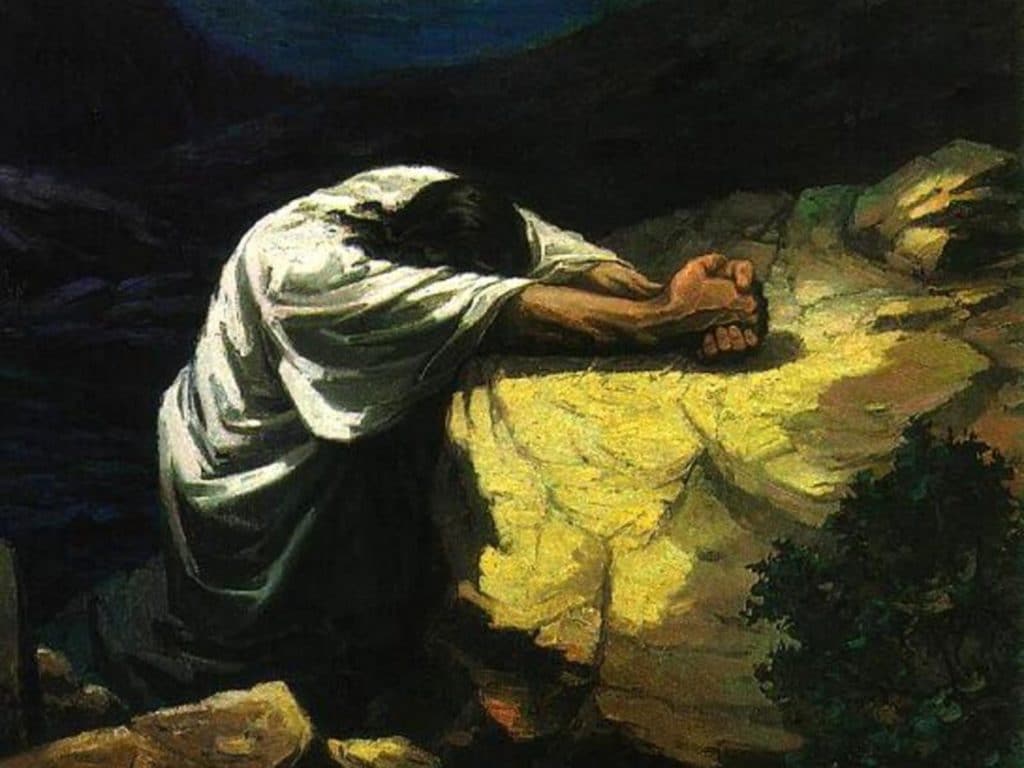
39 And he came out and went, as was his custom, to the Mount of Olives, and the disciples followed him. 40 And when he came to the place, he said to them, “Pray that you may not enter into temptation.” 41 And he withdrew from them about a stone’s throw, and knelt down and prayed, 42 saying, “Father, if you are willing, remove this cup from me. Nevertheless, not my will, but yours, be done.” 43 And there appeared to him an angel from heaven, strengthening him. 44 And being in agony he prayed more earnestly; and his sweat became like great drops of blood falling down to the ground. 45 And when he rose from prayer, he came to the disciples and found them sleeping for sorrow, 46 and he said to them, “Why are you sleeping? Rise and pray that you may not enter into temptation.” Luke 22:39-46 ESV

One of the truly fascinating things about studying Scripture is how the Spirit of God constantly reveals new insights that had previously been hidden from view. So often, we can find ourselves reading through a passage and focusing on a portion that seems particularly relevant to our current circumstances. Then, at a later date, we read the same passage and discover something we had overlooked. For instance, I had never noticed the statement made by Luke in chapter 21, verse 37.

Every day Jesus went to the Temple to teach, and each evening he returned to spend the night on the Mount of Olives. – Luke 21:37 NLT

I had assumed that Jesus returned each evening to the nearby village of Bethany where Lazarus and his two sisters resided. I had never noticed that Jesus and His disciples had actually been camping out on the Mount of Olives, located just across the Kidron Valley from the Eastern walls of Jerusalem.

But on this night, Jesus led His disciples to the Garden of Gethsemane, which was located on the Mount of Olives. Once there, He instructed His disciples to pray, then He took Peter, James, and John and found a more isolated spot where He informed them, “My soul is crushed with grief to the point of death. Stay here and keep watch with me” (Matthew 26:38 NLT). According to Matthew, Jesus was “anguished and distressed” (Matthew 26:37 NLT). As the moment of His suffering and death drew nearer, Jesus could feel the intensity and immensity of the burden He was about to bear. The scene as described by the gospel writers paints an image of increasing isolation as Jesus moves from the company of the 11 to the more intimate companions of Peter, James, and John. And then, it ends with Jesus in completely isolated and alone, except for the presence of His Heavenly Father.

…he withdrew from them about a stone’s throw, and knelt down and prayed… – Luke 22:41 ESV

From 11 to three to one. Jesus was entering a period marked by extreme sorrow and pain, and none of His disciples could fathom its weight or empathize with His suffering. Matthew describes Jesus as bowing down “with his face to the ground” (Matthew 26:39 NLT). Mark provides an added detail that describes the intensity of Jesus’ actions.

he fell on the ground – Mark 14:35 ESV

Jesus was emotionally vested in the moment. His entire being was experiencing the full brunt of the responsibility given to Him by His Father. In this seminal moment of Jesus’ life, we are given a vivid portrait of both His divinity and humanity. He was fully God and fully human, and nowhere does this unique union of two essences become more evident than in the darkness of the Garden of Gethsemane. As the Son of God, Jesus declares His intention to faithfully fulfill the will of His Father. But as the Son of Man, Jesus displays His humanity and a natural aversion to the intense suffering He is about to undergo. He openly and honestly shares His heart with the Father.

“Father, if you are willing, please take this cup of suffering away from me. – Luke 22:42 NLT

Jesus was not an automaton, preprogrammed to mechanically adhere to a predetermined set of instructions. He was not simply going through the motions. And we tend to forget that, as a man, Jesus would endure all the intense pain, heartache, physical and emotional trauma that any other man would feel who was forced to endure scourging and crucifixion. And yet, He was prepared to do it on His own initiative and not because He was being forced to do so.

“No one can take my life from me. I sacrifice it voluntarily. For I have the authority to lay it down when I want to and also to take it up again. For this is what my Father has commanded.” – John 10:18 NLT

At one time, Jesus had described Himself as “the good shepherd” and added that “The good shepherd sacrifices his life for the sheep” (John 10:11 NLT). And He made it perfectly clear that His sacrifice was voluntary and not coerced.

“I sacrifice my life for the sheep.” – John 10:15 NLT

Jesus did not have a death wish. As a human, He knew that the pain ahead would be excruciating. Yet, as God, He knew it was also inescapable. His human nature was revolted at the prospect of death by crucifixion. He knew it would be like nothing He had ever experienced before or ever again. And, in allowing Himself to endure such a devastatingly cruel form of execution, Jesus was making Himself one with us. The author of Hebrews reminds us:

Therefore, it was necessary for him to be made in every respect like us, his brothers and sisters, so that he could be our merciful and faithful High Priest before God. Then he could offer a sacrifice that would take away the sins of the people. Since he himself has gone through suffering and testing, he is able to help us when we are being tested. – Hebrews 2:17-18 NLT

One of the things we fail to recognize is that the mental, emotional, and psychological suffering Jesus endured prior to the cross is what makes Him an empathetic and understanding Savior. He understands our pain because He has endured it. He knows the reality of the fear and apprehension that so often grips our lives because He experienced it. He is intimately familiar with those moments when our will stands in direct opposition to God’s. But what He models for us is a complete reliance upon and submission to His Father’s sovereign will for His life.

“Yet I want your will to be done, not mine.” – Luke 22:42 NLT

Jesus’ death on the cross was not performance art. He was not pretending to bleed. He wasn’t putting on a well-rehearsed show that appeared real but was really all an act. No, the pain was intense. The beatings took their toll. The nails pierced through real flesh, severing real veins, and spilling real human blood. His muscles were cramped. His breath grew labored. His sight became blurred from the sweat, the blood, and the unrelenting pain. And yet, knowing all of this long before it happened, Jesus was willing to endure it – all for us.

For God made Christ, who never sinned, to be the offering for our sin, so that we could be made right with God through Christ. – 2 Corinthians 5:21 NLT

Luke provides us with insight into the intensity of Jesus’ prayer time. This was not a “now-I-lay-me-down-to-sleep” kind of prayer. It was so emotionally exhausting and draining that “an angel from heaven appeared and strengthened him” (Luke 22:43 NLT). But even this divinely ordained respite failed to make the rest of Jesus’ prayer time any less difficult. If anything, it seems to have renewed and re-energized Jesus’ efforts.

He prayed more fervently, and he was in such agony of spirit that his sweat fell to the ground like great drops of blood. – Luke 22:44 NLT

It is impossible to know the exact meaning behind this reference to sweat falling like drops of blood. Suffice it to say, this was an intensely emotional experience for Jesus. Every aspect of His being was engaged and impacted by this moment. Yet, both Mark and Matthew record that while Jesus was pouring out His heart and exhausting every last vestige of emotional energy, the disciples were fast asleep (Matthew 26:40; Mark 14:37). Luke seems to cut them some slack by indicating that they were “exhausted from grief” (Luke 22:45 NLT).

It’s interesting to consider that Jesus was grieved, yet He faced it by asking that His Heavenly Father’s will be done. He knew that His sorrow was real, but that it took a backseat to the divine plan for mankind’s redemption. But the disciples faced their sorrow through escape. They sought relief from their grief by sleep rather than prayer. In a sense, they sought their own will. Instead of facing the unappealing prospect of suffering by submitting to God’s will, they chose the temporary prospect of sleep.

So, Jesus woke them and warned, “Get up and pray, so that you will not give in to temptation” (Luke 22:46 NLT). What Luke chooses to leave out of his narrative is that Jesus directed this statement to Peter, one of the three whom He had chosen to accompany Him further into the garden. And Jesus made this statement the first time He found Peter, James, and John asleep. 

He said to Peter, “Couldn’t you watch with me even one hour? Keep watch and pray, so that you will not give in to temptation. For the spirit is willing, but the body is weak!” – Matthew 26:40-41 NLT

This was the same man who had boldly declared, “Lord, I am ready to go with you both to prison and to death” (Luke 22:33 ESV). And yet, Jesus knew that it would only be a matter of time before Peter would deny even knowing Him. What Peter needed was divine help, not sleep. What Peter should have been doing was praying. But he was about to learn the truth behind Jesus’ words: The spirit is willing, but the body is weak.

English Standard Version (ESV) The Holy Bible, English Standard Version. ESV® Permanent Text Edition® (2016). Copyright © 2001 by Crossway Bibles, a publishing ministry of Good News Publishers.

New Living Translation (NLT) Holy Bible, New Living Translation, copyright © 1996, 2004, 2015 by Tyndale House Foundation. Used by permission of Tyndale House Publishers Inc., Carol Stream, Illinois 60188. All rights reserved.

The Message (MSG)Copyright © 1993, 1994, 1995, 1996, 2000, 2001, 2002 by Eugene H. Peterson

It Is Enough

31 “Simon, Simon, behold, Satan demanded to have you, that he might sift you like wheat, 32 but I have prayed for you that your faith may not fail. And when you have turned again, strengthen your brothers.” 33 Peter said to him, “Lord, I am ready to go with you both to prison and to death.” 34 Jesus said, “I tell you, Peter, the rooster will not crow this day, until you deny three times that you know me.”

35 And he said to them, “When I sent you out with no moneybag or knapsack or sandals, did you lack anything?” They said, “Nothing.” 36 He said to them, “But now let the one who has a moneybag take it, and likewise a knapsack. And let the one who has no sword sell his cloak and buy one. 37 For I tell you that this Scripture must be fulfilled in me: ‘And he was numbered with the transgressors.’ For what is written about me has its fulfillment.” 38 And they said, “Look, Lord, here are two swords.” And he said to them, “It is enough.”  Luke 22:31-38 ESV

It’s clear from Mark’s account that, immediately after their celebration of the Passover meal,, Jesus and His disciples had left the upper room and made their way to the Mount of Olives, just across the Kidron Valley, east of Jerusalem.

And when they had sung a hymn, they went out to the Mount of Olives. – Mark 14:26 ESV

It was there that Jesus made yet another disturbing announcement.

And Jesus said to them, “You will all fall away, for it is written, ‘I will strike the shepherd, and the sheep will be scattered.’ But after I am raised up, I will go before you to Galilee.” – Mark 14:27-28 ESV

This foreboding prediction caught the disciples off-guard and caused the always quick-to-speak Peter to defend his own honor.

“Even though they all fall away, I will not.” – Mark 14:29 ESV

He was separating himself from the rest by declaring his undying commitment to remain by Jesus’ side no matter what happened. It was probably at this point in the conversation that Jesus spoke the words that Luke records.

“Simon, Simon, behold, Satan demanded to have you, that he might sift you like wheat, but I have prayed for you that your faith may not fail. And when you have turned again, strengthen your brothers.” – Luke 22:31-32 ESV

Jesus knew Simon well. He had spent more than three years attempting to disciple this impulsive and rather self-absorbed fisherman from Galilee. Peter was an over-confident over-achiever who regularly viewed himself as the unofficial and self-declared spokesman for the twelve. He had a strong competitive streak and a tendency to put his mouth in gear before his brain was fully engaged. This propensity often led him to say things he would later regret. And this would prove to be one such occasion.

Peter refused to accept Jesus’ assessment of his future faithfulness, but instead he argued that he was more than willing to lay his life on the line.

“Lord, I am ready to go with you both to prison and to death.” – Luke 22:33 ESV

These boastful words would come back to haunt Peter. He truly believed he was completely sold-out to the cause and willing to sacrifice anything to ensure that Jesus’ kingdom came to fruition. But what he didn’t know was the state of his own heart. Peter refused to accept the fact that he might be some kind of traitor or turncoat. Jesus must have had him confused with one of the other disciples. Yet Jesus made it clear that He had the right man by describing the exact nature of his wrong choice .

“I tell you, Peter, the rooster will not crow this day, until you deny three times that you know me.” – Luke 22:34 ESV

This must have hit Peter like a freight train. Jesus’ dire prediction left him stunned, embarrassed, and more than a bit defensive. Mark records that Peter immediately refuted Jesus’ accusation.

“If I must die with you, I will not deny you.” – Mark 14:31 ESV

In a desperate attempt to protect his own reputation, Peter essentially accused Jesus of being a liar. He denied Jesus’ assertion that he would be a denier. It’s important to remember that this entire conversation took place within earshot of the other disciples because when Peter made this bold claim, the other disciples echoed his words.

And they all said the same. – Luke 22:31 ESV

But at this point, Jesus redirected the topic of conversation by reminding them of their earlier mission when He had “sent them out to proclaim the kingdom of God and to heal” (Luke 9:2 ESV). Jesus asked them, “When I sent you out with no moneybag or knapsack or sandals, did you lack anything?” (Luke 22:35 ESV), and they responded, “Nothing!”

Then, Jesus made a shocking statement that must have left the disciples in a state of confusion.

“But now let the one who has a moneybag take it, and likewise a knapsack. And let the one who has no sword sell his cloak and buy one. – Luke 22:36 ESV

With this rather strange pronouncement, Jesus was letting them know that things were about to take a radical change. Earlier, when He had sent them out by twos, they had been instructed to provide nothing for their own care. Instead, they were to rely on the gracious support of others. But with Jesus’ approaching death and eventual resurrection, the spiritual battle around them was about to enter a new and much-darker phase. Little did they know that the days ahead would be marked by increasing hostility and resistance. This is what Jesus had tried to explain to them on a much earlier occasion.

“Don’t imagine that I came to bring peace to the earth! I came not to bring peace, but a sword.

‘I have come to set a man against his father,
    a daughter against her mother,
and a daughter-in-law against her mother-in-law.
    Your enemies will be right in your own household!’” – Matthew 10:34-36 NLT

Jesus had not been suggesting that His mission was that of a physical revolution fought with swords and spears. He was letting them know that the gospel of the Kingdom of God was going to end up having a polarizing affect on humanity. Those who embrace the gospel would find themselves facing the anger and animosity of their own loved ones. Jesus went on to tell them that their decision to follow Him would come with a high cost.

“If you love your father or mother more than you love me, you are not worthy of being mine; or if you love your son or daughter more than me, you are not worthy of being mine. If you refuse to take up your cross and follow me, you are not worthy of being mine.” – Matthew 10:37-38 NLT

Commitment to the cause of Christ would require a drastic change in priorities and alliances. Nothing was to stand in the way of their sold-out allegiance to Him. They would have to be willing to sacrifice everything for the cause. But Jesus assured them it would be well worth the effort.

“If you cling to your life, you will lose it; but if you give up your life for me, you will find it.” – Matthew 10:39 NLT

But was Jesus really suggesting that the disciples sell their possession order to purchase weapons? Was He condoning self-defense and physical violence? Some would suggest that is exactly what Jesus was doing. They point to Jesus’ response when one of the disciples indicated that they already had two swords in their possession. He said, “It is enough” (Luke 22:38 ESV). And if we fast-forward to later in the evening, when the soldiers came to arrest Jesus in the Garden of Gethsemane, Luke reports that one of the disciples responded to the intrusion by asking, “Lord, shall we strike with the sword?” (Luke 22:49 ESV). And before Jesus could say a word, one of them struck the servant of the high priest and cut off his right ear” (Luke 22:50 ESV). It seems apparent that the disciples had taken Jesus’ admonition to arm themselves quite literally. And yet, Matthew reveals that Jesus did not approve of their actions.

“Put away your sword,” Jesus told him. “Those who use the sword will die by the sword. Don’t you realize that I could ask my Father for thousands of angels to protect us, and he would send them instantly? But if I did, how would the Scriptures be fulfilled that describe what must happen now?” – Matthew 26:52-54 NLT

The whole reference to swords was meant to be a metaphor that let them know that they were about to go into battle. But as the apostle Paul would later explain, the battle was going to be spiritual, not physical in nature.

For we are not fighting against flesh-and-blood enemies, but against evil rulers and authorities of the unseen world, against mighty powers in this dark world, and against evil spirits in the heavenly places. – Ephesians 6:12 NLT

And Jesus inferred that this was spiritual conflict that could only be won by spiritual means. He clearly indicates that if physical protection was the objective, He could have made a personal request to His heavenly Father and thousands of angels with flaming swords would have descended in an instant. But Jesus never made that request and those angels never appeared. This wasn’t case of a lack of weaponry. It was matter of God’s will.

When Jesus had said, “It is enough,” He wasn’t suggesting that two swords would be sufficient to defend the kingdom. He was letting His disciples know that God can do much with little. Just as Jesus had fed the multitude with five loaves of bread and two fish, God could and would accomplish great things through 11 men who were ill-equipped and unprepared for the raging battle that loomed before them.

And the apostle Paul went on to describe the nature of the armor and the arsenal the disciples would eventually use to wage war in the spiritual realm.

Therefore, put on every piece of God’s armor so you will be able to resist the enemy in the time of evil. Then after the battle you will still be standing firm. Stand your ground, putting on the belt of truth and the body armor of God’s righteousness. For shoes, put on the peace that comes from the Good News so that you will be fully prepared. In addition to all of these, hold up the shield of faith to stop the fiery arrows of the devil. Put on salvation as your helmet, and take the sword of the Spirit, which is the word of God. – Ephesians 6:13-17 NLT

It is enough.

English Standard Version (ESV) The Holy Bible, English Standard Version. ESV® Permanent Text Edition® (2016). Copyright © 2001 by Crossway Bibles, a publishing ministry of Good News Publishers.

New Living Translation (NLT) Holy Bible, New Living Translation, copyright © 1996, 2004, 2015 by Tyndale House Foundation. Used by permission of Tyndale House Publishers Inc., Carol Stream, Illinois 60188. All rights reserved.

The Message (MSG)Copyright © 1993, 1994, 1995, 1996, 2000, 2001, 2002 by Eugene H. Peterson

The End

7 And they asked him, “Teacher, when will these things be, and what will be the sign when these things are about to take place?” And he said, “See that you are not led astray. For many will come in my name, saying, ‘I am he!’ and, ‘The time is at hand!’ Do not go after them. And when you hear of wars and tumults, do not be terrified, for these things must first take place, but the end will not be at once.”

10 Then he said to them, “Nation will rise against nation, and kingdom against kingdom. 11 There will be great earthquakes, and in various places famines and pestilences. And there will be terrors and great signs from heaven. 12 But before all this they will lay their hands on you and persecute you, delivering you up to the synagogues and prisons, and you will be brought before kings and governors for my name’s sake. 13 This will be your opportunity to bear witness. 14 Settle it therefore in your minds not to meditate beforehand how to answer, 15 for I will give you a mouth and wisdom, which none of your adversaries will be able to withstand or contradict. 16 You will be delivered up even by parents and brothers and relatives and friends, and some of you they will put to death. 17 You will be hated by all for my name’s sake. 18 But not a hair of your head will perish. 19 By your endurance you will gain your lives.  Luke 21:7-19 ESV

This was not what the disciples wanted to hear. After delivering the shocking news that the beautiful temple would one day be destroyed, Jesus led His disciples out of the city of Jerusalem and up the Mount of Olives. This location just across the Kidron Valley from the eastern walls of the city, provided an elevated vantage point from which to view the capital and its glorious temple. From this secluded spot, Jesus continued to teach His disciples and prepare them for the fateful days that lie ahead. His address to these men has come to be known as the Olivet Discourse.

As expected, the disciples were struggling with Jesus’ stunning pronouncement that the sacred house of God was going to be destroyed. This concept would have been unfathomable to the disciples, and would have caused them to consider the last time the temple of God had been destroyed. It had taken place more than six centuries earlier, when the Babylonians had conquered Jerusalem, leaving a path of death and destruction in their wake. In the process, they destroyed the majestic temple that Solomon had constructed. And for 70 years, the city and its once-magnificent temple sat abandoned until God orchestrated the return of a remnant of the people from their exile in Babylon. Under the leadership of Nehemiah, this ragtag group of former slaves had been able to rebuild and restore the temple and the city. But it would be more than five centuries later before Herod the Great orchestrated a massive remodeling project that would greatly enhance and expand the temple.

As the disciples looked back across the Kidron Valley, they could see the facade of this beautiful structure gleaming in the afternoon sun. This sight, coupled with Jesus’ words, led four of the disciples to approach Him for more information (Mark 13:3). James, John, Peter, and Andrew wanted to know more, so these two sets of brothers asked Jesus for an explanation.

“Teacher,” they asked, “when will all this happen? What sign will show us that these things are about to take place?” – Luke 21:7 NLT

Their questions reveal that they were focused on the destruction of the temple. They wanted to know when this horrific act of judgment would take place and if there would be any warning signs. Basically, they were wanting to know if it was going to happen soon and if they would have ample warning so they could be out of the city when it took place. But their full attention appears to have been on the city and the temple. Despite all of Jesus’ earlier warnings about His pending death in Jerusalem, these men were more concerned about the possible destruction of the temple than anything else.

In his gospel account, John records another Passover, three years earlier, when Jesus had cleared the temple of the moneychangers and vendors. The Jewish religious leaders had demanded that Jesus show them a sign that would prove His authority to do such a thing. And Jesus had responded:

“Destroy this temple, and in three days I will raise it up.” – John 2:19 ESV

But these learned men failed to catch the symbolic nature of His answer. Instead, they took Him literally, viewing His answer as utterly ridiculous and impossible.

“It has taken forty-six years to build this temple, and will you raise it up in three days?”  – John 2:20 ESV

John goes on to explain, Jesus “was speaking about the temple of his body” (John 2:21 ESV). But the disciples would not connect the dots until after Jesus had died and been raised back to life. So, as they sat on the Mount of Olives watching the rays of the setting sun reflect off the gold inlay of the temple, they were fixated on its destruction, but not on the fast-approaching death of their Lord and Master.

But Jesus, sensing their confusion and concern, provided them with a foretaste of things to come.

“Don’t let anyone mislead you, for many will come in my name, claiming, ‘I am the Messiah,’ and saying, ‘The time has come!’ But don’t believe them. And when you hear of wars and insurrections, don’t panic. Yes, these things must take place first, but the end won’t follow immediately.” – Luke 21:8-9 NLT

Jesus accelerated the narrative to a day in the far-distant future, when the end of the age was to take place. He compressed and combined a great many events into a single answer, providing His disciples with an overview of things to come. He knew they were fixated on the day in which they lived. They were wanting to know when the temple would be destroyed and what the conditions would be like when it happened. But Jesus was speaking of future events that would take place long after the disciples were dead and gone.

Roughly four decades later, the Romans would destroy the city of Jerusalem and its magnificent temple. Some of the disciples would live long enough to witness that fateful day. And yet, Jesus was speaking of events that still remain unfulfilled, even in our day. He described those who would show up in that future day, claiming to be Him and declaring themselves to be the messiah or savior offering deliverance. He warned of a future marked by wars, civil unrest, and natural disasters. But these “signs” would be nothing but the “birth pains” (Mark 15:8) that precede the fast-approaching climax of the redemptive history. They will merely preface the end of the age.

Jesus was providing James, John, Peter, and Andrew with a comprehensive overview of the eschaton or end times. But He didn’t do so in easy-to-understand terms that fall into a simple chronological sequence. The disciples had no idea what was about to happen. In just a matter of days, their world would be rocked by the death of Jesus. But then, three days later, He would rise again. Then, He would return to His Father in heaven and send the Spirit to indwell and empower the disciples for the work He had commissioned them to do. As a result, they would plan a major role in the dissemination of the gospel and the subsequent growth of the church.

But centuries would pass and, even as the church continued to grow, the spiritual state of the world would continue to decay. And it will continue do so until Jesus returns to the earth. The downward spiral of humanity’s spiritual condition will  accelerate and intensify, reaching its lowest point until the rapture of the church takes place. This mass exodus of all believers from the face of the earth will usher in a time of tribulation, “such as has not been from the beginning of the world until now, no, and never will be” (Matthew 24:21 ESV).

Jesus was giving these four men a crash course in eschatology or the study of end times. While their minds were fixated on the temple and its possible destruction, Jesus was trying to get them to see the bigger picture. There was far more going on than they realized. The temple was not as important and integral as they believed it to be. Jesus’ emphasis on nations and kingdoms subtly reveals that the people of Israel will no longer be the focal point of God’s redemptive story. It is not that He will abandon them, but that He will use their rejection of His Son and their subsequent role in His death, as an impetus to include people of every tribe, nation, and tongue into His family.

And the apostle Paul reminds us that God has great plans in store for His chosen people. Their initial rejection of the Messiah did not permanently invalidate His covenant commitments to them. He will remain faithful and fulfill every promise He has made to them.

Did God’s people stumble and fall beyond recovery? Of course not! They were disobedient, so God made salvation available to the Gentiles. But he wanted his own people to become jealous and claim it for themselves. Now if the Gentiles were enriched because the people of Israel turned down God’s offer of salvation, think how much greater a blessing the world will share when they finally accept it. – Romans 11:11-12 NLT

But Jesus wanted these four men to understand that while much of what He just described was to take place in the distant future, they were to be on their guard. The days ahead were going to be filled with uncertainty and the very real threat of persecution.

You will be hated by all for my name’s sake.” – Luke 13:13 ESV

With His death, resurrection, and ascension, their lives would get much more complicated. In the process of taking the gospel to the nations, they would face trials and difficulties of all kinds. But they would have the indwelling Spirit of God to guide, protect, and empower them. They needed to stop worrying about the temple of God and begin thinking about the will of God. What was He doing in their midst? What did He have planned for them to do in the days ahead? And Jesus told them that. while things would get far worse before they got better, they could rest assured that their lives were held securely in God’s hands.

“But not a hair of your head will perish! By standing firm, you will win your souls.” – Luke 21:18-19 NLT

According to Jesus, the future would be filled with all kinds of uncomfortable and settling signs.

Sign 1: False Messiahs

Sign 2: Wars, threats of wars, and insurrections

Sign 3: Global conflict

Sign 4: Natural disasters

Sign 5: Personal Persecution 

Sign 6: Denial of Christ and Spiritual Apathy 

Sign 7: The Perseverance of the Saints and the Spread of the Gospel 

But in spite of the fact that many would end up deserting and denying Jesus, there would be those who endured and persevered to the end. They would remain faithful, resulting in the spread of the good news about the Kingdom throughout the world. This includes the period of time from Jesus’ ascension all the way to the end. And it will be at that time that Jesus returns.

This incredible passage provides us with a glimpse into the future of not only Israel but the world. Jesus was preparing His disciples to think globally and eternally. He was attempting to move their point of reference from the here-and-now to the yet-to-be. These men had been obsessed with their own immediate context. They had hoped that Jesus was going to establish His Messianic Kingdom in their lifetimes. They had a difficult time accepting His repeated predictions of His death in Jerusalem. And the very thought of the temple being destroyed was unfathomable to them. That was inconceivable and unacceptable. But Jesus had a long-term perspective that was focused on God’s eternal plan of redemption. He was not done yet. He had to die. He had to rise again. He had to return to His Father’s side. And then, one day, when the time is right, He will return to earth and complete His Father’s will.

English Standard Version (ESV) The Holy Bible, English Standard Version. ESV® Permanent Text Edition® (2016). Copyright © 2001 by Crossway Bibles, a publishing ministry of Good News Publishers.

New Living Translation (NLT) Holy Bible, New Living Translation, copyright © 1996, 2004, 2015 by Tyndale House Foundation. Used by permission of Tyndale House Publishers Inc., Carol Stream, Illinois 60188. All rights reserved.
The Message (MSG)Copyright © 1993, 1994, 1995, 1996, 2000, 2001, 2002 by Eugene H. Peterson

The Love of the World

1 Now King Solomon loved many foreign women, along with the daughter of Pharaoh: Moabite, Ammonite, Edomite, Sidonian, and Hittite women, from the nations concerning which the Lord had said to the people of Israel, “You shall not enter into marriage with them, neither shall they with you, for surely they will turn away your heart after their gods.” Solomon clung to these in love. He had 700 wives, who were princesses, and 300 concubines. And his wives turned away his heart. For when Solomon was old his wives turned away his heart after other gods, and his heart was not wholly true to the Lord his God, as was the heart of David his father. For Solomon went after Ashtoreth the goddess of the Sidonians, and after Milcom the abomination of the Ammonites. So Solomon did what was evil in the sight of the Lord and did not wholly follow the Lord, as David his father had done. Then Solomon built a high place for Chemosh the abomination of Moab, and for Molech the abomination of the Ammonites, on the mountain east of Jerusalem. And so he did for all his foreign wives, who made offerings and sacrificed to their gods. 1 Kings 11:1-8 ESV


In this chapter, the author pulls back the curtain on Solomon’s life, revealing the poorly veiled secret that would prove to be his ultimate downfall. Solomon loved women. And he used his position and power as king to more than satisfy his insatiable desire for the opposite sex. The text reveals the staggering fact that Solomon had amassed a harem of 1,000 wives and concubines. And it had all started with his marriage to the daughter of the Egyptian Pharaoh (1 Kings 3:1). This had probably been a marriage of convenience, allowing Solomon to form a close alliance with another powerful nation. He certainly made the most of this marital union by purchasing thousands of horses and chariots from the Egyptians to equip his army (1 Kings 10:28-29).

But Solomon’s infatuation with women didn’t stop with Pharaoh’s daughter. He went on to add other foreign women to his growing harem, including “Moabite, Ammonite, Edomite, Sidonian, and Hittite women” (1 Kings 11:1 ESV). And the author points out the underlying problem with Solomon’s actions. Solomon had chosen to love foreign women “from the nations concerning which the Lord had said to the people of Israel, ‘You shall not enter into marriage with them, neither shall they with you, for surely they will turn away your heart after their gods’” (1 Kings 11:2 ESV).

Solomon was in direct violation of the command of God, given to the people of Israel during their journey from Egypt to Canaan. God had warned the Israelites that they were not to intermarry with the pagans who currently occupied the land He was giving them as their inheritance. Moses conveyed this command in no uncertain terms.

“When the Lord your God brings you into the land you are about to enter and occupy, he will clear away many nations ahead of you: the Hittites, Girgashites, Amorites, Canaanites, Perizzites, Hivites, and Jebusites. These seven nations are greater and more numerous than you. When the Lord your God hands these nations over to you and you conquer them, you must completely destroy them. Make no treaties with them and show them no mercy. You must not intermarry with them. Do not let your daughters and sons marry their sons and daughters, for they will lead your children away from me to worship other gods. Then the anger of the Lord will burn against you, and he will quickly destroy you.” – Deuteronomy 7:1-4 NLT

And God had also prohibited the Israelites from having anything to do with the Ammonites and Moabites.

These nations did not welcome you with food and water when you came out of Egypt. Instead, they hired Balaam son of Beor from Pethor in distant Aram-naharaim to curse you. But the Lord your God refused to listen to Balaam. He turned the intended curse into a blessing because the Lord your God loves you. As long as you live, you must never promote the welfare and prosperity of the Ammonites or Moabites. – Deuteronomy 23:4-6 NLT

But Solomon was a collector. He had a passion for fine things and filled his palace with treasures of all kinds, including women from all over the known world. He treated them like prized possessions, living symbols of his unsurpassed wealth and proof of his obsession with fulfilling his heart’s every desire. Years later, Solomon would confess his narcissistic propensities.

“I collected great sums of silver and gold, the treasure of many kings and provinces. I hired wonderful singers, both men and women, and had many beautiful concubines. I had everything a man could desire!

So I became greater than all who had lived in Jerusalem before me, and my wisdom never failed me. Anything I wanted, I would take. I denied myself no pleasure. – Ecclesiastes 2:8-9 NLT

Despite the warnings of God, Solomon “clung to these in love” (1 Kings 11:2 ESV). Even though Solomon had been gifted with wisdom beyond compare, his obsessive-compulsive tendencies led him to make decisions that were clearly foolish and, ultimately, destructive. God had made His will perfectly and plainly clear.

“The king must not take many wives for himself, because they will turn his heart away from the Lord.” – Deuteronomy 17:17 NLT

But Solomon, emboldened by his wisdom and empowered by his position as king, decided that he knew what was best. Fulfilling his physical desires and passions took precedence over his obedience to God. And he would suffer the consequences for his unfaithfulness.

Whenever a child of God places his will above that of God, he will find himself making constant compromises and concessions in order to justify his actions. He will rationalize his decisions in an attempt to convince himself that he is doing the right thing. In doing so, he allows himself to be driven by his desires, rather than guided by the loving hand of God Almighty. And this pattern of behavior can be clearly seen in the life of Solomon. Back in chapter 3, the author declared Solomon’s love for and commitment to God.

Solomon loved the Lord, walking in the statutes of David his father – 1 Kings 3:3 ESV

But by chapter 11, things had begun to change.

King Solomon loved many foreign women – 1 Kings 11:1 ESV

Solomon never stopped loving God, but he soon found himself with divided affections and a diminished devotion. His love, or better yet, lust for his many wives made it impossible for Solomon to love God with all his heart, soul, mind, and strength. His capacity to love God had been severely diluted. He had allowed himself to become distracted by the things of this world. And, as the apostle John makes clear, this love affair with material possessions and physical passions always leads to diminished devotion for God.

Do not love this world nor the things it offers you, for when you love the world, you do not have the love of the Father in you. For the world offers only a craving for physical pleasure, a craving for everything we see, and pride in our achievements and possessions. These are not from the Father, but are from this world. And this world is fading away, along with everything that people crave. But anyone who does what pleases God will live forever.  – 1 John 2:15-17 NLT

Chapter 11 provides the sad and sobering turning point in the life of Solomon. Everything had started out so well. He had been appointed by God to replace his father as king of Israel. He had been gifted with great wisdom and rewarded with wealth and fame. His kingdom was marked by peace and prosperity. And he had been given the privilege and honor of building a temple for God. But the honeymoon was over.

Solomon had failed to heed his father’s warning.

“Take courage and be a man. Observe the requirements of the Lord your God, and follow all his ways. Keep the decrees, commands, regulations, and laws written in the Law of Moses so that you will be successful in all you do and wherever you go.” – 1 Kings 2:2-3 NLT

God had made a covenant commitment to David.

“Furthermore, the Lord declares that he will make a house for you—a dynasty of kings! For when you die and are buried with your ancestors, I will raise up one of your descendants, your own offspring, and I will make his kingdom strong. He is the one who will build a house—a temple—for my name. And I will secure his royal throne forever.” – 2 Samuel 7:11-13 NLT

But David had understood that this promise came with conditions. He knew that the covenant blessings would be forfeited if his son refused to remain faithful to God. And David had shared this important caveat with his son while lying on his deathbed.

“If your descendants live as they should and follow me faithfully with all their heart and soul, one of them will always sit on the throne of Israel.” – 1 Kings 2:4 NLT

Yet here we find the son of David committing the unpardonable sin. He had not only disobeyed God by marrying foreign women, but he had begun to worship their false gods.

Solomon went after Ashtoreth the goddess of the Sidonians, and after Milcom the abomination of the Ammonites. So Solomon did what was evil in the sight of the Lord and did not wholly follow the Lord, as David his father had done. – 1 Kings 11:5-6 NLT

His love for the world and all the tempting pleasures it offered had turned his heart from the Lord. His life had become a living example of something Jesus later warned about.

“No one can serve two masters. For you will hate one and love the other; you will be devoted to one and despise the other. You cannot serve God and be enslaved to money.” – Matthew 6:24 NLT

It is fascinating to note that Solomon’s love of women eventually produced in him a devotion for their pagan gods. And his affection for these false gods would prompt him to erect shrines or places of worship in their honor. The man who had built the house for Yahweh, the one true God, found himself building altars to Chemosh and Molech, the gods of the Moabites and Ammonites. But notice where he built them – “on the mountain east of Jerusalem” (1 Kings 11:7 ESV). This was the Mount of Olives, the very same place where, hundreds of years later, another son of David would pray the following prayer: “Father… not my will, but yours, be done” (Luke 22:42 ESV). On the same location where Solomon had erected altars to false gods, Jesus would declare His commitment to faithfully fulfill the will of God.

It was on the Mount of Olives that Solomon and his many wives offered up their sacrifices to  Molech and  Chemosh. But in the very same place, Jesus, the Son of David and the Savior of the world would humbly and obediently sacrifice His own will for that of His Heavenly Father.

English Standard Version (ESV) The Holy Bible, English Standard Version. ESV® Permanent Text Edition® (2016). Copyright © 2001 by Crossway Bibles, a publishing ministry of Good News Publishers.

New Living Translation (NLT) Holy Bible, New Living Translation, copyright © 1996, 2004, 2015 by Tyndale House Foundation. Used by permission of Tyndale House Publishers Inc., Carol Stream, Illinois 60188. All rights reserved.

The Message (MSG)Copyright © 1993, 1994, 1995, 1996, 2000, 2001, 2002 by Eugene H. Peterson

The Beginning of the End

26 And when they had sung a hymn, they went out to the Mount of Olives. 27 And Jesus said to them, “You will all fall away, for it is written, ‘I will strike the shepherd, and the sheep will be scattered.’ 28 But after I am raised up, I will go before you to Galilee.” 29 Peter said to him, “Even though they all fall away, I will not.” 30 And Jesus said to him, “Truly, I tell you, this very night, before the rooster crows twice, you will deny me three times.” 31 But he said emphatically, “If I must die with you, I will not deny you.” And they all said the same.”

32 And they went to a place called Gethsemane. And he said to his disciples, “Sit here while I pray.” 33 And he took with him Peter and James and John, and began to be greatly distressed and troubled. 34 And he said to them, “My soul is very sorrowful, even to death. Remain here and watch.” 35 And going a little farther, he fell on the ground and prayed that, if it were possible, the hour might pass from him. 36 And he said, “Abba, Father, all things are possible for you. Remove this cup from me. Yet not what I will, but what you will.” 37 And he came and found them sleeping, and he said to Peter, “Simon, are you asleep? Could you not watch one hour? 38 Watch and pray that you may not enter into temptation. The spirit indeed is willing, but the flesh is weak.” 39 And again he went away and prayed, saying the same words. 40 And again he came and found them sleeping, for their eyes were very heavy, and they did not know what to answer him. 41 And he came the third time and said to them, “Are you still sleeping and taking your rest? It is enough; the hour has come. The Son of Man is betrayed into the hands of sinners. 42 Rise, let us be going; see, my betrayer is at hand.” Mark 14:26-42 ESV

As part of their Passover celebration, Jesus and the disciples closed their time together with a hymn. Then they made their way out of the city and back to the Mount of Olives, located on the opposite side of the Kidron Valley, just east of Jerusalem. There Jesus made yet another shocking announcement to His men: “You will all fall away, for it is written, ‘I will strike the shepherd, and the sheep will be scattered.’ But after I am raised up, I will go before you to Galilee” (Mark 14:27-28 ESV).

Jesus used a verse from the prophet Zechariah to predict the falling away of His disciples. Not only was one of them going to betray Him, but the rest would end up deserting Him. These men had been His closest companions for 3-1/2 years, yet Jesus was letting them know that the events of the next 48 hours would result in their abandonment of Him. Shocked and shamed by this less-than-flattering disclosure from Jesus, Peter spoke up and vehemently denied that it applied to him.

“Even though they all fall away, I will not.” – Mark 14:29 ESV

He refused to accept Jesus’ assessment of his loyalty, and boldly proclaimed his ever-lasting allegiance. But Peter was speaking from the point of ignorance. He had no idea what was about to take place. Even though Jesus had disclosed the fate that awaited Him in Jerusalem, the disciples had failed to grasp the full import of His words.

Jesus’ allusion to the scattered sheep ties back to His earlier declaration regarding His identity as the Good Shepherd.

“I am the good shepherd. The good shepherd lays down his life for the sheep.” – John 10:11 ESV

What Peter refused to come to grips with was the pending death of Jesus. He could not bring himself to believe that Jesus was actually going to die in Jerusalem. With a sincere yet false sense of bravado, Peter declared that he would remain by Jesus’ side no matter what happened. But Jesus knew something Peter didn’t know: The future. And Jesus revealed to HIs well-intentioned friend that not only would he prove to be a deserter, but he would also end up being a denier.

“Truly, I tell you, this very night, before the rooster crows twice, you will deny me three times.” – Mark 14:30 ESV

And, once again, the ever-eager and over-confident Peter rejected Jesus’ accusation, vociferously declaring his to-the-death commitment to Jesus.

“If I must die with you, I will not deny you.” – Mark 14:30 ESV

And Mark indicates that the other 10 disciples, not wanting Peter to get all the glory, voiced their own determination to stick with Jesus to the bitter end. But they, too, were unaware of all that was about to take place. Even that night, the intensity of the spiritual battle surrounding Jesus was going to intensify dramatically, causing each of them to scatter to the four winds.

With the words of Jesus still echoing in their ears, the disciples followed Jesus from the Mount of Olives back to the Garden of Gethsemane. In essence, they reversed their steps and headed back to the city of Jerusalem, where all the events of the next 48 hours would take place. But in the garden, Jesus took three of His closest disciples and sought out a secluded spot in which to pray. He handpicked Peter, James, and John, the same men who had witnessed His transfiguration on the mountaintop (Mark 9:2-3). On that occasion, they had seen Jesus conversing with Isaiah and Moses. This time, they would be given the privilege of listening in as Jesus spoke with His Heavenly Father. He shared with these three men the agitated state in which He found himself, declaring,  “My soul is very sorrowful, even to death. Remain here and watch” (Mark 14:34 ESV). Unlike Peter, Jesus didn’t attempt to cover up His apprehensions with bold-sounding rhetoric. He willingly shared exactly what He was feeling at that moment. In this scene, we are given a glimpse into the humanity of Jesus. He was the God-man, 100 percent God and 100 percent human. And nowhere else in Scripture do we see His human nature displayed with greater clarity.

The author of Hebrews reminds us that Jesus, our High Priest, can empathize with our pain and suffering because He endured it all. There is nothing we will face that He did not encounter during His days on this earth.

This High Priest of ours understands our weaknesses, for he faced all of the same testings we do, yet he did not sin. So let us come boldly to the throne of our gracious God. There we will receive his mercy, and we will find grace to help us when we need it most. – Hebrews 4:15-16 NLT

As Jesus knelt in the garden that night, He felt the full weight of the burden He was about to bear. He knew all that would happen that in the hours ahead, and He was fully aware of the pain and suffering that would accompany His crucifixion. So, He called out, “My Father, if it be possible, let this cup pass from me; nevertheless, not as I will, but as you will” (Matthew 26:39 ESV).

Jesus found Himself in a state of inner turmoil. It was only natural for His human nature to find the physical suffering He was about to endure to be something to avoid. But, as the Son of God, He knew that His full obedience to His Father’s will was necessary. Again, the author of Hebrews describes the sacrificial nature of Jesus’ mission.

…when Christ came into the world, he said to God, “You did not want animal sacrifices or sin offerings. But you have given me a body to offer.” – Hebrews 10:5 NLT

He had come to suffer and die, but that did not mean He had to enjoy the prospect of all that was about to happen. And, as Jesus prayed, He poured out His heart to His Father, displaying a deep sense of grief and foreboding. Luke records that God sent an angel to minister to Him in His agony.

…there appeared to him an angel from heaven, strengthening him. And being in agony he prayed more earnestly; and his sweat became like great drops of blood falling down to the ground. – Luke 22:43-44 ESV

But as Jesus wrestled with the thought of His pending suffering and death, the three disciples slept soundly. And Jesus, finding them asleep, confronted the self-appointed ring-leader of the group.

“Simon, are you asleep? Could you not watch one hour? Watch and pray that you may not enter into temptation. The spirit indeed is willing, but the flesh is weak.” – Mark 14:37-38 ESV

The one who had bragged that he would not fall away or deny Jesus couldn’t even manage to keep his eyes open while his Master agonized just a few feet away. On three separate occasions, Jesus returned to find His three proteges sound asleep. They meant well, but, as Jesus indicated, their spirit was willing, but their flesh was weak. They didn’t have the inner strength to counter their fleshly desires. Weariness made watchfulness impossible. And in a matter of moments, fear would overshadow any sense of faithfulness they had to Jesus.

His time of prayer having ended, Jesus woke His sleeping companions and announced that the end was about to begin.

“Are you still sleeping and taking your rest? It is enough; the hour has come. The Son of Man is betrayed into the hands of sinners. Rise, let us be going; see, my betrayer is at hand.” – Mark 14:41-42 ESV

And the weary disciples, still wiping the sleep from their eyes, woke to find themselves amid a living nightmare. The darkness of the night was now pierced by the flames of torches and the shouts of men. Their peaceful slumber was replaced by a chaotic scene filled with armed guards carrying swords and spears. And there, in the midst of the crowd, stood their friend and companion, Judas.

English Standard Version (ESV) The Holy Bible, English Standard Version. ESV® Permanent Text Edition® (2016). Copyright © 2001 by Crossway Bibles, a publishing ministry of Good News Publishers.

New Living Translation (NLT) Holy Bible, New Living Translation, copyright © 1996, 2004, 2015 by Tyndale House Foundation. Used by permission of Tyndale House Publishers Inc., Carol Stream, Illinois 60188. All rights reserved.

The Message (MSG)Copyright © 1993, 1994, 1995, 1996, 2000, 2001, 2002 by Eugene H. Peterson

A Preview of Coming Attractions

And as he sat on the Mount of Olives opposite the temple, Peter and James and John and Andrew asked him privately, “Tell us, when will these things be, and what will be the sign when all these things are about to be accomplished?” And Jesus began to say to them, “See that no one leads you astray. Many will come in my name, saying, ‘I am he!’ and they will lead many astray. And when you hear of wars and rumors of wars, do not be alarmed. This must take place, but the end is not yet. For nation will rise against nation, and kingdom against kingdom. There will be earthquakes in various places; there will be famines. These are but the beginning of the birth pains.

“But be on your guard. For they will deliver you over to councils, and you will be beaten in synagogues, and you will stand before governors and kings for my sake, to bear witness before them. 10 And the gospel must first be proclaimed to all nations. 11 And when they bring you to trial and deliver you over, do not be anxious beforehand what you are to say, but say whatever is given you in that hour, for it is not you who speak, but the Holy Spirit. 12 And brother will deliver brother over to death, and the father his child, and children will rise against parents and have them put to death. 13 And you will be hated by all for my name’s sake. But the one who endures to the end will be saved.” Mark 13:3-13 ESV

After delivering the shocking news that the beautiful temple would one day be destroyed, Jesus led His disciples out of the city of Jerusalem and up the Mount of Olives. This location, just across the Kidron Valley, provided an elevated vantage point from which the view the temple and the entire city of Jerusalem. From this secluded spot, Jesus continued to teach His disciples and prepare them for the fateful days that lie ahead. His address to these men has come to be known as the Olivet Discourse.

As usual, the disciples were wrestling with the stunning pronouncement by Jesus that the sacred house of God was going to be destroyed. This information would have been unfathomable to the disciples, and it would have caused them to consider the last time the temple of God had been destroyed. It had take place more than six centuries earlier, when the Babylonians had conquered Jerusalem, leaving a wake of death and destruction in their wake. In the process, they destroyed the majestic temple that Solomon had constructed. The city and its once-magnificent temple had sat abandoned for 70 years until God orchestrated the return of a remnant of the people from their exile in Babylonian. This ragtag group of former slaves, under the leadership of Nehemiah, were able to rebuild and restore the temple and the city. But it would be more than five centuries later before Herod the Great orchestrated a massive remodeling project that would greatly enhance and expand the temple.

As the disciples looked back across the Kidron Valley, they could see the facade of this beautiful structure gleaming in the afternoon sun. This sight, coupled with Jesus’ words, led four of the disciples to approach Him for more information. James, John, Peter, and Andrew wanted to know more, so these two sets of brothers asked Jesus for an explanation.

“Tell us, when will these things be, and what will be the sign when all these things are about to be accomplished?” – Mark 13:4 ESV

Their questions reveal that they were focused on the destruction of the temple. They wanted to know when this horrific act of judgment would take place and if there would be a warning sign. Basically, they were wanting to know if it was going to happen soon and if they would have ample warning so they could be out of the city when it took place. But their full attention appears to be on the city and the temple. Despite all of Jesus’ earlier announcements regarding His pending death in Jerusalem, these men are more concerned about the possible destruction of the temple.

In his gospel account, John records another Passover, three years earlier, when Jesus had cleared the temple of the moneychangers and vendors. The Jewish religious leaders had demanded that Jesus show them a sign that would prove His authority to do such a thing. And Jesus had responded:

“Destroy this temple, and in three days I will raise it up.” – John 2:19 ESV

But these learned men failed to catch the symbolic nature of His answer. Instead, they took Him literally, viewing His answer as utterly ridiculous and impossible.

“It has taken forty-six years to build this temple, and will you raise it up in three days?”  – John 2:20 ESV

But as John reveals in his gospel account, Jesus “was speaking about the temple of his body” (John 2:21 ESV). And John goes on to reveal that even the disciples would not connect the dots until after Jesus had died and been raised back to life. So, as they sat on the Mount of Olives watching the rays of the setting sun reflect off the gold of the temple, they were fixated on its destruction, but not on the fast-approaching death of their Lord and Master.

But Jesus, sensing their confusion and concern, provides them with a foretaste of things to come.

“Don’t let anyone mislead you, for many will come in my name, claiming, ‘I am the Messiah.’ They will deceive many. And you will hear of wars and threats of wars, but don’t panic. Yes, these things must take place, but the end won’t follow immediately. Nation will go to war against nation, and kingdom against kingdom. There will be earthquakes in many parts of the world, as well as famines. But this is only the first of the birth pains, with more to come.” – Mark 13:5-8 NLT

Jesus fast-forwards the narrative to a day in the far-distant future, when the end of the age will take place. Jesus is compressing and combining a great many events into a single answer, providing His disciples with an overview of things to come. They are fixated on the day in which they live. They are wanting to know when the temple will be destroyed and what will be the conditions under which it will happen. But Jesus is speaking of future events that will take place long after the disciples are dead and gone.

Roughly four decades later, the Romans would destroy the city of Jerusalem and its magnificent temple. Some of the disciples would live long enough to witness that fateful day. But Jesus was speaking of events that remain unfulfilled, even in our day. He describes those who will show up claiming to be Him, declaring themselves to be a messiah or savior, and offering to provide deliverance. He warns of a future marked by wars, civil unrest, and natural disasters. But these “signs” will be nothing but the “birth pains” that precede the birth of what is to come. They will merely preface the end of the age.

Jesus is providing James, John, Peter, and Andrew with a comprehensive overview of the end times. But He is not doing so in easy-to-understand terms that fall into a simple chronological order. The disciples have no idea what is about to happen. In just a matter of days, their world will be rocked by the death of Jesus. But then, three days later, He will rise again. Then, He will return to His Father in heaven, sending the Spirit to indwell and empower the disciples for the work He has given them to do. And they will play a major part in the decimation of the gospel and the subsequent growth of the church. But centuries will pass and, even as the church continues to grow, the spiritual state of the world will continue to decay. And it will do so until Jesus returns to the earth. The downward spiral of humanity’s spiritual condition will continue to accelerate and intensify, reaching its lowest point when the church is raptured from the scene. This mass exodus of all believers from the face of the earth will usher in a time of tribulation, “such as has not been from the beginning of the world until now, no, and never will be” (Matthew 24:21 ESV).

Jesus was giving these four men a crash course in eschatology or the study of end times. While their minds were fixated on the temple and its possible destruction, Jesus was trying to get them to see the bigger picture. There was far more going on than they realized. The temple was not as important and integral as they believed it to be. Jesus’ emphasis on nations and kingdoms subtly reveals that the people of Israel will no longer be the focal point of God’s redemptive story. It is not that He will abandon them, but that He will use their rejection of His Son and their subsequent role in His death, as an impetus for the inclusion of people of every tribe, nation, and tongue into His family.

And the apostle Paul reminds us that God has great plans in store for His chosen people. Their initial rejection of the Messiah did not permanently invalidate His covenant commitments to them. He will remain faithful and fulfill every promise He has made to them.

Did God’s people stumble and fall beyond recovery? Of course not! They were disobedient, so God made salvation available to the Gentiles. But he wanted his own people to become jealous and claim it for themselves. Now if the Gentiles were enriched because the people of Israel turned down God’s offer of salvation, think how much greater a blessing the world will share when they finally accept it. – Romans 11:11-12 NLT

But Jesus wanted these four men to understand that while much of what He just described was to take place in the distant future, they were to be on their guard. The days ahead were going to be filled with uncertainty and the very real threat of persecution. With His death, resurrection, and ascension, their lives were about to get much more complicated. In the process of taking the gospel to the nations, they would face trials and difficulties of all kinds. But they would have the indwelling Spirit of God to guide, protect, and empower them. They needed to stop worrying about the temple of God and begin thinking about the will of God. What was He doing in their midst? What did He have planned for them to do in the days ahead? And Jesus told them that. while things would get far worse before they got better, there was going to be a happy ending to this story.

“…you will be hated by all for my name’s sake. But the one who endures to the end will be saved.” – Mark 13:13 ESV

English Standard Version (ESV) The Holy Bible, English Standard Version. ESV® Permanent Text Edition® (2016). Copyright © 2001 by Crossway Bibles, a publishing ministry of Good News Publishers.

New Living Translation (NLT) Holy Bible, New Living Translation, copyright © 1996, 2004, 2015 by Tyndale House Foundation. Used by permission of Tyndale House Publishers Inc., Carol Stream, Illinois 60188. All rights reserved.

The Message (MSG)Copyright © 1993, 1994, 1995, 1996, 2000, 2001, 2002 by Eugene H. Peterson

Faithful In the Face of Death.

36 Then Jesus went with them to a place called Gethsemane, and he said to his disciples, “Sit here, while I go over there and pray.” 37 And taking with him Peter and the two sons of Zebedee, he began to be sorrowful and troubled. 38 Then he said to them, “My soul is very sorrowful, even to death; remain here, and watch with me.” 39 And going a little farther he fell on his face and prayed, saying, “My Father, if it be possible, let this cup pass from me; nevertheless, not as I will, but as you will.” 40 And he came to the disciples and found them sleeping. And he said to Peter, “So, could you not watch with me one hour? 41 Watch and pray that you may not enter into temptation. The spirit indeed is willing, but the flesh is weak.” 42 Again, for the second time, he went away and prayed, “My Father, if this cannot pass unless I drink it, your will be done.” 43 And again he came and found them sleeping, for their eyes were heavy. 44 So, leaving them again, he went away and prayed for the third time, saying the same words again. 45 Then he came to the disciples and said to them, “Sleep and take your rest later on. See, the hour is at hand, and the Son of Man is betrayed into the hands of sinners. 46 Rise, let us be going; see, my betrayer is at hand.” – Matthew 26:36-46 ESV

agony-in-the-garden-1-1024x768.jpgHaving completed the Passover meal, Jesus and His disciples made their way through the city of Jerusalem, out the eastern gate, and onto the Mount of Olives. They stopped at a place called Gethsemane, which means “an olive press.” Here, Jesus took three of His disciples, Peter, James and John, and found a secluded place where He could pray. These are the same three men who had accompanied Him and been eyewitnesses to His transfiguration. But on this occasion, rather than seeing Jesus in His glorified state, they would watch as He agonized over His coming trials.

Jesus described to them His state of mind: “My soul is very sorrowful, even to death” (Matthew 26:38 ESV). His emotional state was one of deep and overwhelming sadness over what was about to happen. His sorrow alone was enough to kill Him. But what was it that caused such a drastic state of deep melancholy in Jesus? Was He afraid to die? Did He regret His decision to sacrifice Himself on behalf of sinful mankind? Was He having second thoughts? The text, along with the words and actions of Jesus, provide us with the answers.

Matthew relates that Jesus went off by Himself and immediately fell on His face before His Father in a state of prayer. He pleaded, “My Father, if it be possible, let this cup pass from me” (Matthew 26:39 ESV).

One of the things this passage reveals is the human side of Jesus’ nature. He was 100 percent God, but also 100 percent human – a state often referred to as the hypostatic union. At His incarnation, Jesus, the eternal, second person of the Trinity, became the God-man. His assumption of a human nature was essential to the role He would play as the Savior of mankind. The author of Hebrews explains:

Because God’s children are human beings – made of flesh and blood – the Son also became flesh and blood. For only as a human being could he die, and only by dying could he break the power of the devil, who had the power of death. – Hebrews 2:14 NLT

The apostle Paul would put it this way:

[God] sent his own Son in a body like the bodies we sinners have. And in that body God declared an end to sin’s control over us by giving his Son as a sacrifice for our sins. – Romans 8:3 NLT

Jesus never relinquished any of His divine attributes, but, in becoming a man, He combined His human and divine natures into one person. And as a man, Jesus felt pain, experienced hunger, grew tired, and, as we will see, became susceptible to death.

In His humanity, Jesus knew that what He was about to endure would be excruciatingly painful. He would be scourged mercilessly with a flagellum, a whip featuring multiple leather strands, each weighted with lead balls or pieces of bone. He would be beaten, spit upon, slapped, and degraded. And eventually, He would be nailed to a wooden cross and left to die by exposure and suffocation. Jesus’ human nature was repulsed by the prospect of facing such a painful and gruesome death. He longed for another way, a plan B.

But, in His divinity, He knew that this was all part of His Father’s sovereign will. This is why He stated, “nevertheless, not as I will, but as you will” (Matthew 26:39 ESV).

But there is a second explanation behind Jesus’ intense sorrow and His cry for an alternative plan. He was fully aware that, upon the cross, He would be taking on the sin debt of the entire world. He who never committed a single sin would bear the full brunt of God’s wrath against all the sins of men for all time.

For God made Christ, who never sinned, to be the offering for our sin, so that we could be made right with God through Christ. – 2 Corinthians 5:21 NLT

Sin separates mankind from God. And Jesus knew that when He took on the sin debt of mankind, He would become separated from His Father for the first time in all of eternity. Their fellowship would be broken. And, in His divine nature, that prospect was unfathomable and unthinkable to Jesus. Yet again, He knew it was all part of God’s plan and, therefore, necessary.

Jesus longed for this “cup of wrath” to pass. If you recall, back in chapter 20, Matthew recorded an encounter between Jesus and the mother of James and John, the two brothers who were with Him in Gethsemane that night. She had asked Jesus to allow her two sons to sit on His right and on His left when He established His kingdom on earth. But Jesus had responded to her two sons, “You don’t know what you are asking! Are you able to drink from the bitter cup of suffering I am about to drink?” (Matthew 20:22 NLT).

Only He was worthy to suffer for the sins of mankind. He alone could meet God’s demanding criteria for an acceptable sacrifice – an unblemished, sinless Lamb.

And it’s interesting to note that when Jesus stopped to check on Peter, James, and John, He had found them asleep. While He had been agonizing over His coming death, these three were obviously unconcerned with and unsympathetic to His pain. They slept while Jesus wept. And Jesus made an interesting observation, stating, “The spirit indeed is willing, but the flesh is weak” (Matthew 26:41 ESV). This was most likely aimed at Peter, who had been the one who had vehemently denied Jesus prediction that they would all bail on Him in His time of greatest need.

“Though they all fall away because of you, I will never fall away.” – Matthew 26:33 ESV).

And yet, here was Peter finding it difficult even to stay awake while His master suffered under the weight of His pending death.

Three separate times Jesus expressed His feelings to His heavenly Father, and three times He communicated His willingness to do His Father’s will. He was committed. Every ounce of His humanity longed to escape what was to come, but His divinity provided the strength He needed to do what He had been called to do.

In his commentary on the book of Matthew, D.A. Carson writes:

“In the first garden ‘Not your will but mine’ changed Paradise to desert and brought man from Eden to Gethsemane. Now ‘Not my will but yours’ brings anguish to the man who prays it but transforms the desert into the kingdom and brings man from Gethsemane to the gates of glory.” – D.A. Carson, Matthew, p. 545.

Jesus was willing to face the fate God had planned for Him because He trusted His heavenly Father. He knew there was no other way. Salvation was only possible through His obedient submission to the sovereign will of God the Father. And the hour had come for Him to begin His journey from Gethsemane to Golgotha. Having finished His prayer time with the Father, Jesus turned to His disciples and said, “the hour is at hand, and the Son of Man is betrayed into the hands of sinners” (Matthew 26:45 ESV).

Judas was on his way, bringing with him the guards of the high priest. The darkness of that night was about to deepen as the forces of evil began their ill-fated attempt to snuff out the Light of the world. But as John would later write:

The light shines in the darkness, and the darkness can never extinguish it. – John 1:5 NLT

God’s light came into the world, but people loved the darkness more than the light, for their actions were evil. All who do evil hate the light and refuse to go near it for fear their sins will be exposed. But those who do what is right come to the light so others can see that they are doing what God wants. – John 3:19-21 NLT

Jesus would end up buried in the darkness of a borrowed tomb. His life would be forcefully taken from Him, but as He had predicted, it would be on His terms.

“No one can take my life from me. I sacrifice it voluntarily. For I have the authority to lay it down when I want to and also to take it up again. For this is what my Father has commanded.” – John 10:18 NLT

Jesus lived to do the will of His Father. And He died in obedience to the will of His Father. When Jesus had stated, “I and the Father are one” (John 10:30 ESV), He had meant it. Their wills were united, and their love for sinful mankind was unified around the sole solution to man’s problem: The sacrificial death of the sinless Son of God.

English Standard Version (ESV)
The Holy Bible, English Standard Version. ESV® Permanent Text Edition® (2016). Copyright © 2001 by Crossway Bibles, a publishing ministry of Good News Publishers.

New Living Translation (NLT)
Holy Bible, New Living Translation, copyright © 1996, 2004, 2015 by Tyndale House Foundation. Used by permission of Tyndale House Publishers Inc., Carol Stream, Illinois 60188. All rights reserved.

The Message (MSG)Copyright © 1993, 1994, 1995, 1996, 2000, 2001, 2002 by Eugene H. Peterson

Seven Days to Sunday – Week 4

7daystillsunday_screenThis is the fourth week in our series on the final week of Jesus’ life. It deals with two very interesting events that are typically disconnected from one another, but that should be taken together to understand their meaning. The cursing of the fig tree and the cleansing of the Temple are not two isolated events, but are meant to be taken together and provide us with one primary lesson.

SevenDaysWk4Notes