Our Faithful God

A Song of Ascents.

1 Those who trust in the LORD are like Mount Zion,
    which cannot be moved, but abides forever.
As the mountains surround Jerusalem,
    so the LORD surrounds his people,
    from this time forth and forevermore.
For the scepter of wickedness shall not rest
    on the land allotted to the righteous,
lest the righteous stretch out
    their hands to do wrong.
Do good, O LORD, to those who are good,
    and to those who are upright in their hearts!
But those who turn aside to their crooked ways
    the LORD will lead away with evildoers!
    Peace be upon Israel!
 
Psalm 125:1-5 ESV

In this song of ascent, the psalmist uses Mount Zion as a symbol of Israel’s unique status as God’s chosen people. But his focus is on those who “trust in the LORD.” He describes the faithful and trustworthy as being like Mount Zion, the location of Jerusalem. This spot on earth was sacred to the Israelites because it housed Yahweh’s Temple and was considered His dwelling place on earth. After Solomon had dedicated the newly built Temple, he received a word from Yahweh, assuring him that the LORD’s presence would always abide there.

“I have heard your prayer and your plea, which you have made before me. I have consecrated this house that you have built, by putting my name there forever. My eyes and my heart will be there for all time. – 1 Kings 9:3 ESV

So, when the psalmist states, “Those who trust in the LORD are like Mount Zion,” he is reminding them of their status as Yahweh’s “treasured possession” (Exodus 19:5). Throughout their history, the Israelites had heard Yahweh affirm their unique status as His covenant people.

For you are a holy people, who belong to the LORD your God. Of all the people on earth, the LORD your God has chosen you to be his own special treasure. – Deuteronomy 7:6 NLT

For the LORD has chosen Jacob for himself, Israel for his own special treasure. – Psalm 135:4 NLT

“The LORD has declared today that you are his people, his own special treasure, just as he promised, and that you must obey all his commands. And if you do, he will set you high above all the other nations he has made. Then you will receive praise, honor, and renown. You will be a nation that is holy to the LORD your God, just as he promised.” – Deuteronomy 26:18-19 NLT

But notice Moses’ emphasis on obedience. They were to be a covenant-keeping people. That is what the psalmist means by “those who trust in the LORD.” Trust requires faith, and faith demands obedience. Moses instructed the Israelites to obey all of Yahweh’s commands, not just some of them. They were to be faithful to Him alone and faithfully live up to His holy standards, and if they did, they would “receive praise, honor, and renown.”

The Israelites were to be holy and set apart, just as Yahweh’s Temple was. In fact, the only thing that made the Temple unique was the faithful adherence of Yahweh’s covenant people as they obeyed His commands concerning the sacrificial system. The Temple was holy, but could only remain so as long as the people who worshiped there lived holy, set-apart lives. However, the Israelites had a track record of disobedience, and, at one point, God accused them of going through the motions when it came to their worship.

“I hate all your show and pretense—
    the hypocrisy of your religious festivals and solemn assemblies.
I will not accept your burnt offerings and grain offerings.
    I won’t even notice all your choice peace offerings.
Away with your noisy hymns of praise!
    I will not listen to the music of your harps.
Instead, I want to see a mighty flood of justice,
    an endless river of righteous living. – Amos 5:21-24 NLT

During the reign of Josiah, God warned the people of Judah that He was weary of their apostasy and idolatry. Even though Josiah had instituted many reforms aimed at restoring the faithfulness of God’s people, Yahweh warned, “I will also banish Judah from my presence just as I have banished Israel. And I will reject my chosen city of Jerusalem and the Temple where my name was to be honored” (2 Kings 23:27 NLT).

Yet, during the days of Isaiah, Yahweh spoke of redeeming His disobedient people and restoring the glory of Jerusalem.

“And they will be called the Holy People, the Redeemed of The LORD; and you will be called Sought Out, A City Not Forsaken. – Isaiah 62:12 NLT

And that is the point of this psalm. While the Israelites were directly linked to Mount Zion and the city of Jerusalem, Yahweh is compared to the mountains that surrounded the City of David.

Just as the mountains surround Jerusalem,
    so the Lord surrounds his people, both now and forever. – Psalm 125:2 NLT

“Mount Zion is not the highest peak in the mountain range around Jerusalem. To its east lies the Mount of Olives, to its north Mount Scopus, to the west and south are other hills, all of which are higher than Mount Zion. Surrounded by mountains, Mount Zion was secure, by its natural defensibility. So the psalmist compares the Lord to the hills around Jerusalem and the people to Mount Zion.” – Willem A.  VanGemeren, “Psalms.” In Psalms-Song of Songs. Vol. 5 of The Expositor’s Bible Commentary

As significant as Mount Zion was, it would be nothing without the terrain that surrounded it. What made it so impregnable was its location. In the same way, the people of Israel were significant because of their relationship with Yahweh. Without Him, they would be just another people group. What set them apart was Yahweh’s strength and stability. Like the mountains surrounding Jerusalem, the God of Israel was an immovable and reliable source of security for His people. In one of his psalms, Asaph described Yahweh as more resiliant and dependable than the mountains themselves.

God is our refuge and strength,
    always ready to help in times of trouble.
So we will not fear when earthquakes come
    and the mountains crumble into the sea.
Let the oceans roar and foam.
    Let the mountains tremble as the waters surge!  – Psalm 46:1-3 NLT

At one point in Israel’s history, God allowed the Temple to be destroyed by the Babylonians. It was part of His cleansing of the land, as He purged the wickedness from Judah. Yahweh used the Babylonians to destroy the city of Jerusalem, desecrate His House, and deport His disobedient people into captivity. Yet, despite their unfaithfulness, Yahweh remained faithful.

Long before the fall of Jerusalem, the psalmist optimistically wrote, “The wicked will not rule the land of the godly, for then the godly might be tempted to do wrong” (Psalm 125:3 NLT). But he would be proved wrong. The day came when God allowed the wicked to rule the land of the godly. The Babylonians conquered Judah and placed its people under their dominion. For 70 years, the Israelites would be subjected to the whims of their Babylonian overlords. The land would become desolate, and the city of Jerusalem would be uninhabitable and inhospitable to life, all because the chosen people of God had chosen to be unfaithful. 

Unaware of the dark events that lie in Israel’s future, the psalmist begs God to spare them from tragedy.

O LORD, do good to those who are good,
    whose hearts are in tune with you.
But banish those who turn to crooked ways, O LORD.
    Take them away with those who do evil. – Psalm 125:4-5 NLT

In a way, the psalmist’s prayer was answered. God did banish those who turn to crooked ways. Yahweh purged the land of wickedness when He ordained the fall of Jerusalem. This was in keeping with the warning He gave to Moses and the people of Israel before they entered the Promised Land.

“You must obey all my decrees and regulations. You must not commit any of these detestable sins. This applies both to native-born Israelites and to the foreigners living among you.

“All these detestable activities are practiced by the people of the land where I am taking you, and this is how the land has become defiled. So do not defile the land and give it a reason to vomit you out, as it will vomit out the people who live there now. – Leviticus 18:26-28 NLT

Yahweh, the faithful One, was forced to deal with His unfaithful people. The powerful protector became their judge, jury, and executioner.

“You made me furious by worshiping idols you made with your own hands, bringing on yourselves all the disasters you now suffer. And now the LORD of Heaven’s Armies says: Because you have not listened to me, I will gather together all the armies of the north under King Nebuchadnezzar of Babylon, whom I have appointed as my deputy. I will bring them all against this land and its people and against the surrounding nations. I will completely destroy you and make you an object of horror and contempt and a ruin forever.” – Jeremiah 25:7-9 NLT

But despite Yahweh’s judgment and punishment of His disobedient people, He would not abandon them forever. In the Book of Jeremiah, the prophet records Yahweh’s promise to keep His covenant commitment to His people. He will one day return them to the land and restore His relationship with them.

“When I bring Israel home again from captivity
    and restore their fortunes,
Jerusalem will be rebuilt on its ruins,
    and the palace reconstructed as before.
There will be joy and songs of thanksgiving,
    and I will multiply my people, not diminish them;
I will honor them, not despise them. – Jeremiah 30:18-19 NLT

This promise was partially fulfilled when a remnant of Israelites returned from captivity in Babylon under the leadership of Zerubbabel, Ezra, and Nehemiah. But the final phase of its fulfillment lies in the future.

The prophet Isaiah foretold of this event when he delivered this message from Yahweh concerning Israel’s future redemption and restoration.

Go out through the gates!
    Prepare the highway for my people to return!
Smooth out the road; pull out the boulders;
    raise a flag for all the nations to see.
The LORD has sent this message to every land:
    “Tell the people of Israel,
‘Look, your Savior is coming.
    See, he brings his reward with him as he comes.’”
They will be called “The Holy People”
    and “The People Redeemed by the LORD.”
And Jerusalem will be known as “The Desirable Place”
    and “The City No Longer Forsaken.” – Isaiah 62:10-12 NLT

The Savior is coming. Jesus Christ, the Messiah of Israel and the Savior of the world, will one day return to earth and complete the redemptive plan of His Heavenly Father. That will include the restoration of Israel and the redemption of His covenant people. At the second coming of Jesus, the fate of Israel will be finalized, and it will answer the psalmist’s prayer for God to “do good to those who are good” and “banish those who turn to crooked ways” (Psalm 125:4-5 NLT). 

Then I saw a new heaven and a new earth, for the first heaven and the first earth had passed away, and the sea was no more. And I saw the holy city, new Jerusalem, coming down out of heaven from God, prepared as a bride adorned for her husband. And I heard a loud voice from the throne saying, “Behold, the dwelling place of God is with man. He will dwell with them, and they will be his people, and God himself will be with them as their God. He will wipe away every tear from their eyes, and death shall be no more, neither shall there be mourning, nor crying, nor pain anymore, for the former things have passed away.” – Revelation 21:1-4 ESV

Father, You are like the mountains surrounding Mount Zion. You are firm, unchanging, reliable, and trustworthy. You provide protection and security to those You call Your own, and while we so often prove unfaithful and disobedient, You remain unchanging in Your commitments to us. You love us unconditionally. You provide for us abundantly. You put up with us patiently. And You keep Your promises to us faithfully. Thank You. Amen

English Standard Version (ESV) The Holy Bible, English Standard Version. ESV® Permanent Text Edition® (2016). Copyright © 2001 by Crossway Bibles, a publishing ministry of Good News Publishers.

New Living Translation (NLT) Holy Bible, New Living Translation, copyright © 1996, 2004, 2015 by Tyndale House Foundation. Used by permission of Tyndale House Publishers Inc., Carol Stream, Illinois 60188. All rights reserved.
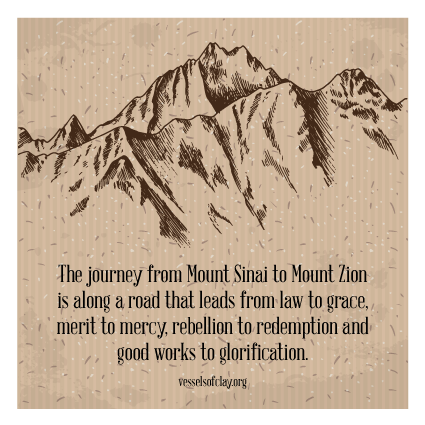
The Journey from Merit to Mercy

18 For you have not come to what may be touched, a blazing fire and darkness and gloom and a tempest 19 and the sound of a trumpet and a voice whose words made the hearers beg that no further messages be spoken to them. 20 For they could not endure the order that was given, “If even a beast touches the mountain, it shall be stoned.” 21 Indeed, so terrifying was the sight that Moses said, “I tremble with fear.” 22 But you have come to Mount Zion and to the city of the living God, the heavenly Jerusalem, and to innumerable angels in festal gathering, 23 and to the assembly of the firstborn who are enrolled in heaven, and to God, the judge of all, and to the spirits of the righteous made perfect, 24 and to Jesus, the mediator of a new covenant, and to the sprinkled blood that speaks a better word than the blood of Abel. – Hebrews 12:18-24 ESV

Two-MountainsThe author of Hebrews compares the Christian life to that of a long and arduous journey. Because of his Hebrew audience, he most likely had in mind the more than 40-year journey the people of Israel took to get to the land promised by God to their forefather, Abraham.

That trek had ended up being an ultra-marathon, covering thousands of miles and four decades, and it required incredible endurance and a constant awareness that there truly was a goal in mind. They were headed somewhere. The seemingly endless journey had an actual destination. Even on those days when it all felt pointless and mind-numbingly repetitious, they had to keep walking and trusting that God knew what He was doing and that Moses knew where he was going. At times, they had their doubts and felt free to make them known.

In these verses, the author contrasts Mount Sinai with Mount Zion. The first mountain was from their past. It was the place, early on in the Exodus story, where God had met with Moses and given him the Ten Commandments and the Book of the Covenant. That fateful day, when Moses prepared to ascend Mount Sinai had been a terrifying and life-changing moment for the people of God.

On the morning of the third day there were thunders and lightnings and a thick cloud on the mountain and a very loud trumpet blast, so that all the people in the camp trembled. Then Moses brought the people out of the camp to meet God, and they took their stand at the foot of the mountain. Now Mount Sinai was wrapped in smoke because the Lord had descended on it in fire. The smoke of it went up like the smoke of a kiln, and the whole mountain trembled greatly. And as the sound of the trumpet grew louder and louder, Moses spoke, and God answered him in thunder. – Exodus 19:16-19 ESV

The physical manifestations that accompanied the presence of God on the pinnacle of the mountain had left the people in a state of fear and anxiety. The Exodus account goes on to say, “when all the people saw the thunder and the flashes of lightning and the sound of the trumpet and the mountain smoking, the people were afraid and trembled, and they stood far off and said to Moses, ‘You speak to us, and we will listen; but do not let God speak to us, lest we die’” (Exodus 20:18-19 ESV).

The dramatic pyrotechnic display they witnessed that day left them terrified. None of them missed the significance or symbolism of it all. Their God was powerful, holy, transcendent, and not to be trifled with. The dramatic display on the top of Mount Sinai was intended to reinforce in their minds the holiness of God. It was also a reminder of their own sinfulness. That fact would be reinforced by God’s giving of the Ten Commandments to Moses.

But as the book of Exodus recounts, the first time Moses returned from the top of the mountain with the tablets in his hands, he found the people worshiping the golden calf. Just days after the dramatic and frightening display of God’s presence on the mountain that had left them trembling in fear, they had determined to make their own god. Moses had been gone for 40 days and the people began to doubt that he would ever return. So, in his absence, they convinced Aaron, Moses’ older brother, to fashion a false god out of their trinkets of gold.

When the people saw how long it was taking Moses to come back down the mountain, they gathered around Aaron. “Come on,” they said, “make us some gods who can lead us. We don’t know what happened to this fellow Moses, who brought us here from the land of Egypt.” – Exodus 32:1 NLT

Angered by the actions of His rebellious people, God informed Moses of His intentions to destroy them.

“I have seen how stubborn and rebellious these people are. Now leave me alone so my fierce anger can blaze against them, and I will destroy them. Then I will make you, Moses, into a great nation.” – Exodus 32:9-10 NLT

But Moses interceded on behalf of the people, pleading with God to remember the covenant He had made with Abraham.

“Change your mind about this terrible disaster you have threatened against your people! Remember your servants Abraham, Isaac, and Jacob. You bound yourself with an oath to them, saying, ‘I will make your descendants as numerous as the stars of heaven. And I will give them all of this land that I have promised to your descendants, and they will possess it forever.’” – Exodus 32:12-13 NLT

But their sinful actions produced painful consequences. That very day, God used the Levites to execute 3,000 individuals who had instigated the rebellion. So, from that day forward, the remaining Israelites would always view Mount Sinai as a symbol of God’s holiness and their own unrighteousness, and the Law God gave them would prove to be a constant reminder of their own sinfulness and incapacity to live obediently.

But for the believer, Mount Zion is a radically different mountain that represents an altogether different encounter with God. Mount Sinai was physical in nature and could be seen and touched, albeit on pain of death. Yet Mount Zion is a spiritual mountain. There is no smoke, fire, thunder, lightning, or ban against drawing near. Mount Zion is not only approachable, it is preferable. It is our final destination. It represents “the city of the living God, the heavenly Jerusalem” (Hebrews 12:22 ESV).

During the reigns of David and Solomon, Jerusalem was a powerful city, the capital of the Jewish empire. It was in Jerusalem that Solomon built the temple. It was there that the people came each year on the Day of Atonement to make sacrifices to God. As the people journeyed from the surrounding areas up to Jerusalem, they would sing the Songs of Ascent found in the Psalms. One of them says, “Those who trust in the Lord are like Mount Zion, which cannot be moved, but abides forever. As the mountains surround Jerusalem, so the Lord surrounds his people, from this time forth and forevermore” (Psalm 125:1-2 ESV).

Jerusalem, the royal city, sat on the top of Mount Zion, where it represented the presence of God. It was there that God dwelt in the Holy of Holies of the temple. It was to Zion that the people walked in order to celebrate the various feasts and festivals. It was to Mount Zion they ascended to receive forgiveness of sin and to have their relationship with God restored.

For those who have placed their faith in Jesus, Mount Zion is the final destination on their spiritual journey. It represents the believer’s heavenly home – “the city of the living God, the heavenly Jerusalem.” Christ-followers are on a journey to a place where they will encounter God, but rather than experiencing fear and trembling, they will enjoy peace, acceptance, joy, and freedom from sin and sorrow. There will be no condemnation. There will be no need for the law to remind us of God’s holy expectations. We will be holy.

There will be no conviction of sin or any need for the law to expose our sin anymore because we will be sinless. In a sense, the Christian life is a journey from one mountain to another. It is a long, sometimes difficult trip away from the mountain where man’s relationship with God was marked by law, rule-keeping, disobedience, fear, and failure. It is a daily walk toward another mountain where we will find complete forgiveness, the redemption of our bodies, and our final glorification.

Paul reminds us, “But our citizenship is in heaven, and from it we await a Savior, the Lord Jesus Christ, who will transform our lowly body to be like his glorious body” (Philippians 3:20-21 ESV).

We are on our way to Mount Zion. That is our final destination. It is our home. And while the journey there may seem long and at times difficult, we must keep our eye on the prize. We must never turn back to Mount Sinai, marked by rules and a constant reminder of our guilt and sin. Mount Zion is our home, where we will be with all those who have gone before us and enjoy unbroken fellowship with God and “Jesus, the mediator of a new covenant” (Hebrews 12:24 ESV).

English Standard Version (ESV) The Holy Bible, English Standard Version. ESV® Permanent Text Edition® (2016). Copyright © 2001

New Living Translation (NLT) Holy Bible, New Living Translation, copyright © 1996, 2004, 2015 by Tyndale House Foundation. Used by permission of Tyndale House Publishers Inc., Carol Stream, Illinois 60188. All rights reserved.

The Valley Between Two Mountains.

Two-MountainsFor you have not come to what may be touched, a blazing fire and darkness and gloom and a tempest and the sound of a trumpet and a voice whose words made the hearers beg that no further messages be spoken to them. For they could not endure the order that was given, “If even a beast touches the mountain, it shall be stoned.” Indeed, so terrifying was the sight that Moses said, “I tremble with fear.” But you have come to Mount Zion and to the city of the living God, the heavenly Jerusalem, and to innumerable angels in festal gathering, and to the assembly of the firstborn who are enrolled in heaven, and to God, the judge of all, and to the spirits of the righteous made perfect, and to Jesus, the mediator of a new covenant, and to the sprinkled blood that speaks a better word than the blood of Abel. – Hebrews 12:18-24 ESV

The author of Hebrews compares the Christian life to that or a long and arduous journey. Because of his Hebrew audience, he most likely has in mind the more than 40 year journey the people of Israel took to get to the land promised by God to their forefather, Abraham. That had been an ultra-ultra-mega-marathon, covering thousands of miles and four decades. And it had required incredible endurance and a constant awareness that there truly was a goal in mind. They were headed somewhere. They had an actual destination. Even on those days when it all felt pointless and mind-numbingly repetitious, they had to keep walking and trusting that God knew what He was doing and Moses knew where he was going. At times, they had their doubts and felt free to make them known.

In these verses, the author contrasts Mount Sinai with Mount Zion. The first mountain was from their past. It was the place, early on in the Exodus story, where God had met with Moses and given them the Ten Commandments. It had been a terrifying and life-changing moment for the people of God.

On the morning of the third day there were thunders and lightnings and a thick cloud on the mountain and a very loud trumpet blast, so that all the people in the camp trembled. Then Moses brought the people out of the camp to meet God, and they took their stand at the foot of the mountain. Now Mount Sinai was wrapped in smoke because the Lord had descended on it in fire. The smoke of it went up like the smoke of a kiln, and the whole mountain trembled greatly. And as the sound of the trumpet grew louder and louder, Moses spoke, and God answered him in thunder. – Exodus 19:16-19 ESV

The physical manifestations that had accompanied the presence of God that day had left the people in a state of fear and anxiety. The Exodus account goes on to say, “when all the people saw the thunder and the flashes of lightning and the sound of the trumpet and the mountain smoking, the people were afraid and trembled, and they stood far off and said to Moses, ‘You speak to us, and we will listen; but do not let God speak to us, lest we die’” (Exodus 20:18-19 ESV). The dramatic physical display they witnessed that day left them terrified. None of them missed the significance or symbolism of it all. Their God was powerful, holy, transcendent and not to be trifled with. The dramatic display on the top of Mount Sinai was intended to reinforce in their minds the holiness of God. It was also a reminder of their own sinfulness. That fact would be reinforced by the giving of Ten Commandments by God to Moses. But if you recall, the first time Moses returned from the top of the mountain with the tablets in his hands he found the people worshiping the golden calf. Just days after the pyrotechnic display on the mountain that had left them trembling in fear, they had determined to make their own god. So Mount Sinai would forever be a symbol of God’s holiness and their own sinfulness. The law God gave them would prove to be a constant reminder of their own sinfulness and incapacity to live obediently.

But Mount Zion was a different mountain and represents an altogether different encounter with God. Mount Sinai was physical in nature and could be seen and touched, albeit at pain of death. Yet Mount Zion is a spiritual mountain. There is no smoke, fire, thunder, lightning, or ban against coming near. Mount Zion is not only approachable, it is preferable. It is our final destination. It represents “the city of the living God, the heavenly Jerusalem” (Hebrews 12:22 ESV). During the reigns of David and Solomon, Jerusalem was a powerful city, the capital of the Jewish empire. It was in Jerusalem that Solomon built the temple. It was there that the people came each year on the Day of Atonement to make sacrifices to God. As the people journeyed from the surrounding areas up to Jerusalem, they would sing the Songs of Ascent found in the psalms. One of them says, “Those who trust in the Lord are like Mount Zion, which cannot be moved, but abides forever. As the mountains surround Jerusalem, so the Lord surrounds his people, from this time forth and forevermore” (Psalm 125:1-2 ESV). Jerusalem, Mount Zion, represented the presence of God. It was there that God dwelt in the Holy of Holies. It was to Zion the people walked in order to celebrate the various feasts and festivals. It was there they went to receive forgiveness of sin and to have their relationship with God restored.

For believers, our final destination is also Mount Zion. It represents our heavenly home – “the city of the living God, the heavenly Jerusalem.” We are on a journey to a place where we will encounter God, but rather than experiencing fear and trembling, we will enjoy peace, acceptance, joy, and a freedom from sin and sorrow. There will be no condemnation. There will be no need for the law to remind us God’s holy expectations. We will be holy. There will be no conviction of sin or any need for the law to expose our sin anymore, because we will be sinless. In a sense, the Christian life is a journey from one mountain to another. It is a long, sometimes difficult trip away from the mountain where man’s relationship with God was marked by law, rule-keeping, disobedience, fear and failure. It is a daily walk toward another mountain where we will find complete forgiveness, the redemption of our bodies and our final glorification. Paul reminds us, “But our citizenship is in heaven, and from it we await a Savior, the Lord Jesus Christ, who will transform our lowly body to be like his glorious body” (Philippians 3:20-21 ESV). We are on our way to Mount Zion. That is our final destination. It is our home. And while the journey there may seem long and at times difficult, we must keep our eye on the prize. We must never turn back to Mount Sinai, marked by rules and a constant reminder of our guilt and sin. Mount Zion is our home, where we will be with all those who have gone before us and enjoy unbroken fellowship with God and “Jesus, the mediator of a new covenant” (Hebrews 12:24 ESV).


Day 100 – Matthew 21:20-22; Mark 11:19-26

Have Faith In God.

Matthew 21:20-22; Mark 11:19-26

Then Jesus said to the disciples, “Have faith in God. I tell you the truth, you can say to this mountain, May you be lifted up and thrown into the sea,’ and it will happen. But you must really believe it will happen and have no doubt in your heart.” – Mark 11:22-23 NLT

This is one of those passages that gets used and abused on a regular basis. It gets lifted out of context and construed to mean just about anything people want it to mean. It has been used to justify all kinds of prayers, to inspire and encourage boldness in the lives of believers, and to support the name-it-claim-it theology of many groups. But what was Jesus really teaching that day? What was His point in cursing the fig tree, and then why did He turn that occasion into a lesson on prayer? As always, context is essential when unpacking this passage. Jesus is on His way back into Jerusalem with His disciples. The day before they had passed this very spot on their way from Bethany into the city. He had pronounced a curse on the fig tree and now, as they passed by it again, “the disciples noticed that it had withered from the roots up” (Mark 11:20 NLT). Peter, always eager to have his voice heard, pointed out this fact to Jesus, who then responds with a brief lesson on faith and prayer. It is important that this section of the passage be kept in context with everything else that has happened before it and that will come after it.

When the disciples see the fig tree in its withered state, they surely thought back to the day before when Jesus cursed it saying, “May no one ever eat your fruit again!” (Mark 11:14 NLT). Mark tells us the disciples clearly heard Jesus pronounce the curse on the tree. But apparently, it was not until the next day that it had fully withered and died. The disciples are amazed at all of this and Jesus uses this as a teaching moment. His main point has to do with faith. But notice that it has to do with the focus of our faith. There are those who would use this passage to teach that if you have faith that you can do something, you can do it. In other words, the focus of our faith needs to be in what it is that we want accomplished. But Jesus did not say, “Have faith in your efforts.” He didn’t encourage the disciples to “believe it hard enough and you will have it.” No, He said, “Have faith in God.” It would be easy to make this teaching by Jesus all about “moving mountains,” or accomplishing mighty things for God. But what Jesus really seems to be trying to communicate is that all things are possible with God. He is unlimited in His strength. He is unstoppable and all powerful. So place your faith in Him. If God wants you to move a mountain, He will not only tell you, He will provide the power to make it possible. This is not about me determining what it is that I want to do or have done. This is about trusting God for His will and relying on His power to accomplish that will.

One of the significant details in this story is the location of Jesus and disciples when He tells it. They are standing somewhere between Bethany and Jerusalem. More than likely, they are somewhere on the Mount of Olives and across the Kidron Valley lies Mount Zion, the mountain range upon which Jerusalem sat. I believe Jesus is continuing to make a point about the state of affairs in Jerusalem. Oftentimes, the references to Mount Zion and Jerusalem are interchangeable in Scripture. The entire capital city of the Hebrew nation occupied this area. As in His cursing of the fig tree, Jesus is making a point about the judgment of God against the people of God for their fruitlessness and unfaithfulness. Have faith in God. He will deal with Jerusalem, and in just a few short years from this point in time, the city would be destroyed. When it comes to dealing with unfaithfulness and fruitlessness, have faith in God – He will act. Yes, Jesus is teaching His disciples to pray and to do so without doubt. They are to ask, believing that God will answer. But it is essential that when they pray, that they ask according to God’s will. Our faith should be in Him, not in the nature of our request or the unbelievability of our expectations. Jesus says, “I tell you, you can pray for anything, and if you believe that you’ve received it, it will be yours” (Mark 11:24 NLT). So is Jesus telling me that I can pray for a new Mercedes, and actually receive it, as long as I believe hard enough that I already have it? I don’t think so. And yet, that is what some people try to twist this passage to mean. This isn’t about us using God as some sort of cosmic Genie in a bottle. He does not exist to grant our wishes or fulfill our wildest dreams. Jesus did not curse the fig tree on a whim or as some sort of personal vendetta against the tree for failing to meet His needs. His cursing of the fig tree was a visual lesson for the disciples meant to teach them about God’s intentions for the hypocritical religious leaders of the Jews. The object of our faith is to be God, not the outcome for which we are praying. If we focus on God, we can ask, fully believing that He will answer – as if it has already been done.

But it’s interesting that Jesus closes out His teaching on prayer with a kind of disclaimer. He seems to try to tone down any enthusiasm the disciples might be feeling at the thought of having that kind of power available to them through the means of prayer. He tells them that “when you are praying, first forgive anyone you are holding a grudge against, so that Your Father in heaven will forgive your sins, too” (Mark 11:25 NLT). In other words, before you start asking God to move mountains, ask Him to move in your own heart, confessing your sins and forgiving those who might have sinned against you. There seems to be a not-so-subtle hint from Jesus that we are to do some personal housecleaning before we attempt to move mountains for God. A right heart was going to be essential to having right motives when asking God to act on our behalf. God will not honor prayers prayed in anger, selfishness, pride, or aimed at accomplishing our will in place of His. We are to have faith in God. It is not the intensity or fervor of our prayers, the size of our requests, or the shocking nature of our expectations that God is interested in. It is the focus of our faith that concerns Him. Do we trust Him? Will we trust Him?

Father, I want to accomplish great things for You, but too often it for my own glory and so that I might be seen as a powerful resource in Your toolbox. But I know that I am to make You the focus, not me. I am to trust in Your power, not mine. Continue to teach me to have faith in You, and in nothing and no one else, but You. Amen.

Ken Miller
Grow Pastor & Minister to Men
kenm@christchapelbc.org