A Son Has Been Born

13 So Boaz took Ruth, and she became his wife. And he went in to her, and the Lord gave her conception, and she bore a son. 14 Then the women said to Naomi, “Blessed be the Lord, who has not left you this day without a redeemer, and may his name be renowned in Israel! 15 He shall be to you a restorer of life and a nourisher of your old age, for your daughter-in-law who loves you, who is more to you than seven sons, has given birth to him.” 16 Then Naomi took the child and laid him on her lap and became his nurse. 17 And the women of the neighborhood gave him a name, saying, “A son has been born to Naomi.” They named him Obed. He was the father of Jesse, the father of David.

18 Now these are the generations of Perez: Perez fathered Hezron, 19 Hezron fathered Ram, Ram fathered Amminadab, 20 Amminadab fathered Nahshon, Nahshon fathered Salmon, 21 Salmon fathered Boaz, Boaz fathered Obed, 22 Obed fathered Jesse, and Jesse fathered David. Ruth 4:13-21 ESV

When reading the closing verses of Ruth’s story, it is essential that we not miss the statement, “and the Lord gave her conception” (Ruth 4:13 ESV). First of all, those six simple words reinforce the underlying theme of God’s redemption that runs throughout the entire book. Ruth, Boaz, and Naomi are nothing more than actors in the divine drama, written by the hand of God and directed according to His sovereign will. Nothing in this story has been the result of luck, fate, kismet, karma, or blind chance.

It all began with Elimelech’s decision to escape the famine in Judah by moving his family to Moab. But his plan had not included any thought of his unexpected death. He never dreamed he would leave his wife a widow living in a foreign land. But that’s exactly what happened. And Naomi’s two sons, unsure of when they might be able to return to Bethlehem, decided to find wives among the Moabites and begin their families. But little did they know that, ten years later, they too would suffer unexpected deaths, leaving two more widows in the land of Moab.

But eventually, the famine subsided in Judah, and Naomi was able to return home, accompanied by her daughter-in-law, Ruth. Now, through a series of divinely-ordained encounters, Ruth is married to a wealthy relative of Naomi’s, a man named Boaz, who rescued these two widows by faithfully executing his obligations as their kinsman-redeemer.

All the way back in chapter 1, the author recorded Naomi’s words to her two daughters-in-law, as she prepared to return to Judah. She fully expected that they would choose to stay in Moab, remarry, and begin their lives anew.

“The Lord grant that you may find rest, each of you in the house of her husband!” – Ruth 1:9 ESV

But Ruth had chosen to remain with Naomi, and now that blessing had come to pass. Ruth had found a husband, but not just any husband. By God’s gracious will, she had found Boaz, who proved to be Naomi’s kinsman-redeemer and a man of integrity, honor, and compassion.

Back in Moab, when Ruth had expressed her intentions to remain with Naomi and follow her back to the land of Judah, she had no idea what the future held. But she was willing to accept whatever came her way.

“…where you go I will go, and where you lodge I will lodge. Your people shall be my people, and your God my God…” – Ruth 1:16 ESV

And Ruth had proved true to her word. Now, God had rewarded her faithfulness with a loving husband, a home of her own, and a son. In buying Elimelech’s land, then marrying Ruth, Boaz had done far more than fulfill his responsibility as the kinsman-redeemer. Yes, he had redeemed Naomi and Ruth out of their helpless and seemingly hopeless predicament. But, unbeknownst to him, he had played a major role in God’s redemptive plan for the world.

The women in the city, upon hearing of Ruth’s delivery of her new son, pronounced a blessing that had far greater implications than they could have ever imagined.

“Blessed be the Lord, who has not left you this day without a redeemer, and may his name be renowned in Israel! He shall be to you a restorer of life and a nourisher of your old age, for your daughter-in-law who loves you, who is more to you than seven sons, has given birth to him.” – Ruth 4:14-15 ESV

They gave God glory. But little did they know just how much glory their God deserved. This birth was going to have life-changing ramifications, and not just for Ruth and Boaz. Their words were directed at Naomi and were meant to remind her just how blessed she was. She had found a redeemer, who had restored her life and given her hope in her old age. But more than that, she had found a daughter-in-law who loved her deeply. And now, she had a new son-in-law, who had given her a grandson and the assurance that Elimelech’s line would be continued.

But, in the midst of all the joy and celebration, we have to stop and ask a difficult question: How could God approve of and bless a union between an Israelite and a Moabite when the law seems to have prohibited it?

“No Ammonite or Moabite may enter the assembly of the Lord. Even to the tenth generation, none of them may enter the assembly of the Lord forever, because they did not meet you with bread and with water on the way, when you came out of Egypt, and because they hired against you Balaam the son of Beor from Pethor of Mesopotamia, to curse you.” – Deuteronomy 23:3-4 ESV

The answer can be found in the pledge that Ruth made to Naomi back in the land of Moab: “Your people shall be my people, and your God my God” (Ruth 1:16 ESV). Ruth was stating her intentions to become an Israelite, giving up her Moabite citizenship along with her allegiance to her god. With her words, Ruth was expressing her intentions to become a proselyte to Judaism.

The ancient Hebrews had no concept of “conversion”, although they did practice assimilation of non-Israelites into the Israelite community, either through marriage or acceptance of the beliefs and practices of the community. Having agreed to make Yahweh her God and the Israelites her people, Ruth would have been accepted into the faith community as one of their own. She would have been considered a gerim (Hebrew for “strangers”). And with her marriage to Boaz, a Hebrew in good standing, she would have become a permanent resident and given equal rights and responsibilities as a member of the community. The Israelites were commanded by God to love the gerim, for, at one time, they had been gerim in Egypt.

This inclusion of Ruth into the family of God is critical. And the author reveals its true significance by recording the following words: “A son has been born to Naomi.” Notice that it does not say, “A son has been born to Ruth.” The emphasis is on the lineage of Elimelech, the husband of Naomi. This son was going to carry on the family name. And the author goes on to state that “They named him Obed. He was the father of Jesse, the father of David” (Ruth 4:17 ESV).

Obed means “redeemer,” which fits in with the whole kinsman-redeemer motif found throughout the story. The goʾel or kinsman-redeemer was, in essence, “a guardian of the family interests.” And Obed, this brand new baby was named “Redeemer” because his birth had redeemed Naomi’s life and restored her husband’s lineage. But he would prove to be an even greater “Redeemer,” as the closing verses of the chapter make clear.

Now these are the generations of Perez: Perez fathered Hezron, Hezron fathered Ram, Ram fathered Amminadab, Amminadab fathered Nahshon, Nahshon fathered Salmon, Salmon fathered Boaz, Boaz fathered Obed, Obed fathered Jesse, and Jesse fathered David. – Ruth 4:18-21 ESV

It seems a bit odd that the author chose to end his narrative with a genealogical record. But there is a divine method to his madness. It reveals God’s sovereign plan and makes clear that God does not operate according to man’s ways or in accordance to expected protocols. Dr. Thomas L. Constable points out the relevance of this genealogical record.

Why does the genealogy start with Perez? He was the founder of the branch of Judah’s family that took his name, to which Elimelech and Boaz belonged. Perez was the illegitimate son of Judah who, like Jacob, seized the initiative to stand in the line of messianic promise from his twin brother. This genealogy emphasizes how God circumvented custom and tradition in providing Israel’s great redeemer, David. Like Perez, Boaz was the descendant of an Israelite father, Salmon, and a Canaanite harlot, Rahab. Both Tamar and Rahab entered Israel because they believed and valued God’s promises to Israel, as Ruth did. David himself was the youngest rather than the eldest son of Jesse. (NET Bible study notes).

And if we fast-forward to the gospel of Matthew, we find within his genealogy of Jesus the same list of names.

Abraham was the father of Isaac, and Isaac the father of Jacob, and Jacob the father of Judah and his brothers, and Judah the father of Perez and Zerah by Tamar, and Perez the father of Hezron, and Hezron the father of Ram, and Ram the father of Amminadab, and Amminadab the father of Nahshon, and Nahshon the father of Salmon, and Salmon the father of Boaz by Rahab, and Boaz the father of Obed by Ruth, and Obed the father of Jesse, and Jesse the father of David the king. – Matthew 1:2-6 ESV

And Matthew goes on to point out that Jesus would be born a descendant of Abraham, through the line of David the king of Israel. The birth of Obed, “the redeemer,” would result in the birth of Jesus, the ultimate Redeemer of mankind. When the angel appeared to Joseph with news of Mary’s conception, he announced, “She will bear a son, and you shall call his name Jesus, for he will save his people from their sins” (Matthew 1:21 ESV). Jesus would be the ultimate kinsman-redeemer. He would serve as the Savior, the one who takes away the sins of the world. His redemption would provide far more than release from widowhood, poverty, despair, or rejection. He would provide the means by which sinful men and women could be restored to a right relationship with God Almighty.

The story of Ruth is the story of redemption. But it’s true significance reaches far beyond the borders of Bethlehem and the period of the Judges. The redemption of God spans borders, boundaries, time, and space. His plan for mankind is not limited to a single nation and is not limited by the passing of years or centuries. The pages of the book of Ruth are filled with the presence of God and the reminder of His unwavering promise to send His Son as the King of kings and Lord of lords.

But you, O Bethlehem Ephrathah,
    are only a small village among all the people of Judah.
Yet a ruler of Israel,
    whose origins are in the distant past,
    will come from you on my behalf. – Micah 5:2 NLT

English Standard Version (ESV)
The Holy Bible, English Standard Version. ESV® Permanent Text Edition® (2016). Copyright © 2001 by Crossway Bibles, a publishing ministry of Good News Publishers.

New Living Translation (NLT)
Holy Bible, New Living Translation, copyright © 1996, 2004, 2015 by Tyndale House Foundation. Used by permission of Tyndale House Publishers Inc., Carol Stream, Illinois 60188. All rights reserved.

The Message (MSG)Copyright © 1993, 1994, 1995, 1996, 2000, 2001, 2002 by Eugene H. Peterson

Wait and See

14 So she lay at his feet until the morning, but arose before one could recognize another. And he said, “Let it not be known that the woman came to the threshing floor.” 15 And he said, “Bring the garment you are wearing and hold it out.” So she held it, and he measured out six measures of barley and put it on her. Then she went into the city. 16 And when she came to her mother-in-law, she said, “How did you fare, my daughter?” Then she told her all that the man had done for her, 17 saying, “These six measures of barley he gave to me, for he said to me, ‘You must not go back empty-handed to your mother-in-law.’” 18 She replied, “Wait, my daughter, until you learn how the matter turns out, for the man will not rest but will settle the matter today.” Ruth 3:14-18 ESV

The next scene in this slowly unveiling drama takes place in the darkness of the early morning hours. Boaz has been startled from a deep sleep only to find Ruth, the Moabite daughter-in-law of Naomi, sleeping at his feet. And while Boaz fully understood Ruth’s motives and knew her to be “a worthy woman” (vs 12), he was well aware that their totally innocent encounter could be completely misconstrued. Boaz realized that, if anyone should see the two of them together, the rumors would fly and their reputations could be ruined.

Boaz thought, “No one must know that a woman visited the threshing floor.” – Ruth 3:14 NET

Idle gossip was the last thing either one of them needed. If Boaz was going to be of any help to Ruth, they would need to keep everything between them above board and according to the Mosaic Law. Any affection he felt for her and any desire she had for a quick resolution to her problem had to take a back seat to proper protocol.

Boaz was fully cognizant of just how difficult it had been for Ruth to throw herself at his feet – literally. She had placed herself at his mercy, virtually begging him to take her as his wife. And she was not acting from purely selfish motives. Ruth was looking out for her mother-in-law Naomi. The odds of Naomi, a much-older widow, of finding anyone to marry her were slim. It was likely that Naomi was no longer of child-bearing age. Therefore, it was unlikely that any man would take her as his wife because she could not provide with children, let alone an heir. But Ruth, though a widow, was young and in the prime of her life, and she had that sixth sense that told her that Boaz was attracted to her. And since he was also Naomi’s kinsman-redeemer, marriage to him would solve all their problems.

But as Boaz had pointed out, there was another potential kinsman-redeemer who was a closer relative of Elimelech’s. He would need to be given the opportunity to purchase the land belonging to Elimelech and to take Ruth as his wife. The rules needed to be followed. The proper procedures needed to be carried out. And that would take time.

Yet Boaz was not going to send away Ruth empty-handed. He realized that she needed assurances and that any delay in the disposition of the kinsman-redeemer decision would only aggravate her circumstances. She and Noami still had to eat. They still required a roof over their heads. So, before she left, Boaz gave her a gift, intended to meet their physical need and to provide Ruth with assurances of his intention to care for her and Naomi.

Then Boaz said to her, “Bring your cloak and spread it out.” He measured six scoops of barley into the cloak and placed it on her back. Then he returned to the town. – Ruth 3:15 NLT

Ruth would return to Naomi, but Boaz would make his way into town where he would set up a meeting between the other kinsman-redeemer and the town elders. He was a man on a mission.

When Naomi saw Ruth, she greeted her by asking, “How did you fare, my daughter?” (Ruth 3:16 ESV). But in the original Hebrew, Naomi’s question is much more direct. She wasn’t asking about Ruth’s mood or emotional state. She literally asked her daughter-in-law “Who are you?” Was she unaware of her identity? Certainly not. She was wanting to know if Boaz had popped the question. In a real sense, Naomi was asking Ruth, “Are you his wife?” (R. L. Hubbard, Jr., Ruth (NICOT), 223-24, and F. W. Bush, Ruth, Esther (WBC), 184-85). You can sense her anxiousness to know what had happened. She had sent Ruth to see Boaz, fully expecting him to fulfill his role as the kinsman-redeemer by offering her his hand in marriage.

When Ruth had brought her up to speed, sharing the news about the second kinsman-redeemer, Naomi was not disappointed. She simply encouraged Ruth to be patient, trusting that Boaz would do the right thing. All would work out.

“Just be patient, my daughter, until we hear what happens. The man won’t rest until he has settled things today.” – Ruth 3:18 NLT

There is so much happening behind the scenes in this story. While God may appear to be absent, His presence can be felt as each scene unfolds. He is orchestrating His divine plan in ways that none of the characters can see, but each of them will eventually look back and recognize the imprint of His all-powerful hand in every area of their lives.

At no time do Ruth, Naomi, or Boaz display a sense of panic. There is no wringing of hands or displays of impatience. There is little doubt that Naomi and Ruth would like things to happen quickly. They both desire that their helpless condition be remedied sooner rather than later. But they do not express frustration with Boaz or with God.

And while it is clear that Boaz wants to do his part, he refrains from forcing his will on the matter. He doesn’t take matters into his own hands or place his agenda ahead of God’s. One can almost sense an underlying dependency upon God pervading this entire narrative. There is no reason to panic. There is no call for worry or fear.

Ruth, Naomi, and Boaz could not see the future. They had no way of knowing what was going to happen. But they seem content to wait and watch, expecting God to do something great. And their display of eager, yet patient expectation is something the apostle Paul would later recommend to all those who place their hope and trust in God.

And we know that God causes everything to work together for the good of those who love God and are called according to his purpose for them. – Romans 8:28 NLT

English Standard Version (ESV)
The Holy Bible, English Standard Version. ESV® Permanent Text Edition® (2016). Copyright © 2001 by Crossway Bibles, a publishing ministry of Good News Publishers.

New Living Translation (NLT)
Holy Bible, New Living Translation, copyright © 1996, 2004, 2015 by Tyndale House Foundation. Used by permission of Tyndale House Publishers Inc., Carol Stream, Illinois 60188. All rights reserved.

The Message (MSG)Copyright © 1993, 1994, 1995, 1996, 2000, 2001, 2002 by Eugene H. Peterson

There Is A Redeemer

So she went down to the threshing floor and did just as her mother-in-law had commanded her. And when Boaz had eaten and drunk, and his heart was merry, he went to lie down at the end of the heap of grain. Then she came softly and uncovered his feet and lay down. At midnight the man was startled and turned over, and behold, a woman lay at his feet! He said, “Who are you?” And she answered, “I am Ruth, your servant. Spread your wings over your servant, for you are a redeemer.” 10 And he said, “May you be blessed by the Lord, my daughter. You have made this last kindness greater than the first in that you have not gone after young men, whether poor or rich. 11 And now, my daughter, do not fear. I will do for you all that you ask, for all my fellow townsmen know that you are a worthy woman. 12 And now it is true that I am a redeemer. Yet there is a redeemer nearer than I. 13 Remain tonight, and in the morning, if he will redeem you, good; let him do it. But if he is not willing to redeem you, then, as the Lord lives, I will redeem you. Lie down until the morning.” Ruth 3:6-13 ESV

As strange as Naomi’s counsel must have sounded to Ruth, she did exactly what her mother-in-law had told her to do. That night, when Boaz had fallen asleep, Ruth crept over to him, gently pulled back his cloak, and exposed his feet and legs to the cold night air. Then she lay down at his side and waited for him to wake up. And it wasn’t long before the uncomfortable sensation of having his limbs exposed caused Boaz to stir from his sleep, only to find a strange woman lying at his feet.

While the actions of Ruth may seem strange to us, there is nothing immoral or unethical about her behavior. In fact, it is likely that she was not the only woman sleeping at the threshing floor that evening. This was the peak of the harvest season and all the male and female servants of Boaz would have been working around the clock to harvest and thresh the wheat. Rather than go home, they would have slept on the site, ready to begin their work with the rising of the sun.

But Boaz was shocked to find this young woman sleeping in such close proximity. It was awkward at best and could easily be misconstrued by others. But the author reveals that this encounter between Ruth and Boaz took place at midnight, while everyone else remained asleep.

Boaz’s initial question had to do with the woman’s identity. While he had seen Ruth before, this was all taking place in the dark and he had no way of seeing who it was that was sleeping at his feet. So, he asked, ““Who are you?” And Ruth wasted no time in answering his question. “I am Ruth, your servant” she replied. But she didn’t stop there. Ruth immediately added, “Spread your wings over your servant, for you are a redeemer” (Ruth 3:9 ESV).

What in the world did she mean by this somewhat cryptic statement? And what possessed Ruth to use such a strange metaphor? We are not given any direct answers to these questions in the passage. But if we look at the Old Testament book of Ezekiel, we find a similar description used by God when speaking of His marriage to the people of Israel.

“When I passed by you again and saw you, behold, you were at the age for love, and I spread the corner of my garment over you and covered your nakedness; I made my vow to you and entered into a covenant with you, declares the Lord God, and you became mine.” – Ezekiel 8 ESV

It would appear that Naomi has brought Ruth up to speed regarding the responsibilities of the kinsman-redeemer. Which may explain Ruth’s rather bold confrontation of Boaz. It is readily apparent that Ruth is looking for a lot more from Boaz than a cash loan or the guarantee of long-term employment as one of his maidservants. The NET Bible chose to translate verse 9 in such a way that Ruth’s intentions are quite clear.

“Marry your servant, for you are a guardian of the family interests.” (NET)

The NET Bible study notes add: “Ruth’s words can be taken, in effect, as a marriage proposal.”

This young widow is asking for a long-term and costly commitment from Boaz. By making Ruth his wife, Boaz would not only be taking on her care but he would be making a binding covenant to be her husband. And all the way back in the garden, God expressed His intentions for a marriage to be a permanent union.

“Therefore a man shall leave his father and his mother and hold fast to his wife, and they shall become one flesh.” – Genesis 24 ESV

It’s interesting to note that nowhere in the Old Testament is marriage listed as an obligation of a kinsman-redeemer. So, it would seem that Ruth is asking more of Boaz than the law required. She must have sensed that Boaz had an interest in her. For some reason, she interpreted his treatment of her as much more than an act of kindness. And she seems fully prepared to call his bluff. In essence, Ruth is telling Boaz to fish or cut bait. She and Naomi needed help. They were widows without a reliable source of income and no means of meeting their long-term needs. Boaz was the go’el, the kinsman-redeemer, and Ruth was demanding that he step up to the plate and do what needs to be done.

And Boaz has an interesting response to what he obviously understood as a marriage proposal from Ruth.

“May you be blessed by the Lord, my daughter. You have made this last kindness greater than the first in that you have not gone after young men, whether poor or rich. – Ruth 3:10 ESV

Rather than expressing surprise or shock at Ruth’s bold demand, Boaz lets Ruth know that he is flattered. He describes Ruth’s proposal of marriage as an act of kindness. He knew full well that she needed a husband, but probably thought she would prefer a much younger man. But Ruth had continued coming back to Boaz’s fields and was now expressing her desire to be his wife. That blew Boaz away. And this latest interaction with Ruth, on top of all that she had done to care for Naomi, further endeared her to Boaz. And he assures Ruth that he will do all that she has requested of him.

“Now don’t worry about a thing, my daughter. I will do what is necessary, for everyone in town knows you are a virtuous woman.” – Ruth 3:11 NLT

But first, they would have to do things the right way. Unbeknownst to Ruth or Naomi, there was someone else in Bethlehem who was a closer relative of Elimelech than was Boaz. In an effort to do the right thing and not rob this man of his right to fulfill his kinsman-redeemer responsibility, Boaz recommended to Ruth that this man be given the first right of refusal.

“…while it’s true that I am one of your family redeemers, there is another man who is more closely related to you than I am. Stay here tonight, and in the morning I will talk to him. If he is willing to redeem you, very well. Let him marry you.” – Ruth 3:12-13 NLT

But Boaz assured Ruth that, should this other relative fail to marry Ruth, he was ready, willing, and able.

“But if he is not willing, then as surely as the Lord lives, I will redeem you myself! Now lie down here until morning.” – Ruth 3:13 NLT

There is an unstated part of this whole transaction that will eventually come to light and provide much-needed clarification as to what is really going on. This is a far more complicated issue than a marriage agreement between Boaz and Ruth. As we will see, in the very next chapter, there are land rights involved. According to the Mosaic Law, land, which was apportioned by God to the various tribes, was to remain in the family at all costs. This required that a kinsman-redeemer purchase land that was up for sale or in risk of foreclosure due to unpaid debts.

In the case of Elimeleich, he had land that would have passed down to his sons, but they too were deceased. And as a woman, Naomi was legally prohibited from owning land. So, it was essential that a kinsman-redeemer step in and purchase the land. And it would come with the added responsibility of marrying Ruth, the widowed wife of one of Elimelech’s sons. All of this will be made perfectly clear as Boaz presents the full facts surrounding the case.

Eventually, Boaz and the other relative will appear before the elders of the city and determine which of them will take on the role of the kinsman-redeemer. But we have already seen how God has operating behind the scenes, orchestrating all the events so that the union of Ruth and Boaz might come to full fruition. He is not done yet. But, even without having read the story before, we can almost sense how all of this is going to turn out.

English Standard Version (ESV)
The Holy Bible, English Standard Version. ESV® Permanent Text Edition® (2016). Copyright © 2001 by Crossway Bibles, a publishing ministry of Good News Publishers.

New Living Translation (NLT)
Holy Bible, New Living Translation, copyright © 1996, 2004, 2015 by Tyndale House Foundation. Used by permission of Tyndale House Publishers Inc., Carol Stream, Illinois 60188. All rights reserved.

The Message (MSG)Copyright © 1993, 1994, 1995, 1996, 2000, 2001, 2002 by Eugene H. Peterson

You Want Me To Do What?

1 Then Naomi her mother-in-law said to her, “My daughter, should I not seek rest for you, that it may be well with you? Is not Boaz our relative, with whose young women you were? See, he is winnowing barley tonight at the threshing floor. Wash therefore and anoint yourself, and put on your cloak and go down to the threshing floor, but do not make yourself known to the man until he has finished eating and drinking. But when he lies down, observe the place where he lies. Then go and uncover his feet and lie down, and he will tell you what to do.” And she replied, “All that you say I will do.” – Ruth 3:1-5 ESV

Back in chapter one, we have the record of Naomi’s words to her two distraught daughters-in-law, spoken not long after they had lost their husbands. She expressed her heartfelt desire that they find rest. And she knew that this would only be possible when each of them found a new husband. There would be no rest for them as long as they remained widows.

The Lord grant that you may find rest, each of you in the house of her husband!” – Judges 1:9 ESV

The Hebrew word she used is mĕnuwchah, and it conveys the idea of repose or comfort. It was often used in reference to matrimony because it was only in this state that a woman could find the safety and security she needed in a society where women were sometimes treated as second-class citizens and were afforded few individual rights. It was within the context of marriage that a woman could find a home to live in and a husband to provide for her needs. As a widow herself, Naomi was well-acquainted with the insecurities and insufficiencies that would accompany the unmarried state of her daughters.

Now, in chapter 3, we see Naomi repeating her desire that Ruth find rest, but this time she seems to take upon herself the responsibility for making it happen.

“My daughter, should I not seek rest for you, that it may be well with you? – Ruth 3:1 ESV

It seems that Naomi had become the self-appointed matchmaker for Ruth, driven in part by her feelings of responsibility for her daughter-in-law’s current predicament. Naomi hoped to find her a suitable husband so that Ruth wouldn’t have to spend the rest of her life in a constant state of distress and deprivation. It also seems clear that Naomi sensed there might be something more “intimate” between Ruth and Boaz than even her daughter-in-law realized. She recognized that Boaz’s displays of kindness to Ruth were driven by more than an obligation to fulfill his responsibilities as the kindred-redeemer.

It seems quite apparent that Naomi had developed a plan to bring about the “rest” that she longed for Ruth to experience. Knowing that Boaz was her kinsman-redeemer and that Boaz seemed to be attracted to her widowed daughter-in-law, Naomi shared her plan with Ruth.

“So bathe yourself, rub on some perfumed oil, and get dressed up. Then go down to the threshing floor. But don’t let the man know you’re there until he finishes his meal.” – Ruth 3:3 NLT

In essence, Naomi told Ruth to “paint the barn.” No doubt, Ruth was accustomed to wearing the kind of clothes that made sense for working in the fields. Chapter 2 makes it clear that Naomi was returning to the fields of Boaz on a regular basis. She began during the barley harvest but continued to glean when the wheat harvest came in.

So Ruth worked beside Boaz’s female servants, gathering grain until the end of the barley harvest as well as the wheat harvest. – Ruth 2:23 NLT

There would have been few reasons for Ruth to clean up, let alone dress up. She was a common laborer whose long days were filled with back-breaking labor. But on this occasion, Naomi told Ruth to dress like she was going out on a date. She was to bathe, put on her best outfit, and splash on her best-smelling perfume. It seems clear that Naomi was not sending Ruth on a job interview. And the next set of instructions reveals that Naomi had ulterior motives in mind.

“When he gets ready to go to sleep, take careful notice of the place where he lies down. Then go, uncover his legs, and lie down beside him.” – Ruth 3:4 NLT

There is a lot going on here. While it appears that Naomi’s actions are totally focused on Ruth’s well-being, her actions are not purely selfless. It is important to remember that Ruth was the widow of Naomi’s son, Chilion. And the story makes it clear that neither Chilion or his brother, Mahlon, had lived long enough to sire any male heirs. That means there was no one to carry on Elimelech’s lineage. It would have died with his two sons. But if a brother or other family member were to marry Ruth, any son she bore would bear Elimelech’s name and keep the line alive. So, Naomi had a vested interest in this opportunity with Boaz developing into something long-term and with more intimate ramifications.

This entire scene is strange to our modern-day sensibilities. We are not exactly sure what is going on and why Naomi is giving these bizarre instructions to her daughter-in-law. Amazingly, Ruth never bats an eye or expresses any concerns or reluctance. She simply conveys her determination to do whatever her mother-in-law’s told her to do.

“All that you say I will do.” – Ruth 3:5 ESV

But look closely at the content of Naomi’s instructions. Ruth as to wait until Boaz fell asleep, then she was to “uncover his legs, and lie down beside him” (Ruth 3:4 NLT). What in the world is going on here? This strange-sounding counsel must have even left Ruth scratching her head in wonder. What possible good could come out of this?

The matter is somewhat complicated by the input of various commentators who suggest that the phrase, “uncover his legs” is actually a euphemism for the male reproductive organ. But this seems unlikely. For Ruth to do so would have been an act of immorality. But it could mean that Naomi was asking Ruth to pull back Boaz’s blanket, exposing his feet and torso, thus exposing his mid-section to the cold night air. This unexpected “wake-up call” would have roused Boaz from his sleep, only to find Ruth curled up next to him, uncovered and unprotected from the elements.

As an act of chivalry, Boaz would have taken his blanket and covered the woman lying by his side. And this action would have been in keeping with God’s covenant relationship with Israel as portrayed by the prophet Ezekiel.

 “‘Then I passed by you and watched you, noticing that you had reached the age for love. I spread my cloak over you and covered your nakedness. I swore a solemn oath to you and entered into a marriage covenant with you, declares the Sovereign Lord, and you became mine.’” – Ezekiel 16:8 NLT

Naomi told Ruth that after carrying out all she had told her to do, Ruth was to wait for Boaz’s response.

“…he will tell you what to do…” – Ruth 3:4 ESV

At this point in the story, we have no way of knowing what that even means. But neither did Ruth. But she must have questioned the wisdom of Naomi’s plan. Would Boaz become angry? Would he react in confusion? Was there a possibility that he saw her actions as insubordinate or somehow presumptuous? Ruth had no way of knowing the answers to any of those questions, but she indicated her willingness to obey Naomi’s instructions. She placed her trust in her mother-in-law by doing the illogical and unimaginable.

English Standard Version (ESV)
The Holy Bible, English Standard Version. ESV® Permanent Text Edition® (2016). Copyright © 2001 by Crossway Bibles, a publishing ministry of Good News Publishers.

New Living Translation (NLT)
Holy Bible, New Living Translation, copyright © 1996, 2004, 2015 by Tyndale House Foundation. Used by permission of Tyndale House Publishers Inc., Carol Stream, Illinois 60188. All rights reserved.

The Message (MSG)Copyright © 1993, 1994, 1995, 1996, 2000, 2001, 2002 by Eugene H. Peterson

One of Our Redeemers

14 And at mealtime Boaz said to her, “Come here and eat some bread and dip your morsel in the wine.” So she sat beside the reapers, and he passed to her roasted grain. And she ate until she was satisfied, and she had some left over. 15 When she rose to glean, Boaz instructed his young men, saying, “Let her glean even among the sheaves, and do not reproach her. 16 And also pull out some from the bundles for her and leave it for her to glean, and do not rebuke her.”

17 So she gleaned in the field until evening. Then she beat out what she had gleaned, and it was about an ephah of barley. 18 And she took it up and went into the city. Her mother-in-law saw what she had gleaned. She also brought out and gave her what food she had left over after being satisfied. 19 And her mother-in-law said to her, “Where did you glean today? And where have you worked? Blessed be the man who took notice of you.” So she told her mother-in-law with whom she had worked and said, “The man’s name with whom I worked today is Boaz.” 20 And Naomi said to her daughter-in-law, “May he be blessed by the Lord, whose kindness has not forsaken the living or the dead!” Naomi also said to her, “The man is a close relative of ours, one of our redeemers.” 21 And Ruth the Moabite said, “Besides, he said to me, ‘You shall keep close by my young men until they have finished all my harvest.’” 22 And Naomi said to Ruth, her daughter-in-law, “It is good, my daughter, that you go out with his young women, lest in another field you be assaulted.” 23 So she kept close to the young women of Boaz, gleaning until the end of the barley and wheat harvests. And she lived with her mother-in-law. – Ruth 2:14-23 ESV

The kindness of Boaz has taken Ruth by surprise. Being a foreigner in a strange land and unfamiliar with their religious laws and customs, Ruth would not have expected this unknown man to treat her with so much dignity and respect.

Boaz went well beyond the obligations prescribed by the Mosaic Law, inviting Ruth to remain in his field under his protection. He even fed her and treated her with the same dignity afforded the maidservants who worked for him. And Ruth, fully recognizing and appreciating the kindness of this stranger, expressed her surprise at his gracious words and generous actions towards her.

“…you have comforted me and spoken kindly to your servant, though I am not one of your servants.” – Judges 2:13 ESV

Boaz was motivated by his responsibilities as a kinsman-redeemer. According to the Mosaic Law, as a relative of Elimelech, Naomi’s deceased husband, Boaz was obligated to care for her. As a widow, Naomi was in a vulnerable position, having no means of livelihood and poor prospects for remarriage. But God had provided a safety net for situations such as this, commanding the relatives of individuals like Naomi to step in and redeem them from their distress.

Upon discovering the identity of the man in whose field Ruth had gleaned, Ruth refers to Boaz as her ga’al, her kinsman-redeemer. It is the same word used to describe God’s redemption of the Israelites out of their slavery in Egypt.

Say therefore to the people of Israel, ‘I am the Lord, and I will bring you out from under the burdens of the Egyptians, and I will deliver you from slavery to them, and I will redeem you with an outstretched arm and with great acts of judgment. – Exodus 6:6 ESV

Naomi had been just as impressed as Ruth with the over-the-top kindness that the landowner had shown to her. And when she found out he was a close relative, it all made sense to her. Now it was all beginning to make sense to her. Boaz was fulfilling his responsibility as her kinsman-redeemer, and this important detail did not escape Naomi’s notice.

“May the Lord bless him!” Naomi told her daughter-in-law. “He is showing his kindness to us as well as to your dead husband. That man is one of our closest relatives, one of our family redeemers.” – Ruth 2:20 NLT

Things were looking up. Noami could begin to see a glimmer of hope in the overwhelming darkness that had marked her life for the last ten years. While the future had looked bleak and foreboding that morning, Naomi now had reason to believe that the days ahead might be brighter. And Ruth added a bit of additional good news.

“What’s more, Boaz even told me to come back and stay with his harvesters until the entire harvest is completed.” – Ruth 2:21 NLT

This dramatic change in circumstances should not be overlooked. If you recall, when Naomi had informed her two daughters-in-law that she was returning home to Bethlehem, they had expressed their desire to go with her. But she had tried to talk them out of it, providing a rather dark view of God and his recent actions in her life.

“Why should you go on with me? Can I still give birth to other sons who could grow up to be your husbands? No, my daughters, return to your parents’ homes, for I am too old to marry again. And even if it were possible, and I were to get married tonight and bear sons, then what? Would you wait for them to grow up and refuse to marry someone else? No, of course not, my daughters! Things are far more bitter for me than for you, because the Lord himself has raised his fist against me.” – Ruth 1:11-13 NLT

Yet now, with news of Ruth’s encounter with Boaz, Naomi was beginning to see things differently. But take note that Naomi recognized and commented upon the kindness of Boaz. She referred to his hesed, a Hebrew word that described the mercy or benevolence shown to those going through difficulty. It is a loyal love that expresses itself in willing sacrifice for another. And it is the kind of love Naomi had asked God to show to her two daughters-in-law because of their love to her.

And may the Lord reward you for your kindness [hesed] to your husbands and to me. – Ruth 1:8 NLT

God was answering her prayer. Boaz had shown kindness to Ruth and Naomi recognized it. But at this point in the story, Naomi makes no mention of God’s hesed. There is no indication that she saw the hand of God in the events of that day. She was glad that things had worked out so well for Ruth and was excited that Boaz had been the owner of the field where Ruth had gleaned that day. But at no point does Naomi express her recognition of God’s sovereign hand in her life. She simply tells Ruth to take advantage of their seeming good fortune.

“Good!” Naomi exclaimed. “Do as he said, my daughter. Stay with his young women right through the whole harvest. You might be harassed in other fields, but you’ll be safe with him.” – Ruth 2:22 NLT

Practical advice from a very pragmatic woman. This was all too good to be true, and Naomi wanted Ruth to take full advantage of the serendipitous circumstances in which they found themselves. Ruth had brought home far more grain than Naomi had expected. And the unexpected news that Ruth had wandered into the fields of one of Elimelech’s kinsman had been an unexpected and much-welcomed boon to Naomi.

Yet, neither of these women had any idea what God had in store for them. Their expectations were not ambitious. They were simply looking to survive. As Naomi had told her two daughters-in-law, she was too old to even consider remarriage. And Ruth was a Moabite widow living in the land of Judah, so her prospects of finding a husband were limited as well. They were content with Ruth continuing to glean grain from the fields of Boaz. Their luck had changed. Things were looking up. But little did they realize that all of this was because God was looking down on them. And He had far greater plans in store for them than they could have ever imagined. While the prospects of gleaning grain in a safe environment was good enough for Naomi and Ruth, God had something far better planned.

Yahweh, the kinsman-redeemer of Israel was about to do something that would eventually provide spiritual sustenance for generations of Jews and Gentiles.

English Standard Version (ESV)
The Holy Bible, English Standard Version. ESV® Permanent Text Edition® (2016). Copyright © 2001 by Crossway Bibles, a publishing ministry of Good News Publishers.

New Living Translation (NLT)
Holy Bible, New Living Translation, copyright © 1996, 2004, 2015 by Tyndale House Foundation. Used by permission of Tyndale House Publishers Inc., Carol Stream, Illinois 60188. All rights reserved.

The Message (MSG)Copyright © 1993, 1994, 1995, 1996, 2000, 2001, 2002 by Eugene H. Peterson
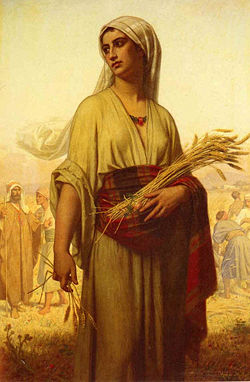
And She Happened to Come…

1 Now Naomi had a relative of her husband’s, a worthy man of the clan of Elimelech, whose name was Boaz. And Ruth the Moabite said to Naomi, “Let me go to the field and glean among the ears of grain after him in whose sight I shall find favor.” And she said to her, “Go, my daughter.” So she set out and went and gleaned in the field after the reapers, and she happened to come to the part of the field belonging to Boaz, who was of the clan of Elimelech. – Ruth 2:1-3 ESV

Chapter one ends with a seemingly irrelevant reference that describes Naomi and Ruth returning to Bethlehem at “the beginning of barley harvest.”

What at first appears to be little more than a throwaway line was actually intended to provide a welcome transition from the dark days that marked Naomi’s life in Moab to the more hopeful future that lay ahead as she returns to the land of promise.

This entire story began with a reference to the period of the judges and a description of a famine in the land of Judah. With these two details, the author provides an important preface for the remainder of his narrative by establishing that this story takes place during a time marked by Israel’s disobedience and God’s judgment. The nearly 300-year-long period of Israel’s history recorded in the book of  Judges was filled with repeated outbreaks of apostasy on the part of God’s people, followed by periods of suffering as a result of God’s divine judgment. The famine, while a natural disaster, had been God-ordained. Israel was suffering yet again the righteous wrath of God Almighty. But Naomi had received word that God had relented.

…the Lord had visited his people and given them food. – Ruth 1:6 ESV

It was this news that had prompted Naomi to return home. And the story reveals that she arrived in Bethlehem at just the time when the annual barley harvest was taking place. When she and her husband had left Judah, it had been a time of famine. Now she was returning at a time marked by fruitfulness and feasting. For Naomi, Moab had been a place of loss and sorrow. While there, she had experienced the deaths of her husband and two sons. But now, she was returning home to Bethlehem, the “house of bread,” and just in time for the first of the first fruits of the God-ordained harvest to be gathered.

Naomi had no way of knowing what the future held. She was still a widow and she was accompanied by her widowed Moabite daughter-in-law. She had no source of income, and there is no indication that she had a home in which to live upon her return. Her immediate prospects were bleak. But the author wants us to know that God was at work behind the scenes. His mention of the harvest is a subtle, yet powerful reminder that the lives of Naomi and Ruth were in the hands of God Almighty.

Despite her dire circumstances, Naomi would find herself far from alone. In fact, chapter two opens with a hope-infused reference to Naomi’s relative.

Naomi had a relative of her husband’s, a worthy man of the clan of Elimelech, whose name was Boaz. – Ruth 2:1 ESV

The timing of her return to Judah was divinely ordained and sovereignly orchestrated. Even the decision by Ruth to leave abandon her own home and family to align herself with Naomi is going to be revealed as the will and the work of God. There is no luck, kismet, or cosmic karma going on here. This is not a case of fortunate timing or happenstance. Everything about this story is intended to point to God. He is at work behind the scenes, orchestrating every single aspect of the story, from the timing to the characters involved. And it is because He has a much larger and grander plan involved than Naomi and Ruth could have ever imagined.

With the author’s introductory details concerning Boaz, he telegraphs yet another seemingly serendipitous encounter. Naomi and Ruth are not aware of Boaz’s presence yet. He has been introduced but has not yet made his appearance in the story. But Ruth, desiring to provide some source of sustenance for she and Naomi, offers to go into the fields outside Bethlehem and “glean among the ears of grain” (Ruth 2:2 ESV). In order to do so, she will need to find a farmer willing to let her gather some of the grain that remained in the corners and edges of his field.

This was a common practice among the Israelites because God had ordained it as a means of caring for the poor and needy among them. It had part of God’s original law passed down to the people of Israel through Moses at Mount Sinai in the wilderness.

“When you reap the harvest of your land, you shall not reap your field right up to its edge, neither shall you gather the gleanings after your harvest. And you shall not strip your vineyard bare, neither shall you gather the fallen grapes of your vineyard. You shall leave them for the poor and for the sojourner: I am the Lord your God. – Leviticus 10:9-10 ESV

Now, decades later, here was Ruth preparing to take advantage of this divine decree in order to provide for her and her mother-in-law. But little did Ruth know that God had something far more significant in store for the two of them. She was a stranger to Bethlehem, a widowed Moabite woman wandering around the barley fields outside the city. And she just happens upon a field that belongs to the close relative of Naomi.

So she set out and went and gleaned in the field after the reapers, and she happened to come to the part of the field belonging to Boaz, who was of the clan of Elimelech. – Ruth 2:3 ESV

The author wants us to know that this appears to be a case of blind luck. He purposefully uses the Hebrew word miqreh, which means “unforeseen meeting or event, accident, happening, chance, fortune.” But he knows this is nothing of the sort. It appears as if Naomi has inadvertently and unexpectedly stumbled into this situation. Unknowingly, she has chosen to glean barley grain in the field that belongs to a relative of Naomi’s deceased husband. But while Naomi was operating blind, her every action took place under the divine gaze of God. He was watching but also directing each and every aspect of this story.

Think about the details of this story. Naomi moves to Moab with her husband Elimelech in order to escape a famine in the land of Judah. While there, her husband unexpectedly dies. Her two sons end up marrying women from Moab. Had the family not moved to this foreign country, this would never have happened. One of those women just happened to be Ruth. When the two sons of Elimelech died, Naomi was left with Moabite women as her only family. But when Naomi announced her plans to return to Judah, only one of the women made the fateful decision to accompany her. And that woman was Ruth.

Now, Ruth, who had promised to stay with and care for her mother-in-law, has taken upon herself the responsibility to seek some kind of food for the two of them. And she happens to end up gleaning barley grain in the field of Boaz, a close relative of her deceased father-in-law, Elimelech.

The scene is set and the next act in the divine drama of God’s redemptive plan is ready to be revealed.

English Standard Version (ESV)
The Holy Bible, English Standard Version. ESV® Permanent Text Edition® (2016). Copyright © 2001 by Crossway Bibles, a publishing ministry of Good News Publishers.

New Living Translation (NLT)
Holy Bible, New Living Translation, copyright © 1996, 2004, 2015 by Tyndale House Foundation. Used by permission of Tyndale House Publishers Inc., Carol Stream, Illinois 60188. All rights reserved.

The Message (MSG)Copyright © 1993, 1994, 1995, 1996, 2000, 2001, 2002 by Eugene H. Peterson

Your God Will Be My God

Then she arose with her daughters-in-law to return from the country of Moab, for she had heard in the fields of Moab that the Lord had visited his people and given them food. So she set out from the place where she was with her two daughters-in-law, and they went on the way to return to the land of Judah. But Naomi said to her two daughters-in-law, “Go, return each of you to her mother’s house. May the Lord deal kindly with you, as you have dealt with the dead and with me. The Lord grant that you may find rest, each of you in the house of her husband!” Then she kissed them, and they lifted up their voices and wept. 10 And they said to her, “No, we will return with you to your people.” 11 But Naomi said, “Turn back, my daughters; why will you go with me? Have I yet sons in my womb that they may become your husbands? 12 Turn back, my daughters; go your way, for I am too old to have a husband. If I should say I have hope, even if I should have a husband this night and should bear sons, 13 would you therefore wait till they were grown? Would you therefore refrain from marrying? No, my daughters, for it is exceedingly bitter to me for your sake that the hand of the Lord has gone out against me.” 14 Then they lifted up their voices and wept again. And Orpah kissed her mother-in-law, but Ruth clung to her.

15 And she said, “See, your sister-in-law has gone back to her people and to her gods; return after your sister-in-law.” 16 But Ruth said, “Do not urge me to leave you or to return from following you. For where you go I will go, and where you lodge I will lodge. Your people shall be my people, and your God my God. 17 Where you die I will die, and there will I be buried. May the Lord do so to me and more also if anything but death parts me from you.” 18 And when Naomi saw that she was determined to go with her, she said no more. – Ruth 1:6-18 ESV

The book of Ruth takes place during the time of the judges, a three-century-long period of spiritual darkness marked by unfaithfulness and apostasy. In the book of Judges, the people of Israel are repeatedly portrayed as stubborn, rebellious, and unrepentant. And, as the author of Judges points out, their track record of unfaithfulness to God was persistent and pervasive.

And the people of Israel did what was evil in the sight of the LORD and served the Baals. – Judges 2:11

That condemning statement is made at least seven times in the book of Judges. And each time the people of Israel turned their backs on God, He would bring judgment upon them in the form of the Canaanites, who would plunder the Israelites until they called out to Him for help. Then God would send a judge who would deliver them from their enemies. But eventually, when that judge died, the people would turn back to their former ways, worshiping the false gods of the Canaanites. And the cycle would begin again.

In the midst of all this sin, suffering, sorrow, and salvation, the book of Ruth provides a much-needed respite. It appears as a parenthetical pause, offering a refreshing glimpse into the life of a single Israelite family and their struggle for survival in those turbulent times.

Yet, the book of Ruth opens up on a remarkably sad note, revealing the fate of an Israelite woman named Naomi, whose entire world has cratered in around her.  She is living in the land of Moab, having fled with her husband from Bethlehem in an effort to escape a devastating famine. But rather than finding relief in Moab, Naomi loses her soul mate. Elimelech, her husband, dies suddenly and unexpectedly, leaving her a widow in a foreign country. Fortunately, her two adult sons are with her. And in an effort to make the most of their time in Moab, her two sons marry Moabite wives and settle down. But Naomi’s fate seems to be cursed. Ten years later, both of her sons also die, leaving Naomi and her two Moabite daughters-in-law to fend for themselves.

The scene is set. The actors in this divine drama stand on the stage, poised to reveal the plot devised by God from eternity past. What we have here is more than just a story of the life of Naomi and a Moabite woman named Ruth. It is a glimpse into God’s sovereign plan of redemption for sinful mankind. This small book seems to chronicle the life of a single Moabite woman, and yet, within its pages, it reveals the providential outworkings of a gracious, omnipotent, and omniscient God. Every single aspect of this story is God-ordained, from the famine in the land of Canaan to Elimelech’s decision to move his family to Moab. The deaths of Elimelech and his sons did not catch God by surprise. At no point in this story is God portrayed as wringing His hands with worry or fretting over the unfortunate circumstances surrounding Naomi. While she had every right to wonder where God was in the midst of all her suffering, at no point does she question His love or sovereignty. In fact, she exhibits a remarkable degree of peace and patience in the face of overwhelming loss.

Her husband and sons gone, Naomi has little reason to remain in Moab. A widowed Israelite woman, she has little hope of finding a husband among the Moabites. And she has no means of providing for herself and her recently widowed daughters-in-law, so she makes plans to return home. And at this point in the story, just when things are looking impossibly dark, a glimmer of light appears. While searching for food in the fields of Moab, Naomi hears the rumor “that the Lord had visited his people and given them food” (Ruth 1:6 ESV).

The famine had ended. It was safe to return home. But this fortunate news should not be received as some form of good luck or blind fate. This is a sign of God’s divine timing. At just the right time, God brought an end to the famine, so that Naomi could return to her native land of Judah. She would be going back to her hometown of Bethlehem, a small village whose very name means “house of bread.” God was going to provide for her needs, and in ways, she could never have imagined.

And little did Naomi know that all her losses would actually result in blessing, not only for her but for the people of Israel and the nations of the world. The dark cloud overshadowing her life’s story was going to have a silver lining that would have global and eternal ramifications.

As Naomi prepared to make the long journey home, she encouraged her daughters-in-law to remain in Moab. They were both young enough that remarriage was a distinct possibility and the most logical solution to their problem. There was no future for them in Judah. And Naomi graciously pronounced a blessing on both of them.

“May the Lord deal kindly with you, as you have dealt with the dead and with me. The Lord grant that you may find rest, each of you in the house of her husband!” – Ruth 1:8-9 ESV

Naomi had not lost her trust in God. She still believed He was there and that He cared, despite all that she had endured over the last ten years. And she lovingly asked that God would bless her two daughters-in-law with husbands, health, and happiness.

Initially, both women refused Naomi’s request that they remain in Moab. They each expressed their intention to stay by her side, refusing to forsake her in her time of need. But with further coaxing from Naomi, one of the women, Orpah, decided to return to her own people. But Ruth, unwilling to leave her mother-in-law alone, refused Naomi’s advice and boldly proclaimed her unwavering pledge of faithfulness.

“Don’t ask me to leave you and turn back. Wherever you go, I will go; wherever you live, I will live. Your people will be my people, and your God will be my God. Wherever you die, I will die, and there I will be buried. May the Lord punish me severely if I allow anything but death to separate us!” – Ruth 1:16-17 NLT

These verses have a familiar ring to them because, over the centuries, they have become a common feature of innumerable wedding ceremonies. Tens of thousands of brides and grooms have repeated these words to one another as a pledge of their commitment to marital fidelity and solidarity.

But when Ruth uttered these words to Naomi, she was expressing her willingness to leave all that she knew behind. She was stating her intention to walk away from her family and ancestral home. She would be moving to a land in which she would be a foreigner and an outsider. As a Moabitess, her chances of remarriage in Judah would be drastically reduced. And she was taking on the weighty responsibility of providing for her widowed mother-in-law, for as long as God gave her breath.

This amazing expression of faithfulness should not be taken lightly. It stands in stark contrast to the blatant unfaithfulness and infidelity of the nation of Israel as portrayed throughout the period of the judges. This was a time in the life of Israel when each man “did what was right in his own eyes” (Judges 17:6 ESV). And yet, here was Ruth, a woman from Moab, who was willing to put the needs of her mother-in-law ahead of her own. And don’t miss this often-overlooked aspect of Ruth’s commitment. She was even willing to give up her god.

While the people of Israel were busy forsaking Yahweh, their covenant-keeping God, here was Ruth the Moabitess, making a covenant commitment to switch her allegiance to Him. Whether she realized it or not, Ruth was forsaking her false god for the one true God. And her decision was going to have eternal ramifications that would influence the nation of Israel and the entire world.

English Standard Version (ESV)
The Holy Bible, English Standard Version. ESV® Permanent Text Edition® (2016). Copyright © 2001 by Crossway Bibles, a publishing ministry of Good News Publishers.

New Living Translation (NLT)
Holy Bible, New Living Translation, copyright © 1996, 2004, 2015 by Tyndale House Foundation. Used by permission of Tyndale House Publishers Inc., Carol Stream, Illinois 60188. All rights reserved.

The Message (MSG)Copyright © 1993, 1994, 1995, 1996, 2000, 2001, 2002 by Eugene H. Peterson

The Woman Was Left

1 In the days when the judges ruled there was a famine in the land, and a man of Bethlehem in Judah went to sojourn in the country of Moab, he and his wife and his two sons. The name of the man was Elimelech and the name of his wife Naomi, and the names of his two sons were Mahlon and Chilion. They were Ephrathites from Bethlehem in Judah. They went into the country of Moab and remained there. But Elimelech, the husband of Naomi, died, and she was left with her two sons. These took Moabite wives; the name of the one was Orpah and the name of the other Ruth. They lived there about ten years, and both Mahlon and Chilion died, so that the woman was left without her two sons and her husband. – Ruth 1:1-5 ESV

The title for this little book stems from the name of its primary character, a relatively obscure woman who appears on the scene during the time in which Israel was under the leadership of judges. This 300-year-long period of Israel’s history ran from 1375 B.C. to 1075 B.C., and it is described in less-than-flattering terms in the latter part of the book of Judges:

In those days there was no king in Israel. Everyone did what was right in his own eyes. – Judges 17:6 ESV

The period of the judges was marked by apostasy and spiritual infidelity among the people of Israel. They were in the land of Canaan, the land that God had promised to give to Abraham’s descendants as their inheritance. Under the leadership of Joshua, the twelve tribes of Israel had waged war against the land’s occupants and had successfully displaced a large portion of their enemies, just as God had commanded them.

…the LORD said to Moses, “Give the following instructions to the people of Israel: When you cross the Jordan River into the land of Canaan, you must drive out all the people living there. You must destroy all their carved and molten images and demolish all their pagan shrines. Take possession of the land and settle in it, because I have given it to you to occupy.” – Numbers 33:50-53 NLT

But Israel had failed to follow God’s orders to the letter. They had made compromises and concessions, choosing to make alliances with the nations living in the land, rather than expelling them as God had commanded. And the book of Judges chronicles their partial obedience.

Manasseh did not drive out the inhabitants of Beth-shean and its villages, or Taanach and its villages, or the inhabitants of Dor and its villages, or the inhabitants of Ibleam and its villages, or the inhabitants of Megiddo and its villages, for the Canaanites persisted in dwelling in that land. – Judges 1:27 ESV

And Ephraim did not drive out the Canaanites who lived in Gezer, so the Canaanites lived in Gezer among them. – Judges 1:29 ESV

Zebulun did not drive out the inhabitants of Kitron, or the inhabitants of Nahalol, so the Canaanites lived among them, but became subject to forced labor. – Judges 1:30 ESV

Asher did not drive out the inhabitants of Acco, or the inhabitants of Sidon or of Ahlab or of Achzib or of Helbah or of Aphik or of Rehob, so the Asherites lived among the Canaanites, the inhabitants of the land, for they did not drive them out. – Judges 1:32-33 ESV

Naphtali did not drive out the inhabitants of Beth-shemesh, or the inhabitants of Beth-anath, so they lived among the Canaanites, the inhabitants of the land.  – Judges 1:33 ESV

The Amorites pressed the people of Dan back into the hill country, for they did not allow them to come down to the plain. – Judges 1:34 ESV

And God had warned the people of Israel that if they failed to remove the Canaanites from the land, these pagan nations would become a snare for them.

“…if you fail to drive out the people who live in the land, those who remain will be like splinters in your eyes and thorns in your sides. They will harass you in the land where you live. And I will do to you what I had planned to do to them.” – Numbers 33:55-56 NLT

Because the people of Israel failed to remove the Canaanites, they ended up worshiping the gods of the Canaanites.

They followed other gods—the gods of the nations who lived around them. They worshiped them and made the Lord angry. They abandoned the Lord and worshiped Baal and the Ashtoreths.

The Lord was furious with Israel and handed them over to robbers who plundered them. He turned them over to their enemies who lived around them. – Judges 2:12-14 NLT

Needless to say, this period does not represent a high-water mark for the nation of Israel. In fact, the book of Judges describes it in stark terms.

…there arose another generation after them who did not know the Lord or the work that he had done for Israel. – Judges 2:10 ESV

And it in this milieu of apostasy and unfaithfulness that the book of Ruth finds its setting. Because of Israel’s persistent sin of idolatry, God is using the very nations they should have driven from the land as His instruments of judgment.

he gave them over to plunderers, who plundered them – Judges 2:14 ESV

But there was a method to God’s seeming madness. He had a purpose behind His divine judgment.

Then the Lord raised up judges, who saved them out of the hand of those who plundered them. Yet they did not listen to their judges, for they whored after other gods and bowed down to them. They soon turned aside from the way in which their fathers had walked, who had obeyed the commandments of the Lord, and they did not do so. Whenever the Lord raised up judges for them, the Lord was with the judge, and he saved them from the hand of their enemies all the days of the judge. For the Lord was moved to pity by their groaning because of those who afflicted and oppressed them. But whenever the judge died, they turned back and were more corrupt than their fathers, going after other gods, serving them and bowing down to them. – Judges 2:16-19 ESV

Over the years, God would raise up the various nations that remained in the land to  use as His instruments of judgment. This included the Ammonites, MIdianites, Jebusites, and Amalekites. And each time they showed up, these enemies would steal, pillage, plunder, and destroy, leaving a wake of destruction in their path that left the tribes of Israel demoralized, intimidated, and striving to survive.

And the book of Ruth opens up with the description of “a famine in the land” (Ruth 1:1 ESV). The focal point of the story is a region known as Ephrathah, which was occupied by the Ephrathites. It is believed that Ephrathah was the ancient name of the Canaanite city that occupied the spot. But the name was later given its Hebrew name of Bethlehem, which means “house of bread.”

In this city lived a man named Elimelech who was married to a woman named Naomi. In an effort to escape the famine, this couple and their two adult sons relocated to the land of Moab, located at the southern border of the land of Canaan, and just east of the Dead Sea.

Moab was outside the boundaries of the land of Canaan, which gives the impression that the famine was localized. Elimelech did not attempt to go north, which would have kept them within the borders of the promised land and among their own people. It seems likely that the famine had impacted all of the tribal lands in which the people of Israel lived. This would indicate that the famine had been God-ordained and was another form of judgment from the land of God.

Elimelech, hoping to escape the ravages of the famine, relocates his family to Moab. But why did he choose the land of Moab? The logical answer would be that Moab had escaped the ravages of the famine. There would be pasture land for Elimelech’s flocks. Grain and fruit would be available for his wife and sons. It seems likely that Elimelech saw this as a temporary relocation, and that he had every intention of returning to his fellow Ephrathites as soon as the famine ended.

But God had other plans. Elimelech died – abruptly and unexpectedly, leaving his wife a widow living in a foreign land. In time, her two sons ended up marrying Moabite women. This is an important, yet easily overlooked detail in the story. Since these two young men were stuck in Moab and they had no access to Israelite women, they chose for themselves Moabite women to marry. And this would seem to be in direct contradiction to a command given by God years earlier through Moses.

“No Ammonite or Moabite or any of their descendants for ten generations may be admitted to the assembly of the LORD. These nations did not welcome you with food and water when you came out of Egypt. Instead, they hired Balaam son of Beor from Pethor in distant Aram-naharaim to curse you. But the LORD your God refused to listen to Balaam. He turned the intended curse into a blessing because the LORD your God loves you. As long as you live, you must never promote the welfare and prosperity of the Ammonites or Moabites.” – Deuteronomy 23:3-6 NLT

The Moabites were actually close relatives of the Israelites because they were the direct descendants of Lot, the nephew of Abraham, the father of the Hebrew people. But the Moabites were also the result of Lot’s incestuous relationship with one of his own daughters (Genesis 19:30-38).

But here we have the two sons of Elimelech marrying two of the descendants of Lot, both citizens of the nation of Moab. And, almost as if expected, we read that, ten years later, the two sons abruptly die. Now we have three widows, Naomi, Orpah, and Ruth. One was a Jew, while the other two were Moabites. But in all three cases, their circumstances could not have been any worse. Their value as potential wives had dropped precipitously with the death of their husbands. In that ancient culture, widowhood could be a death sentence.

When Naomi had lost her husband, she found herself in a relatively stable condition because she had two adult sons to care for her. Her ability to produce any kind of income on her own was limited. And very few men would marry a widow, preferring instead to have a virgin for their wife.

And when Naomi’s sons died, she was left in a highly vulnerable and hopeless situation. Not only that, she now had two widowed daughters-in-law in her care. They were her responsibility. But she had no way of caring for her own needs, let alone theirs.

And so, the story of Ruth begins. A famine. An escape. Three unexpected deaths. Three unprotected widows. And the perfect opportunity for God to show up.

English Standard Version (ESV)
The Holy Bible, English Standard Version. ESV® Permanent Text Edition® (2016). Copyright © 2001 by Crossway Bibles, a publishing ministry of Good News Publishers.

New Living Translation (NLT)
Holy Bible, New Living Translation, copyright © 1996, 2004, 2015 by Tyndale House Foundation. Used by permission of Tyndale House Publishers Inc., Carol Stream, Illinois 60188. All rights reserved.

The Message (MSG)Copyright © 1993, 1994, 1995, 1996, 2000, 2001, 2002 by Eugene H. Peterson

No Rest For the Redeemer.

So she lay at his feet until the morning, but arose before one could recognize another. And he said, “Let it not be known that the woman came to the threshing floor.” And he said, “Bring the garment you are wearing and hold it out.” So she held it, and he measured out six measures of barley and put it on her. Then she went into the city. And when she came to her mother-in-law, she said, “How did you fare, my daughter?” Then she told her all that the man had done for her, saying, “These six measures of barley he gave to me, for he said to me, ‘You must not go back empty-handed to your mother-in-law.’” She replied, “Wait, my daughter, until you learn how the matter turns out, for the man will not rest but will settle the matter today.” – Ruth 3:14-18 ESV

Ruth had gone to the field of Boaz, looking for protection, refuge and rest. She had been sent there by Naomi, her mother-in-law. The goal had been to get Boaz to step up and accept his role as her kinsman-redeemer. Naomi seemed to sense that there was an attraction between the older Boaz and the recently widowed Ruth. And she determined to encourage this potential relationship along, hoping that it would change the fate of both Ruth and herself. There was no doubt something a bit self-serving in Naomi’s actions and her subsequent counsel for Ruth to approach Boaz directly and rather presumptuously.

Here is a servant demanding that the boss marry her, a Moabite making the demand of an Israelite, a woman making the demand of a man, a poor person making the demand of a rich man. Was this an act of foreigner naïveté, or a daughter-in-law’s devotion to her mother-in-law, or another sign of the hidden hand of God? From a natural perspective the scheme was doomed from the beginning as a hopeless gamble, and the responsibility Naomi placed on Ruth was quite unreasonable. But it worked! – Daniel I. Block, Judges, Ruth

There is much that is revealed in these passages regarding the character qualities of the key figures. We have seen that Naomi had a somewhat negative outlook. There is no doubt that she had been  through a lot, but she seemed to think that all of her problems were the direct result of God afflicting her. She saw it all as some form of punishment. This reveals her belief in God’s sovereignty and providence, but seems to indicate that she had a glass-half-full kind of outlook on life. She had a difficult time seeing that all of this could be used by God for her good.

Ruth comes across as a highly diligent and faithful young woman who was committed to the care of her mother-in-law. When given the opportunity to abandon Naomi and return to her own people to begin her life anew, she refused and dedicated herself to Naomi’s well-being and to her God. Ruth was not afraid of hard work and did not suffer from shyness. She was willing to do whatever it took to make sure she and Naomi survived. And she never seemed to see herself as a victim.

Boaz comes across as a kind and gracious man who showed legitimate concern for Ruth. He had been impressed with all that he had heard about her and how she had chosen to sacrifice all in order to care for Naomi. He was a man of high ethical standards who, as a man of means, was generous with those who were less fortunate. And when he became aware of the plight of Naomi and Ruth, he stepped in to do what he could do to assist them. Now, with Ruth’s request that he be her kinsman-redeemer (Ruth 3:6), Boaz reveals his strong spirit of determination and sense of responsibility. He tells Ruth, “Remain tonight, and in the morning, if he will redeem you, good; let him do it. But if he is not willing to redeem you, then, as the Lord lives, I will redeem you. Lie down until the morning” (Ruth 3:13 ESV). And Boaz’s dependability seems to have been well-known, because Naomi tells Ruth, “for the man will not rest but will settle the matter today” (Ruth 3:18 ESV). Boaz could be counted on to do whatever needed to be done. His word was his pledge. He could be trusted.

The Hebrew word for “rest” that Naomi used is shaqat and it refers to peace, quietness or repose. Boaz was not going to have peace or be satisfied until Ruth had the protection, refuge and rest for which she was looking. He would do whatever it took to make sure she got what she needed. He would sacrifice time, sleep, resources and his own needs to make sure that the right thing was done for Ruth and Naomi.

This image of the faithful, dedicated kinsman-redeemer is a foreshadowing of the One who was to come: The Messiah, Jesus Christ. He too was determined and dedicated to doing whatever it took that redemption was made available. Paul reminds us, “though he was in the form of God, did not count equality with God a thing to be grasped, but emptied himself, by taking the form of a servant, being born in the likeness of men. And being found in human form, he humbled himself by becoming obedient to the point of death, even death on a cross” (Philippians 2:6-8 ESV). In his gospel account, Luke tells us that as the time drew closer for Jesus to go to Jerusalem where He would suffer and die, “he set his face to go to Jerusalem” (Luke 9:51 ESV). The Greek word Luke used is stērizō and it means “to turn resolutely in a certain direction” (“G4741 – stērizō – Strong’s Greek Lexicon (KJV).” Blue Letter Bible). Jesus was determined to do what He had come to do.

Matthew records that when Jesus told His disciples that He was going to Jerusalem where “he would suffer many terrible things at the hands of the elders, the leading priests, and the teachers of religious law. He would be killed, but on the third day he would be raised from the dead” (Matthew 16:21 NLT), Peter rebuked Him. And Jesus responded to Peter with the sobering words, “Get away from me, Satan! You are a dangerous trap to me. You are seeing things merely from a human point of view, not from God’s” (Matthew 16:23 NLT). Jesus would not be deterred from His task. He would not rest until He had accomplished His God-ordained role as redeemer. Jesus fully understood His role and He took it seriously. He told His disciples, “For even the Son of Man came not to be served but to serve others and to give his life as a ransom for many” (Mark 10:45 NLT).

Boaz would not rest until Ruth found the rest for which she was looking. He was willing to put her needs ahead of his own. He was willing to sacrifice His own comfort and convenience for the needs of another. He would do whatever it took to ensure that Ruth and Naomi were taken care of. And as the following chapter will reveal, Boaz wasted no time doing exactly what he had told Ruth he would do. He was a man of his word. And he stands as a type of Christ, a representation of the one who was to come, who would not rest until redemption was made available to a lost and dying world. He would give His life as payment for the sins of men and as the only means of reconciling a lost world to a holy God.

For you know that God paid a ransom to save you from the empty life you inherited from your ancestors. And the ransom he paid was not mere gold or silver. It was the precious blood of Christ, the sinless, spotless Lamb of God. God chose him as your ransom long before the world began, but he has now revealed him to you in these last days. – 1 Peter 1:18-20 NLT

Naomi the Negative. Ruth the Resilient.

So the two of them went on until they came to Bethlehem. And when they came to Bethlehem, the whole town was stirred because of them. And the women said, “Is this Naomi?” She said to them, “Do not call me Naomi; call me Mara, for the Almighty has dealt very bitterly with me. I went away full, and the Lord has brought me back empty. Why call me Naomi, when the Lord has testified against me and the Almighty has brought calamity upon me?”

So Naomi returned, and Ruth the Moabite her daughter-in-law with her, who returned from the country of Moab. And they came to Bethlehem at the beginning of barley harvest.

Now Naomi had a relative of her husband’s, a worthy man of the clan of Elimelech, whose name was Boaz. And Ruth the Moabite said to Naomi, “Let me go to the field and glean among the ears of grain after him in whose sight I shall find favor.” And she said to her, “Go, my daughter.” So she set out and went and gleaned in the field after the reapers, and she happened to come to the part of the field belonging to Boaz, who was of the clan of Elimelech. And behold, Boaz came from Bethlehem. And he said to the reapers, “The Lord be with you!” And they answered, “The Lord bless you.” Then Boaz said to his young man who was in charge of the reapers, “Whose young woman is this?” And the servant who was in charge of the reapers answered, “She is the young Moabite woman, who came back with Naomi from the country of Moab. She said, ‘Please let me glean and gather among the sheaves after the reapers.’ So she came, and she has continued from early morning until now, except for a short rest.” – Ruth 1:19-2:7 ESV

These verses are filled with contrasts. The most obvious one is the difference between the two women: Naomi and her daughter-in-law, Ruth. They both arrive in Bethlehem, but with radically different outlooks. Naomi had left during a famine, but arrived back during the barley harvest. Conditions back home had obviously improved. But she is so busy dwelling on all that had happened to her in Moab, that she fails to notice or appreciate the improved conditions in Bethlehem. In fact, she is so despondent over the loss of her husband and two sons, that she informs everyone her name will no longer be Naomi, but Mara. Naomi means, “my pleasantness” and Mara means, “bitterness.” She is so upset with her lot in life that she goes so far as to change her name to reflect her outlook. She is bitter and hold God responsible, claiming,  “I left here full, but the Lord has caused me to return empty-handed” (Ruth 1:27 NLT). In her mind, it was God who had opposed her and the El Shaddai, God Almighty, who had caused her to suffer. Her reference to God using the Hebrew name, Shaddai, reveals her belief in God’s all-powerful, sovereign nature. She rightly understands God’s omnipotence, but fails to grasp His lovingkindness. She views God as an all-powerful and somewhat angry deity who wields His power unfairly and unjustly. She sees no purpose in her losses and can find no silver lining to the dark cloud of her despair. She believes her fate is in the hands of God, but she finds no comfort there.

But Ruth, the Moabitess, seems to have a different perspective. Of the two women, it would seem that she had even more justification to be negative about her new circumstances. She too had lost her husband. She had also left behind her family and friends and moved to a new country with nothing more than her widowed mother-in-law as a companion. She found herself an outsider, a non-Jew living in the land of Israel. And on top of that, she was a woman and a widow, two things that would not be in her favor in the male-dominated society of the ancient Middle East. And yet, Ruth proves to be a beacon of light in the midst of Naomi’s darkened outlook.

With no means of providing for themselves, Naomi and Ruth are left with no other option than to search for grain in the fields after barley harvesters were done. This was called gleaning and it was a God-ordained policy meant to assist the needy. God had commanded the Israelites:

“When you reap the harvest of your land, you shall not reap your field right up to its edge, neither shall you gather the gleanings after your harvest. And you shall not strip your vineyard bare, neither shall you gather the fallen grapes of your vineyard. You shall leave them for the poor and for the sojourner: I am the Lord your God. – Leviticus 19:9-10 ESV

Rather than wallow in self-pity, Ruth determined to do whatever was necessary to provide for she and her mother-in-law. She asked Naomi for permission to do something about their dire circumstances, saying, “Let me go to the fields so I can gather grain behind whoever permits me to do so” (Ruth 2:2 NLT). With Naomi’s permission, she headed into the fields. And this is where the story gets interesting. The author gives us a not-so-subtle clue that there is more going on here than good luck. “Now she just happened to end up in the portion of the field belonging to Boaz, who was from the clan of Elimelech” (Ruth 2:3 NLT). Chapter two began with a brief parenthetical introduction to Boaz, telling us that “Naomi had a relative on her husband’s side of the family named Boaz. He was a wealthy, prominent man from the clan of Elimelech” (Ruth 2:1 NLT). When Ruth went into the fields, she knew nothing of Boaz or his fields. She simply went to glean. Her objective was to find food, not a husband. Her only motivation was survival. But again, the author lets us know that there is something providential going on here. He writes, “And behold, Boaz came from Bethlehem” (Ruth 2:4 ESV). It just so happened that Ruth decided to glean in the field belonging to Boaz. It just so happened that Boaz showed up at the very same time Ruth was gleaning in his field. What a coincidence. What incredible timing.

It would be so easy to read the book of Ruth as a fanciful love story, a kind of screenplay  for a Hebrew Hallmark movie, where the down-and-out country girl meets the well-to-do city boy and their lives end happily ever after. But there is so much more going on here than a cheesy boy-meets-girl scenario with a sappy everything-turns-out-okay ending. This is about the sovereign will of God regarding His covenant promise to Abraham, Isaac and Jacob. Ruth, this widowed, helpless non-Jewish woman is going to become a major player in the divine plan of redemption. In his genealogical record of the birth of Jesus, Matthew writes, “Boaz the father of Obed by Ruth, and Obed the father of Jesse, and Jesse the father of David the king” (Matthew 1:5-6 ESV). Spoiler alert: Ruth and Boaz do end up together. They get married and have a son named Obed, who would become the grandfather of King David. And from King David’s lineage would come Jesus Christ. God would end up making a covenant with David, saying, “And your house and your kingdom shall be made sure forever before me. Your throne shall be established forever” (2 Samuel 7:16 ESV). That promise would be fulfilled in Jesus, whose rule and reign on the throne of David will take place in the millennial kingdom.

Ruth went into the field to find grain. But God sent her into the field to find her purpose in life. She would become a major player in God’s divine plan for the redemption of the world and the eventual birth of the One who will reign as King of kings and Lord of lords. Ruth, like Mary, was going to be a vessel in the hands of God to bring about His divine will and accomplish His sovereign plan of salvation. The message given to Mary by the angel, Gabriel, sums up the real story behind the story of Ruth. God had far more in mind than providing grain or even a husband for Ruth. He was out to provide salvation to a lost and dying the world.

“Don’t be afraid, Mary,” the angel told her, “for you have found favor with God! You will conceive and give birth to a son, and you will name him Jesus. He will be very great and will be called the Son of the Most High. The Lord God will give him the throne of his ancestor David. And he will reign over Israel forever; his Kingdom will never end!” – Luke 1:30-33 NLT