So Great A Salvation

15 To give a human example, brothers: even with a man-made covenant, no one annuls it or adds to it once it has been ratified. 16 Now the promises were made to Abraham and to his offspring. It does not say, “And to offsprings,” referring to many, but referring to one, “And to your offspring,” who is Christ. 17 This is what I mean: the law, which came 430 years afterward, does not annul a covenant previously ratified by God, so as to make the promise void. 18 For if the inheritance comes by the law, it no longer comes by promise; but God gave it to Abraham by a promise.

19 Why then the law? It was added because of transgressions, until the offspring should come to whom the promise had been made, and it was put in place through angels by an intermediary. 20 Now an intermediary implies more than one, but God is one.

21 Is the law then contrary to the promises of God? Certainly not! For if a law had been given that could give life, then righteousness would indeed be by the law. 22 But the Scripture imprisoned everything under sin, so that the promise by faith in Jesus Christ might be given to those who believe.

23 Now before faith came, we were held captive under the law, imprisoned until the coming faith would be revealed. 24 So then, the law was our guardian until Christ came, in order that we might be justified by faith. 25 But now that faith has come, we are no longer under a guardian, 26 for in Christ Jesus you are all sons of God, through faith. 27 For as many of you as were baptized into Christ have put on Christ. 28 There is neither Jew nor Greek, there is neither slave nor free, there is no male and female, for you are all one in Christ Jesus. 29 And if you are Christ’s, then you are Abraham’s offspring, heirs according to promise. – Galatians 3:15-29 ESV

As a former Pharisee, Paul had a scholarly understanding of the Old Testament. But it was after his conversion, when he had received the indwelling Holy Spirit, that Paul truly began to understand that the Old Testament was a foreshadowing of the coming Messiah, Jesus Christ. Post-conversion, his comprehension of the Scriptures was both magnified and clarified. Familiar passages took on a whole new meaning when he was able to view them through the lens of the gospel. In the case of Genesis 13:15 and 17:8, where Moses records God’s covenant with Abraham, Paul exegetes these all-too-familiar passages by revealing that through them, God had been promising the coming of Christ.

He was the “seed” or “offspring” through whom all the nations would be blessed. God’s promise to Abraham would ultimately be fulfilled through Jesus. But what is Paul’s point in bringing to light this new interpretation or understanding of God’s promise? He was attempting to answer the argument that the Mosaic law, which came after the giving of the promise by God to Abraham, somehow superseded or supplanted it.

But Paul argues that God had made a binding covenant with Abraham and his “offspring.” This God-ordained agreement could not be nullified or broken. It was a unilateral covenant, made by God and could only be annulled by God. But Paul argues that at no point did God revoke or replace the covenant, even when He had given Moses the law some 430 years afterward. In fact, Paul points out that the inheritance tied to the promise of God could be received only through the promise of God. It was not accessible any other way, especially not through the keeping of the law. And the inheritance of which Paul speaks is tied directly to the idea of justification by faith. This was the crux of the problem taking place among the Galatian believers.

They had been told that their justification was tied to the keeping of the law, most specifically to God’s command regarding circumcision. In other words, they were being sold a bill of goods that promised them a right standing before God through law-keeping and self-effort, not faith in Christ alone.

Paul wrote to the Colossian believers:

May you be strengthened with all power, according to his glorious might, for all endurance and patience with joy, giving thanks to the Father, who has qualified you to share in the inheritance of the saints in light. He has delivered us from the domain of darkness and transferred us to the kingdom of his beloved Son, in whom we have redemption, the forgiveness of sins. – Colossians 1:11-14 ESV

He prayed for the Ephesian believers…

…that the God of our Lord Jesus Christ, the Father of glory, may give you the Spirit of wisdom and of revelation in the knowledge of him, having the eyes of your hearts enlightened, that you may know what is the hope to which he has called you, what are the riches of his glorious inheritance in the saints – Ephesians 1:17-18 ESV

For Paul, the promise of God made to Abraham and fulfilled in Christ, was all about the wonderful reality of a restored relationship with God, for both Jews and Gentiles. And this incredible gift was only available through faith in the finished work of Jesus Christ. It could not be attained through self-effort. Paul went on to tell the Ephesian believers that he wanted them to understand “what is the immeasurable greatness of his power toward us who believe, according to the working of his great might that he worked in Christ when he raised him from the dead and seated him at his right hand in the heavenly places” (Ephesians 1:19-20 ESV).

Our salvation, justification, sanctification, and glorification are all tied to the work of Christ on our behalf. Our righteousness comes from Christ. Our right standing before God is a result of His shed blood. Our future inheritance is tied to His sacrificial death on the cross. All that we are and all that we hope to be is based on the finished work of Christ, and for that, we have much to be grateful.

So, what is the role of the law? If it is not necessary for salvation, why did God command the Israelites to keep His lengthy list of commands and regulations? Paul knew these questions were on the minds of his audience, so he chose to provide the answers.

It was given alongside the promise to show people their sins. – Galatians 3:19 NLT

Once again, Paul stresses the presence of the promise as being separate from the law. They were not inextricably linked as the Judaizers claimed. Keeping of God’s law was not a mandatory or non-negotiable requirement for receiving the promises made to Abraham’s “offspring.” Paul brings up this word again to stress the role that Jesus played in fulfilling the promise made by God.

Why then the law? It was added because of transgressions, until the offspring should come to whom the promise had been made. – Galatians 3:19 ESV

Until Jesus came and provided a better way to achieve a right standing with God, the law would serve as a temporary guardian or guide, assisting the Israelites in living up to God’s holy standard of righteousness. Paul makes that point in verse 24.

…the law was our guardian until Christ came, in order that we might be justified by faith. – Galatians 3:24 ESV

Paul continues to unpack the true meaning behind the promise that God made to Abraham. According to Paul, the offspring to whom God referred was Jesus, and the law was given by God after He had made the promise to Abraham to expose the full extent of mankind’s sinfulness. God gave His chosen people the law “because of transgressions.”

The law was given by God to reveal or expose man’s sin. It clearly articulated God’s holy and righteous expectations, and there could be no debate. In his letter to the Romans, Paul wrote, “Yet if it had not been for the law, I would not have known sin. For I would not have known what it is to covet if the law had not said, ‘You shall not covet’” (Romans 7:7 ESV). Before the giving of the law, man could have rationalized away his sin or simply claimed ignorance. But the law removed that option for God’s chosen people.

Paul goes on to say that the presence of the law acted as an impetus to sin, not causing man to sin, but provoking man’s sinful nature to rebel against it. When the law said, “Do not…”, man’s sin nature automatically and reflexively responded, “I will…”. Paul went on to say, “sin, seizing an opportunity through the commandment, produced in me all kinds of covetousness” (Romans 7:8 ESV). Indwelling sin, which opposes God, stands opposed to His holy law. It rejects it and entices man’s fleshly, sinful nature to disobey it. Like a parent telling their child not to touch a hot stove, the prohibition creates in the child an even deeper desire to do that which has been denied.

In verse 19, Paul says the law “was put in place through angels by an intermediary.” Moses provides us with some insight into the meaning behind Paul’s statement. Just before his death, Moses gave a blessing to the people of Israel, saying, “The Lord came from Sinai and dawned from Seir upon us; he shone forth from Mount Paran; he came from the ten thousands of holy ones, with flaming fire at his right hand” (Deuteronomy 33:2 ESV). Angels played a mediatory role, while Moses played an intermediatory role. The law was given and it placed responsibilities on God and upon man. God was obligated and committed to bless when men obeyed His law.

And if you faithfully obey the voice of the Lord your God, being careful to do all his commandments that I command you today, the Lord your God will set you high above all the nations of the earth. And all these blessings shall come upon you and overtake you, if you obey the voice of the Lord your God. – Deuteronomy 28:1-2 ESV

But He was also required to curse or punish when man disobeyed.

But if you will not obey the voice of the Lord your God or be careful to do all his commandments and his statutes that I command you today, then all these curses shall come upon you and overtake you.Deuteronomy 28:15 ESV

In contrast, when it came to the Abrahamic covenant, the promise God made regarding his “offspring” was solely the responsibility of God. There was no intermediary. The promise was made by God and would be fulfilled by Him alone. No angels played a part, and Abraham was not required to do anything to earn the fulfillment of the promise. He was simply required to trust God, and Paul describes Abraham as having an unwavering faith in God.

No unbelief made him waver concerning the promise of God, but he grew strong in his faith as he gave glory to God, fully convinced that God was able to do what he had promised. That is why his faith was “counted to him as righteousness.” – Romans 4:20-22 ESV

The law did not stand opposed to or somehow replace the promise of God. It was not intended to be a replacement for the promise. And it was never designed to produce in man a righteousness that would restore him to a right relationship with God. What it did was reveal the depth of humanity’s sinfulness and helplessness. Whether motivated by a genuine love for or fear of God, men were incapable of keeping His righteous decrees. The law simply confirmed that they were lawbreakers.

The law was designed to be temporary in nature. It was to be in effect until the promise was fulfilled and “the offspring” came. With the coming of Jesus and His death on the cross, the law’s binding hold on man was released. Jesus became the fulfillment of the law, having obediently kept every single requirement. He did what no other man had ever done, and His sinless perfection made Him the perfect, blameless sacrifice that God required to atone for the sins of mankind. Jesus paid it all. His sinless, unselfish sacrifice of His own life satisfied the just demands of a holy God.

In Romans, Paul writes of the unbelievable impact of Jesus’ death on our behalf:

For while we were still weak, at the right time Christ died for the ungodly. For one will scarcely die for a righteous person—though perhaps for a good person one would dare even to die — but God shows his love for us in that while we were still sinners, Christ died for us. Since, therefore, we have now been justified by his blood, much more shall we be saved by him from the wrath of God. – Romans 5:6-9 ESV

Law-keeping is not the answer to man’s sin problem. The law was never intended to provide salvation. It was designed to show man his sin and place him under God’s holy and just condemnation. The law was not even capable of driving men to God. As Paul indicated, it actually inflamed man’s sinful nature and drove him further from God. Law-breakers hate the law; they look for ways to disobey it and get around it. They see the law as oppressive and unnecessary. But Jesus came to free men from the law. He came to provide a means by which they could be made right with God apart from the law. And Paul makes it very clear that Jesus died for us while we were still sinners. We didn’t see our need for a Savior and then run to Him. We were dead in our trespasses and sins. We were blinded by our own sin natures and by Satan himself. And yet God, in His grace, opened our eyes to see the glory of the offer of the gift of His Son’s death. The scales fell off our eyes and His Spirit gave us the supernatural ability to say yes to that which we had previously rejected.

For by grace you have been saved through faith. And this is not your own doing; it is the gift of God, not a result of works, so that no one may boast. For we are his workmanship, created in Christ Jesus for good works, which God prepared beforehand, that we should walk in them. – Ephesians 2:8-10 ESV

Even our faith is a gift from God, otherwise, it would be of our own doing. Paul wants us to understand that our salvation is the sovereign work of God, from beginning to end. As when Jesus called Lazarus from the tomb, shouting, “Lazarus, come forth!,” God calls us out of the death and darkness of sin, providing us with not only life but the capacity to obey. That is why Paul refers to the gospel as “so great a salvation.” It needs no add-ons or addendums. God’s plan is perfect because it is all based on Him alone.

English Standard Version (ESV) The Holy Bible, English Standard Version. ESV® Permanent Text Edition® (2016). Copyright © 2001

New Living Translation (NLT) Holy Bible, New Living Translation, copyright © 1996, 2004, 2015 by Tyndale House Foundation. Used by permission of Tyndale House Publishers Inc., Carol Stream, Illinois 60188. All rights reserved.
A New Chapter Begins

1 Abraham took another wife, whose name was Keturah. She bore him Zimran, Jokshan, Medan, Midian, Ishbak, and Shuah. Jokshan fathered Sheba and Dedan. The sons of Dedan were Asshurim, Letushim, and Leummim. The sons of Midian were Ephah, Epher, Hanoch, Abida, and Eldaah. All these were the children of Keturah. Abraham gave all he had to Isaac. But to the sons of his concubines Abraham gave gifts, and while he was still living he sent them away from his son Isaac, eastward to the east country.

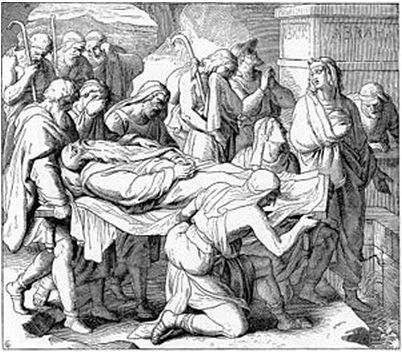
These are the days of the years of Abraham’s life, 175 years. Abraham breathed his last and died in a good old age, an old man and full of years, and was gathered to his people. Isaac and Ishmael his sons buried him in the cave of Machpelah, in the field of Ephron the son of Zohar the Hittite, east of Mamre, 10 the field that Abraham purchased from the Hittites. There Abraham was buried, with Sarah his wife. 11 After the death of Abraham, God blessed Isaac his son. And Isaac settled at Beer-lahai-roi.

12 These are the generations of Ishmael, Abraham’s son, whom Hagar the Egyptian, Sarah’s servant, bore to Abraham. 13 These are the names of the sons of Ishmael, named in the order of their birth: Nebaioth, the firstborn of Ishmael; and Kedar, Adbeel, Mibsam, 14 Mishma, Dumah, Massa, 15 Hadad, Tema, Jetur, Naphish, and Kedemah. 16 These are the sons of Ishmael and these are their names, by their villages and by their encampments, twelve princes according to their tribes. 17 (These are the years of the life of Ishmael: 137 years. He breathed his last and died, and was gathered to his people.) 18 They settled from Havilah to Shur, which is opposite Egypt in the direction of Assyria. He settled over against all his kinsmen. Genesis 25:1-18 ESV

The 25th chapter marks the midway point in the book of Genesis. And while the chapter designations came long after the book was written, the details recorded in this section of Moses’ chronicle serve as a turning point in the narrative. For the last 14 chapters, Abraham has served as the story’s central character. Since the moment God called him out of Haran and disclosed the terms of the covenant, Abraham has been the protagonist and the promised progenitor of God’s grand plan. It would be through Abraham that God would fulfill His covenant promise to establish a great nation. And yet, here at the midway point of the Genesis account, Abraham is old and quite wealthy, but he has only one son. It would be a gross understatement to say that Abraham’s quiver was full. And even that one son is 37-year-old, newly married, and currently childless. Where is this great nation that God had promised?

But 24 chapters remain, and God is far from done. It is as if God is turning a page in the storyline and beginning something new. Isaac has found and married his bride – with the help of God. Sarah has died and, as these verses reveal, Abraham is not long for this world. He has reached the ripe old age of 175 and yet, Moses describes him in terms that belie his elderly status. He may not be a spring chicken, but he is far from a doddering old man. When Sarah had died, Abraham had been 137 years old. And while he mourned the loss of his wife, he eventually married a woman named Keturah. Up to this point in the story, Abraham had fathered only two children, Ishmael and Isaac. But his marriage to Keturah would result in the births of six additional children.

This insight into Abraham’s procreative capabilities seems intended to underscore the unique nature of Isaac’s birth. Abraham had always been capable of fathering children. He had no trouble in impregnating his wife’s handmaiden, Hagar. And even as he neared the latter days of his life, he proved to be fully capable of producing descendants. But the text makes it clear that children were not to be heirs of the promise. After providing the identities of Abraham’s latest offspring, Moses states:

All these were the children of Keturah. Abraham gave all he had to Isaac. – Genesis 25:5 ESV

These children were not destined to be part of the “great nation” that God had promised to produce from Abraham and Sarah. God had even told Abraham that Ishmael, the son born to him by Hagar, was not to be an heir of the covenant.

“As for Ishmael, I have heard you; behold, I have blessed him and will make him fruitful and multiply him greatly. He shall father twelve princes, and I will make him into a great nation. But I will establish my covenant with Isaac, whom Sarah shall bear to you at this time next year.” – Genesis 17:20-21 ESV

It is important to remember that Sarah always resented the presence of Ishmael. Even though his very existence had been the result of her bright idea to have Hagar bear a son for Abraham, Sarah despised this son of a slave woman (Galatians 4:22-23). And the day had come, after the birth of Isaac, that she demanded that Ishmael be disinherited.

“Cast out this slave woman with her son, for the son of this slave woman shall not be heir with my son Isaac.” – Genesis 21:10 ESV

While Abraham found his wife’s anger to be unjust and disturbing, God encouraged him to give in to her demands.

“Be not displeased because of the boy and because of your slave woman. Whatever Sarah says to you, do as she tells you, for through Isaac shall your offspring be named. And I will make a nation of the son of the slave woman also, because he is your offspring.” – Genesis 21:12-13 ESV

And, just like always, God kept His word. Moses records that Abraham sent away each of the sons born to his concubine, Keturah. He provided them with gifts, but they would not share in the inheritance of Isaac. They suffered the same fate as that of Ishmael. They were cast out but they were far from forgotten by God. Notice how Moses records the children born to Ishmael. Why would he bother to add that seemingly unimportant detail?

These are the generations of Ishmael, Abraham’s son, whom Hagar the Egyptian, Sarah’s servant, bore to Abraham. These are the names of the sons of Ishmael, named in the order of their birth: Nebaioth, the firstborn of Ishmael; and Kedar, Adbeel, Mibsam, Mishma, Dumah, Massa, Hadad, Tema, Jetur, Naphish, and Kedemah. – Genesis 25:12-15 ESV

These names mean nothing to us. And yet, their very mention is designed to prove the integrity of God’s word. Remember what God had said to Sarah: “As for Ishmael, I have heard you; behold, I have blessed him and will make him fruitful and multiply him greatly. He shall father twelve princes, and I will make him into a great nation” (Genesis 17:20 ESV).

Now, look closely at the list of obscure and difficult-to-pronounce names recorded in verses 12-15 of Genesis 25. There were twelves sons born to Ishmael. In spite of Sarah’s ill-treatment of this young man, God had chosen to keep His word and bless him. He would make of Ishmael a great nation. The whole point seems to be that Abraham had always been fully capable of procreating and producing a long line of descendants. Ishmael had been prolific and produced 12 sons. In the same way, the six sons born to Keturah would go on to produce many offspring. But only the descendants of Isaac would become the nation through whom the other nations of the earth would be blessed. Only the line of Isaac would produce a chosen people, set apart by God, and destined to become the conduit through which He would pour out His divine blessing on humanity.

God fulfilled His promise and made Ishmael the father of “12 princes.” It is interesting to note the correlation between these 12 “tribes” and the 12 tribes that would eventually come through the line of Isaac. Moses indicates that Ishmael’s descendants “settled from Havilah to Shur, which is opposite Egypt in the direction of Assyria. He settled over against all his kinsmen” (Genesis 25:18 ESV). The Ishmaelites eventually settled in the region of Arabia, southeast of Canaan, and would have a less-than-ideal relationship with their distant relatives, the Israelites. But God had kept His word. He had faithfully fulfilled His promise.

And with the fate of Ishmael’s descendants established, Moses records that, at the age of 175, “Abraham breathed his last and died in a good old age, an old man and full of years, and was gathered to his people” (Genesis 25:8 ESV). The life of Abraham came to an end. But the fulfillment of God’s promises had only just begun. The story is far from over. And verse 19 will begin a new chapter in God’s grand redemptive plan as Moses records the births of Esau and Jacob. But this story will contain many familiar features and themes. Yet another woman will find herself cursed by barrenness. There will be seemingly irreconcilable conflicts between siblings. Glaring examples of jealousy, anger, deceit, and disobedience will fill the storyline. But through it all, God will be operating behind the scenes, orchestrating His sovereign plan to fulfill the covenant he made with Abraham. Yahweh is fully committed to His promise to bless the nations. 

English Standard Version (ESV) The Holy Bible, English Standard Version. ESV® Permanent Text Edition® (2016). Copyright © 2001 by Crossway Bibles, a publishing ministry of Good News Publishers.

New Living Translation (NLT) Holy Bible, New Living Translation, copyright © 1996, 2004, 2015 by Tyndale House Foundation. Used by permission of Tyndale House Publishers Inc., Carol Stream, Illinois 60188. All rights reserved.

New English Translation (NET)NET Bible® copyright ©1996-2017 by Biblical Studies Press, L.L.C. http://netbible.com All rights reserved.

The Danger of Misplaced Hope

1 After these things God tested Abraham and said to him, “Abraham!” And he said, “Here I am.” He said, “Take your son, your only son Isaac, whom you love, and go to the land of Moriah, and offer him there as a burnt offering on one of the mountains of which I shall tell you.” So Abraham rose early in the morning, saddled his donkey, and took two of his young men with him, and his son Isaac. And he cut the wood for the burnt offering and arose and went to the place of which God had told him. Genesis 22:1-3 ESV

Due to over-familiarity and poor hermeneutics, this well-known biblical story has lost a lot of its impact on many Christians. It has been turned into nothing more than a simplistic tale of one man’s struggle with maintaining his faith in God against all odds. There is a tendency to make the story prescriptive rather than descriptive. In other words, we want to find some aspect of Abraham’s difficult encounter with God and use it as a model for our own faith journey. But this story was not intended to provide us with a do-as-Abraham-did moralistic lesson that we can simply emulate and expect similar results.

Yes, this chapter recounts the story of Abraham’s faith being put to the test, but because we know how the story ends, we fail to recognize and appreciate the gravity of the situation he faced. One must always keep in mind that the original audience for whom Moses recorded this story would have been familiar with its outcome. They were the descendants of Abraham, Isaac, and Jacob, and so they would have known that this story has a happy ending. But they would have found the details surrounding Abraham’s encounter with God to be both shocking and sobering.

As the descendants of Abraham, they had inherited the God of Abraham, and this story was meant to focus their attention on Him. Their God was great and fully expected His chosen people to live in obedience to His commands. But chapter 22 of Genesis is less about the faith-filled exploits of Abraham than it is about the faithfulness of God. As we do with so many of the stories found in the Scriptures, we tend to make this one about us. Because we’re human, we seek out the moral lessons, both good and bad, that we can learn from the human characters found in the stories the Bible contains. We teach our children to “dare to be a Daniel,” using his faithfulness in the face of difficult circumstances as a model for our own godliness. We read about Joseph and assume that if we emulate his can-do attitude in the midst of trials, we will enjoy similar blessings from God. And while there certainly are valuable lessons to be learned from the lives of the characters found in the Scriptures, the real hero of each of the stories is God.

Moses opens chapter 22 with the simple statement: “After these things.” This likely refers to all the events found in the preceding chapters, including the birth and weaning of Isaac, the disinheriting and casting out of Ishmael, and the purchase of the well by Abraham. But, in a sense, it points all the way back to God’s original call of Abraham found in chapter 12. In the ten chapters that follow, Moses has recorded the unique and constantly evolving relationship between Yahweh and this man from Ur of the Chaldees. The one consistent factor in this decades-long relationship is God’s unwavering commitment to bless Abraham.

“Go from your country and your kindred and your father’s house to the land that I will show you. And I will make of you a great nation, and I will bless you and make your name great, so that you will be a blessing. I will bless those who bless you, and him who dishonors you I will curse, and in you all the families of the earth shall be blessed.” – Genesis 12:1-3 ESV

“Look toward heaven, and number the stars, if you are able to number them.” Then he said to him, “So shall your offspring be.” – Genesis 15:5 ESV

“Behold, my covenant is with you, and you shall be the father of a multitude of nations. – Genesis 17:4 ESV

For more than 25 years, Abraham waited to see these promises fulfilled. But as the years passed, he grew older and his wife’s barrenness remained an insurmountable obstacle. Yet, Moses records that Abraham “believed the Lord, and he [God} counted it to him as righteousness” (Genesis 15:6 ESV). Abraham truly believed that God would do what He had promised to do, even though he had doubts concerning how and when. At one time, he had considered Lot to be a viable means by which God would fulfill the promise. But God had eliminated that possibility. Then, Abraham had shifted his hope to Ishmael, the son born to him through Hagar, his wife’s Egyptian handmaid. But God had removed Ishmael as an option.

And then, when Abraham was 100 and his wife was 90, God had miraculously opened Sarah’s womb and she conceived and gave birth to a son. And this highly improbable and physically impossible blessing occurred just as God had promised.

I will bless her, and moreover, I will give you a son by her. I will bless her, and she shall become nations; kings of peoples shall come from her.” – Genesis 17:16 ESV

Sarah your wife shall bear you a son, and you shall call his name Isaac. I will establish my covenant with him as an everlasting covenant for his offspring after him. – Genesis 17:19 ESV

And God kept His word.

The Lord visited Sarah as he had said, and the Lord did to Sarah as he had promised. And Sarah conceived and bore Abraham a son in his old age at the time of which God had spoken to him. Abraham called the name of his son who was born to him, whom Sarah bore him, Isaac. – Genesis 21:1-3 ESV

What a happy ending. After all the years of waiting and hoping, Abraham and Sarah finally had that for which they had so anxiously and eagerly longed: A son. Their dream had come true. And it’s not difficult to spot the high value they placed in this miracle baby. Sarah’s pregnancy and delivery had left her filled with joy over the dramatic shift in her fortunes.

“God has brought me laughter. All who hear about this will laugh with me. Who would have said to Abraham that Sarah would nurse a baby? Yet I have given Abraham a son in his old age!” – Genesis 21:6-7 NLT

On the day that Isaac was weaned, Abraham had celebrated the occasion with a feast. He was beside himself with pride and wanted everyone to join him in honoring his son and future heir.

But Sarah, driven by her maternal instincts and her strong dislike for Abraham’s other son, ordered the immediate expulsion of Ishmael and his mother.

“Get rid of that slave woman and her son. He is not going to share the inheritance with my son, Isaac. I won’t have it!” – Genesis 21:10 NLT

She was taking no risks. In her mind, Isaac was the only legitimate heir to the family inheritance, and, with Ishmael out of the way, all competition had been effectively eliminated.

But to understand what is happening here, one has to return to the command that God had issued to Abraham in his 90th year.

“I am God Almighty; walk before me, and be blameless, that I may make my covenant between me and you, and may multiply you greatly.” – Genesis 17:1-2 ESV

God was calling Abraham to a life of integrity or moral wholeness. Every area of his life was to be dedicated to God and he was to live with the constant awareness that God was always watching. In other words, God was to be the sole focus of his life. And what is interesting to note is that, shortly after issuing this command, God declared, “I have made you the father of a multitude of nations” (Genesis 17:5 ESV). The Hebrew word is what is known as a Qal Perfect verb, which generally designates a completed action. In other words, it expresses an event in the past tense. It has already taken place. Long before Isaac was born, God declared that He had already made Abraham the father of a multitude of nations. It was a future event that was as good as fulfilled because it was guaranteed by God.

So, what’s the point? In demanding that Abraham conduct his life with moral integrity and a constant awareness of His presence, God was issuing a call to total dependence and reliance upon Him. God didn’t need Isaac to exist to prove His faithfulness. The assurance that God’s will would be done was not to be found in Isaac. This young boy was not to be mistaken as the promise. He was simply a conduit through whom God would fulfill His covenant commitment to make from Abraham a great nation. But even that aspect of the promise was not dependent upon Isaac. God had already made it clear that Abraham’s other son, Ishmael, would produce a multitude of offspring. He had told Hagar, I will surely multiply your offspring so that they cannot be numbered for multitude” (Genesis 16:10 ESV). And God had reiterated that promise to Abraham.

“As for Ishmael, I have heard you; behold, I have blessed him and will make him fruitful and multiply him greatly. He shall father twelve princes, and I will make him into a great nation.” – Genesis 17:20 ESV

There was more to God’s promise than the guarantee of many descendants. He could and would fulfill that aspect of the promise through Ishmael. No, God had something far greater in mind and it all goes back to the original call of Abraham.

“I will make of you a great nation, and I will bless you and make your name great, so that you will be a blessing. I will bless those who bless you, and him who dishonors you I will curse, and in you all the families of the earth shall be blessed.” – Genesis 12:2-3 ESV

God was going to do something great and it would be accomplished through Abraham and his offspring. And the apostle Paul provides a Spirit-inspired insight into this future fulfillment of God’s promise.

Now the promises were made to Abraham and to his offspring. It does not say, “And to offsprings,” referring to many, but referring to one, “And to your offspring,” who is Christ. – Galatians 3:16 ESV

God did not need Abraham to father a lot of descendants in order that He might bless the nations. There was only one offspring necessary for God to fulfill His covenant commitment. But because the arrival of that one offspring was scheduled for centuries later, there would be many other descendants of Abraham born along the way, including Isaac, Jacob, Joseph, and David. Isaac was not the fulfillment of the promise. And yet, Abraham and Sarah had managed to make Isaac the focal point of their lives. With his birth, Isaac had become the center of their universe and the focus of their future hopes. So, God decided to test Abraham’s allegiance and realign his priorities. And He did so in a jaw-dropping, faith-shaking manner.

“Take your son, your only son Isaac, whom you love, and go to the land of Moriah, and offer him there as a burnt offering on one of the mountains of which I shall tell you.” – Genesis 22:2 ESV

Don’t miss the gravity of this moment. God was commanding Abraham to sacrifice his hope, to put to death the one in whom all his dreams and ambitions for the future were based. Or so he thought. Would Abraham be willing to walk before God and be blameless? Would he trust the God who made the promise or place his hope in the son who seemed to be the key to the promise being fulfilled? Was God dependent upon Isaac? Would Abraham allow this young boy to become an indispensable necessity for God’s future blessings? Or would he put His hope and trust in God?

English Standard Version (ESV) The Holy Bible, English Standard Version. ESV® Permanent Text Edition® (2016). Copyright © 2001 by Crossway Bibles, a publishing ministry of Good News Publishers.

New Living Translation (NLT) Holy Bible, New Living Translation, copyright © 1996, 2004, 2015 by Tyndale House Foundation. Used by permission of Tyndale House Publishers Inc., Carol Stream, Illinois 60188. All rights reserved.

New English Translation (NET)NET Bible® copyright ©1996-2017 by Biblical Studies Press, L.L.C. http://netbible.com All rights reserved.

When Men (and Women) Play God

11 And the angel of the Lord said to her,

“Behold, you are pregnant
    and shall bear a son.
You shall call his name Ishmael,
    because the Lord has listened to your affliction.
12 He shall be a wild donkey of a man,
    his hand against everyone
    and everyone’s hand against him,
and he shall dwell over against all his kinsmen.”

13 So she called the name of the Lord who spoke to her, “You are a God of seeing,” for she said, “Truly here I have seen him who looks after me.” 14 Therefore the well was called Beer-lahai-roi; it lies between Kadesh and Bered.

15 And Hagar bore Abram a son, and Abram called the name of his son, whom Hagar bore, Ishmael. 16 Abram was eighty-six years old when Hagar bore Ishmael to Abram. Genesis 16:11-16 ESV

A  pregnant and homeless Hagar found herself in the middle of the wilderness having an unexpected conversation with the angel of the Lord. And much to her surprise, this divine messenger has just commanded Hagar to return home and submit herself to the Sarai, the very woman who had cast her out like unwanted trash. This disheartened and fearful woman must have reeled at the thought of risking further alienation and possible retribution from an angry and vengeful Sarai. But the angel of God provided a doubtful Hagar with a shocking revelation that was meant to elicit faith and produce obedience.

“I will surely multiply your offspring so that they cannot be numbered for multitude.” – Genesis 16:10 ESV

God was assuring Hagar that the child she carried in her womb would not only live, but he would produce an abundance of offspring. This female Egyptian slave had been made the unwitting participant in Sarai’s clever scheme to fulfill God’s promise through human means. When Sarai’s barrenness continued to stifle any hope of her bearing a son for her husband, Abram, she had turned to Hagar as a possible and practical solution. It had been her idea to have Abram impregnate her personal handmaid. And when her plan worked, and Hagar became pregnant with Abram’s child, Sarai regretted her decision and ordered the threat removed.

But, as always, God had bigger plans in store for Hagar and, more importantly,  for the baby she carried in her womb. In the middle of the inhospitable wilderness, the forlorn and forgotten Hagar was given new hope.

“You are now pregnant and will give birth to a son. You are to name him Ishmael (which means ‘God hears’), for the Lord has heard your cry of distress. – Genesis 16:11 NLT

This announcement was meant to assure Hagar that her child would live. And God would not only give her a son, but He would give that boy a name: Ishmael. This name is actually a compound word in Hebrew (yišmāʿē’l). It stems from the word for “hear” and the word for “God.” So, the boy’s God-given name would mean “God hears.” His name would reflect the reality that Yahweh had heard Hagar’s desperate cries for help and had determined to answer them. One can only imagine the fear-driven pleas of this abandoned woman as she pondered her own fate and that of her child. Was she destined to die in the wilderness, pregnant and alone? Would she live long enough to witness the birth of her child, but then be forced to watch its life slip away due to hunger and exposure to the elements? Was this some kind of divine punishment for her role in the whole affair surrogate birth mother affair?

What is interesting to consider is that, due to her identity as an Egyptian, it is highly likely that Hagar was not a follower of Yahweh. Her ten-year exposure to Abram and his family may have resulted in her conversion, but it is just as likely that she remained a worshiper of one of the many gods of Egypt. And her cries in the wilderness could have been directed at one of these false deities.

But who heard her? And who responded to her pleas for help? It was Yahweh, the very same God who had called her former master out of Haran. It had been this God’s messenger who had shown up in the wilderness and delivered the good news about her son and his future descendants. But not everything about the angel’s message would have sounded positive to Hagar. He also delivered what must have come across to her as bad news.

“This son of yours will be a wild man, as untamed as a wild donkey! He will raise his fist against everyone, and everyone will be against him. Yes, he will live in open hostility against all his relatives.” – Genesis 16:12 NLT

At first glance, this pronouncement comes across as anything but good news. But to a woman who had been faced with the possible death of her unborn son, this news was hopeful. He would grow up to be a man who lived independently. He would be powerful and resourceful. And, while he would end up alienated from his own relatives, he would father a sizeable nation of his own that would have a lasting impact on the world.

In time, the descendants of Ishmael would end up as the mortal enemies of their blood relatives, the Israelites. Islamic lore teaches that Ishmael would become the patriarch of the Muslim people. But the Bible simply states that Ishmael and his descendants would live in open hostility to the descendants of Abram through his son, Isaac. Ishmael and Isaac had the same father, but two different birth mothers. And their family trees would branch off in two distinctively different directions. But God was behind it all. In fact, Paul picks up on this story when writing to the believers living in the Roman-ruled province of Galatia. He would use the disparate relationship between these two half-brothers as an illustration of those who live as slaves to the law and those who enjoy the freedom brought about by God’s promise.

Tell me, you who want to live under the law, do you know what the law actually says? The Scriptures say that Abraham had two sons, one from his slave wife and one from his freeborn wife. The son of the slave wife was born in a human attempt to bring about the fulfillment of God’s promise. But the son of the freeborn wife was born as God’s own fulfillment of his promise. These two women serve as an illustration of God’s two covenants. – Galatians 4:21-24 NLT

Paul uses this Old Testament story to drive home a very important point to his Christian readers who are struggling with the difference between law and grace. He points out that Ishmael was born to a slave woman, while Isaac was born to Sarai, a free woman. The status of the two boys would dramatically impact their positions in the family of Abram. In fact, Moses makes clear that Ishmael would end up being alienated from and at odds with the other children of Abraham.

Secondly, Paul stresses the difference between their two births. Ishmael was the result of a purely human relationship. There was no miracle involved. Abram impregnated Hagar, she ended up pregnant, and eventually gave birth. There was nothing supernatural about it. But, in comparison, Sarai’s pregnancy was divinely ordained and ordered. She was old and barren, but God miraculously intervened and produced a child in fulfillment of His promise to Abram. Isaac was a son born to Sarai and not Hagar. That had been God’s plan all along. He is the God of the impossible, and He had never been in need of Sarai’s help or advice.

And Paul elaborates further on the distinction between these two women and their respective seed.

The first woman, Hagar, represents Mount Sinai where people received the law that enslaved them. And now Jerusalem is just like Mount Sinai in Arabia, because she and her children live in slavery to the law. But the other woman, Sarah, represents the heavenly Jerusalem. She is the free woman, and she is our mother. – Galatians 4:24-26 NLT

Paul is not suggesting that the story of Sarai and Hagar is mythical or purely metaphorical. But he does suggest that it contains an important allegorical lesson. These two women were very real, but their lives also served as power illustrations of a much deeper truth that would apply in the not-so-distant future. Much to the chagrin of any Jews in his readership, Paul uses the slave-born son of Hagar as an illustration of the Jewish people who refused to believe in Christ. They were stuck relying upon the law for their salvation. They considered themselves to be legitimate sons of Abram, but God viewed them differently. In Paul’s analogy, Isaac becomes a representative of those born under freedom from the law. This is a direct reference to Christians, those whom Jesus has set free from the burden of the law.

Hagar represents the Mosaic Covenant, with all its laws and legal requirements. But Sarai represents the New Covenant, made possible through the sacrifice of Jesus Christ on the cross. It is fascinating to consider that Jesus, the Savior of the world, also entered the world through the means of a miraculous, Spirit-enabled birth.

The promises of God will always be fulfilled by the divinely ordained means of God. Hagar had never been intended to be the mother of the offspring of Abram through whom God would bless all the nations. Human means never produce spiritual outcomes. And, while God would end up blessing Ishmael, and produce from him a great number of descendants. There would be no future Messiah or Savior born from his family tree. That was reserved for the son of the promise: Isaac.

In response to the message of the angel, Hagar declares that this God of Abram is a “God who sees.” He had seen her plight and responded to her plea. He had graciously given her a promise and a hope, and she believed. And the chapter ends on a somewhat anticlimactic note with the simple declaration:

So Hagar gave Abram a son, and Abram named him Ishmael. Abram was eighty-six years old when Ishmael was born. – Genesis 16:15-16 NLT

God was far from done because the promise had not yet been fulfilled. But it would be, according to His terms, and right on time with His preordained schedule.

English Standard Version (ESV) The Holy Bible, English Standard Version. ESV® Permanent Text Edition® (2016). Copyright © 2001 by Crossway Bibles, a publishing ministry of Good News Publishers.

New Living Translation (NLT) Holy Bible, New Living Translation, copyright © 1996, 2004, 2015 by Tyndale House Foundation. Used by permission of Tyndale House Publishers Inc., Carol Stream, Illinois 60188. All rights reserved.

New English Translation (NET)NET Bible® copyright ©1996-2017 by Biblical Studies Press, L.L.C. http://netbible.com All rights reserved.

The Promise Maker

1 After these things the word of the Lord came to Abram in a vision: “Fear not, Abram, I am your shield; your reward shall be very great.” But Abram said, “O Lord God, what will you give me, for I continue childless, and the heir of my house is Eliezer of Damascus?” And Abram said, “Behold, you have given me no offspring, and a member of my household will be my heir.” And behold, the word of the Lord came to him: “This man shall not be your heir; your very own son shall be your heir.” And he brought him outside and said, “Look toward heaven, and number the stars, if you are able to number them.” Then he said to him, “So shall your offspring be.” And he believed the Lord, and he counted it to him as righteousness. Genesis 15-1-6 ESV

Abram has just received a blessing from Melchizedek, priest of the Most High God.

Blessed be Abram by God Most High,
    Creator of heaven and earth. – Genesis 14:19 NLT

Sometime after his encounter with the king-priest Melchizedek, God provided his servant with a confirmation and explanation of that blessing in the form of a vision. The Most High God referred to Himself as Abram’s shield or protector. In the same way that Abram had protected and delivered his nephew Lot during his time of captivity, God would be Abram’s defender and deliverer. And while Abram had turned down the king of Sodom’s offer of all the plunder taken from Sodom, he could be certain that God would reward him with something of far greater value.

One of the questions this passage raises is why God opened up His address to Abram with the words, “Fear not.” What was it that Abram feared? Some believe that, upon receiving an unexpected vision of the Most High God, Abram was filled with fear and awe. This would have been a normal and natural reaction to such an encounter with God. When Moses was given a vision of God in the form of a burning bush, “he hid his face, for he was afraid to look at God” (Exodus 3:6 ESV).

But based on the context of chapter 14, it makes more sense to see Abram’s fear as horizontal in nature, rather than vertical. Due to his victory over the four Mesopotamian kings, Abram had just made himself some powerful enemies. Not only that, by displaying his military might, he had inadvertently placed a target on his back. Whether he liked it or not, he was the new sheriff in town and everyone would be gunning for him. Abram was essentially a shepherd and not a warrior, and the thought that his enemies might seek retribution on him and his household was keeping him up at night. So, God assured his fearful servant that he had nothing to worry about. Abram could rest in the knowledge that God would protect and provide for him. It is the same message that God would give to Abram’s descendants centuries later.

“Don’t be afraid, for I am with you. Don’t be discouraged, for I am your God. I will strengthen you and help you. I will hold you up with my victorious right hand.” – Isaiah 41:10 NLT

Abram’s response to God’s words of comfort and encouragement is less than confident.

“O Lord God, what will you give me, for I continue childless, and the heir of my house is Eliezer of Damascus?” – Genesis 15:2 NLT

With this statement, Abram reveals that his greatest fear was that of failure. He knew that God had promised to bless him. He couldn’t stop thinking about the words God had spoken when he was still living in Haran.

“I will make of you a great nation, and I will bless you and make your name great, so that you will be a blessing. I will bless those who bless you, and him who dishonors you I will curse, and in you all the families of the earth shall be blessed.” – Genesis 12:2-3 ESV

Abram had been 75-years-old when God made that promise. And now, years later, he had only grown older and his wife’s fertility problem had not improved. All the way back in Genesis 11:30, Moses had disclosed the sad state of Sarai’s reproductive health: “Now Sarai was barren; she had no child.”

All of these factors weighed heavily on Abram’s mind. Based on the circumstances, he could see no way that God’s promise could ever come to fruition. Abram had resigned himself to the fact that one of his household servants would end up as his heir. He informed God about the desperate nature of his situation and even blamed Him for it.

You have given me no descendants of my own, so one of my servants will be my heir.” – Genesis 15:3 NLT

It appears that Abram was growing impatient. During his time in the land of Canaan, he had seen his financial prospects improve. He had grown rich and his herds had grown in number. And here was God promising to shower him with further rewards. But what difference would it make if he had no one to whom he could leave his great wealth?

It’s not difficult to ascertain how Abram had assessed his situation and come up with a possible solution. He had given up on Sarai ever giving birth to a son, and had assumed that they would end up adopting one of their household servants as their son and making him the rightful heir to their estate. There had probably been a time when Abram had believed Lot, his nephew, would be the logical choice. But there had been a fallout between the two of them. So, at this point, Abram had determined that his heir would end up being Eliezer of Damascus.

What is ironic about Abram’s conclusion is that Eliezer’s name means “God is help.” Yet, it would appear that Abram was the one who was attempting to help God. He was offering God a logical solution to the whole fruitlessness problem. Abram was willing to settle for less. He was willing to accept a foreign-born “member” of his house as his heir rather than wait on God to do the impossible. But God had other plans. He was not going to compromise. And Sarai’s barrenness was not going to be a problem. So, God gently but firmly broke the news to Abram.

“No, your servant will not be your heir, for you will have a son of your own who will be your heir.” – Genesis 15:4 NLT

In essence, God said, “Thanks for the tip, but no!” The Creator-God didn’t need Abram’s help or advice. If anything, Eliezer’s presence in Abram’s house was meant to be a constant reminder that “God is help.” Eliezer wasn’t intended to be the solution. No, every time Abram said Eliezer’s name, it should have reminded him that God was the solution. And to stress the miraculous nature of His promise, God took Abram outside and told him to “look up into the sky and count the stars if you can” (Genesis 15:5 NLT). Then, as Abram stood staring up into the night sky, overwhelmed by the sheer number of stars, God boldly proclaimed, “That’s how many descendants you will have!” (Genesis 15:5 NLT).

This was not the first time Abram had heard such an outlandish prediction from God. Earlier, when Abram had separated from Lot, God had assured him that all the land of Canaan would be his and that land would be filled with his descendants.

I will give you so many descendants that, like the dust of the earth, they cannot be counted! – Genesis 13:16 NLT

This blessing would not come through Eliezer or any other substitute. God had promised to give Abram a son, and He was well aware of Sarai’s barrenness. In fact, as the sovereign God of the universe, her barrenness had been part of His plan all along. The improbability and impossibility of it all had been baked into the cake. God wanted Abram to understand that everything about this promise would be miraculous and supernatural.

And then Moses adds a somewhat surprising conclusion. Despite all of Abram’s former doubts and fears, he “believed the Lord, and the Lord counted him as righteous because of his faith” (Genesis 15:6 NLT). Suddenly, Abram’s mental state went from doubt to assurance. He went from trying to help God out to having hope in God’s promise. His confidence in God grew deeper and richer.

It’s interesting to note that Abram had always believed that God would give him an heir. His doubts had been focused on the means by which God would fulfill that promise. He had been hung up on Sarai’s barrenness. That’s why he had come up with what he believed to be an acceptable and logical alternative solution. But now, his belief focused in on the power of God to accomplish the impossible. He went from believing in the promise to believing in the God who made the promise. And there is a huge difference.

In the great “Hall of Faith” found in chapter 11 of the book of Hebrews, the author states, “without faith it is impossible to please him, for whoever would draw near to God must believe that he exists and that he rewards those who seek him” (Hebrews 11:6 ESV). Abram was learning that his faith in God was the key to the promise of God. That does not mean that faith is what determines our reward, but that faith or belief in God is the means by which we appropriate the promises of God. We have to believe, trust in, and place our confidence in the God behind the promise.

The author of Hebrews goes on to explain how Abram displayed faith in God. And he describes how Abram’s faith developed and deepened over time until it influenced even his wife, Sarai.

By faith Abraham obeyed when he was called to go out to a place that he was to receive as an inheritance. And he went out, not knowing where he was going. By faith he went to live in the land of promise, as in a foreign land, living in tents with Isaac and Jacob, heirs with him of the same promise. For he was looking forward to the city that has foundations, whose designer and builder is God. By faith Sarah herself received power to conceive, even when she was past the age, since she considered him faithful who had promised. Therefore from one man, and him as good as dead, were born descendants as many as the stars of heaven and as many as the innumerable grains of sand by the seashore. – Hebrews 11:8-12 ESV

Moses declares that God counted or credited Abram’s faith as righteousness. Abram was justified or made right with God because he chose to believe and trust, not only in the promises of God but in the God behind the promises. Abram had transferred his hope in the promise to the divine promise maker. And the author of Hebrews goes on to point out that faith in the God of the promise is what sets His people apart. Whether a child of God ever sees the promise fulfilled in their lifetime, they will continue to trust in the word and reliability of the promise maker.

All these people earned a good reputation because of their faith, yet none of them received all that God had promised. – Hebrews 11:39 NLT

Abram would eventually see a son born to his barren wife. But he would never own any land in Canaan. He would never live to see the day when his descendants, as numerous as the stars in the sky, would occupy that land. But he would continue to believe that His God was good and could be trusted to do what He promised, whether Abram lived to see it or not. That is the essence of faith.

Now faith is the assurance of things hoped for, the conviction of things not seen. – Hebrews 11:1 ESV

English Standard Version (ESV) The Holy Bible, English Standard Version. ESV® Permanent Text Edition® (2016). Copyright © 2001 by Crossway Bibles, a publishing ministry of Good News Publishers.

New Living Translation (NLT) Holy Bible, New Living Translation, copyright © 1996, 2004, 2015 by Tyndale House Foundation. Used by permission of Tyndale House Publishers Inc., Carol Stream, Illinois 60188. All rights reserved.

New English Translation (NET)NET Bible® copyright ©1996-2017 by Biblical Studies Press, L.L.C. http://netbible.com All rights reserved.

The Fine Line From Cursing to Blessing

10 These are the generations of Shem. When Shem was 100 years old, he fathered Arpachshad two years after the flood. 11 And Shem lived after he fathered Arpachshad 500 years and had other sons and daughters.

12 When Arpachshad had lived 35 years, he fathered Shelah. 13 And Arpachshad lived after he fathered Shelah 403 years and had other sons and daughters.

14 When Shelah had lived 30 years, he fathered Eber. 15 And Shelah lived after he fathered Eber 403 years and had other sons and daughters.

16 When Eber had lived 34 years, he fathered Peleg. 17 And Eber lived after he fathered Peleg 430 years and had other sons and daughters.

18 When Peleg had lived 30 years, he fathered Reu. 19 And Peleg lived after he fathered Reu 209 years and had other sons and daughters.

20 When Reu had lived 32 years, he fathered Serug. 21 And Reu lived after he fathered Serug 207 years and had other sons and daughters.

22 When Serug had lived 30 years, he fathered Nahor. 23 And Serug lived after he fathered Nahor 200 years and had other sons and daughters.

24 When Nahor had lived 29 years, he fathered Terah. 25 And Nahor lived after he fathered Terah 119 years and had other sons and daughters.

26 When Terah had lived 70 years, he fathered Abram, Nahor, and Haran.

27 Now these are the generations of Terah. Terah fathered Abram, Nahor, and Haran; and Haran fathered Lot. 28 Haran died in the presence of his father Terah in the land of his kindred, in Ur of the Chaldeans. 29 And Abram and Nahor took wives. The name of Abram’s wife was Sarai, and the name of Nahor’s wife, Milcah, the daughter of Haran the father of Milcah and Iscah. 30 Now Sarai was barren; she had no child.

31 Terah took Abram his son and Lot the son of Haran, his grandson, and Sarai his daughter-in-law, his son Abram’s wife, and they went forth together from Ur of the Chaldeans to go into the land of Canaan, but when they came to Haran, they settled there. 32 The days of Terah were 205 years, and Terah died in Haran. Genesis 11:10-32 ESV

With the opening verses of chapter 11, Moses provides an explanation of an earlier comment he made regarding Peleg, a descendant of Shem.

To Eber were born two sons: the name of the one was Peleg, for in his days the earth was divided – Genesis 10:25 ESV

Bookending the story of the tower of Babel are two genealogical lists. In chapter 10, beginning in verse 11, Moses provides an abbreviated version of Shem’s lineage, because it provides no branch for Peleg, the son of Eber. In reference to Peleg simply states: “in his days the earth was divided” (Genesis 10:25 ESV). The story of Babel is what follows. When humanity decided to settle down in the land of Shinar, build a city, and erect a tower as a monument to their own glory, God took action. They shared a common ancestry and enjoyed the benefits of a common language. This unified connection gave them a sense of invincibility and fueled their desire for autonomy. That is why God said, “Behold, they are one people, and they have all one language, and this is only the beginning of what they will do. And nothing that they propose to do will now be impossible for them” (Genesis 11:6 ESV). 

Rather than obeying God’s mandate to fill the earth, they had determined to remain in one place and construct a city that would reflect their own greatness. Rather than honor God, they chose to glorify themselves. So, God stepped in and “confused” their language. He miraculously divided their number by creating a barrier to further communication. Suddenly, they found themselves unable to understand one another. This God-enforced diversity resulted in their dispersal across the face of all the earth.

And it is at this point, that Moses picks back up the genealogical record of Shem’s descendants. With the story of Babel explained, Moses is able to reveal what happened to Peleg after “the earth was divided” (Genesis 10:25 ESV).

Back in chapter five, Moses recorded another genealogical record that began with Adam and ended with Noah and his three sons. This list contains the names of all those who descended from Adam and Eve and vividly portrays the life-altering consequences of the first couple’s sin and the divine curse it incurred.

First of all, it states that Adam “fathered a son in his own likeness, after his image” (Genesis 5:3 ESV). This statement stands in stark contrast to the creation account where God had said, “Let us make man in our image, after our likeness” (Genesis1:26 ESV). Because of the entrance of sin into the perfect environment of Eden, mankind was permanently damaged. Adam and Eve would pass on to their descendants their proclivity for sin and the divine decree of death as its punishment. The original man and woman were to be God’s image-bearers. But like a marred mirror, this first couple and all their progeny would be incapable of perfectly reflecting the glory of God – all because of sin. Their children would be born in their image and bear their likeness. 

And the list found in chapter five contains another sober reminder of the consequences of the fall. With each successive generation, Moses repeatedly and intentionally states “he fathered” and “he died.” While the creation story in chapter one emphasizes the glory and wonder of new life, the genealogical list in chapter five provides the new post-fall reality of death.

But Moses leaves out that dark and depressing aspect of mankind’s fate in the genealogy of Shem recorded in chapter 11. While the age of each father is listed, there is no mention of death. This distinction is subtle, yet significant. Moses is attempting to paint a more hopeful future for humanity. Even after the debacle of Babel, when “the earth was divided” by God (Genesis 10:25) because of the pride and arrogance of man, this second genealogy of Shem is intended to reveal a new line of humanity that will result in another new beginning.

The first part of this list is much like the one found in chapter 10. But this time, Moses traces the branch of Eber’s family tree through his son, Peleg. According to the list, Eber had other sons and daughters. In other words, there were other branches to his family tree that could have been traced, but Moses concentrated all his attention on Peleg and the line of descent that flowed through his son, Reu. Moses is very specific and has an end in mind. His methodical record of Peleg’s lineage has actually been reverse-engineered and intended to trace the ancestral pedigree of a particular offspring of Adam. Notice where the genealogy ends.

When Terah had lived 70 years, he fathered Abram, Nahor, and Haran. – Genesis 11:26 ESV

After listing generations of descendants from Shem, the list suddenly stops. Moses has reached his desired destination. And the name of Abram would have caught the attention of Moses’ Hebrew audience. After all, he was their revered patriarch, the father of the Hebrew nation. This entire exercise in genealogical authentication was meant to validate Abram as a descendant of Noah and an offspring of Adam. And one of the reasons this is so important is because of the curse God had leveled against the serpent for his role in the fall of man.

And I will cause hostility between you and the woman,
    and between your offspring and her offspring.
He will strike your head,
    and you will strike his heel.” – Genesis 3:15 NLT

Of all the genealogical lists contained in Genesis, this one is intended to provide a sense of hope and anticipation. The world is broken and marred. And with the birth of each new generation, mankind is slowly moving further away from God. And yet, here in chapter 11, an offspring of Eve is born who will play a significant role in fulfilling the divine curse that God had leveled on the enemy. Satan would pay dearly for his attempt to dethrone God by deceiving and damaging His image-bearers. Despite the subsequent generations that flowed from the first couple and the track record of wickedness that plagued them, God had a plan for restoring them. He had a preconceived strategy for redeeming fallen humanity even before He had breathed life into the first man.

This chapter is intended to be a turning point in what has been a somewhat bleak story. Moses is preparing to reveal the next chapter in his history of mankind by introducing a new character who will play a vital role in God’s redemptive plan. Up to this point in the Genesis account, there have been two primary protagonists: Adam and Noah. One represents humanity in its pre-fall and post-fall states. The other spans the pre-flood and post-flood periods of mankind’s existence. But now, Moses introduces a third character whose life will greatly influence the unfolding story of God’s redemptive plan.

What should stand out in all of this is God’s sovereignty. He is operating behind the scenes, orchestrating and overseeing every aspect of His creation. Nothing escapes His notice or happens outside of His sovereign and providential will. The birth of Abram was not a case of blind luck, fate, or cosmic karma. It was the preordained will of God Almighty. God had predetermined the birth of Abram because He had always planned to use this one man as a conduit through whom He would one day pour out His blessings on humanity. As will become evident as the story unfolds, God had grand plans for this seemingly insignificant descendant of Adam. The One who ordained Abram’s birth would one day divulge Abram’s calling.

“Go from your country and your kindred and your father’s house to the land that I will show you. And I will make of you a great nation, and I will bless you and make your name great, so that you will be a blessing. I will bless those who bless you, and him who dishonors you I will curse, and in you all the families of the earth shall be blessed.” – Genesis 12:1-3 ESV

That last line speaks volumes. God was going to use a solitary offspring of Eve to reverse the curse and pour out His blessings on all the families of the earth. This one man, Abram, would prove to be the divinely ordained conduit thought whom God would bring hope to a sin-damaged world and the gift of life to all those living under the curse of death.

And Moses ends chapter 11 with Abram moving from his home in Ur to the distant land of Haran. Moses describes Abram’s slow but steady migration east, bringing him ever closer to the land of Canaan. And Moses intended this far-from-subtle insight into Abram’s former home and ultimate destination to remind his Jewish readers of their roots. They hailed from the land of Shinar, the infamous site of Babel and the future home of Babylon. Their patriarch was a Chaldean and not a Jew. And their distinct Hebraic language had been the result of God’s judgment against the rebellious people of Babel. Their heritage was marred. Their patriarch was far from pristine. But their God had a plan that would put all these pieces together to form a perfect plan so that He might bless the nations of the earth.

English Standard Version (ESV) The Holy Bible, English Standard Version. ESV® Permanent Text Edition® (2016). Copyright © 2001 by Crossway Bibles, a publishing ministry of Good News Publishers.

New Living Translation (NLT) Holy Bible, New Living Translation, copyright © 1996, 2004, 2015 by Tyndale House Foundation. Used by permission of Tyndale House Publishers Inc., Carol Stream, Illinois 60188. All rights reserved.

New English Translation (NET)NET Bible® copyright ©1996-2017 by Biblical Studies Press, L.L.C. http://netbible.com All rights reserved.

The Hidden Hope of Salvation

21 To Shem also, the father of all the children of Eber, the elder brother of Japheth, children were born. 22 The sons of Shem: Elam, Asshur, Arpachshad, Lud, and Aram. 23 The sons of Aram: Uz, Hul, Gether, and Mash. 24 Arpachshad fathered Shelah; and Shelah fathered Eber. 25 To Eber were born two sons: the name of the one was Peleg, for in his days the earth was divided, and his brother’s name was Joktan. 26 Joktan fathered Almodad, Sheleph, Hazarmaveth, Jerah, 27 Hadoram, Uzal, Diklah, 28 Obal, Abimael, Sheba, 29 Ophir, Havilah, and Jobab; all these were the sons of Joktan. 30 The territory in which they lived extended from Mesha in the direction of Sephar to the hill country of the east. 31 These are the sons of Shem, by their clans, their languages, their lands, and their nations.

32 These are the clans of the sons of Noah, according to their genealogies, in their nations, and from these the nations spread abroad on the earth after the flood.  Genesis 10:21-32 ESV

Compared to his younger brother’s genealogy, Shem’s lineage is far more pedestrian in nature. It contains no names that might raise eyebrows or elicit a sense of shock. And yet, within this list of obscure and difficult to pronounce names Moses provided a subtle, yet powerful, reminder of God’s sovereign authority over the affairs of mankind.

For most modern readers, this list of names seems rather superfluous. The individuals listed are unknown to us and, therefore, carry little weight. Yet, for the Jewish audience to whom Moses penned the book of Genesis, these names would have had a great deal of significance. At the mention of Arpachshad, Shelah, Eber, and Peleg, Moses would have had his reader’s undistracted attention, because these men were part of the family tree of Abraham, the father of the Hebrew nation. In fact, Moses will provide a more detailed and complete genealogy of Abraham in the very next chapter. He will go on to trace the lineage of Shem through the line of Peleg, all the way to the man who would become the patriarch of the Jewish people.

But in chapter nine, Moses chose to ignore the line of Peleg and traced the lineage of his brother, Joktan instead. Moses provides a rather strange aside when describing these two brothers.

To Eber were born two sons: the name of the one was Peleg, for in his days the earth was divided, and his brother’s name was Joktan. – Genesis 10:25 ESV

There has been much debate regarding the meaning of the phrase, “the earth was divided.” The Hebrew word is פָּלַג (pālaḡ), and it means “to split, cleave, or divide.” Based on the context of chapter 11, the most logical explanation is that Moses is referring to God’s dividing of the nations by the creation of languages. It seems that the events recorded in Genesis 11:1-9 occurred during the lifetime of Peleg. It was in Peleg’s lifetime that God decided to “divide or split” the earth by confusing the languages of the people. And Moses provides a detailed description of God’s momentous decision.

“Behold, they are one people, and they have all one language, and this is only the beginning of what they will do. And nothing that they propose to do will now be impossible for them. Come, let us go down and there confuse their language, so that they may not understand one another’s speech.” – Genesis 11:6-7 ESV

And Moses goes on to describe how God “dispersed them from there over the face of all the earth” (Genesis 11:8 ESV). God literally “divided” or “split” the earth by creating new people groups with different languages. Their inability to communicate with one another caused an immediate parting of the ways, indirectly fulfilling God’s command that mankind “fill the earth.” In “dispersing” them, God was breaking humanity in pieces and scattering them abroad. That is the literal meaning of the Hebrew word, פּוּץ (pûṣ).

It would appear that Moses split the genealogy found in chapter 10 at the juncture of Peleg and Joktan because he was going to provide further details about Peleg’s lineage in the following chapter. During the lives of these two brothers, something significant and earth-shattering took place. And Moses will provide further insights into that momentous occasion. But it seems safe to conclude that when Moses states “in his days the earth was divided,” he is referring to the events surrounding the tower of Babel, as described in the opening verses of chapter 11. Another reason for reaching this conclusion is found in a psalm written by David. In it, he uses the very same word, (pālaḡ), to describe the dividing and confusion of languages.

Destroy, O Lord, divide (pālaḡ) their tongues;
    for I see violence and strife in the city. – Psalm 55:9 ESV

So, hidden within this somewhat meaningless and uninteresting genealogy is a subtle reminder of God’s sovereign will. As the sons of Noah procreate and populate the planet, God is operating behind the scene, sovereignly orchestrating His divine will. With the birth of each new son, another branch in the human family tree begins. Peleg and Joktan, while brothers, would produce two distinctively different progeny.  From Joktan would come the various Arabic tribes, the Yemenites, Assyrians, Lydians, and Aramaens. These “clans of the sons of Noah, according to their genealogies, in their nations, and from these the nations spread abroad on the earth after the flood” (Genesis 10:32 ESV).

God was orchestrating the creation of all those nations that were destined to play vital roles in His future plans for the world. By sovereignly forming such diverse groups as the Egyptians, Assyrians, Babylonians, and Canaanites, God was putting in place all the pieces to His divine plan for mankind’s redemption. There was a method to the seeming madness. God had a reason for creating each of these distinct people groups. And Moses wanted his readers to understand that the existence of each of these nations had been decreed by God’s will. They didn’t just happen. They were planned by God Almighty. And while each of them would eventually become an enemy of Israel, God had a divinely ordained role for them to play.

There is no cosmic karma in the universe. Nothing happens by chance. Nations rise and fall by the sovereign will of God. The existence of languages was part of God’s plan. The birth of great nation-states was His idea. Each of the men listed in the genealogy of chapter 10 would go on to father a multitude of descendants. And these people would eventually form various nations, representing a diverse mix of ethnicities with each speaking their own unique language and displaying their own cultural distinctiveness. And it would be into this diverse and divisive milieu that God would sovereignly raise up a single man who would become the next “Adam” in the story of mankind’s eventual redemption from the fall.

This all takes us back to the protoevangelium (first gospel) found in Genesis 3:15. In pronouncing His curse against the serpent, God provided the promise of an offspring or seed, that would come from the woman.

“I will put enmity between you and the woman,
    and between your offspring and her offspring;
he shall bruise your head,
    and you shall bruise his heel.” – Genesis 3:15 ESV

There is far more to this statement than the prediction of mutual hatred between mankind and snakes. This was a divinely decreed promise of payback for Satan’s role in Adam and Eve’s rebellion against God. There would one day come a descendant of Eve who would restore fallen mankind to a right relationship with God. Jesus Christ, as outlined in the gospel of Luke, would be born a descendant of Adam (Luke 3:23-38). But as Matthew records in his gospel account, Jesus would also be the descendant of Abraham, who would be born from the line of Peleg.

…Jesus Christ, the son of David, the son of Abraham. – Matthew 1:1 ESV

Hidden within these somewhat obscure genealogical lists is the message of God’s sovereign plan to restore what Satan had attempted to destroy. When God sent the flood as a form of judgment against the wickedness of humanity, He could have destroyed Noah and his sons, and been completely just and right in doing so. While Noah found favor with God, he was not sinless. While Moses describes him as righteous and blameless “in his generation” (Genesis 6:9 ESV), this was intended as a statement of comparison, not commendation. In other words, Noah had not earned his salvation from God. God did not spare Noah because he was righteous. No, according to the book of Hebrews, God spared Noah because he believed and obeyed. He took God at His word and heeded the warning that judgment was coming.

By faith Noah, being warned by God concerning events as yet unseen, in reverent fear constructed an ark for the saving of his household. By this he condemned the world and became an heir of the righteousness that comes by faith. – Hebrews 11:7 ESV

Noah’s faith was in the salvation of God. Despite the fact that none of God’s commands made much sense or the likelihood of a worldwide flood seemed remote at best, Noah believed and obeyed. He put his faith in God’s promise of deliverance. But in stepping on the ark he had helped to construct, Noah was foreshadowing a greater deliverance to come. And the author of Hebrews ends chapter 11, his great “Hall of Faith,” with the following words of encouragement and insight.

All these people earned a good reputation because of their faith, yet none of them received all that God had promised. For God had something better in mind for us, so that they would not reach perfection without us. – Hebrews 11:39-40 NLT

Out of all the offspring born to Adam and Noah, there would eventually come one “seed” that would provide a means of restoring broken humanity to a right relationship with its Creator.

English Standard Version (ESV) The Holy Bible, English Standard Version. ESV® Permanent Text Edition® (2016). Copyright © 2001 by Crossway Bibles, a publishing ministry of Good News Publishers.

New Living Translation (NLT) Holy Bible, New Living Translation, copyright © 1996, 2004, 2015 by Tyndale House Foundation. Used by permission of Tyndale House Publishers Inc., Carol Stream, Illinois 60188. All rights reserved.

New English Translation (NET)NET Bible® copyright ©1996-2017 by Biblical Studies Press, L.L.C. http://netbible.com All rights reserved.

From Barrenness to Bounty

18 And Zechariah said to the angel, “How shall I know this? For I am an old man, and my wife is advanced in years.” 19 And the angel answered him, “I am Gabriel. I stand in the presence of God, and I was sent to speak to you and to bring you this good news. 20 And behold, you will be silent and unable to speak until the day that these things take place, because you did not believe my words, which will be fulfilled in their time.” 21 And the people were waiting for Zechariah, and they were wondering at his delay in the temple. 22 And when he came out, he was unable to speak to them, and they realized that he had seen a vision in the temple. And he kept making signs to them and remained mute. 23 And when his time of service was ended, he went to his home.

24 After these days his wife Elizabeth conceived, and for five months she kept herself hidden, saying, 25 “Thus the Lord has done for me in the days when he looked on me, to take away my reproach among people.” – Luke 1:18-25 ESV

Having recovered from the initial shock of his divine encounter with the angelic visitor, Zechariah gathered his wits about him and assessed the content of the message. He immediately saw a problem and shared his concern with the angel.

“How can I be sure of this? For I am an old man, and my wife is old as well.” – Luke 1:18 NLT

He desperately wanted to believe the news that his barren wife would have a son, but he needed proof. After all, the odds were stacked against them. Even if God could arrange for Elizabeth to get pregnant, there was another pressing problem: She was well beyond child-bearing age. So, as wonderful as this news sounded, Zechariah was having a difficult time accepting it as true.

You would have thought the appearance of an angel would have been more than enough for Zechariah. As a priest of God, he would have known about Israel’s history and the other divine encounters his forefathers had experienced, including Abraham the great patriarch of the Hebrew people. As we saw yesterday, there are glaring similarities between the story of Abraham and Sarah and Zechariah and Elizabeth. Both couples were advanced in years and the two women were suffering from an inability to bear children. Yet, centuries earlier, God had appeared to Abraham in a vision and declared His intention to bless this elderly couple and make of them a great nation.

“Do not be afraid, Abram, for I will protect you, and your reward will be great.” – Genesis 15:1 NLT

But Abraham, like Zechariah, had found the good news to be a bit too good to be true.

“O Sovereign Lord, what good are all your blessings when I don’t even have a son? Since you’ve given me no children, Eliezer of Damascus, a servant in my household, will inherit all my wealth. You have given me no descendants of my own, so one of my servants will be my heir.” – Genesis 15:2-3 NLT

Abraham saw a glaring flaw in God’s plan and couldn’t help but share it. Yet God was nonplused, responding to Abraham’s doubt with further assurances of His intentions to make of Abraham a great nation.

“No, your servant will not be your heir, for you will have a son of your own who will be your heir.” Then the Lord took Abram outside and said to him, “Look up into the sky and count the stars if you can. That’s how many descendants you will have!” – Genesis 15:4-5 NLT

What happens next is significant and often overlooked. We are told that Abraham believed God and the Lord counted him as righteous because of his faith” (Genesis 15:6 NLT). Abraham is recognized for his faith and declared to be righteous accordingly. Yet, moments later, after God reiterates His promise to give Abraham the entire land of Canaan as his possession, Abraham responds in doubt.

But Abram replied, “O Sovereign Lord, how can I be sure that I will actually possess it?” – Genesis 15:8 NLT

Within minutes, Abraham went from believing God to having serious concerns about God’s ability to pull off what He was promising. So, he asked the Lord for a sign and received one. It may be that Zechariah had this story in mind when he said to the angel, “How can I be sure of this?” Abraham had asked for and received a sign, so why shouldn’t he? But what Zechariah got was a stern answer from the angel.

“I am Gabriel, who stands in the presence of God, and I was sent to speak to you and to bring you this good news. – Luke 1:19 NLT

This was not just any angel, but the well-known and revered Gabriel. Zechariah would have recognized the name because the prophet, Daniel, had recorded about his two encounters with the very same angel.

As I, Daniel, was trying to understand the meaning of this vision, someone who looked like a man stood in front of me. And I heard a human voice calling out from the Ulai River, “Gabriel, tell this man the meaning of his vision.”

As Gabriel approached the place where I was standing, I became so terrified that I fell with my face to the ground. – Daniel 8:16-17 NLT

Daniel would have a second and equally memorable visit from Gabriel.

As I was praying, Gabriel, whom I had seen in the earlier vision, came swiftly to me at the time of the evening sacrifice. He explained to me, “Daniel, I have come here to give you insight and understanding. The moment you began praying, a command was given. And now I am here to tell you what it was, for you are very precious to God. Listen carefully so that you can understand the meaning of your vision.” – Daniel 9:21-23 NLT

This was the very same angelic being who was appearing to Zechariah, having been sent from the very throne room of God with a personal message for this elderly priest and his barren wife. But because Zechariah had chosen to doubt the veracity of the message, Gabriel delivered a stern word of rebuke along with a promise to give Zechariah the sign he had requested.

“…because you did not believe my words, which will be fulfilled in their time, you will be silent, unable to speak, until the day these things take place.” – Luke 1:20 NLT

Zechariah was immediately struck dumb. He lost his ability to speak. He had asked for a sign and received one. And it is interesting to note that, with the sign, Zechariah had the proof he needed to believe the message of Gabriel. The good news was true. But now, because of his lack of faith, he had lost the ability to share that news with anyone. On leaving the temple, he was immediately confronted by those in the courtyard who had begun to worry about his long delay. They peppered him with questions, but unable to speak, Zechariah was forced to use his hands to try and explain what had happened inside the temple. But despite Zechariah’s hampered communications capacity, the onlookers could tell that something significant had taken place.

They realized that he had seen a vision in the Holy Place. – Luke 1:22 NLT

When he had completed his priestly duties for the day, Zechariah returned home. He couldn’t wait to share the good news with his wife but would find it virtually impossible to convey the content of Gabriel’s message without the ability to speak.

Somehow, Zechariah was able to let his wife know the exciting news. At some point, he probably took a stylus and a sheet of parchment and inscribed the details of his encounter with Gabriel. And it seems likely that Elizabeth would have been just as incredulous at discovering the content of the angel’s message. But as the months passed, she soon received irrefutable proof that all Gabriel had said was true. She was pregnant. Despite her old age and barren state, she had a child forming in her womb. And she immediately recognized her condition as a gracious gift from the hand of God.

“This is what the Lord has done for me at the time when he has been gracious to me, to take away my disgrace among people.” – Luke 1:25 NLT

Her words echo those of Rachel, another barren woman who was given a child by the gracious hand of God.

She became pregnant and gave birth to a son. “God has removed my disgrace,” she said. – Genesis 30:23 NLT

Elizabeth shared the same boundless gratitude to God that Hannah expressed when her years of barrenness ended with the birth of Samuel. She proclaimed her joy and thanks to God in the form of a son.

“My heart rejoices in the Lord!
    The Lord has made me strong.
Now I have an answer for my enemies;
    I rejoice because you rescued me.” – 1 Samuel

Whether these women realized it or not, they were speaking on behalf of the entire nation of Israel. Each of them had suffered through years of childlessness, bearing the shame and indignation that accompanied their inability to provide their husbands with offspring. In their culture, that was a fate worse than death. They were fruitless and powerless to do anything about it. Yet, each of them had called out to God and He had heard their cries and answered.

Elizabeth had longed for God to remove her reproach. She was tired of being the focus of everyone’s cruel gossip. She knew that other women were talking among themselves, spreading the vicious rumors that she had done something to anger God. These women would have assumed that Elizabeth was being punished for some hidden sin or moral indiscretion. Her inability to bear children must have been a curse from God Almighty. But they were wrong. Her barrenness, like that of Hannah, Sarah, and Rachel, was meant to be a sign that God could reverse the fortunes of the fruitless and hopeless. He could turn a barren womb into a place of sanctuary and nurture for the next generation of Israelites. He could use a woman’s reproach to bring about the world’s redemption. Elizabeth would have a son who would grow to be a man. And this man would herald the coming of another baby, born from the womb of a young Jewish girl named Mary.

In reality, the spiritually barren people of Israel were going to give birth to the Savior of the world. God had promised to give Abraham as many descendants as there are stars in the sky and to make his offspring a blessing to the nations. And that promise was about to be fulfilled but in a way that no one expected. The apostle Paul would later explain that all the promises that God made to Abraham were ultimately fulfilled in Jesus.

Now the promises were made to Abraham and to his offspring. It does not say, “And to offsprings,” referring to many, but referring to one, “And to your offspring,” who is Christ. – Galatians 3:16 ESV

God was about to do something spectacular, and it would begin with the birth of a son to an elderly priest and his barren wife. The spiritual desert that Israel had become was about to burst forth with fruitfulness and abundance in the form of a prophetic messenger and his news of the coming Kingdom of God.

English Standard Version (ESV) The Holy Bible, English Standard Version. ESV® Permanent Text Edition® (2016). Copyright © 2001 by Crossway Bibles, a publishing ministry of Good News Publishers.

New Living Translation (NLT) Holy Bible, New Living Translation, copyright © 1996, 2004, 2015 by Tyndale House Foundation. Used by permission of Tyndale House Publishers Inc., Carol Stream, Illinois 60188. All rights reserved.

The Message (MSG)Copyright © 1993, 1994, 1995, 1996, 2000, 2001, 2002 by Eugene H. Peterson


Free To Obey.

Why then the law? It was added because of transgressions, until the offspring should come to whom the promise had been made, and it was put in place through angels by an intermediary. Now an intermediary implies more than one, but God is one.

Is the law then contrary to the promises of God? Certainly not! For if a law had been given that could give life, then righteousness would indeed be by the law. But the Scripture imprisoned everything under sin, so that the promise by faith in Jesus Christ might be given to those who believe. – Galatians 3:19-22 ESV

There’s that word, “offspring” again. Paul continues to unpack the true meaning behind Genesis 22:18 where God made His promise to Abraham: “and in your offspring shall all the nations of the earth be blessed.” According to Paul, the “offspring” to whom God referred in His promise was Jesus. It would be through Abraham’s descendant, Jesus Christ, that all the nations of the earth would be blessed. And the law was given by God after He had made the promise to Abraham. Why? In order to expose the extent of mankind’s sinfulness. God gave His chosen people the law “because of transgressions.” The law clearly articulated God’s holy and righteous expectations of men. There could be no debate. In his letter to the Romans, Paul wrote, “Yet if it had not been for the law, I would not have known sin. For I would not have known what it is to covet if the law had not said, ‘You shall not covet’” (Romans 7:7 ESV). Prior to the giving of the law, man could have rationalized away his sin or simply claimed ignorance. But the law made it perfectly clear what God expected and demanded of mankind, especially His chosen people. In Romans, Paul indicates that the very presence of the law acted as an impetus to sin, not causing man to sin, but provoking man’s sin nature to rebel against it. When the law said, “Do not…”, man’s sin nature automatically and reflexively responded, “But I will…”. Paul went on to say, “sin, seizing an opportunity through the commandment, produced in me all kinds of covetousness” (Romans 7:8 ESV). Indwelling sin, which opposes God, stands opposed to His holy law. It rejects the law and entices man’s fleshly, sinful nature to disobey it. Like a parent telling their child not to touch a hot stove, the prohibition creates in the child an even deeper desire and curiosity to do that which has been denied.

In verse 19, Paul says the law “was put in place through angels by an intermediary.” Moses provides us with some insight into the meaning behind Paul’s statement. Just prior to his death, Moses gave a blessing to the people of Israel, saying, “The Lord came from Sinai and dawned from Seir upon us; he shone forth from Mount Paran; he came from the ten thousands of holy ones, with flaming fire at his right hand” (Deuteronomy 33:2 ESV). Angels played a mediatory role, while Moses played an intermediatory role. The law was given and it placed responsibilities on God and upon man. God was obligated and committed to bless when men obeyed His law.

And if you faithfully obey the voice of the Lord your God, being careful to do all his commandments that I command you today, the Lord your God will set you high above all the nations of the earth. And all these blessings shall come upon you and overtake you, if you obey the voice of the Lord your God. – Deuteronomy 28:1-2 ESV

But He was also required to curse or punish when man disobeyed.

But if you will not obey the voice of the Lord your God or be careful to do all his commandments and his statutes that I command you today, then all these curses shall come upon you and overtake you.Deuteronomy 28:15 ESV

In contrast, when it came to the Abrahamic covenant, the promise God made to Him regarding his “offspring”, the sole responsibility of the covenant fell upon God. There was no intermediary. It was a unilateral covenant. The promise was made by God and would be fulfilled by Him. Moses could add nothing to the equation. He was simply required to believe God, and Paul writes in Romans, “No unbelief made him waver concerning the promise of God, but he grew strong in his faith as he gave glory to God, fully convinced that God was able to do what he had promised. That is why his faith was ‘counted to him as righteousness’” (Romans 4:20-22 ESV).

The law did not stand opposed to or somehow replace the promise of God. It was not intended to be a substitute for the promise. And it was never designed to produce in man a righteousness that could restore him to a right relationship with God. What it did was show men just how sinful and helpless they really were. Whether motivated by genuine love for or fear of God, men were incapable of keeping His righteous decrees. The law simply confirmed that they were law breakers.

Paul tells us the law was designed to be temporary in nature. It was to be in effect until the promise was fulfilled and “the offspring” came. With the coming of Jesus and His death on the cross, the law’s binding hold on man was released. Jesus became the fulfillment of the law, having obediently kept every single requirement. He did what no other man had ever done. And His sinless perfection made Him the perfect, blameless sacrifice that God required to atone for the sins of mankind. Jesus paid it all. His sinless, unselfish sacrifice of His own life satisfied the just demands of a holy God.

In Romans, Paul writes of the unbelievable impact of Jesus’ death on our behalf:

For while we were still weak, at the right time Christ died for the ungodly. For one will scarcely die for a righteous person—though perhaps for a good person one would dare even to die — but God shows his love for us in that while we were still sinners, Christ died for us. Since, therefore, we have now been justified by his blood, much more shall we be saved by him from the wrath of God. – Romans 5:6-9 ESV

Law-keeping is not the answer to man’s sin problem. The law was never intended to provide salvation. It was designed to show man His sin and place him under God’s holy, just condemnation. The law was not even capable of driving men to God. As Paul indicated, it actually inflamed man’s sin nature and drove him further from God. Law-breakers hate the law. They look for ways to disobey it and get around it. They see the law as oppressive and unnecessary. But Jesus came to free men from the law. He came to provide a means by which they could be made right with God apart from the law. And Paul makes it very clear that Jesus died for us while we were still sinners. We didn’t see our need for a Savior and run to Him. We were dead in our trespasses and sins. We were blinded by our own sin natures and by Satan himself. And yet God, in His grace, opened our eyes to see the glory of the offer of the gift of His Son’s death. The scales fell off our eyes and His Spirit gave us the supernatural ability to say yes to that which we, if left to ourselves, we would have always said no.

For by grace you have been saved through faith. And this is not your own doing; it is the gift of God, not a result of works, so that no one may boast. For we are his workmanship, created in Christ Jesus for good works, which God prepared beforehand, that we should walk in them. – Ephesians 2:8-10 ESV

Even our faith is a gift from God, otherwise it would be a work. It is not our doing, but a gift from God.  Our salvation is the sovereign work of God, from beginning to end. As when Jesus called Lazarus from the tomb, shouting, “Lazarus, come forth!”, God calls us out of the death and darkness of sin, providing us with not only life but the capacity to obey. That is truly amazing grace.