Sovereign Over All

God rules the universe and all it contains with absolute power and authority. That is the essence of the doctrine of God’s sovereignty. He is not only all-knowing (omniscient) but all-powerful (omnipotent), and because God is spirit, His presence is all-pervasive (omnipresent). In the Book of Isaiah, the prophet records God’s words concerning His sovereignty.

“Only I can tell you the future
    before it even happens.
Everything I plan will come to pass,
    for I do whatever I wish.”
Isaiah 46:10 NLT

The prophet Daniel provides further insight into the incomparable power and authority that marks God’s sovereign reign over all He has made.

His rule is everlasting,
    and his kingdom is eternal.
All the people of the earth
    are nothing compared to him.
He does as he pleases
    among the angels of heaven
    and among the people of the earth.
No one can stop him or say to him,
    “What do you mean by doing these things?” – Daniel 4:34-35 NLT

According to Dictionary.com, sovereignty is “the quality or state of being sovereign, or of having supreme power or authority.” A “sovereign” is “a person who has supreme power or authority.” So, when we talk about the sovereignty of God, we’re referring to His absolute rule, control, and authority over everything He has created, including the affairs of men. A. W. Pink describes it as “the exercise of His supremacy.”

“He is the Most High, Lord of heaven and earth. Subject to none, influence by none, absolutely independent; God does as He pleases, only as He pleases, always as He pleases. None can thwart Him, none can hinder Him.” – A. W. Pink, The Attributes of God

The word “sovereignty” is not commonly used today. When we hear it, we tend to think of kings and queens, those royal personages from ancient history who wielded great power and influence over nation-states and the citizens who comprised them. These privileged individuals, most of whom owed their position to the practice of hereditary succession, enjoyed tremendous influence and reigned over vast kingdoms. Unlike Britain’s modern-day royal family, these ancient heads of state were much more than mere figureheads. They were the supreme rulers over their domains, operating under the political doctrine known as the divine right of kings “which asserted that kings derived their authority from God and could not therefore be held accountable for their actions by any earthly authority” (Britannica, The Editors of Encyclopaedia. “divine right of kings”. Encyclopedia Britannica, 14 Jun. 2024, https://www.britannica.com/topic/divine-right-of-kings. Accessed 2 August 2024).

Under this doctrine, kings and queens wielded absolute power and the authority to demand unwavering allegiance from their subjects. It didn’t matter whether they were a good king or a bad one. Even an evil queen fully expected the citizens of her kingdom to submit to her will and obey her decrees. To fail to do so would be considered a display of insubordination at best or, at worst, an act of outright insurrection.

As the sovereign God of the universe, God does not derive His power or authority from anyone else. He does not operate according to a political doctrine or legal principle derived by men. He does not have a divine cabinet or administrative branch from which He seeks counsel or advice. He is not subject to censure or the threat of removal or replacement. Because God is eternal, His sovereign reign has no beginning or end; it is everlasting in nature.

One of the names for God in the Scriptures is “God Almighty” or El Shaddai in Hebrew. It most likely means “God, the All-powerful One,” and refers to His ultimate power over anything and everything. In other words, He is all-powerful. And yet, that power is not limited to His physical capacity to accomplish great feats of strength. Yes, He can perform acts of unparalleled might, but His sovereignty includes the authority by which He does so. God has the right to use His power and always does so in a just and righteous way.

The Lord is righteous in everything he does… – Psalm 145:17 NLT

As for God, His way is perfect… – Psalm 18:30 BSB

He is the Rock; his deeds are perfect. Everything he does is just and fair. He is a faithful God who does no wrong; how just and upright he is! – Deuteronomy 32:4 NLT

Righteous are You, O LORD, and upright are Your judgments. – Psalm 119:137 NLT

As the sovereign King of the universe, God is in complete control of all things. And that authority has not been granted to Him by some outside or greater force. There is nothing greater than God. In the book of Isaiah, He declares His unchallenged authority in no uncertain terms.

“I am the LORD, and there is no other, besides me there is no God…” – Isaiah 45:5 ESV

As stated earlier, God answers to no one. He has no board of directors or parliament to whom He must report or from whom He must seek permission or approval.

“Divine sovereignty means that God is God in fact, as well as in name, that He is on the Throne of the universe, directing all things, working all things ‘after the counsel of His own will’ (Ephesians 1:11)” – A. W. Pink, The Attributes of God

God does what He pleases. That phrase can either encourage or enrage us. It can create in us a sense of peace and calm as we consider the unstoppable nature of His divine will. Yet, for some, the thought of God’s will going unchallenged creates a sense of fear or infuriation as we consider what we believe to be the loss of our own rights.

“God reigns over all His creation, governing and guiding all things to their divinely appointed end. Although, from a human perspective, it may appear otherwise, He is in charge of the universe, exercising absolute control over all things. As our sovereign Lord, He does always as He pleases, only as He pleases, and all that He pleases.” – Steve, J. Lawson, Made In Our Image: What Shall We Do with a “User-Friendly” God?

For some of us, Steve Lawson’s quote paints a picture of God that we find to be disturbing rather than comforting. And it’s most likely because we want to be the master of our fate and the captain of our soul. We don’t mind God getting His way as long as it doesn’t interfere with our plans.

“The god of American popular culture is an indulgent heavenly spirit who is little threat to our lifestyles and luxuries – a god consistent with a consumer culture and rampant immorality. This god might wish that human beings would behave, but he is powerless when they do not.” – Albert Mohler, Foreward to Made In Our Image: What Shall We Do with a “User-Friendly” God?

We like the idea of God being all-powerful, but only as long as that power is at our disposal to do as we see fit. But that’s not how it works. The apostle Paul wrote to the believers in Corinth, reminding them that we exist for God’s glory, not the other way around. Contrary to popular opinion, God isn’t our personal valet or servant. He created us, not the other way around.

…yet for us there is one God, the Father, from whom are all things and for whom we exist, and one Lord, Jesus Christ, through whom are all things and through whom we exist. – 1 Corinthians 8:6 ESV

We exist because God chose it to be so, and we exist for Him. All of creation was intended to bring glory to God as it evidenced “his invisible attributes, namely, his eternal power and divine nature” (Romans 1:20 ESV). Even fallen humanity brings glory to God as He exercises His sovereign will over their lives. There is nothing that happens outside His purview or without His permission. And that should bring His children a sense of peace, confidence, and security.

“Toward all this God is moving with infinite wisdom and prefect precision of action. No one can dissuade Him from His purposes; nothing turn Him aside from His plans. Since He is omniscient, there can be no unforeseen circumstances, no accidents. As He is sovereign, there can be no countermanded orders, no breakdown in authority; and as He is omnipotent, there can be no want of power to achieve His chosen ends. God is sufficient unto Himself for all these things.” – A. W. Tozer, The Knowledge of the Holy

The sovereignty of God is a deep subject. but its application is quite simple. We have a God who is all-powerful and in full control, no matter how things may appear. Circumstances may give the impression that all is lost, the future is bleak, and there is nothing anyone can do to mitigate the problem. But the apostle Paul would beg to differ. He boldly claimed, “I can do all things through him who strengthens me” (Philippians 4:13 ESV). This was not a pride-filled boast or a case of wishful thinking. Paul prefaced this optimistic statement with a very honest disclosure of his own personal life journey.

I have learned in whatever situation I am to be content. I know how to be brought low, and I know how to abound. In any and every circumstance, I have learned the secret of facing plenty and hunger, abundance and need. – Philippians 4:11-12 ESV

It didn’t matter what Paul faced, he was content because he knew his God was sovereign over every aspect of his life – the good and the bad. That’s why Paul encouraged the believers in Rome to cling to the sovereignty of God, no matter what they encountered in this life.

For I am sure that neither death nor life, nor angels nor rulers, nor things present nor things to come, nor powers, nor height nor depth, nor anything else in all creation, will be able to separate us from the love of God in Christ Jesus our Lord. – Romans 8:38-39 ESV

The sovereignty of God is meant to encourage us. The fact that our God is holy, just, righteous, and true in all that He does is what makes His sovereign will not only acceptable but preferable.

“There is no attribute more comforting to His children than that of God’s sovereignty. Under the most adverse circumstances, in the most severe trials, they believe that sovereignty has ordained their afflictions, that sovereignty overrules them, and that sovereignty will sanctify them all. There is nothing for which the children ought more earnestly to contend than the doctrine of their Master over all creation—the kingship of God over all the works of His own hands—the throne of God and His right to sit upon that throne.” – Charles Haddon Spurgeon, Spurgeon’s Sermons Vol. 2, 1856


English Standard Version (ESV)
The Holy Bible, English Standard Version. ESV® Permanent Text Edition® (2016). Copyright © 2001 by Crossway Bibles, a publishing ministry of Good News Publishers.

New Living Translation (NLT)
Holy Bible, New Living Translation, copyright © 1996, 2004, 2015 by Tyndale House Foundation. Used by permission of Tyndale House Publishers Inc., Carol Stream, Illinois 60188. All rights reserved.
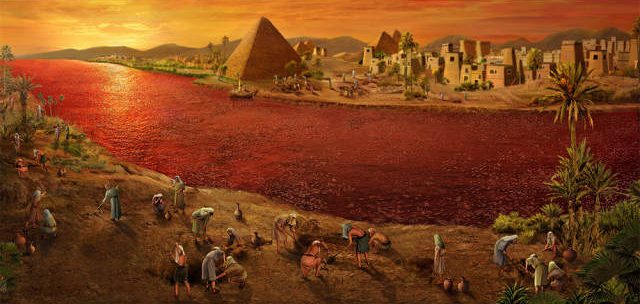
Plague Number One

14 Then the Lord said to Moses, “Pharaoh’s heart is hardened; he refuses to let the people go. 15 Go to Pharaoh in the morning, as he is going out to the water. Stand on the bank of the Nile to meet him, and take in your hand the staff that turned into a serpent. 16 And you shall say to him, ‘The Lord, the God of the Hebrews, sent me to you, saying, “Let my people go, that they may serve me in the wilderness.” But so far, you have not obeyed. 17 Thus says the Lord, “By this you shall know that I am the Lord: behold, with the staff that is in my hand I will strike the water that is in the Nile, and it shall turn into blood. 18 The fish in the Nile shall die, and the Nile will stink, and the Egyptians will grow weary of drinking water from the Nile.”’” 19 And the Lord said to Moses, “Say to Aaron, ‘Take your staff and stretch out your hand over the waters of Egypt, over their rivers, their canals, and their ponds, and all their pools of water, so that they may become blood, and there shall be blood throughout all the land of Egypt, even in vessels of wood and in vessels of stone.’”

20 Moses and Aaron did as the Lord commanded. In the sight of Pharaoh and in the sight of his servants he lifted up the staff and struck the water in the Nile, and all the water in the Nile turned into blood. 21 And the fish in the Nile died, and the Nile stank, so that the Egyptians could not drink water from the Nile. There was blood throughout all the land of Egypt. 22 But the magicians of Egypt did the same by their secret arts. So Pharaoh’s heart remained hardened, and he would not listen to them, as the Lord had said. 23 Pharaoh turned and went into his house, and he did not take even this to heart. 24 And all the Egyptians dug along the Nile for water to drink, for they could not drink the water of the Nile.

25 Seven full days passed after the Lord had struck the Nile. – Exodus 7:14-25 ESV

Things were about to get busy for God’s two elderly representatives. At an age when most men would be slowing down, Moses and Aaron had been assigned the God-ordained task of delivering His people from their captivity in Egypt. And this formidable responsibility wasn’t made any easier by the recalcitrant Pharaoh. As God had warned, the king of Egypt would do everything in his considerable power to keep the Israelites enslaved.

God was not surprised by Pharaoh’s actions. He had actually predicted it and claimed that He was the motivating factor behind Pharaoh’s stubborn resistance.  The Almighty knew the king’s heart and was using his predispositions and natural tendencies to bring about the preordained plan for Israel’s exodus from Egypt. Pharaoh’s “hard heart” would play a major role in God’s redemptive plan.

Having enacted their first sign in the presence of Pharaoh, Moses and Aaron were given instructions to take things to the next level. Araon’s staff turning into a snake was a mere parlor trick compared to what God was about to do. Pharaoh’s arrogant refusal to accept the terms of God’s demands would be met with severe judgment. God was going to strike at the heart of Egypt’s economic, religious, and cultural life: The Nile.

This vast river was the source of all life for the people of Egypt. Its annual flood cycle ensured the dissemination of nutrient-rich silt on the shorelines, providing fertility and prosperity to the land. The Egyptians believed the Nile to be a gift of the gods and they associated a number of their deities with the river itself.

There were Apis and Isis, the god and goddess of the Nile. Khnum was considered the guardian of the Nile. There were at least two gods who were deemed responsible for the Nile’s flooding. The first was the crocodile-like deity Sobek, whose domain consisted of the Nile’s waters. The second was Hapi, who was sometimes referred to as “Lord of the River Bringing Vegetation.” Because of his role in the annual flood cycle, Hapi was also considered a god of fertility.

It makes perfect sense that God would choose this revered natural resource to be the site of His first judgment. He sent Moses and Aaron to meet Pharaoh on the banks of the river the next morning. The omniscient God of Israel foreknew that Pharaoh would be making a morning visit to the river’s banks and He instructed His two agents to get there early and be ready to confront the king upon his arrival.

Moses was instructed to have Aaron take the same staff that God had transformed into a snake and use it to strike the waters of the Nile. But before doing so, Moses was to deliver to Pharaoh the following short speech from God.

So this is what the Lord says: “I will show you that I am the Lord.” Look! I will strike the water of the Nile with this staff in my hand, and the river will turn to blood. The fish in it will die, and the river will stink. The Egyptians will not be able to drink any water from the Nile.’” – Exodus 7:17-18 NLT

It is likely that Pharaoh was accompanied by a royal retinue of armed guards, servants, and administrative officials. Perhaps his visit had religious overtones and there were priests to assist him in making sacrifices to one or more of the gods of the Nile.

But at the sight of these two elderly Hebrews standing on the bank of the river, Pharaoh must have been more than a bit surprised and irritated. And to hear them pronounce their far-fetched plan to turn the river to blood must have left him bemused. Who did these men think they were? Did they not know they were dealing with one of the most powerful men in the world?

But Moses and Aaron did as God had instructed them.

As Pharaoh and all of his officials watched, Aaron raised his staff and struck the water of the Nile. Suddenly, the whole river turned to blood! The fish in the river died, and the water became so foul that the Egyptians couldn’t drink it. There was blood everywhere throughout the land of Egypt. – Exodus 7:20-21 NLT

In a matter of minutes, the entire river had been transformed into blood. This supernatural display of God’s power was meant to demonstrate His superiority and sovereignty. The God of creation was giving irrefutable evidence of His status as the one true God. Hapi, Khnum, Apis, and Isis were all defenseless before the majesty and might of Jehovah. They could not protect their own domain from the devastating judgment of the God of the Hebrews. And all Pharaoh could do was stand back and watch.

According to the text, the effects of this miracle were not localized but widespread throughout Egypt, impacting “all its rivers, canals, ponds, and all the reservoirs” (Exodus 7:19 NLT). Every source of drinking water was affected. And, not only that, the fish that served as a primary source of food for the Egyptians were wiped out as a result of this nationwide catastrophe. 

In what will become a rather strange and repeated scene, Pharaoh’s magicians responded to this devastating display of God’s judgment by replicating it. In other words, they mimicked the actions of God and actually made matters worse. If they had the power to turn water into blood, why did they not choose to do the opposite? Once again, God seems to be using these so-called magicians as instruments of His sovereign will. It is ironic that they display similar power to that of Moses and Aaron, but they cannot repair or resist what God’s agents have done. They can only replicate it and increase the suffering of their own people.

Seven days would pass. During that time, Pharaoh would go about his business as if nothing had happened. He refused to think about the devastation brought upon his nation by the God of Moses and Aaron. Safely ensconced in his palace, he was unaware that his people were busy digging wells in a vain attempt to find fresh drinking water.  And little did Pharaoh know that this was just the beginning. The book of Psalms records the litany of miraculous judgments that were headed Pharaoh’s way.

They did not remember his power
    or the day when he redeemed them from the foe,
when he performed his signs in Egypt
    and his marvels in the fields of Zoan.
He turned their rivers to blood,
    so that they could not drink of their streams.
He sent among them swarms of flies, which devoured them,
    and frogs, which destroyed them.
He gave their crops to the destroying locust
    and the fruit of their labor to the locust.
He destroyed their vines with hail
    and their sycamores with frost.
He gave over their cattle to the hail
    and their flocks to thunderbolts.
He let loose on them his burning anger,
    wrath, indignation, and distress,
    a company of destroying angels.
He made a path for his anger;
    he did not spare them from death,
    but gave their lives over to the plague.
He struck down every firstborn in Egypt,
    the firstfruits of their strength in the tents of Ham.
Then he led out his people like sheep
    and guided them in the wilderness like a flock. – Psalm 78:42-52 ESV

The blood-filled Nile was only the precursor to so much more that God had planned for the nation of Egypt. And when He was done, they would know that He alone was Lord.

English Standard Version (ESV) The Holy Bible, English Standard Version. ESV® Permanent Text Edition® (2016). Copyright © 2001

New Living Translation (NLT) Holy Bible, New Living Translation, copyright © 1996, 2004, 2015 by Tyndale House Foundation. Used by permission of Tyndale House Publishers Inc., Carol Stream, Illinois 60188. All rights reserved.

God Prevailed.

By faith Isaac invoked future blessings on Jacob and Esau. – Hebrews 11:20 ESV

Isaac, the son of Abraham, would live a long life and father two twin sons, Jacob and Esau. He would also inherit the same promise from God given to his father, Abraham.

Sojourn in this land, and I will be with you and will bless you, for to you and to your offspring I will give all these lands, and I will establish the oath that I swore to Abraham your father. I will multiply your offspring as the stars of heaven and will give to your offspring all these lands. And in your offspring all the nations of the earth shall be blessed – Genesis 26:3-4 ESV

When Isaac realized that his days on earth were coming to a close, he determined to bless his sons, beginning with Esau, the first-born of the two.

When Isaac was old and his eyes were dim so that he could not see, he called Esau his older son and said to him, “My son”; and he answered, “Here I am.” He said, “Behold, I am old; I do not know the day of my death. Now then, take your weapons, your quiver and your bow, and go out to the field and hunt game for me, and prepare for me delicious food, such as I love, and bring it to me so that I may eat, that my soul may bless you before I die.” – Genesis 27:1-4 ESV

Of course, little did Isaac know that his wife, Rebekah, had overheard his instructions to Esau. She immediately conspired with Jacob, her favorite of the two sons, to trick Isaac into giving him the blessing reserved for the first-born son. In her defense, Rebekah thought she was doing the right thing. Like her mother-in-law, Sarah, Rebekah was barren and unable to have children. But God came to her and promised to give her twin boys. He told her, “Two nations are in your womb, and two peoples from within you shall be divided; the one shall be stronger than the other, the older shall serve the younger” (Genesis 25:23 ESV). She believed that the blessing of Isaac was the key to God’s promise being fulfilled, so she concocted a plan to make sure Jacob received the blessing of the first-born. And Jacob went along with it because, technically, the birthright was his. Esau had unwisely and impulsively sold it to him for a pot of stew (Genesis 25:29-34). Driven by his hunger, Esau had flippantly forfeited his right to the blessing

So when Rebekah approached Jacob with her plan, he was reluctant, but eventually complicit in carrying it out. And their deception worked. Unknowingly, Isaac gave the blessing to Jacob that had been intended for Esau.

“May God give you of the dew of heaven
    and of the fatness of the earth
    and plenty of grain and wine.
Let peoples serve you,
    and nations bow down to you.
Be lord over your brothers,
    and may your mother’s sons bow down to you.
Cursed be everyone who curses you,
    and blessed be everyone who blesses you!” – Genesis 27:28-29 ESV

But what is interesting about this story is what the author of Hebrews says about Isaac. He writes, “By faith Isaac invoked future blessings on Jacob and Esau.” But wait a minute! He was deceived. He did not knowingly bless Jacob. He did so because he was tricked. How is that an example of faith? Well, first of all, we have to realize that the blessing he gave, fully believing he was giving it to Esau, was an example of faith. It was based on things hoped for and a conviction of things not seen. He was having to trust God to bring it all about. But even when Isaac realized what had happened and that he had been deceived by his wife, though angry, he remained faithful. “Then Isaac trembled very violently and said, ‘Who was it then that hunted game and brought it to me, and I ate it all before you came, and I have blessed him? Yes, and he shall be blessed’” (Genesis 27:33 ESV). Isaac had faith that God would fulfill the promise He had made to Abraham and had passed on to him – in spite of Rebekah’s deception. Things had not turned out quite like he had planned, but he was willing to trust God with the future outcome. Even to the point of blessing Jacob a second time before he moved to Paran in order to escape the wrath of this disgruntled brother.

“God Almighty bless you and make you fruitful and multiply you, that you may become a company of peoples. May he give the blessing of Abraham to you and to your offspring with you, that you may take possession of the land of your sojournings that God gave to Abraham!” – Genesis 28:3-4 ESV

Notice what Isaac did. He went back to the promise of God. In spite of all that had happened, he kept his focus on what God had said. He did not know the full ramifications of all that had transpired. He didn’t even like it. But he was willing to trust God with it. He had no idea what was going to happen in the years ahead. He was blind to all that God was going to do with and to Jacob. But he believed that God had meant it when He had said, “I will establish the oath that I swore to Abraham your father. I will multiply your offspring as the stars of heaven and will give to your offspring all these lands. And in your offspring all the nations of the earth shall be blessed.”

And years later, when Jacob had returned from his self-imposed exile and his father Isaac was near death, God visited him.

And God said to him, “Your name is Jacob; no longer shall your name be called Jacob, but Israel shall be your name.” So he called his name Israel. And God said to him, “I am God Almighty: be fruitful and multiply. A nation and a company of nations shall come from you, and kings shall come from your own body. The land that I gave to Abraham and Isaac I will give to you, and I will give the land to your offspring after you.” – Genesis 35:10-12 ESV

It is interesting to note that God changed Jacob’s name. In Hebrew, his name meant “he takes by the heel or he cheats.” This was a result of what happened at the time of Jacob and Esau’s births. Esau came out first, but the text tells us, “Afterward his brother came out with his hand holding Esau’s heel, so his name was called Jacob” (Genesis 25:26 ESV). But God would change Jacob’s name. And the name change, while subtle in Hebrew, Ya`aqob to Yisra’el, was incredibly significant. Israel means, “ God prevails.” In spite of all the trickery, deceit, human flaws, misplaced blessings, and convoluted circumstances surrounding Jacob’s life, God was in charge. His will was being done. His promise was being fulfilled. And it was in this fact that Isaac had placed his hope and conviction. He had faith that God would do what He said He would do. So by faith he invoked future blessings on his two sons, trusting God to do what only He could do.

Tested By God.

By faith Abraham, when he was tested, offered up Isaac, and he who had received the promises was in the act of offering up his only son, of whom it was said, “Through Isaac shall your offspring be named.” He considered that God was able even to raise him from the dead, from which, figuratively speaking, he did receive him back. – Hebrews 11:17-19 ESV

This story deserves a second look. There are four little words that should raise a certain amount of suspicion and create a bit of confusion in our minds – “when he was tested.” The account of this story found  in Genesis says, “After these things God tested Abraham” (Genesis 22:1 ESV). God tested Abraham. The Hebrew word for “tested” is nacah and it can mean “to test, try, prove, tempt, assay, put to the proof or test” (Hebrew Lexicon :: H5254 (KJV). Blue Letter Bible. Web. 8 Feb, 2016). We might ask ourselves, why would a good God test Abraham? We might also ask why an omniscient, all-knowing God would have to test Abraham. What was the purpose of the test? Was it to prove, test or try Abraham’s faith? Wouldn’t God have already known what the outcome of such a test would be? Didn’t he already have a ram ready to serve as a substitute offering in place of Isaac? Was God really waiting to see what Abraham would do? It would seem that God was testing Abraham, not for His own enlightenment, but for Abraham’s. God already knew the outcome. The psalmist would have us remember that God is all-knowing.

O Lord, you have examined my heart and know everything about me. You know when I sit down or stand up. You know my thoughts even when I’m far away. You see me when I travel and when I rest at home. You know everything I do. You know what I am going to say even before I say it, Lord. – Psalm 139:1-4 NLT

God did not need to know what Abraham would do. But Abraham needed to know what God would do when he was fully obedient – even in the face of an impossible, illogical request. The test was for him. There is another story that speaks of God’s testing. It is found in the book of Exodus. It took place early in the story, immediately after their deliverance from Israel and the miraculous parting of the Red Sea.

Then Moses made Israel set out from the Red Sea, and they went into the wilderness of Shur. They went three days in the wilderness and found no water. When they came to Marah, they could not drink the water of Marah because it was bitter; therefore it was named Marah. And the people grumbled against Moses, saying, “What shall we drink?” And he cried to the Lord, and the Lord showed him a log, and he threw it into the water, and the water became sweet. There the Lord made for them a statute and a rule, and there he tested them – Exodus 15:22-25 ESV

In recording this event, Moses used the same Hebrew word, nacah. God tested them. But notice the difference between the two stories. In this case, the people, who had just witnessed God’s divine deliverance, arrive at Marah and immediately begin to complain about the lack of water. Remember, they had seen God send ten plagues on the people of Egypt. They had seen Him destroy Pharaoh’s army in the Red Sea. But when they found themselves in the wilderness without water, they grumbled and complained, saying, “What shall we drink?” They didn’t even take their problem to God, the one who had delivered them. They complained to Moses. And Moses took the need to God. Despite their complaining, God took care of their need and provided them with sweet water. There he tested them. But again, who was the test for? Did God not know how they were going to react? Was He not fully aware of their hearts and completely unsurprised by their reaction? Wasn’t He the one who led them right to that spot, fully knowing that there was no water? This was a test for them.

And God, after providing them with drinkable water, said to them, “If you will diligently listen to the voice of the Lord your God, and do that which is right in his eyes, and give ear to his commandments and keep all his statutes, I will put none of the diseases on you that I put on the Egyptians, for I am the Lord, your healer” (Exodus 15:26 ESV). God wanted them to know that He could be trusted. He wanted them to know that He was all-powerful. He was testing their knowledge of Him and their faith in Him – for their benefit. The lack of water at Meribah showed them that they did not really know or trust God. It revealed their lack of faith. When they had stood on the banks of the Red Sea with the army of Pharaoh bearing down on them, Moses had told them, “Fear not, stand firm, and see the salvation of the Lord, which he will work for you today” (Exodus 14:13 ESV). And God had delivered them. But as soon as they faced their first problem, they doubted God. They failed the test.

But Abraham passed his test – with flying colors. God was not surprised. He knew Abraham would be obedient. He even had a ram caught in a thicket to serve as the stand-in for Isaac. But that day Abraham learned a great deal about himself and about His God. His faith grew. His hope in God’s promises increased. His conviction in the things promised by God, but not yet seen, deepened. The test was for Abraham’s benefit, not God’s. He learned what true obedience to God looks and feels like. In a way, Abraham was testing the faithfulness of God, counting on Him to come through. He even told his son, Isaac, “God will provide for himself the lamb for a burnt offering, my son” (Genesis 22:8 ESV). He was putting all his faith in God, counting on Him to spare his son or even raise him back to life should he have to follow through with God’s command. God was not testing Abraham in order to see what he would do. The test was so that Abraham could see what God would do and grow in his faith. The apostle Peter gives us an insight into the tests we face in this life.

So be truly glad. There is wonderful joy ahead, even though you have to endure many trials for a little while. These trials will show that your faith is genuine. It is being tested as fire tests and purifies gold—though your faith is far more precious than mere gold. So when your faith remains strong through many trials, it will bring you much praise and glory and honor on the day when Jesus Christ is revealed to the whole world. – 1 Peter 1:6-7 NLT

Like Abraham, our faith will be tested at times. We will find ourselves facing situations and circumstances that will reveal whether our “faith is the assurance of things hoped for, the conviction of things not seen” (Hebrews 11:1 ESV). Will we allow the lack of water to cause us to complain? Will we balk at God’s seemingly unreasonable request and refuse? God knows what we will do? He is never surprised. But the question is whether we know what God will do? And are we willing to trust Him with the outcome? Paul gives us a word of encouragement.

For our present troubles are small and won’t last very long. Yet they produce for us a glory that vastly outweighs them and will last forever! – 2 Corinthians 4:17 NLT

Hear. Forgive. Act.

O Lord, hear; O Lord, forgive. O Lord, pay attention and act. Delay not, for your own sake, O my God, because your city and your people are called by your name. – Daniel 9:19 ESV

Daniel 9:4-19

As Daniel wraps up his prayer, he refocuses his attention on the mercy of God. He asks that God would hear his prayer. He asks that God would forgive the transgressions he has just confessed. Finally, he begs God to hear and do something about it. In the Hebrew, the next phrase is in the negative. He actually says, “delay not.” He is asking that God intervene immediately. In other words, he wants to see the power of God unleashed without delay. After all, they had been waiting 70 years. According to the writings of Jeremiah, the time was ripe for God’s promise or restoration to be fulfilled. Daniel wanted to see it happen ASAP.

But what is interesting is the reason Daniel gave for God to hear, forgive and act. He appeals to God based on His own name and reputation. From Daniel’s human perspective, he saw it as a case of God’s character being at stake. People had already been talking about the state of affairs in Israel, and how their God had abandoned them. Daniel had to have heard countless rumors and discussions regarding God’s apparent apathy toward His own people or His inability to do anything about their condition. Even the Israelites had to have given up hope that their God was ever going to do something about their captivity. That is probably why so many of them had turned to the gods of Babylon. But Daniel held on to what he knew about God. He put his hope in the reality of who God claimed to be and what He had already done for the people of Israel. The words of Jeremiah the prophet rang in his ear, providing him with the faith he needed to keep on believing.

There is none like you, O Lord; you are great, and your name is great in might. Who would not fear you, O King of the nations? For this is your due; for among all the wise ones of the nations and in all their kingdoms there is none like you. They are both stupid and foolish; the instruction of idols is but wood! Beaten silver is brought from Tarshish, and gold from Uphaz. They are the work of the craftsman and of the hands of the goldsmith; their clothing is violet and purple; they are all the work of skilled men. But the Lord is the true God; he is the living God and the everlasting King. At his wrath the earth quakes, and the nations cannot endure his indignation. – Jeremiah 10:6-10 ESV

Daniel’s God was incomparable. He was without equal in power and was worthy of all honor. Daniel longed for God to protect His own name, because he knew the people of Judah were incapable of carrying it off. He asked God to do something because he was painfully well aware that the chosen people of God had chosen to do nothing. There was nothing they could do. They were complete incapable of changing their ways. They were stubborn, rebellious and prone to solve their problems their own way. But Daniel knew they had one hope: God. He knew if anything was going to happen, it would have to be up to God. And if God was to do anything, it would be based on His own desire to protect the character and reputation of His name. God would not allow Himself to be perceived as a liar, as weak, as uncaring, without compassionate, powerless, indifferent, always angry, unmerciful, or unloving. God had promised to restore the people of Judah, and He would. God had made a covenant with the people of Judah, and He would keep it. God was all-powerful, and He would show it. God was loving, and He would prove it. God was sovereign, and He would reveal it. God would hear, forgive and act. Not because of the people of Judah, but because He is God.