Our God Reigns

1 Let every person be subject to the governing authorities. For there is no authority except from God, and those that exist have been instituted by God. Therefore whoever resists the authorities resists what God has appointed, and those who resist will incur judgment. For rulers are not a terror to good conduct, but to bad. Would you have no fear of the one who is in authority? Then do what is good, and you will receive his approval, for he is God’s servant for your good. But if you do wrong, be afraid, for he does not bear the sword in vain. For he is the servant of God, an avenger who carries out God’s wrath on the wrongdoer. Therefore one must be in subjection, not only to avoid God’s wrath but also for the sake of conscience. For because of this you also pay taxes, for the authorities are ministers of God, attending to this very thing. Pay to all what is owed to them: taxes to whom taxes are owed, revenue to whom revenue is owed, respect to whom respect is owed, honor to whom honor is owed. – Romans 13:1-7 ESV

At the heart of this passage is the sovereignty of God. That should not be overlooked or under-emphasized. All throughout his letter, Paul has been dealing with the subject of man’s justification before God. He has made it clear that this is the work of a sovereign God. He is the one who calls, justifies, sanctifies and ultimately glorifies all believers. And even in this section of his letter, where Paul is talking about the practical outflow of one’s faith in relationship to others, he keeps emphasizing God’s sovereignty. In chapter 12, Paul talked about spiritual gifts and their role in the body of Christ. Because they are given by God, there is no room for pride or boasting. Like salvation, they are a gift from God and have nothing to do with human merit. Paul wanted his readers to remember that they had “gifts that differ according to the grace given to us” (Romans 12:6 ESV).

Now, as Paul addresses the believer’s relationship with civil authority, he continues to emphasize God’s sovereignty, but it is important that we keep Paul’s words within their context. He is writing to believers in Rome, the capital of the Roman Empire, the world’s most powerful nation at the time. Both the Jews and the Gentiles who made up the church in Rome knew what it was like to live under the authority of an oppressive regime. And as far as the Romans were concerned, the Christians were little more than a break-off sect of the Hebrew religion. Their only real knowledge of Christianity was tied to the individual for whom it was named, Jesus Christ, who was crucified by Pontius Pilate for claiming to be King of the Jews.

The Christians, like the Jews, were tolerated by the Romans and given certain freedoms to practice their religion in peace. But the Jewish Christians would have had no affinity for the Romans, knowing full well that their people had lived under the weight of Roman rule for years.

Yet Paul tells his readers, “Let every person be subject to the governing authorities” (Romans 13:1 ESV). The word Paul uses is hypotassō, and it means “to subject oneself, obey” (Greek Lexicon :: G5293 (KJV). Blue Letter Bible. Web. 23 Dec, 2015). In this passage, Paul does not address what Christians should do when rulers overstep their God-given authority and begin persecuting their subjects; he simply encourages believers to submit to those in authority over them. And he was not alone in promoting this kind of behavior. The apostle Peter said something very similar.

For the Lord’s sake, submit to all human authority—whether the king as head of state, or the officials he has appointed. For the king has sent them to punish those who do wrong and to honor those who do right. – 1 Peter 2:13-14 NLT

And Paul provides the “why” behind his call for submission to earthly authorities.

For there is no authority except from God, and those that exist have been instituted by God. – Romans 13:1 ESV

It is a case of God’s sovereignty. Jesus lived out this very idea, having submitted Himself to the Roman authorities, even allowing them to carry out their decision to put Him to death. But He knew that His submission was ultimately to God. During His trial, Pilate asked Him, “Don’t you realize that I have the power to release you or crucify you?” (John 19:10 NLT), and Jesus responded, “You would have no power over me at all unless it were given to you from above” (John 19:11 NLT).

The very existence of the Romans as a nation-state had been divinely decreed by God. Their presence in the land of Palestine and their rule over the people of Israel were not something that caught God off guard. Paul wrote in his letter to the Galatians, “But when the fullness of time had come, God sent forth his Son, born of woman, born under the law, to redeem those who were under the law, so that we might receive adoption as sons” (Galatians 4:4-7 ESV). At just the right time, God sent His Son. When Roman rule was at its zenith and the Jewish people were living under their control, the Messiah appeared on the scene. The very existence of the Roman government in the land of Israel played a vital role in fulfilling God’s promises and plan. The death of Jesus, predicted in Isaiah 53, was fulfilled in detail because of the Romans and their practice of crucifixion.

But he was pierced for our rebellion,
    crushed for our sins.
He was beaten so we could be whole.
    He was whipped so we could be healed.
All of us, like sheep, have strayed away.
    We have left God’s paths to follow our own.
Yet the Lord laid on him
    the sins of us all. – Isaiah 53:5-6 NLT

Unjustly condemned,
    he was led away.
No one cared that he died without descendants,
    that his life was cut short in midstream.
But he was struck down
    for the rebellion of my people.
He had done no wrong
    and had never deceived anyone.
But he was buried like a criminal;
    he was put in a rich man’s grave. – Isaiah 53:8=9 NLT

Jesus’ submission to the Roman authorities was based on His understanding of God’s sovereign will for His life. So, when Paul encourages our subjection to governing authorities, he does so based on his understanding that all authority exists by God’s decree. For a believer to resist God-given authority is to resist God.

Again, Paul does not address what a Christian is to do when the government encourages disobedience to God. But if we follow the example of Paul, he submitted to the governmental authorities on many occasions and was willing to go to jail when their demands contradicted the will of God for his life. Ultimately, Paul found himself a prisoner in Rome because of his faith. His preaching of the gospel led to his arrest and imprisonment. So, there may come a time when the believer must resist and disobey civil authority, but we must always be willing to suffer the consequences of our disobedience, even if it means persecution.

Paul makes it clear that all governing authorities are appointed by God. They are “God’s servant for your good” (Romans 13:4 ESV) and “ministers of God” (Romans 13:6 ESV). Ultimately, our submission to civil authority is to be seen as submission to God because He is in control. We are to live our lives with the understanding that our God is sovereign and rules over all, including nations, governments, leaders, parliaments, presidents, dictators, senates, and all man-made institutions. He is in control at all times, and His plan for this world will be fulfilled regardless of who sits on a throne or rules the nations. He used the Assyrians, Babylonians, and Romans to accomplish His will for the nation of Israel, and He remains in authority over all the nations of the earth at this very moment. So, we are to live our lives in submission to and trust in His sovereign, providential power because our God reigns over all.

Our God is great and glorious
We put our trust in Your name, Jesus
Able to save and deliver us
We put our hope in Your name, Jesus

Blessing and honor
Glory and power
Unto our God forever and ever
All of the honor
All of the praise is Yours
Yours forever

Hallelujah
Hallelujah, our God reigns
Hallelujah
Hallelujah, our God reigns

– Israel Houghton, Copyright © 2025 Integrity Music. All Rights Reserved

Father, You rule and reign over all the nations of the earth. Your authority is absolute and Your will is always accomplished, regardless of who sits in the seats of power and claims to be in charge. No political party or government entity can resist Your will or operate outside Your control. This does not mean that You sanction evil or are complicit in the sinful activities of godless nations. But it does mean that their presence on this earth is not outside Your will. Dictators and despots have always existed. Pride, arrogance, and the allure of power have always driven sinful men to do wicked things. But You have the power and authority to use godless people to carry our Your righteous will. You used Pharaoh, Nebuchadnezzar, Ahab, Darius, and others to accomplish Your providential plan for the people of Israel. And You are still operating in undimished authority over the nations of the earth. Help us to see that You remain in control at all times. Despite what happens around us, never let us lose hope in Your redemptive plan for our lives and this world. Amen

English Standard Version (ESV) The Holy Bible, English Standard Version. ESV® Permanent Text Edition® (2016). Copyright © 2001 by Crossway Bibles, a publishing ministry of Good News Publishers.

New Living Translation (NLT) Holy Bible, New Living Translation, copyright © 1996, 2004, 2015 by Tyndale House Foundation. Used by permission of Tyndale House Publishers Inc., Carol Stream, Illinois 60188. All rights reserved.22
The LORD Reigns Over All

20 Then Isaiah the son of Amoz sent to Hezekiah, saying, “Thus says the LORD, the God of Israel: Your prayer to me about Sennacherib king of Assyria I have heard. 21 This is the word that the LORD has spoken concerning him:

“She despises you, she scorns you—
    the virgin daughter of Zion;
she wags her head behind you—
    the daughter of Jerusalem.

22 “Whom have you mocked and reviled?
    Against whom have you raised your voice
and lifted your eyes to the heights?
    Against the Holy One of Israel!
23 By your messengers you have mocked the LORD,
    and you have said, ‘With my many chariots
I have gone up the heights of the mountains,
    to the far recesses of Lebanon;
I felled its tallest cedars,
    its choicest cypresses;
I entered its farthest lodging place,
    its most fruitful forest.
24 I dug wells
    and drank foreign waters,
and I dried up with the sole of my foot
    all the streams of Egypt.’

25 “Have you not heard
    that I determined it long ago?
I planned from days of old
    what now I bring to pass,
that you should turn fortified cities
    into heaps of ruins,
26 while their inhabitants, shorn of strength,
    are dismayed and confounded,
and have become like plants of the field
    and like tender grass,
like grass on the housetops,
    blighted before it is grown.

27 “But I know your sitting down
    and your going out and coming in,
    and your raging against me.
28 Because you have raged against me
    and your complacency has come into my ears,
I will put my hook in your nose
    and my bit in your mouth,
and I will turn you back on the way
    by which you came.

29 “And this shall be the sign for you: this year eat what grows of itself, and in the second year what springs of the same. Then in the third year sow and reap and plant vineyards, and eat their fruit. 30 And the surviving remnant of the house of Judah shall again take root downward and bear fruit upward. 31 For out of Jerusalem shall go a remnant, and out of Mount Zion a band of survivors. The zeal of the LORD will do this.

32 “Therefore thus says the LORD concerning the king of Assyria: He shall not come into this city or shoot an arrow there, or come before it with a shield or cast up a siege mound against it. 33 By the way that he came, by the same he shall return, and he shall not come into this city, declares the LORD. 34 For I will defend this city to save it, for my own sake and for the sake of my servant David.”

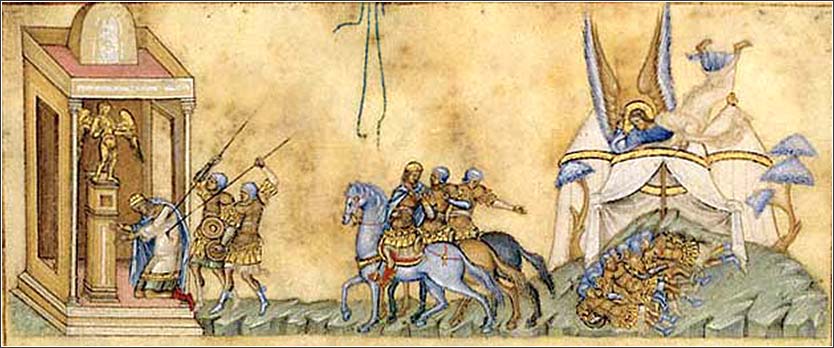
35 And that night the angel of the LORD went out and struck down 185,000 in the camp of the Assyrians. And when people arose early in the morning, behold, these were all dead bodies. 36 Then Sennacherib king of Assyria departed and went home and lived at Nineveh. 37 And as he was worshiping in the house of Nisroch his god, Adrammelech and Sharezer, his sons, struck him down with the sword and escaped into the land of Ararat. And Esarhaddon his son reigned in his place. 2 Kings 19:20-37 ESV

This is essentially the story of three kings. First, there is King Sennacherib, the sovereign ruler over the rapidly expanding Assyrian empire. He is the commander-in-chief of one of the most powerful armies on earth, and his ambitious plans for global conquest have met with little to no resistance. Kingdom after kingdom has fallen before his army, and now he has his sights set on the nation of Judah, where Hezekiah, the second king in our story, rules from his throne in Jerusalem. But King Hezekiah finds himself in the unenviable position of ruling over a city under siege. His capital city is surrounded by the Assyrian army, and he has been given an ultimatum to surrender or face annihilation.

Two kings. One is dressed in his royal robes and reveling in the indisputable reality of his own success. The other has discarded his regal attire for sackcloth and ashes, the garments of mourning. Sennacherib is a confident and self-assured king who sees no end to his plans for global conquest and domination. He is unstoppable, and it would appear that Hezekiah agrees with that assessment because he has turned to Yahweh for help. With his city completely surrounded and his allies nowhere to be seen, Hezekiah has called on the God of Judah to come to their aid.

“O LORD, God of Israel, you are enthroned between the mighty cherubim! You alone are God of all the kingdoms of the earth. You alone created the heavens and the earth. Bend down, O LORD, and listen! Open your eyes, O LORD, and see! Listen to Sennacherib’s words of defiance against the living God.” – 2 Kings 19:15-16 NLT

This penitent petition engages the attention of the third king in our story.  From His royal throne room in heaven, Yahweh heard the humble and contrite prayer of the king of Judah and immediately responded with an answer. The sovereign King of kings, who rules over all the kingdoms of the earth, sent a message to Hezekiah through His prophet Isaiah.

But this message, while delivered to King Hezekiah, was really directed at Sennacherib. Yahweh, the indisputable King of the universe, had a few choice words for the pompous and prideful potentate of Assyria. He warns the over-confident, land-grabbing king that his plans for Judah’s conquest will fail.

“The virgin daughter of Zion
    despises you and laughs at you.
The daughter of Jerusalem
    shakes her head in derision as you flee. – 2 Kings 19:21 NLT

Despite Sennacherib’s boastful claims, Jerusalem will remain pure and undefiled, her walls unbreached, and her population spared the indignities of conquest or capture. Yahweh wanted Sennacherib to know that the day was coming when the citizens of Jerusalem would rejoice and celebrate as the Assyrians abandoned their siege and disappeared over the horizon.

Sennacherib had made the fateful mistake of mocking the wrong deity, and Yahweh let him know that his derisive and disrespectful words were going to cost him. He had offended the Holy One of Israel and would soon suffer the consequences for his error. But first, God points out Sennacherib’s primary problem: His pride.

“By your messengers you have defied the LORD.
    You have said, ‘With my many chariots
I have conquered the highest mountains—
    yes, the remotest peaks of Lebanon.
I have cut down its tallest cedars
    and its finest cypress trees.
I have reached its farthest corners
    and explored its deepest forests.
I have dug wells in many foreign lands
    and refreshed myself with their water.
With the sole of my foot
    I stopped up all the rivers of Egypt!’” – 2 Kings 19:23-24 NLT

Sennacherib suffered from a terminal “I” condition. His unbridled success had gone to his head, and he had begun to believe that he was invincible and, in a sense, divine. By his own boastful admission, Sennacherib claimed that the kings of Assyria had defeated the gods of all their enemies.

“Have the gods of other nations rescued them—such nations as Gozan, Haran, Rezeph, and the people of Eden who were in Tel-assar? My predecessors destroyed them all! What happened to the king of Hamath and the king of Arpad? What happened to the kings of Sepharvaim, Hena, and Ivvah?” – 2 Kings 19:12-13 NLT

And he was convinced that Yahweh, the God of Judah, would fare no better than any of the other gods. But Sennacherib failed to understand that Yahweh was the sovereign ruler over all the nations of the world. The Assyrians’ rise to global dominance had been a part of God’s preordained plan. They were nothing more than instruments in His hands and actors in His divine drama that will one day culminate with the redemption and restoration of all creation.

Yahweh let Sennacherib know that he had no right to boast or brag; he could take no credit for any of his success. It had all been according to the sovereign will of the King of the universe. Although Sennacherib was a pagan and not a citizen of the chosen nation of Israel, God was sovereignly directing this unbeliever’s life to accomplish His divine will.

“I decided this long ago.
Long ago I planned it,
    and now I am making it happen.
I planned for you to crush fortified cities
    into heaps of rubble.
That is why their people have so little power
    and are so frightened and confused.
They are as weak as grass,
    as easily trampled as tender green shoots.
They are like grass sprouting on a housetop,
    scorched before it can grow lush and tall.” – 2 Kings 19:25-26 NLT

This message, while directed at Sennacherib, was meant to encourage Hezekiah. It was intended as a well-timed reminder to the king of Judah that his God was sovereign over all things. Regardless of the circumstances of life, the people of God could and should rest in the fact that their God reigns. Centuries later, when the nation of Judah fell to the Babylonians and a remnant of the people found themselves living in exile, the prophet Daniel expressed his firm belief in Yahweh’s sovereignty over all the affairs of human life.

“…the Most High rules over the kingdoms of the world. He gives them to anyone he chooses— even to the lowliest of people.” – Daniel 4:17 NLT

The psalmists shared Daniel’s optimistic and faith-filled perspective.

The LORD has established his throne in the heavens, and his kingdom rules over all.
 – Psalm 103:19 ESV

For the LORD Most High is awesome. He is the great King of all the earth. – Psalm 47:2 NLT

God reigns above the nations, sitting on his holy throne. – Psalm 47:8 NLT

For all the kings of the earth belong to God. – Psalm 47:9 NLT

The LORD reigns, let the earth rejoice; let the many coastlands be glad! – Psalm 97:1 ESV

The LORD reigns; let the peoples tremble! He sits enthroned upon the cherubim; let the earth quake! – Psalm 99:1 ESV

Yahweh wanted Hezekiah and Sennacherib to understand that they had nothing to do with their positions or power. Their very existence was God-ordained and orchestrated down to the last detail. Their kingdoms and crowns were fully attributable to God, and He had the divine right to remove them from power should He so choose, which is exactly what He warned Sennacherib was going to happen.

“I will put my hook in your nose
    and my bit in your mouth.
I will make you return
    by the same road on which you came.” – 2 Kings 19:28 NLT

Man’s plans must always give way to God’s sovereign will.

Many are the plans in the mind of a man, but it is the purpose of the LORD that will stand. – Proverbs 19:21 ESV

Sennacherib had ambitious plans for global dominance, but he would soon find that God’s plan superseded his own. And the King of the universe assured Hezekiah that He would protect Jerusalem and continue to provide for all their needs. Sennacherib and his forces would remain a threat for three more years, but God made it clear that “his armies will not enter Jerusalem. They will not even shoot an arrow at it” (2 Kings 19:32 NLT).

As a sign that He was in full control of the situation, God sent an angel who slaughtered 185,000 Assyrian soldiers in a single night. The next morning, the citizens of Jerusalem woke up to find the land outside the walls covered in corpses, but the rest of the Assyrian army was nowhere to be seen. The King of kings had displayed His sovereign power by sending a single angel to wreak havoc among the Assyrians.

When Sennacherib returned home, his days of glory and conquest came to an abrupt and ignominious end; he was assassinated by two of his own sons. As a further sign of Yahweh’s sovereignty and singularity as the King of kings, Sennacherib’s less-than-glorious death took place in the temple of his god.

The circumstances surrounding Sennacherib’s demise should not go unnoticed. As the vainglorious king of Assyria was safely ensconced in his capital and worshiping in the temple of his false god, the one true King chose to demonstrate His sovereign power over all the kingdoms of the earth. The Holy One of Israel proved yet again that He is “the great King of all the earth” (Psalm 47:2 NLT).

English Standard Version (ESV) The Holy Bible, English Standard Version. ESV® Permanent Text Edition® (2016). Copyright © 2001 by Crossway Bibles, a publishing ministry of Good News Publishers.

New Living Translation (NLT) Holy Bible, New Living Translation, copyright © 1996, 2004, 2015 by Tyndale House Foundation. Used by permission of Tyndale House Publishers Inc., Carol Stream, Illinois 60188. All rights reserved.