The Wrath of God – PT 2

While we might be tempted to ignore the reality of God’s wrath, the Scriptures make it difficult to deny its existence.

For the Lord holds a cup in his hand
    that is full of foaming wine mixed with spices.
He pours out the wine in judgment,
    and all the wicked must drink it,
    draining it to the dregs.
 
– Psalm 75:8 NLT

“Don’t be afraid of those who want to kill your body; they cannot touch your soul. Fear only God, who can destroy both soul and body in hell.”Matthew 10:28 NLT

“But I’ll tell you whom to fear. Fear God, who has the power to kill you and then throw you into hell. Yes, he’s the one to fear.” – Luke 12:5 NLT

So you see, the Lord knows how to rescue godly people from their trials, even while keeping the wicked under punishment until the day of final judgment. – 2 Peter 2:9 NLT

God hates sin because it is a direct assault on His sovereign will. Every sin is an act of rebellion against His righteousness and His right to rule and reign over the universe He created. These willful acts of transgressions take a myriad of forms and bring out the just and righteous anger of the Almighty.

There are six things that the Lord hates,
    seven that are an abomination to him:
haughty eyes, a lying tongue,
    and hands that shed innocent blood,
a heart that devises wicked plans,
    feet that make haste to run to evil,
a false witness who breathes out lies,
    and one who sows discord among brothers. – Proverbs 6:16-18 ESV

But according to David, God doesn’t just reserve His hatred for the sin committed; “his soul hates the wicked and the one who loves violence” (Psalm 11:5 ESV). This jarring thought may leave us confused and conflicted but it should not cause us to question God’s character. Despite how it may sound, it does not stand in contradiction to John’s declaration: God is love (1 John 4:8 ESV). Love is the essence of who God is; it is the foundational quality of His being. But His love and wrath are far from contradictory or antithetical; they complement one another.

In fact, Paul makes it clear that the birth, life, death, and resurrection of Christ were all demonstrations of God’s wrath against sin and His love for helpless humanity.

Christ died for the ungodly – Romans 5:6 ESV

God shows his love for us in that while we were still sinners, Christ died for us. – Romans 5:8 ESV 

while we were enemies we were reconciled to God by the death of his Son… – Romans 5:10 ESV

You were his enemies, separated from him by your evil thoughts and actions. Yet now he has reconciled you to himself through the death of Christ in his physical body. As a result, he has brought you into his own presence, and you are holy and blameless as you stand before him without a single fault. – Colossians 1:21-22 NLT

As sinners, we deserved God’s wrath but, instead, we were the undeserving beneficiaries of His love. But that love came at a high price. His Son had to die to pay the debt we owed. His sacrifice propitiated or satisfied the just wrath of God. Our sin wasn’t ignored and our debt wasn’t left unpaid; Jesus paid it in full with the willful sacrifice of His own life. We deserved God’s wrath but, instead, He poured out His love in the form of His Son’s selfless substitutionary death on the cross.

Discussing the wrath of God can come across as if we are dealing with a flaw in the divine character. It seems out of step with His love, grace, and mercy. But the wrath of God is never displayed arbitrarily. He need never apologize for it or be embarrassed because of it, and He never unleashes His wrath undeservedly or unjustly. Unlike us, God never loses His temper. He never flies off the handle or suffers from a lack of self-control. He is always purposeful when displaying His wrath against sinful mankind. When doing so, He is displaying who He is, exhibiting His divine nature, and glorifying Himself in the process. In fact, God’s wrath is inseparably linked with His glory. When He exercises His wrath, He displays the fullness of His glory.

The book of Exodus records the encounter that Moses had with God on Mount Sinai. Moses, the deliverer God had chosen to lead His people out of slavery in Egypt, made a bold request of God. He asked the Almighty, “Please show me your glory” (Exodus 33:18 ESV). God agreed to do so but under one condition.

“I will make all my goodness pass before you and will proclaim before you my name ‘The Lord…But,” he said, “you cannot see my face, for man shall not see me and live.” – Exodus 33:19, 20 ESV

God warned Moses that viewing His face would prove deadly. Why? Because of Moses’ sinfulness. No man can behold the full, unveiled glory of God while in his sinful state. Moses wanted to see God’s glory, but to do so without God’s protection would result in Moses’ destruction. Because the wrath of God goes hand-in-hand with the glory of God.

God kept His word, but in a display of His goodness and mercy, He prevented Moses from seeing Him in all His glory.

“I will cover you with my hand until I have passed by. Then I will take away my hand, and you shall see my back, but my face shall not be seen.” – Exodus 33:22-23 ESV

Moses, as a fallen human being, deserved to come under the wrath of God but, instead, he experienced God’s grace and mercy. Remember what God had said to Moses immediately after making his request:

“I will be gracious to whom I will be gracious, and will show mercy on whom I will show mercy.” – Exodus 33:19 ESV

God, because of His righteousness and holiness, is obligated to punish sin. He cannot overlook or ignore it but He can make provision for it. In this case, that is what He did.

The Lord passed before him and proclaimed, “The Lord, the Lord, a God merciful and gracious, slow to anger, and abounding in steadfast love and faithfulness, keeping steadfast love for thousands, forgiving iniquity and transgression and sin, but who will by no means clear the guilty, visiting the iniquity of the fathers on the children and the children’s children, to the third and the fourth generation.” – Exodus 34:6-7 ESV

As God passed by with His hand placed protectively over His servant, He proclaimed His mercy, grace, patience, steadfast love, faithfulness, and forgiveness. In other words, He declared His divine attributes. But don’t miss this part. While God declared that He was willing to forgive iniquity, transgression, and sin, He would not clear the guilty. The Hebrew word translated as “clear” is naqah and it means to “acquit” or ”to leave unpunished.” The guilty must be held to account; they must pay for their sins. God cannot simply whitewash over them.

Just before Moses was given this once-in-a-lifetime opportunity to see the glory of God, he received the law of God – the Ten Commandments – on tablets of stone. Moses returned from the mountaintop, tablets in hand, only to find the people worshiping false gods down in the valley. In his shock and anger, Moses destroyed the tablets containing God’s law. In His wrath, God brought a plague upon the people, punishing them for their rejection of Him.

…the Lord said to Moses, “Whoever has sinned against me, I will blot out of my book. But now go, lead the people to the place about which I have spoken to you; behold, my angel shall go before you. Nevertheless, in the day when I visit, I will visit their sin upon them.”

Then the Lord sent a plague on the people, because they made the calf, the one that Aaron made. – Exodus 32:33-35 ESV

God punished the guilty. He could not and would not allow them to get away with their sin. The entire law, as prescribed by God on Mount Sinai, was based on the premise that “without the shedding of blood, there is no forgiveness” (Hebrews 9:22 NLT). Some would die by the plague that God had sent and their deaths would assuage or propitiate God’s wrath. He had to punish the guilty. He could not simply clear or acquit them.

God gave Moses a second set of tablets, containing His code of conduct for the people of Israel. His laws were intended to set them apart as His chosen people. Those tablets contained all they needed to know about living as His children. He left nothing up to their imaginations. They would not be free to live on their own terms or follow the examples of the other nations around them. But Moses, knowing the hearts of his people, made yet another request of God.

“If now I have found favor in your sight, O Lord, please let the Lord go in the midst of us, for it is a stiff-necked people, and pardon our iniquity and our sin, and take us for your inheritance.” – Exodus 34:9 ESV

Moses knew that, without God’s grace and mercy, the people of Israel would find themselves the fully deserving recipients of God’s wrath, once again. So, God renewed His covenant commitment with the people of Israel, but He warned them:

“…for you shall worship no other god, for the Lord, whose name is Jealous, is a jealous God.” – Exodus 34:14 ESV

God will not tolerate unfaithfulness. He will not put up with His chosen people turning their backs on Him by worshiping something or someone other than Him. But it is not because He is overly sensitive or wears His feelings on His sleeve. It is because He is God and worthy of all glory, honor, and praise.

In the book of Revelation, John records his vision of the throne room of God in heaven. He describes the four living creatures, standing around the throne of God:

Day after day and night after night they keep on saying,

“Holy, holy, holy is the Lord God, the Almighty—
    the one who always was, who is, and who is still to come.” – Revelation 4:8 NLT

They are joined by the 24 elders, who lay their crowns before God’s throne and say:

“You are worthy, O Lord our God, to receive glory and honor and power. For you created all things, and they exist because you created what you pleased.” – Revelation 4:11

God is worthy of our praise. He deserves our worship. He created us and we exist for His glory. When we refuse to give Him the glory He deserves, we sin against Him. Sin is not so much the action we commit, as it is the heart behind the action. What we do is an outward display of the state of our hearts. Jesus said, “…from the heart come evil thoughts, murder, adultery, all sexual immorality, theft, lying, and slander” (Matthew 15:19 NLT). Then He added, “These are what defile you” (Matthew 15:20 NLT). The Greek word for “defile” is koinoō and it means “to make common or unclean.”

Our actions, which stem from our hearts, end up making us unacceptable to God. They display our love for something other than Him. When we sin, we are giving evidence that our hearts do not belong to God. We love something other than Him, such as pleasure, sensuality, self, success, power, position, prominence, or happiness. Those things become idols or substitutes for God and our sin is an outward expression of our love affair with these false gods.

But God’s holiness demands justice, and His justice requires that He display His wrath “against all sinful, wicked people who suppress the truth by their wickedness” (Romans 1:18 NLT). Yet, in His mercy and grace, God came up with a way to satisfy His wrath and display His goodness at the same time. Without the shedding of blood, there is no remission or forgiveness of sin, and since all men have sinned, all men deserve to fall under the wrath of God. But Paul reminds us of the amazing grace of God as displayed through the gift of His Son.

For everyone has sinned; we all fall short of God’s glorious standard. Yet God, in his grace, freely makes us right in his sight. He did this through Christ Jesus when he freed us from the penalty for our sins. For God presented Jesus as the sacrifice for sin. People are made right with God when they believe that Jesus sacrificed his life, shedding his blood. This sacrifice shows that God was being fair when he held back and did not punish those who sinned in times past, for he was looking ahead and including them in what he would do in this present time. God did this to demonstrate his righteousness, for he himself is fair and just, and he makes sinners right in his sight when they believe in Jesus. – Romans 3:23-26 NLT

God satisfied His own wrath by sending His own Son as the payment for mankind’s sin debt. He gave His sinless Son as the atonement for sinful men.

God made Christ, who never sinned, to be the offering for our sin, so that we could be made right with God through Christ. – 2 Corinthians 5:21 NLT

He was handed over to die because of our sins, and he was raised to life to make us right with God. – Romans 4:25 NLT

But to escape the wrath of God, sinful men and women must accept the free gift of God’s sacrifice on their behalf. They must acknowledge their sin and their need for a Savior. The payment has been made, and the gift has been offered, but it must be accepted. Paul goes on to state: “We are made right with God by placing our faith in Jesus Christ” (Romans 3:22 NLT). A few chapters later, he adds: “For the wages of sin is death, but the free gift of God is eternal life through Christ Jesus our Lord” (Romans 6:23 NLT).

The wrath of God is real. But so are His grace and mercy. God is a just God who must punish sin. But He is also a gracious God who has provided a way that He might justify the ungodly. All for our good and His glory.

English Standard Version (ESV)
The Holy Bible, English Standard Version. ESV® Permanent Text Edition® (2016). Copyright © 2001 by Crossway Bibles, a publishing ministry of Good News Publishers.

New Living Translation (NLT)
Holy Bible, New Living Translation, copyright © 1996, 2004, 2015 by Tyndale House Foundation. Used by permission of Tyndale House Publishers Inc., Carol Stream, Illinois 60188. All rights reserved.
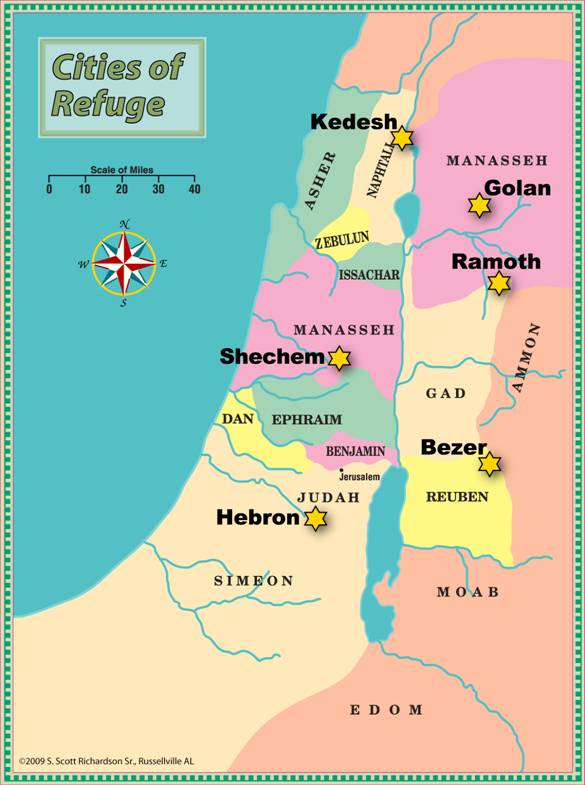
A Gracious Source of Refuge and Hope

And the Lord spoke to Moses, saying, 10 “Speak to the people of Israel and say to them, When you cross the Jordan into the land of Canaan, 11 then you shall select cities to be cities of refuge for you, that the manslayer who kills any person without intent may flee there. 12 The cities shall be for you a refuge from the avenger, that the manslayer may not die until he stands before the congregation for judgment. 13 And the cities that you give shall be your six cities of refuge. 14 You shall give three cities beyond the Jordan, and three cities in the land of Canaan, to be cities of refuge. 15 These six cities shall be for refuge for the people of Israel, and for the stranger and for the sojourner among them, that anyone who kills any person without intent may flee there.

16 “But if he struck him down with an iron object, so that he died, he is a murderer. The murderer shall be put to death. 17 And if he struck him down with a stone tool that could cause death, and he died, he is a murderer. The murderer shall be put to death. 18 Or if he struck him down with a wooden tool that could cause death, and he died, he is a murderer. The murderer shall be put to death. 19 The avenger of blood shall himself put the murderer to death; when he meets him, he shall put him to death. 20 And if he pushed him out of hatred or hurled something at him, lying in wait, so that he died, 21 or in enmity struck him down with his hand, so that he died, then he who struck the blow shall be put to death. He is a murderer. The avenger of blood shall put the murderer to death when he meets him.

22 “But if he pushed him suddenly without enmity, or hurled anything on him without lying in wait 23 or used a stone that could cause death, and without seeing him dropped it on him, so that he died, though he was not his enemy and did not seek his harm, 24 then the congregation shall judge between the manslayer and the avenger of blood, in accordance with these rules. 25 And the congregation shall rescue the manslayer from the hand of the avenger of blood, and the congregation shall restore him to his city of refuge to which he had fled, and he shall live in it until the death of the high priest who was anointed with the holy oil. 26 But if the manslayer shall at any time go beyond the boundaries of his city of refuge to which he fled, 27 and the avenger of blood finds him outside the boundaries of his city of refuge, and the avenger of blood kills the manslayer, he shall not be guilty of blood. 28 For he must remain in his city of refuge until the death of the high priest, but after the death of the high priest the manslayer may return to the land of his possession. 29 And these things shall be for a statute and rule for you throughout your generations in all your dwelling places.

30 “If anyone kills a person, the murderer shall be put to death on the evidence of witnesses. But no person shall be put to death on the testimony of one witness. 31 Moreover, you shall accept no ransom for the life of a murderer, who is guilty of death, but he shall be put to death. 32 And you shall accept no ransom for him who has fled to his city of refuge, that he may return to dwell in the land before the death of the high priest. 33 You shall not pollute the land in which you live, for blood pollutes the land, and no atonement can be made for the land for the blood that is shed in it, except by the blood of the one who shed it. 34 You shall not defile the land in which you live, in the midst of which I dwell, for I the Lord dwell in the midst of the people of Israel.”  Numbers 35:9-34 ESV

The level of detail found in God’s instructions to His people is staggering. In His divine wisdom and according to His intimate understanding of His chosen people, God left nothing to chance or up to their less-than-stellar discretion.  In this chapter, Moses records God’s instructions for the establishment of the six cities of refuge to be located throughout the land of Canaan. These cities were to be strategically placed within the land allotments of the other tribes and occupied by the Levites. Their decentralized locations would make them easily accessible from all parts of the land of Canaan, and their purpose was to provide a safe haven for anyone who had committed unpremeditated murder.  If an Israelite inadvertently and unintentionally caused the death of a fellow Israelite, he could flee to one of these cities and seek refuge from the avenger.

In the cultural context of that day, it was up to the relatives of a murder victim to seek vengeance. This “blood avenger” (Numbers 35:19) was not just free to kill the murdered, he was obligated to do so (Numbers 35:19, 21). It was his duty. He was called the “avenger of blood.”

But in order to prevent the blood avenger from taking the life of an innocent individual, the cities of refuge were established. If an Israelite accidentally killed someone else, he could run to one of these cities and seek refuge. As long as he remained there, he would be protected from the legally sanctioned actions of the blood avenger. It was up to the residents of the city (Levites) to help determine the guilt or innocence of the accused. If it was determined that his actions were premeditated and intentional, he was to be handed over to the blood avenger for retribution. But if he was deemed innocent of having committed voluntary manslaughter, he would be allowed to remain in the city of refuge until the high priest died. In essence, the city became his prison. If he ever left, he would be guilty of violating his sentence and the blood avenger could seek his death.

All of this sounds very barbaric to us, but you have to remember that Israel had no police force to enforce laws or dispense justice. According to the Mosaic Law, murder was a crime worthy of death; the guilty must be punished. But involuntary manslaughter was to be dealt with differently.; that is why the cities were established. God was protecting the innocent.

God dwelt among His people, and His very presence demanded that they live set-apart lives. His holiness and righteousness required that they live differently and distinctively, abiding by a stringent set of rules and regulations that governed their behavior and interactions with one another. Yet God knew their weaknesses and fully understood their incapacity to live up to His exacting standards. The entire sacrificial system was designed to deal with their ongoing struggle with sin.

To unjustly execute the innocent would have been as evil in God’s sight as to excuse the guilty. So, for those who committed involuntary manslaughter, He provided a means for finding justice. If an Israelite unintentionally murdered a fellow Israelite, he could flee to a city of refuge and enjoy permanent protection from the “blood avenger.” He was still guilty of murder, but his life would be spared. The city of refuge became his prison until the day that the high priest died. The high priest’s death would serve as an atonement for the guilty party’s sin, providing them with release from their guilt and the right to live among their kinsmen again – fully innocent and free.

But what was behind the rather strange legal precedent? Due to the sinfulness of the Israelites, the ongoing presence of God was constantly in jeopardy due to their inability to live up to His strict moral standards. Even unintentional sins could end up jeopardizing their enjoyment of His ongoing presence and power. So, He provided them with countless means by which they could receive restoration and assure His continued existence among them. It was God who set them apart. Without Him, they would have been nothing. It was His presence that provided their distinctiveness, and it was their sin that threatened their uniqueness as His chosen people.

From the day that Adam and Eve sinned in the garden, God has been actively and aggressively seeking to restore order to the chaos created by their actions. Their sin brought disorder, disobedience, and, ultimately, death into the world. It wasn’t long after Eve listened to the lies of the enemy and convinced her husband to join her in rejecting God’s word, that death showed up on the scene. Eventually, one of Eve’s own sons determined to kill his own brother, introducing the shadow of death into the once-idyllic garden. In time, the presence of disease would follow close behind, with their bodies undergoing the inevitable effects of aging. Sin would increase, rebellion against God would run rampant, and yet, God continued to reach out to mankind, offering a form of refuge from the consequences of sin.

In a real sense, God’s choice of Abraham made him and his descendants a “city of refuge” for mankind. The people of Israel became the solitary source of God’s abiding presence and divine protection from the guilt and condemnation of sin. It was among the children of God that men could find access to their Creator. It was through the law of God that men could learn His divine requirements and expectations for holiness. It was through His mandatory sacrificial system that men could find atonement for their sins and freedom from the penalty of death they so justly deserved. God had provided a city of refuge among the sons of men.

Eventually, God would send His own Son as the ultimate and final means of refuge and escape from sin’s destructive power and God’s righteous judgment. The Scriptures make it painfully clear that all men are guilty of sin.

For all have sinned and fall short of the glory of God.– Romans 3:23 ESV

Surely there is not a righteous man on earth who does good and never sins. – Ecclesiastes 7:20 ESV

Who can say, “I have made my heart pure; I am clean from my sin?” – Proverbs 20:9 ESV

We are all infected and impure with sin. When we display our righteous deeds, they are nothing but filthy rags. – Isaiah 64:6 NLT

The law of God was given to reveal to men the reality and gravity of their sins. Like a speed limit sign on the side of the freeway, the law provided a constant reminder of man’s proclivity for disobedience and rebellion. Our guilt is unquestionable and undeniable. Sinful humanity stands condemned before a holy and righteous God due to the sinful nature passed down to them from Adam and Eve. All are guilty and all stand condemned. And the very presence of disease and death in our world is an outward reminder of the reality of sin’s devastating consequences.

In the case of someone seeking refuge in one of these cities, if they remained there until the high priest died, their sin was forgiven. They walked away free and clear. The death of the high priest had atoning value just as Jesus’ death atones for our sins.

No one could accuse this person of guilt or condemnation once the high priest had died. And, according to the apostle Paul, those who place their faith in Christ’s death, stand as unaccused and uncondemned because of His atoning work on their behalf.

Who dares accuse us whom God has chosen for his own? Will God? No! He is the one who has given us right standing with himself. Who then will condemn us? Will Christ Jesus? No, for he is the one who died for us and was raised to life for us and is sitting at the place of highest honor next to God, pleading for us. – Romans 8:33-34 NLT

We can take refuge in Christ. He is our high priest and He has died for us. His death has set us free once and for all.

God also bound himself with an oath, so that those who received the promise could be perfectly sure that he would never change his mind. So God has given us both his promise and his oath. These two things are unchangeable because it is impossible for God to lie. Therefore, we who have fled to him for refuge can take new courage, for we can hold on to his promise with confidence. This confidence is like a strong and trustworthy anchor for our souls. It leads us through the curtain of heaven into God’s inner sanctuary. Jesus has already gone in there for us. He has become our eternal High Priest in the line of Melchizedek. – Hebrews 6:17-20 NLT

Like everything else under the old covenant, the cities of refuge were designed to foreshadow Christ. They provide a glimpse into the heart of God, presaging a time when He would send His Son as the ultimate source of refuge for the guilty and condemned. All those who stand accused and worthy of death can find safety and solace in the arms of Christ. But even better than that, His death as the greater high priest paid the penalty for their sin and provided them with full atonement and forgiveness. Their sin is wiped clean and their relationship with God is fully restored.

English Standard Version (ESV) The Holy Bible, English Standard Version. ESV® Permanent Text Edition® (2016). Copyright © 2001

New Living Translation (NLT) Holy Bible, New Living Translation, copyright © 1996, 2004, 2015 by Tyndale House Foundation. Used by permission of Tyndale House Publishers Inc., Carol Stream, Illinois 60188. All rights reserved.

The Standard For Forgiveness

23 “Therefore the kingdom of heaven may be compared to a king who wished to settle accounts with his servants. 24 When he began to settle, one was brought to him who owed him ten thousand talents. 25 And since he could not pay, his master ordered him to be sold, with his wife and children and all that he had, and payment to be made. 26 So the servant fell on his knees, imploring him, ‘Have patience with me, and I will pay you everything.’ 27 And out of pity for him, the master of that servant released him and forgave him the debt. 28 But when that same servant went out, he found one of his fellow servants who owed him a hundred denarii, and seizing him, he began to choke him, saying, ‘Pay what you owe.’ 29 So his fellow servant fell down and pleaded with him, ‘Have patience with me, and I will pay you.’ 30 He refused and went and put him in prison until he should pay the debt. 31 When his fellow servants saw what had taken place, they were greatly distressed, and they went and reported to their master all that had taken place. 32 Then his master summoned him and said to him, ‘You wicked servant! I forgave you all that debt because you pleaded with me. 33 And should not you have had mercy on your fellow servant, as I had mercy on you?’ 34 And in anger his master delivered him to the jailers, until he should pay all his debt. 35 So also my heavenly Father will do to every one of you, if you do not forgive your brother from your heart.” –  Matthew 18:23-35 ESV

In an effort to drive home His message regarding forgiveness, Jesus told His disciples a parable. It’s important to remember that this whole section of Matthew’s gospel had begun with an argument among the disciples about who among them was the greatest in the kingdom of heaven. They were obviously thinking that Jesus was going to set up a kingdom on earth where they would rule and reign alongside Him. That’s why the two brothers, James and John, had asked Jesus to do them a favor.

“When you sit on your glorious throne, we want to sit in places of honor next to you, one on your right and the other on your left.” – Mark 10:37 NLT

Their perception of the kingdom was all about power, position, and prominence. But Jesus was attempting to show them that it was about character and conduct. The day was coming when Jesus would establish His kingdom on earth, but that would not take place until after the Great Tribulation – an event reserved for the end of the age. In the meantime, those who would become members of His spiritual kingdom were to lives marked by humility, compassion, forgiveness, and love.

Jesus had come to change the hearts of men and, as a result, their outward behavior. Rather than arguing about who was the greatest, the disciples should have been introducing others to the Messiah. They should have been following the example of Jesus by serving the needs of those who were burdened by the cares of this world.

One of the marks of a follower of Jesus Christ should be a capacity to forgive others as they have been forgiven by God. Peter wanted to put a limit on how many times he should have to forgive a brother who sinned against him. He chose the number seven. But Jesus raised the ante by stating, “I do not say to you seven times, but seventy-seven times” (Matthew 18:22 ESV). In essence, there was to be no limit. Just as God puts no limit on the number of times we can come to Him for forgiveness.

If we confess our sins, he is faithful and just to forgive us our sins and to cleanse us from all unrighteousness. – 1 John 1:9 ESV

At the dedication of the temple in Jerusalem, Solomon had prayed, “May you hear the humble and earnest requests from me and your people Israel when we pray toward this place. Yes, hear us from heaven where you live, and when you hear, forgive” (1 Kings 8:30 ESV).  Solomon went on to give a list of what-if scenarios, describing situations in which the people of God might sin against God and then call on Him for forgiveness. Because he knew it was inevitable that they would sin.

“The time will come when your people will sin against you (for there is no one who is sinless!) and you will be angry with them and deliver them over to their enemies, who will take them as prisoners to their own land, whether far away or close by. When your people come to their senses in the land where they are held prisoner, they will repent and beg for your mercy in the land of their imprisonment, admitting, ‘We have sinned and gone astray; we have done evil.’ When they return to you with all their heart and being in the land where they are held prisoner, and direct their prayers to you toward the land you gave to their ancestors, your chosen city, and the temple I built for your honor, then listen from your heavenly dwelling place to their prayers for help and vindicate them. Forgive all the rebellious acts of your sinful people and cause their captors to have mercy on them.” – 1 Kings 8:46-50 NLT

Solomon greatly desired that God would extend forgiveness, regardless of the circumstances involved or the number of times a request was invoked. Unlike Peter, Solomon wanted God to place no numerical limits on God’s forgiveness.

Like Solomon, we expect God to forgive us, regardless of the nature of our sin or the number of times we ask. Which brings us to Jesus’ parable. He used a story to drive home His message about forgiveness and life within His kingdom. A certain king called together his bondservants, requiring them to settle their debts with him. In this parable, the debts symbolize sin. The inference in the story is that all of the king’s bondservants owed him something. Remember the words of Solomon: “for there is no one who is sinless!”

One particular bondservant owed the king 10,000 talents. To understand the magnitude of this man’s debt, you have to realize that, at that time, a single talent was equivalent to 20-years wages for a servant. This man’s debt was astronomical and beyond his capacity to repay. So, the king ordered that the man, his family, and all his possessions be sold in order to recoup some of the loss. But the man begged the king for leniency. He knew he was at the king’s mercy and, in spite of the magnitude of his debt, he asked the king to give him time to come up with the money.

This was an absurd request. The servant and the king both knew that repayment was impossible. We are not told how the servant amassed such a debt, but his ability to make restitution was well beyond his means. The king, in an attempt to cut his losses, determined to sell the man and his family as slaves. But the servant begged the king for time, vowing to pay his debt in full. Amazingly, in a display of pity for the man’s predicament, the king “released him and forgave him the debt” (Matthew 18:27 ESV).

Don’t miss that last part. It is essential to understanding this parable. The king didn’t give the man extra time. He didn’t lower the interest rate on the note or decrease the amount owed. He forgave the man’s entire debt. He wiped the slate clean.

But rather than rejoicing at this incredible news, the forgiven man immediately accosted a fellow servant who owed him money. This man’s debt was a hundred denarii. A denarius was worth a single day’s wages for the average servant. From the debtor’s perspective, it was a lot of money, but nothing when compared to the amount the first man had owed. And yet, the forgiven servant demanded immediate payment. He wanted the debt settled at once. And his fellow servant responded just as he had, saying, “Have patience with me, and I will pay you.” But rather than pass on the grace and mercy he had been shown, the man had his fellow servant thrown into jail.

When the king was informed that one of his servants had been jailed, he was surprised and angered. Calling in the ungrateful servant, the king told him, “Evil slave! I forgave you all that debt because you begged me! Should you not have shown mercy to your fellow slave, just as I showed it to you?” (Matthew 18:32-33 NLT).

This man had been forgiven a great debt – one he could have never repaid. The king had given him what he did not deserve and what he had not asked for: Complete forgiveness of his debt. But then the man had turned around and had refused to extend forgiveness to someone else. It was the apostle Paul who stressed the need for believers to forgive as they have been forgiven.

Make allowance for each other’s faults, and forgive anyone who offends you. Remember, the Lord forgave you, so you must forgive others. – Colossians 3:13 NLT

Instead, be kind to each other, tenderhearted, forgiving one another, just as God through Christ has forgiven you. – Ephesians 4:32 NLT

It’s important to notice the punishment meted out by the king. He has the man thrown in jail “until he should pay all his debt.” The inference, based on the size of the debt, is that the man will spend an eternity in jail. Even if he was still able to earn a normal day’s wage, it would take him 200,000 years to repay the debt.

And Jesus dropped a bombshell on His disciples by announcing, “So also my heavenly Father will do to every one of you, if you do not forgive your brother from your heart” (Matthew 18:35 ESV). Was Jesus announcing that eternal punishment awaits those who refuse to forgive? Was He teaching the possibility of the loss of our salvation? It would seem, based on the context in which Jesus told this parable, that He is simply trying to stress the extreme importance of forgiveness. It is to be a cardinal characteristic of the true follower of Christ. And it is those who recognize the degree of their sin debt and the remarkable grace of God’s forgiveness, who will be willing to express their gratitude by extending forgiveness to others. A man who has been forgiven much, but who refuses to forgive others, has never fully recognized the magnitude of his own sin debt. He is driven by pride, not humility. He is marked by arrogance, not gratitude.

At one point in His ministry, Jesus had his feet washed by a woman whom Luke referred to as immoral. The shocked Pharisees called her a sinner. But Jesus stated, “I tell you, her sins—and they are many—have been forgiven, so she has shown me much love. But a person who is forgiven little shows only little love” (Luke 7:47 NLT).

Our sin debt is great. It is beyond our capacity to repay. And yet, Jesus died on the cross in order to ransom us from that debt. He paid the price we could not pay. And our gratitude for what He has done for us should show up in our willingness to forgive those who sin against us. 

English Standard Version (ESV)
The Holy Bible, English Standard Version. ESV® Permanent Text Edition® (2016). Copyright © 2001 by Crossway Bibles, a publishing ministry of Good News Publishers.

New Living Translation (NLT)
Holy Bible, New Living Translation, copyright © 1996, 2004, 2015 by Tyndale House Foundation. Used by permission of Tyndale House Publishers Inc., Carol Stream, Illinois 60188. All rights reserved.

The Message (MSG)Copyright © 1993, 1994, 1995, 1996, 2000, 2001, 2002 by Eugene H. Peterson

And This Is the Thanks I Get?

And you gave them this land, which you swore to their fathers to give them, a land flowing with milk and honey. And they entered and took possession of it. But they did not obey your voice or walk in your law. They did nothing of all you commanded them to do. Therefore you have made all this disaster come upon them. – Jeremiah 32:22-23 ESV

Jeremiah 32:17-25

Sometimes a little bit of reflection can go a long way. Jeremiah had taken time to look back on Israel’s long relationship with God and had recalled the faithfulness of God. He had remembered all that God had done for them as a people. From the moment He had called Abram out of Ur of the Chaldees to the day He had appointed David the king of Israel, God had been there for nation of Israel. He had promised them the land of Canaan and He had made good on that promise. When they had taken possession of the land God had reminded them, “I gave you a land on which you had not labored and cities that you had not built, and you dwell in them. You eat the fruit of vineyards and olive orchards that you did not plant” (Joshua 24:13 ESV). He had done these things, not because they had deserved it or had earned it, but out of His grace and mercy and in order to fulfill His word.

And how had they responded to the kindness of God? With disobedience. In exchange for His unmerited favor and undeserved love, God had simply asked that they treat Him with the dignity and respect He deserved. He expected them to stay faithful to Him alone and worship no other gods beside Him. He gave them laws to follow that would set them apart from all the other nations and protect them from committing sins that could result in their own harm and destruction. But as Jeremiah so sadly recalled, “But they did not obey your voice or walk in your law. They did nothing of all you commanded them to do.” They had returned God’s faithfulness with unfaithfulness. They had repeatedly disobeyed, disrespected and dismissed God, treating Him as irrelevant, replaceable, or even optional in their lives. And now they were about to reap the results of their long history of ingratitude and insubordination. God was not going to tolerate their behavior any longer. 

Sometimes, in our obsession over the grace and mercy of God, we can tend to neglect the doctrine of God’s holiness. We can forget that God is holy in all His ways and cannot tolerate sin. Yes, He is able to offer forgiveness and extend mercy to mankind because of the sacrificial death of His own Son. But Christ’s death did not diminish the seriousness of sin, it simply provided a payment for the penalty. In fact, the death of God’s Son provides us with some idea of just how serious God takes sin. The only payment He could accept that would satisfy His own need for justice and cover the steep price to cover the penalty due for the sins of mankind was the life of His own sinless Son. When we look back at the history of Israel and see God bringing destruction on the people He had chosen as His very own possession, we should be reminded of just how much God hates sin. He couldn’t just overlook it and dismiss it. He couldn’t just say, “Boys will be boys” and act as if it was not that big a deal. Sin was and always will be a bid deal to a holy, righteous God. Sin is an affront to His character. It is rebellion against His sovereign rule. It is a slap in the face of God by the ones He has made and who exist only by His grace and mercy.

As believers, while our sins have been paid for in full by Jesus, that does not give us the right to act as if our sins no longer matter or carry no weight. Paul had to deal with this kind of illogical thinking when he wrote to the Christians in Rome. “Well then, since God’s grace has set us free from the law, does that mean we can go on sinning? Of course not!” (Romans 6:15 NLT). In fact, Paul had told them, “Do not let sin control the way you live; do not give in to sinful desires. Do not let any part of your body become an instrument of evil to serve sin. Instead, give yourselves completely to God, for you were dead, but now you have new life. So use your whole body as an instrument to do what is right for the glory of God. Sin is no longer your master, for you no longer live under the requirements of the law. Instead, you live under the freedom of God’s grace” (Romans 6:12-14 NLT). As those who had benefited from the grace of God made possible through the death of His own Son, they were to take sin seriously and treat God with the gratitude and respect He deserves by glorifying Him through obedient, righteous living. God’s grace is not a license to sin. It is a gift to be appreciated and treated with great honor and respect. God paid a high price in order for us to enjoy a right relationship with Him. He gave His own Son and made it possible for us to exchange our sin for His righteousness. He died so that we might live. Our sins were the cause of Christ’s death. His death was the cost required for our salvation. Our obedience is the least we could do to express our thankfulness for all that God has done. Our hatred and rejection of sin is a great way to let God know just how much we love and appreciate Him.