Fair-Weather Faith

1 When the people saw that Moses delayed to come down from the mountain, the people gathered themselves together to Aaron and said to him, “Up, make us gods who shall go before us. As for this Moses, the man who brought us up out of the land of Egypt, we do not know what has become of him.” So Aaron said to them, “Take off the rings of gold that are in the ears of your wives, your sons, and your daughters, and bring them to me.” So all the people took off the rings of gold that were in their ears and brought them to Aaron. And he received the gold from their hand and fashioned it with a graving tool and made a golden calf. And they said, “These are your gods, O Israel, who brought you up out of the land of Egypt!” When Aaron saw this, he built an altar before it. And Aaron made a proclamation and said, “Tomorrow shall be a feast to the Lord.” And they rose up early the next day and offered burnt offerings and brought peace offerings. And the people sat down to eat and drink and rose up to play. – Exodus 32:1-6 ESV

While Moses had been up on the mountaintop receiving the Decalogue and the Book of the Covenant from God, he had left his brother, Aaron, in charge of the people down in the valley. The last they had seen of Moses was him ascending Mount Sinai into the dark storm cloud. The thunder, lightning, and earth-shaking signs that accompanied God’s presence at Sinai had left them terrified and unwilling to go anywhere near the mountain or its summit. They wanted nothing to do with Yahweh and were content to let Moses act as their proxy.

Then Moses climbed up the mountain, and the cloud covered it. And the glory of the Lord settled down on Mount Sinai, and the cloud covered it for six days. On the seventh day the Lord called to Moses from inside the cloud. To the Israelites at the foot of the mountain, the glory of the Lord appeared at the summit like a consuming fire. Then Moses disappeared into the cloud as he climbed higher up the mountain. He remained on the mountain forty days and forty nights. – Exodus 24:15-18 NLT

During those 40 days and nights, the people of Israel began to wonder whether Moses was ever coming back. His long delay left them concerned about his safety and their own future. What would they do if Moses never came back? For all they knew, Moses had died on the mountaintop, a victim of Yahweh’s wrath.

It’s important to remember the sequence of events that precede chapter 32. God has already given Moses His laws and regulation, and Moses has shared them with the people. Not only that, the people expressed their eager willingness to obey all that God commanded.

Then Moses went down to the people and repeated all the instructions and regulations the Lord had given him. All the people answered with one voice, “We will do everything the Lord has commanded.” – Exodus 24:3 NLT

Following this corporate commitment to keep God’s laws, Moses wrote them all down for posterity (Exodus 24:4). Having completed his record of God’s commands, Moses “took the Book of the Covenant and read it aloud to the people” and, once again, “they all responded, ‘We will do everything the Lord has commanded. We will obey’” (Exodus 24:7 NLT). The people had heard every one of God’s commands and had agreed to keep them.

As part of the ceremony to inaugurate the institution of God’s laws, Moses offered blood sacrifices and sprinkled some of the blood on the people, telling them, “Look, this blood confirms the covenant the Lord has made with you in giving you these instructions” (Exodus 24:8 NLT). They had made a vow to obey all of God’s commands, and now that agreement had been sealed with blood, making it binding and carrying a penalty of death if they broke their commitment. This auspicious ceremony was then followed by a special invitation-only meal between some of the leadership of Israel and God Almighty.

Then Moses, Aaron, Nadab, Abihu, and the seventy elders of Israel climbed up the mountain. There they saw the God of Israel. Under his feet there seemed to be a surface of brilliant blue lapis lazuli, as clear as the sky itself. And though these nobles of Israel gazed upon God, he did not destroy them. In fact, they ate a covenant meal, eating and drinking in his presence! – Exodus 24:9-11 NLT

Then Moses was told to ascend back to the mountaintop where God promised to give a copy of the Ten Commandments written by His own hand.

“Come up to me on the mountain. Stay there, and I will give you the tablets of stone on which I have inscribed the instructions and commands so you can teach the people.” So Moses and his assistant Joshua set out, and Moses climbed up the mountain of God. – Exodus 24:12-13 NLT

Moses left Aaron and the elders of Israel in charge during his absence. These were the very same men who had been given the privilege of seeing the God of Israel and eating a covenant meal with Him. In sharing that meal with Yahweh, they had personally sealed their commitments to the covenant and pledged themselves to see that every law God had given was obeyed by the people of Israel.

What happens next is critical. According to chapter 24, Moses returned to the top of Mount Sinai, “And the glory of the Lord settled down on Mount Sinai, and the cloud covered it for six days. On the seventh day the Lord called to Moses from inside the cloud. To the Israelites at the foot of the mountain, the glory of the Lord appeared at the summit like a consuming fire. Then Moses disappeared into the cloud as he climbed higher up the mountain. He remained on the mountain forty days and forty nights” (Exodus 24:16-18 NLT).

This brings us to the events recorded in chapter 32. At the end of the 40 days, “When the Lord finished speaking with Moses on Mount Sinai, he gave him the two stone tablets inscribed with the terms of the covenant, written by the finger of God.” (Exodus 31:18 NLT).

Moses left the mountaintop with the God-inscribed copy of the Decalogue and all the instructions regarding the construction of the Tabernacle and the establishment of the priesthood. His arms and his mind were full of the divinely revealed will of God for the people of Israel. It is essential to understand that Moses was coming down from the mountain with not only the Ten Commandments but the plans for the Tabernacle, the house within which God’s presence was to dwell among the people. God had made a commitment to live among His chosen people in a house that they could construct with their own hands and pay for with their own resources.

But all that God had shared with Moses regarding the Tabernacle stands in direct opposition to what was taking place down in the valley. In Moses’ absence, the people began to have second thoughts about Yahweh. They were well aware of His commands and had heard every one of the regulations contained in the Book of the Covenant. They had even given their hearty approval and voiced their full commitment to living their lives according to God’s law.

But it took just over a month for the people of Israel to lose all their enthusiasm. The longer Moses delayed, the more they began to have second thoughts about everything. In their minds, Moses was Yahweh’s official representative and spokesperson. If Moses wasn’t coming back, their link to Yawheh would be broken. After all, it had been Moses who showed up in Egypt with news of their deliverance by the hand of Yahweh. And Moses had been the one to lead them out of Egypt and into the wilderness with the help of his God. But with Moses apparently gone, they began to question Yahweh and all the commitments they had made to Him.

When the people saw how long it was taking Moses to come back down the mountain, they gathered around Aaron. “Come on,” they said, “make us some gods who can lead us. We don’t know what happened to this fellow Moses, who brought us here from the land of Egypt.” – Exodus 32:1 NLT

With Moses out of the picture, the people turned to Aaron. At this point, Aaron had no concept of God’s plans regarding the Tabernacle and his future role as the high priest. That information resided with Moses and he had not yet returned to share it. So, when the people came to Aaron and expressed their desire to replace Yahweh with another god, he eagerly obliged them.

“Take the gold rings from the ears of your wives and sons and daughters, and bring them to me.” – Exodus 32:2 NLT

Little did Aaron know that he was taking what belonged to Yahweh and ordering it to be used for idolatry. He was unaware that God had given Moses a very different use for the resources of the people of Israel.

The Lord said to Moses, “Speak to the people of Israel, that they take for me a contribution. From every man whose heart moves him you shall receive the contribution for me. And this is the contribution that you shall receive from them: gold, silver, and bronze, blue and purple and scarlet yarns and fine twined linen, goats’ hair, tanned rams’ skins, goatskins, acacia wood, oil for the lamps, spices for the anointing oil and for the fragrant incense, onyx stones, and stones for setting, for the ephod and for the breastpiece. And let them make me a sanctuary, that I may dwell in their midst. Exactly as I show you concerning the pattern of the tabernacle, and of all its furniture, so you shall make it.” – Exodus 25:1-9 NLT

Aaron ordered the people to donate their gold earrings to construct an idol that was intended to replace Yahweh. This false god would take the place of the one true God. And in carrying out the will of the people, Aaron violated the very first commandment of the Decalogue.

“You must not have any other god but me. You must not make for yourself an idol of any kind or an image of anything in the heavens or on the earth or in the sea. You must not bow down to them or worship them, for I, the Lord your God, am a jealous God who will not tolerate your affection for any other gods.” – Exodus 20:3-5 NLT

And the man who oversaw the construction of this false god was the one whom God had chosen to serve as the high priest of Israel.

Then Aaron took the gold, melted it down, and molded it into the shape of a calf. – Exodus 32:4 NLT

God had great plans for Aaron and the people of Israel. They had no way of knowing that Moses was on his way down the mountain with God’s blueprints for the Tabernacle and His plans for the atoning work of the priesthood. The creator of heaven and earth was getting ready to take up residence among them, and yet they were busy replacing Him with a false god of their own design. And when Aaron had completed the construction of the golden calf and its accompanying altar, the people exclaimed, “O Israel, these are the gods who brought you out of the land of Egypt!” (Exodus 32:4 NLT).
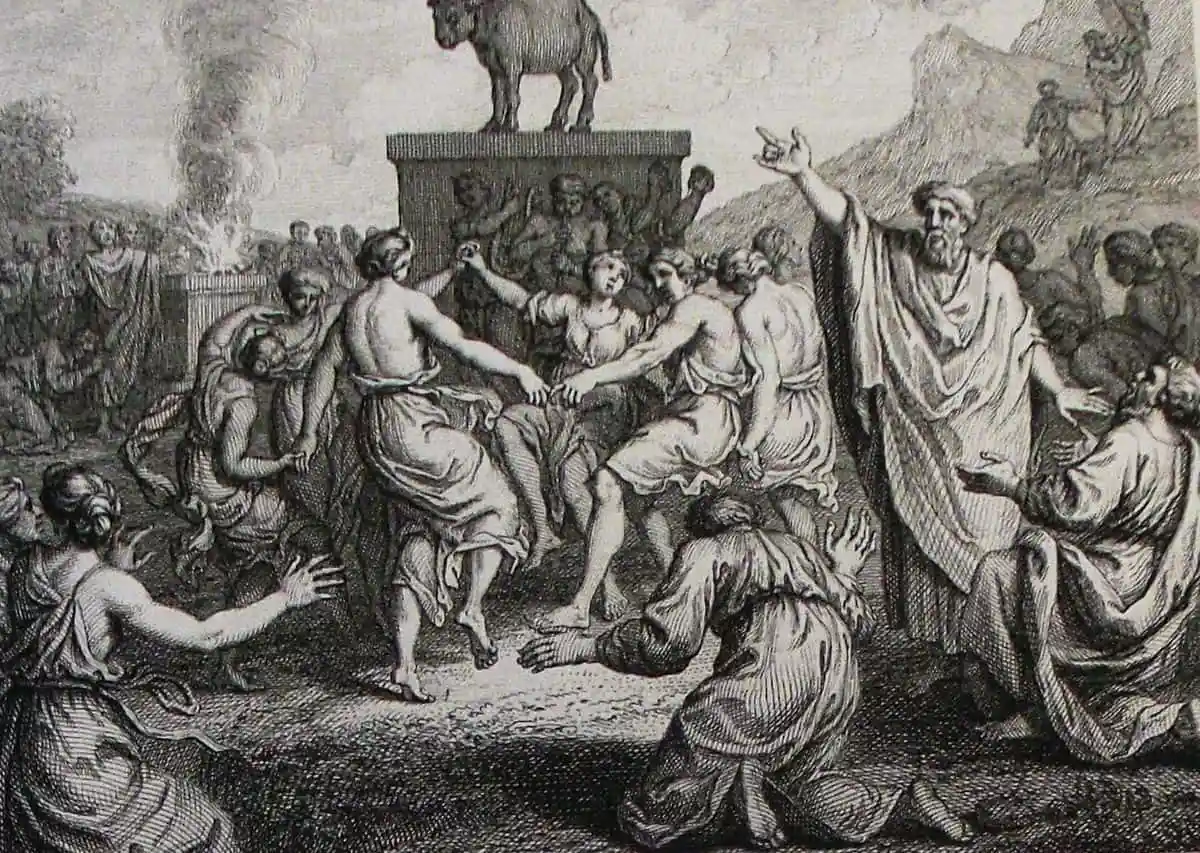
Buoyed by the people’s enthusiasm, Aaron declared a feast for the following day so that the people might worship their newfound god. And sadly, the text records that “The people got up early the next morning to sacrifice burnt offerings and peace offerings. After this, they celebrated with feasting and drinking, and they indulged in pagan revelry” (Exodus 32:6 NLT).

Don’t miss the irony in all of this. Moses was coming down the mountain with all the details concerning the Tabernacle, the priesthood, and the sacrificial system. He had the plans for the Bronze Altar and directions for how the people might receive atonement and cleansing for their sins. But before his feet could reach the valley floor, the people of Israel had decided to come up with a plan of their own. It took just 40 days for the Israelites to forget Yahweh and every commitment they had made to Him. In their minds, He had always been Moses’ God and not their own. So, when Moses failed to return, they seized the opportunity to seek and serve another god.

English Standard Version (ESV) The Holy Bible, English Standard Version. ESV® Permanent Text Edition® (2016). Copyright © 2001

New Living Translation (NLT) Holy Bible, New Living Translation, copyright © 1996, 2004, 2015 by Tyndale House Foundation. Used by permission of Tyndale House Publishers Inc., Carol Stream, Illinois 60188. All rights reserved.

Just Say Yes

1 Then Moses answered, “But behold, they will not believe me or listen to my voice, for they will say, ‘The Lord did not appear to you.’” The Lord said to him, “What is that in your hand?” He said, “A staff.” And he said, “Throw it on the ground.” So he threw it on the ground, and it became a serpent, and Moses ran from it. But the Lord said to Moses, “Put out your hand and catch it by the tail”—so he put out his hand and caught it, and it became a staff in his hand— “that they may believe that the Lord, the God of their fathers, the God of Abraham, the God of Isaac, and the God of Jacob, has appeared to you.” Again, the Lord said to him, “Put your hand inside your cloak.” And he put his hand inside his cloak, and when he took it out, behold, his hand was leprous like snow. Then God said, “Put your hand back inside your cloak.” So he put his hand back inside his cloak, and when he took it out, behold, it was restored like the rest of his flesh. “If they will not believe you,” God said, “or listen to the first sign, they may believe the latter sign. If they will not believe even these two signs or listen to your voice, you shall take some water from the Nile and pour it on the dry ground, and the water that you shall take from the Nile will become blood on the dry ground.”

10 But Moses said to the Lord, “Oh, my Lord, I am not eloquent, either in the past or since you have spoken to your servant, but I am slow of speech and of tongue.” 11 Then the Lord said to him, “Who has made man’s mouth? Who makes him mute, or deaf, or seeing, or blind? Is it not I, the Lord? 12 Now therefore go, and I will be with your mouth and teach you what you shall speak.” 13 But he said, “Oh, my Lord, please send someone else.” 14 Then the anger of the Lord was kindled against Moses and he said, “Is there not Aaron, your brother, the Levite? I know that he can speak well. Behold, he is coming out to meet you, and when he sees you, he will be glad in his heart. 15 You shall speak to him and put the words in his mouth, and I will be with your mouth and with his mouth and will teach you both what to do. 16 He shall speak for you to the people, and he shall be your mouth, and you shall be as God to him. 17 And take in your hand this staff, with which you shall do the signs.” – Exodus 4:1-17 ESV

Moses has seen a burning bush, heard a disembodied voice, and been given a name to go with the source of that voice. By now, he is convinced that it is indeed Jehovah, “the existing one,” with whom he has been speaking, and he fully understands the parameters of the mission he has been given. All of that becomes clear from the very next words that come out of his mouth.

“…behold, they will not believe me or listen to my voice, for they will say, ‘The Lord [Jehovah] did not appear to you.’” – Exodus 4:1 ESV

Moses understands that he is to return to his people in Egypt and give them a message from Jehovah, but he is unconvinced that this mission will succeed. Despite all of God’s assurances, Moses is reluctant to accept the assignment he has been given. There can be little doubt that fear is a primary factor behind Moses’ reticence. He knows that a return to Egypt, even after his lengthy absence, will be risky and potentially deadly. He has a bounty on his head for the murder of an Egyptian, so returning to the scene of the crime doesn’t seem like a particularly smart thing to do.

And it is apparent that Moses has strong doubts about his ability to win over his fellow Hebrews. After all, he had spent the majority of his life living in luxury within the walls of Pharaoh’s palace. To the Israelites, Moses was a turncoat and a traitor. From their perspective, he had “slept” with the enemy and could not be trusted.

So, Moses steps up to the bar and pleads his case with the Almighty. This time, he argues that the Israelites will never believe that he has spoken with Jehovah. After all, no one has heard a word from the Lord for more than 400 years. During that extended period of silence, most of the Israelites had chosen to align themselves with one or more of the gods of Egypt. It was a common belief in those days that deities were regionally based. Their authority and sphere of influence were localized to a particular geographic area. The ancient pagan nations perceived each god or goddess as having a particular domain or sphere of power on the earth. They even assigned oversight of the different parts of that domain to different gods. So, there were gods of the forests, the crops, the mountains, the seas, and the rivers.

Moses feared that when he returned to Egypt declaring to have received a message from Jehovah, the Israelites would never believe him. Some would believe that Jehovah was somewhere back in Canaan and had forgotten all about them. Others would believe His power was limited and prove to be impotent in distant Egypt. Still, others would simply deem Moses a liar who never heard from Jehovah in the first place.

God listens patiently, then proceeds to assuage Moses’ fears with a convincing demonstration of power that was also meant to foreshadow His judgment. God ordered Moses to throw down his shepherd’s staff and, when he did, it was miraculously transformed into a snake. While it’s likely that this powerful visual demonstration got Moses’ attention, he may not have immediately recognized its meaning. God was making an important point that was meant to convey His supreme authority as the one true God.

In Egyptian culture, the snake played an important role. The Uraeus (“rearing cobra”) was the stylized form of an Egyptian cobra that graced the crown of the Pharaoh. Displayed with a flared neck and in an upright position as if preparing to strike, this symbolic image was meant to represent Pharaoh’s sovereignty, royalty, and divine authority.

Whether he realized it or not, Moses was standing before a living symbol of Pharaoh’s power and authority. And when God commanded Moses to pick up the snake by the tail, he must have had second thoughts. He didn’t have to be a snake charmer to know that this tactic would probably not turn out well. But he obeyed. And when he did, the snake turned back into a shepherd’s staff.

God immediately explained the meaning behind this powerful, yet petrifying demonstration. It was so “that they may believe that the Lord, the God of their fathers, the God of Abraham, the God of Isaac, and the God of Jacob, has appeared to you” (Exodus 4:5 ESV). Jehovah, the existing one, would declare His presence in Egypt by having His appointed messenger easily manipulate the serpent of Egypt (Pharaoh). Every time Moses performed this miracle, it would deliver a powerful message to the people of Israel.

“Blessed be the name of God forever and ever,
    to whom belong wisdom and might.
He changes times and seasons;
    he removes kings and sets up kings…” – Daniel 2:20-21 NLT

Jehovah was sovereign over all, including the Pharaoh who wore the symbol of a cobra on his crown. But Egypt’s sovereign would prove to be no match for the sovereign God of the universe. The Israelites would know that the God of their forefathers was amongst them and their days of suffering at the hands of the Egyptians were coming to an end.

But God had one more thing to show Moses. This time, He ordered Moses to put his hand inside his cloak, and when Moses pulled it back out, he was shocked to find it covered in leprosy. While Moses, the author, doesn’t divulge what went through his mind when this happened, it is safe to assume that he was not happy with the outcome. The very hand that had picked up the snake was now diseased and, therefore, unclean. I believe this particular sign was meant to deliver a personal message to Moses. He could refuse to answer God’s call and continue hiding in Midian, but he would pay dearly for it. When this encounter with God was over, Moses would return to Midian (“Put your hand back inside your cloak”), but he would eventually obey and make his way to Egypt.

God was not issuing Moses an invitation to participate in His divine deliverance of the people of Israel. It was a command and it was non-negotiable. In a sense, Moses had entered Midian as an unclean state. He had committed murder, and was damaged goods. But his impurity would be removed and he would become “the hand” of God, declaring the will of God to Pharaoh and the Israelites.

God informs Moses that these two signs were to be used to win over the people of Israel. But if they proved insufficient, Moses could use one more visual demonstration of God’s power. He could take some water from the life-giving Nile and transform it into blood. This great river that sustained all life in the region would become a source and symbol of death. Once again, God was revealing to Moses His power and sovereignty over all things.

But even after these incredible displays of God’s power, Moses continued to balk at obeying God’s command. This time, he argued that he was unqualified for the role.

“O my Lord, I am not an eloquent man, neither in the past nor since you have spoken to your servant, for I am slow of speech and slow of tongue.” – Exodus 4:10 NLT

In essence, Moses was telling God that He had chosen the wrong guy for the job. Moses begged God to reconsider and find someone else to take his place.

“O my Lord, please send anyone else whom you wish to send!” – Exodus 4:13 NLT

But God doesn’t make mistakes. He knew what He was doing and He would not take no for an answer. But He did make a concession. He agreed to give Moses an assistant, someone who could act as Moses’ mouthpiece before Pharaoh. But this was not a knee-jerk reaction or some kind of compromise on God’s part. It had all been planned ahead of time.

“What about your brother Aaron the Levite? I know that he can speak very well. Moreover, he is coming to meet you, and when he sees you he will be glad in his heart.” – Exodus 4:14 NLT

God had already arranged for Aaron to begin the long journey from Egypt to Midian, long before this conversation had begun. God had known in advance how this encounter with Moses was going to go, and God had always planned to have Aaron play a role in the deliverance of His people. And God told Moses exactly how this symbiotic relationship with his brother was going to work.

“So you are to speak to him and put the words in his mouth. And as for me, I will be with your mouth and with his mouth, and I will teach you both what you must do.  He will speak for you to the people, and it will be as if he were your mouth and as if you were his God. You will also take in your hand this staff, with which you will do the signs.” – Exodus 4:15-17 NLT

At this point, the discussion was over. Moses had nothing else to say. He had his assignment and had been given an assistant. Now all that was left to do was to make the long journey back to Egypt.


English Standard Version (ESV) The Holy Bible, English Standard Version. ESV® Permanent Text Edition® (2016). Copyright © 2001

New Living Translation (NLT) Holy Bible, New Living Translation, copyright © 1996, 2004, 2015 by Tyndale House Foundation. Used by permission of Tyndale House Publishers Inc., Carol Stream, Illinois 60188. All rights reserved.

The First Step Is The Hardest.

By faith the people crossed the Red Sea as on dry land, but the Egyptians, when they attempted to do the same, were drowned. – Hebrews 11:29 ESV

After God had destroyed the firstborn of Egypt, including the son of Pharaoh, the Egyptians were ready to see the Hebrews leave. “All the Egyptians urged the people of Israel to get out of the land as quickly as possible, for they thought, ‘We will all die!’” (Exodus 12:33 NLT). Not only did they urge them to leave, they loaded them down with wealth just as God had said they would. “And the people of Israel did as Moses had instructed; they asked the Egyptians for clothing and articles of silver and gold. The Lord caused the Egyptians to look favorably on the Israelites, and they gave the Israelites whatever they asked for. So they stripped the Egyptians of their wealth!” (Exodus 12:25-26 NLT). And they marched out, more than a million strong, under the leadership of Moses and the direction of God.

This is where the story gets interesting. “When Pharaoh finally let the people go, God did not lead them along the main road that runs through Philistine territory, even though that was the shortest route to the Promised Land” (Exodus 13:17 NLT). Instead, “God led them in a roundabout way through the wilderness toward the Red Sea” (Exodus 13:18 NLT). God took them the long way. But not only that, He eventually had them do a U-turn. “Then the Lord gave these instructions to Moses: ‘Order the Israelites to turn back and camp by Pi-hahiroth between Migdol and the sea. Camp there along the shore, across from Baal-zephon’” (Exodus 14:1-2 NLT). They were going backwards. God had them head back toward Egypt and He told Moses why. “‘Pharaoh will think, “The Israelites are confused. They are trapped in the wilderness!” And once again I will harden Pharaoh’s heart, and he will chase after you. I have planned this in order to display my glory through Pharaoh and his whole army. After this the Egyptians will know that I am the Lord!’ So the Israelites camped there as they were told” (Exodus 14:3-4 NLT). God had one last trick up His sleeve for Pharaoh. He knew that once Pharaoh heard that the Hebrews were camped nearby, he would change his mind and go on the attack. This whole encounter was part of God’s plan.

So Pharaoh didn’t disappoint. He showed up with a huge army complete with 600 chariots and he found the Israelites camped before the Red Sea. “As Pharaoh approached, the people of Israel looked up and panicked when they saw the Egyptians overtaking them. They cried out to the Lord, and they said to Moses, ‘Why did you bring us out here to die in the wilderness? Weren’t there enough graves for us in Egypt? What have you done to us? Why did you make us leave Egypt?  Didn’t we tell you this would happen while we were still in Egypt? We said, “Leave us alone! Let us be slaves to the Egyptians. It’s better to be a slave in Egypt than a corpse in the wilderness!”’” (Exodus 14:10-12 NLT). They were not happy. They were in a full-blown panic. And yet, the author of Hebrews says, “By faith the people crossed the Red Sea as on dry land.” They don’t appear to be very faithful in the Exodus account. They don’t seem to have much faith in God. They were scared, disillusioned, and confused. This was not what they had been expecting. Everything had looked so promising and now there were facing the entire army of Pharaoh. They were in a bad spot. They were in a jam. Their circumstances could not have been any worse. But remember, God had led them there. This was all part of His plan. What looked like the beginnings of an unmitigated disaster was actually going to be a divine deliverance.

Even Moses told the people, “Fear not, stand firm, and see the salvation of the Lord, which he will work for you today. For the Egyptians whom you see today, you shall never see again. The Lord will fight for you, and you have only to be silent” (Exodus 14:13-14 ESV). They had front row seats to what was going to be the greatest show on earth. They just didn’t realize it yet. You know the story. God miraculously parted the Red Sea. “Moses stretched out his hand over the sea, and the Lord drove the sea back by a strong east wind all night and made the sea dry land, and the waters were divided. And the people of Israel went into the midst of the sea on dry ground, the waters being a wall to them on their right hand and on their left” (Exodus 14:21-22 ESV).

There are those who say that they people had no faith. They reason that the faith of which the author of Hebrews speaks is that of Moses. It was his faith that got them across the sea. But the Exodus passage makes it clear that “the people of Israel went into the midst of the sea.” Each and every one of them had to place his or her sandals on ground between those two walls of standing water. They had to take that initial step of faith and walk the path that God had provided. It would have been scary. It would have been intimidating. They would have had doubts along the way, wondering if the walls of water would suddenly crash down, drowning them all. It would have taken a while for more than a million people to make the crossing. The ones in the back of the line must have been wondering if they would ever make it across before Pharaoh’s army arrived. And yet, by faith, the people crossed – each and every one of them. Their salvation, the work of God, required that they step out in obedience. They had to walk if they wanted to live. They had to take the path God had provided, in spite of their fears, doubts and apprehensions.

As we walk on this earth as followers of Christ, we will find ourselves facing difficult and sometimes disillusioning circumstances. God’s path for us will not always be easy or make sense. We will have doubts and fears, second thoughts and last-minute temptations to stop in our tracks and refuse to walk the path God has placed before us. But in those moments, we must remember the words of Moses, “Fear not, stand firm, and see the salvation of the Lord” (Exodus 14:13 ESV). That doesn’t mean our fear is sin. It simply means that, at some point, we have to stop fearing and start trusting. We have to remember that God is in control and He has a plan for our lives. The path He lays out before us may seem illogical and even dangerous at times. His solution may appear worse than the problem we are facing. But we must learn to trust Him and step out in faith. The people of Israel doubted, but they walked. They feared, but they took the first step. When there had been no way of escape, God had provided one. And they took it – in faith – weak and wavering as it may have been. And they got to the other side.

Romans 11:1-24

The Faithful God of Israel.

Romans 11:1-24

You, by nature, were a branch cut from a wild olive tree. So if God was willing to do something contrary to nature by grafting you into his cultivated tree, he will be far more eager to graft the original branches back into the tree where they belong. – Romans 11:24 NLT

When reading the book of Romans, especially chapters nine through 11, it is easy to make it all about Jew and Gentile. God, it appears, has rejected one and received the other. But while Paul talks a great deal about these two specific people groups, the real hero of the story is God Himself. Paul has emphasized over and over again the sovereignty and grace of God. He has highlighted God’s undeserved grace and mercy, and made clear the fact that no one, either Jew or Gentile, can earn a right relationship with God. Whether speaking of the nation of Israel or the Gentile nations, it is God who calls, chooses, redeems, restores, and even rejects. But Paul makes it clear that God has NOT rejected the people of Israel. “I ask, then, has God rejected his own people, the nation of Israel? Of course not! I myself am an Israelite, a descendant of Abraham and a member of the tribe of Benjamin” (Romans 11:1 NLT). Paul himself was a Jew and he most certainly had not been rejected by God. He had been chosen by God and had had a life-transforming encounter with Jesus Christ. He was a living example of the fact that God had not completely rejected the people of Israel. Paul reminds his readers that God has been carefully and faithfully sparing a remnant of His chosen people for generations. “…a few of the people of Israel have remained faithful because of God’s grace — his undeserved kindness in choosing them. And since it is through God’s kindness, then it is not by their good works. For in that case, God’s grace would not be what it really is — free and undeserved” (Romans 11:5-6 NLT). As it was with the Gentiles, so it would be with the Jews. A right relationship with God was to be solely based on grace, not works or effort. No one was going to earn their way into good favor with God, not even the people of God, the Jews.

As a result, a majority of the Jews had failed to be restored to God. Unwilling to believe that salvation was available through the death of a single man, they continued to pursue a right relationship with God through attempting to keep the law – a pursuit that Paul considered foolish and impossible. But Paul explains that the rebellion of the people of Israel and their rejection of God had a divine purpose. “Most of the people of Israel have not found the favor of God they are looking for so earnestly. A few have — the ones God has chosen — but the hearts of the rest were hardened. As the Scriptures say, ‘God has put them into a deep sleep. To this day he has shut their eyes so they do not see, and closed their ears so they do not hear'” (Romans 11:7-8 NLT). According to Paul, this was all God’s doing. But why? What was His purpose in hardening their hearts, shutting their eyes, and closing their ears? “God made salvation available to the Gentiles” (Romans 11:11 NLT). That was the purpose. Their rejection of Jesus as their Messiah and Savior opened the doors to the Gentiles. This had always been part of God’s plan. Even long before the moment God made His promise to Abraham to bless all the nations of the earth through him, He had planned make His grace and the gift of His Son available to all nations. And He would use the rejection of Jesus by the Jews as a springboard to for spreading the Good News of Jesus Christ to all the nations. Jesus, a Jew, would be the Savior of all the nations, not just His own people. And yet, God did not completely abandon the people of Israel. As Paul writes, they had not fallen beyond recovery. Their disobedience made salvation available to the Gentiles. But the day is coming when many of Paul’s Jewish brothers and sisters will turn to Christ. “For since their rejection meant that God offered salvation to the rest of the world, their acceptance will be even more wonderful. It will be life for those who were dead!” (Romans 11:15 NLT). Why? Because of the faithfulness and mercy of God. He is not done with the people of Israel. He will spare and restore a remnant of the Jewish people, using the Gentiles as a means to create jealousy among them. In all of this, Paul can see the divine hand of God, working behind the scenes in ways we can’t understand. God chose to make the Israelites a special people in His eyes. He raised up the Savior from among them, but they ended up rejecting Him. But their rejection of the Messiah made possible the spread of the Gospel to the Gentiles. And the blessings of God upon the Gentiles who received Christ as their Savior would be the impetus behind the future salvation of many Jews. And the day is coming when the salvation of the Jews will lead to even more Gentiles coming to faith in Christ. This whole section is really about the faithfulness and sovereignty of God. It is about His divine plan for mankind and how He intends to fulfill that plan and keep His promises to both the Jews and the Gentiles.

We cannot fully understand the ways of God. But it is dangerous for us to question His methods or means. We may not understand what God is doing, but we have no right to doubt His plan or purposes. He knows what He is doing. We can trust that He will do what He has promised and complete what He has begun. We have a limited, short-term perspective. He is eternal and has a long-term view that knows how all this works out in the end. There is a method to God’s seeming madness. He is purposeful and faithful. He is righteous and just. His ways are not our ways. His wisdom is beyond our understanding. But we can rest in the fact that God has everything under control and nothing can prevent His sovereign plan from one day coming to complete and perfect fruition.

Father, You are in control. You are sovereign and have all things held firmly in Your hands. That includes my future and the future of the people of Israel. You are faithful and always keep Your promises. You never go back on Your word or fail to do what You have said You will do. Thank You for allowing me to be a part of Your plan. Not because I deserved it, but because of Your grace and mercy. Thank You that You are going to one day restore the people of Israel. You are not done yet. Your work is not complete. But one day it will be. And I rest in the assurance that You are in complete control, whether I can see it or sense it. Amen.

Ken Miller
Grow Pastor & Minister to Men
kenm@christchapelbc.org

Roman 9:1-15

God’s Mercy and Israel.

Romans 9:1-15

Are we saying, then, that God was unfair? Of course not! For God said to Moses, “I will show mercy to anyone I choose, and I will show compassion to anyone I choose.” – Romans 9:14-15 NLT

In spite of being the apostle to the Gentiles, Paul was an Israelite and proud of it. He referred to himself as “a Hebrew of Hebrews.” Prior to his conversion, he had been a Pharisee and an expert in the law of Moses. He knew his Old Testament Scriptures well and loved the people of Israel greatly. In fact, his “heart was filled with bitter sorrow and unending grief” (Romans 9:2 NLT) for his people, his Jewish brothers and sisters. He even expressed a willingness to be cut off from Christ – if it meant that some of them would be saved. Virtually every time Paul went into a Gentile city to share the Gospel, he made it a point to go to the local synagogue first, in order to share the Good News regarding Jesus Christ with his own people. He knew that God was not done with them yet. He knew that they were still the chosen people of God, to whom God had revealed His glory, entered into covenants, and received His promises. Even Jesus Christ had been born an Israelite. So what was God’s intentions for the people of Israel? And speaking of His promises to them, had God failed to keep them? Paul answers with a resounding, “No!”

God had chosen the people of Israel for a reason, and we find that reason recorded in Exodus 19:5-6: “‘Now if you will obey me and keep my covenant, you will be my own special treasure from among all the peoples on earth; for all the earth belongs to me. And you will be my kingdom of priests, my holy nation.’ This is the message you must give to the people of Israel.” But they had failed. Their history is a record of disobedience and rebellion against God. They had not kept their end of the Mosaic covenant. Even when they got into the Promised Land, they had failed to obey God and remove the occupants of the land. As a result, they intermarried with them, and worshiped their gods. Paul’s whole point in all of this is to remind his readers that even among God’s chosen people, the Israelites, not all would be saved. Just as God had chosen the Israelites as His own, from among all the peoples of the earth, He would choose some from among the Israelites to be saved. In order to be made right with God, the people of Israel were going to have to accept the same free gift that had been offered to the Gentiles – the gift of Jesus Christ. “Well then, has God failed to fulfill his promise to Israel? No, for not all who are born into the nation of Israel are truly members of God’s people!” (Romans 9:6 NLT). That’s a bold statement, and a controversial one, as much today as it was in Paul’s day. For generations, the people of Israel had counted on the fact that they were God’s chosen people. They even allowed themselves to believe that this special distinction was like having a “get-out-of-jail-free card” that allowed them to sin with impunity. They somehow believed God was obligated to bless them because they were descendants of Abraham. Interestingly enough, John the Baptist, when confronted by the Pharisees and religious leaders who had come to watch him baptize in the wilderness, spoke these harsh words: “Prove by the way you live that you have repented of your sins and turned to God. Don’t just say to each other, ‘We’re safe, for we are descendants of Abraham.’ That means nothing, for I tell you, God can create children of Abraham from these very stones” (Matthew 3:8-9 NLT). And here in Romans 9, Paul says, “Being descendants of Abraham doesn’t make them truly Abraham’s children” (Romans 9:7 NLT). Just being a descendant of Abraham didn’t make someone an heir to the promise. It was through Isaac that the promise was to come. It would be through Jacob and not Esau that the promise would flow. Paul is trying to show that God chose to bring the fulfillment of the promise that He made to Abraham through a specific line of his descendants. God’s focus was not just on a particular people, but on one who would be born through a branch of Abraham’s family tree – all according to God’s foreordained plan. Paul clarifies this point in his letter to the Galatians. “God gave the promises to Abraham and his child. And notice that the Scripture doesn’t say ‘to his children,’ as if it meant many descendants. Rather, it says ‘to his child’ – and that, of course, means Christ” (Galatians 3:16 NLT). Christ was the key. God was going to bless all the nations through Jesus Christ. And He would come through the line of Isaac. He would be a descendant of Jacob, not Esau.

Paul’s point? Just being born an Israelite was not enough. Being one of Abraham’s physical descendants did not necessarily make one a child of God. And Paul knows what some would conclude from this statement. “Then doesn’t that make God unfair?” But he replies, “Of course not!” All the way back to the days of Moses, God had made it clear, “I will show mercy to anyone I choose, and I will show compassion to anyone I choose” (Romans 9:14 NLT). God had chosen Abraham. God had chosen Isaac. God had chosen Jacob. God had chosen Moses. God had chosen David. All along the way, God had made clear choices when it came to whom He would reveal Himself. He even chose Mary to bear His Son. God had also chosen to have His Son be born as an Israelite, a descendant of Abraham, Isaac, and Jacob.

God’s choice in all these things had nothing to do with merit or worth. He chose Abraham, not because he was worthy, but simply because it was His divine will. He chose Isaac and Jacob, not because they were somehow more deserving, but because that was part of His plan. God chooses whom He will. He shows mercy on whomever He wills. This whole section has to do with the divine will and sovereign control of God in the lives of men. Salvation is God’s doing. He shows mercy and compassion on whomever He chooses, never as a result of their worth or merit, but simply because He chooses to do so. Paul will continue to unpack this topic in the verses to come. His goal seems to be to get us to understand that God’s incredible grace and mercy is unearned and undeserved. Like salvation, it is a gift, provided by a loving, gracious and merciful God – in spite of us, not because of us.

Father, something in our wiring makes us believe that we somehow deserve to be chosen by You. We want to believe that we are somehow good enough to be considered as recipients of Your grace and love. But if we deserve it, it ceases to be grace. You have chosen to extend the gift of Your Son to us – in spite of us. You have divinely ordained that we receive Your mercy, not because we deserve it, but because You have graciously chosen to extend it to us. Never let us lose sight of that reality. Amen.

Ken Miller
Grow Pastor & Minister to Men
kenm@christchapelbc.org

Day 128 – John 18:2-14, 19-23

The Crux of the Matter.

John 18:2-14, 19-23

“If I said anything wrong, you must prove it. But if I’m speaking the truth, why are you beating me?” – John 18:23 NLT

Jesus has been arrested. His hands have been tied and He has been dragged before Annas, the father-in-law of the high priest, Caiaphas. Annas had been high priest and was still afforded the respect of that title, even though his son-in-law had replaced him as the official high priest. Upon Jesus arrival, Annas began to question Him, asking about His followers and what He had been teaching them. As usual, this is an attempt on the part of the religious leadership to try to get Jesus to say something for which they could accuse of Him of blasphemy, or better yet, insurrection against the Roman authorities. But Jesus doesn’t give them the pleasure of an answer. He simply responds, “Everyone knows that I teach. I have preached regularly in the synagogues and the Temple, where the people gather. I have not spoken in secret. Why are you asking me this question? As those who heard me. They know what I said” (John 18:20-21 NLT). In other words, Jesus makes it clear that nothing He has done has been secretive or clandestine in nature. He has been up-front and honest about everything He has taught. But His response was viewed as disrespectful to one of the Temple guards, who slaps Jesus in the face for His seeming disrespect for the high priest.

Jesus’ response, while short and to the point, speaks volumes. He replied, “If I said anything wrong, you must prove it. But if I’m speaking the truth, why are you beating me?” (John 18:23 NLT). This statement is the central issue here. The burden of Jesus’ guilt was solely on the religious leaders. They were going to have to prove that what Jesus had been teaching and doing was wrong. It was up to them to testify regarding the invalidity or inaccuracy of Jesus’ ministry. But the reality was, there was no justification for the way He was being treated. His arrest was uncalled for. He had done nothing wrong. The only thing for which Jesus was “guilty” was for being exactly who He claimed to be: The Messiah. Jesus was speaking the truth, and had been from the very beginning. But the religious leaders considered Him to be a liar and a blasphemer. They viewed Him as a troublemaker and a threat to their way of life.

It’s interesting that when they arrested Jesus in the garden, He asked them who it was they were looking for. Their response was, “Jesus the Nazarene.” Their view of Jesus was that He was a virtual nobody who hailed from nowhere significant. He was a Nazarene after all, and nobody had much respect for the place or its inhabitants. All the way back at the start of His ministry, when Jesus had met Phillip for the first time, Phillip had told Nathanael, “We have found the very person Moses and the prophets wrote about! His name is Jesus, the son of Joseph from Nazareth” (John 1:45 NLT). Nathanael’s response was typical of the view most Jews had of Jesus’ home town: “Nazareth! Can anything good come from Nazareth?” (John 1:46 NLT).

But Jesus was far more than a Nazarene. He was the Son of God and the Savior of the world. He was the long-awaited Messiah. He was the way, the truth, and the life. He was the key to the restoration of mankind’s relationship with God the Father. He was sent from God and spoke the truth of God. His miracles had validated His message. His words had been proven true over and over again. But Caiaphas and his cohorts refused to believe in Him. To them He was nothing more than a nuisance from Nazareth, and they were about to do whatever it took to see that He was neutralized. The fact that they would be unable to disprove His words or invalidate His claims was inconsequential to them. He was a threat and He had to be eliminated. But they would never find a single thing to accuse Jesus of, except for being exactly who He had always claimed to be. His only guilt would be for being the Son of God and the Messiah. Jesus would die for speaking the truth and for being the Son of God. His divinity would be His undoing. His very role as Savior would result in His own death. But that is the way God had planned it from the start. It was the way it had to be. Their rejection of Jesus would pave the way for our redemption. But God is not done with Israel. Their rejection of Him, while significant, will not be permanent. Paul makes this clear when he writes, “Did God’s people stumble and fall beyond recovery? Of course not! They were disobedient, so God made salvation available to the Gentiles. But he wanted his own people to become jealous and claim it for themselves. Now if the Gentiles were enriched because the people of Israel turned down God’s offer of salvation, think how much greater a blessing the world will share then they finally accept it” (Romans 11:11-12 NLT). In spite of their rejection of Jesus, God will restore them one day. He will show them mercy just as He has done for us. What an incredibly gracious God we serve.

Father, it is so easy to paint the Jews as hardheaded and stubborn. But as Paul reminds us, “Many of the people of Israel are now enemies of the Good News, and this benefits you Gentiles. Yet they are still the people he loves…” (Romans 11:28 NLT). Thank You for Your incredible mercy and grace that You shower on Jew and Gentile alike. You are not a respecter of persons. You sent Your Son to die for all men. Your Son’s gift of His life is available to any and all. And Your promises are unbreakable, even to the Jews.  Amen.

Ken Miller
Grow Pastor & Minister to Men
kenm@christchapelbc.org