1 After this there was a feast of the Jews, and Jesus went up to Jerusalem.
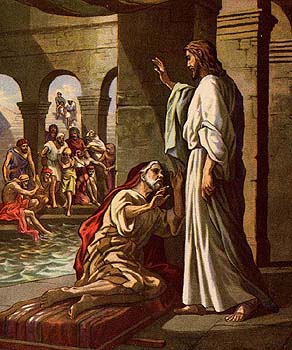
2 Now there is in Jerusalem by the Sheep Gate a pool, in Aramaic called Bethesda, which has five roofed colonnades. 3 In these lay a multitude of invalids—blind, lame, and paralyzed. 5 One man was there who had been an invalid for thirty-eight years. 6 When Jesus saw him lying there and knew that he had already been there a long time, he said to him, “Do you want to be healed?” 7 The sick man answered him, “Sir, I have no one to put me into the pool when the water is stirred up, and while I am going another steps down before me.” 8 Jesus said to him, “Get up, take up your bed, and walk.” 9 And at once the man was healed, and he took up his bed and walked.
Now that day was the Sabbath. 10 So the Jews said to the man who had been healed, “It is the Sabbath, and it is not lawful for you to take up your bed.” 11 But he answered them, “The man who healed me, that man said to me, ‘Take up your bed, and walk.’” 12 They asked him, “Who is the man who said to you, ‘Take up your bed and walk’?” – John 5:1-12 ESV
 With the opening of chapter 5, John begins to explore the growing tension between Jesus and the religious authorities. While the meeting between Jesus and Nicodemus, a Pharisees himself, had been somewhat controversial, it had remained cordial. But with Jesus’ return to Jerusalem, the anger and resentment of the Pharisees and Sadduccees will become increasingly more evident and intense.
John will not abandon the theme of belief that has characterized the first four chapters, but he will now juxtapose it with the growing unbelief of the religious elite of Israel. In a sense, John will use the Pharisees and Sadduccees as a counterpoint to Jesus. These men were to have been the shepherds of Israel, leading the people to the truth of God’s Word and exemplifying a life of obedience. But as John will point out, their legalistic, rule-keeping mindset and arrogant self-righteousness stand in stark contrast to Jesus’ commitment to put the will of God above all else.
“For I have come down from heaven, not to do my own will but the will of him who sent me. And this is the will of him who sent me, that I should lose nothing of all that he has given me, but raise it up on the last day. For this is the will of my Father, that everyone who looks on the Son and believes in him should have eternal life, and I will raise him up on the last day.” – John 6:38-40 ESV
Jesus was on a mission and He would not allow anything or anyone to hinder Him fulfilling the role assigned to Him by His Heavenly Father. He had divine authority to do the things He did. As the Son of God, Jesus did not need the permission of the legal or religious authorities because He was acting on behalf of God Almighty. The will of God superseded that of all other human authorities and allowed Jesus to perform signs and wonders that appeared to contradict the laws of nature and violate the rules of men.
After His brief excursion into the northern region of Galilee, Jesus made a second trip to Jerusalem in order to attend yet another Jewish festival. There were three annual feasts that all Jewish males were required to attend: Passover, Pentecost, and Tabernacles. In recounting this particular story, John leaves the name of the festival out, evidently deeming it as irrelevant to the point he was trying to make.
But John was quite specific when describing the location for this event. The context was critical to understanding what is going on in the story. Jesus arrived at the Pool of Bethesda, just outside the walls of the temple compound. This was a well-known and well-trafficked spot in Jerusalem because the waters of the spring-fed pool were believed to have healing qualities. The setting is key to understanding what is about to take place. As John stated in verse 3, the pool was a magnet for the “blind, lame, and paralyzed.” They all made their way to the pool each day in the hopes that the miraculous powers of the water might make them whole.
While John pointed out that “a multitude of invalids” surrounded the pool, he focused his attention on one particular man whose paralytic condition had persisted for 38 years. It is not clear whether this man had been coming to the pool for nearly four decades or if this was his first time to seek help from its healing waters. But John’s emphasis on the length of time is meant to accentuate the hopelessness of the man’s plight. And Jesus, upon seeing the man, was immediately aware of the decades-long nature of his condition, which makes the question He asks sound so unnecessary and out-of-place.
“Do you want to be healed?” – John 5:6 ESV
Of course, he did. What kind of question is that to ask at a time like this? This poor man had somehow made it all the way to the pool, in spite of his paralysis. He would not have been lying beside the waters if he had not wanted to experience healing.
John does not explain why Jesus chose to single out this one man. There were obviously others at the pool that day, and each and every one of them was there hoping for the same thing: Healing. But Jesus chose to speak to this man. And in response to Jesus’ question, the man explained his plight.
“Sir, I have no one to put me into the pool when the water is stirred up, and while I am going another steps down before me.” – John 4:7 ESV
His problem was not a lack of desire, but it was a lack of opportunity and capacity. His paralysis made it physically impossible for him to pursuit healing. His very condition proved to be a barrier to ever seeing his greatest desire fulfilled. Evidently, the pool’s healing powers were only available when the water was “stirred up.” It was only at that particular moment that a miracle could be expected, but it was reserved for the one who entered the water first. And this man, completely incapacitated by his illness and without anyone to assist him, was left to watch and wait, helplessly and hopelessly.
The description of the man’s plight is meant to stir the heart of the reader. But it is also meant to reveal the spiritual condition of each and every human being as they stand in need of healing but without the means by which to avail themselves of it. The healing waters were within this man’s reach, but he lacked the power to enter them. In a sense, he couldn’t heal himself. He needed help. And this is where Jesus stepped in.
Jesus said to him, “Get up, take up your bed, and walk.” And at once the man was healed, and he took up his bed and walked. – John 5:8-9 ESV
With a word, Jesus provided what the man lacked: The power to change. In a split second, this hopeless, helpless, bed-ridden paralytic was transformed into a completely healthy and whole specimen of a man. And no waters were necessary. Jesus spoke and the man walked.
But right when the story should be taking a decidedly upbeat turn, John reveals an underlying tension. He rather abruptly states, “Now that day was the Sabbath” (John 5:9 ESV). Rather than mentioning the celebration that would have followed such a miraculous moment, John simply points out that this had all taken place on the Sabbath. It was a holy day and, as such, it was to have been a day of rest.
This significant detail is meant to point out the seeming problem with what Jesus said to the man and all that followed. Jesus specifically instructed the man to take up his bed and walk. He could have just told him to walk. Why was it necessary for him to gather up his bedroll? Because it was the Sabbath. Jesus knew exactly what day it was and His instructions to the man were given with that knowledge in mind. And His words produced the desired results. Yes, the man was healed, but not only that, the Pharisees were incensed. These religious rule-keepers witnessed the man carrying his bed and immediately confronted him for his blatant violation of the Sabbath law.
“It is the Sabbath, and it is not lawful for you to take up your bed.” – John 5:10 ESV
It is not clear whether these men had witnessed the healing, but even if they had, they were more concerned with what they saw as a flagrant disregard for the Mosaic Law.
The man, unaware of who Jesus was, told the religious leaders that he was simply obeying the words of the one who had healed him. But they still demanded to know the identity of this Sabbath law-breaker.
Jesus had specifically chosen the Sabbath day to perform this miracle. And His instructions to the lame man had been very precise. This entire scene was designed to set up a contrast between Jesus, the Son of God, and the religious leaders of Israel. He was their Messiah, sent from God to deliver the people from their bondage to sin and death. And as the Savior of the world, He had divine authority to accomplish the will of His Father. But for the religious leaders, their sacred rules and regulations were more important than the will of God. In their minds, adherence to the Sabbath blinded them to the presence of their Savior.
Yet, Jesus would later inform the Pharisees, “the Son of Man is Lord, even over the Sabbath!” (Matthew 12:8 NLT). This was all about authority and authenticity. Jesus was the Son of God and the long-awaited Messiah. And His audacious decision to heal on the Sabbath was proof of His deity and His divine authority.
English Standard Version (ESV) The Holy Bible, English Standard Version. ESV® Permanent Text Edition® (2016). Copyright © 2001 by Crossway Bibles, a publishing ministry of Good News Publishers.
New Living Translation (NLT)
Holy Bible, New Living Translation, copyright © 1996, 2004, 2015 by Tyndale House Foundation. Used by permission of Tyndale House Publishers Inc., Carol Stream, Illinois 60188. All rights reserved.
The Message (MSG)Copyright © 1993, 1994, 1995, 1996, 2000, 2001, 2002 by Eugene H. Peterson