Unseen, But Far From Unappreciated

A Song of Ascents.  

1 Come, bless the LORD, all you servants of the LORD,
    who stand by night in the house of the LORD!
Lift up your hands to the holy place
    and bless the LORD!

May the Lord bless you from Zion,
    he who made heaven and earth! – Psalm 134:1-3 ESV

Just three verses long, this psalm seems to be a short, simple conclusion or benediction to the Song of Ascents, the hymnbook used by pilgrims on their way to Jerusalem to celebrate the annual feasts of Passover, Pentecost, and Booths. The songs of ascent included Psalms 120-134. In this final song, the unidentified psalmist turns his emphasis toward those who serve God in the Temple at night.

Care for the Temple and its courtyard was an around-the-clock affair. While the people slept, the priests were busy protecting, cleaning, purifying, and preparing the Temple for the following day’s activities. According to the Book of 1 Chronicles, there was a group of the Levites assigned to perform some of the more mundane and less-than-glamorous responsibilities associated with the Temple.

The duty of the Levites was to help Aaron’s descendants in the service of the temple of the LORD: to be in charge of the courtyards, the side rooms, the purification of all sacred things and the performance of other duties at the house of God. They were in charge of the bread set out on the table, the flour for the grain offerings, the unleavened wafers, the baking and the mixing, and all measurements of quantity and size.  They were also to stand every morning to thank and praise the LORD. They were to do the same in the evening, and whenever burnt offerings were presented to the LORD on Sabbaths and at New Moon festivals and at appointed feasts. They were to serve before the LORD regularly in the proper number and in the way prescribed for them. – 1 Chronicles 23:28-31 NLT

This psalm was meant to be an expression of encouragement to those who served the LORD at night, in relative obscurity. They were to do so joyfully, offering Him praise even while performing their unseen and unappreciated nightly duties. It was a reminder to the pilgrims and the priests that the role these priests played was far from unimportant. While no one witnessed their nocturnal activities, Yahweh was watching. Their duties were just as essential as those of the priests who offered up the sacrifices in the courtyard. Without their careful purification of the utensils and objects used in the sacrificial system, the offerings made to Yahweh would have been considered unclean and unacceptable. One can only imagine the cleanup job required after a full day of sacrifices, with the Temple grounds and courtyard covered in the blood of thousands of sacrificed animals. Everything had to be cleaned and purified. These men played a critical role in the sacrificial system of Israel, and their efforts were a blessing to Yahweh and, far too often, an unrecognized and underappreciated benefit to the people of God.

What a reminder to us that there are those who serve the body of Christ in obscurity, doing roles that many of us would think are unglamorous and even unimportant. I think of the countless men and women who serve each Sunday in churches all across the world. Their names are unknown, and the tasks they perform are often taken for granted. Some, tasked with the responsibility of leading God’s people in worship, arrive long before the average congregant is awake, so they can practice the music they will play so that our worship is rich and meaningful. Others serve in the nursery and children’s ministries of their local church, faithfully imparting the Word of God to children who are not their own but whom they love and care for as if they were.

There are volunteers who assist with everything from overseeing the flow of cars on and off our parking lots to brewing coffee and preparing rooms for Sunday School classes and services to be held. Without their efforts, the chaos that would ensue would be unbearable. Yet many don’t even notice that these people exist. Hundreds of Sunday School teachers and volunteers serve each and every week throughout the year, and we tend to take them for granted. We come to church knowing they will be there to provide our children a safe environment in which to learn and grow in their knowledge of God and His Word. What about the maintenance staff who work all throughout the week, caring for the buildings and grounds, ensuring they are clean and that everything works correctly? They operate behind the scenes, invisible and unknown to most of us. But consider how their efforts enhance our worship of God on Sunday.

The psalmist was grateful for all the behind-the-scenes efforts that went into making the Temple a well-run and worshipful atmosphere for every congregant. But he not only wanted these unsung heroes to know that their work was appreciated, he wanted them to do their jobs with the proper mindset, “as to the LORD” (Colossians 3:23-24).

Lift your hands toward the sanctuary,
    and praise the LORD. – Psalm 134:2 NLT

They were serving Yahweh by making His house a holy and hospitable place where His presence was welcome and His worship was unhindered. But the psalmist wanted them to never lose sight of the sacredness of their work, no matter how mundane it may have felt. Even in serving as night guards on the Temple grounds, they could turn their job into an act of worship to Yahweh. While some priests had the privilege of serving as God’s intermediaries, offering sacrifices on behalf of the people, others were tasked with cleaning up the aftermath of their efforts. But the psalmist wanted these men to see their roles as sacred. In his book, The Practice of the Presence of God, Brother Lawrence, a 17th-century French Carmelite monk, spoke of the necessity of serving God with joy and out of worship, regardless of the perceived worthiness of the task.

“We ought not to be weary of doing little things for the love of God, who regards not the greatness of the work, but the love with which it is performed.”
“We can do little things for GOD; I turn the cake that is frying on the pan for love of Him, and that done, if there is nothing else to call me, I prostrate myself in worship before Him, Who has given me grace to work; afterwards I rise happier than a king. It is enough for me to pick up but a straw from the ground for the love of GOD.” ― Brother Lawrence, The Practice of the Presence of God

This mindset of selfless service to God is as needed today as ever before. Each child of God needs to learn to practice His presence and conduct their lives in such a way that their every action is done for His glory. No matter how mundane the task may seem, if done for His glory, it will ultimately be for our good.

From those who design and print the worship folders each Sunday to those who brew the coffee and turn on the lights, countless individuals serve behind the scenes to make our worship of God as comfortable and hassle-free as possible. May God bless them for their efforts, and may we learn to thank them for all that they do. If we happen to be one of those faithful servants of God, may we do our work as unto Him, giving him the glory He is due and rejoicing in the privilege we have to serve Him.

Father, thank You for reminding me of all those who serve You selflessly each week. Create in me a heart of gratitude, expressing my thanks to them for all that they do to enhance our worship experience each week. May You bless them Father for their willingness to serve in ways that many would deem beneath them or unworthy of their talents. Help me have a more sacrificial and selfless attitude toward all that I do, so that You are honored as much by my attitude as by my actions. Amen

English Standard Version (ESV) The Holy Bible, English Standard Version. ESV® Permanent Text Edition® (2016). Copyright © 2001 by Crossway Bibles, a publishing ministry of Good News Publishers.

New Living Translation (NLT) Holy Bible, New Living Translation, copyright © 1996, 2004, 2015 by Tyndale House Foundation. Used by permission of Tyndale House Publishers Inc., Carol Stream, Illinois 60188. All rights reserved.
A Kingdom of Priests

1 These are the priests and the Levites who came up with Zerubbabel the son of Shealtiel, and Jeshua: Seraiah, Jeremiah, Ezra, Amariah, Malluch, Hattush, Shecaniah, Rehum, Meremoth, Iddo, Ginnethoi, Abijah, Mijamin, Maadiah, Bilgah, Shemaiah, Joiarib, Jedaiah, Sallu, Amok, Hilkiah, Jedaiah. These were the chiefs of the priests and of their brothers in the days of Jeshua.

And the Levites: Jeshua, Binnui, Kadmiel, Sherebiah, Judah, and Mattaniah, who with his brothers was in charge of the songs of thanksgiving. And Bakbukiah and Unni and their brothers stood opposite them in the service. 10 And Jeshua was the father of Joiakim, Joiakim the father of Eliashib, Eliashib the father of Joiada, 11 Joiada the father of Jonathan, and Jonathan the father of Jaddua.

12 And in the days of Joiakim were priests, heads of fathers’ houses: of Seraiah, Meraiah; of Jeremiah, Hananiah; 13 of Ezra, Meshullam; of Amariah, Jehohanan; 14 of Malluchi, Jonathan; of Shebaniah, Joseph; 15 of Harim, Adna; of Meraioth, Helkai; 16 of Iddo, Zechariah; of Ginnethon, Meshullam; 17 of Abijah, Zichri; of Miniamin, of Moadiah, Piltai; 18 of Bilgah, Shammua; of Shemaiah, Jehonathan; 19 of Joiarib, Mattenai; of Jedaiah, Uzzi; 20 of Sallai, Kallai; of Amok, Eber; 21 of Hilkiah, Hashabiah; of Jedaiah, Nethanel.

22 In the days of Eliashib, Joiada, Johanan, and Jaddua, the Levites were recorded as heads of fathers’ houses; so too were the priests in the reign of Darius the Persian. 23 As for the sons of Levi, their heads of fathers’ houses were written in the Book of the Chronicles until the days of Johanan the son of Eliashib. 24 And the chiefs of the Levites: Hashabiah, Sherebiah, and Jeshua the son of Kadmiel, with their brothers who stood opposite them, to praise and to give thanks, according to the commandment of David the man of God, watch by watch. 25 Mattaniah, Bakbukiah, Obadiah, Meshullam, Talmon, and Akkub were gatekeepers standing guard at the storehouses of the gates. 26 These were in the days of Joiakim the son of Jeshua son of Jozadak, and in the days of Nehemiah the governor and of Ezra, the priest and scribe. Nehemiah 12:1-26 ESV

With the lottery completed to determine the residents of Jerusalem, Nehemiah turns his attention to the spiritual needs of the people. In this chapter, he lists the priests and Levites who returned in 537 B.C. with Zerubbabel and Jeshua the high priest. These men would be essential to securing the long-term success of Nehemiah’s rebuilding and repopulating initiative. It would be useless to fill the city with citizens whose hearts were not right with Yahweh. That is why the priests and Levites were so vital to Judah’s future. Their role within the corporate community of Judah was essential because God had ordained them to serve as mediators between Him and the people. They were tasked with offering sacrifices on behalf of the people, teaching them the Law, modeling moral behavior, and leading them in worship.

Two of the original priests were Nadab and Abihu, the sons of Aaron, the first high priest. Leviticus 10 records the story of these two men offering “unauthorized fire before the Lord, which he had not commanded them” (Leviticus 10:1 ESV). They were guilty of offering sacrifices that were unsanctioned by God and in violation of His commands, and their actions resulted in their deaths. Yahweh consumed them with fire. After having designated their replacements, Yahweh gave Aaron the following command.

“You must distinguish between what is sacred and what is common, between what is ceremonially unclean and what is clean. And you must teach the Israelites all the decrees that the Lord has given them through Moses.” – Leviticus 10:10-11 NLT

Nadab and Abihu had misused their divinely appointed positions as priests. Their actions were out of step with God’s commands and they paid with their lives. The Almighty made an example of them, sending a powerful message to Aaron and the remaining priests that they were to use their positions to illustrate God’s holiness. Immediately after learning of the deaths of his two sons, Aaron received this message from God: “This is what the Lord has said: ‘Among those who are near me I will be sanctified, and before all the people I will be glorified’” (Leviticus 10:3 ESV). The priests were expected to live set-apart lives, adhering to a higher code of conduct that demonstrated their close relationship with Yahweh. 

What complicates the actions of Nadab and Abihu is the story of their encounter with God on Mount Sinai. These two men had been part of a special contingent of leaders who were privileged to ascend the holy mountain with Moses.

Then Moses, Aaron, Nadab, Abihu, and the seventy elders of Israel climbed up the mountain. There they saw the God of Israel. Under his feet there seemed to be a surface of brilliant blue lapis lazuli, as clear as the sky itself. And though these nobles of Israel gazed upon God, he did not destroy them. In fact, they ate a covenant meal, eating and drinking in his presence! – Exodus 24:9-11 NLT

Nadab and Abihu had shared a meal with God. They had seen His glory and lived to tell about it. Yet, not long after this life-changing event took place, they entered the Tabernacle and desecrated His glory by offering unauthorized and unacceptable sacrifices. They robbed God of glory by ignoring His will and carrying out their own. They made it all about themselves and suffered the consequences.

As God’s servants, the priests were obligated to make much of Him. Their roles were never to be about self-promotion or personal glory. Their whole purpose for being was to glorify God. Their garments, diet, living arrangements, and daily responsibilities were unique and meant to set them apart as servants of the one true God.

When King David offered to build a house for God, he was told that his son, Solomon would receive that privilege (2 Samuel 7). Though he was denied the joy of building the Temple, David set about to make preparations for its construction and operation, even organizing the priests, Levites, musicians, and gatekeepers who would serve within its walls. When Solomon finally completed the Temple, he carefully followed his father’s plans for its administration.

In assigning the priests to their duties, Solomon followed the regulations of his father, David. He also assigned the Levites to lead the people in praise and to assist the priests in their daily duties. And he assigned the gatekeepers to their gates by their divisions, following the commands of David, the man of God. Solomon did not deviate in any way from David’s commands concerning the priests and Levites and the treasuries. – 2 Chronicles 8:14-15 NLT

The Temple of God was to be the hub of all life within the nation of Judah. It symbolized God’s presence and power and served as the sole source of forgiveness and atonement for the people. The Temple was a place to worship and realign with God. His presence dwelt within the Holy of Holies. His purifying power was present in the perpetual flames of the bronze altar. The gold, silver, fine fabrics, and elaborate furnishings of the Temple were intended to reflect the glory of God. It was His dwelling place on earth and was to be treated with dignity, honor, and respect.

But those who served within the walls of the Temple were to be distinctively different as well. From their garments to their lifestyles, the priests, servants, gatekeepers, and musicians were to display the uniqueness of their roles and their distinctive relationship with Yahweh. They belonged to Him.

“Look, I have chosen the Levites from among the Israelites to serve as substitutes for all the firstborn sons of the people of Israel. The Levites belong to me…” – Numbers 3:12 NLT

But while God had set apart the Levites for special service, He held all of His chosen people to a higher standard. He gave Moses the following message for the people of Israel:

“Now if you will obey me and keep my covenant, you will be my own special treasure from among all the peoples on earth; for all the earth belongs to me. And you will be my kingdom of priests, my holy nation. – Exodus 19:5-6 NLT

God expected obedience and obeisance from all His people, not just the Levites. The entire community was to hold Him in high esteem and treat Him with honor. Their lives were to reflect their status as His special treasure. For generations, the Israelites had failed to live up to His standards, choosing instead to worship false gods, pursue sensual pleasures, and compromise their convictions by fraternizing with the godless cultures around them. That is what led to their eventual fall and exile. But now that they were back in the land of Judah, Nehemiah was helping them to turn over a new leaf and renew their commitment to Yahweh.

Nehemiah knew his days in Jerusalem were numbered. He had promised King Artaxerxes that he would return when the work was done and that day was fast approaching. So, he made the most of his final days by focusing the people’s attention on their need for Yahweh. They had accomplished a lot in a short period of time. The people had worked hard and rebuilt the walls of the city in less than two months. The Temple had been restored. The city of Jerusalem was in the process of being reoccupied. The sacrificial system, feast days, and priesthood had been reinstituted. But Nehemiah knew that the future success of Judah was dependent upon God. Without Him, Jerusalem was doomed to fall again. If the people failed to honor Him, they would suffer the same fate as their ancestors.

Nehemiah exhibited faith in leaving his safe and secure job as a civil servant working for the king of Persia. It took faith for him to go before the king and risk his anger by asking permission to return to his native land and rebuild the walls. It took faith for him to ask the Jews living in exile to make the long journey back to Judah and take on the formidable task of doing construction work on walls that had been destroyed decades earlier. It took faith for him to face the unceasing attacks of his enemies and continue to build in the face of opposition and the mounting discouragement of the people. It took faith for him to call the people to renew their covenant with God and give up their foreign wives and the children they had born.

All Nehemiah had to go on was the word of God. He couldn’t see the outcome of his efforts. He had no guarantee how things were going to turn out. There is no doubt that Nehemiah had second thoughts along the way. He got discouraged. He had misgivings. He questioned himself and his calling. But he kept trusting and building.

The writer of Hebrews provides us with a wonderful definition of faith: “Faith is the confidence that what we hope for will actually happen; it gives us assurance about things we cannot see” (Hebrews 11:1 NLT). The apostle Paul expresses a similar sentiment: “…for we walk by faith, not by sight” (2 Corinthians 5:7 ESV).

In this life, we can’t always see the outcome. We aren’t always given a crystal clear image of how things will turn out. We simply receive a word from God and are expected to trust Him – sight unseen. That is the essence of faith. Like Nehemiah, we must learn to trust God, not circumstances. While everything around us may point to a less-than-satisfactory conclusion, we must keep our eyes focused on God and His unchanging character. We must trust in His power and unwavering commitment to keep His promises.

English Standard Version (ESV)
The Holy Bible, English Standard Version. ESV® Permanent Text Edition® (2016). Copyright © 2001 by Crossway Bibles, a publishing ministry of Good News Publishers.

New Living Translation (NLT)
Holy Bible, New Living Translation, copyright © 1996, 2004, 2015 by Tyndale House Foundation. Used by permission of Tyndale House Publishers Inc., Carol Stream, Illinois 60188. All rights reserved.

A Breach of Faith

1 So all Israel was recorded in genealogies, and these are written in the Book of the Kings of Israel. And Judah was taken into exile in Babylon because of their breach of faith. Now the first to dwell again in their possessions in their cities were Israel, the priests, the Levites, and the temple servants. And some of the people of Judah, Benjamin, Ephraim, and Manasseh lived in Jerusalem: Uthai the son of Ammihud, son of Omri, son of Imri, son of Bani, from the sons of Perez the son of Judah. And of the Shilonites: Asaiah the firstborn, and his sons. Of the sons of Zerah: Jeuel and their kinsmen, 690. Of the Benjaminites: Sallu the son of Meshullam, son of Hodaviah, son of Hassenuah, Ibneiah the son of Jeroham, Elah the son of Uzzi, son of Michri, and Meshullam the son of Shephatiah, son of Reuel, son of Ibnijah; and their kinsmen according to their generations, 956. All these were heads of fathers’ houses according to their fathers’ houses.

10 Of the priests: Jedaiah, Jehoiarib, Jachin, 11 and Azariah the son of Hilkiah, son of Meshullam, son of Zadok, son of Meraioth, son of Ahitub, the chief officer of the house of God; 12 and Adaiah the son of Jeroham, son of Pashhur, son of Malchijah, and Maasai the son of Adiel, son of Jahzerah, son of Meshullam, son of Meshillemith, son of Immer; 13 besides their kinsmen, heads of their fathers’ houses, 1,760, mighty men for the work of the service of the house of God.

14 Of the Levites: Shemaiah the son of Hasshub, son of Azrikam, son of Hashabiah, of the sons of Merari; 15 and Bakbakkar, Heresh, Galal and Mattaniah the son of Mica, son of Zichri, son of Asaph; 16 and Obadiah the son of Shemaiah, son of Galal, son of Jeduthun, and Berechiah the son of Asa, son of Elkanah, who lived in the villages of the Netophathites.

17 The gatekeepers were Shallum, Akkub, Talmon, Ahiman, and their kinsmen (Shallum was the chief); 18 until then they were in the king’s gate on the east side as the gatekeepers of the camps of the Levites. 19 Shallum the son of Kore, son of Ebiasaph, son of Korah, and his kinsmen of his fathers’ house, the Korahites, were in charge of the work of the service, keepers of the thresholds of the tent, as their fathers had been in charge of the camp of the Lord, keepers of the entrance. 20 And Phinehas the son of Eleazar was the chief officer over them in time past; the Lord was with him. 21 Zechariah the son of Meshelemiah was gatekeeper at the entrance of the tent of meeting. 22 All these, who were chosen as gatekeepers at the thresholds, were 212. They were enrolled by genealogies in their villages. David and Samuel the seer established them in their office of trust. 23 So they and their sons were in charge of the gates of the house of the Lord, that is, the house of the tent, as guards. 24 The gatekeepers were on the four sides, east, west, north, and south. 25 And their kinsmen who were in their villages were obligated to come in every seven days, in turn, to be with these, 26 for the four chief gatekeepers, who were Levites, were entrusted to be over the chambers and the treasures of the house of God. 27 And they lodged around the house of God, for on them lay the duty of watching, and they had charge of opening it every morning.

28 Some of them had charge of the utensils of service, for they were required to count them when they were brought in and taken out. 29 Others of them were appointed over the furniture and over all the holy utensils, also over the fine flour, the wine, the oil, the incense, and the spices. 30 Others, of the sons of the priests, prepared the mixing of the spices, 31 and Mattithiah, one of the Levites, the firstborn of Shallum the Korahite, was entrusted with making the flat cakes. 32 Also some of their kinsmen of the Kohathites had charge of the showbread, to prepare it every Sabbath.

33 Now these, the singers, the heads of fathers’ houses of the Levites, were in the chambers of the temple free from other service, for they were on duty day and night. 34 These were heads of fathers’ houses of the Levites, according to their generations, leaders. These lived in Jerusalem.

35 In Gibeon lived the father of Gibeon, Jeiel, and the name of his wife was Maacah, 36 and his firstborn son Abdon, then Zur, Kish, Baal, Ner, Nadab, 37 Gedor, Ahio, Zechariah, and Mikloth; 38 and Mikloth was the father of Shimeam; and these also lived opposite their kinsmen in Jerusalem, with their kinsmen. 39 Ner fathered Kish, Kish fathered Saul, Saul fathered Jonathan, Malchi-shua, Abinadab, and Eshbaal. 40 And the son of Jonathan was Merib-baal, and Merib-baal fathered Micah. 41 The sons of Micah: Pithon, Melech, Tahrea, and Ahaz. 42 And Ahaz fathered Jarah, and Jarah fathered Alemeth, Azmaveth, and Zimri. And Zimri fathered Moza. 43 Moza fathered Binea, and Rephaiah was his son, Eleasah his son, Azel his son. 44 Azel had six sons and these are their names: Azrikam, Bocheru, Ishmael, Sheariah, Obadiah, and Hanan; these were the sons of Azel.  – 1 Chronicles 9:1-44 ESV

In chapter nine, the seemingly endless lists of genealogies finally come to a close and the chronicler chooses to wrap up his painstaking record with an emphasis on the Temple in Jerusalem and those men who were responsible for its care. In this chapter, he covers the priests, Levites, and all those who served in various capacities within the Temple complex.

He opens this chapter with a brief summary statement that explains the source behind his fastidious record of Israel’s family trees and th

So all Israel was recorded in genealogies, and these are written in the Book of the Kings of Israel. – 1 Chronicles 10:1a ESV

The chronicler wasn’t required to do painstaking research to come up with his lists of Israelite lineages; they were readily available in the historical record. This was his way of claiming that his records were accurate and trustworthy. But then he added a simple line that must have felt like a punch to the stomach to his original audience.

And Judah was taken into exile in Babylon because of their breach of faith. – 1 Chronicles 9:1b ESV

The chronicler wanted his audience of recently returned exiles to know two things: Their rich heritage as the chosen people of God and the reason behind their 70 years of captivity in Babylon.  Most of these people had been born in exile and had never set foot in the land of promise. During their long tenure in Babylon, it is likely that they forgot how they got there in the first place. Babylon had become their home; it was all they knew. But now that they had arrived back in Judah, they needed to understand why they had been cast out, to begin with. It was because of their unfaithfulness.

It’s interesting to note that the chronicler follows up his bombshell statement with a lengthy record concerning the Levites, priests, and Temple servants. These men had been tasked with overseeing the Temple and the nation’s spiritual well-being. Yet, as the chronicler so succinctly stated, “Judah was taken into exile in Babylon because of their breach of faith” (1 Chronicles 9:1b ESV).

What makes this statement so significant is that it is tied directly to the role of the Levitical priesthood. Israel’s unfaithfulness began at the top. In fact, the very next chapter records the sin of Israel’s very first king.

“So Saul died for his breach of faith. He broke faith with the Lord in that he did not keep the command of the Lord, and also consulted a medium, seeking guidance. He did not seek guidance from the Lord.” – 1 Chronicles 10:13-14 ESV

The people of God had a faith problem that was the byproduct of their less-than-stellar leadership. Within Israel, there were three primary leadership positions: The king, the priests, and the prophets. God had ordained these three roles and expected those who held them to perform their responsibilities faithfully. But most of Israel’s kings proved to be far from successful in their role as the keepers of the faith. Sadly, the priests would not fare much better. In the Book of Ezekiel, we are given a less-than-flattering look into the poor track record of the priestly caste.

Ezekiel was a native of Judah who grew up in the capital city of Jerusalem. He lived through the siege of Jerusalem by the Babylonians and was taken captive to Babylon along with King Jehoiachin about 597 BC. As a young man, Ezekiel had been preparing to become a priest in the Temple but his deportation to Babylon changed all that. While in Babylon, he received a commission from God to serve as a prophet to the exiled people of Judah. He describes his calling in the opening lines of the book that bears his name.

In the thirtieth year, in the fourth month, on the fifth day of the month, as I was among the exiles by the Chebar canal, the heavens were opened, and I saw visions of God. – Ezekiel 1:1 ESV

While Ezekiel was trying to acclimate to his new surroundings in Babylon, God appeared and gave him a new appointment that carried with it a heavy responsibility.

“Son of man, stand on your feet, and I will speak with you.” And as he spoke to me, the Spirit entered into me and set me on my feet, and I heard him speaking to me. And he said to me, “Son of man, I send you to the people of Israel, to nations of rebels, who have rebelled against me. They and their fathers have transgressed against me to this very day. The descendants also are impudent and stubborn: I send you to them, and you shall say to them, ‘Thus says the Lord God.’ And whether they hear or refuse to hear (for they are a rebellious house) they will know that a prophet has been among them.” – Ezekiel 2:1-5 NLT

Stranded in the land of Babylon and surrounded by his fellow exiles, Ezekiel found himself with the unenviable task of serving as God’s prophet to a stubborn and rebellious people. His task would not be easy because his audience would be far from receptive to his message. God made that point painfully clear.

“Be not afraid of their words, nor be dismayed at their looks, for they are a rebellious house. And you shall speak my words to them, whether they hear or refuse to hear, for they are a rebellious house.” – Ezekiel 2:6-7 NLT

But Ezekiel took his new commission seriously and delivered God’s message faithfully. His life was filled with visions and visitations from God that provided him with insights into Judah’s plight and God’s plans for them. At one point, he was transported by God to the Temple in Jerusalem where he received an eye-opening glimpse into the sorry state of the priesthood. As Ezekiel stood outside the gate of the Temple, God declared His anger at the atrocities taking place within its walls.

“Son of man, do you see what they are doing—the great abominations that the people of Israel are practicing here, to drive me far from my sanctuary? But you will see greater abominations than these!” – Ezekiel 8:6 NLT

He was led to the entrance to the Temple court and ordered to enter.

“Go in and see the evil abominations they are practicing here.” So I went in and looked. I noticed every figure of creeping thing and beast—detestable images—and every idol of the house of Israel, engraved on the wall all around. – Ezekiel 8:9-10 NLT

The Temple of God was filled with idols. But the vision was far from over.

“Do you see, son of man, what the elders of the house of Israel are doing in the dark, each in the chamber of his idolatrous images? For they think, ‘The Lord does not see us! The Lord has abandoned the land!’” – Ezekiel 8:12 NLT

The leadership of Israel was involved in the sacrilegious and blasphemous activities taking place in God’s house. But Ezekiel was in for an even greater shock.

Then he brought me to the inner court of the Lord’s house. Right there at the entrance to the Lord’s temple, between the porch and the altar, were about twenty-five men with their backs to the Lord’s temple, facing east—they were worshiping the sun toward the east! – Ezekiel 8:16 NLT

These idolatrous acts could not have taken place without the assistance of the priestly caste. These men were complicit and worthy of God’s judgment, having violated their role as God’s priests and allowing His house to be desecrated with images of false gods. As the people of Judah continued to face the threat of annihilation at the hands of the Babylonians, they had become equal opportunity idolaters, seeking the aid of any and all gods that might come to their rescue. But God was not pleased, and in chapter 10, Ezekiel is given a vision of God’s glory departing the Temple.

This look at the visions of the visions of Ezekiel is vital to understanding chapter nine of 1 Chronicles. Long after the fall of Jerusalem and the destruction of the Temple, the people of Israel had lost sight of their guilt and the cause of their judgment. Yet, God had graciously returned them to the scene of the crime – the land of promise. Not only that, He had reminded them of their status as His chosen people. Now, in chapter nine, he lets them know that He will restore the Levitical priesthood to serve in the newly constructed Temple in the recently restored city of Jerusalem.

The nation of Judah broke faith with God and ended up a broken people living in exile in a foreign land. King Saul broke faith with God and not only lost a battle but also his son, Jonathan. Defeated and alone, the great king would end up taking his own life in a final act of faithlessness and desperation. He had abandoned God, not the other way around.

Broken faith always has its consequences. This wasn’t just a case of a lack of faith. If we’re not careful, we could easily conclude that Judah and Saul just couldn’t muster up enough faith to trust God. But theirs was a sin of commission. It was more a case of what they had done, not what they had lacked. The nation of Judah had ended up in exile because they had committed acts of unfaithfulness against God. They had sinned. Unfaithfulness is always a sin. It involves disobedience and infidelity. The people of Judah had failed to live up to their responsibilities as the children of God. The priests had failed to fulfill their role as the servants of God.

God was not shocked or surprised by the failure of the priests or the people. He had not been caught off guard by their breach of faith. He had fully expected it and had even warned the people of Judah that their exile was coming. Their unfaithfulness had åbeen expected by God. He knew that they would find it impossible to keep His commands. And when the nation of Judah found themselves languishing in captivity, God had a plan for their ultimate restoration. He was not done with them yet. After 70 years of exile, He had brought them back to the land and orchestrated the rebuilding of the walls of Jerusalem, the restoration of the Temple, and the repopulation of the city.

English Standard Version (ESV)
The Holy Bible, English Standard Version. ESV® Permanent Text Edition® (2016). Copyright © 2001 by Crossway Bibles, a publishing ministry of Good News Publishers.

New Living Translation (NLT)
Holy Bible, New Living Translation, copyright © 1996, 2004, 2015 by Tyndale House Foundation. Used by permission of Tyndale House Publishers Inc., Carol Stream, Illinois 60188. All rights reserved.

Give Us A King!

1 When Samuel became old, he made his sons judges over Israel. The name of his firstborn son was Joel, and the name of his second, Abijah; they were judges in Beersheba. Yet his sons did not walk in his ways but turned aside after gain. They took bribes and perverted justice.

Then all the elders of Israel gathered together and came to Samuel at Ramah and said to him, “Behold, you are old and your sons do not walk in your ways. Now appoint for us a king to judge us like all the nations.” But the thing displeased Samuel when they said, “Give us a king to judge us.” And Samuel prayed to the Lord. And the Lord said to Samuel, “Obey the voice of the people in all that they say to you, for they have not rejected you, but they have rejected me from being king over them. According to all the deeds that they have done, from the day I brought them up out of Egypt even to this day, forsaking me and serving other gods, so they are also doing to you. Now then, obey their voice; only you shall solemnly warn them and show them the ways of the king who shall reign over them.” – 1 Samuel 8:1-9 ESV

This chapter opens with what appears to be a significant time gap in the narrative. It simply states that “Samuel became old” (1 Samuel 8:1 ESV). It tells us little about his life or the early days of his ministry as Israel’s judge. The previous chapter ended with an abbreviated summary of Samuel’s life, providing the reader with more questions than answers.

Samuel continued as Israel’s judge for the rest of his life. Each year he traveled around, setting up his court first at Bethel, then at Gilgal, and then at Mizpah. He judged the people of Israel at each of these places. Then he would return to his home at Ramah, and he would hear cases there, too. And Samuel built an altar to the Lord at Ramah. – 1 Samuel 7:15-17 NLT

The age of Samuel is omitted. Any of his exploits and accomplishments are left out. In seven relatively brief chapters, his life story was fast-forwarded from infancy to adulthood. It’s almost like watching an “On the Previous Episode” summary of your favorite TV show. But through the divine influence of His Holy Spirit, God ordained that the story skip over the primary years of Samuel’s judgeship and pick up again in the latter years of his life. Despite the title of the book, this story is not about Samuel. It is about the faithful God of Israel and His ongoing relationship with His less-than-faithful people.

The opening verses of chapter 8 have a familiar ring to them. It states that Samuel had two sons who also served as judges over Israel but these men were less-than-qualified for their positions.

…his sons did not walk in his ways but turned aside after gain. They took bribes and perverted justice. – 1 Samuel 8:3 ESV

Many biblical scholars believe that Samuel wrote the vast majority of this book. If that is true, it’s amazing to consider that he would have been the one who penned those words. How painful it must have been for Samuel to summarize the lives of his adult sons in such a stark and condemning manner. But what stands out in this unflattering assessment of his sons is its eerie similarity to the story of Eli’s two boys.

Now Eli was very old, and he kept hearing all that his sons were doing to all Israel, and how they lay with the women who were serving at the entrance to the tent of meeting.  – 1 Samuel 2:22 ESV

This was the household in which Samuel was raised. As a small child, Samuel’s parents had been dropped off at the Tabernacle so that he might serve the Lord all the days of his life. So the formative years of his life were lived under the same roof as the sons of Eli, who are described as “worthless men” who “did not know the Lord” (1 Samuel 2:12 ESV). Samuel had an up-close and personal experience with poor parenting as he watched Eli attempt to manage his two “worthless” sons.

These two middle-aged men had spent their lives pursuing their own personal interests and using their positions as priests to feed their perverse pleasures. Their actions were an affront to God because they violated His law and treated His holy Tabernacle as a means to satiate their greed and lust.

.the sin of the young men was very great in the sight of the Lord, for the men treated the offering of the Lord with contempt. – 1 Samuel 2:12, 17 ESV

This earlier story from Samuel’s past is pertinent because it sheds light on the situation taking place in chapter 8. Samuel is old and, in preparation for his pending death, he has chosen to appoint his sons to serve in his place. But there was no precedence for a judge to appoint his successor. According to the Book of Judges, it was God’s job to raise up judges. (Judges 2:16).

Whenever the Lord raised up a judge over Israel, he was with that judge and rescued the people from their enemies throughout the judge’s lifetime. – Judges 2:18 NLT

Somewhere along the way, Samuel decided that he knew better and appointed Joel and Abijah to serve as co-judges over the people of Israel.

When Samuel became old, he made his sons judges over Israel. – 1 Samuel 8:2 ESV

There is no indication that this decision was God-ordained or the result of prayerful consideration on Samuel’s part. He decided to take matters into his own hands and the results are readily apparent. His sons proved to be wicked and the people all knew it.

…all the elders of Israel met at Ramah to discuss the matter with Samuel. “Look,” they told him, “you are now old, and your sons are not like you. Give us a king to judge us like all the other nations have.” – 1 Samuel 8:4-5 NLT

His decision to reward his sons with their judgeships produced this outcome. Rather than wait on God and allow Him to determine the next judge of Israel, Samuel had come up with his own plan. But even the people could see that Joel and Abijah were unqualified and incapable of leading them in Samuel’s absence. So they came up with their own plan. They demanded that Samuel appoint them a king.

This unprecedented request displeased Samuel for obvious reasons. First, the people had just demeaned his sons and rejected their leadership. Secondly, they were disclosing their dissatisfaction with God’s long-standing use of judges as His methodology for leadership. Finally, their demand must have offended Samuel because it sounded like they had also been dissatisfied with his leadership. He had spent his entire life presiding as judge over these people and now they were looking for a different leadership model. Offended and angered by their demand, Samuel took the matter to the Lord, and he must have been surprised by the response he received.

“Do everything they say to you,” the Lord replied, “for they are rejecting me, not you. They don’t want me to be their king any longer. – 1 Samuel 8:7 NLT

God knew that Samuel had taken the matter personally and was wrestling with feelings of rejection and resentment. Samuel had gotten his feelings hurt. But Samuel needed to know that this was all part of God’s plan. None of this had come as a surprise to God. He had not been caught off guard by their request. In fact, He had long known that this would happen. Centuries before the Israelites entered the land of Canaan, God had told Moses that the day would come when they would ask for a king, and He gave His permission along with His guidelines.

“When you come to the land that the Lord your God is giving you, and you possess it and dwell in it and then say, ‘I will set a king over me, like all the nations that are around me,’ you may indeed set a king over you whom the Lord your God will choose. One from among your brothers you shall set as king over you. You may not put a foreigner over you, who is not your brother. Only he must not acquire many horses for himself or cause the people to return to Egypt in order to acquire many horses, since the Lord has said to you, ‘You shall never return that way again.’ And he shall not acquire many wives for himself, lest his heart turn away, nor shall he acquire for himself excessive silver and gold.” – Deuteronomy 17:14-17 ESV

In God’s reiteration of the covenant promise to Jacob, He alluded to the day when kings would rule over Israel.

“I am El-Shaddai—‘God Almighty.’ Be fruitful and multiply. You will become a great nation, even many nations. Kings will be among your descendants! And I will give you the land I once gave to Abraham and Isaac. Yes, I will give it to you and your descendants after you.” – Genesis 35:11-12 NLT

God had always intended for Israel to have a king but it was to be a king of His choosing. This individual would have to meet God’s criteria for leadership. However, the people of Israel were very specific when it came to the kind of king they wanted “Give us a king to judge us like all the other nations have” (1 Samuel 8:5 NLT). They weren’t looking for a godly king; they were demanding a powerful kingdom-building monarch who would lead them to victory over their enemies and build a dynasty that would last for centuries.

From God’s perspective, the demand of the people was a blatant rejection of Him. He flatly informs Samuel, “They don’t want me to be their king any longer” (1 Samuel 8:7 NLT). God knew the motivation of their hearts and could see that this request was a not-so-veiled rejection of His leadership. The people had grown dissatisfied with the state of affairs in Israel and wanted more. They were tired of being bullied by the Philistines and watching other nations rise to power and prominence under the leadership of their kings. They had grown tired of living under judges and never experiencing the success they longed for. It was time for a change.

God was willing to give them their request but with conditions. He would allow them to have a king “like all the other nations” but they needed to know that there would be consequences. Their hopes for a brighter future would be dimmed by the stark reality of the outcome of their request.

None of this was new to God. For centuries, He had witnessed the constant unfaithfulness of His chosen people. He had called them, transformed them into a mighty nation, redeemed them from their captivity in Egypt, led them to the land of Canaan, and provided them with victories over the nations that occupied that land. In other words, God had acted as their King. But nowhere along the way had they actually submitted to His rule and reign.

Ever since I brought them from Egypt they have continually abandoned me and followed other gods. And now they are giving you the same treatment. Do as they ask, but solemnly warn them about the way a king will reign over them.” – 1 Samuel 8:8-9 NLT

It was time for the next phase of God’s plan for Israel. Again, this was not a knee-jerk reaction on God’s part. He was not caught off guard or surprised by their actions. It was all part of a divinely ordained plan that had been in place long before Israel existed as a nation. God was simply paving the way for the future King of Israel who will one day rule and reign for eternity.

English Standard Version (ESV) The Holy Bible, English Standard Version. ESV® Permanent Text Edition® (2016). Copyright © 2001 by Crossway Bibles, a publishing ministry of Good News Publishers.

New Living Translation (NLT) Holy Bible, New Living Translation, copyright © 1996, 2004, 2015 by Tyndale House Foundation. Used by permission of Tyndale House Publishers Inc., Carol Stream, Illinois 60188. All rights reserved.

Light in the Darkness

12 Now the sons of Eli were worthless men. They did not know the Lord. 13 The custom of the priests with the people was that when any man offered sacrifice, the priest’s servant would come, while the meat was boiling, with a three-pronged fork in his hand, 14 and he would thrust it into the pan or kettle or cauldron or pot. All that the fork brought up the priest would take for himself. This is what they did at Shiloh to all the Israelites who came there. 15 Moreover, before the fat was burned, the priest’s servant would come and say to the man who was sacrificing, “Give meat for the priest to roast, for he will not accept boiled meat from you but only raw.” 16 And if the man said to him, “Let them burn the fat first, and then take as much as you wish,” he would say, “No, you must give it now, and if not, I will take it by force.” 17 Thus the sin of the young men was very great in the sight of the Lord, for the men treated the offering of the Lord with contempt.

18 Samuel was ministering before the Lord, a boy clothed with a linen ephod. 19 And his mother used to make for him a little robe and take it to him each year when she went up with her husband to offer the yearly sacrifice. 20 Then Eli would bless Elkanah and his wife, and say, “May the Lord give you children by this woman for the petition she asked of the Lord.” So then they would return to their home.

21 Indeed the Lord visited Hannah, and she conceived and bore three sons and two daughters. And the boy Samuel grew in the presence of the Lord. – 1 Samuel 2:12-21 ESV

The Old Testament is brutally raw in how it depicts the sinfulness of man. It doesn’t attempt to sugarcoat the facts but presents an uncensored and painfully unflattering portrait of mankind’s moral failings. Even the Jews, having been chosen by God and given His law, couldn’t manage to live in faithfulness and obedience to His commands. Their incessant failure to remain faithful to God is chronicled throughout the pages of the Old Testament.

Chapter 1 introduced Hophni and Phinehas, the two sons of Eli, who served as priests of Yahweh at the Tabernacle in Shiloh (1 Samuel 1:3). These young men were responsible for administering the sacrificial rites associated with the Mosaic Law, and the Book of Leviticus spells out the requirements God placed on their role.

“You must distinguish between what is sacred and what is common, between what is ceremonially unclean and what is clean. And you must teach the Israelites all the decrees that the Lord has given them through Moses.” – Leviticus 10:10-11 NLT

The priests of God were expected to live exemplary lives, modeling righteous behavior and teaching God’s exacting standards to His chosen people. Yet Hophni and Phinehas are described as “scoundrels who had no respect for the Lord or for their duties as priests” (1 Samuel 2:12-13 NLT). This isn’t exactly a glowing job review and its placement immediately after Hannah’s inspiring prayer of gratitude and reverence for God is intentional. 

While Hannah offered praise to God for His power, grace, sovereignty, and mercy, Hophni and Phinehas were busy desecrating His Tabernacle and disobeying His commands. In her song of praise, Hannah unknowingly describes the behavior and fate of these two men.

He will protect his faithful ones,
    but the wicked will disappear in darkness.
No one will succeed by strength alone.
    Those who fight against the Lord will be shattered.
He thunders against them from heaven;
    the Lord judges throughout the earth.” – 1 Samuel 2:9-10 NLT

Hophni and Phinehas were wicked; they were using their position as priests of God for personal gain and to satisfy their own perverse desires. Samuel’s recollection of these men is far from flattering.

the sin of these young men was very serious in the Lord’s sight, for they treated the Lord’s offerings with contempt. – 1 Samuel 2:17 ESV

But what had they done to deserve such a damning assessment? The text makes their crime painfully clear. They treated God’s sacrificial system with contempt, using it as a means for personal gain rather than purification from sin. They had come up with a plan that allowed them to profit from their role as priests.

Eli’s sons would send over a servant with a three-pronged fork. While the meat of the sacrificed animal was still boiling, the servant would stick the fork into the pot and demand that whatever it brought up be given to Eli’s sons. – 1 Samuel 2:13-14 NLT

This was in direct violation of God’s commands concerning the sacrifices. According to the Book of Leviticus, God had prescribed which portion of the sacrifice was to be given to the priest.

“…the priest will burn the fat on the altar, but the breast will belong to Aaron and his descendants. Give the right thigh of your peace offering to the priest as a gift. The right thigh must always be given to the priest who offers the blood and the fat of the peace offering. For I have reserved the breast of the special offering and the right thigh of the sacred offering for the priests. It is the permanent right of Aaron and his descendants to share in the peace offerings brought by the people of Israel.” – Leviticus 7:31-34 NLT

But Hophni and Phinehas weren’t satisfied with God’s provision; they wanted more. These two represent everything that is wrong with Israel. As priests of God, they should have lived lives that were set apart to God. Instead, they lived immoral lives marked by greed, corruption, sexual promiscuity, and a total disregard for the laws of God. The text describes them as worthless men who did not know God (1 Samuel 2:12). They were literally “good for nothing.” And while they obviously knew who God was, they did not recognize or acknowledge His authority over them. They lived as if they were gods, dictating their own rules and selfishly satisfying their own desires. These men were gluttonous and covetous, unwilling to limit their greed to the consumption of food. They were also guilty of gross immorality, using their status as priests to satisfy their perverse sexual desires, a fact their father knew well.

He knew, for instance, that his sons were seducing the young women who assisted at the entrance of the Tabernacle. – 1 Samuel 2:22 NLT

They had no fear of God, as evidenced by their blatant abuse of the sacrificial system. They used their positions as God’s priests for personal gain and pleasure, and their father proved incapable of controlling them.

The story of Hophne and Phinehas reveals how bad things had gotten during the days before Israel had a king; even the priesthood had become corrupt. They were immoral and unfaithful, showing more concern for their own personal pleasure than they did for God and His law. This vivid portrayal of man’s sinfulness provides a stark backdrop onto which the coming of the Son of God will be displayed in the New Testament. God will clearly show that man’s sin was so great and his need for a source of salvation outside of himself was so necessary, that when Jesus appears on the scene, men should have flocked to His presence, begging Him for salvation from their sins.

It’s important to note that this rather dark and depressing depiction of the sins of Hophni and Phinehas is followed by a faint glimmer of hope. The contemptuous and impetuous sons of Eli are contrasted with the young adolescent Samuel, who has grown to be a young boy in the middle of all this immorality and disobedience.

But Samuel, though he was only a boy, served the Lord. He wore a linen garment like that of a priest. – 1 Samuel 2:18 NLT

The boy served the Lord while the men desecrated His character and defiled His Tabernacle. This young innocent child provides a stark contrast that sets the stage for God’s intervention into the sordid story of Hophni and Phinehas. God’s priests had gone rogue, disobeying His will and defaming the character of His name by their behavior. But God was getting ready to step in and rectify the situation. He had a plan in place and Samuel would be an integral part of it.

It would be easy to demonize Hophne and Phinehas. In our own self-righteousness, we could condemn them for their blatantly sinful behavior and wonder how they could have gone so bad so fast. But as the old saying goes, “But for the grace of God go I.” All of us are capable of the same degree of sins as these two young men. Their story is there to remind us of our own capacity to sin against God.

One of the saddest statements of all of Scripture is the one used to describe them: “They did not know the Lord” (1 Samuel 2:12 ESV). They were sons of the high priest of Israel and served as priests themselves. Yet, they did not know the Lord. This doesn’t mean they had no idea who God was, but that they didn’t understand just how serious He was about His commands. They treated God’s law flippantly and with disdain. The NET Bible translates verse 12 this way: “They did not recognize the Lord’s authority.” They viewed God’s laws as optional, obeying their own sinful desires and passions instead.

That is a risk we all face. When we disobey God we act as if we don’t even know Him. As Paul said, “The Jews were entrusted with the oracles of God” (Romans 3:2 ESV), but they failed to obey those oracles. They regularly refused to do what they knew to be the non-negotiable laws of God. And in doing so, they lived no differently than the Gentiles who didn’t know God at all. In fact, their guilt was even greater.

But God has raised up a Samuel. He has ordained an unlikely and unexpected alternative to Hophni and Phinehas. This young boy, the byproduct of a miraculous birth, had been dedicated to God’s service and would prove to be a divine ray of hope in the sin-darkened world of his day.

Hannah had dedicated her son to God and, little did she know that God had big plans for him. But her sacrifice was met with grace and mercy, as God provided her with five additional children. Her obedience to God was rewarded with blessings. But the greatest blessing she would ever receive would be the knowledge that her son would become an instrument in the hands of God Almighty. Even from a distance, she would have the joy of watching Samuel grow in God’s grace and become a beacon of light in a world cloaked in darkness.

…the boy Samuel grew in the presence of the Lord. – 1 Samuel 2:21 ESV

English Standard Version (ESV) The Holy Bible, English Standard Version. ESV® Permanent Text Edition® (2016). Copyright © 2001 by Crossway Bibles, a publishing ministry of Good News Publishers.

New Living Translation (NLT) Holy Bible, New Living Translation, copyright © 1996, 2004, 2015 by Tyndale House Foundation. Used by permission of Tyndale House Publishers Inc., Carol Stream, Illinois 60188. All rights reserved.

A Weighty Responsibility

14 And the Lord spoke to Moses in the wilderness of Sinai, saying, 15 “List the sons of Levi, by fathers’ houses and by clans; every male from a month old and upward you shall list.” 16 So Moses listed them according to the word of the Lord, as he was commanded. 17 And these were the sons of Levi by their names: Gershon and Kohath and Merari. 18 And these are the names of the sons of Gershon by their clans: Libni and Shimei. 19 And the sons of Kohath by their clans: Amram, Izhar, Hebron, and Uzziel. 20 And the sons of Merari by their clans: Mahli and Mushi. These are the clans of the Levites, by their fathers’ houses.

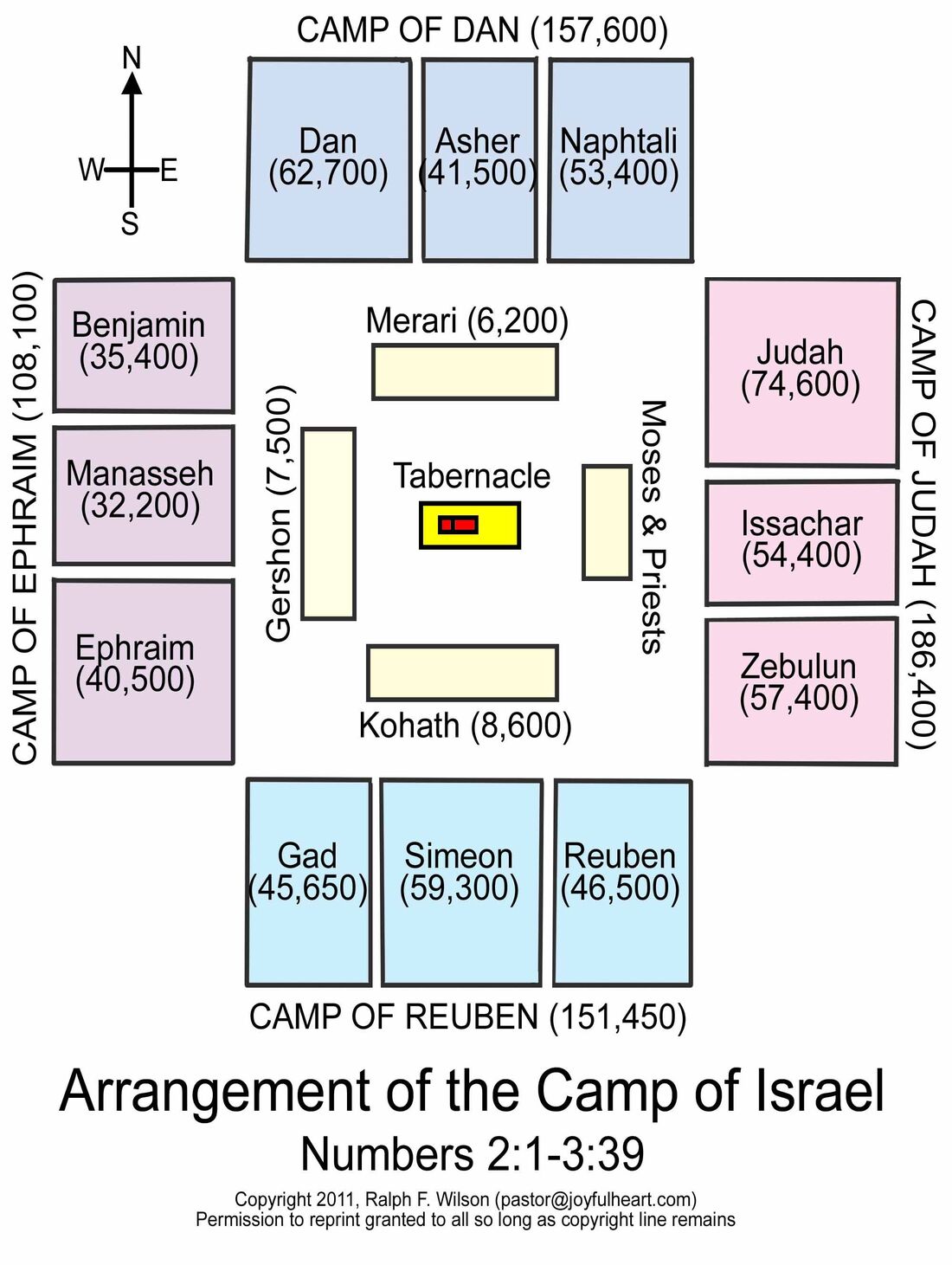
21 To Gershon belonged the clan of the Libnites and the clan of the Shimeites; these were the clans of the Gershonites. 22 Their listing according to the number of all the males from a month old and upward was 7,500. 23 The clans of the Gershonites were to camp behind the tabernacle on the west, 24 with Eliasaph, the son of Lael as chief of the fathers’ house of the Gershonites. 25 And the guard duty of the sons of Gershon in the tent of meeting involved the tabernacle, the tent with its covering, the screen for the entrance of the tent of meeting, 26 the hangings of the court, the screen for the door of the court that is around the tabernacle and the altar, and its cords—all the service connected with these.

27 To Kohath belonged the clan of the Amramites and the clan of the Izharites and the clan of the Hebronites and the clan of the Uzzielites; these are the clans of the Kohathites. 28 According to the number of all the males, from a month old and upward, there were 8,600, keeping guard over the sanctuary. 29 The clans of the sons of Kohath were to camp on the south side of the tabernacle, 30 with Elizaphan the son of Uzziel as chief of the fathers’ house of the clans of the Kohathites. 31 And their guard duty involved the ark, the table, the lampstand, the altars, the vessels of the sanctuary with which the priests minister, and the screen; all the service connected with these. 32 And Eleazar the son of Aaron the priest was to be chief over the chiefs of the Levites, and to have oversight of those who kept guard over the sanctuary.

33 To Merari belonged the clan of the Mahlites and the clan of the Mushites: these are the clans of Merari. 34 Their listing according to the number of all the males from a month old and upward was 6,200. 35 And the chief of the fathers’ house of the clans of Merari was Zuriel the son of Abihail. They were to camp on the north side of the tabernacle. 36 And the appointed guard duty of the sons of Merari involved the frames of the tabernacle, the bars, the pillars, the bases, and all their accessories; all the service connected with these; 37 also the pillars around the court, with their bases and pegs and cords.

38 Those who were to camp before the tabernacle on the east, before the tent of meeting toward the sunrise, were Moses and Aaron and his sons, guarding the sanctuary itself, to protect the people of Israel. And any outsider who came near was to be put to death. 39 All those listed among the Levites, whom Moses and Aaron listed at the commandment of the Lord, by clans, all the males from a month old and upward, were 22,000. – Numbers 3:14-39 ESV

God ordered Moses to take a census of the tribe of Levi, instructing him to number “every male from a month old and upward” (Numbers 3:15 ESV). Levi had three sons and eight grandsons who represented eight different clans which contained 22,000 descendants of Levi. The two Gershonite clans were represented by 7,500 males one-month-old or older. The four Kohathite clans were comprised of 8,600 males one-month-old or older. The two Merarite clans numbered just 6,200 males one-month-old or older.

This numerical assessment of each of the Levite clans was for the purpose of assigning their God-ordained responsibilities. Each of the clans was to carry out tasks related to the maintenance of the Tabernacle. They were also assigned a particular region within the Israelite camp to occupy and oversee. The Gershonites were to camp on the west side of the Tabernacle, while the Kohathites occupied the south side and the Merarites were assigned to the north side. The east side of the Tabernacle, located nearest the entrance to the holy compound, “was reserved for the tents of Moses and of Aaron and his sons, who had the final responsibility for the sanctuary on behalf of the people of Israel” (Numbers 3:38 NLT).

With the Levites strategically placed around the perimeter of the Tabernacle, the Israelites would enjoy the constant presence and influence of God’s ministers and servants. These various Levitical clans were assigned a specific set of responsibilities related to the Tabernacle. The Gershonites “were responsible to care for the Tabernacle, including the sacred tent with its layers of coverings, the curtain at its entrance, the curtains of the courtyard that surrounded the Tabernacle and altar, the curtain at the courtyard entrance, the ropes, and all the equipment related to their use” (Numbers 3:25-26 NLT).

The Kohathiteswere responsible for the care of the Ark, the table, the lampstand, the altars, the various articles used in the sanctuary, the inner curtain, and all the equipment related to their use” (Numbers 3:31 NLT).

Finally, the Merariteswere responsible for the care of the frames supporting the Tabernacle, the crossbars, the pillars, the bases, and all the equipment related to their use. They were also responsible for the posts of the courtyard and all their bases, pegs, and ropes” (Numbers 3:36-37 NLT).

The Tabernacle was the house of God and was to be treated with reverence and respect. The various elements that comprised this one-of-a-kind structure had been designed by God and were painstakingly crafted by men who had been supernaturally endowed with the skills necessary to carry out God’s plan. This was no ordinary tent, and it was to be treated with great care because every part of it had been set apart by God for His use. Even the disassembly and transport of its various elements required careful attention to God’s instructions. The holy objects associated with the Holy Place and the Holy of Holies could not be touched by human hands. That is why God designed them with poles to assist in their transport from one place to another.

God had given Moses very specific orders concerning the care and maintenance of the Tabernacle. Only the priestly class of the Levites were allowed to interact with the Tabernacle when it was in its completed state. The rest of the clans were restricted from entering the Tabernacle until it was time to relocate it for transport to another location. And, on those occasions, the Gershonites, Kohathites, and Merarites had to wait until the holy furniture was properly prepared and covered before they could fulfill their duties. God had given Aaron strict instructions regarding this matter.

“You, your sons, and your relatives from the tribe of Levi will be held responsible for any offenses related to the sanctuary. But you and your sons alone will be held responsible for violations connected with the priesthood.

“Bring your relatives of the tribe of Levi—your ancestral tribe—to assist you and your sons as you perform the sacred duties in front of the Tabernacle of the Covenant. But as the Levites go about all their assigned duties at the Tabernacle, they must be careful not to go near any of the sacred objects or the altar. If they do, both you and they will die. The Levites must join you in fulfilling their responsibilities for the care and maintenance of the Tabernacle, but no unauthorized person may assist you.” – Numbers 18:1-4 NLT

The tribe of Levi had been set apart by God and given the responsibility of caring for His sacred house. “Anyone other than a priest or Levite who went too near the sanctuary was to be put to death” (Numbers 3:38 NLT). By placing the various clans of Levi around the perimeter of the Tabernacle, God created a buffer zone that was designed to protect the people of Israel from possible death for violating His ban on coming too close to the holy place. While God had moved His presence from the top of Mount Sinai to the Holy of Holies in the Tabernacle, He was still to be treated with proper reverence and respect. He had come to dwell among them and was closer than ever before, but they were not to treat His divine presence with contempt or complacency. His nearness did not make Him any less holy. His immanence did not diminish His transcendence. Just because God had taken up residence among them and had placed His glory in the midst of their camp did not give them the right to treat Him with a disrespectful kind of over-familiarity.

The Levites were to act as mediators between God and the rest of the Israelites. The members of the priestly caste were to serve as God’s intercessors, offering sacrifices on behalf of the people and assisting them in maintaining a right standing with Him. The rest of the Levites were to care for the dwelling place of God, ensuring that it was properly maintained and its holiness was protected at all costs. If the house of God became defiled, it would no longer be an appropriate place for God’s presence, and without God’s presence, the Israelites would lose the one thing that set them apart from all the other nations on earth. Moses revealed his understanding of this vital relationship between God’s presence and the Israelites’ unique status among the nations when he said to God, “If you don’t personally go with us, don’t make us leave this place. How will anyone know that you look favorably on me—on me and on your people—if you don’t go with us? For your presence among us sets your people and me apart from all other people on the earth” (Exodus 33:15-16 NLT).

Moses knew that the only thing that set the Israelites apart was the presence of God, and God made it clear that His presence was directly tied to the sanctity of the Tabernacle. That’s why He placed so much emphasis on the Levites and their role as the caretakers of His earthly house. The Tabernacle was the key to their survival and success as they made their way to the Promised Land. God had left Mount Sinai and taken up residence among them in the portable sanctuary He had designed and they had built. As long as they maintained the holiness of God’s house, He would remain among them, and He assigned the Levites with the weighty responsibility of protecting the sanctity of His sanctuary.

English Standard Version (ESV) The Holy Bible, English Standard Version. ESV® Permanent Text Edition® (2016). Copyright © 2001

New Living Translation (NLT) Holy Bible, New Living Translation, copyright © 1996, 2004, 2015 by Tyndale House Foundation. Used by permission of Tyndale House Publishers Inc., Carol Stream, Illinois 60188. All rights reserved.

I Am the Lord

17 And the Lord spoke to Moses, saying, 18 “Speak to Aaron and his sons and all the people of Israel and say to them, When any one of the house of Israel or of the sojourners in Israel presents a burnt offering as his offering, for any of their vows or freewill offerings that they offer to the Lord, 19 if it is to be accepted for you it shall be a male without blemish, of the bulls or the sheep or the goats. 20 You shall not offer anything that has a blemish, for it will not be acceptable for you. 21 And when anyone offers a sacrifice of peace offerings to the Lord to fulfill a vow or as a freewill offering from the herd or from the flock, to be accepted it must be perfect; there shall be no blemish in it. 22 Animals blind or disabled or mutilated or having a discharge or an itch or scabs you shall not offer to the Lord or give them to the Lord as a food offering on the altar. 23 You may present a bull or a lamb that has a part too long or too short for a freewill offering, but for a vow offering it cannot be accepted. 24 Any animal that has its testicles bruised or crushed or torn or cut you shall not offer to the Lord; you shall not do it within your land, 25 neither shall you offer as the bread of your God any such animals gotten from a foreigner. Since there is a blemish in them, because of their mutilation, they will not be accepted for you.”

26 And the Lord spoke to Moses, saying, 27 “When an ox or sheep or goat is born, it shall remain seven days with its mother, and from the eighth day on it shall be acceptable as a food offering to the Lord. 28 But you shall not kill an ox or a sheep and her young in one day. 29 And when you sacrifice a sacrifice of thanksgiving to the Lord, you shall sacrifice it so that you may be accepted. 30 It shall be eaten on the same day; you shall leave none of it until morning: I am the Lord.

31 “So you shall keep my commandments and do them: I am the Lord. 32 And you shall not profane my holy name, that I may be sanctified among the people of Israel. I am the Lord who sanctifies you, 33 who brought you out of the land of Egypt to be your God: I am the Lord.” Leviticus 22:17-33 ESV

Throughout this section of Leviticus, God emphasizes the mandatory nature of His laws and regulations by repeatedly declaring, “I am the Lord.” The conditions for service He placed on His priests were to be obeyed because they came from the lips of God Himself. They were the binding will of Yᵊhōvâ ‘ănî. By repeatedly revealing His identity as the Lord – “the existing One” – God was associating these laws with His holiness and glory. The people were never to assume that these regulations were the product of Moses’ fertile imagination and, therefore, non-binding. Moses was simply the deliverer of the message, not its creator.

Jehovah demanded absolute compliance to His commands. The priests were to listen and obey because the Lord had spoken and His will was to be treated with the same honor and reverence they would give to God himself. To attempt to worship God without heeding His commands would not only be illogical but impossible. God would later condemn this kind of hypocritical form of worship.

“…this people draw near with their mouth
    and honor me with their lips,
    while their hearts are far from me,
and their fear of me is a commandment taught by men…” – Isaiah 29:13 ESV

In one of His many confrontations with the Jewish religious leaders of His day, Jesus quoted from this passage in Isaiah to expose their hypocritical and unacceptable worship of God.

“You hypocrites! Isaiah was right when he prophesied about you, for he wrote,

‘These people honor me with their lips,
    but their hearts are far from me.
Their worship is a farce,
    for they teach man-made ideas as commands from God.’” – Matthew 15:7-9 ESV

They were guilty of giving God lip service. They seemed to say and do all the right things, but their hearts weren’t in it. They placed a higher priority on their own manmade laws and sacred traditions than they did on the commands of Jehovah. Their will trumped His.

But this was never to be the way of God’s people. He had declared His will in no uncertain terms. His commands had been spoken, written down, and repeated. There was no cause for confusion and no point in pleading ignorance. But God continued to stress the importance of obedience to His divine will by clarifying how it applied to every aspect of daily life.

In this case, He addressed the issue of what constituted an acceptable offering. Much of this is repeated material, but it exists in order to emphasize the priests’ role in ensuring that each sacrifice was of the highest quality. Jehovah, the one true God, deserved nothing but the best, and the priests were assigned the responsibility of quality assurance. It was their duty to examine each animal to determine its health and its worthiness to be presented as a gift to Jehovah.

This responsibility was not to be taken lightly because lives depended upon it. For the offering to be accepted and the giver to receive atonement from God, their sacrifice had to meet God’s exacting standards. And if a worshiper attempted to cut corners by bringing an unacceptable animal, it was the priest’s job to expose the deceit and prevent bringing offense to a holy God. Everything about the sacrificial system was based on the quality of the gift that was offered. There were to be no damaged goods or second-class animals presented to God. God expected and deserved the first fruits, the best of the best; not the bruised and worthless products that no one wanted.

The priests were to be the last line of defense. To bring a less-than-perfect offering as a sacrifice to God was a dangerous thing to do. God had made it clear that any gift given to Him had to be without blemish. All grain offerings were to consist of “fine flour” (Leviticus 6:20 ESV). No day-old flour made from leftover grain would do. All animals were to be free from injury, disease, and disfigurement. The Israelites were forbidden from giving old, worn-out animals as gifts to God. To do so would have been unacceptable and proven to be an offense to a holy and righteous God. And it was the priest’s job to ensure that this never happened.

“…you must offer a perfect animal. It may have no defect of any kind.” – Leviticus 22:21 NLT

At no point was the priest to cut corners or make concessions. He was not to accept a bribe from a worshiper and allow a less-than-perfect animal to make it to the altar. And God was very specific when it came to the kinds of offerings He would not accept.

“If an animal has damaged testicles or is castrated, you may not offer it to the Lord. You must never do this in your own land, and you must not accept such an animal from foreigners and then offer it as a sacrifice to your God. Such animals will not be accepted on your behalf, for they are mutilated or defective.” – Leviticus 22:24-25 NLT

It seems odd that God had to go to such great lengths in describing the kinds of animals He would not accept. But He knew that His chosen people would be tempted to cut corners and take the less costly path when it came to their sacrifices. After all, they were expected to give the best of what they had, and these animals represented their livelihood. Sacrificing a perfectly healthy lamb or ox did a number on their bottom line. These animals constituted prime breeding stock. They were a source of income and food. And their sacrifice required a once-for-all-time commitment. The giver would never see that animal again and never recoup the loss of potential revenue it represented.

It’s interesting to note that God had to place an additional prohibition on bringing animals that were too young. The all-knowing God understood that His people would find ways to cut their losses. Since they were required to bring an animal that was less than a year old, they might decide to give a newborn calf or lamb as an offering. After all, the earlier they gave the animal, the less time and money they had to invest in its wellbeing. And, if they gave it immediately after it came out of the womb, there was little time for it to become ill or suffer injury. So, God put a seven-day moratorium in place.

“When a calf or lamb or goat is born, it must be left with its mother for seven days. From the eighth day on, it will be acceptable as a special gift to the Lord. But you must not slaughter a mother animal and her offspring on the same day, whether from the herd or the flock. – Leviticus 22:27-28 NLT

These regulations were designed to keep the Israelites from implementing workarounds in an attempt to cut their losses. God’s prohibition against offering “a mother animal and her offspring on the same day” was probably designed to prevent anyone from trying to double-dip. For instance, if the mother animal suffered an injury while giving birth, the owner might be tempted to use that animal as a sacrifice. And if the mother was slaughtered, it would leave the newborn calf or lamb with no source of nourishment, leading the owner to see it as damaged goods and fodder for sacrifice. These kinds of shortcuts and pragmatic decisions were unacceptable for God’s people.

And God sums up this entire section with a reminder of the purpose behind all the laws and regulations He has given.

“Do not bring shame on my holy name, for I will display my holiness among the people of Israel. I am the Lord who makes you holy.” – Leviticus 22:32 NLT

Obedience was a way of glorifying God’s holy name. But disobedience brought shame and disgrace to the name of God. It showed a blatant disregard for His righteousness and a contempt for His glory and grace. God reminded them that He had rescued them from the land of Egypt so that He might be their God. He had redeemed them from slavery and led them all the way to Mount Sinai. There, He had given them His law and decreed the construction of His Tabernacle. He had promised to dwell among them and be their God. But, in return, He expected them to live up to their status as His chosen people. They were to be a royal priesthood and a holy nation, demonstrating their love for Him by living in compliance with His will.

English Standard Version (ESV) The Holy Bible, English Standard Version. ESV® Permanent Text Edition® (2016). Copyright © 2001

New Living Translation (NLT) Holy Bible, New Living Translation, copyright © 1996, 2004, 2015 by Tyndale House Foundation. Used by permission of Tyndale House Publishers Inc., Carol Stream, Illinois 60188. All rights reserved.

Food For Thought

1 And the Lord spoke to Moses, saying, “Speak to Aaron and his sons so that they abstain from the holy things of the people of Israel, which they dedicate to me, so that they do not profane my holy name: I am the Lord. Say to them, ‘If any one of all your offspring throughout your generations approaches the holy things that the people of Israel dedicate to the Lord, while he has an uncleanness, that person shall be cut off from my presence: I am the Lord. None of the offspring of Aaron who has a leprous disease or a discharge may eat of the holy things until he is clean. Whoever touches anything that is unclean through contact with the dead or a man who has had an emission of semen, and whoever touches a swarming thing by which he may be made unclean or a person from whom he may take uncleanness, whatever his uncleanness may be— the person who touches such a thing shall be unclean until the evening and shall not eat of the holy things unless he has bathed his body in water. When the sun goes down he shall be clean, and afterward he may eat of the holy things, because they are his food. He shall not eat what dies of itself or is torn by beasts, and so make himself unclean by it: I am the Lord.’ They shall therefore keep my charge, lest they bear sin for it and die thereby when they profane it: I am the Lord who sanctifies them.

10 “A lay person shall not eat of a holy thing; no foreign guest of the priest or hired worker shall eat of a holy thing, 11 but if a priest buys a slave as his property for money, the slave may eat of it, and anyone born in his house may eat of his food. 12 If a priest’s daughter marries a layman, she shall not eat of the contribution of the holy things. 13 But if a priest’s daughter is widowed or divorced and has no child and returns to her father’s house, as in her youth, she may eat of her father’s food; yet no lay person shall eat of it. 14 And if anyone eats of a holy thing unintentionally, he shall add the fifth of its value to it and give the holy thing to the priest. 15 They shall not profane the holy things of the people of Israel, which they contribute to the Lord, 16 and so cause them to bear iniquity and guilt, by eating their holy things: for I am the Lord who sanctifies them.” Leviticus 22:1-16 ESV

In this section, God addresses the priests’ relationship with “the holy things of the people of Israel” (Leviticus 22:2 ESV). This is a reference to those offerings given by the people of Israel, of which a portion was set apart as payment to the priests for their service in the Tabernacle. In point of fact, since every sacrifice was dedicated to God, the portion which was given to the priests was actually a gracious gift from God. Yahweh was allowing Aaron and his sons to join Him in a meal of fellowship.

There were a number of different sacrifices or offerings that, once given to God, included a payment to the priests for their service. This included the grain offering.

“These are the instructions regarding the grain offering. Aaron’s sons must present this offering to the Lord in front of the altar. The priest on duty will take from the grain offering a handful of the choice flour moistened with olive oil, together with all the frankincense. He will burn this representative portion on the altar as a pleasing aroma to the Lord. Aaron and his sons may eat the rest of the flour, but it must be baked without yeast and eaten in a sacred place within the courtyard of the Tabernacle.” – Leviticus 6:14-16 NLT

But the priests also received a portion of every sin offering.

Then the Lord said to Moses, “Give Aaron and his sons the following instructions regarding the sin offering. The animal given as an offering for sin is a most holy offering, and it must be slaughtered in the Lord’s presence at the place where the burnt offerings are slaughtered. The priest who offers the sacrifice as a sin offering must eat his portion in a sacred place within the courtyard of the Tabernacle. – Leviticus 6:24-26 NLT

God also allotted a portion of every guilt offering as a gift to the priest who participated in the sacrifice.

“This is the law of the guilt offering. It is most holy. In the place where they kill the burnt offering they shall kill the guilt offering, and its blood shall be thrown against the sides of the altar. And all its fat shall be offered, the fat tail, the fat that covers the entrails, the two kidneys with the fat that is on them at the loins, and the long lobe of the liver that he shall remove with the kidneys. The priest shall burn them on the altar as a food offering to the Lord; it is a guilt offering. Every male among the priests may eat of it. It shall be eaten in a holy place. It is most holy. – Leviticus 7:1-6 NLT

Finally, every peace offering presented to Yahweh included a sizeable gift of food for the priest to eat.

“Speak to the people of Israel, saying, Whoever offers the sacrifice of his peace offerings to the Lord shall bring his offering to the Lord from the sacrifice of his peace offerings. His own hands shall bring the Lord‘s food offerings. He shall bring the fat with the breast, that the breast may be waved as a wave offering before the Lord. The priest shall burn the fat on the altar, but the breast shall be for Aaron and his sons. And the right thigh you shall give to the priest as a contribution from the sacrifice of your peace offerings.” – Leviticus 7:29-32 NLT

But since these gifts had been given to God and He had then shared a portion of them with His priests, they were to be considered holy and treated as such. The consumption of these food gifts came with conditions. They were not to be treated flippantly or irreverently. All the purity laws detailed in Leviticus 11-15 come into play here. The priests were to avoid anything that might render them ceremonially unclean. To partake of these holy food offerings in a state of impurity would be to defile that which belonged to God, and that would be a serious breach of priestly protocol.

These men had been set apart by God to serve in His house, therefore, their holiness was mandatory. That’s why God instituted a rigid purification process for every priest before he could serve as a mediator for the people. Aaron and his sons had to be cleansed and their sins atoned for before they could enter God’s house and offer sacrifices on behalf of the people. And once they had completed their sacrifices for the day, they were free to enjoy the gracious food offerings God had provided for them. But even then, they were not to let down their guard.

The priests were free to share these meals with their family members, but only under the strictest conditions. The purity of the priest’s family came into play as well. Since no priest could eat in an unholy state, neither could any member of his family. This ruled out anyone who was unclean for any reason whatsoever. All the purity laws found in chapters 11-15 came into play here.

“These included skin diseases (chapters 13, 14), bodily emissions (chapter 15), and contact with unclean animals and the dead (chapter 11).” – Kenneth A. Matthew, Leviticus: Holy God, Holy People

No priest or any member of his family could enter into the fellowship meal with Yahweh in an unclean state. The presence of an unclean person at one of these meals would have run the risk of defiling every other participant as well as the food that had been dedicated to God. This was unacceptable and to be avoided at all costs.

There is a sense in which the priest could view the eating of this meal as a post-work celebration. His job was done and now it was time to enjoy the fruits of his labor. But God wanted Aaron and his sons to understand that their holy status did not change when they took off their priestly roles or exited the Tabernacle. And, when it came to these meals, they were to be eaten within the Tabernacle compound – in the very presence of God Almighty. So, the priests were not to let their guard down. They were not free to invite anyone to join them in these meals. No layperson outside of the priest’s immediate family was allowed to participate.

“No one outside a priest’s family may eat the sacred offerings. Even guests and hired workers in a priest’s home are not allowed to eat them. – Leviticus 22:10 NLT

But even the priest’s own children could be banned from the table for a variety of reasons. If they were unclean, they were prohibited from taking part. And if one of the priest’s daughters married outside the tribe of Levi, she forfeited her right to eat the Lord’s offering.

“If a priest’s daughter marries someone outside the priestly family, she may no longer eat the sacred offerings.” – Leviticus 22:12 NLT

God was quite specific and unwavering in His conditions concerning this matter. He even reiterated His ban by stating, “No one outside a priest’s family may eat the sacred offerings” (Leviticus 22:13 NLT). There were to be no workarounds, exemptions, or exceptions. While technically, these food offerings belonged to the priest, they had been dedicated to God. The right for the priest to consume these holy items had been given to him by God. Therefore, these gifts were not to be treated as common or ordinary. God gladly shared what rightfully belonged to Him, but He expected His gift to be treated with dignity, honor, and reverence. That’s why He warned the priests to protect the integrity of His name by preserving the holiness of the food offerings.

The priests must not let the Israelites defile the sacred offerings brought to the Lord by allowing unauthorized people to eat them. – Leviticus 22:15-16 NLT

These food offerings had no special properties and conveyed no supernatural attributes to those who ate them. But they did reflect the character of God. Since they had been dedicated to Him, they were an extension of His very nature. Just as the items in the Tabernacle were to be viewed as holy and treated with reverence, so too were the food gifts that God shared with His priests. And God had Moses warn Aaron and his sons to tread carefully and reverently when feasting on the goodness and graciousness of God.

“Tell Aaron and his sons to be very careful with the sacred gifts that the Israelites set apart for me, so they do not bring shame on my holy name. I am the Lord.” – Leviticus 22:2 NLT

The food itself was never the point. It was always about the holiness of God. Anything associated with the name of God was intended to reflect the holy character of God. And, as such, it was to be treated with care and handled with appropriate respect and reverence.

The apostle Paul encouraged the believers in Corinth to live their lives with the goal to please God at all costs.

So, whether you eat or drink, or whatever you do, do all to the glory of God. – 1 Corinthians 10:31 ESV

That same idea was to motivate the lives of God’s priests. There was no point at which they could take off their robes and let down their guard. Just as the food of the sacrifice belonged to God and deserved to be treated with reverence, so too did the priests belong to God and they were to live every moment of their lives to bring Him glory and honor His name.

English Standard Version (ESV) The Holy Bible, English Standard Version. ESV® Permanent Text Edition® (2016). Copyright © 2001

New Living Translation (NLT) Holy Bible, New Living Translation, copyright © 1996, 2004, 2015 by Tyndale House Foundation. Used by permission of Tyndale House Publishers Inc., Carol Stream, Illinois 60188. All rights reserved.

Cut It Out or Be Cut Off

1 And the Lord spoke to Moses, saying, “Speak to Aaron and his sons and to all the people of Israel and say to them, This is the thing that the Lord has commanded. If any one of the house of Israel kills an ox or a lamb or a goat in the camp, or kills it outside the camp, and does not bring it to the entrance of the tent of meeting to offer it as a gift to the Lord in front of the tabernacle of the Lord, bloodguilt shall be imputed to that man. He has shed blood, and that man shall be cut off from among his people. This is to the end that the people of Israel may bring their sacrifices that they sacrifice in the open field, that they may bring them to the Lord, to the priest at the entrance of the tent of meeting, and sacrifice them as sacrifices of peace offerings to the Lord. And the priest shall throw the blood on the altar of the Lord at the entrance of the tent of meeting and burn the fat for a pleasing aroma to the Lord. So they shall no more sacrifice their sacrifices to goat demons, after whom they whore. This shall be a statute forever for them throughout their generations.

“And you shall say to them, Any one of the house of Israel, or of the strangers who sojourn among them, who offers a burnt offering or sacrifice and does not bring it to the entrance of the tent of meeting to offer it to the Lord, that man shall be cut off from his people.” – Leviticus 17:1-9 ESV

Leviticus 17-26 contains what has come to be known as The Holiness Code. Many scholars believe it was added to the Leviticus corpus much later, perhaps during Judah’s exile in Babylon. It appears to be a summary section that seems somewhat of place, containing language and style inconsistent with the rest of the book. Some believe these chapters include portions written by other authors that were later compiled, edited, and then placed within the book of Leviticus. But the evidence for these conclusions, while compelling, is far from convincing. There is no ironclad proof that these chapters were not penned by Moses. While they differ in style, they carry the same theme that has permeated the rest of the book, the theme of holiness.

These chapters stand out, not only because of their stylistic differences but also because their emphasis shifts from the priestly class to the average Israelite. God was calling all His people to a life of holiness – in every area of their lives. For the last few chapters, the focus has been on the Tabernacle and the sacrificial system associated with it. Chapter 16 dealt with the singular Day of Atonement, a once-a-year sacred event that took place within the context of the Tabernacle and was presided over by Aaron and his sons.

But in chapter 17, God turns his attention to a potential problem among His people. While He had provided them with a comprehensive sacrificial system and a sanctuary in which to perform all the prescribed rites and rituals, He knew that they would be tempted to seek alternative options that would be unacceptable and unholy. Their long tenure in Egypt had left them more than amenable to the worship of false gods, as the golden calf episode so clearly demonstrated (Exodus 32).

Verses 1-9 are not presenting a hypothetical scenario that might take place, but they deal with a pre-existing problem among God’s chosen people. Take a close look at verse 9.

“…the people must no longer offer their sacrifices to the goat demons, acting like prostitutes by going after them.” – Leviticus 17:9 NLT

Evidently, the people of Israel had adopted the pagan practices of their former captors, worshiping the false gods of Egypt, including “goat demons.” These were divine beings that were commonly portrayed with both human and animal characteristics. Separate from both gods and humans, these supernatural creatures were able to move between the divine and real worlds, causing great harm but also coming to the aid of all those who called upon them.

“‘They could be something like genies,’ says Egyptologist Kasia Szpakowska. ‘They would come to one’s aid as often as they acted as fearsome, dangerous creatures.’ Images of demons first began to appear in the Middle Kingdom (ca. 2030–1640 B.C.). Before this time, worship of the gods was highly centralized and mediated by the pharaoh, but during the second millennium B.C., all Egyptians were able to directly participate in religious life…It’s possible these demons—who likely numbered far more than 4,000—were more important to Egyptians’ everyday experience than were the remote gods venerated in the land’s great monuments. ‘An Egyptian demon is really any divine being not worshipped in a temple,’ says Szpakowska. ‘And they were everywhere.’” – Eric A. Powell, “The World of Egyptian Demons,” http://www.archeology.org

One such “demon” was believed to have the form of a goat and inhabited the wilderness places. It is estimated that the ancient Egyptians had as many as 4,000 different demons they worshiped and feared. So, it seems that the Israelites had picked up on this propensity for worshiping and sacrificing to a variety of divine beings, including gods and demons. In fact, the book of Chronicles records the actions of Jeroboam, when he established the northern kingdom of Israel (1 Kings 12).

Jeroboam appointed his own priests to serve at the pagan shrines, where they worshiped the goat and calf idols he had made. – 2 Chronicles 11:15 NLT

God knew that His people had a built-in predilection for idolatry and unfaithfulness. So much so, that they would continue to struggle with remaining true to Yahweh, despite all He had done for them. He had provided the Tabernacle to serve as His dwelling place among them and He had given them the sacrificial system so they could remain holy and worthy of His divine presence. But it seems that they were still practicing the habits they had picked up in Egypt.

Between the time they had left Egypt and arrived at Mount Sinai, where God gave them His law, the people of Israel had been offering sacrifices to false gods. But now that the Tabernacle was complete and the sacrificial system was in place, those days were officially over. God would no longer tolerate their unfaithfulness. So, he laid down “the law.”

“Blood guilt will be accounted to any man from the house of Israel who slaughters an ox or a lamb or a goat inside the camp or outside the camp, but has not brought it to the entrance of the Meeting Tent to present it as an offering to the Lord before the tabernacle of the Lord.” – Leviticus 17:3-4 NLT

Anyone who sacrificed an animal for the purpose of worshiping a demon or false god was in serious trouble. Their actions were to be deemed a capital offense punishable by death. These verses are not dealing with the slaughter of an animal for food. This is a prohibition against offering sacrifices outside the context of the Tabernacle and for any other reason than worshiping Yahweh. God would not tolerate blood sacrifices of any kind that were not dedicated to Him. He alone could provide forgiveness and atonement and, for that reason, He alone was worthy of Israel’s undivided attention and undistracted devotion.

If someone slaughtered an animal “in the open field” (Leviticus 17:5), with the intent of offering its blood to a goat demon, they were advised to alter course and bring that animal to the Tabernacle as a sacrifice to God.

“And the priest shall throw the blood on the altar of the Lord at the entrance of the tent of meeting and burn the fat for a pleasing aroma to the Lord.” – Leviticus 17:6 ESV

The guilty party could escape the death penalty and enjoy life, by a simple act of course correction that demonstrated his commitment to Yahweh’s holiness and His status as the one true God. Even though his original intent had been evil and an offense to a holy God, it was never too late to do the right thing and demonstrate a change of heart. But for all those who dared to disobey God’s law and continue their obstinate pursuit of the gods, demons, and spirits of the Egyptians and other pagan nations, the penalty would be both harsh and fatal.

“Any man from the house of Israel or from the resident foreigners who live in their midst, who offers a burnt offering or a sacrifice but does not bring it to the entrance of the Meeting Tent to offer it to the Lord—that person will be cut off from his people.” – Leviticus 17:8-9 NLT

“The penalty for such idolatry and disregard for the one true God was to ‘cut [the guilty person] off from his people’ (Leviticus 17:4). The implication is that the crime is serious, as serious as murder, in fact, for the guilty person faced death. The use of this expression probably meant that God brought about the judgment.” – Allen P. Ross, Holiness to the Lord: A Guide to the Exposition of the Book of Leviticus

God takes holiness seriously. There could be no syncretism on the part of His people. He would not tolerate their worship of any gods other than Himself. While they might consider their habit of being equal-opportunity idolaters fully compatible with their status as God’s chosen people, God was not amused or willing to give an inch. He had made His position on the matter quite clear.

“You must not have any other god but me. You must not make for yourself an idol of any kind or an image of anything in the heavens or on the earth or in the sea. You must not bow down to them or worship them, for I, the LORD your God, am a jealous God who will not tolerate your affection for any other gods.” – Exodus 20:3-5 NLT

When it came to idolatry, God was quite adamant. Cut it out or be cut off.

English Standard Version (ESV) The Holy Bible, English Standard Version. ESV® Permanent Text Edition® (2016). Copyright © 2001

New Living Translation (NLT) Holy Bible, New Living Translation, copyright © 1996, 2004, 2015 by Tyndale House Foundation. Used by permission of Tyndale House Publishers Inc., Carol Stream, Illinois 60188. All rights reserved.

From Dust to Glory

1 Now Nadab and Abihu, the sons of Aaron, each took his censer and put fire in it and laid incense on it and offered unauthorized fire before the Lord, which he had not commanded them. And fire came out from before the Lord and consumed them, and they died before the Lord. Then Moses said to Aaron, “This is what the Lord has said: ‘Among those who are near me I will be sanctified, and before all the people I will be glorified.’” And Aaron held his peace.

And Moses called Mishael and Elzaphan, the sons of Uzziel the uncle of Aaron, and said to them, “Come near; carry your brothers away from the front of the sanctuary and out of the camp.” So they came near and carried them in their coats out of the camp, as Moses had said. And Moses said to Aaron and to Eleazar and Ithamar his sons, “Do not let the hair of your heads hang loose, and do not tear your clothes, lest you die, and wrath come upon all the congregation; but let your brothers, the whole house of Israel, bewail the burning that the Lord has kindled. And do not go outside the entrance of the tent of meeting, lest you die, for the anointing oil of the Lord is upon you.” And they did according to the word of Moses. – Leviticus 10:1-7 ESV

Chapter 9 ended with the statement: “And fire came out from before the Lord and consumed the burnt offering and the pieces of fat on the altar, and when all the people saw it, they shouted and fell on their faces” (Leviticus 9:24 ESV). In this fiery display of divine power, God demonstrated His acceptance of all that had taken place during the last eight days. The ordination of Aaron and his sons as priests had been carried off without a hitch and God gave His approval by consuming the various sacrifices they offered in dramatic fashion. The Tabernacle, the priests, and the people of Israel were purified, consecrated, atoned for, and properly prepared for God to grace them with His glorious presence.

This was a moment of unparalleled joy and reverent worship. Through their careful and faithful obedience to all of God’s instructions, the people of Israel had accomplished His will and been rewarded with a glimpse of His glory. They had not earned the right to witness His glory. Their efforts had not obligated God to show up and grace them with His presence. But everyone involved, including Moses, Bezalel, and Oholiab, as well as Aaron and his sons, had demonstrated their willingness to trust God and carry out His will based on the promise He had made.

“Have the people of Israel build me a holy sanctuary so I can live among them. You must build this Tabernacle and its furnishings exactly according to the pattern I will show you.” – Exodus 25:8-9 NLT

God had commanded the people to contribute all the materials needed to build the Tabernacle and the list included “gold, silver, and bronze; blue, purple, and scarlet thread; fine linen and goat hair for cloth; tanned ram skins and fine goatskin leather; acacia wood; olive oil for the lamps; spices for the anointing oil and the fragrant incense; onyx stones, and other gemstones to be set in the ephod and the priest’s chestpiece” (Exodus 25:3-7 NLT). And Moses records that the people gave willingly and abundantly.

All whose hearts were stirred and whose spirits were moved came and brought their sacred offerings to the LORD. They brought all the materials needed for the Tabernacle, for the performance of its rituals, and for the sacred garments.

So the people of Israel—every man and woman who was eager to help in the work the LORD had given them through Moses—brought their gifts and gave them freely to the LORD. – Exodus 35:21, 29 NLT

In fact, the people gave so freely that Moses was eventually forced to end the fund-raising campaign for the Tabernacle.

“Men and women, don’t prepare any more gifts for the sanctuary. We have enough!” So the people stopped bringing their sacred offerings. Their contributions were more than enough to complete the whole project. – Exodus 36:6-7 NLT

Again, their sacrificial giving didn’t earn them the right to see God’s glory. But their obedience made possible the construction of the place where His glory would eventually dwell. Their willingness to do what God had commanded allowed God’s plan to come to fruition. The Tabernacle, the priests’ garments, the bronze altar, the altar of incense, and the ark of the covenant with the mercy seat where God’s presence would dwell, would not have existed if the people had not obeyed. And those various elements had made their atonement possible and God’s holy presence among them probable.

Moses followed every one of God’s commands. Bezalel and Oholiab didn’t miss a detail of God’s design instructions for the Tabernacle and its furniture. They built everything according to God’s will and with an unwavering commitment to excellence that reflected their concern for His glory. Even Aaron and his sons faithfully observed the seven-day ritual of ordination, ensuring that they were properly prepared to serve in their role as priests and mediators on behalf of the people.

But something went drastically wrong. As chapter 10 begins, the Lord’s fire once again shows up, but this time to consume the lives of Aaron’s two sons. These two men, along with their father, had been given the right and responsibility to serve in the house of God. They had been set apart for this special role and given clear instructions as to their responsibilities.

“You are to distinguish between the holy and the common, and between the unclean and the clean, and you are to teach the people of Israel all the statutes that the Lord has spoken to them by Moses.” – Leviticus 10:10-11 ESV

Yet, as chapter 10 opens up, Nadab and Abihu are accused of offering “unauthorized fire before the Lord” (Leviticus 10:1 ESV). The New Living Translation provides a bit more clarity as to the nature of their sin.

…they disobeyed the Lord by burning before him the wrong kind of fire, different than he had commanded. – Leviticus 10:1 NLT

Moses provides no timeline for this event. But it would appear that it took place not long after the dedication of the Tabernacle and the ordination of Aaron, Nadab, and Abihu. Once these men had completed the final phase of the eight-day-long ceremony God had prescribed, they went to work serving as intermediaries between the people and God. They would have begun their daily responsibilities in the Tabernacle, which would have included carrying coals from the brazen altar in a hand-held censer in order to burn incense on the altar of incense in the Holy of Holies.

“…he will fill an incense burner with burning coals from the altar that stands before the Lord. Then he will take two handfuls of fragrant powdered incense and will carry the burner and the incense behind the inner curtain. There in the Lord’s presence he will put the incense on the burning coals so that a cloud of incense will rise over the Ark’s cover—the place of atonement—that rests on the Ark of the Covenant.” – Leviticus 16:12-13 NLT

This role was reserved for the high priest. Perhaps Nadab and Abihu took it upon themselves to enter the Holy of Holies and perform the role that had been strictly reserved for their father. Or it could be that they used coals from somewhere other than the brazen altar. Whatever they did, God deemed their actions as “strange,” using a Hebrew word that means “unauthorized, foreign, or profane.” They failed to follow God’s command.

They probably thought their actions were appropriate and made perfect sense to them. It could be that they chose to cut corners and gather the coals from a more accessible spot. But it could also be that they violated God’s protocol and took on a role that was not rightfully theirs. If they attempted to burn incense in the Holy of Holies, they were overstepping their bounds and attempting to assume their father’s role as high priest.

Whatever they did, it was egregious enough in the eyes of God to call down His divine judgment. It would seem that their offense involved entrance into the Holy of Holies because Moses states that “they died before the Lord” (Leviticus 10:2 ESV). It was only in the Holy of Holies, above the mercy seat, that the presence of God’s glory dwelled. So, this “strange fire” must have been offered in God’s presence, and was done in violation of His clear commands.

These two men decided to play fast and loose with God’s divine dictates and they paid for it with their lives. As His sacred servants, they were expected to pursue holiness at all costs. Their sacred garments, though purified by blood, did not render them holy. They were still required to conduct their lives in accordance with God’s will. Walking around in their “robes of righteousness” did not automatically make their actions righteous. In fact, the prophet Isaiah warns, “We have all become like one who is unclean, and all our righteous deeds are like a polluted garment” (Isaiah 64:6 ESV).

Even in their role as priests of God and dressed in the sacred robes designed for them by God, these men managed to live in disobedience to the will of God. And immediately after God struck them down for their judgment-worthy act, Moses reminded their grief-stricken father of the words of God.

“I will display my holiness
    through those who come near me.
I will display my glory
    before all the people.” – Leviticus 10:3 NLT

As painful as it must have been to watch his sons consumed by the fire of God, Aaron needed to understand that God’s holiness and glory can be displayed through both blessings and curses. Just as the fire had consumed the sacrifices on the altar, it also consumed the lives of these two men, providing vivid evidence of God’s holiness and glory. Nadab and Abihu had been turned to dust by Israel’s glorious and praise-worthy God.

But before the smoke cleared, God ordered that the bodies of the men be removed and demanded that Moses appoint their replacements.

Then Moses said to Aaron and to Eleazar and Ithamar his other two sons,  “Do not dishevel the hair of your heads and do not tear your garments, so that you do not die and so that wrath does not come on the whole congregation. Your brothers, all the house of Israel, are to mourn the burning that the Lord has caused. – Leviticus 10:6 ESV

Their disobedience and ultimate demise proved to be no problem for God. The show would go on. God’s plan for the people’s atonement would not be derailed by the thoughtless acts of two unrighteous men. And, as difficult as this may sound, God forbade Aaron and his remaining sons from mourning their loss. They were not allowed to display any of the normal signs of grief associated with the death of a loved one. Instead, Eleazar and Ithamar were immediately thrust into the role of replacing their deceased brothers. As the scorched and lifeless bodies of Nadab and Abihu were removed from the Tabernacle and taken to the outskirts of the camp, Eleazar and Ithamar were quickly sworn in as priests. They went through some kind of expedited consecration process in which they were anointed with oil. Then Moses instructed them not to “go outside the entrance of the tent of meeting, lest you die, for the anointing oil of the Lord is upon you” (Leviticus 10:7 ESV).

These men had work to do. There was no time for grieving over the loss of their brothers. God would assign that task to the people of Israel. It was up to Eleazar and Ithamar to step into the sandals of their brothers and perform their priestly duties. And the text declares that “they did according to the word of Moses” (Leviticus 10:7 ESV).

God was not going to allow the disobedience of Nadab and. Abihu to stand in His way. His people needed atonement and forgiveness and the priests were indispensable in accomplishing that objective. So, though Nadab and Abihu had disqualified themselves, God raised up replacements. And this entire scene reminds me of a statement made by Jesus. On the occasion of His entrance into the city of Jerusalem, the crowds were cheering, Blessed is the King who comes in the name of the Lord! Peace in heaven and glory in the highest” (Luke 19:38 ESV).

But some of the Pharisees in the crowd said to him, Teacher, rebuke your disciples” (Luke 19:39 ESV). To which Jesus responded, “I tell you, if these were silent, the very stones would cry out” (Luke 19:38-40 ESV). God will be glorified, with or without us. As strange as this may sound, Nadab and Abihu brought glory to God even in their deaths. In striking these two men down, God demonstrated His holiness in no uncertain terms. He was glorified in that His greatness was displayed and His intolerance of sin was clearly manifested. Our holy God doesn’t wink at sin. He doesn’t turn a blind eye to man’s indiscretions, especially among His chosen people. Nadab and Abihu were out of sight, but it would be a long time before the memory of their deaths was out of mind or forgotten. Their once pristinely white garments were now covered in the dust of their own annihilation, rendering all who touched them unclean and in need of purification. But because God acted swiftly and justly, cleansing and atonement were still available to all who needed it. Even the unrighteousness of men can never thwart God’s plan to make His righteousness available to all those who seek it.

As the apostle Paul states about the sacrificial death of Jesus, “God made Him who knew no sin to be sin on our behalf, so that in Him we might become the righteousness of God” (2 Corinthians 5:21 BSB).

English Standard Version (ESV) The Holy Bible, English Standard Version. ESV® Permanent Text Edition® (2016). Copyright © 2001

New Living Translation (NLT) Holy Bible, New Living Translation, copyright © 1996, 2004, 2015 by Tyndale House Foundation. Used by permission of Tyndale House Publishers Inc., Carol Stream, Illinois 60188. All rights reserved.