Follow the Leader

11 In the second year, in the second month, on the twentieth day of the month, the cloud lifted from over the tabernacle of the testimony, 12 and the people of Israel set out by stages from the wilderness of Sinai. And the cloud settled down in the wilderness of Paran. 13 They set out for the first time at the command of the Lord by Moses. 14 The standard of the camp of the people of Judah set out first by their companies, and over their company was Nahshon the son of Amminadab. 15 And over the company of the tribe of the people of Issachar was Nethanel the son of Zuar. 16 And over the company of the tribe of the people of Zebulun was Eliab the son of Helon.

17 And when the tabernacle was taken down, the sons of Gershon and the sons of Merari, who carried the tabernacle, set out. 18 And the standard of the camp of Reuben set out by their companies, and over their company was Elizur the son of Shedeur. 19 And over the company of the tribe of the people of Simeon was Shelumiel the son of Zurishaddai. 20 And over the company of the tribe of the people of Gad was Eliasaph the son of Deuel.

21 Then the Kohathites set out, carrying the holy things, and the tabernacle was set up before their arrival. 22 And the standard of the camp of the people of Ephraim set out by their companies, and over their company was Elishama the son of Ammihud. 23 And over the company of the tribe of the people of Manasseh was Gamaliel the son of Pedahzur. 24 And over the company of the tribe of the people of Benjamin was Abidan the son of Gideoni.

25 Then the standard of the camp of the people of Dan, acting as the rear guard of all the camps, set out by their companies, and over their company was Ahiezer the son of Ammishaddai. 26 And over the company of the tribe of the people of Asher was Pagiel the son of Ochran. 27 And over the company of the tribe of the people of Naphtali was Ahira the son of Enan. 28 This was the order of march of the people of Israel by their companies, when they set out.

29 And Moses said to Hobab the son of Reuel the Midianite, Moses’ father-in-law, “We are setting out for the place of which the Lord said, ‘I will give it to you.’ Come with us, and we will do good to you, for the Lord has promised good to Israel.” 30 But he said to him, “I will not go. I will depart to my own land and to my kindred.” 31 And he said, “Please do not leave us, for you know where we should camp in the wilderness, and you will serve as eyes for us. 32 And if you do go with us, whatever good the Lord will do to us, the same will we do to you.”

33 So they set out from the mount of the Lord three days’ journey. And the ark of the covenant of the Lord went before them three days’ journey, to seek out a resting place for them. 34 And the cloud of the Lord was over them by day, whenever they set out from the camp.

35 And whenever the ark set out, Moses said, “Arise, O Lord, and let your enemies be scattered, and let those who hate you flee before you.” 36 And when it rested, he said, “Return, O Lord, to the ten thousand thousands of Israel.” – Numbers 10:11-36 ESV

The orders had been given. Detailed instructions had been carefully communicated to the people of Israel. They knew exactly what they would need to do when God decided it was time for them to leave Mount Sinai and, now, that time had come. Their encampment at the base of the mountain had been their home for almost a year, but God had never intended this spot in the wilderness to be their final destination. According to Exodus 19:1, they had arrived there two months after leaving Egypt.

Exactly two months after the Israelites left Egypt, they arrived in the wilderness of Sinai. After breaking camp at Rephidim, they came to the wilderness of Sinai and set up camp there at the base of Mount Sinai. – Exodus 19:1-2 NLT

Now, just ten days short of the first anniversary of their arrival in Sinai, they were instructed to pack up and leave.

In the second year after Israel’s departure from Egypt—on the twentieth day of the second month—the cloud lifted from the Tabernacle of the Covenant. So the Israelites set out from the wilderness of Sinai and traveled on from place to place until the cloud stopped in the wilderness of Paran. – Numbers 10:11-12 NLT

In Numbers 10, Moses indicates that the day came when the cloud of God’s presence departed from its place above the Tabernacle and made its way into the wilderness. Following the instructions given to them by God, the Levites began the careful disassembly and packing of the Tabernacle while the people of broke camp. When all was ready, they moved out in an orderly, prearranged manner.

…the people of Israel set out by stages from the wilderness of Sinai. – Numbers 10:12 ESV

Due to the large number of Israelites involved in this mass migration, God provided them with strict instructions regarding their movements. It was not to be a free-for-all, with everyone departing at once and according to their own timeline and agenda. With 12 tribes involved consisting of what has been estimated as more than two million people, this was a major undertaking that required precision and careful planning. Tents must be taken down, herds and flocks must be rounded up, and the Tabernacle must be dismantled and prepared for transport to the next destination. According to Numbers 10, the people went about their duties obediently. Everyone did their part and carefully followed the instructions of the Lord.

When the cloud made its way into the wilderness, the people knew it was time to move. At the sound of the two silver trumpets (Numbers 10:1), they gathered together and saw the sight of the cloud making its way into the wilderness. God had made the decision to relocate their camp and move them closer to their final destination: The land of Canaan.

Under normal circumstances, the trip to Kadesh-Barnea should have taken 11 days (Deuteronomy 1:2), but with the large number of Israelites and livestock involved and the need for an orderly and well-regimented evacuation process, it took them three days to arrive at the wilderness of Paran. The cloud had come to rest in that region, signifying that this was the spot where they were to set up camp. God chose this particular location for a reason.

“The Desert of Paran is a large plateau in the northeastern Sinai, south of what later would be called the Negev of Judah, and west of the Arabah. This forms the southernmost portion of the Promised Land, the presumed staging area for the assault on the land itself. The principal lines of assault on the land of Canaan are from the southwest, following the Way of the Sea from Egypt, and from the northwest, following the Way of the Sea from Phoenicia. Israel’s staging for attack in the Desert of Paran was a brilliant strategy. In this way they would avoid the fortified routes to the west, presumably under the control of Egypt. This unusual line of attack from the south would stun the inhabitants of the land. They would come like a sirocco blast from the desert, and the land would be theirs, under the hand of God.” – Ronald B. Allen, “Numbers.” In Genesis—Numbers. Vol. 2 of The Expositor’s Bible Commentary

Verses 13-28 provide the details concerning the departure of Israel from Mount Sinai. The tribe of Judah led the way, with each of the other tribes moving out according to a prearranged plan. Some of the tribes would have started the process long before the Tabernacle was completely dismantled and ready for transport. The lengthy procession would have stretched out for miles as the Israelites made their way into the wilderness, following the cloud of the Lord.

They marched for three days after leaving the mountain of the Lord, with the Ark of the Lord’s Covenant moving ahead of them to show them where to stop and rest. As they moved on each day, the cloud of the Lord hovered over them. – Numbers 10:33-34 NLT

God was guiding them, just as He had promised to do. He was leading them further away from Egypt and ever closer to their new home in Canaan. The land He had promised to Abraham as an inheritance would soon be theirs. But they would have to continue to follow His leading and trust Him for their provisions along the way. The journey would not be easy but Moses knew that as long as they followed God’s will, they would be blessed. He even tried to convince his wife’s brother to join them.

“We are on our way to the place the Lord promised us, for he said, ‘I will give it to you.’ Come with us and we will treat you well, for the Lord has promised wonderful blessings for Israel!” – Numbers 10:29 NLT

It’s interesting to note that Moses asked his brother-in-law to serve as a scout or guide for the people of Israel.

“You know the places in the wilderness where we should camp. Come, be our guide. If you do, we’ll share with you all the blessings the Lord gives us.” – Numbers 10:31-32 NLT

Perhaps Moses knew that Hobab was familiar with the wilderness terrain and could help them choose the best places to camp. But this seems to contradict the idea that the cloud of God was to serve as their guide. It is unclear whether Moses’ request was out of step with the will of God. But he evidently convinced Hobab to join them. Judges 1:16 indicates that the descendants of Moses’ father-in-law were still traveling with the Israelites long after they made it into the land of Canaan.

When the tribe of Judah left Jericho—the city of palms—the Kenites, who were descendants of Moses’ father-in-law, traveled with them into the wilderness of Judah. They settled among the people there, near the town of Arad in the Negev. – Judges 1:16 NLT

Hobab and his family may have ended up traveling with the Israelites, but his services were not required. God was going to lead His people and He did so through the cloud that rested over the Ark of the Covenant.

They marched for three days after leaving the mountain of the Lord, with the Ark of the Lord’s Covenant moving ahead of them to show them where to stop and rest. As they moved on each day, the cloud of the Lord hovered over them. – Numbers 10:33-34 NLT

The Kohathites set out, carrying the articles for the sanctuary carrying the Ark of the Covenant at the head of the procession and the cloud of the Lord hovered above it as they walked. All the Israelites could see the cloud rising up into the sky and know that they were headed in the right direction, and when the Ark came to rest, the people knew it was time to stop for the night. Each time the Ark and the cloud set out, Moses would utter a prayer or blessing.

“Arise, O Lord, and let your enemies be scattered! Let them flee before you!” – Numbers 10:35 NLT

And when the cloud ceased to move and the priests set down the Ark of the Covenant, Moses would pronounce another blessing.

“Return, O Lord, to the countless thousands of Israel!” – Numbers 10:36 NLT

Moses knew that the people of Israel were completely dependent upon God. Without Him, this entire journey would be a disaster and any hope of conquering the land of Canaan would be lost. Little did he know what awaited them in the wilderness. In his mind, they were on their way to the land of promise and preparing to occupy the inheritance promised to them by God. But this chapter, marked by its description of the peoples’ orderly procession from Mount Sinai, is setting up an unexpected disaster awaiting them in the days ahead.

They left Mount Sinai with confidence and in eager anticipation of the future God had in store for them. After a year’s delay, they were on their way to Canaan, their future home and the rich inheritance God had promised to them, But their enthusiasm would soon be dampened by a series of unfortunate events that would keep them from entering the promised land. God would successfully lead them to the border of their new home but their entrance would be denied. Chapters 11-25 chronicles the almost 40-year hiatus that would come as a result of their disobedience to God’s commands. He would get them to the land but they would fail to do their part and, as a result, they would suffer the consequences.

English Standard Version (ESV) The Holy Bible, English Standard Version. ESV® Permanent Text Edition® (2016). Copyright © 2001

New Living Translation (NLT) Holy Bible, New Living Translation, copyright © 1996, 2004, 2015 by Tyndale House Foundation. Used by permission of Tyndale House Publishers Inc., Carol Stream, Illinois 60188. All rights reserved.
Where He Leads Me, I Will Follow

1 The Lord spoke to Moses, saying, 2 “Make two silver trumpets. Of hammered work you shall make them, and you shall use them for summoning the congregation and for breaking camp. 3 And when both are blown, all the congregation shall gather themselves to you at the entrance of the tent of meeting. 4 But if they blow only one, then the chiefs, the heads of the tribes of Israel, shall gather themselves to you. 5 When you blow an alarm, the camps that are on the east side shall set out. 6 And when you blow an alarm the second time, the camps that are on the south side shall set out. An alarm is to be blown whenever they are to set out. 7 But when the assembly is to be gathered together, you shall blow a long blast, but you shall not sound an alarm. 8 And the sons of Aaron, the priests, shall blow the trumpets. The trumpets shall be to you for a perpetual statute throughout your generations. 9 And when you go to war in your land against the adversary who oppresses you, then you shall sound an alarm with the trumpets, that you may be remembered before the Lord your God, and you shall be saved from your enemies. 10 On the day of your gladness also, and at your appointed feasts and at the beginnings of your months, you shall blow the trumpets over your burnt offerings and over the sacrifices of your peace offerings. They shall be a reminder of you before your God: I am the Lord your God.” – Numbers 10:1-10 ESV

God was leading His people. In chapter nine, Moses recorded how God had chosen to manifest His glory and presence in the form of a pillar of cloud that would rest over the Tabernacle. It was to serve as a visual reminder of God’s presence among them and as a means by which God directed their journey through the wilderness.

…when the cloud lifted in the morning, they set out, or if it continued for a day and a night, when the cloud lifted they set out. – Numbers 9:21 ESV

But in the opening verses of chapter 10, Moses records a secondary source of divinely ordained directional aid: Two silver trumpets.

Now the Lord said to Moses, “Make two trumpets of hammered silver for calling the community to assemble and for signaling the breaking of camp.” – Numbers 10:1-2 NLT

“The last directions given at Sinai deal with the manufacture and use of two silver trumpets to coordinate the movements of the tribes on their march through the wilderness. Though they were to be guided by the cloud, more precise means of control were necessary if the people were to march in the tight-knit formations envisaged in chapters 2-3.” – Gordon J. Wenham, Numbers, Tyndale Old Testament Commentaries

From the moment God delivered the Israelites from their captivity in Egypt, He had directed their path. He had gone before them, guiding their every step along the way, and providing for their every need. But they had to follow. They couldn’t veer to the right or the left or go off in another direction. If they did, they would suffer the consequences.

God’s leadership required faithful followers. It reminds me of the chorus of the classic old hymn, Where He Leads Me I Will Follow. It simply states, “Where He leads me I will follow; I’ll go with Him, with Him, all the way.”

The people of Israel had spent nearly a year camped at the base of Mount Sinai. During that time, God had given them His law and provided them with the construction plans for the Tabernacle. He had also given them the sacrificial system as a means of atoning for sin and receiving forgiveness. There at Mount Sinai, they enjoyed God’s presence and provision, but Mount Sinai was not their final destination. They were not where God wanted them to be. So, “In the second year, in the second month, on the twentieth day of the month, the cloud lifted from over the tabernacle of the testimony, and the people of Israel set out by stages from the wilderness of Sinai. And the cloud settled down in the wilderness of Paran” (Numbers 10:11-12 ESV).

God led and the people followed. The trumpets blew and the people gathered to receive their marching orders. As the cloud lifted from above the Tabernacle, it signaled that it was time to break camp and follow God’s leading.

God had a purpose behind everything He did. To get the people of Israel all the way through the wilderness, He knew it was going to require much more than good directions. He could lead them and they could follow but they would have to do so according to His terms. Their following would have to include faithful obedience to His righteous rules and divine requirements. They would have to follow obediently.

God could have miraculously transported them straight to the promised land and eliminated the need for a journey altogether but, instead, He took His time. He gave them rules of conduct. He painstakingly provided them with commands designed to regulate their conduct as they followed Him. The wilderness wanderings were going to be a time of testing; to see if they would live set-apart lives, faithfully following God’s prescribed plan for His people. God didn’t just expect the people to follow, He wanted them to do so faithfully. In other words, they were to follow according to His terms. They had to keep His laws. They had to celebrate His festivals. They had to keep the Sabbath. They had to regularly sacrifice for their sins. They had to deal with impurity in their midst.

Their journey from Mount Sinai to the land of Canaan was to be marked by obedience. When the silver trumpets sounded, they were to heed the call and follow God’s lead. Following God requires faithful adherence to His commands. From our vantage point on this side of the cross, it’s sometimes easy to look back at the Israelites and wonder how they could have failed to realize just how good they had it. They seem to have been slow to comprehend how blessed they were to have God’s actual presence living among them. They got to witness incredible miracles and experience amazing acts of provision, such as manna that fell from the sky and fresh water that flowed from a rock. They wore sandals and clothes that never wore out. Yet despite all this, they continued to disobey Him by disregarding His commands. Yes, when the trumpets sounded, the Israelites followed the cloud but their actions along the way revealed that they were simply going through the motions.

The psalmist writes, “How often they rebelled against him in the wilderness, and insulted him  in the desert! They again challenged God, and offended  the Holy One of Israel” (Psalm 78:40-41 ESV).

But before we point our fingers in accusation and derision, we need to realize that their story is far too often our story. We too are on a journey. We’re walking through this life on our way to another “land” that God has promised to give us. He has chosen us as His own and He has given us the indwelling presence of His Spirit who leads and directs us. God speaks to us through His Word and He calls us to live lives that reflect our unique standing as His children. He has commanded us to live holy lives and provided us with everything we need to make it possible.

By his divine power, God has given us everything we need for living a godly life. We have received all of this by coming to know him, the one who called us to himself by means of his marvelous glory and excellence. – 2 Peter 1:3 NLT

And yet, Peter also revealed that God’s Spirit-empowered children will have to constantly fight the urge to replace godliness with worldliness.

As obedient children, do not be conformed to the passions of your former ignorance, but as he who called you is holy, you also be holy in all your conduct, since it is written, “You shall be holy, for I am holy.” – 1 Peter 1:14-16 ESV

For the Israelites, Mount Sinai held special meaning; it was there that they received God’s law. At the base of the mountain, they had received God’s plan for the sacrificial system and the hope of atonement for sin. But they were not meant to remain in Sinai’s shadow. God had other plans for them. As life-altering as Sinai had been, it was not their final destination. While they could have grown comfortable living beneath the mountain peak where God’s glory was displayed in smoke, fire, thunder, and lightning, their future lay elsewhere. When the cloud moved, the trumpets would sound, and the people of God would leave Sinai in their rear-view mirror. The place where God appeared in glory, declared His law, gave instructions for the Tabernacle, and established the sacrificial system would soon become a distant memory. But the God of Sinai had not abandoned them; He was going before them, guiding them to the land of promise.

For many of us as Christians, we bask in the glory of our salvation story. We focus on the day that we placed our faith in Jesus Christ as our personal Savior and remain content to dwell on that occasion as the most significant moment of our lives. But our salvation experience was just the beginning of the journey. God expects us to move on, following His leading and relying on His Spirit to continue His sanctifying work in our lives. We must recognize the fact that our salvation was the beginning, not the end. There is life to be lived – in Christ. He is to be followed, not just believed in.

Jesus told His disciples, “If anyone would come after me, let him deny himself and take up his cross and follow me” (Matthew 16:24 ESV). There is a cost and a commitment to following Christ. It is a daily event that requires faithful obedience to His will and His way.

Jesus had many followers when He walked this earth. But when things got tough and they discovered that His journey was going to include suffering and even death, the majority of his followers fled. Believing in Jesus was easy; following Him would prove to be a difficult and sometimes risky proposition. A fact His 12 disciples would soon learn

The religious leaders of Jesus’ day were thought to be faithful followers of God but Jesus repeatedly condemned them for their hypocrisy and self-righteousness. He compared them to their ancient ancestors who had killed God’s prophets because they despised God’s message. Like their predecessors, the Pharisees were followers of God in name only. They lived by their own set of standards and put on a facade of faithfulness but were actually blind to the will of God for their lives. Highly knowledgeable of God’s Scriptures, they were unable to recognize the Word of God standing in their midst. They refused to acknowledge Jesus as their Messiah and Savior.

Following is not easy, especially when we’re prone to go our own way. Even after salvation, we are constantly tempted to take our lives into our own hands and determine our own destiny. But God has a plan for our lives and a path for each of us to take. We are on a journey from salvation to our ultimate glorification. The future Kingdom is to be our final home. But for the present, we are wandering through this earthly wilderness, led by God’s Spirit and buoyed by the promise of our eternal inheritance.

The apostle Peter encourages us to live with our eyes on the prize so that we might endure the pitfalls and perils of the journey.

It is by his great mercy that we have been born again, because God raised Jesus Christ from the dead. Now we live with great expectation, and we have a priceless inheritance—an inheritance that is kept in heaven for you, pure and undefiled, beyond the reach of change and decay. And through your faith, God is protecting you by his power until you receive this salvation, which is ready to be revealed on the last day for all to see.

So be truly glad. There is wonderful joy ahead, even though you must endure many trials for a little while. – 1 Peter 1:3-6 NLT

We are living in what Paul Tripp calls “the gospel gap.” Our salvation is in our past; the eternal Kingdom is in our future. For now, we live in that in-between time where our sanctification is taking place. We are in the process of being transformed into the image of Christ as we faithfully follow His example of love, obedience, humility, and service. It is during our time on this planet that we are to live out our salvation in tangible and practical ways that emulate the nature of Christ. We do so by allowing the indwelling Spirit of God to powerfully flow through us, producing a lifestyle that is radically different than the world around us. As we faithfully follow Christ it results in our reflection of His nature to the world around us. It is as we walk with Him, living in obedience to Him, that we become increasingly more like Him.

The silver trumpets were to be used to call the people to action. Whether they were a signal for gathering, celebrating, traveling, or going to war, the trumpets were to be obeyed. God was leading and He expected His people to follow. He was declaring His will and they were to submit to it – willingly and faithfully.

English Standard Version (ESV) The Holy Bible, English Standard Version. ESV® Permanent Text Edition® (2016). Copyright © 2001

New Living Translation (NLT) Holy Bible, New Living Translation, copyright © 1996, 2004, 2015 by Tyndale House Foundation. Used by permission of Tyndale House Publishers Inc., Carol Stream, Illinois 60188. All rights reserved.

A Weighty Responsibility

14 And the Lord spoke to Moses in the wilderness of Sinai, saying, 15 “List the sons of Levi, by fathers’ houses and by clans; every male from a month old and upward you shall list.” 16 So Moses listed them according to the word of the Lord, as he was commanded. 17 And these were the sons of Levi by their names: Gershon and Kohath and Merari. 18 And these are the names of the sons of Gershon by their clans: Libni and Shimei. 19 And the sons of Kohath by their clans: Amram, Izhar, Hebron, and Uzziel. 20 And the sons of Merari by their clans: Mahli and Mushi. These are the clans of the Levites, by their fathers’ houses.

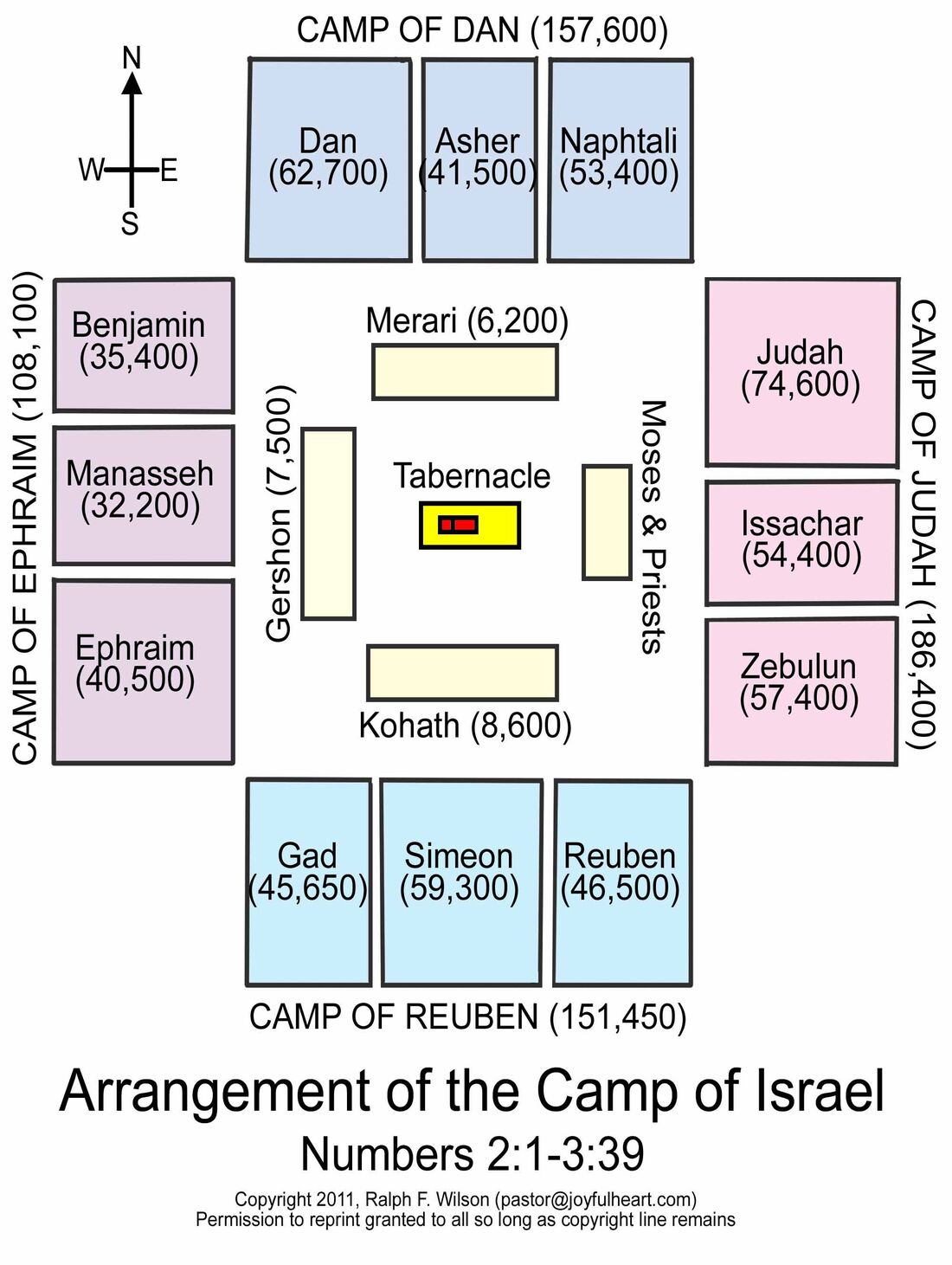
21 To Gershon belonged the clan of the Libnites and the clan of the Shimeites; these were the clans of the Gershonites. 22 Their listing according to the number of all the males from a month old and upward was 7,500. 23 The clans of the Gershonites were to camp behind the tabernacle on the west, 24 with Eliasaph, the son of Lael as chief of the fathers’ house of the Gershonites. 25 And the guard duty of the sons of Gershon in the tent of meeting involved the tabernacle, the tent with its covering, the screen for the entrance of the tent of meeting, 26 the hangings of the court, the screen for the door of the court that is around the tabernacle and the altar, and its cords—all the service connected with these.

27 To Kohath belonged the clan of the Amramites and the clan of the Izharites and the clan of the Hebronites and the clan of the Uzzielites; these are the clans of the Kohathites. 28 According to the number of all the males, from a month old and upward, there were 8,600, keeping guard over the sanctuary. 29 The clans of the sons of Kohath were to camp on the south side of the tabernacle, 30 with Elizaphan the son of Uzziel as chief of the fathers’ house of the clans of the Kohathites. 31 And their guard duty involved the ark, the table, the lampstand, the altars, the vessels of the sanctuary with which the priests minister, and the screen; all the service connected with these. 32 And Eleazar the son of Aaron the priest was to be chief over the chiefs of the Levites, and to have oversight of those who kept guard over the sanctuary.

33 To Merari belonged the clan of the Mahlites and the clan of the Mushites: these are the clans of Merari. 34 Their listing according to the number of all the males from a month old and upward was 6,200. 35 And the chief of the fathers’ house of the clans of Merari was Zuriel the son of Abihail. They were to camp on the north side of the tabernacle. 36 And the appointed guard duty of the sons of Merari involved the frames of the tabernacle, the bars, the pillars, the bases, and all their accessories; all the service connected with these; 37 also the pillars around the court, with their bases and pegs and cords.

38 Those who were to camp before the tabernacle on the east, before the tent of meeting toward the sunrise, were Moses and Aaron and his sons, guarding the sanctuary itself, to protect the people of Israel. And any outsider who came near was to be put to death. 39 All those listed among the Levites, whom Moses and Aaron listed at the commandment of the Lord, by clans, all the males from a month old and upward, were 22,000. – Numbers 3:14-39 ESV

God ordered Moses to take a census of the tribe of Levi, instructing him to number “every male from a month old and upward” (Numbers 3:15 ESV). Levi had three sons and eight grandsons who represented eight different clans which contained 22,000 descendants of Levi. The two Gershonite clans were represented by 7,500 males one-month-old or older. The four Kohathite clans were comprised of 8,600 males one-month-old or older. The two Merarite clans numbered just 6,200 males one-month-old or older.

This numerical assessment of each of the Levite clans was for the purpose of assigning their God-ordained responsibilities. Each of the clans was to carry out tasks related to the maintenance of the Tabernacle. They were also assigned a particular region within the Israelite camp to occupy and oversee. The Gershonites were to camp on the west side of the Tabernacle, while the Kohathites occupied the south side and the Merarites were assigned to the north side. The east side of the Tabernacle, located nearest the entrance to the holy compound, “was reserved for the tents of Moses and of Aaron and his sons, who had the final responsibility for the sanctuary on behalf of the people of Israel” (Numbers 3:38 NLT).

With the Levites strategically placed around the perimeter of the Tabernacle, the Israelites would enjoy the constant presence and influence of God’s ministers and servants. These various Levitical clans were assigned a specific set of responsibilities related to the Tabernacle. The Gershonites “were responsible to care for the Tabernacle, including the sacred tent with its layers of coverings, the curtain at its entrance, the curtains of the courtyard that surrounded the Tabernacle and altar, the curtain at the courtyard entrance, the ropes, and all the equipment related to their use” (Numbers 3:25-26 NLT).

The Kohathites “were responsible for the care of the Ark, the table, the lampstand, the altars, the various articles used in the sanctuary, the inner curtain, and all the equipment related to their use” (Numbers 3:31 NLT).

Finally, the Merarites “were responsible for the care of the frames supporting the Tabernacle, the crossbars, the pillars, the bases, and all the equipment related to their use. They were also responsible for the posts of the courtyard and all their bases, pegs, and ropes” (Numbers 3:36-37 NLT).

The Tabernacle was the house of God and was to be treated with reverence and respect. The various elements that comprised this one-of-a-kind structure had been designed by God and were painstakingly crafted by men who had been supernaturally endowed with the skills necessary to carry out God’s plan. This was no ordinary tent, and it was to be treated with great care because every part of it had been set apart by God for His use. Even the disassembly and transport of its various elements required careful attention to God’s instructions. The holy objects associated with the Holy Place and the Holy of Holies could not be touched by human hands. That is why God designed them with poles to assist in their transport from one place to another.

God had given Moses very specific orders concerning the care and maintenance of the Tabernacle. Only the priestly class of the Levites were allowed to interact with the Tabernacle when it was in its completed state. The rest of the clans were restricted from entering the Tabernacle until it was time to relocate it for transport to another location. And, on those occasions, the Gershonites, Kohathites, and Merarites had to wait until the holy furniture was properly prepared and covered before they could fulfill their duties. God had given Aaron strict instructions regarding this matter.

“You, your sons, and your relatives from the tribe of Levi will be held responsible for any offenses related to the sanctuary. But you and your sons alone will be held responsible for violations connected with the priesthood.

“Bring your relatives of the tribe of Levi—your ancestral tribe—to assist you and your sons as you perform the sacred duties in front of the Tabernacle of the Covenant. But as the Levites go about all their assigned duties at the Tabernacle, they must be careful not to go near any of the sacred objects or the altar. If they do, both you and they will die. The Levites must join you in fulfilling their responsibilities for the care and maintenance of the Tabernacle, but no unauthorized person may assist you.” – Numbers 18:1-4 NLT

The tribe of Levi had been set apart by God and given the responsibility of caring for His sacred house. “Anyone other than a priest or Levite who went too near the sanctuary was to be put to death” (Numbers 3:38 NLT). By placing the various clans of Levi around the perimeter of the Tabernacle, God created a buffer zone that was designed to protect the people of Israel from possible death for violating His ban on coming too close to the holy place. While God had moved His presence from the top of Mount Sinai to the Holy of Holies in the Tabernacle, He was still to be treated with proper reverence and respect. He had come to dwell among them and was closer than ever before, but they were not to treat His divine presence with contempt or complacency. His nearness did not make Him any less holy. His immanence did not diminish His transcendence. Just because God had taken up residence among them and had placed His glory in the midst of their camp did not give them the right to treat Him with a disrespectful kind of over-familiarity.

The Levites were to act as mediators between God and the rest of the Israelites. The members of the priestly caste were to serve as God’s intercessors, offering sacrifices on behalf of the people and assisting them in maintaining a right standing with Him. The rest of the Levites were to care for the dwelling place of God, ensuring that it was properly maintained and its holiness was protected at all costs. If the house of God became defiled, it would no longer be an appropriate place for God’s presence, and without God’s presence, the Israelites would lose the one thing that set them apart from all the other nations on earth. Moses revealed his understanding of this vital relationship between God’s presence and the Israelites’ unique status among the nations when he said to God, “If you don’t personally go with us, don’t make us leave this place. How will anyone know that you look favorably on me—on me and on your people—if you don’t go with us? For your presence among us sets your people and me apart from all other people on the earth” (Exodus 33:15-16 NLT).

Moses knew that the only thing that set the Israelites apart was the presence of God, and God made it clear that His presence was directly tied to the sanctity of the Tabernacle. That’s why He placed so much emphasis on the Levites and their role as the caretakers of His earthly house. The Tabernacle was the key to their survival and success as they made their way to the Promised Land. God had left Mount Sinai and taken up residence among them in the portable sanctuary He had designed and they had built. As long as they maintained the holiness of God’s house, He would remain among them, and He assigned the Levites with the weighty responsibility of protecting the sanctity of His sanctuary.

English Standard Version (ESV) The Holy Bible, English Standard Version. ESV® Permanent Text Edition® (2016). Copyright © 2001

New Living Translation (NLT) Holy Bible, New Living Translation, copyright © 1996, 2004, 2015 by Tyndale House Foundation. Used by permission of Tyndale House Publishers Inc., Carol Stream, Illinois 60188. All rights reserved.

A God of Order

1 The Lord spoke to Moses in the wilderness of Sinai, in the tent of meeting, on the first day of the second month, in the second year after they had come out of the land of Egypt, saying, 2 “Take a census of all the congregation of the people of Israel, by clans, by fathers’ houses, according to the number of names, every male, head by head. 3 From twenty years old and upward, all in Israel who are able to go to war, you and Aaron shall list them, company by company. 4 And there shall be with you a man from each tribe, each man being the head of the house of his fathers. 5 And these are the names of the men who shall assist you. From Reuben, Elizur the son of Shedeur; 6 from Simeon, Shelumiel the son of Zurishaddai; 7 from Judah, Nahshon the son of Amminadab; 8 from Issachar, Nethanel the son of Zuar; 9 from Zebulun, Eliab the son of Helon; 10 from the sons of Joseph, from Ephraim, Elishama the son of Ammihud, and from Manasseh, Gamaliel the son of Pedahzur; 11 from Benjamin, Abidan the son of Gideoni; 12 from Dan, Ahiezer the son of Ammishaddai; 13 from Asher, Pagiel the son of Ochran; 14 from Gad, Eliasaph the son of Deuel; 15 from Naphtali, Ahira the son of Enan.” 16 These were the ones chosen from the congregation, the chiefs of their ancestral tribes, the heads of the clans of Israel.

17 Moses and Aaron took these men who had been named, 18 and on the first day of the second month, they assembled the whole congregation together, who registered themselves by clans, by fathers’ houses, according to the number of names from twenty years old and upward, head by head, 19 as the Lord commanded Moses. So he listed them in the wilderness of Sinai.

20 The people of Reuben, Israel’s firstborn, their generations, by their clans, by their fathers’ houses, according to the number of names, head by head, every male from twenty years old and upward, all who were able to go to war: 21 those listed of the tribe of Reuben were 46,500.

22 Of the people of Simeon, their generations, by their clans, by their fathers’ houses, those of them who were listed, according to the number of names, head by head, every male from twenty years old and upward, all who were able to go to war: 23 those listed of the tribe of Simeon were 59,300.

24 Of the people of Gad, their generations, by their clans, by their fathers’ houses, according to the number of the names, from twenty years old and upward, all who were able to go to war: 25 those listed of the tribe of Gad were 45,650.

26 Of the people of Judah, their generations, by their clans, by their fathers’ houses, according to the number of names, from twenty years old and upward, every man able to go to war: 27 those listed of the tribe of Judah were 74,600.

28 Of the people of Issachar, their generations, by their clans, by their fathers’ houses, according to the number of names, from twenty years old and upward, every man able to go to war: 29 those listed of the tribe of Issachar were 54,400.

30 Of the people of Zebulun, their generations, by their clans, by their fathers’ houses, according to the number of names, from twenty years old and upward, every man able to go to war: 31 those listed of the tribe of Zebulun were 57,400.

32 Of the people of Joseph, namely, of the people of Ephraim, their generations, by their clans, by their fathers’ houses, according to the number of names, from twenty years old and upward, every man able to go to war: 33 those listed of the tribe of Ephraim were 40,500.

34 Of the people of Manasseh, their generations, by their clans, by their fathers’ houses, according to the number of names, from twenty years old and upward, every man able to go to war: 35 those listed of the tribe of Manasseh were 32,200.

36 Of the people of Benjamin, their generations, by their clans, by their fathers’ houses, according to the number of names, from twenty years old and upward, every man able to go to war: 37 those listed of the tribe of Benjamin were 35,400.

38 Of the people of Dan, their generations, by their clans, by their fathers’ houses, according to the number of names, from twenty years old and upward, every man able to go to war: 39 those listed of the tribe of Dan were 62,700.

40 Of the people of Asher, their generations, by their clans, by their fathers’ houses, according to the number of names, from twenty years old and upward, every man able to go to war: 41 those listed of the tribe of Asher were 41,500.

42 Of the people of Naphtali, their generations, by their clans, by their fathers’ houses, according to the number of names, from twenty years old and upward, every man able to go to war: 43 those listed of the tribe of Naphtali were 53,400.

44 These are those who were listed, whom Moses and Aaron listed with the help of the chiefs of Israel, twelve men, each representing his fathers’ house. 45 So all those listed of the people of Israel, by their fathers’ houses, from twenty years old and upward, every man able to go to war in Israel— 46 all those listed were 603,550.

47 But the Levites were not listed along with them by their ancestral tribe. 48 For the Lord spoke to Moses, saying, 49 “Only the tribe of Levi you shall not list, and you shall not take a census of them among the people of Israel. 50 But appoint the Levites over the tabernacle of the testimony, and over all its furnishings, and over all that belongs to it. They are to carry the tabernacle and all its furnishings, and they shall take care of it and shall camp around the tabernacle. 51 When the tabernacle is to set out, the Levites shall take it down, and when the tabernacle is to be pitched, the Levites shall set it up. And if any outsider comes near, he shall be put to death. 52 The people of Israel shall pitch their tents by their companies, each man in his own camp and each man by his own standard. 53 But the Levites shall camp around the tabernacle of the testimony, so that there may be no wrath on the congregation of the people of Israel. And the Levites shall keep guard over the tabernacle of the testimony.” 54 Thus did the people of Israel; they did according to all that the Lord commanded Moses. – Numbers 1:1-54 ESV

Written by Moses, this book was originally part of a five-book known as the Pentateuch, which in Hebrew means “the five scrolls.” The opening chapter of this fourth book of the Pentateuch begins with God commanding Moses to take a census of the people of Israel, who are still encamped at the base of Mount Sinai. A year and a half has passed since God delivered them from their enslavement to the Egyptians and led them to Mount Sinai under the leadership of Moses.

During their stay at Mount Sinai, God revealed Himself to the people of Israel in the form of a storm cloud that encompassed the peak of the mountain and was accompanied by thunder and lightning.

On the morning of the third day there were thunders and lightnings and a thick cloud on the mountain and a very loud trumpet blast, so that all the people in the camp trembled. Then Moses brought the people out of the camp to meet God, and they took their stand at the foot of the mountain. Now Mount Sinai was wrapped in smoke because the Lord had descended on it in fire. The smoke of it went up like the smoke of a kiln, and the whole mountain trembled greatly. – Exodus 18:16-18 ESV

This theophany or visible manifestation of God’s presence was intended to illustrate the glory and greatness of God and instill in the Israelites a reverence for His holiness.

Now the appearance of the glory of the Lord was like a devouring fire on the top of the mountain in the sight of the people of Israel. – Exodus 24:17 ESV

The theophany had its intended effect, creating in the Israelites a reverential awe and a reluctance to draw near the mountain out of fear of death. It was from His temporary abode on the mountaintop that God gave Moses the law and the design for the Tabernacle. A month after having completed the construction of the Tabernacle and the inauguration of the sacrificial system, Moses received a command from God to take a census or a numbering of the people. This divine decree was in preparation for the people to leave Mount Sinai and continue their journey to Canaan, the land God had promised to give them as their inheritance.

According to Moses, the census was taken “on the first day of the second month, in the second year after they had come out of the land of Egypt” (Numbers 1:1 ESV). Twenty days later, the Israelites would break camp and begin the final stage of their journey to the land of Canaan.

In the second year, in the second month, on the twentieth day of the month, the cloud lifted from over the tabernacle of the testimony, and the people of Israel set out by stages from the wilderness of Sinai. – Numbers 10:11-12 ESV

But before they left, God instructed Moses to take a head count of all the males who were 20 years of age or older. He was not to include the mixed multitude that had left Egypt with them but was only to count those men were members of the twelve tribes of Israel. No one who was unfit for military service was to be counted. No women or children were to be included in the final number.

So, Moses had everyone arranged according to their tribe and when the counting was complete, they discovered that there were 603,550 able-bodied men among them. If you add in wives and kids, as well as an estimate of how many foreigners were traveling with them, it isn’t hard to see that the number of people traveling under Moses’ leadership was well over a million and a half. That’s a staggering sum, and the book of Numbers is going to chronicle their nearly 40-year journey through the wilderness.

Their movement from Mount Sinai to Canaan was going to be a logistical miracle. To travel that long and far with that many people would prove to be a feat of epic proportions that would require divine empowerment to succeed.

So why did God have Moses number the people? What could have been His purpose? First of all, it was probably a not-so-subtle reminder that God was keeping the promise He had made to Abraham that He would multiply his seed exceedingly, which was the same promise He had renewed to Jacob.

“Your offspring shall be like the dust of the earth, and you shall spread abroad to the west and to the east and to the north and to the south, and in you and your offspring shall all the families of the earth be blessed.” – Genesis 28:14

When the descendants of Jacob first arrived in Egypt, their entire clan was just over 70 in number. But during their four-century-long stay in Egypt, they experienced a dramatic population increase that could only be explained as a miracle of God. The book of Exodus records that by the time they left Egypt, they were no longer a clan; they were a nation.

And the people of Israel journeyed from Rameses to Succoth, about six hundred thousand men on foot, besides women and children. A mixed multitude also went up with them, and very much livestock, both flocks and herds. – Exodus 12:37-38 ESV

Now, a year and a half later, the census would reveal that their number had not diminished. God had protected and preserved them along the way. And even though He had been forced to mete out judgment on those who had participated in the incident of the golden calf at Mount Sinai (Exodus 32), God had actually increased their number. By the time Moses completed the census, they would know that God had made good on His promise to transform them into a great nation, and they could trust Him to fulfill His promise to give them the land of Canaan as their inheritance.

A second part of God’s command for the census was for Moses to select men from each of the various tribes and clans to assist him. Leadership was going to be critical for this journey, and order would need to be maintained. This divine enlistment of additional leadership was intended to display God’s care and concern for His people. He knew what they would need to survive the journey from Mount Sinai to Canaan, so He had Moses appoint these men as shepherds over the people so that they might care for them.

A good shepherd always knows the exact number of the sheep under his care. As the Shepherd of Israel (Psalms 80:1), God also numbers His flock so that He might properly care for each and every one of them.

Thirdly, God seems to go out of His way to differentiate the Israelites from the host of foreigners traveling with them. We don’t know how many “mixed multitude” left Egypt with them, but it was probably not an insignificant number. So, when God commands the census to be taken, He orders that it not include anyone but the sons of Israel. This differentiation between the Israelites and the mixed multitude illustrates the special relationship between God and His chosen people. God had clearly told the Israelites that they would hold a special place in His heart.

“…you shall be my treasured possession among all peoples, for all the earth is mine; and you shall be to me a kingdom of priests and a holy nation.” – Exodus 19:5-6 ESV

God cares for His own. He knows those that are His (2 Timothy 2:19), and He knows them by name (Philippians 4:3). Even the hairs of their head are numbered (Matthew 10:30).

Finally, God seems to be arranging the people in such a way as to facilitate and improve their orderly travel and the administration of justice. This was not going to be an unruly rabble traveling through the wilderness, but a well-ordered army. God only had Moses number the men who were fit for battle, and then Moses was ordered to arrange them in military rank and file. This was probably meant as a reminder that they were going to have to be prepared to fight when they arrived in the land of promise. Their promised inheritance would not just be handed over to them. So, God was letting them know that would have to learn to follow commands and march in an orderly manner.

Can you imagine what it would have been like for a million and a half people to travel through the wilderness without some kind of plan or orderly system of communication and administration? There would have been thousands of children, hundreds of thousands of animals, and plenty of excuses for chaos and disorder. So, God arranged them in troops and provided them with leaders. God is a god of order, not confusion. He has a plan. He has a purpose. He knows exactly what is needed and when it is needed. And He can always be trusted.

English Standard Version (ESV) The Holy Bible, English Standard Version. ESV® Permanent Text Edition® (2016). Copyright © 2001

New Living Translation (NLT) Holy Bible, New Living Translation, copyright © 1996, 2004, 2015 by Tyndale House Foundation. Used by permission of Tyndale House Publishers Inc., Carol Stream, Illinois 60188. All rights reserved.

Walking in Faith

30 By faith the walls of Jericho fell down after they had been encircled for seven days. – Hebrews 11:30 ESV

Moses was gone. An entire generation of Israelites had died during their forty years of wandering in the wilderness, all because they had refused to believe God and enter the land He had promised them. Their disobedience had brought God’s judgment and that generation would never enter the rest that God had promised to provide for them.

Now, Joshua led a new generation of Israelites into the promised land. They would not just waltz into the land and take over without a fight. The occupants of the land of Canaan were going to have a real problem with the descendants of Abraham showing up and making claims that the land belonged to them because Yahweh, their God, had given it to them. The land and all its provisions were not going to come without a fight. But God would give some important news to Israel’s new leader, Joshua.

When Joshua was by Jericho, he lifted up his eyes and looked, and behold, a man was standing before him with his drawn sword in his hand. And Joshua went to him and said to him, “Are you for us, or for our adversaries?” And he said, “No; but I am the commander of the army of the Lord. Now I have come.” And Joshua fell on his face to the earth and worshiped and said to him, “What does my lord say to his servant?” And the commander of the Lord‘s army said to Joshua, “Take off your sandals from your feet, for the place where you are standing is holy.” And Joshua did so. – Joshua 5:13-15 ESV

This occasion is reminiscent of Moses’ experience at the burning bush. Joshua, like Moses, had a personal and up-close encounter with God Himself in the form of a theophany. Joshua saw what he believed to be a man and this stranger announced himself as the commander of the army of the Lord. The word “commander” can be translated as “prince” or “captain.” Some believe that this “man” was actually the pre-incarnate Christ, and Joshua’s immediate reaction reveals his awareness that he was speaking with more than just a man. He fell on his face and worshiped. The very next chapter records the words that the commander of the army of the Lord shared with Joshua.

Now Jericho was shut up inside and outside because of the people of Israel. None went out, and none came in. And the Lord said to Joshua, “See, I have given Jericho into your hand, with its king and mighty men of valor. You shall march around the city, all the men of war going around the city once. Thus shall you do for six days. Seven priests shall bear seven trumpets of rams’ horns before the ark. On the seventh day you shall march around the city seven times, and the priests shall blow the trumpets. And when they make a long blast with the ram’s horn, when you hear the sound of the trumpet, then all the people shall shout with a great shout, and the wall of the city will fall down flat, and the people shall go up, everyone straight before him.” – Joshua 6:1-5 ESV

These instructions must have sounded strange to Joshua. The city of Jericho was the very first city they encountered after crossing the Jordan River and entering Canaan, it was well-fortified and heavily armed. Yet, the Lord was telling Joshua that He would give the city into their hands. But the conditions for achieving this victory were a bit odd.

The Lord was explicit in His details, leaving nothing to chance or to Joshua’s imagination. For six days, they would make a single circuit around the walls of the city. No arrows would be fired. No spears would be thrown. Imagine the reactions they would have gotten from the people inside the city and the soldiers looking down on this strange spectacle from the tops of the walls. Safely ensconced within their walled fortress,  the citizens of Jericho would have hurled taunts and rained down ridicule on the hapless Israelites as Joshua led them on the bizarre parade around the city walls.

The men of Israel would have struggled with feelings of shame and embarrassment as they marched in a silent column around the city, listening to their enemies question their sanity and manhood. Their swords hung at their side, unused. They were exerting their energy walking in circles rather than fighting their enemy. Under the direction of Joshua, the fighting men of Israel faithfully obeyed the instructions of the commander of the army of the Lord.

The armed men were walking before the priests who were blowing the trumpets, and the rear guard was walking after the ark, while the trumpets blew continually. – Joshua 6:9 ESV

No one said a word. No one fired off a single arrow. And in keeping with the commander’s instructions, no one could respond to the jeers and insults coming from behind the walls of Jericho. But the people of Israel continued to walk day after day for six days. But then the seventh day came.

On the seventh day they rose early, at the dawn of day, and marched around the city in the same manner seven times. It was only on that day that they marched around the city seven times. And at the seventh time, when the priests had blown the trumpets, Joshua said to the people, “Shout, for the Lord has given you the city. And the city and all that is within it shall be devoted to the Lord for destruction.” – Joshua 6:15-17 ESV

This day was going to be different. Six days of seemingly pointless activity were going to be followed by an incredible miracle from God. Just as they had the previous six days, the people marched in silence, but this time they circled the city seven times. And after their final trip around the city, “the people shouted, and the trumpets were blown. As soon as the people heard the sound of the trumpet, the people shouted a great shout, and the wall fell down flat, so that the people went up into the city, every man straight before him, and they captured the city. Then they devoted all in the city to destruction, both men and women, young and old, oxen, sheep, and donkeys, with the edge of the sword” (Joshua 6:20-21 ESV).

For seven days they had walked and waited. For a solid week, they had done as they had been told. They had been faithful and obedient to the Lord’s command. That doesn’t mean they didn’t struggle with doubts or questions regarding the Lord’s plan. There was most likely a fair share of grumbling and grousing around the campfires at night. The people probably wondered if Joshua had really heard from God at all. There was probably a lot of Monday morning quarterbacking going on.

But they walked. For seven days they did as they had been told. Their walking was evidence that they were trusting God. They didn’t know exactly how the walls were going to fall because God had not explained that part of the plan. But they knew the role they were assigned to play. They were to march. They were to obey. And they were to wait on the Lord.

God’s plan required that their pride take a back seat. Their physical abilities had to be used for walking and not fighting. But as the author of Hebrews tells us, “by faith the walls of Jericho fell down.”

It wasn’t their faith that caused the walls to fall. That miraculous accomplishment was God’s doing. But their faith was instrumental in God’s power being unleashed and put on display. Had they stopped walking, the walls would not have fallen. Had they decided to take up their swords and attack the city in their own strength, the outcome would have been radically different.

Their faith was in God. Over a seven-day period, they maintained an “assurance of things hoped for, the conviction of things not seen” (Hebrews 11:1 ESV). They kept walking because they believed God would deliver a victory. They were convinced it would happen, not because they marched but because their God had promised it. Their marching was simply an expression of their faith in God. Sometimes trusting God requires us to step out – in faith – and walk in seemingly meaningless circles. We have to do what appears to be pointless and sometimes even ridiculous so that God can prove His faithfulness.

But if we truly trust God, walking and waiting is well worth the effort. He always comes through – in His way and according to His will. The walls will fall. The victory will come. The enemy will be defeated. And our obedience will further increase our faith in His power, provision, and protection.

English Standard Version (ESV) The Holy Bible, English Standard Version. ESV® Permanent Text Edition® (2016). Copyright © 2001

New Living Translation (NLT) Holy Bible, New Living Translation, copyright © 1996, 2004, 2015 by Tyndale House Foundation. Used by permission of Tyndale House Publishers Inc., Carol Stream, Illinois 60188. All rights reserved.

Future-Focused Faith

8 By faith Abraham obeyed when he was called to go out to a place that he was to receive as an inheritance. And he went out, not knowing where he was going. 9 By faith he went to live in the land of promise, as in a foreign land, living in tents with Isaac and Jacob, heirs with him of the same promise. 10 For he was looking forward to the city that has foundations, whose designer and builder is God. – Hebrews 11:8-10 ESV

The first four words of this section of Hebrews 11 are critical: “By faith Abraham obeyed.” It would be easy to put the emphasis on the latter half of the statement, making Abraham’s obedience the main point. But the author is simply attempting to provide further proof for the opening line of this chapter: “Now faith is the assurance of things hoped for, the conviction of things not seen” (Hebrews 11:1 ESV). Abraham’s obedience, while important, is meant to take a back seat to his faith. It is a byproduct of his faith. As the author said in verse six, “without faith it is impossible to please God.”

We have to go back to the Old Testament book of Genesis to see the complete story of Abraham’s call and his subsequent obedience to that call. He was living in Haran with his father and the rest of his family. They had moved there from Ur. And it was while he was living in Haran that God came to Abram (his original name), and said, “Leave your native country, your relatives, and your father’s family, and go to the land that I will show you. I will make you into a great nation. I will bless you and make you famous, and you will be a blessing to others. I will bless those who bless you and curse those who treat you with contempt. All the families on earth will be blessed through you” (Genesis 12:1-3 ESV).

What’s important to notice is that, according to the text, God had not given him the exact location of his final destination. Even the passage in Hebrews says that Abram “went out, not knowing where he was going.” This is an important part of the story. The extent of Abram’s knowledge was limited. He knew that God had called him and had promised to give him land and to produce from him a great nation. While these promises were substantial in scope, they were also a bit vague. Anyone would naturally want to know where and how. Where is this land you are giving me and how do you intend to produce a great nation from a man with a barren wife?

Abram would have had questions and concerns, yet he still obeyed God and did exactly as he was told. But the author’s emphasis is the faith that fueled Abram’s obedience. 

…by faith Abraham obeyed. – Hebrews 11:8 ESV

He had no idea where he was going or how God was going to pull off what He had promised. Genesis tells us that Abram headed out, under the direction of God, and before long he found himself in the land of Canaan, a land occupied by none other than the Canaanites, the descendants of Ham, one of the sons of Noah.

Abram was a descendant of Shem, another son of Noah. So once he arrived at his final destination, Abram found the land already occupied by some distant family members. The author of Hebrews reminds us that “By faith he went to live in the land of promise, as in a foreign land” (Hebrews 11:9 ESV). Abram found himself living in a land that belonged to others, and its residents lived in well-furnished houses while his small family was relegated to the transient lifestyle of nomads, living in tents and constantly moving from one location to another.

They were little more than squatters and vagabonds who enjoyed no sense of stability or ownership, and this state of affairs would last for generations, spanning the lives of Isaac and Jacob. Abram had received a promise of land but he spent his entire life living like a stranger rather than an occupant. He never owned a home or lived within the secure walls of a city. In fact, the author of Hebrews states that during his entire tenure in Canaan, “he was looking forward to the city that has foundations, whose designer and builder is God” (Hebrews 11:10 ESV).

The Greek word the author uses is ekdechomai and it means “to look for, expect, wait for, await” (Greek Lexicon :: G1551 (KJV). Blue Letter Bible. Web. 4 Feb, 2016. <http://www.blueletterbible.org). Abram was waiting for, expecting, and anticipating something that had not yet come. He was eagerly and hopefully waiting for God to make his residence a permanent one. His understanding of the promise was that it would include a city made up of bricks and mortar, with walls, ceilings, and floors. Abram was eagerly anticipating the end of his nomadic existence spent living in tents.

But he had to wait, and along with having to deal with the existence of Canaanites, he had to endure the devastating impact of a debilitating drought. When he first arrived in the “promised land,” things were so bad that he was forced to take an unplanned detour to Egypt to seek food for his family. This was not what he had expected when he obeyed the call of God back in Ur. But through a series of unexpected but divinely ordained events, Abram arrived back in Canaan a wealthy man with an abundance of livestock. In fact, his flocks were so large that he and his nephew Lot had to part ways in order to keep from running into conflicts over pasturing rights. And when he gave Lot the first choice of land, his nephew chose the very best, leaving Abram with the less attractive portion. But Abram continued to trust God. He placed his hope and convictions in the promises of God. Even after Abram gave Lot the choice of the best land, God reconfirmed His promise to him.

Look as far as you can see in every direction—north and south, east and west. I am giving all this land, as far as you can see, to you and your descendants as a permanent possession. And I will give you so many descendants that, like the dust of the earth, they cannot be counted! Go and walk through the land in every direction, for I am giving it to you. – Genesis 13:14-17 ESV

According to God, the land was as good as his – all of it. Every square acre of it, including all of the land occupied by the Canaanites and by Lot belonged to Abram. He had yet to take possession of a single square inch of the land of Canaan but, according to God’s promise, it was all going to belong to his descendants. Abram placed his faith and hope in God and His word. The fact that he did not possess a permanent home or the deed to a piece of property did not diminish his belief that God was going to follow through on His promise. Abram lived with the assurance of things hoped for, the conviction of things not seen.

Yet, the author states that Abram and all the others listed in chapter 11 “died in faith, not having received the things promised, but having seen them and greeted them from afar, and having acknowledged that they were strangers and exiles on the earth” (Hebrews 11:13 ESV). Theirs was a future-focused faith. It was based on a promise, and that promise was assured because the promise-maker was trustworthy. Abram knew that the promise of God was far greater and encompassed far more than just his individual blessing. God’s promise involved future generations and had far-reaching implications. Abram would never live to see the complete fulfillment of God’s promise. He would be long gone by the time his descendants faced another famine in Canaan and returned to Egypt. He would never live to see them multiply and grow to such a degree that Pharaoh would become fearful of them and decree a pogrom designed to exterminate them. He would not experience the joy of watching God set his descendants free from their captivity in Egypt and lead them back to the promised land. He would not enjoy the thrill of seeing them conquer the land of Canaan and make it their own. He would never see the rise of King David or view the splendor of Solomon’s grand kingdom. And he would never live to see the coming of the Messiah, the one through whom all the nations of the earth would be blessed.

But Abram believed. He had faith. He obeyed. He worshiped. He waited. And he left the future in God’s hands. He had future faith because he believed in an eternal God who never fails to keep His word or fulfill His commitments. And the apostle Paul would have us live by faith as Abram did.

…we ourselves, who have the firstfruits of the Spirit, groan inwardly as we wait eagerly for adoption as sons, the redemption of our bodies. For in this hope we were saved. Now hope that is seen is not hope. For who hopes for what he sees? But if we hope for what we do not see, we wait for it with patience. – Romans 8:23-25 ESV

English Standard Version (ESV) The Holy Bible, English Standard Version. ESV® Permanent Text Edition® (2016). Copyright © 2001

New Living Translation (NLT) Holy Bible, New Living Translation, copyright © 1996, 2004, 2015 by Tyndale House Foundation. Used by permission of Tyndale House Publishers Inc., Carol Stream, Illinois 60188. All rights reserved.

And Now, the Bad News

14 “But if you will not listen to me and will not do all these commandments, 15 if you spurn my statutes, and if your soul abhors my rules, so that you will not do all my commandments, but break my covenant, 16 then I will do this to you: I will visit you with panic, with wasting disease and fever that consume the eyes and make the heart ache. And you shall sow your seed in vain, for your enemies shall eat it. 17 I will set my face against you, and you shall be struck down before your enemies. Those who hate you shall rule over you, and you shall flee when none pursues you. 18 And if in spite of this you will not listen to me, then I will discipline you again sevenfold for your sins, 19 and I will break the pride of your power, and I will make your heavens like iron and your earth like bronze. 20 And your strength shall be spent in vain, for your land shall not yield its increase, and the trees of the land shall not yield their fruit.

21 “Then if you walk contrary to me and will not listen to me, I will continue striking you, sevenfold for your sins. 22 And I will let loose the wild beasts against you, which shall bereave you of your children and destroy your livestock and make you few in number, so that your roads shall be deserted.

23 “And if by this discipline you are not turned to me but walk contrary to me, 24 then I also will walk contrary to you, and I myself will strike you sevenfold for your sins. 25 And I will bring a sword upon you, that shall execute vengeance for the covenant. And if you gather within your cities, I will send pestilence among you, and you shall be delivered into the hand of the enemy. 26 When I break your supply of bread, ten women shall bake your bread in a single oven and shall dole out your bread again by weight, and you shall eat and not be satisfied.

27 “But if in spite of this you will not listen to me, but walk contrary to me, 28 then I will walk contrary to you in fury, and I myself will discipline you sevenfold for your sins. 29 You shall eat the flesh of your sons, and you shall eat the flesh of your daughters. 30 And I will destroy your high places and cut down your incense altars and cast your dead bodies upon the dead bodies of your idols, and my soul will abhor you. 31 And I will lay your cities waste and will make your sanctuaries desolate, and I will not smell your pleasing aromas. 32 And I myself will devastate the land, so that your enemies who settle in it shall be appalled at it. 33 And I will scatter you among the nations, and I will unsheathe the sword after you, and your land shall be a desolation, and your cities shall be a waste.

34 “Then the land shall enjoy its Sabbaths as long as it lies desolate, while you are in your enemies’ land; then the land shall rest, and enjoy its Sabbaths. 35 As long as it lies desolate it shall have rest, the rest that it did not have on your Sabbaths when you were dwelling in it. 36 And as for those of you who are left, I will send faintness into their hearts in the lands of their enemies. The sound of a driven leaf shall put them to flight, and they shall flee as one flees from the sword, and they shall fall when none pursues. 37 They shall stumble over one another, as if to escape a sword, though none pursues. And you shall have no power to stand before your enemies. 38 And you shall perish among the nations, and the land of your enemies shall eat you up. 39 And those of you who are left shall rot away in your enemies’ lands because of their iniquity, and also because of the iniquities of their fathers they shall rot away like them.” – Leviticus 26:14-39 ESV

After having listed the manifold blessings that accompany obedience, God now addresses the less attractive topic of divine discipline for disobedience. In these verses, God provides a five-stage outline of how things will turn out for His people should they refuse to remain faithful to Him, and the list of potential judgments is grim and intended to deter them from considering disobedience as a course of action. God wanted them to understand the gravity of the situation. He had set them apart as His chosen people and made a binding covenant with them.

“Now therefore, if you will indeed obey my voice and keep my covenant, you shall be my treasured possession among all peoples, for all the earth is mine; and you shall be to me a kingdom of priests and a holy nation.” – Exodus 19:5-6 ESV

This agreement between God and His people sometimes referred to as the Mosaic Covenant, was conditional in nature. In other words, it was binding and required the full compliance of both parties. Through their obedience to His covenant conditions, the Israelites would be guaranteed their status as God’s chosen people and assured of ongoing presence, power, and provision.

“If you walk in my statutes and observe my commandments and do them, then…I will make my dwelling among you, and my soul shall not abhor you. And I will walk among you and will be your God, and you shall be my people.” – Leviticus 26:3, 11-12 ESV

But the people needed to know that there was a potential downside to this covenant that they had so eagerly ratified (Exodus 19:8). Failure to keep all the conditions of the covenant came with serious consequences, and the list of judgments God describes in these verses goes from bad to worse. It will begin with divine attacks on their bodies in the form of “wasting diseases” and assaults by their enemies that will leave them defeated and demoralized. Other nations will plunder their crops and treat the Israelites as little more than slaves. The land that God had given the Israelites as their inheritance would no longer provide for their needs. Instead, it would fall into the hands of their enemies, leaving God’s people defeated and destitute.

Continued rebellion will result in drought and famine, “making the skies as unyielding as iron and the earth as hard as bronze” (Leviticus 26:19 NLT). Rain will be withheld and crops will cease to grow. The fruitfulness of the land of promise will become a distant and fading memory. And yet God forewarns His people that this judgment will not produce repentance and obedience. Despite all that they suffer, they will continue to spurn His calls to obey, forcing Yahweh to punish them “seven times over” (Leviticus 26:18 NLT) for their sins. God vows to break their proud spirit and bring them to their knees. Yet, God predicts that His people will prove to be stubborn and unwilling to give up their rebellious ways. That will usher in the next phase of their punishment.

“I will send wild animals that will rob you of your children and destroy your livestock. Your numbers will dwindle, and your roads will be deserted.” – Leviticus 26:22 NLT

The creation itself will turn against God’s people. Not only will they face the threat of enemy attacks, but wild animals will rise up against them. Their lawlessness will result in chaos. No one will be safe. The first judgments primarily affected the fruit of their fields, but this punishment will target the fruit of the womb: Their children.

To grasp the full effect of this judgment, one must understand that God has always called His people to “be fruitful and multiply.” It was the command given to Adam and Eve and passed down to Noah and his sons. And while the Israelites had been slaves in Egypt, God had miraculously multiplied their number. But now, God was warning them that because of disobedience, they could expect to see their number diminish. As King Solomon would later record, children were to be seen as a gift from God.

Behold, children are a heritage from the Lord,
    the fruit of the womb a reward. – Psalm 127:3 ESV

But the Israelites needed to understand that their fruitfulness as a nation was directly tied to their faithfulness. At this point, it’s important to note what God said when He prepared to create man.

“Let us make human beings in our image, to be like us. They will reign over the fish in the sea, the birds in the sky, the livestock, all the wild animals on the earth, and the small animals that scurry along the ground.” – Genesis 1:26 NLT

And God gave the first man and women a mandate:

“Be fruitful and multiply. Fill the earth and govern it. Reign over the fish in the sea, the birds in the sky, and all the animals that scurry along the ground.” – Genesis 1:28 NLT

Now, in the case of His chosen people, God was warning that their fruitfulness and dominion over creation would come to an end should they choose to disobey His commands.

But God was far from done because He knew that His people would find it difficult to repent and return to Him. So, He outlines the next phase of His divine judgment. In response to their ongoing disobedience, God will get personally involved.

“I myself will be hostile toward you. I will personally strike you with calamity seven times over for your sins.” – Leviticus 26:24 NLT

God vows to deal with their rebellion on an intimate level, sending armies against them to mete out His divine judgment. If the people attempt to escape God’s wrath, they’ll only find themselves facing the devastation of a plague they can’t outrun. God’s judgment will be inescapable and unavoidable. God vows to inflict on the people of Israel what had been reserved for the nation of Egypt. This time, the plagues would be directed at God’s people, not their enemies. And God adds insult to injury by promising to destroy Israel’s food supply. No more protection. No more provision.

As the people of Israel heard Moses impart these dire warnings, they must have been dumbstruck and appalled at the severity of God’s words. But the worst was yet to come. In a foreshadowing of Israel’s less-than-stellar future, God predicts their stubbornness and obstinacy in the face of overwhelming judgment, and matter-of-factly states, “I will give full vent to my hostility” (Leviticus 26:28 NLT). And what He describes next is difficult to read and even harder to comprehend. Focusing His attention on the sin of idolatry, God promises to pour out His judgment with unfathomable and unrelenting fury. He describes Israelite cities filled with the destroyed altars of their false gods and the corpses of those who once worshiped them. Those left alive will have been taken captive by their enemies. But before their cities fell, the people of God would have resorted to cannibalism just to survive.

In the midst of their suffering and pain, the apostate people of Israel will attempt to call on God for rescue, but their efforts will prove too little, too late. He will not listen to their cries or accept their sacrifices for forgiveness and atonement. They will be forcibly removed from the land and returned to their former status as exiles and slaves. And God drops the final bombshell in His escalating prediction of future judgment.

“You will die among the foreign nations and be devoured in the land of your enemies. Those of you who survive will waste away in your enemies’ lands because of their sins and the sins of their ancestors.” – Leviticus 26:38-39 NLT

God was serious. His call to obedience was not a suggestion but a command. His blessings were real and fully realizable, but they would require obedience. And if His people chose to break their covenant commitment, they needed to understand that the consequences were equally real and worse than anything they could ever imagine.

English Standard Version (ESV) The Holy Bible, English Standard Version. ESV® Permanent Text Edition® (2016). Copyright © 2001

New Living Translation (NLT) Holy Bible, New Living Translation, copyright © 1996, 2004, 2015 by Tyndale House Foundation. Used by permission of Tyndale House Publishers Inc., Carol Stream, Illinois 60188. All rights reserved.

Guidelines for Living in a Fallen World

35 “If your brother becomes poor and cannot maintain himself with you, you shall support him as though he were a stranger and a sojourner, and he shall live with you. 36 Take no interest from him or profit, but fear your God, that your brother may live beside you. 37 You shall not lend him your money at interest, nor give him your food for profit. 38 I am the Lord your God, who brought you out of the land of Egypt to give you the land of Canaan, and to be your God.

39 “If your brother becomes poor beside you and sells himself to you, you shall not make him serve as a slave: 40 he shall be with you as a hired worker and as a sojourner. He shall serve with you until the year of the jubilee. 41 Then he shall go out from you, he and his children with him, and go back to his own clan and return to the possession of his fathers. 42 For they are my servants, whom I brought out of the land of Egypt; they shall not be sold as slaves. 43 You shall not rule over him ruthlessly but shall fear your God. 44 As for your male and female slaves whom you may have: you may buy male and female slaves from among the nations that are around you. 45 You may also buy from among the strangers who sojourn with you and their clans that are with you, who have been born in your land, and they may be your property. 46 You may bequeath them to your sons after you to inherit as a possession forever. You may make slaves of them, but over your brothers the people of Israel you shall not rule, one over another ruthlessly.” – Leviticus 25:35-46 ESV

In this section, God deals with the issue of poverty among the people of Israel. It was an inevitable and unavoidable reality that some within the Israelite community would end up impoverished and in need of assistance. God has already addressed the future scenario of someone having to sell their land to pay off debts. Now, He deals with how the community was to respond to the less fortunate among them. The poor were to be treated fairly and with compassion.

“If one of your fellow Israelites falls into poverty and cannot support himself, support him as you would a foreigner or a temporary resident and allow him to live with you.” – Leviticus 25:35 NLT

The Hebrew word that is translated as “brother” in the ESV is (‘āḥ), which can refer to a brother of the same parents, a half-brother, a member of the same clan or tribe, or, more broadly, a fellow Israelite. Since God’s focus throughout this chapter has been on the national celebration of the Year of Jubilee, it would seem that He is dealing with the much broader level of the Israelite community and not just a familial relationship. The same terminology is used in the book of Deuteronomy where God prohibits the Israelites from charging of interest to a “brother.”

““You shall not charge interest on loans to your brother, interest on money, interest on food, interest on anything that is lent for interest. You may charge a foreigner interest, but you may not charge your brother interest, that the Lord your God may bless you in all that you undertake in the land that you are entering to take possession of it.” – Deuteronomy 23:19-20 ESV

It makes more sense to view this from the much broader perspective of the brotherhood that existed between all Israelites. As the chosen people of God, they were to care for their own. God expected His people to show mercy and extend grace to one another. The poor were never to be treated as second-class citizens or to be taken advantage of because of their unfortunate circumstances. Instead, the Israelites were to provide them with assistance which include food and shelter, as well as interest-free loans. God commanded that they treat these individuals like family.

“…show your fear of God by letting him live with you as your relative.” – Leviticus 25:36 NLT

God reminds His people that there was a time when they were poor and enslaved, but He had shown them mercy and graciously provided for all their needs.

“I am the Lord your God, who brought you out of the land of Egypt to give you the land of Canaan and to be your God.” – Leviticus 25:38 NLT

When they were living as nothing more than slaves in Egypt, God treated them like family and provided them with freedom, food, and the promise of a land to call their own. He welcomed them with open arms and guaranteed them a part of His inheritance. Now, He was asking the Israelites to do the same with one another.

When the Israelites arrived in the land of Canaan, they would each receive their portion of the inheritance. But despite the graciousness and goodness of God, some would still end up in poverty. Human nature and sin would combine to create less-than-ideal outcomes that left some among the people of God destitute and desperate. Financial ruin would drive some to take drastic measures, such as selling themselves as servants to their wealthier Israelite neighbors. But God had already made provision for such circumstances in His diving of the Book of the Covenant.

“If you buy a Hebrew slave, he may serve for no more than six years. Set him free in the seventh year, and he will owe you nothing for his freedom. If he was single when he became your slave, he shall leave single. But if he was married before he became a slave, then his wife must be freed with him.” – Exodus 21:2-3 NLT

And God would later reiterate this command and provide further conditions concerning the release of these indentured servants.

“If a fellow Hebrew sells himself or herself to be your servant and serves you for six years, in the seventh year you must set that servant free.

“When you release a male servant, do not send him away empty-handed. Give him a generous farewell gift from your flock, your threshing floor, and your winepress. Share with him some of the bounty with which the Lord your God has blessed you. Remember that you were once slaves in the land of Egypt and the Lord your God redeemed you! That is why I am giving you this command.” – Deuteronomy 15:12-15 NLT

The Israelites were never to exploit the less fortunate among them. They were to recognize that the rich and the poor were all equal in the eyes of God. He showed no partiality but treated all His children fairly and justly, and expected them to do the same.

“For the Lord your God is the God of gods and Lord of lords. He is the great God, the mighty and awesome God, who shows no partiality and cannot be bribed. He ensures that orphans and widows receive justice. He shows love to the foreigners living among you and gives them food and clothing. So you, too, must show love to foreigners, for you yourselves were once foreigners in the land of Egypt.” – Deuteronomy 10:17-19 NLT

God wanted the Israelites to remember that He considered each of them His servants and, as such, they were not to enslave one another. Pharaoh had attempted to enslave God’s people and suffered deadly consequences for his actions, and the people of Israel were not to avoid repeating his mistake. An indentured servant was never to be treated as a slave, and they could not be sold like property. While an individual was paying off his debt in the employment of a fellow Israelite, he was to be treated fairly and justly. And when the sabbatical year came, he was to be set free and provided with a generous gift to assist him in rebuilding his life within the community.

But in verses 44-46, God deals with the highly uncomfortable and unpopular topic of slavery. And, in this case, He is not talking about Israelites paying off their debts as indentured servants; He is dealing with foreign slaves.

“However, you may purchase male and female slaves from among the nations around you. You may also purchase the children of temporary residents who live among you, including those who have been born in your land. You may treat them as your property, passing them on to your children as a permanent inheritance. You may treat them as slaves, but you must never treat your fellow Israelites this way.” – Leviticus 25:44-46 NLT

Passages like this one are difficult to reconcile and explain. They seem to fly in the face of our more modern and enlightened sensibilities. They appear to paint God in a negative light, portraying Him as supportive of the institution of slavery. But is God actually sanctioning the enslavement of human beings or is He attempting to regulate what had become a ubiquitous and inevitable part of the fallen world?

“Because men and women are sinners and live in a fallen world, such things as divorce, and we can add for our purposes, slavery, occur. It is sadly a part of the human experience, and the Bible sets out to first regulate treatment of slaves and the to set the grounds for slavery’s elimination. The Bible makes is clear that slaves were not mere chattel but had God-given protections and certain rights (e.g., Exodus 21:7-11). For example, a runaway slave from a foreign country was not to be returned to his master (Deuteronomy 23:15, 16). The motivation for gentler treatment of slaves was theological: The Israelites had once been slaves in Egypt whom God had delivered. The cruelty that they experienced in Egypt was not tolerated in Israel.” – Kenneth A. Matthew, Leviticus: Holy God, Holy People

Over the centuries, many have expressed disappointment and even disdain for the Bible’s lack of an outright ban on the institution of slavery. After all, in His declaration of the Decalogue, God clearly outlawed murder. But consider the fact that He did not prohibit war. In fact, God would later sanction and even participate in the battles between His people and the nations of the earth. God also declared the marriage union to be indissoluble and binding (Genesis 2:24; Matthew 9:5-6). Yet, despite God’s hatred for divorce (Malachi 2:16), He made concessions for it because He knew that, because of sin, it was inevitable (Deuteronomy 24:1-4). God, who never changes, did not alter His view on divorce but made provisions for its inevitable presence among His people. Because of their sinful natures, they would follow the ways of the world and choose to disobey His commands regarding everything from divorce, murder, sexual immorality, and slavery. And when these egregious activities showed up among His people, God provided guidelines for dealing with them. He did not eradicate all sin among His people but provided them with wise and righteous laws to regulate how they were to live in a fallen world filled with all kinds of ungodly temptations.

Fast forward to the New Testament and the apostle Paul provides a new perspective on the issue of slavery based on the death and resurrection of Jesus. With Jesus’ sacrificial death on the cross, He leveled the playing field, making salvation available to any and all, regardless of their ethnicity, gender, or social standing.

There is neither Jew nor Greek, there is neither slave nor free, there is no male and female, for you are all one in Christ Jesus. – Galatians 3:28 ESV

Paul did not call for the elimination of all slavery. It was an accepted part of the social fabric of his day. But Paul was not an advocate of the institution of slavery. Instead, he was a proponent of the gospel of Jesus Christ, which was accessible to all people from every walk of life.

It is interesting to note that God had allowed His own people to live as slaves for centuries before He released them from their captivity. And even after their miraculous deliverance from the evils of slavery, the Israelites would find it tempting to enslave others. Their release did not naturally create a revulsion for the institution of slavery. Just as they were predisposed to lying, cheating, sexual immorality, and idolatry, they would be drawn to the allure of slavery as a form of power and control. God knew His people would follow the ways of the world, so He provided them with stringent guidelines that were intended to separate them from all the other nations.

English Standard Version (ESV) The Holy Bible, English Standard Version. ESV® Permanent Text Edition® (2016). Copyright © 2001

New Living Translation (NLT) Holy Bible, New Living Translation, copyright © 1996, 2004, 2015 by Tyndale House Foundation. Used by permission of Tyndale House Publishers Inc., Carol Stream, Illinois 60188. All rights reserved.

The Right of Ownership

23 “The land shall not be sold in perpetuity, for the land is mine. For you are strangers and sojourners with me. 24 And in all the country you possess, you shall allow a redemption of the land.

25 “If your brother becomes poor and sells part of his property, then his nearest redeemer shall come and redeem what his brother has sold. 26 If a man has no one to redeem it and then himself becomes prosperous and finds sufficient means to redeem it, 27 let him calculate the years since he sold it and pay back the balance to the man to whom he sold it, and then return to his property. 28 But if he does not have sufficient means to recover it, then what he sold shall remain in the hand of the buyer until the year of jubilee. In the jubilee it shall be released, and he shall return to his property.

29 “If a man sells a dwelling house in a walled city, he may redeem it within a year of its sale. For a full year he shall have the right of redemption. 30 If it is not redeemed within a full year, then the house in the walled city shall belong in perpetuity to the buyer, throughout his generations; it shall not be released in the jubilee. 31 But the houses of the villages that have no wall around them shall be classified with the fields of the land. They may be redeemed, and they shall be released in the jubilee. 32 As for the cities of the Levites, the Levites may redeem at any time the houses in the cities they possess. 33 And if one of the Levites exercises his right of redemption, then the house that was sold in a city they possess shall be released in the jubilee. For the houses in the cities of the Levites are their possession among the people of Israel. 34 But the fields of pastureland belonging to their cities may not be sold, for that is their possession forever.” – Leviticus 25:23-34 ESV

As God continues to expand His regulations concerning the Year of Jubilee, He addresses the issue of land ownership. Keep in mind that this information reached the ears of the Israelites long before they ever entered the land of Canaan or took actual possession of it. They were still encamped at the base of Mount Sinai and had a long journey ahead of them. Currently living in tents, they could only speculate about the full impact these regulations would have on their lives. For four centuries, the Israelites had been living on land that belonged to the Egyptians. While they had prospered during their time in Egypt and grown in number, they never owned any property. In fact, during much of their time in Egypt, they had been forced to serve as slaves.

Now, as they stood in their temporary tent city, they must have been excited and a bit confused as they listened to the words of God delivered to them by Moses. The thought of owning their own property would have been music to their ears. But God’s discussions about the Year of Jubilee when property rights reverted back to the original owner must have been difficult to comprehend. But God attempts to assuage all their confusion by informing them that “the land is mine” (Leviticus 25:23 ESV). He wanted them to know that their inheritance of the land of Canaan was going to be less about ownership than about stewardship. The whole concept of an inheritance conveys the idea that God was graciously giving His chosen people the right to live in and care for the land that was rightfully His to give. It was His possession. That meant it did not belong to the Canaanites either. They were little more than squatters, having claimed the land as their own without ever consulting the One to whom it belonged.

Yet God was going to remedy the situation by evicting the illegal tenants and replacing them with His chosen people. But when the descendants of Abraham, Isaac, and Jacob arrived in the land and took up residence in its cities, villages, and towns, they were to understand that the land remained God’s possession.

“The land belongs to God! The people of God did not own the land – or anything else for that matter. They were given the use of the land by God’s goodness and mercy. And so on the basis of this, no land could be sold forever (ṣmṯṯ in25:23 means “beyond reclaim’). With the sale of property they had to grant its redemption. This means that sellers always had the right to buy the property back whenever they were able to do so.” – Allen P. Ross, Holiness to the Lord: A Guide to the Exposition of the Book of Leviticus

While God remained the rightful owner of all the land in Canaan, He was going to allow the Israelites to treat the land as their own. During the 49 years the preceded each of the Jubilee years, the Israelites were able to transfer the rights to their allotted land. But He reminded them that they were “strangers and sojourners” (Leviticus 25:23 ESV). In other words, each of them was to understand that they were literal guests of the One to whom the land belonged.

God knew that the people would end up using the land for their own benefit. Some would attempt to profit from the sale of the land given to them by God. Others would prove to be poor stewards of their God-given resources and end up in poverty, and forced to sell their land to pay off debt. So, God wanted them to understand that, in His eyes, the land never really changed ownership because it all belonged to Him. That’s why God told them, “in all the country you possess, you shall allow a redemption of the land” (Leviticus 25:24 ESV). The New Living Translation puts it this way: “With every purchase of land you must grant the seller the right to buy it back.”

God knew His people well. He understood that life was going to happen and that the Israelites would make poor decisions. Greed would prompt some to sell that which God had given them to steward. Consumerism and coveteousness would cause others to live beyond their means, resulting in debt and poverty. The psalmist reminds us that God gave the land to the people of Israel so that He might bless and enrich them.

Faithfulness springs up from the ground,
    and righteousness looks down from the sky.
Yes, the Lord will give what is good,
    and our land will yield its increase. – Psalm 85:11-12 ESV

Yet, the Israelites would end up treating the land as a commodity. Later in the book of Leviticus, God will assure His people that the land of Canaan will more than provide for all their needs.

“I will send you the seasonal rains. The land will then yield its crops, and the trees of the field will produce their fruit. Your threshing season will overlap with the grape harvest, and your grape harvest will overlap with the season of planting grain. You will eat your fill and live securely in your own land.” – Leviticus 26:4-5 NLT

The land wasn’t just a gift to be sold and bartered at will. It was God’s means of providing for the needs of His people. But God didn’t want His people to treat that gift with contempt by using it for dishonorable or purely selfish purposes. If a man found himself in a position where he was forced to liquidate his property to pay off debt, God provided a way for him to redeem what he had lost.

“If one of your fellow Israelites falls into poverty and is forced to sell some family land, then a close relative should buy it back for him. If there is no close relative to buy the land, but the person who sold it gets enough money to buy it back, he then has the right to redeem it from the one who bought it.” – Leviticus 25:25-27 NLT

If this plan failed, God provided the Year of Jubilee as a way of redeeming the land and restoring it back to the one who had lost it. The one interesting exemption to all of this involved a house that lay in a walled city. Because the house did not include farmable land, it could only be redeemed within the first year after its sale. After that, it was a permanent possession of the new owner. The real focus of this passage is on arable land that was suitable for farming and capable of producing crops. The farmland of Canaan was intended to meet the needs of the people. It was to be considered communal land, with the edges of the fields reserved for the poor and needy of the community (Leviticus 23:22). When an Israelite sold his land, he was potentially jeopardizing the well-being of the entire community. God had intended the land to provide for the needs of all, not just its designated landowner.

In the case of the tribe of Levi, they were given their own exemption concerning houses owned in walled cities. As part of their designation as God’s priestly caste, they received the possession of homes located within cities belonging to the other tribes. In other words, they were given no land as their inheritance.

“Remember that the Levitical priests—that is, the whole of the tribe of Levi—will receive no allotment of land among the other tribes in Israel.…They will have no land of their own among the Israelites.” – Deuteronomy 18:1, 2 NLT

In time, God would command the Israelites to set aside 48 cities within their allotted lands to serve as housing for the Levites.

“Command the people of Israel to give to the Levites from their property certain towns to live in, along with the surrounding pasturelands. These towns will be for the Levites to live in, and the surrounding lands will provide pasture for their cattle, flocks, and other livestock.” – Numbers 35:2-3 NLT

And God provided the Levites with an exemption for these homes within walled cities. Unlike all the rest of the Israelites, the Levites would be given the right to repurchase any home they had sold – at any time.

“The Levites always have the right to buy back a house they have sold within the towns allotted to them. And any property that is sold by the Levites—all houses within the Levitical towns—must be returned in the Year of Jubilee. After all, the houses in the towns reserved for the Levites are the only property they own in all Israel.” – Leviticus 25:32-33 NLT

God would care for the needs of His priests. He would ensure that they had a place to live and access to the farmland that surrounded these cities. God had given them no inheritance in the land, but He had provided for all their needs, even designating an area around each of the 48 cities to serve as pastureland for their flocks and farmland to raise crops.

“The pastureland assigned to the Levites around these towns will extend 1,500 feet from the town walls in every direction.” – Numbers 35:4 NLT

The land was to be God’s gift to His people – ALL of His people. It was to be viewed as a source of provision, not a means of profit. It was to be treated with dignity and honor because it actually belonged to God. The people of Israel were never to forget that they were guests in this land. They had been graciously invited to share in the bounty and blessings of God’s possession and were never to forget that the land belonged to God, not them.

The earth is the Lord’s, and everything in it.
    The world and all its people belong to him. – Psalm 24:1 NLT

English Standard Version (ESV) The Holy Bible, English Standard Version. ESV® Permanent Text Edition® (2016). Copyright © 2001

New Living Translation (NLT) Holy Bible, New Living Translation, copyright © 1996, 2004, 2015 by Tyndale House Foundation. Used by permission of Tyndale House Publishers Inc., Carol Stream, Illinois 60188. All rights reserved.

The Sabbatical Year

1 The Lord spoke to Moses on Mount Sinai, saying, 2 “Speak to the people of Israel and say to them, When you come into the land that I give you, the land shall keep a Sabbath to the Lord. 3 For six years you shall sow your field, and for six years you shall prune your vineyard and gather in its fruits, 4 but in the seventh year there shall be a Sabbath of solemn rest for the land, a Sabbath to the Lord. You shall not sow your field or prune your vineyard. 5 You shall not reap what grows of itself in your harvest, or gather the grapes of your undressed vine. It shall be a year of solemn rest for the land. 6 The Sabbath of the land shall provide food for you, for yourself and for your male and female slaves and for your hired worker and the sojourner who lives with you, 7 and for your cattle and for the wild animals that are in your land: all its yield shall be for food.” – Leviticus 25:1-7 ESV

The concept of rest is important to God. He established the seventh day of the week as the Sabbath, a day of rest when the normal activities of labor were set aside in order to worship Him.

“Remember to observe the Sabbath day by keeping it holy. You have six days each week for your ordinary work, but the seventh day is a Sabbath day of rest dedicated to the Lord your God. On that day no one in your household may do any work. This includes you, your sons and daughters, your male and female servants, your livestock, and any foreigners living among you.  For in six days the Lord made the heavens, the earth, the sea, and everything in them; but on the seventh day he rested. That is why the Lord blessed the Sabbath day and set it apart as holy.” – Exodus 20:8-11 NLT

In a real sense, every day of the week was set aside for the worship of God, because sacrifices were made daily at the Tabernacle. But what set the seventh day apart was the complete cessation of work. Rather than performing their normal routines, the Israelites were to take 24 hours to rest in the provision of Yahweh.

The origin of the Sabbath day can be found in Exodus 16. One month after leaving Egypt, the people of Israel entered the wilderness of Sin and began to grumble about their lack of adequate food. They took their complaint to Moses and Aaron, who responded, “The Lord will give you meat to eat in the evening and bread to satisfy you in the morning, for he has heard all your complaints against him. What have we done? Yes, your complaints are against the Lord, not against us” (Exodus 16:8 NLT). And God delivered on that promise.

That evening vast numbers of quail flew in and covered the camp. And the next morning the area around the camp was wet with dew. When the dew evaporated, a flaky substance as fine as frost blanketed the ground. The Israelites were puzzled when they saw it. “What is it?” they asked each other. They had no idea what it was. – Exodus 16:13-15 NLT

God gave them exactly what they needed, but His gift came with conditions. Each family was told to “gather as much as it needs” (Exodus 16:16 NLT) but God put a limit of two quarts for each person in the household. And the text tells us that “Those who gathered a lot had nothing left over, and those who gathered only a little had enough. Each family had just what it needed” (Exodus 16:18 NLT). This gathering of food was to take place every day of the week, except for the seventh day. God had other plans for that day of the week.

On the sixth day, they gathered twice as much as usual—four quarts for each person instead of two. Then all the leaders of the community came and asked Moses for an explanation. He told them, “This is what the Lord commanded: Tomorrow will be a day of complete rest, a holy Sabbath day set apart for the Lord. So bake or boil as much as you want today, and set aside what is left for tomorrow.” – Exodus 16:22-23 NLT

There would be no gathering of quail or manna on the seventh day, but God made more than adequate provision for that day’s needs. He gave a double portion on the sixth day. Moses provided the people with clear instructions regarding the seventh day.

“Eat this food today, for today is a Sabbath day dedicated to the Lord. There will be no food on the ground today. You may gather the food for six days, but the seventh day is the Sabbath. There will be no food on the ground that day.” – Exodus 16:25-26 NLT

Yet, despite Moses’ warning, the people went out on the seventh day in search of food, only to find that none was there. They labored in vain. There was no need for them to search for food because God had already provided all that they needed. This led God to reiterate His regulation concerning the Sabbath.

“How long will these people refuse to obey my commands and instructions? They must realize that the Sabbath is the Lord’s gift to you. That is why he gives you a two-day supply on the sixth day, so there will be enough for two days. On the Sabbath day you must each stay in your place. Do not go out to pick up food on the seventh day.” – Exodus 16:28-29 NLT

God later codified this command by making it a permanent statute in the Decalogue. The seventh day was to be a perpetual and permanent law among His chosen people. By resting on the seventh day, the people were placing all their trust in God. They were acknowledging His role as their provider and resting in His promise to meet all their needs. And in Exodus 25, God expands the concept of sabbath rest to include the seventh year. But this command would not take effect until the people entered the land of Canaan. By articulating this new law while the people were still in the wilderness of Sinai, God was assuring them of His plans to fulfill the covenant promise He had made to Abraham, Isaac, and Jacob. He was going to keep His word and give them the land of Canaan as their inheritance, and when the arrived in the land, they would be expected to practice a sabbatical year.

“When you have entered the land I am giving you, the land itself must observe a Sabbath rest before the Lord every seventh year. For six years you may plant your fields and prune your vineyards and harvest your crops, but during the seventh year the land must have a Sabbath year of complete rest. It is the Lord’s Sabbath” – Leviticus 25:2-4 NLT

Just as He had met their needs in the wilderness by providing twice as much food on the sixth day of the week, so too He would meet their needs for every seventh year. This command must have sounded strange to the ears of the Israelites. The thought of allowing the land to sit idle for an entire year would have come across as odd and nonsensical. What would they do for food? How would they survive an entire year without doing their normal activities of planting, pruning, and harvesting? Yet God was simply taking the concept of the sabbath day and applying it on a much grander scale. What He would do in a week could be done in terms of years as well. But this command was going to require even greater faith on the part of the people.

What sets this command apart is its emphasis on the land itself. Not only were the Israelites to be the beneficiaries of the Lord’s gracious provision of rest, but so too was the land.

“…during the seventh year the land must have a Sabbath year of complete rest.” – Leviticus 16:4 NLT

“The land must have a year of complete rest.” – Leviticus 16:5 NLT

The land belonged to God and He was protecting it from overuse and abuse. In another sense, He was letting the Israelites know that He was their provider, not the land. He was the one who met all their needs. Their labor was not necessary. Their help was not needed. And to prove His point, God ordered that the people of Israel cease all labor during the seventh year.

“Do not plant your fields or prune your vineyards during that year. And don’t store away the crops that grow on their own or gather the grapes from your unpruned vines.” – Leviticus 25:4-5 NLT

Some Israelites probably saw this as a kind of extended vacation and looked forward to the arrival of that first sabbatical year. It’s safe to assume that others were perplexed by this command and worried about how they would survive an entire year without doing their part to cultivate and care for the land. God’s command must have come across as illogical and impossible to many of the Israelites. The whole concept of receiving something for doing nothing was as strange to them as it is to us. We live by the old adage, “You don’t get something for nothing.” We adhere to the idea that nothing is free in this life. Phrases like, “No pay, no play” and “No pain, no gain” permeate our vocabulary. In our world, everything comes with a price, so you have to either work, pay, or contribute something for anything you want to have.

But in God’s economy, things work differently. He told the Israelites that the land would meet all their needs without any help from them.

“The Sabbath of the land shall provide food for you, for yourself and for your male and female slaves and for your hired worker and the sojourner who lives with you, and for your cattle and for the wild animals that are in your land: all its yield shall be for food.” – Leviticus 16:6-7 NLT

Their lack of labor would have no impact on the fruitfulness of the land. Crops would continue to grow. Vines would still produce grapes. Trees would still yield more than enough fruit to meet their needs. Their flocks would find ample grass on which to feed and grow fat. The land belonged to God and He was its ultimate caretaker. This chapter points back to the early days of creation when God placed the first man and woman in the garden He had created for them.

Then the Lord God planted a garden in Eden in the east, and there he placed the man he had made. The Lord God made all sorts of trees grow up from the ground—trees that were beautiful and that produced delicious fruit. – Genesis 2:8-9 NLT

God had created the garden to meet the needs of man, and He gave man the responsibility of tending the garden.

The Lord God placed the man in the Garden of Eden to tend and watch over it. – Genesis 2:15 NLT

But Adam and Eve didn’t actually produce the fruit of the trees. They had not created the garden or any of the plants that existed within it. They were simply stewards of God’s creation. Their ability to work was never to be seen as the source of their sustenance. The garden belonged to God and He would use it to sustain and bless His children – as long as they obeyed.

And as long as the people of Israel kept God’s command regarding the sabbatical year, they would continue to enjoy His faithfulness as expressed in the fruitfulness of the land. Their needs would be met. While resting from their labors they would learn to rest in the provision of God, and He would not let them down.

English Standard Version (ESV) The Holy Bible, English Standard Version. ESV® Permanent Text Edition® (2016). Copyright © 2001

New Living Translation (NLT) Holy Bible, New Living Translation, copyright © 1996, 2004, 2015 by Tyndale House Foundation. Used by permission of Tyndale House Publishers Inc., Carol Stream, Illinois 60188. All rights reserved.