Little Is Much When God Is In It

1 So Israel took his journey with all that he had and came to Beersheba, and offered sacrifices to the God of his father Isaac. 2 And God spoke to Israel in visions of the night and said, “Jacob, Jacob.” And he said, “Here I am.” 3 Then he said, “I am God, the God of your father. Do not be afraid to go down to Egypt, for there I will make you into a great nation. 4 I myself will go down with you to Egypt, and I will also bring you up again, and Joseph’s hand shall close your eyes.”

5 Then Jacob set out from Beersheba. The sons of Israel carried Jacob their father, their little ones, and their wives, in the wagons that Pharaoh had sent to carry him. 6 They also took their livestock and their goods, which they had gained in the land of Canaan, and came into Egypt, Jacob and all his offspring with him, 7 his sons, and his sons’ sons with him, his daughters, and his sons’ daughters. All his offspring he brought with him into Egypt.

8 Now these are the names of the descendants of Israel, who came into Egypt, Jacob and his sons. Reuben, Jacob’s firstborn, 9 and the sons of Reuben: Hanoch, Pallu, Hezron, and Carmi. 10 The sons of Simeon: Jemuel, Jamin, Ohad, Jachin, Zohar, and Shaul, the son of a Canaanite woman. 11 The sons of Levi: Gershon, Kohath, and Merari. 12 The sons of Judah: Er, Onan, Shelah, Perez, and Zerah (but Er and Onan died in the land of Canaan); and the sons of Perez were Hezron and Hamul. 13 The sons of Issachar: Tola, Puvah, Yob, and Shimron. 14 The sons of Zebulun: Sered, Elon, and Jahleel. 15 These are the sons of Leah, whom she bore to Jacob in Paddan-aram, together with his daughter Dinah; altogether his sons and his daughters numbered thirty-three.

16 The sons of Gad: Ziphion, Haggi, Shuni, Ezbon, Eri, Arodi, and Areli. 17 The sons of Asher: Imnah, Ishvah, Ishvi, Beriah, with Serah their sister. And the sons of Beriah: Heber and Malchiel. 18 These are the sons of Zilpah, whom Laban gave to Leah his daughter; and these she bore to Jacob—sixteen persons.

19 The sons of Rachel, Jacob’s wife: Joseph and Benjamin. 20 And to Joseph in the land of Egypt were born Manasseh and Ephraim, whom Asenath, the daughter of Potiphera the priest of On, bore to him. 21 And the sons of Benjamin: Bela, Becher, Ashbel, Gera, Naaman, Ehi, Rosh, Muppim, Huppim, and Ard. 22 These are the sons of Rachel, who were born to Jacob—fourteen persons in all.

23 The son of Dan: Hushim. 24 The sons of Naphtali: Jahzeel, Guni, Jezer, and Shillem. 25 These are the sons of Bilhah, whom Laban gave to Rachel his daughter, and these she bore to Jacob—seven persons in all.

26 All the persons belonging to Jacob who came into Egypt, who were his own descendants, not including Jacob’s sons’ wives, were sixty-six persons in all. 27 And the sons of Joseph, who were born to him in Egypt, were two. All the persons of the house of Jacob who came into Egypt were seventy. – Genesis 46:1-27 ESV

As Jacob and his family began their journey from Canaan to Egypt, it must have been a bitter-sweet moment for this aging patriarch. While he must have been ecstatic at the thought of seeing his long-lost son, Joseph, it could not have been easy for him to leave behind the land that had been promised by God to his father and grandfather. The land of Canaan was supposed to be his inheritance and that of his children. But it had been devastated by a famine and was no longer capable of sustaining Jacob’s growing family. He really had no other choice but to leave Canaan behind and accept Pharaoh’s generous, yet unexpected, offer. So, motivated by the promise of good land and the prospect of being reunited with Joseph, Jacob and his family set out.

But Jacob made one last stop before crossing the southern border of Canaan and entering the wilderness of the Negev. He instructed his son to lead the caravan to Beersheba, a region that held special significance to Jacob and his family. It was there that Abraham, Jacob’s grandfather, had purchased a well from Abimelech, for the prices of seven yew lambs. The name Beersheba means “well of seven,” and it was there that “Abraham planted a tamarisk tree…and called there on the name of the Lord, the Everlasting God” (Genesis 21:33 ESV).

Years later, Isaac, Jacob’s father, would return to Beersheba and receive a vision from God, telling him, “I am the God of Abraham your father. Fear not, for I am with you and will bless you and multiply your offspring for my servant Abraham’s sake” (Genesis 26:24 ESV). And Isaac “built an altar there and called upon the name of the Lord” (Genesis 26:25 ESV).

Jacob returned to this familiar spot, likely in the hopes of receiving a word from God that might confirm his relocation to Egypt. Jacob was understandably reluctant to leave the land that God had promised to give him as an inheritance. What would happen in his absence? Would they ever return? Would the promise every be fulfilled? This was a watershed moment for Jacob and he sought assurances from God. And God did not disappoint.

After offering sacrifices to God on one of the altars that his grandfather or father had constructed, Jacob went to sleep. And during his sleep, God visited him in a dream and delivered a much-needed word of assurance.

“I am God, the God of your father. Do not be afraid to go down to Egypt, for there I will make you into a great nation. I myself will go down with you to Egypt, and I will also bring you up again, and Joseph’s hand shall close your eyes.” – Genesis 46:3-4 ESV

Jacob had the permission he had been seeking. God had sensed Jacob’s reticence and provided him with divine permission to relocated his family to Egypt. And not only did Jacob have permission to go, he was given the assurance of God’s presence as he did so. Then God upped the ante by reconfirming his promise to turn the clan of Jacob into a mighty nation. This was familiar refrain that had been heard for three generations but had yet to happen. God had told Abraham:

“I will make of you a great nation, and I will bless you and make your name great, so that you will be a blessing.” – Genesis 12:2 ESV

And God had informed Abraham how this transformation would take place.

“Know for certain that your offspring will be sojourners in a land that is not theirs and will be servants there, and they will be afflicted for four hundred years. But I will bring judgment on the nation that they serve, and afterward they shall come out with great possessions.” – Genesis 15:13-14 ESV

Even when Abraham was 99-years-old and still fatherless, God had reconfirmed his promise to make of him a great nation.

“I will make you exceedingly fruitful, and I will make you into nations, and kings shall come from you.” – Genesis 17:6 ESV

And as Abraham anxiously waited for a son, God continued to reiterate His promise.

“Abraham shall surely become a great and mighty nation, and all the nations of the earth shall be blessed in him.” – Genesis 18:18 ESV

Now, years later, Jacob and his family were on their way to the very land where God had said the offspring of Abraham would “sojourn.” This trip had been God-ordained and had been part of the divine plan all along, just as Joseph’s betrayal by his brothers and the famine had been.

Having received confirmation from God, Jacob and his family continued their journey. And Moses uses verses 8-25 to give a detailed description of all the “sons” of Jacob. This list contains all the male descendants who had been born to Jacob while he lived in the land of Canaan. And while the list seems lengthy, it all adds up to a far-from-impressive number.

All the persons belonging to Jacob who came into Egypt, who were his own descendants, not including Jacob’s sons’ wives, were sixty-six persons in all. – Genesis 46:26 ESV

Riding in the wagons that Pharaoh had provided and eating the provisions he had sent, this little ragtag band of Israelites made their way to Egypt. They were small in number and facing an uncertain future in a foreign land where they would be in the minority and little more than aliens. But that had always been their lot. At no time in Canaan had Abraham, Isaac, or Jacob enjoyed the benefit of overwhelming numbers or superior strength. They had always been outsiders, living in a land that was occupied by others. They owned little land, occupied no cities, and garnered little respect. And now they were moving to a country where nothing was familiar and there hopes of inheriting the land of Canaan was a quickly fading memory.

Even if you add in Joseph, his wife, and two sons, the total number of Jacob’s family was a mere 70 individuals. But God was not phased by this seemingly insignificant and insufficient head count. As the creation account revealed, God is fully capable of creating something from nothing. And the entrance of 70 people into the land of Canaan was about to prove true the words of the old hymn, “Little Is Much When God Is In It.”

English Standard Version (ESV) The Holy Bible, English Standard Version. ESV® Permanent Text Edition® (2016). Copyright © 2001 by Crossway Bibles, a publishing ministry of Good News Publishers.

New Living Translation (NLT) Holy Bible, New Living Translation, copyright © 1996, 2004, 2015 by Tyndale House Foundation. Used by permission of Tyndale House Publishers Inc., Carol Stream, Illinois 60188. All rights reserved.

New English Translation (NET)NET Bible® copyright ©1996-2017 by Biblical Studies Press, L.L.C. http://netbible.com All rights reserved.


Like Grandfather, Like Son

1 Now the famine was severe in the land. 2 And when they had eaten the grain that they had brought from Egypt, their father said to them, “Go again, buy us a little food.” 3 But Judah said to him, “The man solemnly warned us, saying, ‘You shall not see my face unless your brother is with you.’ 4 If you will send our brother with us, we will go down and buy you food. 5 But if you will not send him, we will not go down, for the man said to us, ‘You shall not see my face, unless your brother is with you.’” 6 Israel said, “Why did you treat me so badly as to tell the man that you had another brother?” 7 They replied, “The man questioned us carefully about ourselves and our kindred, saying, ‘Is your father still alive? Do you have another brother?’ What we told him was in answer to these questions. Could we in any way know that he would say, ‘Bring your brother down’?” 8 And Judah said to Israel his father, “Send the boy with me, and we will arise and go, that we may live and not die, both we and you and also our little ones. 9 I will be a pledge of his safety. From my hand you shall require him. If I do not bring him back to you and set him before you, then let me bear the blame forever. 10 If we had not delayed, we would now have returned twice.”

11 Then their father Israel said to them, “If it must be so, then do this: take some of the choice fruits of the land in your bags, and carry a present down to the man, a little balm and a little honey, gum, myrrh, pistachio nuts, and almonds. 12 Take double the money with you. Carry back with you the money that was returned in the mouth of your sacks. Perhaps it was an oversight. 13 Take also your brother, and arise, go again to the man. 14 May God Almighty grant you mercy before the man, and may he send back your other brother and Benjamin. And as for me, if I am bereaved of my children, I am bereaved.”

15 So the men took this present, and they took double the money with them, and Benjamin. They arose and went down to Egypt and stood before Joseph.

16 When Joseph saw Benjamin with them, he said to the steward of his house, “Bring the men into the house, and slaughter an animal and make ready, for the men are to dine with me at noon.” 17 The man did as Joseph told him and brought the men to Joseph’s house. 18 And the men were afraid because they were brought to Joseph’s house, and they said, “It is because of the money, which was replaced in our sacks the first time, that we are brought in, so that he may assault us and fall upon us to make us servants and seize our donkeys.” – Genesis 43:1-18 ESV

Reuben and his brothers were unable to convince their father to allow them to take Benjamin back to Egypt with them. Fearing that he might lose yet another son, Jacob refused to give in to the Egyptian governor’s demands. But eventually, their supply of grain ran out and he was left with no other option but to send his sons back to Egypt to purchase additional grain. But Judah reminded him that the trip would be a waste of time if they failed to take Benjamin with them. The Egyptian governor had made it very clear that their brother Simeon would not be released unless they returned with their younger sibling. Reuben reminded his father of Zaphenath-paneah’s conditions.

“You won’t see my face again unless your brother is with you.” – Genesis 43:3 NLT

No Benjamin, no grain. It was as simple as that. And Judah informed his father that he and his brothers were unwilling to make the long and arduous trip unless Benjamin accompanied them.

Jacob expressed his frustration that they had ever mentioned Benjamin in the first place. But Judah defended their actions by explaining that they had simply answered the governor’s questions. How were they to have known that Zaphenath-paneah would require physical proof of Benjamin’s existence?  From their viewpoint, they had no other choice but to obey the governor’s demands. If they refused, they would all end up starving to death. So, after a bit of persistent cajoling from Judah, and an assurance that he would guarantee Benjamin’s safety, Jacob finally acquiesced to the plan.

But it’s important to note that two of Jacob’s sons had made solemn pledges to protect and preserve Benjamin’s life. These men had been changed by their disconcerting encounter with Zaphenath-paneah. Reuben vowed to watch over Benjamin, even putting up the lives of his two sons as collateral.

“You may kill my two sons if I don’t bring Benjamin back to you. I’ll be responsible for him, and I promise to bring him back.” – Genesis 42:37 NLT

Even Judah, the one who had suggested that they sell Joseph to the Ephraimite traders, was now willing to put his reputation and his life on the line to guarantee Benjamin’s physical well-being.

“I personally guarantee his safety. You may hold me responsible if I don’t bring him back to you. Then let me bear the blame forever.” – Genesis 43:9 NLT

It should not be overlooked that Jacob, a man who had betrayed and defrauded his own brother, had fathered 10 sons who ended up doing the same thing to one of their own. But now, years later, Jacob watched as two of these same men pledged to protect the life of their younger sibling. While he knew nothing of what they had done to sell Joseph into slavery, he must have been encouraged by the selfless and sacrificial display of love from his two older sons.

Before sending his sons on a potentially dangerous journey into a foreign land where they would face unknown obstacles, Jacob attempted to do what he could to produce a positive outcome.

“Pack your bags with the best products of this land. Take them down to the man as gifts—balm, honey, gum, aromatic resin, pistachio nuts, and almonds. Also take double the money that was put back in your sacks, as it was probably someone’s mistake. Then take your brother, and go back to the man.” – Genesis 43:11-13 NLT

He reached into his old bag of tricks and came up with the same ploy he had used on his brother Esau (Genesis 32:13-16). If the Egyptian governor was angry that Jacob’s sons had left without paying for the grain, he hoped to assuage that anger with gifts. He doubled the amount of money they should have paid and then threw in some additional agricultural products for good measure.

But Jacob also revealed that he was ready and willing to trust God with the outcome. He was willing to purchase favor with the Egyptian governor but if that didn’t work, he would trust in the sovereignty of God.

“May God Almighty give you mercy as you go before the man, so that he will release Simeon and let Benjamin return. But if I must lose my children, so be it.” – Genesis 43:14 NLT

Jacob had come a long way. In his statement, he reflects the same sentiments that Job expressed when he learned that he had lost all his children in a freak accident.

Job arose and tore his robe and shaved his head and fell on the ground and worshiped. And he said, “Naked I came from my mother’s womb, and naked shall I return. The Lord gave, and the Lord has taken away; blessed be the name of the Lord.” – Genesis 43:20-21 ESV

While Jacob feared losing his sons, he also displays a firm belief that God was going to fulfill His covenant promises. By sending his 11 remaining sons to Egypt, he was following in the footsteps of his grandfather, Abraham. No doubt, Jacob’s father Isaac had told him the story of when Abraham had taken him to Mount Moriah with the intention of following God’s command to offer his only son as a sacrifice. And now, here was Jacob willingly sending his son to Egypt, not knowing if they would ever return. But his decision was an act of faith. If God was going to fulfill His covenant promise, Jacob would need to have sons. And so, he let them go, trusting that God would find a way to allow them to return. But little did Jacob know that God had greater plans than he could ever imagine. All of his sons would eventually return, but only so they could bring their father and families back to the land of Egypt. All in keeping with God’s sovereign and unshakeable plan.

English Standard Version (ESV) The Holy Bible, English Standard Version. ESV® Permanent Text Edition® (2016). Copyright © 2001 by Crossway Bibles, a publishing ministry of Good News Publishers.

New Living Translation (NLT) Holy Bible, New Living Translation, copyright © 1996, 2004, 2015 by Tyndale House Foundation. Used by permission of Tyndale House Publishers Inc., Carol Stream, Illinois 60188. All rights reserved.

New English Translation (NET)NET Bible® copyright ©1996-2017 by Biblical Studies Press, L.L.C. http://netbible.com All rights reserved.
 

A Preview of Coming Attractions

1 Jacob lived in the land of his father’s sojournings, in the land of Canaan.

2 These are the generations of Jacob. Joseph, being seventeen years old, was pasturing the flock with his brothers. He was a boy with the sons of Bilhah and Zilpah, his father’s wives. And Joseph brought a bad report of them to their father. 3 Now Israel loved Joseph more than any other of his sons, because he was the son of his old age. And he made him a robe of many colors. 4 But when his brothers saw that their father loved him more than all his brothers, they hated him and could not speak peacefully to him.

5 Now Joseph had a dream, and when he told it to his brothers they hated him even more. 6 He said to them, “Hear this dream that I have dreamed: 7 Behold, we were binding sheaves in the field, and behold, my sheaf arose and stood upright. And behold, your sheaves gathered around it and bowed down to my sheaf.” 8 His brothers said to him, “Are you indeed to reign over us? Or are you indeed to rule over us?” So they hated him even more for his dreams and for his words.

9 Then he dreamed another dream and told it to his brothers and said, “Behold, I have dreamed another dream. Behold, the sun, the moon, and eleven stars were bowing down to me.” 10 But when he told it to his father and to his brothers, his father rebuked him and said to him, “What is this dream that you have dreamed? Shall I and your mother and your brothers indeed come to bow ourselves to the ground before you?” 11 And his brothers were jealous of him, but his father kept the saying in mind. – Genesis 37:1-11 ESV

After providing a brief of Esau’s life and lineage, Moses shifts the focus back to Jacob. But rather than provide a similar genealogical treatment of Jacob’s life, Moses chose to narrow down his narrative to the life of one particular descendant of Jacob – his 11th son, Joseph. The story shifts from the clan of Esau living in the region of Edom to the family of Jacob living in Canaan, the land of promise. Jacob had returned to Hebron, where he was raising his 12 sons and one daughter. This was familiar territory to Jacob because it was at Hebron that his grandfather, Abraham, had settled after parting ways with Lot (Genesis 13:18). It was while he was living in Hebron that Abraham received a message from God.

“Look as far as you can see in every direction—north and south, east and west. I am giving all this land, as far as you can see, to you and your descendants as a permanent possession. And I will give you so many descendants that, like the dust of the earth, they cannot be counted! Go and walk through the land in every direction, for I am giving it to you.” – Genesis 13:15-17 NLT

It was in Hebron that Abraham purchased land from the Hittites to serve as a burial place for his wife, Sarah. And years later, Abraham’s sons Isaac and Ishmael would bury him alongside Sarah in the same cave on the very same land.

His sons Isaac and Ishmael buried him in the cave of Machpelah, near Mamre, in the field of Ephron son of Zohar the Hittite. This was the field Abraham had purchased from the Hittites and where he had buried his wife Sarah. After Abraham’s death, God blessed his son Isaac, who settled near Beer-lahai-roi in the Negev. – Genesis 25:9-11 NLT

When Isaac died at the ripe old age of 180, his sons, Esau and Jacob, buried him in Hebron as well.

So Jacob returned to his father, Isaac, in Mamre, which is near Kiriath-arba (now called Hebron), where Abraham and Isaac had both lived as foreigners. Isaac lived for 180 years. Then he breathed his last and died at a ripe old age, joining his ancestors in death. And his sons, Esau and Jacob, buried him. – Genesis 35:27-29 NLT

The cave of Machpelah near Hebron had become the family burial plot, so it made sense for Jacob, the son of Isaac and the grandson of Abraham, to settle his family in the same vicinity. Geographically, Hebron was located dead center in what would eventually become the nation of Israel. It was from that vantage point that God gave Abraham a panoramic view of the surrounding territory that would one day become the inheritance of his descendants.

“Look as far as you can see in every direction—north and south, east and west. I am giving all this land, as far as you can see, to you and your descendants as a permanent possession. And I will give you so many descendants that, like the dust of the earth, they cannot be counted! Go and walk through the land in every direction, for I am giving it to you.” – Genesis 13:14-17 NLT

And, years later, when Jacob was on his way from Hebron to Mesopotamia to escape the anger of his brother, God visited him in a dream and delivered virtually the same message He had given to Abraham.

“I am the Lord, the God of your grandfather Abraham, and the God of your father, Isaac. The ground you are lying on belongs to you. I am giving it to you and your descendants. Your descendants will be as numerous as the dust of the earth! They will spread out in all directions—to the west and the east, to the north and the south. And all the families of the earth will be blessed through you and your descendants. What’s more, I am with you, and I will protect you wherever you go. One day I will bring you back to this land. I will not leave you until I have finished giving you everything I have promised you.” – Genesis 28:13-15 NLT

Jacob had returned to Hebron where he now ruled as the patriarch of the family. Yet Moses does not make Jacob the hero of his story. Instead, he turns the reader’s attention to Joseph, one of the youngest of Jacob’s 12 sons. But Joseph was somewhat unique in that he was the first son to be born to Rachel who, for years, had suffered from barrenness. And while Leah, her sister and the second wife of Jacob, had given him six sons, Rachel remained without a child. Until God had intervened.

Then God remembered Rachel’s plight and answered her prayers by enabling her to have children. She became pregnant and gave birth to a son. “God has removed my disgrace,” she said. And she named him Joseph… – Genesis 30:22-24 NLT

And Moses indicates that Joseph enjoyed a certain degree of parental approval that his siblings found objectionable.

Jacob loved Joseph more than any of his other children because Joseph had been born to him in his old age. – Genesis 37:3 NLT

And to make matters worse, Jacob exhibited his favoritism for Joseph by giving him a fancy robe, which further incited his brothers against him. By the time Joseph was 17-years-old, he was the apple of his father’s eyes and the bane of his brothers’ existence. He was both loved and despised. And Joseph seemed to have enjoyed his favored status. He appears to have become his father’s eyes and ears, watching his older siblings and ratting them out if they did anything wrong.

Joseph reported to his father some of the bad things his brothers were doing. – Genesis 37:2 NLT

Not exactly the best way to win friends and influence enemies. So, between the blatant favoritism and the tattle-telling, Joseph developed a less-than-favorable relationship with his 10 older brothers.

…his brothers hated Joseph because their father loved him more than the rest of them. They couldn’t say a kind word to him. – Genesis 37:4 NLT

And it wouldn’t be long before their anger turned into action. They would soon learn that their brother was more than just an informant and a teacher’s pet. He was an arrogant, boastful dreamer. This runt of the litter was having literal dreams of greatness filled with delusions of grandeur, and it infuriated them. It would be one thing to write this all off as the behavior of an innocent child, but Joseph was 17-years-old. He should have known better. But there seems to be a degree of pride in this young man. What else would explain his eagerness to tell his older brothers about his dreams? He must have known that his brothers disliked him, and surely he knew that the content of his dreams was not going to be received well.

…when he told his brothers about it, they hated him more than ever. – Genesis 37:5 NLT

And it’s easy to understand why. His dream had used symbolic imagery of bundles of wheat displaying anthropomorphic characteristics. But his brothers had not missed the point. Their younger brother was clearly attempting to portray himself as their better, and they were furious.

“So you think you will be our king, do you? Do you actually think you will reign over us?” And they hated him all the more because of his dreams and the way he talked about them. – Genesis 37:8 NLT

Perhaps it was just a case of naiveté. Maybe Joseph didn’t really know what he was doing and was sharing his dream with his brothers in the hopes that they might help him decipher its meaning. But that seems unlikely. As will become clear as the story unfolds, Joseph was far from an empty-headed dreamer. He was a very smart and resourceful young man. He had to be aware of his brothers’ hatred for him. And, in seeing their response to his first dream, he would have known that their jealousy of him and hatred for him was at an all-time high. But that didn’t stop him from sharing the content of a second dream.

Joseph had another dream, and again he told his brothers about it. “Listen, I have had another dream,” he said. “The sun, moon, and eleven stars bowed low before me!” – Genesis 37:9 NLT

Just reading that sentence makes me cringe in disbelief. What would possess Joseph to share this dream with his brothers? I think he knew exactly what it meant and he was eager to share it with his “eleven” brothers. And, not only that, he wanted his father and mother to hear the content of his dream as well.

It’s important to note that these dreams were not like those his father had experienced. There were no sightings of angelic beings or words of instruction from God. It would have been obvious to Moses and his original audience that these dreams were divinely ordained. But there is no indication that Jacob or his sons received them this way. In fact, Jacob was very familiar with dreams as mediums through which God spoke, but he did not view Joseph’s dream in that light.

…his father scolded him. “What kind of dream is that?” he asked. “Will your mother and I and your brothers actually come and bow to the ground before you?” – Genesis 37:10 NLT

But we know the rest of the story. Joseph was being given a glimpse into the future fate of Israel. None of them understood the ramifications of Joseph’s dream, but God was clearly conveying His plan to elevate Joseph to a place of prominence and primacy. This favorite son of Jacob would soon find himself basking in the favor of Pharaoh. What none of the characters in the story understood was that they were about to take an unexpected detour. Their journey to possess the promised land was about to take them to a place they never could have imagined. And it was all part of God’s preordained and perfectly formulated plan.

English Standard Version (ESV) The Holy Bible, English Standard Version. ESV® Permanent Text Edition® (2016). Copyright © 2001 by Crossway Bibles, a publishing ministry of Good News Publishers.

New Living Translation (NLT) Holy Bible, New Living Translation, copyright © 1996, 2004, 2015 by Tyndale House Foundation. Used by permission of Tyndale House Publishers Inc., Carol Stream, Illinois 60188. All rights reserved.

New English Translation (NET)NET Bible® copyright ©1996-2017 by Biblical Studies Press, L.L.C. http://netbible.com All rights reserved.

The Weight of Waiting

20 These are the sons of Seir the Horite, the inhabitants of the land: Lotan, Shobal, Zibeon, Anah, 21 Dishon, Ezer, and Dishan; these are the chiefs of the Horites, the sons of Seir in the land of Edom. 22 The sons of Lotan were Hori and Hemam; and Lotan’s sister was Timna. 23 These are the sons of Shobal: Alvan, Manahath, Ebal, Shepho, and Onam. 24 These are the sons of Zibeon: Aiah and Anah; he is the Anah who found the hot springs in the wilderness, as he pastured the donkeys of Zibeon his father. 25 These are the children of Anah: Dishon and Oholibamah the daughter of Anah. 26 These are the sons of Dishon: Hemdan, Eshban, Ithran, and Cheran. 27 These are the sons of Ezer: Bilhan, Zaavan, and Akan. 28 These are the sons of Dishan: Uz and Aran. 29 These are the chiefs of the Horites: the chiefs Lotan, Shobal, Zibeon, Anah, 30 Dishon, Ezer, and Dishan; these are the chiefs of the Horites, chief by chief in the land of Seir.

31 These are the kings who reigned in the land of Edom, before any king reigned over the Israelites. 32 Bela the son of Beor reigned in Edom, the name of his city being Dinhabah. 33 Bela died, and Jobab the son of Zerah of Bozrah reigned in his place. 34 Jobab died, and Husham of the land of the Temanites reigned in his place. 35 Husham died, and Hadad the son of Bedad, who defeated Midian in the country of Moab, reigned in his place, the name of his city being Avith. 36 Hadad died, and Samlah of Masrekah reigned in his place. 37 Samlah died, and Shaul of Rehoboth on the Euphrates reigned in his place. 38 Shaul died, and Baal-hanan the son of Achbor reigned in his place. 39 Baal-hanan the son of Achbor died, and Hadar reigned in his place, the name of his city being Pau; his wife’s name was Mehetabel, the daughter of Matred, daughter of Mezahab.

40 These are the names of the chiefs of Esau, according to their clans and their dwelling places, by their names: the chiefs Timna, Alvah, Jetheth, 41 Oholibamah, Elah, Pinon, 42 Kenaz, Teman, Mibzar, 43 Magdiel, and Iram; these are the chiefs of Edom (that is, Esau, the father of Edom), according to their dwelling places in the land of their possession. – Genesis 36:20-43 ESV

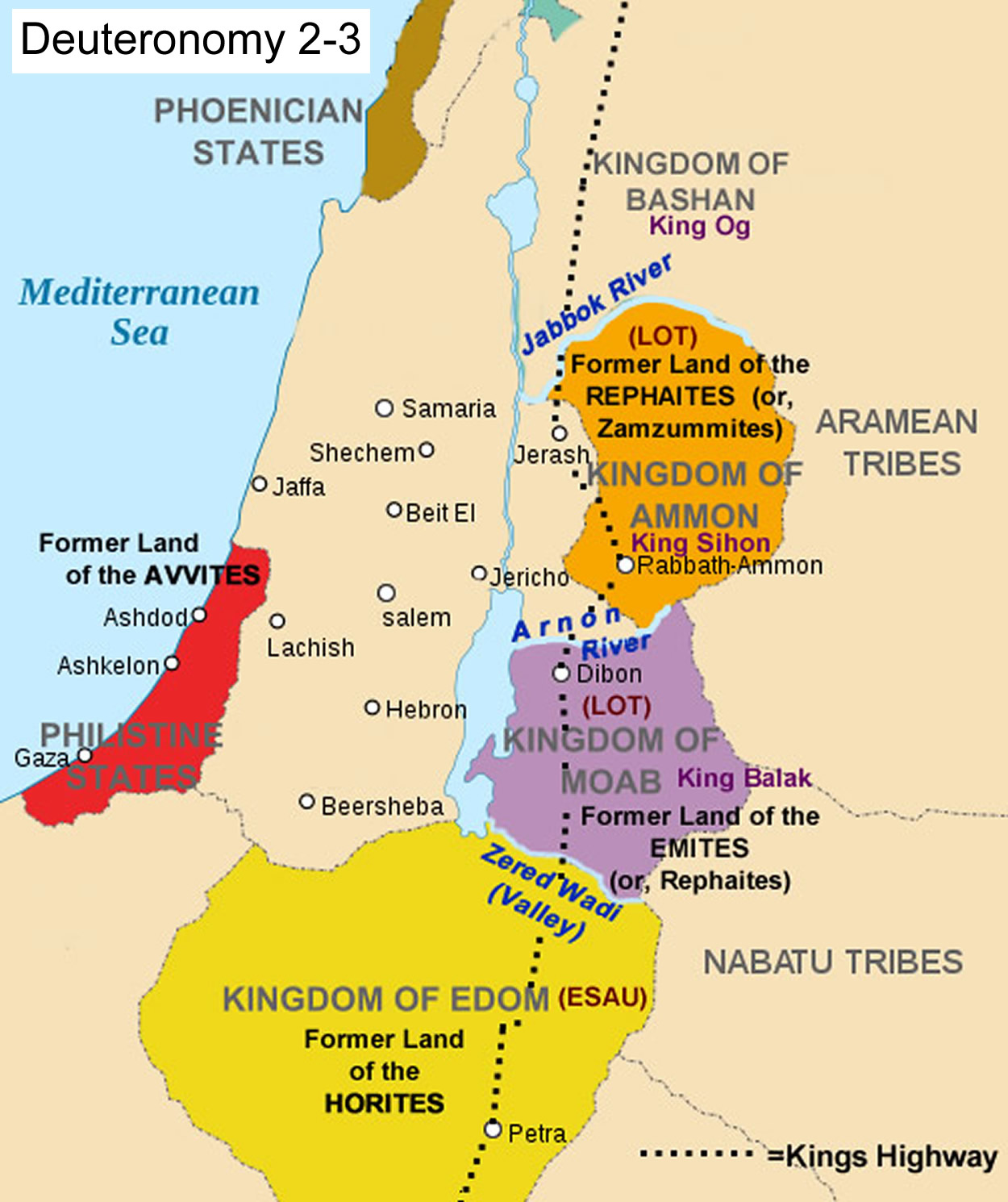
Moses makes it clear that the land in which Esau and his descendants eventually settled was far from empty. It had been occupied by another group of people known as the Horites. The first mention we have of them is found in Genesis 14, where they are listed among a group of nations that were defeated by an alliance of four kings. This confederation of kings attacked and defeated the people living in the area around Mount Seir,  in the far south of Canaan. They ended up conquering the cities of Sodom and Gomorrah, taking captive all the citizens, including the nephew of Abraham.

When Esau separated from his brother, Jacob, he ended up settling in the very same region as the Horites and, eventually, his sons and their children would supplant the Horites as the official inhabitants of the land. Hundreds of years later, when Moses prepared to lead the people of Israel into the promised land, he would receive instruction from God regarding this southern region and its inhabitants.

“You are about to pass through the territory of your brothers, the people of Esau, who live in Seir; and they will be afraid of you. So be very careful. Do not contend with them, for I will not give you any of their land, no, not so much as for the sole of the foot to tread on, because I have given Mount Seir to Esau as a possession.” – Deuteronomy 2:4-5 ESV

Moses records that Esau and his clan didn’t simply overwhelm the Horites with their superior numbers and strength, but that God orchestrated the transference of the land from one group to the other.

“…he [God] destroyed the Horites before them and they dispossessed them and settled in their place even to this day.” – Deuteronomy 2:22 ESV

The leader of the Horites was a man named Seir, and a large mountain in the region aptly bore his name. The Horites proved to be quite prolific, as the genealogy found in verses 20-43 reflects. But the chiefs of Seir and the chiefs of Esau would end up engaged in an ongoing conflict over control of the land around Mount Seir.

These are the sons of Dishan: Uz and Aran. These are the chiefs of the Horites: the chiefs Lotan, Shobal, Zibeon, Anah, Dishon, Ezer, and Dishan; these are the chiefs of the Horites, chief by chief in the land of Seir. – Genesis 36:28-30 ESV

These are the names of the chiefs of Esau, according to their clans and their dwelling places, by their names: the chiefs Timna, Alvah, Jetheth, Oholibamah, Elah, Pinon, Kenaz, Teman, Mibzar, Magdiel, and Iram; these are the chiefs of Edom (that is, Esau, the father of Edom), according to their dwelling places in the land of their possession. – Genesis 436:40-43 ESV

These two groups of “chiefs” or leaders of their clans would have gone head-to-head in battle with one another over control of the land. But what is interesting is that Moses provides a list of the kings who ruled over the land of Edom, and not one chief among the Horites or Edomites can be found on that list. It contains the name of eight Edomite kings, but none appear to be sons of Esau or Seir. In fact, one is referred to as a Temanite, another hales from Rehoboth, and still another comes from a place called Masrekah.  This sequential order of kings seems to reveal that there was a constant shift of power among the people groups that occupied this region. And Moses points out that the land of Edom had many kings long before the nation of Israel had their first monarch. Part of the reason for this disparity is that the people of Israel would eventually make their way to Egypt where they would remain for 400 years. During that time, the land of Edom would go through a long list of kings, chiefs, and leaders, while the Israelites were biding their time in Egypt. But the land of promise, like Edom, would not go unoccupied during the Israelites’ long absence. Canaan would be filled with nations, and overrun by the sins of idolatry and immorality.

And by the time Moses led the people of Israel back into the land, the  descendants of Esau (the Edomites) would be well established around Mount Seir. In keeping with God’s directive, the Israelites would view Edom as off-limits, restricting themselves to the purchase of food and supplies, but avoiding the confiscation of any Edomite territory because it had been given to them by God. And Moses states, “So we went on, away from our brothers, the people of Esau, who live in Seir, away from the Arabah road from Elath and Ezion-geber” (Deuteronomy 2:8 ESV).

All of this sets up the next section of Moses’ historical record of the people of Israel. While Esau and his descendants were busy making themselves at home in Edom, Israel and his descendants would be continuing the nomadic lifestyle established by Abraham and Isaac. Moses opens up chapter seven with the statement: “Jacob lived in the land of his father’s sojournings, in the land of Canaan” (Genesis 37:1 ESV).

The Hebrew word that Moses used is מָגוּר (māḡûr), which can also be translated “to be a stranger.” That is why the New Living Translation translates verse 1 this way: “So Jacob settled again in the land of Canaan, where his father had lived as a foreigner.”

Isaac, like his father before him, lived in the land of Canaan, more like an alien and a stranger than as a legal citizen. Neither Abraham or Isaac lived in a city or built a permanent dwelling place. They were sojourners, moving from one place to another, and never staying long enough to consider anywhere in the land of Canaan as their true home. And it is the author of the book of Hebrews who explains the reason behind this vagabond existence that was passed down from father to sin to grandson.

It was by faith that Abraham obeyed when God called him to leave home and go to another land that God would give him as his inheritance. He went without knowing where he was going. And even when he reached the land God promised him, he lived there by faith—for he was like a foreigner, living in tents. And so did Isaac and Jacob, who inherited the same promise. Abraham was confidently looking forward to a city with eternal foundations, a city designed and built by God. – Hebrews 11:8-10 NLT

And the author of Hebrews indicates that Abraham, Isaac, and Jacob never got to see that city – in their lifetimes.

All these people died still believing what God had promised them. They did not receive what was promised, but they saw it all from a distance and welcomed it. They agreed that they were foreigners and nomads here on earth. – Hebrews 11:13 NLT

The Edomites had kings and kingdoms. Even the Horites had a long list of chiefs and enjoyed that benefit of living in cities built by human hands. But the people of God would have to wait a long time before they experienced the fulfillment of God’s promise. God had promised to give them the land of Canaan as their inheritance, but neither Abraham, Isaac, or Jacob would make ever find their permanent home in the land of promise because God had something better in store.

Obviously people who say such things are looking forward to a country they can call their own. If they had longed for the country they came from, they could have gone back. But they were looking for a better place, a heavenly homeland. That is why God is not ashamed to be called their God, for he has prepared a city for them. – Hebrews 11:14-15 NLT

The wait would be difficult but well worth it.

English Standard Version (ESV) The Holy Bible, English Standard Version. ESV® Permanent Text Edition® (2016). Copyright © 2001 by Crossway Bibles, a publishing ministry of Good News Publishers.

New Living Translation (NLT) Holy Bible, New Living Translation, copyright © 1996, 2004, 2015 by Tyndale House Foundation. Used by permission of Tyndale House Publishers Inc., Carol Stream, Illinois 60188. All rights reserved.

New English Translation (NET)NET Bible® copyright ©1996-2017 by Biblical Studies Press, L.L.C. http://netbible.com All rights reserved.

Revenge, Greed, and Deceit, Oh My!

13 The sons of Jacob answered Shechem and his father Hamor deceitfully, because he had defiled their sister Dinah. 14 They said to them, “We cannot do this thing, to give our sister to one who is uncircumcised, for that would be a disgrace to us. 15 Only on this condition will we agree with you—that you will become as we are by every male among you being circumcised. 16 Then we will give our daughters to you, and we will take your daughters to ourselves, and we will dwell with you and become one people. 17 But if you will not listen to us and be circumcised, then we will take our daughter, and we will be gone.”

18 Their words pleased Hamor and Hamor’s son Shechem. 19 And the young man did not delay to do the thing, because he delighted in Jacob’s daughter. Now he was the most honored of all his father’s house. 20 So Hamor and his son Shechem came to the gate of their city and spoke to the men of their city, saying, 21 “These men are at peace with us; let them dwell in the land and trade in it, for behold, the land is large enough for them. Let us take their daughters as wives, and let us give them our daughters. 22 Only on this condition will the men agree to dwell with us to become one people—when every male among us is circumcised as they are circumcised. 23 Will not their livestock, their property and all their beasts be ours? Only let us agree with them, and they will dwell with us.” 24 And all who went out of the gate of his city listened to Hamor and his son Shechem, and every male was circumcised, all who went out of the gate of his city.

25 On the third day, when they were sore, two of the sons of Jacob, Simeon and Levi, Dinah’s brothers, took their swords and came against the city while it felt secure and killed all the males. 26 They killed Hamor and his son Shechem with the sword and took Dinah out of Shechem’s house and went away. 27 The sons of Jacob came upon the slain and plundered the city, because they had defiled their sister. 28 They took their flocks and their herds, their donkeys, and whatever was in the city and in the field. 29 All their wealth, all their little ones and their wives, all that was in the houses, they captured and plundered.

30 Then Jacob said to Simeon and Levi, “You have brought trouble on me by making me stink to the inhabitants of the land, the Canaanites and the Perizzites. My numbers are few, and if they gather themselves against me and attack me, I shall be destroyed, both I and my household.” 31 But they said, “Should he treat our sister like a prostitute?” – Genesis 34:13-31 ESV

One of the things that stands out in this whole affair is the silence of Jacob. As head of his clan, he had a responsibility to defend his daughter’s honor and to manage his sons’ behavior. But he appears to have said little and done nothing. And his silence regarding Dinah’s rape was unacceptable to her two brothers, Simeon and Levi. They were furious with Shechem for his dishonoring of their sister. And they were appalled that Jacob would consider signing a treaty that would sanction the marriage of their sister to her abuser and promote further unions between the two clans. So, they came up with a plan of their own.

As has been evident throughout the story of Jacob’s life, deceit and trickery come into play once again. The sons of Jacob have inherited their father’s deceptive ways and are determined to use them for their advantage. They even pull the wool over Jacob’s eyes, tricking him into believing that their efforts are sincere. Yet, Moses uses very precise language when describing their response to Hamor and Shechem.

The sons of Jacob answered Shechem and his father Hamor deceitfully, because he had defiled their sister Dinah. – Genesis 34:13 ESV

The Hebrew word translated as “deceitfully” is מִרְמָה (mirmâ) and it describes the use of guile, falsehood, or craftiness with the intent to deceive. The practice of deceit is repeatedly condemned in the Scriptures. Even David, a descendant of Jacob, wrote:

But you, O God, will cast them down
    into the pit of destruction;
men of blood and treachery (mirmâ)
    shall not live out half their days.
But I will trust in you. – Psalm 55:23 ESV

Even King Solomon, another descendant of Jacob, penned the following assessment of those who practice deceit.

Whoever speaks the truth gives honest evidence,
    but a false witness utters deceit (mirmâ). – Proverbs 12:17 ESV

Notice that David links treachery or deceit with bloodshed, and that is exactly what takes place in this story. The lies of Jacob’s sons were intentional and, ultimately, deadly. Their plan all along was to deceive so that they might enact revenge. They had no intention of keeping their agreement with Hamor and Shechem. And nobody seems to see through their wicked scheme, including their own father.

Amazingly, Hamor and Shechem agreed to the rather bizarre conditions that Jacob’s sons added to the treaty. All the men of Shechem would be required to undergo the rite of circumcision in order to seal the agreement. And when Hamor and Shechem shared the terms of the treaty with their constituents, they received a unanimous affirmation.

So all the men in the town council agreed with Hamor and Shechem, and every male in the town was circumcised. – Genesis 34:24 NLT

This was a radical and painful concession on the part of the Shechemites. But it was not unprecedented. The Israelites were not the only nation to practice the rite of circumcision, and it was most commonly performed on male members of the community. There is some evidence that circumcision was practiced as premarital initiation. There is no indication from the text that Jacob’s sons were suggesting the mass conversion of the men of Shechem. They had no intention of welcoming these men into their faith community. It was simply a ploy, a cleverly disguised trick designed to lull the Shechemites into their trap. And it worked.

But it is important to note why the men of Shechem were so willing to endure such a painful procedure and allow themselves to be placed in such a vulnerable condition. Hamor and Shechem had been successful in persuading their countrymen because they had added an important caveat.

“…if we do this, all their livestock and possessions will eventually be ours. Come, let’s agree to their terms and let them settle here among us.” – Genesis 34:23 NLT

Greed was the impetus behind their decision. By agreeing to the terms of the treaty, the men of Shechem believed they would eventually assimilate the clan of Jacob into their own, and gain control over all their possessions. Intermarriage would result in great wealth and circumcision was a small price to pay for such a reward.

But little did these men know that Jacob’s sons had no intention of keeping their word. There would be no marriage between Shechem and Dinah, no blending of the two clans, and no sharing of livestock and possessions. All the Shechemites got out of the agreement was the pain associated with circumcision, followed by the penalty of death. They were slaughtered like helpless, injured animals.

But three days later, when their wounds were still sore, two of Jacob’s sons, Simeon and Levi, who were Dinah’s full brothers, took their swords and entered the town without opposition. Then they slaughtered every male there, including Hamor and his son Shechem. They killed them with their swords, then took Dinah from Shechem’s house and returned to their camp. – Genesis 34:25-26 NLT

Fueled by their anger and vengeance, Simeon and Levi left no man alive. They paid back the Shechemites for the defilement of their sister, delivering a devastating blow that would leave their father shocked and dismayed. And, to make matters worse, their brothers would join in on the action, looting and plundering the defenseless town. They even took the women and children of Shechem as slaves. And having heard the news of what his sons had done, Jacob confronted Simeon and Levi.

“You have ruined me! You’ve made me stink among all the people of this land—among all the Canaanites and Perizzites. We are so few that they will join forces and crush us. I will be ruined, and my entire household will be wiped out!” – Genesis 34:30 NLT

It’s interesting to note that Jacob was worried about his own reputation but never seems to have considered what Dinah’s rape had done to her social standing. Her virginity had been stolen from her, leaving her as little more than a social pariah. Her defilement had left her as “damaged goods” with little hope of ever being married. And Jacob’s willingness to give her to Shechem, the very man who had raped her, seems to indicate that he knew she had no other options. She either married Shechem or remained an unmarried woman the rest of her life.

But Jacob’s failure to deal with the egregious nature of Shechem’s sin left a leadership vacuum in his family, and his sons willingly filled it. And, in response to their father’s reprimand, Simeon and Levi defended their actions by angrily declaring, “But why should we let him treat our sister like a prostitute?” (Genesis 34:31 NLT).

It’s clear from the text that Jacob had already given Dinah to Shechem because the two brothers rescued her from his house. In Jacob’s mind, the deal was done, the treaty had been ratified. But in a single day, his sons had changed all that. And Jacob feared that their actions would end up turning the rest of the nations of Canaan against him. Word would get out and he would become a social pariah in the land of promise. He even feared that their newly acquired reputation for violence would come back to haunt them, resulting in their own eradication. But of all people, Jacob should have known that God had other plans.

He should have never settled outside the city of Shechem and he was wrong for signing an agreement with the citizens of that city. God had set him apart and had promised to make of his descendants a great nation. He and his children were the chosen people of God and the land of Canaan had been promised to them as their inheritance. In a way, Jacob’s sons had done him a favor, albeit by less-than-righteous means. Their spontaneous and anger-fueled response left Jacob with no option but to vacate the region of Shechem. He was no longer safe there. And in the very next chapter, God will direct Jacob to leave Shechem and return to Bethel because, despite Jacob’s fears, his days in Canaan were far from over.

English Standard Version (ESV) The Holy Bible, English Standard Version. ESV® Permanent Text Edition® (2016). Copyright © 2001 by Crossway Bibles, a publishing ministry of Good News Publishers.

New Living Translation (NLT) Holy Bible, New Living Translation, copyright © 1996, 2004, 2015 by Tyndale House Foundation. Used by permission of Tyndale House Publishers Inc., Carol Stream, Illinois 60188. All rights reserved.

New English Translation (NET)NET Bible® copyright ©1996-2017 by Biblical Studies Press, L.L.C. http://netbible.com All rights reserved.

The Promise Maker

1 After these things the word of the Lord came to Abram in a vision: “Fear not, Abram, I am your shield; your reward shall be very great.” 2 But Abram said, “O Lord God, what will you give me, for I continue childless, and the heir of my house is Eliezer of Damascus?” 3 And Abram said, “Behold, you have given me no offspring, and a member of my household will be my heir.” 4 And behold, the word of the Lord came to him: “This man shall not be your heir; your very own son shall be your heir.” 5 And he brought him outside and said, “Look toward heaven, and number the stars, if you are able to number them.” Then he said to him, “So shall your offspring be.” 6 And he believed the Lord, and he counted it to him as righteousness. – Genesis 15-1-6 ESV

Abram has just received a blessing from Melchizedek, priest of the Most High God.

Blessed be Abram by God Most High,
    Creator of heaven and earth. – Genesis 14:19 NLT

Sometime after his encounter with the king-priest Melchizedek, God provided his servant with a confirmation and explanation of that blessing in the form of a vision. The Most High God referred to Himself as Abram’s shield or protector. In the same way that Abram had protected and delivered his nephew Lot during his time of captivity, God would be Abram’s defender and deliverer. And while Abram had turned down the king of Sodom’s offer of all the plunder taken from Sodom, he could be certain that God would reward him with something of far greater value.

One of the questions this passage raises is why God opened up His address to Abram with the words, “Fear not.” What was it that Abram feared? Some believe that, upon receiving an unexpected vision of the Most High God, Abram was filled with fear and awe. This would have been a normal and natural reaction to such an encounter with God. When Moses was given a vision of God in the form of a burning bush, “he hid his face, for he was afraid to look at God” (Exodus 3:6 ESV).

But based on the context of chapter 14, it makes more sense to see Abram’s fear as horizontal in nature, rather than vertical. Due to his victory over the four Mesopotamian kings, Abram had just made himself some powerful enemies. Not only that, by displaying his military might, he had inadvertently placed a target on his back. Whether he liked it or not, he was the new sheriff in town and everyone would be gunning for him. Abram was essentially a shepherd and not a warrior, and the thought that his enemies might seek retribution on him and his household was keeping him up at night. So, God assured his fearful servant that he had nothing to worry about. Abram could rest in the knowledge that God would protect and provide for him. It is the same message that God would give to Abram’s descendants centuries later.

“Don’t be afraid, for I am with you. Don’t be discouraged, for I am your God. I will strengthen you and help you. I will hold you up with my victorious right hand.” – Isaiah 41:10 NLT

Abram’s response to God’s words of comfort and encouragement is less than confident.

“O Lord God, what will you give me, for I continue childless, and the heir of my house is Eliezer of Damascus?” – Genesis 15:2 NLT

With this statement, Abram reveals that his greatest fear was that of failure. He knew that God had promised to bless him. He couldn’t stop thinking about the words God had spoken when he was still living in Haran.

“I will make of you a great nation, and I will bless you and make your name great, so that you will be a blessing. I will bless those who bless you, and him who dishonors you I will curse, and in you all the families of the earth shall be blessed.” – Genesis 12:2-3 ESV

Abram had been 75-years-old when God made that promise. And now, years later, he had only grown older and his wife’s fertility problem had not improved. All the way back in Genesis 11:30, Moses had disclosed the sad state of Sarai’s reproductive health: “Now Sarai was barren; she had no child.”

All of these factors weighed heavily on Abram’s mind. Based on the circumstances, he could see no way that God’s promise could ever come to fruition. Abram had resigned himself to the fact that one of his household servants would end up as his heir. He informed God about the desperate nature of his situation and even blamed Him for it.

“You have given me no descendants of my own, so one of my servants will be my heir.” – Genesis 15:3 NLT

It appears that Abram was growing impatient. During his time in the land of Canaan, he had seen his financial prospects improve. He had grown rich and his herds had grown in number. And here was God promising to shower him with further rewards. But what difference would it make if he had no one to whom he could leave his great wealth?

It’s not difficult to ascertain how Abram had assessed his situation and come up with a possible solution. He had given up on Sarai ever giving birth to a son, and had assumed that they would end up adopting one of their household servants as their son and making him the rightful heir to their estate. There had probably been a time when Abram had believed Lot, his nephew, would be the logical choice. But there had been a fallout between the two of them. So, at this point, Abram had determined that his heir would end up being Eliezer of Damascus.

What is ironic about Abram’s conclusion is that Eliezer’s name means “God is help.” Yet, it would appear that Abram was the one who was attempting to help God. He was offering God a logical solution to the whole fruitlessness problem. Abram was willing to settle for less. He was willing to accept a foreign-born “member” of his house as his heir rather than wait on God to do the impossible. But God had other plans. He was not going to compromise. And Sarai’s barrenness was not going to be a problem. So, God gently but firmly broke the news to Abram.

“No, your servant will not be your heir, for you will have a son of your own who will be your heir.” – Genesis 15:4 NLT

In essence, God said, “Thanks for the tip, but no!” The Creator-God didn’t need Abram’s help or advice. If anything, Eliezer’s presence in Abram’s house was meant to be a constant reminder that “God is help.” Eliezer wasn’t intended to be the solution. No, every time Abram said Eliezer’s name, it should have reminded him that God was the solution. And to stress the miraculous nature of His promise, God took Abram outside and told him to “look up into the sky and count the stars if you can” (Genesis 15:5 NLT). Then, as Abram stood staring up into the night sky, overwhelmed by the sheer number of stars, God boldly proclaimed, “That’s how many descendants you will have!” (Genesis 15:5 NLT).

This was not the first time Abram had heard such an outlandish prediction from God. Earlier, when Abram had separated from Lot, God had assured him that all the land of Canaan would be his and that land would be filled with his descendants.

“I will give you so many descendants that, like the dust of the earth, they cannot be counted!” – Genesis 13:16 NLT

This blessing would not come through Eliezer or any other substitute. God had promised to give Abram a son, and He was well aware of Sarai’s barrenness. In fact, as the sovereign God of the universe, her barrenness had been part of His plan all along. The improbability and impossibility of it all had been baked into the cake. God wanted Abram to understand that everything about this promise would be miraculous and supernatural.

And then Moses adds a somewhat surprising conclusion. Despite all of Abram’s former doubts and fears, he “believed the Lord, and the Lord counted him as righteous because of his faith” (Genesis 15:6 NLT). Suddenly, Abram’s mental state went from doubt to assurance. He went from trying to help God out to having hope in God’s promise. His confidence in God grew deeper and richer.

It’s interesting to note that Abram had always believed that God would give him an heir. His doubts had been focused on the means by which God would fulfill that promise. He had been hung up on Sarai’s barrenness. That’s why he had come up with what he believed to be an acceptable and logical alternative solution. But now, his belief focused in on the power of God to accomplish the impossible. He went from believing in the promise to believing in the God who made the promise. And there is a huge difference.

In the great “Hall of Faith” found in chapter 11 of the book of Hebrews, the author states, “without faith it is impossible to please him, for whoever would draw near to God must believe that he exists and that he rewards those who seek him” (Hebrews 11:6 ESV). Abram was learning that his faith in God was the key to the promise of God. That does not mean that faith is what determines our reward, but that faith or belief in God is the means by which we appropriate the promises of God. We have to believe, trust in, and place our confidence in the God behind the promise.

The author of Hebrews goes on to explain how Abram displayed faith in God. And he describes how Abram’s faith developed and deepened over time until it influenced even his wife, Sarai.

By faith Abraham obeyed when he was called to go out to a place that he was to receive as an inheritance. And he went out, not knowing where he was going. By faith he went to live in the land of promise, as in a foreign land, living in tents with Isaac and Jacob, heirs with him of the same promise. For he was looking forward to the city that has foundations, whose designer and builder is God. By faith Sarah herself received power to conceive, even when she was past the age, since she considered him faithful who had promised. Therefore from one man, and him as good as dead, were born descendants as many as the stars of heaven and as many as the innumerable grains of sand by the seashore. – Hebrews 11:8-12 ESV

Moses declares that God counted or credited Abram’s faith as righteousness. Abram was justified or made right with God because he chose to believe and trust, not only in the promises of God but in the God behind the promises. Abram had transferred his hope in the promise to the divine promise maker. And the author of Hebrews goes on to point out that faith in the God of the promise is what sets His people apart. Whether a child of God ever sees the promise fulfilled in their lifetime, they will continue to trust in the word and reliability of the promise maker.

All these people earned a good reputation because of their faith, yet none of them received all that God had promised. – Hebrews 11:39 NLT

Abram would eventually see a son born to his barren wife. But he would never own any land in Canaan. He would never live to see the day when his descendants, as numerous as the stars in the sky, would occupy that land. But he would continue to believe that His God was good and could be trusted to do what He promised, whether Abram lived to see it or not. That is the essence of faith.

Now faith is the assurance of things hoped for, the conviction of things not seen. – Hebrews 11:1 ESV

English Standard Version (ESV) The Holy Bible, English Standard Version. ESV® Permanent Text Edition® (2016). Copyright © 2001 by Crossway Bibles, a publishing ministry of Good News Publishers.

New Living Translation (NLT) Holy Bible, New Living Translation, copyright © 1996, 2004, 2015 by Tyndale House Foundation. Used by permission of Tyndale House Publishers Inc., Carol Stream, Illinois 60188. All rights reserved.

New English Translation (NET)NET Bible® copyright ©1996-2017 by Biblical Studies Press, L.L.C. http://netbible.com All rights reserved.

A Call and a Commitment

1 Now the Lord said to Abram, “Go from your country and your kindred and your father’s house to the land that I will show you. 2 And I will make of you a great nation, and I will bless you and make your name great, so that you will be a blessing. 3 I will bless those who bless you, and him who dishonors you I will curse, and in you all the families of the earth shall be blessed.” – Genesis 12:1-3 ESV

With the opening verses of chapter 12, Moses provides his Hebrew readers with an important history lesson that solidifies their unique role in God’s redemptive plan for all mankind. For generations, the Jews had rightfully viewed themselves as God’s chosen people. They considered themselves to be a people who had been set apart by God and declared to be His “treasured possession.” Those were the very words that Moses had communicated to them not long after God delivered them out of captivity in Egypt.

“Thus you shall say to the house of Jacob, and tell the people of Israel: ‘You yourselves have seen what I did to the Egyptians, and how I bore you on eagles’ wings and brought you to myself. Now therefore, if you will indeed obey my voice and keep my covenant, you shall be my treasured possession among all peoples, for all the earth is mine; and you shall be to me a kingdom of priests and a holy nation.’” – Exodus 19:3-6 ESV

Years later, when the people of Israel were standing on the border of Canaan, preparing to enter into the land that God had promised to give them, Moses reminded them of their privileged position as God’s set-apart people.

“For you are a holy people, who belong to the LORD your God. Of all the people on earth, the LORD your God has chosen you to be his own special treasure.” – Deuteronomy 7:6 NLT

When reading the story of Abram’s call, it is essential to keep this unique relationship between God and the nation of Israel in mind. The original audience to whom Moses wrote would have relished this retelling of their storied history, but it’s likely that they missed some of the key messages that God had intended for them to hear. They would have brightened at the mention of Abram’s name. This would have been the part of the story where they sat up and took notice. God’s call of Abram had been the impetus for their very existence.

And while that was true, there is something far more significant in the story of Abram’s call than the formation of a single, set-apart nation. For generations, the descendants of Abram had missed the divine purpose behind their existence. They had not earned their favored status with God. The Almighty had not looked down from heaven, noticed their righteous behavior, and decided to reward them with a promotion. In fact, Moses had fully dispelled any thought of their favored status being a reward.

“The LORD did not set his heart on you and choose you because you were more numerous than other nations, for you were the smallest of all nations! Rather, it was simply that the LORD loves you, and he was keeping the oath he had sworn to your ancestors.” – Deuteronomy 7:7-8 NLT

That last line is the key to understanding Genesis 12. The Hebrews, as descendants of Abram, had been created by God. Despite their long and storied history, they had not always existed. There had been a time when not a single Jew walked the face of the earth. Even Abram was not of Jewish descent. He was a Chaldean. But from this one man came a people whom God would set apart. Like the rest of the universe in Genesis 1, the Hebrew people would be created by God, ex nihilo (out of nothing). And the 12th chapter of Genesis begins the story of this “new creation” by God.

The apostle Peter picked up on this theme when writing his first letter. He was addressing Christians who were living in Asia Minor and suffering persecution because of their faith. At one point in his letter, he describes them as “aliens and strangers” (1 Peter 2:11), living in the midst of the spiritual darkness that surrounded them. And he used language that compared them to the people of Israel.

But you are a chosen race, a royal priesthood, a holy nation, a people for his own possession, that you may proclaim the excellencies of him who called you out of darkness into his marvelous light. Once you were not a people, but now you are God’s people; once you had not received mercy, but now you have received mercy. – 1 Peter 2:9-10 ESV

That last line is critical. At one time, these people had not been “a people.” Oh, they existed, but they lacked a relationship with God. The apostle Paul addressed the Gentile believers in Ephesus with a similar thought.

…remember that at that time you were separate from Christ, alienated from the commonwealth of Israel, and strangers to the covenants of the promise, without hope and without God in the world. – Ephesians 2:12 BSB

And Paul went on to remind them of the dramatic transformation that God had brought about in their lives.

Therefore you are no longer strangers and foreigners, but fellow citizens with the saints and members of God’s household… – Ephesians 2:19 BSB

So, back to Genesis 12. With the opening line of the chapter, Moses describes God as sovereignly inserting Himself into the affairs of humanity once again. After all the genealogical lists describing the various lines of Shem, Ham, and Japheth, God focuses His attention on one man: Abram. And to this one individual, God issues a call and provides a promise.

“Go from your country and your kindred and your father’s house to the land that I will show you. And I will make of you a great nation, and I will bless you and make your name great, so that you will be a blessing. I will bless those who bless you, and him who dishonors you I will curse, and in you all the families of the earth shall be blessed.” – Genesis 12:1-3 ESV

According to chapter 11, Abram had been born in Ur of the Chaldeans, located in the land of Shinar. But at one point, his father had made the decision to move his entire family to Canaan. The text provides is no explanation for this costly and difficult relocation. But it is not difficult to see the sovereign hand of God orchestrating this entire affair.

It would have taken a great deal of time and effort to make the long journey from Ur to Canaan. Because the arid and impassable Arabian Desert was located immediately east of Ur, Terah was forced to take a time-consuming detour that eventually led them to Haran. And, once in Haran, Terah had a change of heart and decided to settle down. but God had other plans for Abram. In time, Haran became home to Abram. He too settled down and began to put down roots. But at some point, God commanded him to leave everything behind.

“Leave your native country, your relatives, and your father’s family, and go to the land that I will show you.” – Genesis 12:1 NLT

This was a huge “ask” on God’s part. In those days, family ties were essential to survival. By this time in human history, the world had become a hostile place occupied by disparate people groups based on clans and tribal relationships. After God had scattered the nations across the face of the earth (Genesis 11:9), territorial boundaries and indigenous communities had become commonplace. Everyone had staked out their claims and was protecting their particular piece of the global pie. So, it would not have been easy for Abram to leave the safety and security of his clan behind.

But God’s command came with a promise. He was going to provide Abram with a new home in a new land. And it just happened to be the very same land that Terah had intended as his family’s destination. Perhaps Terah had given up on Canaan because he heard it was already occupied by other, more powerful clans. But this would prove to be no problem for God. For the first time since God had placed Adam in Eden, a man was going to be given a specific tract of land to occupy. And like Eden, Canaan was a beautiful and fruitful land, “a good and broad land, a land flowing with milk and honey” (Exodus 3:8 ESV).

According to God, this new land would become the sole possession of Abram’s descendants. In a sense, Canaan had Abram’s name on the deed. And it would be in this land that God would bless Abram and produce through him “a great nation.”

But there is a problem. It was mentioned in chapter 11 but only in passing. In the listing of Terah’s descendants, Abram is described as taking a wife for himself – a woman named Sarai. And then, almost as an aside, the test reveals, “Now Sarai was barren; she had no child” (Genesis 11:30 ESV). Abram would have been completely unaware of Sarai’s condition. But God knew. And yet, knowing that Sarai was incapable of bearing children, God declared that Abram would become the father of a great nation. God was going to bless Abram by giving him offspring. And those offspring would become a blessing to all the nations of the earth. An undeserving man and his barren wife would become the means by which God would pour out His blessings on all humanity.

And this is the point that the Hebrew people tended to miss. They considered themselves to be blessed by God because they were descendants of Abram. But they neglected to remember that their blessing came with a responsibility: They were to have been a blessing to the nations. God had set apart Abram and all his descendants so that they might serve as His representatives to the nations. God had promised to make them His “treasured possession among all peoples” (Exodus 19:5 ESV). But they had a job to do.

…you shall be to me a kingdom of priests and a holy nation… – Exodus 19:6 ESV

Priests were intended to be the mediators between God and man. The Hebrew people had been set apart by God so that they might minister on His behalf to all the nations of the earth. But they had proved to be unfaithful priests and far from a holy nation. But God’s promise would still be fulfilled. Because it would be through the line of Abram that He would bring the offspring through whom all the nations of the earth would be blessed. Jesus would accomplish what the nation of Israel had failed to do.

“I am the Lord; I have called you in righteousness;
    I will take you by the hand and keep you;
I will give you as a covenant for the people,
    a light for the nations… ” – Isaiah 42:6 ESV

“It is too light a thing that you should be my servant
    to raise up the tribes of Jacob
    and to bring back the preserved of Israel;
I will make you as a light for the nations,
    that my salvation may reach to the end of the earth.” – Isaiah 49:6 ESV

That is what sets this chapter apart. In it is contained the hope of all eternity. The coming of the Messiah is weaved into the fabric of Abram’s call and provides the underlying foundation for God’s promise of future blessing for all mankind.

English Standard Version (ESV) The Holy Bible, English Standard Version. ESV® Permanent Text Edition® (2016). Copyright © 2001 by Crossway Bibles, a publishing ministry of Good News Publishers.

New Living Translation (NLT) Holy Bible, New Living Translation, copyright © 1996, 2004, 2015 by Tyndale House Foundation. Used by permission of Tyndale House Publishers Inc., Carol Stream, Illinois 60188. All rights reserved.

New English Translation (NET)NET Bible® copyright ©1996-2017 by Biblical Studies Press, L.L.C. http://netbible.com All rights reserved.

A Garden of Earthly Delights

8 And the Lord God planted a garden in Eden, in the east, and there he put the man whom he had formed. 9 And out of the ground the Lord God made to spring up every tree that is pleasant to the sight and good for food. The tree of life was in the midst of the garden, and the tree of the knowledge of good and evil.

10 A river flowed out of Eden to water the garden, and there it divided and became four rivers. 11 The name of the first is the Pishon. It is the one that flowed around the whole land of Havilah, where there is gold. 12 And the gold of that land is good; bdellium and onyx stone are there. 13 The name of the second river is the Gihon. It is the one that flowed around the whole land of Cush. 14 And the name of the third river is the Tigris, which flows east of Assyria. And the fourth river is the Euphrates.

15 The Lord God took the man and put him in the garden of Eden to work it and keep it. 16 And the Lord God commanded the man, saying, “You may surely eat of every tree of the garden, 17 but of the tree of the knowledge of good and evil you shall not eat, for in the day that you eat of it you shall surely die.” – Genesis 2:8-17 ESV

Once again, Moses provides some much-needed context to set up the next phase of the creation account. He relates that God planted a garden in a region known as Eden. The Hebrew word of “garden” is גַּן (gan), which was typically used to refer to an orchard. In this eastern section of Eden, God had prepared a grove filled with trees that were “pleasant to the sight and good for food” (Genesis 2:9 ESV). From the wording of the text, it appears that God did not create fully grown trees, but chose instead to have them grow from seeds.

…out of the ground the Lord God made to spring up every tree… – Genesis 2:9 ESV

In Hebrew, the term, “spring up,” means “to sprout, spring forth, to grow.” It should not be overlooked that God caused these trees to spring up from the “ground”(ăḏāmâ).  God used the same ground from which He had formed Adam (‘āḏām) to produce the food that would feed and sustain him. And Moses points out two particular trees that existed in the garden God had created: The tree of life and the tree of the knowledge of good and evil. These two trees will become key factors in the unfolding story.

It was in this idyllic spot that God placed man. This location was intended to be much more than a home for the first couple. In a sense, it was to be a place of worship, a precursor to both the tabernacle and temple that God would later ordain as holy sites in which His presence might dwell and His people could worship Him. In this setting, Adam and Eve would enjoy unbroken fellowship with God. Chapter three reveals that God regularly made His presence known to the first couple.

…the man and his wife heard the sound of the Lord God moving about in the orchard at the breezy time of the day… – Genesis 3:8 NLT

And in that same chapter, it becomes clear that Adam and Eve were accustomed to communicating with God. This garden-temple was meant to be a place of intimate communion between man and his God. And its beautiful surroundings point to the glory and holiness of its designer and creator. There was a river that flowed into the garden, providing pure drinking water for Adam and nourishment for the trees. Moses describes the prevalence of gold, bdellium, and onyx stone – natural resources that would later become coveted for their rarity and subsequent value. These same precious metals and priceless stones would become key decorative elements in the tabernacle and temple that God would ordain.

“Tell the people of Israel to bring me their sacred offerings. Accept the contributions from all whose hearts are moved to offer them. Here is a list of sacred offerings you may accept from them:

gold, silver, and bronze;
blue, purple, and scarlet thread;
fine linen and goat hair for cloth;
tanned ram skins and fine goatskin leather;
acacia wood;
olive oil for the lamps;
spices for the anointing oil and the fragrant incense;
onyx stones, and other gemstones to be set in the ephod and the priest’s chestpiece.

“Have the people of Israel build me a holy sanctuary so I can live among them.” – Exodus 25:1-8 NLT

While we can’t know for certain the exact location of the garden, Moses’ description of the four rivers provides a general idea of where this region may have been. Two of the rivers, the Tigris and Euphrates are located in what would become the land of Babylon. What is interesting to note is that these two rivers flow from the north to the south and encompass two regions that would later be associated with Abraham: Ur and Haran.

Terah took Abram his son and Lot the son of Haran, his grandson, and Sarai his daughter-in-law, his son Abram’s wife, and they went forth together from Ur of the Chaldeans to go into the land of Canaan, but when they came to Haran, they settled there. – Genesis 11:31 ESV

God would call Abram and command him to travel to a land that would become an inheritance to his ancestors.

Now the Lord said to Abram, “Go from your country and your kindred and your father’s house to the land that I will show you. And I will make of you a great nation, and I will bless you and make your name great, so that you will be a blessing. I will bless those who bless you, and him who dishonors you I will curse, and in you all the families of the earth shall be blessed.”

So Abram went, as the Lord had told him, and Lot went with him. Abram was seventy-five years old when he departed from Haran. And Abram took Sarai his wife, and Lot his brother’s son, and all their possessions that they had gathered, and the people that they had acquired in Haran, and they set out to go to the land of Canaan. – Genesis 12:1-5 ESV

And God would later describe two rivers that would form the boundaries of the land that He would give to Abram’s descendants.

On that day the Lord made a covenant with Abram, saying, “To your offspring I give this land, from the river of Egypt to the great river, the river Euphrates…” – Genesis 15:18 ESV

The land that God promised to give Abram’s offspring, the nation of Israel, would stretch from the Nile in the west to the Euphrates in the east. So, the garden in which God placed Adam must have been somewhere within this vast region. And this insight was meant to provide Moses’ readers with a reminder that, from the very beginning, God had intended this land to be the home of His children and the place where He dwelled among them. But this recounting of the creation story was also meant to remind every Israelite who would read it of their own rebellion and subsequent rejection from the land.

Moses makes it clear that God placed man in this very spot and gave him a job to do.

The Lord God took the man and placed him in the orchard in Eden to care for it and to maintain it. – Genesis 2:15 NLT

This verse helps to explain one of the responsibilities that had come with the command that God had given to Adam and Eve:

“Be fruitful and multiply and fill the earth and subdue it, and have dominion over the fish of the sea and over the birds of the heavens and over every living thing that moves on the earth.” – Genesis 1:28 ESV

Adam had been placed in the garden by God and ordered to manage and maintain it. But the garden would also provide for all of Adam’s needs. It was a place of complete sufficiency that was intended to sustain mankind for generations to come. It was in the garden that Adam and Eve were to be fruitful and multiply. But, ultimately, God expected them to leave the garden and fill the earth with more of their kind. They were to procreate and populate the entire earth and, in so doing, spread the image of God all throughout His creation.

But upon placing Adam in the garden, God gave him yet one more command that came with a sobering warning.

Then the Lord God commanded the man, “You may freely eat fruit from every tree of the orchard, but you must not eat from the tree of the knowledge of good and evil, for when you eat from it you will surely die.” – Genesis 1:16

Adam was free to eat from every tree of the garden except one. That means he had free access to the tree of life, and it would appear that this one tree was to be the means by which God sustained and prolonged Adam’s life. As long as he had access to the tree of life, he would live. But there was another tree that would produce the opposite effect. If Adam ate of the tree of the knowledge of good and evil, he would die. Here, for the first time, we see the disparate distinction between life and death, blessings and curses. As long as Adam obeyed the will of God, he would live. But if He chose to disobey, his actions would result in a deadly curse from God.

And as will soon become apparent, the tree of the knowledge of good and evil offered a tantalizing fruit that could give man the ability to self-govern. It would appeal to his desire for autonomy and self-rule. The knowledge of good and evil refers to man’s inherent desire to decide for himself, to self-determine what is right and wrong. In essence, to be his own god and create his own sense of what is just and acceptable behavior. Adam had everything he needed to live in unbroken fellowship with God, but that relationship required that he constantly submit his will to that of God. As long as he did, he would thrive and enjoy the undiminished blessings of God. But, we know how the story ends, because Moses provides all the sordid details.

English Standard Version (ESV) The Holy Bible, English Standard Version. ESV® Permanent Text Edition® (2016). Copyright © 2001 by Crossway Bibles, a publishing ministry of Good News Publishers.

New Living Translation (NLT) Holy Bible, New Living Translation, copyright © 1996, 2004, 2015 by Tyndale House Foundation. Used by permission of Tyndale House Publishers Inc., Carol Stream, Illinois 60188. All rights reserved.

New English Translation (NET)NET Bible® copyright ©1996-2017 by Biblical Studies Press, L.L.C. http://netbible.com All rights reserved.

When the People of God Become the Enemies of God

15 Now when the sons of the prophets who were at Jericho saw him opposite them, they said, “The spirit of Elijah rests on Elisha.” And they came to meet him and bowed to the ground before him. 16 And they said to him, “Behold now, there are with your servants fifty strong men. Please let them go and seek your master. It may be that the Spirit of the Lord has caught him up and cast him upon some mountain or into some valley.” And he said, “You shall not send.” 17 But when they urged him till he was ashamed, he said, “Send.” They sent therefore fifty men. And for three days they sought him but did not find him. 18 And they came back to him while he was staying at Jericho, and he said to them, “Did I not say to you, ‘Do not go’?”

19 Now the men of the city said to Elisha, “Behold, the situation of this city is pleasant, as my lord sees, but the water is bad, and the land is unfruitful.” 20 He said, “Bring me a new bowl, and put salt in it.” So they brought it to him. 21 Then he went to the spring of water and threw salt in it and said, “Thus says the Lord, I have healed this water; from now on neither death nor miscarriage shall come from it.” 22 So the water has been healed to this day, according to the word that Elisha spoke.

23 He went up from there to Bethel, and while he was going up on the way, some small boys came out of the city and jeered at him, saying, “Go up, you baldhead! Go up, you baldhead!” 24 And he turned around, and when he saw them, he cursed them in the name of the Lord. And two she-bears came out of the woods and tore forty-two of the boys. 25 From there he went on to Mount Carmel, and from there he returned to Samaria. – 2 Kings 2:15-25 ESV

After Elijah’s miraculous departure, Elisha was forced to retrace his steps alone. When he arrived at the Jordan River, he used Elijah’s cloak to part the waters, then passed through the river on dry ground. Whether Elisha realized it or not, he was reliving the experience of the people of Israel when they first arrived at the land of Canaan centuries earlier, and he was playing the part of Joshua. When the time had come for the Israelites to occupy the land God had given them for an inheritance, they were under new leadership. Moses had died, and Joshua was his God-appointed replacement. Joshua had inherited the responsibility of leading the nation of Israel across the Jordan River and into the land of promise. And he was old enough to remember that, 40 years earlier, Moses had failed in his first attempt to persuade the people to take possession of the land. So, God promised to give the new leader of His people a sign that He would be with him.

The Lord said to Joshua, “Today I will begin to exalt you in the sight of all Israel, that they may know that, as I was with Moses, so I will be with you.” – Joshua 3:7 ESV

God knew that the people would be reluctant to follow Joshua. That’s why He shared the plan He had put in place to solidify Joshua’s role as Israel’s leader.

“Behold, the ark of the covenant of the Lord of all the earth is passing over before you into the Jordan. Now therefore take twelve men from the tribes of Israel, from each tribe a man. And when the soles of the feet of the priests bearing the ark of the Lord, the Lord of all the earth, shall rest in the waters of the Jordan, the waters of the Jordan shall be cut off from flowing, and the waters coming down from above shall stand in one heap.” – Joshua 3:11-13 ESV

And God’s plan worked to perfection. The waters of Jordan parted, and the people of Israel walked across on dry ground. With their new leader going before them, the nation of Israel left the wilderness behind and began the first part of their God-ordained mission to possess the land He had graciously given them.

Elisha’s crossing of the Jordan mirrors that momentous occasion. Elijah, the former spiritual leader of Israel, was gone, and Elisha, his unproven and inexperienced replacement, required evidence to prove his role as the prophet of God. In a strange case of déjà vu, Elisha found himself mimicking the actions of Joshua once again. The first city the Israelites had encountered after their crossing of the Jordan was Jericho. And that is exactly where Elisha headed. He was met by 50 prophets of God who acknowledged that a transfer of power and leadership had taken place.

…they said, “The spirit of Elijah rests on Elisha.” And they came to meet him and bowed to the ground before him. – 2 Kings 2:15 ESV

But you can sense their reluctance to accept Elisha as Elijah’s replacement. They offer to send a search party to look for Elijah. After all, the prophet had a reputation for disappearing for long periods of time and then showing up unannounced. Perhaps he wasn’t really gone for good. While Elisha tried to talk them out of this vain quest, they persisted, and their search party came back empty-handed.

It’s important to remember that the city of Jericho had been destroyed by Joshua and the people of Israel. It was the very first victory that they had experienced as part of their conquest of the land of Canaan. God had told Joshua, “See, I have given Jericho into your hand, with its king and mighty men of valor” (Joshua 6:2 ESV). And He had given Joshua a rather bizarre strategy for conquering Jericho.

“You shall march around the city, all the men of war going around the city once. Thus shall you do for six days. Seven priests shall bear seven trumpets of rams’ horns before the ark. On the seventh day you shall march around the city seven times, and the priests shall blow the trumpets. And when they make a long blast with the ram’s horn, when you hear the sound of the trumpet, then all the people shall shout with a great shout, and the wall of the city will fall down flat…” – Joshua 6:3-5 ESV

But as strange as God’s tactics may have sounded to Joshua and the people, the results were hard to refute. The walls fell, and the entire city was destroyed. And Joshua placed the city of Jericho under a perpetual curse.

“May the curse of the Lord fall on anyone
    who tries to rebuild the town of Jericho.
At the cost of his firstborn son,
    he will lay its foundation.
At the cost of his youngest son,
    he will set up its gates.” – Joshua 6:26 NLT

This is an important point to consider because when Elisha showed up at Jericho, not only had it been rebuilt, but it was occupied by 50 prophets of Yahweh. They even give the city their Goodhousekeeping Seal of Approval: “This town is located in pleasant surroundings, as you can see” (2 Kings 2:19 NLT). The only problem they had with Jericho was its lack of clean water.

“But the water is bad, and the land is unproductive.” – 2 Kings 2:19 NLT

In Joshua’s day, the city of Jericho had represented the pagan nations that occupied the land of Canaan. It was well-fortified and well-defended. But it had proven to be no match for the God of Israel. He had literally leveled the entire city, and His new leader had “burned the city with fire, and everything in it” (Joshua 6:24 ESV).

Now, centuries later, the city of Jericho had been rebuilt and reoccupied. But not by Canaanites. The people of Israel had made themselves at home in the very city Joshua had cursed, and the prophets of God seemed to have blessed their decision. Yet, the city and the land around it unproductive and unfruitful. It was a town without a pure water supply. The revival of Jericho had been incomplete and insufficient. It was occupied but lacking in vitality and fruitfulness. And, once again, the city had become a symbol of all that was wrong in the land of promise.

When Elisha had crossed over the Jordan, he had entered into enemy territory, just as Joshua and the people of Israel had centuries earlier. But this time, the Israelites were the enemy and not the Canaanites. Under the leadership of wicked kings like Jeroboam and Ahab, the people of Israel had become disobedient and idolatrous. As a result, they were under a curse, having long ago replaced God, their only source of sustenance and refreshment, with the false gods of Canaan.

God, in His covenant faithfulness, led Elisha to restore their source of physical water. But He was really calling the people back to Himself. He was reminding them that He was the only viable and reliable source of salvation and sustenance. The prophet Jeremiah would later describe the spiritual condition of Israel in stark terms.

O Lord, the hope of Israel,
    all who forsake you shall be put to shame;
those who turn away from you shall be written in the earth,
    for they have forsaken the Lord, the fountain of living water. – Jeremiah 17:13 ESV

Elisha purified the water source. In doing so, he made it clear to the people that this was an act of God.

“This is what the Lord says: I have purified this water. It will no longer cause death or infertility.” – 2 Kings 2:21 NLT

God validated Elisha’s ministry, but, more importantly, He vindicated His own status as the One true God. The author clarifies that while the water had been made pure, the people remained stained by sin. The next event the author describes is intended to provide a stark contrast to the water’s purification. As Elisha made his way from Jericho to Bethel, he was confronted by a crowd of “small boys” (2 Kings 2:23 ESV). This description can be a bit misleading. In Hebrew, the phrase is qāṭān naʿar and carries a wide range of possible meanings. The word qāṭān can be translated as “small, little, or young.” The word naʿar was used to refer to a child, a servant, or even a young man. So, based on the rather harsh actions of Elijah, it seems much more likely that he ran into a group of young adolescent males rather than a group of small boys.

These “juvenile delinquents” confronted the prophet of God, “mocking and making fun of him. ‘Go away, baldy!’ they chanted” (2 Kings 2:23 NLT). Whether they recognized Elisha as a prophet is not clear. But their disrespectful treatment of someone who was obviously their elder was a sign of their rebellious hearts. By their actions, these young men represented the people of Israel, showing disdain and dishonor for the prophet of God. They had no fear of Elisha and no respect for his God. From the oldest to the youngest, the entire nation had become hard-hearted and resistant to the leadership of God’s anointed prophet. The next generation of Israelites had been infected by the apostasy and idolatry of their parents. And, in an act of divine judgment, Elisha cursed these young men.

Then two bears came out of the woods and mauled forty-two of them. – 2 Kings 2:24 NLT

This time, there would be no gracious act of mercy from the hand of God. Earlier, Elisha had made impure water clean. But this time, he would judge the unjust actions of impure men. As the prophet of God, Elisha could be an instrument of refreshment and renewal. But he could also serve as God’s divine agent of judgment and condemnation. Yahweh wanted His people to return to Him in humility and repentance. He longed to restore and refresh His people, but He was prepared to discipline them should they refuse to repent.

English Standard Version (ESV) The Holy Bible, English Standard Version. ESV® Permanent Text Edition® (2016). Copyright © 2001 by Crossway Bibles, a publishing ministry of Good News Publishers.

New Living Translation (NLT) Holy Bible, New Living Translation, copyright © 1996, 2004, 2015 by Tyndale House Foundation. Used by permission of Tyndale House Publishers Inc., Carol Stream, Illinois 60188. All rights reserved.

The Message (MSG)Copyright © 1993, 1994, 1995, 1996, 2000, 2001, 2002 by Eugene H. Peterson

No One Like Him

1 Then Moses went up from the plains of Moab to Mount Nebo, to the top of Pisgah, which is opposite Jericho. And the Lord showed him all the land, Gilead as far as Dan, 2 all Naphtali, the land of Ephraim and Manasseh, all the land of Judah as far as the western sea, 3 the Negeb, and the Plain, that is, the Valley of Jericho the city of palm trees, as far as Zoar. 4 And the Lord said to him, “This is the land of which I swore to Abraham, to Isaac, and to Jacob, ‘I will give it to your offspring.’ I have let you see it with your eyes, but you shall not go over there.” 5 So Moses the servant of the Lord died there in the land of Moab, according to the word of the Lord, 6 and he buried him in the valley in the land of Moab opposite Beth-peor; but no one knows the place of his burial to this day. 7 Moses was 120 years old when he died. His eye was undimmed, and his vigor unabated. 8 And the people of Israel wept for Moses in the plains of Moab thirty days. Then the days of weeping and mourning for Moses were ended.

9 And Joshua the son of Nun was full of the spirit of wisdom, for Moses had laid his hands on him. So the people of Israel obeyed him and did as the Lord had commanded Moses. 10 And there has not arisen a prophet since in Israel like Moses, whom the Lord knew face to face, 11 none like him for all the signs and the wonders that the Lord sent him to do in the land of Egypt, to Pharaoh and to all his servants and to all his land, 12 and for all the mighty power and all the great deeds of terror that Moses did in the sight of all Israel. – Deuteronomy 34:1-12 ESV

The fateful day finally arrived. Moses had known for some time that he would never cross over the Jordan and walk in the land of Canaan. He had spent more than 40 years of his 120-year-long life leading the people to the land of promise, but he would never set foot in that land.  He had sinned against God and would pay the consequences for that sin. And that time had come.

As the people of Israel prepared to enter Canaan, God led Moses up to the top of Mount Nebo, located in the plains of Moab. From that vantage point, “the Lord showed him all the land,” from Dan in the north to the Dead Sea in the south. Directly across the valley, Moses would have seen the area on which the temple would later be erected by Solomon. His unobstructed view from the mountaintop would have given him a bird’s-eye perspective of the land promised by God to Abraham. And as Moses scanned the horizon, he was reminded by God:

“This is the land of which I swore to Abraham, to Isaac, and to Jacob, ‘I will give it to your offspring.’ I have let you see it with your eyes…” – Deuteronomy 34:4 ESV

God had fulfilled His promise. He had done what He had said He would do. And now, He was allowing Moses to take it all in, but He would not allow Moses to go in.

“…but you shall not go over there.” – Deuteronomy 34:4 ESV

What an emotional moment this must have been for Moses. To stand, gazing into the vast valley that lay before him, realizing that he was looking at the fulfillment of a nearly half-century of toil and effort on his part. From the moment God had called him in Midian and assigned him the task of rescuing the people of Israel out of slavery in Egypt, Moses had done all that God had asked Him to do. Sure, he had displayed a bit of reluctance early on, doubting that the people of Israel would buy his explanation that God had sent him as their deliverer.

“But behold, they will not believe me or listen to my voice, for they will say, ‘The Lord did not appear to you.’” – Exodus 4:1 ESV

So, God had given Moses tangible proof that the people would listen to what he had to say. He performed a sign, a somewhat disturbing and disconcerting sign. God turned the Moses’ shepherd staff into a snake and then commanded that he pick it up by the tail. When Moses did as God commanded, the snake transformed back into the staff. But God was not done. He commanded that Moses place his hand inside his cloak. Much to his shock and dismay, Moses removed his hand, only to find that it was covered with leprosy. Yet, God miraculously restored it.

But even with these miraculous signs as proof, Moses questioned his own qualifications to act as God’s spokesman.

“Oh, my Lord, I am not eloquent, either in the past or since you have spoken to your servant, but I am slow of speech and of tongue.” – Exodus 4:10 ESV

At this point, Moses was making excuses. He was doing everything in his power to get out of the task God had assigned to him. But God wasn’t interested in Moses’ qualifications. HIs choice of Moses wasn’t based on anything this former murderer and fugitive from justice could bring to the table. God didn’t ask Moses to be eloquent or powerful. He didn’t pick Moses based on his impressive resume or track record as a leader. When God appeared to Moses, it was in the middle of Midian, where Moses had been leading sheep, not men. So, God assured Moses that He didn’t need him to be eloquent or persuasive. He simply needed him to be obedient.

“Who has made man’s mouth? Who makes him mute, or deaf, or seeing, or blind? Is it not I, the Lord?  Now therefore go, and I will be with your mouth and teach you what you shall speak.” – Exodus 4:12-13 ESV

But Moses had displayed a stubborn resistance to God’s will, begging that He find someone else to do this impossible task.

“Oh, my Lord, please send someone else.” – Exodus 4:13 ESV

But God didn’t let Moses off the hook. Instead, He gave Moses an assistant, someone who would walk alongside him and share the burden of leadership with him. God added Aaron, Moses’ brother, to the team.

“You shall speak to him and put the words in his mouth, and I will be with your mouth and with his mouth and will teach you both what to do.  He shall speak for you to the people, and he shall be your mouth, and you shall be as God to him.” – Exodus 4:15-16 ESV

These two men became God’s reluctant delivers. Together, they would confront Pharaoh and demand that he release the people of Israel from their slavery. Together, they would call down the plagues upon the nation of Egypt, bringing about the eventual release of the Israelites. Together, they would lead the people across the wilderness. And together, they would dishonor God before the people, and suffer the consequences for their actions. Years earlier, Aaron had been led by God to the top of another mountain, Mount Hor, where his life was taken by God. He was not allowed to enter the land of promise either.

“Let Aaron be gathered to his people, for he shall not enter the land that I have given to the people of Israel, because you rebelled against my command at the waters of Meribah. Take Aaron and Eleazar his son and bring them up to Mount Hor. And strip Aaron of his garments and put them on Eleazar his son. And Aaron shall be gathered to his people and shall die there.” – Numbers 20:24-26 ESV

And now, Moses was standing on the top of Mount Nebo, where he would experience the very same fate as his brother, Aaron.

 So Moses the servant of the Lord died there in the land of Moab, according to the word of the Lord, and he buried him in the valley in the land of Moab opposite Beth-peor; but no one knows the place of his burial to this day. – Deuteronomy 34:5-6 ESV

There is a great deal of mystery surrounding the death of Moses. And the book of Jude makes it even more difficult to understand what happened.

 But when the archangel Michael, contending with the devil, was disputing about the body of Moses, he did not presume to pronounce a blasphemous judgment, but said, “The Lord rebuke you.” – Jude 9 ESV

We have no idea what this means or to what Peter is referring. But suffice it to say, Moses disappeared from the scene and “no one knows the place of his burial to this day.” Moses died at a ripe old age, but “His eye was undimmed, and his vigor unabated.” In other words, he was in good health when God took him home. And his departure made way for Joshua to take over the reins of leadership.

And Joshua the son of Nun was full of the spirit of wisdom, for Moses had laid his hands on him. So the people of Israel obeyed him and did as the Lord had commanded Moses. – Deuteronomy 34:9 ESV

A new era was beginning. But God closed out the legacy of Moses with the following words:

No prophet ever again arose in Israel like Moses, who knew the Lord face to face. He did all the signs and wonders the Lord had sent him to do in the land of Egypt, to Pharaoh, all his servants, and the whole land, and he displayed great power and awesome might in view of all Israel. – Deuteronomy 34:10-12 NLT

Moses received God’s “Good Housekeeping Seal of Approval.” He had walked with God. He had done signs and wonders on behalf of God.  And he had done it all in the power of God. Moses had been called by God, led by God, empowered by God, and, ultimately, taken home by God. He had served his Master well, and there is little doubt that Moses heard those comforting words, “‘Well done, good and faithful servant. You have been faithful over a little; I will set you over much. Enter into the joy of your master’” (Matthew25:23 NLT).

English Standard Version (ESV) The Holy Bible, English Standard Version. ESV® Permanent Text Edition® (2016). Copyright © 2001 by Crossway Bibles, a publishing ministry of Good News Publishers.

New Living Translation (NLT) Holy Bible, New Living Translation, copyright © 1996, 2004, 2015 by Tyndale House Foundation. Used by permission of Tyndale House Publishers Inc., Carol Stream, Illinois 60188. All rights reserved.

The Message (MSG) Copyright © 1993, 1994, 1995, 1996, 2000, 2001, 2002 by Eugene H. Peterson