Failure to Feed the Flock of God

15 And when he had come to the king, the king said to him, “Micaiah, shall we go to Ramoth-gilead to battle, or shall we refrain?” And he answered him, “Go up and triumph; the LORD will give it into the hand of the king.” 16 But the king said to him, “How many times shall I make you swear that you speak to me nothing but the truth in the name of the LORD?” 17 And he said, “I saw all Israel scattered on the mountains, as sheep that have no shepherd. And the LORD said, ‘These have no master; let each return to his home in peace.’” 18 And the king of Israel said to Jehoshaphat, “Did I not tell you that he would not prophesy good concerning me, but evil?” 19 And Micaiah said, “Therefore hear the word of the LORD: I saw the LORD sitting on his throne, and all the host of heaven standing beside him on his right hand and on his left; 20 and the LORD said, ‘Who will entice Ahab, that he may go up and fall at Ramoth-gilead?’ And one said one thing, and another said another. 21 Then a spirit came forward and stood before the LORD, saying, ‘I will entice him.’ 22 And the LORD said to him, ‘By what means?’ And he said, ‘I will go out, and will be a lying spirit in the mouth of all his prophets.’ And he said, ‘You are to entice him, and you shall succeed; go out and do so.’ 23 Now therefore behold, the LORD has put a lying spirit in the mouth of all these your prophets; the LORD has declared disaster for you.”

24 Then Zedekiah the son of Chenaanah came near and struck Micaiah on the cheek and said, “How did the Spirit of the LORD go from me to speak to you?” 25 And Micaiah said, “Behold, you shall see on that day when you go into an inner chamber to hide yourself.” 26 And the king of Israel said, “Seize Micaiah, and take him back to Amon the governor of the city and to Joash the king’s son, 27 and say, ‘Thus says the king, “Put this fellow in prison and feed him meager rations of bread and water, until I come in peace.”’” 28 And Micaiah said, “If you return in peace, the LORD has not spoken by me.” And he said, “Hear, all you peoples!” 1 Kings 22:15-28 ESV

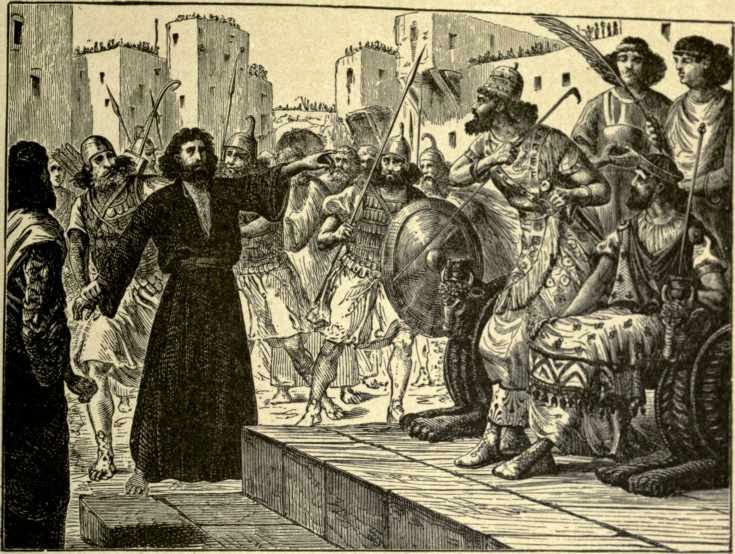
Imagine the scene. Micaiah, the prophet, has been forcibly dragged before King Ahab, who is seated on the dais with his guest, King Jehoshaphat of Judah. Surrounding the two potentates are 400 prophets of Baal, each taking turns declaring their version of the truth. For hours, they have been telling King Ahab exactly what he wants to hear: “Go up to Ramoth-gilead and triumph; the LORD will give it into the hand of the king” (1 Kings 22:12 ESV). One of them, a man named Zedekiah, had even crafted a pair of iron horns and used them as a prop to support his message to the king: “Thus says the LORD, ‘With these you shall push the Syrians until they are destroyed’” (1 Kings 22:11 ESV).

Then Micaiah shows up. Unlike the 400 yes-men who have been masquerading as spokesmen for the false god, Baal, Micaiah was a prophet of Yahweh. As such, he was obligated to speak only those words given to him by God. Which is precisely what Micaiah told the man who had come to fetch him.

As the LORD lives, what the LORD says to me, that I will speak.” – 1 Kings 22:14 ESV

Yet, when King Ahab asked Micaiah to reveal what his God thought about the planned attack of Ramoth-gilead, Micaiah simply repeated the words of the false prophets. He basically told the king, “Go for it!” But Ahab sensed the thinly veiled sarcasm behind Micaiah’s answer and demanded that he tell him the truth. Ahab knew from past experience that Micaiah and his God would oppose his plans. He had even revealed to King Jehoshaphat just how much he loathed Micaiah, telling him, “He never prophesies anything but trouble for me!” (1 Kings 22:8 NLT).

Micaiah knew that it really didn’t matter what he told Ahab, because the king would do as he wanted. Ahab’s stubbornness and arrogance would prevent him from hearing and heeding the message of Yahweh. But Micaiah shared it anyway.

“In a vision I saw all Israel scattered on the mountains, like sheep without a shepherd. And the LORD said, ‘Their master has been killed. Send them home in peace.’” – 1 Kings 22:17 NLT

Ahab was infuriated because Micaiah had just predicted Israel’s defeat and the king’s own death. But this less-than-encouraging message was just what Ahab had expected from the prophet of Yahweh. Just like Elijah, Micaiah proved to be a messenger of doom and gloom, bent on delivering nothing but bad news concerning Ahab’s kingly aspirations.

But Micaiah was not done. He next revealed how God had chosen to implement His plan for Ahab’s demise.

“Listen to what the LORD says! I saw the LORD sitting on his throne with all the armies of heaven around him, on his right and on his left. And the LORD said, ‘Who can entice Ahab to go into battle against Ramoth-gilead so he can be killed?’

“There were many suggestions, and finally a spirit approached the LORD and said, ‘I can do it!’

“‘How will you do this?’ the LORD asked.

“And the spirit replied, ‘I will go out and inspire all of Ahab’s prophets to speak lies.’

“‘You will succeed,’ said the LORD. ‘Go ahead and do it.’” – 1 Kings 22:19-22 NLT

Micaiah was given a vision of a conversation that took place in the throne room of God Almighty. In the vision, Yahweh is portrayed as a king surrounded by his advisors and his army. He is soliciting input from the heavenly host, asking for their counsel on the best way to get Ahab to proceed with his attack on Ramoth-gilead, which will result in his death. A spirit speaks up and offers to deceive the prophets of Baal by giving them a false message of victory. God approves the plan and sends the spirit on its way. Then Micaiah informs Ahab that this is precisely what has happened.

“So you see, the LORD has put a lying spirit in the mouths of all your prophets. For the LORD has pronounced your doom.” – 1 Kings 22:23 NLT

Amazingly, Micaiah tells Ahab the stark reality of all that had just transpired. The 400 prophets had unwittingly declared a lie, enticing Ahab to proceed with his plan to attack Ramoth-gilead and, inadvertently, bringing about his own demise. The identity of this “lying spirit” is unclear. Some view this as an angelic being who visited the king’s prophets and gave them a false message to deliver to the king. Others have determined this to have been a demonic spirit or Satan himself. But the text only indicates that this spirit was authorized by Yahweh to deceive the pseudo-prophets with a false message that would entice Ahab to attack Ramoth-gilead. Their answer, influenced by the spirit sent by Yahweh, was consistent and convincing.

“Yes, go right ahead! The LORD will give the king victory.” – 1 Kings 22:6 NLT 

Yet, even when Micaiah disclosed the truth to Ahab, the king stubbornly refused to give up his plan. He ordered Micaiah’s arrest and imprisonment and commanded that he be given nothing but bread and water until he had returned safely from his battle for Ramoth-gilead. But before being hauled off to prison, Micaiah made one final pronouncement to the king and all those who stood within earshot.

“If you return safely, it will mean that the LORD has not spoken through me!” Then he added to those standing around, “Everyone mark my words!” – 1 Kings 22:28 NLT

The problem with Ahab was not just his stubbornness and idolatry; it was his refusal to shepherd the people of Israel. All his self-centered acts of self-promotion had done irreparable damage to the nation of Israel. He had led the people into apostasy and idolatry, and, as a king over God’s chosen people, he would be held responsible for his failure to care for Yahweh’s flock. Hundreds of years later, the prophet Ezekiel would declare a foreboding message from God concerning all those kings who, like Ahab, had left the people of God like sheep without a shepherd.

Then this message came to me from the LORD: “Son of man, prophesy against the shepherds, the leaders of Israel. Give them this message from the Sovereign LORD: What sorrow awaits you shepherds who feed yourselves instead of your flocks. Shouldn’t shepherds feed their sheep? You drink the milk, wear the wool, and butcher the best animals, but you let your flocks starve. You have not taken care of the weak. You have not tended the sick or bound up the injured. You have not gone looking for those who have wandered away and are lost. Instead, you have ruled them with harshness and cruelty. So my sheep have been scattered without a shepherd, and they are easy prey for any wild animal. They have wandered through all the mountains and all the hills, across the face of the earth, yet no one has gone to search for them.” – Ezekiel 34:1-6 NLT

This motif of shepherdless sheep dates back to the time of Moses. When the great deliverer of Israel was nearing the end of his life, he appealed to God, asking Him to provide the people of Israel with a new shepherd.

Then Moses said to the LORD, “O LORD, you are the God who gives breath to all creatures. Please appoint a new man as leader for the community. Give them someone who will guide them wherever they go and will lead them into battle, so the community of the LORD will not be like sheep without a shepherd.” – Numbers 27:15-17 NLT

Centuries later, long after Ahab had died, Jesus appeared on the scene, offering His own assessment of the spiritual state of the people of Israel.

Jesus traveled through all the towns and villages of that area, teaching in the synagogues and announcing the Good News about the Kingdom. And he healed every kind of disease and illness. When he saw the crowds, he had compassion on them because they were confused and helpless, like sheep without a shepherd. – Matthew 9:35-36 NLT

The Good Shepherd couldn’t help but look at His own people and see them as shepherdless sheep, wandering about confused and helpless. For centuries, they had been misled and mistreated. Their political and spiritual leaders had used and abused them. Those who should have been feeding and caring for them had ended up taking advantage of them, following the example of Ahab. But Jesus arrived on the scene as the Son of David, emulating the example of the man after God’s own heart. Jesus was the quintessential shepherd, the Good Shepherd, who would lay down His life for the sheep. Jesus would shepherd the flock of God with care and compassion, just as His forefather did.

He [Gpd] chose David his servant
    and took him from the sheepfolds;
from following the nursing ewes he brought him
    to shepherd Jacob his people,
    Israel his inheritance.
With upright heart he shepherded them
    and guided them with his skillful hand. – Psalm 78:70-72 ESV

At the end of the day, Ahab’s most significant problem was that he was a lousy shepherd. His chief sin was that he had failed to care for God’s flock and had made his own needs a higher priority than the needs of the people. Like most of the kings of Israel and Judah, Ahab had abused his divinely ordained power and position, and he would have to answer to the Great Shepherd of Israel. But despite Ahab’s egocentric ambitions and his physical and spiritual mistreatment of those whom God had placed under his care, Yahweh would personally ensure that His chosen people received the care and compassion He had promised them.

He will feed his flock like a shepherd. He will carry the lambs in his arms, holding them close to his heart. He will gently lead the mother sheep with their young. – Isaiah 40:11 NLT

English Standard Version (ESV) The Holy Bible, English Standard Version. ESV® Permanent Text Edition® (2016). Copyright © 2001 by Crossway Bibles, a publishing ministry of Good News Publishers.

New Living Translation (NLT) Holy Bible, New Living Translation, copyright © 1996, 2004, 2015 by Tyndale House Foundation. Used by permission of Tyndale House Publishers Inc., Carol Stream, Illinois 60188. All rights reserved.
The Fateful Journey From Faith to Fear

41 And Elijah said to Ahab, “Go up, eat and drink, for there is a sound of the rushing of rain.” 42 So Ahab went up to eat and to drink. And Elijah went up to the top of Mount Carmel. And he bowed himself down on the earth and put his face between his knees. 43 And he said to his servant, “Go up now, look toward the sea.” And he went up and looked and said, “There is nothing.” And he said, “Go again,” seven times. 44 And at the seventh time he said, “Behold, a little cloud like a man’s hand is rising from the sea.” And he said, “Go up, say to Ahab, ‘Prepare your chariot and go down, lest the rain stop you.’” 45 And in a little while the heavens grew black with clouds and wind, and there was a great rain. And Ahab rode and went to Jezreel. 46 And the hand of the LORD was on Elijah, and he gathered up his garment and ran before Ahab to the entrance of Jezreel. 

1 Ahab told Jezebel all that Elijah had done, and how he had killed all the prophets with the sword. Then Jezebel sent a messenger to Elijah, saying, “So may the gods do to me and more also, if I do not make your life as the life of one of them by this time tomorrow.” Then he was afraid, and he arose and ran for his life and came to Beersheba, which belongs to Judah, and left his servant there. 1 Kings 18:41-19:3 ESV

Chapter 18 opened up with the words God spoke to Elijah: “Go, show yourself to Ahab, and I will send rain upon the earth” (1 Kings 18:1 ESV). This statement contains a command as well as a promise from God. After his three-and-a-half-year absence, Elijah was to return to Israel from Sidon and confront King Ahab one more time. But while this command would likely involve significant risk to the prophet, his obedience would result in a tremendous blessing on the people. God would end the prolonged drought and restore rain to the land.

It is impossible to know if Elijah was aware of all that would have to happen before the rain returned. There is no indication as to when God divulged the rest of His plan and Elijah’s role in it. But before the physical drought could end, the spiritual drought afflicting the people would have to come to a decisive conclusion that involved a dramatic confrontation between Elijah and the 450 prophets of Baal. However, the real battle would be between Yahweh, the God of Israel, and Baal, the god of Ahab and Jezebel.

Yahweh had won the day, displaying His power by sending fire from heaven that “consumed the burnt offering and the wood and the stones and the dust, and licked up the water that was in the trench” (1 Kings 18:38 ESV). This demonstrative exhibition of God’s omnipotence brought the people to their knees in fear and worship. What they had just witnessed left them thoroughly convinced that Yahweh was the one true God, and that newly revived awareness left them crying out, “The LORD, he is God; the LORD, he is God” (1 Kings 18:39 ESV). And as if to put an exclamation point on the whole scene, Elijah ordered the capture and execution of all 450 of Baal’s so-called prophets. Their god had remained silent when they cried to him for help. Now the prophet of Yahweh silenced them for good. They would no longer deceive and mislead the people of Israel with fallacious promises concerning their false god.

But there was still one thing missing: The rain that Yahweh had promised. Baal had been discredited, his prophets had been eliminated, and the peoples’ reverence for Yahweh had been rejuvenated. But the land remained under the God-ordained drought that had turned Israel into a dust bowl where water and food were scarce and daily survival was a challenge. The land that God had once described as “flowing with milk and honey” (Exodus 33:3 ESV) had become fruitless and lifeless, reflecting the spiritual state of the people who occupied it.

Hundreds of years earlier, long before the people of Israel took possession of the land of Canaan, Moses warned what would happen if they proved unfaithful.

“And if you will indeed obey my commandments that I command you today, to love the LORD your God, and to serve him with all your heart and with all your soul, he will give the rain for your land in its season, the early rain and the later rain, that you may gather in your grain and your wine and your oil. And he will give grass in your fields for your livestock, and you shall eat and be full. Take care lest your heart be deceived, and you turn aside and serve other gods and worship them; then the anger of the LORD will be kindled against you, and he will shut up the heavens, so that there will be no rain, and the land will yield no fruit, and you will perish quickly off the good land that the LORD is giving you.” – Deuteronomy 11:13-17 ESV

Years later, when God’s people continued to display their propensity for unfaithfulness, His prophet, Joel, would offer this promise of divine restoration even in the face of their disobedience.

Surely the LORD has done great things!
    Don’t be afraid, O land.
Be glad now and rejoice,
    for the LORD has done great things.
Don’t be afraid, you animals of the field,
    for the wilderness pastures will soon be green.
The trees will again be filled with fruit;
    fig trees and grapevines will be loaded down once more.
Rejoice, you people of Jerusalem!
    Rejoice in the LORD your God!
For the rain he sends demonstrates his faithfulness.
    Once more the autumn rains will come,
    as well as the rains of spring.
The threshing floors will again be piled high with grain,
    and the presses will overflow with new wine and olive oil.

The LORD says, “I will give you back what you lost…” – Joel 2:20-25 ESV

That day on Mount Carmel, the people had seen the fire of God fall from heaven, completely consuming the altar, sacrifice, and water. But they had not yet seen or felt His blessing. As Joel stated, “the rain he sends demonstrates his faithfulness.” Their land was in desperate need of restoration and rejuvenation, and so were they. After three-and-a-half years of spiritual drought, their hearts were parched and hardened. They had lost the capacity for fruitfulness and faithfulness and needed an outpouring of God’s grace and mercy.

Elijah knew what God had in store. So, he informed the shell-shocked king to “Go get something to eat and drink, for I hear a mighty rainstorm coming!” (1 Kings 18:41 NLT). There was a blessing on the horizon. Despite Ahab and Jezebel’s wickedness, God was about to pour out His goodness on the land.

The fact that Ahab had food to eat is symbolic of his self-centered approach to leadership. His sins had brought God’s curse upon the nation, but while the people suffered severely from the lack of rain, Ahab and Jezebel lived in royal comfort and ease. God would later issue an indictment against the leaders of Israel, warning them of their blatant disregard for the care of His people.

“What sorrow awaits you shepherds who feed yourselves instead of your flocks. Shouldn’t shepherds feed their sheep?” – Ezekiel 34:2 NLT

As Ahab was busy satisfying his own needs, Elijah interceded on behalf of the people of Israel. He “climbed to the top of Mount Carmel and bowed low to the ground and prayed with his face between his knees” (1 Kings 18:42 NLT). At one point during his prayer, he stopped and sent his servant to look toward the Mediterranean Sea in the east. But the servant saw nothing. This pattern repeated itself five more times with the same disappointing result. But the seventh time, the servant returned with a different report.

“I saw a little cloud about the size of a man’s hand rising from the sea.” – 1 Kings 18:44 NLT

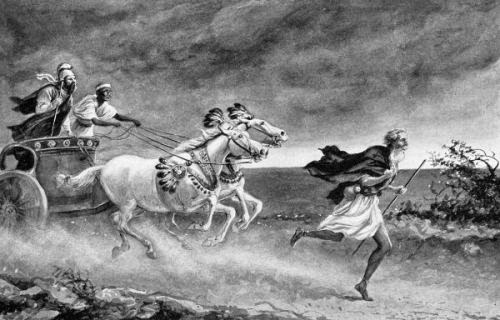
Out on the distant horizon, the servant saw what appeared to be a glimmer of hope. It was a small and seemingly insignificant cloud, but Elijah knew what it meant. The blessing of God was about to fall and, when it did, it would come in torrents. So, he instructed his servant to warn Ahab to leave immediately, or he may not make it back to his winter palace in Jezreel. When Elijah’s servant looked to the east, he saw only a faint possibility. But through his eyes of faith,  Elijah saw something altogether different. He perceived the imminent arrival of the outpouring of God’s blessing, and before long, that small cloud developed into a massive storm that brought strong winds and torrential rains. As Ahab tried to outrun the storm in his chariot, “the LORD gave special strength to Elijah. He tucked his cloak into his belt and ran ahead of Ahab’s chariot all the way to the entrance of Jezreel” (1 Kings 18:46 NLT).

Because Jezreel was anywhere from 10 to 20 miles east of Mount Carmel, some commentators attempt to explain this last verse by saying that Ahab’s chariot got caught in the mud and delayed his arrival. Others speculate that Elijah simply took a shortcut over the ridge of Mount Carmel. But everything about this story has been focused on the matchless power of God, and it should not seem out of the question that God might endow his prophet with a supernatural capacity to outrun the chariot of his arch-nemesis. God had defeated Baal. Now, the prophet of God had defeated the benefactor of Baal.

But while Elijah had won the victory at Mount Carmel and the race to Jezreel, he would have little time to celebrate. Upon hearing the unexpected news of all that had transpired on Mount Carmel, Jezebel was outraged and directed all her anger at Elijah.

“May the gods strike me and even kill me if by this time tomorrow I have not killed you just as you killed them.” – 1 Kings 19:2 NLT

Despite all that Ahab told her about the day’s events, she remained unconvinced of Yahweh’s power. She even called on Baal and his queen mother, Asherah, to come to her aid so that she might avenge the deaths of the prophets by killing Elijah. She was still putting her hope and trust in her false gods. Even the sudden arrival of long-awaited rain did nothing to diminish her misplaced trust in her lifeless and powerless gods. Baal, Jezebel’s beloved fertility god, had done nothing to eliminate the drought that had plagued the land.

But even more surprising than Jezebel’s stubborn belief in Baal and her resistance to God was Elijah’s sudden display of fear and doubt. This man, who had called down fire from heaven and had singlehandedly executed 450 prophets of Baal, found himself intimidated by the idle threats of this self-absorbed, idol-worshiping queen. Her vow to avenge her false god should have made Elijah laugh with scorn. Her god had proven himself to be speechless, powerless, and utterly helpless in the face of Yahweh. Yet, the formerly faithful Elijah was suddenly fearful, and this time, rather than running to the problem in the strength of God, he took flight and tried to escape it. He fled for his life, covering the 25 miles from Jezreel to Beersheba, motivated by fear and in the strength of his own flesh. Faced with the threats of Jezebel, Elijah took his eyes off God and took his fate into his own hands. 

This faithful man of God allowed the words of an idol-obsessed queen to dishearten and defeat him. He had bravely faced off against the 450 prophets of Baal, but now, with Jezebel’s words ringing in his ear, Elijah ran all the way to Beersheba, located on the southern border of Judah. From there, he would enter the Judean wilderness, the very same place where the disobedient and doubtful Israelites had wandered for 40 years when they refused to enter the promised land. And, in no time at all, the once faith-filled Elijah would find himself racked by fear and desiring death rather than face the vengeful anger of Jezebel.

English Standard Version (ESV) The Holy Bible, English Standard Version. ESV® Permanent Text Edition® (2016). Copyright © 2001 by Crossway Bibles, a publishing ministry of Good News Publishers.

New Living Translation (NLT) Holy Bible, New Living Translation, copyright © 1996, 2004, 2015 by Tyndale House Foundation. Used by permission of Tyndale House Publishers Inc., Carol Stream, Illinois 60188. All rights reserved.

The Lord, He is God

22 Then Elijah said to the people, “I, even I only, am left a prophet of the Lord, but Baal’s prophets are 450 men. 23 Let two bulls be given to us, and let them choose one bull for themselves and cut it in pieces and lay it on the wood, but put no fire to it. And I will prepare the other bull and lay it on the wood and put no fire to it. 24 And you call upon the name of your god, and I will call upon the name of the Lord, and the God who answers by fire, he is God.” And all the people answered, “It is well spoken.” 25 Then Elijah said to the prophets of Baal, “Choose for yourselves one bull and prepare it first, for you are many, and call upon the name of your god, but put no fire to it.” 26 And they took the bull that was given them, and they prepared it and called upon the name of Baal from morning until noon, saying, “O Baal, answer us!” But there was no voice, and no one answered. And they limped around the altar that they had made. 27 And at noon Elijah mocked them, saying, “Cry aloud, for he is a god. Either he is musing, or he is relieving himself, or he is on a journey, or perhaps he is asleep and must be awakened.” 28 And they cried aloud and cut themselves after their custom with swords and lances, until the blood gushed out upon them. 29 And as midday passed, they raved on until the time of the offering of the oblation, but there was no voice. No one answered; no one paid attention.

30 Then Elijah said to all the people, “Come near to me.” And all the people came near to him. And he repaired the altar of the Lord that had been thrown down. 31 Elijah took twelve stones, according to the number of the tribes of the sons of Jacob, to whom the word of the Lord came, saying, “Israel shall be your name,” 32 and with the stones he built an altar in the name of the Lord. And he made a trench about the altar, as great as would contain two seahs of seed. 33 And he put the wood in order and cut the bull in pieces and laid it on the wood. And he said, “Fill four jars with water and pour it on the burnt offering and on the wood.” 34 And he said, “Do it a second time.” And they did it a second time. And he said, “Do it a third time.” And they did it a third time. 35 And the water ran around the altar and filled the trench also with water.

36 And at the time of the offering of the oblation, Elijah the prophet came near and said, “O Lord, God of Abraham, Isaac, and Israel, let it be known this day that you are God in Israel, and that I am your servant, and that I have done all these things at your word. 37 Answer me, O Lord, answer me, that this people may know that you, O Lord, are God, and that you have turned their hearts back.” 38 Then the fire of the Lord fell and consumed the burnt offering and the wood and the stones and the dust, and licked up the water that was in the trench. 39 And when all the people saw it, they fell on their faces and said, “The Lord, he is God; the Lord, he is God.” 40 And Elijah said to them, “Seize the prophets of Baal; let not one of them escape.” And they seized them. And Elijah brought them down to the brook Kishon and slaughtered them there. 1 Kings 18:23-40 ESV

The battle for the hearts of the people of Israel was about to begin. Having accepted Elijah’s challenge, King Ahab had decreed that the people assemble at nearby Mount Carmel. He also ordered the 450 prophets of Baal to come, ready to prove the power of their god. But as Elijah stood before the gathered assembly, he issued them a stern challenge.

“How long will you go limping between two different opinions? If the Lord is God, follow him; but if Baal, then follow him.” – 1 Kings 18:21 ESV

His words are reminiscent of those spoken by Joshua hundreds of years earlier, as he addressed the nation of Israel near the end of his life. He too had called the people to choose who they were going serve, the one true God or the false gods of Egypt and Canaan.

“Now therefore fear the Lord and serve him in sincerity and in faithfulness. Put away the gods that your fathers served beyond the River and in Egypt, and serve the Lord. And if it is evil in your eyes to serve the Lord, choose this day whom you will serve, whether the gods your fathers served in the region beyond the River, or the gods of the Amorites in whose land you dwell. But as for me and my house, we will serve the Lord.” – Joshua 24:14-15 ESV

The fickle nature of the Israelites had not changed much over the centuries. They remained prone to chasing after any and every god who came along. They were equal-opportunity idolaters who seemed to have no sense of guilt or shame. Their willingness to accept and affirm any and all gods placed before them had been a problem from the beginning. While they never entirely abandoned their worship of Yahweh, they were constantly trying out new gods in a vain attempt to cover all their bases. Their syncretistic approach to religion and worship was driven by self-interest and greed. In a sense, they seemed to operate on the belief that two gods would be better than one. But Elijah was demanding that they make up their minds. He would not allow them to play the field and continue to offend Yahweh with their spiritual adultery.

In an attempt to stress the lopsided nature of the battle that was about to ensue, Elijah claimed that he was the only prophet of Yahweh still standing in Israel. But he was wrong and he knew it. In his earlier encounter with Obadiah, he had learned that there were at least 100 prophets whom God had spared. But Elijah chose to ignore this detail so that he could paint as bleak a picture as possible. At that moment, the odds were 450 to one. He was the sole prophet of God, preparing to face the overwhelming numbers of the prophets of Baal.

But Elijah knew that this day was not about a battle between him and the more numerous adversaries on the other side. It would be a divine display of Yahweh’s power and Baal’s impotence. Just as Baal had been unable to stop the ravages of the drought that had devasted the land for three years, he would prove incapable of hearing and answering the desperate cries of his prophets.

Elijah set the rules of the contest. Each side was to select an appropriate sacrifice, then offer it up on an altar before their respective god. Then they were to cry out to their deity of choice, and whichever god responded by consuming the offering with fire would prove to be the true god.

In describing the ensuing scene, the author clearly attempts to lampoon the efforts of the prophets of Baal. Their energetic and somewhat odd behavior displays their desperate hope that their god will show up.

…they called on the name of Baal from morning until noontime, shouting, “O Baal, answer us!” But there was no reply of any kind. Then they danced, hobbling around the altar they had made. – 1 Kings 18:26 NLT

And the harder they try to garner the attention of their seemingly distant and disinterested god, the more Elijah taunts their efforts.

“You’ll have to shout louder,” he scoffed, “for surely he is a god! Perhaps he is daydreaming, or is relieving himself. Or maybe he is away on a trip, or is asleep and needs to be wakened!” – 1 Kings 18:27 NLT

In desperation and growing frustration, they resort to shedding their own blood, vainly hoping that their self-mutilation might appease and awaken their god to action. But the author summarizes their prolonged and ineffective efforts with the simple statement: “there was no sound, no reply, no response” (1 Kings 18:29 NLT). Their god remained silent and unseen.

Broken and bloodied by their hours-long effort to call down fire from their god, they finally gave up. Then it was Elijah’s turn. After rebuilding the altar to Yahweh that Jezebel had ordered destroyed, Elijah had the altar and the sacrifice drenched in water. He purposefully stacked the deck against God, creating what would appear to be impossible odds. Elijah used 12 stones to build the altar and then drenched the altar and the sacrifice with 12 large jars of water. Even though this event was taking place among the ten tribes of the northern kingdom, Elijah wanted them to realize that Yahweh was the God of all Israel. They were a divided nation because of idolatry. But in God’s eyes, they were still His chosen people.

And Elijah’s simple prayer illustrates his belief that God longed to restore His covenant people. The God of Abraham, Isaac, and Jacob still loved His people and greatly desired that they would repent and return to Him.

“O Lord, God of Abraham, Isaac, and Jacob, prove today that you are God in Israel and that I am your servant. Prove that I have done all this at your command. O Lord, answer me! Answer me so these people will know that you, O Lord, are God and that you have brought them back to yourself.” – 1 Kings 18:36-37 NLT

No histrionics. No desperate displays of emotional cajoling and pleading. Elijah simply asked God to display His power so that the people might know He was there and that He cared. Elijah was asking God to demonstrate His covenant faithfulness in spite of their unfaithfulness. And, unlike Baal, God heard and responded.

Immediately the fire of the Lord flashed down from heaven and burned up the young bull, the wood, the stones, and the dust. It even licked up all the water in the trench! – 1 Kings 18:38 NLT

The impact of this divine demonstration of power was immediate. Blown away by this supernatural display, the people fell on their faces and cried out, “The Lord—he is God! Yes, the Lord is God!” (1 Kings 18:39 NLT). The altar to Baal remained untouched, just as the prophets had left it. But the altar to Yahweh had been completely consumed, rocks and all. God had more than accepted the sacrifice that Elijah had offered. And in doing so, He confirmed His power, reconfirmed His covenant commitment, and validated His prophet. He was the one true God, and Elijah was His chosen messenger.

And as a final demonstration of God’s unparalleled greatness and His prophet’s authority to act on His behalf, Elijah ordered the capture of every single prophet of Baal. The people obeyed his command and brought all 450 of these false prophets to the Kishon Valley, where Elijah meted out divine judgment and justice on every single one of them. These men had played a major role in the nation’s spiritual decline. They were the visual representation of their false god, and their lies and deception had caused the people of Israel to abandon Yahweh for a god that was nothing more than a figment of man’s fertile imagination.

Looking on as this unexpected scene unfolded before their eyes, King Ahab and his wife Jezebel had to have been reeling from the shock of it all. Not only had their god not shown up, but his prophets had been destroyed. But, as we will see, rather than repent for their sins against God, they will respond in anger and resentment, attempting to take out their wrath on God’s messenger. This arrogant and self-consumed couple will continue to reject Yahweh, stubbornly refusing to admit, “The Lord—he is God! Yes, the Lord is God!”

English Standard Version (ESV) The Holy Bible, English Standard Version. ESV® Permanent Text Edition® (2016). Copyright © 2001 by Crossway Bibles, a publishing ministry of Good News Publishers.

New Living Translation (NLT) Holy Bible, New Living Translation, copyright © 1996, 2004, 2015 by Tyndale House Foundation. Used by permission of Tyndale House Publishers Inc., Carol Stream, Illinois 60188. All rights reserved.

The Message (MSG)Copyright © 1993, 1994, 1995, 1996, 2000, 2001, 2002 by Eugene H. Peterson

1 Kings 17-18, 2 Corinthians 7

Limping Along.

1 Kings 17-18, 2 Corinthians 7

And Elijah came near to all the people and said, “How long will you go limping between two different opinions? If the Lord is God, follow him; but if Baal, then follow him.” – 1 Kings 11:21 ESV

The story of the history of Israel is filled with images of indecisiveness, unfaithfulness, mixed allegiances, and self-centered motives. In other words, it is the story of mankind. But these were the chosen people of God. They had experienced first-hand the powerful hand of God on their lives, having been miraculously set free from captivity in Egypt, provided for and protected for more than 40 years as they wandered in the wilderness, and eventually, given a land of rich abundance and fruitfulness filled with cities and homes they hadn’t built and crops they hadn’t planted. God had proven Himself faithful time and time again over the years. He had given them a great king in David. He had made them a powerful nation. He had blessed them with a wise king in Solomon whose reign was marked by a period of peace and plenty. But despite all of God’s goodness and blessing, the people of Israel could not remain faithful. They never full rejected God. Instead, they hedged their bets and worshiped other gods as well, ensuring that they had all their bases covered when it came to divine protection and provision. But the gods they worshiped proved to be no gods at all. They were impotent and non-existent. When the prophets of Baal called out to him, he remained silent. He gave no answer. “And they took the bull that was given them, and they prepared it and called upon the name of Baal from morning until noon, saying, O Baal, answer us! But there was no voice, and no one answered. And they limped around the altar that they had made” (1 Kings 18:26 ESV). It’s interesting to note that the same verb is used in verse 26 to describe the actions of the prophets of Baal that Elijah uses in verse 21 to describe the people of God – they limped. The actual Hebrew word can mean “to limp, to hop, to jump around.” It is the image of someone on crutches who is unsteady, unstable indecisive, and hesitant in their actions. They were anxious and fearful, unsure if their god was going to come through for them. They lacked conviction and faith. They weren’t short on effort or determination, because they even “cut themselves after their custom with swords and lances, until the blood gushed out upon them” (1 Kings 18:28 ESV). But for all their effort and energy, their god remained silent.

What does this passage reveal about God?

But in contrast, we have the God of Elijah. In the period of time leading up to this event, Elijah had been personally cared for by God, having been miraculously fed by ravens. He had seen a poor widow’s meager oil and flour multiplied by God in order to keep herself, her son, and himself alive. He had watched as the widow’s son became sick and died, but he had trusted God to bring him back to life, and He did. Elijah’s God was alive and well. He could hear and He could respond. He was powerful and compassionate. He could be trusted. And we see in Elijah’s actions that day on Mount Carmel that he believed in his God. He did not limp along in unbelief. He was not hesitant. He exhibited no doubt or indecisiveness. His actions were clear and his orders, concise. He called and his God responded – in power. “Then the fire of the Lord fell and consumed the burnt offering and the wood and the stone and the dust, and licked up the water that was in the trench. And when all the people saw it, they fell on their faces and said, ‘The Lord, he is God; the Lord, he is God’” (1 Kings 18:38-39 ESV).

What does this passage reveal about man?

As long as the people continued to share their allegiance between God and a host of false gods, they would continue to limp along, living lives marked by powerlessness, hopelessness, and physical, as well as spiritual drought. Placing their trust in anyone or anything other than God would continue to prove unproductive and, ultimately, destructive. For all their expended effort and religious zeal, the prophets of Baal only ended up doing harm to themselves. Their blind faith in a false god would result in their own deaths. But the people of Israel were like a lame person on two crutches. Their faith was unsteady and their spiritual walk was unstable. They limped about between the one true God and a host of false gods. They staggered between truth and falsehood. But Elijah challenged them to choose. “If the Lord is God, follow him; but if Baal, then follow him” (1 Kings 18:21 ESV). But they were indecisive. They were unsure. They had long ago begun to doubt in the power of the one true God. As a result, they had begun seeking out the potential help of any and all gods who might meet their needs or fulfill their desires. If God couldn’t or wouldn’t come through, perhaps they could find another god who would meet their needs. As is usually the case, they were seeking a god would would accommodate their wishes. They wanted a god of their own making, who would take care of them according to their own standards. But because their gods were powerless and silent, they wavered back and forth between a host of gods, waiting and watching, hoping that one of them would prove to be the god they were looking for.

How would I apply what I’ve read to my own life?

Paul has already reminded us that the people of Israel were the chosen people of God. He had promised to dwell among them. He had promised to walk among them. He had promised to be their Father and treat them as His own children. All they had to do was live like who they were: the children of God. They were to separate themselves from the rest of the world and live distinctively different lives, according to God’s standards, not their own. And Paul reminded the Corinthians, that as followers of Christ, they were also to see themselves as holy and distinct, children of God. He pleaded, “beloved, let us cleanse ourselves from every defilement of body and spirit, bringing holiness to completion in the fear of God” (2 Corinthians 7:1 ESV). In other words, they were to make the pursuit of holiness their primary focus. Rather than waver in indecisiveness, they were to do everything in their power to “make a clean break with everything that defiles or distracts us, both within and without” (The Message). Paul was wanting to see them live with a singular focus: pursuing holiness and Christ-likeness. But far too often, as believers, we can find ourselves limping along, like someone trying to navigate life while leaning on two crutches. We are unsteady and unsure of ourselves. We are placing our hope and leaning our lives on things that can’t deliver. We are relying on things that, in the long run, will prove themselves unreliable. Only God can be trusted. Only God can come through for us. Only God can deliver what it is we need. How long will you go limping between two different opinions? If the Lord is God, follow Him.

Father, I want to follow You. I want to lean on You, rely on You, trust in You. I am tired of limping along in indecisiveness. You have proven Yourself faithful and true time and time again in my life. The things of this world have proven themselves unreliable and unworthy of my allegiance. Help me to stop wavering and begin trusting You more. Amen

Ken Miller
Grow Pastor & Minister to Men
kenm@christchapelbc.org

1 Kings 22

No News Is NOT Good News.

“The king of Israel replied to Jehoshaphat, ‘There is one more man who could consult the Lord for us, but I hate him. He never prophesies anything but trouble for me!! His name is Micaiah son of Imlah.” ­– 1 Kings 2:8 NLT

I don’t know of anybody who ever named their son after Micaiah, but I think it would be a great name for any boy to have. I’m not quite sure how to pronounce it or what it means, but I know what he stood for: God and the truth. Even against the most powerful man in Israel at the time, this obscure, little know prophet was willing to speak the truth of God, even when he was the odd-man out. I just love this guy’s unbridled devotion to God and his willingness to stand up for God regardless the cost. More than 400 other “prophets” had given King Ahab the news he wanted to hear: If he went up against the Arameans in battle, he would easily win. The Lord would give him victory. But Micaiah had a slightly different take on how things were going to turn out for Ahab and the Israelites.His news was not going to be what Ahab wanted to hear.

I also love the fact that Micaiah had a sarcastic sense of humor. He was a prophet of God, but he wasn’t afraid to drop a little sarcasm on the king when the opportunity presented itself. When he was brought before king Ahab to give his prediction of the battle’s outcome, Micaiah replied, “Yes, go up and be victorious, for the Lord will give the king victory!” (1 Kings 22:15 NLT). That is exactly what Ahab wanted to hear, but he knew that Micaiah wasn’t telling him the truth. Why? Because as Ahab irritatingly told Jehoshphat, “He never prophesies anything but trouble for me” (1 Kings 22:18 NLT). Micaiah ultimately told Ahab the truth – that he would lose his battle against the Arameans and, not only that, he would die. God was going to pay Ahab back for all his wickedness and his lifelong love affair with rebellion. Rather than listen to the prophet of God, Ahab chose to listen to the false prophets who were more than willing to tell him what he wanted to hear. Their news was good news. He wanted God to bless what he was doing. He wanted God to conform to his will. It reminds me of the warning Paul gave Timothy: “For a time is coming when people will no longer listen to sound and wholesome teaching. They will follow their own desires and will look for teachers who will tell them whatever their itching ears want to hear. They will reject the truth and chase after myths” (2 Timothy 4:3-4 NLT). Had Ahab listened to the Word of God delivered to him by the prophet of God, he would have survived this battle. But what God had to say was hard. It was difficult to accept. It would require Ahab to die to his own will and submit to God’s.

So the king died. That’s how Ahab’s story ends. Tragic and sad. He had rejected the Word of God and suffered the consequences. He had refused the will of God and died seeking his own. God had spoken, but Ahab refused to listen. He rejected the good news for a false and more flattering version. And millions of individuals have repeated that same sad mistake ever since. But as followers of Christ, we can also refuse to heed the Word of God. We can ignore it. We can reject it. We can refuse to obey it. There will always be plenty of those willing to tell us what we WANT to hear. They’ll tickle our ears. They’ll tell us everything is fine. They’ll paint a rosy picture of life. They’ll refuse to preach the full counsel of God. But as children of God, we should long to hear the unfiltered, unadulterated Word of God. Not a watered down, sweetened up, pasteurized, homogenized, and palatable version that makes us feel good about ourselves and justifies our sins. No news is NOT good news. Are you willing to hear from God and accept His Word as the final word? Seek it. Listen to it. Obey it.

Father, I can be just as guilty as Ahab of seeking to hear only what I want to hear. I can cherry-pick the Scriptures, looking for passages that justify my actions and assuage my guilt. Give me a listening ear and a soft heart that is ready to hear what You have to say and do what You tell me to do. Amen

Ken Miller
Grow Pastor & Minister to Men
kenm@christchapelbc.org