Ask!

19 Jesus knew that they wanted to ask him, so he said to them, “Is this what you are asking yourselves, what I meant by saying, ‘A little while and you will not see me, and again a little while and you will see me’? 20 Truly, truly, I say to you, you will weep and lament, but the world will rejoice. You will be sorrowful, but your sorrow will turn into joy. 21 When a woman is giving birth, she has sorrow because her hour has come, but when she has delivered the baby, she no longer remembers the anguish, for joy that a human being has been born into the world. 22 So also you have sorrow now, but I will see you again, and your hearts will rejoice, and no one will take your joy from you. 23 In that day you will ask nothing of me. Truly, truly, I say to you, whatever you ask of the Father in my name, he will give it to you. 24 Until now you have asked nothing in my name. Ask, and you will receive, that your joy may be full.” – John 16:19-24 ESV

Seven times in just four verses, John records Jesus using the phrase, “a little while.” It is the Greek word mikron, and it refers to a small or brief space of time. Jesus basically told His disciples that it would not be much longer before He would be gone. But then He followed up that bit of bad news by assuring them that, in no time at all, they would see Him again. Rather than finding Jesus’ words encouraging, the disciples became further confused and increasingly anxious. They had no idea what He was talking about. He seemed to be speaking in riddles that left them with more questions than answers. And, while Jesus had so much more He wanted to share with them, He knew they lacked the mental and emotional bandwidth to handle it.

Jesus, always alert and aware of what was going on in His disciples’ hearts, heard them discussing among themselves.

“What does he mean by ‘a little while’? We do not know what he is talking about.” – John 16:18 ESV

They were afraid to admit their ignorance to Jesus, so they polled one another, hoping that one of them might have a clue as to what He was talking about. But Jesus, knowing that they were dying for an explanation, graciously answered the question they were too scared to ask.

Their confusion revolved around that little Greek word, mikron. They wanted to know just how long “a little while” would be. In other words, they were focused on the length of time, rather than on the events themselves and their subsequent outcome. How long would it be before they could no longer see Jesus? How much time did they have left? And how long would they have to wait to see Him again?

These men were stuck on an earthly plane, unable to see behind the veil and incapable of understanding the spiritual dimension of the moment. Jesus had already told them all that would take place in Jerusalem, but they had failed to grasp the significance of His words.

“See, we are going up to Jerusalem. And the Son of Man will be delivered over to the chief priests and scribes, and they will condemn him to death and deliver him over to the Gentiles to be mocked and flogged and crucified, and he will be raised on the third day.” – Matthew 20:18-19 ESV

Just two days before the Passover Festival began, Jesus reiterated the details concerning His fate to His disciples.

“You know that after two days the Passover is coming, and the Son of Man will be delivered up to be crucified.” – Matthew 26:2 ESV

Later, on the Mount of Olives, just outside the walls of Jerusalem, Jesus added another new twist to the pending proceedings.

“You will all fall away because of me this night. For it is written, ‘I will strike the shepherd, and the sheep of the flock will be scattered.’ But after I am raised up, I will go before you to Galilee.” – Matthew 26:31-32 ESV

Jesus had spoken to them about His death and resurrection, but the news appears to have gone in one ear and out the other. It never fully registered with them. In fact, Matthew provides powerful proof that the disciples failed to comprehend what Jesus told them. It seems that immediately after Jesus had announced He would be delivered over to the chief priests and scribes, condemned to death, mocked, flogged, crucified, and raised on the third day, the mother of James and John approached Jesus with a request.

“Say that these two sons of mine are to sit, one at your right hand and one at your left, in your kingdom.” – Matthew 20:21 ESV

The text reveals that these two brothers were standing right next to their mother when she made this request on their behalf. They were hoping for positions of power and prominence in Jesus’ earthly kingdom. They believed Him to be the Messiah and fully expected Him to rule as the King of Israel from David’s throne in Jerusalem. Nothing of what Jesus had said to them about His death and resurrection had sunk in. Now, as He revealed to them that time was running out, and His death was at hand, they were still unable to get their minds around the epic nature of what was happening around them.

And Jesus told them that things would get worse before they got better.

“I tell you the truth, you will weep and mourn over what is going to happen to me, but the world will rejoice.” – John 16:20 NLT

The unbelieving world, comprised of the Jewish religious leaders and all those former followers of Jesus who had turned their backs on Him, would rejoice over His death. But all those who believed Him to be the Messiah would weep and mourn because His death would be proof that they had been wrong. Their hopes would be dashed. Their eager anticipation that their Savior had come would die alongside Jesus as He hung on the cross.

But Jesus gives them the good news: “You will grieve, but your grief will suddenly turn to wonderful joy” (John 16:21 NLT). Their sorrow would be real, but it would also be brief. It would only last “a little while.” Just when everything appeared dark and grim, something remarkable would take place and the words of Jesus would be fulfilled. 

“…the Son of Man…will be raised on the third day.” – Matthew 20:19 NLT

Just three days after being placed in a grave and written off as a failure and a fraud, Jesus would appear to His disciples. They would see Him again. And while the length of time is significant, it pales compared to the reality of the resurrection. For the disciples, those three days would feel like an eternity and be filled with fear, sorrow, confusion, and a growing sense of despair. All would look lost, and the future would appear bleak. But then, the impossible would happen, and their sorrow would turn to joy. They would discover the truth of the psalm written by King David.

Weeping may last through the night,
    but joy comes with the morning. – Psalm 30:5 NLT

Jesus doesn’t diminish the reality of their sorrow and suffering. Instead, He puts it into perspective by comparing it to a woman in labor. While giving birth, she suffers very real and intense pain. It is overwhelming and all-consuming. And while her labor may seem to last an eternity, it will all be over in “a little while.” And all the suffering will turn to overwhelming joy because it has resulted in the birth of a child.

“…her anguish gives way to joy because she has brought a new baby into the world.” – John 16:21 NLT

Jesus let His disciples know that what they were experiencing was natural, normal, and to be expected. But like the birth of a child, their suffering and sorrow would be turned into joy and celebration when they saw the miracle of “new birth” that God brought about through the resurrection of His Son.

“So you have sorrow now, but I will see you again; then you will rejoice, and no one can rob you of that joy.” – John 16:22 NLT

Not only would they witness the supernatural transformation of Jesus from death to life, but they would also experience a spectacular alteration in their relationship with God. Things would be radically different. With Jesus’ resurrection and ascension, the disciples would find themselves experiencing an intimacy with God the Father that they had never known before. With the help of the indwelling Holy Spirit, they could communicate directly with God. And Jesus informed them that even the nature of their questions would change.

“In that day you will ask nothing of me. Truly, truly, I say to you, whatever you ask of the Father in my name, he will give it to you.” – John 16:23 ESV

Up until this point, the disciples had aimed all kinds of questions at Jesus, and most of their inquiries had to do with points of clarification and explanation. They rarely, if ever, petitioned Jesus for anything, unless you include the request made by the mother of James and John. Jesus seemed to be saying that the very nature of their questions would change. They would be less self-focused and motivated by ignorance. With the Spirit’s assistance, their questions would align with God’s will and guarantee His gracious answer.

The disciples had been great at asking questions like, “When will all this happen? What sign will show us that these things are about to be fulfilled?” (Mark 13:4 ESV). They asked questions because they were looking for answers. But Jesus wanted them to know that, in the future, their questions would become less focused on receiving information and more desirous of asking for God’s will to be done. The Holy Spirit would provide them with all the insight and information they would need. So, they wouldn’t have to focus their questions on things they needed to know. Instead, they would ask God for things to further their task of making Him known.

Jesus points out the key difference between their current questioning and how they will ask it in the future.

“Until now you have asked nothing in my name. Ask, and you will receive, that your joy may be full.” – John 16:24 ESV

They will ask in His name. This means that they will ask according to the very character and nature of Jesus as the Son of God. They will make requests of God in the same way that Jesus did, in keeping with God’s will. John wrote of this Christlike attitude of petitioning the Father in a later letter he penned.

And this is the confidence that we have toward him, that if we ask anything according to his will he hears us. And if we know that he hears us in whatever we ask, we know that we have the requests that we have asked of him. – 1 John 5:14-15 NLT

All of their questions will be answered and all their requests will be in keeping with God’s will and guaranteed to come to fruition. As a result, their sorrow will be turned to joy. That is why Jesus promised His disciples, “Until now you have asked nothing in my name. Ask, and you will receive, that your joy may be full” (John 6:24 ESV). As His disciples, they could ask and receive, seek and find, and knock and find the door into God’s presence opened wide.

English Standard Version (ESV)
The Holy Bible, English Standard Version. ESV® Permanent Text Edition® (2016). Copyright © 2001 by Crossway Bibles, a publishing ministry of Good News Publishers.

New Living Translation (NLT)
Holy Bible, New Living Translation, copyright © 1996, 2004, 2015 by Tyndale House Foundation. Used by permission of Tyndale House Publishers Inc., Carol Stream, Illinois 60188. All rights reserved.
Jehovah-Selah

1 I love you, Lord;
    you are my strength.
2 The Lord is my rock, my fortress, and my savior;
    my God is my rock, in whom I find protection.
He is my shield, the power that saves me,
    and my place of safety.
3 I called on the Lord, who is worthy of praise,
    and he saved me from my enemies. – Psalm 18:1-3 ESV

YHWH–Selaʿ – “The LORD My Rock.” In this Psalm, David provides several descriptions of Yahweh, each of which could be used in conjunction with His name to provide further details concerning His character. First, he describes Yahweh, the LORD, as his strength (ḥēzeq). In Hebrew, this masculine noun conveys the idea of power to provide help in times of need. For David, this hope in God’s capacity to deliver him from difficulty was not a case of wishful thinking but a proven reality. In fact, the descriptor for this Psalm states, “He sang this song to the LORD on the day the LORD rescued him from all his enemies and from Saul.”

David wasn’t speculating about Yahweh’s strength; he spoke from first-hand experience and added a string of nouns to further describe the extent of God’s power: rock, fortress, savior. shield, power, and place of safety. For David, these words served as literary instruments to support his “song” of praise to Yahweh. They blended together to form a musical tribute to his all-powerful, ever-present-in-times-of-need God.

In the early part of his life, David spent years living as a fugitive, constantly on the run to escape the wrath of King Saul. The prophet Samuel had anointed him to be Saul’s replacement, but Saul was not going to vacate the throne willingly or easily. Jealous of David’s military successes and growing popularity among the people, Saul viewed him as a threat and repeatedly tried to eliminate him. But God continually protected and preserved David.

Even after becoming king, David experienced the presence and power of God in his life as he successfully led the armies of Israel to victory over their enemies. He recognized Yahweh’s hand in it all and couldn’t help but sing His praises.

This song comes from a thankful heart. David could remember the dark days of hiding in caves to escape the mercenaries Saul had sent to kill him. In those moments, he felt all alone and defenseless. The presence of his “mighty men” did nothing to bolster his confidence. The anointing of Samuel failed to provide him with hope. So, in his anxiety and fear, he turned to Yahweh.

The ropes of death entangled me;
    floods of destruction swept over me.
The grave wrapped its ropes around me;
    death laid a trap in my path.
But in my distress I cried out to the Lord;
    yes, I prayed to my God for help.
He heard me from his sanctuary;
    my cry to him reached his ears. – Psalm 18:4-6 NLT

In David’s moment of need, God responded.

He heard me from his sanctuary – vs 6

He opened the heavens and came down – vs 9

The Lord thundered from heaven – vs 13

He shot his arrows and scattered his enemies – vs 14

He reached down from heaven and rescued me – vs 16

…the LORD supported me – vs 18

He led me to a place of safety – vs 19

…he rescued me – vs 19

The Lord rewarded me – vs 20

…he restored me – vs 20

God had regularly shown up in David’s life; it wasn’t sporadic or a once-in-a-lifetime experience. This pattern of deliverance was a common occurrence and David learned to rely upon it during his darkest and most difficult days. That’s why he was able to describe Yahweh as his rock.

The Lord lives! Praise to my Rock!
    May the God of my salvation be exalted! – Psalm 18:46 NLT

The term “rock” conjures up images of stability and strength. A rock is immovable and unshakeable. Jesus used this imagery to illustrate a life “built” on the “rock” of His message of salvation.

“I will show you what it’s like when someone comes to me, listens to my teaching, and then follows it. It is like a person building a house who digs deep and lays the foundation on solid rock. When the floodwaters rise and break against that house, it stands firm because it is well built.” – Luke 7:47-48 NLT

The Hebrew word carries the image of a rocky crag or cliff under which a weary traveler might find safety from a storm. It was in such a spot that David found a cave in which to hide and seek refuge from the bounty hunters who sought his life. The imagery of the rock was one of David’s favorite metaphors for referring to Yahweh.

O Lord, I have come to you for protection;
    don’t let me be disgraced.
    Save me, for you do what is right.
Turn your ear to listen to me;
    rescue me quickly.
Be my rock of protection,
    a fortress where I will be safe.
You are my rock and my fortress. – Psalm 31:1-3 NLT

David used “rock” and “fortress” as virtual synonyms. The Hebrew word for “fortress” is mᵉtsudâh and can also be translated as “house of defense.” The word “Masada” is a Hebrew word that means “strong foundation or support.” It is also the name of an ancient fortress in Israel that was built on a natural rock plateau thousands of feet above the Dead Sea. This stronghold became a symbol of Israel’s resistance to the Romans during the later part of the 1st Century A.D.

This seemingly impenetrable mountain fortress housed a small contingent of Jewish rebels who held out against the Romans for months, finally ending their occupation by taking their own lives. For David, these images of fortresses, houses of defense, rocky crags, and well-hidden caves served as perfect metaphors for Yahweh. They are tangible yet, obviously, insufficient symbols of God’s ability to care for His own in any and all circumstances. Unlike the mountaintop fortress of Masada, God never succumbs to the enemy’s attacks. David found God to have a perfect track record when it came to His role as rock, fortress, savior. shield, power, and place of safety.

He rescued me from my powerful enemies,
    from those who hated me and were too strong for me.
They attacked me at a moment when I was in distress,
    but the Lord supported me.
He led me to a place of safety;
    he rescued me because he delights in me. – Psalm 18:17-19 NLT

This imagery of the rock also appears in the New Testament. In 1 Corinthians, Paul provides insight into an Old Testament event that involved a miraculous “rock” through which God met the needs of the Israelites.

I don’t want you to forget, dear brothers and sisters, about our ancestors in the wilderness long ago. All of them were guided by a cloud that moved ahead of them, and all of them walked through the sea on dry ground. In the cloud and in the sea, all of them were baptized as followers of Moses. All of them ate the same spiritual food, and all of them drank the same spiritual water. For they drank from the spiritual rock that traveled with them, and that rock was Christ. – 1 Corinthians 10:1-4 NLT

This is a reference to the story found in Exodus 17. Under the leadership of Moses, the people of Israel are making their way to the land of Canaan. On their journey, they arrived at a place called Rephidim where they discovered no water to drink. As was their habit, the people grumbled at Moses and he took their complaint to God. Yahweh’s response was simple and direct.

“I will stand before you on the rock at Mount Sinai. Strike the rock, and water will come gushing out. Then the people will be able to drink.” So Moses struck the rock as he was told, and water gushed out as the elders looked on.” – Exodus 17:6 NLT

Fast-forward 40 years and the scene shifts from Rephidim to Kadesh in the wilderness of Zin. Once again, the people complained to Moses because there was no water to drink and, as before, he took the problem to God, who responded:

“You and Aaron must take the staff and assemble the entire community. As the people watch, speak to the rock over there, and it will pour out its water. You will provide enough water from the rock to satisfy the whole community and their livestock.” – Numbers 20:8 NLT

Notice that, this time, God instructed Moses to “speak” to the rock, not to strike it. But at the story unfolds, Moses, in his anger decided to do things his way. Gathered the people together

“Listen, you rebels!” he shouted. “Must we bring you water from this rock?” Then Moses raised his hand and struck the rock twice with the staff, and water gushed out. So the entire community and their livestock drank their fill. – Numbers 20:10-11 NLT

Attempting to elevate his stock among the disgruntled Israelites, Moses gave the impression that this miracle was his doing and, in doing so, robbed God of glory. This mistake would cost him dearly. God informed Moses and his brother Aaron, that their actions would prevent them from entering the land of Canaan.

“Because you did not trust me enough to demonstrate my holiness to the people of Israel, you will not lead them into the land I am giving them!” – Numbers 20:12 NLT

But Paul ignores this part of the story and focuses on the rock. Under the inspiration of the Holy Spirit, he reveals that this was not just any rock. In fact, he infers that this was a “spiritual rock that traveled with them” (1 Corinthians 10:4 NLT). But is Paul suggesting that this physical rock somehow accompanied the Israelites as they made their way from Rephidim to Kadesh. There is a rabbinic tradition that takes just such an interpretation, but it is unlikely that this was Paul’s meaning.

Paul was using the story of the physical rock to remind his readers of Jehovah-Selah, Yahweh My Rock. He likely had in mind Moses’ statement from Deuteronomy 32.

“I will proclaim the name of the Lord;
    how glorious is our God!
He is the Rock; his deeds are perfect.
    Everything he does is just and fair.
He is a faithful God who does no wrong;
    how just and upright he is!” – Deuteronomy 32:3-4 NLT

Paul wanted the believers in Corinth to understand that Jesus was God. As the Son of God, He took on human flesh and made God visible to mankind. John points out the amazing nature of the incarnation.

No one has ever seen God. But the unique One, who is himself God, is near to the Father’s heart. He has revealed God to us. – John 1:18 NLT

Paul told the believers in Colossae the very same thing.

Christ is the visible image of the invisible God. – 1:15 NLT

For Paul, Jesus was the ultimate fulfillment of the rock that provided for the Israelites’ physical thirst. But Paul points out that Jesus is a “spiritual rock,” and, as such, He provides spiritual sustenance. Jesus Himself supported this claim.

“Anyone who is thirsty may come to me! Anyone who believes in me may come and drink! For the Scriptures declare, ‘Rivers of living water will flow from his heart.’” – John 7:37-38 NLT

Jesus told the Samaritan woman at the well, “whoever drinks of the water that I will give him will never be thirsty again. The water that I will give him will become in him a spring of water welling up to eternal life” (John 4:14 ESV).

Fast-forward to the Book of Revelation, where John records the words of Jesus as He sits on the throne of David and rules over His kingdom on earth.

 And the one sitting on the throne said, “Look, I am making everything new!” And then he said to me, “Write this down, for what I tell you is trustworthy and true.” And he also said, “It is finished! I am the Alpha and the Omega—the Beginning and the End. To all who are thirsty I will give freely from the springs of the water of life.” – Revelation 22:5-6 NLT

Jesus as Jehovah-Selah (Yahweh My Rock), will ultimately provide for all the needs of His people. He will satisfy their spiritual thirst. He will meet their every need. He will rule over a kingdom of perfect righteousness where sin, suffering, pain, and death are no longer a threat or even a possibility.

But even before that day arrives, HIs followers can rejoice in the reality of His protection and provision as the rock on which they stand.

Christ is my firm foundationThe rock on which I standWhen everything around me is shakenI’ve never been more gladThat I put my faith in Jesus‘Cause He’s never let me downHe’s faithful through generationsSo why would He fail now?He won’t, He won’t

I’ve still got joy in chaosI’ve got peace that makes no senseSo I won’t be going underI’m not held by my own strength‘Cause I’ve built my life on JesusHe’s never let me downHe’s faithful in every seasonSo why would He fail now?

He won’t, He won’t

Firm Foundation lyrics © Capitol CMG Publishing


English Standard Version (ESV) The Holy Bible, English Standard Version. ESV® Permanent Text Edition® (2016). Copyright © 2001 by Crossway Bibles, a publishing ministry of Good News Publishers.

New Living Translation (NLT) Holy Bible, New Living Translation, copyright © 1996, 2004, 2015 by Tyndale House Foundation. Used by permission of Tyndale House Publishers Inc., Carol Stream, Illinois 60188. All rights reserved.

New English Translation (NET)NET Bible® copyright ©1996-2017 by Biblical Studies Press, L.L.C. http://netbible.com All rights reserved.

A Reliable Rock of Escape

15 David saw that Saul had come out to seek his life. David was in the wilderness of Ziph at Horesh. 16 And Jonathan, Saul’s son, rose and went to David at Horesh, and strengthened his hand in God. 17 And he said to him, “Do not fear, for the hand of Saul my father shall not find you. You shall be king over Israel, and I shall be next to you. Saul my father also knows this.” 18 And the two of them made a covenant before the Lord. David remained at Horesh, and Jonathan went home.

19 Then the Ziphites went up to Saul at Gibeah, saying, “Is not David hiding among us in the strongholds at Horesh, on the hill of Hachilah, which is south of Jeshimon? 20 Now come down, O king, according to all your heart’s desire to come down, and our part shall be to surrender him into the king’s hand.” 21 And Saul said, “May you be blessed by the Lord, for you have had compassion on me. 22 Go, make yet more sure. Know and see the place where his foot is, and who has seen him there, for it is told me that he is very cunning. 23 See therefore and take note of all the lurking places where he hides, and come back to me with sure information. Then I will go with you. And if he is in the land, I will search him out among all the thousands of Judah.” 24 And they arose and went to Ziph ahead of Saul.

Now David and his men were in the wilderness of Maon, in the Arabah to the south of Jeshimon. 25 And Saul and his men went to seek him. And David was told, so he went down to the rock and lived in the wilderness of Maon. And when Saul heard that, he pursued after David in the wilderness of Maon. 26 Saul went on one side of the mountain, and David and his men on the other side of the mountain. And David was hurrying to get away from Saul. As Saul and his men were closing in on David and his men to capture them, 27 a messenger came to Saul, saying, “Hurry and come, for the Philistines have made a raid against the land.” 28 So Saul returned from pursuing after David and went against the Philistines. Therefore that place was called the Rock of Escape. 29 And David went up from there and lived in the strongholds of Engedi. – 1 Samuel 23:15-29  ESV

Verse 14 of this same chapter states that Saul sought David every day. He was on a relentless, obsessive mission to destroy David because he knew that as long as David was alive, his crown was in jeopardy. He had even warned his son, Jonathan, “For as long as the son of Jesse lives on the earth, neither you nor your kingdom shall be established” (1 Samuel 20:31 ESV).

It seems that Jonathan had taken those words to heart. He risked the wrath of his father and his own life by covertly arranging to see David one more time. And at that reunion with his best friend, he disclosed to David, “My father will never find you! You are going to be the king of Israel, and I will be next to you, as my father, Saul, is well aware” (1 Samuel 23:17 NLT). Jonathan had seen the handwriting on the wall. He somehow knew that David was to be the next king and that it would be the will and work of God. The text tells us that Jonathan “strengthened his [David’s] hand in God” (1 Samuel 23:16 ESV). He encouraged David to trust God. Not even his father, Saul, was going to be able to stop what God had ordained. Jonathan knew his father was in the wrong and would eventually fail in his attempt to thwart the will of God. It had become increasingly clear to him that Saul’s obsession to put David to death was not only uncalled for but would prove to be unsuccessful. These words from his best friend and the rightful heir to the throne had to have encouraged David greatly. Jonathan was abdicating any right he had to be the next king because he believed David to be God’s choice for the role.

It is interesting how God sometimes uses others to reveal information concerning us that has escaped our notice. All David seemed to know was that Saul was out to kill him. It would seem that he had not yet put two and two together and arrived at the conclusion that Saul’s obsessive-compulsive behavior toward him did have a reason. Saul knew David was God’s choice to be the next king. It took Jonathan to add up the facts and present David with what should have been an obvious conclusion: He was God’s choice to be the next king of Israel.

Jonathan assured David that even Saul was well aware of this fact. We’re not given insight into David’s reaction to this news, but it had to have been an epiphany for him, a light-bulb-illuminating-over-the-head moment. Suddenly, it all began to make sense. The anointing, spear-throwing, raging, and running all began to come together into a clear picture of what God was doing. The last time the two of them had met, David had asked  Jonathan, “What have I done? What is my guilt? And what is my sin before your father, that he seeks my life?” (1 Samuel 20:1 ESV). Now he knew the answer. He was Saul’s God-appointed replacement. No wonder Saul was acting the way he was.

But even with this eye-opening, riddle-solving news, David’s lot in life didn’t undergo any kind of remarkable change. Jonathan would return home and David would find himself still living as a wanted man. In fact, it wouldn’t take long for reality to set back in as David’s location in the wilderness of Ziph was disclosed to Saul by the area’s residents. They ratted David out, informing Saul of his whereabouts, and promising to turn him over to the king.

To get an idea of what David was thinking at this stage of his life, all we have to do is turn to Psalm 54, which was written at this very time. In this psalm, David bears his heart to God. He calls on God to save him, and he promises to offer sacrifices to God when He does finally provide him with deliverance.

O God, save me by your name,
    and vindicate me by your might.
O God, hear my prayer;
    give ear to the words of my mouth.

For strangers have risen against me;
    ruthless men seek my life;
    they do not set God before themselves. Selah

Behold, God is my helper;
    the Lord is the upholder of my life.
He will return the evil to my enemies;
    in your faithfulness put an end to them.

With a freewill offering I will sacrifice to you;
    I will give thanks to your name, O Lord, for it is good.
For he has delivered me from every trouble,
and my eye has looked in triumph on my enemies. – Psalm 54:1-7 ESV

One of the revealing statements in this psalm is David’s conclusion that those who were seeking him and those who would betray him “do not set God before themselves.” The New Living Translation phrases it this way: “They care nothing for God.” Saul and the Ziphites were operating outside of and opposed to the will of God. Yet, they were still instruments in His sovereign hands. Despite their efforts to thwart His divine plan for David, God would use them to accomplish His purposes.

David describes them as strangers, ruthless, and enemies; and he refers to their actions as evil. David realized that this was a spiritual battle between those who care nothing for God and God Himself. So David calls on God to do what only He can do. He pleads with God to save and vindicate him, to avenge and deliver him, to hear and help him. David knew that his life was in God’s hands. God had anointed him and it would be God who would have to protect and deliver him.

David would receive yet another timely example of God’s ability to deliver. When Saul heard that David and his men had relocated to the wilderness of Moan, he set out in hot pursuit. The passage tells us, “Saul and David were now on opposite sides of a mountain. Just as Saul and his men began to close in on David and his men, an urgent message reached Saul that the Philistines were raiding Israel again” (1 Samuel 23:26-27 NLT).

Just in the nick of time, God stepped in. It would be tempting to write this off as nothing more than a very timely coincidence. But for David, it would have been the very well-timed, miraculous intervention of God. Just when Saul and his men were closing in, God stepped in and provided a way of escape, and God would use the enemies of Israel to deliver the next king of Israel. The Philistines had chosen that particular moment in time to raid Israel, forcing Saul to abandon his pursuit of David and return home. The name of that place became known as the Rock of Escape. God had become a rock of escape for David, protecting him from his enemies and providing a miraculous, perfectly timed deliverance from his enemies. But notice that God did not eliminate Saul. He did not provide a permanent victory over Saul by allowing David to kill him in battle. He simply removed the immediate threat and gave David a glimpse of His capacity to save. God was not interested in removing the difficulties from David’s life as much as He was in getting David to trust the One for whom no problem was too difficult.

Saul was not going to go away, but neither was God. David’s life was not going to be problem-free, but David was going to learn that nothing that happened in his life was free from God’s all-seeing eye. Which is why David, years later, would later be able to write these words:

You are my rock and my fortress.
    For the honor of your name, lead me out of this danger.
Pull me from the trap my enemies set for me,
    for I find protection in you alone.
I entrust my spirit into your hand.
    Rescue me, Lord, for you are a faithful God. – Psalm 31:3-5 NLT

English Standard Version (ESV) The Holy Bible, English Standard Version. ESV® Permanent Text Edition® (2016). Copyright © 2001 by Crossway Bibles, a publishing ministry of Good News Publishers.

New Living Translation (NLT) Holy Bible, New Living Translation, copyright © 1996, 2004, 2015 by Tyndale House Foundation. Used by permission of Tyndale House Publishers Inc., Carol Stream, Illinois 60188. All rights reserved.

No Pain, No Gain

1 Then David came to Nob, to Ahimelech the priest. And Ahimelech came to meet David, trembling, and said to him, “Why are you alone, and no one with you?” 2 And David said to Ahimelech the priest, “The king has charged me with a matter and said to me, ‘Let no one know anything of the matter about which I send you, and with which I have charged you.’ I have made an appointment with the young men for such and such a place. 3 Now then, what do you have on hand? Give me five loaves of bread, or whatever is here.” 4 And the priest answered David, “I have no common bread on hand, but there is holy bread—if the young men have kept themselves from women.” 5 And David answered the priest, “Truly women have been kept from us as always when I go on an expedition. The vessels of the young men are holy even when it is an ordinary journey. How much more today will their vessels be holy?” 6 So the priest gave him the holy bread, for there was no bread there but the bread of the Presence, which is removed from before the Lord, to be replaced by hot bread on the day it is taken away.

7 Now a certain man of the servants of Saul was there that day, detained before the Lord. His name was Doeg the Edomite, the chief of Saul’s herdsmen.

8 Then David said to Ahimelech, “Then have you not here a spear or a sword at hand? For I have brought neither my sword nor my weapons with me, because the king’s business required haste.” 9 And the priest said, “The sword of Goliath the Philistine, whom you struck down in the Valley of Elah, behold, it is here wrapped in a cloth behind the ephod. If you will take that, take it, for there is none but that here.” And David said, “There is none like that; give it to me.” – 1 Samuel 21:1-9  ESV

The next ten chapters of the book of 1st Samuel will chronicle the life of David as he spends the next years of his life running from King Saul. Having received the news from Jonathan that Saul was still determined to take his life, David made his way to Nob, which was about two and a half miles southeast of Gibeah. There, he sought out Ahimelech, the high priest.

David was running out of options. He could no longer go home and his relationship with Samuel the prophet had reached an end. David most likely avoided any contact with Samuel because that would be what Saul expected him to and the prophet was probably under surveillance. David had said his final goodbyes to Jonathan, knowing that they would probably never see one another again. So, in need of food and shelter, David turned to the high priest.

His arrival at Nob caught Ahimelech off guard. He was surprised and a bit scared to see David arrive by himself, without his usual allotment of troops. It seems that Saul’s volatile nature was well-known and justly feared. Ahimelech jumped to the conclusion that David had shown up as an agent sent by Saul to wreak havoc on the priests of God. This would ultimately prove not to be a farfetched idea because, in the very next chapter, Saul commands the execution of every single priest in Nob for aiding and abetting David (1 Samuel 22:6-23).

David assured Ahimelech that he was not there to do them harm. Yet, he also lied to the high priest, assuring him that he was on a top-secret mission for the king, the nature of which he was not free to divulge. This deception was used to obtain food for him and his men and to keep the high priest from asking further questions. It also reveals a certain sense of fear and a lack of trust on David’s part. He was not yet willing, ready, and able to put all his reliance upon God. He was in a tight spot and was willing to lie to preserve his own life. As time went on and David began to see God’s miraculous provision and protection, he grew increasingly more confident in God’s capacity to care for his every need. But at this point in the story, David is fairly unfamiliar with the whole fugitive lifestyle and is simply doing whatever he has to do to stay alive.

When David asked Ahimelech for bread, the only thing the high priest had available was the showbread that was put on display in the Tabernacle as part of a weekly sacrifice to God. The book of Leviticus provides us with important details regarding the showbread. It was to be changed out weekly, and the old bread was to serve as food for the priests. But they were required to eat it in a holy place and only while in a purified state because it was considered holy.

“You shall take fine flour and bake twelve loaves from it; two tenths of an ephah shall be in each loaf. And you shall set them in two piles, six in a pile, on the table of pure gold before the Lord. And you shall put pure frankincense on each pile, that it may go with the bread as a memorial portion as a food offering to the Lord. Every Sabbath day Aaron shall arrange it before the Lord regularly; it is from the people of Israel as a covenant forever. And it shall be for Aaron and his sons, and they shall eat it in a holy place, since it is for him a most holy portion out of the Lord‘s food offerings, a perpetual due.” – Leviticus 24:5-9 ESV

Ahimlech’s reticence to share the bread with David and his men was based on the requirement that the bread was holy and not to be eaten by anyone other than the priests and only if they were ceremonially pure. David was able to assure Ahimelech that his soldiers were ceremonially pure because there were no soldiers to begin with. David was alone. There is no indication in the text that David had taken time to gather any troops before he fled. He was completely on his own but knew that Ahimelech would have found that news even more suspicious. So he fabricated the part about his traveling companions.

But David also assured the high priest that he and “his men” were pure; they had no had any sexual relations. This was certainly true of David because he had not seen his wife Michal for several days. But David never addressed the issue that the showbread was dedicated only for priestly consumption and he was not a priest or even a member of the tribe of Levi. He was a Benjamite. Yet, David took the bread.

Were his actions wrong? In lying to the high priest and taking bread that had been dedicated to God and reserved for the priests alone, was David guilty of violating the Mosaic Law? Did he sin against the Lord? For an answer, we have to turn to the lips of Jesus who took time to address this very story.

“Have you not read what David did when he was hungry, and those who were with him: how he entered the house of God and ate the bread of the Presence, which it was not lawful for him to eat nor for those who were with him, but only for the priests?” – Matthew 12:3-4 ESV

Jesus is addressing a group of Pharisees who have just accused His disciples of breaking the Mosaic Law by “harvesting” grain on the Sabbath.

Jesus was walking through some grainfields on the Sabbath. His disciples were hungry, so they began breaking off some heads of grain and eating them. But some Pharisees saw them do it and protested, “Look, your disciples are breaking the law by harvesting grain on the Sabbath.” – Matthew 12:1-2 NLT

Jesus referred back to this historical, real-life event in David’s life in order to make a point to His adversaries. He compared what David did with His own disciples eating the heads of wheat on the Sabbath. The Pharisees, with their legalistic mindset, had declared Jesus and His followers to be in violation of God’s law. For Jesus, the actions of the disciples were justified because they were simply meeting the normal human need to eat. Jesus used the same reasoning on another occasion, when He said to the Pharisees, “If you had a sheep that fell into a well on the Sabbath, wouldn’t you work to pull it out? Of course you would. And how much more valuable is a person than a sheep! Yes, the law permits a person to do good on the Sabbath” (Matthew 12:11-12 NLT). According to Jesus, David was simply trying to stay alive, so his actions were necessary and, therefore, justified.

But what David didn’t know was that his actions were being observed by someone who was on Saul’s payroll. Doeg, the Edomite was in charge of all of Saul’s flocks and it may be that he had it in for David, because he was jealous of his success. After all, David had started out as a shepherd but had risen to a place of power and prominence in the king’s court, and had even married into the king’s family. Perhaps Doeg hoped that by ratting on David, he would be elevated up the royal food chain and move from the pasture to the palace. But regardless of his intent, Doeg made his way to Saul with news about his enemy’s presence in Nob. David’s respite would prove brief and the role Ahimelech played in helping David would prove deadly.

Having been forced to leave Gibeah in a hurry, David was unarmed and defenseless. He had no troops and little hope of staving off any soldiers sent to capture him. So he inquired of Ahimelech whether there were any weapons in the priestly compound. It just so happened that the sword of Goliath, the Philistine champion whom David had killed in hand-to-hand combat, was in the Tabernacle wrapped in a priestly robe. This was the very same sword David had used to cut off the giant’s head. The symbol of his earlier victory would become a sign of hope for the future.

Having retrieved the sword, David took the five loaves of ceremonial showbread and said his goodbyes to Ahimelech. He then began what would be a long and difficult period of running, hiding, and learning to trust in God. In the years that lie ahead, David would find himself experiencing a wide range of life lessons that would increase his faith in God and strengthen his resolve to serve God faithfully. The man and leader David would eventually become would be a direct byproduct of the trials and tribulations of this less-than-pleasant phase of his life. For David, the phrase, “no pain, no gain” could have been the tagline for his life. He would discover the difficult truth that persecution often precedes exaltation. He would endure years of suffering before he ever experienced his crowning. The daily experience of loss and pain would preface his eventual reign.

Years later, when David finally experienced release from Saul’s dogged pursuit and was crowned the king of Israel, he expressed his gratitude and love to God for all He had done.

I love you, O Lord, my strength.
The Lord is my rock and my fortress and my deliverer,
    my God, my rock, in whom I take refuge,
    my shield, and the horn of my salvation, my stronghold.
I call upon the Lord, who is worthy to be praised,
    and I am saved from my enemies. – Psalm 18:1-3 ESV

English Standard Version (ESV) The Holy Bible, English Standard Version. ESV® Permanent Text Edition® (2016). Copyright © 2001 by Crossway Bibles, a publishing ministry of Good News Publishers.

New Living Translation (NLT) Holy Bible, New Living Translation, copyright © 1996, 2004, 2015 by Tyndale House Foundation. Used by permission of Tyndale House Publishers Inc., Carol Stream, Illinois 60188. All rights reserved.

The Secret of Being Content

10 I rejoiced in the Lord greatly that now at length you have revived your concern for me. You were indeed concerned for me, but you had no opportunity. 11 Not that I am speaking of being in need, for I have learned in whatever situation I am to be content. 12 I know how to be brought low, and I know how to abound. In any and every circumstance, I have learned the secret of facing plenty and hunger, abundance and need. 13 I can do all things through him who strengthens me. – Philippians 4:10-13 ESV

At first glance, verse 10 presents what appears to be a somewhat awkward and misplaced transition. Paul seems to be jumping to a whole new topic – his recent receipt of a gift from the Philippian congregation. Yet, this rather abrupt change in direction is strategically placed; Paul seems to be bringing it up at this point because it has everything to do with what he has been discussing in this section. He is using their gift to make an important point about what it means to “think on these things.”

Paul has just stressed that they were to fix their thoughts on whatever is true, honorable, just, pure, lovely, or commendable. He encouraged them to fill their minds with thoughts of those kings of actions and attitudes that reflect these godly characteristics. Then, almost out of nowhere, Paul brings up their recent gift to him. But notice that is it not the gift itself that Paul turns his attention to; it is what the gift represents to him. He tells them that he “rejoiced in the Lord greatly,” not because of the nature of what they gave, but because of the heart behind the gift – “you have revived your concern for me” (Philippians 4:10 ESV). 

The gift was a tangible expression of their love and concern for him. Paul lets them know that he always knew they cared for him, but they had been hindered in expressing their love in either word or deed because of the barrier of distance and his own unique circumstances in Rome. After all, he was hundreds of miles away, and his house arrest made personal visits difficult.

For Paul, the gift they gave him was not the point. He doesn’t even mention what the gift was. It was simply a timely reminder of their love for him and, as he thought about that, he couldn’t help but rejoice. Their thoughtfulness in sending him the gift was an example of whatever is true, honorable, just, pure, lovely, or commendable.

Too often, we allow conditions and circumstances to determine the degree of our joy. When things go well for us, we react with happiness. When they don’t, we can find ourselves struggling with disappointment and disillusionment, wondering what we did to make God angry with us. But circumstances were never meant to be the metrics for measuring our joy or contentment, and neither were material possessions. But the truth is, far too many of us place excessive importance on stuff and things, expecting them to provide a sense of worth and using them as our primary source for finding satisfaction and significance in life.

The Philippians saw Paul as someone in need. He was under house arrest in Rome, so his circumstances were less than ideal. He had no source of income, so his financial situation was challenging. They may have heard that his housing was inadequate and his food supply was insufficient. From their perspective, it must have appeared that Paul was in dire straights, as he awaited trial before Caesar, so they sent him a gift. And it was only natural that they would do so. They wanted to do something to help alleviate any suffering he may be experiencing as a result of his conditions.

But Paul, while grateful for their graciousness and love, used this as another teaching moment, letting them know that, despite what he was going through, he really had no needs. It wasn’t about the condition of his circumstances or the abundance or lack of material things. Paul makes that point quite clear in what has become one of the most well-known and oft-quoted verses from the Bible.

Not that I am speaking of being in need, for I have learned in whatever situation I am to be content. – Philippians 4:11 ESV

Consider what Paul is saying. His mention of the delay in receiving their gift was not intended to convey that he had been in a state of need before its arrival. He had not been sitting around waiting for someone to do something about his circumstances. He had not been longing for a gift of some kind that would lighten his load or improve his living conditions. No, he said that he had been perfectly content; he was at peace. Their gift was deeply appreciated as an expression of their love, but the gift itself didn’t feel a gaping void in his life. Whatever it was that they sent was not going to make him any more happy or satisfied than he already was.

Over the years, Paul had learned a valuable lesson that he was not attempting to pass on to them.

I know how to live on almost nothing or with everything. I have learned the secret of living in every situation, whether it is with a full stomach or empty, with plenty or little. – Philippians 4:12 NLT

Paul refers to what he has learned as a secret or mystery. The Greek word he used is myeō, and it means “to initiate into the mysteries.” He had been taught something that few people ever get to know on their own, and the lesson he learned was taught to him by Jesus Christ Himself. Remember what Paul stated earlier in this same letter: “You must have the same attitude that Christ Jesus had” (Philippians 2:5 NLT).  Jesus was humble, obedient, selfless, sacrificial, and obedient to God the Father, even to the point of death.

Paul must have been familiar with the story of when the disciples brought Jesus food and encouraged Him to eat, but Jesus responded, “I have a kind of food you know nothing about” (John 4:32 NLT). As they debated among themselves where this food could have come from, Jesus told them, “My nourishment comes from doing the will of God, who sent me, and from finishing his work” (John 4:34 NLT).

Paul was probably aware of another encounter Jesus had with a would-be disciple, to whom Jesus declared, “Foxes have holes, and birds of the air have nests, but the Son of Man has nowhere to lay his head” (Luke 9:58 NLT).

For Paul, contentment had nothing to do with the content of a man’s life. Contentment had little to do with material possessions like clothing, food, or proper living arrangements. These things, while necessary, did not bring Paul joy or satisfaction. The size of his personal portfolio was not a determiner of Paul’s contentment. The condition of his circumstances was not how Paul measured his sense of satisfaction. The ebbs and flows of material prosperity had no little or no impact on Paul. He didn’t allow the ups and downs of life circumstances to dictate his overall sense of peace and joy. And, according to Paul, the key to this rather radical view on life was his relationship with Jesus. It was Jesus who gave him the strength to live as he did.

I can do all things through him who strengthens me. – Philippians 4:13 NLT

Paul could survive house arrest, because of Jesus. He could put up with less-than-satisfactory living conditions, because of Jesus. He could do without comfortable clothes or good food, because of Jesus. But Jesus didn’t just give Paul the strength to survive deprivation and neglect. He could survive and thrive despite all the temptations that come with material wealth – all because of Jesus. He had remained undistracted by the allure of fame and fortune, because of Jesus. He was not prone to envy other ministers who were more popular or prosperous. For Paul, this freedom from jealousy, dissatisfaction, and discontentment was all the result of his relationship with Jesus Christ.

In his first letter to the believers in Corinth, Paul reminded them that when he had first arrived in their city, he had not been out to impress them or gain their approval.

I didn’t use lofty words and impressive wisdom to tell you God’s secret plan. For I decided that while I was with you I would forget everything except Jesus Christ, the one who was crucified. I came to you in weakness—timid and trembling. – 1 Corinthians 2:1-2 NLT

His emphasis had been on Jesus. His strength had come from Jesus. He came to them, filled with fear and trepidation, but he found the power to do what he had been called to do – in Christ. In a second letter to that same congregation, Paul emphasized that the strength he received from Christ allowed him to endure anything so that the gospel might be spread and the church of Jesus Christ might be strengthened.

All praise to God, the Father of our Lord Jesus Christ. God is our merciful Father and the source of all comfort. He comforts us in all our troubles so that we can comfort others. When they are troubled, we will be able to give them the same comfort God has given us. For the more we suffer for Christ, the more God will shower us with his comfort through Christ. Even when we are weighed down with troubles, it is for your comfort and salvation! For when we ourselves are comforted, we will certainly comfort you. Then you can patiently endure the same things we suffer. We are confident that as you share in our sufferings, you will also share in the comfort God gives us. – 2 Corinthians 1:3-7 NLT

For Paul, suffering and troubles came with the territory. They were part of the job description of being a follower of Christ, and he was perfectly content to endure all that came with being a faithful servant of Christ. Life isn’t about ideal circumstances or the presence of material comforts; it’s about contentment in Christ.

English Standard Version (ESV) The Holy Bible, English Standard Version. ESV® Permanent Text Edition® (2016). Copyright © 2001 by Crossway Bibles, a publishing ministry of Good News Publishers.

New Living Translation (NLT) Holy Bible, New Living Translation, copyright © 1996, 2004, 2015 by Tyndale House Foundation. Used by permission of Tyndale House Publishers Inc., Carol Stream, Illinois 60188. All rights reserved.

The Message (MSG) Copyright © 1993, 1994, 1995, 1996, 2000, 2001, 2002 by Eugene H. Peterson

Faith is the Victory

10 And the people of Israel set out and camped in Oboth. 11 And they set out from Oboth and camped at Iye-abarim, in the wilderness that is opposite Moab, toward the sunrise. 12 From there they set out and camped in the Valley of Zered. 13 From there they set out and camped on the other side of the Arnon, which is in the wilderness that extends from the border of the Amorites, for the Arnon is the border of Moab, between Moab and the Amorites. 14 Therefore it is said in the Book of the Wars of the Lord,

“Waheb in Suphah, and the valleys of the Arnon,
15 and the slope of the valleys
that extends to the seat of Ar,
and leans to the border of Moab.”

16 And from there they continued to Beer; that is the well of which the Lord said to Moses, “Gather the people together, so that I may give them water.” 17 Then Israel sang this song:

“Spring up, O well!—Sing to it!—
18 the well that the princes made,
that the nobles of the people dug,
with the scepter and with their staffs.”

And from the wilderness they went on to Mattanah, 19 and from Mattanah to Nahaliel, and from Nahaliel to Bamoth, 20 and from Bamoth to the valley lying in the region of Moab by the top of Pisgah that looks down on the desert. – Numbers 21:10-20 ESV

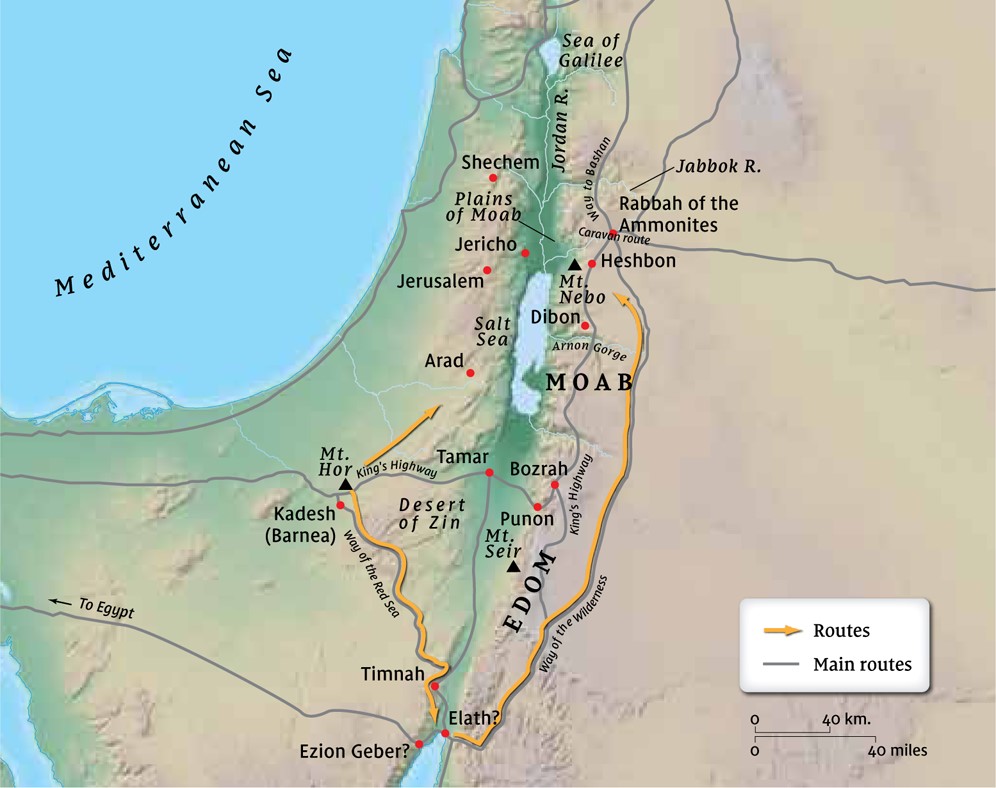
Having been denied safe passage through the land of Edom, the Israelites attempted to make their way through the Negev. However, their efforts were hampered by the Canaanites who occupied that territory. So, they reversed their steps and headed east around the borders of Edom to the western borders of Moab. This would have been a long and circuitous journey that left the Israelites frustrated by their slow progress. It was an unexpected and unwelcome detour that required the people of God to extend their time in the wilderness but there was a reason for this delay. God was waiting for the remainder of the first generation of Israelites who had refused to enter Canaan the first time to die off. In the book of Deuteronomy, Moses recalls the nearly 40-year death march the Israelites were forced to make because of their refusale to obey God’s command.

“Thirty-eight years passed from the time we first left Kadesh-barnea until we finally crossed the Zered Brook! By then, all the men old enough to fight in battle had died in the wilderness, as the Lord had vowed would happen. The Lord struck them down until they had all been eliminated from the community.” – Deuteronomy 2:14-15 NLT

And as that earlier generation slowly died off, the time grew closer to when the next crop of Israelites would face the decision to obey God and enter the land of Canaan. But as they drew closer to Canaan’s border, God warned the people to give the people of Moab a wide berth.

“Do not bother the Moabites, the descendants of Lot, or start a war with them. I have given them Ar as their property, and I will not give you any of their land.” – Deuteronomy 2:9 NLT

When the very last member of the earlier generation died, the Israelites were given permission to cross the border of Moab and enter the land of Ammon,

“Today you will cross the border of Moab at Ar and enter the land of the Ammonites, the descendants of Lot. But do not bother them or start a war with them. I have given the land of Ammon to them as their property, and I will not give you any of their land.’” – Deuteronomy 2:18-19 NLT

As before, the Israelites were to refrain from taking any land from the Ammonites. These people were close relatives of the Israelites and God declared their property to be off limits. God had awarded Lot’s descendants this land and the Israelites had no claim to it.

But the day came when God ordered the Israelites to begin their conquest of the land of Canaan. The older generation was gone and, after a nearly 40-year delay, it was time for God’s people to obey His command and enter the land of promise.

“Then the Lord said, ‘Now get moving! Cross the Arnon Gorge. Look, I will hand over to you Sihon the Amorite, king of Heshbon, and I will give you his land. Attack him and begin to occupy the land. Beginning today I will make people throughout the earth terrified because of you. When they hear reports about you, they will tremble with dread and fear.’” – Deuteronomy 2:24-25 NLT

Moses attempted to negotiate a treaty with Sihon, the king of the Amorites, but he was not interested in peace talks. That’s when God informed Moses to drop the peace overtures and have the people pick up their weapons.

“Look, I have begun to hand King Sihon and his land over to you. Begin now to conquer and occupy his land.” – Deuteronomy 2:31 NLT

The victory was overwhelming. Moses chronicled the event by giving God all the glory:

“…the Lord our God handed him over to us, and we crushed him, his sons, and all his people.  We conquered all his towns and completely destroyed everyone—men, women, and children. Not a single person was spared.” – Deuteronomy 2:33-34 NLT

In this chapter of Numbers, Moses refers to “the Book of the Wars of the Lord” (Numbers 21:14 ESV). This was a record of Israel’s victories recorded in the form of songs. The people were just beginning to witness the overwhelming power of God on their behalf and this victory over the Amorites was to be the first of many. The songs were intended to promote a sense of hope and confidence among the people of God.

After their defeat of the Amorites, the Israelites continued on to Beer, where God quenched the thirst of the people with refreshing water. And the people responded in grateful song.

“Spring up, O well!
    Yes, sing its praises!
Sing of this well,
    which princes dug,
which great leaders hollowed out
    with their scepters and staffs.” – Numbers 21:17-18 NLT

Israel was experiencing a sense of renewed confidence as they witnessed firsthand the power and providence of God. He was graciously preparing them for the days ahead and helping them to understand that anything was possible when they placed their faith in Him.

But while they were getting closer to the land of Canaan, they were not quite ready to take on the challenges that lie across the border. So, God continues to prepare them for the difficult days ahead.

Their enthusiasm, while admirable, would not be enough to bring victory against the nations living in Canaan. What the Israelites really needed was increased confidence in the power of God. Ultimately, the conquest of the land would be up to Him. They were going to need to learn to trust Him implicitly. Cockiness was not an acceptable substitute for confidence in God.

They were learning the timeless lesson recorded in the old hymn, “Faith is the Victory.”

Encamped along the hills of light,
Ye Christian soldiers, rise
And press the battle ere the night
Shall veil the glowing skies.
Against the foe in vales below
Let all our strength be hurled;
Faith is the victory, we know,
That overcomes the world.

Faith is the victory! (Faith is the victory!)
Oh, glorious victory
That overcomes the world.

English Standard Version (ESV) The Holy Bible, English Standard Version. ESV® Permanent Text Edition® (2016). Copyright © 2001

New Living Translation (NLT) Holy Bible, New Living Translation, copyright © 1996, 2004, 2015 by Tyndale House Foundation. Used by permission of Tyndale House Publishers Inc., Carol Stream, Illinois 60188. All rights reserved.

Trust and Obey

1 And the people of Israel, the whole congregation, came into the wilderness of Zin in the first month, and the people stayed in Kadesh. And Miriam died there and was buried there.

2 Now there was no water for the congregation. And they assembled themselves together against Moses and against Aaron. 3 And the people quarreled with Moses and said, “Would that we had perished when our brothers perished before the Lord! 4 Why have you brought the assembly of the Lord into this wilderness, that we should die here, both we and our cattle? 5 And why have you made us come up out of Egypt to bring us to this evil place? It is no place for grain or figs or vines or pomegranates, and there is no water to drink.” 6 Then Moses and Aaron went from the presence of the assembly to the entrance of the tent of meeting and fell on their faces. And the glory of the Lord appeared to them, 7 and the Lord spoke to Moses, saying, 8 “Take the staff, and assemble the congregation, you and Aaron your brother, and tell the rock before their eyes to yield its water. So you shall bring water out of the rock for them and give drink to the congregation and their cattle.” 9 And Moses took the staff from before the Lord, as he commanded him.

10 Then Moses and Aaron gathered the assembly together before the rock, and he said to them, “Hear now, you rebels: shall we bring water for you out of this rock?” 11 And Moses lifted up his hand and struck the rock with his staff twice, and water came out abundantly, and the congregation drank, and their livestock. 12 And the Lord said to Moses and Aaron, “Because you did not believe in me, to uphold me as holy in the eyes of the people of Israel, therefore you shall not bring this assembly into the land that I have given them.” 13 These are the waters of Meribah, where the people of Israel quarreled with the Lord, and through them he showed himself holy. – Numbers 20:1-13 ESV

Nearly 40 years have passed since the Israelites first arrived at the border of the land of Canaan but refused to obey God’s command and take possession of it. Due to their rebellion, they had spent the last four decades wandering through the wilderness between Egypt and Canaan until that generation died off. God was not going to allow them a second chance to take possession of their inheritance. That privilege would be passed to their sons and daughters.

Ever since the Israelites had been delivered from their captivity in Egypt, they had shown a propensity for complaining and, ultimately, rebellion. They had a habit of viewing everything from a negative perspective, and this problem went all the way to the top.

This chapter opens up with the death of Miriam, the elder sister of Moses and Aaron, and what is significant about the timing of her death is its location. She takes her last breath on Earth in a place called Kadesh.

This had been a regular camping point for the people of God during their days in the wilderness. They had been here before, years earlier, and had proven their penchant for rebellion and refusal to obey God’s commands.

“You also made the Lord angry at Taberah, Massah, and Kibroth-hattaavah. And at Kadesh-barnea the Lord sent you out with this command: ‘Go up and take over the land I have given you.’ But you rebelled against the command of the Lord your God and refused to put your trust in him or obey him. Yes, you have been rebelling against the Lord as long as I have known you.” – Deuteronomy 9:22-24 NLT

Kadesh was located near the southern borders of Canaan and it came to represent a kind of stop sign in the lives of the nation of Israel. It was as if this spot was as far as they could force themselves to go in their quest to occupy the land that God had given them. It would be in Kadesh that Miriam’s life would come to an end. She would never set foot in the land of promise all because she had chosen to question God’s will by attempting to wrest leadership from the hands of her own brother. This less-than-flattering scene from Miriam’s life is recorded in Numbers 12. She and Aaron joined forces to demand equal billing when it came to leading the nation.

They said, “Has the Lord spoken only through Moses? Hasn’t he spoken through us, too?” – Numbers 12:2 NLT

They weren’t content in their roles and desired to share the leadership responsibilities with their brother. But God did not agree.

“Why then were you not afraid to speak against my servant Moses?” And the anger of the Lord was kindled against them, and he departed. – Numbers 12:8-9 ESV

For her part in the attempted coup, Miriam was struck with leprosy but Moses interceded for his sister and begged God to heal her, which He did. But while Miriam was spared the pain and social ostracization that comes with leprosy, she would be denied entry into the land of Canaan. She paid dearly for her rebellion.

The story of her death is followed by yet another example of rebellion on the part of the people. The people found themselves in Kadesh once again and, more specifically, at a place called Meribah. That name had a special significance to the people of Israel – for both good and bad reasons. It was at Meribah that God had performed a miraculous sign by providing them with water out of a rock.

In Exodus 17, we have recorded this first encounter with “the rock.” On that occasion, they were in the early stages of their wilderness experience. When they came to the wilderness of Sin, they discovered that there was no water for them to drink. So the people did what they were prone to do – they complained, and Moses did what he was prone to do – take the matter to God.

God instructed him to take his rod and strike a particular rock. When he did, water gushed from the rock. In the book of Corinthians, Paul tells us something significant about this remarkable water-producing rock.

…and all of them drank the same miraculous water. For they all drank from the miraculous rock that traveled with them, and that rock was Christ. – 1 Corinthians 10:4 NLT

Now there was a legend taught by the rabbi that claimed this rock actually traveled with the people of Israel. There is no Scriptural basis for this theory, but in Numbers 20, the “rock” makes an appearance once again. Whether it was the very same rock or just another rock through which God provided for the peoples’ needs, Paul’s point is that the rock symbolized Christ. It was He who had been with the Israelites all the time they were in the wilderness, providing life-sustaining water for them. In fact, in Exodus 17, when it states that God told Moses to strike the rock, that word means to “strike, beat, scourge, ravage, slay, or wound.” It’s the same word used when God “smote” the firstborn of Egypt. It paints a picture of the scourging and beating of Christ at His trials and crucifixion. Jesus would become the source of living water. During His encounter with the Samaritan woman  Jesus told her, “If you only knew the gift God has for you and who I am, you would ask me, and I would give you living water” (John 4:10 NLT). Just a few chapters later, John records Jesus telling a crowd, “If you are thirsty, come to me! If you believe in me, come and drink! For the Scriptures declare that rivers of living water will flow out from within” (John 7:37-38 NLT).

In chapter 20 of the book of Numbers, we have not a retelling of the story of Meribah, but another Meribah. This is one of those “deja-vu-all-over-again” types of experiences. Meribah means ” argument” or “strife.” The name stems from the actions of the people of God because they argued or quarreled with God on both occasions. The second time, God instructed Moses to take up his rod again, but this time He specifically told Moses to SPEAK to the rock – not strike it. In Exodus 17, Moses receives clear instructions from God to strike the rock.

“Pass on before the people, taking with you some of the elders of Israel, and take in your hand the staff with which you struck the Nile, and go. Behold, I will stand before you there on the rock at Horeb, and you shall strike the rock, and water shall come out of it, and the people will drink.” – Exodus 17:5-6 ESV

But this time, Moses was told to speak to the rock.

“You and Aaron must take the staff and assemble the entire community. As the people watch, speak to the rock over there, and it will pour out its water. You will provide enough water from the rock to satisfy the whole community and their livestock.” – Numbers 20:8 NLT

But in his anger with the people, Moses disobeys God and strikes the rock, not once but twice. Not only that, before taking out his anger on the rock, he addressed the people and vocally declared his frustration with them.

“Listen, you rebels!” he shouted. “Must we bring you water from this rock?” – Numbers 20:10 NLT

His actions produced the desired result; water poured from the rock. But in disobeying God, Moses incurred His wrath. Think about it. If what Paul says in 1 Corinthians is true – that the rock is a representation of Christ, then Moses is taking out his anger on Christ. The first time Moses struck the rock, it was a representation of the death that Christ must suffer so that we might have life. But from that point forward, Christ’s life-sustaining power was available for the asking. There was no need to “beat” it out of Him. He had provided before and He would provide again. All Moses needed to do was ask. But instead, He struck the rock in anger, and this action would prevent Moses from entering the land of promise. Like his sister, Miriam, Moses would die in the wilderness, having been denied entrance into the very land he had strived so long to reach. Aaron would suffer a similar fate.

This is a difficult passage. It seems as if Moses and Aaron received a punishment from God that far outweighed the crime. But in his commentary on the Old Testament, Matthew Henry sheds some helpful light on this passage.

“First, They did not punctually observe their orders, but in some things varied from their commission; God bade them speak to the rock, and they spoke to the people, and smote the rock, which at this time they were not ordered to do, but they thought speaking would not do. When, in distrust of the power of the word, we have recourse to the secular power in matters of pure conscience, we do, as Moses here, smite the rock to which we should only speak, Secondly, They assumed too much of the glory of this work of wonder to themselves: Must we fetch water? as if it were done by some power or worthiness of theirs. Therefore it is charged upon them (v. 12) that they did not sanctify God, that is, they did not give him that glory of this miracle which was due unto his name. Thirdly, Unbelief was the great transgression (v. 12): You believed me not; nay, it is called rebelling against God’s commandment, ch. 27:14. The command was to bring water out of the rock, but they rebelled against this command, by distrusting it, and doubting whether it would take effect or no. They speak doubtfully: Must we fetch water? And probably they did in some other ways discover an uncertainty in their own minds whether water would come or no for such a rebellious generation as this was. And perhaps they the rather questioned it, though God had promised it, because the glory of the Lord did not appear before them upon this rock, as it had done upon the rock in Rephidim, Ex. 17:6. They would not take God’s word without a sign.” – Matthew Henry, “Numbers,” Matthew Henry’s Commentary on the Whole Bible

Disobedience, unbelief, and seeking glory for themselves. That was their sin, and it is the sin of many today. We disobey God because we do not believe God. We don’t trust His word. And even when we do obey, we do it to get the glory for ourselves. But while Moses and Aaron were God’s chosen leaders, He would not tolerate their behavior. Moses’ anger-induced actions caused him to disobey and dishonor God. In doing what he did, Moses drew the people’s attention away from God and made himself the star of the show. He robbed God of glory by demonstrating a blatant disregard for His word. For this Moses would pay dearly.

“Because you did not believe in me, to uphold me as holy in the eyes of the people of Israel, therefore you shall not bring this assembly into the land that I have given them.” – Numbers 20:12 ESV

God will provide but He requires obedience. He will provide but He will not share His glory. He will provide but He expects His people to believe. But because Moses didn’t believe God, he ended up dishonoring God. He learned the painful lesson that God is holy and demands that we treat Him as such.

English Standard Version (ESV) The Holy Bible, English Standard Version. ESV® Permanent Text Edition® (2016). Copyright © 2001

New Living Translation (NLT) Holy Bible, New Living Translation, copyright © 1996, 2004, 2015 by Tyndale House Foundation. Used by permission of Tyndale House Publishers Inc., Carol Stream, Illinois 60188. All rights reserved.

Their God Is Their Appetite

16 Then the Lord said to Moses, “Gather for me seventy men of the elders of Israel, whom you know to be the elders of the people and officers over them, and bring them to the tent of meeting, and let them take their stand there with you. 17 And I will come down and talk with you there. And I will take some of the Spirit that is on you and put it on them, and they shall bear the burden of the people with you, so that you may not bear it yourself alone. 18 And say to the people, ‘Consecrate yourselves for tomorrow, and you shall eat meat, for you have wept in the hearing of the Lord, saying, “Who will give us meat to eat? For it was better for us in Egypt.” Therefore the Lord will give you meat, and you shall eat. 19 You shall not eat just one day, or two days, or five days, or ten days, or twenty days, 20 but a whole month, until it comes out at your nostrils and becomes loathsome to you, because you have rejected the Lord who is among you and have wept before him, saying, “Why did we come out of Egypt?”’” 21 But Moses said, “The people among whom I am number six hundred thousand on foot, and you have said, ‘I will give them meat, that they may eat a whole month!’ 22 Shall flocks and herds be slaughtered for them, and be enough for them? Or shall all the fish of the sea be gathered together for them, and be enough for them?” 23 And the Lord said to Moses, “Is the Lord’s hand shortened? Now you shall see whether my word will come true for you or not.”

24 So Moses went out and told the people the words of the Lord. And he gathered seventy men of the elders of the people and placed them around the tent. 25 Then the Lord came down in the cloud and spoke to him, and took some of the Spirit that was on him and put it on the seventy elders. And as soon as the Spirit rested on them, they prophesied. But they did not continue doing it.

26 Now two men remained in the camp, one named Eldad, and the other named Medad, and the Spirit rested on them. They were among those registered, but they had not gone out to the tent, and so they prophesied in the camp. 27 And a young man ran and told Moses, “Eldad and Medad are prophesying in the camp.” 28 And Joshua the son of Nun, the assistant of Moses from his youth, said, “My lord Moses, stop them.” 29 But Moses said to him, “Are you jealous for my sake? Would that all the Lord’s people were prophets, that the Lord would put his Spirit on them!” 30 And Moses and the elders of Israel returned to the camp. – Numbers 11:16-30 ESV

Moses was feeling a bit overwhelmed by his responsibilities as the leader of Israel. From the very first moment he had introduced himself to them as their God-appointed deliverer, he had run into opposition. Even when he had successfully led them out of Egypt and across the Red Sea, they proved to be far from compliant and quick to complain. He had been forced to deal with their rebellion at Mount Sinai, when they had begun to worship the golden calves while he was on the mountaintop receiving the Ten Commandments from God.

They were incessantly complaining about everything, from the quality of the food to the scarcity of water. Some questioned Moses’ leadership skills and tried to displace him. Others tried to mount an insurrection and orchestrate an immediate return to Egypt. Hardly a day went by when Moses didn’t have to deal with a disgruntled Israelite or face another round of searing criticism. Having reached the limits of his patience andin a state of frustration and self-pity, he decided to turn in his resignation to God.

“I can’t carry all these people by myself! The load is far too heavy! If this is how you intend to treat me, just go ahead and kill me. Do me a favor and spare me this misery!” – Numbers 11:14-15 NLT

But God wasn’t going to let Moses off the hook quite so easily; He had more for His servant to do. God was aware that the Israelites were stubborn people who could be disobedient, disrespectful, and ungrateful. Even on a good day, they were difficult to manage. But when things didn’t go the way they expected or desired, they could be virtually ungovernable and intolerable to deal with.

So, God instructed Moses to choose 70 men from among the elders and leaders of Israel. These hand-picked individuals would serve as Moses’ assistants and provide him with much-needed help in managing the day-to-day affairs of the nation. To ensure their capacity for godly leadership, God promised to anoint them with His Spirit. And to prove to the people that these men had been appointed by God, they would receive the gift of prophecy.

“Prophesying here does not refer to prediction or even to proclamation but to giving (in song or speech) praise and similar expressions without prior training (see the comparable experience of Saul in 1 Sam. 10:9-11)” – Eugene H. Merrill, “Numbers.” In The Bible Knowledge Commentary: Old Testament, pp. 215-58.

Their ability to prophesy would testify to their status as God’s chosen messengers. These men were already recognized as leaders among their people, but now they would be seen as God’s messengers and Moses’ co-administrators.

“They will bear the burden of the people along with you, so you will not have to carry it alone.” – Numbers 11:17 NLT

Having dealt with Moses’ complaint about feeling overworked and overwhelmed, God turned His attention to the people’s criticism of the cuisine. They had expressed great displeasure with God’s culinary skills, citing their distaste and disgust for the manna He had provided. They were sick of it and demanded a change in diet.

“Oh, for some meat!” they exclaimed. “We remember the fish we used to eat for free in Egypt. And we had all the cucumbers, melons, leeks, onions, and garlic we wanted. But now our appetites are gone. All we ever see is this manna!” – Numbers 11:4-6 NLT

Despite their complaining and their rather obvious case of selective memory, God had Moses inform the Israelites that He was going to give in to their demand.

“Purify yourselves, for tomorrow you will have meat to eat. You were whining, and the Lord heard you when you cried, ‘Oh, for some meat! We were better off in Egypt!’ Now the Lord will give you meat, and you will have to eat it. And it won’t be for just a day or two, or for five or ten or even twenty. You will eat it for a whole month until you gag and are sick of it.” – Numbers 11:18-20 NLT

The old adage, “Be careful what you wish for” applies here. In demanding that God give them meat to eat, the people were rejecting His providence and provision. He is the one who had graciously and miraculously given them the manna to eat, but they had grown tired of His bland and monotonous diet plan. Driven by their physical appetites and controlled by their fleshly desires, they dared to question God’s goodness and demanded that He meet their needs according to their own criteria. In essence, they were telling God that knew what was best for them. The apostle Paul provides an apt description of these kinds of people.

Their end is destruction, their god is their belly, and they glory in their shame, with minds set on earthly things. – Philippians 3:19 ESV

Yet God promised to fulfill their wish – in abundance. For a solid month, they would consume nothing but meat, and their chosen diet would soon become repugnant to them. Eventually, they would long for the manna of God but meat would remain their only choice on the menu. This novel 30-day diet plan was God’s way of punishing them for their rejection of Him. This wasn’t about food choices but about their unwillingness to submit to God’s will for them. At the heart of their demand for meat was their rejection of God’s entire redemptive plan for them.

“For you have rejected the Lord, who is here among you, and you have whined to him, saying, ‘Why did we ever leave Egypt?’” – Numbers 11:20 NLT

God was attempting to move them forward – toward Canaan – but they were constantly looking backward to Egypt. They were living in the past and refusing to trust God’s future plan for them. They disliked His chosen path for their lives and wanted to return to the “good old days” of Egypt. But their memories were clouded and their faith had been contaminated by a fear of the unknown and a resistance to anything they considered unpleasant. Their journey to the promised land had not turned out to be a walk in the park.

It had been a year since they left Egypt and the promised land was nowhere in sight. Each morning they woke up in the wilderness and waited to see what God would do. Would they stay encamped where they were or would the cloud of God’s presence move from above the Tabernacle and lead them to their next destination? There was no clear end in sight. But the blessings of God required obedience. If they wanted to enjoy His presence, power, and provision, they would have to trust Him and submit to His will. But for the next 30 days, they would be forced to eat their own words and endure a one-dimensional diet of nothing but meat.

When Moses heard what God planned to do, he immediately questioned the logic and logistics of it all. He couldn’t fathom how God intended to provide enough meat to feed so many people. Even if they slaughtered all their livestock and emptied the rivers and streams of every fish, they wouldn’t have enough meat to feed the people of Israel for a month, and they would end up depleting their herds and flocks. So, Moses informed God that His plan was impossible. But God reminded His doubting deliverer that He was fully capable of carrying out His plan.

“Has my arm lost its power? Now you will see whether or not my word comes true!” – Numbers 11:23 NLT

God didn’t tell Moses how He was going to accomplish His meat miracle. He simply instructed Moses to select 70 men and bring them to the Tabernacle for their anointing by the Spirit. Moses obeyed and God fulfilled His promise by pouring out His Spirit and empowering these men to prophesy. For some reason, two of the men never made it to the Tabernacle. Yet, even though they had remained in the camp, the Spirit of God descended upon them, and they too received the gift of prophecy. When Joshua heard about these two outliers, he demanded that Moses put a stop to what he believed to be an unauthorized display of divine power. Yet, Moses refused to do so, instead expressing his desire that every single Israelite would receive the same anointing of God.

“Are you jealous for my sake? I wish that all the Lord’s people were prophets and that the Lord would put his Spirit upon them all!” – Numbers 11:29 NLT

For whatever reason, Eldad and Medad had remained behind in the camp. Yet they had been chosen by Moses and were therefore anointed by God. Their proximity to the Tabernacle was not essential to their calling and their distance from the other 68 men had no impact on their anointing by God. Much to their surprise, the Spirit came upon them and they prophesied in the camp. This display of divine power caught Joshua by surprise and he viewed their prophesying as an attempt to displace Moses as God’s appointed leader.

But rather than seeing Eldad and Medad as competition, Moses expressed his desire that all the people of Israel could experience that same degree of divine endorsement and empowerment. Little did he know that his wish would one day be fulfilled. The prophet Ezekiel speaks of a day when God will pour out His Spirit on all His people.

“Therefore say to the house of Israel, Thus says the Lord God: …I will give you a new heart, and a new spirit I will put within you. And I will remove the heart of stone from your flesh and give you a heart of flesh. And I will put my Spirit within you, and cause you to walk in my statutes and be careful to obey my rules.” – Ezekiel 36:22, 26-27 ESV

While the people would not receive the anointing of the Spirit, they would have a different kind of blessing poured out upon them. God was going to fulfill His promise of meat on a grand scale, and Moses and the rest of the Israelites would learn that God’s arm had not lost its power to provide. But they would also learn the sad lesson that God’s arm had not lost its power to punish.

English Standard Version (ESV) The Holy Bible, English Standard Version. ESV® Permanent Text Edition® (2016). Copyright © 2001

New Living Translation (NLT) Holy Bible, New Living Translation, copyright © 1996, 2004, 2015 by Tyndale House Foundation. Used by permission of Tyndale House Publishers Inc., Carol Stream, Illinois 60188. All rights reserved.

A Loss of Appetite for God’s Ways

1 And the people complained in the hearing of the Lord about their misfortunes, and when the Lord heard it, his anger was kindled, and the fire of the Lord burned among them and consumed some outlying parts of the camp. 2 Then the people cried out to Moses, and Moses prayed to the Lord, and the fire died down. 3 So the name of that place was called Taberah, because the fire of the Lord burned among them.

4 Now the rabble that was among them had a strong craving. And the people of Israel also wept again and said, “Oh that we had meat to eat! 5 We remember the fish we ate in Egypt that cost nothing, the cucumbers, the melons, the leeks, the onions, and the garlic. 6 But now our strength is dried up, and there is nothing at all but this manna to look at.”

7 Now the manna was like coriander seed, and its appearance like that of bdellium. 8 The people went about and gathered it and ground it in handmills or beat it in mortars and boiled it in pots and made cakes of it. And the taste of it was like the taste of cakes baked with oil. 9 When the dew fell upon the camp in the night, the manna fell with it.

10 Moses heard the people weeping throughout their clans, everyone at the door of his tent. And the anger of the Lord blazed hotly, and Moses was displeased. 11 Moses said to the Lord, “Why have you dealt ill with your servant? And why have I not found favor in your sight, that you lay the burden of all this people on me? 12 Did I conceive all this people? Did I give them birth, that you should say to me, ‘Carry them in your bosom, as a nurse carries a nursing child,’ to the land that you swore to give their fathers? 13 Where am I to get meat to give to all this people? For they weep before me and say, ‘Give us meat, that we may eat.’ 14 I am not able to carry all this people alone; the burden is too heavy for me. 15 If you will treat me like this, kill me at once, if I find favor in your sight, that I may not see my wretchedness.” – Numbers 11:1-15 ESV

The people of Israel were on the move. After nearly a year encamped at the base of Mount Sinai, they had watched as the cloud of God’s presence departed from above the Tabernacle, indicating His desire for them to break camp and continue their journey to the land of Canaan. They followed His instructions and methodically made their way to the wilderness of Paran where the cloud had come to rest.

But it wasn’t long before the obedient children of God became disgruntled and obstinate. Their willingness to follow God’s leading came to an abrupt end as soon as they encountered any kind of discomfort or dissatisfaction, and this was not the first time they had expressed their displeasure with God. A year earlier, when they were leaving Egypt after their release from captivity, they found themselves in an unexpected and highly uncomfortable predicament. After Pharaoh had finally agreed to release them, they followed Moses into the wilderness and arrived on the shore of the Red Sea.

When Pharaoh finally let the people go, God did not lead them along the main road that runs through Philistine territory, even though that was the shortest route to the Promised Land. God said, “If the people are faced with a battle, they might change their minds and return to Egypt.” So God led them in a roundabout way through the wilderness toward the Red Sea. Thus the Israelites left Egypt like an army ready for battle. – Exodus 13:17-18 NLT

God had led them to that very spot. It had been His will that they arrive on the banks of the sea just as Pharaoh and his army were bearing down on them. It seems that Pharaoh had experienced a change of heart and decided to force the Israelites back into slavery. So, when the people found themselves with their backs to the sea and the army of Egypt bearing down on them, they responded to Moses in anger.

“Why did you bring us out here to die in the wilderness? Weren’t there enough graves for us in Egypt? What have you done to us? Why did you make us leave Egypt? Didn’t we tell you this would happen while we were still in Egypt? We said, ‘Leave us alone! Let us be slaves to the Egyptians. It’s better to be a slave in Egypt than a corpse in the wilderness!’” – Exodus 14:11-12 NLT

Yet, despite their complaining, God miraculously delivered them. He had Moses part the waters of the Red Sea and they crossed over on dry ground, and the cloud of God’s presence kept the Egyptians at bay until the very last Israelite had made it to the eastern shore of the sea. Then, as Pharaoh’s army attempted to pursue them, “the waters returned and covered all the chariots and charioteers—the entire army of Pharaoh. Of all the Egyptians who had chased the Israelites into the sea, not a single one survived” (Exodus 14:28 NLT).

Their miraculous crossing and the destruction of the Egyptians made an impact on the Israelites.

When the people of Israel saw the mighty power that the Lord had unleashed against the Egyptians, they were filled with awe before him. They put their faith in the Lord and in his servant Moses. – Exodus 14:31 NLT

Now, more than a year later, it appears that their faith had run out. Once again, they struggled with discontentment concerning God’s will for them. They were not happy with their circumstances and so they began to complain to Moses once again.

Soon the people began to complain about their hardship, and the Lord heard everything they said. – Numbers 11:1 NLT

Their year-long hiatus at Mount Sinai had made them lazy and unprepared for the difficulties of traveling through the wilderness. So, the journey to Paran left them disgruntled and dissatisfied with God’s plan for them. They were unhappy and more than willing to voice their displeasure. But again, this was not the first time the Israelites had become disenchanted with God’s will for them.

Three days after their miraculous crossing of the Red Sea, they found themselves in the desert of Shur, a barren place where water was scarce. When they finally discovered an oasis, its water was contaminated and undrinkable. This disappointing outcome led the people to direct their anger at Moses.

Then the people complained and turned against Moses. “What are we going to drink?” they demanded. – Exodus 15:24 NLT

But God directed Moses to a particular piece of wood that, when thrown in the spring, “made the water good to drink” (Exodus 15:25 NLT). Having temporarily satiated the thirst of His dissatisfied people, God then led them to another oasis “where they found twelve springs and seventy palm trees” (Exodus 15:27 NLT). He provided for all their needs. He even “set before them the following decree as a standard to test their faithfulness to him” (Exodus 15:25 NLT).

“If you will listen carefully to the voice of the Lord your God and do what is right in his sight, obeying his commands and keeping all his decrees, then I will not make you suffer any of the diseases I sent on the Egyptians; for I am the Lord who heals you.” – Exodus 15:26 NLT

All God required of His people was that they remain faithful and obedient. In return, He promised to provide for and protect them; they would never go without. That doesn’t mean they would never experience difficulties along the way. But by trusting God, they would get to see His providential hand providing for their every need.

Yet, a year later, they exhibited the same stubborn tendency to grouse and complain at the slightest inconvenience, and God heard everything they said. As a result, “his anger was kindled, and the fire of the Lord burned among them and consumed some outlying parts of the camp” (Numbers 11:1 ESV). It’s unclear whether anyone actually died in this conflagration or whether it was only meant to get their attention. Whatever this “fire” was, it had its intended effect, producing fear in the hearts of the Israelites.

…the people screamed to Moses for help, and when he prayed to the Lord, the fire stopped. – Numbers 11:2 NLT

But while the fire died down, their complaining continued, and it wasn’t long before another round of grievances made their way to the ears of God. It seems that the foreigners who had chosen to accompany the Israelites when they left Egypt had grown disenchanted with the manna that God had provided for them. One month after the Israelites departed Egypt, the people expressed their displeasure to Moses and Aaron over the lack of food.

“If only the Lord had killed us back in Egypt,” they moaned. “There we sat around pots filled with meat and ate all the bread we wanted. But now you have brought us into this wilderness to starve us all to death.” – Exodus 16:3 NLT

But God heard their complaints and responded with grace and mercy. Rather than sending fire as a punishment for their ungratefulness, He determined to shower them with manna.

“I have heard the Israelites’ complaints. Now tell them, ‘In the evening you will have meat to eat, and in the morning you will have all the bread you want. Then you will know that I am the Lord your God.’” – Exodus 16:12 NLT

God fed them. He miraculously met their physical needs with spiritual food. No one knew exactly what manna was but it provided them with the strength and stamina to continue their journey to the land of Canaan. And God would provide it every day for over 40 years.

So the people of Israel ate manna for forty years until they arrived at the land where they would settle. They ate manna until they came to the border of the land of Canaan. – Exodus 16:35 NLT

Yet, just a year after having left Egypt, the people were complaining about the monotonous menu of manna.

“Oh, for some meat!” they exclaimed. “We remember the fish we used to eat for free in Egypt. And we had all the cucumbers, melons, leeks, onions, and garlic we wanted. But now our appetites are gone. All we ever see is this manna!” – Numbers 11:4-6 NLT

They returned God’s grace and mercy with ungratefulness and dissatisfaction. They didn’t like God’s culinary skills. They wanted a more varied and appetizing selection of menu options. In their faulty imaginations, they recalled enjoying a much more diverse and appealing range of food choices back in Egypt. They conveniently forgot the part about slavery and making bricks without straw. They left out the persecution and pain they had experienced during their years of captivity. Driven by their physical appetites, they conjured up memories of their halcyon days in Egypt – which were nothing more than figments of their imaginations.

And, once again, their complaints reached the ears of Moses and God.

Moses heard all the families standing in the doorways of their tents whining, and the Lord became extremely angry. – Numbers 11:10 NLT

But this time, it’s Moses who displays his anger with the people and expresses his frustration with God.

“Why are you treating me, your servant, so harshly? Have mercy on me! What did I do to deserve the burden of all these people? Did I give birth to them? Did I bring them into the world? Why did you tell me to carry them in my arms like a mother carries a nursing baby? How can I carry them to the land you swore to give their ancestors? Where am I supposed to get meat for all these people? They keep whining to me, saying, ‘Give us meat to eat!’ I can’t carry all these people by myself! The load is far too heavy! If this is how you intend to treat me, just go ahead and kill me. Do me a favor and spare me this misery!” – Numbers 11:11-15 NLT

Moses was not a happy camper. For more than a year he had been attempting to lead a people who were inflexible and incorrigible. Nothing seemed to make them happy, and he was at his wit’s end. He had grown tired of their constant complaining and expressed his frustration to God. The burden of caring for these people had taken its toll and he boldly conveyed his displeasure to God. In fact, Moses seems to blame God for the whole state of affairs. He shakes his fist in Yahweh’s face and, essentially, accuses Him of abandonment. According to Moses, God had placed all the burden of leading the nation of Israel on his back, and he was overwhelmed by it all. He was tapped out and ready to throw in the towel.

Moses was suffering the same condition as the people he claimed to be leading. He had taken his eyes off of the Lord. He no longer recognized the sovereign hand of God over his life and conveniently forgot how the Almighty had provided for all his needs. As a result, he wrongly assumed responsibility for the well-being of God’s people. Moses had forgotten that he was nothing more than a conduit of God’s blessing and not its source. He was responsible for leading them but God was their sole provider and protector.

When God had given the people the manna to eat, He had told them it would be a sign of His power and provision.

“Then you will know that I am the Lord your God.” – Exodus 16:12 NLT

Yet, Moses and the people had lost sight of that fact. Comfort and convenience had taken precedence over their faith in God’s sovereignty and providence. Now that the people had the Tabernacle and the guarantee of God’s presence, it was as if they assumed following God would be a trouble-free experience. But at the first sign of discomfort, they complained. And Moses was brazen enough to demand that God fix the problem or kill him on the spot.

“If this is how you intend to treat me, just go ahead and kill me. Do me a favor and spare me this misery!” – Numbers 11:15 NLT

They all had a lot to learn about God’s providential care and, despite their ongoing displays of ingratitude and unbelief, God would continue to show them mercy and grace. He would even respond to Moses’ bold ultimatum with love and not anger, providing His servant with a plan for lightening the burden of leadership.

English Standard Version (ESV) The Holy Bible, English Standard Version. ESV® Permanent Text Edition® (2016). Copyright © 2001

New Living Translation (NLT) Holy Bible, New Living Translation, copyright © 1996, 2004, 2015 by Tyndale House Foundation. Used by permission of Tyndale House Publishers Inc., Carol Stream, Illinois 60188. All rights reserved.

Safe in the Hands of God

1 And the Lord said to Job:

2 “Shall a faultfinder contend with the Almighty?
    He who argues with God, let him answer it.”

3 Then Job answered the Lord and said:

4 “Behold, I am of small account; what shall I answer you?
    I lay my hand on my mouth.
5 I have spoken once, and I will not answer;
    twice, but I will proceed no further.”

6 Then the Lord answered Job out of the whirlwind and said:

7 “Dress for action like a man;
    I will question you, and you make it known to me.
8 Will you even put me in the wrong?
    Will you condemn me that you may be in the right?
9 Have you an arm like God,
    and can you thunder with a voice like his?

10 “Adorn yourself with majesty and dignity;
    clothe yourself with glory and splendor.
11 Pour out the overflowings of your anger,
    and look on everyone who is proud and abase him.
12 Look on everyone who is proud and bring him low
    and tread down the wicked where they stand.
13 Hide them all in the dust together;
    bind their faces in the world below.
14 Then will I also acknowledge to you
    that your own right hand can save you.

15 “Behold, Behemoth,
    which I made as I made you;
    he eats grass like an ox.
16 Behold, his strength in his loins,
    and his power in the muscles of his belly.
17 He makes his tail stiff like a cedar;
    the sinews of his thighs are knit together.
18 His bones are tubes of bronze,
    his limbs like bars of iron.

19 “He is the first of the works of God;
    let him who made him bring near his sword!
20 For the mountains yield food for him
    where all the wild beasts play.
21 Under the lotus plants he lies,
    in the shelter of the reeds and in the marsh.
22 For his shade the lotus trees cover him;
    the willows of the brook surround him.
23 Behold, if the river is turbulent he is not frightened;
    he is confident though Jordan rushes against his mouth.
24 Can one take him by his eyes,
    or pierce his nose with a snare?” – Job 40:1-24 ESV

God takes a brief pause in His rhetorical interrogation to give Job a chance to respond. God demands that this “contender” or “complainer” explain himself. Since Job seems to enjoy arguing with God and questioning His ways, then he must have a lot to say. This is the moment for which Job has been waiting. He has an audience with the Almighty and  the opportunity to defend himself but Job finds himself at a loss for words. Suddenly, when faced with the overwhelming sense of God’s presence and power, Job is speechless.

“I am nothing—how could I ever find the answers?
    I will cover my mouth with my hand.
I have said too much already.
    I have nothing more to say.” – Job 40:4-5 NLT

Wiser words have never been spoken. Job didn’t say much and yet, he spoke volumes. He acknowledges his own ignorance and inadequacy when standing before the God of the universe. He recognizes that he has spoken too freely and flippantly. In his pain and despair, Job allowed himself to vent his frustration to God but in doing so, he had spoken out of turn and failed to show God the reverence and honor He deserved.

But while Job’s reticence to speak was a wise decision, it did not defuse God’s anger or absolve Job from a further tongue-lashing. In fact, God informs Job that silence is not an option. The one who was so quick to criticize the ways of God must answer the questions of God.

“Brace yourself like a man,
    because I have some questions for you,
    and you must answer them.” – Job 40:7 NLT

God seems to be accusing Job of doing the same thing his friends had done to him. In his effort to defend his innocence, Job had overextended his understanding of what his suffering was all about. He was convinced that it wasn’t the result of some sin he had committed, so that led him to make false assumptions about the justice of God. He questioned God’s goodness and righteousness. Job’s perception was limited and his understanding was incomplete. He was unaware of all that was going on behind the scenes so that left him with no other option than to base his conclusions on circumstantial evidence, just as his friends had done.

In his zeal to defend himself and prove his own innocence, Job had falsely accused God. He was so determined to prove himself right that he was willing to accuse God of doing wrong, and God was not happy.

“Will you discredit my justice
    and condemn me just to prove you are right?” – Job 40:8 NLT

This led God to sarcastically suggest that Job reveal his own glory. After all, if he was righteous and morally blameless, then he must be nothing less than a god.

“All right, put on your glory and splendor,
    your honor and majesty.
Give vent to your anger.
    Let it overflow against the proud.
Humiliate the proud with a glance;
    walk on the wicked where they stand.
Bury them in the dust.
    Imprison them in the world of the dead.
Then even I would praise you,
    for your own strength would save you.” – Job 40:10-14 NLT

God demands that Job display his glory and power by pouring out his judgment on the wicked and prideful. He challenges Job to demonstrate his wisdom and righteousness by judging justly and rightly. In a sense, God is demanding that Job prove that he knows what is best and can effectively determine the fate of all those who live on this planet.

But Job is not a god; he is just a man, and that seems to be God’s main point. In all of God’s verbal reprimands of Job, He never specifies a single sin that Job has committed. God never questions Job’s assertion of innocence. The Lord’s primary complaint with Job is his suggestion that God was somehow unfair or unjust. Job didn’t like the state of affairs surrounding his life and he had demanded that God explain Himself. Job knew that God was sovereign over all things so God was somehow responsible for his losses. And since Job had done nothing wrong, God must be the one who was at fault. Job never said those words directly but he inferred them, and God found them offensive and worthy of a stern response.

At the heart of Job’s complaint was his suggestion that God was somehow failing to do His job properly. Job had certain expectations of God that he felt had not been met. In his estimation, the most recent history of his life was out of step with his understanding of God’s character. So, God must course correct and fix the problem. But God found Job’s assertion that He was somehow in the wrong or guilty of mismanagement offensive. There was no basis for that conclusion. That’s why God launched into yet another illustration from nature that proved His impeccable credentials as the overseer of all creation.

God draws Job’s attention to the “Behemoth,” a creature of almost mythical proportions that is the byproduct of God’s imagination and creative power.

“Take a look at Behemoth,
    which I made, just as I made you.
    It eats grass like an ox.
See its powerful loins
    and the muscles of its belly.
Its tail is as strong as a cedar.
    The sinews of its thighs are knit tightly together.
Its bones are tubes of bronze.
    Its limbs are bars of iron.” – Job 40:15-18 NLT

We have no idea what animal God is talking about. Some believe this to be a reference to a mythical creature that never existed, but God seems to contradict that conclusion when He states, “It is a prime example of God’s handiwork, and only its Creator can threaten it” (Job 40:19 NLT). No, this is no make-believe creature formulated in the minds of men; it is an actual flesh-and-blood animal that God brought to life and over which He holds complete control. This beast was so large that it had no equal and faced no threat from predators. Its only adversary was God Himself.

God asserts that “No one can catch it off guard or put a ring in its nose and lead it away” (Job 40:24 NLT). The point? This animal was completely cared for by God. It owed its existence and ongoing sustenance to God. Only God could protect it or threaten it. Its life was in the hands of the Almighty and so was Job’s. No one could harm Job unless God allowed it. No one could threaten his life without God’s permission. Which brings us back to the opening chapters of this book.

They describe an interaction between God and Satan, man’s primary and powerful adversary. In response to God’s declaration of Job’s righteousness, Satan replied:

“Yes, but Job has good reason to fear God. You have always put a wall of protection around him and his home and his property. You have made him prosper in everything he does. Look how rich he is! But reach out and take away everything he has, and he will surely curse you to your face!” – Job 1:9-11 NLT

Satan admits that God cared for and protected Job but he argues that Job would respond differently to God if that protection was removed. God had a different opinion of Job and provided Satan with limited access to test his theory.

“All right, you may test him,” the Lord said to Satan. “Do whatever you want with everything he possesses, but don’t harm him physically.” – Job 1:12 NLT

God gave Satan permission but he didn’t give him carte blanch. Satan was not free to do whatever he wanted to do. His actions were limited. God was still in control.

When Satan’s plan failed and Job refused to curse God, he came up with a second challenge. He asked God for permission to attack Job’s physical well-being. He believed that was the source of Job’s faithfulness and so he sought to take away Job’s health and cause him to curse God. And, once again, God permitted Satan to take his best shot.

“All right, do with him as you please,” the Lord said to Satan. “But spare his life.” – Job 2:6 NLT

God never relinquished control. At no point was He impotent or incapable of protecting Job’s life. And at no time, was God’s assessment of Job’s righteousness threatened or in question. He knew how Job would respond. He knew that Job would survive. God stated that Behemoth is “not disturbed by the raging river, not concerned when the swelling Jordan rushes around it” (Job 40:23 NLT), and that was what he expected from Job. The great beast that God created was capable of enjoying the peaceful respite provided by the shade of the Lotus plant, but it also accepted the storms that occasionally accompanied life. How much more so should Job trust in the goodness and graciousness of God? He had enjoyed great blessings for the vast majority of his life and now, when trials had come, he had lost his faith in God. But now was the time when he needed to know and understand that he too was “a prime example of God’s handiwork, and only its Creator can threaten it” (Job 40:19 NLT).

English Standard Version (ESV) The Holy Bible, English Standard Version. ESV® Permanent Text Edition® (2016). Copyright © 2001

New Living Translation (NLT) Holy Bible, New Living Translation, copyright © 1996, 2004, 2015 by Tyndale House Foundation. Used by permission of Tyndale House Publishers Inc., Carol Stream, Illinois 60188. All rights reserved.