13 And King Solomon sent and brought Hiram from Tyre. 14 He was the son of a widow of the tribe of Naphtali, and his father was a man of Tyre, a worker in bronze. And he was full of wisdom, understanding, and skill for making any work in bronze. He came to King Solomon and did all his work.
15 He cast two pillars of bronze. Eighteen cubits was the height of one pillar, and a line of twelve cubits measured its circumference. It was hollow, and its thickness was four fingers. The second pillar was the same. 16 He also made two capitals of cast bronze to set on the tops of the pillars. The height of the one capital was five cubits, and the height of the other capital was five cubits. 17 There were lattices of checker work with wreaths of chain work for the capitals on the tops of the pillars, a lattice for the one capital and a lattice for the other capital. 18 Likewise he made pomegranates in two rows around the one latticework to cover the capital that was on the top of the pillar, and he did the same with the other capital. 19 Now the capitals that were on the tops of the pillars in the vestibule were of lily-work, four cubits. 20 The capitals were on the two pillars and also above the rounded projection which was beside the latticework. There were two hundred pomegranates in two rows all around, and so with the other capital. 21 He set up the pillars at the vestibule of the Temple. He set up the pillar on the south and called its name Jachin, and he set up the pillar on the north and called its name Boaz. 22 And on the tops of the pillars was lily-work. Thus the work of the pillars was finished.
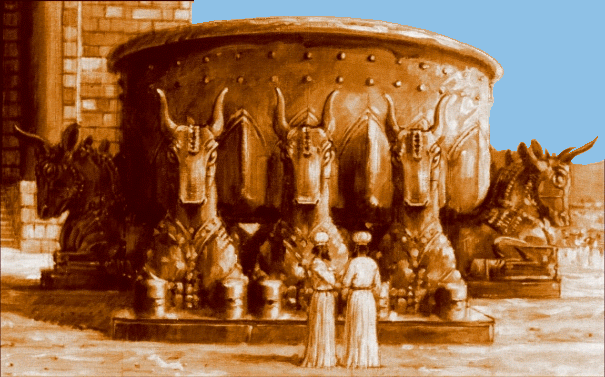 23 Then he made the sea of cast metal. It was round, ten cubits from brim to brim, and five cubits high, and a line of thirty cubits measured its circumference. 24 Under its brim were gourds, for ten cubits, compassing the sea all around. The gourds were in two rows, cast with it when it was cast. 25 It stood on twelve oxen, three facing north, three facing west, three facing south, and three facing east. The sea was set on them, and all their rear parts were inward. 26 Its thickness was a handbreadth, and its brim was made like the brim of a cup, like the flower of a lily. It held two thousand baths.
 27 He also made the ten stands of bronze. Each stand was four cubits long, four cubits wide, and three cubits high. 28 This was the construction of the stands: they had panels, and the panels were set in the frames, 29 and on the panels that were set in the frames were lions, oxen, and cherubim. On the frames, both above and below the lions and oxen, there were wreaths of beveled work. 30 Moreover, each stand had four bronze wheels and axles of bronze, and at the four corners were supports for a basin. The supports were cast with wreaths at the side of each. 31 Its opening was within a crown that projected upward one cubit. Its opening was round, as a pedestal is made, a cubit and a half deep. At its opening there were carvings, and its panels were square, not round. 32 And the four wheels were underneath the panels. The axles of the wheels were of one piece with the stands, and the height of a wheel was a cubit and a half. 33 The wheels were made like a chariot wheel; their axles, their rims, their spokes, and their hubs were all cast. 34 There were four supports at the four corners of each stand. The supports were of one piece with the stands. 35 And on the top of the stand there was a round band half a cubit high; and on the top of the stand its stays and its panels were of one piece with it. 36 And on the surfaces of its stays and on its panels, he carved cherubim, lions, and palm trees, according to the space of each, with wreaths all around. 37 After this manner he made the ten stands. All of them were cast alike, of the same measure and the same form.
38 And he made ten basins of bronze. Each basin held forty baths, each basin measured four cubits, and there was a basin for each of the ten stands. 39 And he set the stands, five on the south side of the house, and five on the north side of the house. And he set the sea at the southeast corner of the house. – 1 Kings 7:13-39 ESV
The first question that comes to mind when reading this section of Chapter Seven is why the author took such great pains to describe each and every item in such precise detail. The amount of information is almost overwhelming, and even with all the helpful descriptions, it’s virtually impossible to determine what each item actually looked like. So, why dedicate so much time and space to their description?
In a sense, the author is telling his readers that Solomon was a man who took a keen interest in every phase of the massive construction project he had commissioned. His father had left him with the overwhelming responsibility to create a house worthy of the God of Israel, and that was not something he took lightly. Solomon was a hands-on construction manager who cared deeply about every detail concerning this once-in-a-lifetime undertaking. While he delegated much of the work, there was never a moment when Solomon was not intimately and personally involved in it. He cared deeply about this project and wanted to ensure that the finished product was both beautiful and functional. When completed, the Temple would become the focal point of Israel’s worship of Yahweh. So, Solomon intended for every item associated with its construction and its ultimate operation to be of the finest craftsmanship.
From the quarrying of the massive stones used to build the temple to the carving of the intricate reliefs that adorned the bronze stands, Solomon oversaw everything. To ensure that the workmanship was of the highest quality, Solomon hired the finest craftsman money could buy.
Verse 13 states that Solomon sought out the services of a skilled craftsman from the city of Tyre, a gifted worker in bronze. But notice the additional details concerning Hiram’s qualifications:
And he was full of wisdom, understanding, and skill for making any work in bronze. – 1 Kings 7:1 ESV
This brings to mind a passage from the book of Exodus where God provided Moses with the identity of another man who would assist in the construction of the Tabernacle.
The LORD said to Moses, “See, I have called by name Bezalel the son of Uri, son of Hur, of the tribe of Judah, and I have filled him with the Spirit of God, with ability and intelligence, with knowledge and all craftsmanship, to devise artistic designs, to work in gold, silver, and bronze, in cutting stones for setting, and in carving wood, to work in every craft.” – Exodus 31:1-5 ESV
As was the case with Moses, it seems that Solomon was receiving divine assistance in procuring the services of the right people to help him complete this one-of-a-kind project. Hiram came highly recommended and divinely gifted for the job.
 Once he arrived in Jerusalem, Hiram set to work casting the two bronze pillars that would grace the entrance to the Temple. At 27 feet in height, these two immense pillars were likely more decorative than functional. Since they were cast from a relatively soft metal like bronze and featured hollow interiors, they would have been incapable of providing support to the Temple’s roof.
These pillars were intended to frame the entrance to the Temple and provide symbolic significance to the One who dwelt within. Each pillar had a name. One was called Boaz, which means “In Him is strength.” The other was named Jachin, which means “He shall establish.” Both names were explicit references to the God of Israel. Every detail that adorned these pillars, from the water lilies to the pomegranates, was intended to illustrate the goodness and greatness of God. The Israelites served a God who provided them with everything they needed, including fertility and fruitfulness.
Next, Hiram crafted “the sea,” a large bronze basin that would sit outside the Temple’s entrance. This massive bowl was designed to replace the bronze laver that God had prescribed for the Tabernacle, while serving the same function as the original. According to Exodus 30, the first laver was used by the priests to purify themselves before offering sacrifices to God.
“You shall also make a basin of bronze, with its stand of bronze, for washing. You shall put it between the tent of meeting and the altar, and you shall put water in it, with which Aaron and his sons shall wash their hands and their feet. When they go into the tent of meeting, or when they come near the altar to minister, to burn a food offering to the Lord, they shall wash with water, so that they may not die. They shall wash their hands and their feet, so that they may not die. It shall be a statute forever to them, even to him and to his offspring throughout their generations.” – Exodus 30:18-21 ESV
The new basin was 15 feet in diameter, 47 feet in circumference, with a depth of 7.5 feet. It could hold up to 18,000 gallons of water, and its large size appears to have been designed to allow priests to completely immerse themselves, rather than just washing their hands and feet. It rested on the backs of 12 bronze oxen, arranged in groups of three, with each group facing a different direction on the compass. These bronze bulls may have been intended to represent the 12 tribes of Israel. But regardless, they were clearly symbols of strength.
Hiram then crafted ten mobile carts, each equipped with a large bronze basin. They featured wheels that allowed them to be moved about the Temple courtyard.
He also made ten basins in which to wash, and set five on the south side, and five on the north side. In these they were to rinse off what was used for the burnt offering, and the sea was for the priests to wash in. – 2 Chronicles 4:6 ESV
Each cart was six feet square and five and one-half feet high, and it held a bronze basin that could hold up to 240 gallons of water. As the Chronicles passage indicates, they were strategically located around the Temple courtyard and used by the priests to cleanse the blood from the sacrificial animals before they were offered to God.
You can almost sense that Solomon was attempting to improve on every item used in the original Tabernacle. He was making significant upgrades. Every item Hiram created was bigger and better than the original. Solomon was obsessed with making the house of God a grand and glorious structure, with every detail reflecting the majesty of its divine occupant. He could have saved himself a lot of time and money by reusing the original items, but Solomon would not settle for anything less than the best. So, he poured countless hours and resources into creating a Temple worthy of his great God, down to the last detail.
Solomon was following the instructions Yahweh gave to Moses from Mount Sinai when He ordered the creation of the original Tabernacle.
“Have the people of Israel build me a holy sanctuary so I can live among them. You must build this Tabernacle and its furnishings exactly according to the pattern I will show you.” – Exodus 25:8-9 NLT
Moses received detailed plans for the construction of the LORD’s house, with nothing left to the imagination. God was explicit in describing every facet of the Tabernacle’s design, and ordered Moses, “Be sure that you make everything according to the pattern I have shown you here on the mountain” (Exodus 25:40 NLT). Evidently, Moses received a vision of what the completed Tabernacle should look like, and he was to ensure that the finished product was an accurate facsimile. He was not to cut corners, leave out any detail, or make alterations to its design. No expense was to be spared, no shortcuts taken, and no cost-cutting measures considered because this was to be the house of Yahweh. The God of the universe deserved nothing but the best. If the people of Israel expected Him to dwell among them, they would need to build a house worthy of housing His presence.
“I will meet the people of Israel there, in the place made holy by my glorious presence. Yes, I will consecrate the Tabernacle and the altar, and I will consecrate Aaron and his sons to serve me as priests. Then I will live among the people of Israel and be their God, and they will know that I am the LORD their God. I am the one who brought them out of the land of Egypt so that I could live among them. I am the LORD their God.” – Exodus 29:43-46 NLT
Solomon shared Moses’ commitment to build a house that Yahweh would deem worthy of bearing His name and containing His glory. So, he went out of his way to ensure that this house met Yahweh’s exacting standards, because he longed for the assurance of Yahweh’s presence and power.
English Standard Version (ESV) The Holy Bible, English Standard Version. ESV® Permanent Text Edition® (2016). Copyright © 2001 by Crossway Bibles, a publishing ministry of Good News Publishers.
New Living Translation (NLT) Holy Bible, New Living Translation, copyright © 1996, 2004, 2015 by Tyndale House Foundation. Used by permission of Tyndale House Publishers Inc., Carol Stream, Illinois 60188. All rights reserved.
 There are few scenes related to the life of Jesus that are more recognizable than the one of Him cleansing the temple. But the image of the Savior of the world wielding a whip in His hands and angrily clearing the temple courtyard is difficult for most of us to reconcile. It seems so out of character. Just a few verses earlier, Matthew described Jesus riding serenely on the colt of a donkey, basking in the adulation and praise of the crowd. People were shouting His praises, declaring Him to be
  This scene most likely took place in the Court of the Gentiles. This was the only place on the temple grounds where non-Jews were allowed to gather. The religious leaders had turned this area into a marketplace filled with money-changing booths, as well as vendors selling doves and other sacrificial animals. You would have heard the bleating of goats and lambs, the bellowing of oxen, and been confronted with all the smells that come with large herds of domesticated animals. And to top it all off, there was graft and corruption taking place. The priests were responsible for approving the animals brought for sacrifice. And if someone brought an unacceptable animal, they would be sold a replacement, at a healthy profit. Then the priests would take the original “blemished” animal and recycle it for sale to another pilgrim.