Godly Grief Vs Worldly Grief

1 In the twenty-third year of Joash the son of Ahaziah, king of Judah, Jehoahaz the son of Jehu began to reign over Israel in Samaria, and he reigned seventeen years. He did what was evil in the sight of the LORD and followed the sins of Jeroboam the son of Nebat, which he made Israel to sin; he did not depart from them. And the anger of the LORD was kindled against Israel, and he gave them continually into the hand of Hazael king of Syria and into the hand of Ben-hadad the son of Hazael. Then Jehoahaz sought the favor of the LORD, and the LORD listened to him, for he saw the oppression of Israel, how the king of Syria oppressed them. (Therefore the LORD gave Israel a savior, so that they escaped from the hand of the Syrians, and the people of Israel lived in their homes as formerly. Nevertheless, they did not depart from the sins of the house of Jeroboam, which he made Israel to sin, but walked in them; and the Asherah also remained in Samaria.) For there was not left to Jehoahaz an army of more than fifty horsemen and ten chariots and ten thousand footmen, for the king of Syria had destroyed them and made them like the dust at threshing. Now the rest of the acts of Jehoahaz and all that he did, and his might, are they not written in the Book of the Chronicles of the Kings of Israel? So Jehoahaz slept with his fathers, and they buried him in Samaria, and Joash his son reigned in his place. 2 Kings 13:1-9 ESV

God had used the Syrians to inflict judgment upon the southern kingdom of Judah. Because of the rebellion of His people, God had given King Hazael and his Syrian troops a resounding victory over the much larger and more powerful army of King Jehoash. Having been wounded in battle against the Syrians, Jehoash became an easy target for some of his disgruntled officials. They strongly opposed his murder of Zechariah, the son of Jehoiada the priest, and saw the nation’s recent defeat by a much smaller Syrian force as a sign of God’s judgment. So, these two men took it upon themselves to assassinate the king while he was lying in bed recovering from his injuries. He was then replaced by his son, Amaziah.

In the meantime, the northern kingdom of Israel was having its own set of struggles with the Syrians. Jehoahaz had ascended to the throne of his father, Jehu, and had managed to keep Israel’s legacy of apostasy alive and well.

He did what was evil in the sight of the LORD and followed the sins of Jeroboam the son of Nebat, which he made Israel to sin; he did not depart from them. – 2 Kings 13:2 ESV

In other words, it was business as usual in Israel. But God had grown weary of watching each successive royal administration try to outdo the sins of their predecessors. Fed up with their stubbornness and blatant unfaithfulness, He unleashed His righteous indignation against Israel and “gave them continually into the hand of Hazael king of Syria and into the hand of Ben-hadad the son of Hazael” (2 Kings 13:3 ESV).

The Syrians became the proverbial thorn in the side of the disobedient Israelites. This imagery was in keeping with God’s earlier warnings against Israel compromising with the pagan nations that occupied the promised land.

But if you do not drive out the inhabitants of the land from before you, then those of them whom you let remain shall be as barbs in your eyes and thorns in your sides, and they shall trouble you in the land where you dwell. – Numbers 33:55 ESV

God would later provide the Israelites with another warning, meant to discourage them from intermarrying with the pagan nations that occupied the land of Canaan.

…know for certain that the LORD your God will no longer drive out these nations before you, but they shall be a snare and a trap for you, a whip on your sides and thorns in your eyes, until you perish from off this good ground that the LORD your God has given you. – Joshua 23:13 ESV

And when the Israelites failed to drive out the inhabitants of the land, God announced that they were on their own; He was abandoning them to their wicked ways. They would have to deal with the consequences of their disobedience.

“So now I say, I will not drive them out before you, but they shall become thorns in your sides, and their gods shall be a snare to you.” – Judges 2:3 ESV

Yet, when God sent the Syrians to plague and provoke the unfaithful people of Israel, King Jehoahaz “sought the favor of the LORD” (2 Kings 13:4 ESV). The constant pain inflicted by this divinely-ordained “thorn” was more than Jehoahaz could bear, so he did something none of his predecessors had ever done: He humbled himself and cried out to God. And his cry was heard and answered. The author states that God, the very one who sent the Syrians, “saw the oppression of Israel, how the king of Syria oppressed them” (2 Kings 13:4 ESV). This statement makes it sound like God was surprised by what He saw, but it would be better interpreted as a declaration of God’s recognition of the suffering His chosen people were having to endure. His judgment, while fully just and well-deserved, had produced its intended results, and He felt compassion for the plight of His people. His discipline of His children was not because He had fallen out of love with them. In fact, the book of Proverbs reminds us, “the LORD corrects those he loves, just as a father corrects a child in whom he delights” (Proverbs3:12 NLT). And the author of Hebrews quotes this very proverb, then adds a further point of clarification.

As you endure this divine discipline, remember that God is treating you as his own children. Who ever heard of a child who is never disciplined by its father? If God doesn’t discipline you as he does all of his children, it means that you are illegitimate and are not really his children at all. – Hebrews 12:7-8 NLT

God had lovingly disciplined them for their disobedience and unfaithfulness. But, as the text reveals, He heard the humbled cry of their king and responded in love and compassion. He did for them what they couldn’t do for themselves; He rescued them from the very plight they had brought upon themselves.

Therefore the LORD gave Israel a savior, so that they escaped from the hand of the Syrians, and the people of Israel lived in their homes as formerly… – 2 Kings 13:5 ESV

This scene brings to mind the book of Judges, which chronicles the period of Israelite history long before they had a king. They had managed to enter Canaan, but failed to completely eliminate the pagan nations that occupied the land before them. As a result, they ended up intermarrying with these nations and worshiping their false gods. This led God to punish them.

…the people of Israel did what was evil in the sight of the LORD and served the Baals. And they abandoned the LORD, the God of their fathers, who had brought them out of the land of Egypt. They went after other gods, from among the gods of the peoples who were around them, and bowed down to them. And they provoked the LORD to anger. They abandoned the LORD and served the Baals and the Ashtaroth.  So the anger of the LORD was kindled against Israel, and he gave them over to plunderers, who plundered them. And he sold them into the hand of their surrounding enemies, so that they could no longer withstand their enemies. – Judges 2:11-14 ESV

But in time, God raised up deliverers who rescued His wayward people and restored them to a right relationship with Him.

Then the LORD raised up judges, who saved them out of the hand of those who plundered them. – Judges 2:17 ESV

Sadly, this cycle would repeat itself over and over again. The people would sin, so God would send a plunderer. Then, when the suffering became unbearable, the people would cry out, and another deliverer would show up to rescue them.

Now, hundreds of years later, the people of Israel would reveal that little had changed. They cried out, and God sent them a savior. We have no way of knowing the identity of this individual. Some have speculated that it was King Adad-Nirari III of Assyria. The Assyrians were the new kids on the block, an up-and-coming nation that was beginning to flex its military muscle in the region. To access the Mediterranean Sea and the fertile valleys located in Canaan, they would have to pass through the land belonging to Syria. It could be that God used this rapidly expanding world power to harass and distract the Syrians, buying King Jehoahaz and the Israelites a much-needed respite.

But regardless of the identity of this God-appointed “savior,” the people of Israel proved to be far from grateful for their rescue. In time, they fell back into their old habits.

But they continued to sin, following the evil example of Jeroboam. They also allowed the Asherah pole in Samaria to remain standing. – 2 Kings 13:6 NLT

Nothing had changed. Jehoahaz remained just as stubborn and unrepentant as always. Even the fact that God had allowed the Syrians to drastically reduce the fighting capacity of Israel’s army failed to elicit a change in Jehoahaz. The oppression of the Syrians got his attention and forced him to cry out to God, but once rescued, he continued to pursue the same ungodly agenda as before. The loving discipline and gracious deliverance of God failed to make a lasting impression on Jehoahaz. He was allowed to complete his reign, but with his decimated army,  he was a king in name only. He would die, and his son would inherit his throne and a diminished kingdom.

God’s loving discipline was meant to bring His wayward people to repentance. But Jehoahaz, like so many of his predecessors, failed to respond to God’s gracious deliverance appropriately. Despite his decimated army, Jehoahaz enjoyed an unexpected break from the Syrian oppression because Yahweh sent a “savior” to restore their fortunes. Yet, once the people “escaped from the hand of the Syrians, and…lived in their homes as formerly” (2 Kings 13:5 ESV), they refused to give up their old pagan practices. With the threat of the Syrians eliminated and their former lifestyles restored, the Israelites forsook Yahweh once again. The author provides an unflattering assessment of their response to Yahweh’s deliverance. “They continued to sin, following the evil example of Jeroboam. They also allowed the Asherah pole in Samaria to remain standing” (2 Kings 13:6 NLT).

This brings to mind a message that Jesus gave to the church in Laodicea, recorded in the Book of Revelation by the apostle John.

“I know all the things you do, that you are neither hot nor cold. I wish that you were one or the other! But since you are like lukewarm water, neither hot nor cold, I will spit you out of my mouth! You say, ‘I am rich. I have everything I want. I don’t need a thing!’ And you don’t realize that you are wretched and miserable and poor and blind and naked. So I advise you to buy gold from me—gold that has been purified by fire. Then you will be rich. Also buy white garments from me so you will not be shamed by your nakedness, and ointment for your eyes so you will be able to see. I correct and discipline everyone I love. So be diligent and turn from your indifference. – Revelation 3:15-19 NLT

That last line says it all. God the Father and Jesus Christ His Son demand true and lasting repentance. The apostle Paul refers to this kind of repentance and associates it with “godly grief.”

I rejoice, not because you were grieved, but because you were grieved into repenting. For you felt a godly grief, so that you suffered no loss through us.

For godly grief produces a repentance that leads to salvation without regret, whereas worldly grief produces death. – 2 Corinthians 7:9-10 ESV

The beleaguered people of Israel had suffered under the unrelenting attacks of the Syrians, and it seems that their grief was worldly and not godly. This produced a false form of repentance that failed to recognize their need for Yahweh. Once delivered from their oppression, their “grief” was replaced with a false sense of optimism and hope, but failed to produce a reverence for and dependence upon Yahweh as their true “savior.” They stubbornly refused to admit that they were “wretched and miserable and poor and blind and naked” (Revelation 3:17 NLT). And their “worldly grief” would ultimately result in death. 

English Standard Version (ESV) The Holy Bible, English Standard Version. ESV® Permanent Text Edition® (2016). Copyright © 2001 by Crossway Bibles, a publishing ministry of Good News Publishers.

New Living Translation (NLT) Holy Bible, New Living Translation, copyright © 1996, 2004, 2015 by Tyndale House Foundation. Used by permission of Tyndale House Publishers Inc., Carol Stream, Illinois 60188. All rights reserved.

Nevertheless…

1 In the seventh year of Jehu, Jehoash began to reign, and he reigned forty years in Jerusalem. His mother’s name was Zibiah of Beersheba. And Jehoash did what was right in the eyes of the LORD all his days, because Jehoiada the priest instructed him. Nevertheless, the high places were not taken away; the people continued to sacrifice and make offerings on the high places.

Jehoash said to the priests, “All the money of the holy things that is brought into the house of the LORD, the money for which each man is assessed—the money from the assessment of persons—and the money that a man’s heart prompts him to bring into the house of the LORD, let the priests take, each from his donor, and let them repair the house wherever any need of repairs is discovered.” But by the twenty-third year of King Jehoash, the priests had made no repairs on the house. Therefore King Jehoash summoned Jehoiada the priest and the other priests and said to them, “Why are you not repairing the house? Now therefore take no more money from your donors, but hand it over for the repair of the house.” So the priests agreed that they should take no more money from the people, and that they should not repair the house.

Then Jehoiada the priest took a chest and bored a hole in the lid of it and set it beside the altar on the right side as one entered the house of the LORD. And the priests who guarded the threshold put in it all the money that was brought into the house of the LORD. 10 And whenever they saw that there was much money in the chest, the king’s secretary and the high priest came up and they bagged and counted the money that was found in the house of the LORD. 11 Then they would give the money that was weighed out into the hands of the workmen who had the oversight of the house of the LORD. And they paid it out to the carpenters and the builders who worked on the house of the LORD, 12 and to the masons and the stonecutters, as well as to buy timber and quarried stone for making repairs on the house of the LORD, and for any outlay for the repairs of the house. 13 But there were not made for the house of the LORD basins of silver, snuffers, bowls, trumpets, or any vessels of gold, or of silver, from the money that was brought into the house of the LORD, 14 for that was given to the workmen who were repairing the house of the LORD with it. 15 And they did not ask for an accounting from the men into whose hand they delivered the money to pay out to the workmen, for they dealt honestly. 16 The money from the guilt offerings and the money from the sin offerings was not brought into the house of the LORD; it belonged to the priests. 2 Kings 12:1-16 ESV

Joash, referred to as Jehoash in this chapter, became the next king of Judah at the age of seven. This young child found himself bearing the heavy burden of leadership over God’s people. But for the first six years of his life, he had lived in the Temple of God, where Jehoiada the priest served as his father figure and spiritual mentor. This faithful servant of God continued to guide the young king during the early years of his reign, and his influence had a powerful impact. The innocent young boy who ascended the throne at seven would rule for four decades, and the author summarizes his reign with the words, “Jehoash did what was right in the eyes of the LORD all his days, because Jehoiada the priest instructed him” (2 Kings 12:2 ESV).

After reading the sordid history of the kings of Israel, this statement comes as a much-needed breath of fresh air. All was not lost. There was still a remnant of the faithful living in the land of Judah, and the actions of Jehoiada the priest demonstrate how God uses His servants to protect and preserve His people. In the midst of all the paganism and idolatry that infected the nation, this one man had remained at his priestly post, serving his God and ministering to the spiritual needs of his people. When the time came to protect the God-appointed heir to the throne of David, Jehoiada willingly put his reputation and life on the line.

The story of Jehoiada is a timely reminder not to underestimate the influence of one individual who chooses to remain faithful to God in the face of overwhelming odds. His determination and perseverance made a world of difference. Like Elijah and Elisha, Jehoiada was thrust into an isolated and lonely role that required him to stand against the forces of evil in his day. By making the fateful decision to hide the young heir to the throne, Jehoiada risked bringing down the wrath of Queen Athaliah. It could have cost him his life, but for six long years, he willingly took the risk and was used by God to preserve the hope of Israel: an heir to sit on the throne of David.

But sadly, the day came when Jehoiada’s influence over the king abruptly ended. The faithful priest died.

But Jehoiada grew old and full of days, and died. He was 130 years old at his death. And they buried him in the city of David among the kings, because he had done good in Israel, and toward God and his house. – 2 Chronicles 24:15-16 ESV

This one man had made a tremendous impact on the king, the house of God, and the people of Israel, and his death left a gaping spiritual void in King Jehoash’s life. With his mentor gone, the king found himself listening to the advice of those whose intentions were less-than-honorable and far from godly.

Now after the death of Jehoiada the princes of Judah came and paid homage to the king. Then the king listened to them. And they abandoned the house of the LORD, the God of their fathers, and served the Asherim and the idols. And wrath came upon Judah and Jerusalem for this guilt of theirs. – 2 Chronicles 24:17-18 ESV

With faithful Jehoiada out of the way, the ungodly princes of Israel took advantage of the situation to promote their anti-Yahweh agenda and lead the nation back into idolatry. Sadly, King Jehoash heeded their counsel.

The next 13 verses of chapter 12 appear to chronicle what happened in Israel as long as Jehoiada remained alive. King Jehoash had ordered repairs to be made to the Temple of God. He had a vested interest in the welfare of this building because it had served as his home and sanctuary for the first six years of his life. But in the 23rd year of his reign, he discovered that his orders had not been followed and no repairs had been made. The people were required to make an annual contribution to the temple treasury, and Jehoash had ordered that part of those funds should be used for the much-needed repairs. But for some unstated reason, the priests failed to disperse the funds to the workmen. So, the work was never done.

To remedy the problem, the king and Jehoiada set up a different system that allowed the transfer of the funds directly to the workmen responsible for the repairs; the priests were removed from the process altogether. Jehoiada set up a large wooden chest at the entrance to the Temple. The people would place their offering in the box, and the money would be periodically collected and distributed to the workmen.

Then they gave the money to the construction supervisors, who used it to pay the people working on the LORD’s Temple—the carpenters, the builders, the masons, and the stonecutters. They also used the money to buy the timber and the finished stone needed for repairing the LORD’s Temple, and they paid any other expenses related to the Temple’s restoration. – 2 Kings 12:11-12 NLT

With this new system in place, the repairs to the house of God were made without any graft or corruption taking place. The honesty and integrity of the workmen eliminated any need for a reconciliation of the funds.

No accounting of this money was required from the construction supervisors, because they were honest and trustworthy men. – 2 Kings 12:15 ESV

This simple statement speaks volumes. The spiritual influence of Jehoiada could be seen in the way the people conducted their lives. The king wasn’t the only one who did what was right in the eyes of the Lord. There was a contagious spirit of honesty and integrity that permeated the culture. As long as Jehoiada remained alive and had the ear of the king, the nation seemed to thrive. But it seems that Jehoiada died not long after the repairs to the Temple were completed. And, as the book of 2 Chronicles reveals, his departure made an immediate impact on the nation.

They decided to abandon the Temple of the Lord, the God of their ancestors, and they worshiped Asherah poles and idols instead! Because of this sin, divine anger fell on Judah and Jerusalem. Yet the LORD sent prophets to bring them back to him. The prophets warned them, but still the people would not listen. – 2 Chronicles 24:18-19 NLT

In Jehoiada’s absence, God sent His prophets to call the people to repentance, but they would not listen. So, eventually, God sent Zechariah, the son of Jehoiada, with a final warning of judgment.

“This is what God says: Why do you disobey the LORD’s commands and keep yourselves from prospering? You have abandoned the LORD, and now he has abandoned you!” – 2 Chronicles 24:20 NLT

Infuriated by Zechariah’s words, King Jehoash and the leaders of Judah chose to kill the messenger.

Then the leaders plotted to kill Zechariah, and King Joash ordered that they stone him to death in the courtyard of the LORD’s Temple. That was how King Joash repaid Jehoiada for his loyalty—by killing his son. Zechariah’s last words as he died were, “May the LORD see what they are doing and avenge my death!” – 2 Chronicles 24:21-22 NLT

Don’t miss the significance of this statement. King Jehoash, who had been raised by Jehoiada in the Temple of God, had his mentor’s son stoned to death in the Temple courtyard. In doing so, he desecrated his former home and the house of Yahweh he had painstakingly repaired. The very one whom God had preserved so that he might sit on David’s throne proved to be as wicked as the woman he replaced. Without the godly influence of Jehoiada in his life, King Jehoash was exposed as an empty suit, a man with a crown on his head but without a heart for God.

The death of Jehoiada drives home the truth found in Proverbs 29:2: “When the righteous increase, the people rejoice, but when the wicked rule, the people groan.”

As long as Jehoiada remained alive, his godly influence influenced King Jehoash and helped to promote and preserve the worship of Yahweh in Judah. But when he passed away at the ripe old age of 130, Jehoiada’s godly influence died with him, leaving King Jehoash susceptible to the less-than-righteous counsel of his royal advisors.

Jehoash had started well. His order to repair the Temple was a positive step designed to revitalize the worship of Yahweh and restore the people’s reliance upon Him as the one and only God. But as the rest of the chapter will reveal, with his godly mentor gone, Jehoash would prove to be ill-prepared to continue the reforms he began.

English Standard Version (ESV) The Holy Bible, English Standard Version. ESV® Permanent Text Edition® (2016). Copyright © 2001 by Crossway Bibles, a publishing ministry of Good News Publishers.

New Living Translation (NLT) Holy Bible, New Living Translation, copyright © 1996, 2004, 2015 by Tyndale House Foundation. Used by permission of Tyndale House Publishers Inc., Carol Stream, Illinois 60188. All rights reserved.

Yahweh’s Divine Tag Team

15 And the LORD said to him, “Go, return on your way to the wilderness of Damascus. And when you arrive, you shall anoint Hazael to be king over Syria. 16 And Jehu the son of Nimshi you shall anoint to be king over Israel, and Elisha the son of Shaphat of Abel-meholah you shall anoint to be prophet in your place. 17 And the one who escapes from the sword of Hazael shall Jehu put to death, and the one who escapes from the sword of Jehu shall Elisha put to death. 18 Yet I will leave seven thousand in Israel, all the knees that have not bowed to Baal, and every mouth that has not kissed him.”

19 So he departed from there and found Elisha the son of Shaphat, who was plowing with twelve yoke of oxen in front of him, and he was with the twelfth. Elijah passed by him and cast his cloak upon him. 20 And he left the oxen and ran after Elijah and said, “Let me kiss my father and my mother, and then I will follow you.” And he said to him, “Go back again, for what have I done to you?” 21 And he returned from following him and took the yoke of oxen and sacrificed them and boiled their flesh with the yokes of the oxen and gave it to the people, and they ate. Then he arose and went after Elijah and assisted him. 1 Kings 19:15-21 ESV

The last three and a half years had taken their toll on Elijah. He had been living in a God-ordained exile in a remote village in the region of Sidon. While God had miraculously cared for him during that time, he had to live with the knowledge that there was a bounty on his head. King Ahab and his queen, Jezebel, had never forgiven him for the drought he had placed on the land of Israel. Elijah must have woken up every morning wondering if that would be the day God called him to confront Ahab and Jezebel one more time.

When that day finally came, Elijah obeyed God and made his way to Mount Carmel, where he challenged King Ahab to pit his 450 prophets of Baal against Yahweh, the one true God. That battle ended up being a lopsided affair, with Elijah’s God as the clear victor and the false god of Ahab and Jezebel exposed as a fraud and a failure. The dead bodies of his 450 prophets, strewn across the Jezreel Valley, were evidence of his decisive defeat.

But Elijah’s hope for revival in the land was soon replaced by fear for his own life. Jezebel had vowed to kill Elijah for his slaughter of the 450 prophets of Baal. And he responded to this news by running away. The prophet of God seemed to have lost all faith in God. Yet, even in his deep state of depression and despondency, Elijah was ministered to by God. Yahweh met Elijah right where he was, in the midst of his doubt and despair, and graciously provided him with a visual demonstration of His power. However, the wind, earthquake, and fire only frightened Elijah, causing him to take refuge in a cave. But it was the quiet whisper of God that drew him out, and the gentle voice of God asked Elijah to explain his presence there. What was the prophet doing so far from the scene of the recent victory over Baal? Why was he hiding? Elijah’s answer revealed his struggle with a lack of faith and a sense of failure.

I have been very jealous for the LORD, the God of hosts. For the people of Israel have forsaken your covenant, thrown down your altars, and killed your prophets with the sword, and I, even I only, am left, and they seek my life, to take it away.” – 1 Kings 19:14 ESV

Elijah described himself as alone and afraid. He had convinced himself that he was the last man standing, with no one to do battle at his side. In the heat of the moment, he had conveniently forgotten about the 100 prophets that God had used Obadiah to protect and preserve (1 Kings 18:13). Elijah felt alienated and alone, but his feelings were not based on reality. God even informed Elijah that He had preserved a remnant of “7,000 others in Israel who have never bowed down to Baal or kissed him!” (1 Kings 19:18 NLT). Elijah was far from alone, and God was far from finished with Elijah. But rather than rebuke His wavering prophet, God gave him his next assignment.

“Go back the same way you came, and travel to the wilderness of Damascus. When you arrive there, anoint Hazael to be king of Aram. Then anoint Jehu grandson of Nimshi to be king of Israel, and anoint Elisha son of Shaphat from the town of Abel-meholah to replace you as my prophet.” – 1 Kings 19:15 ESV

Despite his recent display of faithlessness and fear, Elijah would play a significant role in the next phase of God’s plans for Israel. God gave Elijah three assignments: First, he was to anoint a new king over the Syrians or Arameans. Then, he was to anoint a new king over Israel’s northern kingdom. Finally, he was to anoint his own successor. God provided Elijah little in the way of details. Other than the names of the men he was to anoint, Elijah had no way of knowing what any of this meant or how it would all turn out. But God was letting Elijah know that there were plans in the works of which he was unaware. Whether Elijah realized it or not, Ahab’s days were numbered, and the Syrians would end up playing a part in his eventual demise. There would be a new king in Israel one day. God had defeated the false god, Baal, and now He was going to mete out final judgment on the man responsible for Baal’s presence in Israel.

As if to further convince Elijah that he was not alone and that his mission was far from over, God revealed that the three men Elijah was to anoint would carry on the work that he had started at Mount Carmel. Elijah had killed the 450 prophets of Baal, but there were far more who needed to face the judgment of God for their apostasy and rebellion.

“Anyone who escapes from Hazael will be killed by Jehu, and those who escape Jehu will be killed by Elisha! – 1 Kings 19:17 NLT

Judgment was coming. Yahweh was preparing to purge Israel of all those who had bowed the knee to Baal, and He would start at the top with Ahab and Jezebel. But this divine plan to cleanse Israel would not happen overnight. In fact, it would last long after Elijah was gone. That’s why God informed Elijah that he was to anoint his successor.

“…anoint Elisha son of Shaphat from the town of Abel-meholah to replace you as my prophet. – 1 Kings 19:16 NLT

God already had Elijah’s replacement identified and a strategy in place to carry on His divine plan for Ahab’s punishment and Israel’s purification. A big reason for Elijah’s dejection was that the revival that started at Mount Carmel had stalled. When he had heard the people cry out, “The LORD, he is God; the LORD, he is God” (1 Kings 18:39 ESV), he genuinely believed that God had turned back the hearts of the people, and he expected to see an amazing renewal take place. He may have even thought that Ahab and Jezebel might repent and accept Yahweh as the one true God. But instead, the ever-defiant queen had threatened him with death.

But while Jezebel remained unwavering in her commitment to Baal, Elijah needed to understand that God was unfazed by her actions. As the sovereign, omniscient God of the universe, He had a plan in place to deal with Jezebel, Ahab, and all those who had bent the knee to Baal. And while Elijah might not live to see the final phase of that plan, he would play a decisive role in its implementation.

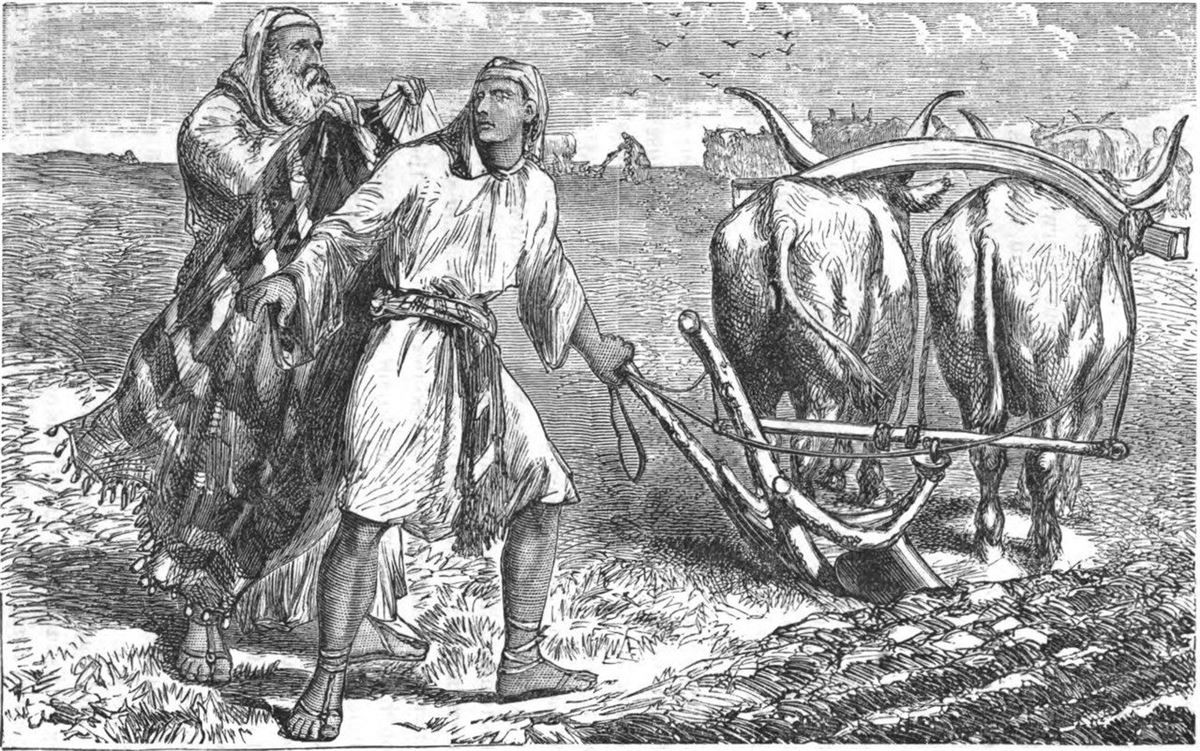
Revived and encouraged by Yahweh’s news, Elijah made his way to Abel-meholah, located in the Jordan Valley. While God clearly told Elijah to travel to the wilderness of Damascus and anoint Hazael to be king of Aram (1 Kings 19:15), it would appear that this was meant to be his final destination. On his way from Mount Sinai, he had to pass through the Jordan Valley, so it only made sense to stop there first and find the man who would be his replacement. He found Elisha plowing with 12 pairs of oxen in a field. This agrarian scene is significant for several reasons. First, it conveys an image of hope and expectation. After three-and-a-half years of drought, the rain had come, and now Elisha was preparing his formerly sun-baked fields for planting. He was anticipating a fruitful harvest sometime in the future. But Elisha’s presence in the field also reveals that he was a man of the land. He was not an influential figure with great wealth and prominence. He was a nondescript nobody whose only credentials were his calling by Yahweh.

What happens next appears strange to our modern sensibilities. Elijah walked up to this man, placed his cloak across his shoulders, and then simply walked away. What kind of bizarre ritual did this represent? How could Elisha have taken this unexpected action from this unknown stranger? Amazingly, it seems as if Elisha fully understood the significance of Elijah’s symbolic act. The text states that he “left the oxen standing there, ran after Elijah, and said to him, ‘First let me go and kiss my father and mother good-bye, and then I will go with you!’” (1 Kings 19:20 NLT). Perhaps God had already prepared Elisha for this moment, having revealed His plan through a dream or vision. He could have sent an angelic messenger to prepare Elisha for the prophet’s arrival. But whatever the case, Elisha seems to have been unfazed by what transpired and fully aware of what it meant. He immediately stopped his plowing and followed the man of God. His words and actions reveal that he knew who Elijah was and what he was asking him to do. His only request was that he be allowed to say goodbye to his family.

Elijah’s response to his request comes across as rather flippant.

Go back again, for what have I done to you?” – 1 Kings 19:20 ESV

In a sense, Elijah was simply emphasizing that this had all been God’s doing, not his. He was merely the messenger. Elisha was free to do as he pleased, and the young farmer-turned-prophet demonstrated his commitment to accept the call of God. He took the plow, the symbol of his former occupation, and used the wood to build an altar. Then, on that altar, he offered up the oxen with which he had been plowing. Elisha burned every bridge to his former life. He bid his parents and his past goodbye and “arose and went after Elijah and assisted him” (1 Kings 19:21 ESV).

As Elijah and Elisha made their way from the Jordan Valley, the first phase of the second half of God’s plan began. The revival Elijah had longed for and given up on was coming. Yahweh was not yet done. Elijah had been a key player in God’s renewal plans for Israel, but his part was coming to an end. The LORD had another man ready to take the baton and finish the race. God would use this divine tag team to accomplish His will concerning Israel and usher in a period of much-needed spiritual renewal among His covenant people. The apostle Paul would later explain his understanding of how God uses a team approach to accomplish His divine will.

What then is Apollos? What is Paul? Servants through whom you believed, as the Lord assigned to each. I planted, Apollos watered, but God gave the growth. So neither he who plants nor he who waters is anything, but only God who gives the growth. He who plants and he who waters are one, and each will receive his wages according to his labor. For we are God’s fellow workers. You are God’s field, God’s building. – 1 Corinthians 3:5-9 ESV

Elijah had planted; now it was Elisha’s turn to water. But the harvest would be the LORD’s.

English Standard Version (ESV) The Holy Bible, English Standard Version. ESV® Permanent Text Edition® (2016). Copyright © 2001 by Crossway Bibles, a publishing ministry of Good News Publishers.

New Living Translation (NLT) Holy Bible, New Living Translation, copyright © 1996, 2004, 2015 by Tyndale House Foundation. Used by permission of Tyndale House Publishers Inc., Carol Stream, Illinois 60188. All rights reserved.

Present Faith In Future Promises

18 And the word of the Lord of hosts came to me, saying, 19 “Thus says the Lord of hosts: The fast of the fourth month and the fast of the fifth and the fast of the seventh and the fast of the tenth shall be to the house of Judah seasons of joy and gladness and cheerful feasts. Therefore love truth and peace.

20 “Thus says the Lord of hosts: Peoples shall yet come, even the inhabitants of many cities. 21 The inhabitants of one city shall go to another, saying, ‘Let us go at once to entreat the favor of the Lord and to seek the Lord of hosts; I myself am going.’ 22 Many peoples and strong nations shall come to seek the Lord of hosts in Jerusalem and to entreat the favor of the Lord. 23 Thus says the Lord of hosts: In those days ten men from the nations of every tongue shall take hold of the robe of a Jew, saying, ‘Let us go with you, for we have heard that God is with you.’” – Zechariah 8:18-23 NLT

Chapter 7 began with a question about fasting. Now, Yahweh points to a future day when it will no longer be necessary to fast. Leviticus 16 records Yahweh’s command concerning fasting. ʿ

“And it shall be a statute to you forever that in the seventh month, on the tenth day of the month, you shall afflict yourselves and shall do no work, either the native or the stranger who sojourns among you. – Leviticus 16:29 ESV

The Hebrew word translated as “afflict” is ānâ and it carries the idea of humbling oneself, to be afflicted, or bowed down. It was commonly associated with fasting because fasting was intended as a sign of repentance and mourning over sins. The Book of Isaiah records Yahweh’s displeasure with the false fasting of the people of Israel.

“Is such the fast that I choose,
a day for a person to humble(ānâ) himself?
Is it to bow down his head like a reed,
and to spread sackcloth and ashes under him?
Will you call this a fast,
and a day acceptable to the Lord?” – Isaiah 58:5 ESV

He accused His people of going through the motions of fasting without the requisite heart change that was required. The people couldn’t understand why their outward displays of self-denial were getting them nowhere with Yahweh.

Why have we fasted, and you see it not?
    Why have we humbled ourselves, and you take no knowledge of it?” – Isaiah 58:3 ESV

But Yahweh explained His disinterest and unwillingness to take their fasts seriously.

Behold, in the day of your fast you seek your own pleasure,
    and oppress all your workers.
Behold, you fast only to quarrel and to fight
    and to hit with a wicked fist.
Fasting like yours this day
    will not make your voice to be heard on high.” – Isaiah 58:3-4 ESV

Fasting was intended to display a repentant heart and a willingness to alter one’s behavior. It was an act of self-denial and public humiliation that demonstrated a recognition of one’s sin and a need for atonement.

But in this chapter, Yahweh describes a future in which fasting will be replaced by “seasons of joy and gladness and cheerful feasts” (Zechariah 8:19 ESV). The fasts associated with the fall of Jerusalem, the destruction of the Temple, and the exile of God’s people will no longer be necessary. Yahweh is pointing to a day when joy will replace mourning and celebrations commemorating His goodness will eliminate all memories of past sins and divine judgment.

The Temple, once completed, would fully restore the sacrificial system, not eliminate it. The need for atonement would continue to require the blood of bulls, goats, sheep, and rams. The immediate future of the people of Judah would require a fully functioning priesthood, a completed Temple, and the sacrifice of countless animals to serve as sin substitutes for the guilty. The Day of Atonement would still require fasting on the part of the people before they could be cleansed from sin.

The author of Hebrews explains the necessity of the sacrificial system but also identifies its shortcomings.

For since the law has but a shadow of the good things to come instead of the true form of these realities, it can never, by the same sacrifices that are continually offered every year, make perfect those who draw near. Otherwise, would they not have ceased to be offered, since the worshipers, having once been cleansed, would no longer have any consciousness of sins? But in these sacrifices there is a reminder of sins every year. For it is impossible for the blood of bulls and goats to take away sins. – Hebrews 10:1-4 ESV

So, when Yahweh speaks of “seasons of joy and gladness and cheerful feasts,” He is talking about a future day when full and permanent atonement will be attained for His people. This message from Yahweh includes His promise of the future restoration and spiritual transformation of His chosen people. It coincides with the message He delivered through the prophet Ezekiel.

“Therefore, give the people of Israel this message from the Sovereign Lord: I am bringing you back, but not because you deserve it. I am doing it to protect my holy name, on which you brought shame while you were scattered among the nations. I will show how holy my great name is—the name on which you brought shame among the nations. And when I reveal my holiness through you before their very eyes, says the Sovereign Lord, then the nations will know that I am the Lord. For I will gather you up from all the nations and bring you home again to your land.

“Then I will sprinkle clean water on you, and you will be clean. Your filth will be washed away, and you will no longer worship idols. And I will give you a new heart, and I will put a new spirit in you. I will take out your stony, stubborn heart and give you a tender, responsive heart. And I will put my Spirit in you so that you will follow my decrees and be careful to obey my regulations. – Ezekiel 36:22-27 NLT

All of these promises will take place when Christ returns to set up His earthly Kingdom. Daniel was given a vision of the end times, including the period known as the Great Tribulation. During those days, God will bring judgment upon the earth and His people, both Jews and Christians, will suffer persecution at the hands of the Antichrist. But God will only allow this wicked world ruler to carry out his genocidal pogrom for three and a half years.

“He will defy the Most High and oppress the holy people of the Most High. He will try to change their sacred festivals and laws, and they will be placed under his control for a time, times, and half a time.

“But then the court will pass judgment, and all his power will be taken away and completely destroyed. Then the sovereignty, power, and greatness of all the kingdoms under heaven will be given to the holy people of the Most High. His kingdom will last forever, and all rulers will serve and obey him.” – Daniel 7:25-27 NLT

This future kingdom will include believing Jews and Gentiles who will reign alongside Christ for 1,000 years.

“The manifestation of the kingdom will be attended by such a fulness of salvation that Judah will forget to commemorate the former mournful events and will only have occasion to rejoice in the benefits of grace bestowed by God.” –  Merrill F.  Unger, Zechariah

Yahweh wants Zechariah to know that the rebuilding of the Temple was just the beginning of His plans for the people of Judah. There is far more in store for His chosen people than they realize. They will accomplish their mission and complete the construction of God’s house. They will also rebuild the walls and hang the gates. The city will be repopulated and the nation will once again enjoy the blessings of Yahweh. But their greatest days lie in the distant future when God will redeem them fully and restore them to a right relationship with Himself that will last for eternity. The apostle Paul described this future day as a mystery. 

I want you to understand this mystery, dear brothers and sisters, so that you will not feel proud about yourselves. Some of the people of Israel have hard hearts, but this will last only until the full number of Gentiles comes to Christ. And so all Israel will be saved. As the Scriptures say,

“The one who rescues will come from Jerusalem,
    and he will turn Israel away from ungodliness.
And this is my covenant with them,
    that I will take away their sins.” – Romans 11:25-27 NLT

As Zechariah listens to these amazing pronouncements from Yahweh, he can’t help but consider the less-than-ideal circumstances surrounding him and the far-from-perfect spiritual state of his fellow Judahites. But God is promising Him a future free from godlessness and sin. Not only that, the formerly destroyed city of Jerusalem will become a light shining on a hill attracting people from all over the world. Countless individuals from distant nations will declare their intention to visit the glorious city of Jerusalem.

“Let us go at once to entreat the favor of the Lord and to seek the Lord of hosts; I myself am going.” – Zechariah 8:21 ESV

Three other prophets recorded this same scene, further certifying its validity and future certainty.

In the last days, the mountain of the Lord’s house
    will be the highest of all—
    the most important place on earth.
It will be raised above the other hills,
    and people from all over the world will stream there to worship.
People from many nations will come and say,
“Come, let us go up to the mountain of the Lord,
    to the house of Jacob’s God.
There he will teach us his ways,
    and we will walk in his paths.”
For the Lord’s teaching will go out from Zion;
    his word will go out from Jerusalem. – Isaiah 2:2-3 NLT

In the last days, the mountain of the Lord’s house
    will be the highest of all—
    the most important place on earth.
It will be raised above the other hills,
    and people from all over the world will stream there to worship.
People from many nations will come and say,
“Come, let us go up to the mountain of the Lord,
    to the house of Jacob’s God.
There he will teach us his ways,
    and we will walk in his paths.”
For the Lord’s teaching will go out from Zion;
    his word will go out from Jerusalem. – Micah 4:1-2 NLT

Long ago the Lord said to Israel:
“I have loved you, my people, with an everlasting love.
    With unfailing love I have drawn you to myself.
I will rebuild you, my virgin Israel.
    You will again be happy
    and dance merrily with your tambourines.
Again you will plant your vineyards on the mountains of Samaria
    and eat from your own gardens there.
The day will come when watchmen will shout
    from the hill country of Ephraim,
‘Come, let us go up to Jerusalem
    to worship the Lord our God.’” – Jeremiah 31:3-6 NLT

Yahweh reiterates His future intentions for His chosen people to Zechariah, stating, “In those days ten men from the nations of every tongue shall take hold of the robe of a Jew, saying, ‘Let us go with you, for we have heard that God is with you’” (Zechariah 8:23 ESV). These promises concerning Judah’s future were meant to encourage Zechariah and motivate the people to carry out their work with enthusiasm and faith. They served a good and gracious God who loved them and had great plans for them.

But Yahweh didn’t want His people to live with their eyes focused on the future. They weren’t to live with their eye set on the preferred future God had in store for them. His promises of future redemption and restoration would take place long after they were gone so, in the meantime, they were to “love truth and peace” (Zechariah 8:19 ESV). In other words, they were to love what God loved. They were to live in keeping with His will, treating one another with love, dignity, respect, and honor. With all His future promises in mind, they were to dedicate themselves to living in a way that honored Him in the here and now.

“Speak the truth to one another; render in your gates judgments that are true and make for peace; do not devise evil in your hearts against one another, and love no false oath, for all these things I hate…” – Zechariah 8:16-17 ESV

The apostle Peter gave the same admonition to the believers who received his second epistle.

By his divine power, God has given us everything we need for living a godly life. We have received all of this by coming to know him, the one who called us to himself by means of his marvelous glory and excellence. And because of his glory and excellence, he has given us great and precious promises. These are the promises that enable you to share his divine nature and escape the world’s corruption caused by human desires.

In view of all this, make every effort to respond to God’s promises. Supplement your faith with a generous provision of moral excellence, and moral excellence with knowledge, and knowledge with self-control, and self-control with patient endurance, and patient endurance with godliness, and godliness with brotherly affection, and brotherly affection with love for everyone.

The more you grow like this, the more productive and useful you will be in your knowledge of our Lord Jesus Christ. – 2 Peter 1:3-8 NLT

The people of Judah were to live with the end in mind, but they were never to lose sight of Yahweh’s call to live godly lives. God’s future faithfulness was meant to inspire present obedience in His covenant people. No matter how difficult the days ahead might be, they could rest in the promise of Yahweh’s unwavering love and long-term commitment to their well-being.

English Standard Version (ESV)
The Holy Bible, English Standard Version. ESV® Permanent Text Edition® (2016). Copyright © 2001 by Crossway Bibles, a publishing ministry of Good News Publishers.

New Living Translation (NLT)
Holy Bible, New Living Translation, copyright © 1996, 2004, 2015 by Tyndale House Foundation. Used by permission of Tyndale House Publishers Inc., Carol Stream, Illinois 60188. All rights reserved.

I Will Make All Things New

1 Then he showed me Joshua the high priest standing before the angel of the LORD, and Satan standing at his right hand to accuse him. And the LORD said to Satan, “The LORD rebuke you, O Satan! The LORD who has chosen Jerusalem rebuke you! Is not this a brand plucked from the fire?” Now Joshua was standing before the angel, clothed with filthy garments. And the angel said to those who were standing before him, “Remove the filthy garments from him.” And to him he said, “Behold, I have taken your iniquity away from you, and I will clothe you with pure vestments.” And I said, “Let them put a clean turban on his head.” So they put a clean turban on his head and clothed him with garments. And the angel of the LORD was standing by.

And the angel of the LORD solemnly assured Joshua, “Thus says the Lord of hosts: If you will walk in my ways and keep my charge, then you shall rule my house and have charge of my courts, and I will give you the right of access among those who are standing here. Hear now, O Joshua the high priest, you and your friends who sit before you, for they are men who are a sign: behold, I will bring my servant the Branch. For behold, on the stone that I have set before Joshua, on a single stone with seven eyes, I will engrave its inscription, declares the Lord of hosts, and I will remove the iniquity of this land in a single day. 10 In that day, declares the LORD of hosts, every one of you will invite his neighbor to come under his vine and under his fig tree.” Zechariah 3:1-10 ESV

In this fourth vision, Zechariah is shown what appears to be a trial in the throne room of heaven. He sees Joshua (Jeshua) the high priest standing before the angel of the LORD as Satan levels accusations against him. This fits the description of Satan found the Book of Revelation.

This great dragon—the ancient serpent called the devil, or Satan, the one deceiving the whole world—was thrown down to the earth with all his angels.

Then I heard a loud voice shouting across the heavens,

“It has come at last—
    salvation and power
and the Kingdom of our God,
    and the authority of his Christ.
For the accuser of our brothers and sisters
    has been thrown down to earth—
the one who accuses them
    before our God day and night.”Revelation 12:9110 NLT

Zechariah does not divulge the nature of Satan’s accusations against Joshua, but he reveals that the high priest is wearing filthy garments. His priestly robes are in a state of impurity, a sign of his sinfulness. But as Zechariah looks on, he hears the voice of Yahweh (the LORD) speaking on Joshua’s defense.

“I, the Lord, reject your accusations, Satan. Yes, the Lord, who has chosen Jerusalem, rebukes you. This man is like a burning stick that has been snatched from the fire.” – Zechariah 3:2 NLT

Joshua, whose name means “Yahweh saves,” is in a disheveled state, but Yahweh orders his garments to be removed and replaced with new ones. Despite Satan’s declarations of Joshua’s guilt and demands for punishment, God offers the high priest undeserved mercy and grace.

“See, I have taken away your sins, and now I am giving you these fine new clothes.” – Zechariah 3:4 NLT

This imagery of new clothes for old is found throughout the Scriptures.

I am overwhelmed with joy in the LORD my God! For he has dressed me with the clothing of salvation and draped me in a robe of righteousness. – Isaiah 61:10 NLT

So remove your dark deeds like dirty clothes, and put on the shining armor of right living.Instead, clothe yourself with the presence of the Lord Jesus Christ. And don’t let yourself think about ways to indulge your evil desires. – Romans 13:12, 14 NLT

for you have stripped off your old sinful nature and all its wicked deeds. Put on your new nature, and be renewed as you learn to know your Creator and become like him. – Colossians 3:9-10 NLT

Joshua’s condition symbolizes that of the nation of Judah. As the high priest, he is their God-appointed representative. The priestly cast was to set the standard of behavior for the rest of the nation. But over the centuries, they had failed at their primary responsibility.

“When the people bring their sin offerings, the priests get fed.
    So the priests are glad when the people sin!
 ‘And what the priests do, the people also do.’
    So now I will punish both priests and people
    for their wicked deeds.” – Hosea 4:8-9 NLT

Their far-from-holy behavior left the entire nation in an unacceptable state before the LORD. Joshua’s condition mirrored that of the people.

We are constant sinners;
    how can people like us be saved?
We are all infected and impure with sin.
    When we display our righteous deeds,
    they are nothing but filthy rags. – Isaiah 64:5-6 NLT

Yet, Yahweh saves. He graciously declares Joshua free from sin and, by extension, the people were also the beneficiaries of God’s abundant grace. God orders Joshua to be dressed in new, pristine priestly robes. His righteousness or right standing before the LORD is restored. The new garments Joshua receives are meant to symbolize his set-apart status as God’s servant. The Book of Exodus describes the one-of-a-kind nature of the priestly robes.

“Make sacred garments for Aaron that are glorious and beautiful. Instruct all the skilled craftsmen whom I have filled with the spirit of wisdom. Have them make garments for Aaron that will distinguish him as a priest set apart for my service. These are the garments they are to make: a chestpiece, an ephod, a robe, a patterned tunic, a turban, and a sash. They are to make these sacred garments for your brother, Aaron, and his sons to wear when they serve me as priests. So give them fine linen cloth, gold thread, and blue, purple, and scarlet thread.” – Exodus 28:2-5 NLT

Robed in righteousness provided by Yahweh, Joshua is given a solemn charge from his gracious benefactor.

“If you follow my ways and carefully serve me, then you will be given authority over my Temple and its courtyards. I will let you walk among these others standing here.” – Zechariah 3:7 NLT

God is demanding that Joshua change his behavior. As the high priest, he had an obligation to live in a way that glorified God. He had been set apart for a higher calling and was expected to conduct himself in a selfless and God-honoring way. In this vision, Joshua serves as a stand-in for all the Levitical priests who ever served. As a priest, he held to a higher standard.

“The purpose of my covenant with the Levites was to bring life and peace, and that is what I gave them. This required reverence from them, and they greatly revered me and stood in awe of my name. They passed on to the people the truth of the instructions they received from me. They did not lie or cheat; they walked with me, living good and righteous lives, and they turned many from lives of sin. – Malachi 2:5-6 NLT

God made His expectations clear.

“The words of a priest’s lips should preserve knowledge of God, and people should go to him for instruction, for the priest is the messenger of the Lord of Heaven’s Armies.” – Malachi 2:7 NLT

But somewhere along the way, the priests had lost their way.

“But you priests have left God’s paths. Your instructions have caused many to stumble into sin. You have corrupted the covenant I made with the Levites,” says the Lord of Heaven’s Armies. “So I have made you despised and humiliated in the eyes of all the people. For you have not obeyed me but have shown favoritism in the way you carry out my instructions.” – Malachi 2:8-9 NLT

Now, God was purifying His priests and calling them back to a life of obedience and faithful service. In the vision, the LORD tells Joshua that his restoration points to another renewal that will take place in the distant future.

“You are symbols of things to come. Soon I am going to bring my servant, the Branch. Now look at the jewel I have set before Jeshua, a single stone with seven facets. I will engrave an inscription on it, says the Lord of Heaven’s Armies, and I will remove the sins of this land in a single day.” – Zechariah 3:8-9 NLT

These two verses point to a future time when God will send another servant to bring about another cleansing that will be even greater in scope and significance. The use of the term “branch” points to the coming Messiah, the Son of God and the Savior of the world.

Out of the stump of David’s family will grow a shoot—
    yes, a new Branch bearing fruit from the old root.
And the Spirit of the Lord will rest on him—
    the Spirit of wisdom and understanding,
the Spirit of counsel and might,
    the Spirit of knowledge and the fear of the Lord.
He will delight in obeying the Lord. – Isaiah 11:1-3 NLT

“For the time is coming,”
    says the Lord,
“when I will raise up a righteous descendant
    from King David’s line.
He will be a King who rules with wisdom.
    He will do what is just and right throughout the land.
And this will be his name:
    ‘The Lord Is Our Righteousness.’
In that day Judah will be saved,
    and Israel will live in safety.
– IJeremiah 23:5-6 NLT

In this vision, Joshua the high priest also symbolizes Jesus, the Great High Priest.

So then, since we have a great High Priest who has entered heaven, Jesus the Son of God, let us hold firmly to what we believe. This High Priest of ours understands our weaknesses, for he faced all of the same testings we do, yet he did not sin. – Hebrews 4:14-15 NLT

But Jesus is also “the Branch” and “the stone” that will restore righteousness to the world. The Psalms speak of a stone that was rejected by men but became a vital building block in God’s redemptive plan.

The stone that the builders rejected
    has now become the cornerstone.
This is the Lord’s doing,
    and it is wonderful to see. – Psalm 118:22-23 NLT

Jesus quoted this verse when addressing the unrighteous religious leaders of His day.

Then Jesus asked them, “Didn’t you ever read this in the Scriptures?

‘The stone that the builders rejected
    has now become the cornerstone.
This is the Lord’s doing,
    and it is wonderful to see.’

“I tell you, the Kingdom of God will be taken away from you and given to a nation that will produce the proper fruit. Anyone who stumbles over that stone will be broken to pieces, and it will crush anyone it falls on.” – Matthew 21:42-44 NLT

Jesus came to be the broken branch that brought life to sinful mankind. The branch likely represents Christ’s first advent, when He offered up His life as payment for the sins of humanity. The stone symbolizes His triumphant return when He appears as the King of kings and the LORD of lords (Revelation 19:6). All the symbolism associated with the stone in Zechariah’s vision is unclear and unexplained. The number seven represents perfection, so the seven eyes mostly likely symbolize Jesus’s perfect wisdom and knowledge. As the Son of God, He is infinitely wise and all-knowing. Unlike Joshua and his high priestly predecessors, Jesus will be the sinless, omniscient, omnipotent high priest who serves in perfect righteousness. And when He comes, He will restore righteousness to the earth, making all things new.

Then I saw a new heaven and a new earth, for the old heaven and the old earth had disappeared. And the sea was also gone. And I saw the holy city, the new Jerusalem, coming down from God out of heaven like a bride beautifully dressed for her husband.

I heard a loud shout from the throne, saying, “Look, God’s home is now among his people! He will live with them, and they will be his people. God himself will be with them. He will wipe every tear from their eyes, and there will be no more death or sorrow or crying or pain. All these things are gone forever.”

And the one sitting on the throne said, “Look, I am making everything new!” And then he said to me, “Write this down, for what I tell you is trustworthy and true.” And he also said, “It is finished! I am the Alpha and the Omega—the Beginning and the End. To all who are thirsty I will give freely from the springs of the water of life. All who are victorious will inherit all these blessings, and I will be their God, and they will be my children. – Revelation 21:1-7 NLT

English Standard Version (ESV)
The Holy Bible, English Standard Version. ESV® Permanent Text Edition® (2016). Copyright © 2001 by Crossway Bibles, a publishing ministry of Good News Publishers.

New Living Translation (NLT)
Holy Bible, New Living Translation, copyright © 1996, 2004, 2015 by Tyndale House Foundation. Used by permission of Tyndale House Publishers Inc., Carol Stream, Illinois 60188. All rights reserved.

Rebuilding the Spiritual Walls

1 On that day they read from the Book of Moses in the hearing of the people. And in it was found written that no Ammonite or Moabite should ever enter the assembly of God, for they did not meet the people of Israel with bread and water, but hired Balaam against them to curse them—yet our God turned the curse into a blessing. As soon as the people heard the law, they separated from Israel all those of foreign descent.

Now before this, Eliashib the priest, who was appointed over the chambers of the house of our God, and who was related to Tobiah, prepared for Tobiah a large chamber where they had previously put the grain offering, the frankincense, the vessels, and the tithes of grain, wine, and oil, which were given by commandment to the Levites, singers, and gatekeepers, and the contributions for the priests. While this was taking place, I was not in Jerusalem, for in the thirty-second year of Artaxerxes king of Babylon I went to the king. And after some time I asked leave of the king and came to Jerusalem, and I then discovered the evil that Eliashib had done for Tobiah, preparing for him a chamber in the courts of the house of God. And I was very angry, and I threw all the household furniture of Tobiah out of the chamber. Then I gave orders, and they cleansed the chambers, and I brought back there the vessels of the house of God, with the grain offering and the frankincense.

10 I also found out that the portions of the Levites had not been given to them, so that the Levites and the singers, who did the work, had fled each to his field. 11 So I confronted the officials and said, “Why is the house of God forsaken?” And I gathered them together and set them in their stations. 12 Then all Judah brought the tithe of the grain, wine, and oil into the storehouses. 13 And I appointed as treasurers over the storehouses Shelemiah the priest, Zadok the scribe, and Pedaiah of the Levites, and as their assistant Hanan the son of Zaccur, son of Mattaniah, for they were considered reliable, and their duty was to distribute to their brothers. 14 Remember me, O my God, concerning this, and do not wipe out my good deeds that I have done for the house of my God and for his service.

15 In those days I saw in Judah people treading winepresses on the Sabbath, and bringing in heaps of grain and loading them on donkeys, and also wine, grapes, figs, and all kinds of loads, which they brought into Jerusalem on the Sabbath day. And I warned them on the day when they sold food. 16 Tyrians also, who lived in the city, brought in fish and all kinds of goods and sold them on the Sabbath to the people of Judah, in Jerusalem itself! 17 Then I confronted the nobles of Judah and said to them, “What is this evil thing that you are doing, profaning the Sabbath day? 18 Did not your fathers act in this way, and did not our God bring all this disaster on us and on this city? Now you are bringing more wrath on Israel by profaning the Sabbath.”

19 As soon as it began to grow dark at the gates of Jerusalem before the Sabbath, I commanded that the doors should be shut and gave orders that they should not be opened until after the Sabbath. And I stationed some of my servants at the gates, that no load might be brought in on the Sabbath day. 20 Then the merchants and sellers of all kinds of wares lodged outside Jerusalem once or twice. 21 But I warned them and said to them, “Why do you lodge outside the wall? If you do so again, I will lay hands on you.” From that time on they did not come on the Sabbath. 22 Then I commanded the Levites that they should purify themselves and come and guard the gates, to keep the Sabbath day holy. Remember this also in my favor, O my God, and spare me according to the greatness of your steadfast love.

23 In those days also I saw the Jews who had married women of Ashdod, Ammon, and Moab. 24 And half of their children spoke the language of Ashdod, and they could not speak the language of Judah, but only the language of each people. 25 And I confronted them and cursed them and beat some of them and pulled out their hair. And I made them take an oath in the name of God, saying, “You shall not give your daughters to their sons, or take their daughters for your sons or for yourselves. 26 Did not Solomon king of Israel sin on account of such women? Among the many nations there was no king like him, and he was beloved by his God, and God made him king over all Israel. Nevertheless, foreign women made even him to sin. 27 Shall we then listen to you and do all this great evil and act treacherously against our God by marrying foreign women?”

28 And one of the sons of Jehoiada, the son of Eliashib the high priest, was the son-in-law of Sanballat the Horonite. Therefore I chased him from me. 29 Remember them, O my God, because they have desecrated the priesthood and the covenant of the priesthood and the Levites.

30 Thus I cleansed them from everything foreign, and I established the duties of the priests and Levites, each in his work; 31 and I provided for the wood offering at appointed times, and for the firstfruits.

Remember me, O my God, for good. Nehemiah 13:1-31 ESV

The timing of these events is crucial. The opening line of this book states that Nehemiah received permission from Artaxerxes to return to Jerusalem during the king’s 20th year (445 B.C.). It is estimated that he arrived in Jerusalem sometime in 444 B.C. Because Nehemiah was on the king’s payroll as his cupbearer, he was allowed to go on his journey but was expected to return to report his progress to the king. Nehemiah states, “in the thirty-second year of Artaxerxes king of Babylon I went to the king” (Nehemiah 13:6 ESV). This would have been 12 years after he arrived in Jerusalem. During his absence, things took a turn for the worse in Jerusalem. This brings to mind the old adage, “When the cats away, the mice will play.” While the teacher was out of the room, chaos broke out among the students.

It’s impossible to know how long Nehemiah was gone. He simply states that he returned “after some time” (Nehemiah 13:6 ESV). The gravity of the conditions in Jerusalem would suggest that he was gone for an extended time, perhaps years. Nehemiah likely received regular reports on the conditions in Jerusalem and was aware of the sorry state of affairs in his native land. This prompted him to approach the king and request another leave of absence to return to Jerusalem to deal with the matter.

When he arrived, Nehemiah was appalled by what he saw. Everywhere he looked, he saw signs that the people had violated the covenant they made with Yahweh.

“We promise not to let our daughters marry the pagan people of the land, and not to let our sons marry their daughters.

“We also promise that if the people of the land should bring any merchandise or grain to be sold on the Sabbath or on any other holy day, we will refuse to buy it. Every seventh year we will let our land rest, and we will cancel all debts owed to us.

“In addition, we promise to obey the command to pay the annual Temple tax of one-eighth of an ounce of silver for the care of the Temple of our God. This will provide for the Bread of the Presence; for the regular grain offerings and burnt offerings; for the offerings on the Sabbaths, the new moon celebrations, and the annual festivals; for the holy offerings; and for the sin offerings to make atonement for Israel. It will provide for everything necessary for the work of the Temple of our God.” – Nehemiah 10:30-33 NLT

The opening lines of Chapter 13 reveal that God’s law prohibited the Israelites from having anything to do with the Ammonites and Moabites. These two nations were the descendants of Lot, the nephew of Abraham. They were the result of his incestuous affairs with his daughters and had stood opposed to the Israelites when they were attempting to enter the land of Canaan. God had specifically told Moses, “No Ammonite or Moabite or any of their descendants for ten generations may be admitted to the assembly of the Lord. These nations did not welcome you with food and water when you came out of Egypt. Instead, they hired Balaam son of Beor from Pethor in distant Aram-naharaim to curse you” (Deuteronomy 25:3-4 NLT). 

God made His views clear concerning Israel’s interactions with these two nations.

“As long as you live, you must never promote the welfare and prosperity of the Ammonites or Moabites.”Deuteronomy 25:6 NLT

Yet, when Nehemiah returned to Jerusalem, he found that Tobiah the Ammonite had been given private accommodations in the Temple. This man was not only a pagan and a foreigner, but he had been one of the most vocal opponents of Nehemiah’s efforts to rebuild the walls. It seems that Tobiah was a relative of Eliashib the high priest (Nehemiah 13:28). This servant of God had taken it upon himself to empty out one of the Temple’s storerooms and convert it into an apartment for his Ammonite relative.

The room had previously been used for storing the grain offerings, the frankincense, various articles for the Temple, and the tithes of grain, new wine, and olive oil (which were prescribed for the Levites, the singers, and the gatekeepers), as well as the offerings for the priests. – Nehemiah 13:5 NLT

To make matters worse, one of Eliashib’s grandsons had married a daughter of Sanballat the Horonite, another prominent opponent of the rebuilding effort. The most prominent spiritual leader in Judah was guilty of fraternizing with the enemy and violating the law of God. His actions set an unacceptable precedence for the rest of the nation by promoting compromise and accommodation. God had set this man apart and tasked him with teaching the law to the people. Instead, he demonstrated an open disdain and disregard for God’s commands.

With the spiritual leaders modeling unrighteous behavior, the people followed suit. They became lax in their commitments to God, refusing to bring “their tithes of grain, new wine, and olive oil to the Temple storerooms” (Nehemiah 13:12 NLT). Their neglect of God’s commands had left the Levites and the Temple servants without enough food to survive and forced them to fend for themselves. They returned to farming and shepherding to make ends meet, abandoning their duties at the Temple.

On the first Sabbath after his return, Nehemiah discovered that the people’s vow to keep the seventh day holy had also been abandoned.

I saw men of Judah treading out their winepresses on the Sabbath. They were also bringing in grain, loading it on donkeys, and bringing their wine, grapes, figs, and all sorts of produce to Jerusalem to sell on the Sabbath. So I rebuked them for selling their produce on that day. Some men from Tyre, who lived in Jerusalem, were bringing in fish and all kinds of merchandise. They were selling it on the Sabbath to the people of Judah—and in Jerusalem at that! – Nememiah 13:15-16 NLT

The Sabbath day had become just like any day of the week. Work was being done. Business transactions were taking place. Foreigners were entering the city to trade and sell. It was a free-for-all and in direct violation of God’s command.

“Remember to observe the Sabbath day by keeping it holy.You have six days each week for your ordinary work, but the seventh day is a Sabbath day of rest dedicated to the Lord your God. On that day no one in your household may do any work. This includes you, your sons and daughters, your male and female servants, your livestock, and any foreigners living among you. For in six days the Lord made the heavens, the earth, the sea, and everything in them; but on the seventh day he rested. That is why the Lord blessed the Sabbath day and set it apart as holy. – Exodus 20:8-11 NLT

When Nehemiah had first returned to Jerusalem in 444 B.C., he “inspected the walls of Jerusalem that were broken down and its gates that had been destroyed by fire” (Nehemiah 2:13 ESV). But those dismal conditions were nothing compared to the sorry state of affairs he found this time. Everywhere he looked he found the “spiritual” walls of Jerusalem had fallen. The covenant had been broken and the people were ripe for spiritual attack. The people had even violated God’s ban on marrying foreigners. It was a fiasco of epic proportions but Nehemiah took charge and began to set things right. He threw out Tobiah. He banished Eliashib’s grandson. He demanded that the people pay their delinquent tithes and offerings. He beat and cursed those who had allowed their children to intermarry with outsiders. He restored the Levites and priests to their duties. He locked the city gates on the Sabbath and shut down all business transactions.

In essence, Nehemiah orchestrated a community-wide revival. He single-handedly instituted a spiritual revitalization program that transformed an entire nation virtually overnight. What he accomplished on this occasion was far more important than building the walls of Jerusalem. The physical stones that comprised the wall could not keep out the apathy and moral decay that threatened to destroy the nation of Judah. The gates couldn’t prevent the enemy from infiltrating the hearts of the people and leading them to disobey God and disavow their allegiance to them. It took one man committed to God to rescue a city filled with people who had broken their vow to God. This faithful layman did what the high priest had failed to do.

In the Book of Ezekiel, God describes the real problem that existed in the land of Judah when Nehemiah first returned.

“I looked for someone who might rebuild the wall of righteousness that guards the land. I searched for someone to stand in the gap in the wall so I wouldn’t have to destroy the land, but I found no one. – Ezekiel 22:30 NLT

But Nehemiah proved to be the right man for the job. He not only built a physical wall to protect the city of Jerusalem, but he also built a spiritual wall that restored a fallen people to their former status as “a kingdom of priests and a holy nation” (Exodus 19:6 ESV).

English Standard Version (ESV)
The Holy Bible, English Standard Version. ESV® Permanent Text Edition® (2016). Copyright © 2001 by Crossway Bibles, a publishing ministry of Good News Publishers.

New Living Translation (NLT)
Holy Bible, New Living Translation, copyright © 1996, 2004, 2015 by Tyndale House Foundation. Used by permission of Tyndale House Publishers Inc., Carol Stream, Illinois 60188. All rights reserved.

From Death to Life

1 The hand of the Lord was upon me, and he brought me out in the Spirit of the Lord and set me down in the middle of the valley; it was full of bones. And he led me around among them, and behold, there were very many on the surface of the valley, and behold, they were very dry. And he said to me, “Son of man, can these bones live?” And I answered, “O Lord God, you know.” Then he said to me, “Prophesy over these bones, and say to them, O dry bones, hear the word of the Lord. Thus says the Lord God to these bones: Behold, I will cause breath to enter you, and you shall live. And I will lay sinews upon you, and will cause flesh to come upon you, and cover you with skin, and put breath in you, and you shall live, and you shall know that I am the Lord.”

So I prophesied as I was commanded. And as I prophesied, there was a sound, and behold, a rattling, and the bones came together, bone to its bone. And I looked, and behold, there were sinews on them, and flesh had come upon them, and skin had covered them. But there was no breath in them. Then he said to me, “Prophesy to the breath; prophesy, son of man, and say to the breath, Thus says the Lord God: Come from the four winds, O breath, and breathe on these slain, that they may live.” 10 So I prophesied as he commanded me, and the breath came into them, and they lived and stood on their feet, an exceedingly great army.

11 Then he said to me, “Son of man, these bones are the whole house of Israel. Behold, they say, ‘Our bones are dried up, and our hope is lost; we are indeed cut off.’ 12 Therefore prophesy, and say to them, Thus says the Lord God: Behold, I will open your graves and raise you from your graves, O my people. And I will bring you into the land of Israel. 13 And you shall know that I am the Lord, when I open your graves, and raise you from your graves, O my people. 14 And I will put my Spirit within you, and you shall live, and I will place you in your own land. Then you shall know that I am the Lord; I have spoken, and I will do it, declares the Lord.” Ezekiel 37:1-14 ESV

God has confirmed His plan to restore Israel to the land of promise, and He has revealed His intention to prepare them spiritually for that day.

“I will give you a new heart, and I will put a new spirit in you. I will take out your stony, stubborn heart and give you a tender, responsive heart. And I will put my Spirit in you so that you will follow my decrees and be careful to obey my regulations.” – Ezekiel 36:26-27 NLT

Bringing impure and unholy people back into the land would accomplish little in the way of real change. Without a radical transformation of their hearts, they would only continue their centuries-long pattern of apostasy. So, God revealed to Ezekiel His future plans for bringing about the miraculous sanctification and justification of His chosen people. Israel’s divine metamorphosis from a nation of sinners to saints will be God’s doing, and not only will He give them new hearts and a new capacity to serve Him, but He will graciously forgive all their past sins (Ezekiel 36:33).

In chapter 37, Ezekiel records God’s graphic illustration of just how miraculous this eschatological transformation will be. He compares Israel’s current spiritual state to that of a valley filled with dry, discarded bones. Everywhere the prophet looks, he sees a stark landscape covered in human remains. But the bodies have been dead for so long that little remains but the carrion-stripped, sun-bleached bones that lie scattered as far as the eye can see.

This surrealistic scene must have disturbed Ezekiel greatly. There was little in the way of good news he could ascertain from this macabre vision. And when God asked him, “can these bones become living people again?” (Ezekiel 37:3 NLT), Ezekiel simply replied, “O Sovereign Lord,…you alone know the answer to that” (Ezekiel 37:3 NLT). The prophet knew it wasn’t a matter of if the bones could live again, but whether they would. For something like that to happen, it would have to be the work of God, and he was uncertain as to what God’s plan for this valley of bones might be.

But his reticence to commit himself to an answer was met with another word from God.

“Speak a prophetic message to these bones and say, ‘Dry bones, listen to the word of the Lord! This is what the Sovereign Lord says: Look! I am going to put breath into you and make you live again! I will put flesh and muscles on you and cover you with skin. I will put breath into you, and you will come to life. Then you will know that I am the Lord.’” – Ezekiel 36:4-6 NLT

The prophet was told to prophesy over the bones. By this time, Ezekiel must have known that the vision was meant to symbolize the sad spiritual state of God’s chosen people. For years now, Ezekiel had been prophesying to a spiritually dead and lifeless people who were completely incapable of responding to his messages. They were like dry, disconnected bones scattered across a lifeless landscape and devoid of any capacity to do anything about their hopeless condition.

Yet, the message God gave Ezekiel to speak to the bones was not a command for them to do something, but a promise of something God was going to do for them. The Creator-God was going to revivify and reanimate that which was dead and lifeless. It was a promise of their future restoration by the hand of God, and it sounds similar to the message Paul gave the church in Ephesus regarding their miraculous transformation from death to life when they placed their faith in Christ.

Once you were dead because of your disobedience and your many sins. You used to live in sin, just like the rest of the world, obeying the devil—the commander of the powers in the unseen world. He is the spirit at work in the hearts of those who refuse to obey God. All of us used to live that way, following the passionate desires and inclinations of our sinful nature. By our very nature we were subject to God’s anger, just like everyone else.

But God is so rich in mercy, and he loved us so much, that even though we were dead because of our sins, he gave us life when he raised Christ from the dead. (It is only by God’s grace that you have been saved!) For he raised us from the dead along with Christ and seated us with him in the heavenly realms because we are united with Christ Jesus. – Ephesians 2:1-6 NLT

Ezekiel is commanded to deliver this prophetic promise of God’s future restoration of His people. And as the words came out of his mouth, Ezekiel witnessed an amazing scene take place before his eyes.

…there was a rattling noise all across the valley. The bones of each body came together and attached themselves as complete skeletons. Then as I watched, muscles and flesh formed over the bones. Then skin formed to cover their bodies, but they still had no breath in them. – Ezekiel 37:7-8 NLT

Stretched out before him was a valley filled with newly restored bodies, each of them covered in muscles, sinews, and flesh. But as impressive as this sight might have been, Ezekiel noticed that they lacked one thing: Life. They had “no breath in them.” So, God gave His prophet another message to deliver.

“Speak a prophetic message to the winds, son of man. Speak a prophetic message and say, ‘This is what the Sovereign Lord says: Come, O breath, from the four winds! Breathe into these dead bodies so they may live again.’” – Ezekiel 37:9 NLT

The anatomically restored bodies remained dead. They looked good but they were useless because they were lifeless, and they needed the one thing that only God could provide: the breath of life. And when Ezekiel called for the breath, it came, filling the lungs of each lifeless body and providing them with the power to stand on their own two feet – a great army.

This dramatic vision was intended to provide Ezekiel with a glimpse into God’s future plans for the people of Israel. He even provided the prophet with a not-so-subtle explanation as to the vision’s meaning.

“Son of man, these bones represent the people of Israel. – Ezekiel 37:11 NLT

Due to their sin, they were as good as dead to God. They had repeatedly violated His commands and turned their backs on Him, showering their affections on the many false gods of the Canaanites. And God’s judgment had scattered them to the four winds, leaving them in a lifeless and utterly hopeless state. And their abject condition had left them disheartened and demoralized.

“We have become old, dry bones—all hope is gone. Our nation is finished.” – Ezekiel 37:11 NLT

And they were right to feel defeated and discouraged. For generations, they had flaunted their disobedience in the face of God. He had repeatedly called them to repent and return to Him in contrition and humility, but they had refused. And now, they felt the full weight of His wrath and they despaired over their uncertain future.  Yet, God wanted them to know that He was not done with them. He had great plans for them.

“I will open your graves of exile and cause you to rise again. Then I will bring you back to the land of Israel. When this happens, O my people, you will know that I am the Lord. I will put my Spirit in you, and you will live again and return home to your own land. Then you will know that I, the Lord, have spoken, and I have done what I said. Yes, the Lord has spoken!’” – Ezekiel 37:12-14 NLT

The exiles to whom Ezekiel ministered wanted to go home. They longed for the day when they might be restored to their proper place in the promised land. But God knew that a revitalized nation of Israel was not the answer to their problems. They needed spiritual revivification, not just national restoration. Returning to the land in their fallen condition would result in the same sinful behavior as before. So, God revealed His plans for a complete renovation of their hearts that would produce the capacity to live in perfect obedience to Him – for eternity.

I, the Sovereign LORD, will gather you back from the nations where you have been scattered, and I will give you the land of Israel once again.’

“When the people return to their homeland, they will remove every trace of their vile images and detestable idols. And I will give them singleness of heart and put a new spirit within them. I will take away their stony, stubborn heart and give them a tender, responsive heart, so they will obey my decrees and regulations. Then they will truly be my people, and I will be their God.” – Ezekiel 11:18-20 NLT

English Standard Version (ESV) The Holy Bible, English Standard Version. ESV® Permanent Text Edition® (2016). Copyright © 2001

New Living Translation (NLT) Holy Bible, New Living Translation, copyright © 1996, 2004, 2015 by Tyndale House Foundation. Used by permission of Tyndale House Publishers Inc., Carol Stream, Illinois 60188. All rights reserved.

God’s Miracle Makeover of Israel

25 “I will sprinkle clean water on you, and you shall be clean from all your uncleannesses, and from all your idols I will cleanse you. 26 And I will give you a new heart, and a new spirit I will put within you. And I will remove the heart of stone from your flesh and give you a heart of flesh. 27 And I will put my Spirit within you, and cause you to walk in my statutes and be careful to obey my rules. 28 You shall dwell in the land that I gave to your fathers, and you shall be my people, and I will be your God. 29 And I will deliver you from all your uncleannesses. And I will summon the grain and make it abundant and lay no famine upon you. 30 I will make the fruit of the tree and the increase of the field abundant, that you may never again suffer the disgrace of famine among the nations. 31 Then you will remember your evil ways, and your deeds that were not good, and you will loathe yourselves for your iniquities and your abominations. 32 It is not for your sake that I will act, declares the Lord God; let that be known to you. Be ashamed and confounded for your ways, O house of Israel.

33 “Thus says the Lord God: On the day that I cleanse you from all your iniquities, I will cause the cities to be inhabited, and the waste places shall be rebuilt. 34 And the land that was desolate shall be tilled, instead of being the desolation that it was in the sight of all who passed by. 35 And they will say, ‘This land that was desolate has become like the garden of Eden, and the waste and desolate and ruined cities are now fortified and inhabited.’ 36 Then the nations that are left all around you shall know that I am the Lord; I have rebuilt the ruined places and replanted that which was desolate. I am the Lord; I have spoken, and I will do it.

37 “Thus says the Lord God: This also I will let the house of Israel ask me to do for them: to increase their people like a flock. 38 Like the flock for sacrifices, like the flock at Jerusalem during her appointed feasts, so shall the waste cities be filled with flocks of people. Then they will know that I am the Lord.” Ezekiel 36:25-38 ESV

The nations mocked the integrity and reliability of Israel’s God by questioning His failure to protect them.

These are the people of the Lord, but he couldn’t keep them safe in his own land! – Ezekiel 36:20 NLT

The people of Israel had flaunted their sins in the face of God despite His repeated warnings of judgment. Even after the Babylonians had begun their siege of Jerusalem, the city’s residents refused to repent of their sins and return to the Lord so that they might be pardoned and delivered. As far away as Babylon, where the exiles from Nebuchadnezzar’s first incursion into Judah had been sent, the Jews were continuing to flaunt their idolatry and immorality in the face of God.

Yet, despite these ongoing displays of stubbornness and unfaithfulness, God promised to redeem and restore a remnant of His people.

“But the mountains of Israel will produce heavy crops of fruit for my people—for they will be coming home again soon! See, I care about you, and I will pay attention to you. Your ground will be plowed and your crops planted. I will greatly increase the population of Israel, and the ruined cities will be rebuilt and filled with people. – Ezekiel 36:8-10 NLT

But there is far more to this promise than the repatriation of God’s people to the land of promise. They had been cast out because of their wickedness and there had been little change in their spiritual condition. Nowhere along the way has God pointed out any sign of contrition or sorrow for their sin. He has not acknowledged a change in their behavior or any display of repentance among them. Yet, He promises to restore them to the land. How can that be? Why would God allow His rebellious and unrepentant children to occupy the land of promise again when they had shown no indication that they were ready to change their ways?

He has guaranteed their return in no uncertain terms.

“I, the Sovereign Lord, will gather you back from the nations where you have been scattered, and I will give you the land of Israel once again.” – Ezekiel 11:17 NLT

I will reach out with my strong hand and powerful arm, and I will bring you back from the lands where you are scattered. – Ezekiel 20:34 NLT

I will bring them back home to their own land of Israel from among the peoples and nations. I will feed them on the mountains of Israel and by the rivers and in all the places where people live. – Ezekiel 34:13 NLT

And there are no conditions tied to these promises. In other words, God has not demanded any particular action on the part of His people for these promises to be fulfilled. This message from God represents a marked change from the original agreement He had made with the Israelites when they were leaving Egypt and headed to the land of promise.

“When I led your ancestors out of Egypt, it was not burnt offerings and sacrifices I wanted from them. This is what I told them: ‘Obey me, and I will be your God, and you will be my people. Do everything as I say, and all will be well!’” – Jeremiah 7:22-23 NLT

That covenant was conditional, stipulating a stringent and unwavering commitment on the part of God’s people that they keep His commands. But this time, God demands nothing from His people. There are no calls to obedience or demands for a change in their behavior. What makes this passage so remarkable is its non-conditional nature. God is going to do for His people what they were incapable of doing for themselves.

The prophet Jeremiah records God’s assessment of His people’s inability to do the right thing.

“But my people would not listen to me. They kept doing whatever they wanted, following the stubborn desires of their evil hearts. They went backward instead of forward. From the day your ancestors left Egypt until now, I have continued to send my servants, the prophets—day in and day out. But my people have not listened to me or even tried to hear. They have been stubborn and sinful—even worse than their ancestors.” – Jeremiah 7:24-26 NLT

It didn’t matter how many times God warned, rebuked, or punished them; they would not repent because they could not. They didn’t have it in them. Yes, there were isolated cases of repentant Jews along the way. There was always a remnant of those who remained faithful to Yahweh, but they were few numbers.

So, God reveals that He is going to do something radically different. Rather than demand repentance, God is going to provide complete renewal – from the inside out.

“I will sprinkle clean water on you, and you will be clean. Your filth will be washed away, and you will no longer worship idols. And I will give you a new heart, and I will put a new spirit in you. I will take out your stony, stubborn heart and give you a tender, responsive heart. And I will put my Spirit in you so that you will follow my decrees and be careful to obey my regulations.” – Ezekiel 36:25-27 NLT

This does not describe some self-motivated, self-improvement strategy instigated by God’s people. No, this is a radical and supernatural transformation of their entire nature. It is exactly what Paul describes in his letter to the Corinthians.

Don’t you realize that those who do wrong will not inherit the Kingdom of God? Don’t fool yourselves. Those who indulge in sexual sin, or who worship idols, or commit adultery, or are male prostitutes, or practice homosexuality, or are thieves, or greedy people, or drunkards, or are abusive, or cheat people—none of these will inherit the Kingdom of God. Some of you were once like that. But you were cleansed; you were made holy; you were made right with God by calling on the name of the Lord Jesus Christ and by the Spirit of our God. – 1 Corinthians 6:9-11 NLT

The members of the Corinthian church to whom Paul wrote had been radically transformed by the power of God made possible through their faith in Jesus Christ. They had been cleansed, made holy, and restored to a right relationship with God through their relationship with Jesus Christ. And as Paul told the believers in Ephesus, “God saved you by his grace when you believed. And you can’t take credit for this; it is a gift from God. Salvation is not a reward for the good things we have done, so none of us can boast about it” (Ephesians 2:8-9 NLT).

God describes the same kind of transformation taking place in the lives of His chosen people, the Israelites.

“The day is coming,” says the Lord, “when I will make a new covenant with the people of Israel and Judah. This covenant will not be like the one I made with their ancestors when I took them by the hand and brought them out of the land of Egypt. They broke that covenant, though I loved them as a husband loves his wife,” says the Lord.

“But this is the new covenant I will make with the people of Israel after those days,” says the Lord. “I will put my instructions deep within them, and I will write them on their hearts. I will be their God, and they will be my people.

And they will not need to teach their neighbors, nor will they need to teach their relatives, saying, ‘You should know the Lord.’ For everyone, from the least to the greatest, will know me already,” says the Lord. “And I will forgive their wickedness, and I will never again remember their sins.” – Jeremiah 31:31-34 NLT

This passage speaks of a future day when God will redeem, renew, and restore His rebellious people. It will be the greatest of all miracles, a profound surgical procedure in which He removes their hearts of stone and replaces them with hearts of flesh. Everything about them will be changed in an instant. And He makes it clear that they will have nothing to brag about because they will have done nothing to make it happen.

I am not doing this because you deserve it. O my people of Israel, you should be utterly ashamed of all you have done!” – Ezekiel 36:32 NLT

The holy and righteous God of Israel will one day pardon His rebellious people. He will redeem a remnant from among the descendants of Abraham and restore them to the land of Canaan where they will live in perfect communion with Him. And when this unprecedented transformation takes place, everyone will know that it is the work of God. There will be no other explanation.

Then the surrounding nations that survive will know that I, the Lord, have rebuilt the ruins and replanted the wasteland. For I, the Lord, have spoken, and I will do what I say. – Ezekiel 36:36 NLT

English Standard Version (ESV) The Holy Bible, English Standard Version. ESV® Permanent Text Edition® (2016). Copyright © 2001

New Living Translation (NLT) Holy Bible, New Living Translation, copyright © 1996, 2004, 2015 by Tyndale House Foundation. Used by permission of Tyndale House Publishers Inc., Carol Stream, Illinois 60188. All rights reserved.

God Is Not Done

1 Now muster your troops, O daughter of troops;
    siege is laid against us;
with a rod they strike the judge of Israel
    on the cheek.
2 But you, O Bethlehem Ephrathah,
    who are too little to be among the clans of Judah,
from you shall come forth for me
    one who is to be ruler in Israel,
whose coming forth is from of old,
    from ancient days.
Therefore he shall give them up until the time
    when she who is in labor has given birth;
then the rest of his brothers shall return
    to the people of Israel.
And he shall stand and shepherd his flock in the strength of the Lord,
    in the majesty of the name of the Lord his God.
And they shall dwell secure, for now he shall be great
    to the ends of the earth.
And he shall be their peace.
– Micah 5:1-5a ESV

Verse 1 of chapter five provides a connecting link back to the theme of chapter four. In the Hebrew Bible, it is actually included as the last verse of chapter four. But regardless of its placement, its message is the same. Jerusalem is being called to muster its troops because the enemy will soon arrive and lay siege to the city.  Jerusalem had a long history associated with warfare. For centuries, nations had battled over this prominent sight located on the top of Mount Zion. According to 2 Samuel 5, David took the city from the Jebusites.

David then led his men to Jerusalem to fight against the Jebusites, the original inhabitants of the land who were living there. The Jebusites taunted David, saying, “You’ll never get in here! Even the blind and lame could keep you out!” For the Jebusites thought they were safe. But David captured the fortress of Zion, which is now called the City of David. – 2 Samuel 5:6-7 NLT

Micah refers to Jerusalem as “the daughter of troops,” indicating its long association with warfare. Even after David made Jerusalem his capital city, this prime piece of real estate in the Middle East would remain a battle ground, attracting the attention of countless enemies who longed to displace the Jews and make it their own. And Micah reveals that an enemy is coming who will do just that. This time, the walls will be breached and the “judge of Israel” will be struck on the cheek.

This is most likely a reference to King Zedekiah, the man who had the unenviable experience of sitting on the throne when the Babylonians showed up to sack the city of Jerusalem. The imagery of him being struck on the cheek is meant to convey the idea of abject humiliation. Micah is warning that this judge or ruler over Israel is going to be publicly shamed and humiliated by those who conquer the city of Jerusalem. And the book of 2 Kings provides us with the grizzly details of what happened.

So on January 15, during the ninth year of Zedekiah’s reign, King Nebuchadnezzar of Babylon led his entire army against Jerusalem. They surrounded the city and built siege ramps against its walls. Jerusalem was kept under siege until the eleventh year of King Zedekiah’s reign.

By July 18 in the eleventh year of Zedekiah’s reign, the famine in the city had become very severe, and the last of the food was entirely gone. Then a section of the city wall was broken down. Since the city was surrounded by the Babylonians, the soldiers waited for nightfall and escaped through the gate between the two walls behind the king’s garden. Then they headed toward the Jordan Valley.

But the Babylonian troops chased the king and overtook him on the plains of Jericho, for his men had all deserted him and scattered. They captured the king and took him to the king of Babylon at Riblah, where they pronounced judgment upon Zedekiah. They made Zedekiah watch as they slaughtered his sons. Then they gouged out Zedekiah’s eyes, bound him in bronze chains, and led him away to Babylon. – 2 Kings 25:1-7 NLT

Verse 1 is dealing with a future event, but one that will take place in a relatively short period of time. As Micah penned these words, the fall of Jerusalem to the Babylonians was still unfulfilled, but it was inevitable and unavoidable.

But suddenly, Micah turns his attention to the fate of another city in Judah and to the exploits of another ruler. Verses 2-5 are intended to provide a stark contrast to the events described in chapter four.

But why are you now screaming in terror?
    Have you no king to lead you?
Have your wise people all died?
    Pain has gripped you like a woman in childbirth.
Writhe and groan like a woman in labor,
    you people of Jerusalem,
for now you must leave this city
    to live in the open country.
You will soon be sent in exile
    to distant Babylon. – Micah 4:9-10 NLT

Unlike the city of Jerusalem, the small village of Bethlehem Ephrathah could look forward to a brighter future. Micah utilizes the two names most commonly associated with this town. Bethlehem means “house of bread” and Ephrathah means “place of fruitfulness.” While Jerusalem had been King David’s capital city, Bethlehem was his birthplace.

Micah refers to Bethlehem as “too little to be among the clans of Judah” (Micah 5:2 ESV). He purposefully accentuates the insignificance of this obscure village, located just five and a half miles due south of Jerusalem. Bethlehem paled in comparison to the capital city with its high walls, luxurious palace, and its temple inlaid with gold and precious stones. A nondescript village like Bethlehem would be overlooked by the Babylonians troops as they made their way to Jerusalem. It had nothing to offer. It contained no palaces to pillage and no fine homes laden with treasures. And yet, Micah signifies that this inconsequential town will have an important role to play in Israel’s future. God had revealed to Micah that Bethlehem was going to be the birthplace of yet another individual who, like David, would rule over the nation of Israel.

…from you shall come forth for me
    one who is to be ruler in Israel. – Micah 5:2 ESV

Here, Micah uses a different Hebrew word than the one he used in verse one. When Micah referred to the “judge” who would be humiliated at the hands of the Babylonians, he used the word shaphat. This was most likely intended as a form of wordplay because the Hebrew word for “rod” is shebet. These two similar-sounding words were meant to drive home his main point: The proud and arrogant king of Israel would be humiliated. 

But in verse two, Micah uses the Hebrew word mashal, which means “to rule” or “to have dominion.” Unlike Zedekiah, who would see his reign brought to an abrupt and ignominious end, this future ruler over Israel “shall stand and shepherd his flock in the strength of the Lord, in the majesty of the name of the Lord his God” (Micah 5:4 ESV).

This ruler will do what Zedekiah and his predecessors failed to do: Shepherd the flock of God. And he will do so in the strength of the Lord and for the majesty of His name. He will be faithful. He will be successful. He will be righteous. And he will be eternal. Notice what Micah has to say about this future king of Israel. He describes him in rather cryptic terms, saying his “coming forth is from of old, from ancient days” (Micah 5:2 ESV). This is meant to set apart this individual as something more than just another human king.

The prophet Ezekiel links this future King of Israel with the former king whom God had designated as a man after His own heart.

“And I will set over them one shepherd, my servant David. He will feed them and be a shepherd to them. And I, the Lord, will be their God, and my servant David will be a prince among my people. I, the Lord, have spoken!” – Ezekiel 34:23-24 NLT

“My servant David will be their king, and they will have only one shepherd. They will obey my regulations and be careful to keep my decrees. They will live in the land I gave my servant Jacob, the land where their ancestors lived. They and their children and their grandchildren after them will live there forever, generation after generation. And my servant David will be their prince forever. – Ezekiel 37:24-25 NLT

But this is not describing a resurrected and resuscitated King David who will regain his throne in Jerusalem. Ezekiel is prophesying the coming of one who will also be a man after God’s own heart and rule the nation of Israel as David did.

He chose David his servant
    and took him from the sheepfolds;
from following the nursing ewes he brought him
    to shepherd Jacob his people,
    Israel his inheritance.
With upright heart he shepherded them
    and guided them with his skillful hand. – Psalm 78:70-72 ESV

The apostle Paul describes this future King of Israel as coming from the very throne room of God and taking on human flesh.

Though he was God,
    he did not think of equality with God
    as something to cling to.
Instead, he gave up his divine privileges;
    he took the humble position of a slave
    and was born as a human being. – Philippians 2:6-7 NLT

And, in his gospel account, Matthew records just how this King was born as a human being.

Jesus was born in Bethlehem in Judea, during the reign of King Herod. About that time some wise men from eastern lands arrived in Jerusalem, asking, “Where is the newborn king of the Jews? We saw his star as it rose, and we have come to worship him.”

King Herod was deeply disturbed when he heard this, as was everyone in Jerusalem. He called a meeting of the leading priests and teachers of religious law and asked, “Where is the Messiah supposed to be born?”

“In Bethlehem in Judea,” they said, “for this is what the prophet wrote:

‘And you, O Bethlehem in the land of Judah,
    are not least among the ruling cities of Judah,
for a ruler will come from you
    who will be the shepherd for my people Israel.’” – Matthew 2:1-6 NLT

And Micah reveals that the people of Judah would find themselves “given up” by God until the time of Jesus’ birth was ordained to take place.

Therefore he shall give them up until the time
    when she who is in labor has given birth. – Micah 5:3 ESV

Jesus Christ was born in the city of Bethlehem. He was a Jew, a descendant of David, and the rightful heir to the throne of David. But His own people rejected Him as their Messiah. They refused to accept Him as their King, choosing instead to betray Him to the Romans, falsely accusing Him of fomenting insurrection against Caesar. So, He was crucified as a punishment for His “crimes.” And the description of His crime was carved into a wooden plaque and placed on the cross upon which He was nailed.

So they took Jesus away. Carrying the cross by himself, he went to the place called Place of the Skull (in Hebrew, Golgotha). There they nailed him to the cross. Two others were crucified with him, one on either side, with Jesus between them. And Pilate posted a sign on the cross that read, “Jesus of Nazareth, the King of the Jews.” – John 19:16-19 NLT

The Jews of Jesus’ day rejected Him. And, while He continues to be ignored by the vast majority of His fellow citizens of Israel, Micah prophesies concerning a future day when the chosen people of God will have their eyes opened and their relationship with God fully restored.

…the rest of his brothers shall return
    to the people of Israel. – Micah 5:3 ESV

Micah referred to this event back in chapter two, when he quoted the promise of God.

“Someday, O Israel, I will gather you;
    I will gather the remnant who are left.
I will bring you together again like sheep in a pen,
    like a flock in its pasture.
Yes, your land will again
    be filled with noisy crowds! – Micah 2:12 NLT

Jesus Christ will be the fulfillment of this promise. But it did not take place at His first coming. So, it remains as yet unfulfilled. But God is not done. He has a plan in place and He will bring it about in His perfect timing. As the apostle Paul makes clear in his letter to the Romans, God has great things in store for Israel.

“The one who rescues will come from Jerusalem,
    and he will turn Israel away from ungodliness.
And this is my covenant with them,
    that I will take away their sins.” – Romans 11:26-27 NLT

English Standard Version (ESV) The Holy Bible, English Standard Version. ESV® Permanent Text Edition® (2016). Copyright © 2001 by Crossway Bibles, a publishing ministry of Good News Publishers.

New Living Translation (NLT)
Holy Bible, New Living Translation, copyright © 1996, 2004, 2015 by Tyndale House Foundation. Used by permission of Tyndale House Publishers Inc., Carol Stream, Illinois 60188. All rights reserved.

The Message (MSG)Copyright © 1993, 1994, 1995, 1996, 2000, 2001, 2002 by Eugene H. Peterson

Remember, Restore, and Renew!

1 Remember, O Lord, what has befallen us;
    look, and see our disgrace!
Our inheritance has been turned over to strangers,
    our homes to foreigners.
We have become orphans, fatherless;
    our mothers are like widows.
We must pay for the water we drink;
    the wood we get must be bought.
Our pursuers are at our necks;
    we are weary; we are given no rest.
We have given the hand to Egypt, and to Assyria,
    to get bread enough.
Our fathers sinned, and are no more;
    and we bear their iniquities.
Slaves rule over us;
    there is none to deliver us from their hand.
We get our bread at the peril of our lives,
    because of the sword in the wilderness.
10 Our skin is hot as an oven
    with the burning heat of famine.
11 Women are raped in Zion,
    young women in the towns of Judah.
12 Princes are hung up by their hands;
    no respect is shown to the elders.
13 Young men are compelled to grind at the mill,
    and boys stagger under loads of wood.
14 The old men have left the city gate,
    the young men their music.
15 The joy of our hearts has ceased;
    our dancing has been turned to mourning.
16 The crown has fallen from our head;
    woe to us, for we have sinned!
17 For this our heart has become sick,
    for these things our eyes have grown dim,
18 for Mount Zion which lies desolate;
    jackals prowl over it.
19 But you, O Lord, reign forever;
    your throne endures to all generations.
20 Why do you forget us forever,
    why do you forsake us for so many days?
21 Restore us to yourself, O Lord, that we may be restored!
    Renew our days as of old—
22 unless you have utterly rejected us,
    and you remain exceedingly angry with us.
Lamentations 5:1-22 ESV

The state of affairs in Judah could not have been any worse. And Jeremiah had an up-close and personal perspective on every aspect of the suffering and pain. He had been there for the days of the Babylonian siege. He had lived through the fall of Jerusalem. And he had watched as the enemies of Judah had leveled the royal capital, destroyed the temple, and murdered vast numbers its citizens. Jeremiah had been forced to watch as thousands of his fellow Jews had been placed in chains and forced to march all the way back the Babylonian capital as slaves.

For those who remained behind in Judah, the prospects were grim. Their nation had been destroyed. Their homes had been reduced to rubble and the national economy was non-existent. They had no king, no army, and, therefore, no means of protection from the enemies. They were weak, defenseless, and hopeless. Their army had not protected them. Their allies had abandoned them. And every one of their false gods had failed to come through for them.

But while everyone around him was wringing their hands in fear and dismay, Jeremiah was taking his concerns to the one source who could do anything about it. He was pleading his case directly to God Almighty. And the first thing he asks God to do is remember.

Remember, O Lord, what has befallen us;
    look, and see our disgrace! – Lamentations 5:1 ESV

Jeremiah is not afraid that God will somehow forget what has happened to Judah. He is calling on God to reflect upon their current circumstances and to consider them soberly and circumspectly. Jeremiah had his perspective on things, but he knew that only one viewpoint mattered and that was God’s.

And Jeremiah appeals to God as to a Father, describing the devastated condition of His children.

Our inheritance has been turned over to strangers,
    our homes to foreigners.
We have become orphans, fatherless;
    our mothers are like widows. – Lamentations 5:2-3 ESV

The land of Judah had been part of the inheritance provided by God to the people of Israel when they had arrived in the land of Canaan. It had been His gift to them, in keeping with the promise He had made to Abraham centuries earlier.

“And I will give to you and to your offspring after you the land of your sojournings, all the land of Canaan, for an everlasting possession, and I will be their God.” – Genesis 17:8 ESV

But Jeremiah reminds God that the land was no longer controlled by the descendants of Abraham. It was being ruled by the Babylonians. The Judahites who had been left in the land were nothing more than caretakers for their Babylonian overlords. And without any army, the people of Judah would find themselves incapable of defending the land from incursions from foreign raiding parties. Before long, what little remained of the former inheritance given by God to the descendants of Abraham would be lost.

And Jeremiah appeals to God’s sense of justice by describing the people of Judah as fatherless orphans and widows. They are like children who have lost their fathers and have no one to protect them. Their status is no better than that of a recently widowed woman who, upon the death of her husband, finds herself without a home and without access to any legal rights to ensure her future. And as a prophet of God, Jeremiah was very familiar with God’s stance on widows and orphans.

Learn to do good.
    Seek justice.
Help the oppressed.
    Defend the cause of orphans.
    Fight for the rights of widows. – Isaiah 1:17 NLT

Jeremiah knew that God had strong feelings for the helpless and the defenseless, and took exception to those who abused them.

Your leaders are rebels,
    the companions of thieves.
All of them love bribes
    and demand payoffs,
but they refuse to defend the cause of orphans
   or fight for the rights of widows. – Isaiah 1:23 NLT

And Jeremiah had repeatedly conveyed God’s message of concern for the helpless and hopeless to the people of Judah.

This is what the LORD says: Be fair-minded and just. Do what is right! Help those who have been robbed; rescue them from their oppressors. Quit your evil deeds! Do not mistreat foreigners, orphans, and widows. Stop murdering the innocent! – Jeremiah 22:3 NLT

But no one had listened. No one had cared. They had refused to take God’s commands seriously. And, as a result, the entire nation had become widows and orphans. They had gone from being the abusers to being abused. Before the fall of Jerusalem, when it was business-as-usual in Judah, the people had practiced injustice by taking advantage of the helpless and hopeless. Everybody had been out for themselves. But now, the table had turned. And Jeremiah describes just how radical the shift in circumstances had been.

Clean drinking water, which used to be readily available and free, was now exorbitantly expensive. Firewood had become a not commodity as well. And food had become virtually non-existent because of famine and the constant presence of foreign raiding parties. Children were dying of starvation. Women were being raped. Young men and boys were being forced to do manual labor like slaves. Civil society had fallen apart, with village elders being shown no respect, former princes being treated like common thieves, and the general population left in a state of abject despair.

Joy has left our hearts;
    our dancing has turned to mourning. – Lamentations 5:15 NLT

Jeremiah is sharing his heart with his God. He is telling the King of Judah the sorrowful state of His citizens. He is appealing to the loving Father of the children of Israel and asking Him to consider their fate and intervene on their behalf. Not because they deserve it, but because He is God.

The garlands have fallen from our heads.
    Weep for us because we have sinned.
Our hearts are sick and weary,
    and our eyes grow dim with tears. – Lamentations 5:16-17 NLT

Jeremiah knew full well that this fate had long been coming. It had been the inevitable outcome of generations of unfaithfulness.

Our ancestors sinned, but they have died—
    and we are suffering the punishment they deserved! – Lamentations 5:7 NLT

But now, Jeremiah calls on His faithful God to intervene. Jerusalem may have been destroyed, but the God of Jerusalem was alive and well, sitting on His throne in heaven.

But you, O Lord, reign forever;
    your throne endures to all generations. – Lamentations 5:19 ESV

Nothing that had happened on earth had changed anything about God’s rule and reign in heaven. The current conditions in Judah were no indictment on the power and sovereignty of God. He had not lost a step. He had not diminished in His authority or power. That is why Jeremiah knew that any delay in the reversal of their affairs was up to God. He was obviously not out of control, so He must have had a reason for postponing His deliverance.

So, Jeremiah begs God to act now! No more delay. If there was no reason for delaying His deliverance, then why not bring it now?

Restore us to yourself, O Lord, that we may be restored!
    Renew our days as of old—
unless you have utterly rejected us,
    and you remain exceedingly angry with us. – Lamentations 5:21-22 ESV

Remember, restore, and renew. That is what Jeremiah longed for God to do. He was counting on the fact that God had not utterly rejected them. His knowledge of God would not allow him to go there. He knew that God was faithful and would not abandon His children forever. He had punished them, but He would also restore them. This was the God Jeremiah knew and believed in. It was the God he had served with his life and in whom He relied upon for salvation.

Like his fellow prophets, Jeremiah continued to place his hope in the trustworthiness of God.

Where is another God like you,
    who pardons the guilt of the remnant,
    overlooking the sins of his special people?
You will not stay angry with your people forever,
    because you delight in showing unfailing love.
Once again you will have compassion on us.
    You will trample our sins under your feet
    and throw them into the depths of the ocean!
You will show us your faithfulness and unfailing love
    as you promised to our ancestors Abraham and Jacob long ago. – Micah 7:18-20 NLT

English Standard Version (ESV)
The Holy Bible, English Standard Version. ESV® Permanent Text Edition® (2016). Copyright © 2001 by Crossway Bibles, a publishing ministry of Good News Publishers.

New Living Translation (NLT)
Holy Bible, New Living Translation, copyright © 1996, 2004, 2015 by Tyndale House Foundation. Used by permission of Tyndale House Publishers Inc., Carol Stream, Illinois 60188. All rights reserved.

The Message (MSG)Copyright © 1993, 1994, 1995, 1996, 2000, 2001, 2002 by Eugene H. Peterson