Godly Grief Vs Worldly Grief

1 In the twenty-third year of Joash the son of Ahaziah, king of Judah, Jehoahaz the son of Jehu began to reign over Israel in Samaria, and he reigned seventeen years. 2 He did what was evil in the sight of the LORD and followed the sins of Jeroboam the son of Nebat, which he made Israel to sin; he did not depart from them. 3 And the anger of the LORD was kindled against Israel, and he gave them continually into the hand of Hazael king of Syria and into the hand of Ben-hadad the son of Hazael. 4 Then Jehoahaz sought the favor of the LORD, and the LORD listened to him, for he saw the oppression of Israel, how the king of Syria oppressed them. 5 (Therefore the LORD gave Israel a savior, so that they escaped from the hand of the Syrians, and the people of Israel lived in their homes as formerly. 6 Nevertheless, they did not depart from the sins of the house of Jeroboam, which he made Israel to sin, but walked in them; and the Asherah also remained in Samaria.) 7 For there was not left to Jehoahaz an army of more than fifty horsemen and ten chariots and ten thousand footmen, for the king of Syria had destroyed them and made them like the dust at threshing. 8 Now the rest of the acts of Jehoahaz and all that he did, and his might, are they not written in the Book of the Chronicles of the Kings of Israel? 9 So Jehoahaz slept with his fathers, and they buried him in Samaria, and Joash his son reigned in his place. – 2 Kings 13:1-9 ESV

God had used the Syrians to inflict judgment upon the southern kingdom of Judah. Because of the rebellion of His people, God had given King Hazael and his Syrian troops a resounding victory over the much larger and more powerful army of King Jehoash. Having been wounded in battle against the Syrians, Jehoash became an easy target for some of his disgruntled officials. They strongly opposed his murder of Zechariah, the son of Jehoiada the priest, and saw the nation’s recent defeat by a much smaller Syrian force as a sign of God’s judgment. So, these two men took it upon themselves to assassinate the king while he was lying in bed recovering from his injuries. He was then replaced by his son, Amaziah.

In the meantime, the northern kingdom of Israel was having its own set of struggles with the Syrians. Jehoahaz had ascended to the throne of his father, Jehu, and had managed to keep Israel’s legacy of apostasy alive and well.

He did what was evil in the sight of the LORD and followed the sins of Jeroboam the son of Nebat, which he made Israel to sin; he did not depart from them. – 2 Kings 13:2 ESV

In other words, it was business as usual in Israel. But God had grown weary of watching each successive royal administration try to outdo the sins of their predecessors. Fed up with their stubbornness and blatant unfaithfulness, He unleashed His righteous indignation against Israel and “gave them continually into the hand of Hazael king of Syria and into the hand of Ben-hadad the son of Hazael” (2 Kings 13:3 ESV).

The Syrians became the proverbial thorn in the side of the disobedient Israelites. This imagery was in keeping with God’s earlier warnings against Israel compromising with the pagan nations that occupied the promised land.

But if you do not drive out the inhabitants of the land from before you, then those of them whom you let remain shall be as barbs in your eyes and thorns in your sides, and they shall trouble you in the land where you dwell. – Numbers 33:55 ESV

God would later provide the Israelites with another warning, meant to discourage them from intermarrying with the pagan nations that occupied the land of Canaan.

…know for certain that the LORD your God will no longer drive out these nations before you, but they shall be a snare and a trap for you, a whip on your sides and thorns in your eyes, until you perish from off this good ground that the LORD your God has given you. – Joshua 23:13 ESV

And when the Israelites failed to drive out the inhabitants of the land, God announced that they were on their own; He was abandoning them to their wicked ways. They would have to deal with the consequences of their disobedience.

“So now I say, I will not drive them out before you, but they shall become thorns in your sides, and their gods shall be a snare to you.” – Judges 2:3 ESV

Yet, when God sent the Syrians to plague and provoke the unfaithful people of Israel, King Jehoahaz “sought the favor of the LORD” (2 Kings 13:4 ESV). The constant pain inflicted by this divinely-ordained “thorn” was more than Jehoahaz could bear, so he did something none of his predecessors had ever done: He humbled himself and cried out to God. And his cry was heard and answered. The author states that God, the very one who sent the Syrians, “saw the oppression of Israel, how the king of Syria oppressed them” (2 Kings 13:4 ESV). This statement makes it sound like God was surprised by what He saw, but it would be better interpreted as a declaration of God’s recognition of the suffering His chosen people were having to endure. His judgment, while fully just and well-deserved, had produced its intended results, and He felt compassion for the plight of His people. His discipline of His children was not because He had fallen out of love with them. In fact, the book of Proverbs reminds us, “the LORD corrects those he loves, just as a father corrects a child in whom he delights” (Proverbs3:12 NLT). And the author of Hebrews quotes this very proverb, then adds a further point of clarification.

As you endure this divine discipline, remember that God is treating you as his own children. Who ever heard of a child who is never disciplined by its father? If God doesn’t discipline you as he does all of his children, it means that you are illegitimate and are not really his children at all. – Hebrews 12:7-8 NLT

God had lovingly disciplined them for their disobedience and unfaithfulness. But, as the text reveals, He heard the humbled cry of their king and responded in love and compassion. He did for them what they couldn’t do for themselves; He rescued them from the very plight they had brought upon themselves.

Therefore the LORD gave Israel a savior, so that they escaped from the hand of the Syrians, and the people of Israel lived in their homes as formerly… – 2 Kings 13:5 ESV

This scene brings to mind the book of Judges, which chronicles the period of Israelite history long before they had a king. They had managed to enter Canaan, but failed to completely eliminate the pagan nations that occupied the land before them. As a result, they ended up intermarrying with these nations and worshiping their false gods. This led God to punish them.

…the people of Israel did what was evil in the sight of the LORD and served the Baals. And they abandoned the LORD, the God of their fathers, who had brought them out of the land of Egypt. They went after other gods, from among the gods of the peoples who were around them, and bowed down to them. And they provoked the LORD to anger. They abandoned the LORD and served the Baals and the Ashtaroth.  So the anger of the LORD was kindled against Israel, and he gave them over to plunderers, who plundered them. And he sold them into the hand of their surrounding enemies, so that they could no longer withstand their enemies. – Judges 2:11-14 ESV

But in time, God raised up deliverers who rescued His wayward people and restored them to a right relationship with Him.

Then the LORD raised up judges, who saved them out of the hand of those who plundered them. – Judges 2:17 ESV

Sadly, this cycle would repeat itself over and over again. The people would sin, so God would send a plunderer. Then, when the suffering became unbearable, the people would cry out, and another deliverer would show up to rescue them.

Now, hundreds of years later, the people of Israel would reveal that little had changed. They cried out, and God sent them a savior. We have no way of knowing the identity of this individual. Some have speculated that it was King Adad-Nirari III of Assyria. The Assyrians were the new kids on the block, an up-and-coming nation that was beginning to flex its military muscle in the region. To access the Mediterranean Sea and the fertile valleys located in Canaan, they would have to pass through the land belonging to Syria. It could be that God used this rapidly expanding world power to harass and distract the Syrians, buying King Jehoahaz and the Israelites a much-needed respite.

But regardless of the identity of this God-appointed “savior,” the people of Israel proved to be far from grateful for their rescue. In time, they fell back into their old habits.

But they continued to sin, following the evil example of Jeroboam. They also allowed the Asherah pole in Samaria to remain standing. – 2 Kings 13:6 NLT

Nothing had changed. Jehoahaz remained just as stubborn and unrepentant as always. Even the fact that God had allowed the Syrians to drastically reduce the fighting capacity of Israel’s army failed to elicit a change in Jehoahaz. The oppression of the Syrians got his attention and forced him to cry out to God, but once rescued, he continued to pursue the same ungodly agenda as before. The loving discipline and gracious deliverance of God failed to make a lasting impression on Jehoahaz. He was allowed to complete his reign, but with his decimated army,  he was a king in name only. He would die, and his son would inherit his throne and a diminished kingdom.

God’s loving discipline was meant to bring His wayward people to repentance. But Jehoahaz, like so many of his predecessors, failed to respond to God’s gracious deliverance appropriately. Despite his decimated army, Jehoahaz enjoyed an unexpected break from the Syrian oppression because Yahweh sent a “savior” to restore their fortunes. Yet, once the people “escaped from the hand of the Syrians, and…lived in their homes as formerly” (2 Kings 13:5 ESV), they refused to give up their old pagan practices. With the threat of the Syrians eliminated and their former lifestyles restored, the Israelites forsook Yahweh once again. The author provides an unflattering assessment of their response to Yahweh’s deliverance. “They continued to sin, following the evil example of Jeroboam. They also allowed the Asherah pole in Samaria to remain standing” (2 Kings 13:6 NLT).

This brings to mind a message that Jesus gave to the church in Laodicea, recorded in the Book of Revelation by the apostle John.

“I know all the things you do, that you are neither hot nor cold. I wish that you were one or the other! But since you are like lukewarm water, neither hot nor cold, I will spit you out of my mouth! You say, ‘I am rich. I have everything I want. I don’t need a thing!’ And you don’t realize that you are wretched and miserable and poor and blind and naked. So I advise you to buy gold from me—gold that has been purified by fire. Then you will be rich. Also buy white garments from me so you will not be shamed by your nakedness, and ointment for your eyes so you will be able to see. I correct and discipline everyone I love. So be diligent and turn from your indifference.” – Revelation 3:15-19 NLT

That last line says it all. God the Father and Jesus Christ His Son demand true and lasting repentance. The apostle Paul refers to this kind of repentance and associates it with “godly grief.”

I rejoice, not because you were grieved, but because you were grieved into repenting. For you felt a godly grief, so that you suffered no loss through us.

For godly grief produces a repentance that leads to salvation without regret, whereas worldly grief produces death. – 2 Corinthians 7:9-10 ESV

The beleaguered people of Israel had suffered under the unrelenting attacks of the Syrians, and it seems that their grief was worldly and not godly. This produced a false form of repentance that failed to recognize their need for Yahweh. Once delivered from their oppression, their “grief” was replaced with a false sense of optimism and hope, but failed to produce a reverence for and dependence upon Yahweh as their true “savior.” They stubbornly refused to admit that they were “wretched and miserable and poor and blind and naked” (Revelation 3:17 NLT). And their “worldly grief” would ultimately result in death. 

English Standard Version (ESV) The Holy Bible, English Standard Version. ESV® Permanent Text Edition® (2016). Copyright © 2001 by Crossway Bibles, a publishing ministry of Good News Publishers.

New Living Translation (NLT) Holy Bible, New Living Translation, copyright © 1996, 2004, 2015 by Tyndale House Foundation. Used by permission of Tyndale House Publishers Inc., Carol Stream, Illinois 60188. All rights reserved.

Nevertheless…

1 In the seventh year of Jehu, Jehoash began to reign, and he reigned forty years in Jerusalem. His mother’s name was Zibiah of Beersheba. 2 And Jehoash did what was right in the eyes of the LORD all his days, because Jehoiada the priest instructed him. 3 Nevertheless, the high places were not taken away; the people continued to sacrifice and make offerings on the high places.

4 Jehoash said to the priests, “All the money of the holy things that is brought into the house of the LORD, the money for which each man is assessed—the money from the assessment of persons—and the money that a man’s heart prompts him to bring into the house of the LORD, 5 let the priests take, each from his donor, and let them repair the house wherever any need of repairs is discovered.” 6 But by the twenty-third year of King Jehoash, the priests had made no repairs on the house. 7 Therefore King Jehoash summoned Jehoiada the priest and the other priests and said to them, “Why are you not repairing the house? Now therefore take no more money from your donors, but hand it over for the repair of the house.” 8 So the priests agreed that they should take no more money from the people, and that they should not repair the house.

9 Then Jehoiada the priest took a chest and bored a hole in the lid of it and set it beside the altar on the right side as one entered the house of the LORD. And the priests who guarded the threshold put in it all the money that was brought into the house of the LORD. 10 And whenever they saw that there was much money in the chest, the king’s secretary and the high priest came up and they bagged and counted the money that was found in the house of the LORD. 11 Then they would give the money that was weighed out into the hands of the workmen who had the oversight of the house of the LORD. And they paid it out to the carpenters and the builders who worked on the house of the LORD, 12 and to the masons and the stonecutters, as well as to buy timber and quarried stone for making repairs on the house of the LORD, and for any outlay for the repairs of the house. 13 But there were not made for the house of the LORD basins of silver, snuffers, bowls, trumpets, or any vessels of gold, or of silver, from the money that was brought into the house of the LORD, 14 for that was given to the workmen who were repairing the house of the LORD with it. 15 And they did not ask for an accounting from the men into whose hand they delivered the money to pay out to the workmen, for they dealt honestly. 16 The money from the guilt offerings and the money from the sin offerings was not brought into the house of the LORD; it belonged to the priests. – 2 Kings 12:1-16 ESV

Joash, referred to as Jehoash in this chapter, became the next king of Judah at the age of seven. This young child found himself bearing the heavy burden of leadership over God’s people. But for the first six years of his life, he had lived in the Temple of God, where Jehoiada the priest served as his father figure and spiritual mentor. This faithful servant of God continued to guide the young king during the early years of his reign, and his influence had a powerful impact. The innocent young boy who ascended the throne at seven would rule for four decades, and the author summarizes his reign with the words, “Jehoash did what was right in the eyes of the LORD all his days, because Jehoiada the priest instructed him” (2 Kings 12:2 ESV).

After reading the sordid history of the kings of Israel, this statement comes as a much-needed breath of fresh air. All was not lost. There was still a remnant of the faithful living in the land of Judah, and the actions of Jehoiada the priest demonstrate how God uses His servants to protect and preserve His people. In the midst of all the paganism and idolatry that infected the nation, this one man had remained at his priestly post, serving his God and ministering to the spiritual needs of his people. When the time came to protect the God-appointed heir to the throne of David, Jehoiada willingly put his reputation and life on the line.

The story of Jehoiada is a timely reminder not to underestimate the influence of one individual who chooses to remain faithful to God in the face of overwhelming odds. His determination and perseverance made a world of difference. Like Elijah and Elisha, Jehoiada was thrust into an isolated and lonely role that required him to stand against the forces of evil in his day. By making the fateful decision to hide the young heir to the throne, Jehoiada risked bringing down the wrath of Queen Athaliah. It could have cost him his life, but for six long years, he willingly took the risk and was used by God to preserve the hope of Israel: an heir to sit on the throne of David.

But sadly, the day came when Jehoiada’s influence over the king abruptly ended. The faithful priest died.

But Jehoiada grew old and full of days, and died. He was 130 years old at his death. And they buried him in the city of David among the kings, because he had done good in Israel, and toward God and his house. – 2 Chronicles 24:15-16 ESV

This one man had made a tremendous impact on the king, the house of God, and the people of Israel, and his death left a gaping spiritual void in King Jehoash’s life. With his mentor gone, the king found himself listening to the advice of those whose intentions were less-than-honorable and far from godly.

Now after the death of Jehoiada the princes of Judah came and paid homage to the king. Then the king listened to them. And they abandoned the house of the LORD, the God of their fathers, and served the Asherim and the idols. And wrath came upon Judah and Jerusalem for this guilt of theirs. – 2 Chronicles 24:17-18 ESV

With faithful Jehoiada out of the way, the ungodly princes of Israel took advantage of the situation to promote their anti-Yahweh agenda and lead the nation back into idolatry. Sadly, King Jehoash heeded their counsel.

The next 13 verses of chapter 12 appear to chronicle what happened in Israel as long as Jehoiada remained alive. King Jehoash had ordered repairs to be made to the Temple of God. He had a vested interest in the welfare of this building because it had served as his home and sanctuary for the first six years of his life. But in the 23rd year of his reign, he discovered that his orders had not been followed and no repairs had been made. The people were required to make an annual contribution to the temple treasury, and Jehoash had ordered that part of those funds should be used for the much-needed repairs. But for some unstated reason, the priests failed to disperse the funds to the workmen. So, the work was never done.

To remedy the problem, the king and Jehoiada set up a different system that allowed the transfer of the funds directly to the workmen responsible for the repairs; the priests were removed from the process altogether. Jehoiada set up a large wooden chest at the entrance to the Temple. The people would place their offering in the box, and the money would be periodically collected and distributed to the workmen.

Then they gave the money to the construction supervisors, who used it to pay the people working on the LORD’s Temple—the carpenters, the builders, the masons, and the stonecutters. They also used the money to buy the timber and the finished stone needed for repairing the LORD’s Temple, and they paid any other expenses related to the Temple’s restoration. – 2 Kings 12:11-12 NLT

With this new system in place, the repairs to the house of God were made without any graft or corruption taking place. The honesty and integrity of the workmen eliminated any need for a reconciliation of the funds.

No accounting of this money was required from the construction supervisors, because they were honest and trustworthy men. – 2 Kings 12:15 ESV

This simple statement speaks volumes. The spiritual influence of Jehoiada could be seen in the way the people conducted their lives. The king wasn’t the only one who did what was right in the eyes of the Lord. There was a contagious spirit of honesty and integrity that permeated the culture. As long as Jehoiada remained alive and had the ear of the king, the nation seemed to thrive. But it seems that Jehoiada died not long after the repairs to the Temple were completed. And, as the book of 2 Chronicles reveals, his departure made an immediate impact on the nation.

They decided to abandon the Temple of the Lord, the God of their ancestors, and they worshiped Asherah poles and idols instead! Because of this sin, divine anger fell on Judah and Jerusalem. Yet the LORD sent prophets to bring them back to him. The prophets warned them, but still the people would not listen. – 2 Chronicles 24:18-19 NLT

In Jehoiada’s absence, God sent His prophets to call the people to repentance, but they would not listen. So, eventually, God sent Zechariah, the son of Jehoiada, with a final warning of judgment.

“This is what God says: Why do you disobey the LORD’s commands and keep yourselves from prospering? You have abandoned the LORD, and now he has abandoned you!” – 2 Chronicles 24:20 NLT

Infuriated by Zechariah’s words, King Jehoash and the leaders of Judah chose to kill the messenger.

Then the leaders plotted to kill Zechariah, and King Joash ordered that they stone him to death in the courtyard of the LORD’s Temple. That was how King Joash repaid Jehoiada for his loyalty—by killing his son. Zechariah’s last words as he died were, “May the LORD see what they are doing and avenge my death!” – 2 Chronicles 24:21-22 NLT

Don’t miss the significance of this statement. King Jehoash, who had been raised by Jehoiada in the Temple of God, had his mentor’s son stoned to death in the Temple courtyard. In doing so, he desecrated his former home and the house of Yahweh he had painstakingly repaired. The very one whom God had preserved so that he might sit on David’s throne proved to be as wicked as the woman he replaced. Without the godly influence of Jehoiada in his life, King Jehoash was exposed as an empty suit, a man with a crown on his head but without a heart for God.

The death of Jehoiada drives home the truth found in Proverbs 29:2: “When the righteous increase, the people rejoice, but when the wicked rule, the people groan.”

As long as Jehoiada remained alive, his godly influence influenced King Jehoash and helped to promote and preserve the worship of Yahweh in Judah. But when he passed away at the ripe old age of 130, Jehoiada’s godly influence died with him, leaving King Jehoash susceptible to the less-than-righteous counsel of his royal advisors.

Jehoash had started well. His order to repair the Temple was a positive step designed to revitalize the worship of Yahweh and restore the people’s reliance upon Him as the one and only God. But as the rest of the chapter will reveal, with his godly mentor gone, Jehoash would prove to be ill-prepared to continue the reforms he began.

English Standard Version (ESV) The Holy Bible, English Standard Version. ESV® Permanent Text Edition® (2016). Copyright © 2001 by Crossway Bibles, a publishing ministry of Good News Publishers.

New Living Translation (NLT) Holy Bible, New Living Translation, copyright © 1996, 2004, 2015 by Tyndale House Foundation. Used by permission of Tyndale House Publishers Inc., Carol Stream, Illinois 60188. All rights reserved.

Yahweh’s Divine Tag Team

15 And the LORD said to him, “Go, return on your way to the wilderness of Damascus. And when you arrive, you shall anoint Hazael to be king over Syria. 16 And Jehu the son of Nimshi you shall anoint to be king over Israel, and Elisha the son of Shaphat of Abel-meholah you shall anoint to be prophet in your place. 17 And the one who escapes from the sword of Hazael shall Jehu put to death, and the one who escapes from the sword of Jehu shall Elisha put to death. 18 Yet I will leave seven thousand in Israel, all the knees that have not bowed to Baal, and every mouth that has not kissed him.”

19 So he departed from there and found Elisha the son of Shaphat, who was plowing with twelve yoke of oxen in front of him, and he was with the twelfth. Elijah passed by him and cast his cloak upon him. 20 And he left the oxen and ran after Elijah and said, “Let me kiss my father and my mother, and then I will follow you.” And he said to him, “Go back again, for what have I done to you?” 21 And he returned from following him and took the yoke of oxen and sacrificed them and boiled their flesh with the yokes of the oxen and gave it to the people, and they ate. Then he arose and went after Elijah and assisted him. – 1 Kings 19:15-21 ESV

The last three and a half years had taken their toll on Elijah. He had been living in a God-ordained exile in a remote village in the region of Sidon. While God had miraculously cared for him during that time, he had to live with the knowledge that there was a bounty on his head. King Ahab and his queen, Jezebel, had never forgiven him for the drought he had placed on the land of Israel. Elijah must have woken up every morning wondering if that would be the day God called him to confront Ahab and Jezebel one more time.

When that day finally came, Elijah obeyed God and made his way to Mount Carmel, where he challenged King Ahab to pit his 450 prophets of Baal against Yahweh, the one true God. That battle ended up being a lopsided affair, with Elijah’s God as the clear victor and the false god of Ahab and Jezebel exposed as a fraud and a failure. The dead bodies of his 450 prophets, strewn across the Jezreel Valley, were evidence of his decisive defeat.

But Elijah’s hope for revival in the land was soon replaced by fear for his own life. Jezebel had vowed to kill Elijah for his slaughter of the 450 prophets of Baal. And he responded to this news by running away. The prophet of God seemed to have lost all faith in God. Yet, even in his deep state of depression and despondency, Elijah was ministered to by God. Yahweh met Elijah right where he was, in the midst of his doubt and despair, and graciously provided him with a visual demonstration of His power. However, the wind, earthquake, and fire only frightened Elijah, causing him to take refuge in a cave. But it was the quiet whisper of God that drew him out, and the gentle voice of God asked Elijah to explain his presence there. What was the prophet doing so far from the scene of the recent victory over Baal? Why was he hiding? Elijah’s answer revealed his struggle with a lack of faith and a sense of failure.

“I have been very jealous for the LORD, the God of hosts. For the people of Israel have forsaken your covenant, thrown down your altars, and killed your prophets with the sword, and I, even I only, am left, and they seek my life, to take it away.” – 1 Kings 19:14 ESV

Elijah described himself as alone and afraid. He had convinced himself that he was the last man standing, with no one to do battle at his side. In the heat of the moment, he had conveniently forgotten about the 100 prophets that God had used Obadiah to protect and preserve (1 Kings 18:13). Elijah felt alienated and alone, but his feelings were not based on reality. God even informed Elijah that He had preserved a remnant of “7,000 others in Israel who have never bowed down to Baal or kissed him!” (1 Kings 19:18 NLT). Elijah was far from alone, and God was far from finished with Elijah. But rather than rebuke His wavering prophet, God gave him his next assignment.

“Go back the same way you came, and travel to the wilderness of Damascus. When you arrive there, anoint Hazael to be king of Aram. Then anoint Jehu grandson of Nimshi to be king of Israel, and anoint Elisha son of Shaphat from the town of Abel-meholah to replace you as my prophet.” – 1 Kings 19:15 ESV

Despite his recent display of faithlessness and fear, Elijah would play a significant role in the next phase of God’s plans for Israel. God gave Elijah three assignments: First, he was to anoint a new king over the Syrians or Arameans. Then, he was to anoint a new king over Israel’s northern kingdom. Finally, he was to anoint his own successor. God provided Elijah little in the way of details. Other than the names of the men he was to anoint, Elijah had no way of knowing what any of this meant or how it would all turn out. But God was letting Elijah know that there were plans in the works of which he was unaware. Whether Elijah realized it or not, Ahab’s days were numbered, and the Syrians would end up playing a part in his eventual demise. There would be a new king in Israel one day. God had defeated the false god, Baal, and now He was going to mete out final judgment on the man responsible for Baal’s presence in Israel.

As if to further convince Elijah that he was not alone and that his mission was far from over, God revealed that the three men Elijah was to anoint would carry on the work that he had started at Mount Carmel. Elijah had killed the 450 prophets of Baal, but there were far more who needed to face the judgment of God for their apostasy and rebellion.

“Anyone who escapes from Hazael will be killed by Jehu, and those who escape Jehu will be killed by Elisha!” – 1 Kings 19:17 NLT

Judgment was coming. Yahweh was preparing to purge Israel of all those who had bowed the knee to Baal, and He would start at the top with Ahab and Jezebel. But this divine plan to cleanse Israel would not happen overnight. In fact, it would last long after Elijah was gone. That’s why God informed Elijah that he was to anoint his successor.

“…anoint Elisha son of Shaphat from the town of Abel-meholah to replace you as my prophet.” – 1 Kings 19:16 NLT

God already had Elijah’s replacement identified and a strategy in place to carry on His divine plan for Ahab’s punishment and Israel’s purification. A big reason for Elijah’s dejection was that the revival that started at Mount Carmel had stalled. When he had heard the people cry out, “The LORD, he is God; the LORD, he is God” (1 Kings 18:39 ESV), he genuinely believed that God had turned back the hearts of the people, and he expected to see an amazing renewal take place. He may have even thought that Ahab and Jezebel might repent and accept Yahweh as the one true God. But instead, the ever-defiant queen had threatened him with death.

But while Jezebel remained unwavering in her commitment to Baal, Elijah needed to understand that God was unfazed by her actions. As the sovereign, omniscient God of the universe, He had a plan in place to deal with Jezebel, Ahab, and all those who had bent the knee to Baal. And while Elijah might not live to see the final phase of that plan, he would play a decisive role in its implementation.

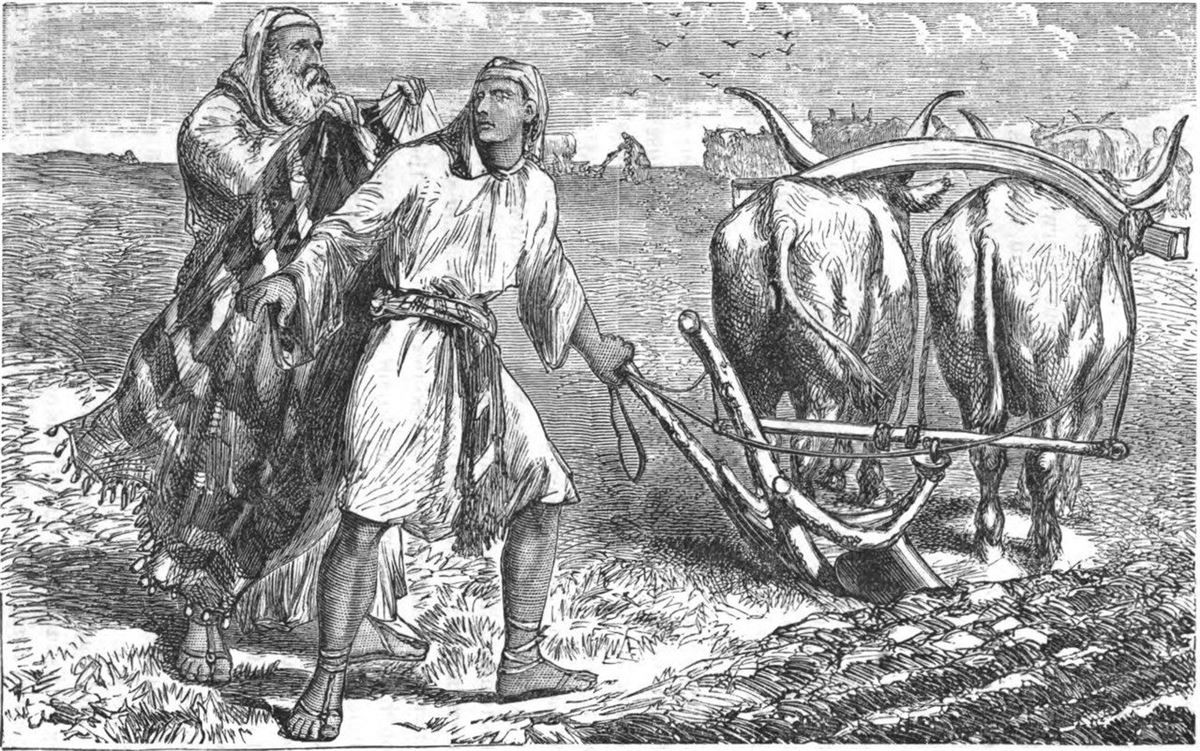
Revived and encouraged by Yahweh’s news, Elijah made his way to Abel-meholah, located in the Jordan Valley. While God clearly told Elijah to travel to the wilderness of Damascus and anoint Hazael to be king of Aram (1 Kings 19:15), it would appear that this was meant to be his final destination. On his way from Mount Sinai, he had to pass through the Jordan Valley, so it only made sense to stop there first and find the man who would be his replacement. He found Elisha plowing with 12 pairs of oxen in a field. This agrarian scene is significant for several reasons. First, it conveys an image of hope and expectation. After three-and-a-half years of drought, the rain had come, and now Elisha was preparing his formerly sun-baked fields for planting. He was anticipating a fruitful harvest sometime in the future. But Elisha’s presence in the field also reveals that he was a man of the land. He was not an influential figure with great wealth and prominence. He was a nondescript nobody whose only credentials were his calling by Yahweh.

What happens next appears strange to our modern sensibilities. Elijah walked up to this man, placed his cloak across his shoulders, and then simply walked away. What kind of bizarre ritual did this represent? How could Elisha have taken this unexpected action from this unknown stranger? Amazingly, it seems as if Elisha fully understood the significance of Elijah’s symbolic act. The text states that he “left the oxen standing there, ran after Elijah, and said to him, ‘First let me go and kiss my father and mother good-bye, and then I will go with you!’” (1 Kings 19:20 NLT). Perhaps God had already prepared Elisha for this moment, having revealed His plan through a dream or vision. He could have sent an angelic messenger to prepare Elisha for the prophet’s arrival. But whatever the case, Elisha seems to have been unfazed by what transpired and fully aware of what it meant. He immediately stopped his plowing and followed the man of God. His words and actions reveal that he knew who Elijah was and what he was asking him to do. His only request was that he be allowed to say goodbye to his family.

Elijah’s response to his request comes across as rather flippant.

“Go back again, for what have I done to you?” – 1 Kings 19:20 ESV

In a sense, Elijah was simply emphasizing that this had all been God’s doing, not his. He was merely the messenger. Elisha was free to do as he pleased, and the young farmer-turned-prophet demonstrated his commitment to accept the call of God. He took the plow, the symbol of his former occupation, and used the wood to build an altar. Then, on that altar, he offered up the oxen with which he had been plowing. Elisha burned every bridge to his former life. He bid his parents and his past goodbye and “arose and went after Elijah and assisted him” (1 Kings 19:21 ESV).

As Elijah and Elisha made their way from the Jordan Valley, the first phase of the second half of God’s plan began. The revival Elijah had longed for and given up on was coming. Yahweh was not yet done. Elijah had been a key player in God’s renewal plans for Israel, but his part was coming to an end. The LORD had another man ready to take the baton and finish the race. God would use this divine tag team to accomplish His will concerning Israel and usher in a period of much-needed spiritual renewal among His covenant people. The apostle Paul would later explain his understanding of how God uses a team approach to accomplish His divine will.

What then is Apollos? What is Paul? Servants through whom you believed, as the Lord assigned to each. I planted, Apollos watered, but God gave the growth. So neither he who plants nor he who waters is anything, but only God who gives the growth. He who plants and he who waters are one, and each will receive his wages according to his labor. For we are God’s fellow workers. You are God’s field, God’s building. – 1 Corinthians 3:5-9 ESV

Elijah had planted; now it was Elisha’s turn to water. But the harvest would be the LORD’s.

English Standard Version (ESV) The Holy Bible, English Standard Version. ESV® Permanent Text Edition® (2016). Copyright © 2001 by Crossway Bibles, a publishing ministry of Good News Publishers.

New Living Translation (NLT) Holy Bible, New Living Translation, copyright © 1996, 2004, 2015 by Tyndale House Foundation. Used by permission of Tyndale House Publishers Inc., Carol Stream, Illinois 60188. All rights reserved.

Nehemiah 13, Hebrews 12

Remain Faithful.

Nehemiah 13, Hebrews 12

As you endure this divine discipline, remember that God is treating you as his own children. Who ever heard of a child who is never disciplined by its father? For our earthly fathers disciplined us for a few years, doing the best they knew how. But God’s discipline is always good for us, so that we might share in his holiness. – Hebrews 12:7, 10 NLT

Nehemiah had served as governor of Judah for 12 years; then, as he had promised the king, he had returned to Susa. He would remain in Babylon for a period of 3 years before returning to Judah again. And when he arrived he found things had deteriorated once again. The people had violated the covenant they had made with God. They still had not separated themselves from the Ammonites and Moabites. They had continued to marry outsiders and make alliances with their enemies. Eliashib, the high priest, had allowed Tobiah the Ammonite to marry into his family. Not only that, he had provided Tobiah, a proven enemy of Judah, with his own private quarters inside the temple itself. This was in direct violation of God’s word found in Deuteronomy 23:3-4. The high priest had put friendship with the world ahead of obedience to God and had desecrated the temple in the meantime. But there was more. The people had not paid the temple tax or provided for the Levites, leading Nehemiah to accuse them of forsaking the house of God. They were violating the Sabbath by buying and selling goods on the holy day. Things seemed to be about as bad as they had ever been. But Nehemiah took action. Rather than walk away in disgust and return to his life in Babylon, he once again took it upon himself to make a difference.

What does this passage reveal about God?

God was going to use Nehemiah yet again to bring repentance and revival among His people. God is always looking for a man that He can use to speak His truth and call His people to repentance. Over in the book of Ezekiel we find these sobering words: “I looked for someone who might rebuild the wall of righteousness that guards the land. I searched for someone to stand in the gap in the wall so I wouldn’t have to destroy the land, but I found no one” (Ezekiel 22:30 NLT). God isn’t looking for extraordinary men. He isn’t looking for perfect men. He is simply looking for obedient men like Nehemiah. Men who are willing to rebuild the wall of righteousness that guards the land. And God’s search is not relegated to men. He is looking for men and women who, in spite of their flaws, will remain faithful to Him and stand in the gap on behalf of His people.  

What does this passage reveal about man?

We live in a day much like that of Nehemiah’s. The spiritual walls are in need of repair. The people of God are in a weakened, vulnerable state. God is looking for men and women who will be difference-makers. The apostle Paul warned Timothy of days like this: “You should know this, Timothy, that in the last days there will be very difficult times. For people will love only themselves and their money. They will be boastful and proud, scoffing at God, disobedient to their parents, and ungrateful. They will consider nothing sacred. They will be unloving and unforgiving; they will slander others and have no self-control. They will be cruel and hate what is good. They will betray their friends, be reckless, be puffed up with pride, and love pleasure rather than God. They will act religious, but they will reject the power that could make them godly. Stay away from people like that!” (2 Timothy 3:1-5 NLT). In the book of Isaiah, we read about God’s assessment of the people of Israel and it is NOT a pretty picture. “Shout with the voice of a trumpet blast. Shout aloud! Don’t be timid. Tell my people Israel of their sins! Yet they act so pious! They come to the Temple every day and seem delighted to learn all about me. They act like a righteous nation that would never abandon the laws of its God. They ask me to take action on their behalf, pretending they want to be near me” (Isaiah 58:1-2 NLT). There comes a time when someone has to step up and speak out, so God raises up a Nehemiah. to say the difficult things that need to be said and do the hard things that no one else wants to do. 

How would I apply what I’ve read to my own life?

God loves His people. But He will not allow them to live in ongoing sin and open rebellion to His Word. He will bring discipline. But He will also at time bring an individual along who will act as His instrument to bring healing to His people. Over in Isaiah 58 we read these encouraging words: “Some of you will rebuild the deserted ruins of your cities. Then you will be known as a rebuilder of walls and a restorer of homes” (Isaiah 58:12 NLT). As bad as things may get, there is always hope that God will bring about His loving discipline and correction. There is also the assurance that He will use men and women like us to bring it about. The writer of Hebrews encourages us to “lay aside every, and sin which clings so closely, and let us run with endurance the race that is set before us, looking to Jesus, the founder and perfecter of our faith” (Hebrews 12:1 ESV). We have work to do. It may be that God wants to use us to bring about healing and restoration to His people. The question is whether or not we will be ready and willing when that time comes. So the writer of Hebrews challenges us, “So take a new grip with your tired hands and strengthen your weak knees. Mark out a straight path for your feet so that those who are weak and lame will not fall but become strong” (Hebrews 12:12 NLT).

Father, help me remain faithful and ready so that I can be used by You when the time comes. And help me recognize the need when necessary and be ready to step into it boldly and confidently, knowing that You will be with me. I want to be a rebuilder of walls and a restorer of homes. Let me be the Nehemiah of my day. Amen

Ken Miller
Grow Pastor & Minister to Men
kenm@christchapelbc.org