Knowing God

Qoph

145 With my whole heart I cry; answer me, O LORD!
    I will keep your statutes.
146 I call to you; save me,
    that I may observe your testimonies.
147 I rise before dawn and cry for help;
    I hope in your words.
148 My eyes are awake before the watches of the night,
    that I may meditate on your promise.
149 Hear my voice according to your steadfast love;
    O LORD, according to your justice give me life.
150 They draw near who persecute me with evil purpose;
    they are far from your law.
151 But you are near, O LORD,
    and all your commandments are true.
152 Long have I known from your testimonies
    that you have founded them forever.

Resh

153 Look on my affliction and deliver me,
    for I do not forget your law.
154 Plead my cause and redeem me;
    give me life according to your promise!
155 Salvation is far from the wicked,
    for they do not seek your statutes.
156 Great is your mercy, O LORD;
    give me life according to your rules.
157 Many are my persecutors and my adversaries,
    but I do not swerve from your testimonies.
158 I look at the faithless with disgust,
    because they do not keep your commands.
159 Consider how I love your precepts!
    Give me life according to your steadfast love.
160 The sum of your word is truth,
    and every one of your righteous rules endures forever.

Shin

161 Princes persecute me without cause,
    but my heart stands in awe of your words.
162 I rejoice at your word
    like one who finds great spoil.
163 I hate and abhor falsehood,
    but I love your law.
164 Seven times a day I praise you
    for your righteous rules.
165 Great peace have those who love your law;
    nothing can make them stumble.
166 I hope for your salvation, O LORD,
    and I do your commandments.
167 My soul keeps your testimonies;
    I love them exceedingly.
168 I keep your precepts and testimonies,
    for all my ways are before you. Psalm 119:145-168 ESV

The psalmist’s ongoing prayer for deliverance from his enemies was based on his desire to obey Yahweh’s commands. He longed to live so he could continue observing and applying all the truths found in Yahweh’s written word.

I cry out to you; rescue me,
    that I may obey your laws. – Psalm 119:146 NLT

It would be an understatement to say that he was obsessed with God’s word. He confesses to staying awake at night thinking about God’s promises. The Scriptures were his hope for healing and deliverance because he knew obedience was rewarded with blessing. That is why he made the pursuit of God’s word a high priority in his life. He had made a lifelong habit of putting the written word of God ahead of all else and was committed to spending the rest of his days seeking to know Yahweh by searching the Scriptures.

I have known from my earliest days
    that your laws will last forever. – Psalm 119:152 NLT

Life is filled with uncertainties, and the things of this earth will pass away, but the word of God is reliable and eternal. Yahweh’s decrees are unchanging and completely trustworthy, through all generations. They don’t change with the times or require updating due to the constantly evolving nature of world conditions. The psalmist believed in the constancy and consistency of God’s word and wholeheartedly embraced the teaching of the prophet Isaiah.

“The grass withers and the flowers fade
    beneath the breath of the LORD.
    And so it is with people.
The grass withers and the flowers fade,
    but the word of our God stands forever.” – Isaiah 40:7-8 NLT

He expressed this belief earlier in this psalm.

Your word, O LORD, is everlasting; it is firmly fixed in the heavens. – Psalm 119:89 BSB

And he states it again in the next strophe.

The very essence of your words is truth;
    all your just regulations will stand forever. – Psalm 119:160 NLT

His unwavering belief in the divine nature of Scripture and its timeless wisdom kept him going during the darkest moments of his life. Verses 153-160 contain some of the strongest statements regarding his current circumstances.

Look upon my suffering and rescue me… – vs 153 NLT

Argue my case; take my side! – vs 154 NLT

Many persecute and trouble me – vs 157 NLT

Give back my life because of your unfailing love – vs 159 NLT

His situation was dire, but his dedication to God’s word remained strong. He refused to allow the difficulties of his life to distract him or cause him to doubt God’s promises.

I have not forgotten your instructions. – vs 153 NLT

I have not swerved from your laws. – vs 157 NLT

See how I love your commandments – vs 159 NLT

He accuses his enemies of not only neglecting God’s word but of having no concern for it whatsoever. “They care nothing for your word” (Psalm 119:158 NLT), he declares. They refuse to give it the honor it deserves and reject its authority over their lives. But for the psalmist, the Scriptures are more essential to human life and flourishing than air, water, and food. He knows his life depends upon the life-sustaining power of God’s word. Earlier in this psalm, he described God’s word as “sweeter than honey” (Psalm 119:103 NLT). This confession echoes the words ofJeremiah the prophet.

When I discovered your words, I devoured them.
    They are my joy and my heart’s delight… – Jeremiah 15:16 NLT

The psalmist would have been familiar with the story of Job and his epic bout with sorrow and suffering. But the beleaguered Job was able to write the following words during some of his darkest moments.

For I have stayed on God’s paths;
    I have followed his ways and not turned aside.
I have not departed from his commands,
    but have treasured his words more than daily food. – Job 23:11-12 NLT

It was King David who wrote:

The laws of the Lord are true;
    each one is fair.
They are more desirable than gold,
    even the finest gold.
They are sweeter than honey,
    even honey dripping from the comb.
They are a warning to your servant,
    a great reward for those who obey them. – Psalm 19:9-11 NLT

My soul thirsts for you;
    my whole body longs for you
in this parched and weary land
    where there is no water.

You satisfy me more than the richest feast. – Psalm 63:1, 5 NLT

Like the great king, the psalmist found hope and sustenance in the word of God. They were more than words on paper or quaint stories from the ancient past; they were life-giving truths that revealed God’s power and confirmed His presence among His people. That is why the psalmist could say, “I rejoice in your word like one who discovers a great treasure” (Psalm 119:162 NLT). God’s words were more precious than gold or silver. They were more nourishing than the finest feast and as vital to life as fresh water. 

But the psalmist found God’s word more than life-sustaining; it was also praise-producing.

I will praise you seven times a day
    because all your regulations are just. – Psalm 119:164 NLT

The Scriptures are more than information on a page or stories in a book. They are the revelation of God to man and make the unknowable God knowable. They make the unapproachable God accessible and relatable. His words reveal His will and make His divine ways understandable and applicable.

The psalmist had discovered the viability and reliability of God’s word. The Scriptures contained the truth concerning His power, trustworthiness, and love. They revealed His character and affirmed His covenant faithfulness. And as another psalmist put it, they were the proof of God’s presence and the key to wisdom.

All he does is just and good,
    and all his commandments are trustworthy.
They are forever true,
    to be obeyed faithfully and with integrity.

Fear of the LORD is the foundation of true wisdom.
    All who obey his commandments will grow in wisdom. – Psalm 111:7-8, 10 NLT

Father, Your word is reliable. From Genesis to Revelation, we have a compendium of insights into Your character and a powerful reminder of Your goodness, greatness, mercy, and love for Your people. But it is so easy to treat Your word flippantly by seeing it as nothing more than a historical narrative of ancient peoples and past events. But Your word is alive and active. It is relevant and powerfully productive in bringing about life change and heart transformation. But it takes a commitment to reading it and allowing the Holy Spirit to apply it to our lives. Help me to see Your word as more vital than food and water and more valuable than silver or gold. May it become the highest priority in my life so that I might become more Christ-like and praise-prone. Amen

English Standard Version (ESV) The Holy Bible, English Standard Version. ESV® Permanent Text Edition® (2016). Copyright © 2001 by Crossway Bibles, a publishing ministry of Good News Publishers.

New Living Translation (NLT) Holy Bible, New Living Translation, copyright © 1996, 2004, 2015 by Tyndale House Foundation. Used by permission of Tyndale House Publishers Inc., Carol Stream, Illinois 60188. All rights reserved.
God’s Glory on Display

To the choirmaster. A Psalm of David.

1 The heavens declare the glory of God,
    and the sky above proclaims his handiwork.
Day to day pours out speech,
    and night to night reveals knowledge.
There is no speech, nor are there words,
    whose voice is not heard.
Their voice goes out through all the earth,
    and their words to the end of the world.
In them he has set a tent for the sun,
    which comes out like a bridegroom leaving his chamber,
    and, like a strong man, runs its course with joy.
Its rising is from the end of the heavens,
    and its circuit to the end of them,
    and there is nothing hidden from its heat.

The law of the Lord is perfect,
    reviving the soul;
the testimony of the Lord is sure,
    making wise the simple;
the precepts of the Lord are right,
    rejoicing the heart;
the commandment of the Lord is pure,
    enlightening the eyes;
the fear of the Lord is clean,
    enduring forever;
the rules of the Lord are true,
    and righteous altogether.
10 More to be desired are they than gold,
    even much fine gold;
sweeter also than honey
    and drippings of the honeycomb.
11 Moreover, by them is your servant warned;
    in keeping them there is great reward.

12 Who can discern his errors?
    Declare me innocent from hidden faults.
13 Keep back your servant also from presumptuous sins;
    let them not have dominion over me!
Then I shall be blameless,
    and innocent of great transgression.

14 Let the words of my mouth and the meditation of my heart
    be acceptable in your sight,
    O Lord, my rock and my redeemer. Psalm 19:1-14 ESV

David opens this Psalm by comparing two aspects of God’s revelatory nature. First, he speaks of “the heavens” or “the sky,” which “proclaims His handiwork. His use of two different words helps to differentiate between the earth’s atmosphere and outer space. The heavens contain the sun, moon, stars, and planets, while the sky is home to birds, clouds, rain, thunder, and lightning. During the day, David could look up at the sky and be amazed at God’s creative prowess. The sound of the wind and the songs of the birds declared God’s presence and power. The clouds that traveled overhead and brought refreshing rain to the earth were reminders of God’s glory and gracious provision.

At night, a whole new scene unfolded as the moon and stars became visible and provided a reminder of God’s majesty and greatness. The incalculable number of stars visible to the eye provided another unspoken lesson about the Creator’s glory. Another Psalmist wrote, “He determines the number of the stars; he gives to all of them their names” (Psalm 147:4 ESV).

Isaiah described God as “enthroned above the circle of the earth; its dwellers are like grasshoppers. He stretches out the heavens like a curtain, and spreads them out like a tent to dwell in” (Isaiah 40:22 BSB). In the Book of Job, God confronts His suffering servant and asks a series of rhetorical questions designed to highlight His power and expose Job’s arrogance.

“Can you direct the movement of the stars—
    binding the cluster of the Pleiades
    or loosening the cords of Orion?
Can you direct the constellations through the seasons
    or guide the Bear with her cubs across the heavens?
Do you know the laws of the universe?
    Can you use them to regulate the earth?

“Can you shout to the clouds
    and make it rain?
Can you make lightning appear
    and cause it to strike as you direct?
Who gives intuition to the heart
    and instinct to the mind?
Who is wise enough to count all the clouds?
    Who can tilt the water jars of heaven
when the parched ground is dry
    and the soil has hardened into clods? – Job 38:31-38 NLT

God’s power and glory are clearly evident in His creation. His greatness is mirrored in the vastness of the universe, the inexhaustible energy of the sun, and the countless stars in the sky. But when it comes to revealing Himself to man, God didn’t stop there.

David knew God through His written word, as found in the Pentateuch, the first five books of the Bible penned by Moses. This is the second aspect of God’s revelation of Himself to mankind. David had discovered the greatness of God as revealed in the Mosaic Law. He had learned that God’s Law revives the soul, gives the naive much-needed wisdom, brings joy to the heart, and helps men see life more clearly. He viewed the Law as God’s communication to man, providing insights into His righteousness and making holiness practical and tangible. The Law had been given by God to Moses so that the people of Israel would have a clear and non-debatable understanding of His expectations for them. If they listened and obeyed, they would be blessed. If they chose to disobey, they would suffer the consequences.

They are sweeter than honey,
    even honey dripping from the comb.
They are a warning to your servant,
    a great reward for those who obey them. – Psalm 19:10-11 NLT

David found the words of God more desirable than gold and more appetizing than his favorite sweet. As king of Israel, David had access to wealth and great food, so he knew what it meant to satisfy his desires through materialism and hedonism. Money doesn’t last and a great meal only leaves you hungry and desiring more. Nothing satisfies like the word of God.

One of the things David learned about God’s word is its ability to penetrate the heart and reveal what’s hidden there.

How can I know all the sins lurking in my heart?
    Cleanse me from these hidden faults. – Psalm 19:12 NLT

God’s Law has the unique capacity to expose the soul (like an X-ray) and reveal sins — even those committed unknowingly or unintentionally. David would have agreed with God’s assessment of the human heart found in the Book of Jeremiah.

“The human heart is the most deceitful of all things,
    and desperately wicked.
    Who really knows how bad it is?
But I, the Lord, search all hearts
    and examine secret motives.
I give all people their due rewards,
    according to what their actions deserve.”– Jeremiah 17:9-10 NLT

But David understood that God’s word not only revealed sin, it provided a means of cleansing. Obeying God’s Law protects us from committing sins out of presumption or sheer arrogance. David knew that his righteousness depended on God’s faithful, reliable, pure, trustworthy, correct, and sound Law. It was only through time spent reading and meditating on God’s word that David could live a life that was pleasing to God.

The heavens and the sky provided tangible reminders that God was there and that He was powerful. They declared His glory and greatness. But His Law declared His holiness and righteousness in ways men could understand and emulate. The heavens declare the glory of God (Psalm 19:1), but the Law of the LORD revives the soul (Psalm 19:7) and enlightens the eyes (Psalm 19:8). It encourages, convicts, teaches, warns, and rewards. And, for David, it produced an understanding of God that resulted in an ever-increasing desire to please Him.

May the words of my mouth
    and the meditation of my heart
be pleasing to you,
    O Lord, my rock and my redeemer. – Psalm 19:14 NLT

Father, Your Word is invaluable and irreplaceable. There is nothing else like it in the universe that can transform my life and bring joy, peace, wisdom, direction, and satisfaction. Continue to increase my love for it, obedience to it, and dependence upon it. Let me love it like David did. Use Your Word to see into my heart and reveal what I can’t see. Transform me by it. Equip me with it. Convict me through it. And never let me walk away from it. Amen

English Standard Version (ESV) The Holy Bible, English Standard Version. ESV® Permanent Text Edition® (2016). Copyright © 2001 by Crossway Bibles, a publishing ministry of Good News Publishers.

New Living Translation (NLT) Holy Bible, New Living Translation, copyright © 1996, 2004, 2015 by Tyndale House Foundation. Used by permission of Tyndale House Publishers Inc., Carol Stream, Illinois 60188. All rights reserved.

A Bitter-Sweet Assignment

1 And he said to me, “Son of man, stand on your feet, and I will speak with you.” And as he spoke to me, the Spirit entered into me and set me on my feet, and I heard him speaking to me. And he said to me, “Son of man, I send you to the people of Israel, to nations of rebels, who have rebelled against me. They and their fathers have transgressed against me to this very day. The descendants also are impudent and stubborn: I send you to them, and you shall say to them, ‘Thus says the Lord God.’ And whether they hear or refuse to hear (for they are a rebellious house) they will know that a prophet has been among them. And you, son of man, be not afraid of them, nor be afraid of their words, though briers and thorns are with you and you sit on scorpions. Be not afraid of their words, nor be dismayed at their looks, for they are a rebellious house. And you shall speak my words to them, whether they hear or refuse to hear, for they are a rebellious house.

“But you, son of man, hear what I say to you. Be not rebellious like that rebellious house; open your mouth and eat what I give you.” And when I looked, behold, a hand was stretched out to me, and behold, a scroll of a book was in it. 10 And he spread it before me. And it had writing on the front and on the back, and there were written on it words of lamentation and mourning and woe.

1 And he said to me, “Son of man, eat whatever you find here. Eat this scroll, and go, speak to the house of Israel.” So I opened my mouth, and he gave me this scroll to eat. And he said to me, “Son of man, feed your belly with this scroll that I give you and fill your stomach with it.” Then I ate it, and it was in my mouth as sweet as honey. – Ezekiel 2:1-3:3 ESV

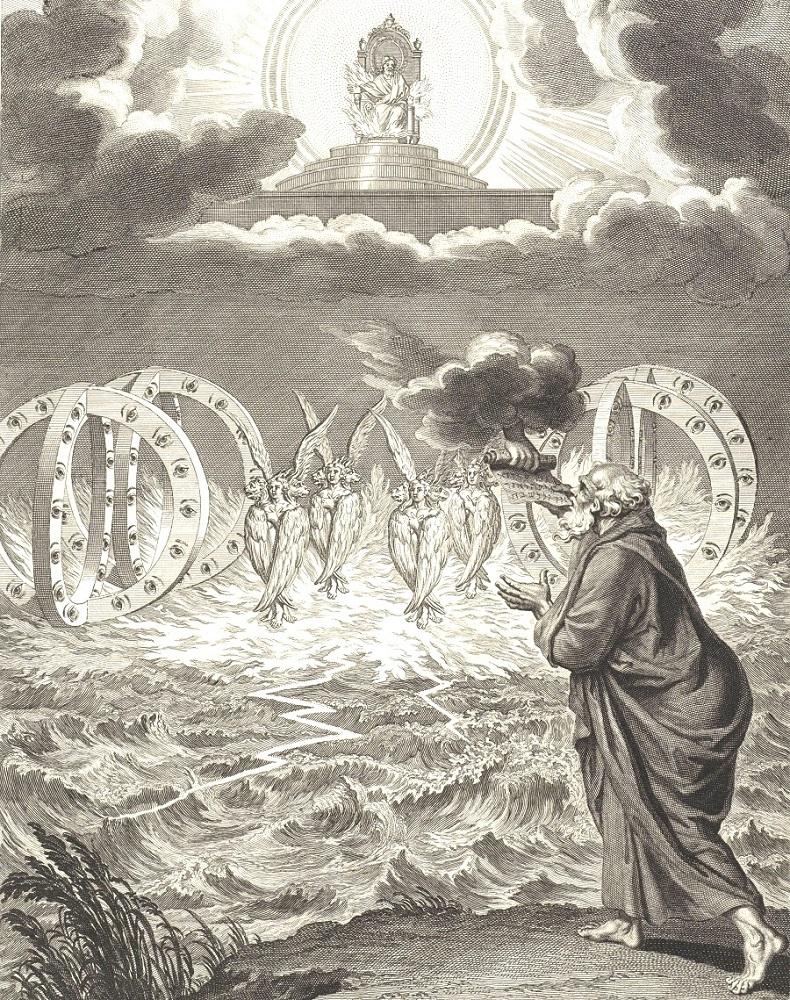
Ezekiel had been given a vision of God’s glory, and it left him face down on the ground in reverential fear and wonder. As this exiled young priest stood by the banks of the Kebar River in Babylon, the God of the universe made an unexpected and highly spectacular appearance.

Above this surface was something that looked like a throne made of blue lapis lazuli. And on this throne high above was a figure whose appearance resembled a man. From what appeared to be his waist up, he looked like gleaming amber, flickering like a fire. And from his waist down, he looked like a burning flame, shining with splendor. All around him was a glowing halo, like a rainbow shining in the clouds on a rainy day. This is what the glory of the Lord looked like to me. – Ezekiel 1:26-28 NLT

It is safe to assume that this was a once-in-a-lifetime experience for Ezekiel. He had never seen anything like this before, and to have the God of Abraham, Isaac, and Jacob appear to him in the remote recesses of the land of Babylon must have been a shock to his system. He was just a lowly priest who had been taken captive just like all the other residents of Jerusalem when the city had fallen to King Nebuchadnezzar’s forces.  Jehoiachin was the king of Judah at the time and, according to 2 Kings 12:9, “He did evil in the sight of the Lord as his ancestors had done.” Like most of his predecessors, Jehoiachin chose to use his royal power to promote idolatry that fostered unfaithfulness to God, and he suffered greatly for his refusal to honor the Almighty.

At that time the generals of King Nebuchadnezzar of Babylon marched to Jerusalem and besieged the city. King Nebuchadnezzar of Babylon came to the city while his generals were besieging it. King Jehoiachin of Judah, along with his mother, his servants, his officials, and his eunuchs surrendered to the king of Babylon. The king of Babylon, in the eighth year of his reign, took Jehoiachin prisoner. Nebuchadnezzar took from there all the riches in the treasuries of the Lord’s temple and of the royal palace. He removed all the gold items that King Solomon of Israel had made for the Lord’s temple, just as the Lord had warned. He deported all the residents of Jerusalem, including all the officials and all the soldiers (10,000 people in all). This included all the craftsmen and those who worked with metal. No one was left except for the poorest among the people of the land. – 2 Kings 12:10-14 NLT

Living amongst the exiled people of God, Ezekiel had firsthand experience with the apathy and complacency that had taken hold of them. A long way from home and no longer able to avail themselves of the temple and the sacrificial system, they had begun to lose interest in the things of God. Their circumstances had left them feeling abandoned by God and distraught over the far-from-ideal conditions of their captivity. With the passage of time, God had become out of sight, out of mind. They simply assumed He had turned His back on them and so, in time, they gave up hope and determined to make the most of their situation in Babylon.

But God had other plans that included appointing Ezekiel as the one who would deliver His message to the exiles. He had not forgotten about them. They had not been abandoned. Their exile had been intended to get their attention and to bring them to a point of repentance. Now, Ezekiel was going to be commissioned to serve as God’s spokesperson, delivering His call to repentance.

Having gotten Ezekiel’s full attention through the grand display of His glory, God delivered the details of his new assignment.

“I am sending you to the nation of Israel, a rebellious nation that has rebelled against me. They and their ancestors have been rebelling against me to this very day. They are a stubborn and hard-hearted people. But I am sending you to say to them, ‘This is what the Sovereign Lord says!’” – Ezekiel 2:3-4 NLT

God makes it painfully clear that Ezekiel’s new task would not be easy. He would have to deliver a message from God to a people who had a track record of stubbornness and insubordination. And God warns Ezekiel that his audience may not receive his message with open arms.

“And whether they listen or refuse to listen—for remember, they are rebels—at least they will know they have had a prophet among them.” – Ezekiel 2:5 NLT

There was no guarantee that Ezekiel would experience success. Despite the fact that he would be speaking the words of God, he had no way of knowing how the people would respond. In fact, God made it sound like his mission was doomed to certain failure.

What would you do if God called you to a task that He knew you were going to fail at? What if He even told you your efforts would be fruitless and non-productive? Most of us would bail. We would give up long before we got going. Because we’re wired with one thing in mind – success – and failure is not an acceptable alternative. But when Ezekiel got his marching orders from God, he was also given the not-so-great news that his ministry would be unsuccessful because his audience was going to be unresponsive.  God even told Ezekiel to expect threats and animosity. This was going to be one difficult job assignment.

In a sense, God was foreshadowing failure, but demanding obedience. Ezekiel’s success would not be measured by the number of callous, carnal Israelites he converted, but on his willingness to carry out God’s assignment faithfully, even in the face of rejection, ridicule, and poor results.

Even the message God gave Ezekiel to share was anything but good news. In his vision, Ezekiel was given a scroll that was covered with writing front and back, from edge to edge. It’s content?

“Funeral songs, words of sorrows, and pronouncements of doom.” – Ezekiel 2:9b NLT

It was a veritable compendium of bad news. So, not only would Ezekiel have a non-responsive audience, he was given an unappealing message. But God fully understood the foreboding nature of Ezekiel’s assignment, and he knew that Ezekiel was already wrestling with whether to follow through with His command. The young priest was afraid of how he and his message might be received by the people, but God encouraged him to have faith.

“Do not fear them or their words. Don’t be afraid even though their threats surround you like nettles and briars and stinging scorpions. Do not be dismayed by their dark scowls, even though they are rebels.” – Ezekiel 2:6 NLT

God was telling Ezekiel not to be frightened by the things they would threaten to do to him, the harsh words they might say about him, or the negative reaction they would inevitably have to him.

“Son of man, do not fear them or their words. Don’t be afraid even though their threats surround you like nettles and briers and stinging scorpions. Do not be dismayed by their dark scowls, even though they are rebels. You must give them my messages whether they listen or not. But they won’t listen, for they are completely rebellious!” – Ezekiel 2:6-7 NLT

Ezekiel was going to experience resistance. His message would not be well-received and the people would hold him responsible for its content. It was only a matter of time before they sought to kill the messenger. That’s why God warned Ezekiel to refrain from emulating the rebellious nature of his audience. He was not to reject God’s assignment just because it sounded difficult and more than a bit dangerous. God was open and above board as to the difficulty of the mission. He didn’t attempt to sugarcoat the assignment or paint a rosy picture of its outcome. Instead, God gave His newly appointed prophet all he would need to succeed.

“Son of man, listen to what I say to you. Do not join them in their rebellion. Open your mouth, and eat what I give you.” – Ezekiel 2:8 NLT

God held out a scroll, upon which were written lamentations, mourning, and woes. In other words, it was filled with bad news. The sheer volume of disheartening content was so great that it covered both sides of the scroll. God’s indictment against His people was great and He commanded Ezekiel to consume every last bit of it. He was to take it all in so that he might regurgitate it, word for word, to the disobedient people of God.

“Son of man, eat whatever you find here. Eat this scroll, and go, speak to the house of Israel.” – Ezekiel 3:1 ESV

But much to his surprise, Ezekiel found the less-than-appealing content of the scroll to be “sweet as honey.” (Ezekiel 3:3 ESV). There is a similar scene described in the book of Revelation. In it, the apostle John is given a vision of an angel who descends from heaven with a scroll in his hand. He presents the scroll to John and commands him to eat it.

“Yes, take it and eat it,” he said. “It will be sweet as honey in your mouth, but it will turn sour in your stomach!” So I took the small scroll from the hand of the angel, and I ate it! It was sweet in my mouth, but when I swallowed it, it turned sour in my stomach.

Then I was told, “You must prophesy again about many peoples, nations, languages, and kings.” – Revelation 10:9-11 NLT

Both John and Ezekiel would find the words of God to be both sweet and bitter. When the truth of God is consumed, it is pleasant and life-giving, but it can also result in conviction and condemnation.

For the word of God is alive and powerful. It is sharper than the sharpest two-edged sword, cutting between soul and spirit, between joint and marrow. It exposes our innermost thoughts and desires. – Hebrews 4:12 NLT

All Scripture is inspired by God and is useful to teach us what is true and to make us realize what is wrong in our lives. It corrects us when we are wrong and teaches us to do what is right. – 2 Timothy 3:16 NLT

For Ezekiel, consuming God’s word was sweet to the taste, but declaring it to the people would be a bitter experience. They would find it distasteful and difficult to swallow. But God was calling Ezekiel to be faithful and fearless in declaring its truth regardless of the outcome.

English Standard Version (ESV) The Holy Bible, English Standard Version. ESV® Permanent Text Edition® (2016). Copyright © 2001

New Living Translation (NLT) Holy Bible, New Living Translation, copyright © 1996, 2004, 2015 by Tyndale House Foundation. Used by permission of Tyndale House Publishers Inc., Carol Stream, Illinois 60188. All rights reserved.

Before We Begin

1 In the beginning, God created the heavens and the earth. The earth was without form and void, and darkness was over the face of the deep. And the Spirit of God was hovering over the face of the waters. Genesis 1:1-2 ESV

The book of beginnings. That is how this first book of the Bible is often described, and that moniker is well deserved. The first three words of the opening chapter form a rather short and succinct thesis statement that establishes the author’s intentions. This lengthy historical narrative was intended to provide a divinely inspired explanation for the existence of the universe. Within its pages, is found the creation story, describing God’s sovereign act of forming the stars and planets, the earth, and all its inhabitants, with special emphasis placed upon one particular people group – the nation of Israel.

Genesis is both a book of history and theology. According to the Merriam-Webster dictionary, theology is “the study of God and of God’s relation to the world” (“Theology.” Merriam-Webster.com Dictionary, Merriam-Webster, https://www.merriam-webster.com/dictionary/theology. Accessed 9 Dec. 2021.). And because Genesis opens with the words, “In the beginning, God…,” it reveals itself to be an unapologetically God-focused book. He serves as its primary protagonist, appearing on virtually every page and spanning its vast historical scope with sovereign authority and power.

The 50 chapters that comprise the book of Genesis cover a period of at least 2500 years – from the moment of creation to the death of the patriarch, Joseph. Of course, dating a book like Genesis is difficult, if not, impossible. As will become apparent in our exposition of the book, there has been much debate about the historicity of Genesis. Some regard it as nothing more than a collection of myths or fables. Others, who defend its authenticity, question its reliability when it comes to the accuracy of its dating and descriptions. The rise of the Enlightenment in the 18th-Century, with its emphasis on science and logic, reason and rationalism, led many Christians to question the accuracy of God’s Word. In the late 18th-Century, a new form of biblical study emerged from Germany that encouraged a more scientific approach to biblical interpretation. By the mid-nineteenth century, this historical-critical method of examining the biblical text had come to be known as higher criticism. Its influence was far-reaching, impacting seminaries and theological institutions across the world. With its emphasis on reason and rationalism, higher criticism tends to reject the supernatural aspect of the biblical text. Of course, to a proponent of higher criticism, the book of Genesis provides a treasure trove of evidence against the Bible’s reliability as a historical narrative.

There are many within evangelicalism today who remain influenced by this rationalistic approach to biblical interpretation. They reject the validity of a six-day creation narrative because it seems to contradict the scientific validation of the theory of evolution. They question the veracity of the many supernatural stories found on its pages, declaring them to be nothing more than oral traditions passed down from one unenlightened generation to another.

Whether they realize it or not, most modern Christians have been heavily influenced by this higher-critical method of biblical interpretation. Armed with science and reason, they approach the Bible with a pervading sense of skepticism and doubt. What cannot be reasonably explained is conveniently reinterpreted or simply rejected altogether. This hyper-critical and reductionistic approach to biblical interpretation renders the text devoid of the Spirit’s inspiration and turns the content of the Bible into little more than a collection of moralistic tales and man-made myths.

While no intelligent Christian should reject the advances in human knowledge achieved through scientific research and exploration, there is a danger in allowing human reason to trump divine intervention. The God of the Bible is not the byproduct of man’s fertile imagination. Man did not create God. According to the book of Genesis, it was the other way around. A Christian must approach the Bible in faith, understanding that what is contained within its pages is divinely inspired. It is not a collection of man-made myths or humanly concocted stories, but a Spirit-empowered book that provides us with a reliable retelling of mankind’s past and a prophetic glimpse into our future. It is a book that provides insights into the unknown and unexplained. It contains divine guidance for navigating the vicissitudes of life. More than just another book, the Bible is the word of God to humanity. As the apostle Paul so clearly states:

All Scripture is inspired by God and is useful to teach us what is true and to make us realize what is wrong in our lives. It corrects us when we are wrong and teaches us to do what is right. – 2 Timothy 3:16 NLT

And because it is divinely inspired and beyond the reach of human reason, there is much about the Bible that remains inexplicable. God has clearly communicated the transcendent nature of His wisdom and His ways.

For my thoughts are not your thoughts,
    neither are your ways my ways, declares the Lord.
For as the heavens are higher than the earth,
    so are my ways higher than your ways
    and my thoughts than your thoughts. – Isaiah  55:8-9 ESV

And the apostle Paul provides us with a much-needed reminder of just ill-equipped we are to understand the unfathomable ways of God.

Oh, how great are God’s riches and wisdom and knowledge! How impossible it is for us to understand his decisions and his ways! – Romans 11:33 NLT

So, as we approach this remarkable book, we need to do so with reverence and humility. If we attempt to use our highly limited resources of human reasoning and rationalism to explain the ways of God, we will only end up diminishing His glory and displaying our own hubris and arrogance. When we attempt to use our insufficient intelligence to explain the ways of God, we will soon find ourselves on the receiving end of God’s divine disfavor and having to endure a well-deserved lecture on His superiority and sovereignty. Like Job, who dared to question the ways of God, we will have to answer to the only One who has all the answers.

“Who is this that questions my wisdom
    with such ignorant words?
Brace yourself like a man,
    because I have some questions for you,
    and you must answer them.

“Where were you when I laid the foundations of the earth?
    Tell me, if you know so much.
Who determined its dimensions
    and stretched out the surveying line?
What supports its foundations,
    and who laid its cornerstone
as the morning stars sang together
    and all the angels shouted for joy?” – Job 38:2-7 NLT

Job, a mere man, dared to question God. The created questioned the Creator. And God was not amused by Job’s arrogant attitude. The all-powerful, all-knowing God of the universe repeatedly confronted the fist-shaking, fulminating Job, sarcastically exposing the ridiculous nature of his resentment and anger.

“Where does light come from,
    and where does darkness go?
Can you take each to its home?
    Do you know how to get there?
But of course you know all this!
For you were born before it was all created,
    and you are so very experienced! – Job 38:19-21 NLT

As we begin this study of the book of Genesis, may we do so with a sense of humility, freely confessing the limited nature of our knowledge and willingly accepting the greatness of our God. There will be much we will never understand and even more that we will never be able to explain. This is going to be a journey of discovery, one that will require equal amounts of faith and faithfulness. We must trust God as we walk the pages of Genesis. Like the characters whose lives we will encounter, we too will have questions along the way. We will have doubts. But we must not allow the inexplicable and unexplainable to deter us from the path of discovery.

If we remain faithful, we will grow to know God better. He will not answer all our questions or solve all the conundrums of life. But He will reveal Himself to us along the way. We will see His power and sovereign will at work in the creation of all things. We will discover the incredible nature of His unrelenting love. His holiness and justice will be displayed alongside His wrath and judgment. Along the way, God will reveal to us His grace, goodness, glory, and greatness, alongside His grand redemptive plan. The goal of the journey is to know God. After all, the entire Bible is the revelation of God to man. It is His gracious message of self-revelation that allows us to comprehend not only His identity but our own as well. Jesus stated that the objective of eternal life was not our escape from condemnation and death, but our knowledge of Him and His Heavenly Father.

“And this is eternal life, that they know you, the only true God, and Jesus Christ whom you have sent.” – John 17:3 ESV

It is my prayer that we may read the book of Genesis with the goal to know God better.

English Standard Version (ESV) The Holy Bible, English Standard Version. ESV® Permanent Text Edition® (2016). Copyright © 2001 by Crossway Bibles, a publishing ministry of Good News Publishers.

New Living Translation (NLT) Holy Bible, New Living Translation, copyright © 1996, 2004, 2015 by Tyndale House Foundation. Used by permission of Tyndale House Publishers Inc., Carol Stream, Illinois 60188. All rights reserved.

New English Translation (NET)NET Bible® copyright ©1996-2017 by Biblical Studies Press, L.L.C. http://netbible.com All rights reserved.

All In God’s Timing

And as they were coming down the mountain, he charged them to tell no one what they had seen, until the Son of Man had risen from the dead. 10 So they kept the matter to themselves, questioning what this rising from the dead might mean. 11 And they asked him, “Why do the scribes say that first Elijah must come?” 12 And he said to them, “Elijah does come first to restore all things. And how is it written of the Son of Man that he should suffer many things and be treated with contempt? 13 But I tell you that Elijah has come, and they did to him whatever they pleased, as it is written of him.” Mark 9:9-13 ESV

Being a disciple of Jesus must have been a roller-coaster ride of emotions and experiences. Every day for three years, these 12 men had been exposed to mind-blowing displays of never-before-seen miracles. And these relatively uneducated men had received a daily dose of profound and difficult-to-understand teaching that left even the scribes and Pharisees dumbfounded. Their time with Jesus had been an adventure but also a head-spinning whirlwind of cryptic sayings and confounding experiences.

As Peter, James, and John made their way down the mountain, their minds must have been reeling from what they had just witnessed. Just minutes earlier, they had watched as Jesus was transformed right before their eyes. Suddenly, without warning or explanation, Jesus began to emanate a brilliant light. Mark described it this way: “his clothes became dazzling white, far whiter than any earthly bleach could ever make them” (Mark 9:3 NLT). These three men had seen Jesus do a lot of inexplicable and unprecedented things over the last three years, but nothing quite like this. When they had witnessed Jesus walking on the water in the midst of a storm, it had made a distinct impression. In fact, they had initially thought He was some kind of ghostly apparition. So, what must have been going through their minds as they took in the transfiguration of Jesus?

But when the long-departed prophets, Moses and Elijah, had suddenly appeared on the scene, it seems that the disciples began to put two and two together. They knew that something spectacular was happening. And as they took in the scene transpiring before them, they must have wondered if this was it – was Jesus getting ready to usher in His Kingdom? Had Moses, the great deliverer come to assist Jesus in His quest to release the people of Israel from their captivity to the Romans? And was the appearance of Elijah proof that the time had come? Was this the fulfillment of the long-awaited prophecy?

“Behold, I will send you Elijah the prophet before the great and awesome day of the Lord comes. And he will turn the hearts of fathers to their children and the hearts of children to their fathers, lest I come and strike the land with a decree of utter destruction.” – Malachi 4:5-6 ESV

But the miracle on the mountain had ended just as fast as it had started. Suddenly, Elijah and Moses were gone and Jesus stood before them just as He had been before. The glory was gone but the impact of the moment lingered with the disciples. And they must have been bursting at the seams, eager to tell the other nine disciples all that they had seen. But Jesus threw cold water on their plans, commanding them to keep it all to themselves until the proper time.

he told them not to tell anyone what they had seen until the Son of Man had risen from the dead. – Mark 9:9 NLT

Now stop and think about this statement for a second. The disciples had just witnessed Jesus speaking to Moses and Elijah. Their minds must have been filled with thoughts of the coming Kingdom. Their hopes and dreams of Jesus being the long-awaited Messiah were about to come true. And yet, He brings up the subject of death again. This was the same topic He had raised before the transfiguration.

Then Jesus began to tell them that the Son of Man must suffer many terrible things and be rejected by the elders, the leading priests, and the teachers of religious law. He would be killed, but three days later he would rise from the dead. – Mark 8:31 NLT

Peter had found this news unacceptable and had told Jesus so. But his verbal dismissal of Jesus’ words had earned him a stern rebuke. Now Peter, James, and John were hearing Jesus bring up the same incomprehensible and objectionable subject again. And Mark makes it clear that they had no idea what Jesus was talking about.

…they kept the matter to themselves, questioning what this rising from the dead might mean. – Mark 9:10 ESV

It wasn’t that the disciples had no concept of the resurrection. As Jews, they believed in a future resurrection of the dead. They would have been familiar with the writings of Isaiah and Daniel.

Your dead shall live; their bodies shall rise.
    You who dwell in the dust, awake and sing for joy!
For your dew is a dew of light,
    and the earth will give birth to the dead. – Isaiah 26:19 ESV

And many of those who sleep in the dust of the earth shall awake, some to everlasting life, and some to shame and everlasting contempt. And those who are wise shall shine like the brightness of the sky above; and those who turn many to righteousness, like the stars forever and ever. – Daniel 12:2-3 ESV

In a later scene from Jesus’ life, He would tell Martha that her dead brother Lazarus would “rise again” (John 11:23 ESV). And her response would be: “I know that he will rise again in the resurrection on the last day” (John 11:24 ESV). She believed in a future resurrection of the dead at the end of the age. So did the disciples. But they were having difficulty understanding what any of this had to do with Jesus establishing His Kingdom.

Confused by Jesus’ words, the disciples simply ignore them and turn their attention back to the scene they had witnessed on the mountain top. They had seen Elijah with their own eyes and this most likely had led them to believe that the prophecy of Malachi was being fulfilled. So, they asked Jesus for clarification.

“Why do the teachers of religious law insist that Elijah must return before the Messiah comes?” – Mark 9:11 NLT

Their question has a purpose behind it. They had just seen Elijah, so they were asking Jesus to confirm that His messiahship was about to begin. One thing was meant to follow the other. Elijah had appeared, now it was time for Jesus to do His part. The disciples had to have been thinking about another familiar Messianic passage from the pen of Malachi.

“Look! I am sending my messenger, and he will prepare the way before me. Then the Lord you are seeking will suddenly come to his Temple. The messenger of the covenant, whom you look for so eagerly, is surely coming,” says the Lord of Heaven’s Armies.

“But who will be able to endure it when he comes? Who will be able to stand and face him when he appears? For he will be like a blazing fire that refines metal, or like a strong soap that bleaches clothes. He will sit like a refiner of silver, burning away the dross. He will purify the Levites, refining them like gold and silver, so that they may once again offer acceptable sacrifices to the Lord. Then once more the Lord will accept the offerings brought to him by the people of Judah and Jerusalem, as he did in the past.” – Malachi 3:1-4 NLT

You can see the imagery used by Malachi that supported what the disciples had seen on the mountain top. The blazing Messiah, reigning from His temple and restoring the nation of Israel to its former glory.

It seems that the disciples had linked their siting of Elijah with the timing of the Messiah’s appearance. They had just seen Elijah, so it must be time for Jesus to drop the charade and reveal Himself for who He really was: The Messiah of Israel. It was time for Him to get down to the serious business of ruling and reigning from the throne of David. The time for miracles and difficult-to-understand messages was over.

But Jesus revealed that the scribes had interpreted Malachi correctly. Elijah would precede the Messiah.

“Elijah is indeed coming first to get everything ready. – Mark 9:12 NLT

But the scribes and the disciples had left out a very important part of the prophecy. Not only was Elijah to come first, but the Messiah was going to endure great suffering. The people of Israel had conveniently ignored the many Old Testament passages that alluded to the Messiah’s death. Under the inspiration of the Holy Spirit, King David had written about the Messiah’s treatment at the hands of men.

But I am a worm and not a man,
    scorned by mankind and despised by the people.
All who see me mock me;
    they make mouths at me; they wag their heads;
He trusts in the Lord; let him deliver him;
    let him rescue him, for he delights in him!” – Psalm 22:6-8 ESV

And Matthew records the fulfillment of this prophecy.

So also the chief priests, with the scribes and elders, mocked him, saying, “He saved others; he cannot save himself. He is the King of Israel; let him come down now from the cross, and we will believe in him. He trusts in God; let God deliver him now, if he desires him. For he said, ‘I am the Son of God.’” – Matthew 27:41-43 ESV

The prophet Isaiah predicted the tremendous suffering and agony that the Messiah would have to endure at the hands of sinful men.

See, my servant will prosper;
    he will be highly exalted.
But many were amazed when they saw him.
    His face was so disfigured he seemed hardly human,
    and from his appearance, one would scarcely know he was a man. – Isaiah 52:13-14 NLT

He was despised and rejected—
    a man of sorrows, acquainted with deepest grief.
We turned our backs on him and looked the other way.
    He was despised, and we did not care. – Isaiah 53:3 NLT

But he was pierced for our rebellion,
    crushed for our sins.
He was beaten so we could be whole.
    He was whipped so we could be healed. – Isaiah 53:5 NLT

He was oppressed and treated harshly,
    yet he never said a word.
He was led like a lamb to the slaughter. – Isaiah 53:7 NLT

Jesus wants His disciples to know that the very same Scriptures that predict the coming of Elijah also predict the suffering of the Son of Man. So, He asks them, “why do the Scriptures say that the Son of Man must suffer greatly and be treated with utter contempt?” (Mark 9:12 NLT). There is a divine order to things. God has a plan and every detail of that plan must take place in order, including the suffering of the Savior.

Then Jesus dropped the real news that must have exploded like a bombshell on the unsuspecting disciples.

“But I tell you, Elijah has already come, and they chose to abuse him, just as the Scriptures predicted.” – Mark 9:13 NLT

And Jesus wasn’t referring to the same Elijah they saw on the mountain top. He was speaking of John the Baptist. This was confirmed by the angel who visited Zechariah and informed him that his wife would give birth to a son.

Your wife, Elizabeth, will give you a son, and you are to name him John. You will have great joy and gladness, and many will rejoice at his birth, for he will be great in the eyes of the Lord. He must never touch wine or other alcoholic drinks. He will be filled with the Holy Spirit, even before his birth. And he will turn many Israelites to the Lord their God. He will be a man with the spirit and power of Elijah. He will prepare the people for the coming of the Lord. He will turn the hearts of the fathers to their children, and he will cause those who are rebellious to accept the wisdom of the godly.” – Luke 1:13-17 NLT

At the time when Jesus and His disciples were descending the mountain, John the Baptist was dead, a victim of the wrath of Herod. And Jesus let the disciples know that the death of John would precede His own death.

“…they did not recognize him, but did to him whatever they pleased. So also the Son of Man will certainly suffer at their hands.” – Matthew 17:12 ESV

The disciples’ experience on the mountain had left them eagerly anticipating that Jesus was about to establish His Kingdom. But something else had to happen first. The Son of Man must suffer.

English Standard Version (ESV) The Holy Bible, English Standard Version. ESV® Permanent Text Edition® (2016). Copyright © 2001 by Crossway Bibles, a publishing ministry of Good News Publishers.

New Living Translation (NLT) Holy Bible, New Living Translation, copyright © 1996, 2004, 2015 by Tyndale House Foundation. Used by permission of Tyndale House Publishers Inc., Carol Stream, Illinois 60188. All rights reserved.

The Message (MSG)Copyright © 1993, 1994, 1995, 1996, 2000, 2001, 2002 by Eugene H. Peterson

My Ways Are Higher

10 “When you draw near to a city to fight against it, offer terms of peace to it. 11 And if it responds to you peaceably and it opens to you, then all the people who are found in it shall do forced labor for you and shall serve you. 12 But if it makes no peace with you, but makes war against you, then you shall besiege it. 13 And when the Lord your God gives it into your hand, you shall put all its males to the sword, 14 but the women and the little ones, the livestock, and everything else in the city, all its spoil, you shall take as plunder for yourselves. And you shall enjoy the spoil of your enemies, which the Lord your God has given you. 15 Thus you shall do to all the cities that are very far from you, which are not cities of the nations here. 16 But in the cities of these peoples that the Lord your God is giving you for an inheritance, you shall save alive nothing that breathes, 17 but you shall devote them to complete destruction, the Hittites and the Amorites, the Canaanites and the Perizzites, the Hivites and the Jebusites, as the Lord your God has commanded, 18 that they may not teach you to do according to all their abominable practices that they have done for their gods, and so you sin against the Lord your God.

19 “When you besiege a city for a long time, making war against it in order to take it, you shall not destroy its trees by wielding an axe against them. You may eat from them, but you shall not cut them down. Are the trees in the field human, that they should be besieged by you? 20 Only the trees that you know are not trees for food you may destroy and cut down, that you may build siegeworks against the city that makes war with you, until it falls.– Deuteronomy 20:10-20 ESV

Let’s face it, these are difficult verses to understand, let alone to justify. They deal with sensitive topics, and their content appears counter-intuitive and contradictory to our sense of fairness and ethics. This is one of those passages that cause many to reject the God of the Old Testament as antithetical to the loving, grace-giving, and merciful God of the New Testament.

But despite any reservations we may have with the more sinister portrait of God found in these verses, the Scriptures do not portray God as bipolar in nature. We may not like what we see. His actions may offend our more refined 21st-Century sensibilities, but the biblical portrait of God is designed to be taken in full, not in part.

The nature of God is complex and complicated. And mankind is at a distinct disadvantage when it comes to comprehending His wisdom or His ways. God, by the very nature of His being, is incomprehensible and beyond man’s capacity to understand. His own assessment of His transcendent nature is quite plain.

“My thoughts are nothing like your thoughts,” says the Lord.
    “And my ways are far beyond anything you could imagine.
For just as the heavens are higher than the earth,
    so my ways are higher than your ways
    and my thoughts higher than your thoughts.” – Isaiah 55:8-9 NLT

Even the psalmist understood that mere humans were at a distinct disadvantage when it came to understanding the ways of God.

When I look at the night sky and see the work of your fingers—the moon and the stars you set in place—what are mere mortals that you should think about them, human beings that you should care for them? – Psalm 8:3-4 NLT

He was blown away that the God who created the universe and all it contains would even give a second thought to “mere mortals” like himself. But how quickly we more sophisticated and well-educated modern mortals attempt to judge God and hold Him accountable for His actions. And yet, the ancient prophet, Isaiah, would have us consider the danger of putting the God of the universe on trial, passing judgment on His behavior as if He somehow answers to us.

“What sorrow awaits those who argue with their Creator. Does a clay pot argue with its maker? Does the clay dispute with the one who shapes it, saying, ‘Stop, you’re doing it wrong!’ Does the pot exclaim, ‘How clumsy can you be?’” – Isaiah 45:9 NLT

These verses in Deuteronomy 20 must be read with the whole context of the biblical narrative in mind. The Bible is a single book written by a solitary author and tells a singular story. It is the revelation of God. On its pages are found a diverse and somewhat disparate compellation of images that, when taken together, provide a comprehensive portrait of God. As God, He is far from simple or simplistic in nature. His character is complex and multifaceted, yet never contradictory or conflicting. He is, at the same time loving, wrathful, holy, vengeful, kind, angry, just, condemning, forgiving, uncompromising, and compassionate.

So, when we read of God advocating the complete annihilation of a people group, we are tempted to react with shock and disdain. The image it portrays stands diametrically opposed to the one we have formed in our minds. But far too often, our image of God is a flawed and overly simplistic one, based on human reasoning and not divine revelation. We tend to paint God using a limited palette of colors, designed to cast Him in a way that mirrors our own nature and pleases our human sensibilities. We prefer a God who looks like us, acts like us, and can be fully understood by us. We are not comfortable with the apparent contradictions and contrasts that accompany a transcendent, incomprehensible God.

In these verses, God provides the Israelites with His rules regarding warfare. He has brought them to the land of Canaan and now it is time for them to inhabit the land He had promised to them as their inheritance. But to do so, they would have to remove the nations that currently occupied the land. And while we may find this as nothing more than a display of God-ordained ethnic cleansing, we have to be careful that we do not step into the very dangerous role of acting as God’s judge.

Our inability to grasp God’s ways does not give us carte blanch to judge His actions. As God said to His disgruntled and disenchanted servant, Job: “Do you still want to argue with the Almighty? You are God’s critic, but do you have the answers?” (Job 40:2 NLT).

In response to Job’s relentless questioning of His motives and methods, God went on to ask Job, “Will you discredit my justice and condemn me just to prove you are right?” (Job 40:8 NLT).

God was unsparing in His response to Job’s arrogant assault on His character, asking him, “Who is this that questions my wisdom with such ignorance?” (Job 42:3 NLT).

And, while we may find if offensive and incomprehensible that God would issue a command for Israel to put all the males of a city to the sword and to take all the women and children as captives, we must refrain from acting as God’s judge. When we hear Moses tell the Israelites: “in the cities of these peoples that the Lord your God is giving you for an inheritance, you shall save alive nothing that breathes, but you shall devote them to complete destruction” (Deuteronomy 20:16 ESV), we naturally react with shock and dismay. But who are we to question the ways of God? What right do we have to judge the Almighty according to our limited wisdom and understanding? His ways are far beyond anything we could ever imagine or comprehend.

God was not asking the Israelites to approve of His methods. He was demanding that they trust His character and willingly rely on His track record of faithfulness. He had never let them down. He had never given them a reason to doubt His word or to question His integrity. And while we may not particularly like God’s methods or understand His ways, we have no right to act as His judge. This chapter of the story may not make sense to us. We may not see the method behind God’s seeming madness, but the Bible contains a story that has a beginning and an end. Every chapter and every verse in every book of the Bible paints a comprehensive picture of God’s redemptive plan for mankind. And this story, while sometimes a difficult read, ends very well.

English Standard Version (ESV) The Holy Bible, English Standard Version. ESV® Permanent Text Edition® (2016). Copyright © 2001 by Crossway Bibles, a publishing ministry of Good News Publishers.

New Living Translation (NLT) Holy Bible, New Living Translation, copyright © 1996, 2004, 2015 by Tyndale House Foundation. Used by permission of Tyndale House Publishers Inc., Carol Stream, Illinois 60188. All rights reserved.

The Message (MSG) Copyright © 1993, 1994, 1995, 1996, 2000, 2001, 2002 by Eugene H. Peterson

Holy Help.

Little children, you are from God and have overcome them, for he who is in you is greater than he who is in the world. – 1 John 4:4 ESV

1 John 4:1-6

Not everyone who claims to speak or write on behalf of God has been sent by God. But how are we to know the difference? When you walk into a Christian bookstore and see the shelves lined with titles that all claim to be written from a Christian perspective and worthy of not only your time, but your money, can you trust them to be trustworthy? John gives us the litmus test: Find out what they say about Jesus. In other words, check their message. Do they confess Jesus as the Son of God and the Savior of the world? That’s the foundational test. But beyond that, is their message consistent with Scripture? To discover that, you will have to know the Scriptures. And you will have to be discerning, because false prophets do not usually deny Jesus. They simply do not confess Jesus. The danger is much more subtle. They may teach a slightly different Jesus. They may portray a redefined version of Jesus. But is their message consistent with the Scriptures? Is the Jesus they present the same one the apostles confessed? Has their Jesus been “modernized” to bring Him up to speed with current events and our culture’s changing views? Is the version  of Jesus they paint of a more tolerant, loving, totally accepting, non-condemning Jesus? Or is He the Jesus that loved sinners and said to the woman caught in the act of adultery, “Neither do I condemn you; go, and from now on sin no more” (John 8:11 ESV). The problem today with many who claim to be speaking on behalf of God is that they want their Jesus to be accepting of both the sinner and the sin. They want a version of Jesus that is tolerant and totally accepting. And He is. But they forget that “he appeared in order to take away sins, and in him there is no sin” (1 John 3:5 ESV). “The reason the Son of God appeared was to destroy the works of the devil” (1 John 3:8 ESV). When we start redefining Jesus and His message, we are on shaky ground. And when we start accepting the teachings of those who would portray a slightly different Jesus than the one the Scriptures reveal, we are venturing into dangerous territory. So what are we to do?

John would have us remember that we have help. Jesus has left us a helper, the Holy Spirit, who lives within us and lives to assist us and empower us as we make our way through this life. John tells us, “the Spirit who lives in you is greater than the spirit who lives in the world” (1 John 4:4 NLT). Because we have the Spirit’s help, we can overcome all the false teachers and confusing doctrine that is being spewed out all around us. The Greek word John uses that is translated “overcome” is nikaō, and it can mean “to carry off the victory.” When referring to Christians, it typically means that they are those who ”hold fast their faith even unto death against the power of their foes.” And the Spirit is the one who helps us do just that. We have to rely on Him to help us spot falsehood. He alone can help us discern fact from fiction. But here is the point many of us miss. He will not do it apart from the Word of God. Dr. Thomas Constable puts it this way: “We overcome Satan, his agents, and his influence as we resist his temptations to doubt, deny, disregard, and disobey the Word of God.” But we overcome only with the help of the Spirit. But it is so important for us to remember that He will use the Word of God as the means by which we evaluate and test what is being taught. It is far more easy for us to doubt, deny, disregard and disobey the Word of God when we don’t know the Word of God. It is far more likely that we will give into false teaching when we don’t know what the true teaching of Scripture is. The Holy Spirit helps us understand Scripture. But if we spend no time in the Word, we make it impossible for the Spirit to teach us, convict us, equip us or comfort us through the Word. Paul reminded Timothy, “All Scripture is inspired by God and is useful to teach us what is true and to make us realize what is wrong in our lives. It corrects us when we are wrong and teaches us to do what is right” (2 Timothy 3:16 NLT). Jesus promised us, “But when the Father sends the Advocate as my representative–that is, the Holy Spirit–he will teach you everything and will remind you of everything I have told you” (John  14:26 NLT). So we have everything we need to withstand the assault of the enemy that comes in the form of false teaching, deceptive doctrine, and tempting half-truths. We have holy help, in the form of God’s Spirit and God’s Word. So we can overcome.

2 Timothy 3:10-17

Practical and Profitable.

2 Timothy 3:10-17

All Scripture is inspired by God and is useful to teach us what is true and to make us realize what is wrong in our lives. It corrects us when we are wrong and teaches us to do what is right. God uses it to prepare and equip his people to do every good work. – 2 Timothy 3:16-17 NLT

As far as Paul was concerned, the Word of God was a non-negotiable necessity for the people of God. An understanding of God’s Word was essential for anyone who wanted to live the life Christ died to make possible. Our salvation was accomplished solely through the efforts of Christ on the cross, with nothing done on our part to earn or deserve it. But our sanctification, or continued transformation into the likeness of Christ is ongoing and dependent upon the wisdom and guidance found in the Word of God, as well as the indwelling presence of the Spirit of God.

Paul reminded his young disciple, “But you, Timothy, certainly know what I teach, and how I live, and what my purpose in life is. You know my faith, my patience, my love, and my endurance. You know how much persecution and suffering I have endured. You know all about how I was persecuted in Antioch, Iconium, and Lystra — but the Lord rescued me from all of it” (2 Timothy 3:10-11 NLT). Timothy was well-acquainted with Paul’s life and had watched his mentor model the Christian life integrity, faith and purpose. He knew that Paul was a student of the Scriptures and applied them daily to his own life and ministry. Paul was intimately familiar with the character of God as revealed in the Word of God. The Gospel message was not something new or novel, but simply an extension of the redemptive plan that God had revealed all throughout the writings of Moses and the prophets. It was Paul’s familiarity with the Old Testament Scriptures that gave him such a remarkable understanding of just who Jesus really was and the significance of what His death, burial and resurrection had accomplished. It was the Scriptures that kept Paul from misinterpreting Christ’s mission or giving it his own spin, as many of the false teachers had been doing. It was Paul’s faithfulness to the Word of God that resulted in much of the persecution he endured on behalf of God. And Paul made it clear that persecution and suffering were not just reserved for him alone. He told Timothy, “Yes, and everyone who wants to live a godly life in Christ Jesus will suffer persecution” (2 Timothy 3:12 NLT). Persecution and sanctification are inseparable in the life of the believer. The life of true godliness will always attract the attention of the enemy and result in spiritual attack. If there is one thing that Satan hates more than salvation, it is sanctification. An individual who surrenders his or her life to Christ, but then lives as if nothing has really happened, is no threat to the enemy. But should that individual begin to spend time in God’s Word and listen to the promptings of the Holy Spirit in their life, Satan will sit up and take notice. He will turn up the heat. He will do everything in his power to derail their efforts and distract their attention to other things. Satan’s desire is to keep believers ignorant of God’s Word and so distracted by the things of this world, that we become ignorant and impotent. Our knowledge of the truth as revealed in the Word of God, is the greatest threat to the father of lies. As long as he can keep us out of the Word, he can mislead us with tantalizing and plausible-sounding half-truths.

But Paul reminds Timothy that the Scriptures are the inspired words of God, designed to teach us what is really true. It is the Word of God that tells us the truth about who God is and why the world is in the sorry state it’s in. The Word of God tells us the truth about sin and the reason we need a Savior. It paints a painfully clear picture of our condition and shows us the only remedy. It is through the Scriptures that we learn right and wrong, truth from falsehood, and fact from fiction. The Scriptures comfort, convict, and correct. They guide and enlighten, inspire and encourage. They equip and instruct us how to live godly lives. As the people of God, we are dependent upon the Word of God for our spiritual well-being. The Scriptures are to be non-optional in the life of the believer. But Bible knowledge is not to be our ultimate goal. Knowledge of the Scriptures is a means to an end. “God uses it to prepare and equip his people to do every good work” (2 Timothy 3:17 NLT). The Word of God is intended to reveal the will of God so that we might accomplish the work of God. Satan doesn’t fear our knowledge of Scripture. He fears when we apply it to our lives and allow it to transform us into the likeness of Christ.

Father, Your Word is essential to living the Christian life. But it can be so easy to treat it as an optional part of day. Too often we leave it out and then wonder why we don’t sense Your power and feel a nagging need to know Your will. Make us a people of the Word. Draw us into to it daily. But don’t just let us study it to increase our own knowledge and impress others. Help us to apply its truths to our daily lives and live in obedience to its commands.  Amen.

Ken Miller Grow Pastor
& Minister to Men kenm@christchapelbc.org

Proverbs 30d

Faithful and True.

“Every word of God proves true. He is a shield to all who come to him for protection. Do not add to his words, or he may rebuke you and expose you as a liar.” – Proverbs 30:5-6 NLT

Our God is reliable. You can always count on Him. You can trust everything He has ever said and depend on Him to follow through on every promise and commitment He has ever made. He doesn’t lie, play fast and loose with the facts, attempt to deceive, or ever have to say He is sorry. He doesn’t make mistakes. He never says or does the wrong thing – ever. Since the beginning of time, God has proven His faithfulness and trustworthiness over and over again, providing constant, unwavering protection and provision to His people in spite of their own unfaithfulness and rebellion. Over the centuries, God has had to watch as men have twisted His words and attempted to speak on His behalf and in His name. They have exclaimed, “Thus says the Lord,” but they were unauthorized to speak for God. Over in the book of Ezekiel, God has some serious complaints about what is going on in the land of Israel.

Again a message came to me from the Lord: “Son of man, give the people of Israel this message: In the day of my indignation, you will be like a polluted land, a land without rain. Your princes plot conspiracies just as lions stalk their prey. They devour innocent people, seizing treasures and extorting wealth. They make many widows in the land. Your priests have violated my instructions and defiled my holy things. They make no distinction between what is holy and what is not. And they do not teach my people the difference between what is ceremonially clean and unclean. They disregard my Sabbath days so that I am dishonored among them. Your leaders are like wolves who tear apart their victims. They actually destroy people’s lives for money! And your prophets cover up for them by announcing false visions and making lying predictions. They say, ‘My message is from the Sovereign Lord,’ when the Lord hasn’t spoken a single word to them. Even common people oppress the poor, rob the needy, and deprive foreigners of justice.”

The only thing we can count on in this world is God Himself. His Word is the only reliable source of truth. There are so many who want to speak for God, but fail to use His Word as their primary source. If they do use His Word, they tend to cherry pick verses, forcing them to support their own conclusions and giving God’s Word meanings He never intended.

We live in a time much like that described above. One of the most disturbing statements is, “They make no distinction between what is holy and what is not.” This was an indictment on the religious leaders of the day. They were no longer seeing things as God sees them. They had blurred the lines between the holy and the profane. They were accepting of and accommodating to things that God had declared unholy. They had become overly tolerant and excessively lenient. And God was not pleased. But even when those who represent God fail to faithfully honor Him, He can always be trusted. His Word can be depended upon. Our God is faithful and true. Which is why we must read, study, and obey His Word. We must ask His Holy Spirit to help us understand His Word. It is in the Bible that we find the truth of God revealed. It is in the study of the Bible that we come to know the truth about God and hear Him speaking to us. It can be trusted. It will be proved faithful and true just as He is.

Father, thank You for your faithfulness and reliability. Forgive me for the times when I doubt You or attempt to speak on Your behalf when I really haven’t heard from You. Forgive me for any times I have tried to put words in Your mouth. Keep me dependent upon Your Word and reliant upon Your truth and faithfulness. Amen.

Ken Miller

Grow Pastor & Minister to Men
kenm@christchapelbc.org