A Vision of Things to Come

15 And he took up his discourse and said,

“The oracle of Balaam the son of Beor,
    the oracle of the man whose eye is opened,
16 the oracle of him who hears the words of God,
    and knows the knowledge of the Most High,
who sees the vision of the Almighty,
    falling down with his eyes uncovered:
17 I see him, but not now;
    I behold him, but not near:
a star shall come out of Jacob,
    and a scepter shall rise out of Israel;
it shall crush the forehead of Moab
    and break down all the sons of Sheth.
18 Edom shall be dispossessed;
    Seir also, his enemies, shall be dispossessed.
    Israel is doing valiantly.
19 And one from Jacob shall exercise dominion
    and destroy the survivors of cities!”

20 Then he looked on Amalek and took up his discourse and said,

“Amalek was the first among the nations,
    but its end is utter destruction.”

21 And he looked on the Kenite, and took up his discourse and said,

“Enduring is your dwelling place,
    and your nest is set in the rock.
22 Nevertheless, Kain shall be burned
    when Asshur takes you away captive.”

23 And he took up his discourse and said,

“Alas, who shall live when God does this?
24     But ships shall come from Kittim
and shall afflict Asshur and Eber;
    and he too shall come to utter destruction.”

25 Then Balaam rose and went back to his place. And Balak also went his way. Numbers 24:15-25 ESV

Balaam, the seer, had seen and heard all he needed to determine the will of Jehovah. No more altars were necessary and there was no need to spill the blood of another animal. God had made Himself perfectly clear and had left nothing up to doubt or debate. While King Balak was still holding out hope that a curse of the Israelites was forthcoming, In a sense, Balaam was saying, “I can see clearly now!”

“This is the message of Balaam son of Beor,
    the message of the man whose eyes see clearly,
the message of one who hears the words of God,
    who has knowledge from the Most High,
who sees a vision from the Almighty,
    who bows down with eyes wide open…” – Numbers 24:15-16 NLT

There was no further need to consult with the Lord. This newly enlightened soothsayer was transformed into a spokesman of God and given a series of disturbing prophecies to deliver to King Balak. First, true to his reputation as a seer, Balaam spoke of seeing an individual whose arrival was sometime in the foreseeable future.

“I see him, but not now;
    I behold him, but not near…” – Numbers 24:17 ESV

And Balaam informs King Balak that the origins of this coming one would be of a supernatural nature and accompanied by kingly authority.

“…a star shall come out of Jacob,
    and a scepter shall rise out of Israel…” – Numbers 24:17 ESV

From the very people group that Balak had hoped to curse would come a future king.

“That stars could be used metaphorically for kings is suggested by Isaiah 14:12, where the king of Babylon is called ‘Day Star’, and Revelation 22:16, which calls Jesus ‘the offspring of David, the bright morning star.’ That a king is meant here is confirmed by the second line of the couplet: a sceptre shall rise out of Israel, a sceptre being part of the royal insignia (Ps. 45:6; Amos 1:5,8; Gen. 49:10).” – Gordon J. Wenham, Numbers, Tyndale Old Testament Commentaries

And that king will “crush the forehead of Moab” (Numbers 24:17 ESV). This appears to be a reference to the king of Moab, the title held by Balak. This bit of bad news only confirmed Balak’s earlier suspicions and further fueled his desire to see the Israelites cursed. They were a direct threat to his rule and reign.

But the news only gets worse. Balaam goes on to mention the sons of Sheth as well as the kingdoms of Edom and Seir. This coming king would break down and dispossess them all.

“Edom will be taken over,
    and Seir, its enemy, will be conquered,
    while Israel marches on in triumph.” – Numbers 24:18 NLT

No one would be able to stand against God’s appointed leader and His chosen people. That included the Amalekites and the Kenites. This future king would be powerful and successful in leading the Israelites against all the inhabitants of the land of Canaan. And this prophecy was right in line with the blessing that Jacob had given to his son Judah centuries earlier.

“The scepter will not depart from Judah,
    nor the ruler’s staff from his descendants,
until the coming of the one to whom it belongs,
    the one whom all nations will honor.” – Genesis 49:10 NLT

Whether he realized it or not, Balaam was being used by God to confirm that very prophecy. The promise of a future king who would come from the tribe of Judah was still yet to be fulfilled. There is sense in which much of this prophecy was fulfilled under the reign of King David, a member of the tribe of Judah. David would prove to be a warrior-king whose military victories helped put Israel on the map politically speaking. He would expand the boundaries of Israel through military conquest and create one of the most powerful nations on the face of the earth at that time. And he would bequeath that nation to his son, Solomon, who would continue to build and expand the kingdom of Israel. But the day would come when Solomon’s kingdom would be divided in half, never again to enjoy its former glory. So, the final phase of Balaam’s prophecy remains unfulfilled.

“Alas, who can survive
    unless God has willed it?
Ships will come from the coasts of Cyprus;
    they will oppress Assyria and afflict Eber,
but they, too, will be utterly destroyed.” – Numbers 24:23-24 NLT

This appears to be a reference to future kingdoms that will come to power in the region and attempt to overthrow God’s people. But even these powers-to-be will meet a similar fate as the Moabites, Kenites, and Edomites. They will be utterly destroyed by God’s people with the help of the “star” who holds the “scepter” in his hand. And the book of Revelation predicts this coming time when a descendant of Jacob from the tribe of Judah will bring victory over all of Israel’s enemies once and for all.

To all who are victorious, who obey me to the very end,

To them I will give authority over all the nations.
They will rule the nations with an iron rod
    and smash them like clay pots.

They will have the same authority I received from my Father, and I will also give them the morning star! – Revelation 2:26-28 NLT

And in Revelation 22, the apostle John provides insight into the identity of “the morning star.”

“I, Jesus, have sent my angel to give you this message for the churches. I am both the source of David and the heir to his throne. I am the bright morning star.” – Revelation 22:16 NLT

Jesus is the one of whom Balaam prophesied. He is the one who will bring destruction to the enemies of Israel. And the apostle John was given a vision of this end-times event, which he recorded in the book of Revelation.

Then I saw heaven opened, and a white horse was standing there. Its rider was named Faithful and True, for he judges fairly and wages a righteous war. His eyes were like flames of fire, and on his head were many crowns. A name was written on him that no one understood except himself. He wore a robe dipped in blood, and his title was the Word of God. The armies of heaven, dressed in the finest of pure white linen, followed him on white horses. From his mouth came a sharp sword to strike down the nations. He will rule them with an iron rod. He will release the fierce wrath of God, the Almighty, like juice flowing from a winepress. On his robe at his thigh was written this title: King of all kings and Lord of all lords. – Revelation 19:11-16 NLT

There is no way that Balaam understood the full import of his words. He had no way of seeing into the future and identifying this conquering king to come. But once he had delivered his Spirit-inspired message to King Balak, he went on his way. And Balak was left to consider the words of Jehovah and the impact they might have on his life and kingdom.

English Standard Version (ESV) The Holy Bible, English Standard Version. ESV® Permanent Text Edition® (2016). Copyright © 2001

New Living Translation (NLT) Holy Bible, New Living Translation, copyright © 1996, 2004, 2015 by Tyndale House Foundation. Used by permission of Tyndale House Publishers Inc., Carol Stream, Illinois 60188. All rights reserved.
The Weight of Waiting

20 These are the sons of Seir the Horite, the inhabitants of the land: Lotan, Shobal, Zibeon, Anah, 21 Dishon, Ezer, and Dishan; these are the chiefs of the Horites, the sons of Seir in the land of Edom. 22 The sons of Lotan were Hori and Hemam; and Lotan’s sister was Timna. 23 These are the sons of Shobal: Alvan, Manahath, Ebal, Shepho, and Onam. 24 These are the sons of Zibeon: Aiah and Anah; he is the Anah who found the hot springs in the wilderness, as he pastured the donkeys of Zibeon his father. 25 These are the children of Anah: Dishon and Oholibamah the daughter of Anah. 26 These are the sons of Dishon: Hemdan, Eshban, Ithran, and Cheran. 27 These are the sons of Ezer: Bilhan, Zaavan, and Akan. 28 These are the sons of Dishan: Uz and Aran. 29 These are the chiefs of the Horites: the chiefs Lotan, Shobal, Zibeon, Anah, 30 Dishon, Ezer, and Dishan; these are the chiefs of the Horites, chief by chief in the land of Seir.

31 These are the kings who reigned in the land of Edom, before any king reigned over the Israelites. 32 Bela the son of Beor reigned in Edom, the name of his city being Dinhabah. 33 Bela died, and Jobab the son of Zerah of Bozrah reigned in his place. 34 Jobab died, and Husham of the land of the Temanites reigned in his place. 35 Husham died, and Hadad the son of Bedad, who defeated Midian in the country of Moab, reigned in his place, the name of his city being Avith. 36 Hadad died, and Samlah of Masrekah reigned in his place. 37 Samlah died, and Shaul of Rehoboth on the Euphrates reigned in his place. 38 Shaul died, and Baal-hanan the son of Achbor reigned in his place. 39 Baal-hanan the son of Achbor died, and Hadar reigned in his place, the name of his city being Pau; his wife’s name was Mehetabel, the daughter of Matred, daughter of Mezahab.

40 These are the names of the chiefs of Esau, according to their clans and their dwelling places, by their names: the chiefs Timna, Alvah, Jetheth, 41 Oholibamah, Elah, Pinon, 42 Kenaz, Teman, Mibzar, 43 Magdiel, and Iram; these are the chiefs of Edom (that is, Esau, the father of Edom), according to their dwelling places in the land of their possession. Genesis 36:20-43 ESV

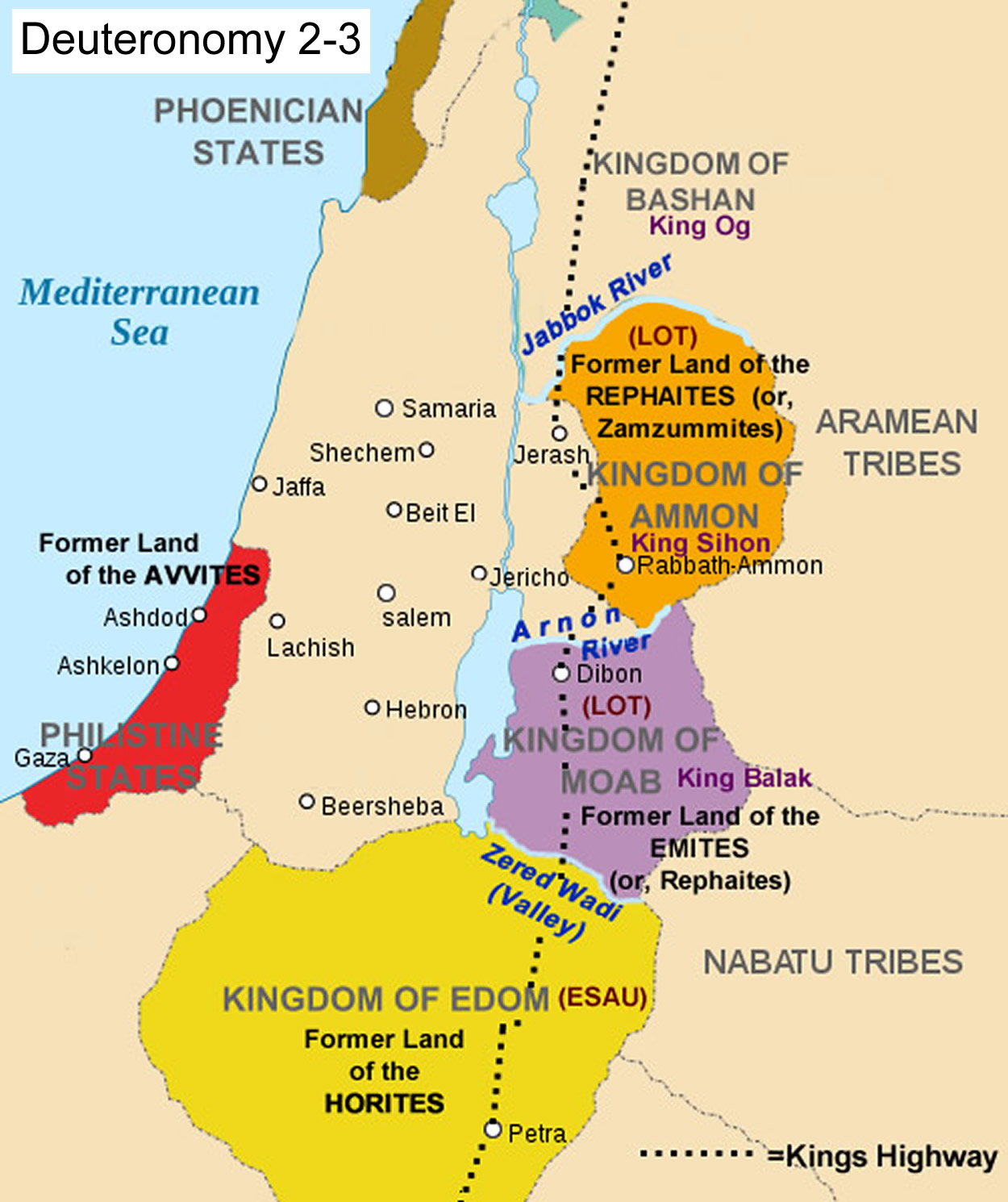
Moses makes it clear that the land in which Esau and his descendants eventually settled was far from empty. It had been occupied by another group of people known as the Horites. The first mention we have of them is found in Genesis 14, where they are listed among a group of nations that were defeated by an alliance of four kings. This confederation of kings attacked and defeated the people living in the area around Mount Seir,  in the far south of Canaan. They ended up conquering the cities of Sodom and Gomorrah, taking captive all the citizens, including the nephew of Abraham.

When Esau separated from his brother, Jacob, he ended up settling in the very same region as the Horites and, eventually, his sons and their children would supplant the Horites as the official inhabitants of the land. Hundreds of years later, when Moses prepared to lead the people of Israel into the promised land, he would receive instruction from God regarding this southern region and its inhabitants.

“You are about to pass through the territory of your brothers, the people of Esau, who live in Seir; and they will be afraid of you. So be very careful. Do not contend with them, for I will not give you any of their land, no, not so much as for the sole of the foot to tread on, because I have given Mount Seir to Esau as a possession.” – Deuteronomy 2:4-5 ESV

Moses records that Esau and his clan didn’t simply overwhelm the Horites with their superior numbers and strength, but that God orchestrated the transference of the land from one group to the other.

“…he [God] destroyed the Horites before them and they dispossessed them and settled in their place even to this day.” – Deuteronomy 2:22 ESV

The leader of the Horites was a man named Seir, and a large mountain in the region aptly bore his name. The Horites proved to be quite prolific, as the genealogy found in verses 20-43 reflects. But the chiefs of Seir and the chiefs of Esau would end up engaged in an ongoing conflict over control of the land around Mount Seir.

These are the sons of Dishan: Uz and Aran. These are the chiefs of the Horites: the chiefs Lotan, Shobal, Zibeon, Anah, Dishon, Ezer, and Dishan; these are the chiefs of the Horites, chief by chief in the land of Seir. – Genesis 36:28-30 ESV

These are the names of the chiefs of Esau, according to their clans and their dwelling places, by their names: the chiefs Timna, Alvah, Jetheth, Oholibamah, Elah, Pinon, Kenaz, Teman, Mibzar, Magdiel, and Iram; these are the chiefs of Edom (that is, Esau, the father of Edom), according to their dwelling places in the land of their possession. – Genesis 436:40-43 ESV

These two groups of “chiefs” or leaders of their clans would have gone head-to-head in battle with one another over control of the land. But what is interesting is that Moses provides a list of the kings who ruled over the land of Edom, and not one chief among the Horites or Edomites can be found on that list. It contains the name of eight Edomite kings, but none appear to be sons of Esau or Seir. In fact, one is referred to as a Temanite, another hales from Rehoboth, and still another comes from a place called Masrekah.  This sequential order of kings seems to reveal that there was a constant shift of power among the people groups that occupied this region. And Moses points out that the land of Edom had many kings long before the nation of Israel had their first monarch. Part of the reason for this disparity is that the people of Israel would eventually make their way to Egypt where they would remain for 400 years. During that time, the land of Edom would go through a long list of kings, chiefs, and leaders, while the Israelites were biding their time in Egypt. But the land of promise, like Edom, would not go unoccupied during the Israelites’ long absence. Canaan would be filled with nations, and overrun by the sins of idolatry and immorality.

And by the time Moses led the people of Israel back into the land, the  descendants of Esau (the Edomites) would be well established around Mount Seir. In keeping with God’s directive, the Israelites would view Edom as off-limits, restricting themselves to the purchase of food and supplies, but avoiding the confiscation of any Edomite territory because it had been given to them by God. And Moses states, “So we went on, away from our brothers, the people of Esau, who live in Seir, away from the Arabah road from Elath and Ezion-geber (Deuteronomy 2:8 ESV).

All of this sets up the next section of Moses’ historical record of the people of Israel. While Esau and his descendants were busy making themselves at home in Edom, Israel and his descendants would be continuing the nomadic lifestyle established by Abraham and Isaac. Moses opens up chapter seven with the statement: “Jacob lived in the land of his father’s sojournings, in the land of Canaan” (Genesis 37:1 ESV).

The Hebrew word that Moses used is מָגוּר (māḡûr), which can also be translated “to be a stranger.” That is why the New Living Translation translates verse 1 this way: “So Jacob settled again in the land of Canaan, where his father had lived as a foreigner.

Isaac, like his father before him, lived in the land of Canaan, more like an alien and a stranger than as a legal citizen. Neither Abraham or Isaac lived in a city or built a permanent dwelling place. They were sojourners, moving from one place to another, and never staying long enough to consider anywhere in the land of Canaan as their true home. And it is the author of the book of Hebrews who explains the reason behind this vagabond existence that was passed down from father to sin to grandson.

It was by faith that Abraham obeyed when God called him to leave home and go to another land that God would give him as his inheritance. He went without knowing where he was going. And even when he reached the land God promised him, he lived there by faith—for he was like a foreigner, living in tents. And so did Isaac and Jacob, who inherited the same promise. Abraham was confidently looking forward to a city with eternal foundations, a city designed and built by God. – Hebrews 11:8-10 NLT

And the author of Hebrews indicates that Abraham, Isaac, and Jacob never got to see that city – in their lifetimes.

All these people died still believing what God had promised them. They did not receive what was promised, but they saw it all from a distance and welcomed it. They agreed that they were foreigners and nomads here on earth. – Hebrews 11:13 NLT

The Edomites had kings and kingdoms. Even the Horites had a long list of chiefs and enjoyed that benefit of living in cities built by human hands. But the people of God would have to wait a long time before they experienced the fulfillment of God’s promise. God had promised to give them the land of Canaan as their inheritance, but neither Abraham, Isaac, or Jacob would make ever find their permanent home in the land of promise because God had something better in store.

Obviously people who say such things are looking forward to a country they can call their own. If they had longed for the country they came from, they could have gone back. But they were looking for a better place, a heavenly homeland. That is why God is not ashamed to be called their God, for he has prepared a city for them. – Hebrews 11:14-15 NLT

The wait would be difficult but well worth it.

English Standard Version (ESV) The Holy Bible, English Standard Version. ESV® Permanent Text Edition® (2016). Copyright © 2001 by Crossway Bibles, a publishing ministry of Good News Publishers.

New Living Translation (NLT) Holy Bible, New Living Translation, copyright © 1996, 2004, 2015 by Tyndale House Foundation. Used by permission of Tyndale House Publishers Inc., Carol Stream, Illinois 60188. All rights reserved.

New English Translation (NET)NET Bible® copyright ©1996-2017 by Biblical Studies Press, L.L.C. http://netbible.com All rights reserved.