God’s Octogenarian Tag Team

1 And the Lord said to Moses, “See, I have made you like God to Pharaoh, and your brother Aaron shall be your prophet. You shall speak all that I command you, and your brother Aaron shall tell Pharaoh to let the people of Israel go out of his land. But I will harden Pharaoh’s heart, and though I multiply my signs and wonders in the land of Egypt, Pharaoh will not listen to you. Then I will lay my hand on Egypt and bring my hosts, my people the children of Israel, out of the land of Egypt by great acts of judgment. The Egyptians shall know that I am the Lord, when I stretch out my hand against Egypt and bring out the people of Israel from among them.” Moses and Aaron did so; they did just as the Lord commanded them. Now Moses was eighty years old, and Aaron eighty-three years old, when they spoke to Pharaoh.

Then the Lord said to Moses and Aaron, “When Pharaoh says to you, ‘Prove yourselves by working a miracle,’ then you shall say to Aaron, ‘Take your staff and cast it down before Pharaoh, that it may become a serpent.’” 10 So Moses and Aaron went to Pharaoh and did just as the Lord commanded. Aaron cast down his staff before Pharaoh and his servants, and it became a serpent. 11 Then Pharaoh summoned the wise men and the sorcerers, and they, the magicians of Egypt, also did the same by their secret arts. 12 For each man cast down his staff, and they became serpents. But Aaron’s staff swallowed up their staffs. 13 Still Pharaoh’s heart was hardened, and he would not listen to them, as the Lord had said. – Exodus 7:1-13 ESV

When God first commissioned Moses for his new role as the deliverer of the people of Israel, Moses tried to use his lack of speaking skills as an excuse for turning down the position. But God responded by adding Aaron, Moses’ older brother, to the team. The two of them would become the perfect pair, with Moses serving as the silent, but highly powerful partner and Aaron performing the role of spokesman. God described their partnership this way:

“You shall speak to him [Aaron] and put the words in his mouth, and I will be with your mouth and with his mouth and will teach you both what to do. He shall speak for you to the people, and he shall be your mouth, and you shall be as God to him. And take in your hand this staff, with which you shall do the signs.” – Exodus 4:15-17 ESV

Moses would be responsible for passing on to Aaron any messages he received from the Lord, then Aaron would vocalize God’s words to the appropriate party. But all signs and wonders would be Moses’ purview. With his staff in hand, he would enact any and all miracles ordered by God to validate the message and the messengers. Even before Moses left Midian, God told him, “When you go back to Egypt, see that you do before Pharaoh all the miracles that I have put in your power. But I will harden his heart, so that he will not let the people go” (Exodus 4:21 ESV).

Upon their arrival in Egypt, Moses and his brother had run into an apparent roadblock in their efforts to deliver the people of Israel. Things had started out well when the Hebrews had received the two men and their message with open arms. But Pharaoh had proved to be a hard nut to crack, rejecting their request to allow the Israelites to go into the wilderness to worship their God. And Pharaoh subsidized his rejection by increasing the workload of the Hebrews, whom he viewed as little more than captive immigrant workers. With their hopes dashed and their daily lives marked by suffering and pain, the Israelites lashed out at Moses and Aaron, blaming them for their circumstances. This led Moses to take out his frustration on God.

“O Lord, why have you done evil to this people? Why did you ever send me? For since I came to Pharaoh to speak in your name, he has done evil to this people, and you have not delivered your people at all.” – Exodus 5:22-23 ESV

But none of this should have come as a shock to Moses. God had warned him that Pharaoh would not be cooperative. What is interesting to note is that words were never going to be the means by which God accomplished His will in Egypt. Pharaoh was never going to be coerced or convinced by words alone. And while Moses had been worrying about his lack of rhetorical skills, he should have listened to what God had said.

“When you go back to Egypt, see that you do before Pharaoh all the miracles that I have put in your power. But I will harden his heart, so that he will not let the people go. Then you shall say to Pharaoh, ‘Thus says the Lord, Israel is my firstborn son, and I say to you, “Let my son go that he may serve me.” If you refuse to let him go, behold, I will kill your firstborn son.’” – Exodus 4:21-23 ESV

The miracles would be the means by which God orchestrated the release of His people. And God told Moses that one particular miracle would prove to be the deciding factor in persuading Pharaoh to let God’s people go.

As chapter seven opens, the roles of Aaron and Moses remain the same. Aaron will continue to act as the mouthpiece for the pair, while Moses performs all the signs. But God informs them that even all the signs and wonders Moses displays before Pharaoh will do nothing to change his mind.

“I will harden Pharaoh’s heart, and though I multiply my signs and wonders in the land of Egypt, Pharaoh will not listen to you.” – Exodus 7:3-4 ESV

In a sense, God is letting Moses know that the initial signs he performs will appear as little more than cheap parlor tricks to Pharaoh. He will be impressed but not enough to change his mind. And as this chapter reveals, the magicians of Egypt will replicate many of the signs that Moses performs, further negating their influence. But God told Moses that another set of signs and wonders was coming.

“Then I will lay my hand on Egypt and bring my hosts, my people the children of Israel, out of the land of Egypt by great acts of judgment. The Egyptians shall know that I am the Lord, when I stretch out my hand against Egypt and bring out the people of Israel from among them.” – Exodus 7:4-5 ESV

These “great acts of judgment” were going to take things to a whole new level. And God wanted His two messengers to know that the simple, yet impressive signs He had instructed Moses to perform were just the beginning. There was far more to come.

But God instructed them to go before Pharaoh and do just as He had commanded them to do. Pharaoh was going to demand that they provide some kind of sign to prove that they were truly representatives of the Hebrews’ deity.

“When Pharaoh says to you, ‘Prove yourselves by working a miracle,’ then you shall say to Aaron, ‘Take your staff and cast it down before Pharaoh, that it may become a serpent.’” – Exodus 7:9 ESV

In this instance, it would be Aaron who did double duty, speaking to Pharaoh but also performing the sign from God. When they appeared before Pharaoh, he demanded a sign just as God had predicted, and Aaron did as God commanded. He threw his staff to the ground and it became a snake. But Aaron and Moses must have been shocked when the Egyptian magicians quickly replicated the sign by turning their own staffs into snakes. The text provides no explanation for how the magicians managed to do what they did. But there are only a few options available. Either these men did what they did by the power of Satan or God did it. The second choice makes the most sense. Since the staff of Aaron possessed no power in and of itself, it had to be God who made this miraculous transformation possible. The sign was His idea. So, when the magicians threw down their staffs, God displayed His power yet again, and the magicians were probably amazed by what they saw. It is likely that they never expected their efforts to be successful. But the real demonstration of God’s power was in what happened next.

But Aaron’s staff swallowed up their staffs. – Exodus 7:12 ESV

This powerful demonstration of God’s power would have validated Aaron as His spokesman. God was the one who turned all the staffs into snakes and He was the one who gave Aaron’s staff primacy over all the others. God was declaring Aaron and Moses to be His official representatives. But Pharaoh remained unimpressed and unwavering in his commitment to deny the Israelites their freedom.

Still Pharaoh’s heart was hardened, and he would not listen to them, as the Lord had said. – Exodus 7:13 ESV

Now the stage was set. Pharaoh knew he was dealing with two men who had true power. Yet, he remained just as fervent in his desire to keep the Israelites in their role as free slave labor. He was not about to give up this valuable asset, even when faced with Aaron’s display of magical power. It was going to take a lot more than that to change his heart and God knew it. Not only that, God had ordained it.

But as this scene in the royal palace comes to a close, it is essential that we not gloss over the small detail that Moses discloses in the narrative.

Now Moses was eighty years old, and Aaron eighty-three years old, when they spoke to Pharaoh. – Exodus 7:7 ESV

As the old adage states, these two men were not spring chickens. They would be considered old in just about any cultural context, but in that day and age, they would have been ancient. Moses spent 40 years of his life in Pharaoh’s court before fleeing to Midian. There, he lived another 40 years in relative obscurity and anonymity. And at the ripe old age of 80, God called Moses to serve as the deliverer of His people. This octogenarian was destined to be the God-ordained savior of the Israelite people. He had been for this role and God had planned for his starting date to begin at age 80.

“D. L. Moody wittily said that Moses spent forty years in Pharaoh’s court thinking he was somebody; forty years in the desert learning he was nobody; and forty years showing what God can do with somebody who found out he was nobody.” – Bernard Ramm, His Way Out

I can’t help but think of the movie, “Grumpy Old Men,” starring Jack Lemmon and Walter Matthau. It is difficult not to see Moses and Aaron as two crusty old senior citizens with bad backs, diminished hearing, and poor eyesight. When they should have been playing canasta in the old folks’ home, they were serving as God’s emissaries in the court of Pharaoh. They would not have been impressive to look at. Their presence would not have struck fear into Pharaoh. But these two unlikely candidates had been chosen by God to carry out His sovereign plan for delivering His people. And, with His help, they would prove more than adequate for the task.

English Standard Version (ESV) The Holy Bible, English Standard Version. ESV® Permanent Text Edition® (2016). Copyright © 2001

New Living Translation (NLT) Holy Bible, New Living Translation, copyright © 1996, 2004, 2015 by Tyndale House Foundation. Used by permission of Tyndale House Publishers Inc., Carol Stream, Illinois 60188. All rights reserved.
Faith Is the Victory

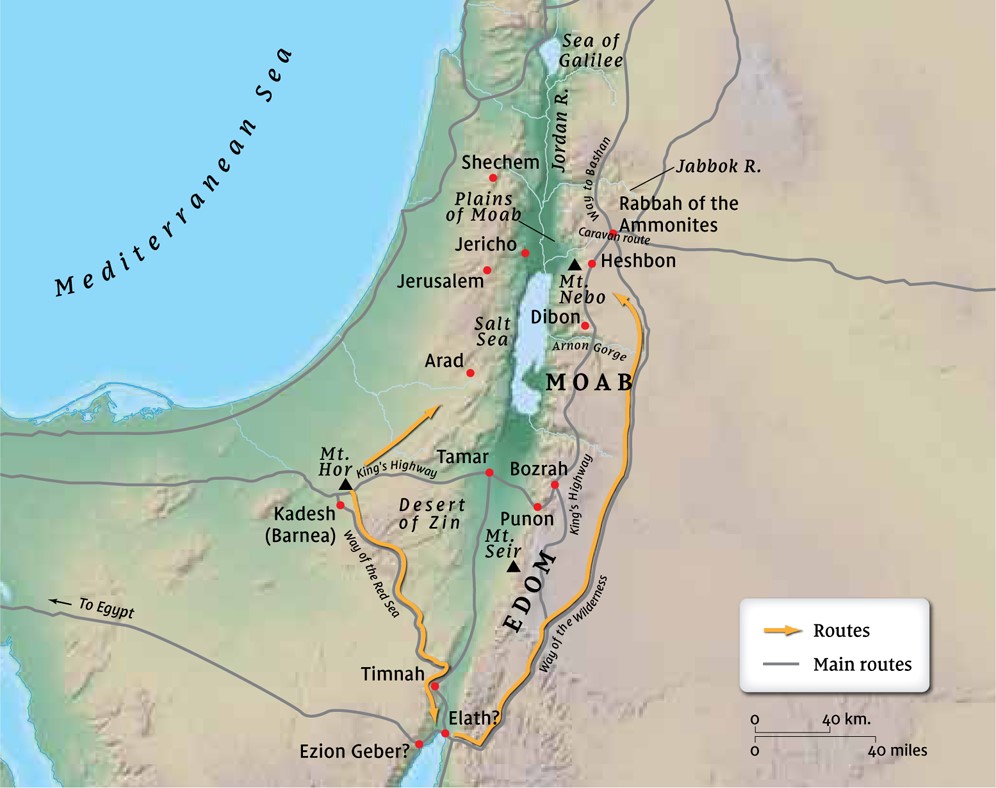
1 When the Canaanite, the king of Arad, who lived in the Negeb, heard that Israel was coming by the way of Atharim, he fought against Israel, and took some of them captive. And Israel vowed a vow to the Lord and said, “If you will indeed give this people into my hand, then I will devote their cities to destruction.” And the Lord heeded the voice of Israel and gave over the Canaanites, and they devoted them and their cities to destruction. So the name of the place was called Hormah.

From Mount Hor they set out by the way to the Red Sea, to go around the land of Edom. And the people became impatient on the way. And the people spoke against God and against Moses, “Why have you brought us up out of Egypt to die in the wilderness? For there is no food and no water, and we loathe this worthless food.” Then the Lord sent fiery serpents among the people, and they bit the people, so that many people of Israel died. And the people came to Moses and said, “We have sinned, for we have spoken against the Lord and against you. Pray to the Lord, that he take away the serpents from us.” So Moses prayed for the people. And the Lord said to Moses, “Make a fiery serpent and set it on a pole, and everyone who is bitten, when he sees it, shall live.” So Moses made a bronze serpent and set it on a pole. And if a serpent bit anyone, he would look at the bronze serpent and live. Numbers 21:1-9 ESV

One of the things the Israelites seemed to quickly forget was that their presence in the wilderness was their own fault. God had led them from Egypt to the edge of the land of promise 40 years earlier, but they had decided that entrance into the land was way too risky. The 12 spies they had in to reconnoiter the land had returned with a conflicting report concerning conditions in Canaan.

“We entered the land you sent us to explore, and it is indeed a bountiful country—a land flowing with milk and honey. Here is the kind of fruit it produces. But the people living there are powerful, and their towns are large and fortified. We even saw giants there, the descendants of Anak! – Numbers 13:27-28 ESV

The second half of their report left the Israelites dejected and demoralized. Despite the news that this land was fertile and filled with abundant fruit, the presence of “giants” was too much for the Israelites. And the spies fed their doubts and anxieties by confirming their worst fears.

“We can’t go up against them! They are stronger than we are!” So they spread this bad report about the land among the Israelites: “The land we traveled through and explored will devour anyone who goes to live there. All the people we saw were huge. We even saw giants there, the descendants of Anak. Next to them we felt like grasshoppers, and that’s what they thought, too!” – Numbers 13:31-33 ESV

These rumors succeeded in convincing the Israelites that God’s promise of victory over their enemies was impossible. Rather than enter the land and risk certain death, they decided it would make more sense to return to Egypt. This bit of twisted logic earned them the wrath of God. He made the fateful decision to allow that entire generation to spend the rest of their lives wandering aimlessly in the wilderness until none of them was left. They would not be allowed to enter Canaan or return to Egypt. Instead, they would spend the remaining days of their lives in a kind of existential limbo that lasted four decades.

During that time, both Miriam and Aaron died. Many of their friends and family members succumbed to the effects of old age and illness. And they all discovered that life in the wilderness was no picnic. Their persistent presence near the borders of Canaan had attracted the attention of the land’s occupants. These nations had heard the rumors about this massive host of people who had escaped from Egypt and were headed their way. It is likely that they knew the Israelites to be the descendants of Jacob and were afraid that they would be looking to find a place to live. This was a migrant problem of epic proportions. The thought of two million-plus Israelites invading their borders caused these nations to react with fear and brute force.

The last chapter revealed that the Edomites sent a large army to dissuade the Israelites from attempting to pass through their land. They wanted nothing to do with them. And now, “The Canaanite king of Arad, who lived in the Negev, heard that the Israelites were approaching on the road through Atharim. So he attacked the Israelites and took some of them as prisoners” (Numbers 21:2 NLT). Nothing was going well for the Israelites. As a nation, they were persona non grata. They had no home and were finding the nations outside the borders of Canaan to be just as dangerous as the “giants“ they had refused to confront. Their refusal to enter the land had come with serious repercussions.

Yet, there is one glimmer of hope in this dark period of Israel’s existence. Their self-inflicted troubles caused them to call out to God. When some of their people were captured by the forces of the king of Arad, the Israelites begged God to come to their aid. And what’s interesting to note is that these very same people who had seen the odds in Canaan as insurmountable were suddenly ready to take on all comers. They even made a vow to completely annihilate the opposition if God would come to their aid.

“If you will hand these people over to us, we will completely destroy all their towns.” – Numbers 21:2 NLT

What makes this even more fascinating is that the Israelites had been here before. Thirty-eight years earlier, after having refused to enter the land of Canaan the first time, God had sentenced them to their life of wandering in the wilderness. In response to this death sentence from God, they quickly changed their minds and decided to enter the land after all. But Moses warned them that it was too late.

“Why are you now disobeying the Lord’s orders to return to the wilderness? It won’t work. Do not go up into the land now. You will only be crushed by your enemies because the Lord is not with you. When you face the Amalekites and Canaanites in battle, you will be slaughtered. The Lord will abandon you because you have abandoned the Lord.” – Numbers 14:41-43 NLT

But the people refused to listen, and “defiantly pushed ahead toward the hill country, even though neither Moses nor the Ark of the Lord’s Covenant left the camp” (Numbers 14:44 NLT). The result was a rout. The Israelites were soundly defeated because they attempted to take on their enemies without God’s permission or help.

Now, 38 years later, they decided to seek God’s assistance, and He “heard the Israelites’ request and gave them victory over the Canaanites. The Israelites completely destroyed them and their towns” (Numbers 22:3 NLT). Amazingly, what they had feared was impossible four decades earlier, was actually quite easy when they did it God’s way. Their victory was assured when they chose to seek God’s permission and assistance.

But even after that exhilarating display of God’s power, they quickly reverted to their old habit of complaining about their lot in life. While they had enjoyed a great victory, they were not allowed to occupy the towns they had conquered. Instead, they had to backtrack to Mount Hor and then travel further south and east in order to skirt the borders of Edom. They had gotten a taste of success, but still found themselves cursed to wander through the wilderness. Those conquered cities and villages were not theirs to occupy.

And as the people made the long trek around Edom, the thrill of victory soon gave way to the agony of defeat and despair.

…the people grew impatient with the long journey, and they began to speak against God and Moses. “Why have you brought us out of Egypt to die here in the wilderness?” they complained. “There is nothing to eat here and nothing to drink. And we hate this horrible manna!” – Numbers 21:4-5 NLT

The incessant wandering they had brought on themselves soon led to discontentment and dissidence with God’s will. They were not happy with the way things were going and they let Moses know. And God let them have it. He sent a plague of poisonous snakes among them, and soon the bodies of the dead began to pile up. And suddenly, the people were singing a different tune.

“We have sinned by speaking against the Lord and against you. Pray that the Lord will take away the snakes.” – Numbers 21:7 NLT

God’s judgment produced a confession. The people repented of their sin and begged Moses to intercede on their behalf and ask God to remove the curse of the snakes. And when Moses sought God, he was given the following instructions.

“Make a replica of a poisonous snake and attach it to a pole. All who are bitten will live if they simply look at it!” – Numbers 21:8 NLT

This rather strange command makes it appear as if God was asking Moses to make an idol. But the serpent on a stick was not meant to be worshiped. It was intended to be a test of their faith.

God did not answer their request to remove the snakes. In fact, He indicated that the snakes would continue to do what He had sent them to do. They would keep inflicting pain, suffering, and death upon the Israelites as punishment for their ingratitude and dishonor of His holiness. What God did was create a rather bizarre plan for receiving deliverance over certain death. When bitten, all the people had to do was look at the serpent on the pole and they would be healed. But that simple glance would require faith.

God did not remove the penalty for their sins. They would still be bitten by the snakes. But now they had a means of receiving life rather than death. The bite of the snake would no longer prove deadly. But the secret to receiving life rather than death was faith – the belief that God could and would heal. And that faith required the one who had been bitten to look their death sentence in the face. They had to turn their eyes to the pole and see their condemnation on public display. And if they refused, they would die.

And the apostle John would later record the words of Jesus where He stated that this entire scene in the wilderness was meant to foreshadow His coming and His substitutionary death on the cross.

…the Son of Man has come down from heaven. And as Moses lifted up the bronze snake on a pole in the wilderness, so the Son of Man must be lifted up, so that everyone who believes in him will have eternal life. – John 3:13-15 NLT

When a sinner looks at the cross, he sees the wrath of God poured out on the sins of mankind. Jesus was not the cause of our death but the means of our victory over it. He bore our sins so that we might not have to pay for them with our own lives. And that is exactly what the apostle Paul told the believers in Corinth.

God made Him who knew no sin to be sin on our behalf, so that in Him we might become the righteousness of God. – 2 Corinthians 5:21 BSB

And Peter would state the same blessed hope.

He himself bore our sins in his body on the tree, that we might die to sin and live to righteousness. By his wounds you have been healed. – 1 Peter 2:24 ESV

And the key to victory over death is faith. One must “believe in Him” to be saved. The Israelites had only to look at the serpent on the pole to be saved from death. And all those under the death sentence that comes as a result of sin need only look at the cross of Christ to receive life everlasting.

It should be noted that this entire scene began with the people complaining about the manna that God had graciously given as a source of life. Their ingratitude was met with God’s judgment. They had refused His offer of the bread of life and faced the sting of death. And the only means of salvation would be faith in His mercy and grace.

“The bread is a picture of Jesus; as the Bread of Heaven he is the proper nourisher of his people. The bronze snake is a picture of Jesus, who became sin for us as he hung on that awful tree. The manna had to be eaten. The snake had to be seen. The commands of Scripture are for doing. The manna was no good if left to rot. The metal snake would not avail if none looked at it. The manna and the snake are twin aspects of the grace of God.” – Ronald B. Allen, “Numbers.” In Genesis—Numbers. Vol. 2 of The Expositor’s Bible Commentary

English Standard Version (ESV) The Holy Bible, English Standard Version. ESV® Permanent Text Edition® (2016). Copyright © 2001

New Living Translation (NLT) Holy Bible, New Living Translation, copyright © 1996, 2004, 2015 by Tyndale House Foundation. Used by permission of Tyndale House Publishers Inc., Carol Stream, Illinois 60188. All rights reserved.

A Costly Choice

16 To the woman he said,

“I will surely multiply your pain in childbearing;
    in pain you shall bring forth children.
Your desire shall be contrary to your husband,
    but he shall rule over you.”

17 And to Adam he said,

“Because you have listened to the voice of your wife
    and have eaten of the tree
of which I commanded you,
    ‘You shall not eat of it,’
cursed is the ground because of you;
    in pain you shall eat of it all the days of your life;
18 thorns and thistles it shall bring forth for you;
    and you shall eat the plants of the field.
19 By the sweat of your face
    you shall eat bread,
till you return to the ground,
    for out of it you were taken;
for you are dust,
    and to dust you shall return.” Genesis 3:16-19 ESV

God cursed the serpent and, by extension, Satan, the one who had been behind the entire forbidden fruit incident. But now, He turns His attention to the two VIPs of His creation. Adam and Eve had been formed by the very hand of God and given the exclusive privilege of bearing His image. Not only that, they had been given the distinctive responsibility to act as God’s vice-regents, ruling over and caring for all that He had made. They were to have been stewards over the vast and diverse earthly domain God had created.

Eve had succumbed to the serpent’s temptation and eaten the fruit of the one tree God had decreed as off-limits. And it wasn’t so much the act of fruit consumption that got Eve in trouble. It was the motivation behind the act. When Eve heard the serpent promise that eating the fruit would not lead to death, she had believed him.

The woman was convinced. She saw that the tree was beautiful and its fruit looked delicious, and she wanted the wisdom it would give her. So she took some of the fruit and ate it. – Genesis 3:6 NLT

Eve was out to satiate a hunger that had nothing to do with food. She wanted to “be like God, knowing both good and evil” (Genesis 3:5 NLT). Eve’s brief exchange with the serpent had left her with a seemingly insatiable desire for sovereignty and autonomy. Eve didn’t suffer from a vitamin D deficiency. She wasn’t born with a forbidden fruit fetish. No, she had an authority problem. She wanted to be in control. And it seems that her mate shared her predisposition for independence and self-rule because he quickly joined her in eating the fruit. And, according to the book of James, they had no one to blame but themselves.

And remember, when you are being tempted, do not say, “God is tempting me.” God is never tempted to do wrong, and he never tempts anyone else. Temptation comes from our own desires, which entice us and drag us away. These desires give birth to sinful actions. And when sin is allowed to grow, it gives birth to death. – James 1:13-15 NLT

This raises a somewhat disconcerting question. Why did God place the tree of the knowledge of good and evil in the garden in the first place? It seems that, in so doing, God provided a form of “temptation” for Adam and Eve. It seems only logical that had the tree not been there in the first place, Eve would not have been tempted to eat of its fruit. But this is an overly simplistic deduction. According to the Westminister Confession of Faith, God had preordained the potential for sin because He had also preordained the solution to the problem it would cause.

Our first parents, begin seduced by the subtlety and temptations of Satan, sinned in eating the forbidden fruit. This their sin God was pleased, according to His wise and holy counsel, to permit, having purposed to order it to His own glory. – Westminster Confession of Faith, 6:1

By placing the tree in the garden, God established a test, but not a temptation. Notice what the text states about the tree and its fruit.

…the tree was good for food, and that it was a delight to the eyes… – Genesis 3:6 ESV

There was nothing inherently wrong with the quality of the fruit. It was not poisonous or potentially deadly. In fact, after Adam and Eve ate the fruit, they remained fully alive. Satan had been partially correct when he stated, “You will not surely die” (Genesis 3:4 ESV). The tree and its fruit were not the problems. The tree of the knowledge of good and evil was not, in and of itself, evil. It was as holy and pure as any other tree that God had placed in the garden. But God had set it apart and declared it off-limits to Adam and Eve. He deemed one tree as forbidden. And that one tree would become a test of Adam and Eve’s obedience. Would they obey God’s command and refrain from eating the fruit of that one tree? God knew the answer to that question because He had already come up with the solution to the problem it would cause. As was revealed in God’s curse of the serpent, He had already pre-ordained the coming of the offspring who would eventually bruise the serpent’s head.

God had created the universe and all that it contained, and He had declared it all to be “very good.” Then He had placed Adam and Eve in that perfectly holy and sinless environment. Hermann Bavinck provides us with a somewhat head-scratching analysis of the situation in which Adam and Eve found themselves.

“The possibility of sinning is from God. The idea of sin was first conceived in his mind. God eternally conceived sin as his absolute polar opposite and thus, in that sense, included it in his decree, or else it would never have been able to arise and exist in reality. It was not Satan, nor Adam and Eve, who first conceived of the idea of sin; God himself as it were made it visible to their eyes. By means of the tree of the knowledge of good and evil and the probationary command, he clearly showed human beings the two roads they could take. And before the fall he even permitted an evil power from without to insinuate itself into Paradise, using the snake as its medium, and to discuss with Eve the meaning of the probationary command. There is therefore no doubt that God willed the possibility of sin.” – Hermann Bavinck, Reformed Dogmatics

Notice his emphasis that God “willed the possibility of sin.”  God did not force Adam and Eve to eat the fruit. They made that decision on their own. God had provided them with more than enough food options to fulfill their daily nutritional requirements. But they wanted the one thing they were told they could not have. They made a choice. In choosing the forbidden fruit they were really choosing to doubt and disobey God. Their decision revealed their unwillingness to trust God and submit to His will for their lives.

God had created Adam and Eve with the capacity for reason and self-determination. They were not automatons, operating by pure animal instinct. Created in God’s image, they bore an intelligence unequaled by any other living creature. They could speak, discern, process information, and make rational decisions. In other words, they had the ability to choose what they would do. Built into the kingdom mandate God had given Adam and Eve was the possibility that they might decide to disobey it. He had commanded them to be fruitful and multiply. But they could have chosen to disobey that command. The rest of the creative order procreated according to instinct. The other living creatures lacked the God-given capacity to think for themselves.
They did as God had designed them to do. But Adam and Eve had been equipped with the God-ordained capacity to obey or disobey.

And because they had chosen to exercise their option to disobey, they were doomed to suffer the consequences. The painful lesson Adam and Eve learned that fateful day was that, as finite creatures, they were completely dependent upon God for their very existence. They owed Him their lives and they were reliant upon Him for all their needs. And yet, they had chosen autonomy over dependency – a decision that would cost them dearly.

God communicated His displeasure with Eve by explaining the “fruit” of her sin.

“I will sharpen the pain of your pregnancy,
    and in pain you will give birth.
And you will desire to control your husband,
    but he will rule over you.” – Genesis 3:16 NLT

From this point forward, the woman would find obedience to God’s command to be fruitful and multiply marked by pain and suffering. And the complementary and co-equal relationship God had given her and Adam would be replaced by a competitive and sometimes combative spirit. With the introduction of sin, the “one flesh” nature of the husband and wife relationship would be difficult to maintain. Selfishness would replace the symbiosis God had originally planned for marriage.

But God saved His harshest words and strongest punishment for Adam. Because Adam had chosen to listen to his wife and eat of the fruit that God had forbidden, he would find his role as steward of God’s creation to become a burden rather than a blessing.

“Since you listened to your wife and ate from the tree
    whose fruit I commanded you not to eat,
the ground is cursed because of you.
    All your life you will struggle to scratch a living from it. – Genesis 3:17 NLT

God had always intended for Adam to labor. Work was always intended to be a blessing, not a curse.

The Lord God took the man and put him in the garden of Eden to work it and keep it. – Genesis 2:15 ESV

But because Adam chose to disobey God, he would find His God-ordained mandate to be burdensome and back-breaking. God actually cursed the ground, causing it to sprout thorns and thistles. Planting would become difficult. Harvesting would be hit or miss. The ground would still provide the food man needed, but it would not release its bounty easily. God warned Adam:

“By the sweat of your brow
    will you have food to eat
until you return to the ground
    from which you were made.
For you were made from dust,
    and to dust you will return.” – Genesis 3:19 NLT

For the first time since God placed Adam in the garden, He reveals the invading presence of death. He had warned Adam that eating the fruit of the forbidden tree would result in death. But the fruit would not be the source of Adam’s demise. His body would now suffer the consequences of living in a fallen world where the ravages of time and toil would take their toll. Man, whom God had formed from the dust of the ground would return to from whence he came. The breath of life would be removed and his body would be returned to its original state.

This section of the creation narrative paints a bleak and sobering picture. And with it, Moses provides the backdrop for all that will follow. The rest of the book will detail the subsequent and far-reaching ramifications of that one fateful decision. Sin had entered the world and its influence would be felt for generations to come.

English Standard Version (ESV) The Holy Bible, English Standard Version. ESV® Permanent Text Edition® (2016). Copyright © 2001 by Crossway Bibles, a publishing ministry of Good News Publishers.

New Living Translation (NLT) Holy Bible, New Living Translation, copyright © 1996, 2004, 2015 by Tyndale House Foundation. Used by permission of Tyndale House Publishers Inc., Carol Stream, Illinois 60188. All rights reserved.

New English Translation (NET)NET Bible® copyright ©1996-2017 by Biblical Studies Press, L.L.C. http://netbible.com All rights reserved.

The Short Journey from Doubt to Disobedience

1 Now the serpent was more crafty than any other beast of the field that the Lord God had made.

He said to the woman, “Did God actually say, ‘You shall not eat of any tree in the garden’?” And the woman said to the serpent, “We may eat of the fruit of the trees in the garden, but God said, ‘You shall not eat of the fruit of the tree that is in the midst of the garden, neither shall you touch it, lest you die.’” But the serpent said to the woman, “You will not surely die. For God knows that when you eat of it your eyes will be opened, and you will be like God, knowing good and evil.” So when the woman saw that the tree was good for food, and that it was a delight to the eyes, and that the tree was to be desired to make one wise, she took of its fruit and ate, and she also gave some to her husband who was with her, and he ate. Then the eyes of both were opened, and they knew that they were naked. And they sewed fig leaves together and made themselves loincloths. Genesis 3:1-7 ESV

With the opening of chapter three, the story takes a sudden and decidedly dark turn. The preceding chapter ended with the first marriage ceremony, officiated over by God Himself, as He joined together as “one flesh,” the man and woman He had created. It had been an idyllic scene, as Adam welcomed his new wife.

“At last!” the man exclaimed.

“This one is bone from my bone,
    and flesh from my flesh!
She will be called ‘woman,’
    because she was taken from ‘man.’” – Genesis 2:25 NLT

And Moses ended that chapter by noting that “the man and his wife were both naked, but they felt no shame” (Genesis 2:25 NLT). They enjoyed a relationship built on innocence, transparency, and complete trust. They were just as God had intended them to be and, together, they enjoyed the bountiful and beautiful environment He had prepared for them. Yet, their state of unadulterated innocence and intimacy was about to change – forever.

One day, as Eve walked in the garden, she was confronted by one of the other “living creatures.“ In a scene straight out of a Harry Potter novel, Eve is confronted by a beautiful and particularly beguiling serpent. Surprisingly, Eve does not seem to be shocked at the creature’s capacity to speak. Due to her recent arrival on the scene, Eve may have not yet interacted with any of the other animals, so she would have been unaware that the capacity of speech was solely restricted to humans. The fact that the serpent spoke to her does not seem to surprise her. But the words that come from the mouth of the serpent will have life-altering implications.

It is interesting to note the wordplay that takes place between verse 25 of chapter two and verse 1 of chapter three. In Hebrew, the word for “naked” is עָרוֹם (ʿārôm), and the word used to describe the craftiness of the serpent is עָרוּם (ʿārûm). Moses, writing under the inspiration of the Holy Spirit, uses these two words to differentiate between Eve, the innocent protagonist, and the serpent, the clever and cunning antagonist. The serpent is going to make a full-frontal assault on the child-like innocence and inexperience of Eve.

But before preceding, we have to address the issue of the serpent’s identity. Was this just another snake in the garden? It would seem that the answer is no. This serpent displayed the capacity to reason and speak. Moses describes it as being “more crafty than any other beast of the field that the Lord God had made” (Genesis 3:1 ESV). This statement could indicate that the serpent was not one of God’s creations. Then where did it come from? Most biblical scholars agree that the serpent was a manifestation of Satan himself. The prophet Ezekiel describes Satan as being in Eden.

You were in Eden, the garden of God;
    every precious stone was your covering,
sardius, topaz, and diamond,
    beryl, onyx, and jasper,
sapphire, emerald, and carbuncle;
    and crafted in gold were your settings
    and your engravings.
On the day that you were created
    they were prepared.
You were an anointed guardian cherub.
    I placed you; you were on the holy mountain of God;
    in the midst of the stones of fire you walked.
You were blameless in your ways
    from the day you were created,
    till unrighteousness was found in you. – Ezekiel 28:13-15 ESV

And Ezekiel describes the ignominious fall of this “anointed guardian cherub” who had been “full of wisdom and perfect in beauty” (Ezekiel 28:12 ESV).

Your heart was proud because of your beauty;
    you corrupted your wisdom for the sake of your splendor.
I cast you to the ground;
    I exposed you before kings,
    to feast their eyes on you. – Ezekiel 28:17 ESV

And the prophet Isaiah provides further insights into Satan’s epic fall from grace.

“How you are fallen from heaven,
    O Day Star, son of Dawn!
How you are cut down to the ground,
    you who laid the nations low!
You said in your heart,
    ‘I will ascend to heaven;
above the stars of God
    I will set my throne on high;
I will sit on the mount of assembly
    in the far reaches of the north;
I will ascend above the heights of the clouds;
    I will make myself like the Most High.’” – Isaiah 14:12-14 ESV

Satan, desiring to be as God, had led an angelic insurrection against the Almighty. But his attempt to overthrow and replace God had failed and he was cast down to earth. In the book of Revelation, John provides an apt description of this former ministering angel. He refers to him as “that ancient serpent, who is called the devil and Satan, the deceiver of the whole world” (Revelation 12:9 ESV). Jesus described Satan as “a murderer from the beginning” (John 8:44 ESV). With this statement, Jesus seems to indicate Satan’s role in the fall. He played the part of the deceiver, using lies and half-truths to persuade Adam and Eve to rebel against God. And Jesus went on to explain that Satan “does not stand in the truth, because there is no truth in him. When he lies, he speaks out of his own character, for he is a liar and the father of lies” (John 8:44 ESV).

It seems clear that the serpent was merely a tool, a deceptive prop in the hands of Satan. It could be that Satan even disguised himself in the guise of a serpent in order to infiltrate the garden and catch the unsuspecting Eve off guard. The apostle Paul, when calling the false teachers who were deceiving local congregations, he described them as “deceitful workman, disguising themselves as apostles of Christ” (2 Corinthians 11:13 ESV). Then, he went on to explain the source of their deception.

And no wonder, for even Satan disguises himself as an angel of light. So it is no surprise if his servants, also, disguise themselves as servants of righteousness. Their end will correspond to their deeds. – 2 Corinthians 11:14-15 ESV

It doesn’t require a stretch of the imagination to consider Satan as disguising himself as a serpent. In that form, he was able to approach Eve and raise questions about the integrity and trustworthiness of God. He may have been cast down, but he had not yet given up his desire to replace God. This time, he chose to attack God’s chosen image-bearers in an effort to dissuade them from the kingdom mandate they had been given. And his weapon of choice was deceit, designed to produce doubt, which would eventually lead to disobedience. He began his conversation with Eve by asking a cleverly worded question:

“Did God actually say, ‘You shall not eat of any tree in the garden’?” – Genesis 2:1 ESV

He was testing her knowledge and understanding of God’s command concerning the trees of the garden. But he was also subtly encouraging Eve to doubt the integrity of God’s word.

But Eve calmly responded, “We may eat of the fruit of the trees in the garden, but God said, ‘You shall not eat of the fruit of the tree that is in the midst of the garden, neither shall you touch it, lest you die’” (Genesis 3:2-3 ESV). But Eve exposed her ignorance of God’s command by adding the inaccurate prohibition against touching the tree. Her answer was only partially correct, and this opened the door to Satan’s next salvo.

“You will not surely die. For God knows that when you eat of it your eyes will be opened, and you will be like God, knowing good and evil.” – Genesis 3:4-5 ESV

With this one statement, Satan planted the seeds of doubt that would soon spring forth into full-grown disobedience. He blatantly refuted the word of God by declaring that eating the fruit of the forbidden tree would result in life, not death. He insinuated to Even that God was holding out on them. The Almighty was trying to prevent them from experiencing all that they were meant to be. He asserted that if they actually disobeyed God and ate of the tree of the knowledge of good and evil, they would be like God. In other words, the fruit would give them the capacity to determine right from wrong. They would become autonomous and self-governing. In a sense, they would be like God in that they would be able to determine what was best for themselves. They would no longer have to live by God’s restrictive and repressive rules.

Satan portrayed God as the deceiver. He turned the tables and cast God as the villain in the story. It was Yahweh who was keeping them from enjoying their well-deserved freedom and right to self-determination.

And Eve quickly succumbed to Satan’s tempting ploy. Moses states that “the woman saw that the tree was good for food, and that it was a delight to the eyes, and that the tree was to be desired to make one wise” (Genesis 3:6 ESV). She immediately experienced what the apostle John would later describe as “a craving for physical pleasure, a craving for everything we see, and pride in our achievements and possessions” (1 John 2:16 NLT). She fell in love with the fruit and all that it could offer. And she ate. She gave in to the temptation. Not only that, she shared the forbidden fruit with her husband. Yes, Adam was there. He had been the entire time. He had heard the entire conversation between Eve and the serpent and had never spoken up. It had been to Adam that God had given the original warning concerning the tree.

And the Lord God commanded the man, saying, “You may surely eat of every tree of the garden, but of the tree of the knowledge of good and evil you shall not eat, for in the day that you eat of it you shall surely die.” – Genesis 2:16-17 ESV

He knew exactly what God had said and should have refuted the lies of the serpent. But, instead, Adam followed his wife’s lead and accepted her offer of the fruit. He too, doubted God’s word and made the fateful decision to disobey God’s command. And the rest, they say, is history. Moses sadly states, “the eyes of both were opened, and they knew that they were naked” (Genesis 3:7 ESV). They got exactly what the serpent had promised: Their eyes were opened. But what they saw disturbed them. Rather looking on one another’s innocence, they viewed themselves in the guise of guilt. They had sinned and they knew it. And they immediately tried to cover their nakedness and hide themselves from the all-seeing eyes of God.  

English Standard Version (ESV) The Holy Bible, English Standard Version. ESV® Permanent Text Edition® (2016). Copyright © 2001 by Crossway Bibles, a publishing ministry of Good News Publishers.

New Living Translation (NLT) Holy Bible, New Living Translation, copyright © 1996, 2004, 2015 by Tyndale House Foundation. Used by permission of Tyndale House Publishers Inc., Carol Stream, Illinois 60188. All rights reserved.

New English Translation (NET)NET Bible® copyright ©1996-2017 by Biblical Studies Press, L.L.C. http://netbible.com All rights reserved.