The Great Physician

13 He went out again beside the sea, and all the crowd was coming to him, and he was teaching them. 14 And as he passed by, he saw Levi the son of Alphaeus sitting at the tax booth, and he said to him, “Follow me.” And he rose and followed him.

15 And as he reclined at table in his house, many tax collectors and sinners were reclining with Jesus and his disciples, for there were many who followed him. 16 And the scribes of the Pharisees, when they saw that he was eating with sinners and tax collectors, said to his disciples, “Why does he eat with tax collectors and sinners?” 17 And when Jesus heard it, he said to them, “Those who are well have no need of a physician, but those who are sick. I came not to call the righteous, but sinners.” – Mark 2:13-17 ESV

Jesus had just displayed His power and authority over the physical realm by healing the paralyzed man. But more importantly, His astonishing ability to restore the man’s health demonstrated His God-given authority to forgive sin. As the Son of God, Jesus came to earth to set men free from slavery to sin and the death sentence that accompanied it. The formerly paralyzed man, while now physically whole and forgiven, would still commit sins and face the ultimate penalty for doing so: physical death and eternal separation from God.

But Jesus became a man so He could serve as the substitutionary atonement, the ultimate sacrifice for the sins of mankind. His death on behalf of sinful humanity would satisfy the just and righteous wrath of God, and provide all those who placed their faith in His atoning work with a way to be restored to a right relationship with His Father. As a result of Jesus’ selfless sacrifice, they would enjoy forgiveness of all their sins, past, present, and future. The author of Hebrews describes it this way:

…he has appeared once for all at the end of the ages to put away sin by the sacrifice of himself. – Hebrews 9:26 ESV

The psalmist gives a powerful reminder of the Son of God’s sin-forgiving power.

As far as the east is from the west, so far has He removed our transgressions from us.
 – Psalm 103:12 BSB

Mark transitions his narrative from the crowded confines of Simon and Andrew’s home to the shoreline of the Sea of Galilee. But he maintains his emphasis on Jesus’ power and authority to forgive sin, and continues to reveal the growing divide between Jesus and the religious authorities.

While walking along the seashore, Jesus taught the crowds that continued to follow Him wherever He went. As they made their way along the roadway from Capernaum to Damascus and onto the shore of the Sea of Galilee, they came across the tax booth of a man named Levi. This was not some chance encounter but a divinely scheduled appointment. When Levi woke up that morning, he had no idea that his day would include a one-on-one meeting with the Messiah of Israel. Matthew’s account of the same scene reveals that he was the man whom Jesus called.

As Jesus passed on from there, he saw a man called Matthew sitting at the tax booth, and he said to him, “Follow me.” And he rose and followed him. – Matthew 9:9 ESV

Luke describes Levi (Matthew) as a “tax collector” (Luke 5:27), whose chosen profession made him highly unpopular with his fellow Jews. As an employee of Herod Antipas, the Roman-appointed puppet king of Israel, Levi’s job was to collect all taxes related to trade and customs. Because Capernaum sat on a major trade route from Damascus, Levi would have collected export and import fees, sales and customs taxes, and tolls. But what made men like Levi particularly unpopular was their tendency to extort additional fees and surcharges from the fellow Jews. People saw tax collectors as social pariahs who worked for the enemy and took advantage of their own people to line their pockets.

So, when Jesus issued Levi an invitation to follow Him, the Jews would have been shocked and appalled. In their minds, Levi was a traitor to his people and the epitome of a godless sinner. To make matters worse, Mark reveals that Jesus chose to share a meal with this social outcast. Luke records that Levi threw a party in Jesus’ honor and invited many guests.

Levi made him a great feast in his house, and there was a large company of tax collectors and others reclining at table with them. – Luke 5:29 ESV

Mark clarifies that the “others” reclining at the table were sinners.

…many tax collectors and sinners were reclining with Jesus and his disciples. – Mark 2:15 ESV

It seems Levi invited his friends, who, like him, were considered the dregs of the community. Yet, Jesus accepted Levi’s invitation to dine at his house and willingly chose to associate with those whom the Jews considered as unclean and unacceptable. And Jesus’ actions did not go unnoticed.

But when the teachers of religious law who were Pharisees saw him eating with tax collectors and other sinners, they asked his disciples, “Why does he eat with such scum?” – Mark 2:16 NLT

They were shocked and disgusted by this shameless display of poor judgment on Jesus’ part; He should have known better. By entering Levi’s home and sharing a meal with this motley collection of sinners, Jesus and His disciples contaminated themselves and became ceremonially unclean.

A clear us-versus-them vibe is at play. The Pharisees viewed themselves as righteous because of their meticulous adherence to both the written and oral laws of the Jews. They were the law-keepers and the law-enforcers, and, as far as they were concerned, Jesus had chosen to associate with the scum of the earth. By entering Levi’s home, Jesus had done the unthinkable and unforgivable.

The Pharisees had no compassion for people like Levi and no desire to reach out to those whom they considered sinners. They felt no responsibility for the spiritual well-being of the less fortunate, whom they considered unworthy of mercy. In the minds of the Pharisees, the sin-prone common people held back the nation of Israel and kept it from enjoying the full favor of God. To the self-righteous Pharisees, it was the sorry likes of Levi and his friends that kept Israel from being all that it could be. These “sinners” were a blight on the nation. Yet Jesus revealed His love for the undeserving and irredeemable.

Jesus was fully aware of the disgust and distaste His actions had caused, and He chose to address the issue head-on.

“Those who are well have no need of a physician, but those who are sick. I came not to call the righteous, but sinners.” – Mark 2:17 ESV

With this simple statement, Jesus exposed the glaring difference between Himself and His accusers. They considered themselves spiritually healthy and whole and had no need of a Savior. But what they failed to understand was that their good deeds were of no value to God. As the prophet Isaiah wrote hundreds of years earlier: “We are all infected and impure with sin. When we display our righteous deeds, they are nothing but filthy rags” (Isaiah 64:6 NLT).

Jesus was not impressed by the Pharisees and their outward displays of righteousness. He would later call them out for their hypocrisy and lack of compassion.

“…they don’t practice what they teach. They crush people with unbearable religious demands and never lift a finger to ease the burden.” – Matthew 23:3-4 NLT

“What sorrow awaits you teachers of religious law and you Pharisees. Hypocrites! For you shut the door of the Kingdom of Heaven in people’s faces. You won’t go in yourselves, and you don’t let others enter either.” – Matthew 23:13 NLT

These men considered themselves to be the cream of the crop, the religious elite of Israel whose unblemished behavior guaranteed them a place in God’s kingdom. But Jesus let them know that their self-confidence was misplaced and mistaken. He had come to minister to the sick, those who recognized their spiritual malady and sought help. Like the paralyzed man, the tax collectors and sinners gathered in Levi’s home needed assistance. They knew they were sinners and were fully aware that they lacked what was necessary to “heal” themselves.

The apostle John wrote, “If we confess our sins, he is faithful and just to forgive us our sins and to cleanse us from all unrighteousness” (1 John 1:9 ESV). The sinners reclining around the table with Jesus were just the kind of people Jesus came to save. They were sinners who needed a Savior, and if they would only confess their sin, they would know the joy of having their sins forgiven and their spiritual illness healed.

But the Pharisees, riddled with pride and a misplaced sense of self-righteousness, could not see their need and were unwilling to confess their sins. But their self-confidence would ultimately result in their own self-destruction. Their stubborn insistence that they were spiritually whole would be their downfall. The apostle Paul describes the dangerous path they had chosen and its deadly destination.

Yes, they knew God, but they wouldn’t worship him as God or even give him thanks. And they began to think up foolish ideas of what God was like. As a result, their minds became dark and confused. Claiming to be wise, they instead became utter fools. – Romans 1:21-22 NLT

They are backstabbers, haters of God, insolent, proud, and boastful. They invent new ways of sinning, and they disobey their parents. They refuse to understand, break their promises, are heartless, and have no mercy. They know God’s justice requires that those who do these things deserve to die, yet they do them anyway. Worse yet, they encourage others to do them, too. – Romans 1:30-32 NLT

Paul also seemed to have men like the Pharisees in mind when he warned Timothy to avoid those who “act religious” but whose lives are marked by lovelessness, cruelty, slander, pride, and a love of pleasure.

For people will love only themselves and their money. They will be boastful and proud, scoffing at God, disobedient to their parents, and ungrateful. They will consider nothing sacred. They will be unloving and unforgiving; they will slander others and have no self-control. They will be cruel and hate what is good. They will betray their friends, be reckless, be puffed up with pride, and love pleasure rather than God. They will act religious, but they will reject the power that could make them godly. Stay away from people like that! – 2 Timothy 3:2-5 NLT

While the Pharisees were well-respected, even revered, by the common people, Jesus was unrelenting in His criticism of them. At one point, He accused them of using their religious authority to do harm, rather than good.

“What sorrow awaits you teachers of religious law and you Pharisees. Hypocrites! For you cross land and sea to make one convert, and then you turn that person into twice the child of hell you yourselves are!” – Matthew 23:15 NLT

Jesus came to seek and save the lost (Luke 19:10). His mission was to reach those in need of spiritual healing, and He was willing to risk “contamination” to see the sick made whole. When Jesus encountered the leper in need of healing, “he stretched out his hand and touched him…and immediately the leprosy left him, and he was made clean” (Mark 1:41-42 ESV). The Pharisees would have avoided this man like the plague. They would have banned him from entering the temple or synagogue. But in their arrogant display of self-righteousness, they were the unclean ones, passing their impurity on to everyone around them. This led Jesus to say of them, “You are like hidden graves in a field. People walk over them without knowing the corruption they are stepping on” (Luke 11:44 NLT).

They were sick and in need of healing, but their pride blinded them to their true spiritual condition and Jesus’ role as the Great Physician. He came to offer hope and healing to the spiritually sick, so He took his message of restoration and reconciliation to those desperate enough to hear and receive it. Levi knew he was an outcast and a sinner, condemned and unclean. But he followed the doctor’s orders that day and received healing and forgiveness. And his admission of need led to a lifetime of service to the Son of God and the hope of eternal life.

English Standard Version (ESV) The Holy Bible, English Standard Version. ESV® Permanent Text Edition® (2016). Copyright © 2001 by Crossway Bibles, a publishing ministry of Good News Publishers.

New Living Translation (NLT) Holy Bible, New Living Translation, copyright © 1996, 2004, 2015 by Tyndale House Foundation. Used by permission of Tyndale House Publishers Inc., Carol Stream, Illinois 60188. All rights reserved.

God Alone

1 And when he returned to Capernaum after some days, it was reported that he was at home. 2 And many were gathered together, so that there was no more room, not even at the door. And he was preaching the word to them. 3 And they came, bringing to him a paralytic carried by four men. 4 And when they could not get near him because of the crowd, they removed the roof above him, and when they had made an opening, they let down the bed on which the paralytic lay. 5 And when Jesus saw their faith, he said to the paralytic, “Son, your sins are forgiven.” 6 Now some of the scribes were sitting there, questioning in their hearts, 7 “Why does this man speak like that? He is blaspheming! Who can forgive sins but God alone?” 8 And immediately Jesus, perceiving in his spirit that they thus questioned within themselves, said to them, “Why do you question these things in your hearts? 9 Which is easier, to say to the paralytic, ‘Your sins are forgiven,’ or to say, ‘Rise, take up your bed and walk’? 10 But that you may know that the Son of Man has authority on earth to forgive sins”—he said to the paralytic— 11 “I say to you, rise, pick up your bed, and go home.” 12 And he rose and immediately picked up his bed and went out before them all, so that they were all amazed and glorified God, saying, “We never saw anything like this!” – Mark 2:1-12 ESV

Mark has noted that Jesus “went throughout all Galilee, preaching in their synagogues and casting out demons” (Mark 1:39 ESV). One of the miracles He performed on his ministry junket was healing a man with leprosy. Jesus physically touched the unclean man, removing all traces of the disease and leaving him completely whole and ceremonially pure. And though Jesus had warned him to tell no one, the man couldn’t keep his mouth shut. Eager to spread the news about his restored condition, “he went out and began to talk freely about it, and to spread the news, so that Jesus could no longer openly enter a town, but was out in desolate places, and people were coming to him from every quarter” (Mark 1:45 ESV).

Eventually, Jesus returned to Capernaum, a small town on the northern shore of the Sea of Galilee, which served as His base of operations. But as news of His miracles continued to spread throughout the region, the crowds grew in number and intensity. They had heard rumors that Jesus had “healed many who were sick with various diseases, and cast out many demons” (Mark 1:34 ESV). 

These unbelievable reports created hope and longing among others who suffered from sickness and affliction. Their desperate desire for healing and restoration drove them to seek this miracle-working Rabbi from Nazareth. Mark indicates that they showed up in Capernaum, surrounding the place where Jesus was staying. This was most likely the home of Simon and Andrew, where Jesus had healed Simon’s mother-in-law.

The emboldened crowd pushed its way into the home, filling it to capacity and spilling out into the street. Jesus took advantage of this captive audience by “preaching the word to them” (Mark 2:2 ESV). The Greek word Mark used is logos, which can be translated as “word,” but refers to the communication of a particular concept or idea. Earlier in his gospel, Mark indicated that Jesus had picked up the ministry that John the Baptist had begun by “proclaiming the gospel of God, and saying, ‘The time is fulfilled, and the kingdom of God is at hand; repent and believe in the gospel’” (Mark 1:14-15 ESV).

So, those who had crowded into the home of Simon and Andrew were forced to hear a sermon from Jesus. They came seeking healing but received a lesson on their need to repent. The good news was that the Kingdom of God was near, but the bad news was that they were not prepared to enter that kingdom; they had sins for which they needed to repent. That was the whole purpose of John the Baptist’s ministry in the Judean wilderness.

John appeared, baptizing in the wilderness and proclaiming a baptism of repentance for the forgiveness of sins. And all the country of Judea and all Jerusalem were going out to him and were being baptized by him in the river Jordan, confessing their sins. – Mark 1:4-5 ESV

It seems likely that “the word” Jesus spoke that day contained ample references to the need for confession, but confession without forgiveness is insufficient. As John wrote in his first letter, “If we confess our sins, he is faithful and just to forgive us our sins and to cleanse us from all unrighteousness” (1 John 1:9 ESV).

Confession and repentance, while necessary, will not provide anyone with entrance into God’s kingdom. Without forgiveness, the stain of sin remains, leaving the confessor impure and unworthy to enter God’s presence. The entire Jewish sacrificial system was based on the fact that “without the shedding of blood there is no forgiveness of sins” (Hebrews 9:22 ESV). Sacrifices had to be made. An innocent life had to be taken. Blood had to be spilled.

So, as Jesus preached to the people, He likely declared their need for forgiveness. They came seeking physical healing, but He made sure they understood their need for something far more significant. In God’s sovereign will, an opportunity presented itself to demonstrate what Jesus was trying to communicate.

As Jesus preached, four men showed up carrying their paralyzed friend on a pallet. When they found it impossible to get through the crowd packed into the small home, they went to the roof. In desperation, they cut a hole in the roof and lowered the pallet into the room where Jesus was speaking. The noise and debris must have brought Jesus’ sermon to an abrupt end. All eyes in the room turned to watch as the paralyzed man was lowered into the room.

What happened next is significant. Mark states that upon “seeing” the faith of the friends who had lowered the man into the room, Jesus spoke. But before we look at what Jesus said, we need to examine how He “saw” their faith. These men had come with a specific purpose in mind. They had carried their friend to the home, dug a hole in the roof, and lowered him into the room because they believed that Jesus could heal him. Their faith was evident in their actions. They longed to see their friend made whole, and they believed Jesus had the power and authority to do it.

They had heard that Jesus could heal and were confident He could restore their friend’s mobility. But they didn’t know Jesus could forgive sin. Their pressing need was the healing of their friend’s paralysis, but Jesus knew that physical healing was not enough.  But upon seeing their faith in action, Jesus spoke. He turned to the man laying on the pallet and said, “Son, your sins are forgiven” (Mark 2:6 ESV). Rather than offering physical healing, Jesus declared him spiritually whole. He gave the man something no one in the room had come to receive, and Jesus’ words left the crowd in stunned silence. They didn’t know what to say.

But some Jewish religious leaders in the room heard what Jesus said and immediately declared Him a blasphemer.

“Why does this man speak like that? He is blaspheming! Who can forgive sins but God alone?” – Mark 2:7 ESV

These scribes were anxious to see whether the rumors about Jesus were true. Could he really perform miracles? But when Jesus offered the paralyzed man forgiveness for his sins, they were shocked and appalled. In the minds of the Jews, sickness was a byproduct of sin. Sickness and disease were considered punishments from God for sins committed against Him. The worse the disease, the more egregious the sin that caused it. They considered this man’s debilitating paralysis a punishment from God, and yet Jesus declared that his sins were forgiven. They must have keenly observed that the man remained completely immobilized and unable to move from his pallet.

Jesus, well aware of the impact of His words and the accusation of the scribes, posed a question: “Why do you question these things in your hearts? Which is easier, to say to the paralytic, ‘Your sins are forgiven,’ or to say, ‘Rise, take up your bed and walk’?” (Mark 2:8-9 ESV).

In their minds, Jesus had committed the unpardonable sin. He had dared to place Himself on equal footing with God, who alone can forgive sins. But Jesus pointed out that forgiving someone’s sins was easy; anyone could do it. The question was whether He had the power and authority to do so. In their minds, the answer was no; Jesus had no business offering this man forgiveness for the sins that had caused his paralysis.

But to prove He had the power and authority to forgive the man’s sins, Jesus did the more “difficult” thing; He healed the man. But He made sure they understood the motive behind the miracle He was about to perform.

“So I will prove to you that the Son of Man has the authority on earth to forgive sins.” – Mark 2:10 NLT

Then He did something that left everyone in the room slack-jawed and surprised.

Then Jesus turned to the paralyzed man and said, “Stand up, pick up your mat, and go home!” – Mark 2:10-11 NLT

It required no effort for Jesus to speak those words; anyone could have done it. But when Jesus spoke, amazing things happened, and this time was no different than all the others. As soon as the words left Jesus’ mouth, “the man jumped up, grabbed his mat, and walked out through the stunned onlookers” (Mark 2:12 NLT). In a split second, the man’s paralysis was completely gone; he had been miraculously restored to full health and vitality. If this man’s sickness resulted from sin, then his sins must have been forgiven. Everyone in the room could see that he was no longer under any form of divine punishment or condemnation.

Jesus’ actions did not confirm the scribes’ erroneous belief that illness is caused by sin. He demonstrated that He had the God-given power and authority to restore both physical and spiritual health. He could eradicate the effects of sickness and eliminate the condemnation of sin.

Jesus did not make the formerly paralyzed man sinless; He made him physically whole. The sad reality is that, in his newly restored state, that man went on to live a life marked by sin; it was inevitable and unavoidable. But by healing the man, Jesus displayed His divine power. If He could restore a paralyzed man’s ability to walk, He could also restore the spiritual health of a humanity paralyzed by sin, and that is why He came to earth.

The people “were all amazed and glorified God, saying, ‘We never saw anything like this!’” (Mark 2:12 ESV). They were blown away by the man’s healing, but they missed the point Jesus was making. They saw healing as more difficult and more important than forgiveness of sins. The restoration of the man’s physical condition overshadowed Jesus’ renewal of his spiritual condition. No one in the room had come to receive forgiveness of sins; they longed for healing or the chance to witness a miracle. But all the signs and wonders Jesus performed were intended to demonstrate His power and authority over sin, death, and the grave. He was the Son of God and came to give sinful humanity a way to receive forgiveness for their sins and a restored relationship with God the Father.  Yes, He could heal diseases, but His real mission was “to seek and to save the lost” (Luke 19:10 ESV).   

“Is it easier to say to the paralyzed man ‘Your sins are forgiven,’ or ‘Stand up, pick up your mat, and walk’?” (Mark 2:9 NLT). The truth is, both are easy to say, but it takes someone with power and authority to back up their words with actions. Jesus spoke, and the man was healed. He forgave the man’s sins, and it was so. Because He had the power and authority to make the man whole, both physically and spiritually. 

English Standard Version (ESV) The Holy Bible, English Standard Version. ESV® Permanent Text Edition® (2016). Copyright © 2001 by Crossway Bibles, a publishing ministry of Good News Publishers.

New Living Translation (NLT) Holy Bible, New Living Translation, copyright © 1996, 2004, 2015 by Tyndale House Foundation. Used by permission of Tyndale House Publishers Inc., Carol Stream, Illinois 60188. All rights reserved.
Robbing God of Glory

12 At that time Merodach-baladan the son of Baladan, king of Babylon, sent envoys with letters and a present to Hezekiah, for he heard that Hezekiah had been sick. 13 And Hezekiah welcomed them, and he showed them all his treasure house, the silver, the gold, the spices, the precious oil, his armory, all that was found in his storehouses. There was nothing in his house or in all his realm that Hezekiah did not show them. 14 Then Isaiah the prophet came to King Hezekiah, and said to him, “What did these men say? And from where did they come to you?” And Hezekiah said, “They have come from a far country, from Babylon.” 15 He said, “What have they seen in your house?” And Hezekiah answered, “They have seen all that is in my house; there is nothing in my storehouses that I did not show them.”

16 Then Isaiah said to Hezekiah, “Hear the word of the Lord: 17 Behold, the days are coming, when all that is in your house, and that which your fathers have stored up till this day, shall be carried to Babylon. Nothing shall be left, says the Lord. 18 And some of your own sons, who will come from you, whom you will father, shall be taken away, and they shall be eunuchs in the palace of the king of Babylon.” 19 Then Hezekiah said to Isaiah, “The word of the Lord that you have spoken is good.” For he thought, “Why not, if there will be peace and security in my days?”

20 The rest of the deeds of Hezekiah and all his might and how he made the pool and the conduit and brought water into the city, are they not written in the Book of the Chronicles of the Kings of Judah? 21 And Hezekiah slept with his fathers, and Manasseh his son reigned in his place. – 2 Kings 20:12-21 ESV

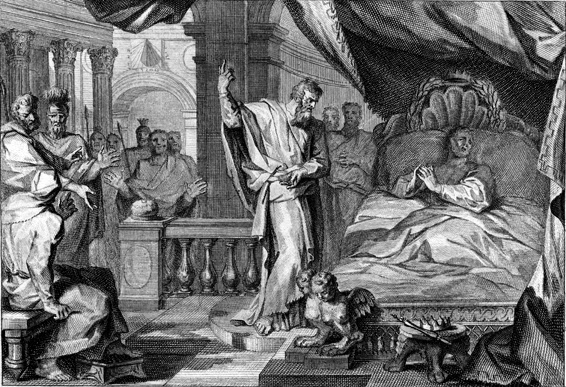
Hezekiah shows the Babylonian messengers his treasures (2 Kings 20, 13). Wood engraving, published in 1886.

For whatever reason, the author of 2 Kings provides no details concerning Hezekiah’s reaction to his miraculous healing or to God’s gracious gift of 15 more years of life. This man had been near death and had been told by the prophet of God that his days were numbered. He was deathly sick and helpless to do anything about his situation, so he cried out to God. And Yahweh responded by restoring his health and promising to extend his reign by 15 years. Yet, the author simply skips to the next story without providing any insight into Hezekiah’s response to this wonderful gift from God. But if we turn to 2 Chronicles 32, we discover that the newly healed king did not respond with humble gratitude, but with pride.

Hezekiah did not respond appropriately to the kindness shown him, and he became proud. So the Lord’s anger came against him and against Judah and Jerusalem. – 2 Chronicles 32:25 NLT

Perhaps Hezekiah’s new lease on life had gone to his head. He had narrowly escaped the clutches of death and was back to full health. On top of that, the Assyrian menace had all but disappeared. His kingdom was secure and he was enjoying an unprecedented period of peace and prosperity. But he failed to remember the one who had made it all possible. He neglected to offer any form of sacrifice to express his thanks to Yahweh. And this arrogant display of ingratitude brought God’s anger against the king, his capital, and the nation of Judah.

Once again, we’re given little in the way of details. The author does not tell us what form God’s judgment took. But it had its intended effect.

Hezekiah humbled himself and repented of his pride, as did the people of Jerusalem. So the Lord’s anger did not fall on them during Hezekiah’s lifetime. – 2 Chronicles 32:26 NLT

God’s wrath was abated but it seems that Hezekiah’s pride was not. It seems that Merodach-baladan, the king of Babylon, had heard of Hezekiah’s illness and sent emissaries to visit him. By the time these men had made the long trek from Babylon to Jerusalem, Hezekiah had been healed. So, when they arrived, the newly revived king decided to impress his guests by giving them the grand tour of the royal capital. And he showed them everything.

Hezekiah received the Babylonian envoys and showed them everything in his treasure-houses—the silver, the gold, the spices, and the aromatic oils. He also took them to see his armory and showed them everything in his royal treasuries! There was nothing in his palace or kingdom that Hezekiah did not show them. – 2 Kings 20:13 NLT

But to better understand what is going on here, we need to turn back to 2 Chronicles 32 for context. It would appear that King Hezekiah not only enjoying renewed health but a revitalized kingdom with a reinvigorated economy. Things were booming in Judah.

Hezekiah was very wealthy and highly honored. He built special treasury buildings for his silver, gold, precious stones, and spices, and for his shields and other valuable items. He also constructed many storehouses for his grain, new wine, and olive oil; and he made many stalls for his cattle and pens for his flocks of sheep and goats. He built many towns and acquired vast flocks and herds, for God had given him great wealth. He blocked up the upper spring of Gihon and brought the water down through a tunnel to the west side of the City of David. And so he succeeded in everything he did. – 2 Chronicles 32:27-30 NLT

Hezekiah had it all: Health, wealth, and prosperity. And he was more than happy to display the full extent of his power and possessions to his foreign guests. But the author 2 Chronicles reveals an important detail that must not be overlooked. The visiting Babylonian emissaries wanted to know “about the sign that had been done in the land” (2 Chronicles 32:31 ESV). Evidently, upon their arrival, they had been told how the king had been healed by God. Someone had shared with them about the miracle of the shadow reversing itself on the steps of Ahaz. And they were intrigued and eager to hear more. In other words, Hezekiah was being given a chance to brag about his God. But the passage tells us that “God left him to himself, in order to test him and to know all that was in his heart” (2 Chronicles 32:31 ESV).

God stood back and watched to see how Hezekiah would respond to this opportunity. But rather than declare the glory and the goodness of Yahweh to his pagan guests, Hezekiah bragged about himself. He said nothing about his miraculous healing or of God’s promise to extend his reign an additional 15 years. And he fails to even mention the miraculous sign. His entire exchange with these men was centered upon himself. Look closely at how the author describes Hezekiah’s actions:

…he showed them all his treasure house, the silver, the gold, the spices, the precious oil, his armory, all that was found in his storehouses. There was nothing in his house or in all his realm that Hezekiah did not show them. – 2 Kings 20:13 ESV

It was all about him. And when Hezekiah is confronted by the prophet Isaiah, he further confirms the self-centered nature of his interaction with the envoys.

“They have seen all that is in my house; there is nothing in my storehouses that I did not show them.” – 2 Kings 20:15 ESV

Not once does Hezekiah mention Yahweh. He doesn’t even acknowledge God as the source behind all his possession, including his very life. And with this incredible display of self-adulation, Hezekiah failed the test and revealed exactly what was in his heart. So, Isaiah delivered what should have been a devastating bit of bad news:

“Behold, the days are coming, when all that is in your house, and that which your fathers have stored up till this day, shall be carried to Babylon. Nothing shall be left, says the Lord.” – 2 Kings 20:17 ESV

And, as if that was not bad enough, Isaiah adds another element to God’s divine judgment against Hezekiah and Judah.

“…some of your own sons, who will come from you, whom you will father, shall be taken away, and they shall be eunuchs in the palace of the king of Babylon.” – 2 Kings 20:18 ESV

And to our shock and surprise, Hezekiah responds favorably to the prophet’s words. He isn’t even fazed by the news that his sons will be taken as captives and forced to become eunuchs to the king of Babylon. He hears all of this as good news. Why? Because all Hezekiah really cared about was himself. Look closely at his response to Isaiah.

“At least there will be peace and security during my lifetime.” – 2 Kings 20:19 NLT

According to 2 Chronicles 32:27, “Hezekiah was very wealthy and highly honored.” He enjoyed great prestige, power, and a time of unprecedented peace. And as long as he was able to keep what he had, he was willing to sacrifice the future, even if it meant that his sons would suffer so that he could prosper.

What makes this story even more disheartening is the fact that, at one time, Hezekiah had penned a poem to Yahweh, expressing his gratitude for his healing. Immediately after receiving the news that God would graciously deliver him from death, Hezekiah had taken the time to put his thoughts in writing. Look closely at what he said:

Lord, your discipline is good,
    for it leads to life and health.
You restore my health
    and allow me to live!
Yes, this anguish was good for me,
    for you have rescued me from death
    and forgiven all my sins.
For the dead cannot praise you;
    they cannot raise their voices in praise.
Those who go down to the grave
    can no longer hope in your faithfulness.
Only the living can praise you as I do today.
    Each generation tells of your faithfulness to the next.
Think of it—the Lord is ready to heal me!
    I will sing his praises with instruments
every day of my life
    in the Temple of the Lord. – Isaiah 38:16-20 NLT

They say time heals all wounds. But in Hezekiah’s case, time became his enemy. The further he got away from his near-death experience and his miraculous healing by God, the more forgetful and ungrateful he became. His focus shifted from the goodness and greatness of God to his own power and possessions. He became self-obsessed and myopic in his outlook and, as a result, he lost sight of the glory and grandeur of God. And it would be the prophet Isaiah who would write his own poem concerning Yahweh, that should have served as a wake-up call to the pride-filled and self-possessed king of Judah.

The Lord is the everlasting God,
    the Creator of all the earth.
He never grows weak or weary.
    No one can measure the depths of his understanding.
He gives power to the weak
    and strength to the powerless.
Even youths will become weak and tired,
    and young men will fall in exhaustion.
But those who trust in the Lord will find new strength.
    They will soar high on wings like eagles.
They will run and not grow weary.
    They will walk and not faint. – Isaiah 40:28-31 NLT

English Standard Version (ESV) The Holy Bible, English Standard Version. ESV® Permanent Text Edition® (2016). Copyright © 2001 by Crossway Bibles, a publishing ministry of Good News Publishers.

New Living Translation (NLT) Holy Bible, New Living Translation, copyright © 1996, 2004, 2015 by Tyndale House Foundation. Used by permission of Tyndale House Publishers Inc., Carol Stream, Illinois 60188. All rights reserved.

The Message (MSG)Copyright © 1993, 1994, 1995, 1996, 2000, 2001, 2002 by Eugene H. Peterson

Sickness, Shadows, and Signs

1 In those days Hezekiah became sick and was at the point of death. And Isaiah the prophet the son of Amoz came to him and said to him, “Thus says the Lord, ‘Set your house in order, for you shall die; you shall not recover.’” 2 Then Hezekiah turned his face to the wall and prayed to the Lord, saying, 3 “Now, O Lord, please remember how I have walked before you in faithfulness and with a whole heart, and have done what is good in your sight.” And Hezekiah wept bitterly. 4 And before Isaiah had gone out of the middle court, the word of the Lord came to him: 5 “Turn back, and say to Hezekiah the leader of my people, Thus says the Lord, the God of David your father: I have heard your prayer; I have seen your tears. Behold, I will heal you. On the third day you shall go up to the house of the Lord, 6 and I will add fifteen years to your life. I will deliver you and this city out of the hand of the king of Assyria, and I will defend this city for my own sake and for my servant David’s sake.” 7 And Isaiah said, “Bring a cake of figs. And let them take and lay it on the boil, that he may recover.”

8 And Hezekiah said to Isaiah, “What shall be the sign that the Lord will heal me, and that I shall go up to the house of the Lord on the third day?” 9 And Isaiah said, “This shall be the sign to you from the Lord, that the Lord will do the thing that he has promised: shall the shadow go forward ten steps, or go back ten steps?” 10 And Hezekiah answered, “It is an easy thing for the shadow to lengthen ten steps. Rather let the shadow go back ten steps.” 11 And Isaiah the prophet called to the Lord, and he brought the shadow back ten steps, by which it had gone down on the steps of Ahaz. – 2 Kings 20:1-11 ESV

Hezekiah was a good man who remained faithful to Yahweh throughout his tenure as king of Judah. This made him a rather rare commodity among the other kings Judah and Israel. Most of these men displayed a passion for idols and a propensity for godless behavior that brought upon them God’s judgment. So many of Hezekiah’s peers and predecessors had been nothing more than apostate idol worshipers. Yet, the author of 2 Kings saved his most glowing assessment for King Hezekiah.

He trusted in the Lord, the God of Israel, so that there was none like him among all the kings of Judah after him, nor among those who were before him. – 2 Kings 18:5 ESV

Hezekiah had instituted a series of religious reforms in Judah that were meant to restore the peoples’ devotion to and confidence in Yahweh. He cleansed the temple of God that had been allowed to fall into a state of disrepair. He reinstituted temple worship by recommissioning the priests and Levites. He also called for the reinstatement of the feast of unleavened bread and the celebration of Passover,  which both had long been neglected. These annual celebrations had been commissioned by God and were intended to be reminders of God’s deliverance of the people of Israel from their captivity in Egypt. But when Hezekiah issued a royal decree that the nation of Judah gather in Jerusalem to re-commemorate these two God-ordained festivals, some of the people responded with derision and refused to attend. Many of those who did come to Jerusalem had failed to follow God’s requirements concerning purification.

Most of those who came from Ephraim, Manasseh, Issachar, and Zebulun had not purified themselves. But King Hezekiah prayed for them, and they were allowed to eat the Passover meal anyway, even though this was contrary to the requirements of the Law. For Hezekiah said, “May the Lord, who is good, pardon those who decide to follow the Lord, the God of their ancestors, even though they are not properly cleansed for the ceremony.” And the Lord listened to Hezekiah’s prayer and healed the people. – 2 Chronicles 30:18-20 NLT

Yet all of Hezekiah’s reforms and his determination to restore the nation’s dedication to Yahweh did not prevent him from encountering difficulties during his reign. His faithfulness to God did not innoculate his reign from potential trials or keep his kingdom trouble-free. In fact, even this godly and faithful king found himself having to deal with the threat of destruction at the hands of the Assyrians. But when the enemy showed up outside the gates of Jerusalem, Hezekiah didn’t rail against God, accusing the Almighty of having abandoned His people. The king didn’t waste time listing all of his reforms or recounting all his efforts to restore the worship of Yahweh to Judah. No, he simply prayed that God would intervene on their behalf – and He did. God had not prevented the enemy from showing up, but He did miraculously cause them to go away. In the midst of their greatest trial, when all looked hopeless and they found themselves helpless, Hezekiah and the people of Judah had their faith reinvigorated by the power and presence of God.

And while God miraculously delivered His people from the threat of annihilation by the Assyrians, that was not the only difficulty that Hezekiah faced. The author states that “in those days” or around the same time that the Assyrian threat was taking place, the king of Judah became deathly ill. Just when the kingdom was facing its most difficult trial, Hezekiah was given a devasting bit of bad news from the prophet of God: “Set your affairs in order, for you are going to die. You will not recover from this illness” (2 Kings 20:1 NLT).

But once again, Hezekiah didn’t respond in anger or resentment. He didn’t lash out at God in disappointment or hurl accusations of divine dereliction of duty. He simply prayed. He turned his face to the wall and called out to his God: “Remember, O Lord, how I have always been faithful to you and have served you single-mindedly, always doing what pleases you” (2 Kings 20:3 NLT). Then he simply wept. 

Hezekiah wasn’t bragging or boasting. He wasn’t insinuating that God was somehow obligated to heal him. He was simply asking that God not forget his efforts to remain faithful. Hezekiah did not ask to be restored. He begged to be remembered. And he probably had his eternal state in mind at the time. He was hoping that he had done enough to earn God’s favor and to secure entrance into His Kingdom. And God heard Hezekiah’s prayer and provided him with an immediate response.

“I have heard your prayer and seen your tears. I will heal you, and three days from now you will get out of bed and go to the Temple of the Lord. I will add fifteen years to your life, and I will rescue you and this city from the king of Assyria. I will defend this city for my own honor and for the sake of my servant David.” – 2 Kings 20:5-6 NLT

God gave Hezekiah an additional 15 years to lead the people of Judah. And, on top of that, God assured Hezekiah that He would protect the city of Jerusalem from the Assyrian threat. God was going to eliminate the enemy outside the gates of the city and the illness inside the body of Hezekiah. And when the king asked Isaiah if he could provide any proof that these things would actually take place, God graciously obliged by providing a miracle.

…he brought the shadow back ten steps, by which it had gone down on the steps of Ahaz. – 2 Kings 20:11 ESV

Evidently, right before the eyes of the king and all those in his royal bedroom, the sun appeared to reverse itself. The shadow that had advanced ten steps suddenly went in the opposite direction, in direct violation of natural order. God’s particular choice of a sign was intended to prove to Hezekiah that He could do the impossible. If He could cause the shadow to reverse its course, He could also reverse the effects of Hezekiah’s illness and the outcome of the Assyrian siege.

Nothing was too difficult for God. The one who gave the sun its light could control its shadow. The one who gave Hezekiah his life could prolong it. And the one who gave men the ability to conceive and implement plans could easily redirect or reverse those plans to suit His sovereign will. The shadow reversed. The king was healed. The Assyrians gave up their siege of Jerusalem. God graciously displayed His power over sickness, nature, and the nations of the world. And Hezekiah was given 15 more years to prove his faithfulness to Yahweh. But as we will see, his new lease on life will not produce the most glowing results. The glory of his former faithfulness will see its shadow reversed as the king struggles with pride and the seductive influence of success.

English Standard Version (ESV) The Holy Bible, English Standard Version. ESV® Permanent Text Edition® (2016). Copyright © 2001 by Crossway Bibles, a publishing ministry of Good News Publishers.

New Living Translation (NLT) Holy Bible, New Living Translation, copyright © 1996, 2004, 2015 by Tyndale House Foundation. Used by permission of Tyndale House Publishers Inc., Carol Stream, Illinois 60188. All rights reserved.

The Message (MSG)Copyright © 1993, 1994, 1995, 1996, 2000, 2001, 2002 by Eugene H. Peterson

Lord of the Sabbath

1 After this there was a feast of the Jews, and Jesus went up to Jerusalem.

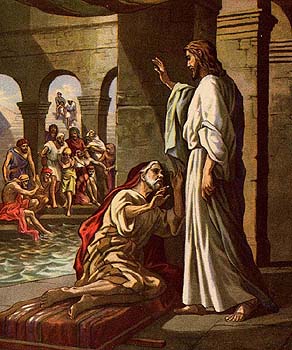
2 Now there is in Jerusalem by the Sheep Gate a pool, in Aramaic called Bethesda, which has five roofed colonnades. 3 In these lay a multitude of invalids—blind, lame, and paralyzed. 5 One man was there who had been an invalid for thirty-eight years. 6 When Jesus saw him lying there and knew that he had already been there a long time, he said to him, “Do you want to be healed?” 7 The sick man answered him, “Sir, I have no one to put me into the pool when the water is stirred up, and while I am going another steps down before me.” 8 Jesus said to him, “Get up, take up your bed, and walk.” 9 And at once the man was healed, and he took up his bed and walked.

Now that day was the Sabbath. 10 So the Jews said to the man who had been healed, “It is the Sabbath, and it is not lawful for you to take up your bed.” 11 But he answered them, “The man who healed me, that man said to me, ‘Take up your bed, and walk.’” 12 They asked him, “Who is the man who said to you, ‘Take up your bed and walk’?” – John 5:1-12 ESV

With the opening of chapter 5, John begins to explore the growing tension between Jesus and the religious authorities. While the meeting between Jesus and Nicodemus, a Pharisees himself, had been somewhat controversial, it had remained cordial. But with Jesus’ return to Jerusalem, the anger and resentment of the Pharisees and Sadduccees will become increasingly more evident and intense.

John will not abandon the theme of belief that has characterized the first four chapters, but he will now juxtapose it with the growing unbelief of the religious elite of Israel. In a sense, John will use the Pharisees and Sadduccees as a counterpoint to Jesus. These men were to have been the shepherds of Israel, leading the people to the truth of God’s Word and exemplifying a life of obedience. But as John will point out, their legalistic, rule-keeping mindset and arrogant self-righteousness stand in stark contrast to Jesus’ commitment to put the will of God above all else.  

“For I have come down from heaven, not to do my own will but the will of him who sent me. And this is the will of him who sent me, that I should lose nothing of all that he has given me, but raise it up on the last day. For this is the will of my Father, that everyone who looks on the Son and believes in him should have eternal life, and I will raise him up on the last day.” – John 6:38-40 ESV

Jesus was on a mission and He would not allow anything or anyone to hinder Him fulfilling the role assigned to Him by His Heavenly Father. He had divine authority to do the things He did. As the Son of God, Jesus did not need the permission of the legal or religious authorities because He was acting on behalf of God Almighty. The will of God superseded that of all other human authorities and allowed Jesus to perform signs and wonders that appeared to contradict the laws of nature and violate the rules of men.

After His brief excursion into the northern region of Galilee, Jesus made a second trip to Jerusalem in order to attend yet another Jewish festival. There were three annual feasts that all Jewish males were required to attend: Passover, Pentecost, and Tabernacles. In recounting this particular story, John leaves the name of the festival out, evidently deeming it as irrelevant to the point he was trying to make.

But John was quite specific when describing the location for this event. The context was critical to understanding what is going on in the story. Jesus arrived at the Pool of Bethesda, just outside the walls of the temple compound. This was a well-known and well-trafficked spot in Jerusalem because the waters of the spring-fed pool were believed to have healing qualities. The setting is key to understanding what is about to take place. As John stated in verse 3, the pool was a magnet for the “blind, lame, and paralyzed.” They all made their way to the pool each day in the hopes that the miraculous powers of the water might make them whole.

While John pointed out that “a multitude of invalids” surrounded the pool, he focused his attention on one particular man whose paralytic condition had persisted for 38 years. It is not clear whether this man had been coming to the pool for nearly four decades or if this was his first time to seek help from its healing waters. But John’s emphasis on the length of time is meant to accentuate the hopelessness of the man’s plight. And Jesus, upon seeing the man, was immediately aware of the decades-long nature of his condition, which makes the question He asks sound so unnecessary and out-of-place.

“Do you want to be healed?” – John 5:6 ESV

Of course, he did. What kind of question is that to ask at a time like this? This poor man had somehow made it all the way to the pool, in spite of his paralysis. He would not have been lying beside the waters if he had not wanted to experience healing.

John does not explain why Jesus chose to single out this one man. There were obviously others at the pool that day, and each and every one of them was there hoping for the same thing: Healing. But Jesus chose to speak to this man. And in response to Jesus’ question, the man explained his plight.

“Sir, I have no one to put me into the pool when the water is stirred up, and while I am going another steps down before me.” – John 4:7 ESV

His problem was not a lack of desire, but it was a lack of opportunity and capacity. His paralysis made it physically impossible for him to pursuit healing. His very condition proved to be a barrier to ever seeing his greatest desire fulfilled. Evidently, the pool’s healing powers were only available when the water was “stirred up.” It was only at that particular moment that a miracle could be expected, but it was reserved for the one who entered the water first. And this man, completely incapacitated by his illness and without anyone to assist him, was left to watch and wait, helplessly and hopelessly.

The description of the man’s plight is meant to stir the heart of the reader. But it is also meant to reveal the spiritual condition of each and every human being as they stand in need of healing but without the means by which to avail themselves of it. The healing waters were within this man’s reach, but he lacked the power to enter them. In a sense, he couldn’t heal himself. He needed help. And this is where Jesus stepped in.

Jesus said to him, “Get up, take up your bed, and walk.” And at once the man was healed, and he took up his bed and walked. – John 5:8-9 ESV

With a word, Jesus provided what the man lacked: The power to change. In a split second, this hopeless, helpless, bed-ridden paralytic was transformed into a completely healthy and whole specimen of a man. And no waters were necessary. Jesus spoke and the man walked.

But right when the story should be taking a decidedly upbeat turn, John reveals an underlying tension. He rather abruptly states, “Now that day was the Sabbath” (John 5:9 ESV). Rather than mentioning the celebration that would have followed such a miraculous moment, John simply points out that this had all taken place on the Sabbath. It was a holy day and, as such, it was to have been a day of rest. 

This significant detail is meant to point out the seeming problem with what Jesus said to the man and all that followed. Jesus specifically instructed the man to take up his bed and walk. He could have just told him to walk. Why was it necessary for him to gather up his bedroll? Because it was the Sabbath. Jesus knew exactly what day it was and His instructions to the man were given with that knowledge in mind. And His words produced the desired results. Yes, the man was healed, but not only that, the Pharisees were incensed. These religious rule-keepers witnessed the man carrying his bed and immediately confronted him for his blatant violation of the Sabbath law.

“It is the Sabbath, and it is not lawful for you to take up your bed.” – John 5:10 ESV

It is not clear whether these men had witnessed the healing, but even if they had, they were more concerned with what they saw as a flagrant disregard for the Mosaic Law.

The man, unaware of who Jesus was, told the religious leaders that he was simply obeying the words of the one who had healed him. But they still demanded to know the identity of this Sabbath law-breaker.

Jesus had specifically chosen the Sabbath day to perform this miracle. And His instructions to the lame man had been very precise. This entire scene was designed to set up a contrast between Jesus, the Son of God, and the religious leaders of Israel. He was their Messiah, sent from God to deliver the people from their bondage to sin and death. And as the Savior of the world, He had divine authority to accomplish the will of His Father. But for the religious leaders, their sacred rules and regulations were more important than the will of God. In their minds, adherence to the Sabbath blinded them to the presence of their Savior.

Yet, Jesus would later inform the Pharisees, “the Son of Man is Lord, even over the Sabbath!” (Matthew 12:8 NLT). This was all about authority and authenticity. Jesus was the Son of God and the long-awaited Messiah. And His audacious decision to heal on the Sabbath was proof of His deity and His divine authority.

English Standard Version (ESV) The Holy Bible, English Standard Version. ESV® Permanent Text Edition® (2016). Copyright © 2001 by Crossway Bibles, a publishing ministry of Good News Publishers.

New Living Translation (NLT)
Holy Bible, New Living Translation, copyright © 1996, 2004, 2015 by Tyndale House Foundation. Used by permission of Tyndale House Publishers Inc., Carol Stream, Illinois 60188. All rights reserved.

The Message (MSG)Copyright © 1993, 1994, 1995, 1996, 2000, 2001, 2002 by Eugene H. Peterson

The Man Believed the Word

46 So he came again to Cana in Galilee, where he had made the water wine. And at Capernaum there was an official whose son was ill. 47 When this man heard that Jesus had come from Judea to Galilee, he went to him and asked him to come down and heal his son, for he was at the point of death. 48 So Jesus said to him, “Unless you see signs and wonders you will not believe.” 49 The official said to him, “Sir, come down before my child dies.” 50 Jesus said to him, “Go; your son will live.” The man believed the word that Jesus spoke to him and went on his way. 51 As he was going down, his servants met him and told him that his son was recovering. 52 So he asked them the hour when he began to get better, and they said to him, “Yesterday at the seventh hour the fever left him.” 53 The father knew that was the hour when Jesus had said to him, “Your son will live.” And he himself believed, and all his household. 54 This was now the second sign that Jesus did when he had come from Judea to Galilee. – John 4:46-54 ESV

After their two-day, unplanned stopover in Samaria, Jesus and His disciples left for the northern region of Galilee. He did so, in spite of the popular proverb He had quoted to His disciples: “a prophet has no honor in his own hometown” (John 4:44 ESV). Jesus was returning to Galilee, but He made His way to Cana, rather than His own hometown of Nazareth. He returned to the scene of His first miracle, where He had turned the water into wine.

In verse 45, John indicates that Jesus received a warm welcome in Galilee because many of the people had been eyewitnesses to the signs He had performed in Jerusalem during the Feast of Passover. With this reference to Jesus’ signs, John provides a link back to the miracle performed at the wedding feast in Cana. While the guests at the feast had no idea that Jesus had transformed ordinary water into wine, His disciples were fully aware of what had transpired.

This, the first of his signs, Jesus did at Cana in Galilee, and manifested his glory. And his disciples believed in him. – John 2:11 ESV

And when Jesus had gone on to perform additional signs in Jerusalem during the Passover festival, John records, “many believed in his name when they saw the signs that he was doing” (John 2:23 ESV).

The basis for their belief was the nature of the miraculous signs Jesus performed. And John makes it clear that the warm reception Jesus received in Galilee was due to “all that he had done in Jerusalem” (John 4:45 ESV). They too were attracted to and enamored by the miracles of Jesus. And His reputation as a miracle worker was spreading rapidly throughout all Israel. Which sets up the next encounter Jesus will experience.

While in Cana, Jesus received a visit from an unnamed government official who came seeking healing for his deathly-ill son. While we know little about this man, it is likely that he was a Jew who was in the employment of Herod Antipas, the unofficial “king” of the Jews, appointed by the Romans. This distraught father had made the 13-mile journey from Capernaum to Cana in the hopes that he could convince Jesus to return with him and heal his son.

But this man’s impassioned plea for help was met with what a somewhat caustic response from Jesus.

“Unless you see signs and wonders you will not believe.” – John 4:48 ESV

While it is unclear in our English translation, Jesus used the plural pronoun “you,” indicating that His comment was aimed at the Jewish people. Their belief in Him was fickle and focused solely on His ability to entertain them with His supernatural miracles. They loved the idea of a miracle-working Messiah. But Jesus had made it clear to Nicodemus that the key to eternal life was to believe in Him, not just the miracles He performed.

“Whoever believes in him is not condemned, but whoever does not believe is condemned already, because he has not believed in the name of the only Son of God.” – John 3:18 ESV

They were believing in the miracle-performing reputation of Jesus, but not in the name of Jesus. It was not enough that He came declaring Himself to be the Son of God. They needed proof. They demanded signs. And the apostle Paul would later condemn his own people for their stubborn refusal to acknowledge the greatest sign ever given that proved the deity of Jesus.

Since God in his wisdom saw to it that the world would never know him through human wisdom, he has used our foolish preaching to save those who believe. It is foolish to the Jews, who ask for signs from heaven. And it is foolish to the Greeks, who seek human wisdom. So when we preach that Christ was crucified, the Jews are offended and the Gentiles say it’s all nonsense. – 1 Corinthians 1:21-23 NLT

Undeterred by the seeming slight from Jesus, the desperate father begged Jesus to come to Capernaum and heal his son before it was too late. He was running out of time. His son was at death’s door and they still had a 13-mile journey ahead of them. If only he could get Jesus to agree to accompany him back to Capernaum, there might still be a chance that his son could live.

And Jesus answered the man’s impassioned plea with the simple response, “Go; your son will live” (John 4:50 ESV). On that matter-of-fact statement from the lips of Jesus, the official “believed what Jesus said and started home” (John 4:50 NLT). He didn’t argue. He didn’t continue to plead with Jesus to come with him. He simply turned and began the 13-mile return trip home – believing the words of Jesus. No sign. No miracle. No proof.

The belief this man exhibited was of a different sort that those in Cana who believed because of the signs Jesus had performed in Jerusalem. It stood in stark contrast to the belief of Jesus’ disciples which had been based on His ability to turn water into wine. This man had believed the words of Jesus. And this distinction is significant. It brings to mind the testimony of God Himself, spoken at the baptism of Jesus.

“This is my Son, my Chosen One; listen to him!” – Luke 9:35 ESV

The Jews were enamored by the works of Jesus but they refused to listen to His words. As long as He kept performing miracles, they kept believing, but that belief was misplaced. They were so busy seeking a sign, that they missed the Savior.

Later on in his gospel, John records the words of Jesus declaring the divine origin of His message.

“For I have not spoken on my own authority, but the Father who sent me has himself given me a commandment—what to say and what to speak.” – John 12:49 ESV

And this was not the first time Jesus had claimed His words to be divinely inspired and spoken on behalf of His heavenly Father.

“My teaching is not mine, but his who sent me. If anyone’s will is to do God’s will, he will know whether the teaching is from God or whether I am speaking on my own authority.” – John 7:16-17 ESV

The people should have been listening to the words of Jesus, but they were too busy focusing their attention on the works of Jesus. And with their obsession over His miracles, they were missing the meat of His message.

“Do you not believe that I am in the Father and the Father is in me? The words that I say to you I do not speak on my own authority, but the Father who dwells in me does his works. Believe me that I am in the Father and the Father is in me, or else believe on account of the works themselves.” –  John 14:10-11 ESV

In a sense, Jesus was stating that there were two sources of belief: His miracles or His message. But the truest form of belief was to receive the words of Jesus as the words of God because He spoke as God. And Jesus went on to assure His disciples that they too would go on to perform miracles and signs.

“Truly, truly, I say to you, whoever believes in me will also do the works that I do; and greater works than these will he do, because I am going to the Father. Whatever you ask in my name, this I will do, that the Father may be glorified in the Son. If you ask me anything in my name, I will do it.” – John 14:12-13 ESV

Their ability to perform miracles would be based on their belief in Him and who He claimed to be. He was the Son of God and had the full authority of God to share His power with those who placed their faith in Him.

John’s entire gospel is focused on the divinity of Jesus. He is declaring the divine Sonship of Jesus and providing indisputable proof that this Rabbi from Nazareth was indeed who He claimed to be: The Son of God and the Savior of the world.

And as further evidence of Jesus’ deity, John describes the scene that took place when the father ran into his servants on his way home. They met him alone the way with the good news that “his son was alive and well” (John 4:51 NLT). And when the father asked at what time his son had begun to improve, he was told, “Yesterday afternoon at one o’clock his fever suddenly disappeared!” (John 4:52 NLT). And John closes his account with the following words:

Then the father realized that that was the very time Jesus had told him, “Your son will live.” And he and his entire household believed in Jesus. – John 4:53 NLT

When Jesus had said, “Your son will live,” the man had taken Him at His word and headed home. Now, he received confirmation that His faith had been rewarded. His son was well. Jesus had spoken, the man had believed, and his son had been healed. But notice how John ends this story with the words, “he and his entire household believed in Jesus.”

Their belief was not in the miracle but in the one who had spoken the miracle into existence. They believed in Jesus. Their faith was not focused on the healing of their family member. It was directed at the one who spoke with the authority of God.

English Standard Version (ESV) The Holy Bible, English Standard Version. ESV® Permanent Text Edition® (2016). Copyright © 2001 by Crossway Bibles, a publishing ministry of Good News Publishers.

New Living Translation (NLT)
Holy Bible, New Living Translation, copyright © 1996, 2004, 2015 by Tyndale House Foundation. Used by permission of Tyndale House Publishers Inc., Carol Stream, Illinois 60188. All rights reserved.

The Message (MSG)Copyright © 1993, 1994, 1995, 1996, 2000, 2001, 2002 by Eugene H. Peterson

Our Prayer Partner.

Likewise the Spirit helps us in our weakness. For we do not know what to pray for as we ought, but the Spirit himself intercedes for us with groanings too deep for words. And he who searches hearts knows what is the mind of the Spirit, because the Spirit intercedes for the saints according to the will of God. – Romans 8:26-27 ESV

In the preceding verses, Paul encourages us to wait eagerly, hopefully, and yet patiently for the final stage of our adoption as sons and daughters of God and for the redemption of our bodies. There is a day coming when we will freed from these bodies of death as Paul called them (Romans 7:24). We will be given new bodies and the long-awaited opportunity to live in perfect, unbroken fellowship with God, fully enjoying our position as His children and all the benefits that come with being His heirs. But in the meantime, we must continue to live in a fallen world, dealing with the ongoing presence of our sin natures and struggling against the persistent attacks of Satan. Back in verse 17, Paul told us “we suffer with him in order that we may also be glorified with him.” Our glorification is coming, but in the meantime we sometimes find ourselves suffering as a result of our faith in Christ and our relationship with Him. And as we suffer as God’s children, we naturally call out to Him as our Father. We find ourselves too weak at times to handle all that is happening to us and around us in this world. We are constantly experiencing and witnessing the effects of sin. And so, in our weakness, we cry out for help. But there are times when we don’t even know what to pray. We aren’t even sure what to ask God for. And when we do ask, we sometimes never see the answer to our request.

In our present circumstances, our needs are constant, but Paul assures us that so is the help of the Holy Spirit. He helps us in our weakness. As we patiently, eagerly, hopefully wait for our final adoption and redemption, He comes alongside and assists us during this time of suffering. Paul says we “groan inwardly as we wait eagerly for adoption as sons, the redemption of our bodies” (Romans 8:23 ESV). That word, “groan”, means to sigh or pray inaudibly. As we attempt to live holy lives in the midst of an unholy world, we find ourselves struggling with our own sin and the constant emotional bombardment from witnessing sin’s damaging influence over the world. So we pray. We call out. And when we do, we find ourselves asking God to remove the cause of our struggles. We beg Him to remove sickness from our loved ones. We ask Him to provide us with resources when our bank account is low or our pantry is bare. We plead with Him to remove our pain and restore our strength when we are weak. And when He doesn’t seem to answer those prayers, we become defeated, confused and, at times, even bitter and disillusioned. But Paul would have us consider that the Holy Spirit helps us in our times of weakness. When we don’t know what to pray, how to pray, or how to get what we pray for, He intercedes on our behalf. “For we do not know what to pray for as we ought, but the Spirit himself intercedes for us with groanings too deep for words.” The truth is, we don’t know what we need. Paul says, we don’t know what to pray for. We are like little children who ask for the obvious. Driven by our fallen human nature, we tend to ask for what we want, not necessarily what we need. If we have pain, we want it removed. If we experience sickness, we can think of nothing better than having it healed. Paul provided us with a personal testimony regarding this very thing. “So to keep me from becoming conceited because of the surpassing greatness of the revelations, a thorn was given me in the flesh, a messenger of Satan to harass me, to keep me from becoming conceited. Three times I pleaded with the Lord about this, that it should leave me. But he said to me, ‘My grace is sufficient for you, for my power is made perfect in weakness’” (2 Corinthians 12:7-9 ESV). Whatever the “thorn” in Paul’s flesh might have been, Paul prayed that it be removed. But God had other plans and a higher purpose. He was protecting Paul from conceited, proud and arrogant over his position as God’s spokesman. Paul pleaded for the removal of the thorn, but the Holy Spirit interceded and turned those self-centered, comfort-oriented requests into prayers that matched the will of God.

We are children of God, but like all children, we rarely know what we truly need. The Spirit does, because He knows the heart and mind of God. If you ask a small child what he or she wants for dinner, they are likely to respond, “Ice cream!” That is what they want, but that is not what they need. And a loving parent would not give in to their request. Instead, they would provide them with what they truly needed, even though the child may feel like their “needs” are not being met. The difference between our prayers and those that the Spirit prays on our behalf are that He “intercedes for the saints according to the will of God.” I don’t always know the will of God. I don’t always know what is best for me. But the Spirit does. And He is constantly taking my sighs, moans, and silent prayers, and turning them into requests that align with God’s will for my life as His child. So when His answers come, I may not always recognize them, but I can trust that they are just what I needed. I have a prayer partner who intercedes on my behalf. He knows the desires of my heart, the will of God, and how the two can become one. Like any loving Father, God is not interested in giving us all that we want, but He is determined to provide us with all that we need for life and godliness. And His Spirit helps us pray within His will so that we can always know that we are receiving the right answer at just the right time.

1 Corinthians 15:35-58

New and Improved!

1 Corinthians 15:35-58

Our bodies are buried in brokenness, but they will be raised in glory. They are buried in weakness, but they will be raised in strength. They are buried as natural human bodies, but they will be raised as spiritual bodies. For just as there are natural bodies, there are also spiritual bodies. – 1 Corinthians 15:43-44 NLT

As I write this post this morning, my 91-year old father lies in a hospital room in Fort Worth, Texas, having suffered two grand mal seizures just a few days ago. When I walked into his room the morning after he had had them, what I saw was a shock to my system. Lying in the bed was a small, pale body that looked nothing like the man I have known for 58 years. My father had been through an ordeal and his body showed it. He appeared near death. His ninety one years of life had seemed to catch up with him in a hurry, with the latest ordeal having taken a final toll. Thankfully, God has His hands on my father’s life and seems to be restoring him, slowly but surely. But upon first seeing our father lying in that hospital bed, my brother and I both remarked that it appeared as if dad was ready to go home. He was hearing heaven call. Today’s passage couldn’t have been more timely. When I read the verses above this morning, I couldn’t help but see that image of my father’s frail body lying under those thin hospital sheets and illuminated by the stark light of that cold, inhospitable ICU room. His body appeared broken and weak. His body looked frail and fragile. Inside was the man I have always known. His mind still sharp. His love for God unwavering. His passion for Jesus unchanged. It reminded me of another passage from the pen of Paul found in his second letter to the Corinthians. “For we know that when this earthly tent we live in is taken down (that is, when we die and leave this earthly body), we will have a house in heaven, an eternal body made for us by God himself and not by human hands. We grow weary in our present bodies, and we long to put on our heavenly bodies like new clothing. For we will put on heavenly bodies, we will not be spirits without bodies. While we live in these earthly bodies, we groan and sigh, but it’s not that we want to die and get rid of these bodies that clothe us. Rather, we want to put on our new bodies so that these dying bodies will be swallowed up by life. God himself has prepared us for this, and as a guarantee he has give us his Holy Spirit” (2 Corinthians 5:1-5 NLT).

We will have new bodies. It’s guaranteed! My dad will one day be released from the confines of his earthly, human “tent” and take up residence in a new body prepared for Him by God. Paul wanted the Corinthians to understand that same reality. Our earthly bodies were made for life on this earth. But they are not equipped to handle heaven. They are temporal, and heaven is eternal. And should my father live (and I pray that he will), and the Lord returns, he will receive a new spiritual body. “It will happen in a moment, in the blink of an eye” (1 Corinthians 15:52 NLT). His earthly body, weak and worn out as it is, will be transformed into a new, spiritual body that will never die. He will become immortal. His body will become eternal. What will he look like? I have no idea. Will he appear as he did in that hospital bed? I think not. What age will he appear? I don’t know. But I do know that the day is coming when he will receive a new body that will never grow old, never succumb to disease, never experience pain, and never require hospitalization or medical treatment of any kind. The physical death of our bodies is the result of the fall – the sin of Adam and Eve in their rejection of God. Death entered the equation because they chose to live for themselves, rather than obey and honor God. “But thank God! He gives us victory over sin and death through our Lord Jesus Christ” (1 Corinthians 15:57 NLT). As believers, we don’t have to fear death, because God has promised us eternal life and new spiritual bodies with which to experience it. We will get to exchange these old, worn-out tents for new ones. My dad will some day receive a new body that is strong, virile, and disease and pain free. The resurrection of our bodies is not just wishful thinking. It is a promise of God. And as I go up to visit my dad in just a few minutes, I will take that promise with me, clinging to the words of Paul, “So, my dear brothers and sisters, be strong and immovable” (1 Corinthians 15:58 NLT). My God is faithful. He is not done yet.

Father, thank You that this is not all there is. As much as I love my life, I am so grateful that there is more to come. There is something far greater in store that You have planned for us. These bodies and our existence on this planet are temporary, not permanent. Our pain and suffering are only for the moment. There is a day coming when all things will be renewed and restored to their original state, including our bodies. May I not forget that in the days ahead. Should my dad survive, I will praise You. Should You decide to take him home, I will rejoice in the fact that He is with You. He will have a new body. He will have renewed strength. He will be at home with the Lord – where he was meant to be. Thank You!. Amen.

Ken Miller
Grow Pastor & Minister to Men
kenm@christchapelbc.org

Day 61 – Matthew 15:29-31; Mark 7:31-37

He Healed Them All!

Matthew 15:29-31; Mark 7:31-37

“A vast crowd brought to him people who were lame, blind, crippled, those who couldn’t speak, and many others. They laid them before Jesus, and he healed them all.’” – Matthew 15:30 NLT

There are so many recorded incidents of Jesus healing people in the Bible that they can easily become almost non-events to us. We just expect Jesus to heal people. At least we expect Jesus to heal people in the Bible. We’re not quite so confident when it comes to real life. But when it comes to reading the Scriptures we have gotten so used to the stories about blind people receiving their sight, lame people suddenly being able to walk, and mute people gaining back the ability to speak, that they no longer shock or surprise us. But in Jesus’ day, these miracles were anything but expected, and the people had not become complacent about them. When Jesus showed up, the sick and needy showed up as well. And Jesus rarely, if ever, disappointed. Matthew records an occasion where Jesus, having returned to the shore of Galilee from the region of Tyre and Sidon, sits down on a nearby hillside and suddenly finds Himself surrounded by a crowd. They had brought with them all kinds of people with all kinds of needs, and they laid them all at the feet of Jesus. Imagine the scene. People unable to walk, crippled by disease, birth defects or injury, are hobbling or laying at the feet of Jesus. Some are on mats, some are on crutches, but all are in need. They can’t work or make a living. Some are probably in great pain. Next to them are the blind. These people live in a constant world of darkness, unable to see the faces of their own family members or enjoy the beauty of the world around them. There are probably young and old alike. Some have been born blind, while others have lost their sight due to injury, disease, illness or just old age. But each of them suffers the same fate: A life marked by certain poverty, constant darkness and little hope. Mixed in with these two groups were the mute. For whatever reason, these people found themselves unable to speak, trapped in a world where their thoughts, ideas and emotions had to be communicated through hand motions or scribbled notes. They were incapable of expressing words of love, affirmation, encouragement, joy, or praise. They couldn’t sing, shout, whisper, laugh or tell another living soul what they were thinking, feeling, or needing.

What a sad scenario. It reminds me of a scene from the recent movie, Lincoln, where President Lincoln tours a makeshift hospital filled with Union soldiers who have been injured in battle during the Civil War. Many have had their limbs amputated. Others have been permanently blinded by the fragments of exploding bombs. None will ever be the same again. Many will not live to see old age. And all the president can do is walk among them, issuing words of thanks and encouragement. How helpless. How hopeless. How frustrating.

But Jesus did not face those same limitations. He could do so much more, and He did. He healed them all. Matthew does not tell us how Jesus did it. He could have made His way among them, touching each one and speaking to them individually. Or He could have simply healed the entire group in one single, magnificent moment. I tend to believe that is what He did. And Matthew tells us that the crowd was amazed. They were blown away! And we would have been too. Suddenly there were people who had never walked before, running and jumping, shouting and screaming for joy. There were blind people covering their eyes from the blinding light of the sun, then slowly taking in the sights around them. They were grabbing the faces of spouses, children, family members and friends, perhaps seeing them for the first time in their lives. Their were tears being shed, sounds of laughter and shouts of joy. But the loudest group was probably those who had once been unable to speak. Suddenly, they are able to shout, scream, sing, and praise God. And I’m sure they did. Most of them probably shouted themselves hoarse!.

What a scene! I think it’s safe to say that none of us have ever experienced anything like it. But the truth is, every time we get together with a group of other believers, that is just the kind of experience we should have. Each of us who have received salvation through Jesus Christ have been healed of the greatest disease plaguing mankind – sin. We have been taken from death to life. We have been set free from slavery to sin. It reminds me of the lyrics from that great old hymn, Amazing Grace. “Amazing Grace, how sweet the sound, that saved a wretch like me. I once was lost but now am found, was blind but now I see.” Our salvation is no less amazing than what happened on that hillside that day. In fact, it is more amazing. Those peoples’ conditions, while improved physically, remained the same spiritually. While they praised the name of the God of Israel for what had happened, there is no indication that they believed in Jesus Christ as their Lord and Savior. They received physical healing, but not spiritual healing. They were still condemned because of their sin and lost without a Savior. But for those of us who are recipients of the amazing grace of God through placing our faith in Jesus Christ as our Savior, we have much to shout about. Our lives should be marked by joy, singing, excitement, excitement, anticipation and grateful appreciation.

Jesus, You have healed my life and made me whole. You have taken away my sin and replaced it with Your righteousness. I was once dead, but You have made me alive and well. I was once helpless and hopeless, but You have given me eternal life and a life free from condemnation and the fear of death. Thank You! Thank You! Thank You!. Amen.

Ken Miller

Grow Pastor & Minister to Men
kenm@christchapelbc.org