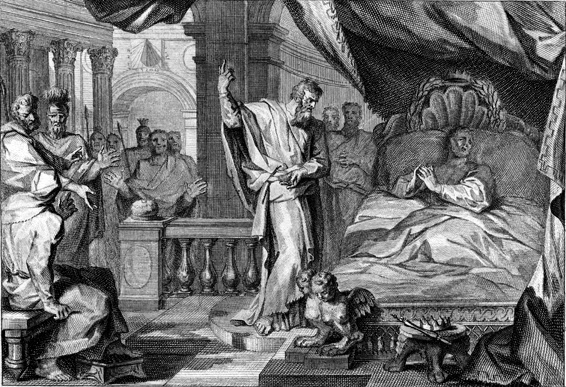
Nothing Is Too Difficult for God

1 In those days Hezekiah became sick and was at the point of death. And Isaiah the prophet the son of Amoz came to him and said to him, “Thus says the LORD, ‘Set your house in order, for you shall die; you shall not recover.’” Then Hezekiah turned his face to the wall and prayed to the LORD, saying, “Now, O LORD, please remember how I have walked before you in faithfulness and with a whole heart, and have done what is good in your sight.” And Hezekiah wept bitterly. And before Isaiah had gone out of the middle court, the word of the LORD came to him: “Turn back, and say to Hezekiah the leader of my people, Thus says the LORD, the God of David your father: I have heard your prayer; I have seen your tears. Behold, I will heal you. On the third day you shall go up to the house of the LORD, and I will add fifteen years to your life. I will deliver you and this city out of the hand of the king of Assyria, and I will defend this city for my own sake and for my servant David’s sake.” And Isaiah said, “Bring a cake of figs. And let them take and lay it on the boil, that he may recover.”

And Hezekiah said to Isaiah, “What shall be the sign that the LORD will heal me, and that I shall go up to the house of the LORD on the third day?” And Isaiah said, “This shall be the sign to you from the LORD, that the LORD will do the thing that he has promised: shall the shadow go forward ten steps, or go back ten steps?” 10 And Hezekiah answered, “It is an easy thing for the shadow to lengthen ten steps. Rather let the shadow go back ten steps.” 11 And Isaiah the prophet called to the LORD, and he brought the shadow back ten steps, by which it had gone down on the steps of Ahaz. 2 Kings 20:1-11 ESV

Hezekiah was a good man who remained faithful to Yahweh throughout his tenure as Judah’s king. This made him a rather rare commodity among the other kings of Judah and Israel. Most of these men displayed a passion for idols and a propensity for godless behavior that brought God’s judgment upon them. Many of Hezekiah’s peers and predecessors had been nothing more than apostate idol worshipers. Yet, the author of 2 Kings saved his most glowing assessment for King Hezekiah.

He trusted in the LORD, the God of Israel, so that there was none like him among all the kings of Judah after him, nor among those who were before him. – 2 Kings 18:5 ESV

Hezekiah had instituted a series of religious reforms in Judah that were meant to restore the people’s devotion to and confidence in Yahweh. He repaired and cleansed the Temple of God that had been allowed to fall into a state of disrepair. He reinstituted Temple worship by recommissioning the priests and Levites. He also called for the reinstatement of the Feast of Unleavened Bread and the celebration of Passover,  both of which had long been neglected. These annual celebrations had been commissioned by God and were intended to be reminders of God’s deliverance of the people of Israel from their captivity in Egypt. But when Hezekiah issued a royal decree that the nation of Judah gather in Jerusalem to re-commemorate these two God-ordained festivals, some of the people responded with derision and refused to attend. Many of those who did come to Jerusalem had failed to follow God’s requirements concerning purification.

Most of those who came from Ephraim, Manasseh, Issachar, and Zebulun had not purified themselves. But King Hezekiah prayed for them, and they were allowed to eat the Passover meal anyway, even though this was contrary to the requirements of the Law. For Hezekiah said, “May the LORD, who is good, pardon those who decide to follow the LORD, the God of their ancestors, even though they are not properly cleansed for the ceremony.” And the LORD listened to Hezekiah’s prayer and healed the people. – 2 Chronicles 30:18-20 NLT

Yet all of Hezekiah’s reforms and his determination to restore the nation’s dedication to Yahweh did not prevent him from encountering difficulties during his reign. His faithfulness to God did not inoculate his kingship from potential trials or guarantee him a trouble-free kingdom. In fact, even this godly and faithful king found himself having to deal with the threat of destruction at the hands of the Assyrians.

However, when the enemy showed up outside the gates of Jerusalem, Hezekiah didn’t rail against God, accusing the Almighty of having abandoned His people. The king didn’t waste time listing all of his reforms or recounting all his efforts to restore the worship of Yahweh to Judah. No, he simply prayed that God would intervene on their behalf, and He did. God had not prevented the enemy from showing up, but He did miraculously cause them to go away. In the midst of their greatest trial, when all looked hopeless and they found themselves helpless, Hezekiah and the people of Judah had their faith reinvigorated by the power and presence of God.

While God miraculously delivered His people from the threat of annihilation by the Assyrians, that was not the only difficulty Hezekiah faced. The author states that “in those days” or around the same time that the Assyrian threat was taking place, the king of Judah became deathly ill. Just when the kingdom was facing its most difficult trial, Hezekiah was given devastating news from the prophet of God: “Set your affairs in order, for you are going to die. You will not recover from this illness” (2 Kings 20:1 NLT).

Once again, Hezekiah didn’t respond in anger or resentment. He didn’t lash out at God in disappointment or hurl accusations of divine dereliction of duty. He simply prayed, turning his face to the wall and calling out to his God: “Remember, O LORD, how I have always been faithful to you and have served you single-mindedly, always doing what pleases you” (2 Kings 20:3 NLT). Then he simply wept. 

Hezekiah wasn’t bragging or boasting. He wasn’t insinuating that God was somehow obligated to heal him. He was simply asking that God not forget his efforts to remain faithful. Hezekiah did not ask to be restored; he begged to be remembered. Due to the nature of his illness and God’s decree that it was terminal, he probably had his eternal state in mind when asking God to remember him. He was hoping that he had done enough to earn God’s favor and to secure entrance into His Kingdom. But his cries for Yahweh’s mercy did not go unheard or unheeded. He received an immediate and encouraging response.

“I have heard your prayer and seen your tears. I will heal you, and three days from now you will get out of bed and go to the Temple of the LORD. I will add fifteen years to your life, and I will rescue you and this city from the king of Assyria. I will defend this city for my own honor and for the sake of my servant David.” – 2 Kings 20:5-6 NLT

God gave Hezekiah an additional 15 years to lead the people of Judah. On top of that, God assured Hezekiah that He would protect the city of Jerusalem from the Assyrian threat. He would miraculously eliminate the enemy outside the gates of the city and the illness inside Hezekiah’s body. And when the king asked Isaiah if he could provide any proof that these things would actually take place, God graciously obliged by providing a miracle.

he brought the shadow back ten steps, by which it had gone down on the steps of Ahaz. – 2 Kings 20:11 ESV

Evidently, right before the eyes of the king and all those in his royal bedroom, the sun appeared to reverse itself. The shadow that had advanced ten steps suddenly went in the opposite direction, in direct violation of natural order. God’s particular choice of this sign was intended to demonstrate His ability to do the impossible. If He could cause the shadow to reverse its course, He could also reverse the effects of Hezekiah’s illness and the outcome of the Assyrian siege.

Nothing is too difficult for God. The one who spoke light into existence (Genesis 1:3) could command it to do His bidding. The one who created the sun was fully capable of controlling its shadow. The one who gave Hezekiah life could prolong it. And the one who gave kings the authority to conceive and implement plans could easily redirect or reverse those plans to suit His sovereign will. The shadow reversed. The king was healed. The Assyrians gave up their siege of Jerusalem.

God graciously displayed His power over sickness, nature, and the nations of the world, and Hezekiah was given 15 more years to prove his faithfulness to Yahweh. But as will soon become evident, his new lease on life will produce some unexpected outcomes. The glory of his former faithfulness will see its shadow reversed as the king struggles with pride and the seductive influence of success.

English Standard Version (ESV) The Holy Bible, English Standard Version. ESV® Permanent Text Edition® (2016). Copyright © 2001 by Crossway Bibles, a publishing ministry of Good News Publishers.

New Living Translation (NLT) Holy Bible, New Living Translation, copyright © 1996, 2004, 2015 by Tyndale House Foundation. Used by permission of Tyndale House Publishers Inc., Carol Stream, Illinois 60188. All rights reserved.

Anyone Can Play God

26 Then Eliakim the son of Hilkiah, and Shebnah, and Joah, said to the Rabshakeh, “Please speak to your servants in Aramaic, for we understand it. Do not speak to us in the language of Judah within the hearing of the people who are on the wall.” 27 But the Rabshakeh said to them, “Has my master sent me to speak these words to your master and to you, and not to the men sitting on the wall, who are doomed with you to eat their own dung and to drink their own urine?”

28 Then the Rabshakeh stood and called out in a loud voice in the language of Judah: “Hear the word of the great king, the king of Assyria! 29 Thus says the king: ‘Do not let Hezekiah deceive you, for he will not be able to deliver you out of my hand. 30 Do not let Hezekiah make you trust in the LORD by saying, The LORD will surely deliver us, and this city will not be given into the hand of the king of Assyria.’ 31 Do not listen to Hezekiah, for thus says the king of Assyria: ‘Make your peace with me and come out to me. Then each one of you will eat of his own vine, and each one of his own fig tree, and each one of you will drink the water of his own cistern, 32 until I come and take you away to a land like your own land, a land of grain and wine, a land of bread and vineyards, a land of olive trees and honey, that you may live, and not die. And do not listen to Hezekiah when he misleads you by saying, “The LORD will deliver us.” 33 Has any of the gods of the nations ever delivered his land out of the hand of the king of Assyria? 34 Where are the gods of Hamath and Arpad? Where are the gods of Sepharvaim, Hena, and Ivvah? Have they delivered Samaria out of my hand? 35 Who among all the gods of the lands have delivered their lands out of my hand, that the LORD should deliver Jerusalem out of my hand?’”

36 But the people were silent and answered him not a word, for the king’s command was, “Do not answer him.” 37 Then Eliakim the son of Hilkiah, who was over the household, and Shebna the secretary, and Joah the son of Asaph, the recorder, came to Hezekiah with their clothes torn and told him the words of the Rabshakeh. 2 Kings 18:26-37 ESV

This entire scene is filled with a sense of nervous anticipation. The people of Judah are lining the eastern walls of the city, overlooking the Kidron Valley, where the Assyrian army lies spread out before them in numbers too great to count. But their eyes are locked on the three emissaries whom King Hezekiah commissioned to discuss the terms of peace with the Assyrians. Eliakim, Shebnah, and Joah hold the fate of the nation in their hands, and the people know that the negotiating skills of these three men will determine whether Judah stands or falls. So, all eyes are fixed on the momentous scene taking place at the base of the walls of the city.

But the Rabshakeh, or supreme commander of the Assyrian army, is not interested in peace negotiations; he has come to demand the unconditional surrender of the city and its inhabitants. He and his troops have repeatedly proven their superior strength, and he is confident that the city of Jerusalem will be one more domino to fall as they continue their conquest of Palestine. Speaking on behalf of his commander-in-chief, the Rabshakeh declares Hezekiah’s rebellion to be ill-conceived and ill-fated.

“This is what the great king of Assyria says: What are you trusting in that makes you so confident? Do you think that mere words can substitute for military skill and strength? Who are you counting on, that you have rebelled against me? – 2 Kings 18:19-20 NLT

With the citizens of Jerusalem looking on and listening in, this arrogant military commander summarily dismisses any likelihood that the Egyptians will come to the aid of the city. The last-minute military alliance that King Hezekiah made with Pharaoh will prove disappointingly insufficient. The Rabshakeh sarcastically compares Pharaoh to a cane or walking stick made from a reed. It may appear to give support, but it will shatter as soon as any weight is placed upon it.

Then the overly confident Assyrian commander informs the Jewish emissaries that if they are holding out hope that Yahweh will come to their rescue, they will be sorely disappointed. Their deity will join a long list of other gods who proved unsuccessful in stopping the Assyrian juggernaut. And, hoping to further undermine their faith in divine rescue, the Rabshakeh announces to the people of Judah that Yahweh had ordered their destruction.

“What’s more, do you think we have invaded your land without the LORD’s direction? The LORD himself told us, ‘Attack this land and destroy it!’”  2 Kings 18:25 NLT

Eliakim, Shebna, and Joah could sense that all this boastful rhetoric was having its intended effect. The Rabshakeh had purposefully delivered his message in Hebrew so that all the people on the wall could hear what he had to say, and they were growing increasingly more concerned. When the king’s three emissaries asked that the conversation be switched to Aramaic, the Rabshakeh refused and called out in a loud voice, “Do you think my master sent this message only to you and your master? He wants all the people to hear it, for when we put this city under siege, they will suffer along with you. They will be so hungry and thirsty that they will eat their own dung and drink their own urine” (2 Kings 18:27 NLT).

At this point, the Rabshakeh turns his attention to the people on the walls of the city. He begins to sow seeds of doubt and suspicion by raising questions concerning King Hezekiah’s intentions and trustworthiness. By addressing the people directly, the Rabshakeh hopes to foment an uprising within the walls of the city, inciting the citizens to turn on their king and demand that he spare their lives by surrendering to the Assyrians. And to help sweeten the pot, the Rabshakeh offers them tempting promises of peace and prosperity.

“Don’t listen to Hezekiah! These are the terms the king of Assyria is offering: Make peace with me—open the gates and come out. Then each of you can continue eating from your own grapevine and fig tree and drinking from your own well. Then I will arrange to take you to another land like this one—a land of grain and new wine, bread and vineyards, olive groves and honey. Choose life instead of death! – 2 Kings 18:31-32 NLT

Look closely at what the Assyrian king is offering the people of Judah. Essentially, this pagan king is putting himself in the place of Yahweh, promising to provide for all their needs. If they will only surrender, he will end the siege and supply them with ample food and drink. He offers them fresh water and offers to take them to “a land of grain and new wine, bread and vineyards, olive groves and honey.” That should sound familiar. When God had commissioned Moses to rescue the people of Israel from their captivity in Egypt, He promised to lead them to a “fertile and spacious land…a land flowing with milk and honey” (Exodus 3:8 NLT). And after God had successfully freed them from their captivity and led them to the land of Canaan, He reminded them again of His promise to give them “a good land of flowing streams and pools of water, with fountains and springs that gush out in the valleys and hills. It is a land of wheat and barley; of grapevines, fig trees, and pomegranates; of olive oil and honey. It is a land where food is plentiful and nothing is lacking” (Deuteronomy 8:7-9 NLT).

Now, centuries later, the pagan king of Assyria offers to replicate what God had done for His chosen people. If they would only turn their backs on Yahweh and trust in King Sennacherib, he would provide for all their needs and take them to a new “promised land.”

Sennacherib was placing himself in the role of Yahweh, declaring himself to be the source of life and death. By placing their trust in him, they would be assured of peace, prosperity, and life. But centuries earlier, Moses had delivered a much different message to the people of Israel. As they stood on the banks of the Jordan River, preparing to enter the land of promise for the very first time, he  warned them:

“Today I have given you the choice between life and death, between blessings and curses. Now I call on heaven and earth to witness the choice you make. Oh, that you would choose life, so that you and your descendants might live! You can make this choice by loving the LORD your God, obeying him, and committing yourself firmly to him. This is the key to your life. And if you love and obey the LORD, you will live long in the land the LORD swore to give your ancestors Abraham, Isaac, and Jacob.” – Deuteronomy 30:19-20 NLT

Sennacherib was playing god. This over-confident king with an overactive ego dared to place himself on equal standing with God Almighty. With his promise-filled rhetoric, he hoped to persuade the people of Judah to abandon their hope and trust in Yahweh by offering them a “better” promised land.

This scene is reminiscent of one that took place in the wilderness centuries later. After being baptized by John in the Jordan River, “Jesus was led by the Spirit into the wilderness to be tempted there by the devil. For forty days and forty nights he fasted and became very hungry” (Matthew 4:1-2 NLT). In his famished state, Jesus found Himself accosted by the enemy, who repeatedly tried to persuade Him to turn His back on God.

“If you are the Son of God, tell these stones to become loaves of bread.” – Matthew 4:3 NLT

Satan tempted Jesus to satiate His hunger by rejecting the will of His Heavenly Father and displaying His divine powers for purely selfish reasons. But Jesus refused to allow His temporary physical needs to distract Him from doing His Father’s will. He would later tell His disciples, “My nourishment comes from doing the will of God, who sent me, and from finishing his work” (John 4:34 NLT).

Next, Satan took Jesus “to the highest point of the Temple, and said, ‘If you are the Son of God, jump off! For the Scriptures say, “He will order his angels to protect you. And they will hold you up with their hands so you won’t even hurt your foot on a stone.”’” (Matthew 4:5-6 NLT). Once again, Satan tempted Jesus to circumvent His Father’s will for His life. Jesus had not taken on human flesh so He could put on a dramatic display of His Father’s power and His own self-importance. As He later told His disciples, “the Son of Man came not to be served but to serve others and to give his life as a ransom for many” (Matthew 20:28 NLT). Satan was offering Jesus a substitute source of self-glorification that God had not sanctioned, which led Jesus to respond, “You must not test the Lord your God” (Matthew 4:7 NLT).

Finally, Satan reached into his demonic bag of tricks and pulled out one final temptation. This one was in the form of a promise, much like the one that Sennacherib made to the people of Judah. Having taken Jesus to the peak of a nearby mountain, Satan “showed him all the kingdoms of the world and their glory” (Matthew 4:8 NLT). Then Satan made an offer that he believed Jesus would find impossible to turn down.

“I will give it all to you,” he said, “if you will kneel down and worship me.” – Matthew 4:9 NLT

Satan promised Jesus all the kingdoms of the world in exchange for His worship. But Satan failed to understand that those nations were not his to give because they already belonged to Jesus. The apostle Paul declared Jesus’ right of ownership based on His role as the Creator God.

…for through him God created everything in the heavenly realms and on earth. He made the things we can see and the things we can’t see— such as thrones, kingdoms, rulers, and authorities in the unseen world. Everything was created through him and for him. – Colossians 1:16 NLT

Satan was making promises he couldn’t keep and offering gifts that were not his to give, much like Sennacherib. This egotistical monarch boldly declared his god-like capacity to supply all their needs in exchange for their subjugation and obeisance.

But while the people on the wall were disturbed by what they heard, they obeyed King Hezekiah’s command and remained silent. The three emissaries, their clothes torn as a sign of mourning, returned to the king and reported all that they had heard. It was a dark day in Judah. The enemy was at the gate, and the allies of Judah were nowhere to be found. But despite the boasts of the Rabshakeh, the God of Judah was still on His throne and in complete control of all that was happening. He alone held the power of life and death in His hands, and King Sennacherib and his overconfident military commander were about to discover that they were no match for the all-powerful God of Judah.

English Standard Version (ESV) The Holy Bible, English Standard Version. ESV® Permanent Text Edition® (2016). Copyright © 2001 by Crossway Bibles, a publishing ministry of Good News Publishers.

New Living Translation (NLT) Holy Bible, New Living Translation, copyright © 1996, 2004, 2015 by Tyndale House Foundation. Used by permission of Tyndale House Publishers Inc., Carol Stream, Illinois 60188. All rights reserved.

Faith, Famine, and Fruitfulness

24 Afterward Ben-hadad king of Syria mustered his entire army and went up and besieged Samaria. 25 And there was a great famine in Samaria, as they besieged it, until a donkey’s head was sold for eighty shekels of silver, and the fourth part of a kab of dove’s dung for five shekels of silver.’ 26 Now as the king of Israel was passing by on the wall, a woman cried out to him, saying, “Help, my lord, O king!” 27 And he said, “If the LORD will not help you, how shall I help you? From the threshing floor, or from the winepress?” 28 And the king asked her, “What is your trouble?” She answered, “This woman said to me, ‘Give your son, that we may eat him today, and we will eat my son tomorrow.’ 29 So we boiled my son and ate him. And on the next day I said to her, ‘Give your son, that we may eat him.’ But she has hidden her son.” 30 When the king heard the words of the woman, he tore his clothes—now he was passing by on the wall—and the people looked, and behold, he had sackcloth beneath on his body— 31 and he said, “May God do so to me and more also, if the head of Elisha the son of Shaphat remains on his shoulders today.”

32 Elisha was sitting in his house, and the elders were sitting with him. Now the king had dispatched a man from his presence, but before the messenger arrived Elisha said to the elders, “Do you see how this murderer has sent to take off my head? Look, when the messenger comes, shut the door and hold the door fast against him. Is not the sound of his master’s feet behind him?” 33 And while he was still speaking with them, the messenger came down to him and said, “This trouble is from the LORD! Why should I wait for the LORD any longer?” 

1 But Elisha said, “Hear the word of the LORD: thus says the LORD, Tomorrow about this time a seah of fine flour shall be sold for a shekel, and two seahs of barley for a shekel, at the gate of Samaria.” Then the captain on whose hand the king leaned said to the man of God, “If the LORD himself should make windows in heaven, could this thing be?” But he said, “You shall see it with your own eyes, but you shall not eat of it.”2 Kings 6:24-7:2 ESV

One thing that becomes painfully evident when reading God’s Word is that it often paints humanity in far-from-flattering terms. The characters found in the Bible are presented with all their flaws and foibles fully exposed. The reader gets to see the good, the bad, and the ugly aspects of human nature in all their gory details. There are examples of mankind’s more positive traits, but they seem few and far between. From the opening pages of Genesis to the closing chapters of Revelation, the fallen nature of humanity is presented with painstaking accuracy.

Throughout the book, we see a litany of vices on display, including all of the seven deadly sins: pride, greed, lust, envy, gluttony, anger, and sloth. Countless stories chronicle mankind’s stubbornness, arrogance, and selfishness, and they are intended to stand in stark contrast to the righteousness of God. Throughout the Bible, we see the sinfulness of man set against the stark backdrop of God’s incomparable holiness. The stories of mankind’s unfaithfulness, arrogance, pride, and sin are seamlessly woven together with the countless examples of God’s power and sovereignty. And today’s passage contains one such story.

For some time, Ben-hadad II, the king of Syria, had been trying to develop secret plans to invade Israel. But each time he attempted to put them into action, the Israelites were one step ahead of him. He discovered that Elisha the prophet had been receiving secret intel on all their planning sessions, and it had come directly from Yahweh, the God of Israel. Since Ben-hadad couldn’t do anything to stop the all-powerful Yahweh, he decided to capture Elisha. But, once again, his strategy failed miserably. When his troops laid siege to the city of Dothan, where Elisha was living, God blinded them. Then Elisha led them to Samaria, where the king of Israel spared their lives and hosted a feast for them. These men returned home, grateful to be alive.

But then we read, “Afterward Ben-hadad king of Syria mustered his entire army and went up and besieged Samaria” (2 Kings 6:24 ESV). We’re not told how much time transpired between Ben-hadad’s last failed attempt to attack Israel and this latest campaign. But he had not given up his intentions to conquer the nation of Israel. This man’s stubborn persistence is on full display. Despite what had happened to his troops the last time they went into Israelite territory, he was determined to carry out his latest plan.

As a result of the siege, the conditions inside Samaria quickly deteriorated. Food became scarce, and the people within the walls of the city became desperate. Price gouging was prevalent because there was nothing to eat. People were willing to pay exorbitant prices for anything that even remotely resembled food.

The siege lasted so long that a donkey’s head sold for eighty pieces of silver, and a cup of dove’s dung sold for five pieces of silver. –  2 Kings 6:25 NLT 

These were desperate times. And to make sure we understand just how bad things had become, the author reveals that the people had resorted to cannibalism. To drive home the dire nature of their circumstances, he shares the story of a mother sacrificing her infant son so that she and her friends could survive. This sickening story was told to King Jehoram as he walked along the city walls, surveying the worsening conditions of his people. What makes this incident all the more repulsive is that it involved deceit and dishonesty. Facing starvation, two mothers had agreed to kill their own children and eat their flesh just to survive. One had followed through on her commitment, but when it came time for the second mother to kill her child, she couldn’t bring herself to do it. In a desperate attempt to preserve the life of her child, the woman hid him.

The abysmal conditions within Samaria should have come as no surprise to the people of Israel because Yahweh had warned them that disobedience to His law would result in severe discipline.

“If in spite of all this you still refuse to listen and still remain hostile toward me, then I will give full vent to my hostility. I myself will punish you seven times over for your sins. Then you will eat the flesh of your own sons and daughters. – Leviticus 26:27-29 NLT

“They will attack your cities until all the fortified walls in your land—the walls you trusted to protect you—are knocked down. They will attack all the towns in the land the LORD your God has given you.

“The siege and terrible distress of the enemy’s attack will be so severe that you will eat the flesh of your own sons and daughters, whom the LORD your God has given you. – Deuteronomy 28:52-53 NLT

Upon hearing the woman’s story, King Jehoram was sickened and tore his clothes in mourning. Yet, rather than see the situation as a sign of God’s judgment against apostate Israel, the king decided to blame Elisha. After all, the prophet was Yahweh’s official spokesman and had proven to be a thorn in Jehoram’s side for some time.

“May God strike me and even kill me if I don’t separate Elisha’s head from his shoulders this very day.” – 2 Kings 6:31 NLT

Jehoram was about to make the age-old mistake of killing the messenger. He knew that Elisha spoke for God, so he assumed that if he could eliminate the prophet, the conditions in Samaria would improve. But Elisha was not the cause of his problem or the source behind the judgment Israel was experiencing. The siege and the resulting famine were the handiwork of the sovereign, all-powerful Yahweh. God had warned them what would happen if they turned their backs on Him, and now they were suffering the consequences.

Jehoram’s decision to kill God’s prophet was doomed to failure. However, fueled by anger, arrogance, and pride, the king sent a messenger to retrieve Elisha and bring him back to the palace for execution. But Elisha was one step ahead of Jehoram, having been informed by God of the king’s intentions.

“A murderer has sent a man to cut off my head. When he arrives, shut the door and keep him out. We will soon hear his master’s steps following him.” – 2 Kings 6:32 NLT

When the messenger arrived, he found the door to Elisha’s home blocked. So, he dutifully delivered his message from the king.

“All this misery is from the LORD! Why should I wait for the LORD any longer?” – 2 Kings 6:33 NLT

Jehoram acknowledged that God was behind the siege, but he also revealed his doubt that God would ever rescue them. Since he couldn’t vent his frustration on God, he was determined to take out his anger on God’s prophet. He was following the same strategy his mother Jezebel had used when Elijah defeated and killed the 450 prophets of Baal. Angered by the prophet’s unexpected victory over her false god, she ordered his death (1 Kings 19:2). Now, years later, here was her son attempting to thwart the plan of God by killing the prophet of God. Jehoram’s pride, arrogance, and anger are on full display. At no point does he take ownership of his godless leadership of the nation. He displays no remorse or repentance. Yet the prophet delivered an unexpected, seemingly inexplicable message to the king.

“Listen to this message from the LORD! This is what the LORD says: By this time tomorrow in the markets of Samaria, six quarts of choice flour will cost only one piece of silver, and twelve quarts of barley grain will cost only one piece of silver.” – 2 Kings 7:1 NLT

Things were about to take a dramatic turn for the better. In just 24 hours, God would miraculously reverse the conditions in Samaria. The long-lasting siege and the devastating famine would come to an abrupt end, and the people living inside the walls of Samaria would suddenly find food readily available and affordable. But the king’s messenger found Elisha’s prediction to be far-fetched and refused to believe a word he said.

“That couldn’t happen even if the LORD opened the windows of heaven!” – 2 Kings 7:2 NLT

This arrogant man questioned the prophet’s words, but, more importantly, he displayed his doubt in Yahweh’s power, and Elisha warned him that he would pay dearly for his mistake.

“You will see it happen with your own eyes, but you won’t be able to eat any of it!” – 2 Kings 7:2 NLT

God was about to do something incredible, but this emissary of the king refused to believe it was possible. Like his boss, he had long ago given up any belief in Yahweh’s sovereignty and power. From his godless and apostate perspective, this problem was too big, even for God. For this unbelieving, apostate servant of the king, news of Israel’s reversal of fortunes was too good to be true. He refused to believe that the Syrians would suddenly abandon their siege and that the conditions in Samaria would miraculously change overnight. His faith in Elisha’s God was too small, so he forfeited any hope of enjoying the fruits of Yahweh’s favor.

The emissary’s doubts in Elisha’s words and Yahweh’s power reflect the spiritual state of the entire nation of Israel. His reticence to believe brings to mind the words of Yahweh recorded by the prophet Micah centuries later.

You are cursed with a curse, for you are robbing me, the whole nation of you. Bring the full tithe into the storehouse, that there may be food in my house. And thereby put me to the test, says the Lord of hosts, if I will not open the windows of heaven for you and pour down for you a blessing until there is no more need. I will rebuke the devourer for you, so that it will not destroy the fruits of your soil, and your vine in the field shall not fail to bear, says the Lord of hosts. – Malachi 39-11 ESV

English Standard Version (ESV) The Holy Bible, English Standard Version. ESV® Permanent Text Edition® (2016). Copyright © 2001 by Crossway Bibles, a publishing ministry of Good News Publishers.

New Living Translation (NLT) Holy Bible, New Living Translation, copyright © 1996, 2004, 2015 by Tyndale House Foundation. Used by permission of Tyndale House Publishers Inc., Carol Stream, Illinois 60188. All rights reserved.

The Case for Character Over Competence

14 And Sheba passed through all the tribes of Israel to Abel of Beth-maacah, and all the Bichrites assembled and followed him in. 15 And all the men who were with Joab came and besieged him in Abel of Beth-maacah. They cast up a mound against the city, and it stood against the rampart, and they were battering the wall to throw it down. 16 Then a wise woman called from the city, “Listen! Listen! Tell Joab, ‘Come here, that I may speak to you.’” 17 And he came near her, and the woman said, “Are you Joab?” He answered, “I am.” Then she said to him, “Listen to the words of your servant.” And he answered, “I am listening.” 18 Then she said, “They used to say in former times, ‘Let them but ask counsel at Abel,’ and so they settled a matter. 19 I am one of those who are peaceable and faithful in Israel. You seek to destroy a city that is a mother in Israel. Why will you swallow up the heritage of the Lord?” 20 Joab answered, “Far be it from me, far be it, that I should swallow up or destroy! 21 That is not true. But a man of the hill country of Ephraim, called Sheba the son of Bichri, has lifted up his hand against King David. Give up him alone, and I will withdraw from the city.” And the woman said to Joab, “Behold, his head shall be thrown to you over the wall.” 22 Then the woman went to all the people in her wisdom. And they cut off the head of Sheba the son of Bichri and threw it out to Joab. So he blew the trumpet, and they dispersed from the city, every man to his home. And Joab returned to Jerusalem to the king.

23 Now Joab was in command of all the army of Israel; and Benaiah the son of Jehoiada was in command of the Cherethites and the Pelethites; 24 and Adoram was in charge of the forced labor; and Jehoshaphat the son of Ahilud was the recorder; 25 and Sheva was secretary; and Zadok and Abiathar were priests; 26 and Ira the Jairite was also David’s priest. 2 Samuel 20:14-26 ESV

Finally, like a cool breeze on a hot summer day, we get a refreshing glimpse of true wisdom amid all the folly that filled the preceding chapters. Time after time, we have seen impulsiveness, anger, fear, and recrimination rule the day. Decisions have been made based on nothing more than raw emotion. Extremely intelligent people have made some very dumb choices. Godly individuals have made ungodly decisions, and the results have been death and destruction.

Joab has just brutally murdered Amasa, leaving his body lying in the middle of the road for all to see. Now he is besieging the city of Abel, in an attempt to capture Sheba, the instigator of yet another rebellion against David. Israelite forces have surrounded the city and erected siege walls against it. They are in the process of attempting to knock down the city’s walls, and the prospects of yet more bloodshed loom large. Then wisdom shows up.

Located where it is in the narrative of David’s life, this short little vignette provides a stark counterpoint to all that has taken place so far. In it, we are introduced to an unnamed woman from the city of Abel who is simply referred to as a “wise woman.” Other than that, we know nothing else about her. She is a resident of the besieged city and, like all her fellow citizens, she is forced to watch as David’s troops batter its walls. The fearful residents are at a loss as to the purpose of the siege because they remain unaware of Abel’s presence within their walls. There is no indication that anyone inside the city knew that an insurrectionist was hiding among them, so the presence of Israelite troops must have left them confused and concerned about their fate.

Outside the walls, Joab has made no attempt to parlay with the city officials to negotiate the handover of Sheba. Driven by the same emotions that led him to kill Absalom and Amasa, Joab is foolishly and stubbornly focused on one thing: The capture and death of Sheba. Obsessed with capturing Sheba and clearing his own name, Joab is willing to destroy an entire city filled with fellow Israelites. Nothing and no one is going to stand in his way.

Then wisdom showed up, in the form of a nameless woman who saw a serious problem and had the foresight to do something about it. As the city’s leaders stood by helplessly and hopelessly, this unidentified woman decided to act. She called out to Joab, asking for an opportunity to talk with him. During all the chaos and confusion surrounding the siege, she calmly called for a conversation, a chance to discuss what was going on and how they might avert a tragedy. Once she had Joab’s attention, she said to him:

“There used to be a saying, ‘If you want to settle an argument, ask advice at the town of Abel.’ I am one who is peace loving and faithful in Israel. But you are destroying an important town in Israel. Why do you want to devour what belongs to the Lord?” – 2 Samuel 20:18-19 NLT

She informs Joab that her hometown was once recognized as an important city in Israel and was renowned for its wisdom. She wants Joab to know that he is not attacking a foreign city filled with pagans; he is threatening the lives of his fellow Israelites. The woman describes herself as peace-loving and faithful, intentionally contrasting herself with Joab and his troops. She wants peace while Joab seems intent on devouring what belongs to God. Confused by Joab’s actions, she demands to know why he has chosen to attack her beloved city.

Like a scene from an action movie, the focus shifts to Joab, standing amid the rubble at the base of the city wall, adorned in his armor and surrounded by his fellow soldiers. In response to the woman’s question, Joab informs her of Sheba’s presence in their midst and of the crime for which he was guilty. This was apparently news to the woman and the rest of the people inside the city walls. They had no idea they were harboring a fugitive from justice. As soon as the woman discovered the cause of all their problems, she took action. Armed with the news of Sheba’s presence within their walls, the woman agreed to turn him over and then took the matter before the people of Abel.

What happens next is intriguing. It’s unlikely that this woman had the authority to speak on behalf of the entire community, so she must have consulted with the city officials to come up with their response to Joab’s demands. It seems that some doubted Joab’s integrity and worried that he would not keep his word. They were willing to seek out and turn over the fugitive Sheba, but they were not willing to open up their gates to do so. That would have provided Joab with easy access to their city and left them vulnerable to attack. So this wise woman negotiated a different response to Joab’s demands. She convinced the leaders of the city to cut off Sheba’s head and throw it over the wall.

Everyone in the city knew that the penalty for insurrection was death, so Sheba was a dead man walking. It was only a matter of time until he was executed for his crime, so they simply sped up the process and threw his severed head over the wall. Joab got what he had come for. The case was closed and their city gates remained tightly shut. If Joab was being honest and the death of Sheba was all he wanted, then justice had been served. Joab had the head of Sheba as proof that the guilty one had been dealt with effectively.

By keeping the city gates closed and throwing Sheba’s head over the wall, she protected the citizens inside and tested the reliability of Joab’s words. If, after having his demands met, Joab had failed to call off the siege, the woman would have exposed his deceit with a minimum of risk. Her decision to cut off Sheba’s head was a wise move on her part and it accomplished what she had set out to do: Deliver her city from further harm. Joab and his troops dispersed, leaving the residents of Abel unharmed. Her wise counsel spared the city and prevented Joab from committing yet another crime of passion.

What is interesting is how this section of the story is immediately followed by a seemingly out-of-place listing of David’s key administrative heads. You see the names of men like Joab, Benaiah, Adoniram, Jehoshaphat, Sheva, Zakok, Abiathar, and Ira. Among them are David’s military commander, the captain of his bodyguard, his royal historian, his court secretary, and priests.

These prominent men served as David’s inner circle, sitting on his royal cabinet and providing him with counsel. They were well-known and revered. They were powerful and influential. Their names and titles are mentioned, but nothing is said about their character. The appearance of their names at this point in the narrative is intended to serve as a counterpoint to the woman in the story. To this day, she remains unknown and unnamed, but she is remembered and recognized for her wisdom. It wasn’t who she was that mattered. It was what she was – she was a wise and well-respected woman whose godly character preserved the lives of her entire community. This “wise woman” was known for having the character quality of wisdom and she proved it by her behavior.

The men whose names are listed in the closing verses of this chapter are distinguished by their royal titles and the prestige of serving as the king’s advisors. But without wisdom, their positions and prominence would prove meaningless. Solomon, David’s son and the successor to his throne, was known for his wisdom. In the early days of his reign, Solomon asked God, “give your servant a discerning mind so he can make judicial decisions for your people and distinguish right from wrong. Otherwise no one is able to make judicial decisions for this great nation of yours” (1 Kings 3:9 NLT).

God granted Solomon’s request, stating, “Because you asked for the ability to make wise judicial decisions, and not for long life, or riches, or vengeance on your enemies, I grant your request and give you a wise and discerning mind superior to that of anyone who has preceded or will succeed you” (1 Kings 3:11-12 NLT). 

Years later, Solomon would pen these important words concerning wisdom.

For the Lord grants wisdom!
    From his mouth come knowledge and understanding.
He grants a treasure of common sense to the honest.
    He is a shield to those who walk with integrity.
He guards the paths of the just
    and protects those who are faithful to him.

Then you will understand what is right, just, and fair,
    and you will find the right way to go.
For wisdom will enter your heart,
    and knowledge will fill you with joy.
Wise choices will watch over you.
    Understanding will keep you safe. – Proverbs 2:6-11 NLT

It was the woman’s wisdom that diverted a tragedy. She had knowledge and understanding. She possessed common sense. She knew what was right, just, and fair. She discerned the right way to go and never turned back. Her wisdom kept her city safe and resulted in much joy. We can only imagine the celebration that took place inside the city walls of Abel that night after the siege was lifted and the troops had dispersed. Wisdom brought joy. This is why Solomon went on to say, “So follow the steps of the good, and stay on the paths of the righteous” (Proverbs 2:20 NLT).

David would have done well to surround himself with individuals like the wise woman from Abel. But he seems to have had a tendency to choose men who were untrustworthy and prone to foolishness. When it comes to leadership, character should always trump charisma and capabilities. It is not that qualifications are unimportant or should be ignored. But God is looking for more than competencies and credentials.

When God sent Samuel to the house of Jesse to find the next king of Israel, He told the prophet: “Don’t judge by his appearance or height, for I have rejected him. The LORD doesn’t see things the way you see them. People judge by outward appearance, but the LORD looks at the heart” (1 Samuel 16:7 NLT).

Wisdom is God-given and resides in the heart, not the brain. It involves far more than intellect. Some of the brightest people can be the greatest fools because the essence of foolishness is the rejection of God. It is to live as if God doesn’t exist or doesn’t matter. Paul describes the plight of those who, in their human intelligence, dismiss the existence of God or end up creating a god of their own choosing.

Yes, they knew God, but they wouldn’t worship him as God or even give him thanks. And they began to think up foolish ideas of what God was like. As a result, their minds became dark and confused. Claiming to be wise, they instead became utter fools. – Romans 1:21-22 NLT

Wisdom really works but it is only available to those who know God and fear Him – like the wise woman from Abel.

English Standard Version (ESV) The Holy Bible, English Standard Version. ESV® Permanent Text Edition® (2016). Copyright © 2001 by Crossway Bibles, a publishing ministry of Good News Publishers.

New Living Translation (NLT) Holy Bible, New Living Translation, copyright © 1996, 2004, 2015 by Tyndale House Foundation. Used by permission of Tyndale House Publishers Inc., Carol Stream, Illinois 60188. All rights reserved.

I Am Against You

7 “Therefore thus says the Lord God: Because you are more turbulent than the nations that are all around you, and have not walked in my statutes or obeyed my rules, and have not even acted according to the rules of the nations that are all around you, therefore thus says the Lord God: Behold, I, even I, am against you. And I will execute judgments in your midst in the sight of the nations. And because of all your abominations I will do with you what I have never yet done, and the like of which I will never do again. 10 Therefore fathers shall eat their sons in your midst, and sons shall eat their fathers. And I will execute judgments on you, and any of you who survive I will scatter to all the winds. 11 Therefore, as I live, declares the Lord God, surely, because you have defiled my sanctuary with all your detestable things and with all your abominations, therefore I will withdraw. My eye will not spare, and I will have no pity. 12 A third part of you shall die of pestilence and be consumed with famine in your midst; a third part shall fall by the sword all around you; and a third part I will scatter to all the winds and will unsheathe the sword after them.

13 “Thus shall my anger spend itself, and I will vent my fury upon them and satisfy myself. And they shall know that I am the Lord—that I have spoken in my jealousy—when I spend my fury upon them. 14 Moreover, I will make you a desolation and an object of reproach among the nations all around you and in the sight of all who pass by. 15 You shall be a reproach and a taunt, a warning and a horror, to the nations all around you, when I execute judgments on you in anger and fury, and with furious rebukes—I am the Lord; I have spoken— 16 when I send against you the deadly arrows of famine, arrows for destruction, which I will send to destroy you, and when I bring more and more famine upon you and break your supply of bread. 17 I will send famine and wild beasts against you, and they will rob you of your children. Pestilence and blood shall pass through you, and I will bring the sword upon you. I am the Lord; I have spoken.” – Ezekiel 5:7-17 ESV

It seems that, at the end of the 430 days, Ezekiel was given a message to deliver to the people living in Babylon. His period of God-ordained silence was over and he was allowed to deliver a stinging explanation for his dramatic performance. If anyone had somehow missed the message contained in his more than 14-month-long parable in a play, his little sermon at the end would clear up any lingering confusion.

They had done the unacceptable and unimaginable. They had made an enemy out of God Almighty.

“I myself, the Sovereign Lord, am now your enemy. I will punish you publicly while all the nations watch.” – Ezekiel 5:8 NLT

The people of Israel had enjoyed a one-of-a-kind relationship with the God of the universe. He had chosen them as His own special possession, after having formed them out of nothing and transforming them into a great and powerful nation. There had been a time when the people of Israel were nonexistent. Centuries earlier, God had called an obscure Chaldean named Abram and commanded him to leave his native land and travel to a place called Canaan. This former pagan and his barren wife received a divine commission to abandon all they had ever known, including their false gods and families, and travel to a place that God promised to give them as an inheritance to their children.

“Leave your native country, your relatives, and your father’s family, and go to the land that I will show you. I will make you into a great nation. I will bless you and make you famous, and you will be a blessing to others. I will bless those who bless you and curse those who treat you with contempt. All the families on earth will be blessed through you.” – Genesis 12:1-3 NLT

And Abram obeyed the command of the Lord, traveling all the way to Canaan, where God blessed him abundantly. But Abram would eventually die, having never seen the majority of God’s promises fulfilled. Yet, from him would come a grandson named Jacob, who would one day move his small family to Egypt in order to escape a famine in the land of Canaan. And God had provided Abram with a forewarning of these events.

“You can be sure that your descendants will be strangers in a foreign land, where they will be oppressed as slaves for 400 years. But I will punish the nation that enslaves them, and in the end they will come away with great wealth. (As for you, you will die in peace and be buried at a ripe old age.) After four generations your descendants will return here to this land…” – Genesis 15:13-16 NLT

Jacob and his family would remain in Egypt for more than four centuries and, during that time, their numbers would expand greatly. God eventually changed Jacob’s name to Israel, and the small clan of 70 who originally entered the land of Egypt would grow to number in the millions, causing the Egyptians to see them as a potential threat to their way of life. So, Pharaoh came up with a plan to persecute and enslave the Israelites.

“Look, the people of Israel now outnumber us and are stronger than we are. We must make a plan to keep them from growing even more. If we don’t, and if war breaks out, they will join our enemies and fight against us. Then they will escape from the country.”

So the Egyptians made the Israelites their slaves. – Exodus 1:9-11 NLT

But this was all part of God’s plan for the seed of Abraham. He had ordained every facet of the story, including their eventual deliverance by the hand of Moses. And long after Moses helped lead them out of their captivity in Egypt, he would write the following words to remind them of their unique relationship with God.

“For you are a holy people, who belong to the LORD your God. Of all the people on earth, the LORD your God has chosen you to be his own special treasure.

“The LORD did not set his heart on you and choose you because you were more numerous than other nations, for you were the smallest of all nations! Rather, it was simply that the LORD loves you, and he was keeping the oath he had sworn to your ancestors. That is why the LORD rescued you with such a strong hand from your slavery and from the oppressive hand of Pharaoh, king of Egypt.” – Deuteronomy 7:6-8 NLT

Now, centuries later, after having inherited the land of Canaan, just as God had promised to Abraham, the people of Israel had proven to be far from grateful and less than faithful. They had taken for granted their privileged status as God’s prized possession.

“You have seen what I did to the Egyptians. You know how I carried you on eagles’ wings and brought you to myself. Now if you will obey me and keep my covenant, you will be my own special treasure from among all the peoples on earth; for all the earth belongs to me. And you will be my kingdom of priests, my holy nation.’ This is the message you must give to the people of Israel.” – Exodus 19:4-6 NLT

They had failed to appreciate their one-of-a-kind calling and repeatedly refused to keep the terms of the covenant God had made with them. God had promised to bless them if they would only live in obedience to His commands.

“If you fully obey the Lord your God and carefully keep all his commands that I am giving you today, the Lord your God will set you high above all the nations of the world. – Deuteronomy 28:1 NLT

But their failure to keep God’s commands would come with serious consequences.

“But if you refuse to listen to the Lord your God and do not obey all the commands and decrees I am giving you today, all these curses will come and overwhelm you…” – Deuteronomy 28:15 NLT

And for centuries, the people of Israel had wavered back and forth between obedience and rebellion. They had repeatedly proven themselves incapable of remaining faithful to God, as they regularly worshiped the false gods of the Canaanites. And God warned them time and time again that their unfaithfulness would require Him to punish them. And the people to whom Ezekiel was ministering in Babylon were there because God had sent Nebuchadnezzar and his forces to besiege the city of Jerusalem. They had been taken captive and exiled because they had violated the terms of the covenant.

Now, Ezekiel warns them that more devastation was in store for Jerusalem because the infidelity of its citizens remained unchanged. Despite the fall of the city to Nebuchadnezzar’s forces and the capture and deportment of thousands of its citizens, the remaining population continued to live in stubborn disobedience to God.

“Because of your detestable idols, I will punish you like I have never punished anyone before or ever will again. Parents will eat their own children, and children will eat their parents. I will punish you and scatter to the winds the few who survive.” – Ezekiel 5:9 NLT

The second siege of Jerusalem was going to be far worse than the first. This time, the conditions within the city walls would deteriorate to such a degree that the people would be forced to eat their own children in order to survive. And God makes it clear that these horrendous conditions will be the direct result of their unfaithfulness and infidelity.

“So I will turn you into a ruin, a mockery in the eyes of the surrounding nations and to all who pass by. You will become an object of mockery and taunting and horror. You will be a warning to all the nations around you. They will see what happens when the Lord punishes a nation in anger and rebukes it, says the Lord.” – Ezekiel 5:14-15 NLT

The chosen people of God would find their holy city destroyed, the temple of their God demolished, and their status as a mighty nation diminished beyond recognition. It is not as if God had not warned them. All the way back during their days in the wilderness as they made their way to the promised land, Moses had given them a warning from God.

“Just as the Lord has found great pleasure in causing you to prosper and multiply, the Lord will find pleasure in destroying you. You will be torn from the land you are about to enter and occupy. For the Lord will scatter you among all the nations from one end of the earth to the other. There you will worship foreign gods that neither you nor your ancestors have known, gods made of wood and stone! There among those nations you will find no peace or place to rest. And the Lord will cause your heart to tremble, your eyesight to fail, and your soul to despair. Your life will constantly hang in the balance. You will live night and day in fear, unsure if you will survive. In the morning you will say, ‘If only it were night!’ And in the evening you will say, ‘If only it were morning!’ For you will be terrified by the awful horrors you see around you.” – Deuteronomy 28:63-67 NLT

Now, centuries later, God’s warning was become reality. The news would soon arrive of Jerusalem’s fall and the destruction of the temple. And a new wave of captives would arrive in Babylon bringing with them terrible tales of the horrific conditions during the siege. They would confirm all the details of God’s predictions. And all those who had witnessed Ezekiel’s strange but mesmerizing street performance would know that he truly was a prophet of God. And they would know, beyond the shadow of a doubt, that their less-than-ideal conditions in Babylon were because they had chosen to make an enemy of God. They had willingly spurned the love of their Holy Father, responding to His affections with disdain, disobedience, and disloyalty.

English Standard Version (ESV) The Holy Bible, English Standard Version. ESV® Permanent Text Edition® (2016). Copyright © 2001

New Living Translation (NLT) Holy Bible, New Living Translation, copyright © 1996, 2004, 2015 by Tyndale House Foundation. Used by permission of Tyndale House Publishers Inc., Carol Stream, Illinois 60188. All rights reserved.


A Day of Good News

Now there were four men who were lepers at the entrance to the gate. And they said to one another, “Why are we sitting here until we die? If we say, ‘Let us enter the city,’ the famine is in the city, and we shall die there. And if we sit here, we die also. So now come, let us go over to the camp of the Syrians. If they spare our lives we shall live, and if they kill us we shall but die.” So they arose at twilight to go to the camp of the Syrians. But when they came to the edge of the camp of the Syrians, behold, there was no one there. For the Lord had made the army of the Syrians hear the sound of chariots and of horses, the sound of a great army, so that they said to one another, “Behold, the king of Israel has hired against us the kings of the Hittites and the kings of Egypt to come against us.” So they fled away in the twilight and abandoned their tents, their horses, and their donkeys, leaving the camp as it was, and fled for their lives. And when these lepers came to the edge of the camp, they went into a tent and ate and drank, and they carried off silver and gold and clothing and went and hid them. Then they came back and entered another tent and carried off things from it and went and hid them.

Then they said to one another, “We are not doing right. This day is a day of good news. If we are silent and wait until the morning light, punishment will overtake us. Now therefore come; let us go and tell the king’s household.” 10 So they came and called to the gatekeepers of the city and told them, “We came to the camp of the Syrians, and behold, there was no one to be seen or heard there, nothing but the horses tied and the donkeys tied and the tents as they were.” 11 Then the gatekeepers called out, and it was told within the king’s household. 12 And the king rose in the night and said to his servants, “I will tell you what the Syrians have done to us. They know that we are hungry. Therefore they have gone out of the camp to hide themselves in the open country, thinking, ‘When they come out of the city, we shall take them alive and get into the city.’” 13 And one of his servants said, “Let some men take five of the remaining horses, seeing that those who are left here will fare like the whole multitude of Israel who have already perished. Let us send and see.” 14 So they took two horsemen, and the king sent them after the army of the Syrians, saying, “Go and see.” 15 So they went after them as far as the Jordan, and behold, all the way was littered with garments and equipment that the Syrians had thrown away in their haste. And the messengers returned and told the king.

16 Then the people went out and plundered the camp of the Syrians. So a seah of fine flour was sold for a shekel, and two seahs of barley for a shekel, according to the word of the Lord. 17 Now the king had appointed the captain on whose hand he leaned to have charge of the gate. And the people trampled him in the gate, so that he died, as the man of God had said when the king came down to him. 18 For when the man of God had said to the king, “Two seahs of barley shall be sold for a shekel, and a seah of fine flour for a shekel, about this time tomorrow in the gate of Samaria,” 19 the captain had answered the man of God, “If the Lord himself should make windows in heaven, could such a thing be?” And he had said, “You shall see it with your own eyes, but you shall not eat of it.” 20 And so it happened to him, for the people trampled him in the gate and he died. 2 Kings 7:3-20 ESV

A protracted siege by the Syrians had left the royal city of Samaria in dire straits. The people inside the walls were starving to death due to the lack of food and some had even resorted to cannibalism, eating their own children to survive. Jehoram, the king of Israel, was powerless to do anything about the situation. He recognized that this was some form of punishment from the hand of Yahweh, but he refused to repent of his apostasy and idolatry. Defenseless against the Syrians and completely powerless to thwart the divine wrath of Yahweh, Jehoram turned his anger and frustration against the prophet Elisha.

Jehoram knew that Elisha was somehow to blame for the devastating conditions in Samaria. And he fully expected the prophet to bring nothing but bad news regarding the ultimate outcome of the siege. But to his surprise, Elisha predicted a dramatic and virtually instantaneous reversal of fortunes.

“By this time tomorrow in the markets of Samaria, six quarts of choice flour will cost only one piece of silver, and twelve quarts of barley grain will cost only one piece of silver.” – 2 Kings 7:1 NLT

Elisha informed the king that within 24 hours, the conditions within the walls of Samaria would improve so dramatically that it would be as if the siege never took place. But Elisha provided no explanation as to how this remarkable transformation would take place. And at least one individual responded to his words with doubt and derision.

The officer assisting the king said to the man of God, “That couldn’t happen even if the Lord opened the windows of heaven!” – 2 Kings 7:2 NLT

The author then transitions his story from the doubting officer to four lepers who sat at the gate of the city. Because of their disease, these men were social outcasts whose survival was based on the generosity of others. They were forced to beg for handouts in order to survive. And the siege had made their circumstances worse than ever. Their appearance in the story at this particular point in time is purely intentional. In a sense, they serve as proxies for the entire nation of Israel. Their disease reflects the spiritual state of God’s people. And their abject state of hopelessness and helplessness is meant to mirror the plight of all those who have abandoned Yahweh.

As they sat at the gate of the city, these four men assessed their situation and determined to do something about it. They could stay where they were and starve to death, or they could risk entering the Syrian camp and placing themselves at the mercy of the enemy. So, sometime before sunrise, they made their fateful decision and walked the short distance from the walls of Samaria to the Syrian encampment. Fully expecting to encounter a Syrian sentry somewhere along the way, they were surprised to find that they were able to walk into the camp uninhibited and unaccosted. The place was a virtual ghost town with not a single Syrian sight. It was as if the entire Syrian army had just evaporated into thin air, leaving behind all their tents, equipment,  and provisions, including mass quantities of food and wine. These four starving lepers found themselves living in a dream come true. Suddenly and unexpectedly, these men who had spent their entire lives begging for food, found themselves surrounded by a seemingly endless supply of delicious delicacies and fine wines.

…they went into one tent after another, eating and drinking wine; and they carried off silver and gold and clothing and hid it. – 2 Kings 7:8 NLT

Like kids let loose in a candy store, they greedily stuffed their faces and their pockets. They had no idea what had happened to the Syrians, and they didn’t seem to care. Their minds were focused on the perpetual feast in front of them and all the silver and gold that had been left for them. Little did they know that their good fortune had been an act of God.

For the Lord had caused the Aramean army to hear the clatter of speeding chariots and the galloping of horses and the sounds of a great army approaching. – 2 Kings 7:6 NLT

Sometime before the lepers had made their decision to enter the Syrian camp, God had performed a miracle. He had caused the Syrians to hear what sounded like a large army headed their way. They immediately concluded that the Israelites had somehow gotten word to their allies and help was on the way.

“The king of Israel has hired the Hittites and Egyptians to attack us!” they cried to one another. So they panicked and ran into the night, abandoning their tents, horses, donkeys, and everything else, as they fled for their lives. – 2 Kings 7:6-7 NLT

There were no Hittites or Egyptians. There were no chariots or horses. It had all been a divine ruse. And when the four lepers finally stopped pillaging long enough to consider the incredible nature of what they were witnessing, they had second thoughts.

“This is not right. This is a day of good news, and we aren’t sharing it with anyone! If we wait until morning, some calamity will certainly fall upon us. Come on, let’s go back and tell the people at the palace.” – 2 Kings 7:9 NLT

But when their good news reached the ears of King Jehoram, he reacted with derision. He saw it as nothing more than a clever ploy by the Syrians to lure the Israelite troops out of the safety of the city. It was all too good to be true. Jehoram could not bring himself to believe that victory could come that easily. There was no way that the long-standing siege could end without a fight and the fall of the city. So, he sent scouts to verify the report of the lepers, and they discovered “a trail of clothing and equipment that the Arameans had thrown away in their mad rush to escape” (2 Kings 7:15 NLT).

It was true. The Syrians were gone and the siege was over. But not only that, the Syrian camp was filled with more than enough food to feed the citizens of the city. And when the Israelites had finished plundering the camp, the conditions within the walls of Samaria were instantaneously reversed.

Then the people of Samaria rushed out and plundered the Aramean camp. So it was true that six quarts of choice flour were sold that day for one piece of silver, and twelve quarts of barley grain were sold for one piece of silver, just as the Lord had promised. – 2 Kings 7:16 NLT

And the author makes sure that we understand the nature of this amazing turn of events.

…everything happened exactly as the man of God had predicted. – 2 Kings 7:17 NLT

God had intervened on behalf of His disobedient children. He had graciously and mercifully delivered them from their enemy and rescued them from imminent death. Overnight, the four lepers had experienced a dramatic shift in their fortunes. They not only had full stomachs but they had hidden enough treasure to transform themselves from paupers to princes. And the people of Samaria were blessed with food they didn’t deserve and riches they had not earned. Their good and gracious God had lovingly spared them – one more time.

But the one man who had expressed doubt concerning God’s ability to deliver His people would find himself suffering a different fate. Elisha had warned him, “You will see it happen with your own eyes, but you won’t be able to eat any of it!” (2 Kings 7:2 NLT). And when the starving masses flowed out of the city to plunder the Syrian camp, this man was crushed to death. He never lived long enough to see what God had done. And not one morsel of the fine Syrian cuisine or one drop of their wine ever touched his lips. He had doubted the power of God and suffered the consequences. The day of good news turned out to be very bad news for him.

English Standard Version (ESV) The Holy Bible, English Standard Version. ESV® Permanent Text Edition® (2016). Copyright © 2001 by Crossway Bibles, a publishing ministry of Good News Publishers.

New Living Translation (NLT) Holy Bible, New Living Translation, copyright © 1996, 2004, 2015 by Tyndale House Foundation. Used by permission of Tyndale House Publishers Inc., Carol Stream, Illinois 60188. All rights reserved.

The Message (MSG)Copyright © 1993, 1994, 1995, 1996, 2000, 2001, 2002 by Eugene H. Peterson