The LORD of Hosts Is With Us

To the choirmaster. Of the Sons of Korah. According to Alamoth. A Song.

1 God is our refuge and strength,
    a very present help in trouble.
Therefore we will not fear though the earth gives way,
    though the mountains be moved into the heart of the sea,
though its waters roar and foam,
    though the mountains tremble at its swelling. Selah

There is a river whose streams make glad the city of God,
    the holy habitation of the Most High.
God is in the midst of her; she shall not be moved;
    God will help her when morning dawns.
The nations rage, the kingdoms totter;
    he utters his voice, the earth melts.
The LORD of hosts is with us;
    the God of Jacob is our fortress. Selah

Come, behold the works of the LORD,
    how he has brought desolations on the earth.
He makes wars cease to the end of the earth;
    he breaks the bow and shatters the spear;
    he burns the chariots with fire.
10 “Be still, and know that I am God.
    I will be exalted among the nations,
    I will be exalted in the earth!”
11 The LORD of hosts is with us;
    the God of Jacob is our fortress. Selah Psalm 46:1-11 ESV

The title of this psalm reveals that it was written by one of the sons of Korah and “according to Alamoth.” The meaning of this description is somewhat obscure, but the Hebrew word ʿălāmôṯ refers to maidens or young women. Some conjecture that this psalm was to be sung by men but in falsetto voices “according to the alamoth style” (NET Bible). This musical notation was intended to dictate the vocal style of the song when performed. 

But while the title’s exact meaning remains undetermined, the psalm’s message is clear. The opening line establishes the theme.

God is our refuge and strength,
    always ready to help in times of trouble. – Psalm 46:1 NLT

Inspired by this psalm, the great reformer Martin Luther penned the opening lines of his hymn, “A Mighty Fortress Is Our God.”

A mighty Fortress is our GodA Bulwark never failingOur Helper He amid the floodOf mortal ills prevailing

Isaac Watts also found inspiration from this psalm when writing “O God Our Help In Ages Past.”

O God, our help in ages past,
Our hope for years to come,
Our shelter from the stormy blast,
And our eternal home.

Both Luther and Watts found the message of Psalm 46 hopeful and inspirational. Its declaration of God’s greatness even in the face of calamity struck a chord with them, and they echoed its message in their own words and for a more contemporary audience.

The psalm contrasts the eternality and power of God with the temporal chaos of the fallen world in which men live. Earthquakes, natural disasters, storms, and man-made wars may rock our world, but God remains firmly established on His heavenly throne and in complete control of all things. Chaos may abound around us, but there is no reason to fear because “The Lord of hosts is with us; the God of Jacob is our fortress” (Psalm 46:7 ESV).

Under the inspiration of the Holy Spirit, the psalmist painted a beautiful picture that portrays the past, present, and future plans of God. Isaac Watts seemed to grasp this point when he penned the opening line of his hymn. He mentioned God’s help in the past ages as the source of our hope for years to come. God is constant and consistent. He is eternal and unchanging.

So we will not fear when earthquakes come
    and the mountains crumble into the sea.
Let the oceans roar and foam.
    Let the mountains tremble as the waters surge! – Psalm 46:3 NLT

The God who created the world can maintain and sustain it, even in the face of earth-shattering disasters. His presence is a source of power that assures His people of protection and peace even amid the storms of life. The psalmist describes the assuring nature of God’s presence.

A river brings joy to the city of our God,
    the sacred home of the Most High.
God dwells in that city; it cannot be destroyed.
    From the very break of day, God will protect it. – Psalm 46:4-5 NLT

The city of God refers to Jerusalem, but there was no river flowing in or out of the capital city. Yet, the apostle John was given a glimpse of the New Jerusalem, the city which will be the home of God’s people where they will dwell with Him for eternity. That city will feature a river flowing from the throne of God.

Then the angel showed me a river with the water of life, clear as crystal, flowing from the throne of God and of the Lamb. It flowed down the center of the main street. On each side of the river grew a tree of life, bearing twelve crops of fruit, with a fresh crop each month. The leaves were used for medicine to heal the nations. – Revelation 22:1-2 NLT

In that city, the permanent presence of God will provide protection from pain, sorrow, suffering, storms, and wars.

“Look, God’s home is now among his people! He will live with them, and they will be his people. God himself will be with them. He will wipe every tear from their eyes, and there will be no more death or sorrow or crying or pain. All these things are gone forever.” – Revelation 21:3-4 NLT

But until that day comes and the holy city descends from heaven to earth, the world will be marked by continuing chaos and confusion.

The nations rage, the kingdoms totter;
he utters his voice, the earth melts. – Psalm 46:6 ESV

But God will be with us. He will not leave us or forsake us.

The LORD of hosts is with us;
    the God of Jacob is our fortress. – Psalm 46:7 ESV

In the present, storms will come, wars will rage, chaos will persist, and fears will assail us. But we can rest in the hope of God’s pervasive presence and power. The psalmist fills his song with words of comfort and encouragement, speaking of God’s sovereignty over the nations of the world.

Come, see the glorious works of the Lord:
    See how he brings destruction upon the world.
He causes wars to end throughout the earth.
    He breaks the bow and snaps the spear;
    he burns the shields with fire. – Psalm 46:8-9 NLT

But this image of God defeating the armies of the world is prophetic, foreshadowing an event that remains unfulfilled but clearly predicted in the Book of Revelation.

Then I saw heaven opened, and a white horse was standing there. Its rider was named Faithful and True, for he judges fairly and wages a righteous war. His eyes were like flames of fire, and on his head were many crowns. A name was written on him that no one understood except himself. He wore a robe dipped in blood, and his title was the Word of God. The armies of heaven, dressed in the finest of pure white linen, followed him on white horses. From his mouth came a sharp sword to strike down the nations. He will rule them with an iron rod. He will release the fierce wrath of God, the Almighty, like juice flowing from a winepress. On his robe at his thigh was written this title: King of all kings and Lord of all lords. – Revelation 19:11-16 NLT

In a vision, John was given a preview of coming attractions. He was allowed to witness the second coming of Christ when, as the King of kings and Lord of lords, Jesus will defeat the armies of this world and set up His Millennial Kingdom on earth.

Then I saw an angel standing in the sun, shouting to the vultures flying high in the sky: “Come! Gather together for the great banquet God has prepared. Come and eat the flesh of kings, generals, and strong warriors; of horses and their riders; and of all humanity, both free and slave, small and great.”

Then I saw the beast and the kings of the world and their armies gathered together to fight against the one sitting on the horse and his army. And the beast was captured, and with him the false prophet who did mighty miracles on behalf of the beast—miracles that deceived all who had accepted the mark of the beast and who worshiped his statue. Both the beast and his false prophet were thrown alive into the fiery lake of burning sulfur. Their entire army was killed by the sharp sword that came from the mouth of the one riding the white horse. And the vultures all gorged themselves on the dead bodies. – Revelation 19:17-21 NLT

We still live in a world marked by wars and marred by natural disasters. But there is a day coming when God will bring an end to all the chaos and confusion. He will send His Son to earth a second time to finish the redemptive plan He began on the cross. It is our hope in God’s promise of these future events that allows us to experience peace in the present world in which we live. God is reminding us that He is in charge and will one day make all things new.

“Be still, and know that I am God!
    I will be honored by every nation.
    I will be honored throughout the world.” – Psalm 46:10 NLT

In his vision of the end times, John was allowed to hear the words of another song entitled “the song of Moses, the servant of God, and the song of the Lamb” (Revelation 15:3 NLT). Sung by a choir of men and women who had been martyred by the Antichrist, this song echoes the words of Psalm 46.

“Great and marvelous are your works,
    O Lord God, the Almighty.
Just and true are your ways,
    O King of the nations.
Who will not fear you, Lord,
    and glorify your name?
    For you alone are holy.
All nations will come and worship before you,
    for your righteous deeds have been revealed.” – Revelation 15:3-4 NLT

The God who will bring about the restoration of all things is near — even as the chaos and confusion seem to reign over us. He is not distant or disinterested in the current condition of this world. He is not powerless or impotent. No, the psalmist would have us remember “The LORD of hosts is with us; the God of Jacob is our fortress” (Psalm 46:11 ESV). But there is a day coming when God will send His Son again, and the New Jerusalem will descend. The end will come just as He promised and the eternal state will begin — never to end. And, once again, John was given a glimpse of that new city that should produce faith and hope in the heart of every believer.

I saw no temple in the city, for the Lord God Almighty and the Lamb are its temple. And the city has no need of sun or moon, for the glory of God illuminates the city, and the Lamb is its light. The nations will walk in its light, and the kings of the world will enter the city in all their glory. Its gates will never be closed at the end of day because there is no night there. And all the nations will bring their glory and honor into the city. Nothing evil will be allowed to enter, nor anyone who practices shameful idolatry and dishonesty—but only those whose names are written in the Lamb’s Book of Life. – Revelation 22:22-27 NLT

Father, the world is a place of chaos and confusion, and it can feel as if You are nowhere to be found. But this psalm reminds me that You are always with us. You never leave us or forsake us. You never forget about us. In fact, You are working a plan that includes the here and now and the hereafter. As You told the people of Israel, “I know the plans I have for you, They are plans for good and not for disaster, to give you a future and a hope” (Jeremiah 29:11 NLT). That promise holds true for us as well. Help me to rest in Your eternal plan. Restore my hope so that I can resist the urge to doubt and fear when the storms of life come and wars rage all around me. You are with me and You have great plans for me. Amen

English Standard Version (ESV) The Holy Bible, English Standard Version. ESV® Permanent Text Edition® (2016). Copyright © 2001 by Crossway Bibles, a publishing ministry of Good News Publishers.

New Living Translation (NLT) Holy Bible, New Living Translation, copyright © 1996, 2004, 2015 by Tyndale House Foundation. Used by permission of Tyndale House Publishers Inc., Carol Stream, Illinois 60188. All rights reserved.
All According to Plan

When he turned his back to leave Samuel, God gave him another heart. And all these signs came to pass that day. 10 When they came to Gibeah, behold, a group of prophets met him, and the Spirit of God rushed upon him, and he prophesied among them. 11 And when all who knew him previously saw how he prophesied with the prophets, the people said to one another, “What has come over the son of Kish? Is Saul also among the prophets?” 12 And a man of the place answered, “And who is their father?” Therefore it became a proverb, “Is Saul also among the prophets?” 13 When he had finished prophesying, he came to the high place.

14 Saul’s uncle said to him and to his servant, “Where did you go?” And he said, “To seek the donkeys. And when we saw they were not to be found, we went to Samuel.” 15 And Saul’s uncle said, “Please tell me what Samuel said to you.” 16 And Saul said to his uncle, “He told us plainly that the donkeys had been found.” But about the matter of the kingdom, of which Samuel had spoken, he did not tell him anything. – 1 Samuel 10:9-16 ESV

It’s difficult to discern exactly what is meant by the phrase, “God gave him another heart”(1 Samuel 10:9 ESV). Over the centuries, there has been a lot of speculation and debate about what happened to Saul in that moment. Some have tied his heart change to the filling of the Spirit of God. But it seems that his inner transformation, whatever it may have been, took place the moment “he turned his back to leave Samuel” (1 Samuel 10:9 ESV).

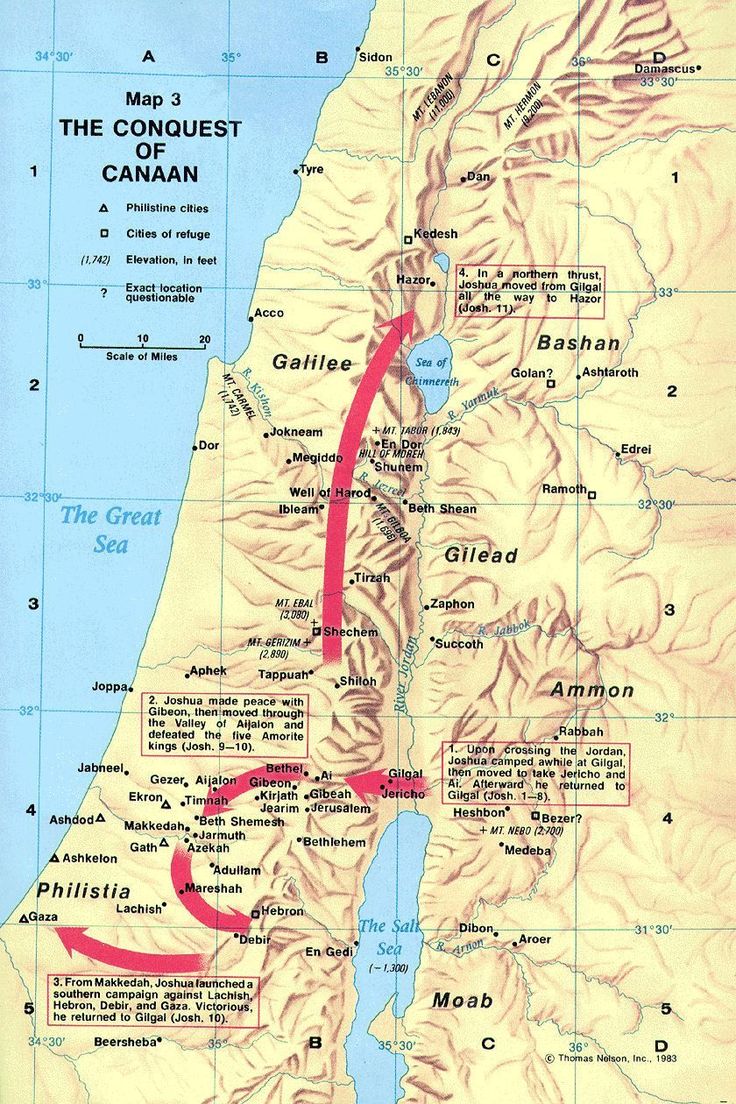
From the overall context, it would appear that Saul walked away with a new perspective. His attitude had been transformed by his encounter with Samuel and the news that God had anointed him to be Israel’s king. When Saul first met Samuel, the prophet told him, “I am here to tell you that you and your family are the focus of all Israel’s hopes” (1 Samuel 9:20 NLT). But this cryptic message left Saul uncomfortable and confused, prompting him to respond, “But I’m only from the tribe of Benjamin, the smallest tribe in Israel, and my family is the least important of all the families of that tribe! Why are you talking like this to me?” (1 Samuel 9:21 NLT).

Saul had no idea what Samuel was talking about and as the rest of the day unfolded, he became even more unsettled and uncertain. Things were happening so fast and it was almost impossible for him to take it all in. But the moment when Samuel anointed Saul with oil proved to be a game changer. That experience, coupled with the prophetic words spoken by the prophet, left Saul a different man. God transformed his reluctance into belief, empowering Saul to step out in faith and do what Samuel had told him to do. He obeyed the will of God and, as a result, “all Samuel’s signs were fulfilled that day” (1 Samuel 10:9 NLT). Had Saul refused to believe and act on Samuel’s words, the story would have ended there; none of Samuel’s predictions would have come to fruition. But the all-powerful, invisible God of Israel was operating behind the scenes, softening Saul’s heart and prompting his obedience.

As Saul and his servant entered the town of Gibeah, they encountered a group of prophets, just as Samuel had predicted. What happened next must have caught Saul by surprise and left his unwitting servant in disbelief.

Then the Spirit of God came powerfully upon Saul, and he, too, began to prophesy. – 1 Samuel 10:10 NLT

Samuel had told Saul that this would happen (1 Samuel 10:6) but experiencing it was another matter altogether. In a matter of seconds, Saul was filled with the Holy Spirit and began to prophesy. The inference is that Saul came under the power of the Holy Spirit and was no longer in control of his actions. He became an instrument in the hands of God. There is no explanation given as to how or what Saul prophesied. When Samuel predicted this encounter, he provided an important detail: “…you will meet a band of prophets coming down from the place of worship. They will be playing a harp, a tambourine, a flute, and a lyre, and they will be prophesying” (1 Samuel 10:5 NLT). These men were musicians who may have been connected to the Tabernacle and assisted in the worship of Yahweh. If this is true, they would have been Levites. Their presence in Gibeah is unexplained and the exact nature of their prophesying is unclear. But it seems that they were singing God’s praises under the Holy Spirit’s influence. And before he could take it all in, Saul joined in. This young man from the tribe of Benjamin suddenly broke out in song and joined the procession of prophets as they proclaimed the glories of God.

 This strange scene didn’t go unnoticed. The bystanders who took it all in began to question what they were seeing. Here was Saul, the son of Kish, dancing and singing along with the prophets of God. This unexpected and unprecedented behavior by this young man caused them to ask, “Can anyone become a prophet, no matter who his father is?” (1 Samuel 10:12 NLT). It reminds me of the lyrics from an old Sesame Street song.

One of these sounds is not like the others
One of these sounds doesn’t belong
Can you tell which sound is not like the other
By the time I finish my song?

Saul didn’t belong in the band of prophets. As a member of the tribe of Benjamin, he had no right to take part in their God-appointed duties. But there he was, big as life, and clearly exhibiting the evidence of being Spirit-empowered, which left the people asking, “How did the son of Kish become a prophet?” (1 Samuel 10:11 NLT).

But Saul’s moment in the spotlight came to an end and he went on his way. When his uncle demanded to know where he had been, Saul chose to present a truncated and sanitized version of his experience.

“We were looking for the donkeys,” Saul replied, “but we couldn’t find them. So we went to Samuel to ask him where they were.” – 1 Samuel 10:14 NLT

This wasn’t a lie but it wasn’t exactly the truth either. For whatever reason, Saul decided to withhold some of the pertinent information regarding his encounter with Samuel. He fails to mention the banquet, his anointing with oil, or Samuel’s prophesy concerning his call to be Israel’s king. Perhaps Saul was concerned about how his family would receive this news and he wanted to be the one to tell his father and mother all that had happened. Had he told his uncle the full story, the news could have spread quickly, creating an even greater uproar than his short-term role as a prophet had caused. So, “Saul didn’t tell his uncle what Samuel said about the kingdom” (1 Samuel 10:16 NLT).

Saul’s reticence to divulge the full story was in keeping with the words of Samuel. The prophet had given him clear instructions.

“…go down to Gilgal ahead of me. I will join you there to sacrifice burnt offerings and peace offerings. You must wait for seven days until I arrive and give you further instructions.” – 1 Samuel 10:8 NLT

Saul had not been told to make the news of his anointing known to anyone, including his own family. He was instructed to go to Gilgal and wait for the prophet, and that is what he did.

This entire plan had a God-ordained schedule associated with it. Everything had to happen according to God’s well-timed and predetermined schedule. The seminal event in Israel’s storied history was not going to happen by chance or according to the whims or wishes of men. God was implementing His divine plan and nothing could stand in His way.

English Standard Version (ESV) The Holy Bible, English Standard Version. ESV® Permanent Text Edition® (2016). Copyright © 2001 by Crossway Bibles, a publishing ministry of Good News Publishers.

New Living Translation (NLT) Holy Bible, New Living Translation, copyright © 1996, 2004, 2015 by Tyndale House Foundation. Used by permission of Tyndale House Publishers Inc., Carol Stream, Illinois 60188. All rights reserved.

Our All-Knowing God Always Knows What Is Best

16 The Lord spoke to Moses, saying, 17 “These are the names of the men who shall divide the land to you for inheritance: Eleazar the priest and Joshua the son of Nun. 18 You shall take one chief from every tribe to divide the land for inheritance. 19 These are the names of the men: Of the tribe of Judah, Caleb the son of Jephunneh. 20 Of the tribe of the people of Simeon, Shemuel the son of Ammihud. 21 Of the tribe of Benjamin, Elidad the son of Chislon. 22 Of the tribe of the people of Dan a chief, Bukki the son of Jogli. 23 Of the people of Joseph: of the tribe of the people of Manasseh a chief, Hanniel the son of Ephod. 24 And of the tribe of the people of Ephraim a chief, Kemuel the son of Shiphtan. 25 Of the tribe of the people of Zebulun a chief, Elizaphan the son of Parnach. 26 Of the tribe of the people of Issachar a chief, Paltiel the son of Azzan. 27 And of the tribe of the people of Asher a chief, Ahihud the son of Shelomi. 28 Of the tribe of the people of Naphtali a chief, Pedahel the son of Ammihud.” 29 These are the men whom the Lord commanded to divide the inheritance for the people of Israel in the land of Canaan. 

1 The Lord spoke to Moses in the plains of Moab by the Jordan at Jericho, saying, “Command the people of Israel to give to the Levites some of the inheritance of their possession as cities for them to dwell in. And you shall give to the Levites pasturelands around the cities. The cities shall be theirs to dwell in, and their pasturelands shall be for their cattle and for their livestock and for all their beasts. The pasturelands of the cities, which you shall give to the Levites, shall reach from the wall of the city outward a thousand cubits all around. And you shall measure, outside the city, on the east side two thousand cubits, and on the south side two thousand cubits, and on the west side two thousand cubits, and on the north side two thousand cubits, the city being in the middle. This shall belong to them as pastureland for their cities.

“The cities that you give to the Levites shall be the six cities of refuge, where you shall permit the manslayer to flee, and in addition to them you shall give forty-two cities. All the cities that you give to the Levites shall be forty-eight, with their pasturelands. And as for the cities that you shall give from the possession of the people of Israel, from the larger tribes you shall take many, and from the smaller tribes you shall take few; each, in proportion to the inheritance that it inherits, shall give of its cities to the Levites.” Numbers 34:16-35:8 ESV

God provided Moses with the name of one man from each of the ten tribes of Israel. These men, hand-picked by God, would assist Eleazar, the high priest, and Joshua in the distribution of the land. The tribes of Gad and Reuben were not included because they had chosen to settle outside the boundaries of Canaan. These men were well-respected leaders among their respective tribes and would help to guarantee that the land was fairly apportioned and that each tribe, regardless of its size, was treated equitably and fairly. There was to be no favoritism or any form of nepotism. The larger tribes, whose numbers would be based on the recent census taken by Moses, would be allotted more extensive land allotments. But was not a guarantee that they would receive the best land. God was giving these ten men the weighty responsibility of dividing up the Israelites’ inheritance in a way that would satisfy all the parties involved, and that would not be an easy task.

The next thing on God’s agenda was to arrange for the needs of the tribe of Levi, his own tribe. He had already informed Moses that the Levites would inherit no land in Canaan. God had set apart the tribe of Levi as His special possession and had dedicated them to the care and maintenance of the Tabernacle. As a result, God promised to be their inheritance.

“Remember that the Levitical priests—that is, the whole of the tribe of Levi—will receive no allotment of land among the other tribes in Israel. Instead, the priests and Levites will eat from the special gifts given to the Lord, for that is their share. They will have no land of their own among the Israelites. The Lord himself is their special possession, just as he promised them.” – Deuteronomy 18:1-2 NLT

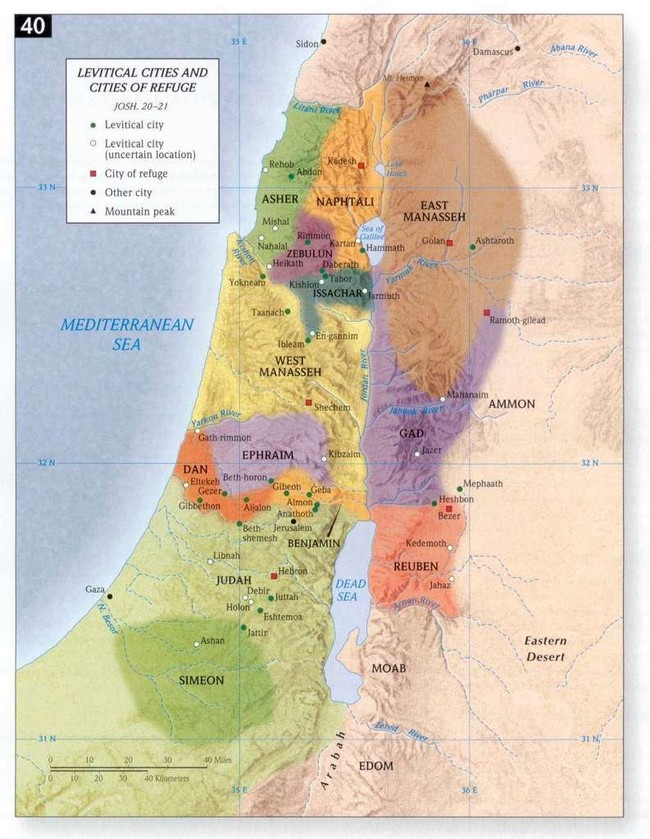
But while the Levites would be allotted no land in Canaan, they would be awarded the deeds to 48 cities located within the territories of each of the other 11 tribes (Joshua 21). Even the tribes of Gad, Reuben, and the half-tribe of Manasseh were required to provide the Levites with towns and pastureland for their flocks on the other side of the Jordan River. God had made ample accommodations for the Levites.

These Levitical cities were to be strategically located throughout the nation of Israel so that every Israelite was no more than ten miles from one of them. This helped to ensure that the people of God were never far away from a member of the Levitical priesthood, whose job was to provide instruction in the ways of God. The Levitical priests served as judges (Deuteronomy 17:8-13) and teachers of God’s law (Deuteronomy 33:10). So, it was essential that every Israelite had ready access to a Levitical town and a priest of God.

Of the 48 towns awarded to the Levites, six were to be designated as cities of refuge. These were specially sanctioned zones within the boundaries of Israel where anyone guilty of committing a non-premediated murder could seek asylum. God had already declared His ruling concerning murder (Exodus 20:13), but He had Moses present a special provision for cases involving accidental homicide.

“If someone kills another person unintentionally, without previous hostility, the slayer may flee to any of these cities to live in safety. – Deuteronomy 19:4 NLT

He even had Moses provide a potential scenario in which a city of refuge would become necessary.

“For example, suppose someone goes into the forest with a neighbor to cut wood. And suppose one of them swings an ax to chop down a tree, and the ax head flies off the handle, killing the other person. In such cases, the slayer may flee to one of the cities of refuge to live in safety.” – Deuteronomy 19:5 NLT

God knew that life would happen and that deadly accidents would be a part of the Israelites’ existence in the land. Men would be killed and justice would need to be pursued. But what He didn’t want was some form of vigilante justice running rampant through the nation. Yet God knew that the relatives of a murder victim would tend to seek revenge against the guilty party and ask questions later. The cities of refuge were intended to protect the innocent while justice was being served.

Since Israel had no professional police force, these kinds of accidents could easily turn into bloodbaths where the relatives of the victim sought to avenge their loved one’s death. So, these cities, occupied by the Levites, would provide a place where the guilty party could find solace and seek a fair judgment concerning his guilt or innocence. In His plans for the land of promise, God was leaving nothing to chance. He was creating a well-designed system for dealing with the inevitable problem of sin among His chosen people. He was going to distribute the Levitical priesthood among them to provide spiritual enlightenment and He was going to create safe havens for those who unwittingly committed even the gravest of sins. God was providing for and protecting His people.

English Standard Version (ESV) The Holy Bible, English Standard Version. ESV® Permanent Text Edition® (2016). Copyright © 2001

New Living Translation (NLT) Holy Bible, New Living Translation, copyright © 1996, 2004, 2015 by Tyndale House Foundation. Used by permission of Tyndale House Publishers Inc., Carol Stream, Illinois 60188. All rights reserved.

A Famine and Fruitfulness

20 So Joseph bought all the land of Egypt for Pharaoh, for all the Egyptians sold their fields, because the famine was severe on them. The land became Pharaoh’s. 21 As for the people, he made servants of them from one end of Egypt to the other. 22 Only the land of the priests he did not buy, for the priests had a fixed allowance from Pharaoh and lived on the allowance that Pharaoh gave them; therefore they did not sell their land.

23 Then Joseph said to the people, “Behold, I have this day bought you and your land for Pharaoh. Now here is seed for you, and you shall sow the land. 24 And at the harvests you shall give a fifth to Pharaoh, and four fifths shall be your own, as seed for the field and as food for yourselves and your households, and as food for your little ones.” 25 And they said, “You have saved our lives; may it please my lord, we will be servants to Pharaoh.” 26 So Joseph made it a statute concerning the land of Egypt, and it stands to this day, that Pharaoh should have the fifth; the land of the priests alone did not become Pharaoh’s.

27 Thus Israel settled in the land of Egypt, in the land of Goshen. And they gained possessions in it, and were fruitful and multiplied greatly. 28 And Jacob lived in the land of Egypt seventeen years. So the days of Jacob, the years of his life, were 147 years.

29 And when the time drew near that Israel must die, he called his son Joseph and said to him, “If now I have found favor in your sight, put your hand under my thigh and promise to deal kindly and truly with me. Do not bury me in Egypt, 30 but let me lie with my fathers. Carry me out of Egypt and bury me in their burying place.” He answered, “I will do as you have said.” 31 And he said, “Swear to me”; and he swore to him. Then Israel bowed himself upon the head of his bed. – Genesis 47:20-31 ESV

With his family comfortably settled in the land of Goshen, Joseph returned to his duties of stewarding the well-being of Pharaoh’s empire. Throughout the year seven years of famine, he used the grain he had stockpiled during the seven years of plenty to feed the starving citizens of the country. But didn’t set up a welfare state. Instead, he sold the grain to the people. And when their money ran out, he traded grain for livestock. When their supply of livestock was exhausted, the people were allowed to trade in their land holdings for grain, amassing an extensive real estate empire for the state. Then, when the people no longer had any money to spend, livestock to sell, or land to trade, they were left with only one option: To become the indentured servants of Pharaoh. And while this may appear as an egregious example of government overreach, Joseph was actually using the government’s administrative capabilities to protect and preserve the people and the nation.

Joseph allowed the people to continue living on the land, raising crops as they had done before. But he imposed a 20 percent tax on all agricultural production. This levy, while high, would allow Pharaoh’s administration to continue their food assistance program throughout the remaining years of the famine. The people were allowed to keep four-fifths of whatever they harvested, but the remaining one-fifth went into the royal granaries. And the people did not see any of this as a land grab or a form of government-led extortion. They were grateful to be alive.

“You have saved our lives; may it please my lord, we will be servants to Pharaoh.” – Genesis 47:25 ESV

Yet, it should not be overlooked that, while the people of Egypt were slowly handing over their resources, lands, and freedoms to the state, the people of Israel were enjoying the blessings of God in Goshen.

Meanwhile, the people of Israel settled in the region of Goshen in Egypt. There they acquired property, and they were fruitful, and their population grew rapidly. – Genesis 47:27 NLT

It seems that the Israelites were able to take advantage of the dire situation in Egypt by buying up land that their Egyptian neighbors were being forced to sell. All during the famine, Joseph provided Jacob and the rest of his family with food. Jacob had entered Egypt a very wealthy man, and he used his formidable resources to accumulate a growing real estate portfolio in Egypt. As his family grew, so did his land holdings. God was fulfilling the promise He had made to Jacob years earlier.

“Your name is Jacob; no longer shall your name be called Jacob, but Israel shall be your name.” So he called his name Israel. And God said to him, “I am God Almighty: be fruitful and multiply.” – Genesis 35:10-11 ESV

At that time, Jacob had no idea that the fruitfulness and multiplication of his family would take place in Egypt and not Canaan. But that had been God’s plan all along. Even Joseph understood that reality. Everything that had happened in his life had been according to the preordained, sovereign will of God Almighty. He would later emphasize that fact to his brothers.

“Do not fear, for am I in the place of God? As for you, you meant evil against me, but God meant it for good, to bring it about that many people should be kept alive, as they are today. So do not fear; I will provide for you and your little ones.” – Genesis 50:19-21 ESV

So, Jacob’s migration to Egypt had been God’s will. He had planned it, orchestrated it, and was now fulfilling it in real-time. But Jacob would not live long enough to see Canaan again. In fact, none of his sons, including Joseph would ever set foot in the promised land again. Jacob would live an additional 17 years, dying at the ripe old age of 147. But as he looked around him, he could see the signs of God’s blessings everywhere. He had lived to see his long-lost son restored to his side. He was the proud patriarch of a rapidly growing clan living in a fruitful land that God had miraculously provided. And while he had never owned an acre of land in Canaan, he had been able to take title to a large portion of the land in Egypt’s rich Nile delta.

But Jacob never saw Egypt as his home. To the end of his life, he still retained his love and longing for the land of Canaan. He had not forgotten God’s promise to provide the land of Canaan as his inheritance. And, while he knew he would never make it back there alive, he made Joseph swear that his body would be returned to Canaan for burial, in the very same plot of land that Abraham had bought to bury Sarah. Even in death, he wanted to be associated with the land of promise. And Joseph swore an oath to fulfill his father’s dying wish.

For Jacob, Egypt was simply a temporary, but necessary diversion in the journey toward God’s fulfillment of the promise. Whether or not he knew the details that God had shared with his grandfather, Abraham, is unclear. In Genesis 15:13, Moses records God’s announcement to Abraham that his descendants would spend 400 years in a foreign land. But at the end of that end lengthy period of time, they would return to the land of Canaan. And whether Jacob had a four-century delay in mind, he knew that the day would come when God returned His people to their land.

English Standard Version (ESV) The Holy Bible, English Standard Version. ESV® Permanent Text Edition® (2016). Copyright © 2001 by Crossway Bibles, a publishing ministry of Good News Publishers.

New Living Translation (NLT) Holy Bible, New Living Translation, copyright © 1996, 2004, 2015 by Tyndale House Foundation. Used by permission of Tyndale House Publishers Inc., Carol Stream, Illinois 60188. All rights reserved.

New English Translation (NET)NET Bible® copyright ©1996-2017 by Biblical Studies Press, L.L.C. http://netbible.com All rights reserved.