The Allure of Spiritual Syncretism

29 But every nation still made gods of its own and put them in the shrines of the high places that the Samaritans had made, every nation in the cities in which they lived. 30 The men of Babylon made Succoth-benoth, the men of Cuth made Nergal, the men of Hamath made Ashima, 31 and the Avvites made Nibhaz and Tartak; and the Sepharvites burned their children in the fire to Adrammelech and Anammelech, the gods of Sepharvaim. 32 They also feared the LORD and appointed from among themselves all sorts of people as priests of the high places, who sacrificed for them in the shrines of the high places. 33 So they feared the LORD but also served their own gods, after the manner of the nations from among whom they had been carried away.

34 To this day they do according to the former manner. They do not fear the LORD, and they do not follow the statutes or the rules or the law or the commandment that the LORD commanded the children of Jacob, whom he named Israel. 35 The LORD made a covenant with them and commanded them, “You shall not fear other gods or bow yourselves to them or serve them or sacrifice to them, 36 but you shall fear the LORD, who brought you out of the land of Egypt with great power and with an outstretched arm. You shall bow yourselves to him, and to him you shall sacrifice. 37 And the statutes and the rules and the law and the commandment that he wrote for you, you shall always be careful to do. You shall not fear other gods, 38 and you shall not forget the covenant that I have made with you. You shall not fear other gods, 39 but you shall fear the LORD your God, and he will deliver you out of the hand of all your enemies.” 40 However, they would not listen, but they did according to their former manner.

41 So these nations feared the LORD and also served their carved images. Their children did likewise, and their children’s children—as their fathers did, so they do to this day. 2 Kings 17:29-41 ESV

So they feared the Lord but also served their own gods.”
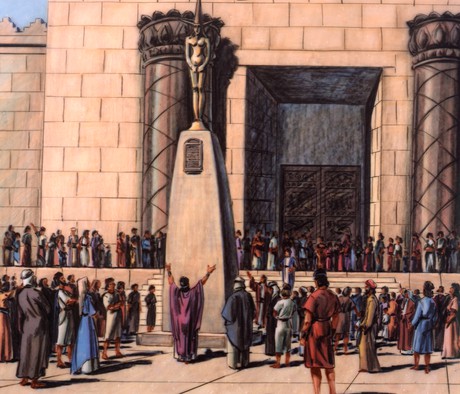
That phrase appears twice in the closing verses of chapter 17, and it aptly summarizes the spiritual state of the nation of Israel after it fell to the Assyrians. Many of its citizens had been captured and exiled to various locations in Assyria, and their vacancies were filled by people from other conquered nations who were forced to relocate to Israel and start new lives. This sudden influx of refugees from foreign countries turned Israel into a veritable melting pot and, ultimately, resulted in intermarriage between the remaining Jews and their new neighbors.

These newly transplanted inhabitants found themselves living in a foreign land where they didn’t understand the language or customs. They were strangers living in a strange place, but they found some comfort in the fact that many of their gods already had shrines dedicated to them in Israel. The ten northern tribes had been assimilating the gods of other nations for years. Under Jeroboam’s leadership, they had created their own gods, complete with temples and a priesthood. Under Ahab and Jezebel, they had adopted and promoted the worship of Baal and Asherah. And along the way, other kings of Israel had embraced the false gods of their foreign allies. So, the new arrivals to Israel found an atmosphere of religious tolerance and ecumenism.

Immediately after these foreign refugees arrived in Israel and took up residence in the abandoned cities of Samaria, they began worshiping their false gods. But the land on which they now lived belonged to Yahwah, and He took offense at their actions. He had set apart the land of Israel as holy and given to the descendants of Abraham as their inheritance. It was to have been a place where they lived in obedience to His will and worshiped Him alone. Their failure to do so led to their defeat and deportation at the hands of the Assyrians. However, their eviction from the land had not changed its sanctity or voided the covenant commitment God had made with His people. There was still a remnant of Jews living in the land of Israel, and He expected them to keep their end of the agreement they had made with Him.

So, when these foreigners began to worship their false gods on land that belonged to the one true God, they found themselves experiencing divine judgment.

But since these foreign settlers did not worship the LORD when they first arrived, the LORD sent lions among them, which killed some of them. – 2 Kings 17:25 NLT

As a result, the king of Assyria ordered that one of the exiled Israelite priests be sent back so that he might instruct the immigrants in the proper worship of Yahweh.

So one of the priests who had been exiled from Samaria returned to Bethel and taught the new residents how to worship the LORD. – 2 Kings 17:28 NLT

This highly pragmatic plan implemented by the king of Assyria was evidently successful. But while many of the new arrivals eagerly adopted Yahweh as their God, they added Him to their growing list of deities. He became just one more god to whom they offered sacrifices to win favor and good fortune.

These new residents worshiped the LORD, but they also appointed from among themselves all sorts of people as priests to offer sacrifices at their places of worship. And though they worshiped the LORD, they continued to follow their own gods according to the religious customs of the nations from which they came. – 2 Kings 17:32-33 NLT

With the sudden arrival of these various people groups, the religious landscape of Israel became ever more crowded and confused. Almost overnight, the idolatrous state of Israel exploded with new options and opportunities as the number of false gods continued to increase. The already tolerant and easily tempted Israelites found themselves surrounded by a virtual sea of new gods from which to choose.

Those from Babylon worshiped idols of their god Succoth-benoth. Those from Cuthah worshiped their god Nergal. And those from Hamath worshiped Ashima. The Avvites worshiped their gods Nibhaz and Tartak. And the people from Sepharvaim even burned their own children as sacrifices to their gods Adrammelech and Anammelech. – 2 Kings 17:30-31 NLT

The worship of Yahweh became increasingly more diluted and defused as a spirit of syncretism and religious pluralism spread over the land. The fall of Israel did not result in a spirit of repentance and religious reform among God’s people. In fact, His judgment of them was met by indifference and continued apostasy.

They continue to follow their former practices instead of truly worshiping the LORD and obeying the decrees, regulations, instructions, and commands he gave the descendants of Jacob, whose name he changed to Israel. – 2 Kings 17:34 NLT

There appears to be no remorse or repentance on the part of God’s people. Their neighbors had been taken captive and exiled to Assyria, but those who had been left behind remained just as committed to living in disobedience to God’s laws. And it seems that those who found themselves living as captives in Assyria were no less stubborn and unwilling to return to Yahweh. Yet when King Solomon dedicated the newly constructed Temple, he asked God to show mercy on His disobedient people, should they find themselves in exile and call out for help.

“If your people Israel are defeated by their enemies because they have sinned against you, and if they turn to you and acknowledge your name and pray to you here in this Temple, then hear from heaven and forgive the sin of your people Israel and return them to this land you gave their ancestors.” – 1 Kings 8:33-34 NLT

But they had failed to turn and acknowledge God’s name. They had refused to pray and ask for Yahweh’s forgiveness. Both those in exile and those living in the land of Israel continued to disobey His commands and violate His covenant agreement. And the author makes it clear that God took their disobedience seriously.

For the LORD had made a covenant with the descendants of Jacob and commanded them: “Do not worship any other gods or bow before them or serve them or offer sacrifices to them. But worship only the LORD, who brought you out of Egypt with great strength and a powerful arm. Bow down to him alone, and offer sacrifices only to him. Be careful at all times to obey the decrees, regulations, instructions, and commands that he wrote for you. You must not worship other gods. Do not forget the covenant I made with you, and do not worship other gods. You must worship only the LORD your God. He is the one who will rescue you from all your enemies.” – 2 Kings 17:35-39 NLT

They had no excuse. The remnant of Israelites still living in the land knew exactly what Yahweh expected of them, but they continued to reject His word and refused to repent. While the new residents were given instruction in the proper worship of Yahweh, they simply added Him to their long and growing list of god options. “While these new residents worshiped the LORD, they also worshiped their idols. And to this day their descendants do the same” (2 Kings 17:41 NLT).

This last verse is meant to convey a sense of inevitability and determinism. Nothing was going to change. They were fully committed to doing things their way, regardless of the circumstances or consequences. By the time Jesus appeared on the scene centuries later, the long-term implications of this syncretistic and overly tolerant religious mindset had resulted in the division between the Jews and the Samaritans. The foreigners transplanted into Israel by the king of Assyria eventually intermarried with the remaining Jewish population. These mixed marriages led to the assimilation of cultures and religions, producing a population known as the Samaritans. The Samaritans were considered to be half-breeds by the Jews of Jesus’ day and were treated as second-class citizens. They practiced a religion that combined the worship of Yahweh with aspects of paganism and idolatry. As the Samaritan woman confessed to Jesus, they even had their own place of worship, outside the confines of Jerusalem (John 4:20).

Chapter 17 of 2 Kings brings the story of the northern kingdom to a dramatic and somber close. At this point, part of the nation is living in exile in Assyria; the rest remain in the land but are marked by a spirit of spiritual syncretism and moral compromise. There will be no more kings to rule over the ten tribes. They will remain under God’s judgment and experience the curses He had warned would come should they choose to disobey. But the author will turn his attention back to the southern kingdom of Judah. For now, they remain free to follow God’s commands. But will they? The author provides a not-so-subtle hint of what lies in store for the people of Judah.

Because the LORD was very angry with Israel, he swept them away from his presence. Only the tribe of Judah remained in the land. But even the people of Judah refused to obey the commands of the LORD their God, for they followed the evil practices that Israel had introduced. – 2 Kings 17:18-19 NLT

The handwriting is on the wall, and the fate of the nation of Judah seems sealed by their stubborn refusal to learn anything from the fall of their northern neighbors. They had been eyewitnesses to the stark reality of Yahweh’s judgment and yet failed to make a much-needed course correction.

The prophet Jeremiah records Yahweh’s less-than-flattering assessment of the northern kingdom’s fall from grace and His prognosis for Judah’s future.

“Have you seen what fickle Israel has done? Like a wife who commits adultery, Israel has worshiped other gods on every hill and under every green tree. I thought, ‘After she has done all this, she will return to me.’ But she did not return, and her faithless sister Judah saw this. She saw that I divorced faithless Israel because of her adultery. But that treacherous sister Judah had no fear, and now she, too, has left me and given herself to prostitution. Israel treated it all so lightly—she thought nothing of committing adultery by worshiping idols made of wood and stone. So now the land has been polluted. But despite all this, her faithless sister Judah has never sincerely returned to me. She has only pretended to be sorry. I, the LORD, have spoken!” – Jeremiah 3:6-10 NLT

English Standard Version (ESV) The Holy Bible, English Standard Version. ESV® Permanent Text Edition® (2016). Copyright © 2001 by Crossway Bibles, a publishing ministry of Good News Publishers.

New Living Translation (NLT) Holy Bible, New Living Translation, copyright © 1996, 2004, 2015 by Tyndale House Foundation. Used by permission of Tyndale House Publishers Inc., Carol Stream, Illinois 60188. All rights reserved.

Limping Between Two Spiritual Opinions

1 After many days the word of the LORD came to Elijah, in the third year, saying, “Go, show yourself to Ahab, and I will send rain upon the earth.” So Elijah went to show himself to Ahab. Now the famine was severe in Samaria. And Ahab called Obadiah, who was over the household. (Now Obadiah feared the LORD greatly, and when Jezebel cut off the prophets of the LORD, Obadiah took a hundred prophets and hid them by fifties in a cave and fed them with bread and water.) And Ahab said to Obadiah, “Go through the land to all the springs of water and to all the valleys. Perhaps we may find grass and save the horses and mules alive, and not lose some of the animals.” So they divided the land between them to pass through it. Ahab went in one direction by himself, and Obadiah went in another direction by himself.

And as Obadiah was on the way, behold, Elijah met him. And Obadiah recognized him and fell on his face and said, “Is it you, my lord Elijah?” And he answered him, “It is I. Go, tell your lord, ‘Behold, Elijah is here.’” And he said, “How have I sinned, that you would give your servant into the hand of Ahab, to kill me? 10 As the LORD your God lives, there is no nation or kingdom where my lord has not sent to seek you. And when they would say, ‘He is not here,’ he would take an oath of the kingdom or nation, that they had not found you. 11 And now you say, ‘Go, tell your lord, “Behold, Elijah is here.”’ 12 And as soon as I have gone from you, the Spirit of the LORD will carry you I know not where. And so, when I come and tell Ahab and he cannot find you, he will kill me, although I your servant have feared the LORD from my youth. 13 Has it not been told my lord what I did when Jezebel killed the prophets of the Lord, how I hid a hundred men of the Lord’s prophets by fifties in a cave and fed them with bread and water? 14 And now you say, ‘Go, tell your lord, “Behold, Elijah is here”’; and he will kill me.” 15 And Elijah said, “As the LORD of hosts lives, before whom I stand, I will surely show myself to him today.” 16 So Obadiah went to meet Ahab, and told him. And Ahab went to meet Elijah.

17 When Ahab saw Elijah, Ahab said to him, “Is it you, you troubler of Israel?” 18 And he answered, “I have not troubled Israel, but you have, and your father’s house, because you have abandoned the commandments of the LORD and followed the Baals. 19 Now therefore send and gather all Israel to me at Mount Carmel, and the 450 prophets of Baal and the 400 prophets of Asherah, who eat at Jezebel’s table.”

20 So Ahab sent to all the people of Israel and gathered the prophets together at Mount Carmel. 21 And Elijah came near to all the people and said, “How long will you go limping between two different opinions? If the LORD is God, follow him; but if Baal, then follow him.” And the people did not answer him a word. 1 Kings 18:1-22 ESV

For nearly three years, Elijah has been living in exile among the Sidonians. God had sent him there to protect and preserve him for the next phase of his mission. Three years earlier, Elijah had delivered God’s message of judgment to King Ahab and his pagan queen, Jezebel. Their joint decision to use their royal power to legislate the worship of Baal had brought down the anger of Yahweh in the form of a devastating famine. Knowing this godless couple would seek to kill His messenger, God sent Elijah away so that he could live to fight another day, and that day had finally come.

In his original encounter with Ahab, Elijah had boldly declared that the famine would last until God ordered him to bring it to an end.

“As surely as the LORD, the God of Israel, lives—the God I serve—there will be no dew or rain during the next few years until I give the word!” – 1 Kings 17:1 NLT

Now, three years later, Elijah had received his marching orders from God.

“Go, show yourself to Ahab, and I will send rain upon the earth.” – 1 Kings 18:1 ESV

God had allowed the drought to take its toll. Three years without rain had resulted in a widespread famine that had even impacted the capital city of Samaria. It was there that Ahab had ordered the construction of a temple to Baal, the Phoenician fertility god.

He erected an altar for Baal in the house of Baal, which he built in Samaria. And Ahab made an Asherah. Ahab did more to provoke the LORD, the God of Israel, to anger than all the kings of Israel who were before him. – 1 Kings 16:32-33 ESV

But Baal’s presence had not spared the royal city. Whatever power the people believed their beloved fertility god possessed had failed to stem the ravaging effects of the drought and the life-threatening nature of the resulting famine. Things had gotten so bad that Ahab ordered a search for any land where there might be grass to feed his horses and mules. As king, he was more concerned about the fate of his livestock than he was about the well-being of the people under his care. So, he sent his household manager on a desperate, but futile search for green grass in the midst of a famine. But what Obadiah ended up finding was something neither he nor the king ever expected.

As Obadiah was walking along, he suddenly saw Elijah coming toward him. Obadiah recognized him at once and bowed low to the ground before him. “Is it really you, my lord Elijah?” he asked. – 1 Kings 18:7 NLT

Obadiah was shocked to run into Elijah. After three years, he had probably assumed that the prophet had met an untimely end. But out of reverence and honor, he bowed before Elijah. This man, who served as a royal official in the court of King Ahab, was still a faithful follower of Yahweh, and the author provides an essential parenthetical description that lets the reader know that Obadiah can be trusted.

Obadiah was a devoted follower of the LORD. Once when Jezebel had tried to kill all the LORD’s prophets, Obadiah had hidden 100 of them in two caves. He put fifty prophets in each cave and supplied them with food and water. – 1 Kings 18:3-4 NLT

This little detail concerning Obadiah will prove to be important as the narrative unfolds. First, it lets the reader know that after Elijah had delivered God’s message concerning the drought, Jezebel had launched a campaign to liquidate any and all of God’s prophets from the land of Israel. It seems reasonable to believe that her goal had been to catch and eliminate Elijah. Still, she was willing to execute any prophet of Yahweh who might stand in opposition to her will and the worship of her false god.

But the author’s little aside provides a second detail that will prove crucial. Jezebel’s death squads had failed to find and kill 100 prophets of Yahweh because they had been protected by Obadiah. At significant risk to his own life, this royal official had willfully violated the queen’s command by aiding and abetting those whose executions she had ordered. God had chosen to use ravens to deliver food for Elijah. But in the case of the 100 prophets, He had selected a member of Ahab’s royal court. Once again, God had used an unlikely and unexpected source to preserve His messengers. The fact that these 100 prophets exist will become more important as the story unfolds.

Recognizing Obadiah as a member of the royal court, Elijah instructed him to return to the palace with a message for the king.

“Go, tell your lord, ‘Behold, Elijah is here.’” – 1 Kings 18:8 ESV

Obadiah, while a faithful follower of Yahweh, was not thrilled at the prospect of sharing this news with King Ahab. He knew that Elijah was a wanted man with a bounty on his head, and Ahab had gone to great lengths to locate and eliminate this proverbial thorn in his side.

“I swear by the Lord your God that the king has searched every nation and kingdom on earth from end to end to find you” – 1 Kings 18:10 NLT

After three years, Ahab’s quest to find Elijah had proven unsuccessful, and his frustration would have been at an all-time high. Obadiah was afraid that if he delivered Elijah’s message and then the prophet disappeared again, the king would take out his anger on him. In an attempt to let Elijah know that he had already risked his life in the cause of Yahweh, Obadiah shared the story of his rescue of the 100 prophets. Hadn’t that been enough? Was God now requiring him to put his life on the line again just so he could deliver Elijah’s message to the king?

But Elijah promised his reluctant friend that he would not put his life in jeopardy; he would not be going anywhere because he had a job to do. In fact, he assured Obadiah that he would appear before the king that very day. So, Obadiah did as the prophet commanded and rode to find the king, who was also conducting a futile search for green grass.

When Ahab heard the news, he dropped everything and rode to meet Elijah. Upon seeing the man he loathed and despised, the king sarcastically asked, “Is it you, you troubler of Israel?” (1 Kings 18:17 ESV). This arrogant and apostate king tried to blame Elijah for the nation’s woes. He knew that Elijah had spoken the drought into existence, and he held him personally responsible for all the pain and suffering it had caused. His stubborn and unrepentant heart would not allow him to admit his own culpability for what had happened. It was the sin of Ahab and his wife that had brought down the judgment of God. Elijah had just been the messenger, and he immediately placed the blame for Israel’s woes right where it belonged.

“I have made no trouble for Israel,” Elijah replied. “You and your family are the troublemakers, for you have refused to obey the commands of the LORD and have worshiped the images of Baal instead. – 1 Kings 18:18 NLT

Ahab and his father Omri had led the people of Israel into apostasy by promoting the worship of false gods. They had turned their backs on Yahweh, causing God’s chosen people to commit spiritual adultery by giving their allegiance and affections to the gods of the Canaanites. They were to blame for the drought and the famine it caused.

But it’s important to recall that God had told Elijah to deliver a message to Ahab that would have sounded like good news: “Tell him that I will soon send rain!” (1 Kings 18:1 NLT). Yet, while the drought was about to end, the judgment was far from over. God was about to deliver a devastating blow to the royal couple that would reveal the impotence of their false god and the futility of abandoning the one true God.

Elijah threw down the gauntlet, challenging the king to a public showdown that would pit Baal against Yahweh.

“Now summon all Israel to join me at Mount Carmel, along with the 450 prophets of Baal and the 400 prophets of Asherah who are supported by Jezebel.” – 1 Kings 18:19 NLT

Driven by pride, the king took the challenge and called for an assembly of all the people of Israel. He ordered all the prophets of his false gods to gather together to do battle with Elijah and his God. Just consider the arrogance required to do what Ahab did. He was willingly and deliberately going to war with God Almighty, and he legitimately thought he could win, but his ego was in for a rude awakening. His gods were about to be exposed for what they were: Figments of man’s fertile and futile imagination that would be proven lifeless and powerless before the God of the universe.

In an epic showdown, Elijah was going to take on the god of Ahab and Jezebel, and challenge the people of Israel to end their vacillating indecision about which God they would serve. In a sense, Elijah was following the lead of Joshua, who, centuries earlier, had issued a similar challenge to the indecisive and unfaithful Israelites of his day.

“…choose today whom you will serve. Would you prefer the gods your ancestors served beyond the Euphrates? Or will it be the gods of the Amorites in whose land you now live? But as for me and my family, we will serve the LORD.” – Joshua 24:15 NLT

English Standard Version (ESV) The Holy Bible, English Standard Version. ESV® Permanent Text Edition® (2016). Copyright © 2001 by Crossway Bibles, a publishing ministry of Good News Publishers.

New Living Translation (NLT) Holy Bible, New Living Translation, copyright © 1996, 2004, 2015 by Tyndale House Foundation. Used by permission of Tyndale House Publishers Inc., Carol Stream, Illinois 60188. All rights reserved.
Their Hearts Are Far From Me

A Psalm of Asaph.

1 The Mighty One, God the LORD,
    speaks and summons the earth
    from the rising of the sun to its setting.
Out of Zion, the perfection of beauty,
    God shines forth.

Our God comes; he does not keep silence;
    before him is a devouring fire,
    around him a mighty tempest.
He calls to the heavens above
    and to the earth, that he may judge his people:
“Gather to me my faithful ones,
    who made a covenant with me by sacrifice!”
The heavens declare his righteousness,
    for God himself is judge! Selah

“Hear, O my people, and I will speak;
    O Israel, I will testify against you.
    I am God, your God.
Not for your sacrifices do I rebuke you;
    your burnt offerings are continually before me.
I will not accept a bull from your house
    or goats from your folds.
10 For every beast of the forest is mine,
    the cattle on a thousand hills.
11 I know all the birds of the hills,
    and all that moves in the field is mine.

12 “If I were hungry, I would not tell you,
    for the world and its fullness are mine.
13 Do I eat the flesh of bulls
    or drink the blood of goats?
14 Offer to God a sacrifice of thanksgiving,
    and perform your vows to the Most High,
15 and call upon me in the day of trouble;
    I will deliver you, and you shall glorify me.”

16 But to the wicked God says:
    “What right have you to recite my statutes
    or take my covenant on your lips?
17 For you hate discipline,
    and you cast my words behind you.
18 If you see a thief, you are pleased with him,
    and you keep company with adulterers.

19 “You give your mouth free rein for evil,
    and your tongue frames deceit.
20 You sit and speak against your brother;
    you slander your own mother’s son.
21 These things you have done, and I have been silent;
    you thought that I was one like yourself.
But now I rebuke you and lay the charge before you.

22 “Mark this, then, you who forget God,
    lest I tear you apart, and there be none to deliver!
23 The one who offers thanksgiving as his sacrifice glorifies me;
    to one who orders his way rightly
    I will show the salvation of God!” Psalm 50:1-23 ESV

Asaph, the apparent author of this psalm, was a Levite who headed up a contingent of musicians who provided worship music to accompany the people’s offering of sacrifices before the Ark of the Covenant in the Temple.

David appointed the following Levites to lead the people in worship before the Ark of the LORD—to invoke his blessings, to give thanks, and to praise the LORD, the God of Israel. Asaph, the leader of this group, sounded the cymbals. Second to him was Zechariah, followed by Jeiel, Shemiramoth, Jehiel, Mattithiah, Eliab, Benaiah, Obed-edom, and Jeiel. They played the harps and lyres. The priests, Benaiah and Jahaziel, played the trumpets regularly before the Ark of God’s Covenant. – 1 Chronicles 16:4-6 NLT

Asaph’s role in leading the people in worshipping Yahweh must have inspired him to write this psalm. Observing his fellow Israelites as they offered their sacrifices to God gave him a perfect vantage point to witness their hypocrisy and duplicity. Asaph was not a Levitical priest, so he had no authority to address what he believed to be the people’s blatant disregard for Yahweh. This prompted him to write this psalm as an extended speech. from the lips of God Himself.

He opens the psalm with a description of Yahweh’s glory.

The LORD [Yahweh], the Mighty One, is God,
    and he has spoken;
he has summoned all humanity
    from where the sun rises to where it sets. – Psalm 50:1 NLT

What God had to say would be addressed to “all humanity,” not just the people of Israel. This extended audience was intended to make what He had to say all the more convicting for His chosen people. He was about to expose their dirty laundry for all the world to see. And Asaph goes out of his way to establish God’s glory and majesty, describing Him as beautiful and radiant but also surrounded by a consuming fire. God’s splendor is contrasted with His judgment, setting up the bad news the people of Israel are about to hear.

He calls on the heavens above and earth below
    to witness the judgment of his people. – Psalm 50:4 NLT

This will not be a private rebuke, but instead, it will be a public declaration of Israel’s disobedience and well-deserved judgment. Asaph portrays Yahweh as a justifiably angry husband whose wife has committed adultery. They have broken their covenant relationship with Him by refusing to remain faithful and responding to His care and compassion with disinterest and disrespect. In a command laced with sarcasm, Asaph has God call His covenant people to the stand.

“Bring my faithful people to me—
    those who made a covenant with me by giving sacrifices.” – Psalm 50:5 NLT

Asaph recalls the fateful day when Moses came down from Mount Sinai with the Book of the Covenant containing God’s laws. He had read every one of God’s commands, making sure the people understood the nature of the commitment they were about to make.

Then Moses went down to the people and repeated all the instructions and regulations the LORD had given him. All the people answered with one voice, “We will do everything the LORD has commanded.”

Then Moses carefully wrote down all the LORD’s instructions. Early the next morning Moses got up and built an altar at the foot of the mountain. He also set up twelve pillars, one for each of the twelve tribes of Israel. Then he sent some of the young Israelite men to present burnt offerings and to sacrifice bulls as peace offerings to the LORD. Moses drained half the blood from these animals into basins. The other half he splattered against the altar.

Then he took the Book of the Covenant and read it aloud to the people. Again they all responded, “We will do everything the LORD has commanded. We will obey.” – Exodus 24:3-7 NLT

They had repeatedly expressed their intentions to keep the Lord’s commands. But now, Asaph was exposing their failure to live up to their commitment, and he did so by having Yahweh deliver the bad news.

“O my people, listen as I speak.
    Here are my charges against you, O Israel:
    I am God, your God! – Psalm 50:7 NLT

But what God has to say to His people is surprising. He doesn’t complain about the quality of their sacrifices or their failure to keep the various rituals associated with Temple worship.

I have no complaint about your sacrifices
    or the burnt offerings you constantly offer. – Psalm 50:8 NLT

They weren’t guilty of bringing shoddy sheep or blemished lambs. They hadn’t offered improper or inappropriate sacrifices. It wasn’t the quality of their offerings that was the problem; it was the condition of their hearts. Asaph has Yahweh expose the meaninglessness of their repeated sacrifices by declaring His lack of need for them.

“But I do not need the bulls from your barns
    or the goats from your pens.
For all the animals of the forest are mine,
    and I own the cattle on a thousand hills. – Psalm 50:9-10 NLT

God isn’t hungry. He has no need or insufficiency that requires their provision of food. He is the Creator of the universe who spoke all life into existence. So, He is fully capable of meeting His own needs without their help. But He makes the real problem clear.

“Make thankfulness your sacrifice to God,
    and keep the vows you made to the Most High. – Psalm 50:14 NLT

Gratefulness and obedience were the missing ingredients to their sacrifices. Bulls and goats were not what God was looking for. The prophet Isaiah records a similar indictment from God, accusing His covenant people of simply going through the motions when it came to their worship of Him.

“What makes you think I want all your sacrifices?”
    says the LORD.
“I am sick of your burnt offerings of rams
    and the fat of fattened cattle.
I get no pleasure from the blood
    of bulls and lambs and goats.
When you come to worship me,
    who asked you to parade through my courts with all your ceremony?
Stop bringing me your meaningless gifts;
    the incense of your offerings disgusts me!
As for your celebrations of the new moon and the Sabbath
    and your special days for fasting—
they are all sinful and false.
    I want no more of your pious meetings.” – Isaiah 1:11-13 NLT

Asaph was expressing a similar dissatisfaction without the behavior of his fellow Israelites. As he witnessed their repeated sacrifices, he could tell their hearts were not in it. It had all become nothing more than a ritualistic observance that no longer carried any weight and was missing any sincerity or passion. And to drive home his point, Asaph has God be the bearer of bad news.

“Why bother reciting my decrees
    and pretending to obey my covenant?
For you refuse my discipline
    and treat my words like trash.
When you see thieves, you approve of them,
    and you spend your time with adulterers.
Your mouth is filled with wickedness,
    and your tongue is full of lies.
You sit around and slander your brother—
    your own mother’s son. – Psalm 50:16-20 NLT

From God’s perspective, it was all pretense and posturing. Their sacrifices were meaningless and heartless. The people of Israel were guilty of saying one thing and doing another. Their worship of Yahweh, expressed through their offerings and sacrifices, was all a hypocritical and worthless display. Again, the prophet Isaiah recorded God’s displeasure with this disengenuous behavior on the part of His people.

And so the Lord says,
    “These people say they are mine.
They honor me with their lips,
    but their hearts are far from me.
And their worship of me
    is nothing but man-made rules learned by rote.” – Isaiah 29:13 NLT

In his role as a Levitical musician, Asaph had repeatedly witnessed this egregious behavior and been appalled by it. Now, he was taking the opportunity to highlight it by having the LORD condemn it for what it was – disobedience and disrespect for His glory. To accentuate the gravity of their transgression, Asaph has God declare that His patience has run out. No longer willing to tolerate their breaking of their covenant vows to Him, Yahweh threatens rebuke unless they repent.

While you did all this, I remained silent,
    and you thought I didn’t care.
But now I will rebuke you,
    listing all my charges against you.
Repent, all of you who forget me,
    or I will tear you apart,
    and no one will help you.
– Psalm 50:21-22 NLT

If Asaph intended to compose a song that would stir the people to change their ways, this one is more of a dirge than a call to contrition and recommitment. It is more depressing than inspiring. Yet, he closes his song with a merciful call from Yahweh, offering the people of Israel an opportunity to do the right thing.

“But giving thanks is a sacrifice that truly honors me.
    If you keep to my path,
    I will reveal to you the salvation of God.” – Psalm 50:23 NLT

It was King David who declared the real sacrifice that God required of His people. Having been convicted of his adulterous affair with Bathsheba and his role in the murder of her husband, David expressed the valuable lesson he had learned from this self-induced but highly painful experience.

You do not desire a sacrifice, or I would offer one.
    You do not want a burnt offering.
The sacrifice you desire is a broken spirit.
    You will not reject a broken and repentant heart, O God. – Psalm 51:16-17 NLT

That is what Asaph longed to see in the people of Israel, and so he composed a song that would lead them to worship God rightly, respectfully, and reverently.

Father, Iit is so easy to just go through the motions when it comes to worshiping You. Showing up to church each Sunday is easy. Making the effort to spend time in Your Word takes discipline, but none of that matters if my heart is far from You. I can do all the right things but miss the point that my heart is not right with You. I don’t want to be hypocritical or duplicitous. I know I can fool others but I can’t fool You. Help me to live openly and honestly before You, displaying abroken and contrite heart when necessary, but also a grateful and fully submissive heart each day of my life. Because You are worthy and well-deserving of my honor, love, time, and attention. Amen

English Standard Version (ESV) The Holy Bible, English Standard Version. ESV® Permanent Text Edition® (2016). Copyright © 2001 by Crossway Bibles, a publishing ministry of Good News Publishers.

New Living Translation (NLT) Holy Bible, New Living Translation, copyright © 1996, 2004, 2015 by Tyndale House Foundation. Used by permission of Tyndale House Publishers Inc., Carol Stream, Illinois 60188. All rights reserved.

God’s Presence and Protection Require Faithfulness

A Song. A Psalm of the Sons of Korah.

1 Great is the LORD and greatly to be praised
    in the city of our God!
His holy mountain, beautiful in elevation,
    is the joy of all the earth,
Mount Zion, in the far north,
    the city of the great King.
Within her citadels God
    has made himself known as a fortress.

For behold, the kings assembled;
    they came on together.
As soon as they saw it, they were astounded;
    they were in panic; they took to flight.
Trembling took hold of them there,
    anguish as of a woman in labor.
By the east wind you shattered
    the ships of Tarshish.
As we have heard, so have we seen
    in the city of the LORD of hosts,
in the city of our God,
    which God will establish forever. Selah

We have thought on your steadfast love, O God,
    in the midst of your temple.
10 As your name, O God,
    so your praise reaches to the ends of the earth.
Your right hand is filled with righteousness.
11     Let Mount Zion be glad!
Let the daughters of Judah rejoice
    because of your judgments!

12 Walk about Zion, go around her,
    number her towers,
13 consider well her ramparts,
    go through her citadels,
that you may tell the next generation
14     that this is God,
our God forever and ever.
    He will guide us forever. Psalm 48:1-14 ESV

This psalm, like the previous one, was written by one of the sons of Korah and was designed to accentuate the supremacy and superiority of Yahweh over every other ĕlōhîm. The title ĕlōhîm, which is commonly rendered as “god” in our English translations, was the generic title for all deities. Yet, it was also used to refer to the one true God, the Creator of the universe.

In the beginning, God [ĕlōhîm] created the heavens and the earth. The earth was without form and void, and darkness was over the face of the deep. And the Spirit of God [ĕlōhîm] was hovering over the face of the waters. – Genesis 1:1-2 ESV

To differentiate Himself from all the false gods that mankind manufactured after the fall, the Creator God introduced Himself to Moses with a new name.

Say this to the people of Israel: I am has sent me to you.” God [ĕlōhîm] also said to Moses, “Say this to the people of Israel: Yahweh, the God of your ancestors—the God [ĕlōhîm] of Abraham, the God [ĕlōhîm] of Isaac, and the God [ĕlōhîm] of Jacob—has sent me to you. – Exodus 3:14-15 NLT

This more intimate and personal name would become the primary way the people of Israel addressed their God. He even told them, “This is my eternal name, my name to remember for all generations” (Psalm 48:15 NLT).

The psalmist opens his song with a statement of praise for this eternal and highly personal name of God.

How great is the LORD [Yahweh],
    how deserving of praise… – Psalm 48:1 NLT

In a sense, the psalmist is highlighting the unparalleled nature of Israel’s ĕlōhîm. Other nations could claim to worship a superior ĕlōhîm, but their god was no match for Yahweh. In ancient times, gods were believed to be regionally based deities who ruled from and over specific locales. That is why the psalmist mentions Jerusalem, “the city of our God!” (Psalm 48:2 ESV). Then, he specifies the exact spot on which the royal city sits.

His holy mountain, beautiful in elevation,
    is the joy of all the earth,
Mount Zion, in the far north,
    the city of the great King.
Within her citadels God
    has made himself known as a fortress. – Psalm 48:1-3 ESV

From the psalmist’s perspective, Yahweh dwelt in Jerusalam, which sat on the Mount of Zion. He describes this sacred spot as Yahweh’s citadel or palace, from which He rules as the great King. His presence among the Israelites created a fortress-like environment, protecting them from their enemies and assuring them of safety and security from harm.

God himself is in Jerusalem’s towers,
    revealing himself as its defender. – Psalm 48:3 NLT

In a somewhat arrogant fashion, the psalmist brags of Jerusalem’s invincibility, declaring that Yahweh’s presence serves as a kind of “iron dome,” protecting its inhabitants from all threats.

The kings of the earth joined forces
    and advanced against the city.
But when they saw it, they were stunned;
    they were terrified and ran away.
They were gripped with terror
    and writhed in pain like a woman in labor.
You destroyed them like the mighty ships of Tarshish
    shattered by a powerful east wind. – Psalm 48:4-7 NLT

With Yahweh serving as their protector and defender, they could sleep peacefully at night, knowing they had nothing to fear. No harm could come their way as long as Yahweh was with them.

Verse 2 contains a subtle yet significant statement intended to set Yahweh apart from the competition. In describing Mount Zion, the psalmist states, “It is lofty and pleasing to look at,  a source of joy to the whole earth. Mount Zion resembles the peaks of Zaphon” (Psalm 48:2 NET). He is purposefully differentiating Mount Zion from Mount Zaphon, a range located to the north of Jerusalem. This reference to Mount Zaphon is important because local legends designated this location as the gathering place of the gods.

The prophet Isaiah recorded a divine warning against the king of Babylon, predicting his eventual fall.

“How you are fallen from heaven,
    O shining star, son of the morning!
You have been thrown down to the earth,
    you who destroyed the nations of the world.
For you said to yourself,
    ‘I will ascend to heaven and set my throne above God’s stars.
I will preside on the mountain of the gods
    far away in the north [ṣāp̄ôn].
I will climb to the highest heavens
    and be like the Most High…” – Isaiah 14:12-14 NLT

In this prophetic judgment, the king is described as seeking to set up his throne on “the mountain of the gods,” which was located in the north. The Hebrew word translated as “north” is ṣāp̄ôn or Zaphon.

“Mt. Zaphon to the north of Palestine was the mythical residence of the gods (as Mt. Olympus was the mythical residence of the gods to the Greeks; v. 13; cf. Ps. 48:2). Rather than being king of the gods, Babylon’s king proved to be only human having weakened nations through his domination of them. Even though he had exalted himself to near deity status, he would die and go to Sheol like every other proud person.” – Thomas L. Constable, Study Notes on Isaiah

“Zaphon, located north of Israel, was the sacred mountain of the Canaanites from which their high god El supposedly ruled. However, Zion was the real ‘Zaphon,’ for it was here that the Lord God of Israel, the ‘Great King’ of the universe, lived and ruled.” – Robert B. Chisholm, Jr., “A Theology of the Psalms.” In A Biblical Theology of the Old Testament

Zaphon was not a sacred mountain because the Canaanite god, El, was not a real god. He was the figment of the fertile imaginations of a pagan people who attempted to replace the one true ĕlōhîm with a god of their own making. The apostle Paul describes mankind’s sin-inspired penchant for replacing the one true God with a poor substitute.

Yes, they knew God, but they wouldn’t worship him as God or even give him thanks. And they began to think up foolish ideas of what God was like. As a result, their minds became dark and confused. Claiming to be wise, they instead became utter fools. And instead of worshiping the glorious, ever-living God, they worshiped idols made to look like mere people and birds and animals and reptiles. – Romans 1:21-23 NLT

But for the psalmist, no other ĕlōhîm would do.

O God [ĕlōhîm], we meditate on your unfailing love
    as we worship in your Temple.
As your name deserves, O God [ĕlōhîm],
    you will be praised to the ends of the earth.
    Your strong right hand is filled with victory.
Let the people on Mount Zion rejoice.
    Let all the towns of Judah be glad
    because of your justice. – Psalm 48:9-11 NLT

There was no competition between Zion and Zaphon because there was no ĕlōhîm living in the north. Yahweh had no rivals, and the people of Israel had nothing to worry about when it came to their enemies and their enemies’ false, non-existent gods. All they had to do was look at the majesty and magnificence of Jerusalem and be reminded that their ĕlōhîm was superior.

Go, inspect the city of Jerusalem.
    Walk around and count the many towers.
Take note of the fortified walls,
    and tour all the citadels,
that you may describe them
    to future generations.
For that is what God is like.
    He is our God forever and ever,
    and he will guide us until we die. – Psalm 48:12-14 NLT

The city was impregnable, a fitting reminder of God’s power and protective capacity. The fortifications of Jerusalem were to serve as a symbol of Yahweh’s presence, power, and provision for generations to come. He would not leave them or forsake them. But in his enthusiasm, the psalmist leaves out one small but highly significant point. God expected His people to remain faithful. His presence was predicated on their obedience to His law and faithfulness to the covenant they had made with Him. They would enjoy His protection as long as they remained spiritually faithful and refrained from worshiping other ĕlōhîm. But centuries later, the prophet Isaiah would repeatedly warn of God’s pending wrath for their infidelity and unfaithfulness.

“Pray no more for these people, Jeremiah. Do not weep or pray for them, and don’t beg me to help them, for I will not listen to you. Don’t you see what they are doing throughout the towns of Judah and in the streets of Jerusalem? No wonder I am so angry! Watch how the children gather wood and the fathers build sacrificial fires. See how the women knead dough and make cakes to offer to the Queen of Heaven. And they pour out liquid offerings to their other idol gods! Am I the one they are hurting?” asks the Lord. “Most of all, they hurt themselves, to their own shame.”

So this is what the Sovereign Lord says: “I will pour out my terrible fury on this place. Its people, animals, trees, and crops will be consumed by the unquenchable fire of my anger.” – Jeremiah 7:16-20 NLT

God’s presence and protection are vital to His people’s survival, but they do not come without a cost. God requires that His people commit wholeheartedly to Him. He is a jealous God who will not tolerate infidelity and unfaithfulness. He will not tolerate spiritual adultery among His chosen people. If the psalmist wanted to continue to enjoy the presence, power, and protection of Yahweh, he would need to call the people of Israel to live up to their covenant commitments.

Father, I revel in the reality of Your presence in my life and I fully appreciate the promise of the care and protection You provide. But I sometimes live as though my actions don’t matter. I treat Your love with a flippancy and carelessness that borders on rebellion. I fail to treat You with the honor and reverence You deserve, living my life according to my own will and agenda. I know You are the one true God and I am confident in Your power and fully appreciate Your divine protection over my life. But forgive me for the many times I take Your protection for granted. Help me to live faithfully and obediently, treating You with all the honor You deserve. Amen

English Standard Version (ESV) The Holy Bible, English Standard Version. ESV® Permanent Text Edition® (2016). Copyright © 2001 by Crossway Bibles, a publishing ministry of Good News Publishers.

New Living Translation (NLT) Holy Bible, New Living Translation, copyright © 1996, 2004, 2015 by Tyndale House Foundation. Used by permission of Tyndale House Publishers Inc., Carol Stream, Illinois 60188. All rights reserved.

Not For the Faint of Heart

1 The word of the Lord came to me: “Son of man, there were two women, the daughters of one mother. They played the whore in Egypt; they played the whore in their youth; there their breasts were pressed and their virgin bosoms handled. Oholah was the name of the elder and Oholibah the name of her sister. They became mine, and they bore sons and daughters. As for their names, Oholah is Samaria, and Oholibah is Jerusalem.

“Oholah played the whore while she was mine, and she lusted after her lovers the Assyrians, warriors clothed in purple, governors and commanders, all of them desirable young men, horsemen riding on horses. She bestowed her whoring upon them, the choicest men of Assyria all of them, and she defiled herself with all the idols of everyone after whom she lusted. She did not give up her whoring that she had begun in Egypt; for in her youth men had lain with her and handled her virgin bosom and poured out their whoring lust upon her. Therefore I delivered her into the hands of her lovers, into the hands of the Assyrians, after whom she lusted. 10 These uncovered her nakedness; they seized her sons and her daughters; and as for her, they killed her with the sword; and she became a byword among women, when judgment had been executed on her.

11 “Her sister Oholibah saw this, and she became more corrupt than her sister in her lust and in her whoring, which was worse than that of her sister. 12 She lusted after the Assyrians, governors and commanders, warriors clothed in full armor, horsemen riding on horses, all of them desirable young men. 13 And I saw that she was defiled; they both took the same way. 14 But she carried her whoring further. She saw men portrayed on the wall, the images of the Chaldeans portrayed in vermilion, 15 wearing belts on their waists, with flowing turbans on their heads, all of them having the appearance of officers, a likeness of Babylonians whose native land was Chaldea. 16 When she saw them, she lusted after them and sent messengers to them in Chaldea. 17 And the Babylonians came to her into the bed of love, and they defiled her with their whoring lust. And after she was defiled by them, she turned from them in disgust. 18 When she carried on her whoring so openly and flaunted her nakedness, I turned in disgust from her, as I had turned in disgust from her sister. 19 Yet she increased her whoring, remembering the days of her youth, when she played the whore in the land of Egypt 20 and lusted after her lovers there, whose members were like those of donkeys, and whose issue was like that of horses. 21 Thus you longed for the lewdness of your youth, when the Egyptians handled your bosom and pressed your young breasts.” – Ezekiel 23:1-21 ESV

This chapter needs a graphic-warning label. It is full of sexual imagery and illicit language that makes it difficult to read and even harder to reconcile as content befitting God’s Word. But its message was meant to produce shock and disgust by comparing the behavior of God’s people with the grossest and most unacceptable sexual sins imaginable.

God begins this unflattering portrayal of His people by alluding to them by different names. The northern kingdom of Israel becomes Oholah and the southern kingdom of Judah becomes Oholibah. These pseudonyms were meant to depict each kingdom in a negative light, portraying them as two sisters who each display a penchant for sexual promiscuity and immorality. Oholah means “her tent,” and is meant to represent Samaria, the capital city of the northern kingdom. This designation most likely refers to King Jeroboam’s determination to set up his own houses of worship in Israel to prevent the people from returning to Jerusalem to worship at the temple. His actions are recorded in 1 Kings.

…on the advice of his counselors, the king made two gold calves. He said to the people, “It is too much trouble for you to worship in Jerusalem. Look, Israel, these are the gods who brought you out of Egypt!”

He placed these calf idols in Bethel and in Dan—at either end of his kingdom. But this became a great sin, for the people worshiped the idols, traveling as far north as Dan to worship the one there.

Jeroboam also erected buildings at the pagan shrines and ordained priests from the common people—those who were not from the priestly tribe of Levi. And Jeroboam instituted a religious festival in Bethel, held on the fifteenth day of the eighth month, in imitation of the annual Festival of Shelters in Judah. There at Bethel he himself offered sacrifices to the calves he had made, and he appointed priests for the pagan shrines he had made. So on the fifteenth day of the eighth month, a day that he himself had designated, Jeroboam offered sacrifices on the altar at Bethel. He instituted a religious festival for Israel, and he went up to the altar to burn incense. – 1 Kings 12:18-31 NLT

In a sense, Jeroboam, the first king to rule over the northern kingdom, made the grave error of erecting an alternative house of worship, tempting the people to reject Yahweh as their god.

By contrast, the name Oholibah means “my tent is in her,” and stands for Jerusalem, the capital city of Judah where God’s temple was located. It was at this one “tent” that the people of Judah were to worship the one true God: Yahweh. But like their northern neighbors, the Judahites had proven themselves to be unfaithful. 

This entire chapter acts as a metaphorical version of Jeremiah 3:6-11, where God outlines the sins of Israel and Judah.

During the reign of King Josiah, the Lord said to me, “Have you seen what fickle Israel has done? Like a wife who commits adultery, Israel has worshiped other gods on every hill and under every green tree. I thought, ‘After she has done all this, she will return to me.’ But she did not return, and her faithless sister Judah saw this. She saw that I divorced faithless Israel because of her adultery. But that treacherous sister Judah had no fear, and now she, too, has left me and given herself to prostitution. Israel treated it all so lightly—she thought nothing of committing adultery by worshiping idols made of wood and stone. So now the land has been polluted. But despite all this, her faithless sister Judah has never sincerely returned to me. She has only pretended to be sorry. I, the Lord, have spoken!”

Then the Lord said to me, “Even faithless Israel is less guilty than treacherous Judah!” – Jeremiah 3:6-11 NLT

In the Ezekiel passage, God describes Ohalah and Oholibah as His “wives.” This is not intended to be a divine endorsement of polygamy but is simply meant to be a picture of the intimate relationship between God and His chosen people. The two kingdoms comprised the 12 tribes of Israel and they had been set apart as His own. But God accuses them of having committed adultery. The northern kingdom, allured by the power and prestige of the Assyrian Empire, made unsanctioned alliances with this up-and-coming global power. God deems these dalliances as nothing short of adulterous.

“Oholah lusted after other lovers instead of me, and she gave her love to the Assyrian officers.” – Ezekiel 23:5 NLT

The kings of Judah literally prostrated themselves as the feet of the Assyrian kings, hoping to evade defeat at their hands. This scene is depicted in The Black Obelisk of Shalmaneser,  which shows King Jehu of Israel bowing in submission before King Shalmaneser III of Assyria and giving him tribute money.

The primary problem with these alliances was that they encouraged the people to place their hopes in someone other than God. Secondarily, they led to idolatry. Each time Israel made a treaty with a foreign power, they ended up embracing the false gods of their newfound “lovers.”

“…she prostituted herself with the most desirable men of Assyria, worshiping their idols and defiling herself.” – Ezekiel 23:7 NLT

And God reveals that this tendency to spiritual adultery had begun all the way back in Egypt. At one time, Israel and Judah had been one nation, formed by God in the crucible of captivity in Egypt. There, for 400 years, the descendants of Abraham had suffered under the oppressive hand of their Egyptian overlords, but they had also grown into a mighty nation. And during their four-century-long stay in the land of the Pharaohs, they had turned their backs on the God of Abraham, Isaac, and Jacob, embracing instead the gods of the Egyptians. So, idolatry was nothing new for them. It had been a problem from the very beginning.

“…when she left Egypt, she did not leave her spirit of prostitution behind. She was still as lewd as in her youth, when the Egyptians slept with her, fondled her breasts, and used her as a prostitute. – Ezekiel 23:8 NLT

They brought their adulterous tendencies with them to the land of promise, continuing to give their affections to other gods. Even when Solomon, the son of King David, ascended to the throne of Israel, he promoted idolatry. Having disobeyed God by marrying many foreign wives, he soon found himself embracing their false gods and erecting shrines and worship centers all over the kingdom. It was for this reason that God split Solomon’s kingdom in half, creating Judah and Israel.

And after the division of the kingdom, the adultery continued virtually unabated. Eventually, God punished the northern kingdom, using the Assyrians to destroy the capital city of Samaria and subjugate the disobedient citizens of Israel.

I handed her over to her Assyrian lovers, whom she desired so much. They stripped her, took away her children as their slaves, and then killed her. After she received her punishment, her reputation was known to every woman in the land. – Ezekiel 23:9-10 NLT

Yet, the fall of Judah did nothing to change the behavior of the southern kingdom of Israel. Having watched their northern “sister” suffer humiliation and annihilation at the hands of their enemies, they stubbornly continued to pursue the same adulterous path.

“Yet even though Oholibah saw what had happened to Oholah, her sister, she followed right in her footsteps. And she was even more depraved, abandoning herself to her lust and prostitution. – Ezekiel 23:11 NLT

Rather than learn a valuable lesson from the fall of Judah, the southern kingdom upped the ante and escalated their idolatrous ways. And God uses extremely graphic language to describe just how wicked Judah became.

“…she turned to even greater prostitution, remembering her youth when she was a prostitute in Egypt. She lusted after lovers with genitals as large as a donkey’s and emissions like those of a horse.” – Ezekiel 23:19-20 NLT

To understand just how disturbing this message must have been for Ezekiel to deliver and for his audience to receive, imagine going to church one Sunday morning and hearing your pastor present a message that contained some of the same imagery and language that Ezekiel used. Just think how you would feel if he accused you of spiritual prostitution and used the same graphic details to describe your spiritual indiscretions. You would be shocked, appalled, and probably offended. So were the people of Judah. And that is exactly what God intended. He wanted to shock them. He wanted to offend them. And He wanted them to be appalled at the gravity of their guilt. So He used extremely graphic language to describe just how serious their sin was.

Sometimes we can become overly comfortable with our sin that we view it with a kind of casualness. We get so used to it that we forget just how detestable it is to God. That was Judah’s problem. They had sinned for so long that it no longer bothered them. They had learned to live with it and excuse it. They become accustomed to justifying their behavior. But God made it graphicly clear that this was anything but normal. Like two sisters who blatantly prostituted themselves with other men, Israel and Judah pursued relationships with other nations and other gods. They turned their backs on God and sought satisfaction elsewhere. They looked to other nations for their security. They turned to other gods for hope and healing. And while we might consider those actions less-than-shocking, God makes it clear that He viewed their actions as nothing short of immoral and unthinkable. Like a woman who walks out on her loving husband and gives herself physically to every man she meets, Israel and Judah had prostituted themselves time and time again – right in front of the very God who had chosen them, rescued them, and blessed them with His Law, His Temple, and His presence.

This chapter should disturb us and wake us up to the reality of the seriousness of sin. It should shock us and make us understand just how serious spiritual adultery is to God. He doesn’t take it lightly. He won’t tolerate it among His people. He would not and could not turn a blind eye to the actions of Judah or Israel. Spiritual unfaithfulness was and still is an offense to a holy God. If it bothered Him this much, back in the day of Ezekiel, it must still bother Him today. He is warning us to consider the seriousness of unfaithfulness and spiritual infidelity in the life of the child of God.

English Standard Version (ESV) The Holy Bible, English Standard Version. ESV® Permanent Text Edition® (2016). Copyright © 2001

New Living Translation (NLT) Holy Bible, New Living Translation, copyright © 1996, 2004, 2015 by Tyndale House Foundation. Used by permission of Tyndale House Publishers Inc., Carol Stream, Illinois 60188. All rights reserved.

Uncompromising Conviction

1 And behold, a man of God came out of Judah by the word of the Lord to Bethel. Jeroboam was standing by the altar to make offerings. And the man cried against the altar by the word of the Lord and said, “O altar, altar, thus says the Lord: ‘Behold, a son shall be born to the house of David, Josiah by name, and he shall sacrifice on you the priests of the high places who make offerings on you, and human bones shall be burned on you.’” And he gave a sign the same day, saying, “This is the sign that the Lord has spoken: ‘Behold, the altar shall be torn down, and the ashes that are on it shall be poured out.’” And when the king heard the saying of the man of God, which he cried against the altar at Bethel, Jeroboam stretched out his hand from the altar, saying, “Seize him.” And his hand, which he stretched out against him, dried up, so that he could not draw it back to himself. The altar also was torn down, and the ashes poured out from the altar, according to the sign that the man of God had given by the word of the Lord. And the king said to the man of God, “Entreat now the favor of the Lord your God, and pray for me, that my hand may be restored to me.” And the man of God entreated the Lord, and the king’s hand was restored to him and became as it was before. And the king said to the man of God, “Come home with me, and refresh yourself, and I will give you a reward.” And the man of God said to the king, “If you give me half your house, I will not go in with you. And I will not eat bread or drink water in this place, for so was it commanded me by the word of the Lord, saying, ‘You shall neither eat bread nor drink water nor return by the way that you came.’” 10 So he went another way and did not return by the way that he came to Bethel. 1 Kings 13:1-10 ESV

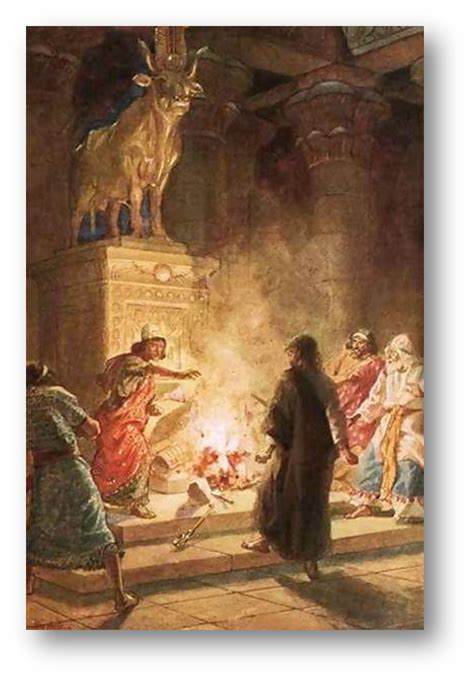
In an effort to preserve the kingdom given to him by God, Jeroboam had made a boneheaded decision that ended up offending God. He knew that the Israelites were a religious people and feared that they would continue to travel to Judah to offer sacrifices at the temple Solomon had built in Jerusalem. This continued spiritual connection to the holy city might influence them to restore their relationship with Rehoboam and the people of Judah. So, to prevent this from happening, Jeroboam had made the fateful decision to create an alternate religion for the ten tribes of Israel, complete with priests and golden idols made to look like calves, which he had placed in the cities of Dan and Bethel. Then he convinced the people to turn their backs on Yahweh by offering their sacrifices to the two golden calves.

“It is too much trouble for you to worship in Jerusalem. Look, Israel, these are the gods who brought you out of Egypt!”

He placed these calf idols in Bethel and in Dan—at either end of his kingdom. But this became a great sin, for the people worshiped the idols, traveling as far north as Dan to worship the one there. – 1 Kings 12:28-30 NLT

In following Jeroboam’s lead, the people no longer sought forgiveness, cleansing, and blessing from God Almighty, but placed their hopes in lifeless statues made by human hands. Years later, the prophet Isaiah would describe the futility of worshiping false gods.

How foolish are those who manufacture idols.
    These prized objects are really worthless.
The people who worship idols don’t know this,
    so they are all put to shame.
Who but a fool would make his own god—
    an idol that cannot help him one bit?
All who worship idols will be disgraced
    along with all these craftsmen—mere humans—
    who claim they can make a god.
They may all stand together,
    but they will stand in terror and shame. – Isaiah 44:9-11 NLT

But to Jeroboam, his decision made all the sense in the world. He was a pragmatist who was more interested in preserving his newfound status as king than in promoting the ongoing worship of the one who had made him king. And his decision, while initially successful, was about to prove seriously flawed.

Jeroboam had traveled to Bethel in order to offer sacrifices to one of his false gods. But while there, he received a visit from a prophet of the one true God. This unnamed man had come from Judah with a message from the Almighty. So, as Jeroboam was about to offer sacrifices to his visible, but lifeless god, he was given a word from the invisible, yet all-powerful God of Israel. And the prophet, seemingly ignoring Jeroboam, directed his message at the altar the king had constructed. In a sense, this was one god speaking to another. Yahweh was challenging the false god of Jeroboam by delivering a prophecy concerning its coming destruction.

O altar, altar! This is what the Lord says: A child named Josiah will be born into the dynasty of David. On you he will sacrifice the priests from the pagan shrines who come here to burn incense, and human bones will be burned on you.” – 1 Kings 13:2 NLT

Jeroboam’s god was going to meet an untimely end. When faced with the power of God Almighty, Jeroboam’s false god proved incapable of defending itself. It remained speechless because it was lifeless. And the warning delivered by the prophet of God carried long-term ramifications. It would be 290 years later before God fulfilled His word, and all during that time, the nation of Israel would continue to worship their false gods. But eventually, God would raise up a king over Judah whose name was Josiah, and he would institute a series of religious reforms in both Judah and Israel. And, in doing so, he would fulfill God’s prophecy against the altar of Jeroboam’s false god.

The king also tore down the altar at Bethel—the pagan shrine that Jeroboam son of Nebat had made when he caused Israel to sin. He burned down the shrine and ground it to dust, and he burned the Asherah pole. Then Josiah turned around and noticed several tombs in the side of the hill. He ordered that the bones be brought out, and he burned them on the altar at Bethel to desecrate it. (This happened just as the Lord had promised through the man of God when Jeroboam stood beside the altar at the festival.) – 2 Kings 23:15-16 NLT

The very fact that this altar was still in existence and in use nearly 300 years later reveals the level of apostasy in Israel. Jeroboam’s decision to replace Yahweh with false gods was going to have long-lasting consequences. In an effort to preserve his kingdom Jeroboam was willing to sacrifice the spiritual well-being of his own people.

And to demonstrate that the words he had spoken were true, “the man of God gave a sign to prove his message” (1 Kings 13:3 NLT).

He said, “The Lord has promised to give this sign: This altar will split apart, and its ashes will be poured out on the ground.” – 1 Kings 13:3 NLT

God was going to validate His word with a powerful sign. There would be an immediate judgment on Jeroboam’s apostasy. His shrine and the golden calf it contained would be destroyed. But, once again, Jeroboam attempted to preserve his kingdom by rejecting the will of God. After the prophet had spoken his word of warning, Jeroboam commanded that he be arrested. He wrongly assumed that he could thwart the will of God by binding the messenger of God. And, in doing so, Jeroboam would establish a precedent that would carry over for generations. His successors to the throne of Israel would continue to reject the will of God by resisting and refusing the messengers of God. Rather than repent and return in humble submission to Yahweh, they would each cling stubbornly to their false gods, dooming their people to the judgment of God.

But Jeroboam’s attempt to stop God’s prophet proved ineffective and injurious. He still ended up with a shattered altar and a paralyzed hand. Suddenly convinced of the prophet’s position as God’s spokesman, Jeroboam begged him to intercede with Yahweh on his behalf.

“Entreat now the favor of the Lord your God, and pray for me, that my hand may be restored to me.” – 1 Kings 13:6 ESV

The prophet prayed and God responded, restoring full mobility to Jeroboam’s paralyzed hand. But Jeroboam’s response to this miracle is revealing. Having just witnessed the miraculous destruction of the altar to his false god and having had his hand paralyzed by God, you would think that Jeroboam would have begged for forgiveness. But instead, he tries to win over the favor of the prophet by inviting him to dinner and offering him a reward. Perhaps Jeroboam feared that the prophet might turn his attention to Dan and destroy the altar there. So, in another attempt to preserve his kingdom, he tried to bribe the prophet of God.

But God, knowing the true nature of Jeroboam’s heart, had warned the prophet not to accept any invitation from this conniving and calculating king.

“Even if you gave me half of everything you own, I would not go with you. I would not eat or drink anything in this place. For the Lord gave me this command: ‘You must not eat or drink anything while you are there, and do not return to Judah by the same way you came.’” – 1 Kings 13:8-9 NLT

Jeroboam was a man who, for the sake of his kingdom, had been willing to compromise his faith in God. And he assumed that this unnamed prophet would be just as willing to make concessions in exchange for monetary gain. But he was wrong. This young prophet was unwilling to sell out his God for personal reward. Even when faced with Jeroboam’s offer of a reward, this faithful servant of God remained uncompromising in his commitment to the will of God. He recognized Yahweh as the one true God and would not allow Jeroboam or anyone else to cause him to compromise his convictions. And his actions reflect his firm and unwavering belief in his God.

This is what the Lord says—
    your Redeemer and Creator:
“I am the Lord, who made all things.
    I alone stretched out the heavens.
Who was with me
    when I made the earth?
I expose the false prophets as liars
    and make fools of fortune-tellers.
I cause the wise to give bad advice,
    thus proving them to be fools.
But I carry out the predictions of my prophets!” – Isaiah 44:24-26 NLT

English Standard Version (ESV) The Holy Bible, English Standard Version. ESV® Permanent Text Edition® (2016). Copyright © 2001 by Crossway Bibles, a publishing ministry of Good News Publishers.

New Living Translation (NLT) Holy Bible, New Living Translation, copyright © 1996, 2004, 2015 by Tyndale House Foundation. Used by permission of Tyndale House Publishers Inc., Carol Stream, Illinois 60188. All rights reserved.

The Message (MSG)Copyright © 1993, 1994, 1995, 1996, 2000, 2001, 2002 by Eugene H. Peterson

Failure to Bless

1 Woe to those who devise wickedness
    and work evil on their beds!
When the morning dawns, they perform it,
    because it is in the power of their hand.
They covet fields and seize them,
    and houses, and take them away;
they oppress a man and his house,
    a man and his inheritance.
Therefore thus says the Lord:
behold, against this family I am devising disaster,
    from which you cannot remove your necks,
and you shall not walk haughtily,
    for it will be a time of disaster.
In that day they shall take up a taunt song against you
    and moan bitterly,
and say, “We are utterly ruined;
    he changes the portion of my people;
how he removes it from me!
    To an apostate he allots our fields.”
Therefore you will have none to cast the line by lot
    in the assembly of the Lord.
Micah 2:1-5 ESV

The judgment of God was coming against Israel and Judah. But why? The answer to that question is found in chapter one: “All this is for the transgression of Jacob and for the sins of the house of Israel” (Micah 1:5 ESV). And both Israel and Judah stood as guilty and condemned by God. But just in case anyone was thinking about arguing their case, Micah provides a detailed list of crimes worthy of conviction.

While chapter one included God’s indictments against Israel and Judah, in chapter two the focus shifts to the southern kingdom of Judah. After all, as one of its residents, Micah had been appointed by God to deliver his message of judgment and call to repentance to his own people. And God wanted Micah to make it painfully clear that when the nation fell, it would not be the result of blind fate or because of the imperialistic ambitions of a foreign power. No, it would be because of their many sins against God. The grounds for their future fall would be their own wickedness. The source of their ultimate demise would be their sovereign, holy, and righteous God.

Micah proceeds to itemize the many sins of the people of Judah through a series of woes. The term “woe” was often used to express sorrow or lament but in this case, Micah is using it as a threat or announcement of pending judgment because of guilt.

Unrighteousness had become so prolific in Judah that there were those who spend their nights concocting plans to commit acts of wickedness the next day. They literally dreamed of sinning. And, because they had the financial resources and power to put those plans into action, “When the morning dawns, they perform it” (Micah 2:1 ESV).

This first woe seems to be directed at the rich and powerful in Judah, who were using their influence to take advantage of the less fortunate among them. They were growing richer by means of extortion and graft. They were motivated by greed and devoid of compassion, using their formidable resources and connections to satisfy their insatiable lust for more.

When you want a piece of land,
    you find a way to seize it.
When you want someone’s house,
    you take it by fraud and violence.
You cheat a man of his property,
    stealing his family’s inheritance. – Micah 2:2 NLT

The actions of these individuals were driven by a love of self. They exhibited the characteristics outlined by James centuries later.

You want what you don’t have, so you scheme and kill to get it. You are jealous of what others have, but you can’t get it, so you fight and wage war to take it away from them. Yet you don’t have what you want because you don’t ask God for it. And even when you ask, you don’t get it because your motives are all wrong—you want only what will give you pleasure. – James 4:2-3 NLT

These people were guilty of violating the tenth commandment.

“You must not covet your neighbor’s house. You must not covet your neighbor’s wife, male or female servant, ox or donkey, or anything else that belongs to your neighbor.”
 – Exodus 21:17 NLT

And because they were using their power and influence to turn their thoughts of covetousness into reality, they were also guilty of breaking the eighth commandment, which prohibited stealing. And to top it all off, they were guilty of violating what Jesus said was the second greatest commandment of God. “love your neighbor as yourself” (Leviticus 19:18 NLT).

James accused these kinds of people of spiritual adultery. They were guilty of making a god out of money and material possessions.

You adulterers! Don’t you realize that friendship with the world makes you an enemy of God? I say it again: If you want to be a friend of the world, you make yourself an enemy of God. – James 4:4 NLT

They were worshiping the gifts rather than the Giver. And they took great pride in their affluence and in their ability to increase their wealth through cunning and deceit. But Micah warns them that there will be serious consequences for their actions.

But this is what the Lord says:
“I will reward your evil with evil;
    you won’t be able to pull your neck out of the noose.
You will no longer walk around proudly,
    for it will be a terrible time.” – Micah 2:3 NLT

Notice his emphasis on pride. That is exactly what James points out in his letter when addressing the spiritual adulterers of his day.

As the Scriptures say,

“God opposes the proud
    but gives grace to the humble.”

So humble yourselves before God. Resist the devil, and he will flee from you. Come close to God, and God will come close to you. Wash your hands, you sinners; purify your hearts, for your loyalty is divided between God and the world. Let there be tears for what you have done. Let there be sorrow and deep grief. Let there be sadness instead of laughter, and gloom instead of joy. Humble yourselves before the Lord, and he will lift you up in honor. – James 4:6-10 NLT

Pride and arrogance have no place in the life of a child of God. Everything we have comes from the gracious hand of God, as James makes clear in his letter.

Every good gift and every perfect gift is from above, coming down from the Father of lights… – James 1:17 ESV

And what we have been given by God is intended for the good of all. His blessings are meant to be shared. There is no place for selfishness and self-centeredness among God’s people. Greed, lust, and covetousness are antithetical to the life of righteousness to which we have been called. And the same thing was true of the people of Judah in Micah’s day. Long before they had ever entered the land of Canaan, God had promised that He would bless them and that He expected them to use those blessings to care for one another. His gracious gifts were to be lovingly shared, not greedily hoarded.

“There should be no poor among you, for the LORD your God will greatly bless you in the land he is giving you as a special possession. You will receive this blessing if you are careful to obey all the commands of the LORD your God that I am giving you today.” – Deuteronomy 15:4-5 NLT

But generations later, the people of God had proven their inability and unwillingness to follow God’s commands. So, Micah warns them that the very evil they had committed was about to come upon them. These greedy, covetous people would find themselves the victims of someone else’s dreams of conquest and acquisition. The Babylonians would show up one day and use their great power, wealth, and influence to relieve the proud people of Judah of their homes, lands, and dignity. Micah warns that the once-prideful people of God will sing a doleful dirge, lamenting their fall from grace.

“We are finished,
        completely ruined!
    God has confiscated our land,
        taking it from us.
    He has given our fields
        to those who betrayed us.” – Micah 2:4 NLT

God was going to take away the very land He had given to them as their inheritance. He would deprive them of the source of their abundance and fruitfulness. The fields and houses they had stolen from others would be taken from them. They would be left with nothing. No inheritance, no land, no homes, no flocks, no herds, no grains, no fruit, and no hope. And all because they had chosen to disobey the will of God.

Give generously to the poor, not grudgingly, for the LORD your God will bless you in everything you do. There will always be some in the land who are poor. That is why I am commanding you to share freely with the poor and with other Israelites in need. – Deuteronomy 15:10-11 NLT

Because of their disobedience, the entire land of Judah would become inhabited by the poor. Those who had been graciously blessed by God, but had become dissatisfied with His gifts, would one day find themselves mourning their losses. Both Israel and Judah had been blessed by God so that they might be a blessing to others. But they had failed to use God’s gifts wisely and selflessly. They had become plagued by pride, arrogance, greed, and covetousness. And they were going to learn the invaluable lesson that Jesus would later share.

“When someone has been given much, much will be required in return; and when someone has been entrusted with much, even more will be required.” – Luke 12:48 NLT

English Standard Version (ESV)
The Holy Bible, English Standard Version. ESV® Permanent Text Edition® (2016). Copyright © 2001 by Crossway Bibles, a publishing ministry of Good News Publishers.

New Living Translation (NLT)
Holy Bible, New Living Translation, copyright © 1996, 2004, 2015 by Tyndale House Foundation. Used by permission of Tyndale House Publishers Inc., Carol Stream, Illinois 60188. All rights reserved.

The Message (MSG)Copyright © 1993, 1994, 1995, 1996, 2000, 2001, 2002 by Eugene H. Peterson

The Lunacy of Idolatry

18 “What profit is an idol
    when its maker has shaped it,
    a metal image, a teacher of lies?
For its maker trusts in his own creation
    when he makes speechless idols!
19 Woe to him who says to a wooden thing, Awake;
    to a silent stone, Arise!
Can this teach?
Behold, it is overlaid with gold and silver,
    and there is no breath at all in it.
20 But the Lord is in his holy temple;
    let all the earth keep silence before him.” Habakkuk 2:18-20 ESV

In this final “woe,” God deals with the ubiquitous problem of idolatry. Ever since the Fall, mankind had been on a virtual binge, seeking for comfort, guidance, provision, and protection from anything and everything other than their creator God. In the opening chapter of Romans, Paul portrays this wholesale abandonment of God by fallen humanity in stark terms.

Yes, they knew God, but they wouldn’t worship him as God or even give him thanks. And they began to think up foolish ideas of what God was like. As a result, their minds became dark and confused. Claiming to be wise, they instead became utter fools. And instead of worshiping the glorious, ever-living God, they worshiped idols made to look like mere people and birds and animals and reptiles. – Romans 1:21-23 NLT

They traded the truth about God for a lie. So they worshiped and served the things God created instead of the Creator himself, who is worthy of eternal praise! – Romans 1:25 NLT

Man, made in the image of God, was wired for worship. Adam and Eve had been created by God to have unbroken fellowship with Him. Their lives were intended to bring Him glory through their faithful obedience to His creation mandate.

Then God said, “Let us make human beings in our image, to be like us. They will reign over the fish in the sea, the birds in the sky, the livestock, all the wild animals on the earth, and the small animals that scurry along the ground.”

So God created human beings in his own image.
    In the image of God he created them;
    male and female he created them.

Then God blessed them and said, “Be fruitful and multiply. Fill the earth and govern it. Reign over the fish in the sea, the birds in the sky, and all the animals that scurry along the ground.” – Genesis 1:26-28 NLT

But because of their decision to disobey God by eating the fruit of the one tree He had forbidden, any further access into His presence was denied, and the focal point of their worship was lost. And it didn’t take long before sin had so marred the image of God in man, that the Almighty determined to wipe them from the face of the earth.

The Lord observed the extent of human wickedness on the earth, and he saw that everything they thought or imagined was consistently and totally evil. So the Lord was sorry he had ever made them and put them on the earth. It broke his heart. And the Lord said, “I will wipe this human race I have created from the face of the earth.” – Genesis 6:5-7 NLT

Yet, God had chosen to spare Noah and his family, allowing them to begin the process of repopulating the earth again.

And you, be fruitful and multiply, increase greatly on the earth and multiply in it.”  – Genesis 9:7 ESV

And, obviously, Noah and his family were successful in fulfilling God’s creation mandate. They were fruitful and refilled the earth. But their fruitfulness was accompanied by ever-increasing faithlessness. According to the apostle Paul, the nations of the earth developed a perverse penchant for substitute gods, choosing to replace the one true God with deities of their own making. And it wasn’t long before their decision to displace God resulted in rampant godlessness.

Their lives became full of every kind of wickedness, sin, greed, hate, envy, murder, quarreling, deception, malicious behavior, and gossip. They are backstabbers, haters of God, insolent, proud, and boastful. They invent new ways of sinning, and they disobey their parents. They refuse to understand, break their promises, are heartless, and have no mercy. They know God’s justice requires that those who do these things deserve to die, yet they do them anyway. Worse yet, they encourage others to do them, too. – Romans 1:29-32 NLT

And yet, God, in His grace and mercy, chose to begin again. He chose a single man, Abraham, and promised to make of him a great nation. This man’s descendants would become God’s treasured possession on whom He would pour out His blessings and with whom He would make an everlasting covenant.

“If you fully obey the Lord your God and carefully keep all his commands that I am giving you today, the Lord your God will set you high above all the nations of the world. You will experience all these blessings if you obey the Lord your God…” – Deuteronomy 28:1-2 NLT

But one of the primary criteria associated with God’s covenant commitment with the descendants of Abraham would be their refusal to worship any other gods.

“You must not have any other god but me. You must not make for yourself an idol of any kind or an image of anything in the heavens or on the earth or in the sea. You must not bow down to them or worship them, for I, the LORD your God, am a jealous God who will not tolerate your affection for any other gods.” – Exodus 20:3-5 NLT

And yet, generations after the death of Abraham, his progeny would have proven their inability to keep their end of the agreement. The nation which had been set apart by God as His own would have established an unprecedented track record of spiritual infidelity. And by the time Habakkuk penned the words of the book that bears his name, the apostasy of God’s people would have become untenable and unforgivable.

The whole reason God was sending the Babylonians against the people of Judah was due to their unfaithfulness. And God had chosen to use an idolatrous nation to bring His judgment upon His idolatrous children. The people of Judah, like their northern kin in Israel, had made a habit of worshiping false gods. So, God was going to fulfill His promise to discipline them for their disobedience. He would do to them exactly as Moses had warned generations earlier.

“The Lord will exile you and your king to a nation unknown to you and your ancestors. There in exile you will worship gods of wood and stone! – Deuteronomy 28:36 NLT

If they wanted to continue to worship false gods, Yahweh would make sure they had every opportunity – but not in the land that He had graciously provided for them. They would find themselves exiled in a foreign land, surrounded by pagan gods and powerful enemies.

And this final woe points directly at the primary problem going on in Judah. God’s chosen people were guilty of spiritual adultery. They had “exchanged the glory of the immortal God for images resembling mortal man and birds and animals and creeping things” (Romans 1:23 ESV). Or, as the New Living Translation puts it, “…instead of worshiping the glorious, ever-living God, they worshiped idols made to look like mere people and birds and animals and reptiles.”

God reveals the sheer idiocy behind their decision to replace Him with man-made gods.

“Woe to him who says to a wooden thing, Awake;
    to a silent stone, Arise!” – Habakkuk 2:19 ESV

Their decision to substitute the one true God with gods of their own creation was ludicrous. It made no sense. And God sarcastically portrays the stupidity of their decision.

“What good is an idol carved by man,
    or a cast image that deceives you?
How foolish to trust in your own creation—
    a god that can’t even talk! – Habakkuk 1:18 NLT

“To speechless stone images you say,
    ‘Rise up and teach us!’
    Can an idol tell you what to do?
They may be overlaid with gold and silver,
    but they are lifeless inside. – Habakkuk 1:19 NLT

This is not the first and only time God had exposed the ridiculous nature of Judah’s idolatry. He had also spoken through Isaiah, clearly denunciating and debunking the veracity and value of idols.

The idol makers encourage one another,
    saying to each other, “Be strong!”
The carver encourages the goldsmith,
    and the molder helps at the anvil.
    “Good,” they say. “It’s coming along fine.”
Carefully they join the parts together,
    then fasten the thing in place so it won’t fall over. – Isaiah 41:6-7 NLT

How foolish are those who manufacture idols.
    These prized objects are really worthless.
The people who worship idols don’t know this,
    so they are all put to shame.
Who but a fool would make his own god—
    an idol that cannot help him one bit? – Isaiah 44:9-10 NLT

The person who made the idol never stops to reflect,
    “Why, it’s just a block of wood!
I burned half of it for heat
    and used it to bake my bread and roast my meat.
How can the rest of it be a god?
    Should I bow down to worship a piece of wood?” – Isaiah 44:19 NLT

Only a fool would fail to recognize the obvious absurdity of idolatry.

The poor, deluded fool feeds on ashes.
    He trusts something that can’t help him at all.
Yet he cannot bring himself to ask,
    “Is this idol that I’m holding in my hand a lie?” – Isaiah 44:20 NLT

And yet, here was the nation of Judah facing the very real prospect of having another idolatrous nation invade their borders and destroy their cities and towns. They were poor, deluded fools who had put their hope and trust in pieces of wood and stone. These lifeless and utterly helpless icons of man’s arrogant pride would prove to be unreliable when the judgment of God fell.

Later on, in the book of Isaiah, God issues a tongue-in-cheek challenge to the people of Judah. They could put their trust in their false gods, but the outcome of their efforts would prove less-than-successful.

“Let’s see if your idols can save you
    when you cry to them for help.
Why, a puff of wind can knock them down!
    If you just breathe on them, they fall over!
But whoever trusts in me will inherit the land
    and possess my holy mountain.” – Isaiah 57:13 NLT

And God points out to Habakkuk that the man-made, lifeless gods the people of Judah had chosen to worship were no substitute for Him.

“But the Lord is in his holy temple;
    let all the earth keep silence before him.” – Habakkuk 2:20 ESV

God was not some elf-on-a-shelf, made from human hands and carried from one place to another. He was “the Lord,” Jehovah, “the existing one.” And He was in His holy temple, looking down on His disobedient and unfaithful people, and preparing to unleash His righteous indignation upon them.

The God of the universe is a jealous God who will not share His glory with anyone or anything. He will not put up with the worship of false gods. Yes, He will tolerate this behavior for a time, patiently putting up with the fickleness and unfaithfulness of fallen humanity. But the day is coming when He will eliminate all the false gods manufactured by fallen men. And all the earth will stand before Him in reverent awe and stunned silence.

English Standard Version (ESV)
The Holy Bible, English Standard Version. ESV® Permanent Text Edition® (2016). Copyright © 2001 by Crossway Bibles, a publishing ministry of Good News Publishers.

New Living Translation (NLT)
Holy Bible, New Living Translation, copyright © 1996, 2004, 2015 by Tyndale House Foundation. Used by permission of Tyndale House Publishers Inc., Carol Stream, Illinois 60188. All rights reserved.

The Message (MSG)Copyright © 1993, 1994, 1995, 1996, 2000, 2001, 2002 by Eugene H. Peterson

The Choice Is Yours

But you, draw near,
    sons of the sorceress,
    offspring of the adulterer and the loose woman.
Whom are you mocking?
    Against whom do you open your mouth wide
    and stick out your tongue?
Are you not children of transgression,
    the offspring of deceit,
you who burn with lust among the oaks,
    under every green tree,
who slaughter your children in the valleys,
    under the clefts of the rocks?
Among the smooth stones of the valley is your portion;
    they, they, are your lot;
to them you have poured out a drink offering,
    you have brought a grain offering.
    Shall I relent for these things?
On a high and lofty mountain
    you have set your bed,
    and there you went up to offer sacrifice.
Behind the door and the doorpost
    you have set up your memorial;
for, deserting me, you have uncovered your bed,
    you have gone up to it,
    you have made it wide;
and you have made a covenant for yourself with them,
    you have loved their bed,
    you have looked on nakedness.
You journeyed to the king with oil
    and multiplied your perfumes;
you sent your envoys far off,
    and sent down even to Sheol.
10 You were wearied with the length of your way,
    but you did not say, “It is hopeless”;
you found new life for your strength,
    and so you were not faint.

11 Whom did you dread and fear,
    so that you lied,
and did not remember me,
    did not lay it to heart?
Have I not held my peace, even for a long time,
    and you do not fear me?
12 I will declare your righteousness and your deeds,
    but they will not profit you.
13 When you cry out, let your collection of idols deliver you!
    The wind will carry them all off,
    a breath will take them away.
But he who takes refuge in me shall possess the land
    and shall inherit my holy mountain.Isaiah 57:3-13 ESV

After castigating and condemning the watchmen, the self-proclaimed spiritual leaders of Judah, God turns His attention to the people. While they had been misinformed and mislead by the false prophets, they were not without a measure of guilt. And God makes it painfully clear what He thought about their behavior towards Him. He addresses them in not-so-flattering terms, calling them “sons of sorcerors, offspring of the adulterer and the loose woman” (Isaiah 57:3 ESV). The New Living Translation makes it even more unpleasant, translating verse3 as “you witches’ children, you offspring of adulterers and prostitutes!” And God is not done. he goes on to describe them as “children of transgression, the offspring of deceit” (Isaiah 57:4 ESV).

God is not happy with them. And all these unflattering appellations are tied directly to their practice of idolatry. God is unsparing in His accusations against them. Like a criminal prosecutor in a court of law, God lays out His evidence, providing more than enough proof to convict the people of Judah of their crime and justify their well-deserved punishment.

God accuses them of worshiping their false gods under every oak and green tree they can find and doing so with passion. The Hebrew word translated as “passion” is chamam and it carries a sexual connotation. It can be translated as “inflamed” or “aroused.” To put it in rather graphic terms, the people of Judah “got off” on practicing idolatry. They set up shrines and high places all over the land of Canaan, where they worshiped their false deities and even practiced child sacrifice as part of their passionate adoration of their gods. And God had been very clear in His commands regarding child sacrifice.

“Do not permit any of your children to be offered as a sacrifice to Molech, for you must not bring shame on the name of your God. I am the LORD.”  – Leviticus 18:21 NLT

“Give the people of Israel these instructions, which apply both to native Israelites and to the foreigners living in Israel. If any of them offer their children as a sacrifice to Molech, they must be put to death.” – Leviticus 20:2 NLT

“I myself will turn against them and cut them off from the community, because they have defiled my sanctuary and brought shame on my holy name by offering their children to Molech.” – Leviticus 20:3 NLT

Yet, here was God, generations later, accusing His people of doing exactly what He had told them not to do. They had idols under the trees, in the valleys, on top of the mountains, and just about every other place you could imagine. False gods were ubiquitous in Judah. And in the very act of worship their many false gods, they were proving themselves unfaithful and spiritually adulterous to the one true God. Like a faithful husband speaking to his promiscuous wife, God tells them, “You have left me and climbed into bed with these detestable gods. You have committed yourselves to them. You love to look at their naked bodies” (Isaiah 57:8 NLT).

Their passion for their false gods was relentless. Many of their gods were the result of political or military alliances with pagan nations. Envoys from Judah would travel long distances to worship the false gods of their potential allies, carrying olive oil and perfume to use as tributes to these idols. God describes them as constantly in search of some god who could provide them what they were seeking. And just when they would start to lose hope, they would discover yet another potential savior in the form of a statue made of stone, wood or precious metal.

“You grew weary in your search,
    but you never gave up.
Desire gave you renewed strength,
    and you did not grow weary.” – Isaiah 57:10 NLT

In the face of God’s whithering charges against them, He poses a question:

“Whom did you dread and fear,
    so that you lied,
and did not remember me,
    did not lay it to heart?” – Isaiah 57:11 ESV

Obviously, they had not feared God, or they wouldn’t have disobeyed His commands like they had. So, was their unfaithfulness driven by fear of their enemies? Or was it due to fear of their enemies’ gods? Whatever the case, they had not exhited any fear of God, even though He had displayed tremendous patience with them. Now, God was done showing them patience. And, knowing that they would argue with Him and try to present themselves as faithful servants who had done acts of righteousness deserving of His grace and mercy, God breaks the not-so-good news to them.

“Now I will expose your so-called good deeds.
    None of them will help you.” – Isaiah 57:12 NLT

Later on in this very same book, Isaiah will deliver some seriously bad news to the people of Judah, that will blow their concept of self-righteousness out of the water.

You welcome those who gladly do good,
    who follow godly ways.
But you have been very angry with us,
    for we are not godly.
We are constant sinners;
    how can people like us be saved?
We are all infected and impure with sin.
    When we display our righteous deeds,
    they are nothing but filthy rags. – Isaiah 64:5-6 NLT

They had no righteous deeds. Their best deeds done on their best day with the best of intentions were worthless in the eyes of God. He could see into their hearts. And as God stated earlier in the book of Isaiah, “These people say they are mine. They honor me with their lips, but their hearts are far from me. And their worship of me is nothing but man-made rules learned by rote” (Isaiah29:13 NLT). 

So, God offers His disobedient and idolatrous people a challenge. The next time they faced trouble, He suggests that they call on their false gods to save them. And, because God has already made it clear that the next thing that was going to happen to them would be His judgment of them, He was basically taunting them to use their gods to stop Him. But God lets them know the outcome ahead of time.

“The wind will carry them all off,
    a breath will take them away.” – Isaiah 57:13 ESV

They will prove laughingly impotent. But God says that “whoever trusts in me will inherit the land and possess my holy mountain” (Isaiah 57:13 NLT). They could continue to trust in their false gods. They could passionately pursue deliverance from lifeless idols or put their hope in the God of the universe. The choice was theirs, but the outcome of that choice was completely up to God and not up for debate.

English Standard Version (ESV) The Holy Bible, English Standard Version. ESV® Permanent Text Edition® (2016). Copyright © 2001 by Crossway Bibles, a publishing ministry of Good News Publishers.

New Living Translation (NLT) Holy Bible, New Living Translation, copyright © 1996, 2004, 2015 by Tyndale House Foundation. Used by permission of Tyndale House Publishers Inc., Carol Stream, Illinois 60188. All rights reserved.

The Message (MSG) Copyright © 1993, 1994, 1995, 1996, 2000, 2001, 2002 by Eugene H. Peterson

Your Maker Is Your Husband

1 “Sing, O barren one, who did not bear;
    break forth into singing and cry aloud,
    you who have not been in labor!
For the children of the desolate one will be more
    than the children of her who is married,” says the Lord.
“Enlarge the place of your tent,
    and let the curtains of your habitations be stretched out;
do not hold back; lengthen your cords
    and strengthen your stakes.
For you will spread abroad to the right and to the left,
    and your offspring will possess the nations
    and will people the desolate cities.

“Fear not, for you will not be ashamed;
    be not confounded, for you will not be disgraced;
for you will forget the shame of your youth,
    and the reproach of your widowhood you will remember no more.
For your Maker is your husband,
    the Lord of hosts is his name;
and the Holy One of Israel is your Redeemer,
    the God of the whole earth he is called.
For the Lord has called you
    like a wife deserted and grieved in spirit,
like a wife of youth when she is cast off,
    says your God.
For a brief moment I deserted you,
    but with great compassion I will gather you.
In overflowing anger for a moment
    I hid my face from you,
but with everlasting love I will have compassion on you,”
    says the Lord, your Redeemer.

“This is like the days of Noah to me:
    as I swore that the waters of Noah
    should no more go over the earth,
so I have sworn that I will not be angry with you,
    and will not rebuke you.
10 For the mountains may depart
    and the hills be removed,
but my steadfast love shall not depart from you,
    and my covenant of peace shall not be removed,”
    says the Lord, who has compassion on you.

11 “O afflicted one, storm-tossed and not comforted,
    behold, I will set your stones in antimony,
    and lay your foundations with sapphires.
12 I will make your pinnacles of agate,
    your gates of carbuncles,
    and all your wall of precious stones.
13 All your children shall be taught by the Lord,
    and great shall be the peace of your children.
14 In righteousness you shall be established;
    you shall be far from oppression, for you shall not fear;
    and from terror, for it shall not come near you.
15 If anyone stirs up strife,
    it is not from me;
whoever stirs up strife with you
    shall fall because of you.
16 Behold, I have created the smith
    who blows the fire of coals
    and produces a weapon for its purpose.
I have also created the ravager to destroy;
17     no weapon that is fashioned against you shall succeed,
    and you shall refute every tongue that rises against you in judgment.
This is the heritage of the servants of the Lord
    and their vindication from me, declares the Lord.” Isaiah 54:1-17 ESV

This chapter speaks of the coming blessings of God, made possible by the suffering servant of God. The content of these verses is directed at the people of Judah and is intended to encourage their hope and trust in God, even in the midst of their present circumstances. God has clearly shown them that He has a long-term plan for them. While they would suffer because of their rebellion against Him, they would not be completely or permanently abandoned by Him. And, He comforts them by guaranteeing His commitment to them.

“For a brief moment I abandoned you,
    but with great compassion I will take you back.
In a burst of anger I turned my face away for a little while.
    But with everlasting love I will have compassion on you,”
    says the Lord, your Redeemer. – Isaiah 54:7-8 NLT

It is interesting to note that, in the 17 verses that make up this chapter, God is referred to by a range of different names. He is called their “Maker,” the one who fashioned them out of nothing. Their very existence was His doing. And not only had God given life to each and every Hebrew, He had created the nation of Israel to which they belonged.  And then He had made them His wife. He had betrothed Himself to the people of Israel. We see the language of the marital covenant reflected in Exodus 19 when God called them into a special relationship with Him.

“‘And now, if you will diligently listen to me and keep my covenant, then you will be my special possession out of all the nations, for all the earth is mine, and you will be to me a kingdom of priests and a holy nation.’ These are the words that you will speak to the Israelites.” – Exodus 19:5-6 NLT

And the people had responded to His proposal by declaring, “All that the Lord has commanded we will do!” (Exodus 19:8 NLT). And yet, the bride would prove to be unfaithful. She would not keep the covenant she made with her Husband. In fact, God later indicts His wife, accusing her of adultery.

“If a man divorces his wife
and she leaves him and becomes another man’s wife,
he may not take her back again.
Doing that would utterly defile the land.
But you, Israel, have given yourself as a prostitute to many gods.
So what makes you think you can return to me?”
says the Lord. – Jeremiah 3:1 NET

And yet, just a few verses later, God calls on His bride to do just that.

“Return, O faithless children, declares the Lord; for I am your master.” – Jeremiah 3:14 ESV

The Hebrew word translated as “master” was actually used as a play on words. It is ba`al, and you can see its similarity to the name of the pagan God, Baal. But what is even more significant is that the Hebrew word ba`al can be translated as “husband.” God was Israel’s master because of His role as their husband. And, as their husband, God had remained faithful to His covenant promises. He had not wandered or committed spiritual adultery. He had not chosen another bride. And the text goes on to explain why. Because He is the “Lord of hosts” and “the Holy One of Israel” (Isaiah 54:5 ESV). He is mighty in power and morally pure. This is what made His decision to wed Israel all that more remarkable. And it is because He is the Lord of hosts and the Holy One of Israel that He will keep His covenant promises to them.

The book of Deuteronomy emphasizes the unique relationship between God and the people of Israel.

For you are a holy people, who belong to the Lord your God. Of all the people on earth, the Lord your God has chosen you to be his own special treasure, His covenant wife.

“The Lord did not set his heart on you and choose you because you were more numerous than other nations, for you were the smallest of all nations! Rather, it was simply that the Lord loves you, and he was keeping the oath he had sworn to your ancestors.” – Deuteronomy 7:6-8 NLT

Israel had not been more beautiful. The had not come with a sizeable dowry. There was no benefit to God in this relationship. He wed Himself to her because of the promise He had made to Abraham.

“I will confirm my covenant with you and your descendants after you, from generation to generation. This is the everlasting covenant: I will always be your God and the God of your descendants after you.” – Genesis 17:7 NLT

God, Israel’s faithful Husband, would become their kinsman-Redeemer, buying her back out of her slavery, which had happened as a result of her infidelity. This strange relationship between God and the people of Israel is outlined in the book of Hosea, where the prophet is told by God to marry a prostitute and bear children with her. Then, when Hosea’s wife proves unfaithful and falls back into prostitution and, eventually, becomes enslaved, Hosea is commanded by God to redeem her from her slavery.

And God will use this real-life scenario to illustrate His relationship with the people of Israel. He even uses the wordplay mentioned earlier, cleverly revealing the uncomfortable similarity between ba`al (husband) and Baal (a false god).

“And in that day, declares the Lord, you will call me ‘My Husband,’ and no longer will you call me ‘My Baal.’ For I will remove the names of the Baals from her mouth, and they shall be remembered by name no more.” – Hosea 2:16-17 ESV

The day was going to come when Israel would no longer confuse their true Master or husband with the false gods of the pagan nations. They would no longer prostitute themselves to a host of other gods, breaking their covenant promise with their one true Husband. Why? Because God would call them back. He would restore them.

For the Lord has called you
    like a wife deserted and grieved in spirit,
like a wife of youth when she is cast off,
    says your God. – Isaiah 54:6 ESV

And God confirms this commitment when He tells them: “my steadfast love shall not depart from you, and my covenant of peace shall not be removed” (Isaiah 54:10 ESV). And verses 11-17 contain an amazing account of how God will bless His wayward wife, showering her with gifts and His goodness, all in spite of her unfaithfulness.

While the peoples of Israel and Judah were currently experiencing affliction, all as a result of their unfaithfulness to God, Isaiah assures them that a day was coming when they would be redeemed and restored by God. And the imagery in these verses portrays a beautifully restored and repopulated city of Jerusalem. The walls, battlements, and foundations are described as being made of precious stones. The city is filled with children who are being instructed in the ways of the Lord. It will be a time of great peace, free from oppression and fear. This seems to coincide with the New Jerusalem, as seen by the apostle John and described in the book of Revelation.

“Come, I will show you the Bride, the wife of the Lamb.” And he carried me away in the Spirit to a great, high mountain, and showed me the holy city Jerusalem coming down out of heaven from God, having the glory of God, its radiance like a most rare jewel, like a jasper, clear as crystal.” – Revelation 19:9-11 ESV

Jerusalem becomes the symbol of the bride, the nation of Israel. It will be the home where God will dwell with His people. But more important than the physical description of the city is the description of its two primary occupants:

And I saw no temple in the city, for its temple is the Lord God the Almighty and the Lamb. And the city has no need of sun or moon to shine on it, for the glory of God gives it light, and its lamp is the Lamb. – Revelation 19:22-23 ESV

Isaiah 54 is a prophetic promise outlining God’s intentions toward His covenant wife, Israel. At the time at which Isaiah penned this chapter, Israel and Judah were barren, desolate, afflicted, and facing more of the same. But God was reassuring them that He would remain faithful. He would be unwavering in His marital vows, even to the point of redeeming His wayward wife out of captivity and restoring her to a right relationship with Himself. And God closes the chapter with His personal guarantee to do all that He has promised.

“This is the heritage of the servants of the Lord
    and their vindication from me, declares the Lord.” – Isaiah 54:17 ESV

English Standard Version (ESV) The Holy Bible, English Standard Version. ESV® Permanent Text Edition® (2016). Copyright © 2001 by Crossway Bibles, a publishing ministry of Good News Publishers.

New Living Translation (NLT) Holy Bible, New Living Translation, copyright © 1996, 2004, 2015 by Tyndale House Foundation. Used by permission of Tyndale House Publishers Inc., Carol Stream, Illinois 60188. All rights reserved.

The Message (MSG) Copyright © 1993, 1994, 1995, 1996, 2000, 2001, 2002 by Eugene H. Peterson