Don’t Do As They Did

1 For I do not want you to be unaware, brothers, that our fathers were all under the cloud, and all passed through the sea, 2 and all were baptized into Moses in the cloud and in the sea, 3 and all ate the same spiritual food, 4 and all drank the same spiritual drink. For they drank from the spiritual Rock that followed them, and the Rock was Christ. 5 Nevertheless, with most of them God was not pleased, for they were overthrown in the wilderness.

6 Now these things took place as examples for us, that we might not desire evil as they did. – 1 Corinthians 10:1-6 ESV

Paul is still dealing with the problem taking place in Corinth. They are experiencing disunity within their fellowship over the issue of eating meat sacrificed to idols. Actually, it was about much more than that. There were those within the church who were using their newfound freedom in Christ to excuse their continued participation in the sacrificial feasts or meals offered on behalf of false gods. These individuals had rationalized that there was no harm in participating in these pagan practices because they false gods don’t really exist.

But others, who once worshiped the same false gods, felt that it was wrong for a Christian to have anything to do with idols. While Paul agreed that the logic behind the first group’s argument was sound, their motivation was not. They were more concerned about their own rights than they were about the spiritual well-being of their fellow believers. He let them know that their rights needed to take a back seat to the spiritual health of the church, and he used himself as an example.

Now he lets them know that they are overlooking something even more dangerous: the serious threat of falling into idolatry. While there were those in the church who, in their pride, felt free to associate with others who worshiped false gods, Paul warns them that they are playing with fire. While idols pose no danger because they represent non-existent gods, idol worship is real and dangerously deadly.

Paul wanted his audience to know that their relationship with God, as His chosen people, was not an antidote or protection against the temptation to idolatry. Paul uses the people of Israel as a primary example and uses five comparative illustrations to make his point. First, he talks about the pillar of cloud that guided them in the wilderness during the exodus. This manifestation of God’s presence represented His glory and power and was used to lead, direct, and protect them.

And the Lord went before them by day in a pillar of cloud to lead them along the way, and by night in a pillar of fire to give them light, that they might travel by day and by night. The pillar of cloud by day and the pillar of fire by night did not depart from before the people. – Exodus 13:21-22 ESV

As they were leaving Egypt, the cloud settled between the people of Israel and the advancing armies of Pharaoh, protecting them throughout the night.

Then the angel of God who was going before the host of Israel moved and went behind them, and the pillar of cloud moved from before them and stood behind them, coming between the host of Egypt and the host of Israel. And there was the cloud and the darkness. And it lit up the night without one coming near the other all night. – Exodus 14:19-20 ESV

The next day, the people of Israel passed through the sea on dry ground, and Paul uses that miraculous event as his second illustration. God intervened on Israel’s behalf and provided a way of escape, delivering every one of the Israelites to the other side, while completely devastating the armies of Pharaoh. God’s people were eyewitnesses to the Lord’s salvation.

Next, Paul refers to their “baptism” into Moses. In following the cloud and passing through the Red Sea, they were submitting to, or immersing themselves under, the leadership of Moses, God’s chosen deliverer. He was to be their God-ordained instrument of redemption, leading them all throughout their time in the wilderness.

During their days traveling through the wilderness, God provided all the food they needed for the journey. Paul refers to the spiritual food they enjoyed from God’s hand. In His mercy and grace, Yahweh provided them with manna and quail, as well as water from a rock. He miraculously provided for their physical needs, providing food and water when none was available, and He did so despite their grumbling and complaining. Paul makes it clear that the rock symbolized Christ, the provider of living water.

For they drank from the spiritual rock that traveled with them, and that rock was Christ. – 1 Corinthians 10:4 NLT

But Paul brings all of these marvelous illustrations to a sudden and surprising close when he states: “Nevertheless, with most of them God was not pleased, for they were overthrown in the wilderness” (1 Corinthians 10:5 ESV).

Regardless of their unique status as God’s chosen and redeemed people, and despite all that God had done for them, they were “overthrown in the wilderness.” In reality, they all died. An entire generation of Israelites would spend the rest of their lives wandering in the wilderness and never experience the joys of entering the promised land. Paul is going to unpack exactly why this was the case and how their mistake was meant as a warning to the people of God living in Corinth.

One of the most significant moments in the history of the people of Israel occurred early in their wilderness wanderings. They had not been free from bondage very long when God called Moses up to Mount Sinai to receive the law. While he was there, something took place down in the valley. Moses records the tragic event for us:

When the people saw that Moses delayed to come down from the mountain, the people gathered themselves together to Aaron and said to him, “Up, make us gods who shall go before us. As for this Moses, the man who brought us up out of the land of Egypt, we do not know what has become of him.” So Aaron said to them, “Take off the rings of gold that are in the ears of your wives, your sons, and your daughters, and bring them to me.” So all the people took off the rings of gold that were in their ears and brought them to Aaron. And he received the gold from their hand and fashioned it with a graving tool and made a golden calf. And they said, “These are your gods, O Israel, who brought you up out of the land of Egypt!” When Aaron saw this, he built an altar before it. And Aaron made a proclamation and said, “Tomorrow shall be a feast to the Lord.” And they rose up early the next day and offered burnt offerings and brought peace offerings. And the people sat down to eat and drink and rose up to play. – Exodus 32:1-6 ESV

In Moses’ absence, the people engaged in idol worship. They had been delivered, led, fed, and protected by God and were about to receive the law of God. They would also receive instructions to build the Tabernacle, a structure designed to house the very presence of God. But they responded to the unmerited favor of God with unfaithfulness. They had seen God perform ten miraculous plagues in Egypt. They had seen Him part the waters of the Red Sea. They had walked across on dry land, then witnessed the devastating destruction of Pharaoh’s army. And yet, they chose to put their trust in a false god rather than the one true God.

Paul explains, “Now these things took place as examples for us, that we might not desire evil as they did” (1 Corinthians 10:6 ESV). Their deadly mistake serves as a warning to God’s people. Their ingratitude and unfaithfulness are a powerful reminder to all those who call themselves children of God. As His chosen people, they enjoyed His presence, provision, and protection, but that did not make them immune from His punishment for their disobedience. That seems to be Paul’s point. As God’s chosen people, we must never think that we are incapable of sin or insusceptible to temptation. Unfaithfulness is a real and present danger for each of us. Paul warned the Ephesian believers of the ever-present potential for unfaithfulness.

For once you were full of darkness, but now you have light from the Lord. So live as people of light! For this light within you produces only what is good and right and true. Carefully determine what pleases the Lord. Take no part in the worthless deeds of evil and darkness; instead, expose them. It is shameful even to talk about the things that ungodly people do in secret. – Ephesians 5:8-12 NLT

As God’s chosen people, the Israelites had been set apart and were expected to live distinctively different lives. They were to shine as lights in the darkness that surrounded them. Their behavior was to be determined by God and designed to bring Him glory. Their lives were supposed to be marked by righteousness and faithfulness. And yet, Paul states, “with most of them God was not pleased.”

Paul wanted the Corinthian believers to learn from the Israelites’ mistakes. He longed to see Christ-followers embrace the grace, mercy, and love of God with a determination to live godly lives. He told the believer in Colossae that he prayed for them constantly, “asking that you may be filled with the knowledge of his will in all spiritual wisdom and understanding, so as to walk in a manner worthy of the Lord, fully pleasing to him: bearing fruit in every good work and increasing in the knowledge of God (Colossians 1:9-10 ESV). And that should be the prayer of every believer.

Father, the story of the Israelites fills the pages of the Old Testament and paints a bleak picture of their unfaithfulness in the face of Your goodness and grace. You showered them with undeserved blessings and they returned the favor with ingratitude and spiritual infidelity. Yet, as Paul points out, their mistakes were meant to serve as powerful lessons for us. While it’s easy to to judge them for their ungratefulness and disobedience, their actions serve as a mirror, reflecting our own behavior back to us. We can be just as prone to idolatry and spiritual infidelity. We too, can end up spending all our time complaining about our lot in life or wasting our time pursuing the pleasures of this world. We have been blessed and You have called us to be a blessing to the world around us. We are to shine like lights in the darkness. We are to live as Your children and display Your character to a lost and dying world. Help us walk in a manner that is worthy of Your name and brings joy to Your heart. Amen

English Standard Version (ESV) The Holy Bible, English Standard Version. ESV® Permanent Text Edition® (2016). Copyright © 2001 by Crossway Bibles, a publishing ministry of Good News Publishers.

New Living Translation (NLT) Holy Bible, New Living Translation, copyright © 1996, 2004, 2015 by Tyndale House Foundation. Used by permission of Tyndale House Publishers Inc., Carol Stream, Illinois 60188. All rights reserved.
Sovereign Over All

1 And behold, a man of God came out of Judah by the word of the LORD to Bethel. Jeroboam was standing by the altar to make offerings. 2 And the man cried against the altar by the word of the LORD and said, “O altar, altar, thus says the LORD: ‘Behold, a son shall be born to the house of David, Josiah by name, and he shall sacrifice on you the priests of the high places who make offerings on you, and human bones shall be burned on you.’” 3 And he gave a sign the same day, saying, “This is the sign that the LORD spoken: ‘Behold, the altar shall be torn down, and the ashes that are on it shall be poured out.’” 4 And when the king heard the saying of the man of God, which he cried against the altar at Bethel, Jeroboam stretched out his hand from the altar, saying, “Seize him.” And his hand, which he stretched out against him, dried up, so that he could not draw it back to himself. 5 The altar also was torn down, and the ashes poured out from the altar, according to the sign that the man of God had given by the word of the LORD. 6 And the king said to the man of God, “Entreat now the favor of the LORD your God, and pray for me, that my hand may be restored to me.” And the man of God entreated the LORD, and the king’s hand was restored to him and became as it was before. 7 And the king said to the man of God, “Come home with me, and refresh yourself, and I will give you a reward.” 8 And the man of God said to the king, “If you give me half your house, I will not go in with you. And I will not eat bread or drink water in this place, 9 for so was it commanded me by the word of the LORD, saying, ‘You shall neither eat bread nor drink water nor return by the way that you came.’” 10 So he went another way and did not return by the way that he came to Bethel. – 1 Kings 13:1-10 ESV

In an effort to preserve the kingdom given to him by God, Jeroboam made a boneheaded decision that ended up offending God. He knew that the members of the ten northern tribes were religious people and feared that they would continue to travel to Judah to offer sacrifices at the Temple Solomon had built in Jerusalem. This continued spiritual connection to the holy city might influence them to restore their relationship with Rehoboam and the people of Judah. So, to prevent this from happening, Jeroboam made the fateful decision to create an alternate religion for the ten tribes of Israel, complete with priests and golden idols made to look like calves, which he had placed in the cities of Dan and Bethel. Then he convinced the people to turn their backs on Yahweh by offering their sacrifices to the two golden calves.

“It is too much trouble for you to worship in Jerusalem. Look, Israel, these are the gods who brought you out of Egypt!”

He placed these calf idols in Bethel and in Dan—at either end of his kingdom. But this became a great sin, for the people worshiped the idols, traveling as far north as Dan to worship the one there. – 1 Kings 12:28-30 NLT

In following Jeroboam’s lead, the people no longer sought forgiveness, cleansing, and blessing from God Almighty, but placed their hopes in lifeless statues made by human hands. Years later, the prophet Isaiah would describe the futility of worshiping false gods.

How foolish are those who manufacture idols.
    These prized objects are really worthless.
The people who worship idols don’t know this,
    so they are all put to shame.
Who but a fool would make his own god—
    an idol that cannot help him one bit?
All who worship idols will be disgraced
    along with all these craftsmen—mere humans—
    who claim they can make a god.
They may all stand together,
    but they will stand in terror and shame. – Isaiah 44:9-11 NLT

But to Jeroboam, his decision made all the sense in the world. He was a pragmatist who was more interested in preserving his newfound status as king than in promoting the ongoing worship of the one who had made him king. And his decision, while initially successful, was about to prove seriously flawed.

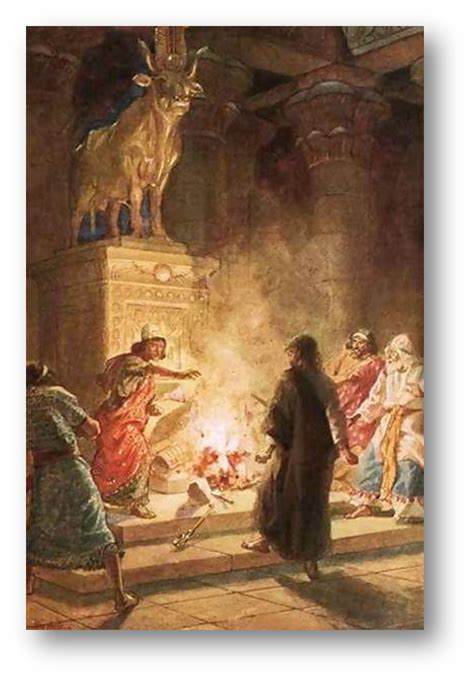
Jeroboam had traveled to Bethel to offer sacrifices to one of his false gods. But while there, he received a visit from a prophet of the one true God. This unnamed man had come from Judah with a message from Yahweh. So, as Jeroboam was about to offer sacrifices to his visible, but lifeless god, he was given a word from the invisible, yet all-powerful God of Israel. And the prophet, seemingly ignoring Jeroboam, directed his message at the altar the king had constructed. In a sense, this was one deity speaking to another. Yahweh was challenging the false god of Jeroboam by delivering a prophecy concerning its coming destruction.

“O altar, altar! This is what the LORD says: A child named Josiah will be born into the dynasty of David. On you he will sacrifice the priests from the pagan shrines who come here to burn incense, and human bones will be burned on you.” – 1 Kings 13:2 NLT

Jeroboam’s god was going to meet an untimely end. When faced with the power of God Almighty, Jeroboam’s false god proved incapable of defending itself. It remained speechless because it was lifeless. And the warning delivered by the prophet of God carried long-term ramifications. It would be 290 years later before God fulfilled His word, and all during that time, the nation of Israel would continue to worship their false gods. But eventually, God would raise up a king over the southern kingdom of Judah named Josiah, and he would institute a series of religious reforms in both Judah and Israel. In doing so, he would fulfill God’s prophecy against the altar of Jeroboam’s false god.

The king also tore down the altar at Bethel—the pagan shrine that Jeroboam son of Nebat had made when he caused Israel to sin. He burned down the shrine and ground it to dust, and he burned the Asherah pole. Then Josiah turned around and noticed several tombs in the side of the hill. He ordered that the bones be brought out, and he burned them on the altar at Bethel to desecrate it. (This happened just as the LORD had promised through the man of God when Jeroboam stood beside the altar at the festival.) – 2 Kings 23:15-16 NLT

The very fact that this altar was still in existence and in use nearly 300 years later reveals the level of apostasy in Israel. Jeroboam’s decision to replace Yahweh with false gods was going to have long-lasting consequences. In an effort to preserve his kingdom, Jeroboam had been willing to sacrifice the spiritual well-being of his own people.

And to demonstrate that the words he had spoken were true, “the man of God gave a sign to prove his message” (1 Kings 13:3 NLT).

He said, “The LORD has promised to give this sign: This altar will split apart, and its ashes will be poured out on the ground.” – 1 Kings 13:3 NLT

God was going to validate His word with a powerful sign. There would be an immediate judgment on Jeroboam’s apostasy. His shrine and the golden calf it contained would be destroyed. But, once again, Jeroboam attempted to preserve his kingdom by rejecting the will of God. After the prophet had spoken his word of warning, Jeroboam commanded that he be arrested. He wrongly assumed that he could thwart the will of God by binding the messenger of God. In doing so, Jeroboam would establish a precedent that would carry over for generations. His successors to the throne of Israel would continue to reject the will of God by resisting and refusing the messengers of God. Rather than repent and return in humble submission to Yahweh, they would each cling stubbornly to their false gods, dooming their people to the judgment of God.

But Jeroboam’s attempt to stop God’s prophet proved ineffective and injurious. He still ended up with a shattered altar and a paralyzed hand. Suddenly convinced of the prophet’s position as God’s spokesman, Jeroboam begged him to intercede with Yahweh on his behalf.

“Entreat now the favor of the LORD your God, and pray for me, that my hand may be restored to me.” – 1 Kings 13:6 ESV

The prophet prayed and God responded, restoring full mobility to Jeroboam’s paralyzed hand. But Jeroboam’s response to this miracle is revealing. Having just witnessed the miraculous destruction of the altar to his false god and having had his hand paralyzed by God, you would think that Jeroboam would have begged for forgiveness. But instead, he tries to win over the favor of the prophet by inviting him to dinner and offering him a reward. Perhaps Jeroboam feared that the prophet might turn his attention to Dan and destroy the altar there. So, in another attempt to preserve his kingdom, he tried to bribe the prophet of God.

But God, knowing the true nature of Jeroboam’s heart, had warned the prophet not to accept any invitation from this conniving and calculating king.

“Even if you gave me half of everything you own, I would not go with you. I would not eat or drink anything in this place. For the Lord gave me this command: ‘You must not eat or drink anything while you are there, and do not return to Judah by the same way you came.’” – 1 Kings 13:8-9 NLT

Jeroboam was a man who, for the sake of his kingdom, had been willing to compromise his faith in God. And he assumed that this unnamed prophet would be just as willing to make concessions in exchange for monetary gain. But he was wrong. This unnamed prophet of Yahweh refused to compromise his convictions for personal gain. Even when faced with Jeroboam’s offer of a reward, this faithful servant remained uncompromising in his commitment to the will of God. He recognized Yahweh as the one true God and refused to be tempted by Jeroboam’s thinly veiled offer of monetary gain in exchange for spiritual infidelity. His actions reflect his firm and unwavering belief in his God, and echo the words Yahweh spoke through the prophet Isaiah.

This is what the LORD says—
    your Redeemer and Creator:
“I am the LORD, who made all things.
    I alone stretched out the heavens.
Who was with me
    when I made the earth?
I expose the false prophets as liars
    and make fools of fortune-tellers.
I cause the wise to give bad advice,
    thus proving them to be fools.
But I carry out the predictions of my prophets!” – Isaiah 44:24-26 NLT

Jeroboam’s reign over the ten northern tribes had been the work of God, not the result of his own ambition and ingenuity. Yahweh had ordained his rise to power as part of a judgment against Solomon for his spiritual infidelity that resulted in the proliferation of false gods in Israel. But rather than honor Yahweh for His providential role in his rise to power, Jeroboam had created his own religion, complete with its own gods, priestly caste, and sacrificial system. In a vain attempt to solidify his kingdom, Jeroboam led the ten northern tribes to abandon Yahweh and place their hope in the golden calves he had made.

Despite Jeroboam’s actions, the young prophet’s appearance serves as a sign that Yahweh was still in control. Jeroboam could create his own gods and erect shrines in their honor, but he could not escape the sovereign will of Yahweh. According to the word of the prophet, Jeroboam’s altar was destroyed and the ashes poured out. His god proved to be powerless before the one true God, and Jeroboam’s attempt to have the prophet arrested proved futile. As he pointed his finger at the prophet and ordered his arrest, Yahweh intervened, paralyzing Jeroboam’s arm and forcing him to watch as his precious altar was destroyed. Ironically, the rebellious Jeroboam was forced to beg the prophet to call on Yahweh for healing. Rather than appeal to his own self-manufactured god, Jeroboam knew that Yahweh was his only hope.

The prophet prayed, and the LORD answered. Despite his track record of unfaithfulness, Jeroboam received grace and mercy from Yahweh. The recalcitrant king’s hand was restored, and his kingdom was preserved because Yahweh had a much larger plan in place that Jeroboam or any other king could not oppose.

English Standard Version (ESV) The Holy Bible, English Standard Version. ESV® Permanent Text Edition® (2016). Copyright © 2001 by Crossway Bibles, a publishing ministry of Good News Publishers.

New Living Translation (NLT) Holy Bible, New Living Translation, copyright © 1996, 2004, 2015 by Tyndale House Foundation. Used by permission of Tyndale House Publishers Inc., Carol Stream, Illinois 60188. All rights reserved.

Divided Allegiance

25 Then Jeroboam built Shechem in the hill country of Ephraim and lived there. And he went out from there and built Penuel. 26 And Jeroboam said in his heart, “Now the kingdom will turn back to the house of David. 27 If this people go up to offer sacrifices in the temple of the LORD at Jerusalem, then the heart of this people will turn again to their lord, to Rehoboam king of Judah, and they will kill me and return to Rehoboam king of Judah.” 28 So the king took counsel and made two calves of gold. And he said to the people, “You have gone up to Jerusalem long enough. Behold your gods, O Israel, who brought you up out of the land of Egypt.” 29 And he set one in Bethel, and the other he put in Dan. 30 Then this thing became a sin, for the people went as far as Dan to be before one. 31 He also made temples on high places and appointed priests from among all the people, who were not of the Levites. 32 And Jeroboam appointed a feast on the fifteenth day of the eighth month like the feast that was in Judah, and he offered sacrifices on the altar. So he did in Bethel, sacrificing to the calves that he made. And he placed in Bethel the priests of the high places that he had made. 33 He went up to the altar that he had made in Bethel on the fifteenth day in the eighth month, in the month that he had devised from his own heart. And he instituted a feast for the people of Israel and went up to the altar to make offerings. – 1 Kings 12:25-33 ESV

Because of Solomon’s unfaithfulness, God divided his vast kingdom in half, placing ten of the 12 tribes under the rule of Jeroboam. This left Rehoboam, the son of Solomon, with only the tribe over which to reign, that of Judah. The sprawling domain he had inherited from his father had been greatly diminished, virtually overnight. This judgment against Solomon resulted in the division of one kingdom into two. In the north, the ten tribes would become the nation of Israel. In the south, the tribe of Judah, which was later joined by the tribe of Benjamin, would become known as the nation of Judah.

The 12 tribes of Israel were the descendants of the 12 sons of Jacob, whose name God later changed to Israel. These 12 tribes had been set apart by God and bestowed with a great privilege; they were to be His chosen people.

“For you are a people holy to the LORD your God. The LORD your God has chosen you to be a people for his treasured possession, out of all the peoples who are on the face of the earth.” – Deuteronomy 7:6 ESV

“And the LORD has declared today that you are a people for his treasured possession, as he has promised you, and that you are to keep all his commandments, and that he will set you in praise and in fame and in honor high above all nations that he has made, and that you shall be a people holy to the LORD your God, as he promised.” – Deuteronomy 26:18-19 ESV

God had miraculously rescued them out of their slavery in Egypt and had led them to the land of Canaan, which He had promised to give them as their inheritance. On their way to this promised land, God graciously provided them with His law, which provided them with detailed instructions regarding their behavior as His chosen people. They were His treasured possession and, as such, they were to reflect their unique status by conducting their lives according to His commands. This would ensure that they remained holy or set apart, living distinctively different lives from all the other nations of the world. And because God knew they would fail to keep all His laws, He provided them with the sacrificial system so they could receive cleansing from and forgiveness for their sins. But the one thing God required from them was faithfulness. The very first law He had given them to obey concerned their unwavering allegiance to Him.

“You shall have no other gods before me.” – Exodus 20:3 ESV

And because He knew the natural proclivity of man’s heart, God elaborated on His command by adding the following restrictions:

“You shall not make for yourself a carved image, or any likeness of anything that is in heaven above, or that is in the earth beneath, or that is in the water under the earth. You shall not bow down to them or serve them, for I the LORD your God am a jealous God, visiting the iniquity of the fathers on the children to the third and the fourth generation of those who hate me…” – Exodus 20:4-5 ESV

The book of Exodus goes on to record that the very day Moses came down from the top of Mount Sinai with the commandments of God in hand, he discovered the people of Israel had already violated the first command. While he had been on the mountaintop, the people had begun to have second thoughts about his leadership and the God he claimed to represent.

When the people saw that Moses delayed to come down from the mountain, the people gathered themselves together to Aaron and said to him, “Up, make us gods who shall go before us. As for this Moses, the man who brought us up out of the land of Egypt, we do not know what has become of him.” – Exodus 32:1 ESV

Aaron, the brother of Moses, obliged the people and ordered the construction of a golden calf, which the people promptly began to worship. When Moses later descended from Mount Sinai, he found the people dancing and singing before their newly crafted god.

And as soon as he came near the camp and saw the calf and the dancing, Moses’ anger burned hot, and he threw the tablets out of his hands and broke them at the foot of the mountain. He took the calf that they had made and burned it with fire… – Exodus 32:19-20 ESV

However, this wasn’t a new god; it was a reimagining of the one true God. When the golden calf was finished, the people said, “These are your gods, O Israel, who brought you up out of the land of Egypt!” (Exodus 32:4 ESV). But this declaration by the people concerned Aaron.

When Aaron saw this, he built an altar before it. And Aaron made a proclamation and said, “Tomorrow shall be a feast to the LORD.” – Exodus 32:5 ESV

Aaron clarified that this idol was to be seen as a representation of Yahweh, the LORD. He had helped the people create a more approachable and personable Yahweh. Rather than the God of smoke, fire, thunder, and lightning that had appeared on Mount Sinai, they now had a version of Yahweh that reminded them of the false gods they worshiped back in Egypt. 

This proclivity for unfaithfulness did not stop in the wilderness of Sinai. Even after God graciously led them to the land of Canaan and assisted them in conquering and occupying the land He had promised to give them, the people continued their pattern of disobedience, which led to further spiritual adultery. Idolatry became a habit for the people of God. And it was Solomon’s own penchant for false gods that led to the division of his kingdom.

…when Solomon was old his wives turned away his heart after other gods, and his heart was not wholly true to the LORD his God, as was the heart of David his father. For Solomon went after Ashtoreth the goddess of the Sidonians, and after Milcom the abomination of the Ammonites. So Solomon did what was evil in the sight of the LORD… – 1 Kings 11:4-6 ESV

But the infidelity of the people of Israel didn’t end with God’s judgment. As this chapter reveals, they seemed to have an endless capacity for unfaithfulness. As soon as Jeroboam was crowned king over the ten northern tribes, he made an executive decision that he hoped would guarantee his reign for years to come. Fearing that the people would feel obligated to worship Yahweh in Jerusalem, where Solomon’s temple was located, Jeroboam came up with a plan to erect his own holy cities with his own gods. This would eliminate the need for any Israelite to journey to Jerusalem to offer sacrifices. So, buoyed by the advice of his counselors, Jeroboam built these shrines in the cities of Dan and Bethel. Just like Aaron and Solomon, Jeroboam became personally responsible for leading the people into rebellion against God.

This caused Israel to sin; the people went to Bethel and Dan to worship the calves. – 1 Kings 12:20 ESV

And Jeroboam didn’t stop with the construction of these shrines to his man-made gods. He created his own religious system, complete with priests and a sacrificial system. He attempted to replicate all the details of the system established by Yahweh and, in doing so, provided the people with an alternative means of cleansing and forgiveness. But everything he did was in direct violation of Yahweh’s law.

It’s important to remember that God had given Jeroboam his kingdom and his kingship. He had done nothing to earn his new position or to establish his domain. It had all been handed to him by the sovereign will of God. And yet, fearing that he might lose what he had been given, Jeroboam chose to violate the will of God to protect and preserve his newfound power and prestige. Relying on faulty human reasoning, he determined that the best way to maintain the people’s allegiance was to provide them with their own gods to worship. And like docile sheep, the people willingly followed the lead of their new shepherd.

On the fifteenth day of the eighth month (a date he had arbitrarily chosen) Jeroboam offered sacrifices on the altar he had made in Bethel. He inaugurated a festival for the Israelites and went up to the altar to offer sacrifices. – 1 Kings 12: 33 NLT

The many shrines that Solomon had built to honor Ashtoreth, the goddess of the Sidonians; Milcom, the god of the Ammonites; and Chemosh, the god of Moab, were still in the land of Judah. The spirit of idolatry had not ended with the split of the kingdom. Now, Jeroboam had ensured that the ten northern tribes had their own false gods to worship in place of the one true God.

Centuries later, the apostle Paul described mankind’s tendency to try to replace the one true God with their own versions of Him.

But God shows his anger from heaven against all sinful, wicked people who suppress the truth by their wickedness.  They know the truth about God because he has made it obvious to them. For ever since the world was created, people have seen the earth and sky. Through everything God made, they can clearly see his invisible qualities—his eternal power and divine nature. So they have no excuse for not knowing God.

Yes, they knew God, but they wouldn’t worship him as God or even give him thanks. And they began to think up foolish ideas of what God was like. As a result, their minds became dark and confused. Claiming to be wise, they instead became utter fools. And instead of worshiping the glorious, ever-living God, they worshiped idols made to look like mere people and birds and animals and reptiles. – Romans 1:18-23 NLT

The Israelites, whom Yahweh had chosen to be His treasured possession, had every reason to know and understand the truth about God. He had redeemed them out of slavery in Egypt. He had led them across the wilderness to Mount Sinai, where He appeared to them in the form of a dark cloud complete with thunder and lightning. From Sinai’s peak, He had given them His law and the plans for the Tabernacle, which would serve as His heavenly dwelling place during their journey to Canaan.

Yahweh assisted them in their conquest of the land of Canaan and fulfilled His promise to give them the land as their inheritance. But the people of Israel have proved to be far from faithful and prone to spiritual infidelity. Solomon had set the tone, and his successors would follow his lead. The rest of the Book of Kings chronicles the sad story of how the divided nation of Israel failed to give Yahweh their undivided allegiance. Led by their kings, the people of Israel would consistently turn their backs on Yahweh. They would never entirely abandon Him, but they would consistently break their covenant commitment to Him.

English Standard Version (ESV) The Holy Bible, English Standard Version. ESV® Permanent Text Edition® (2016). Copyright © 2001 by Crossway Bibles, a publishing ministry of Good News Publishers.

New Living Translation (NLT) Holy Bible, New Living Translation, copyright © 1996, 2004, 2015 by Tyndale House Foundation. Used by permission of Tyndale House Publishers Inc., Carol Stream, Illinois 60188. All rights reserved.